Host: Today's guest thought he would buy a business with an SBA loan, pay down the debt, cash, flow it and live happily ever after. Instead, he has rolled up dozens of businesses in commercial H vac and adjacent services to over $1 billion in annual revenue. Yes, a billion. Traditionally, for searchers who develop a vision to consolidate their industries, 100 million in revenue is the big hairy, audacious goal. Well, today's interview with Steve Carroll might reframe what's possible in his deck to the private equity fund that backed him. Steve's plan was to acquire his way to $10 million of EBITDA over five or so years. A pretty traditional roll up play, but he got to $10 million of EBITDA in a year and a half. It was working so well at that point, he had to keep going. Now, Steve didn't give us EBITDA numbers of where he is today, but he has said that margins at Kelso industries are around 10%, which would suggest 100 to 150 million of EBITDA. More remarkable still, he's done that in five years. From would be SBA buyer in late 2020 to 1.2 billion as Kelso Industries as of November 2025. Wow. Now, obviously the formula for this success is multifaceted and we can't cover all of it in an hour and a half. So Steve and I focused on key inflection points early in the journey, points that might help you. Now, I assume you're not yet to a billion. One of the key points of this entire journey was Steve going from acquisition number one to acquisition number two. Acquisition number one was a business he bought and operated himself. Even moonlighting for a while. While he maintained a W2, he was drowning during this time working 100 hour weeks, the idea that he could ever really grow seemed remote. He was too in the weeds of this business. And then he and his partner, another Steve, considered a shift in their model for acquisition number two. And that was a big unlock. It remains the foundation of a model that they've refined over five years and two dozen plus subsequent acquisitions. So this interview could have been hours longer, but hopefully we did justice to at least the first couple of years of Steve's remarkable journey to build Kelso Industries to this unicorn of entrepreneurship through acquisition. Please enjoy Steve Carroll, CEO and co founder of Kelso Industries. You know that getting a business under LOI is a key milestone, but also a starting gun. Getting your deal from LOI to a closed SBA funded acquisition is a race and Most business buyers don't realize how many hurdles are ahead until they hit one. Today, Thursday, December 4, leading SBA loan broker Heather Anderson will host a webinar walking you through the acquisition process like a coach preparing you for a race. You'll learn how to increase your speed, avoid painful delays, outmaneuver other buyers, and anticipate obstacles before they appear. The webinar is how to run the SBA Deal Race and it is today, Thursday, December 4th, noon Eastern. Link to register for the webinar is right at the top of this episode's show notes or on the Acquiring Minds homepage. Acquiring Minds Co Are you drawn to the opportunity of small business acquisition, but don't seek to acquire a business yourself? Well, this coming Tuesday, Nicholas James, my partner in Mind's Capital, is hosting a webinar about investing in, not leading small business acquisitions. You'll hear the occasional guest on Acquiring Minds talk about investing in search deals. Well, Tuesday's webinar is your primer on how to begin doing that yourself, how to build a strategy around SMB investing, how to generate deal flow, how to diligence and what it looks like post closing with board seats, reporting taxes, etc. The webinar is how to invest in SMBs without buying one yourself. It's this coming Tuesday, December 9th, noon Eastern. Link to register for the webinar is right at the top of this episode's show notes or on the Acquiring Minds homepage. Acquiring Minds Co. Welcome to Acquiring Minds, a podcast about buying businesses. My name is Will Smith. Acquiring an existing business is an awesome opportunity for many entrepreneurs and on this podcast I talk to the people who do it. The team at Aspen HR recently published a short white paper targeted at searchers Entitled A New CEO's Guide to Human Resources. It lays out the key items you should be thinking about as you transition into CEO and owner of the business you bought. The link to download it is in the show notes. Aspen is a professional employer organization or peo, run by a searcher for searchers. Search fund veteran Mark Sinatra runs the company which provides HR compliance, flawless payroll, Fortune 500 caliber benefits and HR due diligence support for your acquisition, all for a fraction of the cost. Go to aspenhr.com or contact Mark directly@markspenhr.com Steve Carroll welcome to Acquiring Minds.
[6:17] Guest: Thank you for having me. Glad to be here Steve.
Host: I first heard about you from Dave Gilbert. Dave and I were talking at the Buy Then Build Summit in September and he says, do you know Steve at Kelso? I say no he said he's at over a billion in revenue, and he started just a few years ago. And I said, I said, come again? So you. You have indeed built Kelso over about five years into a business with north of a billion dollars in revenue, making it the largest business by a mile that has been featured on Acquiring Minds. Thank you very much for doing this, Steve.
Guest: Thank you for having me. That is all true.
Host: Great. Well, just to hear it in your words and, and, and kind of understand where we're going, give us the destination first. Give us a snapshot of what Kelso Industries is here in November 25th.
Guest: Yeah. Thank you. So Kelso today is north of a billion. It's about 1.2 billion. As a, as a whole, we have acquired and partnered with over 31 companies. We have a few companies that we've actually started in there on top of the 31. So we have states and offices that we support all over the US from the west coast all the way to the east coast and everywhere in between.
Host: And what does the business do?
Guest: We are a commercial and industrial mechanical, electrical and plumbing service provider.
Host: So what we know is an mep, and for whatever reason, that's what it's called in a commercial context. But, you know, it's the equivalent of in residential, like you said, you know, it'd be H vac, plumbing and electrical, that trio, but in a commercial context. And you also do construction and system service and maintenance, all of which we'll talk more about in more depth. But today, you're essentially a very large mep.
Guest: That is exactly right.
Host: Great. I believe you told me 3,000 customers, 10,000 jobs across. 3,000 customers. That right?
Guest: That's about right, yes.
Host: Okay. Well, when you're so big, those numbers, you know, shift and move probably on a daily basis.
Guest: Yes.
Host: Okay. Well, that's great, Steve. Thank you. Now we know where we're going. Let's rewind some background on you, please.
Guest: Yeah. So I grew up in a small town in Portland, Oregon, called Sandy, Oregon, and grew up on a farm, working with my hands, working with tractors, and felt like it was a natural career path to get into construction. And so studied construction in college, worked construction jobs the entire time, and then got into a career in construction on the general contracting side of the commercial world. And that's where the thesis for Kelso really came to light when I. When I saw firsthand how hard it was to work with and coordinate the MEP trades.
[9:35] Host: Say more about that, Steve. What was the pain point that you were experiencing yeah.
Guest: So that some of the biggest scopes in doing any sort of project, a remodel or retrofit construction, any, anything, generally speaking, involve electrical, plumbing and, and the air component of the building. That can be a factory, it can be a university, it can be anything in between. And so these things are always working together. You need electrical in order to power the H Vac and the H vac systems are typically large and they go often right in the same place that electrical is. And so you're just constantly working together, but it's almost always a different company that you're dealing with. So what we're trying to do is we're trying to simplify the solution for the customer. Whether it's a general contractor or the building engineer, the property manager, whoever's in charge of this facility or this campus, we want to bring a solution that makes their life a little easier and therefore makes the solution a better solution. And I just, I lived firsthand, some of the bigger companies have a couple of those part in parts of the US And I saw how easy and smooth it all was because they worked out a lot of the kinks behind the scenes. Whereas a lot of smaller companies, which makes up the lion share of this industry, are very small companies under, and what I call very small, under 50 million of revenues, typically pretty small. You're not going to have a lot of these things in house. And so you're the client trying to coordinate these things. And it, it's, it's a tricky thing to do.
Host: And the client is a GC or the client is a, a landlord, a property owner, or it depends, it could.
Guest: For us, we do both, we want to have both. We, we serve the client during their construction phase. And if there's a GC involved, that's great. We, we do a lot with GCs, but we also want to be there for the entire life cycle of the building. So after something's built, you need to maintain it, you need to service it, and oftentimes you have to replace it at some point. And we, our goal and our intention is to be there for that client through that whole life cycle. We call it the Kelso Flywheel. And we're, we're happy to do the small maintenance work. We're also happy to do the big huge hundred million dollars worth of install work when that needs to be done as well.
[12:22] Host: Okay. Okay. And so just so I'm clear on how things are currently done and the pain point that you saw up close, traditionally there's an. So if a Building is going up. There's an me, there's a gc, gc subs to an mep, and then there are other vendors involved there as well. And so you're. The GC has to coordinate across all these subs. Is that what I'm.
Guest: Is that what it is? Yeah, yeah. You're building a new building there. There could be 60 different trades that you're managing throughout the course, from ground to commissioning and turning over the keys to the owner. And I lived that life. I lived that life. Painting, flooring, roofing, structural steel, drywall, all that stuff. All that has to be coordinated. But the, the mission critical, the critical elements of the building are the mep. You need them to go in together, you need them to work together, you need them to function. When this is all done together, you don't quite just install it and leave. So it's really critical that it works and it works well. And what we're trying to do is we're trying to simplify that whole process by partnering with and bringing in those partners into Kelso and allowing them to coordinate on the back end versus trying to do it all on the site. Trying to solve solutions and problems on the fly. It's hard to do. And that causes a lot of stress. And that's one of the problems with construction, is just trying to solve things on the fly.
Host: Okay. And so. But MEPs are often a single organization. Will do all will will be integrated. That's why they're called MEPs. That is typically integrated.
Guest: There's not many of them out there.
Host: Oh, okay.
Guest: I thought very few.
Host: Oh, okay. I thought MEPS was kind of a whole category, these commercial folks that do all three. But you're saying that actually just bringing those three together is itself pretty differentiated. Pretty rare.
Guest: Very rare. Very, very, very rare. There's. There's a few players in parts of the US that are doing that. There's nobody that does that. It's at scale.
Host: Okay, great. Thank you. Okay. So you experience this up close, a vision starts to form in your mind. Right?
Guest: That's it. Yeah, we, we had the idea. I had the idea a long time ago. Wasn't going to be able to do it as a gc, so I, I left, went and had a totally different career for a while inside corporate America. Walmart in Arkansas moved my family to Bentonville. Really good experience from a learning standpoint. That town's amazing, by the way. For anybody here or around here that's been to or from Bentonville, Arkansas, it's the Walmart headquarters. It's amazing town. Thought I'd be there one or two years. I ended up staying there seven years. Just an amazing place to work, amazing opportunities, learned a ton and a lot of the culture that we have here at Kelo comes from my, what I felt like was my learnings and my experience being a part of Sam Walton's legacy. And that that man is, is, is incredible, incredible leader, a servant leader. I've read his book a million times, but I got to experience something that he left behind many, many years later. He died in the 90s, but he left something that's very special. And so I, I, I, I've, I've sought to, I've sought to bring as many elements of that business. Even though it's retail, it's still a people business. And I believe our business is actually very similar. We're, we install and service and do highly technical work and we even manufacture a lot of things. But we are a people business and the culture that we create here I believe is special because we're not just treating our people like commodities.
[16:42] Host: Running payroll, paying your bills, closing your books and producing financials. These are critical tasks every business owner must do or oversee. But spending time on them distracts you from the leadership in growth work you want to do. So let system 6 do it for you. Owned and led by a former Searcher, Chris Williams, System 6 is a leading outsourced finance team for hundreds of SMBs, including over 50 searcher acquired businesses. Chris, Tim and the System 6 team understand firsthand the challenges, the opportunities of jumping into a business as its new owner. So whether you own your business already or have one under LOI, talk to System 6 about how they can give you time back and improve your financial operations. Mention acquiring minds and they'll provide a free review of your books and financial ops, a $500 value. Check out system6.com link in the show notes or email helloystems6.com so how do you finally decide to take that first entrepreneurial step? And what does it look like?
[18:03] Guest: Yeah, so the, the vision was there, the experience was there. I had, I had gained some awesome experience at Walmart because you can, you can effectively run very, very large businesses inside of a very, very large company and hardly anybody even notice. But I got, I got some experience talking and thinking about really big numbers, but trying to translate that into what we've, what we had to start with early on, that's harder to do and you don't have any resources. It's your own money so early on I was just trying to piece something together to get this going. And so we, I had convinced my childhood friend who we met at Kelso Elementary School, by the way, that's, that's where this name comes from. I convinced him that this was something worth doing. He had a very successful career in accounting finance, investment banking and private equity. And he had lived all over the country. And so I was early on convincing the right people, I feel as, as part of my journey to believe in this with me for the knowledge that they can bring, but also the experience and a little bit the capital. You know, these things are, you can't do it when you're 20 years old if you don't have any capital. Right. So we had saved up between the two of us some starting capital and we together went to look at opportunities. And I was.
Host: By that and by that you mean you had this capital that you were going to put toward buying an existing business. What was the strategy?
Guest: Well, in, in the beginning we thought we would just buy something with an SBA loan. So went through that whole thing getting, finding banks and networking. We found a broker one an SBA broker that had a bunch of banks that we could go to. And this was all new for me and I was still working a corporate full time job 4050 hours a week. And so I was doing this on nights and weekends. And finding that broker was helpful because I learned a lot and he would respond to things after hours. So again, I think that to me, the theme I learned early on was finding the right people that would help you in your mission. So I found this broker, explained what I wanted to do. He helped me find a bank along the way that would be helpful. Unfortunately, that bank ended up bailing at the last minute, so I had to find another one.
Host: And I think bailed on a particular acquisition, a deal that you were about to close on.
Guest: Yes, yes. And it worked out for the better that it happened that way. But in the moment, there's so many setbacks in a journey of trying to get something like this going. That would have been 2019, 2020. I had found an asset not big and I, I think like a lot of searchers may have found some of the content that's out there that says you can buy a small business and have it be a passive income. And that's kind of what I thought to start because I, I didn't have enough money at that moment to buy something big enough to quit my job. So I needed it to be passive.
[21:40] Host: But it was going to be an mep. You were looking for an MEP still?
Guest: Yeah. The original vision I was starting with H Vac.
Host: H Vac.
Guest: I found an H VAC business. I found a bunch, traveled around the country, used my own money for all of this, visited a bunch of them. I saw different shops and warehouses. I saw different processes. I saw businesses that were too big that I couldn't afford. I got to see some smaller ones. And my thought was, oh, I'll. I'll. I'll partner with this general manager of the. Of a business. Not the owner, but the general manager that. Selling the. The owner selling the business to me. I'll go to the general manager and work a deal with him before I close. And so.
Host: And he'll run it for me and I'll collect the checks.
Guest: That's it. That's what I thought. I thought that was how this works. And during diligence, I was frantically trying to get the banking stuff figured out. During diligence, the previous owner or the current owner in that situation and him had a fight about something, and my general manager quit and left. So now that is.
Host: That is one of the many flaws with the idea that one of these businesses can run by itself. What happens when the GM quits?
Guest: That's exactly it. And I was distraught. I mean, that happened in. After all this effort, flying around the country using my own money. I was out a lot of money at that point. And in August or September of 2020, this happened. And he wouldn't answer my phone. He went. He was gone. He. He had. He didn't want to be a part of this business in any way, even though we. I had offered him a way to earn equity and everything. I thought. I thought it was pretty unique and special, and I wasn't willing to give up. And so I started interviewing like crazy. Any. Any. You know, I was getting referrals and references, and I was trying to talk to people. I had joined Facebook groups of people in our industry, and I had built some friends. I actually built a friendship with a guy that was the number two of a competitor in a kind of a neighboring city. We became friends. And after a bunch of failed offers and other people that I thought could be the general manager, this guy. We came to a deal. I remember standing in my garage and it was just. It was raining like crazy. And that was kind of my office. And we had. We had inked a deal, and I signed it, took a picture of it, sent it to him, and he signed it and sent it back to Me. And I was like, okay, this is going to work. This is going to be great. Two days later he calls me up, he's like, Steve, I can't leave. I can't leave my father in law. Sorry, I think what you're doing is awesome, but I can't do this. And so that was in September of 2020. And the office manager at that same moment came to me and said, I'm doing a lot more. I need a $40,000 raise. And I said, a $40,000 raise. We hadn't closed yet. We're like a week away. I had every. Everything was dialed in except a general manager. And she was kind of doing that work, but didn't have the sales skills. And so sales were down 15%, 20%, and she wanted this raise. I just remember thinking, man, this entrepreneurship thing is really hard. I can't do this. I'm going to be funding 10 to $20,000 out of pocket just to keep this business alive. And we don't even have a salesperson. I've been unsuccessful at hiring a general manager.
[25:45] Host: How big was this business, Steve, and where was it?
Guest: It was very small. It was in Fayetteville, Arkansas headquarters or the, you know, the area of University of Arkansas. It's a nice little town. 5, 600,000 people, maybe 700 if you count the surrounding area. And I thought I could just keep my job at Walmart and I had a very successful career and I thought I could just do this on the side because a lot of the gurus out there tell you you can buy these businesses and run it passively. And I just, I wasn't able to figure it out. So unfortunately, at the 11th hour and 58 seconds, I had to pull the plug on all of that.
Host: Well, Steve, this point about having them run passively, the, the irony, I guess, of all of this is that in Kelo you have figured it out. It's actually baked into the model of Kelo. And now it's not to say that I don't want to use the word passive, but you have figured out a way to scale businesses that run self sufficiently with your support. So. And of course, every business of any size is essentially a bunch of little operations, you know, kind of rowing in the same direction. So delegating management is something that can happen and you're a picture of that. But I also, but don't get me wrong, I also of course agree with you that the idea that some inexperienced person is going to buy their first small week messy business and think that the GM Is just going to send them checks is not what we're talking about here and is, is not something that I encourage people to pursue.
[27:35] Guest: So anyway, nailed it.
Host: Okay, so heartbreak this first attempt. Happily you didn't quit, I guess to go to do this. There's the silver lining. Still had income, you know, had something to you hadn't. You hadn't burned the boats.
Guest: That's right. Luckily I was able to keep my full time job and if I hadn't, I don't know, I mean that, that's. You start to run out of cash, you're using money on survival like that, that would have been tough. So for me, I'm a big advocate of keeping your job. So September 2020, Steve Nicholson, my business partner, he's been awesome, amazing partner this whole time. I remember him saying, hey, if you want to buy this business, I know it's going to be some headaches, but if you want to do it, I'll still support you with it. We'll be partners. And I just remember thinking, oh man, all the pressure is on me to decide he wants to do this. I wish we could do it. I ultimately had to say no. My gut so hard. This whole thing's so hard. A lot of searchers, I'm sure are going through this same thing, but what came out of it was really good. Tons and tons of learnings. I had seen many, many, many businesses in person with my own eyes, also coming from the industry and just pairing that all together. I remember going back to him and saying, okay, how, how bad do you want to do this? How big of a business would you be willing to buy? And he was like, let's buy the biggest business we can buy with an SBA loan. Let's find the biggest one that we can afford to buy. And I was like, are you sure you have to personal guarantee with me on all this? We're doing this if that's the case. And he was like, yeah, we're doing it. So luckily timing was good for him. Timing was good for me. I went to my wife and I was like, we might go bankrupt. I don't know what's going to happen. Look what happened on this other one. Are you sure you want to do this? And she's like, yeah, let's do it. So the, the most important.
Host: That was an easy conversation. Doesn't usually go so smoothly.
Guest: Yeah. I hadn't quite burned my bridges with my wife on my entrepreneurial ventures, although I had had many. But I always kept my job. I always had a full Time job. So I always had income and she had seen that I was making sure that the family was taken care of. So I think that helped.
[30:09] Host: And so to be clear, Steve, you are, have always been an entrepreneurial guy, but kind of a side hustle lish guy. So this actually isn't such a big departure from you there, there. This was, you know, part of who you are to do, to do, set out to do something. Entrepreneur.
Guest: It is. My dad's an entrepreneur. I, I, I remember when I was at Walmart that first, first year I got there, I thought this was going to be the rest of my career. This place is awesome. And I got there in July of 2014 and in, in January of 2015, all the people that recruited me got let go. The guy that helped me the most was gone. All of the people that interviewed me, that vouched for me to move there, they were all gone. And I remember that next summer my daughter was born, my second child was born. And I just remember thinking, I'm going to use these two, three weeks or whatever the paternity was. And it wasn't long. I just remember I have to find a solution for providing for my family if I get let go. It happened to people that thought they would never let go. So I'm on my own. So ever since then, I've tried many, many different things. I flipped a house. I have many, many startups and business ventures and online things that could be almost a whole other discussion. But my wife was conditioned for all of that since many years.
Host: Okay, mine too. Great, Steve. So take us back to where we, where we are. You and Steve decide you're going to try again, but go bigger. You, you've learned that you don't want to buy small and avoiding buying super small is something that we're often told, you got a taste of it without actually having crossed the line as you reflect back on it. Fortunately, as painful as it was at the time. So mid search, you guys decide, okay, we're still going to do this. We're just going to go bigger.
Guest: That's exactly right. And my thought was let's, let's buy something that has some redundancy, has some management, has some process, has some leadership, has some diversity of customers. I would love to have a sheet metal shop. I think that was, I felt a differentiator in our space to be able to make your own duct work. So, and it's all, it's a debate and an argument with people in our industry whether whether you need it or not. But I felt like just being able to own and control a little more of the supply chain was important to me for my first business. Just to be able to go to customers and say, I've got the team, but I can also make the duct work. I wanted to be able to do that. And so I, I again got on airplanes, flew all over the country on my own dime. Steve wasn't paying me to do it, or I wasn't paying him. I was doing it with my own money. And so, you know, you stay in the Motel 6, you sure rent the cheapest car, and you take the Southwest flights. And that's what I did for a couple of years here and went back to the, went back to the drawing board, found a business in Phoenix. And I found them relatively quickly. And so in. Over Thanksgiving again, I had some time off. We had that week off for Thanksgiving, so I made a bunch of trips. And one of the trips was the day after Thanksgiving. I was in Arizona meeting with the owner of this business and so many stories to tell about this journey and this individual too. But said construction owner owned the business for 20 plus years. He had actually bought the business and he could kind of, maybe he BS'd me, I don't know, but he could, he could relate somewhat to what we were doing and believed that we could buy the business. And it was, it was bigger. It was 17 million of revenue instead of $700,000 revenue or $900,000 revenue.
[34:24] Host: Much bigger. Great. Okay.
Guest: Much bigger.
Host: Okay. And, and does this one close?
Guest: Is this your first acquisition? This one closed, but it's, it's, it's a, there's cliffhangers all along the way. And we were trying to. We brought the SBA process in. We were doing our diligence. I had flown out there on my own dime three or four different times. And we realized after going through and trying to understand this business, it was more commercial trying to understand this business. What they were doing is they were saying, you're not going to get any AR and you're not going to get any apart. You're bringing your working capital was the way they were marketing the business. And we thought, okay, well how much could it be? Customers probably pay on time, etc. So how much is the working capital? We would ask them that all the time, and we would ask them how much they feel like it should be. And the numbers they gave us versus what we learned it needed to be after we had dug into the industry enough were quite different. And so we were buying this business for the maximum that we could get from an SBA loan. And we were going to fund the difference for working capital. And we, we, we quickly realized for as much revenue as it was doing, we needed millions of dollars more.
Host: So yeah, I would think a 17 construction business doing 17 million in revenue. Yeah, it would be low single digit millions of working capital in any given working capital needs.
[36:07] Guest: You are much smarter than I am, Will. So I, I, I totally miss, misread that whole thing. That was one of the things, the mistakes that we made early on is working capital. And so guess what? The SBA only gives you $5 million. We weren't buying any real estate, so there was no, you know, there was no way to get more. And so we were, we were again up, up a creek on this thing, this journey and thought, you know, thought it, thought it might fail again. But I remember going to my partner in. And what was that? It was probably February or March of 2021 and saying, man, we, we have to figure out how to do this. What ideas do you have? And I remember him saying, well, let's go raise the money. And that, that was a Friday night that we decided to do that all weekend. We built our pitch materials, worked through the weekend, tweaking it. Sunday night we sent it out to one group and we were starting to send it out to the others that my partner had worked with. And luckily that that group raised their hand and said, we, we want to partner with you guys.
Host: Let's unpack this, Steve. So to be clear, you've got the, you've got the Arizona deal. This is during the Arizona deal. This is when you've realized the working capital needs are going to be extreme in terms of the capital you guys need to bring. So basically can't afford it, can't pull it off with an SBA loan. So it's, it's so again, you're so, so. Which forces a shift in strategy. And so then, okay, so then you decide to raise money to pursue this venture, raise money to pursue this particular deal or raise money for something broader.
Guest: Yeah. So in doing this pivot again, another pivot, we had to rethink what we were going to do because we thought, hey, if we can buy something with an SBA loan, we can kind of just run this forever, pay off the loan over time, cash flow, this thing. Yep, it's going to be great and maybe someday we'll sell it. And to me, the math on all of that was great and it would be sufficient to justify leaving my core corporate career and for my partner to leave his corporate career, we thought it would. No one was going to get rich doing it, but it was going to be fine. What changes when you raise money is you've got to produce the right return, and the right return requires something much bigger. Usually when we, when you have to raise millions of dollars. And so we had to expedite our vision. I mean, at that time, we thought, hey, my vision is this. Let's just do this part of it. We don't even have to do all of it, and we're going to be good. Maybe someday we'll kind of raise some money and do something more. It, it expedited that whole journey when we had to raise money. So we said that at that point, okay, let's, let's push harder on this bigger vision. Let's create, let's create the time frame. Let's create the expected returns. We're buying a $2 million EBITDA business. We need to show how we're going to grow this to $10 million of EBITDA. Like, I'm sure many searchers here are way smarter than me and already knew and know how to do that, but that was when things really changed for us. Because in order to go from 2 million to 10 million of EBITDA, you've got to have a variety of growth strategies. So we presented the growth strategies we felt like made the most sense, and one of them was M A.
[40:04] Host: Sure. So, Steve, this feels to me like you went from SBA searchers or business buyers to independent sponsors where you're. You've got a deal under loi. So Arizona is under LOI at this point, I assume.
Guest: Yep, yep.
Host: You've got a deal under loi, and you go out to raise money for this immediate live deal, but also for demonstrating a path of how you're going to quintuple the earnings of this project. And M and A is almost always a big part of that. And so essentially, you're talking about a construction business roll up now, and you're. And you're raising from, you know, institutional investors or, or professional investors. Not a kind of friends, friends and family situation.
Guest: Yeah, no friends and family.
Host: Yep, yep. And what did, how did that change your ownership? Or what, what was it, what was the kind of cap stack that you
Guest: were proposing to the investors? Yeah, it changed the big time. You've got a. It's a totally different capital structure at that point. What's, what's been great is the partners, their, their name is Peterson Partners. They're Based in Salt Lake City. I actually went to graduate school with our partner. He was a year ahead of me, but I, we had known, known each other and my business partner had looked at doing deals with him for 10 years. Never had done anything but had looked at deals together because my business partner was an independent sponsor for a while in his previous life and he had also raised a fund and they were off doing other things before he left. But he was, my business partner was very skilled at that journey of raising money and getting deals done as an independent sponsor. I don't know if anyone was calling it that back then, but he was doing that work. And so we effectively went back to his well of hey, let's go to some people that we know. And it was, it was during COVID too. This was 2021. This was in the height of you can't meet in person, masks on airplanes, all of that mess. And so I have to really tip my hand to everybody at Peterson Partners. They believed in us, bought into this whole thing without any in person meetings. It was all phone calls and it was all zooms and teams calls. And we had known each other so it wasn't like totally weird. Completely weird. But we weren't doing in person PowerPoint, you know, sure, we were doing it on, on teams and yeah, that was very an odd time.
[43:00] Host: Well, it's probably also a testament to Steve, your partner, that they had a lot of faith in his ability to, to pull something like this off. Not to say that they, you didn't, you didn't also weigh in, but it sounds like he was the one that brought the relationship, had the relationship 100%
Guest: and we leaned on each other's strengths. He, he's, he was, was and is a wizard when it comes to capital and strategy with capital. And he's seen a lot of things, he's seen a lot of things go poorly as well too. So that's the great thing about Kelso is we've mitigated a lot of bad things because my business partner's been around long enough to see what can go wrong, especially in bigger companies too. So I brought the operations, construction boots on the ground experience. He brought the finance and capital side and, and the Peterson guys, they believed us and we're, we're lucky that it worked out that way. But Steve has a long list that we were going to go hit, hit up and we just didn't have to. So it allowed us to move quickly
Host: and. But can you tell us how the ownership structure changed? How your, your you know, your effective equity changed.
Guest: Yeah, absolutely. I mean, they brought more of the check, obviously, and we didn't, we actually didn't use any debt in the beginning, which was really instrumental. I would highly recommend for groups starting out because if you're getting into a new industry, there's going to be things you don't know. Even if you think you know the industry, there's going to be lots of things you're not going to know. So we had no debt for over a year and that was extremely helpful.
Host: And so that means they weren't just equitizing this acquisition, they were putting a lot of cash on your balance sheet to go off and do more acquisitions.
[45:05] Guest: Committed capital. Yeah, they, they didn't put, they didn't put a bunch of cash just sitting there, but they committed capital as needed from one of their funds and that allowed us. Again, that was very helpful. We had promised them in this process that we would grow the business to 10 million of EBITDA. And so using capital is really important for all sides. That's what their job is, to deploy capital. And we had to develop a plan to help them achieve their goals. And acquisitions is one of the best ways to do that.
Host: What do the following Acquiring Minds guests all have in common? Doug Johns, Morley Desai, Tim Erickson, Chirag Shah, Shane Ursam. They all went through the Acquisition Lab, the accelerator in community for people serious about buying a business. But they represent just a sliver of the Lab's success stories. The number of deals across the Lab's cohorts now stands at over 120, with over $300 million in aggregate transaction value. The Acquisition Lab was founded by Walker Deibel, author of Buy Then Build, the book that introduced so many of you to the very idea of buying a business. The Lab offers a month long, intensive, almost daily Q and A sessions with advisors, live deal reviews with Walker, deal team introductions and an active community of serious searchers. Check out acquisitionlab.com link in the notes or email the lab's co founder, Chelsea Wood. Chelsea buy, then build.com. how is the process of in your own mind changing your vision of the future to. Me and Steve are going to own this whole thing to. We're going to be partnered with private equity right out of the gate. We're going to have a lot of stakeholders now. We're going to own significantly less of this overall project. That's a very. That's very different in many ways.
Guest: It is, it is.
Host: Did it take, did it take adjustment mentally or.
Guest: Yeah, sure. The Great thing about Peterson Partners is they told us many times, and I, I've seen this. Ha. I've seen this really happen with them where they say they're, they, they're partnering with the people, they're not acquiring businesses. And I really, really have felt that from them. And they're, they haven't, they haven't micromanaged us because they're not acquiring the business. They're partnering with the people that together were buying the business. And that's a big difference. It is, it has felt much less like we're commodities. And I know some, sometimes that can happen when you raise money from private equity or work with private equity. I've seen it. I've managed to have amazing partners here. And that's been a big part of our story is trust. And we have four core values at Kelso, our first core values partnership. And I believe Peterson's lived that along the way. And they've challenged us, they've challenged me as the CEO many times to improve, improve. But what it's allowed is for us to align our visions and, and evolve the vision as we achieved our goals along the way. And they've, they've seen the vision with me, I, I quickly was telling these guys, Steve and our partners at Peterson, that we were going to grow this to a billion dollars. And they might have laughed a little bit sometimes, they might have maybe been hard to believe. But they, they never said, you're, we're not going to help you do that. They never did that. They said, all right, let's, we'll help you try. And I think to me that's a big deal. And a partner is, do they, do they help believe, do they believe in you? Do they help you achieve your, your goals? Or do they put up roadblocks every lift left and right?
[49:21] Host: Well, that billion dollar vision of yours, that was not there in that first, first deck.
Guest: No, no, it was not.
Host: Okay, that, that came later. The, the first picture that you were painting was zero to $10 million of EBITDA in five years.
Guest: Yep.
Host: Great.
Guest: Five, depending on the sensitivity analysis.
Host: But yeah, five to eight. A very conventional independent sponsor play, actually. Yeah. And so you, with this money in hand, then you go to Arizona and how does it, how does that deal then come together?
Guest: Yeah, it was, it was crazy. So we closed on the deal May 28, 2021. The next Friday, Saturday, or, I'm sorry, Saturday, Sunday, Monday. Monday is, I always get this wrong. I believe it's Memorial Day in May, playing basketball with some friends in Their backyard in Arkansas. My family's there. Everybody's having a good time, and my Achilles ruptures. Haven't even met the employees yet. I'm in Arkansas. The business that we just bought is in Arizona. And there's a whole story there. But my wife gets on the phone and calls Steve Nicholson through my phone. And I remember Steve. I could hear him. He's like, why are you calling me from Steve's phone? Is Steve dead?
Host: Right? Is this the. Did he actually get hit by a bus? The thing we're always worried about.
[51:06] Guest: We joke about all that stuff, but. But it's. But it's part of the culture and. And I think the grit that we've had to endure to try to get this thing built. So many. So many different roadblocks. I was supposed to be on an airplane. A few hours later, I was in the emergency room and missed my flight. Had to get an early flight the next day because I wasn't gonna. I wasn't gonna mess up the opportunity of a lifetime. I felt to go lead this and do this, and being there on the first day, to me was a critical moment.
Host: Absolutely.
Guest: I got a 5am flight out of northwest Arkansas and had to go through Dallas without an ankle. So there was a little bit of crawling. I had to find. I had to find a wheelchair. And in the northwest Arkansas airport that early, there's no helpers. There's no one to push you. So I had to crawl around and find a wheelchair with my luggage and everything else. And then I found a wheelchair and I had to wheel myself through this airport. It took. I was going. I had to go a million miles an hour to try to get myself to miss. Not miss that flight. Yeah, it was. It was crazy. But I got there.
Host: The team. Yeah, the team in Arizona was probably impressed, actually, as you limped in to give your day one speech.
Guest: I hope so. Who knows? I mean, one of the guys, um, in that meeting, I finally got there, and I think it was like 11 o', clock, 11am or something. And one of the guys there, he looked like he was about to have a, you know, mental breakdown or a seizure or something. His face was completely red. I remember seeing sweat dripping off of his face because he thought we were buying the business and we were just going to lay everybody off. And so you. Can I use that as a. A visual for searchers to understand how hard this is not.
Host: Yeah.
Guest: On you. Yeah. I mean, if your Achilles ruptures, yes, that sucks. But on the employees. And what are they going through and are they going to start looking for a job right away and applying for other jobs and man, it was hard.
Host: And Steve, had you, had you quit then your Walmart job, was this something that you were going to run even remotely?
Guest: I was able to have some. I, I worked out a relationship with my, my manager and the team there to where we're able to use some vacation time and, and I was able to give enough time to them and I, I did both for a while.
Host: Okay.
Guest: And that was hard. But I quit and, and Peterson was
[54:03] Host: fine with that too.
Guest: Yeah, I did. They didn't have a choice. I, I work, I had to work it out. It's just, yeah, that was a very, very stressful time. And I think when you, when you have all of that, I, it manifests by my, my ankle, you know, like my ankle ruptured. This was very stressful. And so we were able to get the business acquired. We're able to somewhat appease the employees that things were going to be fine. And we immediately began the training with the owners which only ended up lasting a couple of weeks. It was very, very short somewhat because we just had such different core values and how to treat people and two, the, it was husband and wife. The wife just didn't want to want anything to do with the business at that point. And that's hard too. So you kind of see it's when you're buying a business, just because someone says they want to do something doesn't mean it's going to happen that way afterwards. And we, we, we were left with some nasty Easter eggs.
Host: Bo.
Guest: A bunch of Easter eggs. People wanting raises, massive raises. Like the day after people employees would come to me and said hey, so and so the previous owner promised you were going to give us a raise. And, and you know, vendors stopped paying us as fast as they used to pay us. I'm sorry, allow us to pay them. They wanted us to pay faster. They started hounding us for payments, got a bunch of, had a few bad jobs that effectively cost us millions of dollars, lost millions of dollars and yeah, that was all of that. Built the story by which now we've scaled Kelso to not do well.
Host: I recall that you learned so many lessons from acquisition number one and all of those, all of those pitfalls and Easter eggs that it was particularly a particularly valuable acquisition. It seems like you learn fast and you integrate your, your hard won lessons fast. One of the key things that you'd mentioned to me is how going forward you changed the structure, the partnership Structure with sellers. So in this case, where the sellers leave very quickly, that was like one of the big takeaways to avoid going forward. To talk about that, please.
Guest: Yeah. So the first deal to your point, the owners left quickly and we had this vision that we were going to grow this to $10 million of EBITDA. And I'm working a hundred hours a week operating this business. I'm in there at 4:35am every day when the shop opens and I'm the last person there. I go home, see my family for a little bit, and then I work on, on the business the rest of the night trying to get stuff done. And we're supposed to.
[57:14] Host: Sorry, Steve. Had they moved, had you moved your family to Arizona?
Guest: We moved the family in October. And so I didn't have my family there until, for five, six months. And so I worked out of residence in. Steve Nicholson and I shared a residence inn for basically six months. And both of us would work our tails off at the business. And then we, we, we also had dreams. This was going to be fun. We're gonna be, it's gonna be like we're kids. We're gonna go do stuff together and it's gonna be fun. And we would work our butts off and by the end of the day, after we had something to eat, we were, we were dead. We're absolutely dead. We never, we never once did anything fun. We would go get, we would go get dinner and go back to the hotel and we were, we were so beyond dead. We had to, we're never did anything fun. But that was, that was good because I was able to stay focused on the business. And we, we were not independent sponsors that was just going to hire somebody to run the business. We were running the business. Learning the intimate details of what goes on with hiring, firing customers, vendors, accounts payable, accounts receivable, payable, cash flow.
Host: Was that, but was that by design, Steve, or was that because you just had to. Because there just wasn't a management layer. I mean, what was that different than what your vision had been or had you intended to get in there and basically run it like an owner operator?
Guest: I, I, I did. I didn't know the independent sponsor model. So this was, this was what we were going to do. We were going to be this week on the ground. And I had come from construction. I have, I have a lot of friends in construction. And so I was gonna, I was able to bring a lot of work to the business through my relationships. So being the operator, being the CEO, the President of that business was helpful. Probably millions of dollars of work came in because of my relationships.
Host: And so because you were the face. So if you had been. Yeah. The independent sponsor behind the scenes, you wouldn't have been able to close those, that new business. Because as CEO, you were the face and you could. Great, great. And so. And then. But you do eventually move your family. So now you're based in Arizona for this chapter.
Guest: That chapter. We got the family here. And I was still working crazy hours. And luckily my wife was super patient. She. She had just been on her own for six months. And so it was, it was almost just nice to see me around a little more often on the weekends. But family was here, business was okay. But we were starting to realize all of the many issues they were. They were starting to really come to light. Six months or so, seven months or so after we had closed on the business, and I remember Steve kind of putting the pressure on, hey, we need to grow this to 10 million of EBITDA. And I'm like, dude, I'm working 100 hours a week still. Six, seven, eight months after, after this thing, I don't see, I don't see a way for us to get out. I'm. I can barely. We don't have a management layer here that can run this business.
[1:00:41] Host: Well, let's. Let's hear how you got out of this, Steve, because this is probably something that current searchers who've already bought their business and are in their businesses are feeling would be searchers who, you know, would be owners will feel. How did you solve that?
Guest: Yeah, that is the question.
Host: That is the question in a small business. How do you get out from being the one who's carrying the whole thing 100 hours a week?
Guest: It is, it is. And it's actually the secret sauce that I. That I believe has allowed us to scale at the rate we have this part right here that we're talking about. So we needed to buy other companies, we needed to grow, we needed to do something. Buying companies made the most sense. That was part of our strategy. So we started looking at deals and I'm flying to Texas. Amidst running this company that's a madhouse. As hard as, you know, very hard thing to do. But I'm flying to Texas, I'm flying to California. I'm flying, flying to Utah, I'm flying to other parts of California. We're flying all over the place, nights and weekends. During the day, I'm on the phone, I'm on my computer. I'm estimating Projects, I'm dealing with customer issues. I'm trying to keep employees from quitting. I'm doing all that still. And we would go meet these companies for sale and they would say, yeah, we want to sell our business and this. How much? And we would say, well, here's our offer. And I would just, I would be stressed out of my mind thinking, I can't move here and run this business too. I am, like, tapped out. But we would, we would try, we would try this process and we, we got close on a few, but just never. It just wasn't going to work. And I remember Steve, thank goodness, had this idea that he pitched to me about partnership, like, kind of like what private equity typically tries to do, where they buy a business and partner with the management or partner with the owners and roll equity and all that stuff. And I remember thinking, okay, maybe, but it's going to really depend on the people because again, I'm working 100 hours a week. I'm still trying to recover my ankle. My Achilles ruptured. I never had surgery or anything. I was just trying to survive. I was in a boot, you know. Again, I was just trying to survive. And after all of that, we made a pitch. We made a pitch to a guy up in Idaho. His business was about two, three times bigger than ours. I just remember thinking, there's no way he's even gonna talk to us. Found him on LinkedIn, got to talking with him and said, hey, this is our pitch. You should partner with us. And after a couple conversations, he invited us up there to Boise.
[1:03:42] Host: Steve, what was the pitch?
Guest: The pitch was, we're going to grow this to 10 plus million dollars of EBITDA. We're going to partner, we're going to do this together. And I'm not BSing you because I have a capital provider behind me that's doing this with us. And that somewhat was helpful. I would say that was very helpful because Peterson Partners is a reputable group. A lot of people know them in the, in the area where, you know, in Utah and the West. And Joel Peterson was a professor at Stanford. I think he might still be a professor at Stanford for like 30 or 40 years. So, very reputable group. And so I think he gave, he gave us a meeting because of that. And I, he knew we, we were never going to know as much as him about air conditioning and commercial H Vac. But that wasn't my pitch to him. I wasn't coming to him that I was going to tell him what to do. I was coming to him and saying, can we work together? I have, I have some resources. I have a vision. Can we do this together? If you come join us, can we, can we go faster together? 1 +1 =3.
Host: The pitch, to be just more explicit, is the kind of one of a common pitch that you'll hear, which is take some chips off the table. So you'll have, you, owner will have a liquidity event now, will buy x percent of the business, probably a majority, 60, 70%, 80% maybe, and so have a liquidity event. But stay as the mostly autonomous executive running your business, and we will support you where we can, bring our best practices where we can so that you can hopefully make improvements. But we are not shoving anything down your throat. And as we build the entire thing that we're doing here together, you plus us, plus other acquisitions that we're going on. On to do, there will likely be some second future liquidity event where your 20%, let's call 20 to 40%, whatever equity he rolled will be worth that much more. And you'll have a second bite of the apple. Was. Was that it?
[1:06:18] Guest: I'd say that was pretty good. Yeah. That's, that's the majority of the pitch. Yeah.
Host: Great. Great.
Guest: I think the, the difference for us was that we all, we had to be operators because we were already operating a business. We weren't just an investor. We could talk the talk. We, we had to talk the talk. Yeah, we, we had to operate our business. We had to sustain cash flow. And in our space, understanding and trust and, and partnership is really important. It's less about the money a lot. For a lot of times, it's less about the money. So I believe he partnered with us because we weren't just the money. And there was an opportunity for him to be a part of this Arizona business. There was an opportunity to grow into Utah, and we were supportive of all of it. And we, we also had a similar pitch to him that we are going to go grow the business into other parts of the country. We're going to go find other groups, and it's a big leap. That first partnership.
Host: Yeah.
Guest: Is really, really hard to do, but if you can do it, it can be the basis for a whole, a whole strategy, anything.
Host: Since this was your second acquisition, but first kind of partnership. And, and really that is the model that, that Kelso now really embraces. I'm sure it's ref. Been refined and refined and refined over these, you know, two and a half dozen additional acquisitions that you've done. But was There anything that you learned from that first, that first partnership?
Guest: Oh, tons. I mean, the strategies evolved a bit. I mean, we tried to grow, we wanted to grow the business to 10 million of EBITDA. We're much, much more than that now. And so now when I pitch partnership, I'm able to explain a lot more of what will happen. I can explain the vision, I can explain the elements that will change. Because I used to say we're not going to be trying to change a bunch of things and we're going to work together. But I've learned, unfortunately, that's not true. I thought it was true. But you cannot not change certain things. Bank accounts being one, insurance being other. I mean, there's, there's a number of things that it's just impossible to not change. So I get, I ask for, and I believe they give me lots of grace, some of our early partners, because of all of that. And for that I'm eternally grateful.
[1:09:18] Host: Steve, even though you were a fellow operator, so he saw in you, you know, a brother, not just some investor guy, were you able to point to success yet in Arizona? Like, hey, we've done that, we've done X in Arizona and we're going to come do it for you too.
Guest: Yeah, in parts.
Host: Yeah, okay.
Guest: For sure, in parts.
Host: Okay.
Guest: But what's great is we didn't have to, I mean, the parts that worked well in Arizona, we've never had to go up to Idaho and Utah, where he operates now, and try to change all the things he does. We've never had to do any of that. We, we do a lot of stuff on the back end. But I think it does speak to him personally as being such a good fit for us early on. You need an entrepreneur that's willing to partner with you at that point because a lot is ambiguous and you can't find somebody that expects everything to be perfect because it won't.
Host: Yeah. And so after you do this second acquisition, kind of the first of your partnership model is, does that then reveal itself to be the unlock that you had hoped it would be?
Guest: It was, yeah, yeah, it was absolutely the, the keystone on this, this whole thing. And we quickly realized, we bought a couple other little businesses and ownership changed and you know, they're, they joined Kelso, we bought a few others kind of in the old model. None of those have had the same success as the others that we have done. A partnership approach with and integration is hard. Add ons are hard. Jamming a company into another company is really, really hard. We don't, we don't emphasize doing that. We, we do it from time to time when it makes sense. But the majority of our deals are in a way a standalone platform that over time integrates the right things and becomes a part of Kelso through, we have divisions and we have all the support functions and their teams become a part of Kelso. But in the beginning you don't have any of that. And so especially in the beginning you need businesses that will by and large be a standalone. They can be a part of your strategy and start cross selling and doing certain things together, which we did early on as well. We had a lot of labor in Arizona and that was helpful to our partner in Utah because we shipped a lot of labor for work up to Utah where he was growing. And so it's important to find partners that have a need for some of your original business, your first business. It's important to find businesses that can align to your vision. But at the end of the day the partnership to me is the most important thing.
[1:12:33] Host: But Steve, going, going back to, you know, your original, you know, buy business with an SBA loan and it runs itself, you know, the GM runs it right. What you did in what you found in Idaho feels a little bit like that, that the owner stayed on and it was a pretty self sufficient machine. You got more involved because you were enabling his growth. So you sent people up to Utah as you said and did other things. But you, but it could have just been, you know, collect the checks out of that business sort of situation. Right. So how, how is it different?
Guest: Well, I think so, I've learned this later. He had, he had offers from investors and family offices that he was mulling over. And so I think the difference is what, what resources we have together. He can do more, we can do more. And he saw, he believed the vision that we were going to go achieve together. I think it's easier to do when you're from the industry. When you're in the industry. It's hard to do when you're just bringing capital. It's, there's a lot of people being hit up. A lot of, a lot of companies are being hit up by someone that's bringing capital. Yeah. And I have a friend that did a really big roll up in the drywall space and I believe it's, that was exactly what he did. He, his father in law started a business, he started to take over the business in his 20s and then in his late 20s he went off on this roll up journey and they are a massive, massive success. Hundreds and hundreds of acquisitions. But it's that early foundation. It wasn't a big business. It was like $20 million. And that's, I think, similar with Kelso. And I think the audience here should take this to heart. I try to always advise people on this. Go operate in the industry that you want to go work in, learn the nuances before or during and. And be. Come a part of the industry, join the industry groups, go to the events network. I was a part of the peer group also. They eventually kicked me out, but I was a part of the peer group that had 10 other companies all over the, all over the country. And I was the operator representing my business, the president operating that business. And I learned a little bit there. I met some good people. But again, like being a part of the industry, you can speak the lingo. You can convince customers to give you work. It's hard to do. They kicked me out because sometime after this first acquisition or this part, this first partnership, I should say, I bought something that was kind of close to one of the other companies in the peer group. And then again, the snowball. Right. Like we. The next one was kind of close. I mean, nearby in, in a similar, you know, nearby, different state sometimes can be thought of as competitors if you travel. And so they just saw me as a competitor.
[1:16:06] Host: Gotcha. Okay, Steve, so you, when you said to him, I want to get you. We want to get you to $10 million of EBITDA, you were talking about just his business, not the entire Kelso project.
Guest: No, no, I, I was talking about the entire business. Meaning we're together because at that point he had Kelso Equity. Equity. Our investors were Kelso. It's. It was important for us to be aligned on what we were trying to do and.
Host: Right.
Guest: Going from our business. Plus his was a nice jump on the way to 10 million.
Host: Yeah. And can you share how much he rolled or in general, what the. The typical template looks like that you use with owners?
Guest: Yeah, we're anywhere from. Let's do some quick math. 20 to 40% is pretty typical for us. Somewhere in that range.
Host: Yep. Yep. And from your perspective, kind of the more, the better, the more bought in they are. Guess it depends on a lot of variables.
Guest: Yeah, yeah, yeah, it does. And we acquire a hundred percent of the companies too. So there's. There's no, there's no one that owns any other part of the company. When we partner and acquire, it's the, the role is rolled into Kelso they don't roll it into their own individual company.
Host: Ah, okay. Actually I'm not sure if that's significant or not. I've never actually thought about that question. Is that a, is that unusual or is that the common format? That's probably the common format.
Guest: I have a few competitors that have not done it the way we've done it and I think it causes a lot of confusion. I'm sure a lot of my other competitors do it the way we're doing it, but there's a few that have gotten really, really big in my space that did it the other way. Rolling equity into the their company only and having puts and options and it's. To me it's just too complicated.
[1:18:21] Host: Well, yeah, it would seem that on the, on the exit or the second bite or going public maybe in your case, which we haven't said yet. I'm teasing. Would be much cleaner if everyone just has equity in a single group as opposed to having all these former owners who have equity in their sub entities that have been acquired. That seems quite messy. Okay, so Steve, is this so just to really distill the secret sauce, it's finding owners who will stay on roll 20 to 40% equity and, and be pretty autonomous, pretty self sufficient. One key conversation we're going to have before I let you go is kind of that spectrum of centralization to decentralization. But, but you're mostly a pretty decentralized model or a decentralized at first and only very gradually starting to integrate these businesses. So it's, it's a light touch approach, a partnership approach. And that, that has been the unlock. That's what's. That is the secret that's gotten you to over a billion dollars in five years.
Guest: It's part of it and it's, it's evolved as well as we've gotten more specific on the needs for what we're trying to do in increasing the value of Kelso. We have well over 100 shareholders now that believe in, have to believe in me and Steve Nicholson that what we're doing is going to increase our share price. It's in some ways more important that we increase the share price because we have to be good partners to them and treat the employees and the staff in the right way so that there's not too much disruption in the business and for them, for the customers too. So integration, fun topic. Private equity loves this topic. Everybody wants to talk about integration. Our first core values partnership. And we explain what we're looking out of the partnership looking to get out of the partnership early on in the diligence process and during close and after close. But we also listen to our partners and we listen to what challenges they might have. And we don't force a playbook down anybody's throat. They buy into it because they're excited about being a partner. And we've solved a lot of the headaches. There's still plenty of headaches, though, selling your business and partnering with another group. It's not a, it's not a flip of the switch. And so we've refined our integration strategy. We have divisions and regions. We have all the support functions for each element of our divisions and regions. We have hr, legal, finance, accounting, you know, all these different elements that make it so a company now that joins Kelso, speaking in today's terms, become a part of Kelso through many different facets. And it doesn't mean that we're going in to change much. We're actually coming in to just partner with your team. And my team in different elements is partnering with somebody inside their business. So the person that does payroll has some people inside of Kelso that they work with who also do payroll and is overseeing payroll. Same thing with hr. Same thing with operations, finance, contracts, legal, service, safety, even estimating and being able to work with other teams and start to do this Kelso flywheel and the vision of working together and cross selling the operations teams get more involved with groups in Kelso that can add value to a customer. So integration to us has been a journey. Early on, it was light. Not going to deny it, it was light. It was just me and that other group in Idaho and my partner. And we were working together to achieve our goals. But over time, we've added more partners in and we've realized, oh man, I can't pick up my phone fast enough. This group over here needs help with a truck. This one had a wreck. This one needs to fill out a form for a customer. This one has bonding issues. I mean with the list is it goes deep quickly if you bring on more partners. And so the integration need, as you grow, evolves and the idea or the understanding what creates value and it increases the value of our shares in Kelso has evolved as well. So early on, for a searcher, I think you have to be, you have to listen, you have to be a student of your industry. You can't jam a playbook down anybody's throats. If you force an integration too quickly, expect major issues. That's my big. That's my big learning.
[1:23:39] Host: Thank you for that, Steve. Going back to the, the early days, we've heard this 10 million dollar EBITDA goal that you got funded by Peterson based upon that you closed the deal in Idaho. Based upon that was really the, the, the message over five to, you know, six, seven, eight years. In fact, you got there in a year and a half. You got to $10 million of EBITDA in a year and a half. Over how many acquisitions? When we, so Arizona plus Idaho plus what else?
[1:24:12] Guest: I believe it was around our seventh or eighth. We had some small ones in there and I can speak to this because we did add ons and we jammed companies into other companies. We tried that, we did it, but we also did this partnership model and the, the best businesses were the partnerships. So we had a few smaller ones and we had the rest more platform style add on or partnerships. And a lot of those really are still growing and scaling and 7 or 8 was probably around where we crossed 10.
Host: So you really accelerated also just your acquisition activity. You were drowning in Arizona. You finally decide, wait, maybe there's a partnership model here. In acquisition, you go by Idaho, that's two in what, your first eight or nine months? Probably more.
Guest: The first deal, the first add on was actually May of 2022. That was the business in Idaho. And so from then on we realized we had some more resources and we were able to do a few add ons, some tuck ins. We wanted, we wanted to have some more capabilities in Arizona. But then we found a couple more acquisitions all the way out on the east coast and they fit, they fit our model. We had the right people there. They bought into what we were doing. We had a kind of an integration strategy that made sense for them. And you're right, like I was, I lived on airplanes. But the, the important thing there to take away from this is I remember getting the deal done with our partner in Idaho and then shortly thereafter, I forget when it was, but sometime thereafter we went up to, we were doing a business review with him and I remember looking across everybody across the table and looking at my partner up there and saying, how fast do we want to do this? Do we want to turn this place into a billion dollar business? Because we're crazy entrepreneurs. And I remember him saying, yeah, let's do it. And I said, okay, I need, I need you to look after Arizona. I can't be in the weeds down here and find other companies. And unless you want to go fly across the country and convince people to join Kelso, somebody Has to go do it. And I remember him saying, yeah, I got Arizona, I got it. And so you're Idaho guy. All right. Idaho guy. Yep.
[1:27:11] Host: Ah, okay. And so you stepped out and devoted your full time to bus to, to pipeline development.
Guest: Yep. And so I, the way I call that journey for every business like ours is you run an opco. In the beginning, there is a journey to become the platform CEO. If that's what you're journey is. If you need to become the. Someone has to become the platform CEO. Someone does. And there needs to be a path for the OPCO to be able to sustain with the right leadership and with the right skill and knowledge, someone has to do it. You can try to hire somebody for it. You should. Or you can use partnerships and somebody that's willing to take on more. And he did. He took on, he took on a couple other businesses too, before he finally was like, Steve, like, dude, you're killing me, man. I was like, I know. I don't, I don't, I know how hard this is. And he's, he stretched himself early on and he still oversees a bunch of businesses for us. And I, I, I got it, I got the message when he was tapping out, don't give me any more. And we didn't, we didn't give him anymore. We found other ways to grow and support board. And he still runs the main business that he was running that he owned, but he also oversees a few others for us. And him being flexible to do that early on was, was really key in this journey because someone needs to become the platform CEO.
Host: I'm sorry, when you say that, Steve, you mean the platform? Meaning what?
Guest: In this case, it was Kelso, because the first business we bought was not called Kelso. It was called Grazak. Was the name of the business Grazak Mechanical. His, Our partner in Idaho. His name is Poncho. His business was called Advanced Vance Heating and Cooling. Someone has to take the reins of the platform. And in this case, the name is Kelso Industries.
Host: So you're saying you took the reins or he took the reins? I don't. You took the reins?
Guest: I took the reins. I took the reins of Kelso.
Host: So this is your, this is what you refer to as elevating yourself from branch manager to CEO?
Guest: That's it.
Host: Okay, so, so. And evolving what you're working on from kind of operating company to what, to a Holdco?
Guest: Yeah, in the beginning, it was just a Holdco. So what is the strategy of Kelso? What is the strategy of the Holdco Co Capital M and a growth. What resources do we need to put into it? And for, for quite a while the evolution was we were just running a hold. We were just running a Holdco model. But eventually, like I was saying, we've we got enough partners that I could not pick up the phone fast enough as the Kelso CEO to support my partners when I had to start a investing and hiring people at Kelso. So that you can see the evolution of what I consider Kelso now to be an operating company. It was not an operating company years ago. It was just a Holdco with me and Steve Nicholson. Eventually we had to hire a CFO and eventually we had to hire operations people. And then it's just, it's evolved from there.
[1:30:41] Host: You hit $10 million in EBITDA after a year and a half. When you unlocked this model. That was the goal. You probably were emboldened by the fact that you hit it so quickly. You're in an enormous market. I think you told me it was a 500 billion maybe now with all the data center construction, 600 billion market. So the Runway is infinite. You can build this thing to really a, you know, a multi billion dollar business. And you already have, you're at only single billions, but you could get to multi.
Guest: That's right.
Host: So, so perhaps all of that is why you decided to keep going. But the question is why, why not? Did you consider actually exiting when you hit that $10 million EBITDA number after only a year and a half?
Guest: I remember meeting and talking with Spencer and saying, Spencer, I think we have something special here. He's our partner at Peterson Partners.
Host: Yeah.
Guest: And I remember telling him, I think we have something special here. Because I at that point was literally flying every single day all over the country. And I was in offices, I was seeing companies I knew enough to be dangerous from running the first business and working with our partners. And then we, you know, had a few others and I felt like we had something special to offer and we were, we, it was working. Our conversations of how what we wanted to do was really working and I felt like we had something special. And so quickly we moved the target to 20 or 30 of EBITDA and Peterson put some more capital to work for us. They committed more and we, we went to work on this, on this Holdco model at the time. And so it was such a short period of time. It was like, oh, we can't, we can't just get out of it now. That would be such a Shame. And I convinced these guys and I remind them of this because I think this was really special. I convinced these guys early on. When we bought the first business, we called it, we called the Holdco name. It was behind the scenes. The Kelso name was there. It was, it was always the owner of every business, but it was behind the scenes. But I remember battling a little bit with my partners about this MEP strategy and saying, no, we're not just going to be heating and cooling or H Vac. We're not going to be Kelso H Vac. We're going to be Kelso Industries because we are building an MEP platform. They didn't quite get it early on and it was a stretch even to get them to let me buy the first electrical business to build this MEP model. But once we did, and then we saw how valuable it is for these things to work together, the rest of my organization, internally and externally believed and saw how this vision becomes a reality. And it, it became much easier for everybody to believe me that a billion dollar business wasn't as much of a stretch. And so if you think you can build a billion doll business, why would you sell out at 10 million or even 20 million of EBITDA?
[1:34:08] Host: Sure, fair point. I, and I take it Steve, but I, I will, I still want to apply your success and the speed with which you got to $10 million of EBITDA to other industries or projects that people listening might consider. Do you feel like if I plopped you down in another industry. Well, you know, you know this industry. So, so there was business buyer fit here and you had, you knew the industry but then you really got to know it a lot better by working deep in the weeds in Arizona for, from, you know, 4:00am to 10:00pm for months. Put that aside. Do you think this is replicable in other industries? Building a $10 million EBITDA business roll up pretty quickly?
Guest: You know, I think it is and I think it, it's, you have to either yourself become the knowledge center, the source of expertise, or you have to partner with somebody that, that's willing to do that for you. And I mean that's the private equity model. Private equity doesn't operate, generally speaking. They convince operators all the time to go on this journey. And in a way, Peterson convinced me to be the operator. I convinced them. But in a way, yeah, if you could switch the, if you could switch the tables, if you have capital, if you're trying to repeat this somewhere else, someone has to have the knowledge and Be willing to put in the elbow grease to build the skill set. And if you got that person in place, I think you can do this in most industries. Sure. Some industries are over indexing in returns. Maybe there's a lot of activity and it's hard to buy businesses at the right price. But provided you can buy businesses at the right price, I don't see why you can't do this in other industries.
[1:36:12] Host: Well, it also feels like a in between model for the listener could be to buy a business as an SBA searcher. You know, you learn the industry, learn the business for a number of years. The first few years, get out of your J curve, get pay some of that debt down so you're not living under 9, 80, 90% debt. But then you, then you're really in the industry obviously and you can really tell a story of how you know acquisition, you know the industry. You can hopefully demonstrate results and, and raise money then, and probably can reach out to owners and get calls back and start conversations and build a pipeline relatively, I don't want to say easily, but relatively easily comparing. At least compared to a start from scratch searcher who's sending out cold emails and then raise equity from a group. Maybe that equity will be a lot more inexpensive than, than it was in your case where you were basically starting from scratch and selling a vision. If, if you already have a business that's generating revenue and you already have a track record, you already have a pipeline, maybe you even have some live deals. That seems like a great format for the listener.
Guest: Yeah, 100%. In fact, a lot of business owners that I interact with either want to sell or go do something like this. And so I'm, I'm mentoring a handful of people to execute on this. My favorite person to mentor is somebody that is an expert in an industry. Yeah, they can, you can become an expert in an industry within a couple years. Just.
Host: Exactly. It's a good point.
Guest: Just depends how much of a student you are. I personally believe you have to become an expert and you have to go nuts about learning, meeting all of the players in your industry, knowing all of your competition, knowing the numbers, but knowing the people is really important because you need to have, you need to have a lifeline from time to time when you're running one of these things to have somebody drop in there and help you out. It's not always just learning the books you gotta have. You gotta have the people that believe in you that would be willing to work for you or work with you. And coming into an industry fresh. That's one of the things you got to go figure out pretty quickly.
Host: Steve, you've shared a lot of wisdom already. Was there anything that you wanted to share that I didn't prompt you to?
Guest: Oh, so, so, so much, so much. I, I just appreciate the opportunity to tell our story. I do think this is a replicable model in other industries. I think you have to earn your stripes, so to speak, and operate in a space that you choose to be involved in. It shouldn't be a in and out. I, I'm probably a rare exception where something worked for us fast. But I think the best chance of success is being willing to put in the hundred hours a week and doing that for as long as it takes, because you've got, you got blue collar competitors that have done it for years, and it's hard to compete against those guys. Even though they don't have college degrees, a lot of times they do not. Yeah, but to me, that's, that's the journey here. That's the replicable part of it. And passive. Doing a passive approach to do this. I just encourage everybody to try not to do that. If you're doing it with your own money. I think if you have a ton of money, you can buy a bunch of companies quickly like private equity does. But I think most searchers don't have hundreds of millions of dollars to just throw at problems.
[1:40:22] Host: No, no. That's why they're using SBA loans.
Guest: That's right.
Host: They hope to get there one day. But, uh, but. And this is probably, hopefully their path to do it, but they are definitely not there yet.
Guest: I believe it's a great path, by the way. I hope, I hope more people get into small business ownership. Start something from scratch. Buy something from someone you know, join, join the trades. It's, it's highly, highly needed. We need more people that are willing to do this and make sure. I believe our economy depends on the next generation actually rolling up their sleeves instead of being behind a desk.
Host: Good note to end on. Steve Carroll, Kelso Industries. Congratulations on what you've built. Wow. The numbers speak for themselves. A lot of wisdom. I could have kept you for another hour and a half, but I thank you for the time you've given us. Maybe you'll come back on when you're at 2 billion.
Guest: I'd be happy too. I'd love it.
Host: Thanks, Steve. Hope you enjoyed that interview. Don't forget to subscribe to the Acquiring Minds newsletter. We send an email for every episode with an introduction to the interview, a link to the video version on YouTube, and soon, key takeaways, numbers and more essentials from the interview. For those of you who don't have time to listen or watch it, subscribe at Acquiring Minds Co. You'll also find all our webinars there on the website, both those we have coming up and recordings of past webinars. At this point, There are over 30 webinar recordings, a wealth of information on all the technical nitty gritty of buying a business. Acquiringminds Co.


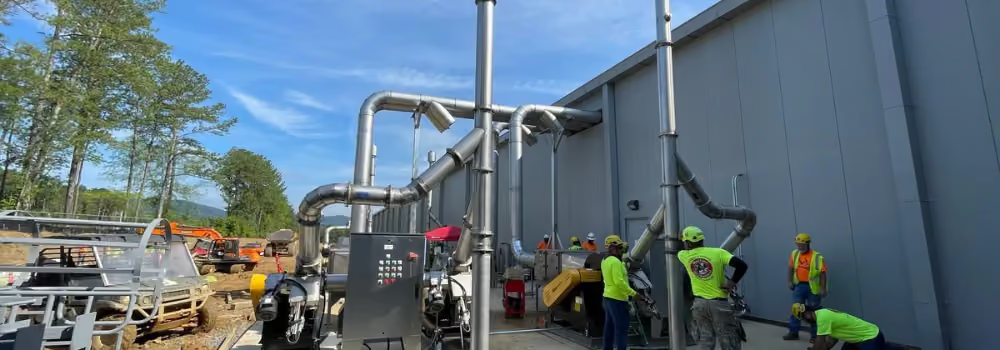




















%20-%20thumbnail.avif)

%20-%20thumbnail.avif)

%20-%20thumbnail.avif)


%20-%20thumbnail.avif)






.avif)