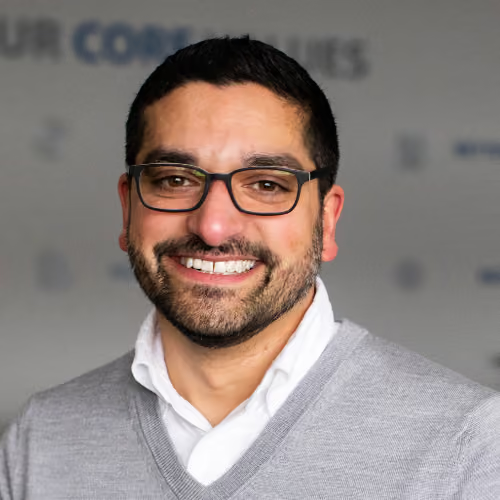
Host: Regular listeners of Acquiring Minds have heard interviews with searchers who layer their ETA journey with a philosophy or an approach. Recall Sarah Chiles and Matthew Ferguson of a few weeks ago who are using ETA to protect the local fabric of their native Aspen, Colorado. We called it a hometown Holdco Chase Murdoch in Salt Lake City is building a holdco of businesses based in the Salt Lake Metro and you've heard about entrepreneurs like John Mahoney who want to build a hold coat specifically for veterans to come be operators and equity holders. Then there's Chris Fredericks who has made employee ownership a key tenet of his Aesop Holdco. Well, today's guest is bringing impact to eta. Adam Rao comes from the world of B Corps and general benefit corporations GBCs and he saw buying a business as a novel approach to building double bottom line enterprise value. We unpack his vision here. It's a vision which is coming to fruition. Adam and his partner acquired a business that had flatlined due to Covid no revenue for 15 months when they bought it. In three years and with one bolt on acquisition they've grown revenue from $0 to over 6 million. Listen for how Adam thought about and protected his downside when taking a flyer on a zero revenue business. Here he is. Adam Rao, owner of Triple 20. Welcome to Acquiring Minds, a podcast about buying businesses. My name is Will Smith. Acquiring an existing business is an awesome opportunity for many entrepreneurs and on this podcast I talk to the people who do it. If you ask owners in the ETA and search community which insurance broker provides highest quality work, great outcomes and has a practice dedicated to searchers and acquisition entrepreneurs, one name comes up again and again. Oberle. Oberle Risk Strategies has worked with hundreds of searchers over nearly a decade and is in fact led by a two time successful searcher, August Felker, which makes Oberle, a specialty insurance brokerage for searchers by a former searcher and if you've got a business under loi, Oberle will provide complimentary due diligence on that business's insurance and benefits program. An easy no risk way to get to know August and the team at Oberle. To take advantage, check out oberly-risk.com that's O B E R L E- risk.com link in the notes Adam Rao welcome to Acquiring Minds.
[3:08] Guest: Thanks for having me.
Host: Adam, you are adding a new wrinkle to the entrepreneurship through acquisition model, that of impact and social good. Your first step there was buying an exhibit production company, so think booths at conferences. You did this while Covid was still Raging. Bold move. We'll get there, but start us off, please. Adam, with a bit of your background and how the idea of buying a business first came across your radar.
Guest: So I started my career in the nonprofit sector for a little over a decade. And I really loved the kind of impact work, community engagement that I was doing in that sector. But I really hated two things. One was kind of the two sided nature of nonprofit, where you're always kind of serving both the people that you're trying to serve as well as the donors who give. And then the governance model is just too slow for an entrepreneur like me. I like moving fast. I like being in control. Maybe not a surprise as a business owner. And so I really wanted to stay doing impact work, but I knew I needed to be kind of in the for profit world. And so I really found out about this idea of an impact company. Companies that are for profit entities measuring their financial performance, needing to make a profit, but also doing social and environmental good through their business. And that's sort of the field that I decided to go into. So after leaving the nonprofit sector, went back, got an mba. Few weeks prior to graduating with my mba, I sort of read the HBR articles on entrepreneurship through acquisition. Wasn't really familiar with it, wasn't taught at the school that I went to, and sort of put it on the shelf as this might be a good fit for me in the future. So went into banking for a few years, decided to leave towards the end of 2019 to start a search which started as self funded. We'll talk more about that, I'm sure. And then, yeah, two years later, ended up buying an exhibit company towards the end of 2021. Right. As you said. Right. As Covid was sort of. We thought. We thought maybe we were through it, and then it turned out we weren't. And so that. That's kind of the story of how I got here.
Host: Just to be more specific on the timing. You bought it Pre Omicron.
Guest: Pre omicron, that's right. September 30th of 2021. And Omicron started. Guess January, February of 2022. Yep.
Host: Yeah. Yeah. Adam, give us a primer on impact for profit impact. I could rattle. I mean, so to rattle off the phrases that I hear. B Corp. Esg. What's the other one? The G, C, B.
Guest: Right. Gbc.
Host: Gbc. Okay. B Corp. Is the one that I feel like I've heard the most, although I feel like I hear it less these days. Anyway, give us a lay of the land there.
[6:00] Guest: Yeah. Happy to do so. So, yeah, so again, an impact company is really in the title, right? It is a company. So it is a for profit entity corporation making money that is also focused on impact and takes both bottom lines into consideration. It's decision making. So that's really the key is that it's always a conversation, there's always a dialogue between are we making social and environmental impacts that are positive and good for the world as well as are we making financial returns for our shareholders? So it's multiple stakeholder capitalism. Right? That's kind of the basics. And then you're right. There are a number of kind of spaces in which certifications that define these companies. The two big ones are, as you mentioned, the gbc, which is a general benefit corporation. I think this is now available in at least half of the states here in the US and essentially this is a legal form. So it's essentially a C Corp, but has a benefit element to it. So you are required as the director of a GBC to take both social and environmental performance and your financial performance into consideration when making decisions. The other key piece is the B Corp certification. This is a third party certification. Think about LEED certification for buildings. It's somewhat similar to that. A third party called B Lab that started this out of Philadelphia really does kind of an audit of your business based on how you're treating your workers, your governance structure, your community engagement. You get a score on that assessment. And if you're above 80, then you get the B Corp certification. You recertify every three years. And essentially it's a stamp of approval saying you're doing business in a way that aligns with the movement's overall goals.
Host: And so is it one or the other? Or they could be both.
Guest: You can have both. And so really happy to note that when we actually did the acquisition at triple 20 or both of our acquisitions, you know, asset purchases under a corporation, the corporation is itself a benefit corporation in Minnesota. So we are a general benefit corporation, which means right in our bylaws, articles of incorporation, it says that we exist both as a for profit entity and to make social, environmental, community impacts. And I'm really pleased to announce as of just a couple of weeks ago, we just got our B Corp certification. So that is a third party stamp of approval that says we are in line with kind of the movement's goals and effort there. So you can think of some companies like Patagonia, Warby, Parker, Allbirds, these are all certified B corporations. I don't know about their legal forms, but they're all certified B corporations, so we're in that kind of space playing with those companies. Mm.
Host: Congratulations on the certificate.
Guest: Thank you. Thank you.
Host: And so, okay, so B Corp is third party certification that you're abiding by the. Whatever the. Not only the spirit, but the parameters of the certification. And then the gbc, the G stands for what?
Guest: General.
Host: General Benefit Corporation.
Guest: Correct.
Host: And that's an actual legal designation, Legal entities type.
Guest: That's. That's correct. It's a legal entity type. Yep.
Host: And certain states offer it, certain don't. So half and half, I think.
[9:04] Guest: Half and a half. Yep.
Host: And are there any. What are the legal implications of being a gbc?
Guest: Yeah, there's no. I mean, everyone asks this question. There's no tax benefit. There's no real differentiation. You can think of it as a C Corp with essentially an extra designation. Originally, the legal form was there for, you know, if we were, for example, publicly traded or if I wasn't the majority shareholder in this company, then, you know, my board or my shareholders can't essentially say, well, you chose to do something where we could have gotten X percent return, but you got less than X percent return because you were focused on social and environmental causes and not just maximizing shareholder value. It essentially protects the decision makers and sort of enforces that. You have to take both sides of the equation into consideration when you're making decisions.
Host: I see. And so when you talk about protecting the decision makers, it would be from. In a non GBC context, where shareholders could sue you for not upholding your fiduciary responsibilities because you willingly didn't maximize shareholder value because you had this other motivation as well, let's say protecting some environmental something.
Guest: So.
Host: Some social something.
Guest: Correct. That.
Host: That actually exposes you to being sued by your.
Guest: Correct. And it goes the opposite way as well. Right. If. If all you're trying to do is maximize financial return and you knowingly are not taking social, environmental considerations into, you know, your decision making, then yeah, you can be held accountable for that as well.
Host: Thank you. Returning to the plot, Adam, So you said that you read the HBR articles. Maybe you mean the book and then you put in it, but then put it on the shelf. Obviously you returned to it. So fill in the gap a little bit there. What happened to finally turn you into a searcher?
Guest: Yeah. Happy to share. So after business school, I went and worked at a small community bank here in the Minneapolis St. Paul area. Sunrise Banks. They are certified B Corp. They are a general benefit corporation. So I kind of landed in the space where I wanted to and really just took the opportunity to learn everything that I possibly could about what it meant to be an impact company, how those decisions were made. And during those years I was really fortunate to just meet with a bunch of people who are in the broader impact investing universe. So you had mentioned the ESG movement earlier. This is right, the movement to try and identify environmental, social, governance risks in publicly traded companies. There's a lot of activity there from impact investors. Not surprisingly, folks who want to put their money to work both generating financial return and social and environmental good in the world also get pitched on lot of startups, as you can imagine, folks that want to start businesses with this at the core of their being as well. And what I kept finding, especially here in the Midwest and in Minnesota in particular, is that both sort of felt either too risky or too distant for the investors that I was speaking with. The ESG movement sort of felt too far away, like we were trying to change capitalism at its core. It wasn't, you know, the store on the corner that you could point at or the bank that you happen to go to. Right, right. And on the flip side, startups of course are high risk endeavors. And so these are folks that aren't necessarily interested in kind of the venture capital space, but they would love to put their money into something that is a for profit entity, that is community oriented, socially and environmentally oriented, but there's not really opportunities. Most certified B corps are privately held. There's not open, you know, markets for their shares. And so a lot of this capital, I think just kind of gets stuck either going into the startup world of the venture capital or trying to kind of change capitalism, political movements, the ESG side. And so I really became intrigued by the possibility that there was a market gap here for impact investors. What if you could buy an existing business less risky than a startup, more local than the ESG movement, buy that business, convert it into an impact company, and then use Impact as part of its strategy for growth. And that's sort of how I began my searching path.
[13:07] Host: And so help me understand you. You were drawn to Impact personally because it, it speaks to you. So you, you wanted to be working in something that was having a positive impact on the world. But so that's your kind of, that's kind of your personal why. But I didn't, I missed this strategic, this other strategic bit about how it would have strategic value in the business itself to be impact oriented.
Guest: Yeah, great question. So obviously, yes, I mean, I, I think businesses should be impact Businesses because it's the right thing to do. I think that we should be, you know, called to do those things. But I think that there's a really important business and marketing element to it as well. Right. So my thesis going in was. Was really twofold. One, if you exist in a fragmented market where there's really low differentiation, being an impact company really just sets you apart. I don't know that anyone is necessarily going to buy from triple 20 specifically because we are an impact company, but our brand definitely is known in our market. Even though there's thousands of companies that build trade show exhibits for clients. Right. We compete against them all the time, but folks know who we are because of our impact commitments. This was true at Sunrise Banks as well. And I think it's true for other companies that are impact businesses. Within fragmented markets, you get a chance just to differentiate yourself and people know who you are. So there's a brand element to it. And then I think the second strategic importance is really around talent. You know, if you look at the number of surveys, there's just a recent one that came out again this week, I think that's showing, you know, folks would leave jobs if there was a business that they could go work to that better aligned with their values. Right. They would be willing to leave their existing job. They might even be willing to take less pay at a job where they could be at a business that aligns with their values. So I think that's going to be even truer as we move through generations. Right. I know as kind of an elder millennial, that was really important to our generation. I imagine that continuing to be important for generations to come, and that really allows us then to attract talent that our competitors can't get. We attract a lot of folks from outside of the trade show exhibit industry to our business. And I don't know about you, Will, but this was an industry I didn't even know existed until I got into the search space. Right. Which is where some of the best opportunities exist. But as you can imagine, unless you had a family member or you had heard about this industry through college or something, to that extent, you. You're not waking up one morning going, you know what I want to do with my life? I want to work at a trade show exhibit company. Right. That's just not really a thing. But I think there are people who are going, oh, this is an impact company. What do you do? And that's actually the way into being able to attract different talent.
[15:43] Host: And, and so the, then the intersection of ETA with impact is simply that it hasn't been an angle some someone or some entrepreneur has taken that you're
Guest: aware of, not that I'm aware of. And it's, it's a really good point because when you think about kind of the impact company movement. So going back to certified B corps for a second, right. The latest data that I have that I've heard from B Lab themselves is that 80% of certified B Corps do less than $2 million of revenue a year. So the vast majority of certified B corps are doing less than $2 million revenue a year, which means that they're relatively small. Which means that if you're an individual who wants to work at an impact company, jobs are really hard to come by. There's just not a lot of opportunity. There's just not enough size. There's not enough influence at the tables that really matter. And so by acquiring a business, we immediately catapulted ourselves into the top 20% of all certified B Corps in the world simply by doing more than $2 million of revenue. And I'd love to take credit for our revenue size, but in a lot of ways, at least half of what we've done was simply because we bought an existing business rather than starting from scratch. So I really see the possibilities of connecting ETA and the impact company movement as a way of accelerating the movement overall. And of course, you get all the benefits of eta, in theory, at least. More stability, an existing team, right. Existing revenue clients and all of that.
Host: Running payroll, paying your bills, closing your books and producing financials. These are critical tasks every business owner must do or oversee. But spending time on them distracts you from the leadership in growth work you want to do. So let system 6 do it for you. Owned and led by a former Searcher, Chris Williams, System 6 is a leading outsourced finance team for hundreds of SMBs, including over 50 searcher acquired businesses. Chris, Tim and the System 6 team understand firsthand the challenges, the opportunities of jumping into a business as its new owner. So whether you own your business already or have one under LOI, talk to System 6 about how they can give you time back and improve your financial operations. Mention acquiring minds and they'll provide a free review of your books and Financial Ops. A $500 value. Check out system6.com link in the show notes or email helloystem6.com okay Adam, so you. You begin your search. Are you only looking for GSB, GSBs or or B Corp sort of certified businesses when you embark on your search?
[18:34] Guest: Yeah, gbcs so yeah, you're good. There's a lot of acronyms in this world. There's a lot of acronyms in the world. No, so actually the opposite will. So I launched my search really with the mission to buy and build the Twin Cities next great impact company. That was kind of where I started and that's where we really landed. And so ultimately we were geographically focused on the twin Cities of Minneapolis, St. Paul. We have three really well known impact companies, at least to our region. And the goal was really could we buy and build the fourth well known impact company in the Twin Cities? And so we were geographically focused on the Twin Cities area. Industry agnostic. That's the kind of advice I, you know, I had met with 20 people who had done searches successfully, tried to get their advice of, you know, what, what do you look for, all of those kinds of things. And the advice that was given to me was, you know, either pick a geography or pick an industry. Right. You're always looking for the needle in the haystack. So you got to make sure that there's enough hay that there's a needle in it. Right. But too much so that you can't find it. And so we chose the geography and then we're industry agnostic.
Host: Excellent. So tell us about the mechanics of the search or tell us about the search process.
Guest: It's a good question. I wish I could say it was a very smooth, you know, normal search process. But like I said, I started in the fall of 2019. In case we forget, Covid hit in March of 2020. And so I searched by myself, self funded for about six months. Prior to COVID 19, I had looked at probably about 100 companies, all kinds of industries, and again, a lot of that. I like to say you always have a search thesis and an investment thesis until you start searching and then you realize, oh, there's something new here that I hadn't considered or what I thought I was going to look for. Maybe that's not exactly what I'm looking for. And so I had gathered some information and kind of refined my thesis over those six months. And then not surprisingly, when the pandemic hit, I sort of push pause on everything. And I was really fortunate to be self funded and be able to just sort of make that decision of too much uncertainty, not really sure where the money is going to come from. Don't really want to look at businesses during this time, Just kind of want to hunker down and figure out what this whole thing's going to look like. And during that time frame, you know, was doing sort of some contract work. Met my now business partner, Silas Morgan. He joined my search towards the end of 2020 and we really kind of relaunched with a little bit of investor funding in January of 2021. The search then really took off. Silas is just phenomenal at this stuff. He's just a go getter. We looked at almost a thousand companies in nine months and ultimately closed on this company, Showcraft, in September of 2021. That's a really, you know, short version of the story. There was a broken deal in there. You know, we looked at plumbing companies, we looked at all sorts of things. Happy to go into anything that you're more interested in.
[21:32] Host: Yeah. First, I recall from our pre call you saying, Adam, that one day you still will get your hands on a plumbing.
Guest: I. I'm hoping to. I'm hoping to. You know, I'm, I'm. I'm not a certified plumber, if you can believe it. So, you know, we're going to need to, we're going to need to find someone to run that. But no, I'm really intrigued by the industry. I don't know of a certified B corp in that space. So the idea of being able to buy and build, you know, the first or one of the first certified B corp plumbing companies is just sort of a unique angle I think would be a lot of fun to take up.
Host: And you mentioned meeting Silas. So you guys met and then in pretty short order decided to search?
Guest: That's correct, yes. Silas and I sort of circled each other's careers for almost a decade before I think we actually met in person and did a little bit of work together. I think he was looking for his next thing. I was, you know, kind of antsy to get going again once the pandemic. I mean, again, in hindsight, did it really calm down? I don't know, but it seemed to be at that time. And yeah, I knew I needed some help. I needed someone who had kind of the CRM, management, marketing, just pure sales funnel kind of skills that Silas brought to the table. He had turned around a couple of places by doing that kind of work and I knew that I could accelerate my search by bringing him on board. So went to some of the investors that had already said, yeah, when you find something, we'd be interested in bringing acquisition capital to the table, sort of pitch them on doing some search capital as well. Raised a little bit of money to be able to pay Silas. I still self funded myself. The goal was always to kind of be able to close with me owning 50.1% or more of the company because I'm a control freak, as I mentioned. And so, you know, we were able to sort of navigate that and pay for the search with some investor dollars as well.
Host: Oh, well, say more about that, Adam, because this was not a traditional search. So you weren't, you weren't subscribing to those very strict, well defined terms. It sounds like you propose something to investors. Give us more color there, please.
Guest: Yeah, for sure. I mean, I like to call it almost a hybrid. I mean, in some ways, you know, we raise search capital to pay kind of Silas salary for up to two years. Some deal in legal costs. I'm. I can't remember exactly how much, honestly. Well, I think we, I think we ended up using about 80, $85,000 of our search capital. Came with kind of the traditional 50% step up, step up, you know, so like use some of the, the pieces of the traditional search model. But it was really a hybrid in that it was just a small amount of money to pay for these particular expenses. I was still doing sweat equity for myself. And then really we had some leftover search capital which all of those investors elected to roll into the acquisition. I think we raised an additional maybe 75, $80,000 of acquisition capital to close. And so it was a pretty small fund. I mean, again, I think this is one of those things around ETA that's really beneficial, especially if you're willing to kind of do this sort of hybrid or kind of self funded model, especially in partnership with the SBA and local banks. You don't have to have a bunch of capital sitting around to be able to get into something if you're an entrepreneur. And that's really exciting. I think as part of the model
[24:43] Host: as well were these friends and family
Guest: investors, mostly MBA connections. So some professors. Right. Some folks I had met through that network and then impact investors that I had connected with during my time at Sunrise Banks. We have a group of seven total investors, as well as myself and Silas on the cap table.
Host: Okay. And you structured it such that at the end of it all, you personally were still going to be majority owner.
Guest: Correct?
Host: 0.1% at a minimum.
Guest: Yeah. So fortunately started, I think at that first started with something like 58% ownership. Right. I mean, and this is just financial modeling of our investors have put in so much. What percentage would they need to own to make the kind of return that we had, you know, talked with them about? And so we were able to kind of structure it that way, we did an add on acquisition in 2023, which I'm sure she'll chat about. And so that diluted me a bit, but I think I still own 53, 54% of the company.
Host: And how did you value their equity in their stake without having a target at the ready?
Guest: Yeah, so, I mean, we had sort of an IRR kind of target for our investors. And, you know, essentially it was really just say once we, once we were getting close to close, it was fairly straightforward to kind of build the model and say, okay, if our investors own 27% or 32% or 40% of the company, what do those returns look like? Sort of split it down the middle, give them kind of, you know, the base case where they're getting what we had discussed. You know, worst case, they're still doing okay, and best case, they're doing well, but they're still owning less than 50%. None of our investors wanted to be board members or, you know, taking on personal guarantees or anything to that extent. So we were really fortunate in that we have passive investors who believed in me, who were really interested in doing something new, that this whole buying and building impact companies, as you mentioned, is sort of a new idea. And so they were excited about that, more than willing to just kind of take the less than 50%, be passive investors like they are in other things. And so, so just sort of calculate it based that way.
Host: Great, thank you, Adam. Okay, so tell us about what you discover in Showcraft or how it comes across your. Your desk and then what it's all about.
Guest: Yeah, I love it. So, you know, in, in the search world, right, we talk about kind of direct sourcing, the cold calls. Right. Buying the data list. We also talk about broker sourcing. Right. And so, not surprisingly, we did a little bit of both in our search primarily, though, with brokers, you know, because we were looking in such a specific geographic area, you know, we just took everyone that we could out for lunch that was a business broker and just said, hey, we're looking for a company that sort of fits these kinds of parameters, fragmented industry. We're looking to use this SBA 7A loan. So that was going to limit our acquisition size to somewhere in that 4 to 5 million top range. Right. So, you know, there was some kind of basic guardrails around what we were looking for. And, you know, we had just had lunch with one of the business brokers in the Twin Cities. He told us he had a company that, you know, sort of met our profile. But Covid Devastated, wasn't sure we would be interested. We had lunch with the owners, they were looking to exit and we were really intrigued by it and so we had a few deals on the table. I'll never let Silas live this down. You know, we went out to lunch after we had met with the owners of Showcraft. We did kind of, you know, rock, paper scissors. Which one do you want to go after? I said Showcraft. He said a different one. I was right. Oh no, wait. Actually I think it was the opposite now that I'm talking about. Well, I'm so sorry it was the opposite. Silas said Showcraft, I said the other one. I think I was still right. But then we ended up going his his way after the broken deal situation. So, you know, showcraft Trade show exhibits pre2020 in the 4 to 5 million revenue range, high customer concentration, had done $0 of revenue for almost 15 consecutive months as a result of COVID would not recommend buying a business like this. But what I saw was the opportunity for the thesis that we had laid out. Highly fragmented market with thousands of companies doing very, very similar product and very old school industry centric talent pool. Not a lot of new talent and definitely not a lot of young talent. And so it seemed like maybe the perfect kind of playground to be able to test the thesis if we could sort of get in and make it work. And obviously with COVID everything was up in the air.
[29:17] Host: You were just going head on into an industry that had been devastated by Covid and with a target acquisition that had its own inherent weaknesses, namely the customer concentration. Help us understand more about how you, how you were able to get comfortable there. Because that's a ton of risk.
Guest: It was a ton of risk. So we did a couple of things to mitigate the risk. One, you know, the owners, like a lot of business owners, kind of understand cash in their bank account, don't really understand business valuation. They had started working with this business broker that made the introduction before COVID but never listed the business. So they had never really gotten a true sense of what the business was worth. Never really started that process. And I think you also have to understand like they were on, you know, probably late 60s to mid 70s, there were two owners and like the person going into their mid 70s, I think the alternative was walking away and closing down. Right. So anything was going to be better than zero and they wanted to be able to exit and see the thing potentially continue to go. At the same time, I think they knew because it had been almost 15 months without revenue Happening that there was no guarantee we would be able to take this over and it would survive. And so we were actually able to work out. I don't, I have never really heard of anyone else doing this, but I think it made sense in the situation we worked out 100% seller debt arrangement, essentially hand the company over to us. Here's the valuation that we'll give you and we'll start with making kind of, you know, principal and interest payments and kind of figure it out from there. I think we even structured those initial payments as interest only for up to three years. Right. Just as a. We don't know where this is going to go. So the agreement has to be that we're going to do this in a fairly risk free way to me personally. And we see what happens. Right. In exchange for that, we did sort of the unusual thing of letting them walk away, you know, cash free, debt free, but also sort of working capital free. And so we then put in a little bit of investor capital and a bank line of credit to kind of manage the working capital situation. But the actual acquisition was done entirely in seller debt up front, which that pretty much mitigated the personal financial risk from my point of view. And as an entrepreneur, it was, let's give this a shot. My instinct was we had a 50, 50 chance of it working and the market was going to control the 50% chance of it not working. And if so, we would just kind of have to move on with our lives. But it's seemed like it was worth the risk.
[31:51] Host: And so to be clear, Adam, this seller note was not personally guaranteed.
Guest: Seller note was not personally guaranteed. It was, you know, kind of as much of a handshake deal as you can get on paper.
Host: Okay, so, so just to, to recap, this business had been a healthy business, Covid absolutely obliterates it. It is literally generated zero revenue in 15 months. The exiting or the, the owners are in their late 60s. They're. They're not gonna, likely not gonna resurrect this on their own. They're all but shutting it down anyway. So they offer 100% seller finance deal to you guys, non personally financed with the hope that maybe you can do something with it. And then whatever sale price, you're gonna tell us what that is, whatever sale price they negotiated, they get. Otherwise you guys, they are likely to unlikely to resurrect it. You guys tried and were unable to. And, and then they don't get there. They don't get any exit, exit value. And when you said they could it was working capital free. That means there was some working capital in the account that you let them walk away with, correct? Well, really interesting. Yeah. So we, we, you know, we do hear about 100% seller financing and we hear about it as something to never ever think you're going to get. But I guess when you buy a business with higher customer concentration, zero revenue in 15 months and just, you know, the kind of the top of the heap of what would be affected by Covid, you can command such terms. And so what was that purchase price?
[33:27] Guest: Yeah, so we purchased, we purchased showcraft for 1.2 million. It was based on essentially just did kind of a three year and five year rolling average of EBITDA that included Covid. And so, you know, I think in hindsight it was probably about a 350, 400k EBITDA business when you kind of, you know, looked at it in the rolling average. And so we landed it for, yeah, probably somewhere between 3, 3 and a half x EBITDA seemed again like a pretty fair valuation over some time. The sellers wanted to get out of that note and so we were able to refinance that using an SBA loan and we actually brought the valuation down to 780,000, which they agreed to. And so, you know, ultimately we bought the business for $780,000 plus whatever the interest was on 1.2 million for a couple of years. And you know, again, in hindsight, when you considered the losses due to Covid and all of that, that ended up being a very fair valuation and give them a lot of credit for sort of, of recognizing that and being willing to negotiate down on that.
Host: I'm going to want to return to that. That's interesting. But when you talk about the rolling average of EBITDA and you talk about including the year where they generated no revenue.
Guest: Yeah.
Host: So that 350 to 400 dish ste number was not what it was making in high performing years. It was making even more than that. And then you averaged in some zero years. Correct. In other words, what is it? What was the business at it when it's functioning well, how much SE was it generating?
Guest: Yeah, so at its peak 2019, it was about 4.9 million in revenue and I would say maybe 3.75k EBITDA. So if we're going to put it in SD terms, it was probably close to about 550sd. So when I say that we included some zero years, that's partially true in that essentially the rolling average, this was fall of 2021. So we were including 2020 in the mix. Right. And so there was almost $2 million of revenue that they had done in the first quarter of 2020 pre Covid, but of course, you know, negative EBITDA for the full year. So the zero revenue was really from essentially like April of 2020 through September 2021 1. But there was some revenue in 2020. There was, you know, negative earnings, but there was. There was some full financials for that calendar year that we included in that rolling average. That, of course, brought the EBITDA down. But it was kind of our best way of sort of spitballing what we thought the business was worth as a result. And coming out of COVID you know, that, that moment, anyone who was buying businesses in 2021, 2022, it was just so hard to do valuation. You know, we looked at a lot of companies that I felt like were extremely overvalued because they did so well during COVID and everything was trying to get out. That actually felt far riskier to me than a business that had done almost nothing during COVID because, you know, you're paying potentially a fair value and maybe you're getting actually a deal. There's risk that comes no matter which way you go. But, you know, this was again, 100% seller finance. I wasn't on the hook for the loan at first, and I don't think it was overvalued by any stretch. So then it became just an entrepreneurial project to try and resurrect it, bring it back and see what we could do.
[36:53] Host: Yeah, that's really well put, Adam, that the business is thriving during COVID almost or not. Almost certainly felt more. More risk on than. Than a business where you knew what a black swan would do to this business because it was doing it. And then you structure. You try to structure your way, your risk out of the equation, which you did very well.
Guest: Exactly.
Host: Now, but just to call out, wow, a 4.9. Call it a $5 million business from 5 million bucks a year to flat zero.
Guest: Yeah.
Host: How heartbreaking.
Guest: Yeah, heartbreaking.
Host: What do the following Acquiring Minds guests all have in common? Doug Johns, Morley Desai, Tim Erickson, Chirag Shaw, Shane Ursum. They all went through the Acquisition Lab, the accelerator in community for people serious about buying a business. But they represent just a sliver of the lab's success stories. The number of deals across the lab's cohorts now stands at over 120, with over $300 million in aggregate transaction value. The Acquisition Lab was founded by Walker Deibel, author of Buy, then build the book that introduced so many of you to the very idea of buying a business. The Lab offers a month long, intensive, almost daily Q and A sessions with advisors, live deal reviews with Walker, Deal team introductions and an active community of serious searchers. Check out acquisitionlab.com, link in the notes or email the Lab's co founder, Chelsea Wood. Chelsea buythenbuild.com you and Silas get into the business. What do you find? What do you see? What do you do?
Guest: Great questions. So we get into the business and I like to tell this story because I think it sort of gives you a sense of what we were walking into. So you have to understand we closed September 30th of 2021. So the business had done $0 of revenue up until essentially we had signed the documents and we were going through the closing process. About six weeks prior to close, the owners brought back some of the team from furlough, so they began operating the business again. I don't remember the exact date, but somewhere in kind of that late summer, early fall before we had closed, they brought the team back to get it operating again. And, you know, this was probably at its height, maybe 14, 15 people, and they brought seven or eight back. So much smaller team. These were folks who hadn't worked over those 15 months because they had all been furloughed. This was all, you know, PPP loans, all of that. So you can just imagine that it was a lot of rust, a lot of confusion, a lot of uncertainty. And then six weeks after these folks had started their jobs again, their company gets bought by someone else and they now have new owners and new bosses. It's a very difficult transition. And in hindsight, that was probably the biggest risk that we just didn't think about in full was just how difficult that would be on the people. And at the same time, I don't know that there was any other way to do it. Right. I mean, this is just going to be the way it kind of works
[40:14] Host: was so the Adam, wouldn't they have been happy to just get back to gainful employment?
Guest: One would think. I do think, you know, we, we inherited some very difficult people. Will. I'm just going to be really honest about it. We inherited some folks that I would just not consider good human beings. And I think folks that, you know, had gotten used to not working for 15 months. I'm going to put it that way again. I want to give, you know, as much empathy as I can to other human beings. That was a difficult time for all of us. And I think getting back into a groove was going to be challenging no matter what. But I think there was a lot of pent up anger. A lot of just, yeah, uncertainty and confusion and, yeah, I think anger that really came out at Silas and me as soon as we bought the company. And the biggest thing that I, that I remember from that, like first week was overhearing a phone call from one of our project managers, desk across from me across the hall. And it was a potential sale on the phone. And I just hear, mm, mm. Well, you're telling me you don't even know what size booth you want? Call me back when you do lick. And I remember, I remember thinking to myself, you know, there's a lot I don't know about the industry. There's a lot I don't know about this business, but I do know that that's really bad. And I just sort of had this sense of, we are going to have to rebuild this thing not just in terms of revenue and clients, but we're gonna have to rebuild it in terms of attitude, mentality and customer centricity. Right. We're gonna have to rebuild this around creating value, getting to know our customers, really identifying pain points, all the things that entrepreneurs do really well. But when you buy an existing business, you hope someone has done at least a little bit of that work. But in a lot of ways, it was like starting from scratch. And the reason I tell that story is because I think it was both really, really bad, but also really, really good. You know, if you talk to folks who have bought businesses, as you've talked to hundreds of them, right, There are folks that get in and it's really difficult to make any changes. It's really difficult to actually make it your own. It's really difficult to do new things because the business is operating well and you don't want to kind of break what's working. In our instance, we sort of had the flip side, like I knew going in that what was being done wasn't good. And within those first three months, we faced a hurricane hitting New Orleans and canceling a show. And then as you mentioned, kind of the on Omicron variant at the beginning of 2022. And so all of our expectations, anything we had hoped for, got thrown out the window very, very quickly and meant we had to move really fast to turn over the team, bring in new people, try new strategies right away. And that was really painful. But it also meant that we got to put our stamp on the business pretty much right. Away and start figuring out what could work as long as we could keep this thing afloat and alive long enough to make it work.
[43:20] Host: Yeah. Yeah. The other thing about having a bad culture, which I gather was sort of endemic. It wasn't just this one individual.
Guest: Correct.
Host: Yeah. Is now not to. Not to minimize it, because turning over everybody or a lot of the people is. Is excruciating and. And certainly does cost months of time and. And just general pain, as you've said, but it is the ultimate lever. So it's, you know, in eta kind of one framework is if a business is. Is doing well in spite of itself, in spite of not having a CRM or doing any marketing or whatever it might be, it. It says something about the prospects of that business and. And the demand for its services and. And. And culture is the biggest of all. So if. If this company could do $5 million a year with basically bad culture, imagine what it could do with good culture. Correct. So. So in some ways you're like, damn, this is going to be painful. On the other hand, it's like, wow, all of a sudden, the ceiling, the potential to this business feels a lot higher than it. That it might have otherwise. Because imagine what we. We can do with this place if. If everybody's a good person.
Guest: That's exactly right. And imagine if we can reduce that customer concentration and imagine if we can actually get a differentiated position in our market. That's exactly right. And so the opportunity was there from the start. And, you know, again, good business partnerships are just a gift. Right. Silas is the pessimist. Between us, he's always going to see the dark clouds on the horizon. Right. And I'm going to see the spring flowers on the other side of the rain. And so, you know, we. We just kind of kept each other sane, I think, because, yeah, we were losing money hand over fist. Not going to lie. Like, I mean, we were losing clients, we were losing revenue, because again, Hurricane Omicron, it was a mess. I mean, it was just a mess. Mess for the first nine months in particular. And that opportunity was just there. And it was just so clear that if we could find a way to keep going, we would probably be able to find our way into some level of success over time.
[45:21] Host: But, Adam, wait. But let's. Let's get into the numbers in the market here. So it's still, you know, now we're on the other side of Omicron, but it's still in year two of. Of. Of COVID Yep. And the conference remind us the conference Industry does come back. So there is now revenue to be had.
Guest: There is, there is. So, you know, we started Q4 of 2021. We were hoping Q4 would be about a million dollars. So essentially, again, how do you do revenue projections when a business has done $0 of revenue in a global pandemic has completely decimated your industry? No idea. You know, we kind of stuck our finger in the wind and said, listen, if it did $5 million in 2019, maybe it would do about 80% of that if things were back. Right. And so we were hoping to do about a million dollars of revenue in Q4. We ended up doing a little bit less than 500,000. I mean, it was just a brutal start. And then.
Host: Hold on. Yeah, okay, it's brutal. And that you don't meet your expectations. But your, your, your goals, but you're trying, you think, or you're hoping to go from zero to a million dollars in a, in a single quarter. I mean, yes, this business has client relationships, yes, it's an existing business, et cetera, et cetera, but from zero to a million in a quarter, I mean, that was pretty. And the fact that you got to 500,000 so you generated $500,000 in revenue in a single quarter.
Guest: Yes. I mean, we're ambitious. I don't know that we're intelligent, but we're ambitious. So, yeah, I mean, yeah, we went from 0 to 500,000. And then going into 2022, we essentially tried to peg about a 4 million dollar year with Omicron, with, with everything that we went through in 2022, we still did about $3.8 million of revenue. So the business did come back at about three quarters of what it was in 2019. Some of that, a lot of that was new business. Conferences and shows did come back, but it was very hit or miss. We had, you know, multiple cancellations. But then, yeah, there were a lot of folks that were really eager to get back to face to face to your point about kind of, you know, business doing well in spite of itself. This was kind of my first instinct that that was probably the case and that the demand was there. Right. I mean, everyone during COVID was saying, we can do conferences and we can do trade shows via Zoom or virtually. Right. Or eventually VR will replace this. And I think people saw their revenue numbers decline. I think they saw those customer relationships decline. People were eager to get back. The industry has still not really fully recovered. You know, if you look at the data from our industry groups, it's probably back to about 90% of what it was pre Covid in terms of attendance and those kinds of things. So there has been some loss. But I do think that broadly speaking, face to face connection really matters. And again, as you well know, when there's a deep human need like that, yeah, things are going to come back and you're going to have to find a way to just kind of keep going long enough to. For that to work. And that's what we kept doing.
[48:25] Host: Yeah. Well, Adam, now I got to press you on the fact that you were so successful generating so much revenue, I know didn't meet your goals, but still in a single quarter. And I heard you say that that was new revenue, so I would have guessed you were just calling all the new. All the existing clients and saying, hey, we're the new owners. We're eager to work for you. You probably did do that, but it sounds like you. This was all new revenue. So at some point, despite how what a solid price and how well you structured this deal, did you ask yourselves, man, we should have just started this thing from scratch? And because you weren't holding on to the people. Yes, the people weren't. Many of the people had to go anyway. So you and Silas were the business.
Guest: I definitely thought that many times. Well, I will say this is one of those businesses that I can't imagine getting into from scratch. Right. Because even though the physical assets aren't significant, like massively significant, we still probably had $2 million of aluminum framing systems that we got as part of the purchase price. Right. Mostly depreciate it, because it depreciates fairly quickly, all of that, but still usable. And so when you think about actually trying to enter as a new entrant, I think it would've been very difficult just personally from a financial standpoint to be able to buy that level of inventory, all of those kinds of things. And yes, I mean, I think it's important to note we did have some existing revenue. Right. I mean, of that 3.8, I'm sure two. Two and a half of that was from previous clients. You know, calling those kinds of things. Not a lot. Right? Not as much as you might hope, but yeah, Certainly more than 50% of our revenue in that first year was from existing clients. Again, the ETA model works in some ways because of those stable points. Right. And that is, you know, we. We benefited from that as well. Just not as much as we might have hoped.
Host: Yeah, I said I wanted to return to your refinancing the loan, and in so doing, you Know, renegotiating the price was that also, this feels like the right moment to bring that in. You were able to convincingly renegotiate that down because so much of the value that you brought, you could demonstrate was from new business and had to let go of so much of the existing team and basically said, hey, the essence of what was there was Frankly not worth 1.2. It was worth more like, what did you say, 750, 787.
Guest: 87.
Host: 80.
Guest: Yeah. So let's go chronologically, if that's okay. So, you know, so we close on Showcraft September of 2021. It's now summer of 2022. Okay. So we're about halfway through the year for nine months. I mean, just got to be honest again, we've been bleeding cash. I mean, we've just been bleeding cash. We're keeping afloat. I have to be honest with you, like, as an entrepreneur, one of the reasons I took a flyer on the business was I sort of figured, I will, I will be able to know whether we are going to make it or not. Within about 90 days and nine months later, I still had no idea. But it certainly didn't feel like we were making it right. I mean, we were, we were losing, we were losing, we were losing. But there was just a little bit of a glimmer in the numbers where we were starting, just starting to see us turning it around. But I didn't think we had enough time. I just didn't think we had enough time to kind of survive that turnaround. It was in that moment in July of 2022 that a couple of my business school classmates reached out to me. Hadn't spoken to them in five years. Right. But this is the beauty of business school networks reach out to me. They say, hey, we're looking for a business to buy. This one doesn't fit us. But it's a trade show exhibit company. We saw on LinkedIn that you bought one of these. We're wondering if you're interested. And I remember going home that night. You got to remember, at this moment, it's still just seller debt. I'm only personally guaranteeing maybe like a half million dollar line of credit. So my risk is still pretty low. And I think to myself, I either need to get out of this thing or I need to double and triple down on it. And for whatever reason, I decided to take this meeting with this owner of this other trade show exhibit company called Display Arts. And so I have coffee with Tom, who's the owner of Display Arts. And I immediately fall in love with the business. And I'll never forget going to Silas and being like, so you know how we bought one of these and it hasn't gone so well. What do you think about doing another one? And we kind of wrapped our head around it and we started working the deal and we actually did the add on of Display Arts in January of 2023. And so by the end of 2022 we had started to see Showcraft turn around because of our kind of strategy, our ability to reduce the cost structure, our ability to sort of wrap our hands around the business. And then we added Display Arts. And what's important about Display Arts was very similarly absolutely devastated by COVID 19. But they had come back starting in, you know, 2021, 2022, and by the time we acquired them In January of 23, they had had a full year of business under their belt in 2022. Right. And so there were clean financials to look at. We sort of knew what the customers looked like, we sort of knew what revenue level to expect. And that add on really then allowed us to accelerate our survival and start getting a little bit of stability. So to, to now come back around. When we did that acquisition of Display, we used an SBA 7A loan. So this was the first time I had taken on a personal guarantee for the acquisition loan. At that same time we started then talking with the sellers of Showcraft because we had to essentially put their seller debt below the bank note. Right. So we had to subordinate it. So that started those conversations of how are we going to get you out of this seller note? What's that going to look like? And the idea was, you know, let's complete this acquisition, let's do the merger over that summer, and then let's go back to the bank and see about buying out that note with another SBA loan. And so over the course of 2023, we acquired display Arcs with an SBA loan. We actually refinanced and termed out some of the losses that we had carried on that line of credit. And so that became sort of a Now a new 10 year loan that we were able to sort of spread out, covering that. And then towards the end of 2023, I think maybe even officially early 2024, we negotiated with the sellers. They had actually come to us being willing to take the 40% haircut. Again, I think they were looking to get out of the note that probably met their retirement needs, you know, those kinds of things. And so we actually just restructured that Paid them out, the. What did I say? 780, I think, and then put that as an SBA loan as well. So we sort of restructured the whole debt that we were carrying from the losses. The new acquisition and the original seller note put it all under, you know, three different SBA loans. One big loan, really. And now we've got that termed out and now we're, you know, kind of in business.
[55:33] Host: Fantastic. And on the SBA loan used to acquire Display Arts, was that one where you needed to bring equity or could you do 100%? Because it was the same NAICS code.
Guest: So we did have to bring equity. We did raise a little bit of additional capital from our investors and we also put some company cash into the deal. So I think we did it as a 1090, I mean, essentially 10% down with 90% of the acquisition price as an SBA loan.
Host: And is there any reason. Were you aware that you could do that or did the bank. Did you try to do that, go 100 financed with it?
Guest: Yeah, no, I mean, you know, we have, we had a great bank partner that those NBA classmates brought to, to us for this, for the deal and, you know, just kind of working it out with them. It was kind of, hey, we want to, we want to, you know, term out this line of credit. We want to do this acquisition. We want to get out of the seller debt. I think, I think we probably could have done any one of those maybe with nothing down. But I think as we were Talking about the four full amount, they were looking for kind of the 10% down, they knew that that would speed up the SBA process too. Right. And, you know, kind of assure that we could get the deal done. So again, I think we raised an additional 65,000 from our investors to do the acquisition. It was a 750k purchase price. And then, you know, we were able to use company cash essentially for the other two loans to be able to kind of term those out. Great.
Host: And it was a $750,000 acquisition for design Arts.
Guest: For Display Arts, that's correct.
Host: Yep, for Display Arts. And can you tell us a little bit more about Display Arts, kind of the bullet points of that business?
[57:04] Guest: I sure can. So, yeah, Display Arts was, you know, is trade show exhibit company as well, but a lot more custom work rather than rental. So Showcraft sort of had this middle market kind of approach. Display Arts still a little bit on the higher end of the market, but really, you know, about a two to two and a half million dollar revenue business pretty consistently about a three to 400k EBIT of business pretty consistently. And the owner was looking to exit, didn't want to go the broker route, had a price in mind. So again, I think when you look at it, we ended up getting it at about 2x, maybe a little over 2x EBITDA, which is a pretty good deal. But again, Covid had devastated. Right. I mean all these kinds of things. So valuations are kind of tricky in this world. Uh, but yeah, we, you know, we got into the business again. It performed fairly well for us in 2023 and then we merged the companies that summer and off to the races after that.
Host: You had mentioned, Adam, that you had really started to by, by the time Display Arts came around, you had really started to do good things and turn around the original business, get costs under control and so on. Anything to share there, that's that. Are any learnings there or is it just two in the weeds too particular to that business?
Guest: I can, I can tell you one, one was we, we inherited a 36,000 square foot space that we needed probably about 18,000 square feet of. And so trying to sublease that, you know, eventually just had to negotiate our way out of that lease. That was the biggest thing that was just killing us from a cost structure standpoint. So part of what really worked well when we did the Display Arts acquisition was the building that I'm now in was the Display Arts headquarters. And we were able to move everything in, centralize it here. Right. So essentially we were able to take two businesses worth of revenue and put it under one roof, which helped, of course, immensely. Right. And so that sort of mini roll up really allowed us to kind of continue all that work that we were doing to get the cost structure under control and kind of grow it from there.
Host: And anything more to say about the culture change or the turnover of most people, it was, it was working. We presume it worked.
Guest: Yeah, we, we ultimately ended up with zero of the original people from Showcraft. After a year, we ended up keeping. And most of the folks from Display Art some stayed. And we still have three folks from the Display Arts team, again, a team of about six or seven. So about half of that team has stayed with us even to today. So again, so much around people that we could talk about and that I think we should talk about in ETA more often. It's the one thing during diligence you can't really know. Right. I mean, you can't really know the character of people. You know, you can talk about performance, you can Talk about compensation. But you know, the character of people, their openness to change, their willingness to be led and coached, that's everything in terms of whether someone's going to kind of make it through an entrepreneurial transition like what we went through.
[1:00:20] Host: Yeah. And you, we, we kind of assume that with Display Arts the folks are good people.
Guest: You're everyone on that team. Very, very good people. Truly almost night and day, I mean, it really was almost night and day. In hindsight, you can almost scarce believe it, you know, but yeah, great people, people who had been there for decades. Right. Folks, folks, retired folks, have left us. Right. I mean, you know, anytime you have a transition like this, it might be the first time in 10 years someone has wondered, huh, maybe I should think about doing something else. But yeah, great people really, really appreciate all the ways that the Display Arts team made that transition, as smooth as it was, was, and all of the ways that that's contributed to our success since.
Host: And, and just going to your point of how difficult it is to diligence culture or people as a group or individually ahead of time, here you have this, this great, almost apples to apples comparison to, well, I, I, I guess, I guess Showcraft was a bigger business. It was twice the revenue of Display Arts, but roughly similar in size or similar in field businesses. One with great culture, one with, with frankly bad culture. And as you look in hindsight about how you, how you perceive this, these businesses from the outside entertaining them as acquisition targets, there was no way to discern that.
Guest: I would say that had, had Showcraft been operating rather than essentially shut down prior to us buying it, I think I would have been able to discern it better. Part of the challenge there was, you know, we really only got to know the owners and the team only came back about six weeks prior to close, like I mentioned. Right.
Host: So it's an exceptional moment.
Guest: Yeah. And so, I mean, you know, the owners can tell you about their team, but they're telling you about their team a year and a half ago. Right. And so, I mean, you didn't know how Covid had changed folks. You didn't know how they would come back. Like, there was just no way to know that. Whereas when we acquired Display Arts, these folks, some had been furloughed during COVID come back and have been working in the business for a full year, essentially. And so, you know, even the kind of qualitative assessment from the owner, I think you can just take a little bit more seriously when they've been working together. Sure. Day for day over the last year as compared to. I haven't even seen that person in 18 months. You know, I just, I don't think it's. It wasn't really fair to the owners of Showcraft to, you know, try and even tell us who their team was because it had been a year and a half since they had interacted with them, let alone us.
Host: Yeah, yeah. And we, we all of us were quite, quite different from March 20th to March 2021.
[1:03:03] Guest: Absolutely.
Host: We all went through our own personal little evolutions. Is there anything to any learning from having to turn over the entire team? Should, as you reflect, should you have done it more quickly, more decisively? Did you do it at the right speed? Anything you did right or wrong that jumps out?
Guest: I don't know that we did anything right or wrong. But the learning, I think the learning would be if you have any sense that you might have to do it for whatever reason, culture, financial performance, if you're walking into a turnaround, I think more industry experience would have really benefited us because we just didn't even know where to recruit. Right. I mean, so I think there's that piece of. When you, when you have to turn something around and you need to replace people, you got to know how to find people before, you know, you can let them go. So we sort of had to stick ourselves with folks much longer than I think we would have preferred, but we just didn't have a choice.
Host: Right.
Guest: So I think lesson, lesson one was maybe broader, which is if you're walking into a turnaround, I think they can be great opportunities, but you should probably know how you're going to hire all of the replacements going in and where you're going to look for them before going in. On a personal level, I think the thing I learned was just size, like Silas and I are just not built to lead a team of seven people. We are much better at our 20 plus people that we have now, simply because that's the kind of leaders and managers we are. And so part of our challenge as we were turning those teams over was, okay, we could let the production guy go, but that means one of us is going to have to go do production and neither of us can do production, so we probably can't do that yet. Right. Whereas, you know, now we're at the point where it's like, okay, I could do the accounting function for six months if I had to. Right. Or, yeah, Silas could run sales for six months if we had. Right. We're just at a point where we have some more general Roles where we could bring in more generalists and be able to cover in different ways. And frankly, again, when you're just letting three or four people out of 22 go or something, that's really different than letting three or four people out of seven go. It's just a very, very different experience.
Host: Yeah. And I, this, I'm glad you brought that up, Adam. I was going to because it struck me on our pre. Call this, this kind of buyer. We talk about business buyer fit. This is sort of headcount buyer fit. And I've never. We often talk about headcount as being just a feature of the business and frankly, the larger the head count often maybe. I mean, you want to see in theory, in kind of business theory, less headcount and more revenue, better that ratio. But in fact, I guess there's a limit there because you don't want too small a business. You, in your, in your personal style, don't want too small a business headcount wise, no matter the revenue, because it, there's just something that doesn't fit with your leadership style there. Is that right? Or, or is what you were saying just now simply like if there's only seven people and one person leaves, there goes, you know, there goes a seventh of, of. Of your organization. Is it, is it that. Because that, that is a classic argument or is a little both?
[1:06:24] Guest: I, I think it's a little bit of both. I mean, there's certainly just, you know, one out of seven from a percentage standpoint makes it much more difficult. Right. For, for that loss to happen. But I do think that there's just something about, you know, I'm, I'm an, I'm an entrepreneur. We move fast, we move, you know, in values, align ways. But we're always seeking growth, we're always going to make change, we're always open to new ideas, all of those kinds of things. Which means we, we do have turnover. I mean, we are going to have folks who just aren't going to be a good fit for that, especially in smaller companies. Right. And so I do think there's just something about. Yeah. When, at least for me, when we're in that 20 to 25 range, it just makes that different. I can push and be much more entrepreneurial without as much fear or concern that we are pushing too fast or we're losing too many or whatever the case is. And I think there's also just sort of, again, in a culture change perspective in particular, you know, it's kind of that old adage or just Lesson, you got to kind of get 50% of the right people in the right seats and then things start to move in the right direction. Right. And so again, when you've got 20, 25 people, you need a core of 10 to 15, and then you're sort of going to be able to work with the rest. When you've got seven to 10, a core of five isn't really going to just move the needle quite as well. Right. It's just not enough, I think, to move the needle, the needle.
Host: So there's a critical mass of culture that, that only a certain number of
Guest: heads can, can, can, can actualize 100%. And again, I think it really does depend on the leader for me. Right. I mean, again, I don't think this will surprise you. I mean, you can even just look at me. I'm a total nerd, right? Like I, I couldn't build things with my hands if I tried, like, I'd lose an arm. It's a bad idea, right. But I'm really good, I'm really good at casting, vision, inspiring people, strategy, finance. Like, those are the things I'm doing good at. And I think a lot of people get into ETA being good at those things. But then you go into companies where, you know, the owners have been really involved not just in accounting or sales, but potentially physical labor, building things. Right. Like managing client relationships. All of those things that are very difficult to replace, whether an owner realizes that or not and make it very, very difficult to bring someone else in. Right. And so there are people, I think, who go into ETA and very rightfully they want more hands on, right. Like they like that smaller size, they want to be more hands on, they want to be more engaged in the day to day. I think for me personally, I'm still a very visionary and strategic leader. I don't want to be involved in the day to day. It's best when I'm not involved in the day to day. And so that just requires a little bit larger team size, a little bit larger company for that to work.
[1:09:15] Host: And would you say the same about Silas, that it was also not his ideal size?
Guest: I think so, yeah. Silas, I mean, so we run the entrepreneurial operating system in our company. Like I'm the visionary. Silas is an integrator. He's very, very good at leading a management team, leading a leadership team, being the leader of leaders. But, you know, we've had to play Silas in a lot of functional leadership roles as we sort of grew the company. Now, I think with 20 to 25, folks. Again, he's much more in his sweet spot, even if we're not entirely there yet. I think both of us have been able to kind of elevate ourselves where we're just better as leaders now than we ever were in the smaller team size.
Host: Great. Adam, well, so take us to where you are today. Can you give us the bullet points of business size and other metrics today? And then we'll wrap up with just kind of like longer term vision.
Guest: Great. Yeah. So back to the chronology a bit. Summer of 2023, we actually merged Display Arts and Showcraft together. We bring everyone under one building. We're now one team, one business, one vision. As a company. That, of course, meant we needed a new name, we needed a new brand for this merge company. So Showcraft and Display arts. In early 2024, four became Triple 20. Triple 20 is the spot on the dartboard that is actually worth more points than the bullseye. It's the hardest spot to hit. It requires more precision. If you're not a darts player. I am not a darts player. You aim for the bullseye because you're most likely to hit something and not, you know, end up with someone's eye being poked out by the darts or whatever. It's actually the easy play. It's where the amateur aim. The Triple 20 is where the pros aim. Right. It requires a little bit more risk, and it requires a lot more precision. And so for us, we've really built.
Host: Sorry to take away to derail your metaphor here, but which one is it on the dartboard? Is it the far edge? Is it the.
Guest: It's.
Host: It's so the circle around the bullseye.
Guest: It's actually the spot just above the bullseye. So it's the. Yeah, it's the triple of the 20 that's just above the bullseye. Okay. And so, you know, you got to watch a darts video at some point. It's a huge deal when people hit the triple 23 times in a row. Like, everyone screams and cheers. Right? It's. It's very, very exciting. But the analogy really is, you know, everything that we do is about precision world building. So we really see ourselves as building these kind of mini, temporary worlds that people are stepping into to learn about a product or brand. And for us, like, the precision, the cleanliness, the hospitality of that space really matters. Again, there are thousands of companies that can build you a trade show booth. We really pride ourselves on building a mini world for your customers to step into and hear more about your brand or Your product. And so for us, that precision piece was really key, but it also captures, I think, a little bit of our entrepreneurial spirit, a little bit of that risk taking, a little bit of, you know, kind of we want to win, we don't want to just, you know, score points. And so for us, it's become a great brand that we've sort of been able to build everything around. Clients have responded well to it. The team, of course, has responded really well to it. And it's, it's allowed us to just sort of differentiate in the space as being kind of, you know, new and fresh and different and obviously thinking in more innovative ways. So, yeah, I love it.
[1:12:37] Host: A great brand. I love it.
Guest: Thank you. Thank you. Yeah, so that was early 2024. So our first full year's triple 20 really was last year, 2024. So to give you a sense, in 2022 as ShowCraft only, we did 3.8 in revenue in 2023, essentially as ShowCraft and display arts together. Trying to remember exactly. I think we did a little over five million, maybe close to five and a half. But it was still kind of a loss here. We were still getting out of leases. You know, I mean, there's all of that. Last year we had a great year. We did $6.4 million on the $6 million goal. We ended up with about $700,000 EBITDA, which was well above our goal. Our margins are really healthy this year. We're off to a phenomenal start. Our first six months are looking really, really good. I think we're actually going to end up ahead of where we were last year at the six month mark. As you can imagine, the back half is still sort of an open question. Tariffs and uncertainty means that, you know, our clients are not quite ready to determine exactly how much they're going to spend in the back half of the year. We've been hit by some of the administration's changes on DEI policies because we were working with some clients specifically in that area who of course now are no longer doing that work. And so, you know, it's going to be a challenging back half of the year, but we're off to a great start. I'm still really optimistic that we're going to be close to our goals, if not above them. And, you know, we're just trying to figure it out from there. It's right now a whole new world. As you can imagine. Post Covid, everyone wants to talk about comparing it to 2018 or 2019. Reality is that world's gone. And so part, part of what's fun but also really challenging is I have no idea what the next year will bring. I have no idea what our ceiling is. I have no idea what our industry will look like because it's brand new and we're sort of having to figure it out day by day, but so is everyone. And you know, as an entrepreneur, that's something that you live for.
Host: Yeah, yeah. You seem to be almost enjoying the uncertainty. Adam. You're telling us all about it with a big smile on your face, which
Guest: I understand there's a reason Silas isn't doing the interview, Will.
Host: Well, and then you probably also answered my final question which was about a longer term vision or a hold co vision. We touched on it a little bit in the pre call. Is that something that even is worth articulating? Are you just looking ahead for the next, at the next six months sort of thing?
[1:15:04] Guest: Yeah, it's a great question. I mean, you know, again running on Eos, we, we have our 10 year target. We, you know, have a sense of where we want to go over the next three years. We, you know, at Triple 20 we really want to become the leading exhibit agency for world changing brands. Like that is our vision is we want to be the first place that world changing brands look to, to create the worlds in which their customers are going to walk into on a trade show floor and experience their products and their brands. And so for us, that's who we want to partner with. That's the work that we want to do and we're on our way towards that. Right. So for us we're looking at revenue growth, we're looking at EBITDA growth. We have, you know, a list of awards that we want to win. All of those kinds of things. Things still taking shape of course. Right. Simply because there's a lot of uncertainty. We don't know exactly where that's going to be. But our goals are to be staying in that 6 to 7 million dollar range. We want to become a million dollar EBITDA company. And again I think, I think we're well on our way to doing that with some ups and downs along the way. So on the triple 20 side, yeah, focus for sure on the next six months but you know, the next three to five years we sort of know where that's going. The Holdco thing is an important idea because again, as you've noted, no one to my knowledge has brought together using ETA to create new impact companies. And again, just to reiterate, at $6 million plus in revenue, we are in the top 20%, maybe the top 15 or even top 10% of all certified B corps in the world by revenue size. That means that we are not a small company in that space. And that means that I believe we have an obligation and a responsibility to utilize what we've learned to create new impact companies that can be in that top 20% using acquisition as a strategy. And so beginning to explore the possibility of what would it look like to create a fund or create a holdco structure where we could search for, buy and build new impact companies using the ETA model. We're just beginning that process, right? We're just beginning that exploration. But we've proven it can work, right? We bought an existing business, maybe not the traditional way of doing so, but we bought an existing business, we've now made it a certified B Corp. We're seeing it work to differentiate ourselves. We're seeing it work in attracting talent. We know that the case study can work. And so there've gotta be other industries and other geographies where we believe we can create new impact companies using acquisition as a strategy. And so beginning to explore that as well.
Host: And, and just tell us a little bit about how Triple 20 is a B corp, how its behavior would be different than if it were not certified
Guest: B Corp. Yeah, for sure. So I mean with triple 20 we actually have what we call our impact areas of focus. So these are things that it may be that other companies, our industry certainly do some of these things, but we explicitly go after them, measure against them, and are aiming to make a difference in them. Right. One is environmental sustainability. So the kind of trade show convention world is the second highest waste producing industry in the world after construction. There's a lot of plastic, a lot of one time use, as you can imagine. And so we are trying to continue using the most environmentally sustainable materials that we can. We encourage our clients to use those. We're always trying to look for ways that we can be more environmentally sustainable in a high waste environment industry. We're really focused on career development. There's not a lot of sort of pipeline programming in our industry for folks coming out of college, especially design. Like we are partnering with schools, namely Bemidji State University, which actually has a trade show exhibit design program. And we want to become kind of a center for folks to do their internship, to learn more about what it means to be in our industry, to learn more what it means to be a precision world builder. Like we want to help people develop those careers. And that is Also inclusive of impact careers. Right. So we're imagining kind of, you know, an entrepreneurs in residence type program, something to that extent where we could train people on what it means to lead an impact company and the decisions that go into that. So we have these areas of focus, you know, along with community engagement and more, where we're really trying to position our business to intentionally create social and environmental good through what we do. And then there's sort of the more passive reality of being a B corp, which is, you know, how we are structured in terms of treating our workers. So everyone in our company is paid a living wage. Everyone has access to health care. These are things that, you know, B lab just sort of requires as part of the B corp process. And so, you know, it's easy to sort of just kind of shrug our shoulders and be like, well, of course, because that's just what it is. But of course that's not true, especially in smaller businesses that everyone's paid a living wage or everyone has access to health care. And so we're differentiating ourselves in that way too.
[1:19:58] Host: Fantastic. Adam, anything that we didn't get to that you wanted to make sure that we did?
Guest: No, I don't think so. I think we covered everything.
Host: If people want to reach out, Adam, with questions about building a holdco or just ETA, the intersection of ETA and impact is LinkedIn the best way?
Guest: LinkedIn is a great way. You're also welcome to email me. It's Adam ra 220 co. I'm sure Will's got the email and can put that in the show notes or whatever. Always love hearing from folks who are interested in this space in impact companies and eta. Anything that we're up to, Always happy to chat. Great.
Host: Well Adam, you. You came recommended so you're all. You've already got fans in the ETA community, so I'm sure this will bring you more. Thanks for coming on, thanks for sharing and congratulations on taking this business all the way back and beyond from where it was in the depths of COVID Thanks Will.
Guest: This was great.
Host: Hope you enjoyed that interview. Don't forget to subscribe to the Acquiring Minds newsletter. We send an email for every episode with an introduction to the interview, a link to the video version on YouTube and soon, key takeaways, numbers and more essentials from from the interview. For those of you who don't have time to listen or watch it, subscribe at acquiringminds.co. you'll also find all our webinars there on the website. Both those we have coming up and recordings of past webinars. At this point, There are over 30 webinar recordings, a wealth of information on all the technical nitty gritty of buying a business. Acquiringminds co.

































%20-%20thumbnail.avif)

%20-%20thumbnail.avif)

%20-%20thumbnail.avif)
.avif)


%20-%20thumbnail.avif)