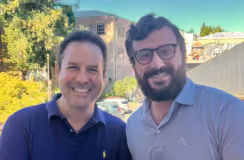
Host: A guest from one of the earliest Acquiring Minds episodes has completed the cycle. Starting as a corporate refugee at age 30, Chris Edwards bought a flooring business in a small Colorado mountain town. Chris endured the exuberant highs and stomach churning lows of business ownership for three and a half years. Last year he decided to put the business back on the market, having doubled EBITDA and grown revenue 50%. He found a buyer, sold the business, and as of recording has completed his transition commitments as seller. The journey with this business, his first, has officially come to a close and today we hear all about it. The numbers, including the exact dollar amount he generated during his ownership and exit the aforementioned roller coaster of owning a small business and how toward the end of his tenure he found himself perpetually grumpy, his reflections on buying a business versus starting one from scratch and much more, Chris provides a window into what the full journey of business acquisition can be for better and worse. For more context, also listen to his other two appearances, episodes 19 and 100 from 2021 and 2022 respectively. Here he is former owner of Affordable Flooring in Steamboat Springs, Colorado. Chris Edwards Announcements Upcoming Webinars this Thursday a legal office hours this one on legal questions related to debt financing. SBA attorneys Bill Barlow and James David Williams returned to cover the main legal hiccups for both SBA and non SBA loans. James, David and Bill will also discuss the new multi step partial buyout process just approved by the SBA. That's this Thursday, February 13th at noon Eastern. Register at the link in today's show notes or on the Acquiring Minds homepage acquiringminds co. Then next Thursday you may have heard my interview with Carlo Santelli, who whose incredible story involved using a sale leaseback to fund his acquisition of a $3 million EBITDA business, enabling him to own the business with no investors and no personal guarantee. Well, the vendor that provided him the sale leaseback, Stream Capital is coming to do a webinar on that very topic. What sale leasebacks are, how to identify opportunities to use them, how to example cases. As you learned from Carlo's interview, sale leasebacks can be a very powerful instrument in your deal, so come learn how they work for SBA and non SBA buyers alike. That's next Thursday, February 20th at noon Eastern. Register at the link in today's show notes or on the Acquiring Minds homepage. Acquiring minds.co and finally, SM Bash is coming back around. SM Bash is the original self funded search conference uniting small business buyers, operators and investors. There are dual tracks of content one for current searchers, one for now. Owner operators and Brent be sure of Permanent Equity fame will be in attendance this year. It's in Dallas April 2nd through 4th and tickets are at a more inclusive price point than years past. So get yours now@smbash.com. Welcome to Acquiring Minds, a podcast about buying businesses. My name is Will Smith. Acquiring an existing business is an awesome opportunity for many entrepreneurs and on this
[4:03] Guest: podcast I talk to the people who do it.
Host: The team at Aspen HR recently published a short white paper targeted at searchers Entitled A New CEO's Guide to Human Resources. It lays out the key items you should be thinking about as you transition into CEO and owner of the business you bought. The link to download it is in the show notes. Aspen is a professional employer organization or peo, run by a searcher for searchers. Search fund veteran Mark Sinatra runs the company, which provides HR compliance, flawless payroll, Fortune 500 caliber benefits and HR due diligence support for your acquisition, all for a fraction of the cost. Go to aspenhr.com or contact Mark directly at mark aspenhr.com Chris Edwards welcome back to Acquiring Minds.
Guest: Thanks for having me Will. Glad to be here Chris.
Host: You were one of my first guests episode 19 back in August 2021 you had bought a flooring business in Steamboat Springs, Colorado. You then came back on for an update on how things were going for my 100th episode year and a half ish later and today you're back because you have sold the business. So yours is a full circle story of self funded search grow exit and today we're going to focus on that exit. Let's start Chris with some background on the acquisition. So refresh our memories please on why you searched and what you bought.
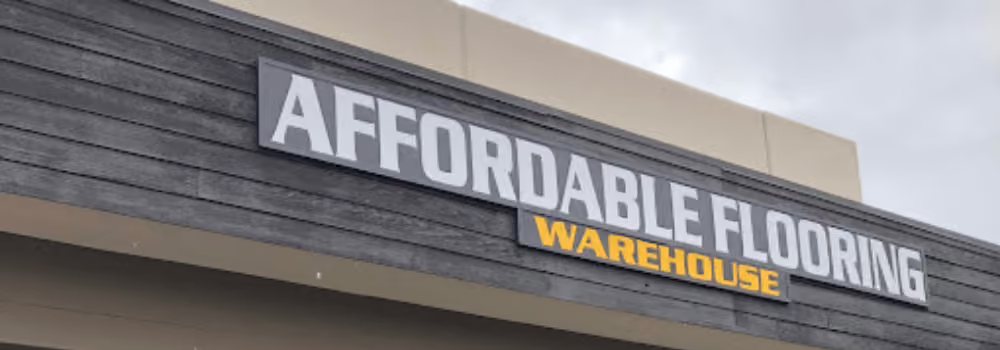
Guest: Yeah, so I started my search in the middle of the pandemic October 2020, quit my job. I was a consultant, did a self funded search and pretty quickly got under LOI for the deal. I ended up closing on Affordable Flooring Warehouse. I closed on it in February of 2021. It is a it was a retail storefront showroom serving mostly retail remodel customers, new builds. We did have a pretty sizable cash and carry business where we sold supplies to contractors. So yeah, it was a flooring store in Steamboat Springs, Colorado. Moved. My wife at the time was my fiance up there. We operated the business for three and a half years, a little more than that, and sold the business at the beginning of October 2024 and as of about a week ago I'm fully out of the transitionary phase I have, that I was obligated to. So I am totally free and clear of the business as of now.
[6:57] Host: What was your experience, if any, in flooring or more broadly, construction, blue collar.
Guest: I had basically no experience in construction or flooring. I installed my own floor one time in a rental condo that I bought. But it was a pretty bad job, I would say, looking back on it, but, you know, I, I worked in some blue collar jobs when I was growing up. In high school, I worked at a feed store, like schlepping hay bales and, you know, moving bags of grain around and stuff like that. But that was really it. And I would not consider myself handy or much of, you know, much in the way of, you know, a carpenter or anything like that. So I, I had very little exposure to the trades and to construction.
Host: And what was it that turns you on about this particular business?
Guest: I like the economics of the deal. I thought the, the purchase price was fair. I liked the tailwinds that, that were ultimately would play out for the business. I like the location, and I thought it was an industry and a business that I could learn having gone through, you know, the sear, you know, wanted to make sure that I closed on a business that I could fairly quickly understand and learn. And flooring was one of those industries where I was like, okay, I think I can do this. It's not exactly rocket science. I'm sure, sure there's more to it than meets the eye, which ended up being the case. But I felt that it was something I could learn, that I could ultimately grow and wasn't something overly complicated.
Host: And a little bit more on the business itself. You mentioned install flooring installation services. You also mentioned a showroom. So what was the revenue mix there? What, what did the business model look like?
Guest: It was about 40% cash and carry, 60% installation services. So 40%, you know, maybe not quite that much. By 35% was contractors coming in, buying grout, buying mortar, buying, you know, supplies that typically they would get in, say, like a Home Depot or a floor and decor. But because we're up in the mountains and there's no big box retailers like that that served those types of products, we were sort of the supply house for this area. So we had about a 35% sort of supply, cash and carry business, and then 65% installation services, which includes the materials, you know, the, the actual flooring, the actual carpet, the pad, all that stuff, and then the labor as well.
[9:37] Host: Fantastic. Chris.
Guest: Okay,
Host: well, I, I want to dig into a lot of the motivations here and how the business evolved and stuff. But let's cut to the chase. Why did you sell? And then let's hear about some of the numbers around the growth of the business and. And your sale price. Why did you sell?
Guest: It was a little bit of a mix of reasons, I think. Number one, I felt like I wanted to take what I had learned and the battles that I had gone through and take that and apply it to a little bit more of a scalable business. The business that we had is a great business. Felt like we did a really good job growing it and expanding it, but I felt like I wanted to turn my attention to a new project and a new business. So I felt like it was a good time for me to do that. We had grown the business pretty significantly. We had increased the profitability by a lot. And I felt like I want to take again what I've learned and apply it to a hopefully more scalable business. Something a business that can expand into multiple locations and has sort of a business model that lends itself to a little bit more growth. I kind of came to a crossroads where I, I asked myself, do I really want to ride this horse further, or is it better for me to monetize it, take the learnings, take the, the capital from that exit and roll it into a new project? And ultimately I landed on the decision to sell it and to move on to a new venture.
Host: And why not The. Well, let's get some numbers first, and then we'll turn to the counterfactuals here. The, the growth in revenue and earnings. Where did you start? Where did you end?
Guest: We started at about 3, little over 3 million, and ended at about 4.5 million. So that's kind of on a, you know, annualized basis. The, the EBITDA, the SDE started at about 500k, something like that, and we grew it to 1.1 million the last year.
Host: Oh, fantastic. So to say that again, revenue you grew by about, what is that, 50% from three to four and a half million. And then EBITDA, you more than doubled from 500 to a run rate of 1.1, did you say?
[12:12] Guest: Yep.
Host: And fantastic. Okay. Okay. Congratulations on that, too, Chris. That's. That's great. Obviously. So $1 million EBITDA or SDE business, is the coveted business for so many people listening here. You now had one in your hands. Why not put in an operator, hold on to it, and whatever this next project is can still be your next project. Okay. You don't have a giant chunk of money to work with to pursue it. But you've got incredible amounts of cash flow. Maybe that's the answer. Maybe you, you envision needing more money to do your next project or what have you anyway. But why not hold on to this incredible asset and put in an operator?
Guest: Well, I felt that there are some personal reasons for selling as well. My wife and I likely will be moving down to the Front Range of Colorado. So I felt that I would be distracted if I had this asset, you know, in Steamboat Springs. I think it would be really hard to find an operator in Steamboat Springs that's going to execute at the level that I think I did. So I think I would have just been frustrated by maybe the lack of performance if I were to have installed an operator. Maybe this is just me not thinking big enough, but I, I felt that I would be better served to monetize it, to roll it into another project and not be distracted by maybe some of the happenings and the, the issues that might have been happening at Affordable Flooring. So that's, that was really, I think, the, the impetus to it. I certainly could have explored, and I did explore the route of installing an operator, but I felt that, you know, in the end the customers would have been better served, the business would have been better served to have a full time owner operator in the business. And I think that's really what probably it would take to keep it at the level that it was at. No one's going to grind as hard as I did to make it a 1.1 million dollar STE business. I think if I were to have installed an operator and then, you know, left and went down to the Front Range and lived there, I think it would be really challenged to get back to that 1.1 million mark. So for all those reasons, I felt that it was best for the business, for myself, for the community to exit, hand it over to a new owner operator and hopefully watch it continue to grow.
[15:09] Host: An SBA loan broker, as opposed to a direct lender, doesn't work for a particular bank. Instead, the broker pairs you with the right SBA lender for your deal based on industry terms risk thresholds, then helps you navigate the process better than many lenders themselves do. Matthias Smith of Pioneer Capital Advisory is just such a broker. Matthias worked at two of the country's top 10 SBA lenders. So he's been on the inside of the SBA process and knows well the pitfalls and hurdles and how to avoid them. He struck out on his own to laser focus on the ETA and search space. Our niche is his niche. You'll see Matthias at all the ETA conferences. He's closed over 30 search deals since starting Pioneer in May of 2022, including some acquiring minds guests. To learn more and get in touch, go to pioneer capitaladvisory.com or click the link in the notes. There's two things there I thought were interesting. First of all, the obvious one which is can an operator ever. You know, how the, the difficulty of finding an operator who's so good that they can be as good as you. The owner that they're so invested. So, and we all know that that's hard and why it's, it's. It can be a bit of a pipe dream to say oh, just buy a business and put it on an operator. So let's take that one first. The. Do you feel like it was just particular to your business that would be. Have been really hard to find an operator that it needed a business, that it needed an operator who was also super invested, I. E. An owner operator or do you, do you feel skeptical about the entire model of putting in operators?
Guest: Well, I think if I'm being honest with myself, I mean I didn't exactly grow it and build it to a place where it's like McDonald's, right? Where it's like you, you, you can just install someone fresh out of high school and it's so well run and so like perfectly, you know, documented and systems in place that this thing is going to run itself with someone who doesn't exactly have the motivation that I did. So I mean we did do a really good job of installing systems and I think we were probably in the top, I would say 1% of how. Of operational sophistication for a flooring store. But you know, if I'm being honest, I, I just, it would be really hard for me to see how someone could get can like push it to the level that I did without being an owner operator. So maybe that's just me thinking, you know, a little bit too limitedly. But I think, I think looking back on it, I'm glad I'm not operating it right now. I'm glad to be kind of turning my attention to a new business. But the, the idea that an operator would run it at a $1.1 million business I think would be a little bit far fetched unless we made some really impressive and impressive changes and, or found a operator who's a unicorn, especially in, in, in Steamboat Springs. You know, just being honest, there's a, there's A certain Persona that lives up here. You know, there's not, it's not exactly the most career driven people that live in Steamboat especially that would want to operate a small business like this. Most of the high functioning, sort of like career people, you know, are entrepreneurs or have their own sort of business going. So to find an employee op, you know, operator that is going to want to live in Steamboat and to endure the winners here and all that stuff, it's. It would be really challenging.
[19:12] Host: And because Steamboat, what's the population first of all?
Guest: 10,000, 12,000 maybe.
Host: Oh wow. I didn't realize it was that small. And it's pretty isolated, right? It's not near Denver or anything.
Guest: It's small, it's isolated. It's 3 1/2 hours away from Denver on a good, you know, clear driving day. On a day like today where it's a blizzard, you know, you're lucky to make it to Denver. Right. So it's a, it's a different lifestyle. It's a different kind of person that lives here. There are certainly challenges that are inherent to operating a business in Steamboat. Part of the one, actually one of the reasons why I bought the business is because it kind of has that geographic moat. Not many people would want to come here and operate a small business and compete. So it's a good thing and a bad thing, right? So as far as like being able to find a large talent pool that may want to operate a flooring store like this, it would be really hard to find that needle in a haystack.
Host: And Steamboat, well, but Chris, if it's hard to find a really great and capable operator, it's probably that much harder to find somebody who actually wants to buy a business there. So business buyers are harder to come by than, than even, than operators. So who'd you sell it to?
Guest: I sold it to a guy and a guy and gal, a couple who lives in Eagle, Colorado, which is near Vail. So they're familiar with mountain life. They know what the winners are like up here. They were just a perfect fit. They. He had construction experience. He was sort of the COO of a large custom home builder in Eagle Vale area, the Vail Valley. So he knows construction, he knows what mountain small town living is like and you know, he was a perfect fit. So if I hadn't have found this buyer, I probably would have gone the route of, of installing an operator or continuing to run it myself. I kind of, you know, in some ways, you know, I put it on the market to see what happen. What Would happen. Right. We got a lot of interest. A lot of people from out of state. But the fact that this guy was in, you know, Vail Valley again, knows construction, knows mountain living, it was just a really good fit for the business.
[21:43] Host: But in fact, you, you saw a lot of interest. Did you consider that a real interest, Tire kicking interest. People who thought they were really interested, but once they realized how hard it is to Steamboat Springs probably weren't going to be interested. What, what did you see? Because I'm hearing, I'm hearing if we hadn't found the guy, we found a couple that we found, it would have been so hard to find somebody. On the other hand, I'm hearing that the business actually got a list. A lot of interest.
Guest: Yeah, there is a lot of interest. I would say most of it tire kicking interest for sure. I think that there's a lot of searchers out there right now. A lot of people that are. That want to go buy business and go the route that I did. Um, but I mean we got probably four or five. Lois. Oh. So there was a pretty good amount of real interest. People willing to actually put an LOI out there. A lot of tire kicking conversations for sure. But yeah, I mean, I think this guy was definitely the best fit. But there were other people that were seriously interested in the business.
Host: Did he have the best offer?
Guest: He had. There was one offer that had a higher dollar amount which actually went above our asking price. But he, I think he had, I felt like he was the most likely to actually close. So that in that ended up happening. And for that reason, yeah, I would say he was the strongest offer wasn't necessarily the highest, but it was. He, he, you know, he asked or he gave us our asking price. The terms were fair, you know, the, the actual economics or, you know, the, the structure of the deal was solid. But again, I think just given his experience of living in the mountains, he was the most likely to actually close. I think if a couple of these people that throughout Lois were to actually come up here, do a site visit and like see what Steamboat Living is really like, they probably would have gotten cold feet.
Host: So interesting to hear from both sides of the table now, especially somebody who went through a search themselves. So who this couple? Were they there? Sounds like they were searchers. Basically had corporate jobs. He had a corporate job. And was. Would you qualify him as a searcher or did he know, did he self identify as that or, or what?
[24:07] Guest: Um, I think he was a passive searcher. I think, you know, he, he wasn't you know, doing a proprietary search or anything like that and doing re reaching out to small businesses. He, he found, he saw our listing, he was looking at a couple other deals in and around the Vail Valley that fell through. But yeah, I wouldn't say he was like a full time searcher. He. He had, he had quit his job about nine months prior and kind of took some personal time. But yeah, he was, he was a searcher. I wouldn't say he was like doing it full time and actually super active with it. So it kind of fell into his lap a little bit.
Host: We're already pretty far away from it. But there was a second point I wanted to make about the possibility of putting in an operator that you made, which was not wanting to be distracted. So even if you had found a great operator, the part of you recognizes in your own personality that you just. You're somebody who wants to focus on a business at a time. Say more about that because I think that that's an underestimated, underappreciated feature of Holdco. The Holdco fantasy, the Holdco aspiration that it's that you need, really need to be good at context switching, compartmentalization. What do you think?
Guest: Yeah, I. I don't know. Maybe I am just not sophisticated enough of an operator. But I, I've come to really appreciate focus. I. I think I might told you in the last episode but I had bought a countertop business and that partnership fell apart and the. And I ended up having to. I ended up selling my equity ST business
Host: and this was the business physically located right next door. So it's not like you had to drive across town, let alone an hour away.
Guest: Yeah.
Host: So these businesses were right under your nose and still it, it felt a little. It got messy. It was, it didn't work. Yeah, yeah.
Guest: I mean it didn't work because I. I partner with a not great guy which is a lesson in and of itself. But I think I have a separate lesson. Yeah, I think that I've come to appreciate. I mean if you really want to do something that is scalable, that can scale to multiple locations, that can be that sort of branch based model, you need to be focused and you need to be laser focused on the one thing that you do really well. And I've really come to appreciate simplicity. Less is more and more. I would have a hard time, you know, having affordable flooring operating in the background at a suboptimal level while I'm focused on another business. I think that the next thing that I do I want it to be bigger. And I think in order to be bigger, you have to have a more simplified model and you have to be really focused on it and do it and do a really, really good job at that one thing. So I, the whole co thing, I think a lot of the, you know, I sort of had the same fantasy when I was getting into eta and I'll, I'll just have like a, you know, mini Berkshire and just what everyone says when they first start out. But I think I've kind of come to the conclusion that I'd rather have one business that I'm really focused on, that I'm really focused on growing and, and doing a really good job for customers. And if I were distracted with affordable flooring or distracted with any other business that's just kind of happening in the background at a suboptimal level, I wouldn't feel great about that.
[28:04] Host: The Holdco fantasy, it's, it takes a personality type. It's really, it's really, I think, more of a capital allocator. You, it's more of an investor who, who likes kind of managing their portfolio versus somebody who wants to go out and grow something.
Guest: Yeah, for sure. And yeah, like you said, it's, it's more of a capital allocator type of role, which I do like. I, I enjoy allocating capital, I enjoy, you know, creating equity value and I enjoy, you know, growing wealth. So there I, I do really enjoy that part of what we do. I would just say that having worked with people that sort of have this Holdco model, and I'm actually consulting a guy right now who kind of has this model, it's really hard to do a lot of things well. It's really hard to do one thing really well. And I think that the Holdco model probably works for someone with a little bit of a higher net worth than I currently have. I mean, I think I've done okay. But, you know, if you really want to have like a Holdco model where you have five really good businesses, you need to have a substantial amount of capital to deploy. So I, I think that's kind of where I would sort of draw the line a little bit. I think that, like I said, I think it's hard to do one thing really well. It's hard to do five things really well. I mean, like I said with, with the granite business, it was hard to do two things really well. And they were right next to each other and they were super complimentary. Some of the people that are in the home improvement space right now that I really admire. One named, one guy named Brian Elias. He's building a company called Refloor. He has scaled to, you know, 80 million, $100 million or whatever he's at right now in four years. And his model is extremely simple. You know, he has laminate, hardwood and vinyl. He doesn't do carpet, he doesn't do tile. He doesn't do, you know, bathroom remodels. Like, he doesn't do cabinets. Like all these flooring stores are kind of trying to be all things to all people. Just speaking about the flooring industry for a second, and Brian has really simplified it, pared it down. And because he's able to do those things really, really well, he can grow his business much faster. So the way, the way that I kind of see it is do you want to have five businesses that all do $3 million or would you rather have one really good business that can get from 5 million to 30 million quickly? Because you do one thing really, really well and you're able to find leads and you're able to market effectively. You're able to do the blocking and tackling of the business and grow the business quicker because you're focused and you're simplified. So I've, like I said, I've kind of come to the conclusion I'd rather have one business that's able to get to 30 million versus five businesses that are really struggling to get over the $3 million mark and get to know the next level.
[31:42] Host: I love the analysis, Chris. I will say yeah, if you can find a business that gets that is surging at 15 and $30 million, we, we all want that, that, that probably is better than, than a holds co, but that's also a really, really even more elusive kind of opportunity to, to seize. Whereas the Holdco, you can get there more reliably, very hard, but you can almost certainly do it. Whereas hitting upon a model that, that is so scalable, that works so well where there's demand in markets across the country, it's, it's not something that is predictable that you'll get there. You know, that you can be sure that you'll get there sort of sort of thing. So I guess, I guess the analysis, if you really want to nerd out on it, is kind of like the, you have to layer over probabilities and what is the probability that you find a business that is doing 15, $30 million in revenue with still a huge amount of Runway and a dialed in model and a huge tam et cetera versus being able to find, you know, five, $3 million EBITDA businesses.
Guest: Yeah, yeah, no, I totally get it and I'm not saying that I would that I have found that gem to get to get to that mark. But yeah, I think there's a lot of different ways to tackle this. The whole co model. Definitely. I'm not here to say that it doesn't work. Yeah, I think that there are, there are a lot of people out there that are doing it really well. But I think for me, given where I'm at in my life, I'm better served. At least this is my analysis and I could be wrong. I'm better served to focus on doing one thing at a time and doing it well.
[33:38] Host: And so is that to say that you have a clear vision of what's next?
Guest: I don't working on it. So maybe next time I'm on here we can discuss. But yeah, that's kind of what I'm spending my time on right now is developing the next thing.
Host: Okay. Do you have anything, any idea directional idea like will you stay in flooring or in something adjacent to flooring or that also. You don't know yet?
Guest: I don't know for sure. It probably will be in the home improvement space. I do like the home improvement business and I think that there are some compelling opportunities out there for sure.
Host: And this, what was the name of the guy doing refloor? Elias.
Guest: Brian Elias.
Host: Yeah, Brian Elias. You couldn't. And so if he's cracked the code to a fast growing flooring business, you must have thought about taking your business and copying his model. Frankly, why did you disqualify going that path?
Guest: Well, I don't know if I have disqualified going that path, but
Host: I, I, why not build from, from your.
Guest: I wouldn't want to do it with the, with the brand that we had. I, the affordable flooring brand, I think is, is good for Steamboat and I think it's good for, for what it is in Steamboat for sure. But it wasn't a brand or a business model that I felt could be Brian Elias, so to speak.
Host: Okay.
Guest: Okay.
Host: And you couldn't just rebrand because then you'd be, you could, but you'd just be walking away from so much equity if you did that. So much brand equity value.
Guest: I strongly considered rebranding before selling the business. Um, but I come to the conclusion that that would be a sort of a, a long road to ho to because there, there is a, there is name equity value of affordable flooring warehouse and Steamboat. It's been around 17 years. It's a trusted name. So to throw that away was a pretty daunting thing. And also the model itself of selling supplies to contractors wasn't something that I wanted to, you know, scale up. So I felt that monetizing, affordable flooring warehouse, monetizing the brand was the way to go.
[36:15] Host: You know, it's so interesting, Chris, because I feel like a lot of the things that made the business appealing in the first place to you are things that you then kind of held you back from growing it. Like, it. There was kind of a ceiling to it. It could be a. A great local business. You talked about the Geo. The geographic moat. But a market of 10,000 ain't gonna. There's just a ceiling on, on how big a business you can grow in a market of 10,000. At which point you say, well, maybe I should buy another local business in Steamboat Springs. And that's how I grow my, my overall entrepreneurial, like, satisfy my entrepreneurial appetite. But if you. But to your point, we've already discussed how you didn't want to do that. You wanted to grow a single business. If you want to grow a single business, hard to do in a small, remote market. So that moat that you talked about earlier, which is so appealing, getting into the business, ends up being a little bit of a. Of a catch 22.
Guest: Yeah, for sure. You know, what was appealing about it ended up being a, you know, restrictor to growth. So, you know, ultimately, like I said, the. The business of affordable flooring warehouse works really well in Steamboat Springs, Colorado. I'm not sure that it. It works anywhere else. So. Yeah, no, it's. Like I said, it's. It's a really good business. We did a good job growing it. But at the end of the day, the. Like you said, what made it attractive is what held it back a little bit. So it's. I think that it's got a bright future and I think there are opportunities to grow it, you know, namely getting into cabinets and things like that. But again, that's where you're introducing complexity into the business and, And I think even further complicating the model.
Host: Great thoughts, Chris. Well, let's. Let's get to the juiciest part here, which is the. What you sold it for and what your ROI looks like you generously have agreed to share those numbers. So what did you buy the business for and what. How much of your own equity did you put in?
Guest: I bought it for 1.7 million, and I put in a little. A hair less than 200k of equity
Host: into the business was enterprise value, purchase price of 1.7. 200,000 of your own money. What did you sell it for?
Guest: I sold it for 4 million.
Host: You sold it for 4 million. And you had taken distributions out during your own. Your three and a half year ownership to the tune of.
[39:00] Guest: To the tune of about. I can pull my spreadsheet, but it's like 1. 1.7 million of distributions.
Host: 1.7 million of distributions. Wow. Over three and a half years. So half a million dollars a year in distributions?
Guest: Yeah, at least. Yeah, something like that. Plus the debt paved down and all that stuff as well.
Host: The debt. You were paying down the debt, but you still had balance on that SBA note, correct?
Guest: Yep.
Host: How much balance did you have left?
Guest: I had 1.3 million. Let me just. Sorry. Pull this up real quick. Sure. Yeah. So I, Yeah, I took about. Took out about 1.7 million of cash distributions, a little more than that, and I had about 1.2 million of debt at the time of the sale. Okay.
Host: And so you sold it for 4 million, minus 1.2 in the debt that you had to pay down. So that's 2.8. But add back to that the distributions you taken over time gets us to 4.5, 4.5. Right, that sound right?
Guest: Yep.
Host: Four and a half million.
Guest: Yep. So more than that. Four, 4.6, 4.65.
Host: Yeah, the six that, that additional bit there is from the working capital. Right. That you.
Guest: You were able to. So.
Host: So you took the working capital with you. So to net that out for. To simplify the. You turn $200,000 of equity into 4.65 of cash in three and a half years.
Guest: Yeah, a little less than 200k of equity, but yeah. Yeah.
Host: Okay, so that's a 23 plus MOIC.
Guest: Yeah, 24, basically.
Host: 24. You don't seem to be smiling there. There it is. There it is. That's remarkable, right? I mean.
Guest: Yeah, I mean, that, that's.
Host: Are we excited? It's insane.
Guest: Yeah.
Host: I just want to make sure I understand how this is as good as it sounds.
Guest: Yeah, no, I mean, it was great. I mean, you know, it was on paper and when you put it that way, it sounds like the greatest thing in the world, you know, and it's. It was life changing, for sure. It was, it was awesome. Um, it was not without its sleepless nights and, you know, intense moments and fetal position type of, you know, experiences, but it was, it was a really great result, financially speaking, for sure.
Host: Yeah. Good for you, Chris. We, we all applaud you. It's inspirational. And how old are you?
[42:03] Guest: I. 34.
Host: 34 and have a family?
Guest: Yep. I have a wife and two daughters.
Host: You know that one of the most common levers to pull in a target acquisition is technology updating the systems of a business that may still be running off a spreadsheet or even pen and paper. But tech is complicated with tons of solutions out there. So choosing the right cloud platform, CRM, telephony, compliance and cybersecurity, not to mention implementing all that, is a job in itself. Acquiring minds Guest Nick Akers knows this firsthand. As a former searcher who now owns Inso Technologies, Nick has seen the tech challenges searchers face when acquiring businesses. His team at Inzo regularly works with searchers and their acquisitions, offering a complimentary IT audit of the target company. Nick takes a personal interest in all their searcher clients, drawing from his own experience in the search phase. Enzo dates back to 1989. So this is a company that has managed the tech for hundreds of small businesses over decades. And one last thing, no long term contracts with Enzo. A big differentiator. Check out enzotechnologies.com I N Z O or email Nick directly@nicknzotechnologies.com and don't forget to tell him you're a searcher. So you are now a seasoned acquirer, seasoned operator, right?
Guest: Yeah, absolutely. Yeah. No, it's transformative experience for sure. I feel much more capable, much more confident, much more willing to, you know, take on risk and to make things happen. So yeah, absolutely. It's a huge confidence building experience. Like I said, it was not without its extremely challenging moments. And I mean intense, you know, moments where I'm talking to my wife and I think I've ruined our lives and what have I done and what the hell am I doing with myself?
Host: All my friends, give us a, give us a peek into one of those moments. Like what was a moment of despair? What had happened?
Guest: I mean, you know, the, the countertop business. I partnered with a key employee from Affordable Flooring and some things came to light and our professional relationship became completely untenable at that point. So I fired him from Affordable Flooring. I exited from the Granite business. And he ended up, you know, partnering with another person, one of my installers, to start a competing business. So, you know, they're taking key accounts away from us. It's a small town, you know, like people are talking. So that was a really challenging time. You know, this was someone that, when I was underwriting the business originally was a really key player in the business and he ended up, yeah, I ended up having to fire him and to, to compete against him ultimately. So there were some really intense moments where I felt like my business is crumbling and what am I doing and, and key accounts are leaving and going with him and things of that nature. So, yeah, I mean, there, there were. I remember on my daughter's first birthday, being in my room, like literally on the verge of tears because I felt like the, the business is like falling apart. And so thank God I have a great wife and someone who is really supportive and helped me through the, the challenging moments. From that moment to the transition to, you know, employees just being difficult in general and installers doing the jobs wrong and we got to rip out a floor and reinstall it and all the things that come with small business, it's really hard. So I think people who are looking to get into this space need to be ready for extremely challenging and difficult moments, especially if they, you know, have taken out a big loan and they've got a lot of pressure and to succeed. And if they don't, they're screwed. So there was just. There's an intensity to this life that I had never experienced before. And coming out the other side, it, it feels good to have gone through it. All the sleepless nights, all the challenging moments and come out the other side.
[46:53] Host: That is so well put, Chris, that line. There's an intensity to this life that. The SMB life, SMB owner life, very almost poetic and I think captures it. And just by the way, reflecting on that particular sleepless phase of the business where you find out that you've partnered with the wrong person and then they go off and compete with you. Small town people are talking, as you said. How do you reflect back on that moment? Did it, did you just out compete them? They continue to be competitors. Did you overestimate in, in your, in your, in your naivete or rookiness, like not being that, that seasoned of an owner, did you overestimate the damage it could do? What?
Guest: Definitely overestimated how much damage it would do. I mean, after I fired him and after I had that moment where I thought the, the business was falling apart, we ended up having by far our best year. Um, you know, we, we grew the business, we were way more profitable. We installed systems. I was able to like, take the part of the business that he was just holding onto and would not let go of and would not relinquish power of and would not let me install better systems and processes. He Just wanted the control. I was able to take that back. It's now my business. It's mine. I'm going to do this, this, this. We are doing this, you know, and we are installing better systems, we're documenting processes, we're making what he did much more simplified, much easier to manage, just things like that. So I definitely.
[48:34] Host: So blessing in disguise, actually.
Guest: Huge blessing in disguise. Huge blessing in disguise. Absolutely. It was. Yeah, it was great. So I definitely overestimated his ability to damage the business. I. I mean, he still competed and he, you know, he still has his accounts and the people that like him and trust him. So, you know, he has his business still. I, I think, frankly, I think it's fledgling. I think that he's. He realized that this is harder than it looks, that he had a pretty great situation, um, even throughout all this, you know, six months later, after he started competing against me, he was still trying to get back in my good graces and come back to the, to the business. And I think he regretted the decision overall. But. Yeah, so I think it was. It was really challenging. It was scary. But we focused on the right things. We turned our attention internally, built a better business, and came out the other side much better for it.
Host: Fantastic. What a story. Great, Chris. Well, I want to start closing us out, but not in any hurry to. I want to get your reflections on a bunch of things I've already pressed you on. How does it feel? And you said, good. Any other, Any other big picture reflections? And then I'll have some pointed questions on it.
Guest: Yeah, I mean, I think. I think reflecting on it, I. Right now I'm glad to be. Not. Not operating the business, honestly, because of that intensity.
Host: The aforementioned intensity?
Guest: Yeah, the aforementioned intensity. It eats at you. I was starting to get really grumpy all the time. I mean, you know, when things go wrong, I felt myself becoming more and more callous, I would say, which is a good thing and a bad thing,
Host: you know, become more callous how?
Guest: I think I became just more, I would say, skeptical of things going right. And. I. I was becoming more grumpy with customers. Um, you know, when. When things were going wrong and it escalated up to me, it became harder and harder for me to be the patient sort of peacemaker that I was, I think, at the beginning of my experience at affordable flooring. So I think. I think I'm glad to have some time to reflect and refresh myself and go skiing and, you know, enjoy steamboats. I really did not have any time to do that. People are Saying I look less tired. I look, you know, like, I'm starting to get some more color in my face and whatever, things like that. So. But, you know, especially, like, having the holiday season to hang out with my family and, like, enjoy Thanksgiving and Christmas and have family up here and just, like, be able to be present and really spend time with people that. I probably wasn't as engaged in the pri the prior few years, just being distracted with the business and things going on and we're doing a job on Christmas Eve and, oh, it goes wrong and whatever. So, yeah, I'm glad to be refreshed a little bit. I think I'm at the stage right now after the new year and just kind of twiddling my thumbs right now. I'm getting anxious to figure out what the next thing is. So definitely turning my attention to what the future holds. So that's a little bit scary right now to try to figure out something that is going to work. So it's. You trade one thing for one problem for another. So I'm excited for the future. I'm definitely feeling energized. But it's also right now I'm at a point where I'm anxious to get going on whatever is next.
[52:50] Host: Do you think it will be buying a business? I know you're figuring it out and you want to. You're keeping your cards close to the chest, but do you think it'll be acquisition?
Guest: You know, I don't know. If I had to give you an answer, I would handicap it at probably 70%. No. So, yeah, I probably would start something from scratch.
Host: Okay, say more. As somebody who's had such a, such a success through the entrepreneurship through acquisition model, why build from scratch this time? Or why? I know you're not committing to it, but why. Why are you tempted by that? Is it just because you're. You have capital now or something else?
Guest: It's because I have a little bit of capital now. It's because, you know, ultimately these small businesses are to some degree broken. Right? I mean, like, the, the thing that was a strength at affordable flooring, like we talked about, ended up being a weakness. Right? So it's not to say they're not good businesses. You can't make money. But like, the, the here's, here's the thing is, like, would you take 200k of equity to buy a business that you, you don't really know what you're getting into? There's a lot of risk, right? I, I went through it firsthand. It worked out great. For me, for sure. Would you rather take that 200k and, and operate a business that you don't, that you didn't build yourself with a huge note over your head, or would you rather take that 200k and build a new business, which you can absolutely do for 200k if you're thoughtful about it? No, no note over your head. You have a bunch of equity backing you up and operate that business. So that's where I'm at right now. So I, but again, I'm not saying for sure I would do that. There's 30% of me that still thinks that acquiring business is a no brainer way to go. How can I argue with the results that I had the first time? Why wouldn't I do that again? So I'm not saying I'm not going to do that, but I am tempted to build something slower, you know, and build it from scratch and build that into something that I would feel better about potentially three years from now than kind of continuing to operate and, you know, extract the crap out of a existing small business. So, yeah, that's the calculus I have right now. Again, I, I have the luxury of being able to take my time because I do have some capital and I'm not stretched for money. So I think, let me say this, what I did at affordable flooring was a life changing thing. And for people who are kind of at the stage of life that I was at, where you're exiting the corporate world or you want to get into entrepreneurship throughout, you know, get into entrepreneurship in a little bit of a lower risk way, I think acquiring a small business is a really great way to learn to, you know, refine your entrepreneurial chops, to take some punches in the face and still make money and hopefully have a positive result on the other side. So telling myself four years ago, I would tell them, tell myself, definitely do this, do not start a business. But now that I have a little bit more capital, now that I have some experience, I feel like the starting from scratch route is a little bit more attractive than it was four years ago.
[56:23] Host: Yeah, it's, it's a great analysis, Chris. And, and really I'm not trying to oversell ETA at all, but it is, but, and I do think that you, you arrived also at a very important point, which is that part, if I, if I will, we're going to go out and start a flooring company tomorrow, I wouldn't have any of the experience or knowledge to do it. And of course entrepreneurs do that and they figure it out. But I'd probably learn at a much slower rate than if I bought a flooring business. So. So where you are now is you have all this institutional operational knowledge that you've gained by going the ETA route, which was really an accelerated, A very accelerated. I don't think we can overstate that. A very accelerated lesson in the flooring and construction and cash and carry sort of serving contractors industry.
[57:14] Guest: Y.
Host: What an interesting discussion. But let's, let's leave that there. I just want to squeeze in a couple more questions here. Chris, you had said that one of the things that attracted you to the flooring business was you wanted a business you could understand. That was simple. Of course, we've now just spent a lot of time hearing about how hard, intense it was. You earlier said there, of course there was more to it than meets the eye, than met the eye at the time. What was the more to it that met the eye? When we look at these businesses on, on biz, buy, sell or have meetings with owners or even do site visits, do we miss or do. Are we not seeing.
Guest: Oh man. Well, I, I think the first thing is going back to the intensity comment. It's intense. Like you can't overestimate how different it is to have that much skin in the game that than what you're probably used to. You know, we go through life, we go to school, we go to college, we go to corporate route. Throughout the whole thing, there's just not a whole lot of intensity to it that can even in my experience compare to entrepreneurship. So that's just the first thing. You have to experience that for yourself. You, if it goes sideways, if it goes belly up, I am going to go bankrupt.
Host: Right.
Guest: So that is a, that's a level of intensity that I had never personally experienced myself. I think the second thing is just what the business actually is and how you build what the business is. So we. No, no matter what business you're in, you are in the sales and get more sales business. So you're in the lead generation business, you are in the marketing business, you are in the lead conversion business. I'm kind of like using e myth parlance here, but you're in the, you're in the finance business, you're in the market, you're in the leadership business. All of these things are like core to what actually drives a successful business. So I had never generated a lead before. I never like, you know, tried to position myself in a marketplace before with a business. So even though I was just doing flooring, that part of it was not super hard to learn. The hard part to learn is that what the business actually is is a lead generation system, it is a marketing system, it is a lead conversion system, it is a leadership system. It is these things that I had never done before. So yes, flooring itself is not overly complicated and that but like there still is a lot of complexity with flooring and technical wherewithal that I had to, to absorb. But the actual core of what a business is is what I had to learn. So yeah, I think that the actual technical flooring thing was less a concern. There was a lot to that I had to learn what you know, where layers are and like how much you know how many pounds of cushion you have in your pad, blah, blah, blah. So there's there, there was a lot to that too. But really just like understanding what actually is a business.
[1:00:45] Host: Yeah. Well, I will say big picture that happily the true stuff, the true learning curve there, all the stuff that you mentioned, the business of business, the marketing, the funnel, the conversion, the sales is actually are much more valuable and more widely applicable skills than just learning flooring. And, and so so now you've got these skills that you can apply into a lot of businesses.
Guest: Right.
Host: Which is great actually. Perfect segue to my next two questions which is when I hear, you know, sales, when I hear marketing, when I hear lead conversion, does that all. Is that all because this was such a project based business. I mean you've got the retail component where people are coming in the door, the contractors are coming in the door and you're selling them stuff. But then the other 2/3 of your business is doing installation services, I guess selling the flooring and then installing it. So that is project, that's a project based business. Is that why you, it was such a, so funnel focused and, and, and how do you reflect on a project based business which we're all told we should avoid?
Guest: Yeah, I mean I, I think that, yeah, the, the understanding your funnel at a very deep level, understanding the leads that are out there, understanding how you generate new leads, understanding how you can convert those leads into, into sales. Yeah, like that, that's a core component of the business and that's something that we I think got a lot better at as time went on. So yeah, in a project based business like that you need to understand those systems deeply. And in my opinion I think you should have it all documented. I think you should have flowchart, I think you should have really robust step by step guides on how you get that lead from a first of all an interested lead to a converted lead. So that's an extremely important part of what we did and what we do. I think a lot of contractors have no real understanding of these concepts. They just kind of like the phone rings and they maybe pick it up, maybe not, maybe they follow up, maybe not. So that's kind of how a lot of the contracting world operates. And that's one of the reasons why I like the contracting world is because I think that there's opportunities to do those things better. Yeah. So to the project based question. Yeah, I mean like it'd be wonderful to have a recurring SaaS model and to have, you know, credit cards dinged every month and to, to have a business like that, like unquestionably that's a better business than what I did at Affordable Flooring and what, you know, project based businesses do. So I, I'm not here to say that the flooring business is better than, than that model because clearly it's not. But I do like project based. I found that we were able to operate a really, I would say fairly sophisticated business to generate high gross margin tickets, to have strong healthy unit economics with our project based, you know, business and model. So is it recurring? Is it the most sexy thing in the world? Absolutely not. But my experience was you can make a lot of money in project based businesses. You can do it better than people that are in project based businesses and you can build a healthy business while all the super smart people are competing for SaaS dollars. Like I found that I was over here just doing flooring tickets and clipping a pretty good gross margin and able to run a high EBITDA business.
[1:04:40] Host: I love that. Thank you for such a refreshing take on project based businesses and in fact what to like about them, even over recurring revenue. I will, I will ask though, Chris, is it was part of the, to return to your word again, part of the intensity of this business is that, is that inherent to a project based business where maybe it wouldn't exist as much in a recurring business? Because intensity comes with projects sort of, you know, and, and every project has a beginning, a middle and end. If something goes wrong in the project, everyone's scrambling, et cetera sort of thing.
Guest: Totally. Yeah. I mean, yeah, like you're in someone's home, right? And if you, if you mess up their home, if you, you know, install the wrong floor or the wrong whatever, like the wrong direction of the floor. Yeah, that's, that's really intense. People are not going to be happy about that. But you know, that's the nature of the business, this nature of the beast. I found that we were able to install, you know, I would say better systems to handle those things. We were able to train our team to have strong customer service skills and to handle any issues that might arise better than our competitors. But yeah, there certainly is an intensity to project based businesses. People want you to get in, get out, do a good job and if you don't do those things then you're in trouble and you're going to hear about it. So I personally like project management. You know, as part of like my kind of consulting brain. I sort of like the phases of project management and I feel like I come to understand it pretty well. So yeah, there's definitely a intensity to project based businesses that probably doesn't happen with more recurring models where you turn it on and the customer is happy or you ship them a product and it's over. So certainly is more intensity to that than other models out there. For sure.
[1:06:47] Host: Yeah. And Chris, this point about the business was really not about flooring but about converting leads. Kind of comment. And of course, and of course all the operational stuff and, and leadership. One of the things that, that for example, Dan Verboski. I recall saying Dan bought a sign business and he's, he's been in it now for a number of years. It's been, it's been hard but the idea that you adopt the identity of the industry that you've acquired into. So as Dan put it, he's like, I'm, you know, I'm a sign guy now. I've been in this industry now for whatever it was, five plus years, seven, eight years, I'm a sign guy. Are you a flooring guy? Are you a floor guy or, or no. Did you, did you adopt the, the identity of the industry or. Not so much. What would you say about how you see yourself today?
Guest: I definitely adopted some aspects of the industry. I mean, my hair is super long. Like I, I, you know, I'm kind of like a little bit more of a rough neck now than, than I was when I was a consultant. I was, I was pretty clean cut. But now I'm a little rougher around the edges, that's for sure. But yeah, I mean like I drive a truck now. You know, I didn't drive a truck before I got into this business. But do I like everyone and everyone in the business? You know, all the sales reps and the people I networked with at events and stuff like that, they're like, oh, once you're in flooring you're, you're here for life, you'll never leave. And I don't buy it. So, no. Do I, do I, do I consider myself a flooring guy now? No, not really. I mean, I don't think what I've learned and what I do is, like I said, the business isn't just flooring. That's just a means to an end. The business is marketing. It's lead generation, it's lead conversion. It's these things that are the actual business and that's what makes it run. Do I know how to install carpet? No. Do I know how to install flooring? Not really. Do I know what goes into those things? Yes. Do I have some technical wherewithal to, like, speak to it cogently? Yes. But I don't consider myself a flooring guy now. Do I like the flooring business and could I see myself doing a flooring business in the future? Yeah. But I don't see myself as a flooring guy now. And that's, that's not my, that's not my fate.
[1:09:06] Host: Okay. All right, Chris, this is great. Anything that I didn't ask any, any final thoughts that we haven't, haven't hit on?
Guest: I don't think so. Hopefully this is helpful and that your listeners get some value out of it.
Host: If people want to reach out, Chris, how can they do that? How do you like them to do that?
Guest: Reach out on Twitter. My handle is Toph T O P H Edwards. Or you can email me. My email is chrisanitisequity.com S A N I T A S Equity.com Super.
Host: Chris Edwards, thank you once again for coming on and being so transparent about those numbers which will likely make them make, make their way into the headline of this interview. And congratulations on, on a great run. We're all eager to see what you do next. Really a fun, a fun full circle journey for you.
Guest: So, yeah. Well, it's been a pleasure talking to you, Will, and it's been awesome to watch your success with Acquiring Minds. So been a pleasure talking to you. Thanks, sir.





























































%20-%20thumbnail.avif)





%20-%20thumbnail.avif)


%20-%20thumbnail.avif)

.avif)




%20-%20thumbnail.avif)