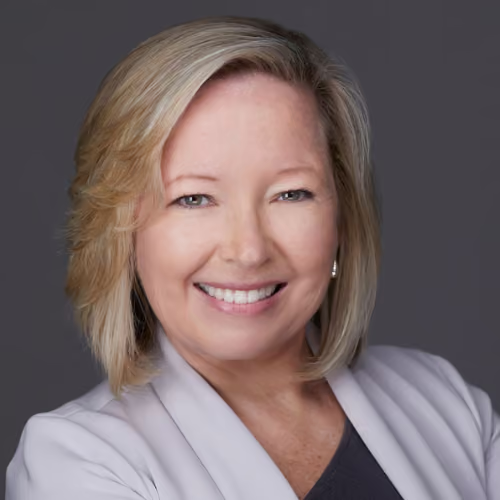
Host: You may have heard me say that seller dishonesty or outright fraud is the leading reason that buying a business goes south. Well, today's case is not that. It's a look at how an acquisition entrepreneur can find himself in crisis for other reasons. Dave Gilbert bought a fractional CFO business only to discover bad camouflaged customer concentration. Not only that, the business model was fundamentally flawed and the third critical issue was just how much of a family business it was. There were family members throughout the organization, which of course made making changes all the more difficult. This is an issue Dave knew about from the outside and was in fact concerned about. Unfortunately, he was right to be so. The business was essentially a turnaround and our interview today shows how Dave spent two years doing exactly that. Remarkably, Dave was able to sustain revenue and EBITDA the whole time. But listen toward the end for how the brutal experience has changed Dave's views on SBA acquisitions. Here he is. Dave Gilbert, owner of Proven. Welcome to Acquiring Minds, a podcast about buying businesses. My name is Will Smith. Acquiring an existing business is an awesome opportunity for many entrepreneurs and on this podcast I talk to the people who do it. You know Enzo Technologies as one of the leading IT managed service providers serving the search community. Led by Nick Akers, an Acquiring Minds guest who bought the 35 year old business. The team at Enzo regularly works with searchers and their acquisitions and one feature of acquired businesses that INZO is seeing over and over is the need to implement cybersecurity promptly during the transition. So many acquired small businesses either have glaring vulnerabilities, lack security best practices or both. That step one to de risk the deal you just closed should be addressing these issues. INSO is your full service IT MSP for post close stability. They assess your target, surface the biggest risks in plain English and give you a day 1 through 30 plan to cut exposure, prevent downtime and even find cost takeouts like bloated telecom bills. Check out enzotechnologies.com on I n Z O or email nick directly@nickot technologies.com Dave Gilbert welcome to Acquiring Minds.
Guest: Thanks Will. Glad to be here.
[3:00] Host: Dave, you bought a fractional CFO business. It looked good on paper of course, but it turned out to be something of a turnaround and we are catching you as you emerge from this painful two year experience. So much to learn from your experience. Dave. Let's dive in some background on you to start please.
Guest: Sure. Happy to. I'm 45 and like most people when they were in their 20s that are my age, I was never endeavored by the tech industry. So I spent about 20 years in tech building companies in tech. The biggest company I built was a credit risk software company and I spent about 10 years doing that and we were the biggest analytics company for credit unions in the country. So that kind of got me started in tech. I started a few other companies and spent oh, five or six years at a global cybersecurity company where I manage teams all over the world, which was super fun as well. Then read buy, then build and decided to dive into buying companies, which is, I started with proven cfo, which is now proven. And in a nutshell, that is my background.
Host: That was great. Dave. And so why did you find ETA so compelling? Especially given that it sounds like you'd had success in zero to one tech land?
Guest: Zero to one is hard, so is eta, especially a turnaround. Zero to one when I started in tech was all about building a unicorn. So it was growth at all costs. It was raising capital and I really didn't, I liked having really smart people around me all the time. Cause in tech you do. What I didn't like is trying to grow to be a billion dollar unicorn and having the pressure of growing at 80 to 100% year over year raising capital versus building for profit. That wasn't attractive to me. So what attracted me to the ETA space really was here was a world that I wasn't familiar with. I mean, obviously in tech there are a lot of acquisitions that happen, but a world that I wasn't familiar with as far as building for profitability, building with everyday people that are, you know, didn't go to Harvard, didn't go to Stanford, didn't. Aren't trying to be the next Facebook, aren't trying to be the next Google. Right?
Host: Yeah.
Guest: It was a world that is very attracted to me because I always don't like being in the spotlight. And with tech you kind of have to be in the spotlight if you want to grow.
Host: Say, say more about that. What do you mean? Because here you are. I got a spotlight on you right now.
Guest: Dave. That's true. So when I was in tech, I, I flew around the us I was in most states, I was speaking a lot at big conferences for credit unions because that's primarily who we served. Even when I was a big cybersecurity firm, you know, I spent a lot of time globally going to a lot of conferences and you end up speaking and it sounds cool, you know. Yeah, world travel is not that fun by yourself. And also speaking, like I said, it sounds cool to speak at a lot of conferences. But at the end of the day, I just wanted to have my job where I could interact with people that I really like to work with. Over time I realized like, that was what was important to me. It's not having a really big company, you know, having a product that tons of people use. It was, it was providing a service of value, but really working with people that I cared about and people that I wanted to work with on a day to day basis. And I didn't mean need to be a billion dollar company in order to do that. Right.
[6:35] Host: And so this idea that was that basically in techland you, you need to be out there so much more because there's a lot of kind of the splashiness is, is part of the game. So there's a lot more kind of persuasion because you're often introducing a new business or new business model to the market. Whereas in our world a lot of these businesses and accounting practice people already understand what that is and you're serving an existing demand rather than trying to create demand.
Guest: Yeah, And I think some of my favorite stories from like the book Buy then Build and others that have kind of led the way in this space is, you know, I can't remember who it was, but one, one person was out golfing. They were talking about how they were golfing with a guy who had started a, I think it was a insulation business. And he was talking about his $2 million house up on the hill. Right. And nobody knows who he is. Nobody knows about his business other than his customers. Right. But it's, it's different when in tech, you know, everybody knows who Mark Zuckerberg is. Everybody knows who Jeff Bezos is or Elon Musk. Everybody knows who they are in their spotlight and they do that intentionally. Right? Where me, I would much rather be the guy who nobody knows who is privately wealthy. So one of the things I realized in being in tech is all of our investors in tech and other investors that I knew or people that had built a 2 billion, 3 billion company and sold, they all did the exact same thing after selling their company. They all became investors. And the primary thing they were looking for is cash flowing businesses or vehicles. And then they used a part of their wealth for what ifs, for the unicorn, for angel investing, right. For the possibility of hitting number two or number three. But those were not what they were using to sustain their life. They were, look, they were looking at cash flowing businesses, right. Or cash flowing assets. And so that occurred to me is like, why try and build what? They got lucky, quite frankly. Like a lot of it has to do with luck. When you go through the number of startups that fell and it's, it's a big number, right? Most of them do not become a unicorn, but the ones that do, they all reinvest and they all have to become investors. So to me, as I looked at that, I was like, why don't I just go for that initially? Why do you need to go for the unicorn? Just skip straight to the cash flow businesses, which is what they're all trying to do, and learn about that business versus trying to build something where the likelihood of you succeeding is very, very low.
[9:18] Host: Well, if there is anybody out there who is struggling with becoming an investor, there's this fund called Minds Capital you might take a look at.
Guest: Think good things about the founders.
Host: Thank you dav, appreciate you letting me use your airtime for that. So you are taken with eta. What does your search look like? Do you have a thesis? How do you go about this?
Guest: Yeah, so I read Buy Them Build, you know, and what's funny is I just happened across that book. It wasn't, you know, I saw somebody on Twitter that I had followed, mentioned that they were reading Buy Them Build and I was like, oh, that's an interesting book. It looks like an interesting book. I'll read it. So I just, I devoured that in a couple days and as I read it I started thinking, okay, you know, probably like most people do as they stumble across eta, like I'll just start looking for businesses. So I started looking, I, I gave it a little more thought than just looking for businesses or as I started looking, I started thinking about what, you know, with my background in tech, spent a lot of time in marketing, in operations, I thought, well, do I really want to go buy a blue collar business where I, I have no experience, like zero experience in doing anything. I mean I know from having built, going from zero to one, I mean, I had my butt handed to me a few times where I tried to build, build a business and felt right as I was studying, you know, what I wanted to buy was something close to what my background was. So keep in mind, going back to my background, I built a credit risk analytics company for credit unions. So you know, there's a lot of math involved, a lot of analytics. You know, I had a business partner who was a PhD in finance, built a lot of our models. So as I thought about that, I thought something in the analysis space in the small business would probably fit that. What I came down to is accounting. I kept thinking about, okay, what's going to be needed long term, what is an essential service, what is kind of boring. And I just kept coming back to accounting. And then the other thing that, the reason I focused on accounting is I thought of this, this whole game of eta. It's all about deal sourcing, right? That's the hardest part about eta. I mean, arguably, I don't think raising capital is, is the difficult part. I think if you have a good deal, you can raise capital. And I don't think that's exclusive to eta. I think that's across the board, tech, real estate, you name it, right? And so it occurred to me that having deal flow is really how you play this game long term. And I thought, what better way of having deal flow then if you're doing the financials for a company that is going to sell in two years, in three years, in five years, in 10 years, you'll know the ins and outs of the business. You'll know when they're wanting to sell. You can probably get a better deal on those businesses when they do want to sell than the market. So to me, as I looked at one, what kind of business do I want to buy based on my background, what kind of business do I want to have and what do I want to do long term? Accounting seemed to fit that narrative and that's why I decided on accounting. So that's ultimately how I decided on the industry that I wanted to start with in eta.
[12:55] Host: Well, your point about deal flow, Dave, is, is backed up by the fact that one of the sort of go to or one of the best practices for deal flow, for generating deal flow is to ask accounting firms, we say that this is one of the sources of deal flow for all, all the reasons that you just described. So if you can actually own an accounting firm, look closer to the deals. So point taken. We're going to hear if that has come true. And then so you, you narrowed in on accounting. How did, what are the mechanics of the search to find an accounting business look like?
Guest: So I started talking and reaching out to owners through calling, through email, through LinkedIn. I was, I probably had 120 meetings with owners over the course of a year and a half. So this is off market. Just sellers that I had reached out to and that were willing to meet with me and talk to me about their business. And what I've found is, and I still have those meetings, I still have, um, I don't know, probably between 5 and 10 per week. And really a Lot of times those result, those don't result in acquisition. Obviously I'm not buying a company every month, that'd be awesome. Um, but they result in really good conversations. And I think at the end of the day, what people forget is people just want to talk to people that are willing to talk to them and network.
Host: Right.
Guest: And I try to keep everything I do really personal. So when I reach out to them, it's not a very blanketed generalized outreach. It's very personal about who I am, my background, what I do and what my intentions are and why I'd like to meet with them. And you know, I've found investors that way. I've found friends and partners. And so even though they don't result in acquisitions, I'm still talking to owners that I met with three years ago and we're still in conversations. And it's. And what that does is it's creating a relationship with them so that when they are ready to sell, I'll probably be one of their first calls to sell because they know who I am. We've been talking for several years and I've created a relationship with them over that time.
[15:14] Host: What do the following Acquiring Minds guests all have in common? Doug Johns, Morley Desai, Tim Erickson, Chirag Shah, Shane Ursam. They all went through the Acquisition Lab, the accelerator in community for people serious about buying a business. But they represent just a sliver of the Lab's success stories. The number of deals across the Lab's cohorts now stands at over 120, with over $300 million in aggregate transaction value. The Acquisition Lab was founded by Walker Deibel, author of Buy Then Build, the book that introduced so many of you to the very idea of buying a business. The Lab offers a month long, intensive, almost daily Q and A sessions with advisors, live deal reviews with Walker, Deal team introductions and an active community of serious searchers. Check out acquisitionlab.com link in the notes or email the lab's co founder, Chelsea Wood. Chelsea buy, then build.com. tell us about proven in the business you found and how you found it.
Guest: So I said I had about 120 meetings. So one of those meetings was with the sellers of proven. I met with them in November of 2022 and we met at, you know, just, just an off site building. I met, there was two of them and I met with them and at, and I thought we had a good conversation. They went back and decided they weren't interested. It wasn't the time that they wanted to sell. I moved on. May of the following year, they sent me an email. Hey, Dave, I think we're ready to sell. And I said, okay, great. There were some red flags for me initially that I. I was a little concerned with. And so I told them no. Funny enough, they had a lot of family members involved into their business, and I was concerned with that, so I told them no. So I kept looking. And about a month later, I was looking on one marketplace and I saw their business come for sale. And I knew exactly who it was because I had already looked at the numbers. I didn't have the information on the sellers, but I knew. So I reached out to the broker and I said, hey, I know who this is. I'm ready. You know, I want to buy, tell so and so that I'm interested. Right.
Host: Wait, but what changed, Dave?
Guest: Well, I think what I came to conclusion is all deals have hair. It's how much you can deal with that. So I was looking for the perfect business, right? I didn't want to find any. I didn't want to have any red flags, you know, and that doesn't exist. Like, the perfect business does not exist. And if they do, they're not selling that business. Why would they? Right? So I think I finally came to the conclusion that I can look for 10 years and I'm never going to find the perfect business. I have to get comfortable with hair on some businesses and what I can do to get mitigate that risk. And so ultimately, I decided the red flags that I saw were mostly around family. I thought they were. I could mitigate those risks. And so that's when I came back to that business.
[18:26] Host: Painful to hear you say that now, Dave.
Guest: It is, yes. We'll get into that. Right.
Host: Okay, so tell us, give us the bullet points on the business, please.
Guest: Okay, so we closed in November of 2023. 2.8 million. The EBITDA was 750. At least the EBITDA we thought we were getting and went through the SBA process. We actually went. Went through two different SBA banks. So little lesson in here is some people would argue just work with one bank. I would argue, if you're going through the process, work with a couple until you're up to closing. And some banks, you know, some brokers would tell you, don't do that. Some banks would tell you, I would absolutely do that. Because we. We were used to that, and we didn't do that at first. And it kind of cost us some time and probably cost us a little bit of interest. One of the.
Host: And to be Clear. Dave. The reason not to do it is because there's a little bit, like your. Whatever bank you don't go with, you've kind of let on that's wasted their time.
Guest: And. But, you know, I was the second time around. So we went through one bank. It was one of the biggest lenders in the country. And the person we were working with during our process left during the bank. And so the underwriter didn't know our story. We didn't have that person to help us push it, Push, push it through. And so we followed him to the new bank, which is the bank we ended up going with. But the second time around, we ended up doing it through a few different banks. And I told them, I was very upfront. You know, I told them, hey, we're talking to a few other banks, and they. They were fine with that. They knew, like, the process, and they said, yeah, that we're. That's. That's pretty common. So despite what you hear from brokers that don't want you to do that, they're doing that on the back end, too.
Host: Yeah, right.
Guest: Yeah, they're talking to multiple banks. And it was good that we did because we did have some. Some favorable terms because there was some competition. But also we had to, you know, we lost time because we had to go through that banking process. So we finally closed in November of 2023 on the, on the loan.
Host: And what was the. What did the purchase look like
Guest: in
Host: terms of the interest, acquisition price in structure?
Guest: Oh, yeah. So the acquisition price was 2.8 million.
Host: Oh, I thought that was the revenue. Sorry, when you said that.
Guest: Not the revenue. The revenue was 2.1 million.
Host: Wow. 750,000 on 2.1 million. That looks really compelling on paper.
Guest: On paper, Right.
Host: Okay. Okay. But 2.8 million was the acquisition price. So you're buying it for a little under 4x, you think?
Guest: Yeah, we thought that was a fair price, right?
[21:01] Host: Yeah, exactly.
Guest: Yeah, it's a fair price. And, you know, we had lots of competition. You know, they picked. Picked me because they liked me at the end of the day, like the sellers like me, they thought I could. I could continue their legacy. And we had, you know, PE firms are bidding on it and other people. So that was what won the deal at the end of the day.
Host: And how did you structure it? So the SBA loan was. What percentage did you have? Investors? Can you show the cap table?
Guest: Sure. So we raised about half a million dollars of equity. We had about 300,000 of working capital, and that was part of the SBA loan, we had a seller's note that was approximately 15%, and the rest was the SBA loan.
Host: And the equity was friends and family. Talk to us about that experience.
Guest: Yeah, so like I said, I, you know, if you find a good deal, I think capital is easy to raise. Most of the capital that, or all the capital we raised were from friends that I had met through networking online. So most of it was from people that I'd met on Twitter before. We found this, this, this company, and I reached out to a few of them and they were interested in investing with us. They're invested in this, this company specifically. And so it took us about a week to raise capital. It wasn't very long. It was really, really quick. And I had the deck put together on what it was we were raising, the risks that were inherent in the company, how we planned to mitigate those, what the ROI was, what the moic, what the step up in capital had it all ready to go. So it didn't take us long to raise. When we reached out, this deck that
Host: you put together, I, of course, now see a lot of these for independent sponsors mostly. But was this your first time putting together a deck like this?
Guest: No, because I'd done that for startups, right. So I was used to kind of putting together capital decks for raising. So. And, and you know, there's a lot of information that you can find online and what a deck should look like. And at the end of the day, you just have to think, like, if you're an investor, what do you want to see, know? What do you want to know? You want to know the risks of the business? You want to know how much, how much money you're going to make on the capital you're investing, how long are you going to get it, and how long it's going to take for you to get that capital returned to you. You're going to want to know, like, what's the market risks, how big's the market, what's the tam? So I kind of knew what an investor would want to see, right? And so I put that deck together, got some feedback on it, of course, and just sent that to the investors that were considering investing with us. And at the time, I mean, it still. Is accounting still a hot industry? You know, multiples are up, lots of people are buying them, lots of PE are gobbling them up. And so it wasn't very hard for us to raise.
Host: And these Twitter relationships that you developed, how much time or what did your kind of publication schedule On Twitter look like, I mean, were you prolific there or what?
[24:04] Guest: So before I bought, I was at Twitter at the time was it was a hotbed for conversations about eta. And I think it's trickled off a little bit, but at the time it was really hot. I was getting to know people on Twitter as I was reaching out and as I was going through other deals and loi and quality of earnings and dealing with banks. So I got to know a lot of people on Twitter just through, hey, do you want to meet? And let's talk about this. And so I just got to know a lot of people through just publishing my, my outreach and my process of going through buying a company.
Host: But it sounds like actually what you were publishing often was questions, your own questions.
Guest: Yeah, yeah, I wasn't, I wasn't publishing like quick tips or, you know, most people that are trying to build content, they're trying to build, you know, they're trying to publish content of. Show their expertise. That's not what I like. Yeah, hey, I'm an idiot when it comes to buying a business. So please help me understand what are these red. What are the red flags I should be looking for? How does this process work? Or how does the SBA process. What's an SBA loan? I don't even know. Or what's independent sponsor versus self funded searcher. You know, learning those terms, learning the terminology. I think the more open you are, the more people are willing to help you, especially in this community. It's a tight community. Lots of people, you know, you go to the conferences, you see lots of. Of the same people there that have been in the space for a while. And I think that will probably continue. And lots of people are willing to help you if you'll just ask for help.
Host: So shall we get into proven the. The. Into. Proven into the discovery of what was behind the. Behind the curtain?
Guest: Yep.
Host: What did you find?
Guest: So we closed November 2023. We were anticipating 750,000 of EBITDA. Like I said, December was kind of a wash. You know, there was no interest payments due on our loan. We were moving into the holidays and I was just trying to get through December. We had a. They had a Christmas party. They typically did. And so I was, I was kind of doing all the things that you would do post close, which is don't change anything, kind of learn what's going on and then assess the situation. Right. So comes January, we have our first interest payment due. I get the financials and by the way, I'm buying an Accounting firm. So the people I'm buying from, one is, you know, a cfo, you know, so I'm saying, can you help me with the books, get this all set up. And we get to the end of January and I realize we are $20,000 in the hole, not profitable after our interest payments. And so my stomach kind of tightened up pretty tight and I realized the EBITDA that we thought we got was not, it was about half of what we thought we were getting. And so I went to work, went to work on cutting costs, went to work on building revenue.
[27:07] Host: Well, Dave, so what was the, what was the discrepancy there? Why was it.
Guest: Good question.
Host: Half of what you thought it was or what you bought.
Guest: So as I said, the red flags in the beginning were family. So this company had a lot of family members working at the business. A lot of the add backs were from family that were not, that were not working in the business but were getting paid from the business. Right. So spouses, mom and dad, sons, brother in laws, they were all working in the business or they were getting paid from the business. Right. So there were benefit add backs, there were salary add backs, some of those. There was also the way we compensated our CFOs at the time, there was a variable comp to their compensation. And that changed right after we closed. Not, I don't think it was sellers intent to change it, but just the way the revenue was set up changed right after we, right after we closed. So there were some nuances to the business that was, that were tough to surface when we were doing our due diligence. Tough to surface in the quality of earnings. We missed it, the bank missed it, investors missed it, quality earnings missed it. Right. So as we closed and I went back and looked at, okay, what were, what did we think we were getting in the financials? What were the financials? And as I looked, those were the, those were the discrepancies that the add backs for the benefits, for the salaries for the cfo, variable comp, Those were the things that were different when we closed versus when we thought, well, we were starting, we were getting before.
Host: So, so let me repeat that back to you, Dave, to make sure I have it. The, a lot of people working, being paid by the business and the sellers argued that a lot of that was just kind of family benefit and they weren't really doing much in the business. And so that those, those payments could be added back to the business and were actually should be considered profit to the business. And you discovered later that in Fact, no, what those folks were being paid for were real costs that needed to continue to be paid for.
Guest: Yeah, and, yeah, yeah.
Host: And then, and then the other piece was the change in, the change in your, your own fee structure. Like the model of the fee structure.
Guest: That's right.
Host: Changed, Right. As you took ownership or just before you took ownership.
Guest: Well, we had news. So there were some new CFOs in the company and so their variable comp was starting to kick in. And also some of the existing CFOs, the variable comp, the way they were paid, it had a new threshold right after we closed. So there was an increase in variable comp for them that was not factored into the analysis before we closed on the business. So the tough thing about this is we really needed to dig into the compensation a little bit further and it was structured, it was, it was really confusing to me. I mean now that I know how it's set up and how it works, it's, it's, I understand it completely and we've completely changed it now, but when we bought it, it was a very confusing comp model. So that was, that was tougher to, to get through. Now the add backs with the family, I don't think if I bought another company, I would buy another company with a lot of family involved. Not that that, that can be a blessing and a curse, I think. And not that I wouldn't do that myself. You know, if I had a company, would I have family work with me? Maybe. I mean I've had really bad experiences with that and I'm not sure that I would. But I know a lot of people do really well with that. Right. I know plenty of family that own businesses and they have other family work there and they do great. So I, I, I just think buying a company with a lot of family, you have to be really careful about really making sure you understand.
[31:04] Host: But, but to be clear, Dave, it sounds like the problem wasn't necessarily inherently the family piece, but that the family, a lot of what the cost, the compensation going to the family members was counted as an add back when it shouldn't have been.
Guest: That's right. So there were other things with the business that were wrong because of the family that we had to fix. Right. So probably be helpful if I go through a few of those. Yeah, please. So it wasn't just the EBITDA was lower. It was also our concentration risk was a lot higher. So we thought the concentration risk was under 10%. You know, talk to everybody on in the ETA space and Great. You know, if you're under 10%, that's good. You know, check, check the box. The problem was, is because we're in a. We were an accounting firm, we were working with private equity firms. Right. And family offices. And a lot of times when you're working with, predict private equity firms or family offices, you're working with multiple businesses underneath them. So if you're Will Smith and you own five businesses and we do your accounting and we're your fractional cfo, and you have those five businesses that we're also doing those books with books for. Technically those are all separate companies. Right. But yeah, if you leave and you don't want to work with us anymore, it's likelihood of us working with your companies underneath you is really low.
Host: Yeah.
Guest: And so our concentration risk was about 30%. Well, it turns out. So that year we had both of those companies leave. One was a family office where the guy who owned these portfolio companies, he passed away. They were liquidating those companies. Nothing we could do about that. The other one was a company that had been with us for seven years, was fairly big and they were at a point where they were just bringing their stuff in house. So they were considering that. I think the sellers thought they could keep them on for quite a bit longer and they would always need us. But that really wasn't the case. They were ready to leave. And so they did stay on for another year, but then they, they left. Wow. So that was.
[33:28] Host: So how much, how much revenue did those, those exiting customers represent?
Guest: About half a million dollars.
Host: Half a million of the.22.1.
Guest: Yeah.
Host: So what is that, like 23% just walks out the door?
Guest: Yeah. Wow. Brutal. So that was, that was revenue we had to replace. So that was, that was another thing that we, you know, we didn't see going in. And, and obviously like when you're buying a company, people are hesitant to share customer lists and share the names and everything beforehand. So as much as you can dig into those things, I think it's helpful and to just discover things that maybe you wouldn't think of beforehand. Another thing that. So when I mentioned the family. So one of the problems we had is they had a head of operations who was their dad. Right. Great guy, loves. Love him to death personally, but he wasn't the right fit to run operations. So when I came in, we had some higher churn than what we wanted. And a lot of that had to do with our operations, which we had to go through and fix mostly with our accounting. The way it was Set up. Right. He wasn't an accountant by trade, which is fine, but we needed somebody that really understood that operation. So I had to go and find somebody. Which this takes time. And there's also, you know, when you, and you know this, but for the listeners, like when you buy a company, all the employees are nervous about what's going to happen. You know, am I going to have a job? How's the culture going to change? And so causing change upon change is a little bit nerve wracking for employees, you know, and the way the, the company was structured with the accountants. So the way, the way it was structured originally was we had a cfo, we'd have accounting manager, an accountant and a bookkeeper. We were too top heavy, mainly because Most of the CFOs were doing work that was accountant level work or controller level work versus CFO level work. And so it would really be okay for a controller to do that or what we call a client lead and accounting manager now to do that work, you didn't need to be a CFO and then move the CFOs to doing more CFO level work. So we had to restructure the teams as well at the time. Right. And so all this disruption is really, especially for accountants. You know, certain industries, certain people are adaptive to change and certain people are not. And accountants do not like change, right? They do not like to have things changing all the time. They like to have structure and they like to have consistency. And so us coming in and realizing, okay, we need to make some changes for profitability. But also this is structured wrong and where we want to go in order to get there, we need to make some changes for operations, for the structure of the team. So we had to completely redo the structure of the team. So to give you an idea, we have had, you know, we had about 20 employees when we bought the company. We have two that are left from when we bought the company. This is a service based organization, right? So what that means is it's not like we can change that overnight or we would lose all of our clients, right?
[36:57] Host: Why?
Guest: Well, because it's a relationship based, right? It's like if I'm your CFO or if I'm your accountant and I'm doing your books, it's not just about, it's not just transactional, right? I can do your ap, I can do your payroll, I can forecast for you, I can help you raise capital. Um, but you also probably like working with me too. And so if I leave, there's a certain Portion of you like yeah, I like proven or I like this company or this company and they do a good job and they have a good process and they have good tech which we do. Right, we have good process and good tech. But I also really like working with Dave and if Dave leaves, you know that's going to question whether or not I want to leave.
Host: And so with the service and that's a strike I guess Dave in against kind of white collar services businesses. Recall at the top we talked about how you were drawn to white collar versus blue collar tradesy businesses but this would be a strike because on the blue collar side clients don't necessarily have the same relationship with the plumber that they do with the fractional. The fractional cfo. If you ask owners in the ETA and search community which insurance broker provides highest quality work, great outcomes and has a practice dedicated to searchers and acquisition entrepreneurs, one name comes up again and again. Oberle. Oberle Risk Strategies has worked with hundreds of searchers over nearly a decade and is in fact led by a two time successful searcher, August Felker, which makes Oberly a specialty insurance brokerage with for searchers by a former searcher. And if you've got a business under Loi, Oberle will provide complimentary due diligence on that business's insurance and benefits program. An easy no risk way to get to know August and the team at Oberle to take advantage. Check out oberle-risk.com that's O B E R L E- risk.com link in the notes.
[39:02] Guest: So we had to completely restructure the team to be what we needed it to be and to be what the clients thought they were getting and to give them improved value, increased efficiency. And that just took time and it also caused turnover. And so I had to be very meticulous about how much time we could do that, how long it would take, who we needed to do that. So we had to put the structure in place with the head of operations restructuring the team. The technology we were using was actually pretty good. So we didn't restructure that a whole lot but we had to completely restructure the teams. And we also wanted to bring in another. Another nuance to this was the sellers had this vision of building this company where they would start a bookkeeper and then teach them how to be an accountant, then teach them how to be a controller, then teach him how to be a cfo. Well, the problem with that is most of those roles are can roll up. It's really tough to teach somebody to be a CFO though, for multiple companies. So if you come to me, you're Will and Will comes to me. And you want a cfo, you want a CFO that knows your industry, that's been through what you're trying to do. You want a CFO that's raised half a billion dollars of capital, that's what you're trying to do, or has taken a company public. You don't want someone that's learned that academically. You want someone that's actually done it. So what I realized is the CFOs that we had, they were really talented, really good, but they didn't have the experience that the companies wanted. So I spent the last year and a half recruiting A players that have the experience, that have done what people want to be on their team. Because who doesn't want an A player on their team? Everybody wants the best of the best. That's how companies grow. That's why companies are, are better than other companies. That's why some of the big public companies, they pay so much for the salaries of these AI engineers. Right?
Host: Yeah.
Guest: Because they want the best of the best. Right. So I spent the last year and a half recruiting the best of the best for all of our fractional executives because I know people want to work with the best and we have the best fractional executives, I would say, in the world. Like people that have taken company public, right. That have solved really, really hard problems, that have turned companies around, that have built companies from zero to half a million dollars or half a billion dollars. Right. And so my vision for PROVEN was really turning it into a lower middle market, mid market consulting company where a company can come to us and yeah, we can do their accounting, we can do their bookkeeping, we can help them with hr, we can help them with their fractional executives. And my vision for PROVEN is really like, I realized after I bought it that 10, 15 years ago, most companies would have to hire their executives to come in full time. Right? You want a cfo, you want a cmo, you want to grow in marketing, you need to hire those people. And they're expensive, they're not cheap. Right? But I realized that in the next 10 to 15 years, with the, the onset of AI, with the all the technology, the way it's progressing with remote work, most companies will be built and they'll want to stay lean and mean. And in order to do that, they don't need to go hire a full time CFO or a CMO or, or a chro or, you know, you go down the list, they can hire, they can't. Well, number one, they probably can't afford to hire the best talent, but they'd want to use them because they want to be the best of whatever they're doing. And so a lot of these companies, my theory is that will be built using the fractional model and using outsourcing, not their core competencies, over the next 15, 20 years. And that's what got me super excited about, proven and about how to build this out for the long term and the vision that we have for it for the future.
[42:50] Host: Dave, your point about family or your experience with family and the fact that you just have two people who remain from when you bought the business was. There was also what you were saying, that the fact that you were restructuring the roles, but also kind of repositioning the entire business was made harder. Because when you make changes at a business that you just bought, that's hard enough. But when there's a fabric of blood relation there as well, it's even. It's even more friction. It's even more fabric that has to tear. It is. Forgive the violence, but, but, but it's like, nobody likes, you know, Susie from accounting leave, but if it's also your aunt, it's that much worse sort of thing.
Guest: Yeah, it, it. That is hard. Especially, you know, I mean, the business we bought, the seller's mom and dad both worked there, and I had to let them go, you know, and that's hard. You know, it's like if I buy Will's H Vac company and you've had your mom and dad working there, who in their late 70s, and you've been paying them, and maybe it's not super valuable, but there's value there, right, to the company that they're providing. But they're not the best of the best. Right. And you have to let them go. That's hard, right? I mean, there's no way, there's no easy way to go back to Will and say, hey, Will, I'm sorry, I had to let your mom and dad go. Right?
Host: I mean, and what did that do for morale?
Guest: It was okay. I mean, there. It was okay there. Their mom was just part time. She was just doing some office things that wasn't too bad. And their dad wasn't really close to a lot of the employees, even though he probably should have been closer. So I think that was okay. The employees recognized that what we were trying to do was improve the business and the value. And so a lot of that came down to communicating the vision of where we were trying to go and making sure that they understood the changes that we're making and really listen to them. You know, do they like our office? Did they like the process that we were, we were putting in place for the employees? What was our culture like? How did we onboard employees and how do we onboard clients? And what were the people that were really dragging us down, which were the people who are really doing the best. And it's. You can't always do everything that they want. But I would try to really listen to their complaints because I came in just fresh, just not knowing what the sellers had promised or what the employees at least thought they had been promised. Not from the sell, but just in general, like, where's the company going? What are we going to get out of this? You know, why? What are the things that we like about this? So I tried to listen to them and make the improvements that they wanted and needed in the company. And some of those were great. But then as we changed more, some of them didn't work for them. So I had to be really thoughtful about how we made the changes, who we're making the changes for, and keeping them engaged while we were making the changes.
[45:48] Host: So is it a red flag to buy a business with so much family? You thought it was a, you thought it was a red flag, which is why you dismissed it out of hand. Then you went back and decided it was something that you could mitigate the risk of. But as it turns out, it, it, you feel like it did bite you. Do you feel like that's a generalizable red flag for the audience?
Guest: I think so, yeah. I think it's probably more often a red flag than it is not. It doesn't mean that you can't buy a business with a lot of family involved. I think you just have to do more diligence, a lot more diligence on their positions, what that means and how involved they are with the business. Right. And also, one thing I didn't touch on, that I want to circle back to is looking at the resumes of the people that you're buying in the business. Right. So for us, had I known the CFOs had not been CFOs before working at Proven, I don't know that I would have, I would have put a bigger risk to the business. Right. So you can, you can go buy an H Vac company or a plumbing company. Assume you're, you're buying a company with licensed plumbers, for example. Right. I would do a lot more research into whether or not they are licensed plumbers, how much experience they have, what they've done before, rather than just assuming that the seller has taken care of that. Because that's not always the case. Right. Like they, it's not that the sellers were wrong, they just had a different vision and they thought that they could build a business by teaching those CFOs how to be a CFOs. Maybe they could have, maybe that's something that I couldn't do. But I, I came in thinking, well, if I'm a company, I, I want you to have experience in my industry, I want you to know how to do this, not in theory know how to do this. Right?
Host: Yeah, yeah.
Guest: And so I think understanding the people's background of the companies you're buying is a super, super important point that probably most people overlook because they assume that the sellers, they've been working this way for 20 years or however long the business has been in business. And it probably works, right? Yeah, probably is the key term there.
[48:03] Host: Well, and I, I, it's difficult, of course, because kind of diligencing every member of the team is that much more of a lift and who knows how much access you'll get to them and so on. Even though I understand you're, you're not saying that you'd actually connect with the employees personally of a business, of a target that you're looking to acquire, you would do it from a distance. But, but the point is taken. I think what probably a lot of searchers do is they just look for proxies like five star reviews. And so if the Internet is saying that this business does a good job, that's the proxy most searchers go with. Okay. I guess they provide a quality service and yours, yours. And I'm not trying to disagree with your point here, Dave. I'm just, I'm just thinking this through. But also I do think that your business was an interesting, was kind of a idiosyncratic one because of this model, this internal model they had where they thought that they could train CFOs from within, from bookkeeper all the way to the top, which was probably a pretty unusual model. If you think that you're buying a business that, that does fractional CFOs, you, I would think that just that, that just without knowing anything about the business, that it was a business working with experienced CFOs, almost like a marketplace to pair them into client businesses. Not this, you know, I can turn a bookkeeper into cfo over a couple of years thing.
Guest: Well, and it is a nuanced thing with. And this was not a CPA firm, but this is a nuanced thing with CPA firms as well. Because fractional CFO work is more common now. A lot of older CPA firms think that I'm a cpa. I know how to do taxes, I know how to do accounting, I know how to do P. Ls, I know how to close the books, I know to do payroll. Could I be a cfo? Sure. I'll charge extra money and I'll be an advisor. Right. So it's this mentality of I can be an advisor because anybody can give advice. Right. Whether or not you're qualified to give advice. Advice is a whole other question. Right. And I. I only always look at people that I take advice from as well. What's their background and what makes them qualified to give me that advice. It's not that they have to go take a test. Test, to me, does not qualify someone to give advice, but their experience is what qualifies them to give advice. Right. And so it's not this. It's not that the sellers were wrong. It's just most CPA firms and most accounting firms that start doing this think that they're qualified when they're not. Right?
Host: What you.
Guest: And it's not based on because they're not talented or they're not capable. It's just they don't have the experience. So what I realized is I've got to go find people with the experience that I would want myself. And then that's where real value is created is when they have the experience to get you to where you want to go. Oh, man, that's. That's precious. Right. And if you can have that in finance, if you can have that in operations, if you can have hr, etcetera, You've got an A team that you can't lose with.
[51:06] Host: So, Dave, when I characterized your PROVEN as an accounting business, that's inaccurate.
Guest: It is now. Seriously. But it is. When we bought it, it wasn't.
Host: So I would classify it was a fractional CFO business.
Guest: Fractional CFO accounting business. We rebranded from PROVEN CFO to proven and we now offer additional services in the fractional space. We offer debt sourcing, we offer deal sourcing. We do quality of earnings, which we didn't do that before. And we focus really heavily on our fractional executives because we believe that long term, that's where companies are going to see the most value is from these people. That have 20, 25 years of experience. And they've done these things in all the industries that you would, you would want them to have experience in.
Host: So to be clear on what happened here, Dave, it's not that the seller intentionally, you know, sold you a lemon. This was, this was a, this was a more kind of nuanced case of miscommunication than, Than that.
Guest: Well, I think it goes beyond that. I think this is where it's tough due diligence because sellers, Sellers had a vision. They believed in their vision. And I'm still friends with them. I, I like them a lot, you know, but they were building toward a vision. They had family involved. Would I not have family involved? I don't know. I mean, can't fault them for wanting to pay their mom and dad for helping out and providing value. Right. Or their son or whoever else was involved. Right. There were quite a few, but they just had a vision that I don't think worked long term. And so can you get a seller to tell you that their vision won't work long term? No way. That's never going to happen. Yeah, right. You're never going to get someone. It's like a CEO saying, hey, I'm too busy, I need a coo. Right? Like, could that happen? Sometimes, Sometimes some people will realize that, hey, I need some help. But getting a seller to say that their vision is not going to work long term or the vision that you have is not going to mix with their vision. Maybe they could realize their vision and maybe it would work with them still running it with their family. But for me, objectively looking at it as a third party, it didn't translate to a third party using their vision. I had to come up with a vision that I thought would work. Right. And it wasn't their vision.
Host: And that's a further bummer, Dave, because part of the value proposition of ETA is that you're buying product market fit. You're buying a business model that's already proven in the market. And here you buy a business where you need to rethink the entire model.
Guest: Yep.
Host: You, I mean, you still have raw ingredients, but, but really, you. You kind of strip this thing down to the studs and start it over in some sense?
Guest: Yeah, absolutely. There's no question about. I absolutely did. And that was one of the bummers for me as I was buying the business is because I went from zero. I, I came from zero to one. Which is probably one of the reasons we didn't fail, is because I came from zero to One, I knew how to start.
[54:09] Host: Interesting point, right? Yeah, yeah.
Guest: And like, for example, when we bought the business, I asked the sellers, you know, what do you do for lead flow? How does that work? Well, the response was we get most of our leads from referrals. And maybe they did historically. In fact, if you talk to most accounting firms, they will say a lot of, almost a lot of them will say we get most of our clients from referrals. Right? That's not. So it wasn't surprising to me to hear them say that. Keep in mind, I had met with 120 different owners before this, right. So I was used to hearing that talk. Track of where do you, how do you do your sales and marketing? How does lead flow work? Well, after closing, I realized we were not getting a ton of referrals. Like, we, we did have referrals, but it wasn't consistent. It wasn't enough that we were, you know, revenue was growing substantially. So I had to start from scratch on really learning what would work for us to get leads. Right. I mean, part of it's in, you know, coming from marketing and sales and SaaS. It's completely different. And what I found is, like, every time you start a new marketing channel, new sales channel, it's, it's a lot of, it's trial and error, even if you know what you're doing. Like, I, I've ran $20 million paid advertising budgets globally, right? I know how to run ads. It's not knowing how to run ads, it's knowing how to find your ICP and where their watering holes are and then how to reach them and how to message them and how to get them to understand the value that you're providing. So a lot of marketing is trial and error, right? And so the same with this business. Like, I knew how to do these things. I know how to set up email campaigns, I know how to do direct mail, I know how to do LinkedIn content, et cetera. But a lot of it's learning what works, what doesn't. And a lot of it just takes time and trial and error. Right. And so for me, it was starting from scratch on our structure, starting from scratch on our sales and marketing, starting from scratch on our value proposition of what we're providing to the company and doing it in a way where the company doesn't fall apart while you're restructuring it.
Host: And so how do you Reflect now on ETA versus 0 to 1? Maybe your case isn't. Maybe I should retract the question because you bought a distressed business unintentional, effectively unintentionally. And therefore, this isn't exactly an ETA story because, you know, under the hood, all this stuff needed to be redone from scratch. So it ended up being closer to a zero to one story. But. But still, obviously you did buy the business. So reflect on 0 to 1 versus ETA now that you're on the other side of. Of both.
Guest: So, you know, I think the conference we were both at, someone asked me what's harder, 0 to 1 or this? And I think this was a little harder. A turnaround is a little bit. It's a little bit harder. And let me tell you why. From 0 to 1, when you're building a company where you're raising capital from venture or angel or whatever, you have a lot of smart people on your board and a lot of smart people rooting for you to succeed. When you buy a business, depending on your. If you have investors or not, you're going to be by yourself. So a lot of what you're doing is you've got to figure out how to do it alone. You don't have a board. I mean, you could create a board that can help you, which I've tried to do, and it's still challenging, depending on how you compensate them. But a turnaround, there's so much that you have to get right for it to be successful, where a zero to one, if you're raising capital from vc, there's always other rounds, there's always more money you can raise, you can pivot, you have a lot of smart people working on your products.
[58:02] Host: And there isn't debt.
Guest: And there isn't debt. Exactly. And personalities. Right, right, right.
Host: Yeah. And. And also in zero to one land, at least in the tech version of Zero to one, with the fundraising and rounds of capital, there's the expectation of experimentation that it's still being figured out. So there's going to be a lot of failure along the way. And so that's just kind of like part of the game. And, and you don't. And you don't feel so hung up when you hit a failure. Okay, let's just try the next thing. Whereas here we're supposed to have skipped over all of that stuff. We're wrapping up here, Dave. But one thing that you haven't said that I know to be true is that during all of this turnover and turmoil, you basically kept revenue in ebitda, where it was when you bought the business. Right?
Guest: Yeah, we did. We were super lucky. You know, we, we've been. We've gone through the J curve and it's been painful and I've lost.
Host: Is it a J curve when you're re. Re thinking and reconstructing an entire business?
Guest: Call it what you want, call it J curve, call it a U curve, I don't know. But we. Yeah, it was. I lost plenty of sleep, plenty of sleepless nights over wondering how this is gonna work out and how to make it work. And it just took thinking through it really slowly over time. And we're in a much better spot now. Like, we've built the foundation of what we can build on. And you know, the, the biggest thing to me is, yeah, we kept revenue and we kept EBITDA roughly where it was when we bought it. And I wish I could say it was because I was a genius, but it's not. It was just luck.
Host: Well, how so how. Well, wait, but how. How did you do it?
Guest: We kept revenue coming in. Right. We restructured expenses. So there's two ways you can add EBITDA to your bottom line. Right? It's not rocket science. You add more revenue, you cut your expenses. Right? That's it. So.
[1:00:05] Host: And you did both?
Guest: We did both, right. We added revenue and we cut our expenses and we continue to do that. Like I look at where we can cut expenses all the time. That doesn't mean I'm cutting them at the expense of our culture or cutting them at expense of the value that we provide to our clients. But part of running a company is just being as efficient as possible, right? And the value gets created with your clients, with your, with your employees, with your culture. As you do that, as you improve. You know, I think a lot of first time managers have a hard time letting people go. But to me, it's like you can either let that person go or they're going to drag down your five best people, where eventually you're going to pay for that long term. And so it's creating an environment where your best people can succeed and you get more of those people and it's a snowball effect, right? And then it just keeps churning and churning. The value you create keeps enlarging over time because you improve the culture. Right? And I think that's what we're doing now, right? Yeah. We kept our revenue good, kept our EBITDA good. Wasn't at where we wanted it to be when we bought it, but now that we have the foundation, we're building on that where it's not going to be where we wanted it to be. It's going to be way further down the line of where it could be. And have we just kept going as business as usual.
Host: Yeah. Okay, but so in terms of the expenses, you let people go where necessary and who weren't going to be a culture fit for proven 2.0. You went virtual.
Guest: We did, yeah. We still, we still have an office, but it's. It's just for mail. We don't have a physical office any longer.
Host: And then you looked for other places to cut expenses. And then on the revenue side, like when 25% of the revenue walked out the door, you, I assume probably you personally just started selling aggressively. Maybe more than. Than. Than the previous company had.
Guest: Yep. Yeah, we, you know, we. It was a lot of trial and error on figuring out which channels worked for us. And, and we figured that out. Right. It's not perfect. We're not a perfect company, but we've definitely spent a lot of time figuring out the channels that work and bringing in the revenue that we need to and adding the value that we need to to the clients that deserve it.
Host: Dave, a few more questions now to just step back and reflect on the whole journey. In no particular order, you used the expression with me drinking the SBA Kool Aid in our pre call. Why is it Kool Aid and how do you reflect on SBA now? SBA acquisitions.
Guest: Good question. You know, it's funny, I, I go back and forth on this depending on who I talk to. Yeah. And their opinion and, and how they look at the world, but I was looking. I was drinking the SBA Kool Aid. I was drinking the own. The majority of the company get an SBA loan. Low risk, high reward, likelihood of failure is low, especially compared to 0 to 1. You don't need a lot of money, and you can grow that over time and improve your wealth. Great. I drank that same Kool Aid. I drank the same Kool Aid, by the way, with the tech companies as well. Right. Since then, in talking to a lot of people that have gone through the independent sponsor route and people that I know, they've been doing that for years, I came to the conclusion. For me, bigger companies are usually lower risk because as I went through it proven, they have those processes dialed in. They have sales marketing department, they have an IT department, they have an accounting department. Right. And when you have to build those from scratch or you have to do wear multiple hats, that's a lot more risky. And you have to build those up. Whereas a bigger company, you're not going to have those. So if you ask me today, I get the question all the time, like, should I go the SBA route? Should I go the independent sponsor route? I'm always going to say the independent sponsor out now because I believe that buying a bigger company, you're going to have less risk and there's going to be more value to be created and you're going to have a longer Runway if you make mistakes, and you will make mistakes, everybody will make mistakes. And whereas the SB route, it's a little more lean, mean, you got a personal guarantee, you're going to have less time to fix those mistakes if you make them. And you better hope you bought a good company and you've got a good team that will support you and you can support while you're building.
[1:04:44] Host: Convincing. But what about. But what about the two features that you were drawn to in SBA ownership that you lose in going to independent sponsorship? Namely, owning it all and not having to really be accountable to anybody. You had investors, but the investors in SBA deals are way less demanding and their expert expectations are, frankly, lower, I would say, at being true, being an investor in independent sponsor deals than investors in independent sponsor deals who are. Who are going to expect you to show how you're going to exit the business again in five years and what the IRR is going to be. You said you had Moykin IRR in your previous slides, but it's a. It's a different, Frankly, a different category of expectation in independent sponsor land. So you go from being somebody who is captain of his own ship and has a much more autonom economy to somebody whose future is a little bit more prescribed or. Yeah, I don't know how to put that exactly. But you take my point.
Guest: Yeah. And I think you have to choose what you're more comfortable with. Right. A lot of people want to have the ownership, and so they're going to go the SBA route, and I don't think there's anything wrong with that. It's just with the extra equity that you get comes the extra risk. With an independent sponsor, if you're not performing, can you lose your upside? Yes, but you're also not going to go bankrupt. Whereas with an SBA loan, you can go bankrupt and lose everything. So a lot of it comes down to the point that you are in life. I went to lunch the other day with a professor that's building an ETA program, and he said ETA is perfect for students when they're buying SDE below half a million dollars because they have nothing to lose. They don't have House, they don't have kids. You know, it's really early on in their life and so they can afford to fail if they fell. And most private equity firms, most ETA searchers that are bigger than them, they're not looking for those smaller companies. So in that route, yeah, I would go sba. You know, if you're early on in life, if you have much more to lose, it doesn't, you know, I don't know if people, most people, less listeners, know this, but it doesn't matter if you have a real estate portfolio of $50 million or $100 million or $5 million. The SBA is going to come for it if you fell. Right. Collateralize your loan. So that's just a matter of fact.
[1:07:18] Host: And what about the difference in expectations by your investors that if you went the independent sponsor route, you're basically expected to exit in five years? Yeah.
Guest: And I think that's something you have to come to terms with. But if, you know, there's a term like live to play another day. Right. And I think going into buying a company the first time, you're not going to know what's coming. And so if you go the independent sponsor route, are they expecting you to exit in five years? Yeah, but what if you buy a business that takes you five years to turn around and you're in no better spot than you were before you bought the business with an SBA route? So I think I could argue either side, you know, with the SBA or the independent sponsor. I would like to, you know, I look at it as like, do you want to create a $10 million company that you're going to own 80% of, or do you want to, or would you BE okay owning $100 million company where you own 20% of that or 10% or 15%? Right. It's going to, it's going to look differently. You might have more demands from investors, but I think most people that are going to buy a business are up for a challenge either way. So I think you just have to decide what you're more comfortable with at the end of the day. And for me, having gone through the self funded search route and gone from zero to one, I know what having investors is like and I'm comfortable with that. What I'm not comfortable with is telling my kids, sorry, guys, we gotta move, because your dad was an idiot and he bought a company that we now have to go bankrupt. I, I'd rather not have that conversation.
Host: Yeah, you told us how you wanted to buy a white collar Business because of the transferability of your skills, you thought and a blue collar business, you didn't feel like you had much to transfer and that it would be hubris to buy such a business. Of course, blue collar trades businesses is a very common target for people in search land. Do you still feel the way you did on the other side of this experience that that was.
[1:09:21] Guest: No. Really?
Host: I mean, maybe you do, maybe you do. I mean I, I guess what I
Guest: realized is operationally the services that we provide very transferable as far as what I've done in the past. Right. So operationally, yes. I know how to provide a P and L. I know how to do payroll and how to do ap. Right. That wasn't that. That's kind of the process that I thought wasn't hard. Now do I know how to fix heavy equipment if I bought a leasing company or equipment rental company? No, I'd have to hire somebody to do that. And I'm not mechanical, so I wouldn't go figure it out on my own. So I think some of the operations, yes, absolutely, are transferable. I think what I overlooked is the skills for building one business don't necessarily translate into building another business. So I had to learn, okay, how does it work with churn, for example, in a service business versus a SaaS business, how does the sales and marketing channels differ in a sales business versus a service business, what is the value you're creating and how do you increase that value over time? So does it translate? Yes, but it's not 100%. So do I think it would translate to a service business or a, a blue collar business? Yeah, somewhat. I don't know if it'd be the same as a service business that we're doing today, but it probably translate. I think it would be fair to buy a blue collar business as it would a white collar business.
Host: Okay, so you've actually, your experience going through this has softened you on that point a little bit.
Guest: It has, yeah.
Host: And finally Dave, your thesis that buying a fractional CFO firm as it was at the time, or a firm that has the visibility into other client businesses and other industries that you might want to acquire into. Acquire targets in, does that feel like it's proven out? Haha.
Guest: No pun intended. Yes and no, we're not. So I do know of clients that are looking to sell the next few years. So in that thesis. Yes. Have we gone into industries that I want to buy in that we could acquire those businesses in the future? Not yet. So I think the thesis will is TBD to hold up whether or not it's been proven long term. Theoretically, I think it still works, but we still have to prove whether or not we can go into the industries that we could potentially buy into and prove that out. But theoretically we still have, we still have companies that I know are going for sell that are interesting, but not ones that we buy.
[1:12:12] Host: Anything we didn't get to. Dave, that you wanted to.
Guest: I don't think so, Will. I think, I think you've got most of the information out of me that about our company. You know, it's, it's been a really good experience. I've, I've loved it. I, I really have it. It's been.
Host: Well, say more because if you hadn't just said that there, I think we would have ended on a, on a, a note of caution. But it seems like you're actually reflect on it with some sort of, I don't know, positivity.
Guest: One of the things that we did really well was we overcapitalized on working capital and that helped us. Right. As we were going through.
Host: You had that $300,000 you said, right?
Guest: Yeah, yeah. And people ask me, well, why? You know, I remember one of our investors who is since advocating for more working capital with other, other people they're investing in asked me, do you really need that much working capital? And I said, I, I don't know, but I'd rather have it and not need it than want it and not get it right.
Host: Sure.
Guest: And so it's been a good learning experience for me. Obviously I wish it was cash flowing better. I wish we could pay back our investors quicker. You know, there's certain aspects of it that I haven't liked that. Has it been a good experience? Yeah, it's been a good experience. It's been a good experience learning how to not have these pitfalls in the future when we acquire other companies and what red flags look out out for because you don't always get those. But just listening to a podcast or reading a book or listening to others have gone through it. You kind of have to go through some of these on your own and then come out the other side. And there's several, there's several people I've talked to that started with what they thought was a cash flowing and it ended up being a turnaround and that's all they do now is turnarounds.
Host: Great. Dave, what is the URL where people can find proven?
Guest: So proven is proven co. Pretty simple. P R O v e n co. You can email me again in contact with me. DaveProuven co as well. Happy to meet with anybody, talk to anybody and I'm on LinkedIn as well.
Host: Great Dave. We'll include links to your LinkedIn and to proven and your email address there in the show notes so people can refer to those Dave Gilbert, thank you very much for coming on and sharing this unusual story. Congratulations on pulling it out and being where you are today. We appreciate it.
Guest: Thanks Will. I appreciate it. Thanks for having me on.
Host: Hope you enjoyed that interview. Don't forget to subscribe to the Acquiring Minds newsletter. We send an email for every episode with an introduction to the interview, a link to the video version on YouTube, and soon key takeaways, numbers and more essentials from the interview. For those of you who don't have time to listen or watch it, subscribe at Acquiring Minds Co. You'll also find all our webinars there on the website, both those we have coming up and recordings of past webinars. At this point There are over three 30 webinar recordings, a wealth of information on all the technical nitty gritty of buying a business Acquiring Minds copy.























































%20-%20thumbnail.avif)





%20-%20thumbnail.avif)

%20-%20thumbnail.avif)

.avif)



%20-%20thumbnail.avif)








.avif)