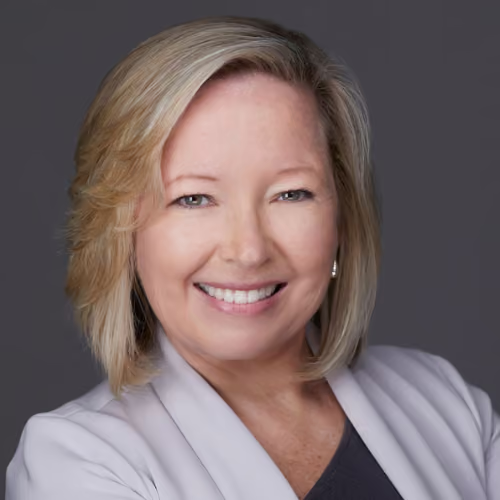
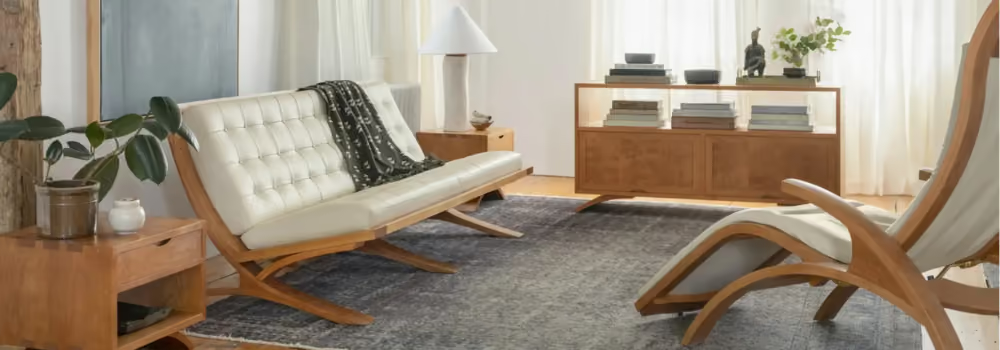
Host: Brand is not a feature of businesses that we typically see down here in the lower lower middle market. Sure there might be some local name recognition for that plumbing business, but a true consumer brand, one that anchors its product or service in quality that means enough to command premium prices. A business like this is unusual. Well, one of the most respected small business acquirers in our world, Chenmark, recently bought just such a business. And Philip Hussey, who sourced and now runs it, is here to tell us all about Thomas Mosher in the process to acquire it. Thomas Mosher is a high end furniture maker. Think $10,000 dining room tables, think the sort of desk that Steve Jobs would buy for his home office. This is a if you know, you know company and brand and Philip's role now will be to take it to a wider audience. I comment to him about how this fundamentally consumer product company seems atypical for Chenmark. Philip's answer is that on the contrary, durability is what Chenmark cares most about and Thomas Mosher the company has demonstrated that. And then when you consider that the craftsmanship of Thomas Mosher products is intended that they might endure 100 years, you see how the spirits of the two companies rhyme. Here is Philip Hussey, CEO of Thomas Mosher. Welcome to Acquiring Minds, a podcast about buying businesses. My name is Will Smith. Acquiring an existing business is an awesome opportunity for many entrepreneurs and on this podcast I talk to the people who do it. You know Enzo Technologies as one of the leading IT managed service providers serving the search community led by Nick Akers, an Acquiring Minds guest who bought the 35 year old business. The team at Inzo regularly works with searchers and their acquisitions and one feature of acquired businesses that Enzo is seeing over and over is the need to implement cybersecurity promptly during the transition. So many acquired small businesses either have glaring vulnerabilities, lack security best practices or both. That step one to de risk the deal you just closed should be addressing these issues. Inso is your full service IT MSP for post close stability. They assess your target, surface the biggest risks in plain English and give you a day one through 30 plan to cut exposure, prevent downtime and even find cost takeouts like bloated telecom bills. Check out enzotechnologies.com on or email Nick directly at nick zotechnologies.com Philip Hussey welcome to Acquiring Minds.
[3:24] Guest: Thank you, great to be here.
Host: Philip, you're the CEO of Thomas Moser, a high end furniture manufacturer in a recent acquisition by Chenmark. Now regular listeners will recognize that name. For those who don't know. We'll explain Shenmark here in a few minutes. But. So this conversation will give us a look inside one of Chenmark's most recent acquisitions and I think, fair to say, an unusual one for Chenmark. We'll get there, but let's start with some background on you, Philip, please.
Guest: Yeah. Well, first of all, Will, thanks. Thanks for having me this morning. I'm a sort of fan. Fan of your. Your work and your podcast. So excited, excited to be here. Thank you. So I. I guess by way of introduction, my name is Philip Hussey, sort of have the privilege of leading the Thomas Moser team. I've been in this seat coming up on 11 months. I've been in the Chenmark ecosystem for a little over five years, five and a half years. Prior to leading Thomas Mosher, I was CEO of Outer Wind Landscaping, which was, or it still is, a design build landscaping company based on Cape Cod. And prior to that came through the Chenmark General Vice President's program, which is a leadership development program that our founders started pretty much five years ago as well. So I'm.
Host: Were you number one? GVP number one.
Guest: There wasn't a program when I started there. Technically a colleague was number one, I guess, but I count myself in the first. First three, so.
Host: So. Okay, great. By the way, the business in question today is Moser or Moser. That.
Guest: That is a good question. Depending on who you ask, you get different answers. I say Thomas Moser.
Host: Okay, Moser, like Ja. Okay, I'm going with. I'm going with what the CEO says. Let's now explain Chenmark a little bit. Again, a lot of people will already know. How about I take a stab and then you fill in the blanks?
Guest: Absolutely.
Host: So Chenmark was founded by three co founders. Trish Higgins, her husband and husband's brother. So that's Trish and Palmer and James. James Higgins. Right. I know James the least. So that's why I get a pass for momentarily blanking on his first name. James Palmer and Trish. And with the idea that. So popular now that small businesses represent a really interesting opportunity and are available for pretty low multiples and you could perhaps buy one and reinvest the earnings of that into buying more and build something really interesting. They have gone on to do that over the last probably 10, maybe 11 or 12 years. It's quite an enterprise these days and an assemblage of a lot of small businesses that are the type that we feature on this podcast. Everything, everything from as you mentioned landscaping to now furniture manufacturing to boat kind of tourist boat tours. There's a food manufacturing like a baking something in Canada and, and, and much, much more. It's really an inspiration to our community. And they have this GVP program which is I guess more formalized by the year. You were among the top three when it was kind of just getting going where part of the challenge of scaling something like Chenmark is finding talent to lead these many businesses that they acquire. And so this general is vice president program is their program to kind of cultivate bench talent that then goes into, to run these businesses and I guess also go out and find them because I think that was the case. Your case. What did I miss there, Philip?
[7:13] Guest: Yeah, that's exactly right. I think you know at some point maybe you should come join the Chenmark marketing team. You did a fantastic job. I think the, the one of the key components that makes genmark special and as James likes to say the anti private equity group is that when we're, when we acquire business we do so with the intention to hold it forever. So much so that we actually don't include an exit valuation in our underwriting because we actually never plan to sort of derive value from that business from selling it to somebody else. And so you add that long term holding period in with the additional fact that we're not running money for other people so we don't have outside investors and it creates a pretty special opportunity set where we get to sort of control our own destiny and drive investments and reinvestments in our companies sort of where and how we see fit. And that's set made a special, pretty special 10 years. And I think if you talk to James, Trish or Palmer they would say we are very much in the early innings of, of the genmark story.
Host: Yeah, no, excellent, excellent additional detail there. Long term hold no outside investors that much more powerful. And yeah, I mean Chenmark's not super public about its aggregate numbers or public at all. At least I haven't seen any but I can, I can only imagine what they are today. And this is the life's work of the three founders. So and they're only 10 years into a maybe a 50 year project. So it's going to, it's going to get scary big here over the years and, and of course the, the, the word of choice in the whole Chinmark approach is compounding. I mean the compounding effects here are going to be scary and Well I
[9:09] Guest: think I'd also add that there's a reason you don't hear a lot about genmark acquisitions because we believe that each company should stand on its own and be able to exist without some fancy holding company or private office somewhere. But it really is a decentralized organization and the, the sort of power of Chenmark is in the operating companies and not some special sauce in, in an office, you know, in some executive office building. It's people every day showing up sort of day in, day out doing the work. And that's why we focus on our operating companies and not, you know, how to build a holding company or the special, special ingredients of making a deal. Sometimes it's just about doing it.
Host: Yeah. Well, another great detail that you added there, Philip, because I subscribe to Chen Mark's newsletter which comes out every Friday night, evening, and they're usually kind of short thought pieces on the knife fight of, of small business. Yes, it's not about, sometimes there's big picture stuff about building something big, but oftentimes it's about the in the trenches realities of what, of what this, of what Chenmark's building and how it's just the, the uncomfortable blocking and tackling of small business.
Guest: The fun block, blocking and tackling, that's the job. So everyone likes to talk about capital, capital allocation, but that is such a fraction of what any operator will do, as most of your listeners probably know.
Host: Well, so you said, Philip, that you were five years in the Chenmark ecosystem. So we don't need to hear the whole, but you know, give us a. What does that mean? And then how did they, how did things change to where you are now?
Guest: So I joined Chenmark right out of business school. I say I went to business school to learn where Excel is on the computer. I'm proud to report I found it and so no know where it is today, but I joined right in 2020. It was Covid. There was no formal program, there was no job posting. But I had gotten to know Trish through various conferences in the sort of greater southern Maine area before business school. As I born and bred in Manor and called Trish and said just to network. She said, what are you doing after school? I said, I have no idea. She said, why don't you come work for us? I said great. And it was pretty much that simple. Uh, and early on I joined one of our landscaping companies in southern Maine. There was no outbound sales team, so I joined to sort of lead and grow an outbound sales sales team. That company did a tuck in acquisition. So I moved companies anyway 20 minutes north to Lead lead a branch of one of our landscaping companies. About nine months after that an opportunity came up to run our company on Cape Cod. And I sort of said that sounds like fun, that sounds like a challenge and jumped in for three years down on Cape Cod, leading that company with the idea that Maine is home. My wife still lived in Maine and I wanted to find a way to get home. So always had sort of one eye back back up north talking to folks looking for opportunities, knowing that at some day I wanted the. The idea was to live in Maine and run a company in Maine and was lucky enough that Thomas Mosher sort of crossed our radar on a couple different fronts and it worked out
[12:45] Host: right. So in this main point is is also another good detail. So Chenmark itself, Chenmark Corporate in quotes is in. Is in Portland, Maine. You are a Mainer. And Thomas Mosher, the acquisition that we're going to talk about today, also a Maine based business, Chenmark Buy as we just heard, Chenmark buys businesses outside of Maine and outside of New England in fact. But I assume they're, they kind of have a concentration of business, their businesses is in that region, correct?
Guest: Yeah. About a third of our companies are in New England and then we have collection in the Southeast. We have a handful in Canada and one in the Midwest now as well.
Host: Great quick aside, but I think valuable for the audience so I, I'll bring this home, I promise. I just had another interview with Robert Gayden who bought a home care business and we talked about how when he first got into the business he was really focused on operations and learning the operations and, and creating efficiencies and improving the operations, refining them and less on growing the top line, less on good old fashioned sales and marketing. And we kind of have this conversation around. We do a segment where it's my observation is that many searchers are focused on improving operations. That's their. The first thing that they think about because perhaps they're just. They go in with a certain bias because the narrative in Search Land is that these small businesses are so inefficient and you can pull a few, you know, make a few tweaks and you know, free up some cash flow. But then this was a reference to another conversation that in fact maybe the best lever of all to pull is just growing sales like any business. So I'm just interested to hear that you stood up a sales, a formal sales operation in a landscaping business. Any thoughts on that? On, on sales and small business broadly?
Guest: A lot of thoughts. I don't know if I have it figured out, I think always very much a learning process. But the related to the landscaping world. The what, what I found is the best way to grow sales is to get out there and do it yourself. And you can hire sales reps and you can try and go, you know, send a million emails, but the only way to learn is to pick up the phone and call. And so when I my first job is at this business essentially was looking at Google Maps, finding large parking lots, calling the facilities director and say can we plow your lot and log that? We were using HubSpot at the time, log that in the CRM and then make sure you call them every year for the next two years, three years and eventually they come around. And so it is very much a. I like to say sales is a contact sport. The best way to do it is to do it. And you can't over engineer your way to success. It's sort of short term compounding do the activities and good things will follow consistently. Right. And that's the key.
[16:00] Host: And do you feel Philip, that many small businesses are under sailed?
Guest: That's, that's a good question. Oftentimes I think it's the hardest part to invest time and energy and attention because you're trying to. It's harder to imagine what could be. Particularly in small business it sales is such a relationship game that oftentimes the owners own the relationships and they get to call a buddy up. If it's in the landscaping world, they know the property managers, they've been working with them for 20 years. It's more natural, right? They're sort of already ingrained in those communities. If you're not, you have to make an sort of extra effort effort to get into those communities, get into those networks and show up. It's less of a cold call, hey, can I plow your lot? But how do you go to the chamber event? How do you sponsor the little league games and consistently be there? And that's how you build trust, sort of. No matter how good your drip email campaigns are on like pretty pictures of snow removal, that, that doesn't build trust, right? Showing up with, with a six pack or with some collateral or sponsoring a little league team or grabbing a meal, that builds trust. And ultimately at least what I've found in B2B sales, it's about relationships first and then value second.
Host: What do the following acquiring minds guests all have in common? Doug Johns, Morley Desai, Tim Erickson, Chirag Shah, Shane Ursum, they all went through the acquisition lab, the accelerator in community for people serious about buying a business, but they represent just a sliver of the Lab success stories. The number of deals across the lab's cohorts now stands at over 120, with over $300 million in aggregate transaction value. The Acquisition Lab was founded by Walker Deibel, author of Buy Then Build, the book that introduced so many of you to the very idea of buying a business. The Lab offers a month long, intensive, almost daily Q and A sessions with advisors, live deal reviews with Walker, Deal team introductions, and an active community of serious searchers. Check out acquisitionlab.com link in the notes or email the lab's co founder, Chelsea Wood. Chelsea buythenbuild.com let's return to your story. So how does Thomas Mosher appear on the radar of you of Chenmark?
[18:45] Guest: So growing up in Maine, I've known about Thomas Moser since before before I can remember. I grew up also in a Maine family business, a main family manufacturing business in southern Maine and so followed generally main businesses and main family businesses my entire life. I had a front row seat to our our family's business as my dad ran it for for 25 years and so was always intrigued about the main business community. And the brand that Tom and his wife Mary built here is iconic. The furniture is incredible. They have a amazing story. So Mo, I'd say most Mainers, at least in the business, in the business world and beyond, know about Moser. And so as I was, I never stopped searching for main businesses while I was in Cape Cod. And so I when I was home on the weekends, I'd send notes at night, etc. And was lucky enough that the Mosers responded to one of my, one of my emails sort of simultaneously. They had a advisory board who had a connection, sort of a second degree connection to Trish, one of the GenMark partners. And both, both of those sort of emails collided at the same time, you could say, and presented the opportunity that the Moser family was starting to think about a transition and heard there was another family family business in Portland who buys and you know, hold small businesses and would we be up for a conversation. And we were off to the races from there. And that first conversation or first email I believe was in March of 2024.
Host: Okay, year and a half ago. And when you sent your outreach to the Mosers, was it part of some sort of kind of drip campaign or, or I should say kind of cold? Well, it was cold, I guess. How personalized manual was this email?
Guest: Did you completely manual why?
Host: And why? It wasn't just in there with a hundred other emails that went out in some automated drip.
Guest: No, generally that's not. That certainly wasn't my process and that's not generally the GenMark process. The I actually I had a connection I had sailed growing up with one of the moer grandsons so knew the family at least tangentially had given or at least had been around Moser gifts being given before. Just it's a very personal story and I tried to draw the main family business connection and the more personal an email is, the more likely you know some somebody's going to respond to it.
[21:28] Host: And who in the family did would you send this email to?
Guest: I sent it to the his title as chairman of the board. He was Tom's son Aaron at the time and he had run the business for a while and then was in a board chair role.
Host: It's okay.
Guest: Okay, great.
Host: And at Chenmark as a GVP or effective GVP as you were. So does that means that you also search or there's the expectation that you're eventually going to be the actual the one to do a search and find a business to bring into Chenmark. Say more about that.
Guest: So the, the leadership Development program, our GVP program has three stages. Your first stage, you'll come in to what I'll say is hq, which makes it sound bigger and fancier than it is, but that's either in Portland or now we have a regional office in Nashville. And so you'll spend I don't call it six months to a year. And these are sort of rough timelines. But in stage one where you'll both do some search activities so connecting with small business owners, brokers, you know, sort of adjacent accountants, lawyers, etc, sharing the Chenmark story and. And you'll also do consulting projects for any one of our small businesses just to start to learn what life in a small business is like. After that you move into what we call stage two, which is a leadership position on an executive team on one of our small businesses. So you'll go be the cfo, coo, head of sales, chief, people officer, sort of any number of positions based on the needs of any one of our operating companies. Again, you'll do that from a year to four years and beyond depending on your situation, the company's needs, the skills you need, et cetera. And then as we are onboarding new companies, anybody who's one of our number twos has the option to raise their hand and I'll say apply in quotes to run the new operating company. So the odds are, I'd say you probably won't run the company that you find because you may source it or have a great conversation early in stage one, and that may lead to an acquisition five years down the road, but there's no presumed ownership. What we like to say is search is a team sport, and we do that by going out and having just great interactions with people and specifically small business owners and people who know small business owners. And the idea is that when they're ready to transition, they'll remember us and that we'll stay in touch. And even if it's seven years from now, we can sort of authentically say we're going to be here. And if we can help, call us. And if it's a good fit for us, great. Would, you know, love to take a look. And if it's not, maybe we can help you find somebody who would be a good fit and so try and be able to fill that matchmaker role as well.
[24:29] Host: But you were far along enough in your tenure at Chenmark to. And also source the deal to. And it was in Maine, which I assume you communicated to Chenmark, your bosses that you wanted to get back to at some point, that it was. If you guys got. If you guys did in fact go through with buying Thomas Mosier, that you'd be the obvious candidate to run it.
Guest: Generally. Yeah. When I accepted the position on the Cape, it was with the understanding that eventually I'd come back to Maine. Um, and there was no sort of mandate go find a company in Maine. Um, but my perspective is good things happen to people who go out and try. And I knew if I, you know, help find a business, I'd be that much more likely to run it. Um, but it. We're a small enough group and sort of our mantra is be up for the adventure and know there. There's what we have done, but what we will do is, you know, anybody's guess.
Host: So super cool. All right, Philip. So now let's start turning our attention to Thomas Moer. The business itself. You have said that it's iconic in Maine. I hadn't heard of the brand, but in ahead of our pre call, I was looking at locations that it has, retail locations which aren't many, but they are in. In some of the most premium retail markets here in Georgetown, in San Francisco. So it's a. It's a premium brand with some retail locations that are in very select locations. Say more about the reputation and brand of Thomas Mosher. Yeah.
Guest: And Maybe I'll take a step back and would it be helpful to get a brief history of the company?
Host: Yeah, please.
Guest: So we were founded in 1972 by Tom Mosher and his wife Mary. Tom was a debate professor at Bates College here in central Maine, a liberal arts college. He came to Maine sort of through the academia world. He was orphaned at the age of 18, ended up putting himself through school, had a professorship in Michigan, and then took a job at the University of Maine in the late 60s, early 70s, eventually making his way down to Bates on a tenure track position on the side. He was always fixing stuff, fixing up homes, fixing furniture, all sorts of sort of handiwork. And they had four young kids and trying to get by. And while Tom was sort of the craftsman, Mary was the brains behind this, selling this stuff. And then in the early 70s, they decided they could make a go of this business. And he quit his, his professorship job teaching debate and launched Thomas Mosher Cabinet Makers. And what was particularly special is that there were two things happening in Maine at that time. One was the back to the land movement. So you had people leaving Boston and New York, finance and legal jobs, coming to central Maine to sort of go back to the land. And building furniture was something that those folks felt were real and authentic. So he had that pool of talent, but he also had a Shaker community. One of the last Shaker communities in the country was here in Maine. And the early furniture was Shaker inspired. And a number of those pieces we continue to, to produce today. And so Tom had this, this talent pool that he could tap into to help grow the early business. And that was in the early 70s, and it expanded pretty quickly from there.
[28:25] Host: And so it started as a cabinet maker.
Guest: We called the cap, he called the cabinet making. It was really furniture. But the people making our furniture we still today call cabinet makers.
Host: Interesting. Okay, is that, is that a term of art in wood furniture manufacturing or is that just an idiosyncrasy of Thomas Moser?
Guest: That is a good question. I actually, I don't have the answer to that.
Host: And you said that he was the craftsman, so he was the talent initially. But to build a business of any size, obviously there are going to be a lot of craftspeople working there. And you said that actually it was his wife who was the business minded one. So how did that relationship between the two of them evolve in the organization?
Guest: So I can speak to as best I know it, Tom passed away this year in March, in his early 90s. Mary, his wife, is still alive in in her late 80s and was lucky enough to get them. Get to know them both a little bit. But Mary, I'd say was ahead of her time on the marketing side. Early on she was ab testing ads in the New Yorker. And what she would do is on sort of not just the New New York or the magazine, but number of newspapers, the road they. Where they were originally making furniture out of a Grange Hall. It didn't have a house at every single address. So imagine you have a house at 19 and a house at, you know, 42. You have all these addresses in between that you could use. So she would make the return address of how people would order furniture different, different addresses on that road, knowing that the mailman in New Gloucester was going to get it back to Thomas Moer. Cabinet makers, because there was only one cabinet maker on that road. And so that's how she was sort of ab testing collateral before that was even a thing. Which just, just blows my mind. And the other Tom, that's so clever. Tom was a larger than life personality as. As far as you think about design and storytelling and connecting with architects and sort of doing what he, what he knew was right, regardless of the data behind it or the sort of logic, just pure gut instinct, which was incredible. And what you want from a designer, I'd say Mary was laser focused on making sure there was a system behind it and that there was a connection to the customer. And between the two of them, it created a force to be reckoned with.
[30:57] Host: Yeah, what a great combination. What a neat history.
Guest: I'd say the. The company could easily be called Tom and Mary Moer instead of just Thomas Moer.
Host: Okay, Philip. Well then take us up to 2025 when you reach out to them. What does the business look like then? Or 2024 last year?
Guest: Absolutely. So there's about 100 employees here. We have 60 or so craftsmen. We have four retail locations. So we have one in San Francisco, we have one in Georgetown, as you mentioned. We have one in Boston on Arlington street just off sort of the. The famous Newbury street shopping corridor. And then we have our location in Freeport, Maine, just down the street from. From L.L. bean. And so those are our retail locations. The business, about 75% of the business is our residential business. So that's. If you go to Thomas Moser.com you'll see a whole host of various residential products, whether it's beds or chairs or dining tables or case pieces. That's what we're most well known for. That 75% of our business. 25% of our business is what I'll call the contract world. And so that's selling pieces of, you know, sort of pieces of furniture to large institutions. Think Harvard, Yale, the New York Public Library, a whole host of prep schools up and down the east coast and even into the Midwest, generally through architects, but sometimes direct to schools. So those are the sort of two functions of the business.
Host: The.
Guest: I'd say the. From a contribution margin perspective, the contract produces more of the contribution margin than the residential line. But the residential line is hands down what has built the brand and why people know us and why people come back and feeds the design of the contract market.
[33:09] Host: And how does it work in furniture manufacturing land? You have your own stores where it's all your product does. And so like. But like a room and board or a design within reach are different. They're not selling product that they've manufactured or they've contract manufactured it. It's got their name on it. Sort that out for us.
Guest: That's correct. Yeah. So we're vertically integrated. So everything that we sell, we build. And that has the blessing of we own quality. And we are known for quality. And to give you a sense for this, we own quality. We actually have no quality department internally. What we do have is craftsmen sign the piece, the pieces with their signature, and they date it when they make it. And so we have people who have put thousands of pieces of furniture out into the world. And when you're gonna. Tom believed our furniture should last longer than the life of the tree that it came from. And so we cut the trees down or we. We have a partner, another family in New Hampshire that is the aggregator of our lumber. They cut trees down between 80 and 120 years old. Our furniture is designed to last at least that long. And so when these craftsmen are signing something that is going to be out in the world for 100 years, they want to be very proud of it, knowing that it's going to last longer than they're sort of. They'll probably be alive. And so you combine that, the signature component, and then you ask the person next to you to. We put a flashlight on every single piece. And you get sign off. They don't actually sign the piece, but you get sign off that, hey, this piece is done and it's okay to sort of head out to shipping and to a customer. And that's our quality department, which is pretty special. And circling back to the contract manufacturing question, that generally doesn't happen when you don't own your manufacturing. Right. That Sort of level of pride in that connectivity is rare and something that makes this place special because we'll hear from customers, we'll get an email saying, this is an incredible piece of furniture. I see Seth built it. Can you make sure he gets this email thanking him for my wedding gift? And then we walk out onto the floor and give it to Seth. And that creates this pretty unique flywheel of reinforcing why quality is so important, unfortunately. Right. The sort of downside of owning your own manufacturing is that the. You have to manage capacity both in the good times and the bad times. Somebody like room and board, who doesn't manufacture, hey, if they're not selling through, they have the luxury of just not ordering. We don't. We don't have that luxury. Right. So we have craftsmen that we need to keep going here in Auburn, Maine. And you don't have as much flexibility in ramping up or down. Down your manufacturing component. And so sometimes I envy those. Those traditional sort of retailers just own the brand. But when you look at the furniture, we don't really compete against them because of the quality that we're making and the relationships we have with our customers. So it's easier, but I don't think it's better.
[36:27] Host: I'm sure that they would have all kinds of reasons why. Why their business model is challenging. Like.
Guest: I'm sure. Yeah, I'm sure. I'm sure. Yeah, yeah.
Host: But we have those.
Guest: We have those challenges too, though. Right. Because we. We have the. We have the storefronts. We don't have as many as they do. Right. But we're still. If you're competing for store frontage and attention, units and eyeballs online and all of these things, we do that too. Absolutely.
Host: So, yeah, yeah, great point. And so give us a picture of the business, like, from a financial perspective, how, you know, what does that look like in 2024 when you start looking?
Guest: Sure. So doing about $20 million plus or minus in. In revenue, I'd say there's about a 5% margin, sort of EBITDA margin on it, which candidly showed us there was a lot of room for opportunity because it's an incredible brand. So the idea was that the brand was worth more than the business, and how can we tap into that to. To. To go drive value for everybody at the company?
Host: So that's really interesting. So just to underline this for everybody, this is a business with this incredible brand and history and culture, but it's kind of limping along. It's not doing that well for $20 million business generating a million bucks in cash flow, call it, you know, 5%, that is, you would think that it could do better. And so your assessment is, you know, it should, could, it could do a lot better. And we can't value this based on EBITDA loan because there's going to be a lot of goodwill allocated here in namely in the brand. But how then do you go about valuing a brand?
Guest: So I think there's two components. There's an operating component to this and then there's the sort of deal structure component. Taking the, the latter piece first, the deal structure component. Thought about it from a potential for, I guess, asymmetric returns. And so hey, what could write look like? And understanding, sort of understanding who we could be. But from a valuation perspective, we're able, from a, we're able to do it pretty in line with how we think about most of our businesses. And for all your listeners out there, right. And most, you know, from. On a multiple of ebitda, not crazy. On most small business acquisitions, we're in line, sort of in line with that. But we're able to think about structure from an earn out perspective with the owners saying, hey, if, you know, we can figure out how to grow incremental value here, there's an opportunity for that value to be passed along to the family as well to, you know, align incentives there.
[39:40] Host: I see. So in fact you did value it according to kind of a traditional, a traditional multiples based valuation. And then that value of the brand that I was leaning into it, leaning into so heavily a minute ago is really just asymmetric upside. It's, that's kind of coming along for, for free, if you will.
Guest: Yeah. Correct.
Host: Yeah. Okay, well that, that's pretty exciting.
Guest: I'd say come along with hard work. So
Host: it's that easy.
Guest: Free what you do.
Host: Is it easy? Yeah. Okay, but, but you are in fact value, you bought the business on a multiple of EBITDA and in the way that some no name furniture manufacturer might have been acquired at. But in fact, in this case, what also comes along for the ride is this incredible brand. Correct.
Guest: And an amazing team like you cannot buy and you cannot teach this quality. It is something like special about the people here who've been doing it. I think our average tenure is like 15 years and a third of the workforce has been here over 25 years. It's.
Host: Oh wow.
Guest: Simply remarkable.
Host: Wow.
Guest: And so I view my job as not to mess that up.
Host: Yeah. So as we have heard, Thomas Moser is a Storied brand, a very well known brand in Maine and probably regionally. And so one thing you'd said to me offline is how there's maybe a little bit more of pressure on you because you're not, not just, you know, carrying forward a business, but carrying forward a business that has a brand that means something to people beyond just inside the business versus, you know, so many of the businesses that Searchers buy where, you know, there isn't a big brand there, there might be, you know, a small local brand or a lot of, you know, five star Google reviews. There's, there's kind of brand equity, but not a brand like there is in this case. And so that, you know, probably brings a little bit more scrutiny to you, like your, your people are watching. Is that, do you feel like that's an additional level of, you know, pressure on your shoulders?
Guest: I don't know if it's pressure, but it's definitely something that I've had to get used to. There's been a handful of requests, whether it's from local or regional publications, alumni magazines, through groups like that, that want to connect, want to talk, want to come and do visits and photo shoots. And I'd say generally I haven't had a sort of public, public role. And I think you add to the fact that the name of the company is the founder's name, Thomas Mosher. I am decidedly not Thomas Moser. Right. My name is Philip. I'm not a furniture designer. And so I've had to do a lot of thinking about how I can steward and champion this company and this brand without having it be as personal to me as it was to Tom, or how what do I need to do to make it as personal to me, even in my own way? And I'd say that's something that I'm still working out. But. And I'll credit one of, one of Chenmark's founders with this saying that when you step in to run a business, you should do it in a way that's authentic to yourself and not try to be somebody else. Because when you try to be somebody else, you'll fail. And so as I talk about what I love about this business, it's the craftsman and the customers and the fact that we're doing something incredibly special in Maine. And so I'm leaning into that and we'll see how the next decade and beyond go.
[43:26] Host: So we see this dynamic in trades businesses and plumbing businesses, let's say, where Searcher buys a business and doesn't know, frankly, the first thing about plumbing, and there's, of course, a craft there, but yours is, you know, that times 10. This is. The whole business is craftsmanship. It's craftsmanship forward. We could say so and, and so in the plumbing example, you know, there's, there's the awkwardness of needing to demonstrate one's value as a searcher who bought a plumbing business when you don't know the first thing about plumbing. I imagine that's more acute here. How has, how have the craftspeople taken to being acquired by somebody or being run by somebody who is not a craftsperson? Does it seem. Are you going through the same sort of credibility gap that so many searchers do, but worse?
Guest: I wouldn't say with the craftsman. They're incredibly gracious, incredibly generous. Tom's big statement was, I'm not Thomas Mosher. You all are talking to the craftsman. And Tom, even after he left teaching, he forever was a teacher. And that's what he's instilled in all the craftsmen, is that you are now the teachers and the stewards of the brand. And I view my job as just to champion them who are championing Tom's ways. And so there's not a holier than thou approach. Any number of them, any one of them on the floor will say, hey, let me show you how I do this. And, and they know, they've been doing it for 10, 15, 20, 30 plus years. And don't expect that I'm a fantastic craftsman. And that's what makes a team. A team is everybody brings sort of different talents to, to the ball game.
[45:09] Host: Yeah, yeah. Well, and actually, but maybe the fact that because there's so much craftsmanship in this brand and what is being produced, sold by this company, it's actually, it actually takes a little bit off of you because there's no possible expectation that you could, that you could, you know, do something like what they do. So, so maybe it actually relieves you of, of any obligation to, like, really, you know, know the technical, know the technical art of what they're doing?
Guest: I, I think that's exactly right. And I'm. I'm learning. I'm halfway through building a chair that I started eight months ago with one of our craftsmen. And I'm also incredibly candid with our customers when they ask if I'm working a showroom or on the phone. How long have you been there? I'll say I've been here 11 months. And here's what I'm interested in about the business. I'm interested in the craftsman experience and the customer experience. And here's where I'm spending my time. And they're lucky that I'm not making the furniture because that's what makes it so great. Um, and that's the piece that I've gotten comfortable, comfortable with saying I don't know. And we have people who do.
Host: The team at Pioneer Capital Advisory has started offering peripassu debt for SBA business buyers. That means they can help unlock up to $3 million of conventional debt on top of the $5 million limit of SBA 7 loans. So Pioneer can structure larger, more complex acquisitions. Listen to our story with Anika John from one of their clients who did just that, buying a $10 million business as a first time self funded searcher. The Pioneer team has closed more than 100 SBA loans, averaging timelines well below industry standards. Founder and owner Matthias Smith and COO Valerie Stash bring over two decades of SBA lending experience. Matthias and Valerie have a full bench of analysts and associates who work your deals with them. A true deal team. Not just a single point of contact. Visit pioneercap.com or click the link in the notes. Yeah, and so going back to the structure then this was you, you mentioned earnout. So was there, was there. How much structure can we talk about here? It was this like, you know, at that size of, you know, 5% margins on 20% revenue. 20 million in revenue. That's almost like SBA able. Is that what you guys did?
Guest: We, we didn't, we didn't do that. I mean there was a sort of cash component at close and then traditional debt, seller debt, seller debt and traditional debt. So not, I mean it's probably not worth getting into sort of the, the details of the, of, of those, those two. But not too different than a traditional deal plus and earn out.
[48:09] Host: Okay, great, Philli. So what is the plan then for Thomas Moer? We've been kind of speaking around it but, but make it concrete for us what the, what the vision is here other than not screwing it up.
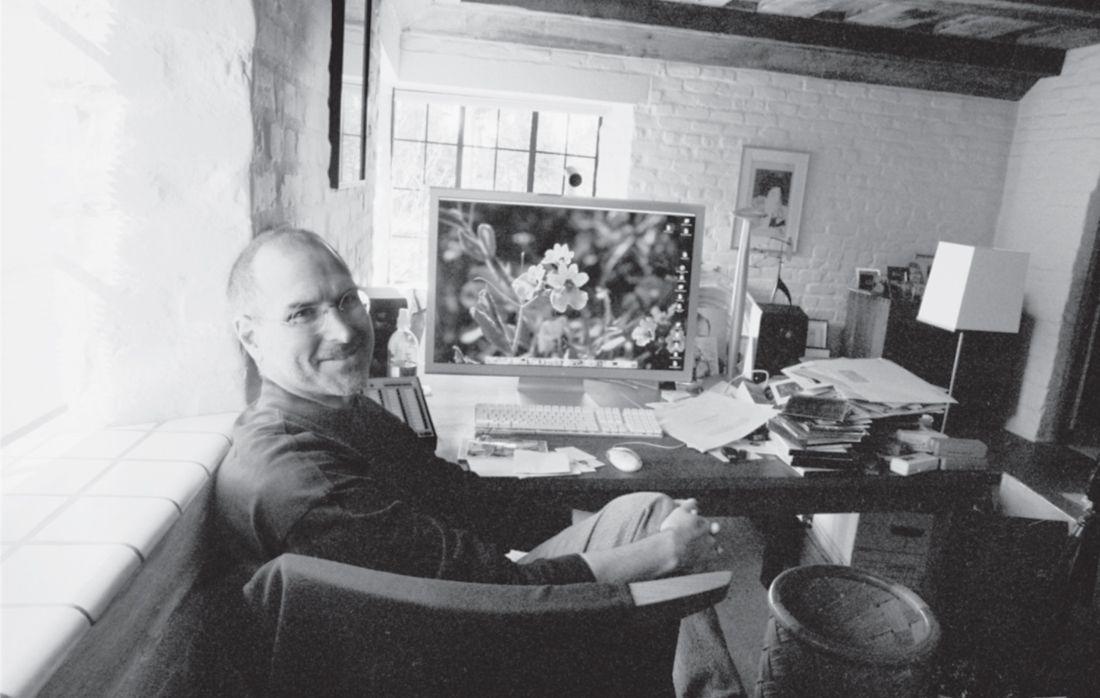
Guest: Yeah, so I'm a big fan of the flywheel. So the how, what is the Moer Flywheel I spent sort of meaningful amount of time thinking about and so maybe walk you through that to provide a little bit of a framework on thinking about it. And so if there's one thing we do really well that's make world class products. And they're amazing. They truly are world class. We presidents have sat in them, popes have sat in them. Steve Jobs has our, or had our desk. If you open up the wall, Walter Isaacson book. The inside cover is Steve Jobs sitting at a desk in an empty room. That is a Mosure desk.
Host: Wow.
Guest: It's amazing. Yeah. We've had incredibly iconic people sit and use and live with our furniture. And so I am just so certain of how world class our product is. And so what should you be able to do with that is you should be able to command premium pricing and high margins. We've since 2008, the company has leaned on discounts to drive volume. If you think design within reach, Herman Miller, Blue Dot, any of these more traditional brands, they also do that. We don't want to compete in that space. Right. We have been giving away margin dollars on discounts in a, in a meaningful way that I actually think is brand like dilutive to the brand and hurts where we can reinvest in the business. So if we're confident we continue to sort of make sure we're producing world class products, I. E. Don't mess it up. Right. Do whatever we can to retain these craftsmen that should be able to command premium, sort of premium margins and high prices. And with that, can we use that to go back and improve the craftsman's experience? Right. So essentially how can we keep and improve the lives of our, our craftsmen here on the floor to make sure we have the world class talent who can deliver that world class product? I think the other caveat I'll add, so that's your, that's your flywheel is product, higher margin, world class talent. Keep going, going and going. Is we're trying, we're thinking how we can improve the experience that goes along with that product. And viewing that as a separate, a separate product really is when you order your furniture today, it could take anywhere from 12 to 18 weeks depending on, you know, what you order and when you order and yada, yada, yada. But there is an experience going on with that as well. And how can we make sure we are sharing the Moser story and having a high touch luxury experience for those folks. So not only do they talk about how amazing the furniture is, but how amazing the build process was, how amazing the delivery process was, how amazing the follow up story was. By the way, did you know you can go for a tour, you can meet your craftsman. All of these pieces have an opportunity to enhance what world class looks like. So that's our process and sort of vision. I think the challenge is many of our, I'll call them backend processes are as handmade as our furniture.
[51:42] Host: And so something tells me you've said that line before.
Guest: I have. And so what that requires is unpacking that in a way to say, how can we make this easier so we can handle, eventually handle more volume, be more efficient in the back office, provide a better customer experience and a better workplace experience. Right. If people are doing less sort of manually entry, manual entry, keying in data, manually processing receipts, those type of activities to unleash all of that talent purely on the customer or purely on the Craftsman. And if we can do that, that flywheel is going to start spinning pretty, pretty quickly.
Host: Can you say more about that? This was. This goes to that just introducing efficiencies right into, into the operations, essentially. Correct?
Guest: Yeah. And I think it's the, it's how you deploy that excess capacity. So pretend you have customer service manually calling people to collect a final payment. So, hey, your furniture is about to be done. I'm going to call you and take. Because we we're made to order. So when you call, when you order a piece of furniture, we're literally going to build it for you. Right? We're not. We don't inventory stuff. There's a handful of products we inventory. But will when you call after this to order the bed, because I know you're going to, we're going to have a guy in the rough, he'll go pick the boards for your bed, right? And we collect 50% up front, 50% on the back end. So if customer service is spending all of their day collecting final payments, guess what they're not doing? Providing wow moments for customers in other areas. So imagine you automate final payment collection, right? Emails, auto charge, whatever. Now you have somebody who can spend half of their day calling customers to wow them, right? What if you knew when somebody's birthday was? What if you wanted to. The woman who runs our front office sends maple syrup to folks when we have an issue. Main maple syrup when there's some type of issue. What if you could do that proactively? So now when you had an issue, but just thanks for your order, your bed's being made. We're going to ship you some maple syrup while you wait. Merry Christmas from Maine. We're not doing that yet, but those are the type of activities that we want to unleash our team on. Because then you, while you're waiting for your bed and you're going to get a package of something or a letter or whatever, you're going to tell your friends, holy cow, I ordered a bed. And while it was being built, I got a product or I Got a note or I got a letter from this company in Maine with, with homemade maple syrup saying thanks for your patience while we build your bed. You're going to tell everybody about that because Design Within Reach is not sending you maple syrup. But in order to free up that capacity, we need to make our back office more efficient. So that, that's what we're working on. Great.
[54:42] Host: Fascinating. And what size business do you think you can get this to like? If it's at 20 million today, could this be a hundred million?
Guest: I see no reason why that can't be a, a target given the, the strength of the brand. The markets we are not in, as you think about luxury markets. We don't have a New York showroom right now. We don't have a Dallas showroom, we don't have an LA showroom. And, and, and, and at various points in this company's history, we've had showrooms in those places. Not in Dallas, but in, certainly in New York, in Chicago and la. And so the more you can be in the places where luxury consumers are, the more brand recognition you get and the faster you can grow. And then your constraint becomes talent and craftsman because it takes a couple of years to get reasonably good, not let alone great at building furniture.
Host: So, and what, and what is the retail strategy? Or maybe, or maybe how much sales flows through retail versus online? I mean, imagine. I imagine you do in some ways there's a lot of deep. Is this at all a DTC business? It's so premium, maybe not very much
Guest: a D2C business, but I'd say it's more like selling a Volvo than selling a mattress. Right. So we do do some online business. It's probably less than a third most folks. If you're going to spend $10,000 on a dining room table, you want to come in and look at it, you want to touch it. It's a sensory experience. And so being there, seeing it, talking to somebody, ma matters.
Host: And so a lot of the sales then are into these four markets, into Maine, D.C. boston and San Francisco. Because that's where your retail footprint currently is.
Guest: Yes, I mean, we're certainly the strongest in the Northeast and up and down the, the Eastern seaboard, West Coast. We have a San Francisco office or, you know, location. We do have a, what I'll call a design center here that responds to we catalogs. We mail out several hundred thousand catalogs a year, and those are getting inbound, sort of inbound sales via catalog. And they're working with folks to help, you know, Figure out what they want and process the order in a way that is probably most folks aren't used to in a call center capacity. Our team may spend an hour or two with, with the team, with somebody on the phone helping them configure a room, go back and forth on email with different pictures, talk about lang, talk about bed height. And so it's, it's split out between all of that, but far less than you'd expect is just direct purchase online.
[57:44] Host: Mm. And so in a world where so much furniture is been offshored, furniture manufacturing has been offshored. I guess North Carolina, like, you know, used to be a big furniture making place and I guess it still is with respect to the US but it's a shadow of its former self. The simple answer to that is that as a. You position yourself as super, super premium, so you're just not targeting a mass consumer audience anyway. As simple as that. It's kind of the answer.
Guest: Yeah, we're not trying to. This isn't a volume game. If you're doing, I'd say craft at scale because it is handcrafted furniture. But we are doing it with more than one person. Right. This is not a guy down the street in his barn. Like there's people ask who we compete against. I'd say generally we're competing against more likely custom furniture makers in your hometown. Right. Who are going to go build that table just for you. But we were doing that with, you know, 60 plus people. And so the model is not to say, hey, how can we go sell this design and have somebody in China make it? Because you lose that sort of personal, you know, approach of knowing your customer and signing the bottom of the table in, in so much that we do, we do a customer residence program so customers can come here and build the table with us and spend a weekend in Maine or a week in Maine experiencing the process. And it's as experiential as. As it is, you know, just, just a table or just a chair.
Host: And how many people take you up on that?
Guest: So it was paused during COVID We're about to restart it this coming spring. We always sell out.
Host: So I hear you say that there. You really don't have competitors. So there just aren't other furniture brands that are essentially making custom pieces at scale. You're really sitting up there by yourself.
Guest: Yeah, there's a handful, but it's. We are truly unique in that, that perspective. There's certainly other expensive furniture out there and there are custom shops out there. We're somewhere in between because it's. We do have known sort of known solutions. Right. You can go on and you pick. You pick what piece you're going to order and you can order that piece. But we are building it for you and we're doing it for you and a lot of other folks too.
[1:00:18] Host: Great. Philip, let's turn our attention back to the relationship with Chenmark. You had said how Chenmark's model is one of high decentralization. All the businesses kind of stand on their own two feet and succeed because of the internal operations and value proposition of those businesses themselves. You had said something to me though about there were financial benefits to being part of the Chenmark family for Thomas Moer. Right. Working capital benefits which of course, as everybody listening knows is just a very delicate feature of small business and particularly in manufacturing. So what benefit did you get there?
Guest: So sort of the, I guess financial benefits of being in Chenmark writ large is that one we're interested in what we need to do to make this business great in a decade. Right. Unless what do you need to do to make it good next year? Right. But we want to be great forever because that's how long we plan to own it. So there's a tolerance for, you know, investments that may have a little longer time horizon. So. So that's one, one component of just access to reinvestment capital is I've never done it in a regular business or sort of outside of the Chenmark world, but I imagine more. More readily available because interests are aligned in building something for the long term. I think the other piece, and this is probably more just an outcome of all of us in the genmark world learning from each other. But we end up sharing stories or outcomes from focusing on working capital and the impact that can have on a business when you can find ways to be more efficient and as you know, peer will do it in another company. I'm like, oh, that's interesting. How can I drive on that in our own business? And you can find ways to fund, you know, we can find ways to fund some of our own growth or our own investments just by pulling out working capital to free up, free up cash to put in other places. And I give you an example if that's. That's helpful, please. There sort of two examples actually found out that we were sitting on probably more lumber than we needed. Sort of how we ordering lumber is we had too much of it. And so the opportunity is, hey, can you do the same with sitting on less lumber inventory? Can you, can you resort it can you get send some of it back. Yes. And talking several hundred thousand dollars worth of excess lumber that great, you can pull that out. Where can you reinvest that? In the sales process, in the tech process, in sort of a number of other areas to drive some of those efficiencies that we talked about earlier. That's one. Let's, I guess let's also use the example of final payments. Hey, what if you could collect those faster and sooner to pull final payments a month forward? So now we automatically send final payments a month before your furniture is going to be ready. So you get all that cash sooner. But it also has the benefit of as soon as that piece comes off the line, we can get it on a truck and sent to the customer so they're not also waiting for their furniture because of back and forth calls for payments. So those are just two examples of how you can look at where, where there's cash tied up in the business and figure out how to pull it out and stick it somewhere else that drives more value.
[1:04:02] Host: Yeah. Wasn't there also an example of your own ability to process cards or something? So when an order comes in, it's 50% upfront. And then of course, course you, Thomas Moer sits on that 50% because it needs to be deployed into the cost of producing the good. But that's over of the piece. But that's over some number of weeks. But wasn't there a benefit of not needing to hold on to all of that, that 50% deposit or something like that?
Guest: Yeah. So credit card companies, if you're taking a large chunk, they're going to want to show that, you know, it's a liability on your books that you still need to deliver this piece of furniture. If this was being run out of one off, you need to make sure you have sort of the cash right to deliver on that liability to make that piece of furniture. We're part of a larger ecosystem, so have the benefit of, you know, a larger balance sheet. So we can tell the bank or the credit card company, the processor in this case, yes, we like we will be able to fund building that furniture down the line and would able to benefit from that, that factor.
Host: I see.
Guest: So.
Host: So a credit card processor say might have been, might have rejected more purchases in the past.
Guest: Not, not rejected, but they just, you need to prove to them that you have the, the, that you're not taking those deposits and putting them somewhere else and going to shut down and you know, somebody's going to be left holding the bag that these Shirts are like, hey, you left with my 50% deposit and I have no furniture.
Host: And.
Guest: And the credit card processors are need to get comfortable that somebody can fulfill on that liability to actually build the furniture. Sure.
Host: Right. I get it in concept. But how did it actually play out in terms of something got better.
Guest: Yeah.
Host: Under Chenmark's ownership where it sounds like before credit card processors would slow down payment processing to call in with you guys and make sure that you're legit or what is the actual essentially just
[1:06:08] Guest: forced the previous company have to sit on those. All those deposits and they couldn't put them to work somewhere because there was no balance sheet behind it.
Host: I see.
Guest: That there were. That furniture was going to be able to be built.
Host: I see, I see. Okay. So you can. You can work with that. The cash that comes in any way you want. You have the freedom to deploy that cash anyway.
Guest: Correct.
Host: Okay, great. So Philip, just if you can. I know, of course this is a very unique business. This all businesses are very unique. But this is your first time in a. Running a manufacturing business, although you did have the family business experience. So you saw a manufacturing business up close. But for anybody, any searcher out there listening who might be interested in manufacturing any What's. What's been your experience kind of just as an entrepreneur running a. Running a manufacturing business really for the first time.
Guest: Yeah. And I'd pro. I. I'd love advice from your audience actually, because I feel like I'm still. Still very new in this. My initial approach to specifically our production process has been not to touch it. I know how unique what we're making is and how special the skill sets are. And so I'm very. I've been very hesitant to come in and pretend like I know how to build a chair better or faster and afraid that if I put my thumb on the scale there, it will take the humanity out of what we're doing. And so we're very much not a production line. Right. We are one person, one piece. And I've tried to reinforce and respect that. And how this business grows is not through building a chair in half the time. That is to me that's a race to the bottom. Chasing efficiencies on the manufacturing side here because of what we're doing. I'd rather figure out how to honestly give people more time. Right. And make this chair furniture even better. Not sure that's possible because it is truly world class. But that's just not a. Not a focus early on for me is on digging the manufacturer, digging in and trying to improve or change, but more just make sure I understand. So as I'm engaging with customers, I can speak to how it happens and sort of the magic behind the curtain.
Host: Yeah, I have to say Philip, that that seems challenging because when I hear you say that the you what. One area of improvement for the business or opportunity I should say is the user experience. And probably the most frustrating part of the user experience of buying a piece from you guys is how long it takes. Now, now in some, in some ways you might, you might argue that that's like creates scarcity, creates desire. It almost, it reinforces the whole, the whole emotional experience of, of, of this thing being created for you at the same time. It's 20, 25, everybody's impatient, everybody just wants it now. So if I'm told I need to wait for 12 weeks for a piece, the thing that's really going to move the needle for me on improving that experience is I only have to wait nine weeks. And isn't there going to be the temptation that you kind of crack the whip. Hurry up guys. Obviously tongue in cheek, but something there maybe.
[1:09:38] Guest: I think it's how else you can satiate that need or not to the point of creating scarcity. Give you an example. We launched a seconds program, essentially pieces that were returned or had to be repaired or didn't quite meet first quality. There's always been a seconds program. It lived here in our freeport location, found a way to put it online so people have more easily, you know, access to that. And hey, if you want a piece and you want it today, guess what? Here, here's what you can get today. If you want something built for you, you know, you gotta wait. And well, people say, hey, can I pay more to jump the line? The answer is no, you gotta wait. And actually during COVID we were up over 30 weeks of waiting and people would. And wow. And that's too long. I think.
Host: 30 weeks.
Guest: Yeah, yeah, that, that is too long. There is a certain period and I'm not exactly sure what that is, but to optimize your supply chain, we are high mix, low volume. And so you can't get really within, you know, two to three months, you start having to like hold, you know, hold more material probably than you need because you don't know when that order is going to come. Given our wide range of SKUs, we've. What we have done is we've switched shippers to accelerate the time it actually lands in your house that we had various shippers picking up sometimes every two Three, four weeks. And so that's adding to the wait time. We have a new shipper they pick up every single week, and that's cut shipping time in half. So where else in the value chain can you provide value that accelerates when a customer gets to experience our furniture?
Host: And what about some giant order from Harvard University? How does that. Does that play nicely with little old me buying a $10,000 dining table?
Guest: Yeah, so it depends what they're ordering, when they're ordering, what our schedule looks like. We have outsourced partners that we can pull in to help build large orders. So we have a partner in Ohio that helps build. Build some of these large scale institutional orders if we need it. And that really just depends on the capacity of our shop and our different work centers. At any given time, we're doing a job for New York Public Library. We do all the chairs in. We have a custom design that was commissioned by the New York Public Library, the Manhattan branch of the New York Public Library. And so most of the branches in New York are our chairs. We're about to build some of those in house. We're ready to get a 500 chair job. You probably wouldn't suck up all our chair capacity, and we'd work. Work with a partner in Ohio to help sort of source the wood, get them, you know, get them the design, inspect the quality. But it would be made externally.
[1:12:42] Host: I see. I see. I was just there weekend before last, actually, so. So your chairs are not yet in the New York Public Library.
Guest: It depends which branch you are. There are a number of branches. Branches that have our chairs. As they're refreshing branches, they can continue to send pos our way.
Host: Oh, okay. I. I assumed we were talking about the one at Bryant park with the lions.
Guest: I. I don't know off the top of my head. Okay, I'm gonna have to go check now, so.
Host: Okay.
Guest: All right.
Host: Philip, anything else that is key to this story that we didn't hit?
Guest: I can't say enough about our craftsman. Honestly, I think that's this. If you were to ask what the secret sauce is here. It's our. Our team building the furniture. As soon as a piece of furniture gets out into the world, it has to last because that's what your brand rests on. And the team here makes sure it's perfect every time. So the rest is all just moving chess pieces around on the board, Right? That's really the secret sauce.
Host: Well, on that, Philip, thank you for mentioning that you're based in Maine and you, you know, a. Not A, a state with a big population, so I imagine finding new craftspeople. You've also already mentioned that it takes some number of years for somebody to train up and be capable to produce a Thomas Moser piece. How are you thinking about increasing capacity with people?
Guest: Yeah, we, we launched a training room. It actually was Tom Moser's workshop here. And when he passed, we set up a training center and actually our shipping. He was our director of shipping. He'd worked here for 40 years. He'd done a number of roles. He'd built custom furniture. He'd build various stuff in the work centers. His name is Dan. We asked him if he'd lead the training center. And so now he is training the next generation of Thomas Mosho cabinet makers. And the idea is that we can bring people in, teach them traditional joinery, and then continue to add tools to their toolkit, if you will, skills to their skill set to be able to build beds and case pieces and tables and continue up, you know, continue up and across our entire product catalog.
Host: And is the pool of people who might be a good fit for this in Maine large enough?
[1:15:03] Guest: We have yet to recruit from a wider field yet. We occasionally we've had folks come from various woodworking schools in Massachusetts or Vermont, but generally I'm bullish about the, the talent pool in central Maine here.
Host: Great. Philip. Well, what a neat business. I love, I actually, I love furniture. I don't claim to be a, a, an expert on it or, you know, know much about it, but I, I, I appreciate a beautiful piece at least. And I love a business with a really strong brand and a legacy business. So there's so much about and of course, I so admire what Chenmark is building broadly. So there's just so much to be excited about here. It's a really neat acquisition. And was it fair to say that this is kind of an unusual one for Chenmark? I said that earlier.
Guest: I think you could, you could say that from a industry perspective. But if you actually look at what Chenmark looks for is brands and companies and goods and products and services that are going to be around for several more decades, I actually think it fits incredibly well within our, in our story because this is a brand that's only proved to grow. And if I was a betting man, I'd, I'd say people are going to continue to want furniture in 25, 30, 50 years. So from that sense, no, not at all. Great.
Host: Good. Note to end on. Philip Hussey, thank you very much for joining us.
Guest: Thank you.
Host: Will hope you enjoyed that interview, don't forget to subscribe to the Acquiring Minds newsletter. We send an email for every episode with an introduction to the interview, a link to the video version on YouTube, and soon key takeaways, numbers and more essentials from the interview. For those of you who don't have time to listen or watch it, subscribe at acquiringminds Co. You'll also find all our webinars there on the website, both those we have coming up and recordings of past webinars. At this point, There are over 30 webinar recordings, a wealth of information on all the technical nitty gritty of buying a business. Acquiringminds Co.





























































%20-%20thumbnail.avif)





%20-%20thumbnail.avif)
%20-%20thumbnail.avif)

.avif)




%20-%20thumbnail.avif)










.avif)