Host: Today's story is a study in not judging a book by its cover. Phil Kohler bought Roman Enterprises, an automotive paint distribution business. Now, Roman had about seven customers. It had essentially a single supplier and it had one, yes, just one employee. Undeterred, Phil looked closely at each of these features and more and decided that he could accept and or mitigate the risk. And there was lots to love about Roman Enterprises. I already mentioned that single employee, a feature that lives in both the pro and con columns. There was also the $800,000 of SDE, a reasonable valuation, sticky relationships, and business buyer fitness. Running this business well is all about supply chain and inventory management and Phil had deep experience doing just that. Here he is Phil Kohler, owner of Roman Enterprises how much will I actually make if I buy this business? That is one of the most common and misunderstood questions that searchers ask. Well, today, Thursday, January 15th, Chelsea Wood of Acquisition Lab will walk us through how to shift from a traditional W2 mindset to an owner's mindset. A mindset that's focused on flexibility, tax efficiency and long term wealth, not just salary. Chelsea will cover why replacing your salary is the wrong question and what to ask instead. What makes up total owner benefit? Spoiler it's more than just the salary in a simple framework to help you estimate your real take home Pay post close that is today, Thursday, January 15th, noon Eastern. Link to register is right at the top of this episode's show notes or on the Acquiring Minds homepage. Acquiringminds Co. Welcome to Acquiring Minds, a podcast about buying businesses. My name is Will Smith. Acquiring an existing business is an awesome opportunity for many entrepreneurs and on this podcast I talk to the people who do it. The team at Aspen HR recently published a short white paper targeted at searchers Entitled A New CEO's Guide to Human Resources. It lays out the key items you should be thinking about as you transition into CEO and owner of the business you bought. The link to download that is in the show notes Aspen HR is a professional employer organization or peo, which provides HR compliance, flawless payroll, robust HR technology and Fortune 500 caliber benefits all for a fraction of the cost compared to using multiple vendors. Reach out to Aspen HR for your complimentary HR diligence checklist and benchmarking analysis. Go to aspenhr.com or contact Jenny Thier directly at jenny@aspenhr.com Phil Kohler welcome to Acquiring Minds.
[3:48] Guest: Thanks Will. I really appreciate you having me on.
Host: Phil, you bought an unusual business. I'd say one employee customer concentration, supplier concentration, but quite profitable. We're going to walk through how you thought about all of that, but let's start off with some background on you, please Phil.
Guest: Sure. So, yeah, I graduated college in 2010, was coming out of the great financial crisis. It wasn't that easy to find a job at that time. And I landed on this small steel company in North Jersey. They were an importer and master distributor of a specialty steel product importing from all over the world. And the company was small, probably like a good size for, on the larger end of the searcher spectrum or maybe for an independent sponsor. So it was small. I came in, I was brought in to do one very specific role. And once I was able to automate that using rerp, it just kind of grew from there. And I was doing, you know, I started managing one customer's inventory, then it was the whole inventory for the company, then it was purchasing, then it was sales, you know. So I, I really had like this apprenticeship of small business and what it was like to be, you know, a number two at a small, you know, maybe 20 something person, 20 people company.
Host: I gather you liked it. I did the small business, the small nature of it. Say, say what you liked about that in particular.
Guest: I, I like that I was able to kind of have my hands on everything and kind of, you know, I could talk to the guy that was doing the shipping and the sales, you know. Whereas later on in my career I, you know, I went to a very large company and you know, it's just things get kind of lost in like this virtual land. You know, you don't know where, what you're doing and how it's impacting everybody. So that's, I really like the small, the small aspect of that.
Host: Great. Yeah, carry on.
Guest: My responsibilities grew at this company. You know, I end up being there for about eight years, six years in. My boss sells the company and he ends up leaving and company still exists. So they bring on a new CEO and that CEO ends up being a very instrumental part of my life. He's a mentor for me. Even tilted to, to the, you know, to this day he knew nothing about steel. He had an investment banking background. But you know, I learned a lot from him then and I, you know, continue to today.
[6:39] Host: Was he a searcher?
Guest: He was not a searcher. He was, you know, somebody that was in investment banking for many years, you know, went to, he was really just a really smart guy, you know, an entrepreneur as well.
Host: But, but he bought the business personally.
Guest: So he, so he didn't. Our largest supplier bought the business and they brought him in and hired him as the CEO. And so, so I had an opportunity to learn from him for a couple of years and then I kind of felt like, okay, I've been here for eight years, I'm a millennial. You know, this is too long to be at one company. And so I, I try to figure out what's next. All right, so I'm going to go to the complete other end of the spectrum and I'm going to look at the biggest companies out there. You know, CPGs, there's a lot in New Jersey. Pharma, big pharma. And so I'm going to get really focused on supply chain, which is what I know really well. I studied that in school and I basically studied that at, at the steel company. And so I go and I end up getting a job at Mondelez. It's one of the largest snack companies in the world. They own all the Nabisco brands, you know, Oreo, Chips Ahoy. And I'd say pretty much within a month or two after I started at Mondelez, I knew that this was, was not the, the right place for me. You know, I, I missed that small business. I missed having, you know, the ability to, to kind of touch all aspects of the business and not be so siloed into to one specific thing. So I think I was kind of searching for what was next and I, you know, read a lot of self development books and um, one in particular I think that was really instrumental in my life was Rich Dad, Poor Dad.
Host: Sure, classic.
Guest: Yeah, it is. I think just, he probably oversimplifies things, but the idea of buying assets that produce cash flow I think was something that was really, you know, mind blowing to me at the time. And I think it, it changed my mindset into, from, you know, earning more money at a W2 so that I could spend more money so that I could buy the bigger house and the nicer car and all of that to let's try to build some financial independence and have these assets that can produce cash flow. And so that kind of started me down the real estate rabbit hole. And we bought some long term rentals. You know, one at a time, we kind of, I dip my toes in, you know, one single family, then two, then three and then, you know, as things, things continue to progress and maybe it wasn't going as fast as I would have liked at that stage. My, one of my good friends tells me, oh, I'm, I'm going to buy a house and turn it into an Airbnb and This was, I think, a newer concept back then, probably around 2020. Not that Airbnb hadn't been around before that, but that's when it really, I think, exploded during COVID And he's like, you might be making, you know, a couple hundred dollars a month cash flow on these long term rentals, but with an Airbnb, you might be able to make a thousand, two thousand. So I was like, okay, this will get me fast. Get, get me to where I'm trying to go faster. And so that was exciting. And so we, we dove into that. I learned about short term rentals. We bought one, we bought a second one. And six months later, and as we're just about ready to get started on the second one, the same friend tells me that, you know, now he's looking at buying a business. And, you know, I'd never heard of this concept at that point, I think. And, you know, he found this website, Biz Buy Sell. It's got a bunch of businesses for sale listed. And so, so I have this frame of, you know, reference of real estate, you know, multiples being, you know, let's say 10 to 20 times, you know, noi. And, you know, maybe a good rental Property is making 20, $30,000 in NOI, you know, if it's an Airbnb, maybe it's making 50,000
[11:14] Host: a year.
Guest: A year. A year. Yeah. And, you know, he tells me that this, we had, we were talking to him about the business and he's like, it's a generator and maintenance and repair and installation company. And you know, so we ask him about the numbers and he's like, it, cash flows $700,000 a year. And I think, you know, the four of the four of us sitting at
Host: the table, mind exploded.
Guest: Yeah, it was definitely a mind explosion.
Host: The four of you sitting at the table.
Guest: The four of us sitting, it was four of my guy friends sitting at, you know, for dinner. We were at this steakhouse. And when, when he said that, I, I can, I can still picture that moment, you know, where time almost stops and you're like, what, what did you say? And you know, again, it's like that moment where I'm revisiting, okay, you know, real estate's good, it's good for building wealth, but this is really, the real estate game is slow. You know, it's, it's, it's a great game. You know, I still, we still have our rentals, but if I'm trying to get to where he is, you know, I can get there a lot faster. If we go out and we can buy a business. So I read Buy Them Build. I start listening to your podcast probably around then. This is like fall of 2022. I. I dive in pretty fast. You know, I think for real estate, it took me nine months to buy my first property, which was $70,000. But for this, I dove in pretty quick. I started evaluating businesses, I started talking to brokers. Within maybe a month after reading Buy Them Build, I see a business that I like, and I'm ready to go. I tell my wife, all right, I think we're going to put an offer on. On this one. And she's like, hold on, hold on. We're. She's. She's eight months pregnant and on our second child, and. And she's like, you know, I'm gonna support you 100 in you doing this, but now is not. Now's not the time.
[13:16] Host: So that was. That was the first time you were broaching the subject with her.
Guest: I mean, I had probably broached the subject, you know, a few weeks prior to that, but maybe she didn't really get the sense of how fast I was moving or how serious I was about it. But when I was, like, ready to put the offer in, she was like, all right, hold on. We. You know, I will support you 100 in this, and I've supported you and everything you've wanted to do in the past, but, you know, we're about to enter a hurricane when this second child is born, and, you know, you remember what it was like the first time. You know, those first couple months, you're not going to sleep much, and we're going to be learning something new. And now there's going to be two of them. Um, and so, you know, I'm. I'm a little distraught, for sure. Um, but I. I put.
Host: But hard to argue with that logic, right?
Guest: Yeah. I think for me, she's. If I don't have her 100% in my corner, then this is not going to work. I'm not going to try to fight her on that. And she's usually right. So, you know, whatever she has, She's a good. She has good instincts, so we're going to trust her on that. So I put buying the business businesses down. I pick real estate back up because, you know, we kind of agree this is passive enough that. And. And, you know, this game enough that we can, you know, maybe increase our portfolio here. You know, buying a business. You're leaving your job. You know, I was still employed at Mondelez this Whole time buying a business means you're leaving your job. And this is too many changes for us, you know, at this stage. So I pick real estate back up. But the market had changed a lot at this stage. You know, at this point we're in early 2023. Rates had probably doubled since I had bought my last rental property, which was no more than six months before that. Rates and prices were very high and you just, I couldn't get anything to pencil out. So I start, you know, getting a little more adventurous. Maybe a few months later I look at Laundromats, I'm like, okay, this is kind of in between a business and, and real estate and you know, I dive in pretty deep into those. But I think I kind of realized that I might be bored after one or two. And you know, it's, it's not the active type of ownership that I was looking for.
[15:46] Host: I would have thought they'd be prohibitively expensive at that point as well.
Guest: They were, they were, I mean they were probably going for 4 or 5x multiples, you know, maybe, maybe a little bit more depending on how automated it was and how much coin operated business they have versus like the delivery business, which is the more active side. Know, now maybe it's six, seven, eight months after my second child is born. You know, I'm still in laundromat phase. We're at dinner and talking to my wife about the Laundromats and she's like, you know, it'd be great if there were other types of businesses that you could look at. And I'm like, you mean the ones we were looking at, you know, before, before Gavin was born? And she's like, yeah, I was like, I was like, yeah, there's plenty of them out there. You know, there's a whole website of them. And, and so that was kind of my acceptance that she's like, okay, she's, we can go back into this now. And so we, so I re, you know, started my search. In the fall of 23,
Host: the team at Pioneer Capital Advisory has started offering peripassu debt for SBA business buyers. That means they can help unlock up to $3 million of conventional debt on top of the $5 million limit of SBA 7 loans. So Pioneer can structure larger, more complex acquisitions. Listen to our story with Anika John for one of their clients who did just that, buying a $10 million business as a first time self funded searcher, the Pioneer team has closed more than 100 SBA loans, averaging timelines well below industry standards. Founder and owner Matthias Smith and COO Valerie Stash bring over two decades of SBA lending experience. Matthias and Valerie have a full bench of analysts and associates who work your deals with them. A true deal team. Not just a single point of contact. Visit pioneercap.com or click the link in the notes. So you turn back to biz by sell.
[18:02] Guest: I turned back to biz by sell. You know, I'm reaching out. I'm doing everything that they tell you to do. Reach out to brokers, you know, evaluate deals, get the reps in. And I, and I knew this. I think the, the experience from real estate translated really well here because with real estate, you're just evaluating property after property until you can get, you know, the numbers to work and pencil out to the way that you want it to. And, and so, you know, I was kind of doing the same thing here with, with the businesses. You know, I had my, my criteria. You know, I, it was definitely a geographically constrained search. I wanted to be within 45 minutes of where I live, preferably 30. You know, I'd worked from home for five years, so a commute didn't really sound that interesting to me.
Host: You're in North Central Jersey.
Guest: I'm in North Central Jersey. There's a lot of, a lot of traffic here. I think the only other thing I would say, like, you know, I would say size was I was looking for around 400,000 in SDE EBITDA margins, around 20%. You know, based on what I had heard from other guests on the podcast and other other mentors and people that are smarter than me, and then, you know, multiple in that 3x range. And then the other, I think key X factor was, you know, the business buyer fit. Did the business that I was looking at play to the skill set that I have? And, and, and would I be successful? You know, it's impossible to know, but, you know, did it seem to make sense?
Host: And, and did, did that mean that you disqualified a lot of types of businesses that we often hear about? Like, were you comfortable looking at a trades business or. No, that was not gonna, you were not gonna do that.
Guest: So I looked at all those businesses and I, and, you know, this still remained to be a criteria for me, this business buyer fit. But I, I looked at, I was pretty industry agnostic. I looked at a printing business. I looked at a behavioral therapy business for children with speech therapy. But I think as I started to get more focused and I, I felt more confident in, in the businesses that I was looking at.
Host: And Phil, just on the 400 SDE number. How did you arrive at that? Because that would be the, the conventional wisdom would say that's a little small.
Guest: I think I just, we did, I did pencil back of the napkin math there and I said, okay, if I want to replace my, you know, $150,000 salary from Mondelez, plus the benefits that I get, you know, plus a little bit of growth, then I think I probably need around 400k and SD. I think I was nervous to go into that bigger range. You know, I felt like this is kind of where I belong, down in this size. You know, I don't want to compete with those guys in private equity or people that have more of a finance background than me.
[21:16] Host: Interesting, Phil, because you actually had some serious small business chops already, something that the finance type people don't often or many searchers often don't. So in, in some sense you, you really had familiarity with the, with the environment of small business.
Guest: Yeah, yeah, you're, you're right. And somebody said that to me actually, Ben, one of your past guests kind of said that.
Host: Jasper.
Guest: Jasper. Yeah. I think for me I, I needed the confidence to be able to feel like I, you know, belonged in that arena.
Host: But I understand.
Guest: Yeah, yeah.
Host: There is something psychological about the STE number it seems, where you can, you know, we can have this rational back and forth about what, what makes sense based on what salary you're replacing or, or you know, size of business that you want to buy, how much management is there or not, et cetera. But there also is this X factor of like, of, of comfort. Some people just a bigger business, a million dollar biz, a million dollar SDE business or above, even if they could buy it, they'd feel uncomfortable buying it. Actually what you did buy, Phil, which I've already teased a little bit and I'll tease further here, is kind of a no man's land because it was, it was higher in sde, but it doesn't, it had none of the kind of people infrastructure that a larger SDE business does it just the opposite, a one employee business. So it's kind of doesn't slot neatly into category. Interestingly. Is now the time to talk about Roman Enterprise?
Guest: Yeah, I think we're ready. You know, so the, let's say the winter of 24, you know, those first few months, I'm putting in a lot of Lois. I think we probably put in five Lois in total. In, in my search evaluated I think 50 businesses and you know, had a couple that were accepted. They fell through pretty Quickly. And then, so Memorial Day ish time of 24, I come across what is Roman Enterprises, the automotive paint distribution company in North Jersey. I remember looking at the SIM and the broker that. That did it, you know, didn't put the. Together the best sim, but there was enough there to, to know that I was interested. I could see the concentration on the sim. You know, know, they clearly said there's only, you know, seven customers that make up almost all the sales. M mainly one large supplier. And so I, you know, I reach out to the broker, he gives me actually all the tax returns, which is maybe a little bit unusual at that stage before you have a signed loi. But I had three tax returns. I had like a ton of information. And I call up this mentor that, you know, had been the CEO and of the steel company. And I kind of remember he's like walking his dog. And I'm, you know, I'm talking to him. I'm like, all right, so, you know, how do I know if this business can support itself? This is a business that was listed at $3 million. They wanted two and a half million for the business and half a million for the inventory. They listed it at 800,000 in SD, you know, but it was, there was, that was a lot of inventory. Half a million dollars. And, you know, do I even know if this business can support itself? You know, do the, do they collect the money fast enough? You know, how are they paying their suppliers and are they turning the inventory quick enough? And so I'm talking to him on the fly and, you know, he's not in front of a computer. He's just asking me. He's like, okay, so what was the AR at the end of the year and what were the sales? And he's like, okay, that's pretty good. They're paying their bills under 30 days. And, you know, what. What was the, you know, cost of goods sold at the end of the year? And, you know, so then we, and
[25:20] Host: Phil, these are all questions that are sort of distribution business specific. These are kind of KPIs that you use to assess a distribution business, in particular, an inventory business. Is that what we're, what we're hearing here?
Guest: Yeah, I think the, I mean, the turns, for sure, inventory turns in, In a distribution business, your business is your inventory, right? And how quickly or not quickly you're able to turn it. So I think we were quickly able. He was quickly able to see, okay, you're. They're turning the inventory six, seven times a year, which is kind of you know, if I had done a Google search, I probably would have found that's. That's a good amount for a distribution business. But I didn't know. I actually didn't. I didn't. I didn't know what was good and what wasn't good. So, you know, he. He kind of gave me the confidence to take the next step and say, okay, this. This is worth digging into. You know, why don't you create a. Create a model and, and. And see how, you know, it looks, you know, from a cash flow perspective. And then. So, so we did that, and, you know, then I arranged it.
Host: Phil, let me. Let me stop you there. Let's explain a little bit more about what the business does. Yeah, so it's a wholesale distributor of paint for automotive. So paint that ends up in body shops on repairing damaged cars, painting over the repaired cars. And much of the paint that's coming in is from a single manufacturer.
Guest: That's correct, yep.
Host: Coming in, meaning it's. It's. It's from abroad. So. So get. Walk us through the supply chain and that'll help explain the business itself, please.
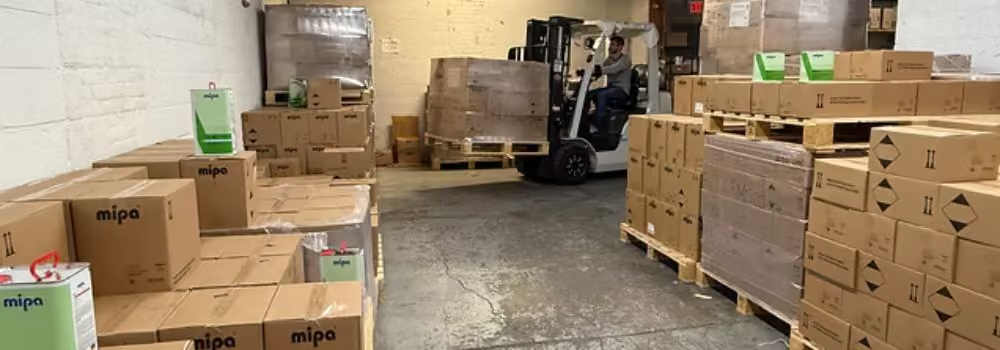
[27:04] Guest: Yeah. So, yeah, so Roman, as you described, is a wholesale distributor. Yeah. Really a warehouse. Because we don't ship a whole. A ton of product out. Our customers, they come in to our warehouse, let's say once a week, sometimes twice, three times, four times. And our customers are handling that last mile delivery. So they are small distributors, you know, with a van or a truck and whatever they can fit in their van. That's their inventory. And so Roman's purpose in this chain is to warehouse this large amount of inventory. And they come and they pick up, you know, maybe a piece or a case of something, you know, and. And yet most of what we sell is. Is automotive paint, but we sell other shops, body shop supplies as well. So that's the customer side. And then on the. On the vendor side, when I was acquiring the business, there was an importer and also happened to be in New Jersey, but really they could have been anywhere. And they had the exclusive rights to import this particular brand of paint from Germany that paints from Germany. And this brand, you know, has been around for a hundred years. And the company in New Jersey, Fleetwood, was importing this particular brand for the last 25 years. And so Fleetwood had the exclusive for the whole US And Roman, you know, probably started with a very small territory, maybe one county. And then as his business grew, you know, maybe he had two or three counties. And then, you know, he kind of got tapped out and so then he started selling wholesaling the product to other small jobber distributors. And then, so, you know, somebody else would have three, four counties and then he'd find somebody else and they would have another four counties. So it expanded to the greater New York City metro area. Maybe around 30, 40 counties in that area.
Host: Wait, sorry. The importers reached it. The import. Fleetwoods reach expanded to that territory?
Guest: No. So Fleetwood's reach was national. Roman's reach was regional.
Host: So your reach of the business you bought is what you just described. Okay.
Guest: Correct. It's like the greater New York City metro area. So North Jersey, all of the five boroughs in New York City, lower New York, eastern Pennsylvania. If you drew, you know, a hundred mile radius around New Newark, New Jersey. That's. That's my territory. But Fleetwood had the whole U.S. so they had another.
[30:04] Host: They were the importer. Their. Their value add was bringing it into the country.
Guest: Correct. They were the importer. In most cases. They, you know, with the exception of Roman, they were unloading every single container from Germany. But we actually. We actually unload our own containers. So we had, you know, a little bit more value in that regard.
Host: Okay, so. So paint is manufactured by this manufacturer in Germany, needs to come into the country. An importer does that. Fleetwood, that importer then has relationships with all these wholesale distributors of which you, Roman, are one. With the asterisk that in fact you guys unload your own. Do unload your own directly at the port, I guess. But then it's in your warehouse, this paint and you have these. As you. As you told me in the pre call, these jobbers are these kind of guy in a truck, guy in a van who, you know, bring the paint from your warehouse to the actual end customer. The body shops throughout the kind of tri state.
Guest: That's exactly right. Yep.
Host: Great. Okay, great.
Guest: Y.
Host: And. And Roman. Roman was the name of the guy as well. The business is called Roman Enterprises.
Guest: Yeah, actually it was. I think he combined his. His son's name and his daughter's name and. And created the word Roman. It was Robert and Amanda. So anyway.
Host: Okay, okay, great. And so the. But the. The infrastructure of this business is this inventory that sits in a single warehouse in. And how many employees? This is where it gets interesting.
Guest: Yeah, there's only one employee. So yeah, for maybe many searchers they would. They would probably say, no, there's not enough infrastructure here. For me. I was like, okay. I would have been perfectly fine. Finding a business with less than five people. Five employees, you know, less people to manage usually means Less headaches and, you know, maybe in some regards. Right. And I guess the employee concentration that I had, I felt like it wasn't a very skilled position. So that if he left for some reason then I, I could find, you know, somebody else to replace him. But he's.
Host: I think you, you even said to me you could do it yourself in a pinch.
Guest: I, I could. And there's been days where he's gone on vacation and, you know, I have to, I have to do it, you know, so. Yeah.
Host: And, and he's basically what the role is, is warehouse manager.
Guest: He's warehouse manager. He also does all of my invoicing. He does a lot of, A lot of the clerical work. Yeah, yeah, a lot of the work that's, you know, you know, data entry, things like that.
[33:04] Host: And the, the owner. So it's the owner plus this employee. The owner was working how much in the business.
Guest: I asked him that on our very first meeting and, and he told me 10 hours a week. I don't know, you know, if that was. Fudged it a little bit, even if it was 20, that I was like, all right, this sounds pretty good.
Host: Exactly. Okay, so here we have this one employee business that does claims to do $800,000 of, I guess, SDE and.
Guest: Right.
Host: Yeah. I mean, so, so, so it's. So it's so interesting because it's a, A much smaller business logistically, you know, headcount wise than even you, who was willing to go pretty small at 400. Ste was looking at. But it's actually double the.
Guest: The. The.
Host: Your target SD800. So how did you think about this? And then we have employee concentration, as you put it. Well, good phrase. The supplier concentration in the, in the form of this. You're basically have this. The rights to distribute this German paint. Right. But if there were some disagreement with that supplier, there could be a problem or some price hike. Right, that could be a problem. Any number of decisions made over in Germany could affect your business dramatically. And then the, so that's supplier concentration and then customer concentration. These jobbers, these, these guys in a truck who come and pick up. You basically have about seven of them and they're your customer. They're delivering your product to the end customer. But really they're your channel and your customer. So you've basically got seven customers. To simplify, I would say very. And sorry, in the multiple again, which. What was the valuation of the business?
Guest: Yes, it was listed at 3 million. With the inventory, we ended up settling on two and a half million. Including the inventory. So at, you know, at 800, I think it's a little bit more than 3x. Right.
Host: So for an SDE of that size, that's a great valuation. Should we presume that that valuation was taking into account these risk factors? That's why it was a good valuation.
Guest: I. I mean, for me, that was definitely a key thought in all of this. You know, I wasn't going to overpay for something that I knew there was a lot of. You know, there were a lot of risks, a lot of concentration to the business. So, you know, I was.
Host: If.
Guest: If they decided to go with somebody that wanted to pay full ask. I wasn't gonna. I wasn't gonna fight, you know, all the way up there. I wanted a comfortable dscr. And I think that the target number I had was around 2.2x, you know, so.
[36:05] Host: Dscr.
Guest: Yeah. So I wanted the debt, you know, the ste to be twice the size of my total debt, you know, monthly or annually, however you want to look at it.
Host: And just for the audience, 2x debt service coverage ratio is comfortable. And on the higher side of, I mean, what that can like is 1 1/2 x even lower. Where people are trying, are cutting it pretty close and really leveraging, you know, getting a lot of leverage, where, you know, any decline in earnings can start to threaten your ability to pay the. The debt service, because basically, you know, that number, as you said, the 2x is basically earnings coming out of the business. Can more. Can half of those earnings can go toward the debt. If it's a 1x DS DSER, that would mean that all of the earnings go just to pay the debt service. So you obviously don't want that, but you'll see people get down to 1, 3, and 4, and that's cutting it pretty close. Yeah, were at a comfortable two. Just for the audience.
Guest: Thank you. I think SBA's requirements are maybe like one and a quarter or something. It like, Right. Yeah. Which is. That sounds pretty slim.
Host: Yeah, but it's pretty. But that's aggressive, so. Well, okay, so say more then, Phil, about how you thought about all of this risk and combined with evaluation, how did you get comfortable with this? There's a lot to like, but there's a lot to talk yourself out of it.
Guest: Yeah, yeah. Just like you said. I mean, for me, initially, I was like, you know, when it was I was looking at those five criteria, I was like, okay, this is 12 minutes from my house. Check, SD check EBITDA margins. I didn't say the size of the revenue, but they were around 20%, you know, the revenue was around 4 million. A little less business buyer fit, I thought was probably the best business that I had found. You know, having that, spent that time at the steel importer and master distributor. You know, this was basically that, but a smaller, smaller company, different commodity. And, and the, and the DSCR was good, I think on the concentration side, you know, Roman had been working with Fleetwood the importer and Mipa, the manufacturer in Germany for like 20 years, I think maybe 25 years. And so that relationship was really long and strong. And then on the same side, on the customer side, these customers had been customers of Romans for 10, 15, 20, 20 plus years. So I felt like that bond was really strong. And also the customers that Roman has, 95% of what they sell is product that comes from Roman. And you know, they're not buying like half for me, half from somebody else that sells a different brand of paint or a quarter or whatever. So, so we're all kind of really tightly, you know, inter. Interlocked here in this, in this chain. And some might, you know, I, I did look at some businesses that had customer concentration where it was like a lab company and they were selling to a university, but then the next year they maybe didn't have that university customer. So like, that to me felt different than this where like these customers had been customers for, for many, many years. And yeah, and their, you know, their body shops that they're selling to were used to this particular brand of paint and they liked it. And you know, so there was a strong stickiness element or factor in there.
[39:56] Host: Yeah. I'm reminded of another recent interview about distribution. And I, my, I'm gathering that in distribution businesses often there's supplier concentration because you're basically the distributor for a particular manufacturer. So this isn't an unusual dynamic actually in the world of distribution. Is that, is that, Am I, am I overstating?
Guest: I think it's not unusual. I think if I was going to paint my perfect distribution company to buy, I'd probably have three suppliers. Like instead of having one that's 70 or 80%, I probably have, you know, three that make up that majority of, let's say, the paint. You know, it's, it's a little bit, it's definitely not, you know, comfortable. But you know, we, you know, I don't really sleep over it anymore. So we're past that stage.
Host: What do the following acquiring minds guests all have in common? Doug Johns, Morley Desai, Tim Erickson, Chirag Shah, Shane Ursam. They all went through the acquisition lap the accelerator in community for people serious about buying a business. But they represent just a sliver of the Lab success stories. The number of deals across the lab's cohorts now stands at over 120, with over $300 million in aggregate transaction value. The Acquisition Lab was founded by Walker Deibel, author of Buy Then Build, the book that introduced so many of you to the very idea of buying a business. The Lab offers a month long, intensive, almost daily Q and A sessions with advisors, live deal reviews with Walker, deal team introductions, and an active community of serious searchers. Check out acquisitionlab.com, link in the notes or email the Lab's co founder, Chelsea Wood. Chelseauythenbuild.com I also want to return to the point about the ideal distribution company. Looks like it works with three suppliers or manufacturers. And is that your own playbook here to diversify some of this risk away? We'll return to that in a minute. So how did you structure this? Did was part of your deal structure? Was risk mitigation part of your deal structure? What did that look like?
[42:24] Guest: Yeah, so I was trying to, to the advice of, you know, again, people that are smarter than me, trying to get that seller note as large as I could for two reasons. One, I was planning to make it a forgivable seller note, and two, I wanted the seller to have a lot of skin in the game and, and not get, you know, a big chunk of money all, all up front. So, you know, I was, I was trying to get that seller note as big as I could. You know, could it have been bigger? Maybe it ended up being, I think, around 28% ish of the two and a half million. So, you know, let's say 690,000 was the seller note, a little bit more than 60 was SBA and I was 10%. So that brings you to 100.
Host: Yeah, so you did. Actually, it's not a huge seller note, but it's on the large side for deals like this. Yeah, so good job there. What about that forgivability and explain what your logic was there. What, what, what does that mean, forgivability and why, how can it, how can it be a helpful instrument in a case like this?
Guest: Yeah, so we had tried to structure the seller note so that, you know, if the business didn't hit certain metrics, certain revenue targets, then you, you know, part of the seller note would, you know, slowly disappear. Right. So be forgiven. Correct. Be forgiven. And I think you have to do it in a certain way because maybe at the time I'm not sure if the SBA allowed for what they call it earnout. So this wasn't quite an earn out. But you know, we were trying to have the, the seller note be forgivable on a sliding scale. That didn't work. The seller did not, did not like that idea. You know. And to his point, you know, you know, he didn't want to be irresponsible for you know, how I ran the business and you know, me sitting in his shoes like I could understand that. You know. So that was something that we tried for. I wasn't sure that I was going to get it but you know, we, we didn't end up getting it. So.
Host: Yeah. Yeah. And that is you know, always the challenge. The forgivability of a seller note is putting risk on the seller because they can't as you said, they can't control how you're going to perform and yet they might be penalized by your incompetence if you, if you underperform a revenue drive revenue down. Just one point about. But, but, but it is still a great tool the forgivable seller note to protect downside. And just for the audience who, who may not be aware that the kind of two sides of the coin here. You mentioned the earnout. Right. So one way to think about this is a forgivable forgivability in a seller note is a way for you buyer to protect downside. Earn out is a, is a way for you buyer to incentivize upside down. So that's kind of people are often kind of like not clear what the difference is there but there's a psych. The kind of psychological mechanism is, is that earnouts are not allowed by the sba. So we actually they're very common outside of the SBA context but on but prohibited in an SBA context. So we actually don't hear about them a lot in SBA self funded deals. But forgivable forgivability is. And if you can get it and it's particularly if there's, it feels like there's a lot of concentration or revenue risk in it. In an SBI SBA acquisition you're doing generally best practice but you tried and often sellers are going to push back.
[46:14] Guest: In hindsight maybe I should have tried for to give the seller some equity like a small amount which I think is now allowed. Right. And, and that kind of would have been maybe the best of both worlds and maybe protected my downside a little bit. More so, you know.
Host: Well, Phil, with the recent changes that would have required a personal, them personally guaranteeing the SBA loan.
Guest: Okay.
Host: So they would not have accepted that. It used to be possible as of, I guess this summer. It's. It's not. Okay, but a good thought because it did used to be possible, but longer. So what does it look like on the other side of an acquisition, the transition in a one employee business? Is it you and, and that employee going to lunch? What, what? Give us a picture.
Guest: I think quickly I'm going to close the gap on from the time like we signed the deal until, until we closed or signed the loi. Just, just because the other part that made this interesting was so I had an opportunity to meet the importer who was my biggest supplier. And so I met them before we closed and he kind of alluded to me that, that he was thinking about selling his business. And if, you know, is he's my sole supply, you know, source of supply, you know, that would make things a little bit precarious. But you know, it turns out he's planning to sell to the German manufacturer. So then they're going to have a U.S. entity here. And so when I found this out, you know, I was like, okay, we need an agreement between, not only between Roman and Fleetwood the importer, but Roman needs an agreement with mepa, the manufacturer, if this ends up happening, you know, in six months, a year, five years, 10 years, whatever, you know, just in case that happens. And it ended up happening about six months after we closed. So I'm glad I had that agreement. So just, you know, catch, catch up the speed. And I actually went and visited MIPA in Germany during the due diligence and that just kind of gave me further confidence, you know, who I was going to be working with. Okay, so now fast forward, we close in March of 25. And yeah, I, I mean, what does it look like running a one person business? I, I come into the warehouse almost every day. Not because I have to, because the previous owner was actually working from home most days and living in Florida half the year, but because I want to be there. And you know, it, you know, keeps me really close to, you know, any business processes that I can improve. I heard one of your recent guests, I think he was an H vac guy that grew it to like 90 million or something like that.
[49:11] Host: Jared Pierce, probably.
Guest: He was saying, you know, try to be there every day and just kind of make small little improvements. And you know, maybe I was doing that a little bit of that before but now it's kind of at the forefront of my mind and I'm like, okay, what are these small incremental improvements that I can make that are going to help grow this, this business?
Host: And what of your relationship to the warehouse manager, your, your sole employee? How did that conversation go? You know that this is a, as much risk as you have in him, this is a big change for him. It's 100% of his colleagues have just turned over.
Guest: I don't know. I, I mean, I heard good things about him from the owner. He had been there. I didn't say this, but he had been there for seven years and the owner really said good things about him. You know, I think after meeting him and now spending, you know, eight months with him, I know that he's an absolute rockstar and I'm very lucky to have him, you know, but I, I don't know, I had confidence in my ability to, to win over one employee. You know, it's not a whole team of 10 or 20. I, I think I can, I think I can make this guy like me. And I'm, and I'm, you know, I'm not being phony around him, but I'm being genuine. And I think he appreciates that. And, and maybe he appreciates having somebody there now, you know, every day so he can talk to, you know, whereas the previous, the seller was there maybe once a month or once a week, you know, if he was up from Florida.
Host: So this guy, your employee, was spending the vast majority of his days kind of walking around a warehouse by himself. A warehouse with a little office in it.
[51:03] Guest: Yeah, it's kind of a very hands on experience with the customers. They kind of come in and they're more so shopping than like, you know, parking their truck and, you know, know, everything's getting fed in. So they're coming in, they're like, oh, I'll take a case of this and a case of that and three of these. And, and so they're, you know, that part is kind of very hands on with my warehouse manager. He's kind of walking around the warehouse with them and, you know, and picking everything with them. So in that regard, you know, he's not alone every day because we, we typically have somebody picking up once, twice, you know, three times a day, depending on how many customers are there. So he's not completely alone, but. Yeah, and I guess in some essence, you know, he was, he was very alone.
Host: Yeah. And so are there any other pros or cons about that feature of the Business to talk about. The pros we've talked about is kind of, you know, less human complexity which is classically probably the biggest challenge of, of these businesses in lower middle market is, is managing people. So that's been simplified. Cons would be obviously he quits or something or doesn't like something, any. Anything, anything else
Guest: maybe. The only other thing is he's, he's kind of like this hybrid of this manager that can do like the clerical work and the physical work. And I wonder if, if he left if I would need to find two people. I don't know for sure. You know, I don't think he's like working, you know, eight hours a day every day, but, you know, finding somebody that could do the physical work and the clerical work, I, I don't know for sure, but it might be a challenge. So I might have to hire two people if he left. I don't know for sure, but maybe.
Host: And you're, you haven't taken that clerical work on yourself now?
Guest: Some of it I'm, I'm kind of taking on, but whatever he was doing before, he's doing today, you know, that hasn't changed. And, and maybe he has actually some additional tasks. I think I'm using the, the ERP that we have the computer system to its fullest extent and in some regards I'm probably eliminating some of the manual work that he was doing for the previous owner. But yeah, I mean I have some clerical work that I do too, but probably the same stuff that the seller was doing.
Host: Well, so then how are you spending time on at the business and you know, presumably growing it? And so what did you see from the outside as in terms of opportunities to grow it and what has now what do you see from the inside?
[54:02] Guest: I think from the outside I was, you know, I saw this as, you know, at least a supply chain play and also a, you know, I'll call, I don't know if you want to call it a sales play, but like increasing the funnel of the number of body shops that we're getting into and that would require me to, you know, push my distributor partners a little bit and encourage them to, to go out there and go after more business every week. But for sure, I think, you know, the supply chain piece was probably the part that I, I felt like, okay, I could right, size this inventory a little bit better. You know, the, the old owner wasn't like looking at sales history. He was just saying like, okay, we typically have this many cases of this problem product or this many Pallets, and that's probably not the most effective use of your, your cash. And maybe you could be stocking other products or, you know, so that, that was definitely my initial thoughts from, you know, prior to buying the business, that
Host: the kind of bringing your own expertise and best practices around inventory management to a business where there was basically all, all about inventory management and the previous owner wasn't doing it as sort of carefully signed systematically as, as the best practice would, would suggest they should.
Guest: Yeah, I think in now being on the other side of the fence, I think what he was doing, obviously it worked for 20 years. You know, I have less cash flow than he does because he didn't have a huge SBA loan and a seller note. So I have to be a little bit more careful than him, you know, but what he was doing was working enough because he was just visually looking at something and saying, okay, I have enough of this. You know, I'm not going to count it. You know, I know that I have 20 boxes here and that's, that's how much I normally have, and so that's enough. But there's definitely room for improvement, you know, and I noticed it in the first, you know, couple of weeks that I was spending with the seller after, during the transition, he would say, like, okay, I usually have, you know, this many boxes, but then I look at the numbers and I'm, I'm able to look at the sales history and build out, you know, my inventory model and say, okay, we could probably bring this down half. And you know, if you start optimizing in different areas, you know, you could really lower the, the amount of inventory
Host: that you have, which is all cash that just becomes, drops to your bottom line then. Yeah, it's freeing up working capital, essentially.
Guest: It's freeing up working capital whether I want to spend it at home or if I want to invest in more inventory. For me, I was always thinking, okay, you know, if we can invest in more inventory, we can have more products to sell for our customers.
Host: Okay, perfect segue. So, so how does one just broadly grow a distribution business, inventory management aside, which is sort of more optimized, A distribution business? You've said that basically having more people buy from you is one way to do it. So that pulls inventory through. Is that, Is that more inventory through. Is that basically the, the answer? Just go out there and sell more like, like every other business?
[57:22] Guest: Yeah, I think you've got to, you've got two factors. You've got velocity and you've got distribution points. So, like, how Many body shops are you selling to? Can you increase that number and how much product is flowing through the body shop? You know, how much velocity are you. Do you have at each shop? You know, can you increase the amount of clear coat that they're buying from us? If they're buying clear coat now, are they interested in sandpaper? You know, I think it's easier to grow, obviously, with your existing customer base. So if we can upsell our existing body shop customers, that would be the easiest way to grow. I think the second way is, you know, adding more distribution points and the third is probably adding additional products. So, you know, growing our portfolio like laterally.
Host: Now in a situation where you have the, your seven guys, your jobbers, and you've already, you already kind of mentioned that, nudging them, incentivizing them to find new body shops to work with, to grow that endpoint, that doesn't give you a lot of control. Is there a way that you can pull through demand and not rely on them to, to generate new customers?
Guest: Yeah, right now probably my ability to do that is, is pretty limited because most of the territory that I have been granted from the MEPA is, has been given to these distributor jobber customers. So they're sort of controlling my ability to grow. And they're all know, you know, their own business owners. So they are motivated by everything that A M business owner is motivated by. But yeah, that is, that is definitely a challenge with the business. I mean, one thing that I'm thinking about, and, you know, we're not quite there yet, but some of these guys are older, you know, they're ready to retire themselves, you know, buying their routes. Buying their routes. Yeah. You know, that's a very real possibility for me. And then I put in a salesperson, you know, so my, my, you know, my SDE isn't going to double, but, you know, I'll basically replace them with a salesperson and then I have full control and visibility what, you know, what goes into the body shops, how much we're selling, you know, and, and that data, I think will be really powerful
[1:00:03] Host: and, but let me understand, sorry, the territory dynamic here. So your market is a little bit kept. You're. Yeah. By, by the, by the distributor agreement you have with mepa.
Guest: Correct. But we are, I'm the smallest. We're one of the smallest players. You know, I'm. We. I can't imagine we have more than a few per, you know, less than 5% market share.
Host: Okay.
Guest: Okay.
Host: One thing you'd said to me in the Pre call that also presents a challenge in selling is like so many businesses where the quality of revenue is high. And despite the fact that we have talked about how much risk and concentration there is in your business, the way you got comfortable with it is because those relationships are long standing and that revenue is very reliable and seems like it's high quality. High quality revenue often means that it's high quality revenue for your, for your competition as well, which is to say it's hard to get a new customer because they are, it's if, if they're, you know, customers are sticky for you, your competitors. Customers are sticky for them. Say more about that.
Guest: Yeah, I think that's absolutely true. And I, I think I'm seeing it more, you know, being on this side of the fence, on the, on the ownership side than I did as the searcher, you know, because what a lot of these large paint companies do is they sign contracts with the body shops and say, okay, you're going to use, you know, you know, Sherwin Williams, you know, paint for the next five years. We're going to give you our free system. You know, you can mix up all your colors and you know, so they sign a contract. So it's, it's a strong barrier to entry, you know, to be able to get somebody to get out of their contract or, you know, use your product when they shouldn't be. So it works both ways for sure. You know, it is definitely a harder. It's sometimes very hard to get into some of these body shops.
Host: So Phil, you have. I've just heard you say that your jobbers are really the ones that you need to lean on to help you generate demand. But in the pre call, we had actually talked about that you've done a little bit of your own door to door sales, actually going direct to body shop. So square that for me.
Guest: Yeah, yeah, yeah. So there's one county in New Jersey that isn't spoken for by any jobber. So I decided to take that, you know, upon myself to try to go door to door to door and see if I can start selling them some clear coat or any of the other primers or products that we sell. And I actually went out with the, the former owner before he left me, you know, from his transition. And so I had that opportunity with him which was. Was really valuable. It sounds really scary, you know, going door to door doing sales. I had done cold calling for real estate, you know, but you know, you're hiding behind a phone and, you know, nobody can, you know, scream it. They can scream at you, but you can hang up the phone. But I would say on the door to door side, it ended up being easier than I thought because I walk into this body shop, you know, I'd say 79 times out of 10, I'm talking to the owner. So I'm, I'm directly, you know, talking with the decision maker because he's the
[1:03:29] Host: one sitting there behind, behind the cash register sort of thing in the, in the little kind of probably dingy like waiting room area. I can imagine, like there's a bell on the door as you open. I could just like picture it. It has a certain musty smell.
Guest: Yeah, go ahead.
Host: That's.
Guest: That's exactly right. So I walk in, I'm probably talking to the owner and, and he can't hang the phone up on me. You know, I'm there and I probably have two, three, four minutes of his time to pitch him on, you know, what I have to offer him and how he can, you know, have the same quality product that he has now for, for a lesser price. In most cases, that is the, the best value ad that we have to this to this supply chain. And so, yeah, so I took it upon myself. I probably went to, you know, a dozen different body shops and we ended up, I ended up selling some to them and I still sell them today. And I'm the, the, the salesperson that, that they, they contact. I'm the one that goes and drives, you know, in my car and delivers the product to them. And it's, you know, it taught me a little bit about what my customers are going through and what potentially a salesperson, if I hired a roman salesperson would, would need to go through, you know, in order to get new business?
Host: And do you get the impression that they're hit up by other door to door or people, People selling in person? Yeah. Is this, is this a feature of their day or week?
Guest: Yeah, yeah, for sure.
Host: Because paint is, is but one of many things that they need to, to buy, so.
Guest: Correct. Yeah, paint is probably the biggest expense I think for a body shop maybe, maybe aside from parts. But that's kind of all over the place, you know. You know, you can have all different types of. And that's a whole different business that sells auto parts. So it's like auto parts and then there's like the parts that the body shop consumes. But yeah, it's, it's. It's not uncommon for the owners to get hit up. So yes, in that regard, it's definitely a challenge.
Host: All right, Phil, well, we're wrapping up, but I have. I do have a few more kind of big picture questions I want to ask you, and I'll just start with how does it feel? How would you. How do you reflect now on your. How many months of ownership?
Guest: Eight months? A little more.
Host: Eight months. How do you reflect on the journey so far?
Guest: I think, yeah, I think a lot of it is enjoying the ride. I think in many ways it's everything that I thought it was going to be. You know, managing a small business. I kind of had a feel from it. From real estate and working at this. This deal company. But I really, I. I love going in, you know, every day I'm probably working a little bit, but before the kids get up in the morning and, you know, so I. I just really. I'm enjoying it. It's. It's been pretty much exactly what I thought I was buying in, in terms of sales and, you know, people. All of that, I think, has been very similar. I think, you know, the part that I underestimated was, you know, these relationships with these customers. And. And I think that part maybe came very easy to the previous owner. I think managing them has. There's been some challenges there for me, you know.
[1:07:04] Host: Can you say more about that?
Guest: Yeah, I think we just had. We had different personality types. You know, I think he was more of a dominant, you know, and dominant personality with an outgoing person. You know, on the disc profile, there's you're dominant and then there's outgoing and then there's like, conscientious and there's. I forget the. I can't remember the last one, but I'm on the opposite end of the spectrum. He's everything that I'm not, and vice versa. And so I'm. I think I'm growing into the kind of person that needs to be there, you know, to manage these, you know, sometimes dramatic situations between customers or with customers and. But it's, I think, all part of the process.
Host: How about just entrepreneurship through acquisition? Is. Is that as advertised? Maybe. Maybe tie it back to that night that you and your buddies were sitting around the table and heard that you could buy a business that cash flow, $700,000, and your mind's all exploded now that you've actually done it and you're in it. Is it? Is it? Would you. What would you tell that guy sitting at the table hearing about this for the first time?
Guest: I'd probably say, you know, for sure, this is not real estate. It's not. It's not passive. It is is very much active, and you can't just set it and forget it with a property manager and, you know, collect your, your cash flows. But, but this is, I think, ultimately what I wanted. You know, I, I, I pictured myself running a small business one day, and, and that's what I'm was able to do with business acquisition with eta. You know, on day one, you know, you're the CEO, you're running the, you know, you're running the ship for better or, you know, for good or bad. But I've, I've seen more good than, than bad in all of this, so, you know, I'm enjoying the ride.
[1:09:10] Host: The concentration that we've talked so much about and combined with this big SBA debt payment, loan payment that you have to make every month, we often will hear about. An SBA loan offers this very strong path to get into doing this. But it's only once you really have those very large debt payments that mercilessly come every month of tens of thousands of dollars often, that you kind of start to appreciate what it really means to take on so much debt. And then when you pair that with the concentration that you have in the sense of, like, you know, a couple of decisions in the wrong direction could hurt my revenue severely. How does that psychologically feel now that it's not abstract? You're actually in it?
Guest: I mean, I think those first few weeks were, I was watching everything really closely because, yeah, that payment, that SBA payment is $25,000. Boom. You know, at the, on the first day of the month, on top of my, my seller note, which is, you know, another three or 4,000. Right, exactly. So, but I, I, I had confidence. I had, you know, I had built out a cash flow model, you know, with the help of this mentor of mine. And I felt like, you know, things would have to really slide, you know, pretty, pretty far down for me to not be able to make these debt payments. I was taking a small salary, $100,000 a year, and my wife had a good salary. And so, you know, I think all that, all those components made me confident enough to, to take that leap. And I think those first few weeks, yeah, it was a little stressful. Now I have some cash reserves, so I feel more comfortable and, and the trajectory is going, you know, up. So, you know, I think that just helps me build, build the confidence in what we're doing. Yeah, yeah.
Host: Well, part of it is just adjusting, getting in there and getting used to the inflows and outflows and seeing that things are working as they're supposed to and you, you know, build some confidence in, in what you bought over, over those first weeks and months going back to your mentor and that early phone call you had with them where you kind of talked to him, talked to him about the business and he was asking you, I, I guess for particular metrics and they sounded good. Broadly distribution businesses for searchers, what, what would you tell them? Do you think that this is, this is a category that people should look at? What metrics? Maybe, I know it's of course very probably category dependent, but maybe what metrics should they be thinking about? We already talked about inventory turn. Are there others? What would you tell specifically searchers who are, whose curiosity is piqued about distribution businesses?
[1:12:19] Guest: I think distribution businesses are easy to get into. You know, unlike manufacturing where there's more, you know, machinery or things that you're, you know, you're turning, you're taking something and turning it into something else. Distribution, the most of the time the same way it comes in is the way it goes out. So I think the struggle and the reason I didn't see a lot of distribution businesses that worked were, is that the margins on distribution businesses tend to not be very good because distributors are not adding as much value as manufacturers. So you don't have a gross margin of 50 or 40%. You have a gross margin of maybe 20 to 30%. And if you're not getting over that critical mass where you have enough volume, you know, to pay for your, your fixed expenses, then your bottom line margin is going to be like 10%. Which is for me, I, I didn't want to go that low. You know, for an EBITDA margin, it just felt too, too razor thin. And so, and by the way, that,
Host: that's something that we didn't, I don't think we underlined earlier, which we should have, that this business had 20 margins as a distribution business. Set it apart from your typical distribution business, right?
Guest: Yeah, yeah, yeah. 20 was definitely on, on the higher end of what I had seen for, for distribution businesses. Most of them, like I said, were closer to 10. I think they're great. You know, I think I don't know how somebody else would, you know, not having like a supply chain background, manage large amounts of inventory and have the, the right processes and procedures to do that. But I think chances are when you're buying a business like this, you probably have somebody, you know, you're probably not getting one employee, you might be getting five and somebody knows, you know, they've been managing the inventory And I think it's something that's, you know, can be learned as well. So I, I think generally I, you know, I like them. I would encourage people to look at them. I think you just got to find the ones with, you know, that have reached that critical mass where they can, you know, pay for their fixed expenses and their, you know, bottom line margins aren't so thin.
Host: And again, I may be generalizing, but I am generalizing. I may be over generalizing the concentration on, on both up and up the chain and down the chain. You'll find it more commonly in distribution than you will other categories. So you got to get, you got to get comfortable with that. You got to already expect it and not necessarily just disqualify a business because there's some concentration, because you are likely to find that in a lot of the distribution businesses. Fair.
[1:15:13] Guest: Yeah, I think it is, you know, again, like if I was painting that perfect business, I might say, you know, having two or three suppliers that can produce the same products is a strong, is a strong place to be. Will I get there at some point? You know, hopefully it, there's some barriers for me there too because, you know, I have commitments that I need to have with my, you know, German manufacturer and, you know, I can't take purchases down, you know, in half, you know, otherwise they'll, they'll not renew my contract. And so, and so there's some challenges there for me. But, you know, I guess if I was going to draw out that perfect picture. Yeah, it, it probably has two or
Host: three there, There is some, some lock in. I may not be using that precisely, but there's some de facto lock in with your manufacturer because you have basically a commitment to sell a certain quantity of product every year. And if you started diversifying your own portfolio, that means eating into the. Their product that you're supposed to be moving.
Guest: Yeah, yeah. Unless we can, if we can grow and have the demand for additional product, then it can warrant this additional supplier. Right.
Host: Yeah. Phil, you had mentioned that your grandfather is something of an inspiration to you as a business person.
Guest: Yeah. So right around, I think when I had read that rich dad, poor dad, which was early on in my entrepreneur days, my brother is, was studying in Israel and my dad went to visit him and they went to the Holocaust museum, and my grandfather was a Holocaust survivor and they found a video of him doing an interview with Steven Spielberg's team. Not like Spielberg himself, but. And during the interview, it's all in Hebrew and, and he, he describes his entire life during The Holocaust. You know, from the time when, you know, he gets separated from his family. His mother and, and. And sister go one way and he goes another way with his father, you know, to the living conditions and what he was eating and, you know, you know, watching his father get sick in front of him and, you know, eventually doesn't even know where he went. He just disappeared one day. And so I think hearing that story, which was very early on in my, you know, entrepreneur ish days, and it really, I think it's the. It's the fuel to my fire. I think about the, the things that he went through that were really hard, and it really makes everything else kind of seem not so hard. Right? You know, customer concentration, who cares? Right? You know, vendor concentration, you know, compared to what he went through, it's nothing. So I think that gives me perspective and, you know, and drives me to. To honor him.
[1:18:32] Host: Yeah. And then he. He lands in Israel and builds a life for himself. Right?
Guest: Yeah. Meets my grandmother. They have my dad and my aunt. My dad ends up immigrating to the US 40 years ago. Meets my mom, you know, here I am, you know, all because he, you know, survived.
Host: Well, thank you for sharing that with us, Phil. It does put things in perspective for all of us, even if it's not in our family line like it is in yours. But it's very, you know, severe. Beautiful motivation.
Guest: Thank you.
Host: Anything we didn't get to.
Guest: I don't think so. Thank. I really appreciate you having me on, Will. You know, I. I've learned so much from your podcast, and I can really see the curiosity in your interviews. You know, I've. I've listened to a lot of different type of. A lot of real estate type podcasts, you know, other business ones.
Host: You.
Guest: You don't seem to have the same agenda as some of these guys that have masterminds and they're trying to sell courses. And, you know, I can really see the curiosity in your interviews, and I think that's what's kept me so engaged in it. And, you know, I really enjoy, you know, every guest interview, and I've learned so much from, from your guests, so thank you.
Host: I appreciate that, Phil. It's really a lot. It's really kind of you to say, especially on air and curious. So do you continue. I'm putting you on the spot. You continue to listen even after acquisition?
Guest: I have, yeah. Yeah.
Host: And how. How does it remain relevant if you've already bought your business?
Guest: I think it gives me ideas, you know, especially from the interviews where you Know, the guest is talking about, you know, what they're doing post acquisition or how they grew. Like, you know, I gave you that example of the H Vac guy that grew to 90 something million. I think it gives me ideas for sure that, you know, if I can take one nugget and implement it. I probably don't, but, but you know, if I could take one nugget a week or a month and implement it into, into my business post acquisition, it's really valuable.
Host: Yeah. And so I'll, I'll infer from that that your interest now is mostly on the operations piece of the stories that you're listening to now as opposed to the search, because you're through your search, correct?
Guest: You know, yeah, maybe. Will I do another acquisition in the future? Perhaps. I'm not really thinking about it now, but yeah, mostly operating.
[1:21:03] Host: And do you think that you could gather just as much from some other small business entrepreneur or owner who didn't necessarily buy their business, or do you think there's something about ETA searchers in their, the way they approach operations that makes it land better for you? And where I'm going with this is I just wonder if there's room to bring on operation owners and entrepreneurs to talk about operations that didn't search to buy their businesses. Non ETA folks, would that, would that feel as relevant, be as relevant to you or does it need to be kind of people who are on your same path?
Guest: I think it would be just as relevant. I mean, I have, I have some people in my network that own small businesses that didn't acquire them and I think, you know, I, I lean on them for advice. You know, I, I have more searchers in my network just because, you know, I, that's, I met or spoken to a lot of guests from your podcasts and that just happens to be my network. But I think if, if it's a small business, you know, there's likely a lot to be learned even from somebody that, you know, didn't take the ETA path.
Host: Yeah, searchers always have that big expense that the 0 to 1 owners don't in the form of a loan payment. So that, that does change a lot of the decision making, I think, at least in the early years of a loan. Interesting. Thank you for indulging my questions, Phil. We will put a link to your LinkedIn and Roman enterprises as well. People can reach out if they have questions looking at distribution businesses.
Guest: Yeah, that's cool.
Host: Super.
Guest: Yeah. Yep.
Host: Phil Kohler, thanks for coming on Inquiring Minds.
Guest: Thanks, Will.
Host: Hope you enjoyed that interview. Don't forget to subscribe to the Acquiring Minds newsletter. We send an email for every episode with an introduction to the interview, a link to the video version on YouTube, YouTube and soon, key takeaways, numbers and more essentials from the interview. For those of you who don't have time to listen or watch it, subscribe at acquiringminds.co. you'll also find all our webinars there on the website, both those we have coming up and recordings of past webinars. At this point, There are over 30 webinar recordings, a wealth of of information on all the technical nitty gritty of buying a business. Acquiringminds Co.





















































%20-%20thumbnail.avif)




%20-%20thumbnail.avif)

%20-%20thumbnail.avif)

.avif)




%20-%20thumbnail.avif)