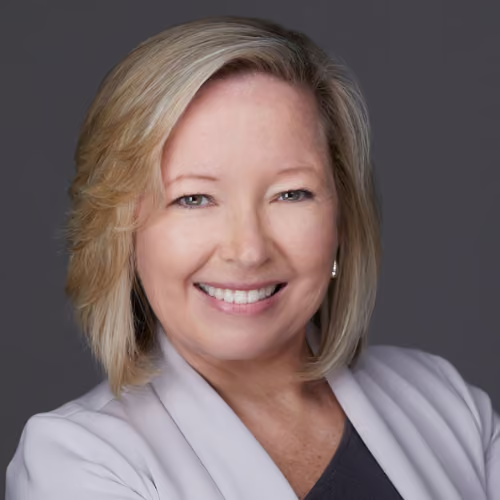
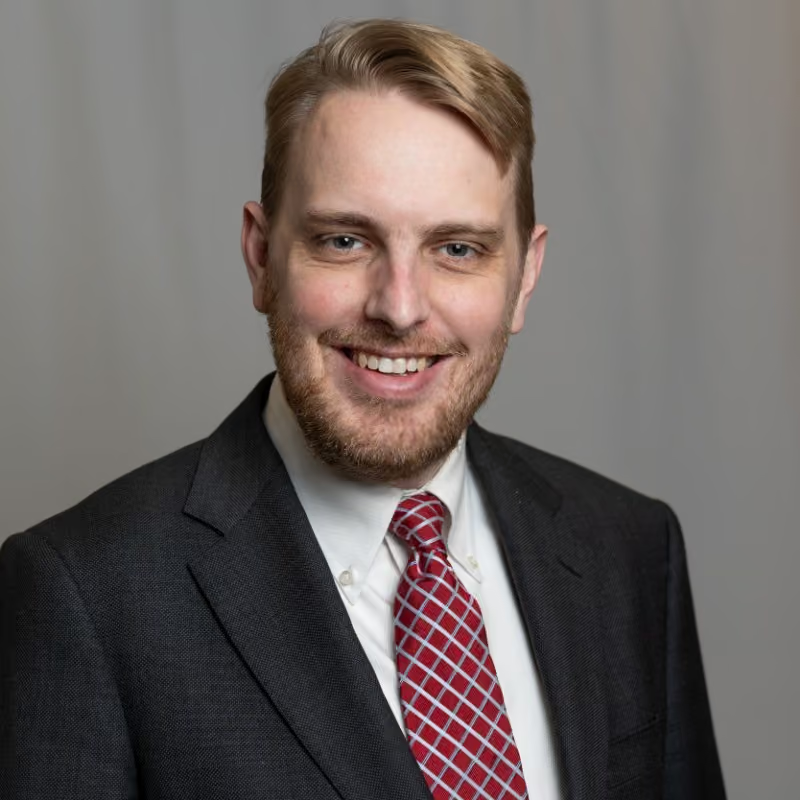
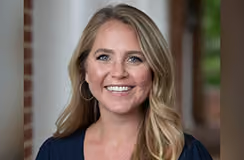
Host: The original plan was not that both wife Lindsay and husband Kevin would buy a business. At first, the idea was that buying a business would be the path Lindsay took out of corporate. Recognizing that this goal would be a serious commitment, Kevin decided to ride along with his wife as support. For a while, not much happened. Eight months came and went. They were both still working W2s and progress was elusive. That changed when they decided to work with a Buy side Advisor group. Not only did the search accelerate, their plans changed. Kevin too would end up with a business in addition to working with a buy side advisor. Other key themes to listen for in today's interview are key man risk and how to structure a deal with a forgivable seller. Note to protect against declining revenues, here are Lindsey Buckheit and Kevin Black, owners of Collective Creative Outdoors and Holdsworth and Nicholas. And if you're interested in learning how to work with a Buy side Advisor for your search, the team mentioned in today's interview, AquaMatch, founded by Athena Simpson, will be hosting a webinar with us in a few weeks on this very topic, how to Work with a Buy side Advisor. That'll be on Thursday, June 5. You can register at the link in today's show notes or on the Acquiring Minds homepage. Acquiring Minds co the webinar is how to Work with a buy side advisor June 5th. See you there. Welcome to Acquiring Minds, a podcast about buying businesses. My name is Will Smith. Acquiring an existing business is an awesome opportunity for many entrepreneurs, and on this podcast I talk to the people who do it. What do the following Acquiring Minds guests all have in common? Doug Johns, Morley Desai, Tim Erickson, Chirag Shah, Shane Ursam. They all went through the acquisition lap, the accelerator in community for people serious about buying a business, but they represent just a sliver of the Lab success stories. The number of deals across the lab's cohorts now stands at over 120, with over $300 million in aggregate transaction value. The Acquisition Lab was founded by Walker Deibel, author of Buy Then Build, the book that introduced so many of you to the very idea of buying a business. The Lab offers a month long, intensive, almost daily Q and A sessions with advisors, live deal reviews with Walker, Deal team introductions, and an active community of serious searchers. Check out acquisitionlab.com, link in the notes or email the lab's co founder, Chelsea Wood. Chelseauythenbuild.com Lindsey Buckeit Kevin Black welcome to Acquiring Minds.
[3:11] Guest 2: Thank you.
Host: The two of you are a couple in life and now in business Actually, in two businesses, what started as a journey to buy a single business ended in the acquisition of two. Lindsay, you have one. Kevin, you have the other. Although there's overlap, we're going to hear about it. Let's get into this unusual story. Lindsay. Kevin, where, why, how did you first get the inkling that you might want to buy a business?
Guest 3: We both spent the majority of our, our careers in, in the corporate world. Lindsay, I guess, really spent her whole
Guest 2: entirety of my career in a corporate world.
Guest 3: I spent the majority of mine in, in corporate sales roles. And I think we were both ready for a change. We were both looking for a change. Lindsay in particular was looking to get out of the corporate world. And we had explored a couple of ideas on how to make that happen. And I think like a lot of your listeners, we stumbled across people talking about, you know, exiting the W2 world through entrepreneurship through acquisition. And it was, it was really appealing. I think it was really intriguing, the, you know, the idea of having more ownership over our direction of our lives, over our ability to earn. But it definitely started as this was a way to get Lindsay out of her corporate, corporate role. So we joined a community together. And at first I was joining as a way of supporting my wife because, you know, it was pretty clear this was going to take a lot of dedication and commitment from both of us to be able to make it happen. But pretty quickly I fell in love with the idea as well. And again, it was, it was that, that control over the outcome of our life, the, the direction, being able to change the direction that we were headed and our, our ability to work towards financial freedom, that I think was really, really appealing for both of us.
Host: Well, I think the three common paths when people think about striking out on their own or doing or doing something to enable that freedom that you were looking for are start a business, build a real estate portfolio, or buy a business. You probably considered all three. You probably saw all the influencers who speak to all three and you're allowed to say the. I already know the answer. You're allowed to say the community that you, that you joined. And what kind of was the, the funnel that first hooked you on buy a business? So, so say so why did you consider buy a business or choose buy a business? And then how did it, you know, what was your progression down from acquisition? Curious to acquisition Serious.
[6:09] Guest 2: I love that. Yeah. So that really effective targeting caught me on Instagram. It was Cody Sanchez, contrarian, thinking it was exactly what I was looking for when I had already tried to find the side gigs, side hustles, real estate, none of those just really fit where we were or how quickly I wanted to make a change. Little did I know at the time that it wouldn't be quick acquiring either. But yeah, so, so we joined the community in May of 2023. Vividly remember that because it, it was like a investment decision to, to take a leap to do this, to make it happen. We spent about eight months in the community, learned a lot, a lot of the basics of like what is this thing? What, how do people do this? What are some success stories? What are some horror stories? And eight months in to our, it was a year membership. We were not any closer to actually buying a business. We were both still working full time and just did not have the time to do the amount of calls that you need to do to chase the brokers that you need to do. And then this is obviously our experience, but it just, it was too difficult for us to, to stay on top of it.
Host: Let me, let me pause you right there Lindsay, and ask a follow up. First of all, when did you become we? So, so in other words, Kevin, when were you converted into this cult? So it was of, of buying businesses. We. We crazy.
Guest 3: That's fair. I mean I joined the community with Lindsay up front. It was always going to be a, we're going to do this together. We're looking for a business for Lindsey to own. This is our way of getting Lindsay out of the corporate world. It was pretty quick, I mean like within a month or so that I think it started feeling really attractive for me in some way. But it wasn't really clear at that time what that actually was going to look like. So was a bit of a progression. We started with it being more of if we found the right business that could use my skill set so background in sales and if the business was able to support both of us, then I would leave. If not, then I would support, you know, as a side gig and Lindsay would be, you know, owning and operating the business, whatever it was that we found. Yeah, it wasn't until a little, a little later in the journey that that the, the two businesses kind of came to, to fruition.
[9:10] Host: Okay. And we're of course going to get there. And then Lindsey, so your eight months of kind of you were learning you were probably making some progress, but at the end felt like you were maybe no closer to buying a business. Was that simply because of you were, you know, what we'd call part time searchers? I mean you both still had your full Time gigs and just couldn't devote the time to searching or was it something else?
Guest 2: That was a big part of it was time, time and effort. But it was also that because of how long it took to actually get something on the hook, I tried to make everything work instead of focusing on deals that actually worked for what I was looking for. It became really easy to try to, to fit square pegs into round holes because you're almost like desperate to find something that could get to the next stage. And so then you end up spending time on deals that you never should have been looking at. And I don't think I had the discipline that I, that I needed to really only look at things that fit the deal box. And we had a deal box. We know, we, we knew generally the type of cash flow we were looking for or the range that we were looking for, the location, all the standard things that they say your deal box should entail. But when it really gets into that first couple of conversations, I kept finding myself trying to see myself in the business rather than like, does the business work for me? I'm, I'm a problem solver. I, I was, I, I was always going to try to find a way to make it work. And, and that was. I, I needed guidance. Honestly, I, I needed help. Um, I was, I was spending too much time on things that, that weren't going to go anywhere.
Host: Perfect segue. So what did you do?
Guest 2: Yeah, so in December, I, I started to freak out because, you know, eight months in, four months left.
Host: The community is an annual membership.
Guest 2: Yes, it is.
Host: And, and by the way, before you continue, did you sense that other people encountered similar wheel spinning or did?
Guest 3: Yeah, yeah, I, I think that, yes, there, I mean, I think that there are people that are going to have a pretty similar experience in that community as well as others. I think there's also people that were in that community that had a very different experience. I think a lot of it comes down to, like, your background, you know, the, the specific challenges that, that we were facing in our search. And, and for us it was the time, the lead flow and, and being able to have somebody with a little bit of the guidance to help us refine the deal box down and really focus in on the deals that were gonna be a good fit for us.
[12:11] Guest 2: Yeah, the, the unbiased lens, I think, is what I needed. Um, I think that that was the piece that was slowing me down and I needed someone to tell me, like, don't, don't look at that. That doesn't, that doesn't fit. And here's why. Um, instead of, well, this is the first deal I found in like three weeks. That is a maybe, I guess I should really put everything I have into it. Right?
Host: Yeah. So it's natural. It seems natural.
Guest 2: Yeah. A lot of different experiences.
Host: Okay, great. And so then how did you seek to solve this problem, this frustration?
Guest 3: Yeah,
Guest 2: so we, we did regular meetups. So there was like a once a month meetup in Austin with other community searchers and we had met Athena Simpson who runs aquamatch, and she had started talking to us at the meetups, like slowly of like, hey, I'm, you know, I'm, I'm in the business of trying to connect searchers with, with their dream businesses. And first I was like, I'm, I've got it, it's fine. If we just keep going, we'll get there. And by December, it was very clear we weren't going to get there with what we were doing. It wasn't enough. So we started working with her and her team in January of 2024. Pretty immediately saw traction. Actually. The first thing that we did was kind of calibrate what really is our deal box and stress test that a little bit. And I think by April we had. What was that? Our first write up.
Guest 3: We had our first write up. You know, we were looking at a write up from her team, which is effectively like a nice packaged analysis on the deal, like why it fits our deal box, what the, what the cash flow is, things like that.
Host: All the, of a particular business they've sourced.
Guest 3: Particular. That's, that's correct.
Host: They send it to you and it's a write up on, on not just the business, but also like why it fits you and what you're looking for.
Guest 3: Yeah, yeah. So they did, they did a lot of the upfront legwork, including like having a, having a conversation with the broker, kind of opening that door for us. And we had our first write up from them in February. We looked at a few businesses between February and April, maybe maybe five or six. And then in April we were, we were introduced to the agency that we ultimately ended up acquiring. So started working with her in January. We had gone eight months without making a lot of traction. Started working with her in January and by April we had the business in front of us that we were ultimately going to acquire.
Host: And so what do you think? So, so we're hearing kind of two things that you think that working with this team, Athena's team, did differently or did supplementally to what you were doing. The time they were certain, they started searching on your behalf. So they were. So that. That's the obvious one.
[15:16] Guest 2: Yeah.
Host: But also this thing, Lindsay, you were saying before this thing about your deal box, you having a deal box, but it actually not being very accurate, some refinement. So. So what was that evolution all about?
Guest 2: Yeah, I think.
Host: And for the, and for the benefit of, you know, searchers who themselves were where you were frustrated thinking they have a deal box, but, but you know, maybe kind of it's a poorly defined one.
Guest 3: Yeah.
Guest 2: I think that the standard categories of the deal box that we had learned were, were still good ones. You know, geography, SDE industries you like or don't like. You know, those were still helpful. But I think what was different about how aquamatch handled it is they took about a month to get to know us and would actually send us deals to be like, yes, no, and why. And then through that calibration period would start to learn. Okay, it sounds like this should be part of your deal box that you don't like. You know, you're okay with, with businesses a certain number of miles outside of Austin, but realistically, given what you want your day to day to feel like, you can't own a business in another state, that's not going to work for you, given what you want your day to day to feel like, or given your likelihood to travel. And it was things like that that I, I wasn't telling myself I can't do or I shouldn't try to do because I don't want to. When I was by myself, it was like, well, I could do that, I could make it work, I can fly there once a month, it's totally fine. But in reality, when someone else was presenting it to me, it was really easy for me to say, I don't want to do that, instead of me having both sides of that conversation. And that's maybe unique to me. I don't think everybody needs that. But I've realized how much an accountability partner helps me. Um, and that's, that's exactly what Acomatch was for me is, is that mirror of, hey, you really going to do this? If so, like, let's, let's move ahead. Let, let's keep having those conversations. But if this is never going to be of interest to you, stop looking at anything that, that checks that box, whatever it may be.
Host: If you ask owners in the ETA and search community which insurance broker provides highest quality work, great outcomes, and has a practice dedicated to searchers and acquisition entrepreneurs, one name comes up again and again. Oberle. Oberle Risk Strategies has worked with hundreds of searchers over nearly a decade and is in fact led by a two time successful searcher, August Felker. Which makes Oberly a specialty insurance brokerage who for searchers by a former searcher. And if you've got a business under Loi Oberle will provide complimentary due diligence on that business's insurance and benefits program. An easy no risk way to get to know August and the team at Oberle to take advantage. Check out oberle-risk.com that's O B E R L E D H risk.com link in the notes.
[18:44] Guest 3: I think the search is. It's an emotional process like you're pouring your metaphorical blood, sweat and tears into trying to make a major life change. And when we were struggling to get enough lead flow to really, I guess, test where our deal box actually was, you start to get a little bit of a scarcity mindset and you try to go after everything that could even possibly be a good fit without really thinking about, yeah, some of those, like what's it going to feel like in your day to day. And so to Lindsay's point, I think for me one of the things that was really helpful was having somebody who was invested in being the mirror, you know, holding up that mirror to, to the deal box to, to help us get more specific about it, understand where it needed to shift and then, and then was able to go find deals to test that deal box and, and to make some changes as needed.
Guest 2: And knowing that the deal flow would stay open even if I decided to look at one. Because if I decided to look at one then, you know, that's, I was researching, I was, I was making phone calls, I was, my, my deal flow process stopped when I was by myself.
Host: On your, on your, when you were doing it on your own.
Guest 2: Yeah.
Host: So. So once you had a deal you liked, there are only so many hours in the day and your hours devoted to your search would go into researching the deal, the live deal that you have. And then your pipeline would dwindle out because you couldn't be refill, refilling it.
Guest 2: Exactly. And we didn't have that with AquaMatch. So it solved the problem that we were having.
Host: The, you know, so this is one of the counterintuitive things. So, so this is a common thing that you'll hear. Buy side brokers, I know that Athena and her team, that's not, they're not brokers and they're not buy side Advisors but kind of under that umbrella of folks who help buyers. One thing that you'll hear them often say is that buyers are too broad in their criteria and it. And it will waste time. And part of their role is helping buyers like you narrow down the criteria. Which is exactly what it sounds like aquamatch did for you all. But the counterintuitive bit is that if you're struggling already with deal flow, how is it that narrowing down the criteria is going to actually yield more deal flow? The whole reason you're kind of getting loose about your. Your deal box is because you're. Because the current deal flow ain't cutting it so. So square that for me.
[21:28] Guest 2: Yeah, I mean I have a. I have a first reaction and is that even to this day I, we were not looking for a particular industry. I'm still very open to a lot of different industries. It's not that my. The, the criteria of the standard deal box categories needed to get smaller. Like it's not like I needed to pick three industries and go. It was that within the industries that I was interested in. The conver. Those first few conversations with the broker and the seller needed to be more targeted to who I was going to be as an owner. And what is the. Like what is the current culture that I'm walking into? For example, you know, is. Is there. What's the hierarchy like? How many employees are there? How long have they been in the business? Do they know you're selling? Like that's all kind of a landscape of a. Of a job you're about to walk onto. It's sort of like trying to interview for a company and not asking any questions about what the culture is. Like you would, you would never do that or you'd never just blindly walk into a job unless. Unless you were desperate. But like it. It was. It's more about the intangibles that I think sell a deal, at least for us than like what is the SDE and where is it located? It's. What is it actually going to feel like? And are you going to be able to fight for it all the way to close and then be able to deal with it after? That has to be a fit or for, for me, I just don't think it was ever going to work. I have to, I have to love what it kind of does now or see the path to make it better pretty early on. And if I don't, then I'm back into that. That hamster wheel of trying to make something work that just really wasn't Ever going to.
Guest 3: Yep. If you're too broad with your, with your deal box, there's just too much noise in, in, in the businesses that you're looking for. And so it, you can never make a decision. It's, it's, you'll get decision overload. I mean you have nothing to measure it against when you're looking at a business. And so yeah, it's a little counterintuitive. Narrow the deal box and, and have better results when you're already struggling to find deals. But you're looking for a needle in a haystack anyway. So if you, if you look for a needle in a haystack in a really big field versus like a much, you know, I don't know, smaller area, you're gonna have a better shot at actually finding it.
[24:06] Guest 2: Yeah. You can get more specific with the questions that you're asking too, because then my research can be focused on the industries. I think I know my, my deal team is looking for and start getting acclimated with what types of things should I be asking If I'm looking at a design and build company or I'm looking at an advertising agency or instead of trying to be knowledgeable about all of these different industries that are coming my way, you can kind of focus in and get clear about the things you need to be asking early on. Yeah, it helps.
Guest 3: Great guys.
Host: Okay, so you start working with their team in January. By April, you said you're looking at the deal that you end up buying. So pick us, pick us back up on the story.
Guest 2: Sure.
Guest 3: Yeah. So we, we were introduced to the, to the broker in April. We had, you know, a pretty immediate good relationship with the broker and with the sellers. When we, when we were able to have a, a face to face sit down with them. We had a signed LOI in June. I think we actually took a little bit of time to negotiate out the specifics of the deal before we got assigned loi but they were, everybody was on board for that approach. And, and then we went into the process of trying to secure funding which took a little bit. We, we, I think we went through six or seven banks to find a, a lender for this deal, which was a little unnerving. You know, um, there, there's can.
Host: Before we get into that, can we hear about the business itself?
Guest 3: Sure. Yeah. So, so it's an, it's an ad agency out of San Antonio. It was, let's see, SDE was about 575, 575,000. Purchase price was 1.6 and we had a pretty, pretty sizable seller note in there to help with some of the downside risk. We did about 1.2 million in revenue in 2023.
Host: And why did this in that write up? What was the pitch of this business for you, Lindsay, even though it's you, Kevin, who is actually the. The operator today?
Guest 2: Yeah, well, so the, the biggest thing was, was the cash flow of how healthy it was because our original threshold was like 3, 350. So that in and of itself was like, this is totally worth talking to them for it. I liked that it had a few employees that, that were going to be staying with the business, um, because I wanted an existing team that I could walk on with. Um, I. It also.
[27:18] Host: How many employees was it?
Guest 2: So there's two employees and then they have two contractors that work kind of part time but have for years. It was close, at least at the time. It was close in nature to the kind of consultative client approach that I had done for years in my career. There was no creative involved in the agency either. So we didn't have to have, you know, a design team or handle any of that process. It is purely. It was purely media buying. So it's making purchases and placing ads for a variety of different clients. It wasn't immediately obvious to me how it might fit. I think there were some ideas around the fact that it could be fully remote if we wanted it to be. That had appealed to us in some prior deals of the option to go fully remote is really attractive to us. Um, then. Yeah, yeah.
Guest 3: I think the other piece of it was that with. With such healthy cash flow, it would be able to support both of us. And so my background was a little bit better aligned to a, to an ad agency, a marketing world. Anyway. I'd been selling a PR marketing software, so I'd been working with a lot of the similar types of clients. And, and it was related enough that it, that it was, it was approachable and we were really confident that I would be able to step in and learn it. So, you know, even when we started pursuing the agency, it was. The intention was for this to be the business that Lindsey was going to own, but I was going to step in as kind of a key player to help run the agency also.
Guest 2: Thank you. Thank you. That's. That was a good point. It was like, oh, well, Kevin can help me. He's got a lot of this background. I can figure it out. And it needed a lot of operationalizing, like putting in systems, putting in processes, which is a lot of what My background is operations, product management, finding efficiencies. So the time it was, I can do it and Kevin will help me and IT support that.
Host: And you both were going to go full time in it.
Guest 3: That's right.
Host: Okay.
Guest 2: We were kind of teetering at that point, to be honest. I think there was a, like, let's see what happens. Sure, sure. I don't think that we fully dove in until we got a bit closer to the signed loi. So it took us a few months to kind of dig in and think about it, but once that LOI was signed, I think we were. We were considering like both of us doing this together and.
[30:12] Host: Okay. And so the business is a. A media buying agency.
Guest 3: That's right.
Host: So. So of course, ad agencies, digital ad agencies come in all shapes and sizes. Digital marketing agencies, all shapes and sizes. This one's niche was. So it doesn't do creative, it doesn't do design. It does just purchasing of. Of media, which in today's day and age, a lot of that would be Facebook, Instagram purchasing and Google Ad purchasing and. And then all the other streaming podcasts as well.
Guest 3: That's right. Plus all the traditional media. So the whole video tv. That's exactly right.
Host: And typically. But typically marketing agencies do both. They do the creative and they do the placing for you. So how. So explain that. How. This one is just the placement.
Guest 3: We work really closely with a couple of creative agencies. So. So, and, and by closely, I mean very, very closely. So, you know, we will farm out the creative side to those creative agencies when. When it's needed and they'll farm out the. The media buying portion to us. So we.
Guest 2: Yeah, kind of a symbiotic relationship in which, like, we can bring clients to each other. It's also not as transactional as it sounds. Our clients actually have, you know, annual plans with us. And so it's. It's the strategy. It's the overall media purchasing strategy with a book of clients that we plug and collaborate with the creative agencies on.
Host: Great guys. And so it could be remote, but wasn't yet remote. San Antonio, you said. And you guys are in Austin.
Guest 3: We're in Austin. We're in South Austin. So it's. It's money drive, but not too far.
Host: But not three hours.
Guest 3: It's not three hours. No, it's.
Host: Because, Lindsay, that was something you thought you might. You could do.
Guest 2: It was. And I don't know what I was thinking, but two out.
Host: What is San Antonio to Austin is two.
Guest 3: So from. From where we're at it's about an hour and 15 minutes. So it's really, it's really not that. Cause we're on the south side of Austin and it's. It's kind of in the north side of San Antonio. So. Yeah, but that was, that was a hurdle when we were going for lending, you know, that some lenders were uncomfortable with it being 75 miles away.
Host: Yeah. Let's hear about how you structured the deal. And I do want to hear your experience with the loan, because the way you structured this was actually really good from the perspective of downside protection. So, so, okay, so it's 575,000 of SDE 1.2 million. What did you acquire it for? And then let's unpack the deal structure, please.
[33:00] Guest 3: Sure. So we acquired it for 1.6 million. And then we, we have 576,000 in a seller note.
Guest 2: So that's three seller notes.
Guest 3: That's broken into three notes. So we have, we, we split the, the equity injection with them. So there's, there's a 5% equity injection that they, that they're carrying. And then we have about 31% of the total purchase price as a forgivable note. That forgivable note's actually broken into two parts. So the first note is a third of the total forgivable note is based on performance months 1 to 12 from close. And then the remaining 2/3 is based off of performance from 12 to 24 months from close.
Host: This is great. Okay, so first of all, firstly, they call out big seller note. So what is that, 576. Over 1.6 is basically over a third. 36%, did you say? Okay, great. 36. 5 of that is equity injection. That's right. And so you guys only had to bring 5% to the table.
Guest 3: That's right.
Host: So 5% of 1.6 million is $80,000 you brought back to the seller note on, on business number one, the agency. So the remaining 31%.
Guest 3: So it's, it's 494. It's 494,000. Is. Is a forgivable note split into two. Into two notes based off of different time periods from close.
Host: And, and so. Yeah, so unpack those time periods again. It was in year one and then year two. Performance of year one. And what are you measuring performance wise? Exactly.
Guest 3: Gross profit. So. So profit part, part of the risk of this business is that we're in effect, buying the transfer of relationships.
Host: Yeah.
Guest 3: And so our concern was because there aren't, there aren't annual contracts with, with these types of clients. And that's pretty standard in this type of a business. And so it would be hard for us to know unless we just really messed something up. It would be hard for us to know whether a client is going to continue to do business with us at the level that they've done with us historically until we get to that one year mark when we start doing annual planning for the next year. But even then, the sellers are still pretty engaged with the business or you know, the plan was that they would be engaged with us. And so there was still some risk that they would be continuing to do business with us without it necessarily being a decision to do business with, with me long term.
Host: Yeah.
Guest 3: And so we wanted to make sure that we were protecting ourselves in the, in the chance that some of our larger clients walked away in that second year. And so we're measuring gross profit
Host: and why, why couldn't the entire forgivable piece just be. Why did you have to tranch it into two years as opposed to just having it be. If anybody leaves before month 24, we reduce it by this, this amount.
[36:17] Guest 3: How so? Gross profit is the proxy for a client leaving. There, there's no contract, there's, there's no, there's no way for us to say that a client has left unless we really mess things up. But there, there was some client concentration in, in this business as well. And so I think that was, that was one of the other, other risks that we were trying to mitigate for
Guest 2: because if that, even if that one client left, we would still not be okay in year two. And so it was, it was difficult to say just this client or all of these clients because there was so much concentration with that one that it, it made more sense to just make sure that. And gave more flexibility honestly. Of like if one of the clients started to spend less, which happens like that. Yeah, that's part of the game with marketing, that they would help us bring in new ones or if that large client started to spend less, that's okay, we'll get some of these others maybe to spend more. And so it made it much more flexible to solve the problem, which is let's just keep revenue and gross profit where it is. Tying it to one felt actually more risky because of that concentration. That was kind of how we thought about it. We also had no idea how long they might end up needing to work with us in the business. We had it in our contract for up to 12 months. So if they were working with us up through that 12 month mark, then those renewals were still based on their presence in the company to some. To some effect. And. Yeah, so we wanted to make sure that really survived.
Host: Yeah.
Guest 2: Through, through that transition as well.
Host: Yeah, it's such a, It's. It's such a great insight that you do need to, you need to protect yourself while they're still in the business. I mean, you need to protect yourself. And then. But for a period of time while they're still in the business, the transition's happening, the risk is half of what it'll be, and then in the final out year where they're completely gone. So you need to account for kind of a. A bit of a process there of them getting the, you know, the clients hearing that the business is sold, but seller's still around to seller being completely vacated from the business.
Guest 3: That's right.
Host: And how did you guys arrive at this, at the number, the 31% number, as opposed to 41% sort of thing?
Guest 3: Yeah, I mean, we, I think we were using the, the SMB law modeling
Guest 2: that, the model that they have tweaked it a little bit to put in the equity injection as a separate note. So we could play with, you know, if they do 5% or they do 7.5% and then this much forgivable. And we just did all the downside modeling. Long time on that.
[39:16] Host: And so it spit out, it kind of spit out a number. It was. You, you arrived at that number rather than deciding at the outset that it should be 31. Do I have no.
Guest 3: Kind of. I mean, so, so basically we, we played with, you know, if we did X in a forgivable note and we lost 10% in revenue in year one, can we still make our. Like, are the lights going to be on at the end of that year?
Guest 2: Can we still cover debt?
Host: Right.
Guest 3: So it was, it was just where we were able to find a good comfort zone of, you know, the, the level of downside risk that we were comfortable with, like how much revenue could we absorb loss and, and still keep the lights on?
Guest 2: And we set, We. We figured out, you know, what was our floor and then what could we go up to to make that seller note bigger? So the 1.6 was actually over asking to incentivize them to take on a bigger note. And we did all of the modeling to make sure those numbers actually worked out in our favor. But in the long run, getting them to carry a bigger note ensured both of us were incentivized towards the success of the business. And we were happy to pay a little bit more in order to get them to do that. And so we just kind of kept moving the purchase price up a little bit to keep increasing that seller financing portion. Yeah, and just played with the model in that way.
Host: Running payroll, paying your bills, closing your books and producing financials. These are critical tasks every business owner must do or oversee. But spending time on them distracts you from the leadership in growth work you want to do. So let system 6 do it for you. Owned and led by a former Searcher, Chris Williams, System 6 is a leading outsourced finance team for hundreds of SMBs, including over 50 searcher acquired businesses. Chris, Tim and the System 6 team understand firsthand the challenges, the opportunities of jumping into a business as its new owner. So whether you own your business already or have one under LOI, talk to System 6 about how they can give you time back and improve your financial operations. Mention acquiring minds and they'll provide a free review of your books and financial ops, a $500 value. Check out system6.com link in the show notes or email helloystem6.com and the 1.6 million that you paid for the $575,000 business is still shy. If just of 3x3x would have been what, 1.725 or something. I don't know if that's right.
[42:19] Guest 3: Yeah, it's like a 2.2.8 x 2.8
Host: now which, which of course sounds quite affordable. So interesting that this was actually after offering even more. So maybe the, the original sale price was 2.5 or 2.6, but it is a small business. It is a, you know, four people, two full time people or I guess two sellers who are full time, two full time employees, two contractors. Still quite a small business and so. And also digital agencies are challenging in, in their barriers to entry. So we see. I have seen a lot of courses teaching you how to spin up a digital agency. So it's a competitive space. So that quality of that revenue is something that you want to be careful that you don't overpay for. Is this, I'm putting words in your mind. Is this, how did you analyze, how did you analyze what? You know, kind of the quality of revenue really here and evaluation.
Guest 3: Yeah, I mean I think those are all really great points. I think what was attractive about this agency in particular is that it's not purely a digital agency. So there's a digital arm of the agency, but then there's the traditional buying side and a lot of those digital digital agencies don't do their own traditional media buys. And so they sometimes need to bring in another agency who can do billboards or TV or radio, but it's also a very old agency, so it's been around for 15 years. So it's, it's very well established in the market, had a really strong reputation. And I think that that's, that's already served us pretty well, even in the, the six months that we've, we've taken it over.
Host: Fantastic. And what is the business model? Where does the revenue actually come from? How is, or how is the. Yeah, what is the, the model of revenue generation?
Guest 3: So, so in, in traditional media buying agencies, there's usually a commission, so it's on the total amount of ad dollars that a client spends. And then, I mean, similar in, in the, the digital world. Right. So, you know, there's, there's a markup on the, the digital ad inventory.
Host: So if you spend a million dollars for a hundred thousand dollars for Instagram ads for a client.
Guest 3: Right.
Host: You will mark that up 10%, let's say.
Guest 3: Sure.
Host: I don't know that that's the number, but for easy math and so that, so, so on $100,000 ad purchase placement you make on behalf of your customer, you make top line, $10,000.
Guest 3: That's right. And that's what that gross profit number is that we're talking about is, is. It's the, the amount the agency keeps after the, the media buys.
[45:03] Host: I see. That's okay. Okay, good clarification. Great. Now back to the lenders.
Guest 3: Yeah.
Host: So how did you convince them? What did that look like?
Guest 3: I mean, it was, it was, that was a fun process. I think we learned a lot about.
Host: I can't, I can't tell if you're smiling or wincing.
Guest 3: Right, Right. It's a little bit of both.
Guest 2: It was so much fun.
Guest 3: Yeah. Yeah. This, this was a particularly tough. I, it was a tough process. It was always going to be a tough process. I think, I think going through a lending process is, is difficult. And what's, what's fun to think back on and remember is every step that we got through in this process felt like we were at a really hard stage, but the next stage always felt a little harder. And that's okay. I mean, that's just.
Guest 2: They want to be really, really sure you want that money. Yeah.
Guest 3: Yeah. So we, we went through several lenders. There were some clear risks with this business, and, and it, it just didn't fit the deal box for a lot of banks. And I think that that was something that we were able to learn is that the same way that every buyer has a dealbox, every bank has a deal box that they want to lend to. And so we wasted some time working with a lender who it, it just wasn't in their deal box. And, and we didn't realize that we didn't know the questions to ask upfront. Um, but ultimately, you know, every business has risk, all deals have risk. And I think part of the game is finding a business that aligns with, with your risk appetite and your skill
Guest 2: set because you're going to have to fiercely defend it.
Guest 3: Right.
Guest 2: And so if you're not comfortable with it and you can't sell it, you will never get through the process. So as long as you know what the risk factors are and you can talk about them, that that's half the battle.
Guest 3: That's right. And we did ultimately end up working with Matthias Smith at Pioneer Capital to help us find some, some lenders who were going to be a good fit.
Host: And Mathias and Kevin was, was that after coming up short with your own looking for, for lenders that, that's right.
Guest 3: We, we, we had had conversations with
Guest 2: maybe two or three, I think.
Guest 3: Yeah. And, and had stalled out. We'd felt like we'd lost some time after having assigned Loi and we were, we were introduced to Matthias and he's, he's another incredible resource. I mean, he is so efficient and so good at what he does and was just a huge resource to have in our corner through the lending process. It would have been very difficult to get it over the line without some of his guidance.
Host: Great.
Guest 3: For sure.
Host: Well, two things to say there. First, he always makes me feel bad with his response times.
[48:01] Guest 3: Seriously.
Guest 2: Yeah, I don't think he sleeps.
Host: So meanwhile, you know, I, I, I can barely keep a top of my, you know, LinkedIn DMs, let alone like respond instantaneously to a text. It's very impressive for a second. So pattern here that you guys DIY your search, then turn to a vendor, you DIY your shopping for loans, then turned to a vendor. Yeah, so whatever. Kind of stating the obvious there and every and everybody listening knows that there are a lot of vendors serving all the different parts of the search, but you're hearing in one story two examples where the accelerant that it is to work with professionals, even though obviously you pay for them.
Guest 3: So.
Guest 2: Right.
Host: Yeah.
Guest 2: Totally worth it in my opinion.
Guest 3: It is, I mean, I think, you know, we were running into a problem and those, those professionals were solutions to Them. And so it was a major, major help through the process for sure.
Host: When you said the banks were pushing back because there are risks to this business and some, and some of the banks you just couldn't get comfortable with. Were there any risks that they identified that we haven't, that we haven't. On this, on this, in this conversation that we didn't talk about yet.
Guest 3: There's key man risk. And so I think with any type of an agency, some banks are going to immediately be a no because they consider, regardless of what type of agency you are, they consider the people at the helm of the agency as the creatives, which was ironic because this agency doesn't do any creative.
Host: Right, exactly.
Guest 3: And so that one felt counterintuitive to me. But really what they mean is they're the expertise. And so there was key man risk, there was client concentration in this business and it's a relationship based business for us and for me personally, those were things that I could get comfortable with because of my background in sales and account management. Know, transferring relationships was something that I've done very well for a very long time. The three main risk areas were the keyman risk, the client concentration and this being the transfer of relationships. So there were, there were definitely some, some banks that were not going to get comfortable with all three of those risks for us. We felt like we were well positioned to manage those because of our backgrounds. Yeah. And there's a lot of banks out there, a lot of banks, a lot of different lending appetites. And, and I think that that's, that's part of the process is trying to understand which banks are going to have which risk appetites in, in specific areas that they just don't really want to wait, you know, wade into.
Host: Yeah. And when you, when you were speaking with the banker banks that didn't ultimately want to do the deal with you, had you yet come up with this structure that was, that was addressing these specific downsides?
[51:08] Guest 3: It had evolved, it evolved through, through the lending process. It wasn't quite where we landed on it, but there was always going to be some forgivable seller note component to may not have been quite as large and it wasn't structured over two years in the way that it was at, at, at the upset. Okay. Okay.
Host: It's just striking because the risks they're identifying are the very ones that you did identify, but also that you really tried to, to protect yourself from.
Guest 3: So you also got a lot better at defending it.
Guest 2: Yeah, yeah, we got a little faster at that every time.
Guest 3: Sure.
Host: Sure. Great. And so to close out this chapter, when did it become, quote unquote, your business, Kevin?
Guest 3: Yeah, so, so after we were in the process of getting lending, we still had our deal flow on with aquamatch and it was, I think early August that we were, you know, about to get our commitment letter. We had been introduced to the, the second business that we ultimately acquired. And that's when we started having some conversations about can, can we, can we do two and. Yeah, yeah. So that's actually when we made the switch was just before we got the commitment letter in August. Right.
Guest 2: And then it took us until October to close the agency. October 4th.
Host: Okay, well, this is, I, I guess so there's overlap here. It's not perfectly sequenced. So now would be the time to hear about this other write up that arrived in your inbox from the AquaMatch team. What was this business all about?
Guest 2: Yeah, so this is a, a small business in Austin, which immediately was a selling point. I, I, we had originally been looking in Austin and the competition in Austin is just really tough for. This
Host: doesn't help that Cody Sanchez, when Cody Sanchez is actually in your own home market. Right?
Guest 3: Yeah.
Guest 2: And so it's a outdoor residential, outdoor design and build. So we lean much more heavily towards the design and construction. Not horticulture specialists, but we do hardscapes and soft scapes and it's, you know, things like outdoor kitchens, pergolas pools, and it is subcontracted out. So the build is, and then the design is done in house. The business was just the seller and actually his wife that were kind of running out of everything. So he was the design architect, he was the project manager, he was kind of the foreman, he was client communication administration. And then his, his wife would, would support him in the day to day and kind of visiting the sites and whatnot.
[54:18] Host: So obvious question there, Lindsay.
Guest 2: Yeah.
Host: Is that sounds like buying a job? Although buying a job is what a lot of people ultimately do for their first business, their SBA business. So that by itself is, is not so unusual. But this sounds like, I mean you just, I think you just said it, it sounds like a one man or 1.5 man business. So more than just key man, this is really the principle, is the business.
Guest 2: Yeah.
Host: So how did you wrap your head around that?
Guest 2: Yeah. So when we were struggling with the lending process and realizing the risks and realizing what it meant for the agency, what, what it meant to mitigate those risks, I think it became more and more clear how much Kevin's skill set was better fit for that. Not that I couldn't have done it, but he was just the better fit for that, for that type of role, that type of job. And we'd already kind of gotten interested in both of us doing this. So when this one came along, I actually realized that part of what was missing from the agency deal for me was that tangible piece. I like to build. I like to see something go from nothing to something. And I have a lot of experience in that.
Host: You mean physical?
Guest 2: Physical in real life stuff physical or you know, even, I think even the, it's funny, the absence of the creative part might have actually been what I would have thrived on. And this is part of like why working with somebody else to like show you your mirror. Originally I liked that it didn't have the creative part, but over time and after unpacking it and realizing like what, what it is that I was looking for and what I enjoy, it's, it's seeing something being built, digital or otherwise. And I don't directly have construction experience. I did grow up around it. My dad is a contractor. He had his own repair and remodel business for, for a number of years when I was younger. So I've had a lot of exposure to it. But I think when I spoke with the seller and talked about the challenges and what his day to day looked like, he was a self proclaimed procrastinator and admitted he cannot delegate. He just can't do it. And I was like, well, I know how to handle both of those things very well. I've been a product manager for years and I was in operations before that. So it was like, okay, so your biggest challenge right now is the thing
[57:02] Host: that I do all the time is the very thing. Exactly.
Guest 2: And, and so there was still a little bit of fear. And I'll be honest, I still have the fear. It's scary. I, I, I am not the subject matter expert for some of the key parts of this business, but I've listened to so many, so many of your podcasts actually, where a lot of buyers aren't the SME on on the business that they buy and it's okay. And I think at that point, as long as we could close the agency, this felt like a job I was really excited to go have and go figure it out, go hire the people I needed to hire to mitigate that risk. And I had a really good rapport with the seller and still do so
Host: well, the excitement, the X factor, as we might call it, is one that we don't talk about very Often, but it is so important if it's a business that you just feels like it gives you energy, you want to jump out of bed and go start working on it. That can overcome a whole lot of quote unquote flaws or weaknesses in the business.
Guest 2: Exactly. Yeah.
Host: But. But just to. Before I leave this point, Lindsay, this also is the very thing, a more extreme version of the very thing that you were hearing from the banks about the agency. They see the prince, these digital marketing agencies, they see the principles as the subject matter experts. And so in your case, that was the case. Of course that is the case in, like you just said, Lindsay, that's the case in so many of the stories you hear in this world on this podcast and others. But it was in your case, if it was all of the expertise was in is was in mostly one individual now. And so the answer is, obviously the game plan is to find people that can replace him.
Guest 2: Yeah, yeah. He's.
Host: Do you tell me what the game plan was?
Guest 3: Yeah.
Guest 2: And so that. That is part of the agreement is he would stay on through, I believe it was six months. And in both the design capacity, but also kind of showing me how it works, introducing me to all of the key parts of the business, the contractors that we work with, showing me all the hats that I would need to wear. And then part of the process, before we even got in, into lending, I asked him to share with me, you know, have you worked with any other designers in the past or do you have any resumes that you have looked at in the past when you thought about getting help yourself? Because there were certain years that he really struggled even to keep up with volume because he wanted to do everything himself, like a lot of business owners do. There's nothing wrong with that. Knowing that about yourself is actually a good sign of self awareness. But he had actually sent me the list of everybody he's worked with. He sent me like five resumes of other designers he's evaluated in the past and was like, there's an abundance of these. I can help you find them. I'm happy to help you find them. These are even people that I've actually spoken to in the past. And so I got a lot of confidence that he was motivated to not only help me with the transition, but, but ensure that there is a plethora of design architects that I could go work with whenever the time comes. So. And I got that pretty early on.
[1:00:37] Host: So this is a guy who while was, I don't want to say micromanaging because he was kind of micromanaging himself. He couldn't let go. Like so many small business owners, he just couldn't let go. But maybe unlike many small business owners, saw that he probably should and, and, and that this business could flourish and that there's actually like the talent that he brings to it, the design talent. You could find replacement talent for him. And he, but he just wasn't the person to do it.
Guest 2: Yeah, I think so. He and his wife, this is their business and this is their only, this was their only form of income. And so since then I've had a few conversations with him of the reality that it was just, it felt too risky for him to try to scale in a way that he was trusting other people when this was their primary form of income. He preferred to stay smaller where he controlled everything because that was their livelihood. And that makes a lot of sense. Yeah, I didn't have to think that way and I don't have to think that way with the agency. And I think that would continue to be like a selling point of all of the things that he listed as challenges. Wouldn't be mine.
Host: Yeah. And well, the other thing is if you solve this problem and you really make this, rather than a one man or one and a half person design and build shop, you actually bring in designers and build a team of designers around yourself and not being a designer yourself.
Guest 3: Yeah.
Host: That will be so such a more valuable asset. I hate to use that word in the small business context, but business, such a more valuable business than, than now. So, so I, I, in other words, I feel like you have this great opportunity, the delta between what you bought and what you can. And then if, you know, once you create this vision, the delta in value is huge. Wider than many of my, my guests. I mean, imagine the difference in value between what you bought and future version where it's you and five designers.
Guest 2: Yeah.
Host: And you're not even a designer, so you're. So there's all that key man risk is gone.
Guest 2: Exactly. And that, that's kind of how we were thinking about it as well is if we've got this steady cash flow with the agency and can keep that going, this can kind of be our, our growth baby. Like this, this is the thing that we, we can morph and change and expand with already a little bit of a, of a plan in place. He, he'd had ideas that, that he wanted to go do. And so exactly that, that was, that was part of the draw. And that also made it worthwhile for this to be my new job for A bit. I wasn't looking to not work and so it kind of. It made sense.
[1:03:34] Host: Yeah. Great.
Guest 2: Yeah.
Host: Anything else on that?
Guest 2: Oh, and I guess also he hadn't really done any marketing.
Guest 3: Right. So we have an ad agency.
Host: We love that.
Guest 2: I can now be the customer.
Guest 3: Yeah.
Host: Great.
Guest 2: Yeah.
Host: Okay. So. So now we're starting to see when this really became your project and Kevin, you hung with the agency. It was just looking at both these opportunities. There was an evolution and it was like, seems obvious that Kevin, you do business A, I do business B. Yep.
Guest 2: Yeah. I think in August when once we got lending secured and we got the write up, I actually had an LOI the same month I had a write up with the second deal. So it accelerated, like just going through that process once and having now that experience, it accelerated the. The process a lot. And I think that's when we were like, can we do both?
Host: So. Right. So. So let's talk about that. Like doing two at once. I mean, yeah, a big enough. A big enough life pivot to buy one, but you're buying. You're buying two.
Guest 3: So.
Host: So how did you guys convince yourselves or what was it? What did that conversation look like?
Guest 2: I felt crazy. I think I straight up asked a few people. Am I crazy for considering this Is this insane?
Host: And what was the feedback?
Guest 2: Mixed. It was mixed.
Guest 3: Mixed. It wasn't as firmly. Yeah, you're crazy. As I think we were expecting it to be at first. It. It took a little bit of getting comfortable for, for the two of us. You know, we. We already felt like we were making such a big change. There's so much risk tied up into it. But on some level, I mean, we're betting on ourselves and that really is what we're doing when we decided to make this change out of the gate is that we were betting on ourselves to be able to come in and do something that we've never done before and to do it well and to make it work. We knew that we were getting one business that was well established with really strong cash flow. And it almost felt in a sense. And maybe this is, I don't know. You tell me. You know, with two businesses, we were de risking a little bit if one business failed. You know, we still had another business that we could grow. But I think at the end of the day, we. We felt strongly that we were worth betting on.
[1:06:11] Guest 2: Yeah, I think there was also an aspect of do I want to work every single day Right. With my husband. But I think when the reality set in of like, oh, okay, so Kevin will be running things day to day. My role will be kind of more in the operations piece of the agency. And it still is, but then, but I want to build. So, so kind of solved the reality that like we are both always going to want our own lanes. And, and the idea that we could share one indefinitely didn't sit well. And so we had this opportunity decided. As long as the bank doesn't think it's crazy, they, they're, they're the ones that are most incentivized to tell us, no, you're crazy, absolutely not. And if it was lendable and we believed we could do it, why not?
Host: This feeling that you wanted to have your own, you both wanted to have individual lanes.
Guest 2: Yeah.
Host: By the way, great, great way to put that. Had that, had you already been having that doubt or did that, did you only kind of have it once you looked at the potential of having two lanes? Because this other business came across.
Guest 3: I, I think that we knew, I think we knew that. I mean we can do anything for a period of time. And so I, I think we knew that at some point if we were just doing a single business, there would need to be an evolution in some way, whether it's, you know, by growing the agency or by eventually doing a second acquisition. We'd always talked about, you know, in a perfect world, this wasn't a one and done acquisition. Especially when acquisition number one ended up being an advertising agency. It just, it just felt there was such a natural play towards like having other businesses that might need advertising support.
Host: Yeah.
Guest 3: So, yeah, I mean, I think, I think the, it wasn't a completely foreign notion but, but yeah, yeah, I think
Guest 2: there was a doubt there. And we had talked about it a lot of like, is this a good idea for us to do? But, but I think once that second business came in, we dug into it, realized, you know, maybe lending is possible. It solidified it for us that this was the better fit anyway.
Host: Yeah, well, going to the risk or de risk and whether or not the banks would push back, a lot of it comes down to what you paid for the second business or what that structure looks like. So if you will.
[1:09:06] Guest 2: Yeah, so we actually did take a similar approach. So the pre. And there's a little bit of a story here, but I'm going to try to give you the short version. The revenue in 23 was only about 750,000, but in prior years it was over a million. And so that was one of the things that I had dug into with him of like, well, what changed? What happened here? Because no bank is going to look at this and say, yeah, let's go. The volume of projects was as high as it had ever been two years prior. That's when when his revenue was the highest. But then he cut his projects in half. But his margin got healthier. And so being able to show that to the bank and with the story that what he did was change was adjust his pricing, he was pricing too low, he was taking on too much work that was too low, working himself to the bone instead of taking higher dollar value projects at higher margins. And that's still what the business does today. And there was a lot of evidence to point to that of like this, this shift is now making this a healthier business. And we'd had the numbers at that point for the current year through August. So it was reflecting the same trajectory, took the same approach with the purchase. We actually increased the purchase price to get the seller to take on a note, a performance based note. So the purchase price was 1.225. Seller financed about 18% which was the 225. So I increased it by exactly the amount that I wanted. Seller financed, the SDE was 340. So still in that range of what we were looking for originally, the multiple is a little bit higher, especially for a relatively one man show. But like we were saying earlier, it had all the things that I was looking for. I was excited about it and it actually was well timed from a, from a family standpoint that I was going to be able to leverage my, my dad's expertise because he's actually going to be moving to the area this summer. And so it's kind of a way to be like hey, those years of experience you had really used some of that.
Host: Well, it sounds like, yeah, like his business had been extremely related. He was a general contractor.
Guest 2: Yeah.
Host: But basically working with subs on residential projects. Right. Which is what.
Guest 2: Yeah, yeah, he does, he, he works for a company now. He, he doesn't do the remodeling anymore but they do home maintenance, home repairs. They even had a renovation arm for a little while that he was heading up. So, so he has, he has a lot of background in that which actually the banks liked to hear as well that I had people in my corner that, that I could use for support.
[1:12:12] Host: And one of the things that we often hear too Lindsay, about banks and revenue that is construction or residential construction or tied to residential construction, it's project based, cyclical quality revenue which can also be challenging, but it doesn't it doesn't sound like, I mean if anything you paid a little bit of a premium here. Doesn't sound like. Did you get any of that from the banks?
Guest 2: Not really. I mean because, because they're, they're, they looked at the P Ls over the years. There's a little bit of downturn just because of Texas weather. It gets extremely hot in the summer, but there's pretty good performance throughout. I mean it's outdoor and there's a healthy appetite of outdoor in Austin. Yeah, everywhere. Yeah, not so much. I think it was more the key man risk that was a factor, but it was also so small. And because we were transparent with the banks about the agency, we didn't want to run into a hurdle there knowing that that hadn't closed yet. So we were very upfront about the fact that that was still in flight and that actually ended up helping us because the cash flow on that business is so healthy that it, they were kind of looking at it as okay, you've, you've got something to fall back on if, if this doesn't work out. Rather than that by itself.
Host: Great. And just going back in the weeds a little bit. On the point of how he repriced, he raised his prices. The. And revenue came down. But was revenue backs. Was swinging back up.
Guest 2: Yeah.
Host: Making its way back up.
Guest 2: Exactly.
Host: At better margins.
Guest 2: It was at. I think that P L that we got at like August of last year was right at the revenue number of the full year before. So it was on its seven.
Host: He had already made 750 for the first eight months. So he was looking at making I guess a million.
Guest 2: Yeah, yeah.
Guest 3: Right.
Guest 2: Yeah. And then I was also still working part time for my W2. Actually I'd switched to a contractor role in November.
Host: Ah.
Guest 2: My last week. My last day was last week actually.
Host: Oh really?
Guest 2: Okay.
Host: Congratulations. And so did you, did you structure that part time work in with the seller? I mean how, how is that. What was the plan there? To gradually go full time in the new business.
Guest 2: The business. And this was actually one of the selling points. It, it already wasn't really a full time. He, he wasn't really working full time. Oh. At, at, in the second, the final year. Because he was doing less volume but higher dollar value. It. It doesn't take all day. Um, so we work mornings together. Still do most mornings. And then I had the afternoons to keep with my old job just to have some of that security coming in. It also is a big leap. I'd worked there for what, 12 years. That was kind of the last piece of diving into this new life, I guess. So we structured it that way. So where my afternoons were either doing agency work or working with my old company.
[1:15:42] Host: And Lindsay, what is it like to transition into a business where you know that you have this key man, the subject matter expert who's downloading himself into you because he's, I assume he's not teaching you the tr. He's not teaching you the technical.
Guest 2: He's teaching me. No, he's not teaching me how to be an architect.
Host: Right.
Guest 2: No, it's, it is hard. It's hard. But a lot of what I did in my last role as a product manager was getting somebody to download their knowledge to me like that. That was a lot of what I did. So it's a lot. It's hard, but it's, it wasn't foreign to anything I had done in the past. And I, you have to go into it understanding that this is a long term thing, like you're just downloading. At some point the things will start to click into place and you have to just trust that it will. And, and they're starting to just pass the 90 day mark. And I'm starting to understand like the parts that I need to solve quickly and the parts that maybe I can wait a little bit, but we have like, and I'm so fortunate I have such a healthy relationship with him and his wife. Like, they're great people, they're really easy to work with and I can just tell that they genuinely care about the, the life of the business he started was their lifeblood from 2017. So,
Host: so he started the business in 2017?
Guest 2: Yeah, yeah, yeah. He built it from the ground up. So it's terrifying. I'm not going to lie about that. It is really scary. But, but I mean if it, And
Host: Lindsay, what will change now that you've gone full time? What do you, what are you going to fill the day with now? Well,
Guest 2: so I, I, this is actually like where we are right now. And what's difficult is that I'm, I have so much more time now to focus on both of the businesses. But there's so much that the agency needs from me right now. Like we're actually hiring that in and of itself having a process for that didn't exist. So I, I try to now split my time between the two businesses every day. And there's like a cutoff midday where I like work on the design and build in the morning and I work on the agency in the afternoon. And that more or less works right now. I'm sure there's a point where that's not going to work, but at the volume that the design and build is at right now, that's, it's feasible. When it starts to scale, it won't be, but that's where we are now. It's doable.
[1:18:35] Host: Great. Kevin, how are things going? Things are going well.
Guest 3: Yeah. I mean, you know, to, to her point, I think the benefit of us doing this together is, I mean, we've, we've got somebody who is going through a very similar process with another company that we can really lean on to, to help each other through the, the challenges of taking on business ownership. And so we're able to, to, you know, try to manage our resources accordingly. So, so the agency right now is in a place where we are scaling and it does need a little bit more of that operational excellence, and that's a big piece of what Lindsey can bring to the table. So I feel really fortunate that she's able to give some of those resources towards the agency now. And then we'll be kind of shifting things right back over towards the design and build to help that scale.
Host: And so in the agency, how is going back to our earlier, earlier conversation of protecting that revenue and the customer concentration, transition of relationships, how has all of that gone and, and new business to the extent that you've sold any new business?
Guest 3: Yeah, no, I, I, I mean, we've, we've brought on three new clients. We've, we've been very successful in transferring those relationships over. I mean, by and large, I think it's going very, very well. Every day, every week has challenges. I, I think there's, there's bound to be bumps in the road. You know, anytime that you're trying to take something over from someone who's poured their, their, their blood, sweat and, and tears into it for years, but, you know, it's going as well as I think it could be going given that we're six months into the transition.
Host: Great, guys. Well, anything that we didn't get to in the story or themes.
Guest 2: The only thing you had mentioned was interesting was the flat fee structure, but we didn't end up talking about, of our deal team.
Guest 3: Yeah.
Guest 2: Like that. We are proponents for deal teams that offer flat fee versus hourly
Host: the vendors.
Guest 3: Right, right.
Host: Yes. Great reminder. Yeah, go ahead. So, so flat fee. So be more specific. What vendors are we talking about? What contrasted to how it's traditionally done.
[1:21:07] Guest 3: Yeah.
Guest 2: So, I mean, every deal diligence really should include in our opinion, a Q of E and an excellent attorney. On the first deal, we we worked with with Barlow and Williams as well. On the second, they are excellent. That is a flat fee structure. And I think what what we experienced was that meant we were both incentivized to close this quickly. You know, don't dilly dally, don't, don't redline a contract as you can. Let's just get over the finish line because. Because we both want to. With the Q of E, we pivoted from our first provider to our second. The first provider we used was an hourly and it was a reasonable rate. We were originally quoted an estimate off of those hourly rates for like the standard Q of E. And it. Those are estimates that they don't actually mean anything. So we ended up like hitting over that estimate pretty significantly and it cost us three to four weeks. So with the second deal, we found a different provider. Chris Barrett over at Midwest CPA actually still work with them for my company for CPA services. And it's just so much better. Like you don't have to worry about what the price is going to be. You can just plan for it, budget for it and move forward. You don't have to worry if. Is this extra call going to cost me 500 bucks? Is this. You know, there's so many questions in the deal process constantly that you need to make sure that your provider is incentivized to help you answer them quickly. Not somebody who's going to want to get on the phone and. And like, oh, well, let's talk about this for 30 minutes. Yeah, they're billing you. It sounds obvious, but. But in the space, when you're spending that much money, it can get really easy to look for. Like the lowest hourly. I would not do that again. That's our personal opinion. But definitely fixed fee. This is the way to go here.
Host: Great call out. Lindsay. Kevin, if people want to get in touch, first of all, what are the names of the businesses, please?
Guest 3: Holdsworth and Nicholas Inc. Is the agency
Host: out of San Nicholas.
Guest 3: Holdsworth and Nicholas, that's right.
Guest 2: Yep. And Collective Creative Outdoors in Austin.
Guest 3: Yeah, Collective Creative Outdoors.
Host: Great guys. And if they want to reach out to you personally, we'll have your LinkedIn. Is that links in the show notes? Is that preferred?
[1:24:04] Guest 3: Yeah, that's fine. Works great.
Host: Yeah, super. Great. Well, Lindsey Buckheit, Kevin Black, you're the first I've heard to do this to the two. The two at once. The swaparoo also. So congratulations to both of you. Congratulations. As a couple. It's been quite a year for you. And yeah, good luck with growing both of these businesses.
Guest 2: Thank you so much. It's great talking to you.
Host: Hope you enjoyed that interview. Don't forget to subscribe to the Acquiring Minds newsletter. We send an email for every episode with an introduction to the interview, a link to the video version on YouTube, and soon key takeaways, numbers and more essentials from the interview. For those of you who don't have time to listen or watch it, subscribe at acquiringminds.co. you'll also find all our webinars there on the website, both those we have coming up, and recordings of past webinars. At this point, There are over 30 webinar recordings, a wealth of information on all the technical nitty gritty of buying a business. Acquiring Minds Co.




























































%20-%20thumbnail.avif)





%20-%20thumbnail.avif)


%20-%20thumbnail.avif)

.avif)




%20-%20thumbnail.avif)