Host: Today's guest was looking for the standard target of a self funded searcher, 750,000 to 1 1/2 million in SDE. When he first learned about the business he would go on to buy, the seller characterized it as quote north of a million in EBITDA check. It was a fit. Well, after going on site and falling in love with the business, our hero Jan Vanarski learned that in fact the business was closer to 4 million in EBITDA. At first Jan was deflated, recognizing it as a far larger business than an SBA loan could approach, even with parapassu debt. But then he had a call with Nicholas James, my own partner in Mind's Capital. Nicholas, a veteran of the independent sponsor world and himself a sponsor, said Jan, I think this is an independent sponsor deal. That 30 minute call changed the trajectory of Jan's journey to buy a business and today he is an independent sponsor having bought that very business, floorguard, a Chicago based manufacturer of floor coating solutions. So today's interview will teach you how to acquire a much larger business should you happen to find one using the independent sponsor model. Jan's story is a wonderful case study. I'm thrilled to bring it to you. And if you are interested in other stories of independent sponsors buying large businesses, check out the Mind's Capital Podcast, our sister podcast that features stories like those Every Wednesday we drop a new episode. Here is Jan Vanarski, CEO of floorguard. There are a handful of legal diligence issues that arise again and again for entrepreneurs buying a business. What are they? Well, attorneys James David Williams and Bill Barlow return for an office hours to walk you through them and of course how you business buyer should address them to protect yourself while still getting your deal across the finish line. That is today, Thursday, July 17, noon Eastern. The webinar is common legal diligence issues and how to handle them. Link to register for the webinar is right at the top of this episode's show Notes or on the Acquiring Minds homepage. Acquiring Minds co See you at noon. Welcome to Acquiring Minds, a podcast about buying businesses. My name is Will Smith. Acquiring an existing business is an awesome opportunity for many entrepreneurs and on this podcast I talk to the people who do it. What do the following Acquiring Minds guests all have in common? Doug Johns, Morley Desai, Tim Erickson, Chirag Shah, Shane Ursam. They all went through the Acquisition Lab, the accelerator in community for people serious about buying a business. But they represent just a sliver of the Lab's success stories. The number of deals across the lab's cohorts now stands at over 120, with over $300 million in aggregate transaction value. The Acquisition Lab was founded by Walker Deibel, author of Buy Then Build, the book that introduced so many of you to the very idea of buying a business. The Lab offers a month long, intensive, almost daily Q and A sessions with advisors, live deal reviews with Walker, Deal team introductions, and an active community of serious searchers. Check out acquisitionlab.com, link in the notes or email the Lab's co founder, Chelsea Wood. Chelseieve.com Jan Vanarski welcome to Acquiring Minds.
[4:01] Guest: Thanks. Well, excited to be here, Jan. You
Host: are the first Acquiring Minds guest to also be a sponsor that our fund Mind's Capital invested in. So it's a personal thrill for me to have you here. I am invested via mines capital in your deal. It is one that I was very enthusiastic about. There's a lot to learn from your story, Jan, from the evolution of your deal as a search deal to an independent sponsor deal and much more beyond. Let us begin. Jan, first, some background on you, please.
Guest: Sure. Yeah. And well, also a really fun moment for me because the whole search process for me started off really listening to your podcasts and there was always this little voice in the back of my mind that was like, oh, if I go down this path, how amazing would it be to be on an episode? So surreal, you know, huge. Thank you to you and all the guests that appeared beforehand because it was really made a big difference. It just made it feel real, like real people were, were, were doing it. It demystified a lot. So I'm just kind of to, to give the community a bit.
Host: Thank you very much. I just, I say it's incredibly gratifying to hear that.
Guest: Yeah. So, yeah, my, my background's, my career has been in a couple of different spots. So it started in management consulting. So I started my career in Accenture in the strategy consulting division. Really, you know, pretty typical path out of college, you know, thought there was only a few things that I could do. I could go into investment banking, I could go into management consulting. I could be a doctor or I could be a lawyer. And I didn't really want to be a doctor, didn't really want to go to law school. Investment banking hours kind of freaked me out. So management consulting it was. And I, so I did that for, for three years and got burnt out of the lifestyle Monday through Thursday travel. I was on the road all the time. I did projects out in Minnesota, Philadelphia, and very quickly the glamour of getting points and status and all that wore off because I would check into the hotel and once they started saying welcome home, when I was checking back into
[6:15] Host: the same hotel, there was a bit
Guest: of a moment where I thought, hey, I might need to do something different. So I pivoted into tech. My wife and I, we moved to Denver. We joined a, a smaller medium sized tech company called Sendgrid. It was about 200 employees and I was there as a product manager who was leading the development of professional services. So that was my pivot. I was doing professional services at Accenture, but then I moved in and became a product manager to own the professional services portfolio for Sendgrid. So did that for a couple of years and got to experience my first exit as an employee. Twilio bought Sendgrid back In I believe 2018, 2019, somewhere in that timeframe. And it was exciting. We went from, you know, 250 employees at the time and we got to experience an exit. Twilio was a fun company to be at. We became a 2000 person company at that point. Twilio is much bigger at this point, but it also began to reinforce a few things in me. One was I really liked building. I loved my time at Sendgrid, building product portfolio, but also like being at small companies. I liked it. I liked it way better when it was 200 people than when it became a few thousand. So a few years later I left and I joined a boutique consultancy in Chicago. So my wife and I, we moved back to Chicago where we are right now. And it was a 25 person consulting shop called Tracing Company. And there I did a lot of growth and strategy consulting across a different, a lot of different industries. Focused a lot on building products towards the end of it, but really enjoyed doing that. I became a managing director there. I got to build up that practice, really got us to help scale us up, focus on attracting more talent. And then we also got acquired. So that company got acquired by a private equity backed accounting firm and very similar story at that point. I'd been through a couple of different exits, realized I liked working at smaller companies and I'd gotten enough confidence at that point in and maybe curiosity in my desire to build something of my own. And I had an inflection point at that point about do I stay in consulting and be a partner now and really sell consulting work and do that for the next 10, 15, 20 years or do I finally scratch that itch and try to do something on my own and my family? I'm a First generation American. We moved from the former Soviet Union in 1995 once the Soviet Union fell apart. My dad runs his own the food truck business and so have always been part of the small business world and started to listen to, you know, coincidentally, your podcast. Started listening to Cody Sanchez, Buy Then Build. Like my epiphany moment came from reading Buy Then Build and realizing, whoa, this is kind of a different path that I could take. And, and that's kind of what brought me to my search. Decided I would take a hard pivot, convince my wife that we should risk all of our money and do that. Invest every, every dime cash in our 401k, do everything you're not supposed to do. And yeah, we went all in. So that's kind of where, where we are today.
[9:29] Host: And Jan, when and why buy a business as opposed to start one, just given your exposure to tech.
Guest: So it was. I think my skill set is better served at scaling out a concept that's proven and building process. I didn't really have a great idea and I loved all the concepts in ETA and buy them and build of get a business that's already been proven. It's been around for a long time. But it needs scale, it needs marketing, it needs sales support, it needs professionalization. That felt less risky to me than starting something on my own. And felt a way to accelerate a little bit too, because we had already gotten accustomed to a lifestyle that you get in consulting. And so going from that to zero was a little bit too big of a leap at that point.
Host: Great. And so how did your search take shape? What were the criteria? How'd you approach it?
Guest: Yeah, so my search changed halfway through it. But it started with a very, very typical kind of searcher criteria where it was going to be anywhere from 750k in SDE to about 1.5 million in SDE. It was going to be SBA backed. We were going to go do an SBA loan. Uh, if we needed to. We might, we might have gone into a little bit of parapassu debt, but really was looking for, you know, the, the core criteria, you know, for me and my wife, we didn't want to move outside of Chicago. So it was going to be a geographic search about an hour outside of Chicago was, was the, the criteria that we had. And then we wanted something that was in home services or, you know, light manufacturing, about as complex as. As I would get. So nothing with, you know, super crazy. And I was still fully employed at the time at my consulting shop and decided that I was going to go down the path of hiring a buy side broker. So I know you've had a couple of episodes with folks who've used Calder Capital. That's who I worked with. And I had a really good experience with them. They were essentially my buy side team throughout. It let me test the waters on seeing what deals were out there, looking for proprietary leads, and then kind of went down that path. Now eventually the business that I bought, Floor Guard, was quite a different business, but it, it took the shape of working with Calder to, to make that happen.
Host: And how did you decide to stay in your W2 and hire an outside firm to effectively do the search for you? Plus plus more I, I think they helped you beyond just bringing you the deal. They helped you close it. You'll, you'll, we'll get into that. You'll correct me if I'm wrong. So how did you decide to do that? And as opposed to just quitting and going full time search, which is a little bit more the typical model.
[12:13] Guest: Yeah, it was, I think it was risk aversion really. So I had a job that, you know, paid well, it continued to provide and I, I didn't want to quit that and not know for sure that there was a business that was lined up for me to go into. And so what I wanted to do is get somebody to help me search for a business to see if there was one out there that, that would close. While still having this as a fallback option. I really saw that as an insurance play. And you know, the, the, the salary that I was getting was going to go to paying down the retainer for Calder, but it still allowed us to maintain our lifestyle. So it was a little bit like an insurance play for me. And then I also, I think was realistic enough that my skill set isn't doing a ton of cold outbound, you know, reaching out to owners to try to figure out, you know, are you interested in selling? I didn't think that I would be able to convey my credentials in a way that made me seem serious. I thought that if I could have, if I could have a buy side broker reach out on my behalf, it would feel more serious. It would feel more like, you know, I, you could close on the deal. I had a team behind me, so it's really those two things. I, to be totally honest, I didn't know buy side brokerages existed. So when I started planning for my search, I joined the acquisition lab. So I went through the acquisition lab, was one of the cohorts, you know, learned about the whole process of doing proprietary search and kind of understood what that would be. And then I started to look for sims out there that, you know, that I could see if I could reach out to and try to practice, you know, proprietary outreach as part of the cohort. But when I did that, I ran into Calder Capital. They were one of the, you know, on the sell side. I liked their sims. They, they were really well organized. And then on their website randomly, I saw that they also had buy side services. So I reached out, tried to learn a little bit more about it, and it, it sounded exactly like what I was looking for. I didn't know that that service existed, honestly. Sounded a little bit too good to be true because they said that they would do everything from finding the leads to being my buy side team after we put the LOI in. But I liked the impression that I got working with the team there. And so I decided, hey, worst comes to worst, you know, I spend some money doing this, if it's not the right path, maybe, you know, six or nine months, you know, I kind of get the guts to quit my job and do a full time kind of proprietary search.
Host: And what was your kind of ROI calculation on the spend? Because working with Calder is not cheap. It's. I don't want to misquote their pricing, but it's. I would, I think it's a few grand a month. So you'd be outlaying that without any certainty of close. How did you think about that investment?
Guest: Yeah, so I, it was interesting. So I say I was kind of hedging a little bit on, you know, not leaving my full time job and having an insurance policy and a fallback. But in my mind, I had already made the decision that I was going to go buy a business. Like it was going to happen sometime within the next year or two, whether or not I go and, you know, find it myself or work with a buy side broker. So I had already set aside the money for what we would invest into it and what that search would look like and if I had to leave and come do a full time search on my own. So I thought I would give it six months. Which is the commitment that you signed for Calder, if that was the case. I signed up for their gold package. They've got different tiers. They've got an entry tier, I think a silver tier and a gold one where you get 10 guaranteed proprietary leads. And they've raised their prices a little bit since then, but I paid $5,000 a month for the retainer So I, a lot, it's definitely a lot when you don't know that you're going to go buy a business. But I was so sure that I wanted to go buy a business that to me it was a, it was a kind of a forcing mechanism to say I'm going to spend a lot of money doing this. So I'm serious. Like I, if they find a good lead, otherwise I'll have thrown 30 grand away, which nobody wants to do. So it was a, it was a forcing mechanism for me and I, I really had a really strong impression with, with the team when I met them and I called the references and heard enough people go, go down the path of using them for services that I just, something in my gut just said trust them. It sounded like they were going to, they were going to follow through.
[16:26] Host: Well and if you think about that lump sum or that six month commitment of 30 grand, if you had quit your job to search full time and it took you six months, it would have been a lot more in $30,000 of opportunity cost. So even though it feels like a big outlay of cash, when you compare it to the opportunity cost, it's actually much more cost effective and you don't have to do the work and you retain your job in case it doesn't work out. You haven't burned the boats.
Guest: Exactly. And that's where at the end of the day it would have wasted that money. But doing that gave me a fallback. I would have still had a job. Luckily my job gave me enough flexibility where I worked from home, enough where I could take on the on site visits and the interviews. But that's exactly what I thought was at the end of the day I'm still getting, you know, it's not depleting my cash reserves. I'm just using my income to go fund Calder. And if it works, it works. If it doesn't work, then you know, I pivot to a different way.
Host: And your point about how you thought working with them would confer credibility on you buyer or would just give you kind of more heft than if you were just a loan searcher that I've actually heard that from another Calder. Calder client and guest on acquiring minds will go know who's in Chicago there as well. Also bought a manufacturing business. Just a quick aside his story. I'm not sure that that's why he worked with Calder but it ultimately played out that way because they got him into a process. The business that he bought was going through a process with being sold professionally by bankers. And he wouldn't have otherwise had access to that process but for called, but for being associated with Cauldro. So they got him in and ultimately he was the winner of the deal. So there is, there's definitely something to be said there for the legitimacy that you get by getting sort of paying for it by, by, by working with, with a Calder or like company. You know that one of the most common levers to pull in a target acquisition is technology updating the systems of a business that may still be running off a spreadsheet or, or even pen and paper. But tech is complicated with tons of solutions out there. So choosing the right cloud platform, CRM, telephony, compliance and cybersecurity, not to mention implementing all that is a job in itself. Acquiring Minds Guest Nick Akers knows this firsthand as a former searcher who now owns ENSO Technologies. And Nick has seen the tech challenges searchers face when acquiring businesses. His team at Inzo regularly works with searchers and their acquisitions, offering a complimentary IT audit of the target company. Nick takes a personal interest in all their searcher clients, drawing from his own experience in the search phase. Enzo dates back to 1989. So this is a company that has managed the tech for hundreds of small businesses over decades. And one last thing, no long term contracts with Inzo, a big differentiator. Check out inzotechnologies.com I N Z O or email Nick directly@nicknzotechnologies.com and don't forget to tell them you're a searcher. We want to hear about floorguard. Is there anything more to say about the search or the process of looking at some deals that you didn't go with? Or should we skip ahead to hearing about floorguard itself?
[19:55] Guest: Yeah, I would say the only thing that's notable about my, my experience working with with Calder was it really did speed up my search. So from signing on the retainer with them to closing on the deal with floorguard was five months from start to finish, so much faster than I anticipated and there was a lot of luck that was involved in there. So I, I did look at five companies in different levels of seriousness. There was another IOI that we put together a couple of other on site visits. One with a machining, a CNC shop, one for a kind of a home services automation type of business. But it was fast and it was, you know, to me that's why, you know, I do a lot of reference calls when folks think about working with a buy side broker and Calder in particular I, you know, I can't say that my experience is normal, but it was certainly, it certainly paid off. I mean, between, we didn't even go through the full six month commitment. And I think what's related to floorguard, which is ultimately the company that, that I bought it, it was a much bigger company that I don't think I would have been introduced to had I done a proprietary, you know, outreach on my own. It was kind of a, an interesting curiosity how they came up and happy to pivot there if it makes sense, but I just thought I'd, I'd note that because it was really fast. I mean, they accelerated my search process. We, you probably would have taken me at least a year, you know, 18 months to go find it on my own.
[21:16] Host: Yeah, I, and I, I do. But just before we pivot to that. Jan, the deals were proprietary. So these, none of these opportunities that they brought, you were on the market?
Guest: No, no, not that I could tell. So the, you know, the, the five that, that I looked into fairly seriously, they, they were all in that kind of, that area where they were thinking of selling. Some of them had engaged either a lawyer or, you know, some advisor, but they, they weren't a public auction. It wasn't, you know, they weren't looking for multiple bids. So they, it looked like whatever their process is behind the scenes to vet, you know, Are you serious? Are you buying? Are you considering buying? Worked because I, I was never in a competitive process. And Floor guard too, they had gotten interest from private equity, but they weren't, they weren't looking for multiple bids. So it was pretty much kind of what they were saying, you know, that you were kind of going up and I think that probably did. Decreases the price that you need to pay because you're not competing against private equity. Great.
Host: John, let's pivot to the size of Floor Guard and how it was bigger than you expected and the process was faster. You were going to say.
Guest: Yeah, so this always makes me laugh when I remember how this got introduced. So, you know, when, when I was working with Calder, I gave them the same criteria, 750k to 1.5 million in STE. Chicago. And that's what they use to find companies. Well, when they, when they talk to companies, not every owner is super open to them about how, you know, what their revenue is, what their, what their margin are, but they usually try to give a range. So what they told, what Floor guard told Calder when they were doing the qualifications were, hey, you know, we're, we're north of $1 million in EBITDA? Well, that's one way of saying it. What they were was really 3.7 million in EBITDA. So they were probably the only owners that I've ever run across or ever heard of that undersold the true profitability of their business. But I didn't find that out actually until after the on site visit. So that's what they said. We had the whole meeting, we were talking about you, where they wanted to go, they didn't want to sell the private equity. So that's what started that conversation because we, we assumed if they said we're north of a million that they were, you know, at most maybe 1.5, maybe pushing 1.6, 1.8. But you normally people round up not, not the way that they did it, so.
Host: And why had they understated it so so much?
Guest: They were very concerned of competition. So they didn't want other people to know how big Floor guard was. They were, they didn't want to, they didn't want competitors snooping around. They were pretty, pretty secretive people. So they were just, they kept a lot of things very tight to the chest.
Host: Okay, okay, great. And so in conversations with them, how, how soon do you learn what the EBITDA actually is? Four times or almost four times a million. I mean, you said three, seven.
Guest: Yeah. So pretty quickly after. But it was, it was only after the onsite visit. So the way that it worked was we, we hopped on a zoom call. We got to know each other, I got to meet the, the two founders, it was a husband and wife team. Got to meet them over a zoom call, got to meet the, the general manager and you know, we hit it off. You know, we seemed to have a good conversation and they invited me to go visit Floor guard in person. So between that initial phone call to the on site visit was I think a week and a half or so. So I drove out there and we, they gave me a tour of the plant, gave me a tour of the facility. We go and we have lunch and basically spent about a half day together. And that goes really well. And then I, I'm going out to my car and, and I, I get pulled aside by the general manager because he says, you know, I just wanted to give you a couple of more data points that you, you know, how to craft the loi. Because at that point it was pretty obvious that, that I wanted to put one together. I was really excited about what I saw. And then he, he says, you know, we'll give you some more Financials, but you know, roughly speaking, floor guards. But 4 million in EBITDA is what we did last year. And I had an oh crap moment where I was like, okay, well that was nice. I'm glad I fell in love with this company and now I can go wave goodbye and go find the next one.
[25:13] Host: The plot thickens.
Guest: Yeah. So the general manager. No, please, you, I was going to say. So the general manager, Nick, he's actually still in the company. He's our COO right now. Him and I are very close. He was always planning on sticking around throughout the transition, but he kind of put a, you know, a thought in my head that said, hey, you know, you could raise some money to go do this. And I kind of laughed him off at that point because I, I was like, I, I don't know how to raise that much money. I already know that if you're getting into a 4 million EBITDA company, those multiples are going to start to be 5, 6, 7x. Who knows? That's a lot of money to go raise. I don't even know how to do that. I was just going to go get a N SBA loan and know, maybe tap into some friends and family. But that's, that's different. But he, he at least planted that thought in my head and then I kind of left and you know, started to do a little bit of research to figure out how to make this happen. And that's when I, I, I reached out. Well, I don't even think it was reaching out. I think I saw a post from, from Nicholas James and I saw him start to, to post about independent sponsor economics and what makes an independent sponsor difference from a self funded searcher. I didn't even know those words. I didn't know the words independent sponsor. I didn't know what Carrie was. I didn't come from a private equity background, but when I saw the, you know, the size of businesses and you know, I saw some of the things that he was writing out, I reached out to on LinkedIn and I just said, you know, hey, you know, I'd love to learn a little bit more. It's either that or someone I somehow got introduced but talked to Nicholas for 30 minutes and you know, I, without exaggeration, I think that was probably the most, you know, impactful kind of life changing 30 minutes that I had had in that whole search process because that was the second sort of light bulb moment going off between, you know, finding out that oh, you can buy a business that you don't need to start a business to, oh, you can actually buy a much larger business and you can raise, you know, a lot more capital. You just need to change the way that you think about the deal terms. And Nicholas introduced me to some SBIC funds that ended up actually financing the deal and doing equity co investments. But that made it feel possible to me at least gave me a chart of how you would do that, how you would structure the deal and so on. Because I had tried before then to structure it as an SBA deal and unsuccessfully tried to figure out how I could retain 80, 90% ownership by creating some wild, unrealistic, you know, SBA type of structure that no bank would ever approve. And I was ready to, at that point, ready to give up. But he showed me a path there, which is now, I know a very common path on independent sponsors, but just one that I just had no idea about.
[28:00] Host: Well, this is so fun because I've heard now the story of that phone call from both sides. Nicholas also shared, shared with me when you called him and that 30 minute exchange that you two had, of course, Nicholas James, for those who in the audience who don't know, is the, is one of my partners in Mind's Capital. The other GP Max Lummis being the third. And Nicholas is a, an independent sponsor himself and has been in that ecosystem for a very long time and has been a guest on Acquiring Minds where he really breaks down his own evolution from searcher to independent sponsor. So we are going to spend a good amount of time, Jan, on, on this. This is the point in your story where you pivot from searcher to independent sponsor and what that looked like. Before we do though, let us hear what, let us hear more about floor guard. What does floor guard do? What is the business? What is the history, et cetera, please.
Guest: Yep. So floorguard is composed really of two companies. So there's the, the main business, the manufacturing business, and floorguard manufactures epoxy and polyaspartic coatings for concrete floors. So those are the, the, the flake floors, the epoxy floors that you would see in garages. In factory floors we manufacture all of that. And we have a couple of different chemistries that we do. We also have a, another business which is really the birth of the company, which is an installation business where we install those coatings again in garages, factory floors. One of our claims to fame is we actually did the floor in the United center in Chicago way back when. Yeah. So our founders were one of the first ones to do these coatings. They started 35 years ago, the installation part of the company. Before then, the, the founder was a carpet cleaner and was frustrated by the lack of money that he could make in carpet cleaning and so decided, hey, let me try to install these, these concrete coatings. And then built a very successful installation business. And then at some point got tired of all the, you know, in his words, the crap that you could buy from all the other companies out there. Sherwin Williams and Home Depot didn't like the, didn't like the coatings that were out there and so decided, hey, I'm going to make my own coating. I'm going to, I'm going to figure out what goes into it. I'm going to source good quality ingredients, you know, and make it so that it was really user friendly. Because the problem with older coatings were that you, you, you basically got five or ten minutes to work with them. You would mix the part A's and the part B's together. You'd have 10 minutes. And so if you're imagining a big factory, you have to break it up into a lot of different sections and you don't have a whole lot of room to make mistakes. And the call to fame for Floorguard was we call our product slogo. So it's a slow curing polyaspartic, which is the top coat, and a slow curing set of epoxies. It gives you an hour of working time. So if you can imagine a breakthrough technologically that happened there, from 5 to 10 minutes of working time to 60 minutes of working time, where you could, you know, instead of having four or five people on a job site, you could have one person. And that's what, what our founder did. He had one person go to all the job sites, you know, two people max. It was a really big job site and that's what really made the installation arm successful. Then about 15 years ago, it was a husband and wife team. So the wife at that point said, hey, we have a great product. And a lot of people have asked to buy just our product. So they started to sell the product and distribute the product across the US and that took off like game dusters. So, you know, right now if the revenue in the ebitda split is 95% manufacturing, product distribution, 5% installation, it really started to take off. It was, it was a unique product. There weren't a lot of slow curing products at the time. There's a bunch more now. But that's, that's the history of the company. So 35 years, it's all manufactured here in the Chicagoland area and, and they've grown, you know, a really cool growth story from you know, literally just you know, a carpet cleaner to an installation company to installing some of the biggest floors in the, in the Chicago area to then, you know, being a major manufacturer.
[32:04] Host: Well, it sounds like your seller was quite an entrepreneur first because just to become successful at epoxy installation would have been pretty difficult because that today, I mean I've had an epoxy coating business or two on the pod, maybe just the one. And it's a hard business, it's pretty undifferentiated. You know, it's, it's just, it's just a classic project based pretty low skilled. I think there's some skill to it but, but not super skilled business. So, so really hard to, to scale. That sounds like he did and, and got some of the best contracts in Chicago and then to you know, by night or whatever figure out how he was going to manufacture his own products. I assume he's not a chemistry by education, a chemist by education and not only do it, but come up with something that's really successful. That's, that is quite a, an epoxy installation guy contractor that was able to do all this. So yeah, any, anything about him that, that, that you as you got to know him that kind of speaks to this uniqueness.
[33:14] Guest: You know, it, it's what I, one of the things that I most admired getting to know him and, and the whole story was just that it was as entrepreneurial as it gets. You know, bootstrapping, starting from nothing. You know, didn't, didn't have a whole lot of money coming into the whole thing. So everything was self financed and self funded. I think it was just, you know, good old fashioned kind of grit and determination, you know, just wanting to get a really good quality product that was out there, not being satisfied with what he could buy. And then just that thought of it can be done better and, and I can. You know, when I kind of got to know how did you get these formulas? What was your, what was your secret? It was self taught. It was, you know, a lot of calling different chemical vendors out there and asking them, you know, what would you do in this situation? How would you formulate these compounds together? A lot of, you know, down the road then it was, you know, the university from YouTube. Right. You know, going through and looking at how are people formulating different things. He, he had his own, you know, very natural R&D arm which was his own installation business. He could test all of his, you know, formulations out there and feel pretty validated about it. So it is pretty inspiring. It's one of those really cool stories where you start from, you know, really just this tiny little company. And the other thing I'll note is epoxy flooring has gotten a lot more popular in the residential space in the last 10 to 15 years. But he started doing this about 30, 35 years ago. Well, ahead of the curve, really. Only when it was being done commercially in factories and warehouses. So, you know, saw an opportunity to. To build a brand and a business. The name Floor Guard, I think is. Was. Was tremendously successful. I mean, it's very descriptive about what it does. A lot of people in the industry know that name just because it. It does roll off the tongue really well. So I think we're just kind of ahead of, you know, ahead of the curve.
Host: It is a great brand. I love the name.
Guest: Great.
Host: And so that conversation with Nicholas Yan was, when. What year are we in at this point? In month, if you recall.
Guest: Yes. So we were in, so 2024. This was probably around May or June. Probably around June is when that conversation took place.
Host: So a year ago.
Guest: Yep.
Host: So as Nicholas tells the story of this phone call, he hears about the business, the size of the business, and he basically says to you, jan, I think this is an independent sponsor deal. What about it made it an independent sponsor deal? Why do you think that he said that now, looking back, or whatever he said in the moment?
Guest: Yeah, yeah. I think there was a few things first. Foremost was the size. So, you know, $4 million. There's not really a way to put together SBA. Even if you go up to Parapassu, you know, the. The. The. The business ultimately sold for $22 million. It was a 5.9x multiple. And, you know, that was the fair valuation for the business. Without doing, you know, moving the SBA aside, the only way to really do that would be to put in, you know, a sizable equity check into it. So the full equity raise ended up being about $7.5 million to put into it. The rest was funded by a combination of, you know, seller note and an SBIC fund, you know, their. Their debt investment into it. But the amount of the equity raise meant going out and actually looking for sizable equity checks, you know, 100, 300, $500,000 equity checks going out to different funds, and disqualified the SBA because it was too big for that. One of the things that Nicholas also talked about in that call was one of the Big benefits of going down as an independent sponsor and not going down the SBA is you don't need to do a personal guarantee at that point, which, you know, I'd already resigned myself to doing a personal guarantee. And even with that one, I'm still all in. You know, we've invested everything that we have into it. But there is something really freeing to know. At the end of the day it's not, you know, if the business goes under, you're not, they're not out for your house and you know, all the assets that you own, it's not, there's not necessarily that same amount of risk which again I had, I didn't know that that was an option. The I guess, quote unquote downsides of going down an independent sponsor path would be the deal economics are really different. So in my mind as a self funded searcher, I was envisioning 80, 90% ownership, maybe even 100% ownership of the business. I was envisioning a 10 year payoff for an SBA loan here. Looking at what money I would be putting in and what money I would need to raise, the ownership looked very different. So now instead of being, you know, 90% owner, you know, I'm you know, 30% owner of this business and now I have a board of directors and now, you know, instead of having, you know, just pure equity, there's also a carry that's involved in there. So that mindset shift took a little while for me to get comfortable with and I had to do a lot of both soul searching on do I want a board of directors and do is that, you know, is that going to feel, you know, kind of like what I'm, I'm looking for and then do the economics of it still make sense? And so that, that took, you know, probably about, you know, a week or two. So still fast. But it took me a while to get comfortable with, with that change in the economics and just what the day to day would be.
[38:27] Host: Let's double click on that. Jan. This is, this is central and, and just I'll, I'll pull in one sort of some flavor here. You mentioned the 30%. It's actually carry, not equity. I'm going to ask you to differentiate those two. But effectively your, your percentage of the proceeds of this adventure is what both of those words mean. It's 30%. It almost feels like a traditional search fund, at least in terms of economics. So in traditional search funds, if you hit the performance hurdles, Searcher will ultimately see 25% carry at the End of it all. And so in your case it's 30% for this deal. One of the things that has been talked about ad nauseam in, on this podcast and in search land is self funded versus traditional search funds. And so in, and, and one of the big pros of, of traditional search funds is that there is no pg, which I heard you just say. So in some sense this, it also feel, this feels similar to one deciding between or, or getting used to doing a traditional search fund instead of a self funded search. Do you think that's a fair comparison?
[39:35] Guest: I think so, yeah. And then just to clarify, so the 30%. So the carried interest in, in this deal was 20%. So it was 20% carried interest, but it was 30% ownership that I ultimately had just based on the equity check that I put in. So that's, that's where the 30% came. But no, you're exactly right, it was, it's very similar to a, to, to search fund kind of economics. And you know, you would still have, you know, investors and a board and all of that. So yeah, I would agree. It's a fair comparison.
Host: Great. And, and then, so just say more about carry versus equity that you, you just glanced off. But, but explain to people who don't know the difference in those terms and how you can have a different carry in equity.
Guest: Yes. So the, the equity would be just based on the, the dollars that you put in. So for simple math, let's say, you know, you're putting in $10 million, everyone's putting in $10 million into the deal. And as you know, the, you know, the sponsor, you're putting in a million dollars, you would get, you know, 10% equity. All the equity is just based on the total amount of dollars that are being put in. The carry is kind of the extra payment for the sponsor for reaching certain deal hurdles. And in this case it was everything after a 10% preferred return. So after investors got all their funds back and a, you know, a 10% return on their invested capital, anything above and beyond that would then get split with, you know, in my case, 20% of it going to me as the sponsor and then 80% of the, the additional returns going to all the other investors. And so that's, that's what that carried interest would be. And so it's the other kind of added carrot in an independent sponsored deal. The only other one that I didn't mention was the, the deal fee that was a part of this as well. So for, you know, finding the deal and getting it to Close. Another part of my, you know, sponsor economics are having a, a deal fee that would I rolled in fully as, as equity into the deal. So for in this case it was $500,000 that was part of the deal fee that gets rolled in as equity. So it increases the amount of, of, of ownership that I have in the company.
Host: And if the, the proceeds to you are based on your carry numbers. So let's say the business sells for a hundred million dollars, we hope, and you have 20 carry, you've met the hurdles and you get 20 million of that. How in that exit moment does the equity, what role does it play if fundamentally your proceeds are dictated by the
[42:03] Guest: carry, it's just another way of getting the proceeds. So, you know, one, I think most investors need to see skin in the game from a sponsor in order to feel comfortable with that. And so that was one my skin in the game to show, hey, I'm putting in, you know, a very sizable equity check. You know, that for me and my family that was, you know, $1.5 million what we put into just as our own equity check. And like I said, that was all of our savings, 401k. We went all in. And I think that did a lot to get my investors comfortable with that. Because when I was going and raising capital, one of the questions would be, you know, what are you putting in? Because if it's just I found the deal and I'm just going to roll my deal fee into that and I'm going to get carry and there's no personal guarantee. Well, you're kind of just playing with other people's money at that point. And for me, it was my first time, you know, running a company being an independent sponsor. So there was a lot of, I think, right questions about, you know, is, is Jan going to be successful? You know what, you know, I don't have a proven track record to show, so my way of demonstrating confidence is I'm going to put in my own money and you know, a, an amount that will hurt a lot to lose. So, and, and the equity part of it just increases the amount of returns that I'll get. So that, you know, we've got three different tranches. You know, the equity shareholders get paid out first and then there's the, you know, class B shareholders, class C, which would be the carried interest. And, and I believe a lot and do believe a lot in this deal. So I, I really wanted to maximize the economic return on it. So carry was one way to do that, but the other was I wanted to invest as much of my own money into it so that I could benefit from the eventual exit as much as I could.
Host: Running payroll, paying your bills, closing your books and producing financials. These are critical tasks every business owner must do or oversee. But spending time on them distracts you from the leadership in growth work you want to do. So let system 6 do it for you. Owned and led by a former Searcher, Chris Williams, System 6 is a leading outsourced finance team for hundreds of SMBs, including over 50 searcher acquired businesses. Chris, Tim and the System 6 team understand firsthand the challenges, the opportunities of jumping into a business as its new owner. So whether you own your business already or have one under LOI, talk to System 6 about how they can give you time back and improve your financial operations. Mention acquiring minds and they'll provide a free review of your books and financial ops. A $500 value. Check out system6.com, link in the show notes or email helloystem6.com that point about Skin in the game is really important in independent sponsor land. Whenever Mind's Capital is looking at a deal, it's one of the you know, key questions asked what are the sponsors putting into the deal? And this for those who are not used to independent sponsor terms, this deal fee is again is basically the credit to you sponsor for getting the deal, finding, sourcing, doing the deal, getting it across the finish line. And it's it's usually a percentage of the enterprise value, usually in the hundreds of thousands of dollars and almost always LPs. Expect want that to be completely rolled into the business. So so while plus you bringing personal capital, your own personal balance sheet into the deal. So it would be, it's a flag if the sponsor is not bringing their own capital and it's a flag if they're pocketing a lot of the of the deal fee. Let's talk a little bit more about the lender economics here and kind of the lender structure. So this is as we've said key feature here is that there's no personal guarantee. So we are outside of SBA land. Who who did you use for your lender and how did that come together? What did that look like?
[46:10] Guest: Yes, that's a good question. So I used Oxer Capital, they're an SBIC fund, they're out of, they're out of Columbus, Ohio. So Oxer Capital and then they needed to bring on another SBIC fund because this deal was a little bit too big for them as well called Everside Capital. So Ultimately the, the debt portion that was written was $13.6 million and that was divided equally between those two SBIC funds. And you know, as I was going through it, you know, I kind of learned what an SBIC fund was. It wasn't a type of, you know, lender that I was familiar with. So you know, an SBIC fund is still backed in some part, and I'm going to get a little bit out of my depth here, but still backed by the SBA in some way. Some of their funds are backed by the sba. They act primarily as a lender. So while they do, and in this case both Oxer and Everside did invest equity alongside with their debt and they primarily act as a lender and they act as a bank, they have an underwriting team as opposed to a private equity firm which is writing really just an equity check when they, when they invest into a business. What I loved about the, this SBIC fund model was one, you know, they were, they were, they had skin in the game on both sides. You know, they, they provided the debt and they provided equity. So their vested interest was making sure the company did well, not just necessarily paid back the debt. I got introduced to them by Nicholas, so that was another credit that I need to give him. Oxer, I think helped, I think wrote the, the debt for one of his first investments. And you know, I've had, I've had a great experience with the team over at Oxford and Everside. The other thing is they're a little bit more flexible on the payment terms. So I believe it's a little bit more similar to how a real estate investment deal would be. So it's all interest only payments for the first five years with a balloon payment in year five for the principal amount. So it makes it so that you've got a lot more cash flow the first few years to reinvest back into the business. You're not amortizing that debt. And then the expectation would be that at some point you refinance in maybe year three, four or five to a more conventional senior bank once the business has grown and you can delever it somewhat. So it creates the ability to invest in Capex, Marketing, Opex, whatever you might need in the beginning, which was really nice. I mean we've fluor has grown organically but we've also just the nature of the way that the debt is structured. We've had plenty of cash flow to reinvest in, in the business and we're not, we're not feeling the same cash Constraints that you would feel if you, you're trying to amortize, you know, 25% of that, that debt every single year or 20% of that if it's a five year note.
[48:45] Host: Great. There was a lot there. Jan, let me underline a few things. So to, to the, the last point first about the interest only payments. So as everyone understands, if you don't have a big loan payment that you have to make and you're just paying, servicing the, the debt with just the interest that frees up all that cash flow to invest in your business as you just said, so gives you a lot more room which in independent sponsor deals they are the expectations by LPs by your investors is that they will be, that they will grow. There's much more of a mandate to grow than in self funded search land. While investors also want to see self funded searchers grow their businesses here it's much more explicit and demanding frankly. So whatever capital, whatever oxygen you have to to to affect that is a good thing. The, and, and, and let's also just make another contrast here between self funded, self funded style, SBA style search and independent sponsors. On the one hand, I'll tie in your kind of psychological shift here. On the one hand, as a self funded searcher, owning 80, 90, as you said, maybe 100% of the business feels like the pinnacle of flexibility because you are the sole owner or almost the sole owner in some sense. That is true. But the way to do that, you know, 99% of self funded searchers do that is by an extraordinary amount of leverage. 80, 90% of the deal is with an SBA loan. And, and what that does is it makes it burdens the business with heavy monthly loan payments. So you, so in some sense you're, you're, you're really, you have a lot less flexibility going into the business as a self funded searcher if you've taken on a lot of leverage because you're servicing this enormous debt. So flexibility on paper from the perspective of you being an owner and kind of being able to call all the shots you want and not really having to answer to anybody or live under a mandate, but a severe lack of flexibility in terms of your, of your cash flexibility which ultimately what is, is what business is about is you know, capital allocation and resource allocation. So interesting kind of nuance there on the point of flexibility. Other point that I wanted to underline here was so sbics, this is the, this is a, these funds, these sbics you hear about constantly in independent sponsor land. You hear about them never in search land. And as you said, they are kind of SBA associated pools of debt capital, but also many of them do also do equity. So they're different than your traditional lender because traditional lenders, SBA lenders, for example, only care about protecting downside. They really don't care about anything else. Sure, they'd love to see your business succeed, but only to the extent that that means that they're likely to get their money back.
[51:52] Guest: Right.
Host: And SBIC has upside. They have some equity as well. They're. They're a bit of a hybrid. They're mostly debt. So in your case, the check from oxer was 80% debt, 20% equity. But that, that 20% equity means that they, there's alignment on both sides. They, they want to see you. They, they're really incentivized to see you grow as well, because they benefit directly from that. Does Oxer have a seat on the board?
Guest: They do, yes. So they have that play out. So they. Oxer and Everside both have a seat on the board the way that the board. We have five people on our board. They each have one board seat and then an observer seat. And we meet quarterly for the board meetings, we do monthly financial reviews. But the way that plays out is they'll sit on the board, we'll review our strategic direction, how the company is performing, and then we have myself on the board. My COO is on the board. And then we have another one of our investors who's on the board, who ran a different coatings company before, who's was introduced through the same network of Oxer, kind of Nicholas, all of them. And so the five of us are on the board and, you know, we've had three, three board meetings or two. Yeah. Going, going on to our third board meeting. The, the thing that I think I've really found that was different than what I expected was having a board and having investors. There was a fear that that was going to feel like a lot of, you know, oversight and, you know, dampen creativity. I felt, you know, very different and I think I've been lucky. I have a, you know, a great group of investors and a great board. In a lot of ways, I feel like I have a group, I have a network to tap into and a group of supporters. Right. I mean, we're all aligned. We all want floorguard to succeed. And whenever I've asked for, you know, connections or introductions, I now have a, you know, a pool of people who are eager to help out and to, you know, to Lend their networks and their time and their resources and frankly their thought partnership too. You know, we have a board who's seen a lot of deals and they've seen what works well, what doesn't work well. And there's a, I think a good sense of accountability that I feel as the sponsor and the CEO to make sure you know, every single month we're making good progress on what we said we were going to do in the last board meeting, you know, our strategic investments. I think I would feel the same way If I owned 100% of the business. But I think it's, there's a bigger edge to it and you know, a bigger pressure to make sure that you're, you're, you're a good steward of the company because it's not just your money, it's, it's, it's investors money, it's bank's money. There's, there's a whole lot more people that are involved there. But I haven't felt, I think I have a very supportive group and it's felt good to be able to tie in and get that expertise. So that was a surprise. I didn't quite know what that would feel. Now don't get me wrong, there's still, I do still feel pressure for us to hit, you know, our forecasts and maintain, you know, this balance of growth, growth and reinvestment and all that. But it's felt much more. I still feel like I have a lot of power and influence to be able to make the decisions, to spend the money and to kind of make the day to day calls. It doesn't feel like an overbearing type of set of governance. And I don't think that's true necessarily of every SBIC fund and every board. I think some are more involved, but I think if you pick your board well and you've got folks who you trust and you can lean on and feel comfortable being transparent for I think can be a really good experience. It's been in my case anyways.
[55:24] Host: Well, one thing, one purpose, key purpose that a board serves also is, is ultimately not maybe as the boss of the CEO, but they can remove the CEO and you are the CEO, which is actually a little bit of a wrinkle to the independent sponsor model which we'll get to. Maybe you've said all there is to say there, but this is one of the key things that you had to get over that week after you digested your call with Nicholas. Having people to answer to. I won't, let's not Call them bosses, that's a little too pat. But having a group of people to answer to that you're accountable to versus not the board and your investors. I mean, mine's capital, us, frankly, you're talking to one of them. So, so how. So let's hear more about that philosophical evolution. How, how did you ultimately get comfortable with it? Was it just kind of the bigger, smaller slice of a bigger pie is ultimately worth it or something else, or talk us through that, because that is, that is really essential here.
Guest: Yeah, I think there's, there's a few flavors, some of them that I got, you know, as I was doing that couple of weeks of, of soul searching and pivoting and a few that I now realize and have internalized. And so just to underscore it, I think the independent sponsor model is really powerful and I think it's a, a really interesting path. And I, I do think that as more people learn about it, there's going to be more maybe hybrid sponsors kind of like me, because I still consider myself, my DNA is very much still an operator and an owner operator. I just, you know, have used this vehicle to be able to get into, you know, a larger business. But I don't see myself being a deal maker kind of like other independent sponsors and make, you know, five, six, seven deals, build a portfolio. You know, I still operate Floor Guard and you know, I want to continue operating companies moving forward. But the, you're very right. I mean, in, in our LLC agreement, in the board agreement, there's, you know, there's clauses where the board can remove me as CEO if, if I'm not performing well. And, and that is something that I, I needed to get comfortable with. The, the big thing is I, I felt I fell in love with the company. I fell in love with Flor, and I really saw a lot of potential there. So really, a lot of the decisions that I was making were trade offs because I felt so strongly about running this company and wanting to do that and seeing the potential here. And so to me, the trade offs on having oversight and having a board and having more reporting requirements felt like a pretty easy trade off to make to be able to get into the seat as the CEO for Floorguard in a $4 million EBITDA business. The other thing was, as I was looking through some of the investments that we could make and just running the math on the cash flow that we would have, it actually made me more, I think, sober about the SBA model because when you, when you look at how much money The SBA debt sucks up in a business those first year. It's pretty tight. There's not a lot of room for error, especially if you're levering up to 90%. And what I've experienced now on the flip side is we have plenty of money to be able to make investments. And we, you know, outside of the first two to three months where we were still building up our cash balances, outside of working capital, I don't. I don't log into the bank account every day stressing about what's that number and do we have enough to make bank payments and, you know, can we pay payroll? It's. There's. It's a bigger business, which means it's. It's much more stable than a smaller business and allows us to make more strategic decisions and act faster when we see an opportunity. I'm now able to fund marketing initiatives and to, you know, buy more, you know, more crews and more machinery and, you know, open up more locations a lot faster because we just have more cash flow coming in and less of it's being soaked up by the. By the debt. And so, frankly, that's all I realized afterward. And as I was running the models, there were two things. One, I fell in love with the company, and then I was running the deal economics. I realized my own personal returns and my family's returns, because, you know, a lot of my family's also invested in the company as well, are actually higher here because the numbers are bigger with the, the way that this could play out and the exit opportunities here. The economics, I think, are going to be bigger here than if I had gotten a 750k SDE business. I think the. That just the dollars, even if the percentages are smaller, the dollars themselves are bigger in, in a, you know, a base case or an upside case.
[59:53] Host: And you'd think that that is intrinsic to a larger business, to using an independent sponsor model in a larger business. Or is it just. Is it just intrinsic to floorguard and the opportunity for growth that you see here?
[1:00:08] Guest: A little of both. I mean, certainly I think floorgard has more opportunities to grow than I saw, but I do think being in a larger business, I think it's easier to grow a larger business because if you fundamentally have a good product and you see, you know, deficits in sales or marketing or on the distribution end, you can act faster. You're not, you're not bootstrapping. I mean, how many people on your podcast will say that they had to re, you know, reinvest back into the business after they got the SBA, you know, loan, they had to put in another 50 grand or another 100 grand. And I think that's just indicative of when you're taking out that much debt, you don't have a whole lot of room to, you know, supercharge growth. So you might see a couple of opportunities, but you can only go after one of them versus here. You know, we can really go after two or three opportunities and still have, you know, you know, cash reserves and be building up, you know, balances for potential acquisitions down the road, you know, bigger ticket things that, that could come
Host: with that one minor point we're just getting very far away from. And so I'm getting back into the weeds a little bit of your relationship with your lender. But it's important for people to hear it. I, I, I think it's the case broadly in a structure like you have with Oxer, where you have, you know, it's a hybrid debt and equity check and they're on the board, you can, you don't need to be so concerned with covenants. And for SBA buyers, they might not know what that is, but a covenant is with, with your lender meeting certain performance requirements. And if you, of the business, so it's more than just you're paying them back according to the, the amortization schedule. They also want to see that the business is performing in certain ways. And if it's not, even if you're making your loan payment, you are, you violated a covenant and that can be trouble between you and your lender. And that's, that's, covenants don't exist in SBA loans, which, like so many, so much in SBA land, is an exception to the rules of most finance. Covenants generally always exist in conventional loans. In the case of an sbic, if they're close to the business and they're on the board and they have equity in the business, they might overlook or understand if you violate a covenant here or there, because they understand the business and they're right there kind of alongside you and they're not going to, they're not going to necessarily hold your feet too close to the fire if it's just a momentary dip or a J curve dip and you can explain it away. So just, I just wanted to call that out because it's a, it's an important feature if you start talking about taking, you know, debt that's not SBA debt. All right, now, circling back up to where we were in the conversation, Jan, also talk to us about a. As the, as the deal became an independent sponsor deal and all the mechanics that shifted the sophistication of, of putting a deal like this together and maybe just start with the materials that you have to assemble. I mean, your, your, your floor guard deck is, you know, 100 page tome as, as. As all sponsor decks are and are
[1:03:16] Guest: expected to be no 100%. So the, there was a lot of quick work that needed to happen between the, you know, the, the making the switch to this is going to be an independent sponsored deal to now, you know, you know, I, I oversimplify that eureka moment of oh, this is possible because, you know, yeah, Nicholas did that and that was great and introduced me to Oxford. But then there was the, the other oh, crap moment which is now I gotta go raise, you know, another, you know, $5 million. Like where is that going to come from? Now? Oxer and Eversight certainly clipped away at a good chunk of that, but I needed to go talk. I believe I don't have the full numbers, but call it anywhere from, you know, two to three million dollars that needed to be be raised from outside investors outside of OX or Everside. You know, and the money that I was putting in, I, that was an overwhelming thought in the beginning. That felt like a lot. Two, three million dollars. Where is that going to come from? And the, you know, the first step was I need to put together a pitch deck. You know, that this is where I leaned a lot on my kind of consulting background. You know, I know how to make a deck. I did that for a living for many, many years. But it was, you know, dissecting. You know, what's the story of this investment? Why, why do I believe so strongly in floorguard? What makes floorguard poised to grow? And then it's also the economics of the deal. So, you know, what's the sale price that we agreed to in the loi? What's the seller note structure? And then once you put together, you know, an LBO model, what do you expect the returns to be in a downside case, base case, and an upside case. And for, you know, depending on what investors you go to, most of the investors don't want to see an overly optimistic, you know, base case where you're projecting, you know, growth that has never happened before. You know, I think depending on how cynical you are as an investor, I think a base case should be. The business continues to do basically what it's been doing over the last, you know, two or three years. You know, an upside case is a Little bit better growth. And a downside case is it actually slows down a little bit. But the whole dance here is making it pencil out so that in each of those cases, you can have an IRR that's, you know, in that 30 to 40% range at least, certainly in a base case and an upside case. And I believe in my downside case, the IRR was 23% or somewhere in that range. And you're right, it's a tome. It's, it's, I think it's, you know, hundreds and, you know, it's dozens and dozens of pages, the big Excel model. And then it's, it's pitch calls where, you know, you go in front of an investor and you, you talk to them for 30, 45 minutes and they grill you on all these questions and they, they ask you, you know, 15 different reasons why this could all go south. And then you narrow it down to the people that seem to not think you're totally crazy. And then you come back to them for round two and round three. Meanwhile, you've got an alawi that's got a timeline on it. Because you've signed an alawi, the sellers aren't going to wait forever. So you have to kind of do this in four, four to six weeks. And, you know, I literally had a, you know, a note in my, in my phone that just had, you know, here's the equity size that I need and here's the interested parties that I had. And I just kept scratching them off. You know, here's another $300,000 check. Here's a $50,000 check. Here's a, you know, million dollar check. One of the, you know, the funds that, that put in, you know, put in a million dollars. And so doing that over four to six weeks was a lot of calls. It was particularly stressful and also reinforced the. I don't necessarily know that I love making deals. I think there was a lot of stress in that whole time period between raising the money and putting in a lot of my own personal cash into due diligence, paying for quality of earnings. And to quote you will, it's a big boy quality of earnings. At that point, it can't be a 5,000, $10,000 quality of earnings. It's a big business. It needs a full CPAs and accounting firm to go run through everything. Investors want to feel really confident that you vetted it, legal diligence and all that. So as all this is going, I'm seeing the bills rack up and, and, and, you know, I'm $75,000 in on diligence fees. And I know that all this is probably likelier to break apart and not transact than it is to transact at that point, which was very stressful. But it, at that point, you, everything is kind of moving fast and you have a, a clock where you need to make sure that you can actually transact this deal. And you're going through diligence. But there's an enormous amount of belief that needs to happen and, you know, getting a lot of, you know, keeping momentum going because a deal wants to die. I think that's a, you know, feel like I've heard that quote a bunch of different ways. I certainly felt like that. But it was 15 different ways the deal wants to die, and you're just trying to keep it alive as much as you can, meanwhile kind of hemorrhaging money left and right as you keep going through that process.
[1:07:59] Host: Yeah. On the hemorrhaging money piece, by the way, this is something, this is also a feature of independent sponsor deals where, why it's so hard for independent sponsors to get, to get started. And we kind of compare this to the traditional search fund economics earlier. This is a big difference with traditional search funds where the fund that you've raised as traditional searcher goes toward these deal costs, goes towards supporting you in your case or an independent sponsor's case. It's all out of pocket. And, and so that's why it's much easier to be doing your second and third deal as an independent sponsor because you have some cash flow to work with, but you, it's just investment off your personal balance sheet with the threat of that just being chalked up to dead deal costs. The deck. Did you build the whole thing yourself?
Guest: I did, yep.
Host: Yep.
Guest: So built all of that. That was a very long weekend project with a lot of iterations. But yeah, it was, it kind of came together pretty quickly. And like I said, I was in consulting, so a lot of my training up until then was building decks and, you know, pitching to executives, which is not dissimilar from pitching to, to investors. So it was, it was a lot of that. And so it came together the, the LBO model itself. I did get some help from some of my investment banking friends who'd been in that process where I didn't know the first thing about building an LBO model and how much detail would go into that. So I put together my own crappy Excel model the first time around and then had my friends help me with that to make sure that it was, you know, what investors would expect to see. So we went through a couple of iterations on that.
[1:09:34] Host: When you came to us and we had our first call, you know, we were very impressed with you, Jan, as everyone can hear how, how bright you are, what a great communicator you are. But, and often I think with Mind's Capital, who, when we get people on the phone who are pitching their deals, we are seeing them toward the end of their raise because we are a gap equity check at Mines Capital. So they've already raised a lot of their money and now they're looking to fill gaps. So they have had many iterations of these conversations already. So they're practiced at their pitch and so they, they always, I mean, I'm always quite impressed with they, how well sponsors answer almost any question you throw at them. But is that just a feature of the fact that we're speaking to them late in their raise? And are those first, first few conversations much choppier? They must be.
Guest: Oh yeah, they're horrible. For me there were, anyways, I can't speak for all sponsors, but for me it was, it was a bloodbath. It was so the, you know, I had to, I, I knew some benchmarks around what, you know, what, what the market would bear in terms of carried interest and you know, what, what people would, would believe in an upside case and a base case. But you know, there, those first couple of calls, it was defending, you know, one floor guard in the investment. A lot of questions around, you know, epoxy, that's a commodity. You know, why do you believe that you can continue to command this kind of gross margin? And the, you know, why do you think you can grow, you know, the, the business had, had grown pretty significantly the last two or three years. But a lot of that had happened after Covid. And there was a big Covid supply chain crash which brought a lot of buyers into the United States. So a lot of questions around why do you think you can sustain that? And the first few calls that I did were terrible. They were really bad. But it also helped me figure out what I needed to get tighter on in the story where I might need to tweak my deal terms a little bit. And it got a lot better towards the back half of it. But it also, frankly, every time I got a question from an investor that I didn't have a great answer to, it helped me develop a think thesis around it that in a lot of ways we've kind of implemented as a strategy now that we, you know, now that the floor guard is, is up and running. So it was, I think it was valuable, but it was, it was tough the first couple of ones. And I think it gets better once you've done that. And you, you can also point to a track record. For me, I didn't have a track record. All I could say is, you know, I, you know, I've been in building products consulting. I've worked with some of the larger, you know, building products, building materials companies out there. But again, you look at a management or a strategy consultant and everyone's thought is this is a person who just tells other people what to do, make some slides, doesn't really know how to operate a business. And so I needed to make people realize, hey, I really wanted to get into the weeds and I had a good sense of kind of practically how you operate a medium sized business. And it took some convincing.
[1:12:29] Host: And while it was grueling to have all those investor calls, there is the benefit. Of course the stakes are high, but there is the kind of side benefit of you're essentially workshopping your thesis and against dozens of people who are just sitting there poking, poking holes in everything that you're asserting. So it really does help you to, to in your own mind, I'm sure get, get that much more confident in the direction you should take.
Guest: Yeah, I think so. And frankly, if you can get through that process and you can get enough people to invest in the deal, it's another form of due diligence. You're doing the Q of, you're doing the legal diligence, but you know, you're getting other people to believe you.
Host: Exactly. Jan, I heard you say that this deal part is, was not your favorite part of this. And so let's now turn our attention to how you are a little bit atypical as an independent sponsor. You. First of all, many of the many people who kind of identify as independent sponsors are former private equity. There's, you know, if, if listeners think that there's a preponderance of former finance people in search, try independent sponsor land where everybody is a former private equity person or banker. Not everybody, but like you, but many of them are. And so they really identify as deal makers. And the kind of typical independent sponsor might look like somebody who has three or four or five businesses in their portfolio. They are not active as the CEOs in those businesses. They're on the boards of all of those businesses and they're, you know, providing strategic direction and kind of moving chess pieces around as the saying goes, but they're not operating. Certainly that's the really the traditional format. Less traditional is doing one deal and being the operator. So in some sense you might argue that you did independent sponsor economics, but you are, you know, a CEO more than, more than a, more than an independent sponsor. Anything to respond to that?
Guest: No, that's exactly right. I think the, at the onset what made me want to buy a business was to operate that business and to, to be the day to day operator, be the day to day CEO. And so even as I was moving over and getting into larger deal and as I think about my career moving forward, I don't envision myself going and just making deals and rolling up a whole bunch of businesses and then installing CEOs and continuing to do that. That doesn't appeal to me. I like the messiness. I like the being on the ground floor, working with the team, building up management teams. I like that. And, and I, I, that's, that's what I'm doing at floorguard for both of the business units that we have. And it's, I'm having a ball doing it.
[1:15:20] Host: Yeah. Yeah. Well, it's just great for people to as, as the curiosity in independent sponsorship grows and as in, as the world of independent sponsorship grows and searchers will either do what you did and want to skip ahead and become sponsors or as their next thing they'll be independent sponsors. It's important to remember what you just said because it's easy to look at typical independent sponsors and think, okay, I have to be a deal maker. What I have to do is do three and four deals and then just kind of be cycling through deals as I buy businesses and exit them and. But this other Yan style is no, you can take the independent sponsor deal structuring and economics and go be the CEO of a single business. So you can still bring that, you know, bring the structure of independent sponsor land to a single deal. This is interesting. We've spent not a lot of time on the business itself and before I let you go, I want to hear about this. This was something that you came to our LP meeting and shared with the Mines Capital LPs which we really appreciate. So tell us what the business model is as you, as you buy floor guard and now how you're trying to evolve it.
Guest: Yeah, yeah. So this is one of the big opportunities that I saw in looking into the deal and that is the way that these building materials are bought normally is you as a contractor might be doing a garage or a factory or whatever. Project you might be doing. So you're going to go buy the materials for that job. Normally you're going to go into a local epoxy supply shop or your Sherwin Williams or Home Depot to go do that. The way that the business was selling primarily up until that point was direct E Commerce. So the, you know, 15 million or so that we were doing in revenue, all of that was coming in through our E commerce site being shipped out of Chicago. And so what you would have is contractors that would be buying, you know, a pallet at a time, two pallets at a time, half a pallet. So really the market that we were serving was this pretty successful contractor that could afford to carry that much inventory and could plan in advance for, I know I want this color of flake in my floor or I want to inventory that and I want to sell, you know, I want to have this much chemical. The reality is most of the market's nowhere near that. The the market is I go buy what I need locally that day, that next day. And we didn't have a whole lot of local presence. So what we're doing intentionally is now building out our distribution channel and having local distributors who either carry the Floor Guard name but are still independent distributors. So Floor Guard Products of Houston as an example, that a store that carries our name but is owned by an independent owner, same thing for Florida Products of San Antonio. And so you can go in there and you can buy 3 gallons of epoxy as opposed to having to, you know, buy, you know, a pallet of that epoxy from us. And the reason that you couldn't buy in small quantities was because it's expensive to ship all of this stuff as hazmat. And when you buy a three gallon kit that might cost $200, it might cost $200 for us to ship it to you. So it just makes it just completely cost prohibitive. But the challenge in doing that is when you introduce a distribution model, you now have to have enough margin for the distributors to make their money. So they're now independent business owners. We have to introduce enough margin for them to be able to make 20 to 30% on their resale. So the balancing act that we're making is, you know, we know that there's a much bigger addressable market if we have local distribution. But when we open a distributor, we can't sell behind their back, so we can't sell direct in their territories. Which means we now need to give those local customers over to them. Well, immediately. That's A kind of a cannibalization of revenue because you've. You. You're now selling to that distributor for less than what you would sell direct to a customer to they resell to them. And what we're seeing right now is volume has ticked up, like I said, 20, 30%. We've seen that volume uptick. Revenue is up. So our revenues are up 5 to 10%. And the first two quarters, our profitability was up, which to me was fantastic. I was excited that we were able to kind of keep that balance of making room for margin while increasing our volume and still having profitability. But we're starting to enter our J curve now, or we're starting to see profitability kind of plateau for a little while until we catch up with. Now our distributors get their own customers. And it's a really powerful business because the average annual value for a contractor is anywhere from 75 to $150,000 worth of product purchases a year. And that's just somebody who's doing two or three projects a week. So not. Not a crazy amount of volume. And so it doesn't take a lot to create really healthy local distribution businesses. You could have 20 customers and you'd have a multi, you know, $1.5 million business with customers that are that valuable. But it takes some time where initially we kind of have to take a step back or sideways in order to make room for that. And we have to be very diligent about not seeing as selling against our resellers, because there's many in our industry who have gone down that path, and then they've turned their back on their resellers and started to sell direct, and then they've lost their whole distribution channel. So we're in the middle of that dance right now. We're trying to navigate it as best we can because we don't want to take a big step backwards in terms of net income. But it's playing out. We're seeing a big uptick with all the new stores, and they've done their restock orders, they're continuing to buy more product, to continue to restock. And it makes it so that we go from having thousands of customers who call us for technical support to now having a smaller segment of distributors who we can support and now own those ultimate kind of customer decisions. And I think that that's a model where Floorguard can 10x20x the. The amount of revenue that we do, if we continue to go down that model versus selling direct, we would cap out. And I don't know where we would have capped out, but it, it's a much smaller market of contractors who can buy direct from, you know, a local, the, directly from a manufacturer.
[1:21:21] Host: And that 15 million of revenue was 15 million of revenue from chemical.
Guest: From chemical, that's right, Yep.
Host: So essentially you're shifting that, which this dance is, shifting that $15 million in chemical revenue that was being sold directly via website orders to these bigger contractors that do a lot of epoxy business. You're, you're shifting all of that into the distribution channel.
Guest: Mm.
Host: Which will mean dollar for dollar, it's, there are less profit, but once you've shifted it into these distribution channels, those distribution channels will unlock much, much greater penetration and allow these much smaller contractors, which is probably an additional 80% of the market, to buy in smaller quantities. It's very powerful.
Guest: Well, and it's, it doesn't take a lot to believe that that would be the case, especially as we dug more into the data. So we, we look at some of the states where we're selling into and where we sell direct, we might have three or four customers. And that's it for the whole state of. And I'm making it up, but let's say Minnesota as an example because we don't have a local distributor there for contractors. It doesn't take much to believe that you could get to 20 in the whole state of Minnesota because there's hundreds of epoxy contractors in every single state. When you look at our competition, the, you know, the epoxy depots of the world and you know, the Cimarrons of the world, they're opening up stores left and right because it's the same model. I mean, construction doesn't matter if it's epoxy or if it's, you know, just remodeling. The contractor goes and buys the material that they need for that day or the day before and they don't have a whole lot of money to be able to float a whole bunch of inventory. So it's, it's, it doesn't take a lot to believe that. And you know, it's, it's, we need to enable our distributors by giving them our initial kind of customers as an investment into their business. But it's a, it's a flywheel that when it starts turning, they start to see all the sales that come through, they start to spend their marketing dollars. And it's a better model in my opinion than having company owned stores, which a lot of our competitors are doing because that comes with a ton of overhead, the amount of, you know, having to put somebody in there and actually, you know, staff it, you know, the lease, all that sort of stuff here if we can get a distributor to. And a lot of these are just exclusive floor guard distributors. They don't carry anybody else's product. They can, you know, we basically multiply our marketing dollars, we multiply our sales force without having to, without having to spend all that money because we're not. We now have their marketing dollars, their sales team. There's a network effect that comes in here that, that is beginning to play out. And I think, you know, if we have a conversation in a year, I hope to say, you know, we've, we've seen a lot of the, you know, the fruits of that and that we're now, you know, 30, 40, 50% bigger than we were before.
[1:24:02] Host: Yeah, yeah. Well, it also takes less time because you can just kind of turn on a new distributor by shipping them product as opposed to standing up a whole store and remodeling and finding the location and the lease and the person to man the store. Very exciting, Jan. And, and what of the actual coding business, the installation business? That, that the kind of your legacy business that was 5% of revenue. Is that something you're still nurturing? It is.
Guest: And you know, that one's a very interesting story in that it, it takes up a disproportionate amount of my personal time and it makes a lot of sense when you think about them. They're really just two separate businesses. But one is a, you know, call it a 300 SDE business and the other is a 3 million EBITDA business. And expect an owner operator to do in a 300 SDE business is exactly what I'm doing. Like going out on estimates and helping to build that out and you know, know, growing. We've grown that part of the business. I think the last month, I mean we, that business was only made money two months out of the year when I took over every, all the other times it was subsidized by the products business. Now it consistently makes 40, $50,000 worth of net income every month and we're consistently doing, you know, $250,000 worth of top line revenue. And it's, it's, it's actually growing faster than our products business. Granted the numbers are smaller, but it, it's cool in that it's very useful for us because we use it as our R&D department. It helps us have more authentically talk to our contractor customers. To say we Run business. We can, we give them leads from our business. But what I didn't factor in was running a, you know, 3,300k, 400k SDE business is a lot of time and a lot of personal time to go do that, which is, I think I, you know, I didn't anticipate that this would feel like running two separate businesses, which is a big leap from never running, having run one business to now essentially day one running two separate businesses. Now it's really probably 1.75 because there's a lot of people that, you know, there's a lot of resources that we go from one spot to another. But it's doing really well and I, I get excited by it because I, you know, it gets me in front of customers and contractors and out in the field and I enjoy doing that. But I, I'm excited for when it gets a bit bigger for us to be able to put in, you know, maybe a proper general manager to go run that business unit for it to continue to expand.
Host: Well, and to think that many SBA self funded searchers would buy such a business. That would be their primary business, the $400,000 installation project based business. And what are you doing differently there that has turned it around to being profitable and self sufficient and indeed growing that one.
Guest: A lot of that's marketing. So in, in this industry it's not quite where you know, H Vac is and where a lot of private equity has swooped in and they've already turned on, you know, the marketing, the website, lead generation, follow through. This is still very much the wild wild west. So I think what's exciting about epoxy is that you have a lot of flooring installers who have shops, but they don't have a Google my business profile, they don't have a website or if they do have a website, you put a lead in there, you'll probably never get a call back because the owner is out there actually installing epoxy floors. So this is one of those industries where if you have a website, you have a call service that answers the, the leads within, you know, a few minutes of them coming in, your appointment, setting rate, your, your, your, your job, you know, success rate, win rate can be, you know, north of 70% and that's what we're experiencing. So there's, this industry still has a lot of, you know, you can, you can win a lot of projects just by doing the, you know, the, the answer, the essentials, answer the phone, get back to people and a lot of what we do on the product side is help our contractors understand that because the best way for us to grow our business is if our contractors can grow their businesses. So we, we've actually partnered with a marketing firm that they rebuilt our website. They're actually now rebuilding the websites for a lot of our contractors and we're investing some of our own funds to help do that because we've seen pretty it it's not rocket science to be able to have a multi million dollar installation business in this industry. And if any of your viewers are, you know, listening in and might want to buy a business in this space, there's a lot of opportunity here. And I do think really in the next five to ten years I think there's going to be more private equity roll roll ups here. We've seen one or two relatively large roll ups happen but I think there's going to be a lot more in the next, you know, in the next five to six years. And the, there's a lot of tailwinds. More and more people are installing epoxy floors in their garages and basements and outdoor patios. So that's just my guess. That's, I think there's going to be a lot more activity here.
[1:28:38] Host: Well, I had said there have been a couple of guests in acquiring mines. I think maybe just one Michael Karabi who bought a towing business and an epoxy installation business at the same time. But I, I saw him subsequent to his interview and he was really unhappy with his epoxy business. It was just now it was a very, very small business and so it probably just came from, with all the headaches of, I think it was a 400,000 revenue business. But interesting to hear that at a certain size that there's a real business to be had there and that it's, it's kind of, you know, where plumbing and H Vac was in terms of digital marketing 10 years ago. That opportunity still to be had. That's actually a really great tip. So thank you for that. Yan, we got to start wrapping up here. Jan, let's return now to where to, to you know, going from searcher to independent sponsor and how that informs the future. So as you touched on when talking about your due diligence, your financial diligence, building your deck, you are showing, you're showing returns to us, your investors and usually those, those returns manifest themselves in, in terms of an exit. There's some sort of, or some sort of liquidity event. What did you tell your investors about the future and where this goes yeah,
Guest: so there has to be a liquidity event for investors to put their money in. In an independent sponsored deal. There needs to be some way particularly for funds to be able to pull their money out. And so there's, there's a few structural ways that can happen. One is every single one of the investors has you know, a put option which means at the end of year five of the investment we, every investor has the right to, to get bought out of their shares. And that would, you know, an independent valuator would come in and say the company is worth X amount and, and at that point, you know, the investors can say I'd like to get bought out. And then we start a negotiation around what that looks like. Whether the company does that from its own cash flows or balance sheet or there's some sort of note. But there is, you know, everyone can, you know, legally pull out their money. Realistically, I think what is likeliest to happen is there's going to be some either private equity firm or strategic buyer, be it, you know, a larger distributor or you know, somebody else who wants to acquire Floor Guard. And, and that would be the exit that we would plan for in you know, years four through five and start planning around that. And for me, you know, that, I think what that would mean is probably stick around for a transition. If things are going well. I would imagine a strategic buyer or private equity would want me to continue running the, the company for several years thereafter. But it, it does give me, you know, optionality to take some chips off the table and I can see my career going, you know, kind of back into a similar model where it might become kind of serial acquiring where hey, you know, I've done this, hopefully proven a track record. Floor Guard's been successful. People, you know, trust that, you know, if I'm putting my name behind a deal that you know, I believe in it and you know, could see myself raising, you know, more equity to go run another business that, that could kind of be in that same realm. But I think I, early on in my career I thought I could map out exactly what everything would be. You know, when I was first in consulting I thought oh yeah, I'm going to map out my 20 year path and it's going to be, I'm going to be a partner by this date and then it's going to be lovely. Or when I went into, you know, startups or into tech, you know, I was going to do this and grow as a product manager. So I've stopped trying to guess at what I will do in the future. I just want to keep doing what I like to do and I know right now I love operating. I, I see a lot of growth potential for Floor Guard. I think that, I don't think I'll ever go back to corporate. That that's not in the cards for me. I want to stay in the small, medium business world. But I could see that either, you know, doing kind of what I'm doing with Floor Guard again and kind of raising another fund. I could see, you know, potentially, you know, joining kind of a large, you know, floor becomes part of a larger organization at some point for the next acquirer, kind of running that for a little bit and then, you know, maybe going in, you know, becoming more of a, an investor for a little while. I'm taking a little bit of a break, so I don't know. But I can tell you that I don't want to continue just doing a ton of deals and step away from Floor Guard and have another CEO run that. The only way I could ever see that happening is if we buy maybe one more company where I would install, you know, maybe a general manager for Floorguard and maybe we buy a coatings company that's in an adjacent space, pipes or furniture or something like that. And maybe I go and operate that company because it's a little fresher and needs more integration. But you know, I really want to keep doing what I'm doing and really grow this as large as it can because I think there's a ton of growth potential for Floorguard and I think we're, I think it'll be, you know, hopefully as much of a rocket ship as we can make it over the next four or five years.
[1:33:21] Host: And about that timeline, Jan, so that is just a, to double, underline it. That's a, a key implied difference between the sponsor and searcher model where often searchers want to hold indefinitely. What if you wanted to hold the business for longer? What if you wanted to hold the business for 20, 10 years indefinitely? What if so so much of the value that you're creating here, building out a distribution network and enabling contractors to become better at their own businesses to create all that pull through demand for you. There's a tailwind here. You think that there's a lot of opportunity in epoxy and actually epoxy installers, that that industry is actually underserved. It's going to take more than four or five years for all of that to truly come to fruition. What if you wanted to do it for 10 years. Or what if you wanted to be active for 10 years and then hold it for the next 20? Does the sponsor model prohibit that or is there a way to do that? And just how do you think about long termism versus the typical private equity model, which is what independent sponsor is of sell at five years?
Guest: That's a good question. I, I think that for me, I still feel like there's optionality where at the end of the hold period there's ways where if I still wanted to be involved with floorguard, I can and still get my investors a liquidity event. There could be, you know, private equity infusion that creates a, you know, a recap or you know, there could be, you know, a strategic buyer where I can still stick around as the CEO and still run that as a division. I think knowing what I know about myself, I like to do things and give, you know, my whole heart into something, but I also like to experience different businesses and I, I can see myself doing this for four or five years and you know, having a great time with it, but then wanting to try, you know, to grow and build something different in a different industry or related industry. I just, I see myself as a builder and I think once, you know, once floorguard gets to a spot where it's big enough, where it's interesting to a bigger private equity or a strategic buyer, I think I will start to dwindle some of my interest just naturally where I think my, I think I want to go build something a little bit smaller again.
Host: Yeah, well, that also is part of the appeal probably for you of the independent sponsor model that it's sort of baked into it are five, six, seven year chapters and if you don't think you want to do something forever and ever and ever, then that's baked into the model and you can kind of expect that after five and seven years you'll be able to shift your focus a little bit onto something else.
[1:36:00] Guest: I think so, yeah. Frankly, I can't, I can't imagine doing anything for the rest of my life. That seems like a lot, a long, long time to commit to doing kind of one thing. Yeah, it does feel like there's optionality and I think at some point having the option to take some chips off the table and to reinvest and, and, and to do that in a number of different places feels like you, you've, you can definitely still do that with the independent sponsor model and still stay involved or not. Like, I think a lot of the same options are on the table. I don't I don't see it being that, that big of a difference because I think for me, I don't know that I would do an indefinite hold of any company. I think that for me, that's just not, not where my innate interest is.
Host: Anything more to say about the independent sponsor now that you're on the other side of it, you're an operator, you have investors, you're, you know, you're, you're in it. Now that you haven't already said, do you reflect back in and on your hesitation or having to get comfortable about the model any differently now that you're in it?
Guest: No. So I feel very grateful for how I ended up in this position and for, you know, getting, you know, for, for Nicholas telling me about all the, you know, how the independent sponsor model worked, for meeting oxer, for getting introduced to all my investors, you know, getting to meet you. It just, it. I feel very grateful for being here and I wouldn't do anything differently. I think that it is a really powerful way, even just the independent sponsor economics, of getting involved in a larger business. And I, you know, about once a week somebody will call me and they'll ask, you know, about my experience. And, you know, I always tell them I think the biggest advice is knowing what I know now. I would always buy bigger and get into bigger companies. I think that there's, and I'm not talking about, you know, 10 million dollar companies, but 2 million to 3 to 4 million, I think is a really nice range. Because of ebitda. Yep.
Host: Because at that point you're such an independent sponsor. Now you speak in ebitda.
Guest: I know, I know.
Host: That's what sponsors do.
Guest: Okay, go ahead. Because you've got the ability to invest into growth initiatives a lot faster than you would. I think one of the big stressors that I didn't fully emotionally prepare for is day one, you know, you have your bank account, you've got whatever working capital you put in there, and then, you know, 30 days later you've got your flow first, you know, bank payment that you need to make, you know, that two weeks from then you have your first payroll to make. That cash flow cycle is, I think, emotionally was way harder to deal with than I expected going into that. And I didn't, I didn't lever as much as I would have with the sba. So for me personally, I, I think there's a lot of power in going bigger and being able to share some of the economics with other people and investors and, and to get in the game. Maybe a little bit earlier than you would if you were trying to be 100 owner of something and be able to participate. So that's the advice that I give. I don't know that it's right for everybody, but I think there's a lot of power in that and not over levering.
[1:39:01] Host: Yes. And just to be clear, in independent sponsor land deals are typically leveraged, the leverage is 2 to 3x. So call it 40 to 60%. Yeah. As opposed to 80 to 90% in SBA lands. Just to give everybody some context. So again, an exception here and how SBA is such an exception in the world of finance that you would leverage something 90% is, is pretty unheard of. What would you say to people who find, you know, your message here pretty compelling about this necessary sophistication to do this? Because, Because I am hesitant to oversell. Independent sponsor. Everybody should go be an independent sponsor and take down a $4 million EBITDA business because there are, it's a much more sophisticated undertaking. Everything from the deck to the size of business and the LPs, the investors that you'll convince, everything in between. So whereas I feel like self funded search, most hard working smart professionals can figure it out. I'm not so glib about advocating an independent sponsor approach to just everybody to just go do.
Guest: I would agree with that. I think there's the SBA to me and the opportunities that it affords is a great example of the American dream. I mean it's really just a uniquely American thing. We've got this opportunity. If you find the right business, you can get all of this government backed money to be able to go into a business and you don't need to get a whole bunch of investors. Normally if you do need some investors, it's friends and family and you don't need a hundred page tome to convince them. It's really just they're betting on you. There is, you know, there's a lot of work that's involved in getting investors to sign, you know, that amount of money away. I mean, I think the, for anybody who's considering that path, I think it's, it's, it's reflecting on it. Can you convince somebody to write a $300,000 check, a $500,000 check, you know, a million dollar check. And that, that takes a lot of analysis. That takes a lot of, you know, I think polish and coming across as confident and kind of selling what that future would be, being comfortable, being grilled and then being, you know, good on the spot, answering Questions. Because a lot of your trial run in those pitch decks meetings are, you know, what you're going to be like as a CEO. So I don't know that you need to necessarily be from a private equity background or investment banking background. I mean, I wasn't. Strategy consulting has some, you know, there's definitely, you know, experience with, you know, investment cases and, and presenting to executives. But I would agree. Well, I think it's, it's a path that's out there, but I don't think it's as accessible to everybody because there's just thresholds that you have to cross and convincing that you have to do where the SVA path is just much more democratized right now.
Host: Yeah, yeah. And I would just say to anybody who hears us say this and feels discouraged, one, if you don't have a banking background, don't have a finance private equity background, one good way to become an independent sponsor eventually is to go do a self funded SBA search, be successful in that, and then seven years later come back around to being an independent sponsor and you will have what so many finance people lack, which, which is operational experience. And that will really differentiate you. And is a, and is a, is quite a powerful thing to be able to sell to investors. So there is, there is a path here, everybody, even if you don't come from finance. Anything else, Jan, what a wonderful conversation. Anything that we didn't hit on that you wanted to?
[1:42:41] Guest: No, I don't think so. We, we covered a lot.
Host: We sure did. Thank you for staying over. Thank you for being such a great communicator and sharing, you know, so you know, everything from the psychology to the travails of your sellers to what you're doing with the business. Just a wonderful trajectory and so much to learn from this interview. So I really thank you for it. We at Mind's Capital are just honored to be in your deal and part of the floor guard journey. So it's, it's really exciting and as I said personally, really exciting for me to have somebody that we've invested in on the POD for the first time. The first time. So thank you there as well. Young.
Guest: Awesome. Thank you so much.
Host: Hope you enjoyed that interview. Don't forget to subscribe to the Acquiring Minds newsletter. We send an email for every episode with an introduction to the interview, a link to the video version on YouTube and soon, key takeaways, numbers and more essentials from the interview. For those of you who don't have time to listen or watch it, subscribe at Acquiring Minds. Co. You'll also find all our webinars there on the website, both those we have coming up and recordings of past webinars. At this point There are over 30 webinar recordings, a wealth of information on all the technical nitty gritty of buying a business, acquiring minds copy.


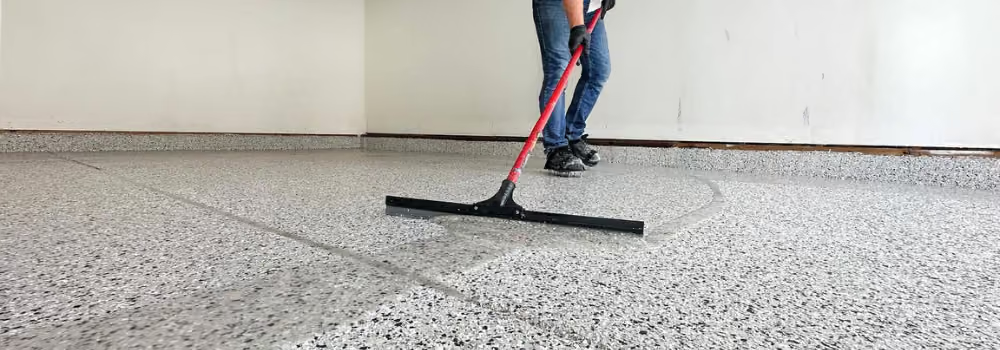










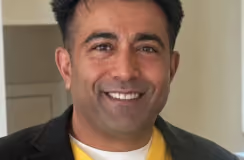






%20-%20thumbnail.avif)


%20-%20thumbnail.avif)

%20-%20thumbnail.avif)
.avif)


%20-%20thumbnail.avif)