Host: One good deal can change your life and that's not hyperbole. Now many people in business never enjoy a life changing deal and they build wealth anyway, compounding hard work and consistency over years. But it sure helps to find a great deal. Exhibit A Today's guest Joe Ziolkowski. And guess what? That great deal was hiding in plain sight on Biz Buy Sell. Like many of you, Joe was checking Biz Buy Sell daily. Not seeing many interesting businesses come up for sale. He finally decided to relax his filters a little and look not just at the new stuff, but the old stuff, the listings that had been sitting for a while. And that is the origin of his ownership of Woodland Face Veneer. Woodland Face is a manufacturer with $11 million in sales and 800,000 ish in SDE sale price 1.5 million. Yes, your math is correct. That's less than 2x for a mature sizable business with an SDE level that self funded searchers all seek. Now there is some customer concentration to this business. It's in a very small town, but those are relatively minor when you consider Joe's entry point into this eight figure manufacturing business. I wish us all similar good fortune. Here is Joe Zielkowski, owner of Woodland Face Veneer. Many acquisition entrepreneurs wrestle with the big questions. Should I go as big as I can or start small? Can I buy more than one business? Is this even the right path for me? Well, in this week's office hours with Chelsea Wood, we're doing something a little different. This is your chance to hear the real answers to questions like these live straight from Acquisition Lab members who've lived them. This is a live panel of closers, as they're called in the Lab members who've completed a search and bought a business. If you're searching for a business to buy, or questioning your next step, or craving clarity on what ownership really feels like, this is a session you don't want to miss. Hosted by Chelsea Wood, co founder of Acquisition Lab, it is this Wednesday, April 23rd noon Eastern. Register at the link in today's show notes or on the Acquiring Minds homepage acquiringminds code. Welcome to Acquiring Minds, a podcast about buying businesses. My name is Will Smith. Acquiring an existing business is an awesome opportunity for many entrepreneurs and on this podcast I talk to the people who do it. Looking for an SBA loan to buy a business? Then meet Pioneer Capital Advisory, your team for getting an SBA 7A loan quickly and at great terms. The team at Pioneer has closed 81 SBA loans in just the last two and a half years with an average close time well under the industry standard. Founder Matthias Smith and general manager Valerie stash both have 10 years of SBA experience and know the process cold. There are three analysts at Pioneer who build you a lending presentation that speaks the language of the bank's underwriters and gets them to yes, two account managers to guide you from underwriting to close as fast and smoothly as possible, and two sales associates ready to walk you through the Pioneer Capital advisory process. That's nine people at Pioneer. A real team. To get you where you're trying to go. New owner of a business, go to pioneer capital advisory.com or click the link in the notes. Joe Zielkowski, welcome to Acquiring Minds.
[4:15] Guest: Awesome. It's great to be here. Thanks for having me.
Host: Joe, you pivoted into buying businesses from real estate, and given your successes so far, safe to say that you are happy about that pivot. There are two good acquisition stories that we're going to cover today. Let's get into it. Joe, how did you decide to pivot from real estate into small business ownership?
Guest: Yeah, so I guess I'll kind of just start earlier, you know.
Host: Yeah.
Guest: Even since from high school, I always kind of had an entrepreneurial spirit. While a lot of my friends, you know, got jobs just at regular retail or, you know, restaurants, I post ads on Craigslist like handyman, odd jobs, and I'd charge 20, 25 bucks an hour. So I did that for the summers throughout high school and getting to college. It was interesting. So kind of a little backstory. I'll keep it short, but my roommate in college, my freshman year, he turned out to be my business partner in real estate. And he was the guy that me and him wrestle against each other in high school. So. So we were kind of like rivals from different schools, same weight class. And yeah, so we wrestled actually in the state finals, so the highest level. And yeah, we kind of, we kind of didn't like each other in high school and we ended up being roommates at Madison, and we both wrestled for them for a bit and ended up kind of really, you know, getting along and became great friends. But we had the same mindset. We both kind of wanted, like, financial freedom early. This was like 2015, 2016. So that's when real estate kind of started to get big on social media, bigger pockets. You know, we listened to a lot of their podcasts and, you know, read their books and whatnot. So we'd literally spent, you know, three years of college just in consuming as much real estate information as we could. And when we both graduated and got jobs, we started buying together. And we grew up. We brought in another partner, grew up to 130 units. So we started in 2020, by 2022, at 130 rental units. And even at that point, though, in a good month, we would each bring home maybe 5,000amonth in cash flow, and we'd kind of, you know, spent all the capital that we had wanted to, you know, putting it back into real estate. And at that point, it's like, man, we either got to bring in more partners to really scale this to what we wanted to achieve with real estate. And I don't know if we had a really specific number in our head, but the cash flow wasn't as great as, you know, it can be portrayed to be on social media and all that.
[7:10] Host: But let me stop you there. So you guys were cash flowing, $5,000 a month each. Correct. And how much. How much were you working to manage those 130 units?
Guest: Yeah, so it wasn't a whole lot. We had third party property management at that point. But that was also kind of hurting our cash flow. We'd cycled through a couple of those, and it wasn't the rates they were charging, but the maintenance. So they all had in house maintenance crews. So they were kind of incentivized to fix every little thing possible. And. And it just didn't really align. So we eventually brought it in house, hired our own guy to manage our units, and that's worked out a lot better. So we maybe spend 10 hours a week now max on that. But. So, yeah, and that was probably the most we'd ever spent. I would say, because I have heard
Host: this many times, that it's shocking that a portfolio of over a hundred doors can yield so little cash flow. Point taken. On the other hand, when I look at the time you did, you guys built that in 2ish years?
Guest: Yeah.
Host: 130 units. You're not working that hard. And it is cash flowing. I'm surprised. And you were so young. I'm surprised that you were disillusioned by this. You guys really were impatient. No offense.
Guest: Well, I think. I think a part of it was to the market changing. So even from 2020 to 2022, that's when interest rates started to climb back up in 2022, and deals just became a lot harder to come by. We initially started by mailing a bunch of letters, direct mail letters to homeowners and whatnot. And we had good success with that. But even a Couple years down the road, it became a lot harder. Cash flow's a lot tighter when you're paying double in interest rates now. Yeah, it just made it kind of so.
[9:16] Host: So you weren't going to be able to rinse and repeat.
Guest: We weren't exactly. And another thing too side note, in 2020 and 21, our lenders would, and I don't know if all lenders allow this, but we had a good, we had a good relationship with them where say we'd buy a duplex for 100,000 and we knew it appraised for 120. Well, we would offer the seller the 100,000 that they wanted, bump the price up 20,000. So technically $120,000 offer. But then we'd get a 20,000 credit at closing to cover our down payment and closing costs. And that became. That kind of went away when interest rates went up too. So just kind of some of the strategies we used to preserve capital when scaling, we're kind of gone. So it was kind of interesting.
Host: So you had this, you had this technique where you could buy property without any money in, without any money down, which is how, how you did it, how you got to 130 units in 2, 2ish years. I mean.
Guest: Yeah, and you know, that's not going to work in every market. We're in central Wisconsin where, you know, we were buying two units, three unit properties for 75 to 100,000. Yeah, that's quite cheap. Right. So it's not going to work say on the coastlines and whatnot. But yeah, we were able to make that work. We did a few flips along the way too. And that's actually how we kind of saved our capital or I saved my capital to invest in a business. So in 22 we probably did like three or four flips, saved up about $100,000 from, from doing those and use that to invest in the business. But going back to your question, it was kind of a natural pivot just being in the field of real estate investing, kind of in the entrepreneurial whatever. On social media, YouTube, you kind of see people like. It was Cody Sanchez, I think I kind of ran across first Alex Herozi. Some people like, you know, people like that, right. You kind of pick up from and learn from. So I don't know who I think like I said on the pre call, Eric's my real estate partner. He introduced me to your podcast, I believe, and kind of from there listened to as much as I could and, and started a search on biz by selling in 2022.
Host: And so it was kind of like this real estate thing is going. Even though we've accumulated quite a portfolio, cash flow wise, it's not that great. It's only going to get harder. What now? And your business partner discovers acquiring minds. You guys are kind of both exposed to Cody Sanchez and others. And so then it's like, okay, this buying business thing might be, might be where to go. And you learn about it and decide indeed, this is where we're going to do.
[12:17] Guest: Yeah, yeah, exactly. And I always knew too, like, I was never a good employee. I felt like. So I kind of knew, like, corporate America wasn't for me. So I never really was involved in corporate America. I had a few jobs that lasted six months and I just like, I can't do this. And anyway, so, yeah, so it was like, I need to buy business, right? I need, I wanted to basically increase my earned income is what I called it, to, you know, put that money to work in real estate and S and P, whatever it is. And yeah, decided buying a business. Looking at the multiples, it just seemed like, it seemed like the right fit. So, yeah, in 2022, started the search pretty much primarily biz by sell. And I connected with different brokers on there as well that I would, you know, reach out to. And I was looking to move somewhere warm at the time so that I spent pretty much my whole life in the Midwest, mainly Wisconsin. And so I was looking everywhere, Florida, Texas, the Carolinas and pretty industry agnostic, open to whatever. And I don't know, I kind of like that strategy. I know some people say niche down and you'll have better luck. I kind of took it. The approach. Just had my kind of guidelines of what I was looking for, cash flow wise, price wise, what I could afford and say I found an opportunity, I'd get the sim, review it and if it looked pretty decent, then I'd kind of review the industry as much as I could online, listen to videos, whatever went into Reddit subreddits and try to get other business owner's experience and then kind of eliminated some from there. Right. So I eliminated a couple of like franchise opportunities. Like I, there was a, a Mr. Rooter plumbing that I actually, I put an offer in but ended up kind of rescinding that after doing some more research on it. And
Host: yeah, Joe, what, what didn't you like about that Mr. Rooter opportunity? Just curious because, because one of my most popular guests has the Mr. Rooter territory in Portland, Doug Johns. So just curious.
Guest: So one of the things, I mean, I knew labor was always going to be a challenge for, for construction and trades and whatnot. And one of the things that I came across with Mr. Rooter plumbing is it's hard to keep and retain good plumbers because a lot of the time they're not doing like real plumbing work. In a sense it's mainly like clean outs and in kind of quick residential jobs. So it's like it's harder to keep a good, you know, licensed plumber. And that was just kind of one of the things that I, I read up on whether it was true or not. You know, it's kind of, I guess scared me off to the idea. And I wasn't a licensed plumber, so in that business too, I would have had to have the seller, you know, keep, kind of keep their, their license on board, which I saw as a risk. There was no employees that were licensed plumbers, so it just kind of, yeah, didn't quite work out. But.
[15:30] Host: And Joe, to your search criteria, so, so how much did you have capital to port toward this? What could you afford? What was the, the parameters there?
Guest: Yeah, yeah, so I had probably about 100, 120,000 saved up. Um, and I was, you know, I was willing to put it all, all to, to risk essentially with our real estate investing, we pretty much were cash broke every time a new property came up. So I wasn't too concerned about, you know, putting, putting all my money down. Maybe I have a higher risk tolerance than some, but I guess that was just me.
Host: Well, and, and let's also say how old, how old were you are you?
Guest: Yeah, so I'm 28 now that I was 25 then.
Host: And single.
Guest: Engaged.
Host: Engaged, okay.
Guest: Yeah. Yep.
Host: But still not no kids, nothing. No mortgage. So you could. You were also at a different phase of life that also of course, informs one's risk appetite. Yeah, yeah, yeah. You know that one of the most common levers to pull in a target acquisition is technology updating the systems of a business that may still be running off a spreadsheet or even pen and paper. But tech is complicated with tons of solutions out there. So choosing the right cloud platform, CRM, telephony, compliance and cybersecurity, not to mention implementing all that, is a job in itself. Acquiring minds Guest Nick Akers knows this firsthand. As a former searcher who now owns Inzo Technologies, Nick has seen the tech challenges searchers face when acquiring businesses. His team at Inzo regularly works with searchers and their acquisitions, offering a complimentary IT audit of the Target company. Nick takes a personal interest in all their searcher clients. Drawing from his own experience in the search phase, Enzo dates back to 1989. So this is a company that has managed the tech for hundreds of small businesses over decades. And one last thing, no long term contracts with Inzo, a big differentiator. Check out inzotechnologies.com I N Z O or email Nick directly@nicknzotechnologies.com and don't forget to tell them you're a searcher. So 100, 120,000 of your own cash to put into this venture. You're 25 years old and ideally you find somewhere warm to live. And is your, is your fiance at the time gonna come with you? Are you guys living together?
[18:10] Guest: Yeah. So no. So she, she's actually, she was going to school in Chicago so I was in Wisconsin and she's still finishing up her last semester now, so she'll be done in May. But no, so she was gonna stay in Chicago and I was gonna go to the place, you know where wherever the business was. And the idea was that then she was going to meet me down there after we graduated or she graduated.
Host: Okay, great. And so 100 to $120,000 in capital. What business size were you then targeting? What could that afford you?
Guest: Yeah, so I was really looking probably up to the one and a half million mark as a purchase price. Just 10% down. SBA, 10% seller carry. Just kind of a traditional deal structure. And I put cash flow criteria around 300,000 minimum after debt service I wanted to have at least 100, 150,000 in SDE. So that was kind of my main criteria. And yeah, just started the search on biz by sell. Probably like six months it took. It went through 100, 150 different Sims. And what's cool about. And we again we talked about this a little on the pre call. What's cool about buying a business, you can compare them in different markets across the US because essentially if they're in the same field, same type of business, they trade relatively at the same multiples. It doesn't really matter what I guess city they're in as far as I found. And that's quite different from real estate. Right. So it's easier to compare when you're searching in a, in a large geographical area.
Host: It's a great point. It's something that not coming from real estate I hadn't considered. But yeah, you don't have to think about the market that much as unlike in real estate where if you look at a property across the country, you really have no idea if it's expensive or not.
Guest: Yeah, exactly. And understanding rents and all that in that area and their laws so got pretty good anyway reviewed like 150 Sims. Got pretty good at being able to eliminate them. Like I'm sure a lot of your guests you can look over SIM in a few minutes and it's like yeah, no, this one's, this one's not for me. And I kind of. And we did the same in real estate. We really knew what a good deal was just because we had reviewed so many real estate deals and it kind of became the same for, for business here and came across one. It was a restoration company, it was a franchise. It was a small franchise. They only had about 35 locations across the US and then they had 15 corporate owned locations mainly all of them in Florida. The corporate owned and seemed like an interesting opportunity and a little more background. I actually had one of one of my six month jobs in, in kind of corporate America. I guess it really wasn't corporate but it was a, as a project manager in a restoration business. So I had a little bit of a, you know, a little bit of experience kind of taste of the industry and that was back in 2020. So I, you know I kind of got comfortable with the idea of this business and, and really the, the numbers were quite attractive. So this was a, these were two corporate owned territories that they were selling and I talked to them and they wanted to focus more on their franchising side kind of scaling that up. So they were going to start to divest some of their, their corporate owned locations, get capital back to expand their franchise side. Great. That made sense. And so what they wanted. So they, these were two established territories in central Florida. They've been around probably for about you know, seven to 10 years each. So they had a good Google presence, they had good reviews and you know, and customers already. So they wanted. They were selling these for a new franchise price plus the cost of the equipment. Even though so, so that was. The total price was about 515,000 is what they wanted for, for these two territories. And they sent me the financials and it was doing about 1.6, 1.7 in revenue and it showed about you know, 500,000 in ste. I kind of figured that was the STE was high because they had you know, 13 or 15 corporate locations kind of on Florida area. So they were sharing resources between locations and so I knew my SD wasn't going to be that high. But Still, I factored probably 350, 400,000. I can essentially buy these two territories for 1.2x or whatever it was.
[23:10] Host: Right, Exactly.
Guest: Just crazy valuation.
Host: Exactly.
Guest: And at that time the equipment was worth about half of that.
Host: And Joe, you could justify it to yourself because there was a good. It's always like if a business is being sold for under market, it's like, well, why. It's almost more of a red flag than it is a green flag. But here there was a good, there was a good reason. Corporate wanted to divest itself of these, of these territories to. Why. To redivert those resources to doing something
Guest: else to growing their franchise side. So they, they. Yeah, we're building out their franchise team and wanted to open up more territories
Host: across the U.S. yeah, so, so makes sense that, that there would be a deal to be had here. So that's encouraging. So there you are. You estimate that it's 350 to 400 of SDE. You're being conservative because they're telling you it's 500, but you wisely are conservative. But even at 350,000 of SD selling them, the sale price being 515, which by the way includes the, Includes the equipment.
[24:12] Guest: Includes the equipment, yeah.
Host: Is a phenomenal. Oh, that was half the value. Of course, just for simplicity's sake, let's just assume it's all that equipment should come with because they. It is necessary to run the business. But anyway, it ends up being. What is that?
Guest: A.
Host: A 1 1/2. 1 1/2 x or less.
Guest: Yeah, one and a half or less. Yep.
Host: Yeah. Amazing, right? And, and good and good history. Seven to 10 years. And how are reviews? You mentioned them.
Guest: Yeah, yeah. Both locations were at 4.8 stars on Google with. With close to 100 reviews. So it was, it was pretty solid.
Host: Very solid. Okay, carry on.
Guest: Yeah, so anyway, kind of went through, went through that process, the SBA financing and it was kind of a pain just with the amount of delays. I mean we probably had. I think it was originally supposed to close of March of 23 or February of 23. Ended up closing in, in May, in the middle of May. So quite a few months of delay just for whatever reason. And it was a little more difficult on the SBA side because one of their territories that they were selling had had its own separate tax returns. But the other territory was rolled up into several other territories that corporate had. So they had to break out each one and then verify that against the corporate tax returns the SBA lender did so There was kind of some back and forth there, but we're able to work through it eventually and closed in May of 23. And yeah, from, from day one, it was, it was pretty hectic, just kind of being thrown into, you know, I guess, a first time owner.
Host: And Joe, where exactly in central Florida.
Guest: And yeah, yeah, so, yeah, so it was in Melbourne, Florida. So it's about an hour south of Daytona. And then Ocala Gainesville was the other location. And you moved to Melbourne? Yep.
Host: So I kind of moved to Melbourne.
Guest: Yep. Kind of had my headquarters there, if you want to call it, and then commuted to Ocala Gainesville, which is a little far, about two and a half hours apart.
Host: Oh, you commuted, meaning you'd go there occasionally?
Guest: Yeah, yeah. Like probably once every other week. I try to make it out there.
Host: Yeah.
Guest: Yep. Okay, great.
Host: So you were saying how hectic it was. How, how, how was it? Tell us about ownership of this business.
Guest: Yeah, yeah, so it was kind of a whirlwind at first. I mean, I was probably averaging, I don't know, 100, 150 calls a day just from my, my operations managers, technicians, customers, whatever it was, and kind of like drinking through a fire hose. But what I did to initially, since these locations were so far apart, which kind of made it a little bit of a challenge, I wanted to hire an operations manager or someone who could oversee the Ocala location. And basically, you know, I had enough cash flow, I believe, to support that and found someone. Pretty good industry experience, but they weren't a very good manager. But they had 30 years in the field in restoration and just didn't end up working out. My employees gotten, I guess, fights or whatever you want to call it, conflict with this new operations manager. So that was kind of a trial and error experiment that didn't work out so well, um, but ended up kind of pivoting, let him go, restructured the team a little bit over, over in that Ocala location and was able to get things running, running more smoothly.
[28:12] Host: But anything more to say about that experience, Joe? I mean, as a first time business owner, young guy making a bad hire, who's really the leader, who's going to be the leader of your essentially remote crew or two and a half hours away. That seems like it could have been a fetal position moment. You're, you're talking about it like it. Maybe it wasn't that big a deal. Say more.
Guest: Yeah, I mean, it probably was. You know, I don't tend to be too emotional, but yeah, I mean, for some it probably could have been a fetal, fetal moment. I mean, I was, I hired him for $100,000 salary, so it was pretty good. And you know, I thought with his experience that he'd help lead the team, but there was such a dynamic or a personality difference between him and the employees. I think age was a part of it and there was a big age gap. And I think, yeah, what I would say is if you're going to try to do that one, vet the person as much as you can, but then also make sure it's a good fit for your team. You, you know, kind of know your team first before you make that hire. And that's kind of what I didn't do. I, I should say kind of made that hire right away without kind of really learning how my team operates and, and their little nuances and whatnot. You know, every, every team's different. So, yeah, I guess that's one piece of advice I would say before you make that hire, try to learn that team yourself and then you can, I think, plug in someone that fits with them a little bit better.
Host: And, and this team out in Gainesville was with the employees at that territory were just a single crew, correct?
Guest: Yep.
[30:00] Host: Of how many?
Guest: There were five. One. One office person, three technicians, and then one kind of like field manager who also went out and, you know, did estimates and whatnot.
Host: Okay. And maybe just quick pause to. I think it's there in the name restoration. But, but what exactly is the nature of the work in a restoration business? Because it is one that you see on biz, Buy, sell here and there. I've heard of plenty of searchers going after such businesses. I don't think I've ever interviewed somebody who bought one. So, so what is, what is restoration? What is the service you're delivering?
Guest: Yeah. So essentially it is water, fire, mold damage, if you. Property damage, any of those reasonings, we come in, help remediate the water, dry it out, get everything ready to be built back. Whether it's mold, we'll put up containment, get all the mold out of there, hepavac, get it cleaned up, get it tested and then ready for reconstruction. Again, same with fire. So the bread and butter of the industry is really the water. Water damage. Whether you have like a dishwasher leak or a water heater or sump pump, whatever it is, those are the highest paying jobs, highest margin jobs. So that's really what you want to try to, I guess, go after in, in restoration. But a part of the problem is, is it is, you know, it's not reoccurring revenue. Right. It, it is project based. And at the end of the day, when a homeowner has a water leak, right. And they have a pipe burst or something, they don't call a restoration company, they're going to call a plumber nine times out of ten, if not more, just because that's the first thing you think of. And a lot of homeowners don't know what the restoration industry is.
Host: Yeah.
Guest: And so, yeah, the thing in the industry where leads come from is those plumbers. And so you have to, as a restoration company, especially in Florida, and this goes throughout the whole US you really got to make good, good relationships with the plumbers in the area, the different plumbing companies. But then it kind of becomes a game of who, what restoration company is going to pay the highest commission for, for these water referrals. And Florida is notorious for, for high commission payouts to plumbers in my area. You mean the average, the average water job that we'd get from a plumber was maybe 2500 bucks, which is on the small side. You want to kind of be around that like $5,000 job size for it to make sense because you're paying $900 to the plumber for, for that referral and you're paying it up front. Right. So you're paying that day one, you get in there, do the restoration work, submit it to the insurance carrier, and then you're not getting paid for another 45 days. So there's a big kind of that negative cash flow or what have you that you kind of got to prepare for in the restoration, especially when you do larger jobs just because they take several weeks. Right. So you're going to have the carrying cost the whole time. And then at the end of the job, you then submit your total job to the carrier and you got to just wait to get paid. And sometimes it would go out like 75, 90 days before from the start of the job to getting paid, which is kind of a, kind of a big deal when you're, you know, starting out, especially, you know, at, at a smaller scale. So. Something to think about.
[33:44] Host: Yeah. Well, all true or I mean, all unpleasant. It sounds like in, in kind of weaknesses of the business model, but these were viable businesses. They, These territories were 7 and 10 years old. And I almost feel like with the, you got this business for such an aggressive multi, such a low multiple that you could almost, you didn't know this at the time, so maybe you couldn't turn around and do it, but you could almost have put another whatever hundred $200,000 on, on the balance sheet to be working capital and still had a low multiple. Yeah, you know what I mean? Would that if you had had the foresight or known what, how tight cash flow is going to be,
Guest: how long
Host: you're gonna have to wait to get paid from the insurance companies, do you think that would have solved the problem?
Guest: Yeah, I definitely think it would have helped relieve some stress. But I mean at the time I did think I had enough money. So I, I got 120, 000 working capital day one. And then I had another 120, 000 line of credit. So I had 240,000 to work with between, between the two locations. So I thought it was enough. Um, and it, and it was, I made it through. I, but I did use all the working capital and basically all the line of credit until I started have several jobs kind of come through and it ended up working out. But yeah, I mean that, that's probably where it was the most stressful. Just, you know, that first 30 to 60 days, especially when I made that new hire, you know, I was, I was. My payroll was kind of to look back, but felt like it was like 40,000amonth if not more. And yeah, it was just, it was stressful because you're kind of, you whittled through all the working capital and you're getting down on your line of credit and you know, these checks are supposed to be coming in. So it's kind of just like following up as much as you can with insurance companies, with the homeowners and just trying to get paid right. To make that next payroll or what have you.
Host: Yeah, well, I, I also recall the story about the hotel job which, which get, which gets to how the. You'll do work and then the insurance company will be like, this is what we're going to pay you for the work. So tell us that story and tell us and share with us what it tells us about the industry.
[36:12] Guest: Yeah, absolutely. So we, we got a big. And another thing about the industry is it, it's on call 24 7. Right. So your on as an owner and at one point too, I was taking the leads and you get calls in the middle of the night because that's when people get floods and, or fires. And so yeah, it's kind of hectic. And this was this hotel job was. It was a fire and then the sprinklers went off. So there's a lot of water damage as well. And got the job. We got there like Three in the Morning took probably four weeks to complete. So. And at this point, I didn't have as much staff, so we would use like temporary help or temp labor because I had crews of like 15 people in there just demoing and all that stuff. But that adds to the carrying cost, especially for a job this large. And yeah, what's unique about restoration with the insurance. With the insurance work, you. The whole industry works off one software pretty much called Xactimate. So it's like line items, and it's got certain pricing for each line item. But when you start the job, you don't submit an estimate or anything like that to the carrier. You just get in there, you do the work. You're recording everything you do throughout the whole process. Take pictures. You have dry logs for moisture testing and whatnot. But then at the end of it, you kind of tally it all up. You get an Xactimate invoice generated based on the work you've done, and you submit that to the carrier. While from there they review all your photos, they review all your dry logs. They really try to review everything you've done. And if you had missed something or one of your technicians didn't take pictures or record something properly, even though you did the work, the carrier is not going to pay you for it. And this being such a large job I didn't really have, well, this was my first big job, you could say. So I wasn't very experienced on having my guys track things as well as they should have. And we submitted our invoice and it was 200 to $240,000 right around there, like 230 to 240. And we. Couple weeks later, the insurance company comes back and they say, look, we can only pay you 158,000 because this is all that that we see. And it's just like, you kind of just have to accept it, especially when it's like you just need to get paid. And they kind of know that too, right? The carrier knows you. You got a lot of carrying costs over these past several weeks. So it's like you accept it or try to fight it, and then you got to wait longer to get paid. So it's. They kind of have you, you know, under a gun, and it's like, okay, I'll just accept it and take that big of a haircut on it. But.
[39:07] Host: So was the job even profitable?
Guest: It was. It was still profitable. And that's what's great about restoration. Like the. The margins are quite, quite healthy in, in the industry. So yeah, it was still profitable, still worked out, but it's still a stressful situation and kind of crummy to deal with when, when you're negotiating with insurance companies on, on work you know you did, but they're not going to pay you for it.
Host: Yeah, well, we all know what, how painful it is as consumers dealing with health insurance companies, so so I imagine that's a taste of what it's like to, to do it on the commercial side. Joe, anything else about the restoration and remediation business to say for other searchers who might be looking at listings in that?
Guest: Corey yeah, one thing that we talked about in the pre call that I think is very important in, in the if you're considering one of these businesses to know where your leads are coming from. So to know where the majority of your calls are coming from. Right. So whether it's from plumbers, whether it's from Google or online services, lead sources or if it's from insurance programs. So you can be, your restoration company can be a part of insurance program. So the big one in Florida is called Contractor Connection and essentially your business has to be established for two years. So your ein has to be established for two years in order to be on the program. So if you're going to go look at a business in Florida Restoration and they get most of their jobs from Contractor Connection, you need to be wary because if you go buy it as an asset sale and you have a new ein, you're going to get kicked off the program. So that's something to be really careful of. And there's other programs too, you know, throughout the country. So yeah, just something to be, you know, wary of. And two, with the plumbing side of things, it's like how high referrals are you paying out is. It doesn't make sense. So just really understand, you know, where the, where the leads are coming from.
Host: Well, great point and I'll just zoom out to say that I have heard a well known lender, SBA lender say one of the biggest oversights she sees searchers make is not understanding how money flows through the business and particularly where, where the dollars come in from, exactly where those leads, what the various channels of business are. So word to the wise would be under would no matter the industry. Yeah, remediation or restoration or remediation or otherwise. So important to understand exactly, exactly, exactly where all of your business is coming from, where all your revenue is coming from. And, and because ultimately these businesses are only as good as the quality of that revenue.
[42:06] Guest: Yeah, exactly.
Host: Great Pick us back up. You're in this business, you're getting woken up in the middle of the night. You hired an operations manager, then had to let him go. But eventually somewhat stable.
Guest: Yeah. So eventually probably like the 5, 6 month mark kind of stabilized. The cash flow was starting to, you know, come in from past jobs. So that, that issue was relieved and you know, at a few larger jobs, which helped kind of boost the, boost the bank account. But yeah, ended up kind of stabilizing it. Trim some of the fat that I believe like just employees and, and whatnot that corporate had been running it with and just kind of had a good lean team that was willing to work, work hard and, and we got more great reviews. So ended up kind of. I don't know if it was a life change or what, but my fiance and I were kind of talking at the time and, and really she didn't want to be down in Florida. Our family's from Wisconsin. So it kind of came to a point, it's like it makes sense to sell the business. And even though I'd only owned it for six months, I, I knew what I bought it for and I knew I could essentially flip it at that price and ended up working with a broker, got it under cash.
Host: Flip it at what? At what price, Joe? At the same price or at a.
Guest: I, I listed it for 1.2, 1.2 million. So.
Host: So by your. But your entry multiple was incredibly low. And then when you have such a lot, when you buy so low, buy for such a good price, you can essentially turn around and resell it without even adding much value. Sounds like you did add value, but you wouldn't have necessarily even had to add much value because there was, there was basically equity baked in because you could just sell it for market a market price of even conservative 2 1/2 x 3 x and you know, come close to doubling your money.
Guest: Yeah, yeah, absolutely. And I, I think I really grasped that concept from real estate. The last flip that my partner and I did, we, this is a funny story. So we working, we're following up this guy for probably a year and a half to buy his six units in the central Wisconsin area. And after a year and a half, he said, yeah, I'm ready to sell. So we had closed on a Friday for 250,000. We knew these properties were worth way more. We closed the following Friday to another buyer. So we sold it to someone else, bought it for 250, sold it for 350 in one week. Yeah. So we kind of I mean I had the idea of like, you know, built in equity on the purchase side of things, just kind of from real estate. Then buying this business at a one, one and a half multiple is kind of the same idea.
[45:06] Host: Running payroll, paying your bills, closing your books and producing financials. These are critical tasks every business owner must do or oversee. But spending time on them distracts you from the leadership in growth work you want to do. So let system 6 do it for you. Owned and led by a former Searcher, Chris Williams, System 6 is a leading outsourced finance team for hundreds of SMBs, including over 50 searcher acquired businesses. Chris, Tim and the System 6 team understand firsthand the challenges, the opportunities of jumping into a business as its new owner. So whether you own your business already or have one under LOI, talk to System 6 about how they can give you time back and improve your financial operations. Mention acquiring minds and they'll provide a free review of your books and financial ops, a $500 value. Check out system6.com link in the show notes or email helloystem6.com you're acquiring minds listener. So you, you know this but I worry for your future because you, you are, you know, when people's first experience of doing something looks like this, they, they think that, that this is the norm. The multiple that you buy that business, bought that business at is such an exception. I've, you know, I've, I've rarely if ever heard of that sort of, that sort of entry multiple. So yeah, you know, you got lucky as, you know, as, you know.
Guest: Yeah, yeah, I definitely knew that. You know, like I said, after reviewing so many sims, you kind of, you get a good idea of, you know, what they're, what they're selling for and yeah, ended up. So I listed that business around six months in for 1.2 million, got under contract within a few weeks, settled on 1.1, closed then in February of 24. So owned it from May of 23 and sold it February of 24 for 1.1. Wow.
Host: Incredible.
Guest: Yeah, yeah. And just a little bit on the deal structure. I had to, to make the SBA comfortable on such a short hold period, I had to have a larger seller note on the sell side to make his SBA lender comfortable. And I was fine with that just because I knew, I knew my fiance wanted to be back in Wisconsin. So we set it up on a five year balloon, 7% interest and yeah, just kind of, kind of more I guess passive income you could say, just kind of similar to real estate. Hmm.
Host: So okay, and so you sold it for 1.1. And how much did you carry as a seller note then?
[48:01] Guest: Did you say? 3. 367.
Host: 367.
Guest: Okay. Yeah. So quite a, quite a large, quite a large note.
Host: Yeah. But you still, so you saw, so 750 or 733 or whatever went into your pocket.
Guest: Right.
Host: And then you had to pay.
Guest: And then you had to pay off my SBA loan. Yeah, so I walked away with about 200. Yeah, a little over 200. 250 I would say with pulling the money out of the, out of the operating accounts as well.
Host: Yeah. So 250 in cash and a $367,000 seller note that you're going to be receiving payments on for the next, what did you say, seven years?
Guest: Five years with the balloon.
Host: Five years.
Guest: Yeah.
Host: Congratulations. That's, that's really something.
Guest: No complaints. I learned a lot and, and the experience worked out. I know that's obviously a unique scenario, but I mean I guess it can't be too unique with the, with the next purchase.
Host: Well that's right. If, if listener you thought that was good, wait until you hear part two. All right, so you get, you go back to Wisconsin, start looking again, got a little bit more capital this time and you got this nice seller note payment coming in. What does search number two look like?
Guest: Yeah, so search number two was at that time I had about a little over 300 in capital. Just stuff I did 50,000 saved up from, from whatever and, and had that 250 from selling the last business. So I had 300 to work with. So my, my purchase price went up a little bit. And this time around, so I felt like I bought a pretty small business. We had 11 employees total for my first one. So this time around I wanted to buy something bigger with a little more structure, structure to it, more of you know, managers in place and, and systems in place. But my, my search is pretty much the same other than that industry agnostic again, whether it be trades. I looked at a transportation business, like a non medical transportation business that actually had put an offer in. This is a smaller one in Milwaukee, like 800,000 purchase price. So I was kind of, you know, going against what I, what I initially set out to do. But again the numbers look pretty good on it. But there was, I don't know, eight offers on it. So I ended up getting beat out. Thankfully I did because yeah, kept the search going. And this was on biz by sell essentially pretty much. And what I do is I would Always search for criteria, you know, in the, in their little options. You could put post it within the last three days, seven days or 30 days. And I kind of figured any stuff that was older than 30 days was, wasn't going to be really any good. So I'd always kind of look at just the fresh stuff. And Wisconsin being a smaller market kind of in general, not a whole lot new popped up maybe one a day throughout the whole entire state. Really.
[51:21] Host: Wow.
Guest: It's what it seems like. Yeah. At least the what my criteria was essentially. So I was looking for this time a minimum of 500,000 SD and I think I went up to a purchase price of like 3 million, maybe a little above that 3.5 I'd go up to but and just yeah, kind of exhausted all my options and I did a little cold outreach. I got a mailing list of different businesses and their email information and I did that for a little bit but just didn't have too much luck with it. Talked with a few owners but it never really panned out. So I mean I don't know if I really recommend that because it didn't work for me but I, yeah, it certainly can work out for, for some people. So my, my business partner, he. Eric, my real estate partner, he, he kind of did that and actually had some success with it. Had a deal fully structured and about to close but it ended up falling through. But he did find that through cold outreach and I don't know, I just kind of view it as a sense of it's similar to large commercial real estate where if you want deals you really work with the commercial brokers in the industry in that type of sense. If you're looking for you know, small multi family properties, sure you can reach out directly to the sellers and have a lot better luck. But when you're talking like bigger businesses or bigger properties trying to reach out to sellers, I don't know, I just didn't have good success with it. So working with brokers I think is really the way to go. Just in my opinion. But yeah. So anyway, going through this search right. Ended up exhausting kind of all the leads or what I thought in the area. But then I'm like I'm just going to go back and kind of search like some of the older, older listings that over the 30 day mark and came across this one, it just said like wood Product Manufacturing Company and listed at 1.6 million 1.595 and basically three sentences worth of information, no photos, no numbers except the price. And I Don't know. For whatever reason, like in my past like searches, I would just skip over these. I'm like, I don't even know if it's worth reaching out. There's like no really good way to get a hold of the broker besides trying to reach out through biz by Sal. It wasn't their direct contact any anything on. On the listing. But for whatever reason I decided to reach out and got back to me and signed an NDA. Looked at the sim. I'm like, holy, wow, this, this is a solid business. On the SIM. This was. So this was 2024. They had financials right away going back to 2018 that they'd showed. Yeah. So right on the sim. So I thought that was great. And because I actually, I don't think I've ever seen that out of the other 100 and whatever 50 Sims that I had, I'd reviewed.
[54:35] Host: Yeah.
Guest: So it's nice to see kind of how they went through, went through Covid and those times, especially for a wood manufacturing company. And so viewed the sim, everything looked great kind of for reference wise, they were doing about 11 to 12 million in revenue basically every year and just really staying consistent. And Even in, in 2020 it dipped down to 10 and a half million and they still turned a profit that year, which is just like, wow. I mean that's. I found that pretty impressive. And 2021 bounced back and 22 is the, you know, business is normal and ended up getting for, you know, the. And so the SDE numbers averaged right around 800,000 for this business every year. Besides the 2020 and 2021, I think it was like a couple hundred thousand those years. But all the other years were like 7,800,000. 2024 was actually 930,000. So a really good 2024. And yeah, listed for a little under 1.6. I offered 1.35, which I mean, I don't. For whatever reason, I didn't know if this was a competitive situation or not. I, I guess I, I had a good conversation with the broker and he said there weren't any other offers on the table at the moment. I'm like, there's got to be. This is too good to be true. And just.
Host: Joe, let me stop you there. Let me stop you there. Hold your thought, please. So first of all, what does it manufacture? What are these wood products that it produces?
Guest: Yeah, so we make, we make one product. It's wood veneer faces essentially. So if you think of like veneer door or like paneling that goes into building cabinets. We literally just make the outer veneer face that. Then we sell to other manufacturing companies that make the final product door or, or the final product paneling, essentially.
Host: And do you sell it in like
Guest: rolls or something like 4 by 8 sheets or literally the size of. The size of the door. So we get pretty customizable in terms of working with our customers. If they need certain dimensions we. For their doors, you know, we can make it to exact specification. And there's a lot to the industry, but our, our kind of value proposition is being more customizable than, than the competitors in the industry and, and just being at a kind of a premium product with a higher price point, essentially.
[57:24] Host: So, okay, and so this, okay, so this is a manufacturing business that does 11 to 12 million in revenue and call it averaging around 800,000 of SDE.
Guest: Yep.
Host: Really consistent revenue. There was a Covid dip, but a minor one and it bounced right back.
Guest: Yep.
Host: It had been sitting and the sale price is, is, is. You said one. Just under 16.
Guest: Just under 16, yep.
Host: 16. So that's call it 2x or just shy of 2x for a business doing $800,000 in SD. And it's been sitting on bis by sell. And the best explanation of that is that it just had a bad, it was just a bad listing, no information, a few sentences.
Guest: That's, that's the only thing I can think of. And I guess too, it was in a smaller market, a smaller town. It's in two rivers, population of like 11,000, but that's about 30 minutes from green Bay. And. But yeah, so I don't know if that had to do something to do with it, but their, their customers are, you know, across the US So that doesn't really affect, you know, where it is too much.
Host: Well, and I would think at that size and an $11 million manufacturing business would have management in place. So while you probably, probably would want to spend a lot of time in Two Rivers, you wouldn't necessarily have to move there.
Guest: Correct.
Host: What did you think? Correct or not?
Guest: Yeah, yeah. I mean, I would, I would, I would agree. But I did. Yeah, I moved to Green Bay, so about a half hour away. My commute is. Just wanted to be in a little bit bigger of a city. But then it worked out because my fiance, her job is half hour the other direction. So we're kind of right in the middle of that. And. And so it works out. Good. Good for that. Great. Yep.
Host: So, okay, so this is remarkable. And so you reach out to the broker and he's like, yeah, no, no other interest. And so already finding a business that the sale price with the seller wants is already 2x. Yeah. More than fair under market. Let's say you were feeling especially lucky and bold. And you offered. Even under that, you offered 1.35.
Guest: Yeah, offered 1.35. And I don't know if I got that from. To do that from. From kind of the broker having a conversation with him. I think I. It just seemed the sellers were kind of just ready to sell. They were, you know, in their 70s, so just ready to retire at this point. But.
[1:00:12] Host: And you knew it had been sitting, so you knew that it wasn't competitive. So that was the only offer they were going to be looking at that week. So that would give one some confidence.
Guest: Yeah, yeah, exactly. So, yeah, offered 1.35. They accepted literally within I think a day or two. And we kind of had a little negotiation. Yeah, had a little negotiation back and forth over the next few weeks. And the price actually went to 1.4 million purchase price. But the original listing said it only included a million dollars in inventory and all the equipment that went involved. So it was going to be. Even though There was about 2.6 million of inventory that they had, they were just going to try to liquidate the other 1.6 and include, you know, a million with the. With the sale price. Eventually kind of just like they came back to me and they're like, look, we don't really want to deal with this inventory, so we'll just. Let's bump the purchase price up 50,000. Then we'll include all 2.6. So I got an additional 1.6 million in inventory for 50,000. So I'm like, yeah, that's no brainer.
Host: Wow. Which of course. So just to be. To press on that a little bit. 1.6 million in inventory. We don't really know if it. How salable that inventory is, so let's. Let's be super conservative and say it's really worth half of that. That's still $800,000 of inventory that you got for 50. So just. Yeah, I mean, so much equity here.
Guest: Yeah, and the equipment too. And I was talking with Rick, the owner, the. The splicers they're called. I mean, these are $250,000 machines and we have four of them. And all the equipment, it's got to be. I don't know what. I could sell it for use, but the equipment now I could probably sell for over a million just. Just in that. So I got really comfortable with the fact I'm like, man, even if this business goes completely under, I lose every customer. I mean even in a liquidation sale I should be completely fine. You know what I mean? Like there's so. It felt like the risk I was taking was just completely mitigated with the inventory and with the equipment and the value of that. So yeah, we ended up closing at 1.4. And this was such a smooth closing compared to my first first one. I think a part of the reason. So I use. And I don't know if this is probably not going to work out in every situation, but the sellers had a really good relationship with their banker. Just a local and not a local, but kind of medium sized regional bank in, in Wisconsin. And I ended up using them for the SBA loan. So their lender knew the books already inside and out because they had been working with them for a long time and pretty much knew everything about the business. So it just made the process so much easier on the closing side of things. And yeah, literally closed on the day we said we were gonna.
[1:03:28] Host: And very interesting tip. So if the seller owner has a good relationship with a particular lender, in this case kind of a regional lender, and if that bank will do SBA 7A loans, acquisition loans, you can, you think that they're. As long as you kind of go to that person within that bank who's already familiar with that business, there's a lot of, there's a lot of kind of opportunity there to remove friction.
Guest: Yeah, yeah, it's, it seems to be the case. And I felt I got a pretty good rate. So for reference, my, my first, my first business that I closed, I think my SBA loan was a little over 11% so and it was variable. So it like from the start, this one was 7 and 7 and 3/4% fixed for three years. So I thought, you know, it's quite a bit better my last one and I'm like if it's going to be a lot smoother transaction, it was well worth it. So yeah, and it was like I said, the first one had several delays. This one closed on the date we were said it was gonna. And I mean literally not a single hiccup in the whole SBA process this time around. So I was quite happy with it. And it's funny because now I'm using their same accountant as well, which works out great because they know all their books inside and out and all I had to do is kind of sign up with them and it's such an Easy transition. And I think this really works too when you have good sellers who are organized, who are trust. I mean I couldn't have asked for better, more trustworthy sellers. Just real down to earth people. And I guess that's a tip too. So I kind of during the due diligence phase, you know, I flew, I was still down in Florida, but I flew up to Wisconsin, got to meet the, got to meet the sellers and it just went really well. I got the tour, the whole facility, really saw how clean and organized it was and they just seem like great people. So I, I felt got comfortable with that fact and, and ended up being true. At least so far.
Host: Okay, well, at least so far, Joe. So I was going to say okay, so tell us about all the skeletons in the closet this underpriced business has. I'm waiting for the other shoe to drop. And in fact it may not. This, this is as good as advertised it, it seems so far.
[1:06:01] Guest: Yeah. So I mean one thing that I was able to see before I closed on the business, they had a small customer concentration and. Right. Every deal, a lot of your guests, every deal is going to have some kind of hair on it. There's just really no way around it. And I think this was the biggest kind of hurdle to overcome, at least in my mind. I mean their biggest customer or our biggest customer is doing at like 40% of our revenue and which, which is quite a bit. And then We're. Our top three or top four are doing 80% of our revenue. So quite a, quite a small customer concentration. So I kind of had to get over that kind of I guess fact going in to the purchase. But after, after closing and now learning more about the whole industry. Well, part of that fact is there's so much consolidation in this type of industry where yeah, we did have more customers at one point but now this one bought that one out and so on. So there's a little more concentration that way but there just really isn't any other options per se. So whether that's on the supply side or customer side, there's only so many commercial door manufacturers at scale. There's only so many veneer suppliers like us. So it seems like right now the industry, it's kind of in a good balance of supply and demand. And actually the, the tough part right now is getting the actual veneer, the raw material for us to build fast enough. So it's a good, I guess a good problem to have. But. So we work with various suppliers and whatnot. But yeah, and your suppliers Deliver.
Host: Deliver you what? Wood?
Guest: Like raw, raw flitches? Yeah. So it's basically, it's called a flitch. So it's lumber or you know, a tree cut in very thin slices and they sent it to us and we cut it down, sort it and essentially splice them together with glue and create a finished face. But yeah, so kind of long story there. That was kind of the biggest hurdle I guess to overcome is the hair on the business that I found so far. Other than that it's been smooth operations
Host: and Joe just double clicking on this weakness of the business, this customer concentration. It sounds like you don't see an obvious way to ameliorate that. There aren't a lot of, unless you start offering completely new products in different categories, there aren't a lot of other customers to go get because it's a pretty concentrated industry. It's one of those where the industry itself has concentration. So it's hard to escape that concentration.
[1:09:05] Guest: Exactly. And, and, and just for anyone that would want to go start a veneer face business, it's pretty much at this point almost an impossible business to start. At least I think just with the knowledge that you need of the actual wood and the veneer itself. I really didn't understand kind of going into it and now that I'm learning more about it, it's, it would be so difficult for someone to actually start a veneer face business. And so I, I, I felt like there's kind of a moat there as well.
Host: Yeah.
Guest: It's also capital intensive. Like you need to do it at scale, you need expensive equipment. So you're really not going to get mom pop shops really, you know, popping up. So quite a bit different than the last business. I was in restoration, where there are a ton of mom and pop shops and, and, and private equity and, and, and what have you and franchises.
Host: So okay, so you learned that about the business, that it's a, a weakness of the business. But it sounds like there were, there really were not other skeletons. The, the owners. You, you were saying good things about them pre transaction, post transaction. You feel just as good about them. They were organized, they were. I mean, why do you have any more visibility into why they didn't list the business for more.
Guest: The only, I've kind of had this conversation with, with the owner. I didn't directly go and ask him. And I mean he's, he's kind of reminded me a few times. He's like, look, you know, I know you got the deal of a lifetime. Essentially. He's like, and so he recognizes that. Right. And I think what was more mysterious
Host: than if he really, if he really knew. So continue.
Guest: Yeah, yeah. So I think in kind of talking with him further on that, I think the biggest thing to him was really seeing his employees taken care of and making sure, you know, I didn't just come in there. It wasn't some corporate company that was going to kind of change the structure, fire people and what have you. Because they had seen that in a smaller town, there's. Here in Two Rivers, there's other manufacturing companies that have recently sold and actually our neighbor literally right next door, they had recently sold a couple years ago to a large corporation, and it kind of got dismantled. So he saw that firsthand, what happened to those employees and, and just didn't want that to happen, happen to his. And, and I think another point is, I mean, he told me, he's like, I mean, so he started this business in two, 2001. 2002, right around there. And he's like, look, I've done really well for myself. It's not about the money at this point. And I kind of verified that. So their, their, their operating system, the wife built it from scratch, and so she was kind of technical. So that's, I think, another reason they're so organized, just because.
[1:12:05] Host: What do you mean, their operating system, Joe?
Guest: Yeah, their ERP, essentially, that tracks all the inventory and accounts receivables.
Host: She built it. What do you mean? She coded it.
Guest: She coded it, yeah.
Host: She's a developer.
Guest: Yeah, she was a developer, yeah. So they got this perfectly tailored system that they've been using for years, and it's completely, yeah, I mean, capable. And I don't think there really is a dedicated software for this industry per se because it's just too small. So what the wife had built really worked well. But anyway, they had used this since the beginning, literally since 2002. So you can look up the lifetime sales of the business and kind of run all that. So they've been doing about 10 million a year since inception. So the total lifetime sales was around like 240 million. So 20, 20 years in business. So that's just going back to the point of, yeah, he's done well. And I think they've really cash flowed, you know, probably 7,800,000 a year for, for 20, 20 years, almost even said they were the year they started the business, they were profitable year one. So it's like they never, they never actually ran negative cash flow at the end of the year, even through 2008 and 2009, which really kind of gave me comfort too in buying the business if they were able to make it through that. Especially in an industry that kind of relies on housing and building and development, I'm like, wow, I just don't see us going back there anytime soon. So that kind of gave me confidence too. Going through with the purchase, the dependence
Host: on real estate, on building generally, does that give this business some cyclicality?
Guest: Not, not quite. Not that I've seen. I mean there might be like a slight dip of maybe 10, 15% in like November kind of December months, just kind of during the holiday months. But other than that, no, it's been, it's been month over month, pretty stable. And so, yeah, not, not too much cyclicality.
Host: Joe, people are going to be so frustrated hearing your answer. No, I'm kidding, man. But listen, congratulations. I mean let's, let's just take a moment to say congratulations on a hungry entrepreneur getting a. Just a wonderful deal and, and not only a great deal, but just a high quality business. And owners that seemed to be just totally selfless about what they were trying to do here in this, in this transition. They were trying to do right by their employees and right by the legacy of the business, even if that meant they didn't, you know, line their pockets as much as they could have. So really, really, I, I don't think noble is too strong a word to say. So that's, that's just wonderful. Anything more to say about the story? I want, I want to leave. We have one more little segment on. I just want to hear what it's like to run a manufacturing business as a guy who doesn't come from manufacturing. And, and here you compare and contrast it with home services. High, high pressure, high stress project based home services. So the restoration business, before we get into that, anything else you want to call out or say.
[1:15:35] Guest: Yeah, I mean, kind of going when you're go. It was tough, especially with like such a small, it's, it's generally a small industry like the wood face veneer. And when you're going through due diligence, it was, it was pretty difficult to try and like, I guess learn more about, about the whole, about the whole industry kind of the ins and outs and because there really just isn't, you know, anything online, there isn't other business owners talking about their, their wood veneer manufacturing business. Like there are home services which kind of, you know, like you said before,
Host: you can, you, you can go to YouTube University for, to hear, you know, restoration owners talk about best practices in their businesses go to subreddits devoted to this. Not so in the wood veneer manufacturing business owner place where there's probably a handful of such people in the world. Go ahead.
Guest: Yeah, yeah. So I think what, what I kind of wanted to do to get as much knowledge as I could, especially after closing, was to keep the owner on for a little longer and which he was completely comfortable with. And I think we have like a six month or a year kind of with six months like in person and year, however long I need for consultation. And you know, I'm just trying to sit with him every day and learn as much as I can about the industry just because like, you know, as I'm going through due diligence, I'm looking at ways just like kind of any other business, you're like, how can I increase revenue? Right?
Host: Yeah, yeah.
Guest: And you're trying to think of like, okay, well in traditional business you think about bringing things in house, right. To, to you know, control the process more and eliminate the middleman, so to say, and get more, get more margin on a sale. So like before I close, I was trying to think of, okay, maybe I can bring in plywood manufacturing, like bring in a press and then I can put my veneer on that and then sell the plywood with the finish veneer, like skip kind of the middleman. And just having these conversations with Rick the, the, the past owner after closing, he, that that's one of the reasons he stayed in business for so long, especially in this industry. It's so tight knit that if I would, if I would bring in a press and start making plywood and, and selling that to end consumers or end businesses, I would literally lose, you know, two of my biggest customers because they're doing that as well. And he said he's seen that in the past where, where other veneer mills tried to bring in their own in house and just doesn't work and they eventually go out of business. So what I'm trying to say is essentially it's like if you can learn as much as you can from the owner, like take advantage of that. Especially with, with an industry like this where it's just hard to find information and it really is just taking, it's going to take years of experience to fully understand it. Try to absorb as much as you can from the owner if they're willing and able. I think is a, is a really important, important thing.
[1:18:43] Host: Yeah. And so your point there is, is that he's basically by sharing this industry experience, what he's seen over the years other mills trying to, to bring in presses and do that. He's saved you from making that similar misstep.
Guest: Exactly.
Host: And does, and, and by the way, does he see any, any way for you to grow the business? I mean, one of the, the great questions to a seller is always, you know, if money were no object, what would you, what would you spend money on tomorrow to grow this business? What do you think he would say?
Guest: Yeah, so there's definitely a few more customers and even our, our biggest customer right now, they want more product from us. But essentially what we're trying to do, our top four customers, we're trying to balance out and allocate as much of our production capacity as possible to each one, to kind of keep each one happy. Right. I mean, we could just keep giving more to our largest customer, but then the lead times for our other customers extends and they might get not happy and, and leave. But that's, I mean, yeah, we've been averaging. I've been cl. We've been closed for about a month now, about a $900,000 backlog week over week. And you know, that's about three to four weeks out. So if, if money wasn't an option, I think it would be to expand the production capacity, kind of make hey while the sun's shining. And but then to his point as well, he said you got to be careful because when, when slowdowns do come now you have more overhead, you've got more maybe loans on the equipment, more staff. So a part of his things of just staying the same size for 20 years was to never have to worry about that problem because he also has seen that. So it's just such a, it's such a unique industry that kind of goes against, it seems like some normal business practices in a sense, but it's worked out and they've kind of come up with this formula that I just want to keep, keep operating.
Host: Well, it is, it is, it's interesting because it is a, an approach you could take to business to remove bumpiness of revenue and, and the pain of downturns. The temptation of every business owner is like you said, when, what is it? The hay? Make hay while the sun's shining. When there's a lot of demand, you want to use that as an opportunity to grow, you grow into that demand. But if you perceive that that demand is going to be transient or is going to be a cycle and then it's going to come back down, you. You can choose not to grow into that demand and, and just always kind of, you know, stay at a certain level. Even though in the good years you could be selling more, you then don't have to suffer the pain of, of having too much overhead, too many people in the down years. Yeah, it's, and I feel like in some ways every business could make that, could make that calculation and, or it kind of implicitly does make that calculation. Whenever you're growing, you're asking yourself, is this demand that I'm growing into always going to be here or is it temporary or what? So anyway, yeah, interesting philosophical discussion.
[1:22:12] Guest: Yeah.
Host: Okay, Joe, let's start rounding out here by hearing about the difference in, in day to day or otherwise of manufacturing your now life versus home services. First, let me ask, just you've said already like you're learning at his knee and you've learned a lot and you're, and you're, and you're basically in a hit the books mode, studying every day, listening, listening, listening. But for a manufacturing business that isn't, I wouldn't, I would call this not super sophisticated manufacturing. This isn't, you know, defense and aerospace or something.
Guest: Right.
Host: How difficult is it to learn? I mean, do you feel like after a year you'll kind of know it or what?
Guest: I mean, yeah, I'll definitely, I think after a year I would learn kind of the general ins and outs of it, but just with the variability of like a wood itself, that's kind of where the more the difficulty and experience comes in just over time. Because a big part of our, of our bread and butter is buying a certain class of veneer from the minute, from the veneer mill. So it's like say B, a B class, it's kind of graded throughout the industry, like double A, a B and so forth. A big part of our, our business is, is kind of buying, you know, AB type quality wood at a certain price, sorting through it and then finding double A quality in it. And so he's like, you know, explaining this to me and I'm like, oh, so it's like arbitrage. He's like, what's that? And I'm like, yeah, well you're buying this veneer at 12 cents a foot. And since you're sorting it and finding the good stuff, now it's worth 36 cents a square foot by just, you know, sorting it and knowing the quality and knowing what to look for in the grains and in the pattern and whatnot. And there's how many different species of wood. So it's just like, so Many little nuances like that that I think is just going to take time to really see the value in the veneer. So I just thought that was, I thought that was really neat how that's kind of they've been operating and you just I guess didn't really know the term. But it's exactly kind of what he's doing. But another thing too that, yeah just like with the day to day operations, like another kind of hiccup I had to get over and this kind of went hand in hand with the last point was well, why aren't our customers just you know, bringing this all in house and, and doing it? And well, I came to realize, well if, if they do the same thing, just buy, you know, double a price to veneer the most expensive stuff which they typically want from us, well they're going to be paying a lot higher price for it and it's going to actually cost them more money in the long run. When we can buy an ab pallet we have customers that want B grade and double A. So we have, our customers want different ranges of things. So if you, if our end consumer tried to like just bring it in house, well now they have to sort all the wood and they're not buying a standard product. So when we finish our product they know exactly what they're going to be paying for face and, and what it's going to be in the quality of it. So it, there's a value in you know, in that sense by us creating a fixed price product for them, they can run their numbers a lot easier and it actually is more costly or cost effective for them to buy from us as well.
[1:25:52] Host: Well, that analysis that you just did is a really good analysis to do. Going into a transaction to that, that's kind of a, that's kind of a supplier that's probably like a Porter's five forces. I think you might have just hit on one of the, the five forces and Porter's five forces of, of the supplier risk or excuse me, I guess in this case it was your customer risk. But the point is in every, in every value chain, you know, they're, you know, the, the, the end product is touched along the way by however many players each taking a little bit of a profit. And, and there's always the question of any of those players, do they move up or down, up or down that value chain, consolidating and starting to offer the service either above or below them on the value chain which is, you know the phrase for that is vertical integration and it's just a good exercise of when you're evaluating a business, is there an opportunity for your target business to maybe do that and, or are the, your either your suppliers upstream from you or your customers downstream from you on, on the value chain likely or able to, to want to consolidate into your space or to, you know, vertically integrate into your, your space in the chain? So it's just a great, it's a great analysis to understand where the, the value is and, and why or why not, you know, people would step on each other's toes or go into each other's link in the chain. Very interesting.
[1:27:17] Guest: I kind of want went away from your question like how the day to day is going. I mean it's, it's business is running smooth compared to the, compared to my first one. And, and this is one of the reasons I wanted to buy a bigger business. You know, we have a couple, couple management structures in place and another great aspect I didn't, I didn't mention. So the daughter of the two sellers who has been working in the business for the past 15 years, she is staying on full time. She didn't want to be an owner, but she wanted to, she wanted to, to stay involved in the business and her kind of role was I guess like the vp. So she's staying in the same role and, and really just knows the ins and outs of, of the whole business. So she's been just, just an absolute blessing and I don't know how, I mean that must be a pretty unique situation where, where they, you know, the child wants to stay on but not be an owner. So. Yeah, I mean, I think I was fortunate in that sense and she's just been amazing to work with. We get her along really well and as I said, they've built such a great operating system and process that it almost seems like I'm coming in here and what do I change? You know, there's, at this point I don't feel like I've learned enough to, to see anything that I want to change yet. But that's kind of, I'm sure it's going to come with time. You know, I'll kind of put my own spin on certain things and, and maybe modernize a few, few, few different processes. But it's been, yeah, it's been smooth running. Customer orders are still coming in nice and strong and, and really no hiccups on the, on the production side either. So.
Host: Amazing. Joe, I will say you are the second interview in as many weeks where the buyer bought a business and in the business. One of the managers and ultimately kind of general manager was a, a child of the owners that just didn't want to buy the business but wanted to stay in the business. And in both cases, yours and the other, it's working out well despite, you know, despite the obvious risk that that would seem like there'd be resentment or whatever. Why, why aren't they the ones to buy the business? And, and it's, it's not crazy that they just simply don't want to be the business owner business and want to stay in it.
Guest: Yeah, absolutely.
Host: Yeah. Joe, this, this, you know, you're making it clear that this, you know, beautiful 10, $11 million business is just happily humming along. No fires to put out, no middle of the night calls, unlike the restoration business. Is that in. Do you think that that's inherent to manufacturing? That makes manufacturing diff different than project based home services? Or is it more the difference in size which you already kind of gave credit to. It's just a bigger business and therefore more processes and so on. Because I could feel, I feel like it could be both, but, but maybe not. Maybe a restoration business, a $10 million, 15 million dollar restoration business, if you were sitting at the top of that hierarchy, would also be a finely tuned machine humming along.
[1:30:32] Guest: What do you think? I don't think it's manufacturing specifically, but more to the size and I think really more to the actual owners and how they operated the business. You know, as I've said, they, the system that they put in place, it just works so well of keeping everything organized and just the experienced staff. I mean we have a team of 35 employees and a lot of them have been around since it started like. Right. So 20 plus years. And they all know more than I'll ever know about wood manufacturing or veneer manufacturing. But it's just great to see and having that team in place. And I think it'd be no different with restoration if you have a full, if it's a big business and there's a full team in place as long as the owner's been operating it how it should be. I think it'd be generally pretty smooth sailing as well.
Host: Great. Joe, anything else to say about the businesses, the story or have we covered it all?
Guest: I think that's. Yeah, no, I think that's pretty much it.
Host: I mean you still have your 130 units.
Guest: So we, we, we've divested down to 78, like a core 78. That are our best, best properties, which is also helped too. And, and kind of alleviate some headaches. You know, as kind of the saying goes, 80 of your problems come from 20 of the. Whatever it is. Yeah, yeah, yeah, whatever it is. So, so we kind of got, got rid of some of our bad properties and yeah, down to 78. So that's, that's running smooth. And, and, and so is, so is the manufacturing business and, and Joe, just
Host: sorry to want to make sure I got the numbers right. So you bought it for you offered 135 and then that went up another to one four you said.
Guest: Yep, one to one four.
Host: And, and then so, and then what was the structure? 10, 1080.
Guest: Correct. 10, 1080. Yep.
Host: Okay. 10 your cash 10 seller note, 80 SBA loan. And how much are you paying yourself?
Guest: So I'm just paying myself 60,000 a year. Oh, I mean, pretty much.
Host: How'd you arrive at that number? Because I recall from your real estate days that's exactly what your real estate was paying you and you weren't happy with that number.
Guest: Well, because that's, I mean right now that's kind of what my, you know, the real estate pays me as well. So that adding to this, this 60,000 plus my, my fiance, she's graduating, she's going to be an optometrist. So starting up in June. So that'll be a, you know, pretty decent income as well. So I just, I feel like I don't need more. My goal is just going to be to pay down the SBA loan. My goal is to pay it off in three years. So that's kind of putting everything back into the business and, and keeping a decent amount of reserves and also part of the structure. I got a $500,000 line of credit to, to operate. But a great thing with this business is for, they've structured it with their main, with our main suppliers. We buy the raw material from, we have 45 day, you know, net pay, but all of our customers pay on net 30. So that works out just beautifully. And I think that's a part of the way the wife, Sharon, she just kind of structured it over the years and kind of built up those relationships. And basically everyone pays on time. They've shown me the books and it's just incredible compared to the restoration industry. And I think it's such a tight knit industry like that. If you don't pay on time, you kind of get a bad rap and people, you know, there's only so few players, so you kind of want to keep a good reputation and it, yeah, that works out the pay structure and
[1:34:35] Host: the cash flow wise, well, like restoration. What we often hear though is in, is in construction where, you know, construction is just the opposite. The terms that you get paid are net 60 and yet your suppliers are all net 30. So you're paying everybody before you get paid. And in your case it's. That's flipped. You're getting paid before you need to pay everybody else. Just incredible cash flow dynamics.
Guest: Yeah. And that was. So I kind of just real quick going back to the search, that's kind of one of the reasons I wanted to stay away from like big commercial, I guess like a commercial construction business. Like one I looked at was just an electrical contracting business. And when they work with, on big commercial properties, I mean that, that negative cash flow cycle is just, it's kind of brutal to deal with, especially as, you know, when you have an SBA loan on top of what the owner doesn't have. So it's a lot harder to, to manage.
Host: Yeah, but. Well, Joe, my takeaway from your story is that everybody should go to biz Buy, sell and look for listings that have been sitting for over 60 days.
Guest: Yeah, I mean, I think there's definitely.
Host: See what's hiding in there.
Guest: Yeah, there's definitely some, some potential there and that's, you know, no different than real estate. Right. You get properties that have been listed for 180, you know, 300 days. It's like there's, there's opportunity and was luck involved? Yeah, absolutely. You know, I'm not going to say here that everyone's going to go find businesses at less than 2x but I don't know, just, I guess takes persistence and just keep looking.
[1:36:18] Host: Joe, if people want to reach out to you, is LinkedIn work or do you prefer some other way?
Guest: Yeah, LinkedIn works, I guess. I mean, email. I don't know if I should I say Marvin. Yeah, go for it. It's just joe j o e@woodland face.com. you can email me there. LinkedIn works as well, but yeah. Great.
Host: And thank you for the name of the company. Woodland Face.
Guest: Woodland Face Veneer.
Host: Yep, Woodland Face Veneer. Great. Joe Ziolkowski, thank you for coming, sharing, being so transparent and of course congratulations again on not one but two under market acquisitions. Yeah. And you're, you know, you're not, you're not yet 30, so a lifetime of good deals. You cashed it in early, man. It's only hard. It's only gonna get harder from here. That's what karma would say.
Guest: Yeah. Right.
Host: All right, Joe, thanks a lot.
Guest: Awesome. I appreciate it. Will thank you.
Host: Hope you enjoyed that interview. Don't forget to subscribe to the Acquiring Minds newsletter. We send an email for every episode with an introduction to the interview, a link to the video version on YouTube, and soon key takeaways, numbers and more essentials from the interview. For those of you who don't have time to listen or watch it, subscribe at acquiringminds Code. You'll also find all our webinars there on the website, both those we have coming up and recordings of past webinars. At this point, There are over 30 webinar recordings, a wealth of information on all the technical nitty gritty of buying a business. Acquiringminds copy.


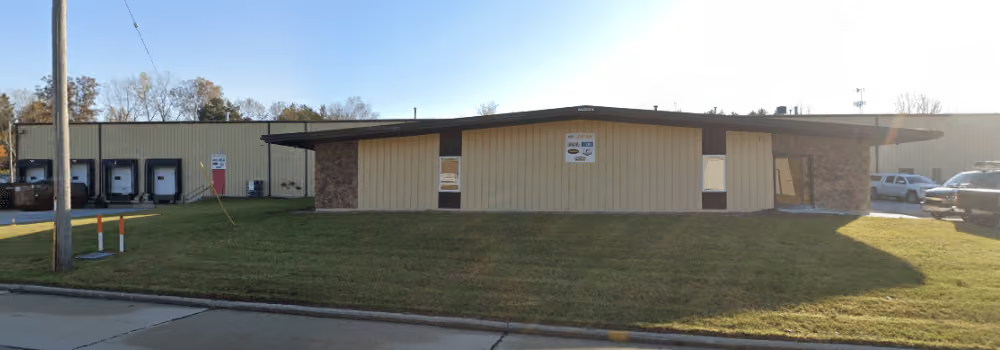


































































%20-%20thumbnail.avif)





%20-%20thumbnail.avif)


%20-%20thumbnail.avif)

.avif)




%20-%20thumbnail.avif)