Host: Could there be better business buyer fit than a retired world champion bowler Acquiring Bowling Alleys Mike Fagan, AKA King of Swing, AKA Argyle Assassin, enjoyed an illustrious career as a professional bowler and today is part of our community as an acquisition entrepreneur, buying the businesses that first sparked a passion in him. At five years old, you will learn about the business of bowling centers, from the reoccurring revenue generated by bowling leagues to the sale leaseback opportunities in the real estate. But a key theme of today's interview with Mike is how the dollars and cents interact with the mission and passion. It's a tension that Mike acknowledges as he tries to optimize the business and service that heavy debt every month while at the same time reviving bowling centers as one of the cherished communal spaces in American life. Head and heart converge in this interview with King of Swing Mike Fagan, owner of ten Pins and More in Rancho Rio, New Mexico. Enjoy. Welcome to Acquiring Minds, a podcast about buying businesses. My name is Will Smith. Acquiring an existing business is an awesome opportunity for many entrepreneurs and on this podcast I talk to the people who do it. What do the following Acquiring Minds guests all have in common? Doug Johns, Morley Desai, Tim Erickson, Chirag Shah, Shane Ursam. They all went through the acquisition lap, the accelerator in community for people serious about buying a business, but they represent just a sliver of the Lab success stories. The number of deals across the lab's cohorts now stands at over 120, with over $300 million in aggregate transaction value. The Acquisition Lab was founded by Walker Deibel, author of Buy Then Build, the book that introduced so many of you to the very idea of buying a business. The Lab offers a month long, intensive, almost daily Q and A sessions with advisors, live deal reviews with Walker, Deal team introductions and an active community of serious searchers. Check out acquisitionlab.com, link in the notes or email the lab's co founder, Chelsea Wood. Chelseauythenbuild.com Mike Fagan welcome to Acquiring Minds.
Guest: Thank you Will. Glad to be here. Thank you for having me, Mike.
Host: We met in Dallas at the Mines Capital Investor Day where you gave a presentation on what you're building. I and the rest of the room loved it. So of course I was eager to get you on Acquiring Minds. You are buying bowling alleys. Let's get into it. Mike, some background on you please, which will reveal why bowling alleys are your thing.
[3:18] Guest: Thanks Will. Yeah, I am one of the lucky people to say that I got to live my childhood dream. I played on the professional bowling tour for 13 seasons. Started in the US and eventually started traveling the world. Played in 30 different countries, played for Team USA, won titles all over the world. And growing up, it was just something that me and my family loved to do. We love to watch it. I love to. I grew up in the Northeast on Long island, and it was always a big event when the pro tour came to town. My parents would let me out of school on a Friday to go watch the match play rounds, and the buildings there were always packed to the edge, you know, probably above fire code. And I enjoyed the atmosphere so much. I just love the energy of those events. And it just got me really excited about the sport of bowling. It was something I just wanted to do, and, you know, I loved it. I did it pretty much starting around 5 years old and kind of took it through college and decided after college that I was going to go and join the tour. So did that for 13 years.
Host: To be clear, you are a world champion.
Guest: I was a world champion, yes. I won the PBA World Championship in 2014, played for Team USA and won gold medals. I was a gold medal winner at the World Games in Kali, Colombia, so had a couple different world championship titles.
Host: That's just incredible. So anybody who knows this, the sport of bowling, would know your name?
Guest: For the most part, yes. Yeah. Even yesterday, I was at a convention down in Orlando called iaapa, and I bumped into a person that I'd seen many, many times before, and he was on Team Malaysia, and he was in town for the convention. And, you know, so, I mean, it's a. It's a bit of a world community, if you will. And I think it's. It's fun when you get to travel around the world and people appreciate what you've been working on to get better at the sport.
Host: Yeah, absolutely. That is just so cool, Mike. And you said you started bowling at five. Did we hear and. Right.
Guest: I did.
Host: When did you get serious about it? We heard that you basically went pro after college, but you probably had been quite serious well before that.
Guest: Yeah, I mean, I played in leagues and, you know, kind of local tournaments. I would say from the age of 5 until maybe 12 or 13. And then in. In 8th grade, the high school coach plucked me out of 8th grade, sent a separate bus to pick me up in eighth grade at the middle school to play on the high school team. And I think ever since then, I just wanted to get better. And that's when I started really getting into more competitions, especially around the Northeast. They have a tournament series called the junior bowlers tour, JBT. It's been going on for probably 50 years and, you know, just played in tournaments all over New York, New Jersey, Connecticut, Pennsylvania, Maryland, Delaware. And that's kind of where I got my start, just doing that every week.
[6:25] Host: Some high schools have bowling teams. Mine did not. I don't think that was in my area, but I've heard that, yeah, it's a. It can be a high school sport.
Guest: I was, I was lucky that it was a letter sport at my school. So it was, you know, part of the, the curriculum. I'm the bowling center that I'm working with now. It's a club sport for men in college, it's a club sport. So not everyone had the same kind of, you know, it's not as ubiquitous as, you know, a football or basketball team. But yes, depending on. I'd say regionally, it's going to be part of the program. So mostly I'd say Midwest, Northeast. I believe Texas has a good high school program as well.
Host: I heard you say that you loved the energy going to watch professional bowlers when you were a kid. A lot of people who become top of their game in sports love the sport itself. And I have no doubt that you love bowling, the sport itself. But I noticed that that also is something that you talk about as if the bowling, the atmosphere of the bowling center itself was something that drew you to the sport. Say more about that.
Guest: Yeah, so, I mean, these are smaller venues, right? So, I mean, even getting a thousand or more people into a location like that, where it's five or six deep, people are standing on chairs and tables to see the action. And, you know, when I was growing up in the 90s, a lot of the events ended up the television finals were aired in an arena. So, for example, the Long Island Open in the mid-90s was played at Seville bowl. And then after that for the television finals on ABC Wide World of Sports. They would have the television finals at an arena. You know, they would build four lanes in the arena. They would have, you know, three or four thousand people potentially watching the event. So, you know, those arena event. It wasn't really the arena events that got me excited. It was more so in the bowling center, you can't move, you can't walk. People are just excited about the event. People are, you know, and that's what kind of drew me to it. I think those environments are a little harder to find these days. But. But I think, you know, back then when I was younger, it just, it drew me in.
Host: I love that, that's so cool. Well, we're going to talk more about bowling, the sport of bowling, the trajectory of bowling and its adoption over the years. So take us back to the story. Then you decide to retire from bowling. I guess.
Guest: When and why I did around 2012. I had my best year on tour, 2013. It felt like I was kind of starting from scratch again. You know, everybody starts from zero every year. There wasn't a lot of residuals. I was traveling 200 plus days a year on the road, a lot of it. Now the tour had started to wane a little bit from, from the financial crisis and sponsorships were dwindling a little bit. So a lot of people were traveling internationally in order to supplement themselves. And for me, it was a fantastic experience. But as I like to tell people, when you've been to places like, you know, I went to Qatar five years in a row to play in the Qatar Open, and it was a great event. But when you go to places like that five, six times, you're not there to really sightsee anymore. You know, you're there to do a job. And, you know, getting on a plane for 12, 15 hours, it was not something I necessarily wanted to be doing for my entire career. And I knew, I knew that I was leaving a couple good years on the table for sure. But I also knew that if I was going to do this for another three or four years, into my late 30s, early 40s, it was going to be something that I was going to do for my entire career. And I wanted to see what else was out there. So I went back to business school.
[10:15] Host: Great. Okay, so pick us up there. Where did you go to business school and what did you think the future held? Was that just sort of a I'll go to business school and figure out my future sort of thing, or did you have direct, more direction?
Guest: Well, I've been entrepreneurial my whole career and I wanted to be entrepreneurial after school, but I didn't really know what that looked like. And I knew, you know, I applied to some programs. I was going to stay local. I was living in Dallas at the time. I was going to stay local in Dallas. Ended up speaking with some folks who kind of encouraged me to dream bigger. So I actually put a, an acceptance on hold for a year. I'm glad I did. I went back to bowling and I did really well my last year. That's when I won the world championship, actually my final year. But during that time I was still applying to schools, taking the gmat and ended up getting accepted into Berkeley. Haas, University of California, Berkeley. It was a fantastic experience. I met so many amazing people, really, you know, an international flavor to the entire class as well. So I think that fit me well with all of my international experience. And just, it's exciting to see where, you know, 10 years later now where all of these folks have gone with their career. But to be entrepreneurial in a place like, you know, the Bay Area often means starting a tech company. And that's not what I was, you know, had in mind. So I. I was a finance undergrad. I went down the finance track, did a summer in investment banking, ended up working in corporate finance my first year, my first job out of B school at MGM Resorts in Las Vegas, which was a good experience. I really enjoyed that was working with, you know, bankers. I had. I had direct exposure right to the CFO of the company. So, I mean, opportunities that you would never have if you. You weren't going through that track. But eventually got a call from an independent sponsor who was looking to acquire a chain of bowling centers and wanted me to come aboard and really develop the chain. And to me, that felt more entrepreneurial than working for a company with 78,000 employees.
[12:30] Host: And it naturally fit with your background. Obviously, that's why they called you Mike. We didn't say what your. Your moniker was, your nickname in the world of bowling.
Guest: I had two. Two nicknames. One I. I like. One I don't really like. One is the King of swing, because of my long, high back swing. And then I used to wear. So at some point they went from like a cotton shirt to a sublimated dye shirt where you could really customize your jersey, much like a, you know, a cyclist or something like that. So I. I actually put a argyle pattern on my shirt. A lot of people thought I was wearing, like, a sweater vest when I was bowling, so they called me the Argyle Assassin, which was not my favorite, but, you know, it's. It stuck.
Host: Well, you kind of invited that there.
Guest: I did, I did.
Host: Was that sort of peacocking? What was up with that, that fashion choice by you?
Guest: Well, at the time, I didn't have any sponsorship, so I needed to try to differentiate my jersey and draw attention to that. And I just felt like that was something unique that most of the players weren't doing. They were doing, you know, very basic designs, and it. It ended up taking off. You know, I obviously couldn't patent it or anything, but, you know, even to this day, you see a lot of college programs and junior bowlers. You Know, putting Argylle on their shirts. So it's. I, you know, I would say that trend. Yeah.
Host: Mike. Mike the trendsetter. Well, we, We. We know what photo will be going out alongside this interview. You and your Argyle. Argyle Assassin. Great. So you join with this independent sponsor, did you? Maybe you didn't even know what they were at the time. You probably just called them private equity. Fair to say.
Guest: Yeah, it was private equity backed. I had actually connected the private equity firm that was backing the transaction I had connected with out of Berkeley, firm called Gray Rock Capital, the independent sponsor. I had known from a long time in the bowling industry. So, I mean, I had connections with. With these folks already, and it just, it felt more like home to me than, you know, don't get me wrong, I. We miss living in Las Vegas. We miss all the perks of working at a place like MGM grand and MGM Resorts and going to all the shows and events. I worked in the corporate entertainment department for about a year or so, but this felt more like home for me.
Host: Yeah. And where was it going to mean that you lived?
[15:02] Guest: So I had to move to the Twin Cities. We moved. We were in Minneapolis for a year and then St. Paul for a couple years with that role. So a little different geography and climate to get adjusted to.
Host: Sure. Great. Well, tell us about your stint there. Tell us what that sponsor's thesis was and how you saw it play out from the front lines.
Guest: Yeah, you know, their thesis is similar to my thesis that there are a lot of bowling centers around the country and there are a lot of league bowlers, over a million league bowlers in our country that are sanctioned and probably many more that are non sanctioned league bowlers. And, you know, these. These facilities are their, you know, their stomping grounds. They're. They're their community hub, Their. Their social network, if you will. And they're very sticky customers. So how do we interconnect these locations? First of all, these locations are mostly run by mom and pop businesses, and that's the case with this chain out of Minnesota. And, you know, my job was to come in and integrate these 10 locations who. Which didn't talk to each other, didn't really follow any similar processes and, and build interconnectivity so that we could open up more acquisition opportunities.
Host: Great. Two follow ups to that. Say more about the role of leagues in the business of bowling, because for those of us outside the leagues, I would. I knew that they exist. I've seen the Big Lebowski. But I didn't. I didn't know, I still would have thought that the bowling alleys basically were mostly populated by birthday parties and casual bowlers and Friday and Saturday night teenagers and families, not the, the leagues. Even though, that they, even though they existed, I wouldn't think that they made up a considerable amount of revenue. So tell us more.
Guest: They do. And you know, that is a tough, that is a part of the business that is very hard to grow. It is usually something that has to grow organically over many years. So you know, being able to acquire businesses that already have this in place is very powerful. And yes, it's, it's not going to be your highest dollar customers. They're not going to be able to pay as much as a big corporate or even a birthday party. But they're usually in the location 30 to 50 to 100 times a year depending on their advocacy of the sport. And you know, for a lot of tense and purposes that gives you a baseline of revenue. It's not going to make you rich as a proprietor, but it's going to make sure that you can pay your bills every month. It's going to kind of give you a good baseline so that if you can start building up the rest of the business like you mentioned, the birthday parties, the corporate events, the Friday and Saturday nights, then that's where you know the cash flowing can really come from,
[18:04] Host: you know. Enzo Technologies as one of the leading IT managed service providers serving the search community. Led by Nick Akers, an acquiring minds guest who bought the 35 year old business. The team at Enzo regularly works with searchers and their acquisitions. And one feature of acquired businesses that Enzo is seeing over and over is the need to implement cybersecurity promptly during the transition. So many acquired small businesses either have glaring vulnerabilities, lack security best practices or both. That step one to de risk the deal you just closed should be addressing these issues. Inso is your full service IT MSP for post close stability. They assess your target surface, the biggest risks in plain English and give you a day one through 30 plan to cut exposure, prevent downtime and even find cost takeouts like bloated telecom bills. Check out enzotechnologies.com I N Z O or email Nick directly at nickzotechnologies.com Also tell us a little bit about bowling league or bowling generally bowling centers as symbol of American social life. And you might mention the the book Bowling Bowling alone here. So kind of a anthropological detour. But, but talk to us about that.
Guest: Yeah, we could have a long discussion about, you know, the History of bowling in Americana and you know, kind of where the economic indicators have pushed the sport of bowling. But you know, historically, if you want to think about the heyday of league bowling in the 1950s, 60s and 70s, you're talking about, you know, nine to five type of workers would get off work, they would go to bowl in their league and you know, they would kind of enjoy time with friends and family after work. How the economy has shifted to more longer hours, you know, less free time, less disposable income. Fewer bowling centers, fewer lane beds across America, especially in, in really high density population areas where the real estate can't necessarily afford to have the, the square footage that a bowling center requires. You know, some of it has disappeared. I think for now it's become very much a sport of the secondary markets, the, you know, the suburban markets, the rural markets, just because the, the big high density markets can't necessarily support it as well. But you know, from a, because of
[21:04] Host: the real estate footprint is that real estate is better used in other applications, you know, some multi family building or whatever or higher producing retail.
Guest: Absolutely correct.
Host: Yeah.
Guest: So from a, from a price per square foot that they, we can pay from a revenue per square foot, you know, bowling is not going to generate the type of revenue that a big box retailer is going to generate. So makes it harder to, especially for proprietors who may have, you know, owned this land for a long period of time and they've seen the areas around them develop and then a big developer comes to them and maybe writes them a big seven figure or eight figure check. Very hard to say no. I mean a lot of proprietors in those markets can switch to a higher end offering where you know, they're attracting corporate business, they're attracting, you know, big parties and events and they're attracting, you know, a higher end clientele with, you know, higher end food and beverage offering. That business is a little bit different than the business that I'm going after. That business is more cyclical. The business that I'm in, that I want to be in is less cyclical. I think people will always be able to find $20 to go to their league night. Most people, even if they lose their job, they may not quit their bowling league. Maybe they don't get a new ball, maybe they don't take a vacation, but they've been bowling in that league for 10, 15, 20 years, they're going to continue to do it.
Host: And the, the cyclical higher end bowling that you're talking about is a lucky strike or a Bolero. Tell us about those two brands.
Guest: Yeah, so they've, they've merged recently, but Bolero, Bolero was really, I mean they, they started as Baltmore Lanes in Manhattan, became a very large chain after the bankruptcy of amf and then Brunswick divested its bowling center business and Bolero also purchased that. So now Bolero, I believe has somewhere in the neighborhood of 350 plus locations. And you know, frankly they've, they've done a fantastic job in monetizing those locations through, through the real estate, through sale leasebacks. They've done a great job in modernizing the facilities and put a lot of money back into the building. But when it comes to those type of modernizations, they want to see a return on investment. And a lot of times the league bowler doesn't necessarily have the willingness or the ability to pay more or, you know, than they're paying now. So where does that leave them? It leaves them needing to go out and find a clientele that can pay a little bit more that, you know, isn't as sensitive to, to price is maybe going bowling once a year. And they're comparing it to, you know, if I look at a party at Topgolf and I look at a party at Bolero or a high end bowling center, I can compare those two things because for me as a consumer, it's just a night out. It's not necessarily something that I'm going to be doing every week as a big advocate of the sport, if that makes sense.
[24:25] Host: So there, there are more premium experiences and therefore targeting a different, a different market and a different kind of use case. It's one off bowler, it's not one off ever, but you know, the periodic bowler having a night out, as you put it, as opposed to the regular bowler. The regular bowler. The league bowler. Yeah.
Guest: And in that situation those places are competing with other high end entertainment options. Whereas the league bowlers, if there's no other traditional bowling center nearby, then there's less competition and there's fewer options. If you're thinking about, you know, having your own ball, bringing your own shoes, going to play in a league, trying to get better at the sport, playing in tournaments. And I think that's where my sweet spot is going to be.
Host: That's great. And what about this book, Bowling Alone?
Guest: You know, it's not really a book about bowling at all. It just, it starts that way, but it, it really just talks about the economic impact of the change in America and how it's, how it's impacted things like, like bowling and how, you know, the traditional league has, you know, the membership in just the sanctioning organizations was on a precipitous decline for probably 30, 40 years. I mean, you know, it was slow. It wasn't like it fell off a cliff at one point. But I mean, you know, 5 to 6% was pretty much the standard decline every single year. And, you know, some of that was people not necessarily finding the time for it, maybe people not finding the money for it, maybe people just losing favor of it. But also, bowling centers closing. And if I'm there's a, there's an interesting use case out of the Bay Area, which is also a center, you know, also a place where real estate's very expensive. And my wife grew up in the Bay Area, and she talks about a bowling center there called Cloverleaf. That was very much what I'm talking about now. A huge community of bowlers, and everyone loved going there. And it, you know, the, the landlord didn't renew the lease for them and they ended up closing. And it kind of left thousands of these avid league bowlers without a place to go. And when you have a couple thousand people living in, within a tight radius of something, their two options are now fight Bay Area traffic and drive 30 minutes or quit and don't bowl anymore. And, and most of them probably won't bowl anymore. And that's why, you know, we end up losing, especially in these major metropolitan areas, we lose a lot of, lot of avid bowlers.
[27:13] Host: Yeah. And where was Cloverleaf exactly?
Guest: It was in Fremont, California.
Host: Well, Mike, I haven't read the book, but, so I may get this wrong, but I know of it. I, I, I've heard it referred to by people who are kind of talking about the political climate in the US and have for years and correct me if I'm wrong, but also wasn't the, wasn't the sort of thesis of the book bowling and its decline as a community event was a proxy for the decline of many community institutions across America in the American social fabric, the atomization of America. And by the way, this book was written in 2000. So this was before the smartphone hit, before social media hit, which of course we all know has only accelerated tragically the atomization of our culture and now around the world. And but it, but, and, and therefore it was, it was quite prescient as well because it was like this trend being calling it in 2000 was, yeah, was just, it couldn't have nailed it any better. But, but it, it, Bowling was like you know, the, I don't know, church maybe or the, the lodges which were, I guess men oriented. But there are all kinds of community institutions around which life flourished. And, and, and you know, the social connections were reinforced that have gone away and, and it's, and bowling is really a symbol, I think of that. So I love, I love, you know, the kind of the philosophy of, you know, what, what, what you're building and how you value, you really value that. I'm putting words in your mouth.
Guest: You're, you're spot on. The good news is that that decline has started to stabilize and we're actually seeing an uptick in sanctioned bowlers and you know, league bowlers again. And I think people are starting to realize that it's not fun just being on a smartphone or you know, watching television at home at night by themselves or you know, they want to get out, they want to enjoy things, they want to get back to real life activities where they're interacting with people face to face. Especially if they're working from home all day. Right. This gives them an opportunity to, to go out and interact with people and enjoy themselves. So I feel like they're the, the worst is behind us and things are going to start kind of trending back upwards or people are looking for experiential things and maybe pickleball is also a microcosm of that as well. But I do think exactly, you know, bowling can also benefit from that trend.
[30:07] Host: Okay, great. So at the working for the independent sponsor you talked about your role was going to be creating interconnectivity, I think you put it, connectivity between these disparate centers. Integration would be the, you know, another kind of the private equity word. Did that work out?
Guest: It did, it did, yeah. I mean I spent three years there, built a lot of systems, a lot of processes. The only really big bugaboo was Covid and you know, our business in a lot of ways. It was a lot easier to build those systems and processes when the locations were closed for many number of months. But at the same time it also put a lot a big damper on our expansion plans. And after three years there, it just didn't. The messaging changed and it wasn't necessarily the story had changed about what is our acquisition strategy. And it just didn't feel like it was going to be something that I had a lot of growth potential in. So I decided to transition out and I went back to a more traditional business school path and I worked in management consulting for about three years as so worked for a boutique Management consulting firm called Blue ridge Partners, ex McKinsey partner founded it and led it. So it was very much a McKinsey light environment, if you will. Worked with a lot of extremely smart people and you know, I think it was a great opportunity to work with a lot of really smart people. But at the end of the day I still wanted to be more entrepreneurial with what I was doing. And I felt like I had a passion for small business which is why I wanted to do a little bit more digging into the ETA space and eventually found acquiring minds and I think that hypercharge things for me to, to take that leap.
Host: Well, music to my ears.
Guest: Mike.
Host: Before we get to your search the I just want to understand if integrating the bowling centers at the sponsor made sense. Reason I ask is because in our world of if you're going to do some sort of roll up or some sort of inorganic acquisition play, there's that question how much to integrate do you integrate? Decentralization versus integration. It's a spectrum. Every case is different and it's a constant source of conversation in this world. So that's why I asked. It sounds like if Covid hadn't, hadn't disrupted the plan, doing some integration of the bowling centers, in fact in this case was going to create economic value
Guest: and it very much created economic value after I left the organization. I believe they've got 25 or 26 locations to date. And I would say that probably a lot of that may be built off of some of the systems and processes that we built, such as online reservations that were congruent across the chain, even IT systems that interconnected the bowling centers, simple things like SharePoint across all of the locations, sales and marketing that were interconnected across all the locations. So those type of things. When you're thinking about the big buckets of accounting, hr, sales, marketing, I think all of that benefits from having congruent systems. I think you need that in order to scale. But when you're thinking about the four walls of those locations, the general manager and the culture within that, those four walls usually drive the business more so than any corporate initiative can, can take hold. So finding good leaders, finding good people for those type of roles is going to, to really impact things. There was one location that comes to mind where the general manager was just the mayor really. And he, everyone loved him. He loved everybody. He was there quite often, you know, six, seven days a week at times. And you know, that place flourished. So it does take a lot of on the ground work. And I think that's where some of the decentralization can take effect. You don't necessarily have to control every in and out of the organization. If they. Or the location, if they are hitting their numbers, if they're hitting their KPIs. My theory is that they should be able to operate with some autonomy. And the, the support services on top of that if you will, the sales, the marketing, hr, accounting and whatnot. Those can certainly help boost the business, maintain, you know, regulatory things. But at the end of the day you've got to give those folks autonomy to run the business and make it their own.
[35:14] Host: Yeah, I love that and I do feel like despite what I just said that the level to which in an inorganic growth play, so lots of acquisitions, the level to which there. The there is integration or integration could be beneficial is very case by case. If there is a generalization to be made about what the right answer is there. I do feel like it's directionally what you said which is back office integration can be helpful whereas consumer facing stuff should be left decentralized. That, that feels like, that feels like there's something, something to that rule of
Guest: thumb because that culture is in that building has probably been built for many decades, if not longer. And that's not something that you want to destroy. So letting that manifest itself into something, you know, and helping around the edges is, is going to be I think where that corporate team or that support team is going to flourish. But yeah, I, I think you've got to be able to let those folks operate the business and have some autonomy or it just. They don't ever feel that sense of ownership.
[36:36] Host: Great. Well, we're gonna hear the very specific case of, of you putting your money where your mouth is after we hear about your acquisition. So you decide that you want to do something more entrepreneurial. You're working for a boutique consultancy. You learn about eta. You listen to acquiring minds, read the books, I assume tell us about how you decide to approach your decision to. And then how, how to approach a search.
Guest: Yeah. So in 2022, after transitioning out of the bowling company moved down to Dallas which, which is where we were located before. Before business school. So we were familiar with this area. We were comfortable with it. We, we knew it was going to be a great place to raise kids. And so my, my approach was really two prong. I was looking for businesses in the DFW metro area and I was also thinking about bowling centers. What does that look like? Spoke with some proprietors that you know, maybe looking to sell but you know they're maybe they have a three year plan or a five year plan. Eventually started reaching out to brokers, agnostic brokers, but also a broker that's very specific to bowling and finding out what's available and seeing if there's anything on their pipeline that might be interesting. And I found the location that we eventually acquired in Rio Rancho, New Mexico. So population of. A growing population of about 125 to 130,000 people. The only bowling center in that community. It had really good bones and has a great community. So to me it was, it was very interesting to approach.
Host: And it's Albuquerque Metro, right?
Guest: That's Albuquerque.
Host: Yeah.
Guest: Yep. Just northwest of, of Albuquerque. We're probably only a mile or two from the border of, of Albuquerque.
Host: And so to be clear, I heard you say brokers. There are actual, this is, there are actual brokers devoted to bowling centers.
Guest: There are, yeah, there's a handful. Not, not too many, less than 5, I would say that I know of. But yes, there are brokers who are actively trying to help proprietors. Most of them. Most proprietors likely don't have much of an exit plan. You know, they're, they've been doing it for a very long time. Maybe they're a second generation or third generation ownership. They just assume that their, their kids are going to take it over. And if they don't have the exit strategy outside of their own family, then they'll usually go to a broker to help find a buyer. Especially if they're the operator and they're living in the business five, six, seven days a week. It's almost impossible to run a process when you're doing all that.
[39:28] Host: Yeah.
Guest: And running the business, which is a,
Host: a pattern that we could say applies to many small businesses, in fact.
Guest: Absolutely.
Host: Work with brokers to, to run a process when you're too busy or frankly don't have the knowledge to do it yourself. But you did encounter, despite the fact that there aren't tons and tons of sellers, this isn't, you know, a million dollar EBITDA H VAC business being sold. There aren't tons of buyers. And yet you bumped up against unrealistic expectations by sellers for the value of their businesses anyway. Right. Say more about that.
Guest: Yeah, I do think that, you know, there any, I mean, there's, I guess there's whole, you know, economic theory devoted to someone who is selling something has more value than the person buying it. And this is no different. I think the seller that I was working with, you know, eventually we got the price down A little bit. But I mean, I think that they were a little unrealistic with their expectation on, on price for a facility that really didn't have a lot of reinvestment over the years. There was, there's a lot of opportunity to reinvest and modernize the business, which we've done a little bit of now. But I think when you're, when you're at a place where a lot of that needs to happen on, on the back end, you know, you kind of have to factor that into the price. Because if I have to come in, you know, for instance, and put a million dollars after the business is acquired, I'm not going to be able to pay, you know, top dollar or high multiple on it.
Host: Exactly. In fact, your effective purchase prices should include that million dollars potentially. Well, this too is a pattern that we see in, in the lower, in lower, lower middle market where sellers overvalue their businesses because of their emotional connection to it and it's their life's work. So it sounds like a lot of the dynamics here are familiar. The team at Aspen HR recently published a short white paper targeted at searchers Entitled A New CEO's Guide to Human Resources. It lays out the key items you should be thinking about as you transition into CEO and owner of the business you bought. The link to download it is in the show notes. Aspen is a professional employer organization or peo, run by a searcher for searchers. Search fund veteran Mark Sinatra runs the company which provides HR compliance, flawless payroll, Fortune 500 caliber benefits and HR due diligence support for your acquisition, all for a fraction of the cost. Go to aspenhr.com or contact Mark directly@markspenhr.com
[42:21] Guest: going back to mar transaction, I think I had the right, I was the right type of buyer for what the seller was looking for. I believe that there was even another offer on the table that was denied because it wasn't necessarily the right type of buyer. The seller was looking for somebody who could continue on their legacy of what they've built over the last 25 years, which was a great league and tournament business. And that's what I wanted to keep going. You know, not every operator has that in mind when they're acquiring a location. You know, maybe they have a lot of, especially Bolero in particular. They're famous for removing leagues from their locations because they're not profitable enough. Or maybe the league doesn't want to change times or days and they're very, you know, stuck in their ways of when they bowl and how they bowl, and they end up parting ways with some of these leagues, which I didn't, I didn't want to be that operator. I want to make sure that, you know, everyone has a place and a time in our location. And I think that's, you know, part of the reason why I was, you know, able to get the deal done.
Host: Yeah, yeah, well, and you certainly have credibility when, when you paint that picture. Given your background, they, they would believe you when you say all of those things. Do these bowling center owners know who you are?
Guest: Yes, almost all of them, I would say, would know who I was. If, if they are heavily involved in the sports side of it in the sanctioned leagues and competition, I would say more than not, would know of me one way or another.
Host: You're my first celebrity Mike to interview.
Guest: It's very exciting in a small circle. Yeah.
Host: Can you tell us about the Rio Rancho Bowling Center? What's it called?
Guest: First of all, it's called 10 pins and more. It's been kind of a staple in the Rio Rancho community for the last 40 plus years. It was built in, I believe, 1982 or 83. And it's gone through a series of owners over the years. But, but the previous, the seller of this transaction had been with the location for 25 years. And like I said, it was just a staple of the community and it was, it needs some TLC for sure. But I mean, you know, when you're, when you're an owner who is, you know, kind of on the back half of their career or near the end of their career, it may not necessarily be your first and foremost idea to start, you know, putting all of our capital back into the business for the next owner. So it, you know, the place needs a little bit of tlc, but, you know, we were able to work something with, with the bank and the SBA and able to free up some additional funds for, for capital improvements. And we've, we've completed those now at least phase one of those capital improvements. And I think everybody who walks in the building now is, is excited about it, excited about the direction that we're going.
[45:32] Host: We're going to, we're going to return to what you've done as, as owner, operator here in a minute. But can you give us some of the numbers of the business as you assess it as a buyer?
Guest: I can. So we were. The business was about 250k in EBITDA and the top line was about 1.5. We acquired the business and the land for a little over $2 million and it was, you know, if you look at it from a valuation perspective from a cash flow for these type of assets, it was probably a little bit high, but the purchase price was a little bit high. You know, these things usually will trade around six, six times or so. And I think I paid around eight times. And I, I look at that, I looked at that perspective as the seller had already dropped the price quite a bit. So I think if I pushed harder on price the deal probably would have never gotten done. So I was willing to take a little bit more of a concession there because most of these, if you look at it from top line perspective, most of these locations will sell at one and a half times revenue with the, with the real estate involved. And in that perspective I was actually getting a nice deal. So depending on how you looked at the equation. And, and to me, when you look at those two things from a, you know, juxtaposition, there's opportunity because the top line is there and now I just need to be able to find that low hanging fruit to make the business more profitable.
Host: And this is a fixed cost business as well. So if you can drive more foot traffic through, that's that almost all drops to the bottom line because the employees are already there, the capital expenditure has already been made, the lights are already on, the doors are already open sort of thing. So above a certain, a certain point level of traffic, it's all gravy or you know, mostly yes.
Guest: From that perspective, if you're looking at it strictly from a ebitda, EBITDAR is another metric in the industry. It's a very high EBITDA business, high margin EBITDA business. Now most of the improvements that are being made from a capex perspective hopefully should last 10, 15, 20 years. When you're talking about, you know, new H vac systems, new lanes, new seating, new aesthetics, new kitchen equipment, those type of things. So long depreciation, life. If you're able to make those adjustments, make those investments, the business should be very profitable for, for a while.
[48:29] Host: And when you say you bought it for 8x250 of EBITDA, by the way, 250 of EBITA EBITDA, meaning that that is not SDE. So that is after paying for a general manager or somebody to run.
Guest: Yes, after, as, after paying a general manager. Yes.
Host: Okay, correct. So, so your, your acquisition number was 2 million plus 2 million for the real estate. So 4 million in total is that,
Guest: no, 2 million included the real estate. So there was, I still haven't gotten an appraisal the bank is holding that. But anyway, long story short is I've seen a valuation report on the real estate in the building. That valuation report, which the seller had done prior to the acquisition, quoted it at about 1.8 for the building and the land. And it was two and a half acres of commercial real estate. There's about a little over a half an acre of undeveloped land on the property. So a lot of opportunity to develop the property even further and maybe open up other revenue streams. But yes, the purchase price that I mentioned included the business, and the real estate also included a liquor license. Most of the assets inside of the business were probably past their depreciable life. So the. We'll get into it. But the. The pin setters, the machines that make the pins go up and down, those were original to when the building opened, but they weren't even new when the building opened. They were from the 1960s and, you know, they were much past these. But those type of machines could last forever if they're maintained properly. But the previous owner was spending a lot of money maintaining those machines through parts and labor. And that was one of the first things that we changed.
Host: Well, so, Mike, to make sure I got it, you paid $2 million for this business, and 1.8 million of that 2 million could be allocated to the real estate and land. So the operating business, you know, you got arguably on paper for $200,000. So less than 1x, if you look at it from that perspective.
Guest: On the other hand, if you look at it. Yes, correct.
Host: On the other hand, you're going to have to make all these capital expenditures, which is, as we talked about a minute ago, is kind of the way you think about it might, you know, is your effective purchase price to get this thing really going Right? Is that how you thought about it?
[51:03] Guest: Absolutely. Ever since kind of the COVID the COVID boom started to fizzle out. The business had been on a fairly steady decline of about 6 to 7%. I think some of that was just due to people going to the location after Covid, you know, being cooped up for so long, then going to the location and realizing nothing had really changed. It's kind of the same thing. It's not that exciting, and I probably won't come back for a while. But they did have a nice boom after Covid. People looking for things to do, looking to go out. I think there is probably overall trends just in alcohol consumption that, you know, the bar is starting to wane a little bit. So we have to find some more Creative ways to draw people in there. You know that, that trend was going on even before the acquisition but you know, we've, we've been able to kind of buck that trend fairly quickly now. It, it took a big investment and it took, you know, some new processes and systems and capex, but you know, we're kind of now in a place where things are, are moving in the right direction.
Host: Well, even with all of that additional, you know, investment that you're making in your first, call it, year of ownership, you bought, you bought this business for less than, you know, the operating business for basically less than 1x. If you basically $200,000 of the purchase price, that's generating $250,000 of EBITA. That's a, that, that seems like a great price. And, and you know, this will get to sale leasebacks, we heard you mention that earlier that that's been used in the industry and, and so we'll talk about the, like what that could mean here for you. Even though I don't think that's your plan. So we'll, we'll return to that. But it, it, you know, at first blush, maybe it doesn't seem like you, like you paid a high price, but I'm feeling like you got a great price. Am I, is my intuition right? Is that how do you feel, in other words?
Guest: Yeah, as, as someone who, you know, is looking to operate the business for a long time, I agree. I think that I was able to get into this opportunity which is one of the reasons why I approached it, even though it wasn't in the market that I live in. I've been traveling back and forth to Rio Rancho every week, every other week for the last six, seven months. And you know, that was one of the, the thesis is that I was willing to go outside of where I lived in order to find an opportunity like this. So yes, good, good bones, like I said to the business, good, good market, a lot of good positive vibes in the location that we could grow from. And you know, if you, if you think about the look, if you think about the transaction the way you're describing it, yes, also a good price. Now my objective is to not just do a quick flip or a sale leaseback. My, my objective is to own the business for a long time. And so in that perspective there's still a big note to pay off. But you know, it, it also, it could be worse, let's put it that
[54:09] Host: way about that note. Given that there was real estate as part of this and in fact much More than half of the price, half of the purchase price was allocated to the real estate. Does that mean you got the, if you use an SBA loan that you got the 25 year amortization?
Guest: That is correct, yes. SBA 7, a 25 year amortization. Our goal from a financing perspective is to refinance on two years in a day into a 504 which is going to significantly lower our interest rate. So the first two years because of a prepayment penalties I believe 5% year one and 3% in year two. We're not, we're not going to attempt to refinance most likely into a lower rate and we are paying, you know, prime plus two or around that. So it's not cheap. But you know, from a perspective of being able to own a large majority of the business, I had some friends and family come in as well a little bit. You know, the SBA is obviously the way to go.
Host: Yeah, yeah. But going back now to the EBITDA coming off of the business, $250,000 a year and you know, no capital expenditures and just, just what it was generating on a $2 million SBA loan, even with 25 years of amortization. That's, that's, that's going to, that eats up a lot of the, does it not?
Guest: Absolutely. Almost all of it, yes.
Host: Almost all of it, yeah.
Guest: I mean especially now since we've, we've borrowed an additional $600,000 for improvements at that point now with effectively a two and a half million dollar note. We are, yeah, all of that EBITDA is getting eaten up with interest payments. So no choice but to, to continue to grow and be more, be more lean and grow top line.
Host: Okay, so we 25 year AM SBA loan, $2 million purchase price, took some friends and family. Can you just net out here the total terms of the deal?
Guest: Yeah, so there was about, we ended up with about a 12 and a half percent seller note. The SBA lent about 1.8. We, we had to put down 10% of that. So 180 down. I also needed to mortgage a, a real estate investment property that I had for collateral reasons. So I, I came in with most of a majority of that 180k personally and then friends and family filled in the rest. But we, yeah, I think there's, you know, looking back at it now and understanding the, the financing and the economics of it now, I think the bank is taking very little risk on this. You know, they've got, they've got my, my property My personal property, which has a value of a, a, a condo, about 300K. And they have that under mortgage. They've got obviously rights to the deed and the land and the building. Now the, the capital equipment that's gone in, that's probably where their risk is because the, you know, the resale on that is, is not going to be anywhere near what we paid for it. But it's still, you know, the SBA is probably covering most of the guarantee at that point. And yeah, the bank is, the bank's getting a pretty good deal right now, so. But we're in business.
[57:52] Host: And that six hundred thousand dollar loan that you got for capital expenditures came from the same lender?
Guest: It did, yes.
Host: And it came after the fact or during the acquisition simultaneously?
Guest: Yes, it came as a line of credit, but not a, not a revolving line of credit. So I can't necessarily pay it back and draw on it. It's just a one time draw.
Host: And you had the foresight to do that because one thing we know is that when you get an SBA loan, it's going to be very, very hard, if not impossible literally to get more credit after you've gotten an SBA loan. So you had the foresight to get it in advance?
Guest: Absolutely.
Host: Excuse me. During the acquisition, I should say in the same transaction.
Guest: Absolutely. And you know, we landed on, I got some quotes from vendors around the project that we wanted to do. I probably wanted to go a little bit bigger than. They were, a little bit hesitant. So we landed at the 600,000 number and I've, I've been able to do some creative things in order to get, to do what I would want it to do with, with other vendors and accessing credit through them. So we all in all we've, we took on probably another 100k through vendor financing and we've been able to do everything that we wanted to do in the location. And right now it's, it's cash flowing and paying for the, it's paying itself. So that's good.
Host: Are you paying yourself?
Guest: I have not yet. I've taken some money just to, just to live, but I am not paying myself a salary. Now
Host: you said that the bank has very little risk here. A large part of that being the value in the real estate. If they worse came to worse, there's $1.8 million of value there. There's also. So now let's turn our attention to a sale leaseback. You don't intend to do that, but explain what that is and how it could theoretically Be used in, in this case?
Guest: Yeah. It's something that my previous employer and the company Bolero, has used predominantly in order to free up capital for further acquisitions or capital improvements. But in this situation, we could find a sale leaseback firm or a REIT in order to sell the real estate and then essentially pay rent for the next, you know, 25. Usually the terms are 20 to 25 years, but that would also, you know, free up some capital, maybe pay off the loan, maybe there's some proceeds. It really depends on the cap rate on the market, on really the size and scale of the business. What I'm learning now, I've been having some conversations recently with some of these folks is that size matters, and having kind of one location is not going to probably get you your best terms. But if they can kind of roll their sale leaseback opportunity into three, four or five locations where it's all kind of guaranteed by one umbrella company, then the term starts to get a little bit more attractive, and then you can really free up some capital for improvements. Now, at that point, you're paying rent, but I think it also comes down to your cost of capital. Right now, my cost of capital is very high. If I can start to roll into 504 programs and get my cost of capital down, it may not necessarily be as attractive to do a sale leaseback and look at paying rent that is on an escalator for, for the, for the foreseeable future.
[1:01:36] Host: Right, right. So just to follow up a couple points there, salespegs can be very powerful. Imagine Listener, you know, he has $1.8 million here in real estate value, land value. He. If you had lined up a sale leaseback to coincide with the transaction, you could have. This is all theoretical. You just made the point that maybe one location, it couldn't have worked. But go with me. You could have freed up $1.8 million in cash to, to. To go toward whatever you want, those capital expenditures toward the purchase price of the business, bringing your own purchase price, your own out of pocket, or whatever you needed to raise from investors or indeed get from the SBA lender way, way down, just by liquidating, effectively liquidating the real estate as you buy the business. So there's a, there's a deep dive on what this looks like in an episode from earlier this year, January, with Carlos Antelli, who bought a manufacturing business doing that. Exactly this, a $3 million EBITDA manufacturing business, and basically came out of pocket 0 himself through, through predominantly the use of a sale leaseback. So it can be very powerful. There's more to it than that. It's not free money. And the sale leaseback by the, the folks who buy the real estate, there are brokers and intermediaries who, who effectuate the sale leaseback, but they're basically selling the real is, they're finding the buyers of this real estate. And as you said, those buyers of real estate are, are going to want to see some sturdiness from the business itself. In your case, the bowling center. They're, they're, as I heard it put, they're essentially taking a kind of a high risk bond or loan from your business. They're, they are taking an annuity in the form of rent on your business. So, so you know, it only works as long as your business is good. And that's where having the number of sites be larger and the business yours be more robust becomes more attractive to them and, or maybe even is required by them to enter into a sale leaseback situation.
[1:03:49] Guest: Absolutely. I think there's two schools of thought on this. One of them is to do a simultaneous sale leaseback. So as soon as the transaction closes, you're doing a sale leaseback in our situation. And I believe what the Bolero model was, was more so around improving the business first and then doing a sale leaseback so that you can get a little bit bigger bite of the apple. If there is a way to improve revenue 50 or you know, 1 or 2x depending on, you know, the, the improvements that are going into the business, then that makes essentially that real estate worth more and the sale leaseback proceeds higher. I think I would probably follow that school of thought if we were going to go this route right now. You know, being six months in, I haven't necessarily been able to create the value that is going to get me a higher price on the sale leaseback. And I still have a large note that the debt would not cover. So therefore it's probably not the right timing for me.
Host: Yeah, excellent point. Improve the business, make it more profitable. And in a sale lease you can get more money from the real estate because it's basically from the buyer's perspective, more productive real estate.
Guest: Absolutely. And, and then you can kind of get into a situation where you're not as an operator getting over your skis, if you will, of how much rent you are paying. So you're kind of, I think that sweet spot is probably around 10% of revenue in this business where, you know, it's, it's a very manageable number. It's not Going to put you in a place where you are, you know, feeling stressed about the rent payment. But if you were to take a little bit bigger sale lease back and you're getting into that closer to 15 to 20% of revenue which many high end markets are, are taking, you know, in, in primary markets like New York and LA and things like that. But in my situation, I don't know if I'd want to have as much stress on the rent payment.
Host: Yeah, yeah. Yep. Well, if the listeners are interested in learning more about sale leasebacks, go back and listen to the Carlos antelli episode from January 2025 also. Or maybe it was earlier than that. I think it was January when we aired it. Also we then did a webinar with the sale leaseback broker who helped Carlo put that deal together. So look under, on the Acquiring Acquiring Minds website under webinars and you'll find a sale leaseback webinar. And it goes very deep into the technicalities of this. So you'll be come out an expert or at least knowing what you're talking about. It's good stuff. Great. Well, and thank you Mike for, for explaining how this could work in your case. So you buy the business and let talk about what, what you have found as owner operator. Just give us kind of net out the transition. How has the transition gone would you say?
[1:06:50] Guest: The first few months were very, very challenging. I mean just change in general. I think, you know, our goal was to maintain the employee base as much as we could. But we also realized that our way of doing things in the previous ownership's way of doing things were, were very different. And I think, you know, most of the employees weren't necessarily getting on the bandwagon. So you know, fortunately and unfortunately.
Host: Can you say more there? What were you wanting to do that they were resisting?
Guest: Well, I mean it's just, it ends up, it's a different business. When you're talking about an owner who has been in there for 25 years, has very, very little debt on the business, they can run it a little bit slower. They don't necessarily need to be as lean or as profitable. Whereas now we're in a situation where there's two plus million dollars in debt on the business and we're looking at a, a big interest payment every month. And if we are not lean, if we're not operating efficiently and optimizing, we're going to go out of business. I mean, there's just no two ways about it. So we have to be able to make our staff be you know, more efficient. We need to be able to be lean where we can be. And, you know, we made some of the capital improvements that we made, has corrected some of that, but it's. It's also a process. You know, there's. So I'll give you an example about bowling centers and how they operate in general and. And definitely applied to our location. So, as I mentioned earlier, the pin setters from the 1960s, they were. They were not doing well. They were. They were constantly breaking, you know, whether it was small fixes or quick fixes during leagues and tournaments, or if it was more major things that were really going bad. So effectively, we had to staff a mechanic, maybe two in the back at all times, in order to go after some of these quick fixes, like your ball doesn't come back, or, you know, I don't want to get too much into the jargon, but, you know, let's just say the pins don't cycle all the way through. Then, you know, someone has to go back and correct that. So effectively, you're paying one, maybe two people to be in the back, just kind of waiting. Waiting for something to break. Wow. Okay.
[1:09:20] Host: Yeah. It's expensive.
Guest: It's very expensive. Yes. And that is, you know, that was the mindset of a lot of these folks, that this is my job. I hang out in the back and I wait for something to break. And since we've gotten our new machines that are state of the art, we can get into a little bit of maybe the. The controversy of them. The new machines that I have are the pins are now on strings, which. Some of which is now fully sanctioned by our governing body. And it's been tested and it's proven, but it is still a little bit controversial in the sport because it's not as traditional as what it once was. But the new. Besides that, the new technology requires very, very little sitting on the machine waiting for something to break. They don't break anymore. Nothing is happening. So, I mean, those roles need to be repurposed, and I want those roles. We didn't let anybody go. But when they quickly realized that my job is not just sitting back here waiting for something to break, they weren't really interested in. In taking anything else on. You know, they weren't interested in coming to be front of house or working on other maintenance projects around the location, which, you know, it definitely needs, but it's a different. It's a different role. So that's one example, you know, and I think that we. We've kind of learned through trial and error that, you know, the model that we have, that we need to have in order to succeed was very different than the previous ownership.
Host: There was turnover, there's been, I mean,
Guest: this industry is very high for turnover anyway. Even if you're operating at, for a long standing time. I mean, you've got younger labor, maybe you know, high school kids or college kids going back to school. So I mean there's always going to be seasonal turnover, but just in general there's, there's a lot of turnover with, you know, hourly type of service wage people, you know, they're, a lot of them will jump ship if someone offers them a dollar more. So I think having. It's taken us about six months now to start building the culture within the organization, within those four walls to say that, you know, if someone were to go offer you 50 cents more an hour, you probably wouldn't leave because you like it here, you like the people, you like what we've got going here, you like how it's growing. And a lot of the technology that we've enabled is actually increasing gratuity quite a bit. So we have, we're in a situation.
Host: What's the connection there?
Guest: Yeah, so we've got, now with part of our new system, we have, we've redesigned the entire POS system in the building and we've got ordering capabilities from kiosks, we've got ordering capabilities from every single lane. So you know, food and beverage has gone up and there's more. We've actually added servers on our lanes, which was never a thing in the previous model. So these folks that are in the location, our customers are ordering more food and beverage. We've corrected some of the, some of the price issues. I mean the previous, the previous ownership, the food, the snack bar or if you will, it, it's, we call it a snack bar. But it really is a proper kitchen. I mean, it is, it's a big space. When, when this building was specked in the 1980s, apparently the original owner, the builder built out a steak and lobster restaurant inside of the bowling center. So our kitchen is, we have a huge walk in, huge walk in freezer, huge walk in fridge, walk in cooler for, you know, for, for beer and alcohol. And so we've got a proper, a proper kitchen. So I don't want to minimize it by calling it a snack bar, but we do call it a snack bar. You know, so there's the, we have more opportunities for these folks. You know, there is prompting at the point of sale for tips and things like that. And I think most of the folks are making more money that way.
[1:13:33] Host: Bringing technology, bringing a digital element to the business has benefited you in other ways. Talk to us about first online reservations and then your Facebook marketing.
Guest: Yeah, online reservations was, was always going to be in the playbook and our, our point of sale and our ecosystem is by Brunswick and, and they're their provider for, for online reservations has a really streamlined process that can get people to, to the cart and to pay pretty quickly. And we, I really like that. And that was one of the bigger reasons why I decided to go with this platform but didn't really know how it was going to kind of, I didn't know what the adoption was going to be right away and we didn't advertise it. We just put it up on the website and you know, we did it about four months ago and people started booking right away. It was, it was wild. I was, I was pleasantly surprised at the number of reservations that we were taking. I think within a few weeks we had a Saturday with, with 20 plus reservations, which was kind of unheard of. Now we were taking the, the location, was taking reservations beforehand, but it was, it was, you would call in, we would put you down. There was no prepayment. There was hardly any information gathered from that situation. And you know, most of the time people didn't show up. But with the online Portal, we're collecting 100 deposit on these reservations and people are utilizing it. It's been, it's been a game changer for our business for sure. But I do think that it started to, you know, it had a little bit of. It had a boost at first and then saw a little bit of a honeymoon period. Now some of that is seasonal. September historically is the worst month of the year for this bowling center, this business, not all bowling centers, but this one. Just because there's a lot of, you know, competitive forces going on in the market. Whether it's going back to school, maybe, you know, college football, NFL starting and people, you know, doing that on the weekends. They have a big state fair in September. So September was always going to be a slow month. We knew that. But at that point I realized like, you know, we've got to start pushing people into these reservations. And I ended up getting connected with. The great thing about bowling alleys in general is just that you come across people from all walks of life. Now most of the time, from my experience, you're going to come across a lot of blue collar folks, you know, maybe H Vac and Plumbing and carpenters and those type of people who are extremely important to what we're trying to do. And we, we want to utilize them as much as we can. But I ended up connecting with one of our league bowlers who is like a digital marketing expert, has worked with a lot of large aggregators, with law firms and big, big pay per click numbers that they would see in those type of industries. And we've been able to put together a playbook for our little small business that is very, very similar to that with meta ads. And in the first weekend, which was about a month ago, we saw really a record. We saw a record Saturday. And I'll tell you why we were so adamant about getting it going so quickly. Every year in October in the Albuquerque metro Rio Rancho area is the balloon fiesta. So if you've seen these images from New Mexico with thousands of balloons in the air, that's happening in our backyard. And previously our location
[1:17:30] Host: was a ghost
Guest: town during that time because most of the people that would frequent our location would go to that event. But we knew that there was a hundred thousand plus tourists every single day that were coming in for the balloon fiesta. And the balloons started at 5 in the morning, so they would likely be looking for something to do in the evening. And after running, running these Facebook ads and working with, working with the team, things just started to take off. And you know, we saw in that first weekend a 10x ROAS. So 10x return on an ad spend. It was incredible. And it's, it's leveled off a little bit since then. But I mean, we're still seeing a very strong positive ROI on meta ads and we'll continue to kind of find where that threshold lies and continue to push, push more ads.
[1:18:30] Host: Roas for the uninitiated is return on ad spend and it's the multiple of revenue generated for every dollar spent. So you spend a dollar, you get 10 bowling revenue dollars back. And 10 is a phenomenal, is a phenomenal ROAS. I think three to four is kind of the floor of where you want to be, but you get into 5 and 6, that's good. 10 is just crushing it.
Guest: Exactly. And that's, there was a short window and I don't think 10 will be a realistic metric long term. But for that period of time to have that kind of return, especially out of the gate, was very, very encouraging and exciting for us. So yeah, we'll, I'm hoping we'll still live in that 5, 6, 7 type of range if we're doing all the Right things and creating the right creative but not something that I really was anticipating doing before we, before this I was hoping to garner more organic traffic, but now, you know, it's Google Ads, Facebook ads, meta ads. It's, it's really become a pay for play model and as long as we're seeing a positive ROI on it, we're going to continue to utilize it. And that, that through just, you know, through the technology we've been able to track those folks through the reservation portal to understand from the time that they see that ad all the way through checkout, there's been some, I don't want to get into too much of the detail but I guess, you know, there are some things with iPhones and blocking sats so we have to make some inferences as to far as like if people are getting to the checkout window. But you know, just from a revenue standpoint we can, we can kind of connect those dots.
Host: Yeah, well, and by the way, that's that 10x ROAS, even with that inference is based on ad spend that led to reservations and collection of revenue right there on the website, correct? That is correct. And where, and where I'm going with this is presumably some people saw the ads, maybe clicked, maybe didn't, but didn't make an online reservation and still mentioned to their buddies, hey, let's go bowling and win bowling. Right. Of course you could say that about all, all marketing that there is some hopeful, hopefully residual benefit that you can't track. So maybe that's not exceptional in this case, but you're, you're actually defining your performance very conservatively, very narrowly.
[1:21:01] Guest: Correct? Yes, that's just what we can track and infer from the amount of traffic that we're receiving from those ads. But yes, you know, not including the top of mind awareness or even just the walk in business.
Host: Right now, Mike, a H VAC proprietor, searcher, private equity shop would you know, do Google Ads, drive, drive some repair work and then would have their guys in the field try to convert, convert that customer into some annual maintenance plan or something. Right. The analogy in your world is are you trying to convert any of your bowling patrons into league bowlers?
Guest: We want to.
Host: That's also kind of your why. Right. There's a. Yeah, there's a core, there's a core mission here and that would be it.
Guest: No, absolutely, absolutely. We do want to grow the sport of bowling. Absolutely. But the way I look at it is the better that we can do with the Friday and Saturday night crowd, the parties, the corporate bookings the birthdays. That is going to give me opportunity to then give back to the sport, if you will, and then potentially create more attractive programming for our league bowlers in order to give them, you know, join a new league, have a new ball. You know, maybe I can, you know, subsidize some of that on the onset and hopefully get people attracted and hooked on the sport like I was as a young person. So yes, that is, that is definitely part of our mission. It's not something that we're focused on right this minute just because, you know, we've got to get our feet under us first. We've got to get this thing cash flowing properly and then it's much easier to allocate resources in that direction where you know, right now, let's say for example, we have 10 or 15, maybe 20 lanes of leagues going, which is fantastic. But let's say that league is only a two person league. Well, next year it could be a three person league. After that it could be a four person or maybe a five person league. So you know, you're, you're able to utilize, increase the utilization of the space better because you've got more people, but you actually, you don't necessarily need to add more lanes in order to accomplish that. And you know, there's, there's a lot of Runway there. There was this, the one location that I mentioned earlier or alluded to had a similar footprint to us and had over 2,500 league bowlers. We probably have 500 and we are still. Okay. But that gives you the kind of scale. Now the location I'm referring to. I'll shout out Sunray Lanes in St. Paul, Minnesota. Their, their location is right across the street from 3M Global headquarters. They get, you know, people coming off the manufacturing line who will want to bowl a 7am League. They, you know, they may have a 3pm, a 6pm, a 9pm League and they're just, you know, wall to wall people almost every day of the week. It's a fantastic business they've got there and that's, that's a great thing to aspire to in my eyes.
[1:24:25] Host: So they have 2500 in their league compared to your 500. We've heard how you have increased traffic.
Guest: The.
Host: Yeah, the lanes Bold.
Guest: Per.
Host: Whoa. By the way, what is your KPI in, in bowling? In a bowling center Games Bold or what?
Guest: Yeah, we're, we're trying to move more towards an hourly model where you know, in, in the league, league bowling. We're just looking at participants that's that's really our metric there. But from a.
Host: And, and that's because they pay a monthly, just a flat monthly fee to be in the league, correct?
Guest: Weekly. Yeah, they'll pay per weekly. Yeah. Okay, so that's, that's really our metric for leagues participation. But then you know, from a. We're trying to shift also the model to an hourly rental model. I think historically people would want to come in and bowl by the game. That's harder to plan. It's harder to build reservations around. If you have a reservation for 7:30 and the people that are coming in before you or get on the lanes at 6:30 and they just want to bowl a couple games, but they take their time. They have some food, they have some drink, maybe they're having a great time. But it's kind of like a table at a restaurant if you think about it that way. You know, maybe that waiter wants to turn that table and then you know, you've got a couple people that people chatting up and you know they're spending an hour after their dinner just chatting. And as a waiter that's hurting you. So getting, getting in a situation where we're thinking about our lanes more like tables at a restaurant and we want to turn them and burn them and you know, get on to the next group. That's, that's how we have to think about this.
Host: Well, Mike, you're, you're threading the, threading the needle there between capitalist who needs to watch his bottom line and a guy who's trying to foster community because you know, letting people be there and hang out there, of course is, is part of the mission too. And I, I'm not. This isn't a criticism, it's, it's attention. That is just the nature of the beast. And now that you're a proprietor.
Guest: Absolutely. And that's I think why we have to give them other things to do in the location. Great food, great bar, arcade games. So we, we invested about $150,000 in arcade games. Got about a 20 piece arcade now. And the arcade is, is looking great people. It's, it becomes at that point an overflow attraction. So most proprietors in the industry will say that they make the most money when they're on about a 60 minute wait. So people roll in, they don't have a reservation, they, they realize it's about an hour wait to bowl. Great. Let me go to the arcade, let me go to the bar, let me go to the restaurant. You know, if they have other attractions, maybe I'll play some putt putt or something like that, and it gives people, it increases that dwell time. That's another big metric in the industry.
[1:27:25] Host: Dwell time. I like it. And so, Mike, you told us that this business was doing, this bowling center was doing a million and a half of revenue, which is what, five grand a day? Call it. It's open seven days a week.
Guest: It is, yeah. Seven days a week.
Host: What do you think the potential is? What's your, what's your, your, your bull case?
Guest: Yeah, you know, I mean, coming into this investment, I was probably had a little bit of hubris and I thought, you know, I'm just going to double revenue, no problem. But I think after the first six months.
Host: You hear that searchers.
Guest: Do you hear that? It's not going to be easy.
Host: Go ahead.
Guest: Not going to be that easy. First six months, we pulled a lot of the levers that I thought were going to drive revenue, but it just doesn't happen overnight. I mean, we put online reservations in and that was great. And it, it prepared us, it set the table for what we need to do. But it, it wasn't necessarily like, you know, 2xing revenue. Now Facebook ads has put us over the edge. We've also brought in someone to handle our sales and events, and I think that that's pushing, pushing us forward as well. So I think year one, when we're all said and done with this first 12 months of the business, if we can be at, you know, 161 7, I think that that would be a win. And then if we can get to 2 million on the second year, I think that would be a win, you know, so I'm, I'm being more cautious than I was when I, at the onset, you know, that I just figured this was going to be a cakewalk and we would be, you know, doubling revenue in no time. But it's not that easy because, you know, if we're, if we start charging, you know, ultimately we've, we've raised prices a little bit, you know, and we're not outside of the realm of what these facilities should charge in the market or anything like that. And a lot of times, like the food business, I don't think I got into this. I was, I was trying to make a point earlier. I never got back to it. The food business under the previous ownership, if you factor in some overhead and factor in some management, was probably losing three to $4,000 a month so heavily,
Host: that's where all of, you know, so much of the profit would come from. You know, we're always told that particularly booze is extremely profitable. And I would think that, you know, the beer would flow in a bowling alley.
[1:30:00] Guest: So yes, the bar side, very profitable. I was referring to just the food. So just, just food and non alcoholic beverages, food and soda, high margin on soda. The food wasn't managed properly and, and it's still, you know, it's still a work in progress for sure. We, I'm not a, you know, food and beverage operator by any means, so I'm still learning every single day on how we can get better at that. And we're bringing in the right people now to, to make that a reality. But you know, it was subsidizing the rest of the business and a lot of it was just the menu hadn't been updated in a couple years and pricing and inflation was going up so much that the costs were getting high and there's probably too much labor in the footprint, you know, and the labor that was there was not necessarily suggestively or actively selling. So you know, we're trying to develop this mindset of, you know, the food should be at bare minimum a break even component of the business that activates the bowling, activates the bar, activates other things. So I mean there's, there's one big opportunity that you know, we can kind of look at and say how do we get more profitable on the food side? And you know, we've had to raise prices a little bit. So some of that has potentially alienated that, that really value driven customer. We don't want to be the cheapest. We want to put forth a great product, we want to put forth great people in front of, in front of our customers and that, that costs money. So we want to make sure that we're presenting ourselves properly and not necessarily just looking for the biggest value driving customer. And we're trying to get some of those folks more involved with a loyalty program that we're rolling out, getting people to utilize the loyalty program. They'll get discounts, they'll get free items and things like that. But it's a very different mindset. I'll give you one example about our bar and just some of the,
Host: I
Guest: like to tell the story, you know, beforehand there were any kind of constraints on the employees. So there was a dollar off a drink for any league bowler. And that was a button in the point of sale system. And on paper that sounds pretty reasonable. Okay, if you're a league bowler, you get a dollar off your drink. Fantastic. In theory. I'm not against it, that button was hit 40,000 times last, but the year before I took it over. So $40,000 and that was only 500 league bowlers. So I don't know. You know, that button was being kind of exploited. So you know, putting those proper controls in place so that, you know, but then also making sure that we have a process and a system to take care of the loyal customer and not just make it a free for all.
Host: Yeah, yeah. Fascinating. We're wrapping up here, Mike, but I, I got a few more questions. So you said let's just continue following this line on potential earnings here. Profit, revenue and earnings. So you said if you can get to 1, 7 or 8 this year it's a win. 2 million next year it's a win. What's the ceiling? Could, could you get to 3 million? Your, your, your, your, your aim to double it, you know, in the in, out, in the out years. Is that even potential?
[1:33:21] Guest: Absolutely, 100%. I think the market would definitely the def, the market has the right,
Host: the
Guest: right mojo in order to, to make that a reality. Now doing it without more capital improvements I think would be very difficult. So you know, we're going to have to re, we're going to have to continually reinvest in the business. Even if it's not a large scale renovation. If we were to take, you know, after two years, we do a refi, we free up some more capital, maybe we, we add another million dollars on a note and we, we add another million dollars back in the business. We can redevelop the property in the back, the half an acre, maybe do some outdoor attractions. You know, we can revamp the food and beverage offering. You know, create more kind of higher end offerings. I think the community would support that. I don't think that, you know, it's a very, it's a very middle class community, but I think in a lot of ways they're looking for entertainment options and I, I do think the community would support it. So I think there's, there's opportunity to get to 3 million, but without a fair amount of capital improvements, I don't think it gets there, at least in this iteration.
Host: And how does all of this square with your goal of buying more? How do you think about future acquisitions in the entire project here?
Guest: Yeah, yeah. I've got to look at it very holistically and how we allocate capital and I have to be realistic about it. If, if there is a better opportunity to allocate capital with another location, then I think I have got to go that route. Not to mention that I've got to look at the goal of my, my goal, my initial goal, three to five locations, eight to $10 million in revenue. To me, that creates the scale that we need in order to have a dedicated sales function, a dedicated marketing function, dedicated accounting and bookkeeping, dedicated hr, those type of things where it would be much, much easier once those things are built to start bolting on more and more and more and more and more locations because the, at least at the administrative level, the cost is almost zero. Especially now with, with AI tools that can really make these folks hyper productive. So I'm, you know, I still want that to be the goal and I do think that that, but I also want to make sure that this location, you know, it's always going to be my first. So I want to make sure it's taken care of properly.
[1:36:02] Host: Nicholas James, my partner in Mind's Capital, said to you that you should move quicker, buy more acquisition, buy more locations. Like your plan should be beyond what you just described to us. Why did he say that?
Guest: Well, Nicholas has been a fantastic influence on what I'm trying to do. And I, I think that, you know, when I went back to business school, people also told me that I need to dream bigger. I need to, you know, just go to the best school that you can get into and it'll, it'll all work itself out, it'll be worthwhile. And, and I, now that I've been through that process, I do think that it was, it was the right thing to do. So I, I really trust Nicholas's opinion on this and I, I know that, you know, owning 100% or close to it of a, you know, a million dollar business versus 10% of $100 million business is a little bit better. So how do I, how do I get there without necessarily growing too fast and getting a little bit flustered? So I, I like the, when I was working in a management consulting for three years, working most, almost every night, some, most weekends, was not seeing my family very much. You know, even though I was working from home, I was just, I was always tired, I was always stressed. I came into this so that, not necessarily for the lifestyle, I still want to work hard, I still want to, you know, grow a business, but I also want to be in control of my own destiny a little bit more. And if I feel like if I take on too much outside capital, then I'm effectively working for them and I don't want to necessarily be in that dynamic now. I'm not saying that every situation will be that way, but I just need to be careful and not necessarily just grow for the sake of growth. It just has to be the right fit.
Host: Well, and I feel like you just kind of encapsulated one of the key questions around self funded search versus a different style of search like a traditional search fund or independent sponsorship or where you are owning a lot less but maybe have a bigger pie but investor capital is, plays a huge role and the control and the true ownership is, is less significantly. And that's, you know, for everybody in every project. The weighing all of that is, you know, needs to be decided independently. Two other questions for you, Mike. Then I'll let you go. You want to get your first right? Your first correct. As you said, this is your first and you've already told us how the general managers or the operators on the ground here are a big part of the fabric of the business itself. You referred to the mayor, you, the business buyer fit here is just crazy, right? Of course. World Champion Bowler buys bowling alley it. How do you think about the fact that you're doing this remotely as often as you have flown over to Albuquerque? If this were down the street or if you were living in Albuquerque, how would it be different? Would it be different?
[1:39:28] Guest: I don't know if this is going to be the most popular answer even with my staff, but I think me being there actually hurts what I'm trying to be doing. I, I do enjoy being there, but it is almost impossible to work in the business and on the business simultaneously. So I'm back in Dallas as much as I can. I'm on location as much as I can, but I'm working on the business. I'm trying to develop these systems and processes and revenue driving opportunities and sales and marketing functions for us to grow the business. If I were closer to the business, I think I would just be there all the time and I would get kind of sucked into the day to day of the business, which is, it's hard. I mean even last night we had an incident where, you know, there was a customer getting louder with one of our employees and we asked him to leave and he wouldn't. And you know, that type of stuff can cause stress and it is stressful and I don't want to deminimize it. But I also want to make sure that I am focused on the big goal and I want to be able to support the operations as much as I can. But me being there and getting kind of in some ways pulled into serving the Drinks and running the register and things like that. It's not. It's not going to grow the business. It's going to. It's going to help kind of put the right mindset in the people. I mean, even, like the first few months that we were there, and I was. I was working there quite a bit, you know, I think a lot of the customers were impressed that I was running food and running drinks and taking orders and, you know, doing some of that stuff. And. And in a lot of ways, it brought me back to when I was a kid and I was working in restaurants, and it was fun. But, you know, I also know that that's not going to necessarily grow our. Our footprint. So I need to learn how to manage this business remotely. I need to learn how to manage three locations remotely. I need to learn how to manage maybe 10 locations remotely. I need to be able to do that and build systems and processes that allow me to see and kind of run by the numbers. And I don't want it to be all lagging indicators, but I do want to make sure that I'm giving the people on the ground the autonomy to do things really well, create their own best practices in some ways, and then potentially replicate that across a chain.
[1:42:16] Host: So. Well put, Mike. I'm reminded of an interview that aired just a week ago. So Gail Azoto, who's buying audio, has acquired and is going to continue acquiring audiology practices. She's based in Miami, and one of her key criteria was, for a practice that she looked at was that it not be reachable to her by car or in her hometown, she had to fly. If. If it was too close, it was disqualified, which is so counterintuitive, but for precisely the same reason. She understood that her role is to learn how to manage a portfolio of these, and to do that means scale, means doing it remotely. And if there were one that were close by, it'd be too easy to get sucked in and solve problems herself, which is actually counterproductive because it's setting her back, it's setting the business back, because that's not the scalable model that she aspires to. Very interesting.
Guest: 100%. And I do think, just to circle back on the financing aspect of it, that when I was first searching and, you know, speaking to SBA lenders, a lot of them wouldn't touch it because I wasn't going to move there. And we eventually found one that did a lot of bowling center deals that was okay with the situation. But at the end of the day, a Lot of SBA brokers will require you to move to that location and be the main operator that's in their best interest, don't get me wrong. But it's, it's harder, a little bit harder probably to find financing if you're doing it that route.
Host: Yeah. And one wonders if, if the lender you did get comfortable with that only got there because of who you are. You, you know bowling alleys inside and out already. But if you, if you were me trying to do this, if even that lender would have said yes, maybe not because I don't have such a deep pre existing knowledge of how bowling centers operate.
Guest: I hope so. I hope so. I mean that's, I've. One of the reasons I went this route is because I felt like there was going to be considerably less friction for me than trying to look at H Vac companies. And you know, I looked at some granite companies and I mean to me it didn't feel like yes, the business is, has a repeatability to it and a lot of these businesses do, but I just didn't know it as well. I didn't. It would have been hard for me to put up effectively my life savings and a personal guarantee against something that I wasn't hyper familiar with.
Host: So let's close with a just a related point here, Mike. Your story as we've heard throughout the conversation is very much about, there's a lot of emotion to it. A why a mission. From an early, early age, you getting into bowling was about the, the excitement that you felt of being in a center with you know, people cheering for the bowlers. And you know, decades later you all, you've, you came to appreciate the, the, the value, the community value, the magic of bowling leagues and you'd like to see those grow and have a hand in that. And I love that. I, I do think that in eta because of the element of kind of an investor perspective that acquisition entrepreneurs need to take, they do need to assess businesses that they're about to put in many cases a personal guarantee on. They need to be somewhat clinical in their analyses. But sometimes kind of the heart piece of this is missing in our stories and you have it in in spades. And I, I love and celebrate that speaking out of both sides of my mouth. But I will press you a little bit on, on that too. Is there you went big with the kind of the, the heart here in your, your connection to this sport. How do you think about how much, how much of this is, you know, your, your own personal mission versus A clinical assessment, an investor assessment of this opportunity. How do you think about that in your decision to pursue this path?
[1:46:28] Guest: Yeah, it, it is, it's a conundrum. I mean, I think because I have to think with two different sides of my brain when it comes to that. There's, there's the analytical side, there's the finance side that is strictly focused on the numbers of the business and the economics of the business and understanding how to grow the business. And then there's the passion that a lot of days doesn't come front and center. I think when I worked for the chain of bowling centers, it was, it was a little bit harder because yes, I was involved in the operations day to day, but I, I never really, in a lot of ways I could have been working for any other company out there, any other roll up because I was just doing sales and marketing and I t and those type of projects. I wasn't really like developing league programming or bowlers or things like that. And not to say that I need to be the one boots on the ground in order to make that happen. I mean, this, this last year or a few months ago, we ended up running the New Mexico Open. So the previous owner had run the New Mexico Open for the last 20 years and we decided to keep that going. And it was tough because it was kind of thrown together in a few months and we were dealing with post merger integration type of stuff and. But we made it happen. We got it off the ground. We had a great event and we had a lot of fun. We had a pro am event, I even bowled a little bit and people were really happy with it. So we, we want to keep things like that going wild. We had a lot of fun. Yeah, we did. And a lot of people, you know, I hadn't, I haven't bowled competitively in, you know, a long, long time. So not to say this was competitive, it was fun, but it just would be good to have more events like that. And I don't necessarily need to like this one. I was very much putting it together. You know, at some point, do we have a team that's large enough in an organization that's large enough where we can dedicate employees to having these type of, you know, more tournaments, more events. I do think that there's enough hours in the day for these, these type of things to exist. Now it's just about optimizing a schedule. For some reason, golfers have no problem getting up and playing at 6am, but bowlers won't do that. So how do we convince people to come during off hours and say this is your, this is your tournament time? Because we're not going to give up our, you know, our cash cow Friday and Saturday nights type of to to run a tournament that is probably mostly subsidized, heavily subsidized. So there's enough hours in the day. We just, we need to be able to build it and then hopefully find the right time to put the passion back into it. Because yes, the mission, the mission is that the mission is to grow the sport of bowling. And it can be done in many different ways. But we've got to, we've got to not lose sight of that.
[1:49:51] Host: Perfect note to end on. Mike Fagan, King of Swing thank you so much for sharing with us. This is such a neat and inspiring and unusual project, so I congratulate you for going down this path. Thanks again.
Guest: Thank you, Will.
Host: Hope you enjoyed that interview. Don't forget to subscribe to the Acquiring Minds newsletter. We send an email for every episode with an introduction to the interview, a link to the video version on YouTube, and soon key takeaways, numbers and more essentials from the interview. For those of you who don't have time to listen or watch it, subscribe at Acquiringminds. Co. You'll also find all our webinars there on the website, both those we have coming up and recordings of past webinars. At this point, There are over 30 webinar recordings, a wealth of information on all the technical nitty gritty of buying a business. Acquiring Minds Co.


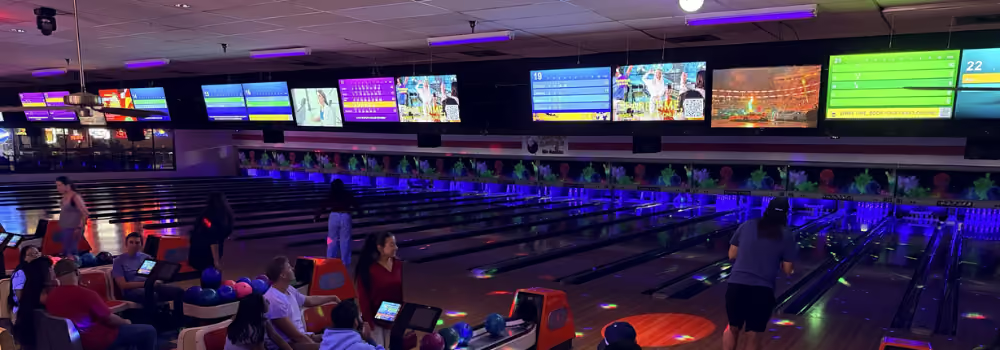


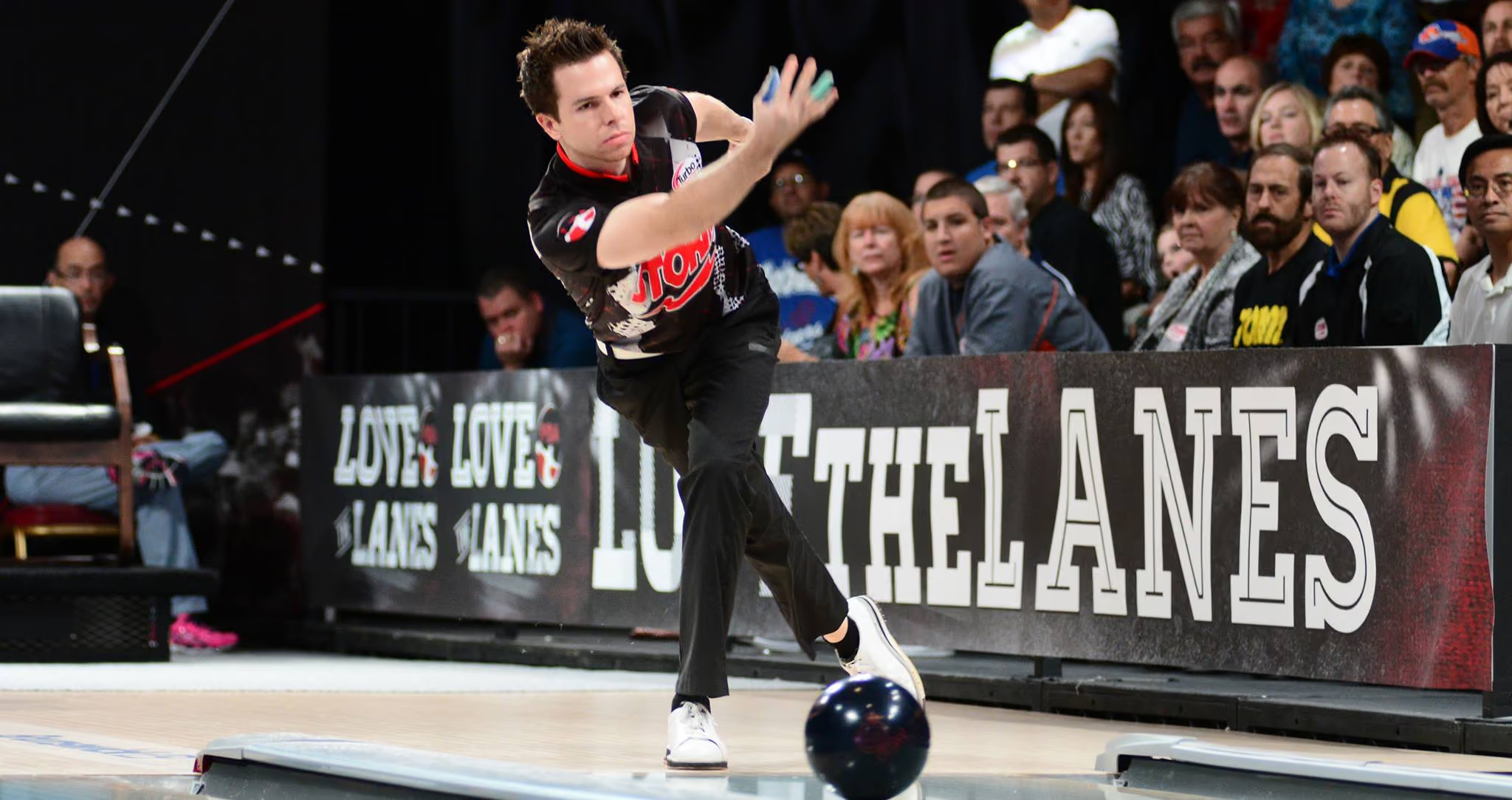













































%20-%20thumbnail.avif)





%20-%20thumbnail.avif)

%20-%20thumbnail.avif)

.avif)




%20-%20thumbnail.avif)







.avif)