Host: After paying the owner's salaries, the business that today's guest bought generated about $150,000 of earnings, which would not typically be large enough for a self funded searcher Jumping into Entrepreneurship through Acquisition But Vilay Matthias Villen of Helsinki saw that the business's flagship product enjoyed sustained demand despite being under marketed and the bones of the business high quality manufacturing, patented design, a network of dealer relationships abroad were good. So while very small, Vilay saw a risk worth taking and so far so good. The business grew 20% last year and that was despite a three month manufacturing pause. While Vilay moved operations from one part of Finland to another, he's eyeing 50% growth in the year ahead and his longer term goal is 5x over five years. That's the bull case. Vilay and I also discussed the bear case, so listen for how he thought about the downside here. Also listen for how he financed the acquisition. To his surprise and mine in Finland there turns out to be a government backed program not unlike the SBA loan here in the us. Obvious lesson for non US See if there is a small business acquisition loan product offered by your government. Such programs may be more common than we all thought. Okay, here is Ville Matias Villen, owner of Thin Easy maker of the Easy Swing Cattle BR. Welcome to Acquiring Minds, a podcast about buying businesses. My name is Will Smith. Acquiring an existing business is an awesome opportunity for many entrepreneurs and on this podcast I talk to the people who do it. The team at Aspen HR recently published a short white paper targeted at searchers Entitled A New CEO's Guide to Human Resources. It lays out the key items you should be thinking about as you transition into CEO and owner of the business you bought. The link to download that is in the show notes Aspen HR is a professional employer organization or peo, which provides HR compliance, flawless payroll, robust HR technology and Fortune 500 caliber benefits, all for a fraction of the cost compared to using multiple vendors. Reach out to Aspen HR for your complimentary HR diligence checklist and benchmarking analysis. Go to aspenhr.com or contact Jenny Thier directly at jennyspinahr.com Ville Matias Villen welcome to Acquiring Minds.
[3:22] Guest: Thanks a lot Will. Pleasure to be here. Vile.
Host: Your story is a bit different than the typical guest. We will get into why that is, but start us off with some background on you please, including where you're based.
Guest: I'm based in Helsinki, Finland, which is a small country between Sweden and Russia. I was born and raised in Finland. I grew up in an entrepreneurial Family on actually both sides. So. So both of my granddads were entrepreneurs and growing up I saw sort of both ends of the spectrum in terms of entrepreneurship. I've seen a bankruptcy and also a successful business ending up in an exit. So from an early age I think I've had an opportunity to have a realistic view of, of what entrepreneurship actually means. And yeah, so after childhood I obviously studied here in Finland, graduated in 2013, then went into management consulting with Accenture in their strategy group where I spent about four years and after that I moved into, I started working with the largest bank in the Nordics called Nordea in their capital markets business, working on business development initiatives.
Host: Okay, and so you were doing well in your corporate career. What changed?
Guest: Well, over time I think I realized that, I think, well, first of all, I think the pace of things was sometimes a bit slow, especially in banking. It was very much focused on sort of minimizing risk, ensuring compliance rather than driving business. And although I enjoyed a lot of my colleagues and the kind of, yeah, it was intellectually interesting, I still felt that, yeah, it was a bit slow paced and I think sometimes you were kind of rewarded for how things looks rather than actual outcomes. And I also felt that sometimes the decisions that were made were not perhaps the best decisions in the long term. They were sort of pretty short sighted. Whereas I sort of would like to make decisions that, that make sense also in, in the long term. So, so I felt that I wanted to do something where, you know, you own the, the outcomes and not just kind of, yeah, you, you, you make a decision that looks, looks good on paper for, for short term and then in the long run it's not the right decision. So I think, yeah, I was appealed by the sort of eat what you kill mentality that is often associated with entrepreneurship. And yeah, I think that's kind of what lured me into.
[6:26] Host: And Vilay, given your exposure to small business entrepreneurship growing up and given what you just described about what you didn't like in corporate life, do you think that you were destined? Were you somebody who was probably going to become an entrepreneur at some point?
Guest: No, I don't think so. Actually never felt that when I was studying and when I started my career, I felt that I'll, I'll probably stick to the, the sort of corporate track. I think it, it started sort of grow on me after being close to 10 years in the corporate world that maybe that could actually be an interesting career path. But I think I was kind of struggling to see how to switch over before I Actually accidentally came across your podcast and that's sort of, that was quite eye opening for me that there's actually a lot of people in a fairly similar situation where they actually, you know, change a traditional corporate career into something very different in the, in the kind of small business world.
Host: Well, that's what we're here for, Vilay. So music to my ears that acquiring minds and our guests influenced you that way. Tell me a little bit about the culture of entrepreneurship and the culture of risk. Maybe in Finland. There of course is the stereotype that in the US there it's sort of risk forward pro entrepreneurship and that may be in the Nordics. Certainly Germany has the reputation of being much more conservative. I hesitate to indulge in stereotypes, but humor me.
Guest: Yeah, I think it's, it's pretty accurate and I think Finland is probably even more extreme. So we had a very bad recession in the 90s. It had a lot to do with several things happening at the same time, but basically we were doing a lot of business with the former Soviet Union and then there was a collapse or devaluation of our own currency at that time, combined with opening up of kind of the economy and allowing entrepreneurs to take loans in foreign currencies at the, I think it was end of the 80s. So that kind of combination led to a lot of bankruptcies in the early 90s. That was part reason for the bankruptcy in my family as well. So I think in the 90s it created a sort of very, very even more kind of conservative mindset. And a lot of people that saw that, I think felt that entrepreneurship is not for them, it's too risky. But then I'd say Since sort of mid 2000 it has started to change a lot with the kind of startup startups phenomenon. And we actually have one of the, I think it is even on a global scale a fairly popular startup event called Sluss, which is organized every November in Finland. And that has, I think led to a lot of young people getting excited about startups and entrepreneurship in general after the sort of negative experience that a lot of people had in the 90s. So now I think it's a lot more common again. But compared to us, I would still say it's fairly conservative.
[10:25] Host: The influence of Nokia, did that give any the entrepreneurs of a generation inspiration?
Guest: Probably not. I think Nokia was one of the best sort of, if you wanted a corporate career at certain time, I think that was kind of the best place you could work for. But in terms of entrepreneurship, I think it's companies like let's say supercell which is very popular. They invented Clash of Clans and a couple of other fairly popular games. Angry Birds is from Finland. We have Walt, which is a delivery company acquired by a US based company. So we have a couple of these type of companies that I think are the main sort of inspiration for people interested in entrepreneurship.
Host: So you hear acquiring minds, you start hearing stories of people buying businesses. What does that lead you to do?
Guest: Well at first it led me to sort of looking into kind of. Yeah, what, what's out in the market in Finland. So there's a couple of sort of sites that are equivalent to biz Buy and Sell. Not as mature but, but still sort of sites that list businesses on. On sell. So that's kind of where where I started. I wanted to get a feel for, just to understand what kind of businesses actually come to market in Finland. And yeah, I first I sort of looked at the businesses very broadly. I saw a lot of, of course a lot of the businesses also on, on those sides are, are not something that, that you might be interested in buying. So restaurants and cafes and, and things like that. But, but I started seeing also a lot of interesting businesses that actually could work as an E target. So I started looking, yeah, as I said very broadly first and then I think I quickly realized that there could be something to it. So then I started to look at couple of businesses in more detail. The first one I looked at was a sort of property maintenance company that was financially very attractive. I spoke with the owner, I think he was very pro actually selling to someone like myself because he felt that the company was very kind of, well, not easy to take over but something that a sort of person that would want to do it with my background could do. But I think it was a very kind of valuable lesson to me. I think the owner actually ended up not selling the company. But I also had a good, good feeling that I'm actually looking for something a bit more tangible perhaps. So I decided to kind of narrow my search a little bit towards something a bit more tangible than pure sort of services business.
[13:43] Host: And what is that say more about that? Just an interest in manufacturing or it didn't feel like, you know, we call them an airball here where there's actually no assets at all. Was it that that gave you discomfort or what?
Guest: No, I think for me it was the kind of day to day life. When I was speaking with the owner and he was describing sort of the pros and cons of the business, I felt that's maybe not for me, it felt like it was a lot of dealing with primarily sort of people issues. And when we talked about sort of scaling up and growing the company, it felt like the main problem would be finding the right people. I'm sure it's pretty similar in all countries, but to me it felt like a lot of the things that you would be working on in a business like that was not something where I felt that it would be a good fit for me, where I would be really engaged and sort of have some sort of internal motivation to work on those type of, type of topics alone. So yeah, I just felt that it wasn't perhaps aligning well with my kind of strengths and what kind of topics I want to work on.
[15:07] Host: Running payroll, paying your bills, closing your books and producing financials. These are critical tasks every business owner must do or oversee. But spending time on them distracts you from the leadership and growth work you want to do. So let system 6 do it for you. Owned and led by a former Searcher, Chris Williams, System 6 is a leading outsourced finance team for hundreds of SMBs, including over 50 searcher acquired businesses. Chris, Tim and the System 6 team understand firsthand the challenges, the opportunities of jumping into a business as its new owner. So whether you own your business already or have one under LOI, talk to System 6 about how they can give you time back and improve your financial operations. Mention acquiring minds and they'll provide a free review of your books and financial ops, a $500 value. Check out system6.com, link in the show notes or email helloystemsix.com
Guest: Then I started to narrow my search a little bit into kind of manufacturing and other sort of businesses that would be a bit more tangible in nature. I quickly came across another business that was in manufacturing. It was quite an interesting one. It was manufacturing heavy machinery to factories, sort of a niche product as well. And it had a lot of expert and I think it was ticking a lot of boxes where you could right off the bat see that there would be a lot of things that could be improved. But then we tried sort of proceed with that but we were a bit late. It was listed on one of these sites and unfortunately there was another buyer who ended up buying the company and we never got to sort of move forward with that opportunity. Then I sort of continued the search and maybe I should say I was also on purpose, sort of. I was not in a rush to find a company. I was, I was doing a kind of, yeah, part time search during nights and weekends. And we were, we were also expecting a second child. So I was, I was kind of on a personal side. I was, I was kind of hoping that I would not find something that would be very interesting at that very moment because I felt it might be a better timing in a year's time or two years time. But then, yeah, then I started, then I, then I actually accidentally happened to come across the business that I ended up buying. Great.
[18:10] Host: Well, before we hear about it, let me ask you just about what you were discovering about the market itself for buying businesses. And just to give kind of a little bit more context to the question. So obviously, Acquiring Minds, it's a US podcast, so the vast majority of my guests and stories are here in the States. And so listeners will have an intuitive sense of, you know, how competitive it is out there and how to, how to, how to buy a business, the mechanics, the how you put the deal together, debt and so on. And I think that when we have stories like yours from outside the us it's always important to explore two attributes of ETA in non US markets or markets that I'm less familiar with. And that is kind of the kind of the supply, demand of businesses and the kind of culture of buying businesses and how sellers react to you, et cetera. So I want to ask you that. And then secondly, which we'll get to later, is of course how you structure a deal, what it looks like to finance, if you can finance it all, if there's bank debt available to do a project like this. We'll get to that. So to the first question and maybe now imagining, you know, a Finnish listener here or listeners in other similar economies, maybe the other Nordics, what did you find about the lay of the land in terms of how many businesses were out there to buy? Is it competitive? Were you bumping up against other searchers, against private equity? What did all that feel like?
Guest: Well, first of all, in terms of numbers, there's a. Similar to, I guess, most Western countries. There's, there's a lot of, lot of good companies where the owners are retiring and they might not have a succession plan in place. So I think in terms of supply, it's. Yeah, there's a lot of supply. Of course, we're a small country, so the numbers compared to us, for instance, are of course tiny. But I would say at least my feeling is that there is a sort of imbalance between supply and demand. So there's a lot more supply than demand. Private equity, of course, yeah, we have private equity and I would say they're probably their target companies, they might be somewhat smaller than what private equity might be looking at in the US but of course they don't really have people to step into a sort of owner operator role. So there is still that, that kind of space where, where and a searcher can actually or is is most likely the only sort of potential buyer. So so I think at least my, my feeling is that that there is a imbalance of of of that and there's plenty of opportunities and I at least haven't heard doing a ETA type of deals in Finland.
[21:16] Host: And so you, the businesses that you spoke to or were interested in, the sellers that you were talking to, you didn't have the impression that this was very competitive, that you were competing with other buyers?
Guest: No, I wouldn't say so. I mean of course there are buyers but. But not very competitive. I don't think they would be getting tens of Lois or something like that. I think they were very kind of open and I got the impression that yeah, there aren't that many sort of ETA type buyers. And even of course the same sort of thinking goes here that not all sellers, if they're sort of big enough to attract also private equity buyers, some of them were quite hesitant to, to selling to a private private equity buyer.
Host: And what about selling to, you know, a young kind of ambitious business school type guy like you where. One of the things that we hear about in other markets is that sometimes sellers are completely confused by the idea that some young person from outside their industry would, would offer to buy their business and that confusion can create friction or skepticism. Did you encounter any of that or was it pretty. The conversations were pretty natural.
Guest: I think the conversations were pretty natural. I did not experience that, but I can easily see that, that in some cases it could also happen especially with, with sort of more let's say complicated manufacturing and things of that nature where you. Where you might need some sort of advanced skill set in order to run a factory or something like that. But I didn't personally come across that. I actually came across sellers that were. Once I explained my sort of thinking and my background, I think they were actually quite open to me as a buyer.
Host: Well, you are painting a rosy picture for searchers in Finland. This seems like a pretty fertile place to buy a business. And by the way, we haven't even gotten to the amount of debt you were able to use here, which will sweeten the pot. We'll get there. Okay, tell us about the business that you bought, please. Ville.
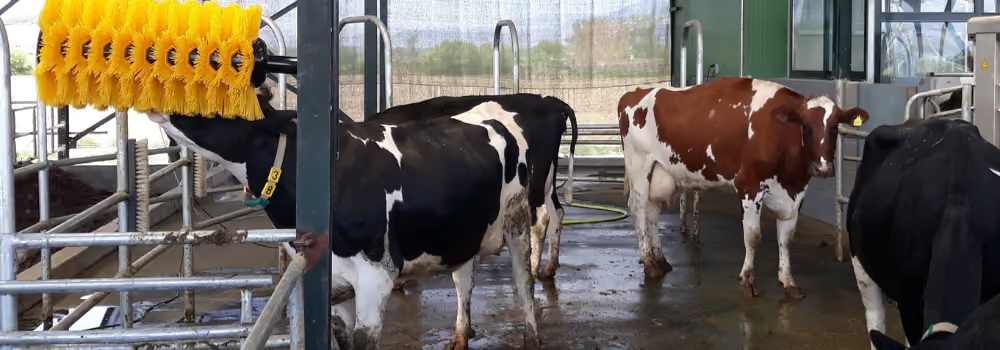
Guest: Yeah, so I bought a company called Finisi, which is a manufacturer of kettle brushes with. With Easy Swing brand. And and for those of you who don't know what a cattle brush is, which is. Was the situation for me as well. It's a brush that is used primarily in. In dairy farms. It's installed or usually multiple of those are installed inside the barn for the cows to. To basically groom themselves. It sounds like a pretty fun product, but it's in fact a sort of a product that both improves the animal's welfare as well as productivity. So yeah, we bought the company. They are manufacturing of a mechanical cattle brush. So there's basically, if I simplify a little bit, there's three types of cattle brushes out in the market. The industry standard is a motorized brush that works with an electric motor. Those have been around since the 80s and that's sort of what most people are more farmer. Most farmers are kind of thinking of when they hear the word cattle brush. And then there are. On the other end of the spectrum, there are these very simple brushes that you just install on a wall that cost let's say 100 bucks. And a motorized kettle brush would. Would cost a few thousand dollars. So Finisi, and how much does your product. That is around $1,500 for the, for the main. Main model that we. We sell the most. So we're. We're somewhere.
[25:46] Host: And Vilay, what. Why, why is a cattle brush so a cow brushes itself using.
Guest: Correct?
Host: Well, I guess it depends on. It depends on the electric. The electric ones are probably the farmer does it. Why are cows being brushed either themselves or the farmer or the farmer doing it. I didn't even know that was a thing.
Guest: Yeah. So they have a natural tendency to kind of groom themselves and scratch themselves. So if they don't have a brush, they will use the barn structures. They will use a tree trunk, whatever they find. And that can lead to injuries. You can damage the barn structures. So it's just natural behavior that they exhibit. And yeah, the motorized brush works in a way that the motor basically rotates the brush and the cow is just standing there. Just to clarify that one. But yeah, very interesting.
Host: And so this business you so to say again, you. You offer a in between sort of not the lowest end and also not the highest end electronic. It's actually, it is actually a mechanical brush with an interesting design. Right. The pendulum. So talk about that. There's actually some, some innovation here and patents and so forth.
[27:08] Guest: Correct. Yeah. So the main model that we sell, it has a pendulum design. So it swings from side to side. Which allows the cows to brush themselves from all sides, including their neck and back and so forth. Whereas the inexpensive brushes typically only allows the cows to brush themselves, perhaps from the sides. The motorized brushes, on the other hand, provide a bit more comprehensive grooming. There are brushes that have both a vertical and horizontal brush, so they are more comprehensive. But on the other hand, they cost a lot more. You have to pay for the electrician to install it. You have to pay for the electricity. And even the best models tend to have a lot of electrical issues. So. So they generate some amount of. Of work for the farmers as well as, you know, the life cycle cost for over five years. You're paying not just the purchase price, but for the electricity and the maintenance. So our brush basically provides, we think, the best grooming. It reaches all the. All the areas that the cow wants to. To reach. It's a very attractive purchase price. It's extremely durable. And the pendulum motion, the swinging motion, is patented. So we have a patent for it in around 30 countries around the world.
Host: I have googled cattle brush here, Vilay, and I'm seeing all these images of a brush that kind of looks like the brush in an automated car wash. It's kind of a 360 brush, bristles on all sides and it's rotating. I mean, these cows are rubbing themselves against it with their eyes closed in ecstasy. So who knew?
Guest: Yeah, exactly.
Host: Great. And so the company was. Is called fin Easy, and the product is called easy swing. Easy swing. Actually, I see it right here. Yeah, there it is. Cattle brush. And I didn't put an easy swing or anything, but it's. It comes up high in the results. So that's great.
Guest: Yeah.
Host: Okay. V. And so this is a. It is a manufacturing business on. On the spectrum of, you know, highly technical, sophisticated manufacturing down to, you know, assembly. Where does it fall on the, on the spectrum there?
Guest: I. I think it's. It's. It's on the assembly end of the spectrum. So basically, it's a fairly simple manufacturing process where we have a lot of suppliers, where we buy different components that we basically weld and assemble together, we paint it and we package it, and that's it. So, yeah, it's manufacturing, but I would say it's very light manufacturing.
[30:15] Host: You know, what that makes me think is that because it's such light manufacturing, and it sounds like when your business is. Is putting the product together, you're not adding a lot of value. And I don't mean to. I don't mean that sounds like very critical. I don't mean it that way, but when you think about a value chain and some link of the chain adding a lot of value, they're, they're, they're, they're changing a lot. You know, the ingredients and what comes out. The other side is quite different. And it sounds like there's not a lot of that happening here. And so probably a lot of the value is in those patents and in fact in your distributor relationships as opposed to the manufacturing work itself. How do you think about, how do you think about what I just said, kind of strategically where the, the value in the, in, in the actual, the business itself and what it, what it, you know, produces into the world?
Guest: I think it's, yeah, partially correct. I think it's. Even though the manufacturing process itself is simple, it's still surprisingly many components that go into it and a lot of kind of design work over the 10 years that the company has been manufacturing the products has gone into kind of getting the right components, getting the right measurements and all of that in place. So I think there are of course, as with any kind of point product that works, we have sort of knockoff versions manufactured in China and Turkey that, that are basically copies of our product. And we've tested a few of those and, and in terms of durability, they, they are nowhere near our product. So, so it's, it's not exactly. Even though the process itself is, is simple, the design is, is still has value in itself. But of course, you're, you're, you're absolutely right that, that the main value lies with the patents, the distributor relationships, and then hopefully over time also in, in
Host: our brand say more about those distributor relationships. And so where revenue, how it's distributed in this business and how it flows into the business.
Guest: Yeah, so right now we have, we're selling the products in roughly, and we have roughly 30 distributors or dealers. Some of them are larger actual distributors, meaning that they actually have dealers of their own around the country where they're based, whereas others are sort of individual dealers that sell directly to farms. And yeah, our revenue is, let's say, 95% export. So as I said, Finland is a very small country also in terms of number of cows. So it's only about 5% of our revenue. And the rest is, is, is coming from, from North America, Europe, a little bit in Asia and Africa as well.
[33:38] Host: And so that would probably be common for a manufacturing business in Finland in, in smaller countries in general because the domestic market isn't large enough. There's just more of an international Orientation for widget producers in countries like that or am I overgeneralizing?
Guest: No, I think for, for this kind of niche product in particular, I think that's, that's spot on.
Host: And size of business, what can you share, numbers wise?
Guest: Yeah, so the company. And now I'm converted the number from euros to US dollars to make it easier for the listeners. So the average revenue between over the last four years has been roughly a little over 900,000 USD. The earnings over that time period, average earnings around 150 and the average SD around 250. So yeah, very small business. And also I should mention that the revenue actually has been declining over the last four years primarily because of the fact that the owners were sort of exploring different options as they were looking to retire. And I think they tried hiring someone to take over running the company and then kind of discovering that that might be a difficult route to take. So yeah, then they decided that they'd try selling it to someone who would be kind of continuing. And I think they were not really investing in sales and marketing over the last few years. So yeah, it had led to slight decline of the, of the revenue.
Host: Okay, so let me repeat those for the audience. The numbers of around $900,000 USD for, in revenue on average for the last 4ish years. Yeah, 100, 100. Well, 250 of SDE. And so they were paying themselves 100. So sort of adjusted EBIT would be 150. Was that right?
[36:01] Guest: Yeah.
Host: Okay. And, and so yes, that's a very small business and declining. So how did you get comfortable with those two weaknesses as you, as you evaluated the business?
Guest: Well, I think it was the owners. They were very open about the situation and then they were basically sharing all of the data that we were asking for very early on in the process. And the fact that even though the revenue was declining, it was still quite steadily coming from the sort of. Yeah, from, from old customers. So a lot of their customers had been with the company. So the dealers and distributors, they had been with the company since. Yeah, basically the company was founded and they were steadily selling, selling the product. And, and you could easily see that in a lot of countries the only dealer would be a small business, perhaps employing just a couple of people, but supposedly covering a large country like let's say the Netherlands or Italy or Spain. So I think it was quite obvious that there is a lot of room to grow just by adding more dealers, having a dealer network that would actually be able to cover the entire market. So I think it was quite comforting that the product was still selling even though it was very limited sales and marketing effort, both on Finisi's side and also on their kind of dealers part. So to me that was kind of a sign that if a product sells without any sale and marketing, then there must be something about the products that is, you know that. And then if you add on sales and marketing, there should be opportunities for significant growth. Great.
Host: So you fundamentally, you became a big believer in the product and saw that there was a track record where sales, there was a lot of recurring sales from these distributors. There was pull through demand for a product. So you, you believed in the product and that led you to also believe the explanation of the decline as it was basically owners getting near retirement, trying to figure out some ways to kind of step out of the business, hire somebody to run it. That doesn't go very well. They're taking their foot off the gas a little bit. All of this seemed like a credible explanation for why it declined and a situation that you with your new vigor could come in and correct in reverse.
[39:16] Guest: Yeah, exactly, exactly. And, and the further we went with the kind of process I think I was, there was no red flags kind of pointing to the other direction. I mean the owners were super honest, super open, they shared everything. And, and I had no reason to kind of doubt anything that they were saying. They were genuinely sort of, they wanted someone to continue and succeed and grow the company to the, to the next level.
Host: What do the following Acquiring minds guests all have in common? Doug Johns, Morley Desai, Tim Erickson, Chirag Shah, Shane Ursam. They all went through the Acquisition Lab, the accelerator in community for people serious about buying a business. But they represent just a sliver of the Lab's success stories. The number of deals across the Lab's cohorts now stands at over 120, with over $300 million in aggregate transaction value. The Acquisition Lab was founded by Walker Deibel, author of Buy Then Build, the book that introduced so many of you to the very idea of buying a business. The Lab offers a month long, intensive, almost daily Q and A sessions with advisors, live deal reviews with Walker, Deal team introductions and an active community of serious searchers. Check out acquisitionlab.com link in the notes or email the Lab's co founder, Chelsea Wood. Chelsea Buy, then build.com and V. What about the other quote unquote weakness, the small amount of, of earnings. So with, you know, your president's or the general manager's salary taken out, it's 150,000 of EBITDA even if you tripled the business, quadrupled the business, well then it ends up being a nice $600,000 in earnings business. But still, that's where a lot of searchers start. They have a $600,000 earnings business that they begin with you. It will take quadrupling the business to get there. How did you think about that? Starting from such a small size, even if you believed that you could grow it, you're requiring a lot of growth to make this a very interesting prospect.
Guest: Yeah, but I think, yeah, it does require quadrupling and I think we're aiming to do more than that. And the previous owners, when they started the company, they were able to grow it from zero to more than a million in revenue on, on their, on their best year over four or five years. So I, I felt that it's definitely doable and by doing that I think I would add a lot of value. And then on the other side, on the other hand, I also felt that, that the downside risk is also quite limited because obviously we're not taking. Yeah, the purchase price is also reflected by the current size of the business. I felt that the downside risk is also quite limited. So even if things don't go as planned, we'd still be able to maintain the current level. And I think the current sort of level still generating, generating earnings would, would require very little kind of work from the owner operator. So it could become sort of a sort of passive income stream in, in the worst case scenario.
[43:28] Host: Well, perfect segue. So one way to de risk an acquisition, a key way to de risk an acquisition is to build that into the deal structure. And buying for a relatively low multiple is, is, is kind of where the structure begins with the purchase price is. So let's now turn our attention to how you did buy this, the terms of the acquisition and how you structured. Structured that.
Guest: Yeah, so we paid roughly 2x SD for the company. But yeah, and then this is where I think my story gets a little bit typical. So we bought it together with my family business, which yeah, makes it a bit a typical ETA story. But I think the main point here is that they were basically a capital partner and I think that's the way we should kind of look at it. But yeah, so we paid roughly 2 times SDE for the company, but from the beginning it was pretty clear that we would not want to run or I would not want to run the company or the manufacturing process in the existing facilities because it was very far away from where I live, very far Away from the customers. It would be basically very difficult to run the manufacturing where it was while kind of, yeah, traveling around the world to meet dealers and distributors. So when we were kind of considering the acquisition, I sort of had two options. Either co locate the manufacturing where my family's existing facilities, or to my family's existing manufacturing facilities where there was some extra space, or then look for a manufacturing partner potentially outside of Finland. I quickly kind of realized that the faster way to do it would be to co locate that in the same facilities with our existing family factory and then take on my family business as a, a capital partner.
[46:14] Host: The business, as I recall, is in Eastern Finland, near the Russian border. You are in Helsinki. It's eight, it's in fact eight hours of difference between the two of you driving. And then your family's manufacturing business is closer to you, but not in Helsinki, and, and in Western Finland, five hours from you. And so the idea here was that you could, as you said, co locate, move the new, the business that we're here to talk about that you're acquiring into the facility of your family business and create some, some synergy there, some economies of scale, bring it closer to you. And, and that made sense financially because as you said, your family business is on the cap table. In fact, they're a significant owner of this business. You, you, you partnered with your family business to acquire the new business. Do I have all that right? Correct.
Guest: Yes. So, so they are, they are the maturity owner and they also rent space for, for Finisi, so the operating company as well as staff. But these are two sort of distinct companies with their own P and L. And basically there is no sort of subsidies or anything like that. So these are sort of very distinct companies with their own businesses and share very little besides sort of the same space between them.
[48:04] Host: And did you communicate in advance to the sellers that you would move the business? And what implications did that have for the business and for employees, et cetera? What I mean, that's pretty disruptive, right?
Guest: Correct. In fact, when they listed the company, they, they, they mentioned that it is something that the, the potential new owner could do just to move the factory because they were aware that the location is perhaps not ideal and it could limit the number of potential buyers. And because of the fact that it is a relatively simple manufacturing process, it was relatively easy to actually move. It's not plugging in a machine into the wall. It was a bit more complicated than that, but it was relatively fast. So they were quite open to that idea. Of course they were Also openly sharing the fact that the employer employees that they had were in a situation where they would probably not want to move if we decide to move to production.
Host: And how many employees are we talking about that would essentially move. Lose their jobs?
Guest: It was basically, besides the. The owner and. And his wife, there was two employees.
Host: Okay. And in fact, I assume those two employees did not come along.
Guest: They.
Host: They left the business.
Guest: Correct. The other one, actually, luckily enough, she'd received another job, more or less. Well, it was a little bit before we. We actually ended up moving the factory. But she. Yeah, she left on her own terms and luckily there was someone else that could cover for her while we were. Yeah. Planning for the move. And the other one. Yeah, unfortunately we. We had to. Yeah. Let them go. They were. Could not move to the other side of the Finland.
Host: Okay, Vilay, let's hear about the. The structure of this acquisition and. And say again why it was that you chose to effectively partner with your family business to buy this business if you know you were buying it for a good multiple and it was a very low SDE. You were a guy who had 10 years of corporate experience. I would have guessed you could. You had the balance sheet to buy this yourself. Am I wrong or did you do it for other reasons or what?
Guest: I think we were exploring a couple of different options, but then I think it made sense, both for my personal kind of risk reasons, to share the risk. Even though it was a small acquisition, but still I felt that buying it on my own and kind of, yeah, putting more or less all of my savings into the deal felt a bit scary. So I felt that for that reason, it would be nice to partner with someone with a capital partner. And then because I felt that we can move faster if we move the manufacturing into the same facilities where my family business operates. For that reason, it also felt like a natural choice that they also invest in this deal and. Great.
[51:43] Host: And so what did your ultimate ownership end up being? Your personal ownership?
Guest: Well, on a personal level, my ownership is roughly 40% and then it's roughly 60% for the family business where there are multiple family members owning that. So. So it's. Yeah.
Host: So you own more of the business than any other individual does.
Guest: Correct.
Host: But it's actually less than 50%. As you said, it's 40%. And so what does. So to the big question that is always so important is how to get debt to buy a business outside of the US where we're fortunate to have the sba. What does it look like in Finland?
Guest: Yeah. So I don't think it's, it's as well known, but there is actually a, a similar solution available in, in Finland. It's, it's called, the organization is called Finvara and they basically have different types of solutions for, for ownership transitions, different management buyouts and so forth. And I was actually able to, so I think it works on a high level, at least in a similar way as the sba. So they basically it's a government backed loan given by a private bank basically that you can get in Finland. And that was what I used for, for my part of the, the acquisition.
Host: So one of the features of the SBA is that yes, it's government backed, but what that enables is debt at better terms than the free market would offer by itself without government subsidy. So high leverage in a, in a great amortization period of 10 years. What is. Same thing here. What did that look like?
Guest: Well, the amortization period that I got that, that I felt probably maybe would have gone a little bit more, I don't know. But my amortization period is five years. So I think that's, that's the difference, I think in, in terms of sort of the other option. Without the government backing, I think the answer from the bank would have been a simple no. At least that's the feel that I got. But yeah, so the amortization period is five years. I don't know if it would have been possible to stretch to seven, maybe 10 years. I doubt it. But what I was able to negotiate was a kind of balloon structure where I'm paying the interest only for the first time, three years. So that gives me a little bit more. Yeah. Room to, to move.
[54:46] Host: Sure. And you said it was 80% of the purchase price, correct?
Guest: Yeah, and yeah. And then 20% cash.
Host: And 20% cash. Great. Okay, so back to downside protection here. You bought it at a great multiple, really, really great. And you have, now you have high leverage. So that, that would actually be more risk, not less risk, 80%. But it did allow you to, to bring less equity to the deal, especially partnering with your family business. But you also don't have to immediately start paying it down for three years. You're paying interest only so those debt to be a lot less as you hopefully grow the business. If you, going back to the question of, you know, not being able to grow the business in your bear case, your downside case, they say you're not able to grow the business very much. It will, it will still support the full debt service at its current revenue Levels.
Guest: Yeah, I think, I think yeah, we will be able to do that but then of course it will be a very different business where, where we're basically trying to yeah, I think make it a, a cash cow where we, it'll
Host: be a break even, not very interesting business.
Guest: Yes, exactly.
Host: So return back to the plot now. You buy the business when. And then have you gone full time in it? Pick us back up on your. On the story.
Guest: Yeah, so yeah, so we, we, we buy the business and, and because of the fact that we had kind of decided that we will be the. We'll buy the business and we'll move the, the manufacturing to. To. To. Yeah co located with our other family business. So we agreed with the sellers that they would run the business up to a point where we're ready to, to move. Before we were able to move the machinery we had to do some construction work. So we closed, we closed the business the previous. The sellers, they were running the business for us basically for, for about six months after which we had completed all the construction work. We move over the machinery, we, we set it up. All of this takes a bit more money and time than we had anticipated which was yeah, obviously a bit unpleasant surprise but we managed to do that. So I quit when we had. So I quit my day job when we had the production up and running and basically we took over the actual operations from the sellers. So I think that was also a bit typical that the sellers were actually actively running the company until we had moved it to the new location.
[58:01] Host: And so you complete the move and then they exit and then you quit your W2 as we would call it in the States, your corporate salaried role and go full time in the business? Can you, can you give us a sense of the salary that you were walking away from or, or that you were going to want to replace or you know how you're thinking about that from the perspective of your lifestyle, of your family, you have a, have a newborn etc.
Guest: Yeah, so I think it was. Yeah. Salaries are obviously a bit different here in Finland compared to the US but, but, but in terms of, of Finland, I would say it was a very good salary. It was six figures and. Yeah, a very good salary, I would say. Yeah.
Host: And so did you see this business needing to replace that in the next, you know, in short order, in a couple years or what? How are you. Because the business isn't big enough to replace that even. No, even if you didn't have debt service, it's not probably coming close to that just yet. So talk us through that.
Guest: Yeah, so I was willing to, to, to cut my salary and, and, and, and in fact I've been actually not taking out any salary for, during the, the first year to, to kind of allow us to invest that into kind of. Yeah. Initiating the, the growth of the company. So I was willing to, to, to first partially live off my savings for a little bit and then settle for a smaller salary until we got the growth going. So yeah, I was definitely putting some skin in the game also in that sense.
Host: Yeah. And by the way, is this one of the areas where the environment in the Nordics, say in Finland is more hospitable to searchers than in the US because things like health care are, health care costs are less onerous or you know, the kind of government provided services are more generous or not really, I'm not really correct.
[1:00:20] Guest: Yeah, health care for instance, I think. Yeah, it's a very good system where, where basically it's, it's for free and, and yeah, same with education for, for kids, it's for free. So, so obviously, yeah, it's, it's, it's less dependent on, on kind of my income in that sense. So in that sense it's, it's a, yeah. More hospitable environment for sure.
Host: Okay, Vilay, so let's hear, we're getting toward the end, but let's hear about how it's gone. Is the business that you bought, the business that you thought you bought, is the demand for the product, the quality of the product, what you thought it was from the outside, your optimistic view that this was a quality product that you, with some energy you could really increase sales of. What have you found?
Guest: Yeah. So I think, I must say, I mean of course there's been some, some negative surprises on the way most mostly related to kind of moving to production and so on. But in terms of the product, the opportunities, I still haven't found any kind of reason why our kind of initial hypothesis of being able to grow it 5x in the next 5 years would not hold true. In fact, we actually just after the close I took some time off, paid time off from work and joined the sellers in the biggest trade show, I would say the main trade show for the agricultural industry in Germany where I was able to meet a lot of the existing dealers and potential new dealers right after closing the deal. And I think that was very, very kind of comforting to see that basically all of the existing dealers were super happy with the product. There was, I think we got 40 new dealers interested in starting to sell our products. All the farmers that we were visiting and if they were familiar or they had our product, they were only giving positive feedback. And those that were not familiar with the product, I think it was, yeah, basically the feedback was that they would be very interested. They found the value proposition of having something that's very durable, no electricity, very appealing. And one kind of interesting observation from that was also that I felt that a lot of people felt that the price point was actually surprisingly low. So I think also, yeah, basically everything that I experienced during that week in Germany was that yeah, there is definitely room to grow. And, and since then I think the same feeling has, has strengthened. So yeah, I think so far.
[1:03:33] Host: Do you, have you, have you seen. Is that showing up in the numbers yet?
Guest: Yes. I mean this year we have basically had our, our production. Yeah. We were not basically manufacturing for three, four months so we had to step on the brake a little bit in terms of sales. But despite that we're seeing, let's say, yeah, we're recording this in November. So we'll do 20% growth compared to previous year this year. And I think next year is looking very good. Usually we don't have a backlog of orders for a long period of time, but now I think our Q1 is basically pointing to that we should be able to grow 40, 50% next year.
Host: No. Fantastic. And so 20% this year, first year.
Guest: Correct.
Host: Even though production was shut down for three months.
Guest: Correct.
Host: Fantastic. So yeah, it's going, I'd say it's going very well. Now Vilay, on the point about the type of business that this is, light manufacturing, fabrication. We talked earlier at the top about how you realized you didn't want to buy a labor intensive business or kind of a purely services business. In a business like yours, I imagine it scales very nicely. So if you grew 20% this year, you hit your 50% growth next year. That to the. Send more product through the increased throughput won't require proportionally more hires, right? It will not. So it will. You'll start to see some, some great scale and more gross margin for every unit produced or what. Talk us through that.
Guest: Yeah, I mean it will require some hiring, but not, not proportionately. So we should be able to increase. Of course we will be investing a lot also in kind of. We've for instance, redid our branding. We'll be investing in marketing a lot. So yeah, a lot of that kind of margin will be going into kind of boosting the growth in the coming years. But it is a more scalable business than a sort of pure service business where basically the margin is dependent on the headcount.
[1:06:17] Host: Yeah, yep. And you're running it or you're owning it from Helsinki.
Guest: Correct.
Host: It's five hours away, a five hour drive away. On the other hand, it is at the premises of your family business. So you probably feel like there's good oversight on of the business from the team that you already know in your family business. Yeah, correct.
Guest: Yeah. So I feel that my main focus now is kind of expanding the dealer network and activating the existing dealers. And as I mentioned, most of our customers are outside of Finland. So it's much easier for me to operate from Helsinki than it would be from where our factory is. That would mean one more flight in between me and our customers.
Host: But the management of the business, you feel comfortable being so far away from it.
Guest: Yeah, so far. I mean, I try to visit as often as possible. We of course have well, basically daily calls or if, and then a broader sort of whole team meeting once a week. And I think so far it's gone well. But obviously it helps that we have people that we knew and we can trust from before, from the family in the same site. So yeah, so far at least it has worked well. But of course I must say that we have been able and lucky in hiring very good people. And as I mentioned, I think in Finland we tend to have people with very high integrity, high work ethic. So, so even though I'm not there on a daily basis, I think it, it works really well.
Host: What is the vision here, Vilay? Let's say you do grow it to, you know, quadruple it, quintuple it. You're in your early 30s, late 30s,
Guest: turning 40 and two years late 30s. Okay. Yes.
Host: Ah, okay. So 38. And what, what do you envision? Do you envision doing this business for the rest of your career or what, what are you thinking about, you know, beyond this first few years of owning this business?
Guest: Well beyond the first few years I envision, I think I find the ETA space very interesting and I think my vision is to, is to sort of grow this company and then ideally kind of transition into more of an Holdco model where the family business could give similar opportunities to other people in Finland who are kind of aspiring searchers that might want to share the risk with someone else and, and, and also have the ability to, to, to help people that might want to do something like what I've done in Finland, both in terms of sort of mentoring, helping in, in whatever, whatever ways. I can but as well but, but also by providing capital. So I think that would be kind of, that's, that's my vision beyond sort of the next five years or or so that the
[1:09:52] Host: you invest in other would be searchers and also sort of mentor them and so you, you start to have be on the cap table of many other searchers in, in Finland and involved in those businesses as board member, advisor, mentor.
Guest: Yeah, yeah, I think that would be, that would be kind of the direction where I, I would like to head. But right now for the next few years I think I will be 100% focused on growing this business because I think that's the best way for me to learn and add value right now. But yeah, beyond that I think that would be the kind of interesting next step.
Host: Absolutely. Well it is a compelling vision. Vilay, is there anything that we haven't talked about that you wanted to or that you wanted to communicate specifically to you know, other Finnish search curious listeners or Nordic search curious listeners?
Guest: Well, I think for and I would believe it it's somewhat true also in other Nordic countries I would encourage a lot of people to, to kind of explore this route because I think it's not too crowded yet. I think there's a lot of good companies to be bought. Not too many buyers I would say in the search space and at least in Finland it's possible to get kind of financing as well. So I would definitely encourage people to look into it. And yeah, I think from my personal story I think it's kind of, I think it was very insightful to kind of openly look at different types of businesses and then really imagine yourself in the day to day and see if that is something where you think you can actually add value and find interesting before kind of setting your mind too narrowly on a specific industry or type of business. Great.
[1:12:09] Host: Well again the business is fin easy and the product is easy swing. You can, you can see it everyone easy swing cattle brush. There it is. It's what a neat niche. Neat product and business Vilay to have acquired. Congratulations on stepping off the corporate path and doing this in your early success that that you have found that your hunches about the business and the opportunity to grow the dealer network have so far borne out. So that's very optimistic and we'll include a link to your LinkedIn for anybody who might want to get in touch who might be in your neck of the woods and wants to connect with another somebody who's already further down the path. Vilay Matias Vilen. Thank you for joining us on Acquiring Minds.
Guest: Thanks a lot, Will. Many thanks for having me.
Host: Hope you enjoyed that interview. Don't forget to subscribe to the Acquiring Minds newsletter. We send an email for every episode with an introduction to the interview, a link to the video version on YouTube, and soon key takeaways, numbers and more essentials from the interview. For those of you who don't have time to listen or watch it, subscribe at acquiringminds Co. You'll also find all our webinars there on the website, both those we have coming up, and recordings of past webinars. At this point There are over 30 webinar recordings, a wealth of information on all the technical nitty gritty of buying a business. Acquiring Minds copy.



























%20-%20thumbnail.avif)




%20-%20thumbnail.avif)
%20-%20thumbnail.avif)

.avif)


%20-%20thumbnail.avif)







.avif)