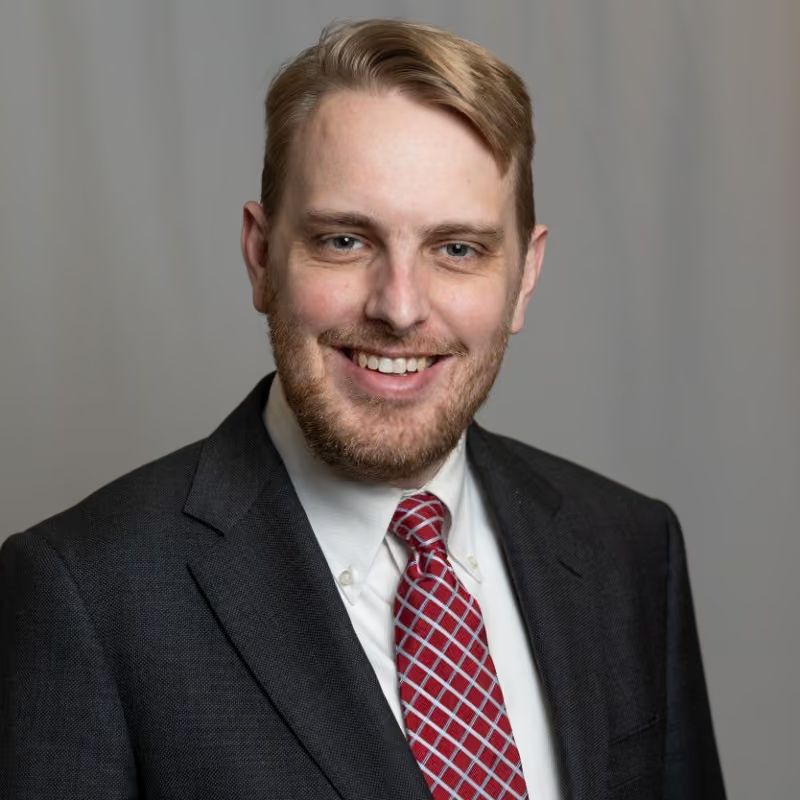
Host: In 1984. National Geographic had recently launched a travel magazine As a new title. It was called Traveler. My mother was on staff at Traveler in those years and in the Summer issue of 1984 is a piece that she authored on Charlottesville, Virginia. And in that piece my mom writes of staying in a lovely historic home, a bed and breakfast. Quote Bed and breakfast. Stays at such historic homes, as well as at some luxurious estates scattered throughout the city and county are available through Charlottesville's guest houses. Bed and Breakfast, Inc. End quote. Words my mom wrote in the early 80s. Well, last summer today's guest, Megan McGee bought that very business, Guest Houses. I'll spare you the details of how we piece this together, but suffice it to say, a remarkable coincidence and a testament to the longevity of many of the businesses that entrepreneurs like Megan, like you acquire that history you find in some of these businesses. It's one of my favorite features of entrepreneurship through Acquisition. Today's story is one that starts with a traditional search fund and ends with Megan's self funded search and acquisition. It was a business that checked new boxes that had emerged for her over a multi year search and one she bought with only $75,000 out of pocket and no SBA loan. Listen for how she structured things. Megan bought quite small and in an operationally complex business, but despite the reputation of such businesses, it has not overwhelmed her and she's able to pay herself a full salary in a distribution. Besides, there is much to learn from Megan McGee's nearly five year journey to become a business owner. Please enjoy A number of Acquiring Minds guests have reported being shocked by by the amount of time gobbled up by the paperwork, phone calls, overall logistics of transferring accounts from the previous owner's name to theirs. And unfortunately, all this work has to happen right at the beginning of the transition. Well, this Thursday, Chelsea Wood of Acquisition Lab will host a webinar on getting tactical about what transition planning actually looks like. In those first critical days after closing, you'll hear firsthand stories from lab members about things like opening new bank and payment processor accounts, moving registrations, utilities and insurance into your name, navigating access to the systems and passwords, vendors and subscriptions, setting up payroll and employee benefits. These will be real lessons learned from lab members about what surprised them, what went smoothly, what didn't, and what they would plan differently next time. The goal is to help you avoid unnecessary friction during one of the most sensitive phases of ownership. That is this Thursday, March 12, noon Eastern. Link to register for the webinar is Right at the top of this episode's show Notes or on the Acquiring Minds homepage. Acquiringminds Code Foreign. Welcome to Acquiring Minds, a podcast about buying businesses. My name is Will Smith. Acquiring an existing business is an awesome opportunity for many entrepreneurs. And on this podcast I talk to the people who do it. Running payroll, paying your bills, closing your books, and producing financials. These are critical tasks every business owner must do or oversee. But spending time on them distracts you from the leadership in growth work you want to do. So let system 6 do it for you. Owned and led by a former Searcher, Chris Williams, System 6 is a leading outsourced finance team for hundreds of SMBs, including over 50 searcher acquired businesses. Chris, Tim and the System 6 team understand firsthand the challenges, the opportunities of jumping into a business as its new owner. So whether you own your business already or have one under LOI, talk to System 6 about how they can give you time back and improve your financial operations. Mention Acquiring Minds and they'll provide a free review of your books and financial ops, a $500 value. Check out system6.com, link in the show notes or email helloystem6.com Megan McGee welcome to acquiring Minds.
[5:20] Guest: Thanks Will. It's good to be here.
Host: Megan, you bought a business in the hospitality space, specifically short term rentals. It is a 40 year old business business that goes back way before Airbnb. This acquisition of yours was the culmination of a multi year search to become the owner of a business. It's a search that evolved along the way. We're going to hear about that and of course your ownership of the business. Let's start with some quick background on you, please. Megan.
Guest: Yeah, and 50 year old business founded in 1976. Yeah, we'll get into that. But yeah, so my background, I have a pretty typical entrepreneur background. I was always that kid who was starting little businesses from a very, very young age. And I grew up in a family where my parents owned a small business. They owned a pest control company in South Florida and my dad had grown the business through small acquisitions over time. And then I studied entrepreneurship. I went to Florida State for college for undergrad. Go Knowles, started a small business while I was there and then I also worked for a couple small businesses when I graduated college, including as a manager of a regional pest control company. Not my dad's company, but a different one. So got a little bit of, you know, management experience and working for growing small businesses and I, I really loved leading people. I loved seeing the impact that small businesses could make. And so I kind of wanted to take it to the next level. So I went back to school to get my mba, went to Darden. I'm representing my Darden gear today. So I went to UVA for business school, and my intention was to figure out how to take it to the next level. I wanted to either be a founder again and start another business, but kind of at a larger level, or I wanted to figure out how I could buy a business. I knew that because of my dad that it was possible to buy a business, but I wasn't really sure how you could do that if you didn't have millions of dollars in the bank. So my goal. One of my goals coming out of business school was I wanted to figure out how you could get funding from other people to pursue one of these entrepreneurial dreams. So I went to Darden, had a great time there. I was student body president for our MBA program, and I pursued both of those paths while I was Darden. Either the founder route or the. I learned that there was a formalized concept called ETA, or search fund. So I pursued that path, did a couple internships. I interned with a searcher who was with Hallstatt Partners. They're a family office based in Florida. And then I interned with Botanical Designs over summer. So I know you just interviewed Edward McDonnell. So I interned with him a few years after he bought his company. Actually, I guess one year after he bought his company. And came out of that out in Seattle. Yep, out in Seattle. And came out of that really confident that I wanted to do a search and buy a business, and also that I wanted to do a traditional search fund.
[8:53] Host: Let's pause there. Megan. This is great. So you must have been super psyched to learn about ETA when you got to Darden, because you had the notion on your own that you wanted to maybe buy a business, and you were attracted to just small business in. In general. And come to find out, as you said, there's this formalized method of doing it that has a lot of energy around it and that is being taught at business schools. That must have been, like, how perfect.
[9:22] Guest: I thought it was too good to be true, as I'm sure a lot of people, when they first learn about search, do. I was on a hike. I vividly remember when I first learned about what ETA was. I was on a hike with the Darden Outdoors Club, and I was talking to Bill Igoe, the. In the class ahead of me, and I said, what are you, you know, just making small talk. What are you gonna do after you graduate? And he said, I'm gonna do a search fund. I'm gonna. And I said, what's that? And he told me and I was like, that's exactly what I wanna do. I just didn't know it existed.
Host: Yeah, how great. Okay, so you decide to do the traditional search path. Why?
Guest: Yeah, so I, you know, I liked all three of the models. I had interned with a single sponsor backed searcher, you could call it an accelerator. And I really liked them. I liked this idea of self funded, even though it was a little scary to me. But, but for the traditional model, I think ultimately the financial security of it felt like less of a risk. And I also, I had no deal experience or, you know, I had, I had an operational experience, but I didn't have the other side of the table on the investor side. And I really wanted to learn more about that and do that part of it really well. And so I wanted to surround myself with smart people, a diversified group who could guide me and mentor me along the way. So I also liked, after interning with Botanical Designs, that was a larger company, I think There were about 60 employees at the time. And I liked the idea of buying a larger business. So for all those reasons, I went the traditional path.
Host: Well, one of the reasons that people choose traditional search is because the investor capital is for the investor capital and all that that enables. But they don't love the idea of having investors. But you actually embrace that. In fact, that was one of the things that was one of the draws, having these, these more experienced mentor, potentially mentor figures above and around you to, to guide you on this journey. That was a plus, definitely.
Guest: Yeah. And I liked, you know, going into my search, I was decently industry agnostic. And so I liked the idea that my group would potentially have experience in one of the industries that I ended up acquiring or doing due diligence around. And so yeah, I, I tried to form a diversified group who could give all sorts of opinions on, you know, helping me find the right business.
[12:15] Host: Great, and you then launched it from Charlottesville. You were based in Charlottesville?
Guest: Yep. I decided to stay in Charlottesville and my intention was to move wherever I bought the company. I had a couple key focus geographies, but widely I was geographically agnostic, looking all over the country.
Host: And what came of that traditional search process?
Guest: Yeah, so my search ended up being pretty long. At about the, the year and a half mark, I went under LOI with an education services company and we got really far along with that deal. It was a great company. It was over 4 million in EBITDA. We had a really good multiple for that size business. It had incredible growth over the last three years. And I really liked the sellers. I liked the industry fit with me. And it was, it was a great deal. So we got really far along in the due diligence process. It checked all of the boxes for my traditional search investors and what we were going for. But this was in 2023 that we were under LOI and the the company. A lot of the revenue was derived from government, from school districts were the payers. And so it was government funding. And the government during COVID had put out Esser funds, which are special funds earmarked for certain expenditures for school districts. And those Esser funds were going to go away at the end of 2024. So I was looking at the deal in 2023. So about a year and a half later it was going to. Those funds would go away. And I did a bunch of diligence and showed that the company would still be able to earn the business of these school districts even without those funds. And there were other funds that could pay for it. But without getting, you know, too detailed into that, Long story short, my investors couldn't get comfortable with that little payer situation. And so could you. I did, yes. I. I felt comfortable with it because I felt like I had proven that the services this company provided were. Had been used at the same level pre Covid and Pre Esser. But my. By the majority of my investors couldn't get comfortable with it. So I ended up. I had been fundraising, I had secured the debt and I had secured a couple investors who were committed to the deal. But it was less than 50% of my cap table. I think maybe 20 or 30% of my cap table was on board for the deal. And so I sort of had this moment where I had a real conversation with one of my investors and I said, this is who's in and this is who's out. Be honest with me. What are my chances of getting this deal across the finish line? And she said to me, megan, if you want to get this deal across the finish line, you probably could. Like, this is a decent deal. There's tons of money out there. If you want to fundraise outside your cap table, you can get this deal done, but it's highly unlikely that you're going to get it done with your cap table. And I highly recommend if you have less than 50% of your cap table on board, that you go forward with the deal. And she just said that it's kind of a red flag when you see that few that small of a percentage investing from your cap table and you should really seriously reconsider moving forward. So I felt very upset with the investors at this point because I felt really strongly that this was. I had been searching for at this point now. It was about. It was getting close to two years. It was probably about the two year mark. And I felt really strongly about this deal. I had gone under Loi before. This deal just absolutely stood out among everything else I had looked at. So I really disagreed with their decision. But I did decide to walk away from the deal because of that advice. And kind of going back to what we were mentioning before about my decision to go the traditional search route, I just personally reflected on why I had chosen to go the traditional path, which was that I wanted people who were smarter than me and more experienced than I was at the time to guide my decision making. And they were all telling me the same thing. And so even though I disagreed with them and I didn't want to take their advice, I decided to take their advice. Um, so yeah, that was, that was a huge low point in my search. I end. I walked away from that deal about at the two year mark in my search.
[17:48] Host: And I found the stakes were also that you may, if you didn't close this, you may not close anything because you to. To your point, because you're at the end of the search or toward the
Guest: end well, and because like I said, this deal to me was. Was just the best thing that I had found it. It checked all the boxes. It was a great size, great valuation, great industry. Like there were so many things that growth. So many things about this deal that were so good. And so in my head I'm like, if it took me a year and a half to get under Loi with this and then if this wasn't even good enough, what's going to be good enough? So yeah, I was at a huge low. And anyone who has gone under Loi with a company they love and gone through months of due diligence and legal and all of that and is dreaming about what their life will be like when they acquire this company knows that feeling of what it's like to walk away. So that was a huge low. I did have some funds left in my.
[18:59] Host: Megan, before you get there, let me just. How do you reflect on the decision now and try to separate yourself from the fact that you're happy with where you are now? So it all Worked out in your kind of your personal story. But the prudence of the investor's decision to not like this deal. Do you see it differently now? Do you see it with more clarity or kind of feel the same way you did?
Guest: It's hard to tell because I don't have an update on the company. I tried to get one, but I don't know. I still think it was a great company and a great deal and I think that the investors probably made a mistake. Yeah, I'm happy with where I ended up, but I think that would have been a great deal for somebody to, to do so. Yeah, I wish I had.
Host: Well, I, I guess it all comes down to whether or not that revenue that you predicted would continue did in fact continue after the, the subsidies went away or whatever.
Guest: They were right, which, which, I don't know. I tried to sell, follow up with the sellers about a year later and they didn't want to talk to me. But yeah, just based on their website, it looks like they did expand the way that they told me they were going to. But, you know, it's hard to tell on a website what the financials really say.
Host: The team at Aspen HR recently published a short white paper targeted at searchers Entitled A New CEO's Guide to Human Resources. It lays out the key items you should be thinking about as you transition into CEO and owner of the business you bought. The link to download that is in the show notes, Aspen HR is a professional employer organization or PEO, which provides HR compliance, flawless payroll, robust HR technology and Fortune 500 caliber benefits, all for a fraction of the cost compared to using multiple vendors. Reach out to Aspen HR for your complimentary HR diligence checklist and benchmarking analysis. Go to aspenhr.com or contact Jenny Thier directly at jenny aspenhr.com well, I have to commend you, Megan, on following through with advice. So one of the classic things about advice with humans is that like they don't take it. They, they, they say I want to mentor because I want to learn from them and have them guide me. Or I, you know, I want, I, or I've learned something about myself. And so, you know, my therapist has told me something about myself and so I'm gonna, you know, I need to act on that, which means making different decisions than I would have otherwise. And it's just very hard for people to do that even when you know that intellectually they know they should, you know, make a different decision. And you had the strength of whatever to, to see. No what I what reason I signed up for the traditional search fund, a big reason was to get this sort of counsel. What good is it if I'm not going to take said counsel? And you did, as painful as it was.
[22:23] Guest: Yeah. And I think looking when you get to that point, you can't be emotional. Obviously I was emotional, but you can't make the decision emotionally. And so I kind of looked at the decision as if I were an outsider giving myself advice. And I think if I, you know, without all of the emotion tied to like this is what I've been envisioning my life and I've been working however many years towards this goal that I really, really, really want and it's so close. Take all that away and just like step outside of my body and say, you should listen to these people who are smarter than you. So I ended up searching for another six months with my traditional search fund. My investors wanted me to keep going because I had some funds left. But I did find another deal that I went under loi with but it was kind of a hail Mary and ultimately just nothing was really panning out in those deals final six months that was anywhere close to the quality of that deal. And I knew I had to get something that was better quality. So I decided to pivot along this journey of me staying in Charlottesville and searching for now two and a half years. It was three years after I graduated. By that point I had met someone. So I met my now fiance Matt, who's from Crozet, Virginia and he's a farmer. And so I took some time reflected after my traditional deals didn't work out and I realized that it was really important for me to stay in Charlottesville. And so I decided to pivot to a self funded search because I knew that buying a company in Charlottesville would really limit my options. And I didn't feel it was write to my investors even though they would have happily wanted me to extend my search with them.
[24:27] Host: Wait, Megan, so you had the option to after running down the funds in the initial kind of self search fund for them to re up in you and give you more capital to keep searching was was on the table?
Guest: Yes. So I had, I had, I don't think I. So actually about a few months before this, probably three or four months before this, I had when I still had some funds, I had told my investors I was going to wind it down and give up. And they all said no, no, no, no, no, you have to keep going, you're going to be great. We really want you to keep searching. So, and you know, everyone gets knocked down, you'll get up again type of thing. So I did and then another three or four months later. So now we're at the two and a half year mark. We were out of about out of funds at this point. I go back to them again and I tell them like, no, seriously, I'm gonna, I'm gonna end my traditional search. It's been great, you all are great, but I wanna, I wanna stop. And yes, they were encouraging me to continue. So many of my investors were very encouraging of me to re raise and that they would support me to re raise a new search fund. Could, could have been the same investors or a mixture of many of the same investors plus a couple new investors, but they were really supportive of that. And I learned during that time that a lot of the traditional investors, I mean if you think about it makes sense from an investor standpoint that you would want to back someone, a searcher who you know and you've seen search over two and a half years and you've worked with, if it's gone well and if you like their process and if you respect them and you think that they're going to, you know, for all the same reasons that you invested in them in the first place, plus now you've seen them work over two and a half years. So it's actually a more sound investment for them to reinvest in a, in a seasoned searcher who has quote, failed over their original search than to potentially invest in a brand new searcher who you don't know what you're getting. So yeah, that was, I think it is surprising to a lot of people to hear that investors would back a searcher to search again after a failed search. But a lot of them were encouraging me to do that personally because now I decided I wanted to live in Charlottesville. I decided not to re raise a traditional search fund, but I still really wanted to buy a business for all the same reasons. So I, I pivoted to a self
[27:13] Host: funded search and so you still wanted to buy a business for all the same reasons. There was no hesitation that you were still gonna, you still wanted to do entrepreneurship because a lot of people who get to the end of a traditional search fund of course would, you know, call it a day and go get a job.
Guest: Yes. So I had, this was a big moment of self reflection this period of time and I had, you know, I spoke with a lot of the investors about what my options were at this point. It felt it was an emotional thing to feel like you, like I had failed in my traditional search and so I did a lot of soul searching. I, I knew in my core that I wanted to lead a business. That was something that I, the search made me feel even more sure about. Realistically, I was exploring other options too. Do I go take a job, you know, self funded search. Now you're not going to be making a paycheck and you also need to think about financing a deal. So at this time I started working. Thankfully Darden offered me a position to work in the entrepreneurship center, the Batten Institute leading ETA at Darden. So I was able to do that. I took that as a part time job and I also was exploring other, a few other options. A few companies who I had connected with along the way were offering me CEO type positions. I was speaking with a couple different investors about either, you know, starting a franchise, a new franchise development or doing something one off working with an individual investor. And so I was kind of exploring like all these different options. And one thing I would say to anyone who is considering search or who is searching and coming to potentially the end of a, of a search and you, is that your opportunities at that point, after searching for two or three years are going to be really strong. Because if you think about it, I mean I spent between two and three years basically running a small private private equity fund all by myself. Or I mean I had investors, but I was sourcing deals, reaching out to companies, evaluating hundreds of businesses, personally interviewing hundreds of CEOs and asking them what, what did you do to get your company where it is? What are you most proud of? What do you wish you did differently? Tell me about your financials. Asking questions that, I mean the opportunity to speak with that many founders and CEOs directly and dig into their financials and negotiate with them and then negotiate legal contracts with them, go through due diligence with really amazing accounting firms and talk about legal language with really amazing law firms. Like I don't know where else you get that type of experience. And so it makes you a really good, amazing candidate for a lot of different jobs. And so my opportunities were, I had a lot of opportunities at the time, but I decided that working part time at Darden and then pursuing a self funded search was what I wanted to do because I really wanted, yeah, I wanted to follow my dream of, of running a small business and I didn't want to put it off anymore.
[31:11] Host: This feels analogous to what you hear in Silicon Valley where if a founder starts a business that ends up failing. They're still extreme or even more hireable after that experience because even though the startup didn't take the experience of going through founding something, raising money, building a team, trying to get product, market fit, etc. It's just an incredible experience and the market seems to perceive value the value in that that it should which is. But I've never heard anybody say this about a quote failed search. So it's, it's a really good call out definitely.
Guest: And, and I would even say a failed traditional search but even it could be self funded. I say traditional just because the investors especially now have such high bar, they have such high standards that and I would say for self funded searchers, run your search like you will be presenting to investors or like you will be raising money even if you aren't because it just makes you be that much, it makes you operate that much more at a higher level and keeping yourself accountable to metrics and all of that.
Host: Yeah, yeah, give give us a couple bullet points on what you mean. What are these? This kind of excellence in a traditional search that a self funded searcher should model?
Guest: Well, for example, even in my self funded when I bought my company I had no outside investors but I still made a sim as if I would be presenting it to investors and I did present it to some investor mentors and family and friends, people in the business world to look it over as if they would invest even though I wasn't going to bring in any investors. Financial and customer due diligence that you do personally before you then potentially hire an outside firm to do anything. Just really deep analysis on customer retention and churn financial analysis. So regulatory analysis, I mean coming up with key bets and yeah, so I would say that's what I tell every self funded searcher is to pretend like you have a group of investors who you have to answer to even if you are going to be doing the deal with without any investors.
[33:46] Host: Yeah, very interesting. It's a, it strikes me as great advice. Great Megan. Okay, back to the plot. You decide to go now self funded. A big part of that was wanting to remain in Charlottesville. Now so you go from geographically agnostic to geographically quite constrained. Is there anything to share about how that search then unfolded or looked different than your traditional search?
Guest: That search ended up being much different from my traditional search because I wasn't doing as much outbound outreach in my traditional search. I had certain metrics that I was trying to, you know, contact a certain number of companies every month, hundred hundreds of companies every Month and in my self funded search it looked very different. By that point I had a lot of inbound deal flow because I had made relationships with brokers. But I really just tried to better develop roots in my community and put feelers out and meet people in person in Charlottesville as much as I could, even if it didn't mean that they would sell their business to me. So I met with several company owners with no intention of buying their business, just to introduce myself, get to know them, learn, pick their brain. Charlottesville is a very small community and it's a very tight knit community. And so I, I also just wanted that like I knew at this point I planned to be in this area for a long time and I wanted to become part of the business community here. And so I wanted to start to get to know people. So I started doing that a lot. Going out for coffee. I'll do a shout out to Shenandoah Jo where we've met. And another search acquired business. And so I took a lot of meetings at Shannon Dojo on Ivy and
Host: Megan, how did you, how did you invite owners to come have a coffee with you?
Guest: I just would reach out. I still used my search email. So, you know, it was megan@peaktide operatingpartners.com Something like that. And I, I would just let them know that I was local and I used a couple things to, to let them know I was like local. I would tell them the neighborhood that I lived in that I had gone to Darden and you know, trying to meet at this local coffee shop, not just a Starbucks or something like that. So I kind of like used some keywords to let them know I was a legit local person. And I, that my, I think I probably even said that my fiance is a farmer at this, he works at this property that people would know and, and so just kind of developing a local credibility through that.
[36:52] Host: Yeah. And you were pretty successful at getting people to come have a cup of coffee with you?
Guest: Yeah, yeah, I think so. And I tried, you know, also at this point I was working part time at Darden, so that was really helpful too. I think that brought a lot of credibility to my name is everyone wants to meet with somebody who works at Darden. I know that that might sound, I don't know if that sounds bad but you know, in our, in our town, like that's a cool thing is that I worked at the entrepreneurship center at Darden and yeah, so for, even if it was for that reason of why they wanted to meet with me they, they met with me.
Host: Yeah.
Guest: Yeah. So you want to talk about how I found guest houses?
Host: Well, just before we get there, one question for you about the businesses you targeted. Did you consider going after pest control, a business that you knew so well and which is a. Something of a darling in home services because of the recurring nature of it and so on.
Guest: So this is an interesting story. This is. Now, let's go back two years to my search, my traditional search. About six months into my traditional search, my dad calls me one day and he said, megan, I, you know, at the time he was looking, he was loosely starting to have conversations with people about selling his business. He had been approached, you know, numerous
Host: times and by a bunch of annoying searchers.
Guest: Yeah, yeah. And so he calls me one day, I'm about six, I'm a couple months into my search, and he says, megan, I'm about to sign an loi. This is your last chance. Do you want to buy my company? And I took, I immediately took the day off and I went, and I went paddleboarding on Ragged Mountain Reservoir to like meditate and reflect on it because it was a huge decision.
Host: It sounds like it's one that you had already thought and he'd already propositioned you.
Guest: Yeah, we had talked about it, but I had decided to go the search path and kind of like try to try to, you know, create my own path.
[39:08] Host: Yeah.
Guest: Um, but I ended up saying no because he had a great business and it would have. Sometimes I wonder if that was a huge mistake. Not anymore. But during my traditional search, when my search was failing, I wondered if that was a huge mistake that I had passed out this up this great opportunity. But ultimately I just, I personally did not like the pest control industry. It's very difficult to be a woman in that industry. Or at least that was my experience when I worked there. And yeah, I wanted to find an industry that better aligned with my personal interests. So.
Host: Well, it also would have meant moving down to Florida home.
Guest: Right, right. Yeah, it would have. I think at the time I was willing to do that though. So. Yeah, but. So anyways, getting back to where you were asking, you know, fast, fast forwarding again to my self funded search. No, I didn't pursue any pest control businesses. If I had gone into pest control, it would have been my dad's business. And so, yeah, that ship had sailed.
Host: Can we just quickly hear about your view of that industry is not being super hospitable to women? Tato Corcoran, a guest from a couple years ago, just came back on for her update episode a couple weeks ago, I interviewed her and she talked about being a woman in manufacturing and how she's fine with it. But it is, it is sort of an ever present feature that follows her around. Nobody ever thinks that she's the business owner, you know, can I talk to your husband? Sort of stuff constantly. She's, she's, you know, good natured about it. It kind of slides off but it's certainly worth mentioning and certainly letting women who might be interested in her case in manufacturing, in your case in pest control know what the realities will feel like. So could you please.
Guest: Yes. And I think you summed it up very well. So it's not that the industry has an overt, you know, hatred to women. Like there are many women in the industry who do very well. There are many companies that have women in, in management positions that are well respected. I just didn't want my career to be a constant battle of pushing and fighting and trying to prove myself every single day just because of my gender. That is something that some people do and I had done in the past, but it just took so much extra mental, mental exhaustion, I guess, mental energy that I just didn't want that to be what I did in my career could have totally happened. And also I spoke with my dad and I think like his business would have been much different than the business that I worked at. But yeah, I just, I didn't feel like it. So if I didn't have to, if I could choose between two types of industries and one, I didn't have to exert all that extra mental effort and the other I did, I was going to choose the one that was more friendly.
[42:29] Host: If you ask owners in the ETA and search community which insurance broker provides highest quality work, great outcomes and has a practice dedicated to searchers and acquisition entrepreneurs, one name comes up again and again. Oberle. Oberle Risk Strategies has worked with hundreds of searchers over nearly a decade and is in fact led by a two time successful searcher, August Felker. Which makes Oberle a specialty insurance brokerage for searchers by a former searcher. And if you've got a business under loi, Oberle will provide complimentary due diligence on that business's insurance and benefits program. An easy no risk way to get to know August and the team at Oberle to take advantage. Check out oberle-risk.com that's o b e r l e-risk.com link in the notes. How do you come across Virginia guest houses?
Guest: So I my fiance Matt is an estate manager at a property just outside of Charlottesville that I had moved to. Now, now I'm in my self funded search and I had moved in with him. He lives on the property and the property has a couple rental houses that are managed by guest houses. And so I had been familiar with this company for a while. Also personally, since 2017, I had been renting properties of my own on Airbnb. So I was very familiar with what the vacation rental management industry looked like and what it was like to operate on a very small scale, you know, one property at a time in that space. So this was like part of my life and part of my awareness, but it just was never really on my radar in terms of search. But now that I was in my self funded search and I was going through this process of getting to know business owners in Charlottesville, I had an aha moment of why don't I reach out to the owner of guest houses? So my fiance put me in touch with him and he immediately, because of that connection, I think I lived on the property. I was engaged or at the time I was dating Matt. He took a meeting with me and so we, that's how I learned about guest houses and that's how I initially, you know, got in touch with the seller. And he wasn't looking to sell at the time. And so we, we talked for a while before ultimately he decided he was interested in it. He knew from our first meeting that that's what I was doing. I was looking to buy a business and I was interested in buying his business. So it took a little while for him to warm up to it, but he had been burnt out and so he was entertaining selling. And then ultimately he did decide he wanted to.
[45:45] Host: He was younger, right? Younger than a typical boomer.
Guest: Yes. And so that actually was one of the weaknesses. I wrote down kind of what I liked and didn't like about the, the business, and to me that was a risk, is that he was so young. He was 40, I think, and so he wanted to sell. But there was always this question in my mind of like, is he serious? Why does he want to sell? He, you know, his reasoning was, and even still now to this day is just he's burnt out. It's a 247 business and he had been doing it for a long time. He had acquired guest houses, but he had previously worked for a competitor and before that a different company in the industry. And so he had been in the industry for probably 15 years or so. And he was just burnt Out.
Host: Well, it, it is the classic red flag of, of the seller's motivation for two reasons. For two reasons. First of all, the. The big one is, are they. Do they know something you don't? They do know something you don't. They always do. The, the asymmetry, as we know in this world, is. Is high. So. But are they. Are they hiding something from you and trying to sell you a lemon? So that's, That's a big, obvious risk, number one. But the other one is the opportunity cost of you investing all of this time, energy, and resources into making a deal happen with somebody who's ambivalent, and then they decide not to go forward. And, and youth is, Is a. Is one of the, you know, flags here, as is somebody who's not even. Who's basically stating that they're not sure they're going to. That they want to sell. So. So it's kind of like a double. There's double doubt in this gentleman's case that he's a young person and is telling you that he's not sure he wants to sell. Well, happily, it worked out, but that would have been a risky one.
Guest: It was. And the. On the first, you know how you. You try to diligence everything. So, like, every risk, it's like, okay, how do I diligence this risk? How do I mitigate for this risk? And so the first one on, does he know something? I don't know, you know, is he selling a lemon? That sort of thing. I had two things, two ways that I sort of mitigated for that. Number one is like, he just turned out to be a very trustworthy guy with high integrity. And like I said, I had been at this point, searching for over three years. I'd spoken with hundreds of sellers. I'd gone down the path to negotiating with several sellers, and he just. I. I could. I could feel, and I could also know from the community and that my. My fiance had done business with him over many years, that he was just a trustworthy person of high integrity. And then I also, of course, structured the deal so that he would be tied in for certain things. So I'm happy to get into this now. Or not. But. But he holds a large seller note. Um, and he also rolled a small percent equity. So both of those things kind of mitigated the risk of. Is he selling me, you know, a lemon?
[49:12] Host: Exactly. Excellent.
Guest: Yeah.
Host: So, of course, deal structure is often the first place you look to. To help mitigate some of. Some of that risk. And I do want to Spend some time on that. But before we get there, Megan, tell us more about the business. The business. I keep calling it Virginia Guesthouses. I hear you calling it just guest houses.
Guest: Well, yeah.
Host: Is that just the shorthand or am I adding a Virginia and I shouldn't be?
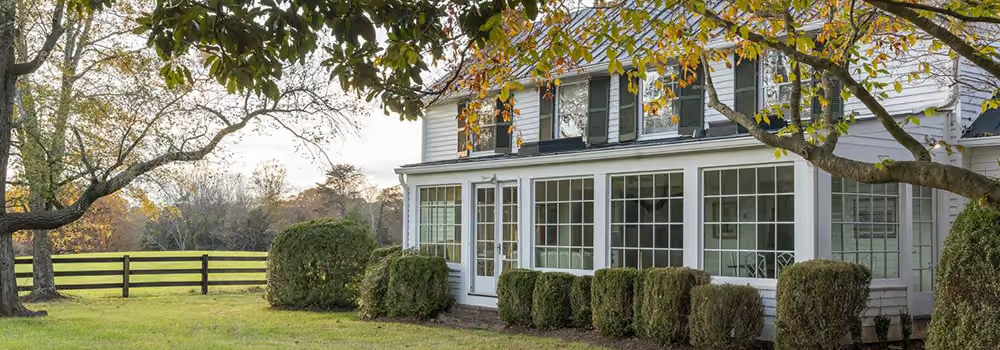
Guest: Well, we're going to expand beyond Virginia. So the big brand is guest houses. But yes, a lot of people call it Virginia guest houses in our area. We're VA guest houses on our website, on Instagram. So go follow. But yeah, so either one, you can use them interchangeably. So yeah, what I really liked about the company, so it's a 50 year old vacation rental management company based in Charlottesville, Virginia. It's founded by women in 1976 and it was founded before, well before Airbnb and before short term rentals were mainstream. And that history was, was really cool. And so the, the history and the brand name that that all came with was, was really interesting. Go ahead. I.
Host: No, no, you know what, I'm chomping at the bit.
Guest: Go for it.
Host: I actually to share this, this fun detail. Oh, there it is.
Guest: Great.
Host: No, it's so, it's so fun. I, so I. So you invited me to, to give a talk at the Darden's ETA conference in, in September, in the fall. And I mentioned this as the intro and it will likely be the introduction to this, this very interview. Megan. I'll probably restate it, but I'll just say it really quickly here. So my mom was a. Wrote travel pieces. She was a writer for National Geographic Traveler in the early 80s and she had done a piece on Charlottesville. You're holding the very magazine. She had done a piece on Charlottesville. She would have been in her early 30s. I would have been four or five. There. There it is. Yes. For those who are listening, she's holding up the magazine, the actual magazine which I, which I gave to, to her. But so my mom, early in her career as a, as a writer for National Geographic Traveler, does this piece on Charlottesville and mentions this business, you know, as, as travel articles often do, like here's the restaurant to eat at, here's the lodging to check out, mentions this very business. And you know, so it, so anyway it just an enormous coincidence how I figured all that out and connected the dots. Long uninteresting story. But my, my mom still has connections to Charlottesville. So that part of it is. That's part of it. But such a remarkable coincidence. And just goes to show that like even back then, in whatever it was the early 80s it was a recommended business, 1984. Yeah. So much fun.
[52:06] Guest: Exactly. So really cool history. And I felt very. Because of that, you know, it was a very reputable company in our area. Known for really high quality properties under management, known for high quality service for owners and for guests who are visiting the area. I personally really, you know, I had decided to stay in Charlottesville. I really love this area and I have a lot of belief in our town, in our region for being a draw for tourism. We have, I say, three main draws to people coming to the area. One is the University, University of Virginia, you know, for graduation, for parents visiting their students for game days and weekends. Two is weddings, where we're one of the top wedding destinations in the country. Now people are saying that we're the number three wedding destination. So if you think of like Pippin Hill Farm and Viney or King Family Vineyards, we have. That's another. I guess there are four. So vineyards. So I call us the Napa of the East coast. We have over 50. The Monticello AVA, it's the. We have over 50 vineyards in our region. So a lot of people come for vineyard weekends. And then Shenandoah National Park. I mean, we are 20 minutes from the entrance of a national park and so there's beautiful hiking, Skyline Drive and the Blue Ridge Parkway. So there's a lot of. There are several different things that draw tourists to our area and it's becoming more and more popular and it's a,
Host: it's a great town. It's a college town. It's a college town as well. So it has that, that certain magic that many successful college towns do of, of being small and village like, but with, you know, it taps into the outs, you know, it's got a kind of a global. Yes, you know, exposure.
[54:17] Guest: Definitely. I mean, I think we have world class restaurants here and we have a big outdoor scene. A lot of people really care about health and there's a lot of opportunity for like mountain biking and cycling. So lots of different hobbies draw people here and it's a good place to be. So anyways, I believed in the area. I believed in this company, I believed in the area. I was reading back through that, that sim that I had created and one, one thing I wrote down of what I liked about the deal is the buyer match, AKA me. And it aligns with my personal priority to live in Charlottesville. Access to skilled talent matches. My personal experience managing short term vacation rentals for eight years.
Host: Yeah, no, it's fantastic business. Buyer fit. Can you give Us some numbers around the business. Yeah.
Guest: So the company manages about 75 properties, which is medium sized for a vacation rental management company. It's, it's a size that you can have a small team, you can start investing in software and that sort of thing and you know, it's pretty good market, market exposure. So manage about 75 properties and it is about, it's under 500,000 of SDE. So very small business. Had four. Yeah. Four full time employees and then a couple cleaning teams. So. Yeah. Right. Happy to talk about anything else, you know.
Host: Well, let's talk, let's talk about how you thought about size, Megan. So under half a million in sde, the, the one that got away or that, you know that deal, we heard that in the education space when you were still doing the traditional search model was 4 million of EBITDA. This is under 500. So the complete other end of the spectrum, from a searcher's perspective, how did you get comfortable with the, that really small size?
Guest: Yeah, that it was definitely a weakness. But at the this point I knew that the size company I would buy would be likely much smaller. I still was ideally aiming for a million in ebitda, but I knew it would probably be smaller than that needing to stay in Charlottesville. So what I was thinking about was the growth potential for the business. This business, even though it was 50 years old, had seen more than it had. You know, it was at 75 properties at the time and had more than doubled in the last five years. And so it had seen a huge growth spurt in recent years. And I saw a lot of potential to continue to grow the business. There are about 3,000 vacation rentals in our area that are currently listed on Airbnb. And so, you know, we only make up 2.5% of that market share. And I felt like there was because of the quality that guest houses has and the lack of quality that other providers had or the, the need for a property manager for those who aren't using one. And because of the tailwinds of our area growing in tourism, I felt like there was a lot of opportunity for growth. Yeah. So. And I felt like I could improve on certain operations for the business. And the business had no, currently even still has no outbound sales. And so it was able to grow to that amount with no outbound sales. So I felt like there was a lot of opportunity to grow beyond with a little bit more effort behind it.
[58:52] Host: So the, what did you say, the doubling of the last few years, how did that, that surge in Properties under management occur if not for some sort of outreach effort?
Guest: That's a good question, I think. So my seller is a realtor and perhaps his connections. He's a well connected person in our area and so perhaps that. But also small things like building an actual nice website and creating a logo that kind of fits with our modern world. Small things like that that he had
Host: done under his ownership.
Guest: Yeah. So not really outbound, but. But professionalizing the brand. He had definitely professionalized the brand and brought it into the 21st century in the last five years.
Host: Yep. So he was not a quote searcher, but he was effectively an acquisition entrepreneur. He'd bought this business, improved it and that was now selling it.
Guest: He. He was, yes. So he had, like I said, he had worked in the industry for 10 plus years and most recently worked for a competitor in our area and ended up leaving the competitor kind of for valid reasons and knew about guest houses, connected with the seller and, and bought the company. So at that time it was very small.
[1:00:22] Host: But yeah, Megan, you were going to tell us about the risk mitigation in the form of deal structure. Let's get into that. Because the deal structure of this is, is, you know, a key part of this acquisition.
Guest: Yeah. So the, in terms of deal structure, the company, like I said, was under 500,000. I bought it at a 2 times ste multiple. So pretty decent valuation. I was.
Host: How were you able to get such. I'd call that more than decent. Is it because the size, the small size or what? That's really low from. Not a number we're used to hearing.
Guest: We didn't talk about multiples when I made my offer. We just talked dollar value. And I think a lot of times sellers have a certain dollar value in mind. And so I could sense that and so I threw out a number. We also had a really long negotiations process and I think my deal structure is probably, probably the reason behind that. So I paid $75,000 out of pocket and the rest of it was seller equity rollover and a seller note. And I also had some downside protection. So I have a guarantee, a personal guarantee on the seller note, but it's limited at $100,000 that gets reduced as I pay down the note. And so all of these things were a negotiation, but I, I stayed pretty firm on the terms. And so.
Host: So no SBA loan.
Guest: No SBA loan, yeah. And I just, like I said, I wanted the seller to be, I wanted this seller to have something tied to the business still. There were certain risks with the business That I couldn't mitigate or I couldn't diligence. Let's say I could mitigate, I couldn't like eliminate. Get comfortable. Yeah, I couldn't eliminate them. So like regulatory risk is one example that actually has proven to be a real risk because the short term rental regulations in our area are quite strict and they're trying to get stricter.
[1:03:10] Host: Yeah.
Guest: So that's an example of something, you know, the seller motivation, customer risk. So one thing I liked the customer mix and I like to the customer tenure. You know, some because of the age of the company. We have, we have clients, property owners who have been with guest houses for 15 years. So I really liked that. And then the mix, you know, the top three customers each have less, a little less than 10%, make up a little less than 10% of revenue. But then all of the other customers, there's a long tail, make up, you know, less than a percent, sometimes a couple of percentage points. And so I liked that. But in our industry, the way that our contracts work is I would say like medium retention. I mean customers have medium switching costs. But sometimes people sell a property. And so there's kind of this natural churn that happens in this industry, which it was fine, it was nothing that this company, guest houses had good retention for the industry. But, but there was this natural churn in the industry that wasn't super comforting. And so certain things like that I was able to get comfortable with because of the deal structure.
Host: Great. So 2x multiple on SDE that was under 500 mostly seller note, some seller rollover. And then you said your down payment was 75 ish thousand dollars. We're not going to go into every single, all of the mathematics here by design audience, but suffice it to say, yeah, there's no key points here. No SBA loan. Good, great valuation and almost all seller financing and some, some seller rollover. And, and so, and that I think what's, you know, the key point here is what you can do that you can get into a business for $75,000 down. Now this is a very small business, so there's that. And we're not here to promote like you know, no money down or you know, to buy business with as little money down as possible. So it's that, that orientation. But when it happens in a prudent, interesting way, it's definitely worth talking about. So is there anything more to say about that or does it kind of speak for itself?
Guest: Yeah, I think it speaks for itself. The one thing I would say Is that the conversation with the seller, and this is valid, is that we would be going in as, as business partners and that I was structuring it in this way to mitigate against certain risks that the business had. And, and yeah, that, that I fully intended, you know, to, to have a relationship going forward and that we would grow the business together and he'd have a second bite of the apple. So it didn't.
[1:06:33] Host: But he wouldn't continue in the business. He would step out completely.
Guest: Well, he has a small percentage of equity and.
Host: No, but operationally, I mean, not really.
Guest: I mean, so he, like I said, he's a real estate agent and he plans to specialize in selling homes to be vacation rentals in our area. And so we talked about having a partnership and we still talk about that, where he can channel business to me and I can do the same to him. And so, yeah, I very much see us as, as business partners. And I, we worked, we had conversation around that the whole time we were working towards this acquisition was that this was meant to be a long term relationship.
Host: Great. Megan. Well, I only have you for a few more minutes and still want to hear about your ownership, your operations of this business and, and what's happened since you closed in May of last year, 2025. Right. And you had told me that after your long experience and years of desire to, to buy. Just give us the psychology of, of getting over the, the final psychological hump.
Guest: My whole life been envisioning that I wanted to own a business. And over the last, you know, from 2019, you could say when I, when I went to business school through 2020, 25, when I bought my company, had envisioned myself buying a business and did a search, grueling search. And then at the final hour, I had this moment of holy, you know, do I really want to. Is this really what I want to do? Like, what if. What if when I get into the seat, what if when the ink dries, I have this realization and it all sinks in that this is not. This is not what I want to do. And it was all wrong. And I don't know, I just had this moment of dread. I had the same feeling when I bought my first house. For whatever reason, I really wanted to buy a house. I had done the inspection, everything was in line with what I thought it was and wanted and was dreaming of. And then, I don't know, when it came down to the closing day, I was like, is this the biggest mistake of my life? For whatever reason, maybe I just feel that way. With big decisions. But luckily, when I got in the seat, I, you know, everything that I had known to be true was true. I'm very happy. This is what I want to be doing. It's a hundred percent. Yeah. What? It's very validating that all of the things I dreamed about that I thought I wanted are actually what I want. So felt very happy about that.
[1:09:21] Host: I think it's easy when you're fantasizing about something to romanticize it and idealize it, which is kind of what a fantasy often is. And then when you're confronted with actually making the dream a reality, it's like, oh, what if it just doesn't measure up? And how could it? Because you've probably been idealizing it the whole time. So I just wanted you to share that, Megan, because, you know, for all the other folks out there who might experience a similar, you know, moment of. Of. Of cold feet.
Guest: Yes. And it's been fun. I mean, it's been really fun. I love what I do every day. I'm excited to come to work. I feel like running a business is my hobby. It's like thinking about this stuff. I'm sure a lot of listeners, when you. When you look at other businesses or go to other businesses, like, if you just have that mind that you're constantly like, oh, this needs to be done better, and why do they do it this way? They should be doing it this way. Like, that's probably a good sign for when you're going to be in the operator seat because it means that you like it and you like just. You like. Yeah. Thinking about business and. Because that's going to be what you're going to be.
Host: Yeah.
Guest: You're going to be thinking about business all the time. So I hope you like it.
Host: I want to hear about ownership now, Megan. I mean, awesome that you are feeling like it is what you wanted. One thing that strikes me that I'll just dive right into is that this business is. Your seller said he was burnt out. He said this is a 247 business. Guest any of your properties can have a problem in the middle of the night. There's just a lot of moving pieces and operationally intensive business. Guests are demanding. I know I am when I go, you know, stay at an Airbnb or whatever there, you know, they can message you just so you've got 75 properties, you want to build that even more. And then when you add to that a very small team, it just seems like the recipe for overwhelm. I don't Think you have been overwhelmed. Correct me. And we're talking now on February 3rd, like nine days into this really annoying snow that has turned to ice across Virginia, and that you have to go and deal with that at every single property or the majority of your property, shovel, clean them up, whatever. So you're. You're right. You know, just on the other side of what would have been an even more operationally overwhelming moment for the business. So anyway, just respond to all of that. That's a very small business. Aside from just the revenue, just the operations of this. Seems like you drown quickly. I get the impression that you have it.
[1:12:17] Guest: It's very true. And I was just speaking with another person in our industry yesterday who has been doing this for many more years than I have, and. And they're feeling the same way, burnt out. I would say two things. Number one, I have a lot right now. I have a lot of energy. And so I am not burnt out. I'm really excited to jump in. And that energy hasn't stopped since I bought the business. And so I'm personally out there. The investors listening to this won't think this is great, but I'm personally out there shoveling snow along with my employees or doing the late night, you know, run out to a property if I need to. But also I have structured my team and our processes so that I don't have to. So when I do those things, it's because I want to, and it's to earn the respect of my team and to learn the business and be really smart and understand fully how everything in this business works so that I can continue to scale it and I can rightfully hold my team to certain standards and ask them to do things that I would do or that I have done. But I also have structured my team and my company so that I don't have to do those things. And as I think about growing, which I want to do, we need to continue to do that even more, have processes in place, have the right team members in place so that when these things happen, which, like you said, they do, it's a 247 business. We're covered. We have the right people who are taking care of it. And not everyone has to come to me for to be able to do their job.
Host: And so to what extent are you working on not in the business at this point? And let's leave aside, when you choose to work it in the business at your discretion for the reason that you just described, you choose to go shovel snow, but. But just. Just leaving it to like what is required of you, how much is on versus in.
Guest: I would say, I would say I work 30% in the business and the rest on the business. The things that I do that are in the business are talking to current homeowners or selling to potential, you know, talking to potential homeowners. So we don't have a dedicated salesperson. That's me. And then you know, standard administrative tasks like managing our accounting. We have outsourced accounting but you know, managing accounting and processing payroll and certain things. But I try to delegate as much as I can. So yeah, I would say mostly like the owner relations and sales is, is what I do that's in the business.
[1:15:21] Host: I'm, I have to say I'm, I'm, I'm shocked. I'm pleasantly surprised that that a, that a small, as I keep saying, operationally intensive business already has the people and or the systems in place to, to support what you just described.
Guest: I think we're a little overstaffed for our size. So we have four full time team members and our size probably doesn't need that many full time staff. I am really happy with our team, the quality of our team members and I intend to have a lot of growth in the next, this year and beyond. And so I, our team, I want to keep us fully staffed to be able to be prepared for that growth. But I think that's part of, part of why I, I don't work so much in the business is my team has it handled. They, they have plenty of, of bandwidth to take care of everything. Great.
Host: Megan. Well, overstaffed SDE under 500 seller note, not SBA, but still, you know, big, big debt payment proportional. I would think that you would have to take, be taking a pay cut yourself personally. Can you talk to us at all about how you're paying yourself? Are you paying yourself start there?
Guest: Yes, I've been paying myself since I think month two and yep, I, I make a, I think it's a pretty standard search CEO salary that you see in like the traditional search fund study and was able to even take home a small distribution and share that with my seller in 2025. So yeah, making, I'm making a healthy, you know, not overpaying myself right now, but making more money than I've ever made and feel really comfortable with where we are. Yeah, even so much that I didn't plan on giving a distribution in 2025 but we had enough cash that I did so feel wow.
Host: Well what I mean, so I interviewed Matt Orly as you we, as we talked about when we met at Shenandoah Joe and he also bought a property, a short term ren business. I think his was, his was larger when he bought it. It's definitely larger now. He's been at it for three years. I don't remember having a sense of the economics, but he's definitely reinvesting a lot into the businesses and has continued to acquire. So all to say, I'm getting the picture of an industry with pretty good margins. Is that a fair takeaway or am I, am I reading into something here?
[1:18:07] Guest: Yeah, I listened to his, to his podcast and it sounds like his margins are about 50% and I would say margins in this industry range from the mid teens up to the mid-30s and we're somewhere in between that. So like I said, we could, our margins could be a little better if we weren't overstaffed. So our margins will get better as we grow since we won't need to hire for a while. But yeah, I mean decent. You know, I would say healthy businesses in this industry have above 20% margin. Net income margin.
Host: Yeah. Well, it feels like you have a healthy business and usually one of the things that we talk about really small businesses or low SDE businesses is that they're sort of inherently maybe unhealthy, is unfair, but fragile. And I just, I'm just getting the sense with yours that you don't have the fragility that a business of this
Guest: size might typically, I would say I, I, yes, that's true. I don't feel like we're fragile. I don't feel like I'm constantly worried. Our business is seasonal and so I haven't been through a full year of operating my business yet. I can see the historical financials each month and I know cash flow wise, what my projections are and what last year needed to maintain, you know, to, to cover expenses, that sort of thing. It also just when you're living it and you see like the occupancy rates dip so much during these winter months. That can just, it's not something I love is to see that we're not making as much money as we were during spring and fall, the high season in this area. Yeah. So I wouldn't say we're, I don't feel super fragile, but I'm also not like pouring tons of money. I mean if I, I would love to hire a salesperson and really help us with this growth. We're not there yet. You know, we, we are going to need a new vehicle in the next year. Or two, my team is asking me about it. We're going to keep running this vehicle as long as we can. We're going to be fine if we have to buy another vehicle, but I'd rather not. So that's kind of where we. Where we're at is we're not just like out here throwing money off the balconies, but we're also fine. And I'm able to pay myself a very healthy CEO salary and do a little bit of marketing and invest in good people. And so that right now is important to me.
Host: Great. Megan, anything that we didn't hit on that you wanted to make sure we talked about?
[1:21:06] Guest: Oh, I wanted to give a quick shout out to Darden and the ETA program at Darden. I do still spend a little bit of time advising around and leading ETA at Darden. And yeah, I just want to say that we give a quick shout out. We. It's a great program to come to, and Darden has a lot of resources. It's been really cool to be part of the growth in the ETA ecosystem here where we have a lot more searchers coming out year over year, and we host the Southeast ETA Conference. And yeah, so that's been really cool, too. And if you are thinking about Darden as an MBA program and you're considering uta, then would love to chat with anyone.
Host: Great. Well, I'm glad you mentioned that. I had wanted to find a couple minutes at the end of the interview to talk about it. We ran out of time. But I'll just. I'll just reinforce your plug that you and I met because you were organizing the CETA Southeastern ETA Conference, which was held at Darden last fall. You were organizing it. You invited me to speak. That's how you and I met. It was a phenomenal conference. Really a great group of people. I. It was. Not only did I enjoy myself as I usually do with these things, but I also just thought it was really valuable. A bunch of new connections that I made became guests after the conference. A bunch of people that I'd interviewed before were there. And. And I've. I've just had a number of Darden grads on here. Edward McDonnell who you mentioned and who will have aired just before this episode, and Bruce Fan and James Temple and Barker Squ. Others, I'm sure I'm forgetting. So it's a. It's a. It's a great and growing kind of ETA ecosystem there in Charlottesville.
Guest: It is. Yeah. We have this group. I'm actually going to see them all tomorrow night. We meet once a quarter and it's sort of this like mostly Darden alums, but not everyone, you know, central Virginia, like small business owner group. And it's really important to have those type of minds to bounce things off of, commiserate with, get advice from. So. So yeah, it's been great.
Host: Megan McGee, thank you for coming on Acquiring Minds and sharing with the audience. Congratulations on the twists and turns, but landing in somewhere that seems like you're really, really happy with it's going well. It's a great fit for you personally.
Guest: Thanks. Well, hopefully I'll be on maybe in a few more years and I'll give the update that we've grown and we're in multiple states and everything is going great. But in the meantime, if you visit Charlottesville, check us out and stay with guest houses.
Host: What's the URL?
Guest: VA guest houses vaguesthouses.com Great.
Host: We'll put it in the notes. Thanks Megan. Hope you enjoyed that interview. Don't forget to subscribe to the Acquiring Minds newsletter. We send an email for every episode with an introduction to the interview, a link to the video version on YouTube and you and soon, key takeaways, numbers and more essentials from the interview. For those of you who don't have time to listen or watch it, subscribe at acquiringminds Co. You'll also find all our webinars there on the website, both those we have coming up and recordings of past webinars. At this point, There are over 30 webinar recordings, a wealth of information on on all the technical nitty gritty of buying a business. Acquiringminds copy.



























































%20-%20thumbnail.avif)





%20-%20thumbnail.avif)


%20-%20thumbnail.avif)

.avif)



%20-%20thumbnail.avif)