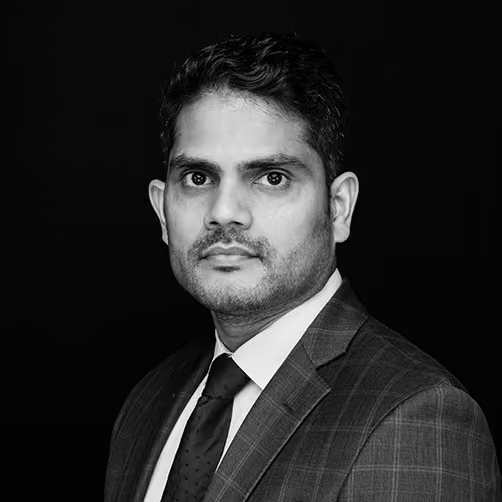
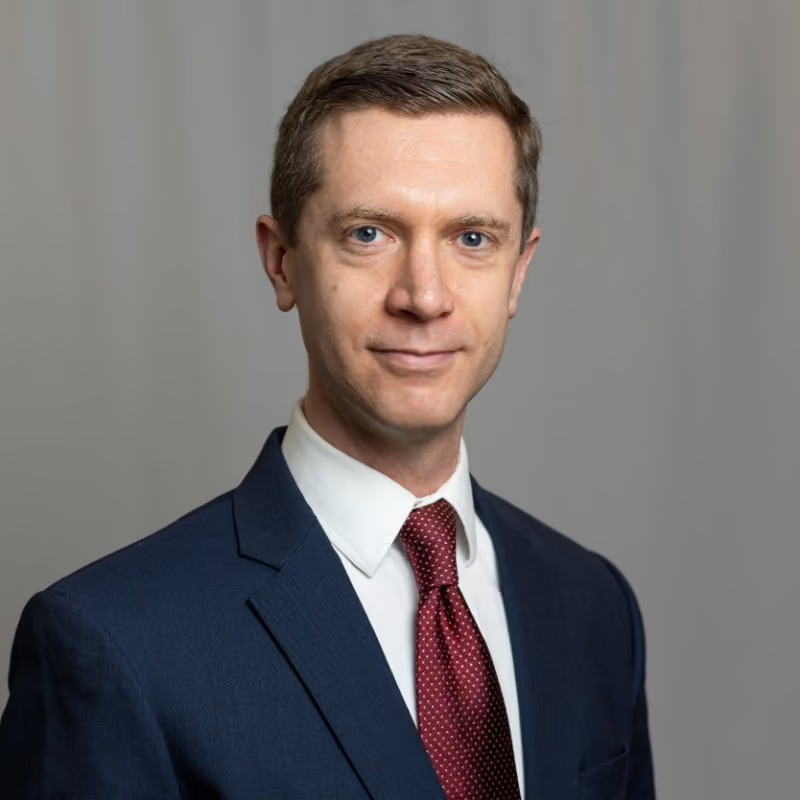
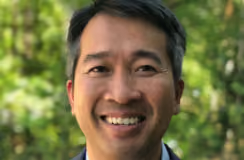
Host: Today's guest decided he wanted to buy a manufacturing business. He thought the onshoring tailwinds were promising, and he thought there would be many small manufacturers lagging in tech that could benefit from his own IT consulting background. So from his home in Northern Virginia, Naveen Venta looked across the Midwest and South for targets that fit the bill. He found one outside Milwaukee, Bailey Specialty Cranes, that builds lifts and booms for sensitive environments. The business's earnings were high six figures, and along with its real estate, Naveen almost maxed out the $5 million available from the SBA to buy it. But what about that distance between Milwaukee and Virginia? Well, in his prior life as a consultant, Naveen was a road warrior, often traveling Monday through. In some ways, this would be more of the same, only as business owner. This time he could work to bring those days away from home down from five per week to four, which he has already accomplished. Now he's eyeing the goal of three days per week in Milwaukee. But make no mistake, says Naveen, the sacrifice is real and you are going to have to be in the business. His words. Once you own the business, the business will own you. It's initially the business will own you more than you owning the business. So there's no escaping. Please enjoy a look inside how Naveen Vinta is making it work as owner of Bailey Specialty Cranes and Aerials. When it comes to SBA lending, not all add backs are created equal. SBA loan broker Heather Anderson returns for lender office hours tomorrow Tuesday to pull back the curtain on how lenders really evaluate adjustments and what actually makes it into the SDE or EBITDA number they're willing to lend against. We'll cover what SBA lenders actually allow as add backs and the difference between defensible and fantasy adjustments, how add backs impact DSCR and loan sizing and the red flags that trigger underwriter skepticism. You're going to get a clearer understanding of how lenders think and how to present the cash flow of your target in a way that stands up to lender scrutiny. That is tomorrow, Tuesday, March 17, noon Eastern. The webinar is Add Backs to cash flow for SBA Loans. Link to register is right at the top of this episode's show notes or on the Acquiring Minds homepage. Acquiring Minds Co and as you know, when buying a business, so much of your success comes down to the people Barlow and Williams attorneys Bill Barlow and James David Williams return for a legal office hours all about the legal questions related to employees and incentives in acquisition deals. Bill and James David will cover non competes and non solicits. Always a big question among searchers, employee benefits and equity and other bonus incentive structures. That is this Thursday, March 19, noon Eastern. The webinar is how to handle common employee issues when buying a business. Link to register is right at the top of this episode's show Notes or or on the Acquiring Minds homepage. Acquiringminds Co. Welcome to Acquiring Minds, a podcast about buying businesses. My name is Will Smith. Acquiring an existing business is an awesome opportunity for many entrepreneurs and on this podcast I I talk to the people who do it. If you ask owners in the ETA and search community which insurance broker provides highest quality work, great outcomes and has a practice dedicated to searchers and acquisition entrepreneurs, one name comes up again and again. Oberle Oberly Risk Strategies has worked with hundreds of searchers over nearly a decade and is in fact led by a two time successful searcher, August Felker, which makes Oberle, a specialty insurance brokerage for searchers by a former searcher. And if you've got a business under loi, Oberle will provide complimentary due diligence on that business's insurance and benefits program. An easy, no risk way to get to know August and the team at Oberle. To take advantage, check out oberle-risk.com that's O B E R L E- risk.com link in the notes. Naveen Venta welcome to Acquiring Minds.
[5:18] Guest: Thank you Will. Thank you for the opportunity to be a guest on your podcast.
Host: Naveen, you bought a manufacturing business in Wisconsin.
Guest: That's right.
Host: You live in Northern Virginia, not too far from me and are flying back and forth to the Business Weekly. We're going to hear how you have managed this and of course all about the business itself. Start us off though with some quick background on you please. Naveen.
Guest: Sure. Thank you Bill, thank you for the opportunity to be on your podcast. Longtime listener, first time caller.
Host: So all right.
Guest: As way of background so quickly covering, I came to the US in 2005 for grad school. After working in Ford Motor Company for a little bit, I joined the US army as a tank mechanic for about four years. Once I got out of the Army I was doing government. Federal government worker, government consulting until I finished my MBA from Darden School of business in 2024. Once I graduated, that's when I acquired Bailey in August of 2024. Okay, that's an overview.
[6:24] Host: That was great. So is it common for immigrants to work in the services? I guess probably more than I realize.
Guest: Yeah. This is a pilot program called MAVNI Military accessions vital to national interest. Usually they run this in combat zones. First time they were running it stateside because I could speak foreign languages. They recruited me for my foreign language skills.
Host: Okay, so you get out of the army and that you got out in what year?
Guest: 2013.
Host: So from 2013 until you started at Darden's executive MBA program, the one that's up here in Northern Virginia, correct?
Guest: That's correct. I started in 2013. 2022.
Host: So from 13 to 2022 you were in IT consulting here in the D.C. area?
Guest: IT consulting? I worked for State Department for a long time, a lot of other agencies. Even though I worked for CGI as a director of consulting, I was Nuclear Regulatory Commission was my client. I was a director over two programs.
Host: Okay, and so but your day to day was management, it was technical. Just give us a picture of what your career like, what your qualifications coming into buying a business were.
Guest: It was always in the IT space. I grew up as a traditional developer, then I came to cybersecurity project management before I went into business school. At the end I was doing program management. Client relationships. There's always it client facing.
Host: Okay, great. And you went to the Darden program. Why?
Guest: Given my GI bill. And then the public school, the number one rated public school, shout out to Darden. So that's why I choose Darden. And then when I was at Darden, I was considering multiple paths. I was very open to what to do after Darden. I was looking at traditional consulting, I was looking at finance or doing a CXO role from one of these private equity. Looking at all of these, the private equity CXO, they required more of a traditional MBA than executive MBA. Somebody seasoned like me, about 15 years of experience. So when I was in quarter six of my MBA, I came through entrepreneurship through acquisition, that class. And then that piqued my interest. Maybe there is an opportunity that I can pull this off myself. As a self funded searcher, that is the first time I came across that term.
Host: Okay, and so as an executive mba, how old were you?
Guest: When I went into the program, I was about 40.
Host: About 40. Okay. Okay. And so you discover ETA at the Starden program. Had you been entrepreneurial or thought you might be an entrepreneur before? Or was that really your first exposure to some sort of entrepreneurial path?
[9:12] Guest: So once I hit what you call the midlife crisis, I wanted to do something different. Once I hit 40, doing business school, while I was in business school, I knew I was going to take a pivot, like how I Took a pivot into the army after being five years in the US I wanted to do something else than what I've done before.
Host: So you do decide in fact to do a self funded search. What do the parameters of that search look like?
Guest: So during the COVID time I had a little bit of the YOLO kind of money. I had some funds set aside for my during the stock market. So I thought I could use that as down payment to buy this. Well, I was looking the way I was looking. As I was going by process of elimination I firmly decided on what I did not want to do. I did not want to do business B2C business to consumer directly. I want to be in the B2B space, especially non it because I can bring my IT experience to that new business. And then also I was looking at manufacturing hindsight being 20 20, I figured the next decade might be a little bit of onshoring because of the pendulum swings the other way philosophy. So that kind of worked out with this new administration. So I was always when I was looking at manufacturing, I was finding businesses in the Huntsville Alabama area or Midwest traditional manufacturing because of my service disabled veteran background.
Host: So you wanted to buy manufacturing because you perceived a strong tailwind there of reshoring on shoring US manufacturing. So that seemed like a big generational tailwind. And what was the other criteria? No B to C. Oh, and. And you wanted something where your IT skills you could, you could lay in it, bring value from your IT background. So. So a a sort of tech backwards business business that could benefit from. Sure.
Guest: Yeah.
Host: Okay, great. And, and say more about size of business or, or tell us about the size of business and what you thought you could afford.
Guest: Yeah. Being in the s self funded search, I want to stay within the SBA parameters of the whole transaction being less than 5 million. So that's what I was looking for. I wanted to stay under that radar of whole acquisition price being less than 5 million.
Host: Well, and that's a big range. I mean you could theoretically find a business doing over a million dollars of ste. Well, you know a million and a half and, and still be within that $5 million loan restriction. Was that something that you could have afforded or would were you entertaining also raising money from investors if you found a business that big?
Guest: This being my first time, I did not want to deal with investors and the new business at the same time. So that's why I was staying under the how close we can get to the 5 million cap because bigger is better in some way. It can be True. It cannot be true. I want to get close to the 5 million cap but not go above it.
[12:15] Host: So that sounds like you're ideally you were going to find a business that was doing about, you know, upper six figures or a million dollars of earnings.
Guest: That's right.
Host: Okay. And. And to the 10% down or 10% ish down that was going to be required. You had the balance sheet for that?
Guest: Yep, I did.
Host: Okay. And so you wanted to do a. Find a business that was doing business with. With the DoD because what, what would your status, what benefit would your status bring to that situation?
Guest: The federal government. There's a mandate of about 3% of the whole federal government business. They put set asides to SDVOSBs. So giving that status, I might get more contracts with the government that will put me as preferential vendor to the government.
Host: But you wanted to find a business that was already doing business with the government.
Guest: Yep.
Host: With the idea that you'd then expand on that more easily because you have this designation.
Guest: Because one I have that designation. But also we have past performance. If you're already within dod, you have past performance. In fact, we are doing business with the U.S. air Force. And then so I can expand to the Navy and other branches of the military.
Host: Okay, okay, okay. And so the manufacturing base traditionally in the US Big in the Midwest. Also heard you say Huntsville, Alabama for people to know who don't know Huntsville. Huntsville is a big center of aerospace and defense.
Guest: Yep, yep, that's right.
Host: And. And I guess manufacturers that serve that industry as well.
Guest: Yeah.
Host: Great. And so you started searching in that geography though you're based, you were based still in Virginia.
Guest: Yeah, I'm based in Virginia. While I was looking. So the, one of the constraints I did not have is I did not have a geographical constraint as long as it is one hop within DC I wanted find out a manufacturing business that is within one hop of D.C. within one hop.
Host: One plane.
Guest: One flight. Hop.
Host: Yep, one flight. But I remember I in the pre call pressing you on this and there was still a limitation there because you weren't going to buy anything in California though you can find not non stop flights to California. Okay, so a flight away, but no further than, you know, the Midwest.
Guest: Yep, yep.
Host: Pretty much still a large swath that really unlocks colors. Half. Half the country.
Guest: Geography. Yep, that's right.
Host: And so talk to us about how you thought about this flying back and forth, which is exactly what type of business that you did find. That's a big commitment. What did your. Do you have a family Yep.
[15:02] Guest: I do have a family. I have a wife, 14 year old and a 10 year old.
Host: Ah, okay. So kids that are a little bit older. So just talk, talk us through your willingness to do this. Point being that most people listening just wouldn't be willing to do it. How, how did you envision work?
Guest: So consultants live this lifestyle all the time. I have lived it before. So given five days of travel, I can minimize that to four days and then eventually three days once I have the systems in place. Because the way to find a business that meets all my criteria, manufacturing, dod, who's selling at the right multiple at the same time I was graduating business school, I thought I have to give up on something. That's why initially I approached with I'm going to give up on geography. One thing for the listeners is you specifically decide on what you want to give up. Otherwise you might find a business that's very enticing and then you might have to give up something you really like and then you might not sustain in that business. So being clear on what are the negotiables, non negotiables from the beginning would help narrow down the process. Yeah.
Host: And you were, you had lived a lifestyle like that before of being away during the week from your family. Okay. So this was kind of more of the same. You knew that you could do it. And it sounds like the, the plan over time was to eventually taper how long you were away from the family. So it starts five days a week and as you build processes and then four, then three. Okay, that's right. All right, very interesting. Well, we're going to return to that theme because that is kind of the key theme of your story. So tell us a little bit about the mechanics of your search given that it was such a broad geographical search.
Guest: Well, I was searching through the traditional biz, buy, sell and other things. The way I approach this is because I eliminated a lot of businesses that I don't want in the pre call we discussed. So I was going through biz by sell and then sending letters to all the brokers listing businesses. I was giving them two letters, one proof of funds and then the other one is bank pre approval. So I was getting the CIM confidential information memorandum from them. So a little bit for the listeners. Once it doesn't matter which business it is, I gave them those two letters. Once they gave me their sim, then I revealed I'm not actually interested in your business per se, but if you can find the business with this criteria, I can close in 90 days. They saw That I was serious and then I could commit. So this deal came by way of it's about to be listed. Brokers, they shop me around in their network and then they sent me this deal before it was listed.
Host: Wow. And how long did it take for that to happen from when you started your search?
Guest: So I started somewhere around like October of 23, I would say in December, January. I've looked at four or five businesses in January. I kind of gave an LOI in. I started negotiating first visit and the second visit we signed an LOI in April and I closed in August of 24.
[18:17] Host: Okay, okay. So actually from start to finish, it was almost a year. But you fat. But you're. I guess what I'm trying to get at is how quickly did this technique, this, this tactic work for you that, that it generated a proprietary deal or a off market deal.
Guest: So I think it took about like four or five months because I was eliminating a lot of businesses. They were saying this will work for you, this will work for you. But my criteria was a little bit ruthless. That's why I had, I said no to a lot of businesses.
Host: Okay, okay, okay. And so just to be clear, so you would, you went on biz by sell and you sort of any, any broker that had a business, you for sale, you requested the SIM and in your request you had, you would have included the two, your two documents or maybe when or, or when they sent you the sim, then you'd send them the two documents. Point is, you communicated who you were and showed them this documentation that you had a balance sheet that you were pre approved and said actually you know, I'm not interested in this business. I've requested information for so much. And so did you do that manually or was there, was there some sort of automated script that you ran to do this? Because it sounds like it was truly a blanket approach. I mean there would have been hundreds of hundreds of brokers.
Guest: Then I was doing it manually. Hundreds of brokers. But at the same time I looked at one broker, I saw the size of businesses they were listing, the type of businesses. And then I was a little bit selective in who I sent this to also. Okay, okay, one clarification. I want to give like bank pre approval letter. When I told this to my follow on MBA classes, they said, how do I get an approval letter? Why would they approve me for that much of a loan loan? So bank pro approval letter. I'm sure your guests might have discussed this before. That's just like a pre approval letter. What it says there's no red flags for you. That doesn't mean they'll give you a loan. To buy a business, the business has to support the cash flow. Obviously the pre approval only means there's no red flags. We can rely on you to pay this loan back. That's all the pre approval letter is.
Host: Yeah, right. And it's a little bit actually when you, when you put it that way, a little bit redundant because if you're showing the broker your resources, your financial resources, your personal financial statement, that's all you've shown the bank also to get the pre approval letter. Right. Because the pre approval letter is essentially that you show them your personal financial statement and they quote pre approve you
Guest: with the same information bank to bank. My memory is like kind of escaping me but I believe I sent tax tax returns also for the one or two years.
Host: Okay. Looking to secure an SBA loan to buy a business? Meet Pioneer Capital Advisory your go to partner for sophisticated buyers who want deals closed quickly and on the best possible terms. The Pioneer team has closed more than 100 SBA loans averaging timelines well below industry standards. Founder and owner Matthias Smith and COO Valerie Stash bring over two decades of SBA lending experience. Matthias and Valerie have built a team that meticulously works your deal from underwriting to close. You'll have a full bench working on your behalf, sales associates who streamline onboarding M and a financial analysts who craft investor grade lender decks. And an operations team that manages every step of the closing process with institutional level rigor. Pioneer is not a single person but your true deal team. Visit pioneer cap.com or click the link in the notes. Well, point is you're, you're making an abundance of an argument that you have these resources. You're showing your own, you know, primary sources of information and then this third party kind of stamp of credibility on what you're saying.
[22:16] Guest: That signals high intent to purchase.
Host: Exactly. That signals high intent.
Guest: Great.
Host: And then you'd be explicit about the high intent. If you can bring me a business that meets my strict criteria, I can close in 90 days.
Guest: Yep, yep, that's right.
Host: Great. Anything more to say about your search or should we turn our attention to the business you found?
Guest: I think we can turn our attention to the business.
Host: Okay, tell us about it.
Guest: So Bailey Cranes. This was started by an engineer who used to work at OEM jlg. Back then it was Oshkosh. So some of the customers started to come to this engineer and then ask can your lift also do this? Also do this a little bit extensions of the original machines were doing. That's when he started this firm. And then right now we have four separate lines of business. If you want to call them the explosion proof. We take the regular boom lifts and scissor lifts and then make them explosion proof. These are used in class one day one hazardous environments. So for practically speaking, mostly used during aircraft painting. Boeing is a big customer of ours. US Air Force is a big customer. And then we have the clean room versions of those same machines. They use these lifts to use to assemble satellites. Those are the two versions. Essentially we are engineered to order aerial work platforms. Business.
Host: Okay. Seller was an engineer who worked at jlg.
Guest: Yes.
Host: JLG is a producer of these lifts. That's right. Customers would want these lifts customized in a way that JLG wouldn't do. He starts a firm to provide these customized lifts. And the explosion proof ness is one of the features that customers demand. So, so what, you guys take the original manufactured product from JLG and add your. How do you make something explosion proof? And what exactly does that mean?
[24:11] Guest: So let's say some of these come with like diesel engines. We take it out, make it battery powered. All the controls are regular electronic controls. We make them intrinsically safe because we take out the big engine. All the functions of the lift have to be performed by hydraulics. We put a huge hydraulic tank and a pump to drive all the functions. So it goes through factory mutual. That is a nrtl, National Regulatory Testing Laboratory that certifies all this equipment for use in Class 1 Div. 1. Without Factory Mutual certification, you're not allowed to sell into those hazardous environments.
Host: And as you explained to me, these hazardous environments, it's not blast proof or explosion proof. Doesn't mean that your equipment survives an explosion. It means that it won't be the cause of an explosion.
Guest: It'll never be the source or ignition for that explosion.
Host: Because in these environments, a single spark from a piece of machinery can cause an explosion.
Guest: Yeah, it can cause a minor explosion that caused you a bigger explosion. And then you see some of these news stories, everything goes up in flames in a matter of seconds.
Host: Wow.
Guest: Yeah.
Host: And so you're doing pretty heavy modifications to these lifts.
Guest: That's right. We are doing pretty heavy modifications. We kind of are permitted by OEMs to do these modifications. They support us in whichever way we can because they don't want to lose the customers. When somebody asks them for a customization, they send them our way because we buy the base machine from them.
Host: Yeah. And didn't you say that you have four core products? Did I hear you say that?
Guest: That's right.
Host: So but then I heard you only mentioned two. Airplane manufacturing, satellite manufacturing.
Guest: And then the other one is like custom, like it. Project management. Anything you want to build from the ground up, we take requirements from the engineers. We work with the engineers on the client side. Once finalize the requirements, we manufacture, go install the machines. These are the pure custom from the ground up. The fourth product is mini pick and carry cranes. Those are the cranes that fit through a standard doorway. These are mostly used in maintenance, repair and overhaul operations working on small planes and engines. They can also go on a freight elevator for a glass installation on high rise buildings. Those are the four products.
Host: So this little mobile crane that can fit through small space or spaces smaller than most. Most cranes can fit through.
Guest: That's right. Yeah.
Host: Okay. And. But the fact that you mentioned those first two products, the, the lifts for the plane manufacturing and the satellite manufacturing are those two lines of business. The majority of the business, revenue wise.
Guest: Yeah, that's the majority of the business that makes like 50% is explosion proof. And then the 25% might be clean room. The rest of the products are the rest of the 25%. Both of them.
[27:10] Host: And do you only do work with the JLG lifts?
Guest: We work with other lifts. But when it comes to explosion proof, you need to factory mutual to certify a particular model. Once a model is certified, we can sell any number of those. On the boom lifts we work with jlg, which is a US based company, Oshkosh. On the scissor lift side, we work with Skyjack, which is a Canadian company.
Host: Okay. And so does that. Is that sort of a concentration risk of any kind?
Guest: It might be, but given how widely available parts are on, somebody from United Rentals can come and work on this lift. Because such a commonly known model, that's why we tend to go that direction.
Host: These are sort of the industry standard.
Guest: Yeah.
Host: Lifts used across in these environments. People know these are the kind of platform, almost plat platforms in and of themselves. These lift, these lift products. Interesting. Can you tell us about the business from a numbers perspective? What, how big a business is this? Employees, etc. Please.
Guest: So employees, we have like three engineers and then three more folks in the office setting. The rest of the folks, 10 to 12 folks between part time and full time are on the shop floor technicians. So total like 16 to 18 people as far as revenue is concerned on 25 because of doge and other Things we did not do as much as expected. 26 is looking very promising, but 25 numbers came out to be like 6.5 with like around 18% EBITDA, 6.5 million in revenue.
Host: So quick math, you must have used almost all of the $5 million loan.
Guest: Yep, I did.
Host: That's great. But you found exactly what you wanted size wise and so. Okay, so can we hear the purchase price and then go into deal terms?
Guest: Sure. So as far as the purchase is concerned, I purchased like traditional, the real estate in a separate LLC and a business in a separate LLC. The business was 3.7 times EBITDA, if I want to call it I was doing it was by the time I bought the EBITDA was listed as around 750 to 800, 750 to 800 EBITDA. And then my multiple turned around 3.8. So to give you the math, around $3.5 million for the business, 1 million for the real estate. I hit the ceiling of 5 million. Close to it.
Host: The business itself, you said, was about three and a half million.
Guest: That's right.
Host: And the real estate was one and a half, you said. Or almost. It's 11 million. Okay, great. And so, and what did the, the structure there of the loan look like?
[30:04] Guest: So I bought 10% equity, 15% is a seller note, and then the rest is an SBA loan. 75% is a SBA loan.
Host: That's so completely kind of traditional SBA loan model. And the loan was, because it was significant real estate. Here, the terms, the amortization term was spread out. So it wasn't 10 years, it was longer.
Guest: It was not a combined loan. It was two different llc. So mixed amortization will be longer, but the business is 10 years, the real estate is 25 years. Right.
Host: So we discussed this in the pre call and when I have talked about blended loans in the past, I've assumed that there was a single loan blended. But maybe I was misunderstanding. And when people were saying blended, what they meant was that there's actually two loans.
Guest: Yeah.
Host: So is that your understanding of how it usually works that there's two separate loans? 1, 10, 12 5.
Guest: Yeah, because the real estate, there's much more like collateral, they give 25.
Host: Yeah, no, that, that I understand, but I, I, for some reason I just, the mechanics of it, I thought it was all bundled into a single loan traditionally. But I, and you know, and then, and then the amortization, there's a, of course, a calculation to come up with what the amortization Schedule should be. And so it can be, you know, 16 years, 18 years for the whole, for the, for the single loan. Because it's been combined into one and blended. But maybe I was misunderstanding and there's kind of always two separate loans. But there's an effective blending that occurs.
Guest: Yeah. Some of the searchers I talked to, that was the case. There's two different loans.
Host: Were you familiar with the idea of a. A sale leaseback?
Guest: I am familiar with the real estate sale leaseback. If you want to inject more capital into the business, that is an opportunity I can leverage.
Host: And so I'm just curious now from somebody who owns a manufacturing business that you know, has some real revenue behind it and since 20 2005. So it's a 21 year old business. I'm just curious to, to this is completely hypothetical. What would your thought be on doing a sale leaseback? You could sell the building, get an infusion of cash, put that in your pocket or reinvest in the business. How do you think about it? Or to the extent that you have thought about it.
Guest: Yeah, put that in your pocket. But this might be too premature. But when it comes time to exit, that might be such a. Not such valuable proposition, somebody trying to buy this. So unless you need to infuse that cash and then you can sustain your existing cash flow on your line of credit. I would rather keep the real estate for more chips for a later day.
Host: Yeah. Yep. Great. What did you perceive as any weaknesses to the business?
[33:02] Guest: Weaknesses of the business? Because we are a small business dealing with bigger customers and bigger clients. So you go through these mezzanine things. The sales cycle is 9 months to like 12 months sometimes. Even though you mentioned we have the tailwinds of manufacturing, this is something I've looked into. Whatever is the headlines today, they don't directly translate to the bottom line in the next quarter. It takes for it to filter through 9 to 12 months and then you see it. That I think is the biggest risk I perceive for the business.
Host: Long sales cycles.
Guest: Yep.
Host: But what about working capital and cash generation? I mean, do you have bad working capital dynamics?
Guest: Working capital dynamics. Unless we get quickly busy that can. That can put a real constraint on the working capital. But as far as for 18 months, past 18 months, I was able to survive with the working capital I had from the business. But I'm sure everybody, every one of your guests gave the same advice. Get as much working capital as you can get from the beginning.
Host: And that is always the advice. Have you found that to be something that you wish you had more of or are you just repeating the advice that everybody says because you know it's good advice, or have you felt it yourself now?
Guest: I felt it myself. I get.
Host: Because of these long sales cycles.
Guest: That's right. We had a half a million dollars line of credit. And then we sometimes come close to using it, but that is always necessary.
Host: You sometimes come. You sometimes come close to. To tapping it. Yeah. Or using it all.
Guest: No, no, not using.
Host: Just tapping.
Guest: Tapping into it.
Host: Yep, just tapping into it. Okay, but you actually haven't tapped into it yet.
Guest: I tapped into it and then just put it back.
Host: Okay. Okay. What about the learning curve of, you know, you called some of your people engineers. So there's real engineering to this product that you all are selling. You don't come from that. What's that been like for you?
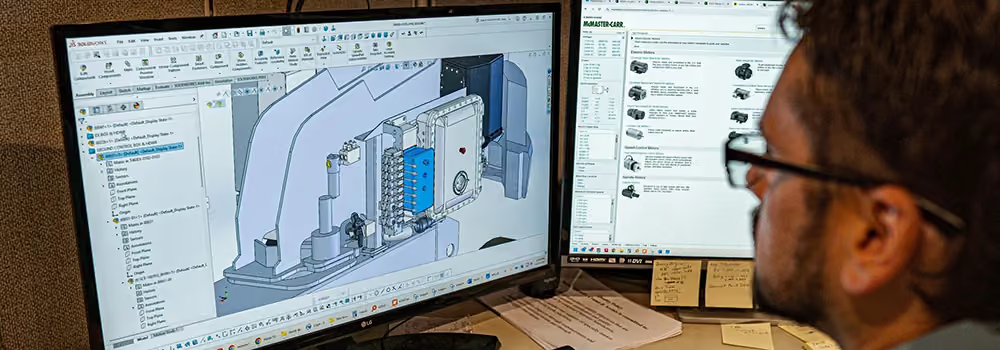
Guest: It has been a learning curve. They use AutoCAD, SolidWorks, Autodesk and everything. That is not something I'm even remotely well versed with coming from an IT background. But like bringing my IT experience to this. The website was very outdated. The logo was like archaic, if I want to say it. And then they never had an ERP death by a thousand cuts. Those were all improvements I was able to make to the business. Since the engineers were working in the same business for a long time, they were able to quickly appreciate what I could bring to the table. And then I understand the terms a little bit. I can talk to somebody about what goes on as far as engineering is concerned, but I'm not in the weeds as far as engineering is concerned.
Host: And your sort of intellectual capital is in three engineers. So are they the core kind of product people at the business?
[36:00] Guest: That's right. They're the core product people. But some of the technicians we have have also been working for 10, 12 years. They have a lot of knowledge in the shop floor as well.
Host: And is it. How much of a priority if. If at all, is it that you bring in other talent who can. Who can. I mean, three people isn't a lot. So if one of those people retires or quits, there goes a third of your intellectual capital. How are you thinking about that risk? Either short term or long term,
Guest: between the technicians and everything. Previously they did not have any systems to record this in place. Now we have some of those. Even some of the. Somebody hits a lottery, I think we will be able to sustain by bringing other engineers. The fact that two out of the three hitting the lottery is like the chances are very low.
Host: Okay.
Guest: Being a small business, you got to make that trade off. This is the risk I'm willing to accept for some of the listeners. When you read all of these books by bigger business, bigger business owners, they can wax philosophically but sometimes real constraints or something. This is a risk you have to accept. Coming into this. There'll be some real risk you cannot eliminate.
Host: Even if you buy a bigger business. You're saying there's just going to be some risk that is on that you can't eliminate is what you're saying.
Guest: No reading business books. They say this is how you need to operate. This is how you need to operate. But in a small business, given the constraints, there is some risk you have to accept. You cannot eliminate or outsource all the risk.
Host: How did the early days of the transition go, Naveen? How did the team take to you? Especially given that you don't have a manufacturing background. Especially given that you were going to be flying in once a week and aren't on the ground. At least you don't live in Wisconsin.
Guest: So I mean they didn't know what to expect. They've been under the same owner for a very long time so they didn't know what to expect. Given my recent professors from Darden, they trained me well. I would have to say I bought a very open leadership approach. We are able to discuss everything on the shop floor. They saw a little bit of change because this is not something they were used to. Once they get acclimated to the way we are discussing things openly. Previously it was a hush hush between what goes on in the shop versus what goes on in the office. I was able to actively break those barriers and then they appreciated what I brought to the table and sorry, you
Host: said that your professors from business school taught you what you needed to say on day one or taught or about this open communication. Say more about what you alluded to there.
Guest: One of the concepts I strongly remember from business school is a hygiene motivation theory. So when I came into the business there was no real break room. All the microwaves and everything were on the shop floor where the dust was there. So I had to specifically make an effort to make that hygiene portion build a separate break room where they can at least go in while the food was warming up. They don't see the dust all around them them. And then as far as motivation is concerned, no matter how much you pay the employees, unless there is hygiene, you need to attend to the both sides of the equation. Hygiene motivation factor. That is something I learned from business school. I was able to apply it directly in the business, I saw results firsthand.
[39:26] Host: Wait, wait a second. Good hygiene at the business or having, you know, food in a break room that's separated from the shop floor. This is an optics thing. This is a signal that you're tending to the well being of the business or what's the point there if I'm missing it?
Guest: So the hygiene is like I care about the way you eat and then dust not going into your food. You don't have to eat it the same this thing, dust being all over. That's why I care about the hygiene of the employees. That gives a strong signal.
Host: I see. And you said you saw immediate benefit from introducing good, good hygiene. Yeah.
Guest: The break room was filled with some kind of snacks. Every time they go into the break room, they can expect something. They can come into the business and say, hey, what is there in the break room? Just bringing donuts once a week. That is very, very minor when it comes to these Northern Virginia. And then you live in these different circles. But when it comes to a manufacturing business, doing those things goes a very long way.
Host: And so you feel that you were able to convince the employees through things like that that maybe this is going to be a good regime change.
Guest: Yep. I mean, I care about the people genuinely is how. That's how you signal. Once a month we had a lunch and then I literally was on the shop floor sometimes helping them do some of the things by virtue of understanding how this works. Can I help you do this one thing now just for me to understand. So they see I was out there with elbow grease. That kind of helped build some assurances that this is not somebody who's just here to turn and burn. You want to call it.
Host: How have you seen it manifest itself that, that it's, you know, the results that you talk about from your efforts there. What. What's gotten better?
Guest: So what's gotten better? Some of the employees who were just waiting for hit the 6500 tire now they want to whatever you need, I'll go whenever you want me to. Whenever you find a replacement, I'm here to support you. And then previously when you had to, when you had to take calls over the weekends, go to client sites to troubleshoot, there was some kind of elaborate arrangement. Now I can sometimes take implicitly granted. Would you be able to support this project and then say, I'll cover this for you. I'm the fine person. You don't need to worry about this client.
Host: You know, Enzo Technologies as one of the leading IT managed service providers serving the Search community led by Nick Akers, an acquiring minds guest who bought the 35 year old business. The team at Enzo regularly works with searchers and their acquisitions. And one feature of acquired businesses that Enzo is seeing over and over is the need to to implement cybersecurity promptly during the transition. So many acquired small businesses either have glaring vulnerabilities, lack security best practices or both. That step one to de risk the deal you just closed should be addressing these issues. INSO is your full service IT MSP for post close stability. They assess your target, surface the biggest risks in plain English and give you a day one through 30 plan to cut exposure, prevent downtime and even find cost takeouts like bloated telecom bills. Check out enzotechnologies.com I N Z O or email Nick directly@nicknzotechnologies.com and what about manufacturing as a business to buy? It's not so common in search land. It's not unheard of. There will have been a manufacturing episode that aired a few before this one, but it's not common. I think part of the reasons are that it is can be technical as in your case part of the reason, the big reason is that it's capex intensive. So you have these capacity kind of ceilings in manufacturing and so you can scale a lot up until you're at capacity but once you're at capacity then getting you know, introducing new capacity is a big capex investment and there's you know that. So it's not great, you know, return on cash and there's strategic and strategic risk there and so on. So those are maybe a couple of the sort of academic weaknesses of manufacturing. So address those. And then also just the motion of running a manufacturing business. What's that like?
[44:16] Guest: Sure. So there is low, there's nothing called as as much as a linear growth is always a stair step kind of growth, you hit the ceiling very quickly. Once you hit the ceiling, it's very hard to break that ceiling until you have like 12 million dollars of CapEx and then buy a new adjacent building, install a new machine. So those are real constraints but that's why industries tend to get around each other in that sense. If I hit that capex now, if I hit that limit for growth, I can outsource some of the manufacturing to people who have that capacity because there's like manufacturing plants all around. So that is something I've observed. That's why industries tend to coalesce. I don't know that's the right term. Industries tend to coalesce all the manufacturing hubs around Milwaukee. When it comes to day to day manufacturing ours is a little more challenging than regular manufacturing because we cannot source parts from anybody who we like. Meaning in the sense these are factory mutual approved parts and then they're on a control document list. Unless you're sourcing from the same vendors you have to go through this approval process again that becomes challenging. And then with how much of modifications we do to the base machine stocking all those inventories also is very capital intensive. Those are the real challenges. Anything the long lead they they can be really long lead items. Because ours is such a niche there's only very few people who do explosion proof components itself.
[45:51] Host: Yeah. And what does your day to day look like?
Guest: Day to day I work like 12 to 15 hours. I'm here at like around 5:30, 6:00 clock in the morning. I'm here 12 hours in the business attending like meetings. I run payroll accounting, I wear multiple hats. All the IT services, everything I go on the shop floor. We have a daily meeting like a stand up meeting. What's going on with each machine like a project. So once we run that I go through a couple of calls with the engineers and then some of the clients running payroll, doing day to day everything and then it was like 2:30, 3 o'. Clock. That's when the shop leaves. The shop works from 6am to 2:30. After they leave we look at the progress on each machine. Me and my engineers walk through each machine, see how much progress we've made. Any blockers on each machine? That's pretty much it with ERP. After I go to my apartment here in Wisconsin I go through all the bills that I need to approve and then taking care of the payroll and then accounts payable, accounts receivable function.
Host: At the risk of nitpicking Naveen, I'm just curious when I hear how long your days are. Some of the things that I heard you say you spend your time on feels outsourceable. Some of the finance functions, maybe even some of the IT though I understand that was where you were going to add value. Personally just curious why you haven't. Why are you able to compress these 12 and 13 hour days down by getting some of this off your plate?
Guest: I think I have started that process. The day to day minutiae of like recording and everything. All I do is approvals and then making the payments. I want to automate some of that but after I know the ins and outs of everything that's going on I want to Know each vendor by name and then how much we spend on each vendor, where the money is actually going. Then I can put some of these automations in place. I have outsourced some of the day to day recording, scanning the documents, putting the numbers in, bookkeeping, but I still want to be over the approvals and everything. Until the business is streamlined, I can automate some of those functions.
[48:05] Host: So part of this is your own self education. You said to me in the pre call that understanding the business, the nooks and every nook and cranny of the business is your philosophical approach to buying a business. Say more.
Guest: I want to understand each and everything that goes on in the business before we try to automate or give it to somebody. Once you decide to hire somebody, you need to have the confidence that they might walk out any day. You can step in. As long as they're performing the functions, you need to know whether they're performing it accurately or not accurately. Unless you are in the weeds and then live that yourself, you'll never know what they're doing, right or wrong. That's why I want to understand each and everything myself.
Host: First you had said that your presence on the ground in the business also is important. You've already talked a little bit about the, the improvements that you're making to the business and what that signals. But and I'm talking about something else, just kind of knowing that the boss is there and cares and is invested. Say talk to, talk to us about your philosophy on that point.
Guest: So coming from outside, not having manufacturing experience, what I bring to the table is my presence just being there, asking the right questions. So knowing that somebody is watching somebody is taking care of everything that's going on. So why are we doing this way? Because the business has been operating from a very long time, their processes might be set and then nobody question why they're doing the way things they're doing things. And then sometimes the shop floor thinks it's engineering's responsibility, sometimes the engineering thinks that's the shop responsibility. So there's nobody in the driver's seat driving this. The previous owner might have started something and then it kind of stayed as a lifestyle business, me wanting to make the change. Unless I understand all the moving parts, I will not understand the second and third order effects of the changes I make. That's why me being present on the ground and then seeing how things are moving, that makes a huge difference. Difference.
Host: When did you close on the business? Did you say it Was fall of 24?
Guest: Yep. August 2024.
Host: August 2024. So you're now basically a year and a half in.
Guest: That's right.
Host: And so how many changes, how much change have you implemented?
Guest: We bought in the ERP and then that ERP debt by a thousand cuts. Now everybody can see how many things we are ordering. Where is the ordering process? So one of the bottlenecks in the business was ordering things. Things being here on time, we had the capacity on the shop floor, we have the capacity to take more orders, but parts do not get here on time because there's like purchase orders flying all around the place. Now I have centralized through erp, Oracle netsuite is what we implemented. Everybody can see how many purchase orders, what's the long lead time, what's the eta. That is one huge change I've implemented other than UI UX at the website and then streamlining some of those functions.
[51:10] Host: And the implementation of NetSuite. Was that you. I assume you hired consultants to do that.
Guest: I semi hired consultants. I had always somebody who took us live and then the rest of the supports from offshore with me playing a huge role of. If somebody needs something, I go into the weeds, I write the scripts, I do everything for netsuite to run properly.
Host: Ah, so netsuite was.
Guest: You were.
Host: You were fluent in netsuite already?
Guest: I mean, I was fluent with the scripts, I was fluent with Oracle, PeopleSoft and other things that I can translate to. This one, Oracle netsuite. Yeah, I'm fluent in that one.
Host: And so you feel that in fact your IT skills have been brought to bear on the business then?
Guest: Yeah, I mean, outside of that, without this ERP and then all these processes, anything we have to do, get a quote out to a new customer and then send a parts order, it would have taken like ages to be able to dig through the files and everything. Now that we have an erp, we can quickly get through it and then provide service that has made a huge difference.
Host: So you'd mentioned that in 2025 revenue was down. That was because of the. Of why?
Guest: Well, the doge how much we rely on the aerospace and defense. Even though the defense budget is going up, the everybody has to reset their table. Where are we spending? What are we spending? That kind of combined with a long sales cycle, they just took a pause at three months and then it delays us by nine to 12 months.
Host: And what does 2026 look like?
Guest: 2026 is looking very promising. Boeing doing what it's doing. Spirit Aerospace used to be part of Boeing. Now that Spirit Aerospace has split between Airbus and Boeing, we are engaging both sides of the house. Airbus and Boeing. And then 2026 is looking to be very promising compared to 25.
Host: And you were 6.5 million in 24. That was the most recent numbers when you bought it.
Guest: Yes.
Host: And what do you think 2026 could be?
Guest: 2026 could be up to like 8.5 based on my visibility and your idea
Host: that you can even, even at capacity, you can grow beyond capacity by subbing out. I'm not sure that's the right vocabulary in a manufacturing context. But by outsourcing, delegating some of the manufacturing. Yes, some of. Some of the manufacturing. Okay. And so at what point do you even with that, that model of being able to, to outsource or sub some of the. Some of your work, at what point do you still hit a ceiling and you would need to make a strategic decision about a capex investment to grow
Guest: more, we might need to acquire a new physical building. That's the capex I will be looking at. If we grow more than like about 15 to 18 million, the way we are doing business, there is a lot of empty space. Given the 5s principles, there's a lot can be optimized here. So after we outsource some of the manufacturing to local firms who have capacity in this business, because we are a niche, I want to retain engineering, assembly, testing and then slapping our label on the machine, somebody can do all the core manufacturing, the fabrication part of the manufacturing.
[54:29] Host: And so. And so with that model you think you could more than double the business from your projected 2026 numbers of 8.5, you think you could get all the way to 18 before having to invest in another building. Great, great.
Guest: Because we have not considered the possibility of having a second shift in the same building. My worker, my the floor comes in at 6, they leave at 2:30. We can have another shift starting at 2pm going to 10pm second shift in the same building.
Host: And that though the two shifts having multiple shifts, this is a very common practice in manufacturing to effectively double capacity.
Guest: Yeah, that's right.
Host: What do you think about manufacturing in search? I had said that it's not a common a category for searchers to look in, but now that you're inside, what would you tell searchers listening about this category of manufacturing? Broadly, I know you're in a particular niche, but generalize if you could.
Guest: But coming from a traditional MBA background, we take our talents and apply to some companies that are already optimized and then we tend to over optimize them. There's a lot of middle America and then manufacturing. There are other sectors that have not gotten the brain power from all the business schools. We can look at these businesses and then we can have a lot of low hanging fruit. It is not a sexy ETA being what it is. You have to like bet yourself and the farm in the traditional sense and also in literal sense. But there is a lot of opportunity in manufacturing. A lot of sectors, everybody now private equity, they go through recurring revenue H vac businesses, roofing companies. But that is a little, I mean little overused is what I would say. Yeah, manufacturing, especially defense manufacturing given the way Anduril has been going there's a lot of opportunity that manufacturers locally can support some of the bigger business and then have the defense industrial base here
Host: say more about what has Anduril been doing and how does that affect somebody like you.
Guest: So they release some of these designs. Anybody who has a basic manufacturing things they release the blueprints and everything. Just saying you can manufacture at this price. However you get to this price optimizing everything, become a vendor to an. Those are some of the opportunities we are pursuing also great.
Host: And what about your status as a veteran in your kind of thesis there has that played out?
Guest: It has not played out to the extent that I expected. Because federal government can directly award you something if it's less than $250,000. The equipment we manufacture usually goes above that limit. That's why when we are doing with business with Lockett, Martin, Raytheon, Boeing, they use us to check that box. Better known business. But that counts towards the supplier diversity goals. But I haven't seen any business directly because of that status yet.
[57:26] Host: Okay Naveen, let's turn our attention back to the flying back and forth. I want to ask how it's going. I suspect since we knew you were already used to that lifestyle the answer might be fine. But give us some color.
Guest: I think I generally prepared my family well before my business school. In the second year of business school I'm going to do something different. I'm not going to be around just the more I prepared them. I think the transition has been much smoother now. Sometimes I go to my apartment and then I think like what am I doing? I'm missing my kids. That is always there in the back of my mind. But sooner you can streamline, sooner you can put business processes in place. You can dial it back to four days in three days. Now when I have to visit a client side, go to a trade show or something. I sometimes take a Sabbatical. In this modern post Covid world, you can work remotely, especially because you own the business. You can make that decision.
Host: Have you gotten it down to four days yet? Did I hear you say that? No.
Guest: You have. Yeah. I am at four days now.
Host: Oh, great. You're at four and you think you're on your way to three.
Guest: Yep.
Host: Oh, great.
Guest: Great.
Host: And. And so you took an apartment in Milwaukee, did you say?
Guest: That's right, Milwaukee. I mean this is called Muskego, a town about 20 minutes outside of Milwaukee.
Host: And. And so you have a little bachelor pad with nothing hanging on the walls, probably.
Guest: Exactly.
Host: Sort of vibe and that. And you spend weeks there. Okay, okay.
Guest: Coming from the military as bare bones as it can get close to a military barracks, you'd call it it.
Host: Yeah. And. And the idea of being away from the family for so long that obviously that's just a very personal decision is. I mean, is there anything that you would advise people listening on that front or it's just too personal and people have to decide for themselves if they can sort of handle it or want to do it.
Guest: I think this is one of the main considerations along with other things you look in the business for. Folks wanted to take the E tier out the first thing. We always tend to delve into the numbers, customer concentration and everything. But I would say if it's a physical business, not a digital presence only business, go visit the business. Imagine yourself literally sitting in that chair, living in that surrounding for a long time. Unless you can imagine that don't go into the due diligence and everything because that becomes a huge factor. Once you own the business, the business will own you. It's the. Initially the business will own you more than you owning the business. So there's no escaping.
[1:00:05] Host: And does that feel oppressive to you or you understood that going into it and it's fine because that's going to scare some people.
Guest: Yeah, I understood that going in. Go into this with eyes wide open because this is not some cakewalk that you can just be in your apartment and be in your house and then checks get mailed to you that this doesn't work like that.
Host: No, of course, of course. But you're. But you know, and hopefully nobody listening is. Is so unrealistic. But you are at an ex. The other extreme of that, Naveen. Living five, five days a week in Milwaukee, working 12 hours a day, maybe more. So you are so in, in the business and making real sacrifice to make this happen.
Guest: That's right. So. Because if you want to build generation wealth as they call it. And then something has got to give you got to pay your due somewhere. And then this is, I think this is a normal process of if you want to be the number one company and eta, I mean engineer to manufacture aerial work platforms, these are some of the sacrifices you have to make.
Host: Well, speaking of generational wealth, Naveen, so this was a business that you with the real estate you paid four and a half million dollars for, right. And you're growing it so you know it's going to be worth something above that. And as you pay down the loan over the years that's going to be, you know, you're building that equity into your own net worth. Do you have a grand plan of selling the business or buying more or grow or just growing, growing this business kind of indefinitely. How do you. Or are you just kind of, you know, up to your eyeballs in the business learning as much as you can and creating optionality for yourself and you'll go from there? What are you, what's the vision for the project overall?
Guest: So I'm up to the eyeballs in the business and everything but even afterwards I want to focus singularly on this one business, making it the best possible. So the way I'm working right now and then everything is we wait for the orders and then there's a little, any kind of uncertainty. We kind of tend to shuffle things around. So I want to get so much inventory and everything so we can be stable for a very, very long time. I want to focus only on this one business. Buying a tuck in acquisition and everything. I don't want to focus on anything else. I just want to focus on this one business only.
Host: And that you mean sort of for now or forever? Are you somebody who bought a business and that's going to. This is your life's work? Is that what you're saying or am I overstating?
Guest: Could be that one. But I'm going to be in a serial way unless I completely exit out of this or find it like running remotely without my interference at all. I'm not even looking at other businesses.
Host: Okay, and, and the probability that you'll exit this business do what do you think? Is that high or is that's, that's, you know, of course, you know, everything has a price. But is that not really your plan?
[1:03:10] Guest: That is part of the plan but that's not anytime soon. Like probably seven, ten years down the line. There's other manufacturers that in the aerial work platforms that look at this niche that this can be very complementary to their businesses. They keep knocking on the doors, but I'm not ready to make that transition anytime soon at all.
Host: Oh, you're already getting interest from buyers of your business. Prospective buyers.
Guest: Wow.
Host: That's a promising sign.
Guest: Yeah. Yeah, great. The, the tailwinds are manifesting this way. Manufacturing. Yep.
Host: And. And so what do you think that those tailwinds are just the, the original one that we talked about manufacturing kind of coming back to the US or some other tailwind?
Guest: The original one. And then also that we are in the aerospace and defense sector. Given the budget's going up, defense is always going to be here. NATO upping their budget to like 5% of their NATO countries. And then you can see some of that Canadian companies, Bombardier, they reach out to us for their defense projects. So overall, great.
Host: Naveen, anything we didn't cover that you had wanted to?
Guest: I think we covered it all.
Host: What's the URL and did you redesign the website? So do we see your handiwork if we go to the URL?
Guest: Yeah, I did redesign the website with the new logo and everything. It's Bailey Cranes B A I l e y cranes.com so anybody can visit the website. Feel free to reach out to me on LinkedIn. Great.
Host: Well, we'll put the URLs for both of those in the show. Notes Naveen Vinta thank you for sharing on Acquiring Minds. Congratulations on making this work. This is a format the the flying to and from your acquisition is a bold way to approach this. It's not unheard of, but it's pretty rare. So I was excited to have you share with with the audience what that looks like. So thank you.
Guest: Thank you. Thank you Will. Thank you for the opportunity you gave me to tell my story.
Host: Hope you enjoyed that interview. Don't forget to subscribe to the Acquiring Minds newsletter. We send an email for every episode with an interview, introduction to the interview, a link to the video version on YouTube, and soon key takeaways, numbers and more essentials from the interview. For those of you who don't have time to listen or watch it, subscribe at acquiringminds Co. You'll also find all our webinars there on the website, both those we have coming up and recordings of past webinars. At this point there are There are over 30 webinar recordings, a wealth of information on all the technical nitty gritty of buying a business. Acquiringminds copy.






































%20-%20thumbnail.avif)




%20-%20thumbnail.avif)

%20-%20thumbnail.avif)
.avif)



%20-%20thumbnail.avif)