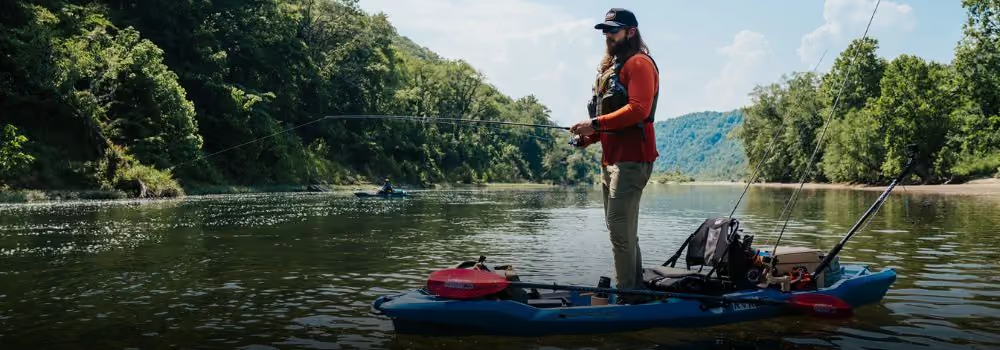
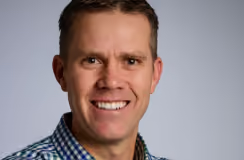
Host: 25 years ago, today's guest bought two businesses within a few months of each other. Don Grigg was in his early 30s, with three kids and a desire to buy a manufacturing business. In the end, both businesses he bought were problem companies, which was by design. He figured the only thing he'd be able to afford were small, struggling businesses and that he'd have to turn them around, which he did. We hear the story of both, including one that he exited for millions of dollars a few years later. Which sounds like the Searcher dream. Buy a tiny business for low six figures, grow it like crazy, and exit to a publicly traded conglomerate at 40 years old. But listen for Don's reflections here and how he contrasts that exit with the outcome of the other business which he owns to this day. He has grown that one from an unprofitable little plastics molding business that did custom work for clients to a manufacturer of kayaks under its own brands doing 22 million in combined revenue. This one has become his life's work, and Don thinks your acquisition could be yours. His words? You can create a family business that reflects your values, that allows you to exercise your entrepreneurial gifts and creative energies around how to build it, and it's incredibly rewarding and you can make that your life's work. Here he is Don Grigg, CEO and co owner of Big Adventures, the company behind Native Watercraft, Liquid Logic Kayaks and Bonafide Kayaks. We talk about flags when evaluating businesses to buy. Green flags are good signs. Yellow flags mean be cautious here. Tread carefully. Red flags stop this Thursday, February 19th Max Lummis and his team at LCS return for due diligence office hours on the topic of red flags that kill or fundamentally reshape acquisition deals. Max and team will discuss revenue quality issues, unsupported EBITDA adjustments, expense timing issues, and other major due diligence discoveries that you should treat as critical risks should you find them in your deal. LCS is a forensic accounting firm that does the quality of earnings for dozens of search acquisitions every year. So come learn about Red Flags from a team trained to find them. That is this Thursday, February 19th, February noon Eastern Register at the link right at the top of this episode's show notes or on the Acquiring Minds homepage. Acquiring Minds Co. Welcome to Acquiring Minds, a podcast about buying businesses. My name is Will Smith. Acquiring an existing business is an awesome opportunity for many entrepreneurs and on this podcast I talk to the people who do it. Running payroll, paying your bills, closing your books and producing financials. These are critical tasks every business owner must do or oversee. But spending time on them distracts you from the leadership in growth work you want to do. So let system 6 do it for you. Owned and led by a former Searcher, Chris Williams, System 6 is a leading outsourced finance team for hundreds of SMBs, including over 50 searcher acquired businesses. Chris, Tim and the System 6 team understand firsthand the challenges, the opportunities of jumping into a business as its new owner. So whether you own your business already or have one under LOI, talk to System 6 about how they can give you time back and improve your financial operations. Mention Acquiring Minds and they'll provide a free review of your books and Financial Ops, a $500 value. Check out system6.com link in the show notes or email helloystem6.com Don Grigg welcome to Acquiring Minds.
[4:52] Guest: Well, thank you Will. Glad to be here.
Host: Don, you bought two businesses, both small, both unhealthy at the time you bought them, but they were the origin story of what became a career for you, building and running them. And today you tell people that entrepreneurship through acquisition ETA can be your life's work if you want it to be, but only for the right type of person. We're going to revisit that theme throughout our conversation today, but let's begin with some background on you please. Don, Going back to before those two acquisitions.
Guest: Well, I graduated from business school in 1990 and my goal was to find a job just like everybody else. I wanted to work in a mid sized manufacturing company and was fortunate to find a job in a brick manufacturing company here in North Carolina. I don't know if you all know this, probably don't, but Sanford, North Carolina is the brick capital of the United States.
[6:01] Host: Did not.
Guest: There's a lot of red clay and that's what you need. And after a couple years I was able to run a small division of that company and I found that I really enjoyed that. It was a lot like running a little company within a bigger company and I think it's a pretty unusual sort of MBA ish job a couple years out of business school to have your own little P and L within a little, really relatively little manufacturing company. But I really connected with that work and it was the first work that I had, you know, since shoot being a busboy in high school that, that I really did like. And I decided at that time that, you know, that's what I wanted to do, which is is to operate businesses.
Host: And Don, what what did you like so much about it?
Guest: I love Being with the people in the, in the plants around the MA doing things, trying to understand how things work and how to try to make them better. So the operations, yeah, also like how, how the employees connect with their work in a manufacturing environment, also the customers and what they need from us. Just the whole, putting the whole picture together was something that I really connected with. Even though it wasn't quite, quite a small, small division. We probably had, you know, 15 or 20 employees total and you know, it was perfect for me at that time and you know, I was really thankful to, to get that kind of opportunity. You know, you get out of business school and you end up getting a business development role or a finance role or a consulting role or some, some officey kind of work and, and you can spend, you know, your whole career in, in these functional roles and never, never get, you know, a P L under you. And to learn that that's what I wanted to do that early was just, just really fortunate.
Host: Did you, did you were there inklings earlier than that that you'd want to be a small business owner? Was this, was this a. Your kind of your first real exposure to that concept?
Guest: So ownership was nowhere in my head. We, you know, just, I just wanted work that was running a small business. I have look, classmates that in the end ran massive businesses. And so it's not like it, it's that unusual to like get a P and L eventually in your life. But it was really good for me to see that that's what I wanted to do that young, that early.
[9:18] Host: Right. And so how did that inform your next steps and next move?
Guest: So this was before ETA was a thing we're talking now, sort of in the mid-1990s, I transitioned to a role with an affiliated private equity group and we were buying companies in metal fabrication and finishing or trying to, I should say it was not a particularly well funded shop, but it was, it was trying to be. And my job there was very much like what a searcher's role is in, in the ETA environment. That's, you know, I was brought in to go search and find metal finishing and fabrication companies that could be joined together in a way that was synergistic. And so throughout the late 1990s, my job was to go meet with business owners and find them and do everything you do that you do in a search. And as, as I did that in these meetings, I kept thinking, well, you know, what I want in my life is to have your job. As I met with these business owners, I, you know, obviously got to see their operations and what they did and how they thought. And I. I started to get an inkling that, that I wanted to be the owner, but it wasn't something that I, you know, acted upon for. For a few years, but definitely developed the thought there. And then, you know, a couple of roadblocks came up and I decided it was time to do my own search. And through, you know, the 10 years after business school, I had put together, you know, a skill set that. That was basically, you know, how to do a search, how to run a little business, how to, you know, the ins and outs of LLC and structures and lawyers and accountants and how to get a deal done. And. And I knew what it was like to operate a little business as well. So, like, for me, the whole process was organic. It wasn't like a subject I chose in business school or something like that. You know, it was just fortuitous because certain things that led me to this path just happened. It wasn't part of a plan. And also. But. But I had the. I had the skill set to go do it. And so finally I woke up and said, you know, I can do this or I think I can do this. I had, at that time, a young family. I had no sponsor, I had no capital except my own savings. So it was a little bit daunting, but I did have the experience.
[12:36] Host: And Don, so you really put this picture together of searching for buying a business, then becoming its owner, kind of based on your own, what you'd witnessed so far in your career, which is to say ETA as we know it today, search wasn't a thing, so nobody was talking about it. You had been in a private equity shop. So private equity, this is a version of private equity. So the idea of buying business, private businesses was not new, and you had been working in it, but kind of putting it all together, that piece, plus the piece of owning and running a manufacturing, in your case, business, and just doing it, the whole thing as operator and as buyer, and that you would just set out on your own to do this. This was all kind of your own entrepreneurial flight of fancy. This was not somebody putting it in your head, correct?
Guest: Yes, but it was. It was organic in that, you know, one thing did lead to another.
Host: Yeah.
Guest: I didn't graduate from business school with a vision that. That got me there. I was lucky to have a set of experiences that did get me there.
Host: Yeah.
Guest: If that makes sense.
Host: Yes. Okay, so what year is this? And say more about your personal situation at the time. Balance sheet, family, repeat that for us, yes.
Guest: So balance sheet, whatever. I'd saved over 10 years since business school. Three kids, all young, and, you know, I hit it. I did hit a few roadblocks after 10 years that sort of pushed me to say, oh, I can do a search. In other words, if, if, if something had opened up and looked like the right path to go down, I may not have ever done the search.
Host: Yeah. What were these roadblocks?
Guest: Oh, as an example, my job at the end with the private equity group was, was operating a little bit of a problem child company in Indiana. And the commute was just too much for me, for the kids and in myself and just being away from home a lot. Yeah, you know, I enjoyed that job, but it just didn't work. So that was a bit of a roadblock there. Geographic one. I, I interviewed for a job at a metal fabrication and finishing company that I had a hundred percent of the skill set to run as a general manager. And they weren't, they needed the general manager to run it. And it was in Raleigh, right down the road. And I'm like, oh, I'm gonna get this job. And I didn't get it. I couldn't believe it. You know, I was just really surprised I didn't get the job. Maybe I thought too much of myself, I don't know. But, you know, that was a roadblock. And so at the same time, I was thinking I should do a search. But, you know, if I get that job, do I do a search? I'm not really sure I do. But, you know, the, the roadblocks were fortuitous. You know, you know, I believe in, you know, I believe that, that we, I all have a calling and that, you know, sometimes God leads us to that calling. And I, I think, you know, me not getting that job and facing those roadblocks was, was a way for me to actually find what I was supposed to do. So I, you know, I, I, I embraced the search in 2001. Just fully embrace it.
[16:45] Host: Right.
Guest: And, you know, my search was focused on problem companies in the lower part of the lower market. That's what I had the capital for. I had a few hundred thousand dollars. That's it.
Host: A few hundred thousand. And why problem companies? Because that would give you yet more discount that you could afford.
Guest: Yeah, exactly. Just the equity had to be very limited so that, you know, the business could not be a good small. And broken is what I call not too broken, hopefully. But anyway.
Host: Well, Don, even despite your balance sheet limitations, then, obviously today we have an ecosystem. Many people Getting into search today also don't have much of their own capital to bring to the table. But there are solutions for that. Capital, providers, investors, there's a whole ecosystem. But even if people don't want to go that path of working with investors, the conventional wisdom on this podcast and others is so drilled into everybody. Don't buy fragile, don't buy tiny, don't buy distressed for your first one. That's, you know, that's not for rookies. You were still flouting what is today conventional wisdom.
[18:10] Guest: That's well out of necessity. I had no sponsor and so I didn't have no sponsor telling me that that was a bad idea. Also.
Host: Yeah, no podcast telling you not to do that.
Guest: You know, and look, I, I, I think the kinds of businesses I was looking at, you know, I, I did need a little luck on my side. A, I needed a business that could be scaled because I didn't want to run a little business with six employees for the rest of my life. And I needed a business that might be somewhat broken but was fixable. You know, not every broken business can be fixed.
Host: Yeah. Yep.
Guest: And as MBAs, we train ourselves to think that, you know, we can fix anything. But you know, that after a lot of experience, I don't think that's true. I think that, you know, there are bad businesses and there are good businesses and if you end up with a bad business, even if you are really good at what you do, it's tough. It's just a bad business. And so I ended up through my search making two investments in separate companies in the plastics business. Both of them, I just, I just got really lucky because they did meet the, you know, sort of a fixable and b scalable criteria.
Host: The team at Aspen HR recently published a short white paper targeted at searchers Entitled A New CEO's Guide to Human Resources. It lays out the key items you should be thinking about as you transition into CEO and owner of the business you bought. The link to download that is in the Show Notes Aspen HR is a professional employer organization or PEO, which provides HR compliance, flawless payroll, robust HR technology and Fortune 500 caliber benefits, all for a fraction of the cost compared to using multiple vendors. Reach out to Aspen HR for your complimentary HR diligence checklist and benchmarking analysis. Go to aspenhr.com or contact Jenny Theere directly at jenny spenhr.com let's take them each in turn, Don. But first of all, industry wise or category wise, you were looking for manufacturing because that's what you knew.
Guest: I think I'll just answer yes. I wanted a manufacturing company. Okay, how about that?
[21:04] Host: Okay.
Guest: That had been my roots in brick manufacturing, you know, in metals. I knew bricks, I knew metals. I wanted, I wanted manufacturing.
Host: Don, let's hear about both of these businesses. The first one, please tell us about it, what it did. Size in terms of revenue, employees, purchase price, whatever you can. I know this is going a ways back now too. So this is 2001 or two, but what you can remember.
Guest: Yeah, now we're, you know, we're in 2002, and I have closed on a company where I've bought a controlling interest in a plastics recycling business. It was losing money with six employees, and it did have some attractive equipment, though. And I thought that I understood there to be a real growth opportunity with a, a customer that made flower pots where we would provide resin on a preferred basis to this recycled resin to this company that then used it to make flower pots that you see in garden centers and stuff like that. I got into that business and realized that there were real problems with that because we needed a new piece of equipment, which I knew about, but it was twice as expensive as that as what I thought it would be, and required skills to run that we did not have, and it was just a much heavier lift to get to this supply situation with the manufacturer of flower pots. I also learned that this manufacturer of flower pots was not so credit worthy. And this was a case of me not doing the best due diligence. Also me learning that when you look at a business from the outside, you don't necessarily understand the whole business. As an mba, we, we're trained to think that we can, but we really can't till we get in there and we run it and we, we turn over all the rocks. We, we don't understand what we're getting into fundamentally, in many cases or all.
Host: We have an expression in eta, you know, is the business that you bought the business you thought it was.
Guest: Exactly. In this case, my business plan was in the trash within six months.
Host: Okay, okay. And, and, and give us some size of the business and what you, what equity you purchase.
Guest: This business had, say, like I said, six employees, about half a million of sales, and was losing a little bit of money, not much. Okay. I injected capital into this for a controlling interest and agreed to finance, you know, a piece of equipment that would get us into the extrusion business, which was the flower pot deal that we did not end up doing.
[24:19] Host: Don, tell us about business number two, please.
Guest: Okay, so business Number two was a plastics molding business that did custom molding of plastic parts for manufacturers. And it had two molding processes, one called thermoforming and one called rotational molding. And so if you needed a. A plastic part made for your, you know, bait box for a fishing boat or. Or a tray for a forklift, we would mold that for you and you would use it. You know, we're part of the supply chain of those manufacturers.
Host: Spect in Right respect in.
Guest: Exactly. But we're custom molders, so we don't own the products that we mold. We, we. We mold them. We take our customers molds and we buy their molds and we use their molds to make their products. So they aren't our products, if you will. And then we had also a line of kayaks that was our product. And the company had figured out how to thermoform kayak, which produced a. A lighter weight, stiffer kayak than a traditionally molded kayak. And that was a, you know, a very sort of early stage thing for the company at that time. So we have.
Host: Go ahead and just to. Just to. As a spoiler, you're foreshadowing there where you are today, which is one of the players in the kayak market.
Guest: That's where it eventually got us to. Yeah, that little, that little division we had. That. That particular division, when I got there, had $400,000 of sales and was losing a fair amount of money trying to get it going.
Host: So why. And what was the revenue and employee base of business number two?
Guest: So business number two was a bigger, better business, was also losing a little money. It had almost 2 million of revenue, and it had about, you know, I'll say, like 18 employees. Okay. Almost everybody on the floor doing molding work.
[27:08] Host: Okay. Okay. So you decide to buy not one, but two struggling, unprofitable small version.
Guest: Yeah, that wasn't the plan, but as you know, these deals fall apart. I expected at least one of them to fall apart, and then they both closed.
Host: Well, for the audience, this is not the first time we've heard this theme. I'll just. I got these two or more. Lois. One of the, you know, they're all bound to fall apart. So if I'm lucky to get one across the finish line, so I'm just going to keep carrying them both down the field. And then, lo and behold, they both closed.
Guest: Yeah, that's what happened.
Host: So, by the way, were you freaked out when you were like, oh, I guess I'm doing. Aside from the capital commitment or whatever it was going to cost you. Just the now responsibility of taking on two businesses.
Guest: Yes. They closed within six months of each other. I was fully engaged in the recycling business when the second one did close and did wonder how I was gonna, you know, do a good job in both places. They were both about an hour and a half from my home and in opposite directions. So.
Host: And. And this was pre zoom.
Guest: This was pre zoom, you know, running
Host: a business from the Internet.
Guest: And they were both factory, so I had to be there. So it was a little dicey for a little bit. But fortunately, a business associate from my brick days joined me at the recycling company pretty quickly, and he became effectively a general manager out there. That was. That was. That was really fortunate. Very talented guy.
Host: Okay, so you have these two businesses. One is a plastics recycling business, about six employees. One is a plastics molding business, about 18 employees. You are owning now and growing these both at the same time.
Guest: I am not. I'm not the sole owner of the molding or the recycling business, though I have partners.
Host: Okay, okay. Are you the. Are you the majority if.
Guest: Are you. What, in the molding business? I am not majority. No. In the recycling business, I have. I have, yeah. Effectively control. Majority control, but yes.
Host: Okay, okay.
Guest: It was really fluid there with the recycling business. Well, there were many different iterations of the ownership structure of that business. Okay, Okay. I joined a partnership group that wanted me to come in and run it. That's how I got the deal and the equity and made the investment. I got operational control through the LLC structure. Okay. There's a lot you can do with a manager managed LLC that gives the manager basically the right to control the business. Okay. Independent of what the equity looks like.
[30:41] Host: Okay, okay. Okay.
Guest: And then very quickly, one by one, these former owners started selling out,
Host: selling their interest to you.
Guest: Yes, yes. And to a new group I brought in. It was very fluid. It's. It's not worth.
Host: Okay, okay, okay. Well, we won't. But so what I think we do is the key bullet points of the journey with the recycling business, which spoiler, you exit and then the pla. And then we'll turn our attention to the plastics business, which you still own today and as we've already said, is now a major kayak manufacturer. So why don't you just can, if you could, give us the bullet points you were about to share earlier of the plastics recycling business all the way up to the. To the exit.
Guest: Yeah. What's interesting about that business is how much potential it had for rapid growth that I could not foresee before I got into it. So you get into a business, you think what's, what's the most important thing is customers, right? And growing customers. And I got into this business with the same idea that I needed to find customers to grow the business. And I thought I had, you know, a really important new customer for the business when I closed. As I got into it, you know, A, that customer, that whole arrangement fell apart. And B, I learned that what's really important here is sources of supply. The customers are basically buying a commodity from you and the commodity gets priced against other commodities. On the feed chain of polyethylene or polypropylene, it's starting with sort of virgin grade and working its way down through off spec and then working all the way to, you know, regrind, which is what we produce, which is sort of the lower end of the spectrum of all the plastic inputs a molding company can buy for what they make.
[33:03] Host: Don, sorry to interject. Hold, please hold the thought. But to be clear, what the business did is take essentially produced plastic, recycled plastic, plastic, scrap plastic.
Guest: Yeah.
Host: And clean wash, process it into plastic that can then be used as an input by plastic molders. So you were an intermediate step of sort of processing scrap plastic into something that could be used by plastic molders, right?
Guest: Exactly, exactly. So you, you, you put your jug of Tide in, in the recycling bin and it goes to a center and there that jug of Tide gets bailed up with all the other number twos and then that recycling center sells off those bales to somebody that then takes those bales and makes a product that a manufacturer then can use that, that plastic to make. And that's what we did. We would buy those bales from recycling facilities as well as post industrial scrap, dirty scrap from manufacturing operations. And we would grind it up and then we would wash it and produce a clean flake and then we would sell that clean flake to often manufacturers of sort of lower end products. I say low end, not really low end, but think of like drainage pipe or packaging. Yeah, stuff like that. Usually it's thick walled, usually it's black. And so what those guys are looking for is the least expensive feedstocks that they can still run. Now they need something clean, dry and flowable because they run extruders and if they put a bunch of junk in there, it's going to screw up their machines. So they need something that's been refined, but they don't need to buy virgin engineering grade resins to make their products. So they would, they would buy it from us. And what I learned was that the trick to this whole business was figuring out where to source scrap and how to buy it cheap. Because if you could make it, you could sell it, if that makes any sense.
Host: Demand was not your problem.
Guest: Supply, demand was not the problem. Now if the price was too high, demand became a problem. You had to have be able to sell what you produced at a price that these manufacturers of drainage pipe found compelling versus what they could buy their alternatives for. But if you could do that, they would buy all that you had.
[36:02] Host: So what was your discovery? You had an insight once you got in there.
Guest: Well, the insight which should have been obvious, honestly, but you know, before I got into it, but you know, which was that the, the challenge was the supply side, how to buy this scrap at, at a cost that we could make money when we sold it as clean regrind. That's the entire challenge of the business. And the washing step that we had when we got there, we had one wash line and then when we sold the business, we had three. The washing step is what bridges the gap between. Scrap plastic that's dirty, it's got labels, it's really unclean, and therefore doesn't have a lot of value as in that state to a clean regrind that when sold to a drainage pipe manufacturer has real value. And so the ecosystem of plastic recycling is, you know, lots of people were out there grinding up plastic scrap and selling it as is. There weren't very many people that were then washing that in the same facility and producing, you know, a higher grade clean regrind. And so we were not unique, but we figured out how to scale that approach. And it all came down to like finding new suppliers, building new wash lines, buying a new factory with more space, and taking care of our customers, of course, who wanted more and more from us. But if you had a customer, let's say that was buying, let's say there was a customer buying 10 loads a month, 10 truckloads of plastic a month from you, and you called them up and you said, I can do 15 now, and the price would be a half a penny lower. They would say, okay, I'll take, I'll take 15. You know, it wasn't a problem on the sell side. Yeah, that was, that was sort of the big switcheroo in terms of expectations from when I, before I bought it and after I bought it, if that makes any sense.
Host: Don, you had characterized that to me, that kind of shift insight, what have you, as kind of this chunk of gold that you found in the business. And if you can find such a chunk. Chunk was maybe not the word. Whatever.
[39:04] Guest: Well, ingot, something like that. Yeah, it was, it was, it was, it was.
Host: And if you just keep doing nugget. Thank you.
Guest: There you go.
Host: So, but what was the, what was the point? What is your point in that point?
Guest: My point is that when, when I bought the business, I had one idea that wasn't right. And then by learning the business, I, I was able, you know, with the, with help to land on a, a repeatable growth strategy that took that business from being, you know, six employees and not making money to 50 employees and about 10 million in revenue and very profitable. So the point, that's the point that, you know, we were lucky. We were lucky to be able to land on a formula that we could execute over six years and make that happen.
Host: But is there, is there also kind of a, you know, if you can just get in the game, opportunities will reveal themselves to you point here? Is there some generalizable point or work? Because I just heard you use the word lucky.
Guest: I feel like I was lucky because it wasn't part of my business plan. I did not foresee this. Yeah, okay. And so, you know, it could have worked out differently. It could have worked out to just be a tough business.
Host: If you ask owners in the ETA and search community which insurance broker provides highest quality work, great outcomes and has a practice dedicated to searchers and acquisition entrepreneurs, one name comes up again and again. Oberly. Oberly Risk Strategies has worked with hundreds of searchers over nearly a decade and is in fact led by a two time successful searcher, August Felker. Which makes Oberle a specialty insurance brokerage for searchers by a former searcher. And if you've got a business under loi, Oberle will provide complimentary due diligence on that business's insurance and benefits program. An easy, no risk way to get to know August and the team at Oberle to take advantage. Check out oberly-risk.com that's O B E R L E hyphen risk.com link in the notes. Well, the other thing you'd said to me is that I think it was this business, maybe both that it was unmanned under managed.
Guest: Oh, that's for sure. Yeah, yeah.
Host: And, and there's a lot of opportunity. There's a lot of under management out there in the world. World.
[42:05] Guest: I think there is.
Host: And there's a lot of opportunity in that. Expand on that. I love that.
Guest: Well, I, I Think many small businesses are under managed. You know, it doesn't mean it's a good business or a bad business, but I think there are good businesses that are under managed that, that, you know, if, if you're able to get involved in one of those, you can make a lot happen. And that's really fun. It's really fun when you, when you, when you get into a situation where you can, you know, see a five year growth plan like we were able to do there. I mean, look, lots of people have done lots greater things than that, but it was fun to be part of, you know, one of them.
Host: Yeah, yeah.
Guest: So, yeah, I like, if, if I see an opportunity that's under managed, I like, I like, I like that characteristic because it means that you can, you think you can affect the business, but I also think you need to be humble when you say to yourself, oh, that that place is under managed. Right, okay, well that's what you think. Now from an outsider standpoint, you may or may not be right about that.
Host: Well, that, and that gets to, to the extent that there's a little bit of hubris in entrepreneurship through acquisition that we all think we can buy these businesses and do it better. Because that's kind of, that kind of is implicit in this whole, in this whole game. And, and so, and so, so often, you know, we're looking at, you know, that a business as under marketed or this or that and all the levers that we're going to pull. And while the exercise of trying to figure out those many levers is valuable is where you are at going to add value. Always important to go in with humility, not hubris, and recognize that for whatever reason, probably many of your, many of your levers are dead on arrival. They're just not going to work and you just can't see it yet.
Guest: That's correct. Yeah. It's easy to make assumptions about what you can do before you get in there and actually try to do them.
Host: Yeah, yeah, yeah. Fascinating. Okay, Don, take us up. So that, okay, so you've told us that, that you hit upon kind of a new offering and the business sort of exploded and got you to $10 million in revenue and that you then exited that business. Tell us the, the quick story of the exit, but most especially the aftermath of that exit.
Guest: Well, yeah, the, you know, the exit was our second largest customer, which was a, a division of Illinois Tool Works, one of their packaging concerns. We, we sold them a lot of resin and they wanted to vertically integrate into recycled resin and they, you Know, kind of made an offer we couldn't refuse. That's one of, one of those things. We didn't really shop the business. And you know, that, that was seven years after we had bought it and was transformational for me and my family and some of the employees.
[45:53] Host: Can you put any numbers around it?
Guest: I'd prefer not to, but. It was more money than I ever thought I'd have, I can tell you that. And my partners did well and the employees did well. Everybody did well.
Host: And you had put in very little going back to your limited, limited resources when you started this journey.
Guest: That's correct. Post transaction. I stayed there with the company to run it for a year and then sort of advise and we got some sort of bigger company thinking into the business. And our business was very entrepreneurial, very hands on. And there are many different grades of scrap and there's ways to approach these little markets that require some creative thinking. So you're sort of marrying your capabilities with, with the scrap markets and the various grades of the scrap because there's, there's a zillion grades of plastic. You have to keep them all separate because everybody needs something a little different and you just have to understand how to work that and, and then work it from a supplier standpoint and a customer standpoint. And predictably, you know, Illinois Tool Works, you know, the, the division we were part of wanted to standardize what we were doing. Sort of like they wanted to make a widget and, and then just do that over and over again. And there are certain grades that are of classic that you can do that. And we, we kind of became much less creative and much more sort of single product oriented. And in doing so, the, the profitability of the business suffered because the, the creativity was where you could find high margin grades. And even though they weren't often more than 20 or 30% of what you did, you made most of your money on those grades. And the bigger commodity grades that maybe were 70, 80% of what you did kind of paid the bills and kept the lights on. So after they bought it, they just went for those grades and paid the bills and kept the lights on. But the profitability of the business really suffered. And all of a sudden, you know, the business is under pressure to cut costs now to get the profits up when the real problem was sort of the, the lack of creativity that used to be there. So it got on a, it got on a kind of a bad track and, and then I, you know, you know, exited entirely.
[49:19] Host: And so how do you reflect on that experience, how has it made you think about selling or holding as you did with the second business which we're about to turn our attention to?
Guest: Yeah, well, I, I think that,
Host: and Don, to just to frame the question, you kind of experienced what for many people, particularly ETA people, was the dream. You bought a business with very little money in, then you sold it for some number of millions of dollars and a few years later, seven years later, as he's still a young guy, you're but mid, late 30s, 40, then that's what, what really many people listening aspire to do.
Guest: Well, yeah, yes, though it did feel like losing a family. You know, we, we have a, we had a strong culture out there. Um, we had a lot of families in that factory and it, it become, it became a much tougher place to be for them post acquisition. And so yeah, you, you, you sort of, you lose your family when you sell out. And often it doesn't go great or it potentially doesn't go great. In that case, that's what happened and it didn't feel great, honestly.
[51:07] Host: So how does that make you think about entrepreneurship through acquisition broadly today, if at all?
Guest: I'm a big fan of family business. As I've gotten older, I think there's a certain social good to long owned family businesses. They can, you know, there are two themes that I think in, in a family business that have been articulated much better by others and maybe, maybe best said is like care and loyalty. I'm using those two words for it because those are words that John Bogle uses in his book titled Enough. He's the founder of Vanguard. He wrote a book called Enough. It's a great book. And you know, loyalty means, you know, the people that work there can expect loyalty from the company, long term loyalty from the company and care, meaning people care about their work, they care about the company and they care about each other. And I think that family owned businesses have potential to create an environment, a work environment that, that displays those characteristics better than particularly better than private equity owned businesses which get pretty laser focused on sort of medium term future profitability and exit multiples when that becomes the sort of the guiding goal. I think it's tough to marry that with some of these characteristics of a family owned business. Right. And so certainly we saw that in when we sold the business. Yeah,
Host: well, the other acquisition, which now let's do here about, seems like the, the, the embodiment of the, the alternative path, the very one that you just kind of described. Right.
Guest: I hope so.
Host: Yeah, so, so give us the bullet points over now that you've been in that business for over 20 years. Right. From 2002-20. Here we are, January 26, 24. 24 years. Yeah. So that's a lot to condense, but do your best.
[54:10] Guest: Well, I mean, this is a business that the first order of business in a custom business is to kind of make sure that it's very job shopping. Right. So you want to make sure that the jobs you're working on are profitable. And so there was a lot of like, is this job profitable, that job profitable? This was back, you know, in the first, let's say, five years. Okay, how do we curate the job shop business so that it's, it's profitable. And then secondly, how do we grow this little kayak line? So it was very simple. That that's all we did for, you know, till the 2009 recession is, is, is curate those two themes. And fortunately, the, you know, the kayak business had legs. We opened a lot of specialty dealers that represented our products and we dialed in our supply and manufacturing and new models. And, you know, we built that into a business that was bigger than the custom business, the custom molding business. And so that in combination with making sure the custom molding business was profitable in terms of the, the sort of like from an activity based costing approach in, in a custom business, like, everything you do is different. You run a hundred of these, then you run 200 of those, and they're all different, the, the operations. So you have to kind of break it down and say, well, what does it cost me to do this? What does it cost me to do that on each and every job? And we, you know, we probably have 50 customers with, you know, 150 different parts. And it took a number of years to kind of dial that in. But once that was dialed in and the, the kayak business was able to sort of expand into itself. You know, we had a nice business after, you know, by the, you know, 2008 or nine. It was, it was, it was a nice business.
Host: The whole thing or the kayak business? The kayak piece.
Guest: The thing in combination. Yeah, the combination of the two.
Host: Okay, and, and Don, before you carry on, give us just a bit of a, a very quick primer on those type, those two different types of manufacturing business. Because as I, as, I'm understanding this, the job shop one was doing custom work as you just described. It's all very custom and there's all kinds of, you know, complexity there. And you have to figure out job costs and all that and you're a service. You're essentially a service to your customers.
Guest: Exactly. Where.
[57:00] Host: Whereas the kayak business then, which, which sprang out of that, was a proper manufacturing business. You developed a product and then cranked that widget out at whatever volume the market would support. And so those are two different business models. Right. And searchers listening might look at businesses in either category. So maybe give us a primer on. On those. Is one better than the other? Is one more searcher friendly than the other?
Guest: The businesses had very different characteristics.
Host: Yeah.
Guest: And the re. They were highly synergistic together under one factory. Okay. Why? The kayak business added scale to the factory and could be grown. The custom business was very profitable, but only within the context of a factory that operated at scale. Meaning, you know, you're running at 80% of capacity. Okay. If you're running a custom business at 50% of capacity, doesn't matter how much margin you have in your jobs, you're not going to make money. But if you have a factory that's running 80, 90% of capacity and you have the kind of margins that exist in custom, it's very profitable. So the kayak business got us to scale.
Host: Okay.
Guest: The custom margins then appeared. Does that make sense?
Host: It does. And it sounds like the. So this custom business can't really be looked at on its own.
Guest: On its own, it's hard to grow custom. It's really hard to go. It. The custom business is great in that it has repeat customers. Like, once you have a customer, you have a customer for life. Or until that. Until that part gets obsoleted. As long as they're making whatever they're making, it's really hard to lose that business. You have a mold, you have expertise, it's in your factory. They don't want to shop it out every year. It's a lot of work for them to do it. It's a very sticky piece of business. But by the same token, it's very hard to grow because finding new customers is just as hard. It's hard to find new customers for
Host: the same reason that it's easy to retain customers.
Guest: Exactly.
Host: People always forget that in these, in sticky revenue businesses with high retention, that that also means that getting new business.
Guest: Exactly. The kayak business was totally different because it was a new product line. It. You know, there were there. There were 200 specialty kayak dealers, paddle sports dealers in the United States. I'm just throwing out a number that's not too far off. And you know, when I got there, we had, we had Five, you know, like, so we had a real market to open up and we had a compelling product to do it with. And so we were able to grow that business pretty consistently for the next to 2009. When the recession hit, things changed for the kayak business. But we, we were able to, you know, really get the scale on the plan and, and, and turn that business into a good business.
[1:00:48] Host: There were a couple of acquisitions that came later that were transformative. Talk about those.
Guest: Yeah. And so we, we came out of the 2009 recession, everybody's just hunkered down. I don't know if you all remember that, but you know, it was, it was a, a year where not a lot could happen. We came out of that and had sort of reached a point where our one brand of kayaks was no longer growing. It was stable. The custom business was recovering, but again, tough to grow. We had the one factory and
Host: the
Guest: way to grow was, was through acquisition. It was just, that was the next step to take for the business. The factory that we had was, was sort of doing well, but you know, sort of at the limits of what it, what it could do. So, you know, I started doing, I'm not going to call it a search, but getting more active within the markets that we played in, talking with, you know, people about our desire to do a combination. And what I wanted to do with, with the kayak business was partner it up. Since we had a, a niche, really a niche product line. It was not a mainstream product line for kayaks. It was sort of a premium niche and I wanted to marry it up with a bigger company somehow. And at the time there, there, there was another company in North Carolina called Legacy Paddle Sports that owned two brands, Native Watercraft and Liquid Logic Kayak. Liquid Logic's pretty well known Whitewater brand. Native Watercraft is a well known fishing brand and a factory in Asheville and an owner group that needed a transition. And so we were able to buy majority of that factory and then put our Hurricane brand together with it. And that was, you know, just look, shoot, that was 11. That was 2015. So we'd, we'd own the kayak business where I'd been part of it for 13 years. And then we do our first acquisition. You, these things sort of take time to get there. Sometimes they happen, sometimes they don't. But like, if you don't have your toe in the water, you know nothing's going to happen.
[1:03:54] Host: And what does that business look like today, the, the kayak business overall?
Guest: So we made, you know, another acquisition in 2018 of another kayak brand called Bonafide Kayaks. And so now we go to market as four brands and we, you know, we're a significant presence in the industry. I think we're number four right now in the business.
Host: And what is employees look like in revenue if you can share?
Guest: So you know, this, this business right now is about 110 employees. The whole business. Okay. Both factories, about 110 employees, about 15 million in kayaks and about seven in custom molding.
Host: So you're still doing the custom molding?
Guest: Oh yeah. We love that business.
Host: Okay, well, it's such a different, it's such a different business. Even though you've said how profitable incredible it is. And as your kayak business grow, grew, grows it. I just, it seems like along the way you just would have gone all in. I don't know, I just would occur.
Guest: No, we actually really like the diversity of custom. Actually there's a third business that we are doing a lot with now called Cool Tops Canopy, which is, which is aftermarket canopies for commercial mowers and tractors. And that's, you know, that started from zero and we made an acquisition there in 2022 that's pushing 3 million right now. So like, what's the common theme around all this? The common theme is rotational molding and thermoforming of large plastic parts. Everything we do has that as a core. And then we have our own products where we use these processes. And then we also have this custom business that use these processes. So it's machinery, it's people, it's factories and these capabilities get employed in a number of ways, if that makes any sense.
[1:06:37] Host: Yeah, absolutely.
Guest: The kayak business is the biggest of all those.
Host: So you, it's a 22 million dollar business started back or your entry into the business back in 2002. I think you said it was doing 2 million at the time, but it was. Yeah, about an unhealthy, an un, very unhealthy business scale.
Guest: Any, anytime a factory is subscale and it's unhealthy.
Host: Okay, so what do you think? Let's now kind of turn our attention to themes of this journey of, of your career. Really how when you reflect back on this business, the longevity of it, the fact that you, you know, versus selling the, you know, the other business that you did that where the financial outcome was a good near term outcome, not so good later outcome. How do you integrate all that in your own mind?
Guest: Well, you know, that's a really good question. I Mean, my goal is to set this business up for continued long term stability in people and ownership and culture, You know, and I hope to be able to do that. I, I know that, you know, you know, a hard exit to, in a private equity sense is probably not a great way to do that. So man, I'm, you know, I'm 62, I like work, so it's not over yet for me. But certainly we'll be thinking about how, how this business can continue to, you know, work for its employees and, and you know, I have partners and how it works for them over, over the, over the, over the long term. So, you know, a hard transition of some sort, you know, in an exit kind of thing that is typically sort of contemplated in ETA is probably not in the plans, you know, ever. It'll probably be some, you know, some sort of softer transition between partners and the people that are running it and bringing in especially some of the key people into the ownership more and more over time.
[1:09:30] Host: So it may be too strong to call you anti PE private equity, but you certainly do believe that private equity and often results in certain outcomes for businesses that are acquired versus keeping ownership with, you know, a legacy owner. What, what do you, what do you think? I mean, I think it's kind of pretty clear, but say it explicitly. What, how do you see private equity?
Guest: Look in, in our industry, it's been problematic. So you know, the plastics industry is filled with sort of niche, quirky little companies. I think the further PE reaches down market, the tougher time it has doing a good job with the company. And you know, I've not seen great outcomes for PE in our industry. I, you know, boy, it's kind of a loaded question what I think of pe. I think, I think PE can do really good job with companies. There's great examples of PE getting involved with, with good companies, making them better, bringing employees into the ownership and doing great things for, for employees. And so like there's no categorical answer to that question. I guess if, if I was going to categorize and that's dangerous, I would say that the PE's new tendency to reach really down market is probably not a great fit for pe. And that, you know, Sponsored search looks a lot like PE in that, you know, it does set up, it, it, it sets up a capital structure that requires an exit at some point, five years, seven years, three years, whatever. It sets up an exit requirement for the capital that may not be great for the company.
[1:12:03] Host: By sponsored search you mean a traditional search fund as opposed to a It looks a lot sba, self funded style.
Guest: Yeah, it looks like a, a lot like PE reaching down market.
Host: I had said at the, in the intro, Don, that ETA can be your life's work, that you believe that entrepreneurship through acquisition can end up being the entrepreneur's life work it has for you. We also said though that it's got to be the right type of person and you're wary of all the attention that ETA gets these days. Why?
Guest: Well, I, I think that, you know, look, the, the messaging in ETA is a lot of hype around the deal, the acquisition, the search. Run your own company. I think it sounds more attractive than it should sound because once a deal is done, you've got a long Runway of running a little company. And that's really what it's about. You know, search is about running a company, not buying a company, then exiting a company five years later. If you find yourself attracted to the deal side of search and the search side of search, the acquisition side of search, probably you should get into private equity. If, if you really are attracted to the idea of running a little company, operating a little company, working with people, getting to know customers, dealing with a lot of really granular problems in a business, that's, that's what you know, that's what you're going to be doing. And the rewarding side of it is if that is what you feel like you're gifted for and that is what you feel like you want to do with your life, you can do it for a long time and you can create, you know, a, a family business that, that, you know, reflects your values, that allows you to exercise your entrepreneurial gifts and creative energies around how to build it. And it's, it's incredibly rewarding and you can, you can make that your life's work. But it's, you know, 95% execution and 5% strategy. And the execution is a lot of, you know, like I said, granular items, little blocking and tackling every day to make the business a little bit better. Every day, make sure people are communicating a little bit better. You have to lean into that kind of work. And I think if that's you, this is, this is a, a great way to spend a life.
[1:15:22] Host: How do you, how does somebody know if it's them or not? Get some experience.
Guest: Yeah. Get some experience with it. Yeah. When, when I talk to searchers, I always ask them about like their, you know, their family history and, and what kind of work they've done and what they, what they connect with and you know, if I hear a story about. Well, my dad owned, you know, an H VAC company, and I used to work there every summer. I'm like, okay, you can, you know, you know what this is like then, you know, you've been there, right? If. If it's like, well, I've. I've just been in consulting, and, you know, I think I might want to run a company. Then it's like, okay, well, how do we figure this out? You might, but, you know, it's hard to tell from that perch whether that this is for you or not. Does that make sense?
Host: It does. Your son and daughter recently bought their own businesses.
Guest: Yeah. So how about that? They did. They became searchers together up in Boston and bought a little industrial service company with about 20 employees. And they just finished up their first year and had a great year.
Host: They.
Guest: They. They were challenged. They. At times exhausted. But they've learned the business, that they're on top of it now. They see, you know, how they can make it better. It's. It's really fun to watch. And.
Host: And they were inspired by you, or they were. At least they saw you, what you had done, and that was. That must have been the initial seed.
Guest: Yeah, that. That was the initial seed, though. The. My son went to business school up there, and there's now a ro. Robust search community. So you. It's not hard to run into this in business school. So between, you know, my example and, you know, business school for him, he. He kind of jumped into it. And my daughter had some operating experience, and in the same way that I did. It's a long story there, but she got to run a division of an IT service company at a young age. Just run the division. They did salesforce integration projects, and
[1:18:11] Host: she
Guest: got a full dose of business operations, and so they were a good team.
Host: Last name Greg.
Guest: Lindsay Greg. Yes. She's married. I just. Yeah, she's.
Host: But son is last name Greg.
Guest: Yeah, Thomas.
Host: Okay. I haven't come across him in the ETA community. I'll.
Guest: Oh, he was up in. Yeah, up and up at Harvard Business School.
Host: Okay. Anything, Don. That we didn't get to. That you wanted to say final thoughts?
Guest: You know, the. There's. There's nothing remarkable that's happened here. I haven't, you know, built a big, fantastic, you know, go to the moon business. It's just blocking and tackling every day. There's nothing really special about it, but it has been a lot of fun. It has been a great vehicle to sort of be entrepreneurial and creative and try to make stuff happen. And so it's just, it's just really fit who I am. And so I'm blessed to have been able to do it and hope to keep doing it.
Host: Well, you have the gratification of having built something that you know will outlive you. Your career is a much more sizable entity than by a lot and when you, than when you acquired it. So while you may have had a career in some other environment, in corporate or as an employee, you might not have felt, or almost certainly wouldn't have felt the sense of having created something that you feel today. And I'm not trying to give you all the credit, I know you'll probably want to give, share some of that credit with your employees. But am I, am I hitting on some part of the gratification you might feel?
Guest: Yeah, absolutely. And sort of to create, you know, you know, a company that can be loyal to its, to its employees. I think that's a big deal. Yeah. Like I said earlier, I think if you can show that loyalty, then you get so much back. Great.
Host: Let's end it on that. Don. Don Grigg, we will provide a link to your LinkedIn in the show notes and of the various brands and companies of your operation, what would be the main one or two to direct people to who are curious,
[1:21:13] Guest: go to native watercraft.com or bonafide kayaks. Just search those terms, you'll find us.
Host: Yeah, great. Don Grigg, thanks very much for doing this.
Guest: Yeah, thank you. Appreciate it.
Host: Will hope you enjoyed that interview. Don't forget to subscribe to the Acquiring Minds newsletter. We send an email for every episode with an introduction to the interview, a link to the video version on YouTube and soon, key takeaways, takeaways, numbers and more essentials from the interview. For those of you who don't have time to listen or watch it, subscribe at acquiringminds.co. you'll also find all our webinars there on the website, both those we have coming up and recordings of past webinars. At this point, There are over 30 webinar recordings, a wealth of information on all the technical nitty gritty gritty of buying a business. Acquiringminds copy.




























%20-%20thumbnail.avif)


%20-%20thumbnail.avif)

%20-%20thumbnail.avif)
.avif)


%20-%20thumbnail.avif)







.avif)