Host: Today's interview has two segments, really. The first is the story of Evan D. Leonardi buying his business. It was a commercial cleaning business in a small rural town doing a reported $500,000 of SDE. The transition was rocky. I wouldn't call it a turnaround business, says Evan. But it was a scary J curve. We hear how Evan has spent a year and a half repairing the unhealthy business, which suffered from weak leadership and sticky family dynamics. Evan doesn't live where the business is. He's a nomad. So listen for how he juggles being on the ground with remote management. The second segment in this interview explores Evan's role today as an SBA buy side advisor to Slash Investor. He's in an ETA community where he helps other searchers source and close their acquisitions and in return receives equity in the businesses around 20%. So if he pulls off five such partnerships, he'll own the equivalent of 100% of a single small business. But he'll be diversified, passive, and without a personal guarantee in any of them. Sounds pretty good. You'll hear how intrigued I am by his model. We unpack it some though. We could have kept going. If you're interested in working with Evan to build out that venture, reach out to him. He's looking for help. Okay, here he is. Evan De Leonardi, owner of Quality Cleaning Service of Northwest Ohio. Welcome to Acquiring Minds, a podcast about buying businesses. My name is Will Smith. Acquiring an existing business is an awesome opportunity for many entrepreneurs and on this podcast I talk to the people who do it. The team at Pioneer Capital Advisory has started offering peripassu debt for SBA business buyers. That means they can help unlock up to $3 million of conventional debt on top of the $5 million limit of SBA 7 loans so Pioneer can structure larger, more complex acquisitions. Listen to our story with Anika John. For one of their clients who did just that, buying a $10 million business as a first time self funded searcher, the Pioneer team has closed more than 100 SBA loans, averaging timelines well below industry standards. Founder and owner Matthias Smith and COO Valerie Stash bring over two decades of SBA lending experience. Matthias and Valerie have a full bench of analysts and associates who who work your deals with them. A true deal team. Not just a single point of contact. Visit pioneercap.com or click the link in the notes. Evan Di Leonardi welcome to Acquiring Minds.
[3:20] Guest: Thanks for having me, Will. I appreciate it.
Host: Evan. There are two parts to your journey as an acquisition entrepreneur and investor. The first is the acquisition of your own business. And the second is how you're also now partnering with other SBA style searchers to get them in their businesses. A very intriguing model. We've had a couple pre calls about it now. So eager to share with the audience this career that you're building for yourself. Let's start with a little background on you first, please Evan.
Guest: Yeah, so I graduated college, went to healthcare consulting for a short stint and then more traditional strategic management consulting didn't stay long. I knew kind of from the beginning after graduating college that I was never going to be a 40 year corporate type of person. I always had the itch, always had the entrepreneurial spirit. So yeah, I spent the first couple years out of, out of school really just working to pay off loans, save up some money, gain some skills, figure out the real world and then took a, my first kind of detour into true adult entrepreneurship. Went into the Airbnb space. So I bought a house, set it up, went really well. Didn't think it was going to be the thing I was going to do for the next 5, 10, 15 years though. I wanted a, a faster path. I was kind of impatient to get out of my job and really become a true self sustaining entrepreneur. So yeah, around that time I of course see the things on social media. My, I don't have social media anymore really, but my algorithms back then loved to send me business stuff and making money stuff because that's all I was trying to figure out back then. So came across the likes of Cody, Sanchez, Walker, Dibel, the big names in this space even before I did the Airbnb and, and I, I bookmarked it both like in my notes and in my head of this looks interesting, this makes sense to me. Do I want to do this right now? No, I don't know if I'm ready. Let me do a couple other things, save a little bit more money, get some more experience and circle back. So probably a year and a half, two years from finding this world of ETA to circling back to it, I decided to join one of those groups, a similar community to what people like Cody do, just to kind of get, I told you in the pre call as I called it, buy down my ignorance, pay a little bit of money, join a group, get some education on it, get network of people doing the same thing, get some leadership and some guidance that would help me not make mistakes and craft a better future for myself. So that was In October of 23 I believe is when I would have joined that group and I Was searching a little bit before then cold calling some businesses like car washes, laundromats, because that's what I thought the, that's how I thought you bought a business.
[6:20] Host: What Cody was talking about.
Guest: Yeah, that's what social media told me to do. And then I realized like this probably isn't the best way. I was seeing other types of businesses that made more sense to me and I hadn't heard about and I thought there's, there's this whole other world I'm not really getting into. So yeah. October of 23, I officially joined a group to kind of take this more seriously, do it more professionally, commit to this fully and you can, you can
Host: plug the group if you want.
Guest: Yeah. So I'm in a. I'm in Ben Kelly's acquisition Ace. So I joined when it was still pretty small, relatively new, which is great because I got one on one support from Ben. He's a good friend of mine in this day. I work in the community doing some consulting for him as well right now. So yeah, it was super beneficial to me. Not here to sell anything obviously. But yeah, it helped me a ton. Really helped me kind of get my footing and it took a lot of the fears out of buying a business. A lot of the, the stuff you're like, I don't know how this works. This seems risky. I got de risked by being around people who are doing the same thing and having people who had done it before guiding me through it.
Host: Well, Ben, I don't know Ben, but I have seen his social media posts and he, they, they come off as sometimes a little bit selling the dream or I should say overselling the dream. Bada bing, bada boom. Buy a business. But as I, when I put that to you, you said, you know, in that the group is solid, that you know, Ben and management in the, in the curriculum is, is super solid. So that was good for me because all I knew was the social media posts. And as we all know, sometimes marketing can, can tempt us into being a little aggressive, but it's all part of a funnel. And so good to hear that inside the community it's super solid and you got a lot out of it and in fact you're now a leader in that community.
Guest: Yep. Yeah, I know there's, there's definitely the, the sales funnel aspect of the social media stuff which is a neither here nor there separate point. But yeah, it's, it's Ben's legit. He knows what he's doing and he helped me a ton. So I got nothing but good things to say about Ben.
Host: Yeah, great. Well, okay, so that was. You got into that group in fall 23. Here we are, second week of January 2026. So. And you said you've been doing a little bit of searching, flirting before that. So really this is two and a half. You're only two and a half years into this whole thing basically, Right?
Guest: Yeah. And ETA specifically. Yep.
Host: Into eta.
Guest: Two and a half years. Yeah.
Host: Yeah. And how old are you now?
Guest: I'm 28.
Host: 28, yeah. So still, it was funny how. Yeah, right. It's funny how you were like, you know, I, you know, I needed to, I needed to spend some years learning or whatever, you know. You had a career before. Exactly. Yeah. It was a few years in your mid-20s. The rest of everybody, by the way, audience, as I, as I talked to Evan here, he's sitting in Tulum, Mexico. This is Friday afternoon. So who knows what he's going to get up to after we get off this interview. And you know, you look like a, you know, sun kissed ponytail digital nomad guy. But as we will hear, while all those things might be true, you are also a, a machine and work really hard. You just like to travel too, I guess. But you don't look the part is what I'm, you know, you're not in a blue blazer, fresh out of private equity shop.
[9:48] Guest: Yeah, correct. I, my whole goal was always lifestyle first. So I mean I hated like traveling for consulting, business casual, everyone kind of playing a part, talking corporate. I, I never liked it, it never felt authentic to me. So yeah, I'm, I have not a ponytail, a man bun. Very different will for those of us out here with longer hair. But yeah, I mean I'm, I'm just trying to be myself. And yeah, it doesn't take away from the fact that I'll work 90 hour weeks, a lot of weeks, and I'll grind on it and I'm trying to do like a pseudo private equity thing while also enjoying my life. And if I can go to the beach on Saturday morning and work a little Saturday afternoon and go get dinner Saturday night, that's the perfect life for me. So.
Host: Well, I, by the way, I think that is something that is lost on people outside of the digital nomad world, despite being that yes, it's, it's an amazing lifestyle and you get to live wherever you want and in these great locales there's also a very practical reason to do it. It can be a phenomenal lifestyle to grind because you can live in, in cheaper places. So your dollar goes further. It's some particular digital nomad destinations. I'm thinking what is what? Chiang Mai I guess is, is, is one that's known Chiang Mai, I may not even be pronouncing it correctly. In others there's, there's kind of a concentration of digital nomads in for particular industries and stuff. I guess Bali a little bit.
Guest: Yeah.
Host: And so you can be around like minded people, other people grinding, hustling, trying to, trying to get something entrepreneurial going. So in fact it's not about sitting on the beach all day. Often in these destinations you're getting around ambitious people just kind of an unconventional manifestation of their ambition. So that's, I don't know Tulum is that, do you, Is that the vibe in Tulum?
Guest: Yeah, Tulum's very, it's very active, very health focused, which I like too. I'm a very like active person, working out, running all that stuff. So it keeps me in shape. Weather's beautiful. So every day you wake up motivated, you can go outside, go for a walk, like those kind of morning routine habit things people talk about that keep you productive. It's really easy to do that when you're not in a place where it's dark at 4:30pm and 20 degrees in gray. The whole. And I'm from Chicago originally, so that's, that's where that comes from. But yeah, like it keeps me motivated, keeps me healthy. And then there is a big like population here of expats, nomads who you don't run into people who are like, oh, I just work a normal corporate job. It's all people starting their own business, doing content, doing something for themselves, trying to build something for themselves. And it's, it's a good energy. It's contagious.
[12:20] Host: Yeah.
Guest: And I'm in Tulum for a couple months and then I'll go somewhere else. But I try to find places that share that, that energy because it keeps me motivated, keeps me grounded and kind of saying that what I'm doing is it's not too crazy and other people are doing similar stuff and I have support and people I can bounce ideas off of, things like that.
Host: Cool. Well, you're also now on a podcast talking to a lot of like minded people. So hopefully you'll get some feedback from your appearance here. Okay, Evan, so you get into the community and you start your own search. Why don't you. We, we have a lot to cover so maybe we won't get into a lot of the details of your search and parameters unless there you think there's something key to tell there otherwise bullet point it for us.
Guest: Yeah, I mean the 15 second buy box I had at the beginning was anything, any industry, anywhere in the country that made enough money to get me out of my job. So it was pretty simple. I didn't come in overly strategic in the sense that I truly didn't think ETA was my path. I thought I was going to buy a business, be able to quit my job, run a business, grow that business, have my Airbnb, maybe do some more real estate once I had some more cash flow. I didn't at the beginning I didn't think I was going to buy a business and buy a second and buy a third like it. It was more of a buy a single business and then run and grow that business. That was always the idea. So yeah, I was okay with anything coming from like technology focused strategic consulting. I don't have any background, any particular trade or industry I hadn't like I worked across industries in consulting but nothing to where I had like deep subject matter knowledge. So yeah, I was open to industries as long as they fit like the normal kind of ETA criteria of like no restaurants, stuff like that. Didn't like retail or E commerce. I didn't really like accounting, which is unpopular. Ben's, Ben Kelly's a huge accounting person. He's in that space. It felt too close to home to white collar. I really wanted to, I wanted to overcorrect, get out of like the corporate white collar world and just find something that's like I could truly get my hands on, was more blue collar, felt more real.
Host: So that you did want something that could be run remotely though, didn't you? That was a criteria.
Guest: Yeah, that was a big part of it. So the reason I was looking nationwide so I was in Chicago at this point I just kind of left going back and forth, nomading with Chicago, still like my home base to some extent. And I wanted, I didn't want to give up that lifestyle just to quit my job because my job was fully remote, which was nice. I would travel when needed, as a lot of consultants do. And that was slowly coming back in 23, a couple years out of COVID And that's like what kind of pushed me to hurry this up. But, but I didn't want to have to move somewhere and be stuck somewhere against my will. So yeah, it was really important that I bought a business that had the, the capacity to be remote sooner rather than later, which any business can be remote if you set it up right. But buying at a smaller scale, there's certain ones that are much easier than others. So that's kind of the. I had that in the back of my head of like, this needs to make me enough money to quit my job and allow me to continue to be somewhat remote as needed going forward.
[15:37] Host: And to be clear, remote means remote. It does not mean absentee. So you were.
Guest: Yes.
Host: As you just said, you were preparing to buy something and build it, so it was going to consume your time you envisioned. It's just you wanted to be location independent perpetually.
Guest: Yeah, I'm not the. Like, I've seen all the social media dreams of buy a business, it's absentee. You just sit on a beach, you do nothing. Even if that were true, which it's. It's very hard to effectively do that all the way. If nothing else, you have the mental headspace and the stress of like a personal guarantee and key employees doing something wrong or something. But yeah, my, my thought was like, I want to work in the business. I enjoy working. I'm kind of a self proclaimed workaholic. Like I, I would feel weird if you told me I couldn't work for like an extended period of time. I wouldn't really know what to do with myself. Yeah, I just find it fun. I didn't find the corporate world fun, but I find this world building stuff, doing stuff for yourself. Maybe that makes me selfish, I'm not sure. But I love building, I love working with people. I like hiring new people. I like seeing processes go into effect and actually work out. So yeah, I never, I never wanted to be absentee. I never wanted it to be like a set and forget it type of business. But I did want it to be so I could spend a couple hours a day on it, help grow it, but not be within 20 minutes of the business or in the office every day. So yeah, remote and absentee to me are very different things.
Host: Well, spoiler, I think you got it now. It has been painful, but I think, I think you are where you want it to be and then some. But I'm jumping ahead, you know. Enzo Technologies as one of the leading IT managed service providers serving the search community. Led by Nick Akers, an Acquiring Minds guest who bought the 35 year old business. The team at Enzo regularly works with searchers and their acquisitions. And one feature of acquired businesses that Enzo is seeing over and over is the need to implement cybersecurity promptly during the transition. So many acquired small businesses either have Glaring vulnerabilities lack security, best practices or both that step one to de risk the deal you just closed should be addressing these issues. INSO is your full service it MSP for post close stability they assess your target surface the biggest risks in plain English and and give you a day one through 30 plan to cut exposure, prevent downtime and even find cost takeouts like bloated telecom bills. Check out enzotechnologies.com in Z O or email Nick directly at nick@enzotechnologies.com Great Evan. So let's hear about business that you bought.
[18:38] Guest: Yeah so timeline wise joined in like October fall 23 was searching as full time as I could still had my job at this point but end of January I got under contract on a commercial cleaning business in Ohio. So at that spoiler that's the business I ended up buying but yeah got under contract at the end of January everything went pretty smooth diligence process pretty smooth QOE everything came back nice clean add backs Single owner who was selling for a reason that might foreshadow something later but he single owner GM in place couple team like management team members in place. He was himself not at the business business every day presently he had a his own corporate job and he was making good money there. So he was kind of like managing this on the side which that's a good sign. Yeah that that was like a. Oh so if you're not even really there five days a week let alone any days a week most of the time like I effectively don't have to be there and I don't have to even change anything for that. Yeah and there are again there are pros and cons to that because I would later find that maybe he should have had a better gauge on what was going on in the business. Maybe he was a little too. Maybe he was a little more absentee than just trying to be remote because he lived in the area generally like an hour or two away but he didn't really have his finger on the pulse of the business very well in which so give us some bullet points
Host: on on the business numbers etc.
Guest: Yeah so I ended up buying it for 1.6 million. There was real estate involved for a minute and then the environmental test came back that it was an old gas station we would have had to do environmental phase two. For anyone who's bought a business with real estate there's some check boxes for the bank you have to go through and if you miss the first one or two they can get extensive and expensive so we decided to just leave the real estate out. Is a very small property anyway. So yeah, 1.6 for the business it was doing around 500k in SD historically. So last three years was. Highest year was 540, lowest year was like 450. I think the other year was like 400, 504 if I remember off the top of my head. The actual numbers. So average about 500. Revenue just under 2 million. So decent kind of standard margins. And yeah, it, it seems solid, Evan, that.
[21:09] Host: See that actually seems like better margins than I would expect. 25% margins call it.
Guest: Yeah.
Host: In commercial cleaning, which I've always understood commercial cleaning kind of janitorial, maybe, maybe this is more niche than that. But I've always understood janitorial to be very low margin because it's low barriers to entry, it's hyper competitive. It's B2B recurring contracted revenue which everybody wants. So it invites a lot of competition. So how is it able to maintain this pricing?
Guest: Yeah, so part of what helped is the owner was I would say taking advantage of some managers to fill cleaning jobs. Like he was working his people to death is the, the quick way to put it, which improved the margins. So that was part of it. But on like a non nefarious side, I say like 10% of the business is like floor work, carpet extraction strip and wax work. So more like project based work. And those margins are really good which kind of pull up the janitorial margins just a couple percentage points at least. And yeah, because it's in, it's in a rural place, there's not as much like hyper competition as you would have. Like for example, I'm actually helping someone buy a business right now in New York City. It's a commercial cleaning business and those margins are single digits. So yeah, they're doing like 3,3 6 in revenue and have about 350k in SDE. So like wow, that's more typical. Like you're probably thinking of.
Host: Exactly.
Guest: There's a little more room out in the rural parts of the country. So if anyone listening lives in a rural area in the country, you want to start a business, like it's not a bad one to get into because of what you said, like low barrier to entry. But yeah, like the margins were. Yeah, about 25%. They were strong and I've been able to maintain and actually grow those a touch. So there's, there's a way to do it. It's just, it's just getting the weeds the business a little bit and being really tight on everything. You can, you can do it like any business.
Host: Yeah. Yeah. Okay, well maybe we'll return to, to commercial cleaning a little bit and get more thoughts from you on it. But for now, more about the business. Okay. 2 million in revenue. 500 of SDE, 1 point, so 1.6. So that's just a little bit over a 3 multiple in what was the deal structure?
Guest: Yeah, so it was SBA financed 90% of it. I had a 5% seller note on 2 year standby, then an 8 year term following that. And this was back for those in the space. This was back before the new rule change where it had to be a 10 year full standby to be for the seller note to be part of the equity injection. So that two year standby qualified as part of my equity injection, which means I only brought 5%. So yeah, 5% note, I brought 5%, 90% SBA, no real estate. Honestly a pretty, a pretty clean deal. No contingencies on the note like nothing fancy. Seller stayed on in whatever capacity he was already in, which wasn't much anyway, for couple months. Just helped me out hopping on calls and stuff. It was nothing too formal. I didn't have to like retain him for a long period of time. So the deal structure itself was pretty, pretty straightforward.
[24:32] Host: Yeah, yeah. And boy, you, you did get from the perspective of bringing little equity to the deal, a great structure there. So as you said there, there was a rule change last summer where before, what you got was the seller note. If it was the seller note could be counted as equity. So. So the 10% equity that SBA typically requires, five half, fully half of that could be seller note no longer. You can still do that, but only if that seller note is on full standby for the full 10 year life of the SBA loan, which effectively has neutralized that as an option. Because sellers are not going to see, are not going to be willing to take a full standby note for 10 years, not get paid their seller note for 10 years. Nobody's going to accept that. So good for you. Now what about this piece of it being in a rural market? Where was it? How were you accessing it? How and how were you thinking that you would manage this business going forward after the transition or kind of on an indefinite basis?
Guest: Yeah. So pros of being a nomad with no pets or kids at this point is I can just pick my next nomad destination. So I was totally fine with just waiting till it closed and then going and living in rural Ohio for as long as Needed. I was prepared to do that. And then eventually when I felt comfortable enough to leave again, I would. But I had no. Nothing else was keeping me from just going there for as long as as was required. So the plan was to go there and I did. For the first about two months I went there and I was in person every day. Then I left for a little bit, maybe like a month I was gone. And then I came back and checked in again, repeated a few times. And like fast forward to present day, like I don't go there much because I have a really good team in place. I trust them a lot. We have new software in place so I can monitor everything from my computer. Like there's. If I went there, I'm not sure what I would do that I can't do remotely aside from just the people part of it, culture building, seeing my team in person, which is valuable. But as we kind of talked about in the pre call, I don't know, I don't know if this makes me sound bad. Like to me, my. The lifestyle I want to live and the future things I'm doing kind of outweigh the benefit of flying back to Ohio on a regular basis just to kind of shake hands, kiss babies type of thing and show my face. Because it's a remote business model too, if you think about it. Like all our cleaners across different sites. The office is only a few people and I talk to them daily basically, so it's not like I don't have a relationship with them even when I'm remote. And like, even our like managers, operations managers in the field, our supervisors, our floaters, we're more management level people. Every night they come in to the office and grab supplies, then they're on their way. And some nights they don't even need supplies. So they would never be in there anyway. So like I've gone back for like four days at a time and not seen a couple of my managers because they just, they don't come in the office. Yeah, I saw them because I asked them to come in, but they wouldn't have naturally come in.
[27:50] Host: It makes sense. Evan, two kind of hesitations. The first is you're making this seem easy. You're going to, you're. Because this is just chapter one of your story. As I said at the top, this the whole second chapter of what you're doing now. It's almost like, you know, you got into this business and kind of are living the dream with just this part of your story. Not even part two as people will Hear. And yeah, I mean it's, it's basically a 500k SDE business which we're told are very fragile businesses that just need a lot of oversight and very little margin for error. Part of the, the reason that big businesses are better is because they're more robust or so one person leaving doesn't collapse the entire Enterpr guys. So but here you bought not a tiny business but on the smaller side. And, and it's remote and it's kind of doing its thing and you're only working in it a few hours a week and only going there a few days every quarter. I guess. So I guess just respond to that like that like that alone could is going to be for some people listening like, wow, you know, going to be their takeaway from this, from your story. And that's not even the main event but like react to. To that because you could go on social media and write a post being like, this is what I did with my small business acquisition and it would read like an overselling the dream post, but in fact it's real. So just react to that whole, that whole. My reaction.
Guest: Yeah, let's. Let's get into the bad stuff. So I've, I like to just talk about it optimistically at first. I'm trying to be positive on a podcast, but. So I mean the first bad thing to circle back to the timeline is I got under contract end of January. We're set to close maybe end of March, beginning of April, like had everything closing checklist done. Just needed to actually do the closing process. And the last thing in the closing checklist, I forget what form it is. It's one of the SBA forms. But long story short, small issue with like the seller's tax returns, some IRS thing, they had to go back and redo their tax return. So we get delayed for six months to start off the deal and then we. I don't actually close until end of September of that year, so kind of sitting on my hands for a while not know if it's going to go through. During this time the seller has effectively checked out. He doesn't really care anymore. He loses a couple big accounts. Doesn't tell me. Tells me he loses one right before closing, but tells me that two old accounts reached out for new bids and he's pretty sure we're gonna get those so like we don't have to worry about it. And I knew there was a risk there, but for me, I'm like a week out from closing. I've been waiting like Nine months to get this deal done. It may be like thinking back, it was a little like, I'm just gonna get this done and figure it out more. So like in my head I was like, there's no way I'm letting this die. Even if my better judgment would have said otherwise. I don't think it should have died. I think I should have maybe been more aggressive with like, no, we need to revisit like the price. Then I want to see like more details. I want to understand why they left xyz. But this was like I had my flights booked. I was supposed to be on a plane like two days later. I was like, I'll figure it out. Hopefully those like new accounts he mentioned come back. So yeah, I closed in the business. Like I said, I was there for the first two months shadowing a team, kind of learning stuff. Slowly but surely I start to uncover the real reason the owner sold the business. So his reason, which he told me which is plausible and is, is true. Like I've kind of had like a like level setting conversation with him post closing. Now it's all kind of settled. But he said he was selling because he's up for promotion at his corporate job. And his boss knew he had the side thing. He's like, look, you got to divest from that if we're going to give you more responsibility. And he told me like, yes, like I make a lot of money from this business. Like and this is a corporate job. He's like, I like my job. Like he, he has an objectively cool job. Like he enjoyed it. That was true. He was like a regional manager. And I took care of a bunch of franchises, made like a quarter million a year, free truck, good benefits. And all he did all day was just drive around and check on his like franchises. And he's like friends with all the people. So he did enjoy it. I like around with him for a couple days and like I saw that he actually liked it and he told me what I believed then I still know to be true. Like he was like, running a business is hard. It's stressful. There's a lot more like head space it takes up. There's a lot more anxiety that comes from it. A corporate job has its cons, but like it's, it's pretty easy. Like you can have a hard corporate job. Like you can also turn your phone off for the weekend in most corporate jobs and you can turn your phone off at 5pm in most corporate jobs and take PTO. And he's like I've successfully started a business because he started this company, bought a business because he kind of took a tack on during it. And then he's like, and now I'm gonna sell it. And like that's all I ever, ever really wanted to do. So I'm comfortable and I'm ready to just kind of get out of it. And like, that's the real story. What I came to find out post closing is it was also because he had some family in the business, which I knew about, but they were all effectively stealing from the company and kind of like freeloading off of him. And he was more comfortable selling the business than firing his own family, like burning bridges with people he had like personal relationships with and dealing with that. So he just sold the business instead. And he told me like two weeks after closing, he's like, if you want to fire all of them, like, go for it. Like, it's, it's your business now. Like, I'm not going to like judge you for it. It's all you. So problems wise, like three months.
[33:33] Host: So that is, that meant. Yeah, that meant you were inheriting some issues, some serious people issues.
Guest: Yeah.
Host: Great. Well, but, and, but, and before we get to those, actually, Evan, because, because that is, let's do here about this transition, this J curve, because it is so key to the fact that while things are great now, you've earned it. I just don't want to get too far away too from your pivot in thinking because you started this thinking that you would buy and buy then built Walker's book. And, and while you have figured out a way to run this business remotely, I have to believe that face to, to, to grow revenue and that is make sales in janitorial. It's kind of a B2B sale. You're, you're trying to, you know, get into accounts of landlords and property managers and that usually require. My sense is that that requires facetime. And so to buy and build this, at least organic through organic sales would mean you being on the ground there. You've opted not to do that. When did, when and why did that strategy change?
Guest: Yeah, so the plan was always to buy them, Bill, but it was still never to be boots on the ground and do it unless I had a business in the perfect location. But even then, like, I didn't really want to be in one location all the time at that point because I just kind of started this life of being a nomad and I loved it. So I'll push back on one thing which is you do have to have someone boots on the ground. You have to have someone going in, doing bids, shaking hands, like building relationships. There's no rule that says it has to be me as the owner.
Host: Yeah, true.
Guest: So my plan was always to find good people and have them do that. And fast forward to today. I think I've gotten to that point. My current gm, she's great. She's like grown up there. She's local, she knows the industry, she's personable, she, she's good at doing the bids. She's works really hard. So she's kind of advocating for me boots on the ground. She has bonus structures in place that if she grows the business, she gets new accounts, she gets rewarded. She's very pumped about that. So I've, I've tried my best to incentivize my team, to grow it on my behalf. And then I've done a ton of work in the past 18 months or so on how do we get new customers? What works? Does do Google Ads work to. Does SEO better? Like, where should I invest my money on a marketing front? Like do lead companies do better? Should we be doing flyers, cold calling? And I've tried a bunch of stuff, spent a bunch of money experimenting and kind of stuck with what's worked best. And I, I've got to the point now where I think 2026 will be in a really good spot because we now have the capacity to take on new bids. Like do new bids. We're getting leads in the door at a pretty decent clip. They're not converting as well as I'd like at this point, but that's the next problem to solve. But we're getting people in the door. We hear a name out there. We've turned our brand around a little bit and our perception in the community from what it was. And I have the whole team doing this with some of my help, I supplemented of course from afar. But it's, it's gotten to the point where my goal was always to get the business so it could grow without me. And I think I to like my. Am I living the dream? Like the first 12 to 18 months of the business, like I was working way more than a couple hours a week in it. I was doing a lot of things early on. I was doing all the staffing myself. I was in Mexico calling potential cleaners, like 50 of them a day. Hey, this is the job, this is the location. Like, can you do this? Like, what's your background? Blah, blah, blah. And then like putting them in our system, like the payroll system, the software for clocking in, sending all that information to my manager, like, hey, this person's gonna train. They're gonna start at this time, this date. They're at this site, like sending a welcoming email to them, like, with the details. Like. So I was doing a ton of like the in the weeds operating stuff, and now I've, now that I know how to do it all. It's one of those things like once you learn it, you can do, do, demonstrate, delegate, whatever that saying is. I did it all so I know how it's done best. And now I can build the systems around it and then train people properly on it and let them run with it. And then I've, I've did that for the operations and I kind of passed that on. Then I've tried to do this like, marketing and sales, and I'm slowly trying to pass that on. So it was like a little bit of a rebuild in a lot of ways. Like, I wouldn't call it a turnaround business, but it was a, it was a scary J curve that I don't think I'm, I still don't think I'm totally out of the woods on yet. But.
[38:10] Host: Yeah. Well, a couple things to, to react to there, Evan. First of all, I, I personally love the model of I, I. We. None of us want to oversell the idea of some remote or passive or business that, you know, operates and grows without you. None of us want to do that. On the other hand, we also recognize that larger businesses, of course, run on branches and multiple locations and GMs at those locations who, who run those branches and basically control the P and L. So, so there is a model. All you have to do is, you know, look at any, any franchise outside your window. There is, or I should say any, you know, largish business with multiple locations, multiple sites, multiple branches, and understand that of course there's, there's a model there that can work. And, and so I think it's, it's worth aspiring too. And so I don't want, I also don't want to undersell that possibility. What I like from my guests that I've seen is exactly what you just articulated where entrepreneur, buyer, you gets in there and does what's necessary to really learn the business and probably builds many of the systems, him or herself, but really, really learns it. And then, and then, so when, so, so you earn the, the knowledge of the business and, and maybe the, the authorship of some of the processes to then start delegating out. So as Opposed to trying to be cute and clever and jump over that part, jump right into, you know, just, just, you know, running the business remotely or from behind a screen or what have you, which is maybe more of the private equity model. So I love that. The other thing I would say that I'm reminded of is your insistence on a nomadic lifestyle in finding a business. That, that, that. And I don't mean that sounds negative. I don't mean it that way, negative at all.
[40:12] Guest: You're right. Lifestyle design always the first priority.
Host: Yeah, and amen to that. That put, kind of put certain, like it, it forced you to think about this project in a certain way. Like it forced you to be able to design a business ownership in a way that was going to suit you. So who I'm reminded of is a couple people, but Gail in particular comes to mind who her episode I guess aired probably in December. Buying audiology practices. And she, she required herself to not buy an audiology practice in her hometown of Miami. It had, whatever she bought had to be a flight away because she would, knew that that that barrier, that physical barrier or friction would require her to be always thinking systems first putting in systems to enable her to, to build an organization that was distributed and that was remote. If she found an audiology practice down the block that she'd be too tempted to go in there and just get in the weeds. And it would, it would put off the realization of what she's actually trying to build, which is a true, a proper enterprise with multiple branches and you know, that run on their own. And she has systems in place to allow her to do that from any location. So anyway, maybe all that's kind of self evident, but you, you, you were effectively doing the same thing. You were coming at this with a certain requirement, a certain lifestyle requirement and that forced you to think about things in a certain way, force these kind of systems. So I like that you want to write, react to that.
Guest: Yeah, no, I agree. I mean it's. If you're comfortable and accessible to a business, it's much easier to just go fix the problem yourself and put it in a system so you don't have to fix it next time. And I had just done this with the Airbnb I kind of mentioned at the beginning. So I, I bought an Airbnb in Chicago, I set it up and then I kind of traveled a little bit and left it there. And I left, saw the problems came back, iterated left, saw problems, came back, iterated. And like fast forward to today, like that property doesn't really ever need me there if I don't want to be there. So I just replicated that with the business and try to do the same thing, fix as much as I can, set it up to be remote, leave, see what breaks come back. And I could always come back. That was the thing. I never. Yeah, I was never in a position where, like, when I leave, like I was always less than 24 hours from being back in that office. Which to me, like, that was comforting. If you live in California and you buy a business in Maine and you have four kids under the age of 10, like, that's maybe not as realistic. I get that. But for me, I could at any point just pick up and go back like there was nothing ever stopping me. And I guess this, to answer one more. Give you one more answer to your question of like, why not, why not stay there? Why not build it? Why not just do what I kind of had thought I was going to do and be their boots on the ground more? Well, I never thought I was gonna be boots on the ground. But like, just focus on the one business more is because once I realized just the math of the returns. Right. If I go buy another business, that's a better idea than focusing all my time on this business. And that's not fully true all the time, but in my case, I think it was because I had access to go buy more businesses at an accelerated rate. I already had the skill, I had the resources, and I mean, quite frankly, I just like preferred buying businesses over operating them. Like I, I enjoy operating businesses, I enjoy operating the cleaning company. I still kind of do today to some extent, but I get much more enjoyment out of buying the next business than I do of operating the ones I already have. So, yeah, again, maybe back to lifestyle design. Like a selfish thing. Like I just, if I was maximizing the raw dollar, I don't know if I would have done everything the same way. But I was just trying to enjoy my life and make some money on the way. So I try to maximize both.
[44:19] Host: Well, yeah, I mean, I think what you're doing now, which we're, we're sort of starting to get into. Yeah, I mean, it presented, it was a better use of your time, at least strictly from a financial perspective. And on top of it, you enjoyed it more. So that's a kind of a no brainer then to follow that. Yeah, hard to deny that.
Guest: Great.
Host: Running payroll, paying your bills, closing your books and producing financials. These are critical tasks every business owner must do or oversee. But spending Time on them distracts you from the leadership in growth work you want to do. So let system 6 do it for you. Owned and led by a former Searcher, Chris Williams, System 6 is a leading outsourced finance team for hundreds of SMBs, including over 50 searcher acquired businesses. Chris, Tim and the System 6 team understand firsthand the challenges, the opportunities of jumping into a business as its new owner. So whether you own your business already or have one under LOI, talk to System 6 about how they can give you time back and improve your financial operations. Mention acquiring minds and they'll provide a free review of your books and financial ops, a $500 value. Check out system6.com link in the show notes or email helloystem6.com okay Evan, well, I want to make sure we have a good amount of time to talk about chapter two to your story. But before we get there, so let, let's, let's hear the, the key, the, the key plot points in this J curve. So all of this work that you've done or all of the kind of turmoil that there was and how, how you resolved it at the, the cleaning business.
[46:19] Guest: Yeah. So the first couple months I'm just learning the business I'm in there. I'm figuring it out. I'm pretty analytical. I'm a numbers guy. So I'm mapping out all the accounts, how much revenue each one gives us a month, what cleaners we have there, the hours they work, the budget of time, like the discrepancy there. Looking at the margins on each job, like specifically. And I noticed that our biggest customer is very unprofitable if not losing us money. And I'm go to the gm, who the GM is a family member of the seller. And I go, why is this happening? And he kind of brushes off. Oh, like we need to raise prices there. We've, we needed to raise prices for a while. Like, I'm like, okay, I knew something was up. I was trying to tread lightly on purpose because at this point, like, if I'm four or five weeks into the business, if that, I can't afford to make anyone too upset because if they leave, like, I don't know what's going on yet. That's, I think, one of the, the biggest risks in a business. Like every time you buy a business, the employees are all scared they're going to get fired. The buyer's scared that everyone's going to quit. But it is a real fear of like, if this person leaves, I don't know how this works. And I'll never know because they're the only person who knows. And again, that's kind of buying a smaller business especially. There's not a lot of cross training, not great systems. There's a lot of key man risk outside of the seller even. So I'm kind of like just letting this happen and letting it play out as I'm documenting, like all the things this person does, all the things that I would need to know if they were to leave or get mad. Because I figured out pretty quickly that their biggest customer, three family members working in the business as well, all making significantly more than the rest of the cleaners, all clocking in for hours that they evidently weren't working and we were getting a lot of complaints. I later found that the GM was hiding. He was getting them to his email and not telling anyone, myself, the past owner, any of the operations managers, because he didn't want to lose the family piggy bank. They didn't want his. He didn't want me or someone else to go in and take out his other family members from there as cleaners because they weren't getting the job done. So it all kind of comes to fruition at one point when basically my managers who know this is going on too, they go. They were getting like fed up. I was worried I was going to lose them if I didn't make a change. And they were, they were the future of the business. They were trustworthy, they were really hardworking, good people. So at some point I had just to make the decision, rip the band aid off. And it did not go well. It was very, very dramatic.
[48:50] Host: Ripping the band aid off. Evan means basically. Oh, the GM specifically or the other. All the family members.
Guest: Well, so I let the GM go. I gotta think about the order of this. One of the family members didn't quit, but they needed some time off for some health. And then one of the other family members took some time off to take care of that family member, family member. So like two of the five were kind of out and then problems kept getting worse and then I ended up letting go of the GM and like essentially like the day after the day before, the other family member there and then the fifth one at a different site just stopped showing up. You just never said anything, never put in a notice, never told anyone, just didn't show up the next day. We saw that coming. So we had someone out there ready for that to happen. But it all kind of.
Host: It was the gm, the G. Okay, but the GM was the big, the big moment. And what was the relation to the owner, the gm?
Guest: He was the seller's step grandfather. So the seller was like 40 and it was a step grandfather. And his. His actual grandmother was one of the cleaners and his sister and her husband and then the step grandfather's son. I don't know. Long story short. Yeah. So they end up all kind of in one fell swoop. Everyone's gone. It. It's kind of a blur to me at this point, and then it's kind of panic mode because I'm not there. I actually. This is the one time I can't be there for other reasons. We'll get to maybe later, but I was at this point, like, working on other business closings and had two closings basically overlap the same time this happened. And I got the flu that week. So I'm bedridden and also trying to like, stabilize this business. It doesn't like, fail and go under three, four months in because I got a PG on it. Very scary time. While also trying to close on two more because, like, if this goes under, I need something in my future to help me pull out of this hole I'm going to be in. So, yeah, it was very, very exhausting. I started basically working in the business 40, 50 hours a week while doing a bunch of other stuff I was doing about two weeks after this. One of my. I had three operations managers at this time. One of them also put in their notice. Nothing bad, they just had always wanted to move out of state. They told me when I took over the business, I was like, that's fine, just give me some notice. He gave me like two or three weeks, which was nice of him, but he was a younger dude, just wanted to leave rural Ohio and move to Charlotte with a couple of his friends, start a new life. So good for him, but not good timing for me. So that's what I'm down.
[51:28] Host: When you said that firing the GM so the family member was scary and went badly. Why did. What was. Why did it go badly if. If the other managers were. Were wanting that. What. What went badly?
Guest: He overreacted very aggressively. He didn't think he did anything wrong. He thought he was getting scapegoated. He eventually sued me for age discrimination, which is now settled and closed. So I can say that, I think. But he thought, like, I was always out to get him all this stuff, which is crazy because, like, he knew his family was stealing. He lived with his family members and, like, would be at the house while they were clocked in and sitting next to him on the couch. So, yeah, a lot of drama, but, like, he was in the office and no one else really was. Like, he had keys to vehicles, he had keys to accounts, he had vehicle titles. He had access to a lot of stuff. And, like, digitally I was able to lock him out of a lot of things. Like, he tried to delete all our files. I recovered them. He tried to send emails. I locked him out of the email. He tried to do a lot of nefarious things to hurt the company. On his way out, he wouldn't return the keys to the cars until I had to threaten to have the police come. So, like, he was not a good sport with it all. He thought I was the bad guy. He was the victim. Very aggressive, threatening. The managers were like, scared of him because they all live in the same little town. So, like, they were scared, like they'd see him in public and he'd do something. Like it was. He's a nice guy. I think he had a rough time and got really overwhelmed. And the family didn't help because they were maybe worse than him. So I don't like, talk badly upon him, but it was a very strenuous time as a new business owner.
Host: And Evan, how big is the town where this business is?
Guest: It's. It's tiny. I don't know how many, like, people, But I mean, 10, 12, 13 restaurants. Most are fast food. It's like very like middle America, small town.
Host: Okay.
Guest: Like one.
Host: And how do you get there? Like, what. What's in your closest airport?
Guest: It's about an hour outside of Toledo. It's like four and a half hours from Chicago, two from Detroit. So I would drive from Chicago, stay there, and then drive back to Chicago.
Host: Oh, I see.
Guest: I would go, yeah, okay.
Host: Okay. So you let him go. It's total drama. And then you lose one of your other three operating managers for unrelated reasons. So you're down to basically you and two operating managers.
Guest: Correct. This is the rocky cut scene of the J Curve, where now it's me, like, stepping in fully and doing a lot of stuff because we were already understaffed on cleaners because our. The GM wasn't hiring people. He was just telling the operations managers to figure it out and go clean more and cover for it. It's like we're severely understaffed on cleaners and on managers have no one in the office. So, like, bidding new jobs, like answering the phones, like, that's not even a thought at this point. It's like we're in survival mode. Yeah, we Lost a few accounts during this time. Some from like, like before. I lost an account the first week that I had nothing to do with. Just like again, bad management by the gm, not doing inspections, not doing check ins, just I caught him playing solitaire on his computer multiple times when I'd walk around the corner into his office, he just didn't care. And it was very evident. And like, accounts were neglected, we lost accounts, we slowly tried to build back up. And I'd say, how did you build back up?
[54:51] Host: How did you write the ship?
Guest: Yeah. So my lead supervisor, I promoted a gm. That's what my GM is today. Thankfully for me, her and my other operations manager who stuck around are warriors. They're two of my favorite people of 2025, without a question. They, they saved me. They worked 10, 12, 14 hour days when needed. They were out there cleaning, they were coming back in the office, like taking calls, getting employees supplies, helping to like train and interview new people. They were, they were doing everything they could and I tried to, as best best I could reward them along the way. They're both in great positions now, have higher salaries than they would have if all this didn't happen, so they get to carry that forward. But yeah, we slowly just started to fill gaps, started to hire some people.
Host: Did you ever get into a like SBA loan payment crunch? I mean, did it ever get.
Guest: No, no, not that bad. Thank God for recurring revenue. We were able to retain enough of the critical revenue that like, it wasn't an insanely profitable year. But we, we didn't, we didn't lose as many accounts as would have been detrimental. And it also, me and my two key people that stayed working probably two to three jobs each means the payroll was a little lower.
Host: Yeah. And you probably weren't paying yourself.
Guest: Not really, no. I started taking a very small salary like once it started, look up a little bit just to like feed myself at some level. Because I had quit my job at this point and had some other income, but I wasn't, I was enrolling in money at this point and didn't have distribution coming in or anything like that.
Host: You're. And so you're living off this other income mostly, which is your Airbnb income.
Guest: Yeah. And then a little bit of like side consulting income and yeah, Airbnb and side consulting income was a lot of it. And then the small salary eventually and savings really for the beginning, but.
Host: Okay, so. So the three of you work your tails off. These, these two people who are really high quality people are both cleaning and Managing and working very long hours. And so little by little, kind of the three of you claw your way back and. And start winning business and start making the appropriate hires. Is that the gist or were there any other big moments?
[57:21] Guest: Yeah, so, like, it's definitely not like completed yet, which is why I say we're still. It's still a work in progress, but yeah. Cause like, I, I hired a couple new managers. A couple didn't work out. I had to like, learn the process of hiring for this business and how it worked and like, who I was looking for. And there's a, sometimes a lack of talent. Like, it's. It takes time to get people to apply in a small area. Eventually, as of like September, October, we brought on a new manager who's really good. And that was our second manager now because the, the one is the GM now and the other one's like the lead supervisor. The two that stayed and it was just them too, with like people rotating in and out until probably September, October of this past year. And then we got a rockstar operations manager who's. Thank God he's there now. And we got a. An office manager in October, which was a huge hire because it took me out of all the hiring duties, which I was still doing until four or five months ago. Like every night on. Indeed messaging people, getting on calls, trying to staff people. But. So it took a good year to really get to the point where we're at now. But now we're. I think we're out of the J curve. We're getting bids, we're trying to get new work. We. Our biggest account, we rebid them. They actually wanted to increase the scope and that covered a lot of the accounts we had lost and kind of evened us out, which is really important. Like, they more than 2x their revenue towards us, which is kind of a lifesaver. They could have fired us with all the issues going on. But I, I went there and sat down with them and like apologized and they knew there were problems and they were happy I was fixing them. They. They stuck with me. Which was like if, if they had left SBA loan payments would have been an actual fear of mine. But yeah, the fact that they stayed and increased and then I could Right. Size the. The budgeting on it. So we're actually making money. Made a, A massive difference.
Host: Yeah. Yeah. I recall you saying in the pre call that you're not being there in person was felt during some of these low points.
Guest: Talk about that. Yeah. I did performance reviews a couple weeks ago for 2025 with all my key people and my one manager who the one, not the one that's the GM now, the other one. She told me that the only feedback she had for me, she said like I was, I've been doing great as an owner. She can tell I'm working hard. She likes me way better than the last owner. So I felt good about all that. And she said she appreciated that I actually had the, the courage to make those tough decisions and fix the problems because I told her I would. And then she's like, sure you will. Because I think she'd been told that before. So she appreciated that I actually did something. But she said the one thing she'd give me back, give me advice on or feedback on was she wishes like I was there in the trenches with them physically during those like really, really hard months. And I apologize for it. We had a heart to heart. She understood too that like the nomadic thing was part of it. And they don't know about that as much. I keep that kind of. I don't tell them I'm in Mexico for multiple months. But she knows that I wasn't taking any money from it. So she knows I had other work that I was doing and that was true. Like I was flying around other places like trying to close on other businesses and trying to do other things. And I had a job at the beginning for a little bit like a corporate job. So like she understood that I wasn't there sometimes out of necessity because I needed to feed myself because I wasn't taking anything from the business. So yeah, we're, we're all on good terms. Like they, there's no resentment about that. It was just, it would have been nice if you were here at that time. But she understands why I'm not there now. And she says like she doesn't really care anymore about it.
[1:01:00] Host: So yeah, a good little detail about how you know again on this question of remoteness and, and the pros and cons and, and sometimes costs to it.
Guest: Yeah.
Host: Tell us where the business is today financially, Evan, and then we'll move into chapter two.
Guest: Yeah. So I think we've gotten back to. I cleaned up a lot of like the, the leakage, the trimmed a lot of the fat. I've made it more efficient. So like we're plus or minus like probably 50,000. And I'd say like we're in like the Maybe low to mid-400s in SD is like what we probably did in 25. I gotta get my year end books. But Pretty solid given all the turmoil that we were able to maintain like at least a reasonable amount of the sd. And I think we're really set up now. All the performance reviews and year end stuff I just did with my four key people is all very positive, very optimistic on the future. They're all very happy to be in their roles. They said it's calmed down a lot. It's a real business now after like years of this. Because this wasn't just when I came in, this was years prior. There'd been issues like this. So they're, they're all happy. We're poised for growth this year and to really get on top of stuff. We're way more organized. We have new software, new systems. We just hired a new manager today who we are really high on. I think is going to be great. So everyone's looking super optimistically in the future but the numbers, like they kind of. It wasn't the home run I was hoping for. It wasn't like the optimistic thing you put on the spreadsheet when you're underwriting.
Host: But from my perspective, just to kind of condense this. Yeah. Okay, so, so EBITDA or, or, or earnings coming out of the business is down, call it 20% which is, you know, not insignificant. That's. But given how small and fragile the business was, given that the quality of the revenue today is higher, the quality of the revenue, the quality of the accounts and the quality of the organization most especially is way, way higher. That is a total win. So I'll take a 20% dip to emerge and you're still paying your debt, you're still paying your loans, you're still supporting yourself and the business is just on much firmer footing. I'll take that all day long. And especially given that we expect some J curve like we, we should all listener. You should all expect that there's going to be some, some dip. There just is unforeseen stuff. There's cleaning house. There's always some, almost always something. That's why the term J curve exists in again. Yeah, you, you had, you had a lot to fix in this business. As you said, it wasn't exactly a turnaround, but it was hardly a healthy business. And, and again unhealthy plus very small equals extremely fragile. So the fact that you emerged, survived at all. No, but emerged with a business that's on pretty firm footing now is great, I would say. And, and so on the earnings coming out of the business, as you said, kind of low 400s. How much of that is going to your SBA loan and how much is going into your pocket, if any.
[1:04:26] Guest: So I mean the SBA loan payments like 220 a year, 18k a month, give or take. So it's, I mean the DSCR is like solid. I got it for a little over 3x right. So it's not like a. I'm not too thin on that which is nice. That helped a lot. I didn't take a ton out just because I want to keep some cash reserves, build some redundancy and I didn't get working capital as part of the deal. First time buyer mistake maybe I didn't get any ar and I didn't. I opted for a line of credit over permanent working capital because I wanted my loan payments to be lower in the future. So I use that line of credit as much as I need at the beginning, stopped when I could and then once I was making money, I paid every dollar back on the line of credit. So all my profit for the year essentially went to paying off that line of credit. So I'm sitting now. Where I'm at now is business is solid. I survived, cut my teeth, learned a lot. I have no more like debt in terms of line of credit. I still have my loan payments every month but I have some money in the account. I can go forward now this year and hope to have some actual distributions. I'll take this year, take some money out, enjoy the kind of fruits of what I've been working on for a while now. Yeah, you asked me in the pre call of like, do I regret buying it? Um, I'm glad I have it now where we're at now. Would I go back? No, I would not go back. But I'm glad I got all the lessons and everything. And yeah, I think financially kind of a wash the first like year and, and change, But I think 20, 26 and beyond is going to be pretty solid is my hope.
[1:06:02] Host: Yeah. Do you regret it? And, and then sort of related to that question or another version of that question is if you saw this business on the market today with what you know now, not just your experience in this business but also all this other experience we're about, would you buy it? And the answer is no. It was, it was not a super high quality business. Although what you have today you've made, you've, you've fashioned into something that's much higher quality, which is awesome. Let me just underline what you just said about the working capital and line of credit. This just came up in another interview. The so you didn't get AR accounts receivable. So you basically had no working capital. You got line of credit and so you were using your line of credit. This was the Andrew Kurzweck interview. Yeah. You were using your line of credit as effectively as working capital. And that is something that first time buyers could, could make that mistake. Don't listener buyer think of line of credit as working capital? It's not a line of credit is there for you know in a pinch you, you have some access to, to credit but working capital permanent. If a business needs as most do permanent working capital that should just be cash reserves that basically function like any other necessary feature of the business, a piece of real estate staff capex it should be sitting there kind of as something that you don't really see as real cash that you can take out. That's what working capital is. So you had to build up working capital which effectively rather than taking that out of the business or, or, or being able to take some of those cash reserves and reinvest as growth capital, basically build up a working capital reserve. We should in fairness treat that as additional purchase price, should we not?
Guest: I'll play devil's advocate that yeah to that a little bit because so I actually I knew that up front but I when I said like I need a first time buyer thing I probably should have tried to get like AR from the seller but I had the option of doing permanent working capital or a line of credit. I chose a line of credit because it's more of a delayed gratification game. If you're gonna like let's just say I needed 200k to make the numbers easy in working capital. If I got 200k is a lump sum permanent working capital. I'm not paying interest that for 10 years. It's part of my loan. My loan payments are higher for 10 years. Whereas if I get as a line of credit I can use it and if I can pay it off six months later. I only paid interest for six months and now the interest is gone. So I, I knew I had enough with the line of credit. Like the math was correct. I only used half of it so I still had like the rest in case of the pinch thing. But it also made it so now where I'm at today like yes, it kind of washed the first year out but now for the next nine years of this loan every payment's smaller. My overall interest payments are going to be way smaller and I'm not paying any interest anymore because the line of Credit's zeroed out unless I want to use it going forward for something. So I kind of opted to suffer a little the first year to save money in the long run. Which, again, would I do that again? I don't know. I. I kind of like that I did it. It's going to set me up for better success later. It sucks while it's happening, though. It's not like a fun thing when like every. You get. Maybe you get 10k in profit that month, but it's right to the line of credit, like paying it off, like next month, right to the line of credit. And that happened for six, seven months until I cleared it. And now. But now I don't have any more interest now. My loan payments are lower now every month going forward. I might save a thousand dollars a month or whatever the number would have been. I don't know the math, but might save a thousand, two thousand a month every month for the next nine years, because I chose to do it that way. So that's my thinking on it, at least. It's not that there's a right or a wrong way, but.
[1:09:59] Host: Well, and, And I think great pushback and point. I think basically you could. You could run a model and kind of assess what the cost was to you in that first year. I mean, there was a real. And I guess my point is there was a real cost to doing it this way of having to kind of figure out a way of using that line of credit to build up working capital reserves. It was. There was. There was a real cost to that. And so you want to weigh that cost against your savings of not having a big working capital chunk put on the balance sheet that then becomes part of your SBA loan that you're paying interest on for 10 years. Um, and so you could. I don't know what that math is, but, you know, you could, you could do it. And, And I guess you kind of in your head or your instinct was that it was going to be cheaper in the long term to build up working capital reserves on your own, as opposed to borrowing to build up balance sheet working capital that you're going to have to pay interest on for 10 years.
Guest: Yeah, yeah, I did the math. And it was cheaper. It's just less optimal because then you don't get to pay yourself as much for the first year. But I was okay with that to pay myself more the next nine. So, yeah, it's. It's partly math. It's just an equation, and it's also a little bit of like, do you want money now or later? What's more important to you?
Host: But yeah, well, and the other point too, Evan, would be line of credit is not versus working capital. You want both.
Guest: Yeah. I mean, a split. Yeah.
Host: You have, you have a line of credit there for kind of rainy day money or whatever it might be that you need credit for. And you have appropriate working capital in the business from day one, sort of conservatively, ideally.
Guest: Correct.
Host: Do we agree? Yeah. Okay.
Guest: I think going forward I'd. And I have on my other businesses, like a split is better because it gets you. You're going to need some anyway, so you might as well get a little upfront and ease that kind of J curve a little bit by having that cash. You don't have to pay back off the line of credit, but it's nice to like split it. So you're not taking all the benefit of later and putting it to now. Yeah, it's just a trade off.
[1:12:11] Host: Okay, Evan, I only got you for a couple more minutes, but this mo. This, what you're doing now is super interesting. Why don't you just give us the kind of how it happened piece real quick? Like how did you find yourself doing what you're doing now and then. So tell us that and then we'll unpack exactly what it is you're doing now a little bit.
Guest: Yeah. So the quick version of it is during that six month delay I mentioned on the, the first deal, the cleaning deal, I was still searching for businesses. I enjoyed the process. I was in a community, I was talking about it with people. I was traveling around and I was meeting people in person. When I go to a new city who were in the group I was in, talking about eta and I, I just kept looking for businesses and when I find them, I'd be like, I want to buy this. But I, I can't because my PG is kind of locked up over here waiting for this business to close. So I started just talking to people about, would you want to partner on this? Would you want to work on this together?
Host: And what did you mean by partner?
Guest: Yeah, so essentially just find a partner who wants to be the majority owner, the operator, the pg. I would just say, like, look, I've been through this before. I can help you like negotiate on it, find like, I found the deal, I can help you negotiate on it, get to closing, help with the transition. It's hard. A lot of stuff happens. I'll get you there. I'll help. I would help them buy down some of their ignorance debt to use that same phrase. And in exchange, I would take a minority piece of the equity. So that's kind of what I started doing. Just kind of stumbled into it at first, because I was still looking. And then fast forward to today, which I'm sure we'll get to like. I'm doubling down on it, but a lot more strategically with more intention, finding partners first that are really good and then going to find businesses that match them. So I'm operating as almost like a. The. The face of a. I find a good operator, I go, what do you need? What do you want? I go, I'll go find that. I find it. I take it, from finding it, negotiating on it, diligence, kind of take the spearhead, the whole process to closing, help transition it, and then stay on as, like, a glorified board member in a consultancy capacity. But they're the majority owner, they're the operator, they have the loan, their name. For all intents and purposes, it's their business to run, and I'm there to help. But my work was primarily up front, and in doing so, I've. I've kind of built this niche where I can get smaller stakes of companies, but I can focus on the process that I enjoy the most, which is the searching and the buying of the businesses, and then find someone else who wants to operate them. So that's the. That's the quick version of what it looks like.
Host: That was great. That was great. Let me repeat it back to you to make sure we got it. So you effectively do the searching for searchers out there or people who would. Who want to buy and operate and own a business. You do the searching and the negotiation and basically get them all the way through closing and some of the transition, that's your contribution, and then they don't have to do all of that. One of the things that we often. Well, I'll. I'll come back to that. They don't have to do all of that. They can kind of step in as owner of this business in. In return, you're doing all of that without a fee, for no upfront cash. In return, you're taking a piece of the business. These are SBA deals.
[1:15:45] Guest: Yes. That's majority. That's the. One of them was full of seller finance, but it could have been sba. Same, like, structure, same size. Yeah. So for all purposes. Yeah, it's all. All SBA buyers.
Host: Okay.
Guest: Okay.
Host: So then you're not doing a personal guarantee. So your cap on the ownership would be 20. So let's say you're doing. So are you. What, what is your ownership of these businesses?
Guest: Yeah, so again, yeah, I stay below the, the personal guarantee threshold because otherwise the model doesn't make as much sense when it comes to a risk profile. So yeah, it depends on the business. There's varying ones like the seller finance one for example. I'm actually over 20% because I also brought some capital to that one. I was also, I was an investor as well as doing this other model we're talking about. But yeah, the other ones are just right under 20 depending on the deal, somewhere between 15 and 19. And it's meaningful enough to make it worth it. But it also keeps me out of the, the risk of more PGs which too many PGs can get very stressful I'm sure as one is already kind of stressful for me. So.
Host: So let's call it 20% for. For easy math that you're 20% piece in these businesses that you're taking. So let's start unpacking this because this is really intriguing. So first of all, 20% I said this to you felt a little rich and it actually doesn't feel rich to me. It feels reasonable. But I, my sense of the market was that others really wouldn't want to part with that much equity to, to you even though you are adding a lot of value equities forever. So how did you arrive at that number and how have you found the market respond to that effectively? Your, your price 20 of the business for. Let me get you into the business.
Guest: Yeah, so I kind of let the market decide. I, I didn't have a master plan up front. Like we talked a lot most of this call about my first business and the struggles with that and hopefully I, I killed the whole this is easy myth and showed it actually was pretty difficult. But yeah, like today like I. So I did a few of them. I have four total businesses now that I own some portion of equity and and then I kind of, I took like a month and I really thought about the structure, the, the strategy I had here. I actually decided maybe I'll go away from this. Maybe I'll go buy like a really big business by myself because I think buying bigger is better as well now that I'm into this more. So maybe I go buy a 2,3 million EITA business and just run that. Maybe I focus on an industry and roll it up. So I had a lot of ideas but I enjoy the search more than the operating. So the big business thing didn't make sense and I just enjoy working with people and helping them find businesses. It's very like it's rewarding. So to get back to your question, I, I circled back a few months ago and I just posted in the group I'm in talk some people I knew and I said like look, this is what I'm going to do. I'm gonna do more formally. If you want to work with me, like let's talk. And I let the market kind of decide what the, the price would be, so to say. And I've just kind of rolled with it. And yeah, for some people it is rich. We talked about this in the pre call. For some people it doesn't make sense and that's fine. It has to be a win win. For others, I mean you get the value of someone who's done it now four times successfully all the way through. So I can help them not make mistakes. And you also get the time value. So a lot of people I work with, maybe they have kids, maybe they have really demanding W2s, maybe they don't have time to fully search for a business, but they're really competent and could operate one effectively and they have the capital to do so to purchase it. So it's, it's a trade off there of would you rather have again to use like the 20% number for easy math. Would you have 80%, 85% of something good that's been vetted by someone who's done it and you didn't have to do a lot of the upfront work and just kind of handed to you? Or would you rather have 100% of something that's maybe not that great or you just never get anything? So yeah, yeah, the, the market kind of told me that that's what I could get for it and I, I just leaned into it because it's a lot of work to do even like it. It sounds easy when you say it like oh, you just do the upfront stuff and you take the equity. But the upfront stuff like I've worked with partners and it's taken 14 months and multiple deals dying, coming back to life onto the next one, dies three times, comes back to life, finally close like this problem throughout. It, it's, it's a long process, it's very difficult at times. So it's gotta be worth it for both sides.
[1:20:19] Host: Regular listeners will, will know that. Well certainly that it's hard to buy a business. The so now kind of flipping to the other side of this argument, which is not that you're charging too much, but that you're actually sticking your neck out. These people that you work with, there's no formal agreement or at least there wasn't for these, Earl, these first few engagements, as I understand it. So how did you protect yourself from somebody working with you? Like you said, you know, There was a 14 month one, somebody working with you, and you're out there doing all this hustle, all this searching for them. You all, all the stuff that we talk about on this podcast, you're doing all of that work and then they, this, this partner, this future prospective partner of yours, just saying, I don't, I just, I change my mind. Or you bring them what you consider good deals and they say no to everything because they're too picky or, you know, all the ways that this could end in an unconsummated transaction and you just spend an inordinate amount of time on them. How do you protect yourself against that? They have no skin in the game, to put it.
[1:21:28] Guest: Yeah. Yes. I mean it, it happens. It's happened before. There's two ways it can happen. One is they just burn out. They don't want to do it or they're too picky. When that happens, it's fine because for me, I can't force anyone to buy a business. I don't want to put, put anyone in a business and have them run it and give them a PG and they're not comfortable. So if, if they end up backing out because they just get cold feet or something like, it's annoying for me for sure, but I have to respect it. And what's the alternative? Like I can't force them, like I said.
Host: Well, the alternative would be, would be you filter out maybe unserious people by saying they gotta put 50, 50, 50 grand toward this up front sort of thing.
Guest: Yeah, and I've thought about that, but I just, it, it feels too, it feels like it's misaligned then. Right. So if I take 50 grand up front and then what if we don't find a business? I have to give them that back. So then like I'm incentivized to find a business at all costs, even if it's not good. Like that doesn't. I'd rather just be like genuine and if I get, I'd rather be the one getting burned. Not in like a legal way or anything. Which is kind of the second part I didn't mention there, which is like, I do have contracts and stuff that like they can't cut me out. And I own most of the relationships with the Broker and the bank and the like attorneys and stuff. So like, I can't really be cut out. It's my team doing a lot of stuff. But yeah, if they, if they just get cold feet, like, it sucks, it's annoying. But I don't want to be in a position where I'm like forcing them to do something because I try to, when I talk to people about this, when I tell them what I do, when I see if it'd be a good match, like, I try to be very upfront, very honest and if they knew I had motive to close, even if it's not a good deal, because otherwise I have to give back money or something. I just think it would, it would cloud the, the partnership a little bit. Like make it a little bit less of a good faith agreement and more transactional. And I have great relationships with my partners, all the ones I've done deals with. Like, we're friends at this point, we talk. I know about their personal lives, their kids, their living situation. Like, so I, I like that it's more personal and less just pure transactional. And maybe you're right, maybe it would make more sense to de. Risk myself on that front and I could still be like good faith in my own right and not do that. But I just, I prefer to keep it the way I do for now at least because it just, it makes, it makes it easier, makes it feel more genuine, at least in my mind.
[1:24:01] Host: Yep. Okay. And the, and you also don't just have to say yes to anybody.
Guest: You, you. Yeah, it's a two way interview.
Host: You're, I'm sure vetting people to, for seriousness, among many other characteristics, ability and so on. How do you think about vetting people? Or, or is it, or is there not so much demand that you need to have some really strict filters or kind of vetting process?
Guest: No, I definitely, I mean, good problem to have, but I, I definitely had to vet people and I, I can only work with so many people, so I had to say no to plenty of people.
Host: Yeah.
Guest: So I mean, part of it's buy box. So I'm, and this might sound a little ironic because of my age, as you pointed out at the beginning, but I'm not looking for the 24 year old who has two years of experience and wants to go buy a car wash because they saw Cody Sanchez talk about it on Instagram. That's like not my world. I want the person who has experience. They don't feel old. They can be younger. One of my partners is. You're older than me. So it's not like they have to be super old, but they have to have experience in an industry that's competitive. So I own a steel fab business. That's one of them. My partners had experience in that space. It made sense. Like that's a good person to work with. Now I have someone who's differentiated, they have a niche they can go after. I only look at like a million million two and above EBITDA businesses now just because they're better. And it's more worth it for me because 20% again to use that number of a $5 million business with 1.3 in EBITDA is better than a $2 million business with 500k and EBITDA. Like it's the same work for me, but I get a bigger piece or the same piece of a bigger pie. So I look for bigger businesses. There's more money in it, it's more stable, it's a better business to run and it's safer, less risky.
Host: Well, let me, let me stop you there, Evan. We'd all prefer to buy businesses with over a million in ste, but those are that much harder to come by. Does that slow down your model? I mean how, how fruitful have your searches been?
Guest: Yeah, sometimes. I mean I could buy way more businesses at 300 KSD than only focusing a million above. But I only have so much time anyway. And if I'm gonna look, there are plenty of million plus businesses out there to where I'm busy like all the time now. Like there's, there's not a shortage. You can go on multiple listing sites, you can start going off market. I have a million broker contacts now. I have recruiters who look for me off market in certain industries. So I have ways to find these businesses. And another criteria piece is I go after people who want a bigger business, they can afford a bigger business, at least like get pre approved for it. And then I mean one of the other things I started as like a value add things. A couple of partners and I started a fund somewhat similar to yours, different space, not competing at all. But now I have the ability to use that fund to fund the businesses. So it's another value add of like look like I can help bring the equity, the investors, I could, I have the whole team. I could find the deals, have all these sourcing techniques and I can make sure like there's no BS on the way. Like the Q looks good, the operations look solid. It's a strong business. So yeah, it's the, the Value prop has evolved over time, but it's, it's gotten to the point where, like, I'm only looking at big businesses that are really stable. There's plenty of them out there still for like the capacity I have. So this current structure, it works for me at least. Well.
[1:27:26] Host: So let's just like play this out a little bit. I mean, if you did five of these, and again, for easy math, let's say you're taking 20% of the business. And, and let's say it takes you two years to do that or even three years. At the end of three years, you have five slices, 20% each. It's effectively like you've bought a business, but you don't. But you're diversified across five businesses. You have no personal guarantee. And at that point you could just stop. You don't have to operate the business. And you. Depending on the health of those businesses or how well they're earning, they may be sending you back cash flow. There may be earnings that are actually coming out of the business if, if your partners, the owner, operators, the, the years are not investing, reinvesting every last dollar. So this is a way to get to full ownership of a business in call it three years. And I'm being pretty conservative. That would just be at a rate of doing two deals a year. Two deals year one year two and one year, one deal, year three to get to your five businesses, effectively a hundred percent. That seems. And, and yeah, that. Am I missing anything? Is there any, is there any weakness to this that I'm not seeing? Because that seem like owning 20% of five businesses seems better than owning 100% of one business.
Guest: Yeah. So I mean, the weaknesses are time, right? Like, and I weighed this, I just talked about this like 10 minutes ago. I could go buy one big business on 100% of it, and I could do that in a year, year and a half to find it, buy it, and get it transitioned realistically. Or take five years to do this, which would take more time. But again, yeah, you're right. I have the pg then more cash outlay for me, more stress. I have to operate it, or at least I have to find someone to operate. And I'm responsible for that. With this model, I have a very highly incentivized, highly capable person with a personal guarantee. And most of the business, like, they want it to do well, it's not the exact equity like a GM or an operator. It works. I know people who do it. I have friends who do it, but it's not the Same. They don't care about it as much as you do. Still, the person with the most equity cares the most. So yeah, the, the model for me works. Your napkin math. It's. Yeah, it's, it's accurate. I think, I still think it's conservative. I closed on four of them and one was myself and had a bunch of problems and that all happened within like a 12 month span. So I think I can do more volume than that. And doing bigger businesses, it starts to add up over the course of a few years if you can do it the right way.
[1:30:12] Host: Why do you think others haven't stumbled into this model? Or maybe they have and they're quiet about it. I mean, I know I can think of a couple people who are doing something like this one really well known name and then one much lesser known name and there's probably others out there doing it and keeping it quiet. Why, why do you. Yeah, why aren't more people doing this model?
Guest: Yeah, like the biggest con is it's really hard. It's. It takes a lot of time. So I actually this morning, a few hours ago, I talked to. I'll give her a shout out. I don't think she'd mind. Katie Fleming, the person you introduced me to, she's also doing this.
Host: She's one of the people.
Guest: I'm thinking, yeah, she's doing like a very similar model. We talked for an hour this morning and it's eerily creepy how similar our models are given we've never talked and live in totally different places in the world. Like it's like down to like the detail of like why we do this thing. Like this aspect of it. It's the same. So I, people are doing it. I think, I don't think it's super popular because one, it takes a long time. It's a long game. It's not a get rich quick scheme. It's not sexy on Instagram.
Host: Well, hold on, Evan. But is it longer than. Let's compare it to just the path of buying your own business. Is it a longer path than just buying your own business?
Guest: I think so, yeah. Because if I wanted, if I wanted to go buy a 2 million EBITDA business today for 8 million, just use easy numbers like my after debt service on like a 2.0 DSCR could be a million bucks. Right. So if I could buy that within 12 months, by month 13, I have a business that can make me a million a year and that's simplified. I know there's taxes and cash reserves and capex and all that stuff. But you could get there quicker. Sorry, Evan.
Host: Well, but, but Evan, I got to push back on that because finding a 2 million dollar EBITDA business and buying it that you can buy for 4x, that's really high quality in 12 months. I don't think I've had a guest be able to do that.
Guest: So I have friends who've done it, so it's possible. But no, you're right, it's, it's not easy. But if I'm going after million plus businesses anyway, like those take the same amount of time like buying even if you do like a million EBITDA business, if you buy that in year one and I buy one of those in year one, cool. I have 20% of it. You have a big chunk of it. Like I have to go do five more of the or four more of those to stack up to the same cash flow effectively. So it is quicker in that sense of I have to find five of those really good businesses and get them all closed. And the time it takes you to find one and get it closed if you just do it as like a hundred percent owner. So it's slower in that sense. But I think it's better long term because of one, lifestyle, like I'm not operating at these businesses. Two, risk profile diversification, no PG stuff like that. And I mean I just again, I enjoy searching more than I enjoy operating. So it makes sense for me personally. I'm not saying it's good for everybody. It's a ton of work upfront. It's like I, I spend to your point at the beginning about like I'm a nomad, but Disney, I sit on the beach. Like I still spend 50, 60, 70, 80 hours some weeks like working on this, searching for deals, going through diligence calls, broker calls, seller calls, flying around the country, doing closings. Like it's, it's a real job. But I can turn it off at any point. Like I could stop and take a month off, I could take a year off and I could just revisit it. The other hard part is just finding people who want to work with you. Like I'm fortunate to be in this position. I accidentally stumbled here where like I'm a coach in this acquisition community now. I have, I've done this before, I have the credibility and now I have the ability to just make one post and have a bunch of people who want to work with me. For the average person, it takes time to get to that point and you could find people still. But like that's the thing.
[1:34:00] Host: That's the thing, Evan, is like when I'm comparing, you know, the paths, the two paths for you, like buying a larger business and that's all you do versus this model. It's true that you couldn't, somebody listening couldn't flip this, turn the switch and flip this model on. You've had to earn your, the right to get there. But where you are now and that you have people who want to work with you and that you have this like deal searching, sourcing engine and have a lot of expertise around it. So you can, you can do deals, which I guess that goes both ways. I was going to say you can do multiple, you can do two, maybe three of these a year. So you could get to 60, you know, the 60 number in a year. A hundred percent in two years pretty conservatively versus, you know, versus a hundred percent in your own business. And you're, you're arguing that you could probably get to that in one year. Okay, but the other thing about that, even for you, Evan, the other thing about that is that you couldn't, you couldn't do, you couldn't buy a big, call it two million dollar business. Two million dollar EBITDA business. You yourself, you own 100 of it. Maybe you could pull that off in a year or a year and a half maybe, but you can't then repeat it because you're all in on that business.
Guest: Exactly.
Host: But this, you can keep repeating and repeating and repeating. So this does scale. It might take you a little bit longer to get to call it a hundred percent of a business. You got to do five deals. You have to do five of these partner deal to 100% of a business. But then you can the next year do it again and get, you know, 160% and 200%. I mean it scales. Whereas buying a business, you 100% of the business, it's got to get all of your attention. The only way that business scales is if you scale that business. So this feels ultimately more scalable, maybe a little bit less to get going. But now that you got the momentum that you do, it feels like better on almost every, on almost every axis, which is why you're doing it.
[1:36:14] Guest: Yeah, no, I totally agree. Yeah, it's, it's slower to start and then it speeds up really fast. Whereas buying one big one would have, would it be faster to start and then maybe you kind of lag behind the other option later on and yeah, like you just did the napkin math briefly. I did the napkin math. For you in the pre call, like, it's, it's little chunks of SMBs, small businesses, but they can add up pretty significantly, especially if you're looking a million plus EBITDA on all these, all these businesses. So I think it's worth, in the long run, I think, I mean, even if I do this for three to five years, three to six years, I could stop and be set for life to some extent. And I don't think I will ever stop. So like, that makes me feel like I'm gonna.
Host: Well, okay, hold, but hold on. Evan, you just said that you think that what you're doing now could set you up for life after three to five years. There are very few people who are in something, very few, vanishingly few people who are in something that would say something like that with such certainty, especially being as young as you are. So can you do the napkin math of that?
Guest: Yeah, well, maybe I'm naive because I'm young and overly optimistic, but I've got punched in the mouth a few times and I kind of like it. So that's what makes me feel like I can keep going. Yeah, I mean, yeah, the napkin math, like for me it's. Let's just again use 20 of each business to use an easy number because I don't want to do math on 19 or 18%. If I'm going a million, like a million, million two is like my minimum. Right. So like for those, I'm gonna, I'm just gonna assume each business is like $5 million because like if you're buying a million five business, million six business, it's gonna be five, six million most likely. So if I have 20% of that, that's a million dollars in equity. And then if I have 20% and I assume like 250k in distributions a year, which I don't want to get too like, technical on the math here, but if you assume like a million dollar EBITDA business on a 2.0 DSCR would be 500k after debt service.
Host: Yeah, half.
Guest: If half that can get distributed maybe not in year one, but like years beyond that, then I would get 50k in distributions with 20% equity.
Host: So 20% of the 2 of the distributions of 250 of, of 250. And that's, that's a conservative number. So, so your partner, the owner, operator, the, the guarantor decides to distribute out of these million dollar SDE businesses, 250, 50 of that could go to you. And so you're, you're adding Maybe not in year one, maybe not in year two, but for many of these, that's. That doesn't seem unrealistic to think that each one of these would be. Would send $50,000 your way, a check to you in the form in the. In the amount of $50,000 a year in years three and beyond. So you're also stacking that income from these carry on.
[1:39:02] Guest: Correct. Yeah. And that's assuming we take half the distributions. And that'd be the minimum SD I'd look at. And like, that's the minimum DSCR I'd look at too. So I think that's really conservative, which should push the rounding up to 20 part of it. But. So, yeah, each business I buy then would effectively give me 50k in cash flow a year and a million or a million in equity for when it eventually sells. So if I, I think, I think I can do at least two a year. If I did less than two, I'd be pretty upset with myself. I think, realistically, I can do three. I think actually I could probably do four or five, but I think that might be a little too overly optimistic. So I'll use three because I think that's doable. I'm under contract on one right now, and it's January 9th, I think, so if that closes.
Host: You were working on it last year.
Guest: Actually, we got under contract this week, so technically it's new, but it could fall out at any point. I had when I was working on last year, that did fall out this week too. So I kind of swapped them, but okay. Either way, if I could do three a year with those numbers.
Host: Yeah.
Guest: To get back to the napkin math, that means every year I'm adding 3 million in equity and 150k in cash flow. So you compound that and go. Even If I go three years of that, about 9 million in equity and 450 in cash flow, but five years of it, 15 million in equity and, oh, now I'm going to triple my math again. That's what decay. Yeah, 7:50 in cash flow. So if I did this for five years with those conservative ish numbers, plus I have other stuff going on I have to fund, like I mentioned, I started, which gives me equity and other things. I have the businesses, I already own the four of those. I have my Airbnb still. I do some consulting stuff. So if I say this for five years, assuming I had nothing else but just starting this today, there's a, a decent chance, if I just keep my head down and do it, that I have a portfolio with 15 million in equity in my own name and 750k in cash flow which I would consider that set for life to some extent. It's not like there's. You can make a lot more money. That's not like I'm ultra high net worth. But that'd be a no.
Host: No. Yes. I consider that amazing. It's a no. No, no. I'm, I'm. No, that's amazing. That's.
Guest: Yeah, I'm trying, I'm trying to think
Host: where, where the cracks in your logic are here.
Guest: You tried in the pre call. I feel like we didn't find many, so I'm hoping that's true.
Host: And so you talked to Katie Fleming this morning who's doing a similar model. What, what did. Is her napkin math the same?
Guest: Yeah, she has a slightly different model in the sense that they do like a little less. A little less for a little less equity. I don't want to speak for her model but. And they go after different businesses of any size. Right. So like she has some smaller businesses and like Boltons that are like really small and some larger ones. So our buy boxes are a little different. She has more volume. I think I'm gonna go for like more size of each business which they both work to some extent. But we talked for an hour this morning and we both kind of came to the conclusions like why aren't more people doing this? Like the con. The crack in it is. It's very difficult to get started in it. Like you need the credibility like I mentioned and it's, it's a full time job plus some like it's essentially.
[1:42:21] Host: Let's, let's double click on that. So as impressive as your napkin math was pretty clean. Clear path to $15 million in five years. $15 million in equity in five years. $750,000 in in distributions. How do you scale that even further? If you want it to be greedy, how do you build a team around or not even greedy but just like not be drowning in work basically because this is. You're essentially a one man show. I think you might have some help here and there. But like all of the genius and all of the value that you're providing your partners is. It truly is from you. You are providing the value directly. So if you wanted to have your life be less crazy or maybe even do six deals a year. So you're at $30 million in equity in five years. Is it possible?
Guest: It is possible. And Katie has more of a team than me. She's been Doing this for longer and is she closed on her first business in 2016, she told me. So she's ahead of me in this and she just started this model relatively recently, a little before I did. So she has a team though and it helps a ton and it's her and her husband. So she has two people kind of manning the ship and a team that helps outside of it. I am truly like a one man show in terms of like the day to day work of this. I like I'm the key man in my own business which you don't want keyman risk in any business you buy but I'm the keyman on my own. So yeah, to scale you're not really
Host: a business, you're an investor really. Yeah, you are.
Guest: Yeah, correct. Which is kind of how I see it too. But yeah, to, to scale it I would need to be a business. I need to become a business. And not just Evan investing in deals. I need to become Evan holding company who has maybe an underwriter on staff who helps with the deals. I need to have someone help with the searching part like inquiring and stuff, helping sign NDAs. I need someone to help put together business plans and help kind of do bank coordination and I need someone to help with like post close services. Like Katie for example. She's got people who help with payroll, invoicing, bookkeeping. They help the holding company and the portfolio companies and the portfolio companies get invoiced. So there's, there's a structure and a real company to be built out of it. We talked in the pre call. I know that's my next step. I think that will come with time because to some extent it's just I don't want to work this much for the next five years because it's, it is like grueling and it's emotionally draining at times and I can get through it all but it's, it's a lot and 80 hour weeks back to back to back and then flying and doing closing here and then this one's under contract here and it's, it's a lot of context switching as well. But yeah, building out a team would help the scale for sure.
[1:45:14] Host: It would help it scale and then just because of the investors I know in the community and, and how they're thinking about this. I mean and by the way, let's underline the point that what you're doing is investing. You're investing but kind of earning your equity in kind rather than with cash. Yeah, you're basically giving sweat, sweat Equity and you're active in the deal. A lot of investors, I mean that's one of the things about investors. It's like where are they on the spectrum of, of added value? Are they just capital or are they more and you're all, all value and no cash, but a lot, but anyway, but, but the ultimate outcome that you want is the same that investors want, which is you want to choose good opera, good jockeys, good horses, so good businesses and good operators and you want them to be successful. And so as your model evolves and talking to all these investors in the community, you start pressing on, okay, how do we improve our chances? How do we make this model as you know, perform as best as it can? So the deal flow is going to be key. The, the better the businesses that you can get under contract, the better quality of operators. So the people that you partner with and you know, the, the better deal flow you or operator flow you have or partner flow you have and can, you know, can, can kind of pick your partners, the stronger the model. And so we see like I'm reminded of Acquisition Lab. Acquisition Lab recently merged with Shareholder Ventures. So Chelsea Wood and Walker are now working with Tim Erickson and his team and they are offering to, to work with kind of the best folks they see in the Acquisition Lab to partner with them and invest with them. So they're, they're solving that problem that way and then post transition. Post, excuse me, post transaction during the transition. How do you set that up for success? And, and, and again Tim and his in the team and Acquisition Lab and Shareholder Ventures have a requirement that they work with, that the searcher now owner work with them on with their finance team or their financial services team for you know, to tighten that up to make sure that's as tight as possible and not only for reporting but just to you know, keep the, the, to have the kind of, the financial piece of the acquisition be as tight as possible. Adam Markley has a similar model where he's got a services firm that provides those services and he requires the searchers that he works with work with them post acquisition. So, so you then you layer in those kind of post acquisition, post transaction services to set everybody up for success. And so yeah, so you're seeing all of these folks in the ecosystem figure out and refine and refine and refine and try to make this, these fundamentally make this transition of ownership in these SMBs most likely to succeed. So super interesting. I feel like privileged to be kind of at the, at the kind of the forefront or at least talking to the people who are at the forefront of this new and exciting model react to all that.
[1:48:27] Guest: Well, I feel privileged to be on the show Will, so I'll say that first. But yeah, I was a longtime listener before you brought me on. I didn't mention that at the beginning but it's fun to be on here. But yeah, so that, that ecosystem you're talking about like I, I'm aware of shareholder ventures they actually came and presented to like the group I'm in Ben Kelly's group acquisition. So they, they did their round to the groups. It's not just acquisition lab. I don't think they went to so but yeah, so I mean that's part of the reason I started the fund that fixes the financing issue, that fixes some of the support issue that allows me to help operators get pre approved for hire. It fixes the part where you have to go find investor money so that I fixed that part of it. I've tried. I'm working on the deal sourcing a lot right now. Like I kind of mentioned a few ways I'm doing it, starting some off market stuff. Had a call yesterday with a recruiter for an industry I really like and they're going to start talking to when they talk to owners about recruitment stuff in that industry they'll also mention hey if you're ever interested in selling, I know somebody and we have an agreement that they'll get a cut like a kind of a finder's fee. So fixing parts of like the financing, the sourcing. I, I did circle back and I had, I had interviews with 50 plus operators and picked just a handful. So I getting more selective with who I'm working with, making sure they want the same things, making sure they're going to be really competent operators, post close stuff like that. So I'm trying to work it all out and get to that point, professionalize it all just constraint by constraint. Like with any business you got to go and find the constraint and fix it. Find the constraint, fix it. So yeah, I think my next constraint and why I brought up a couple of times my next constraint is going to be my personal time and bandwidth because I can only talk on so many calls a day with the seller. I can only press refresh on listing sites so many times and look at like off market emails so many times a day. So yeah, I think the next constraint I'm going to hit is I need a team and I didn't mention this part of like post closing services. Like I'M working on that as well. That's part of the fund I'm creating is we're going to, we're going to have post closing services. One of my partners in that has background in like the payroll, HR services. So like there's an offshore connection VAs and stuff like that. So I'm trying to build the ecosystem. I'm aware of what, what I've done in the past is a great. I stumbled into it all and it's been great and it's been fruitful to this point enough to get me out of my corporate job, which we kind of glossed over. But I quit that earlier in 2024 and like shortly after closing that cleaning company. And I've been doing this ever since, full time. And at first it was kind of like a hustle. I wasn't sure what to do. I wasn't sure if I wanted to just sit on a beach and I had businesses that made me money and maybe I could do that. And then I realized like, nope, that's not, that's not going to be my life. I just don't think that's what I want. I want to build. I want to be in the community. I want to talk to people, talk to people like you, Katie Fleming, other people doing cool things like this. I want to help people buy businesses because I think it's an awesome route for the right person. I think it, it's a terrible route for a lot of people, but for the right person, it's an amazing route to wealth and to freedom and just autonomy over your time, your calendar, your life. So yeah, that's, that's kind of my rant at the end, but that's it.
[1:51:44] Host: Well, that's a perfect note. That's a perfect note to end on, Evan. I mean, I could interrogate you. I already have interrogated you on, on our two pre calls about your model. And I could keep doing that here, but I, I wanted to just give people enough of a sense. I think they have enough of a sense. Something tells me you'll get inbound from this conversation. But it's really, really interesting. Yeah, I mean, whatever. We've done the napkin math. People, People know why I'm in and why I'm intrigued. Speaks for itself. And obviously where I sit in the ecosystem, this is not purely selfless to show the community what's possible, but selfish. You know, this is. I think the, the pie here is enormous. So there's enough to go around and just, you know, it has my, my gears turning for possibilities of my mind's capital or, or whatever. So lots of opportunity in our, in what we're doing here in really exciting and fundamentally entrepreneurial, all of it, which as you just said, the spirit of everybody who's involved in this ecosystem is, is what makes it extra meaningful and fun. So, so let's call it, let's call it there. Evan D. Leonardi, thank you for sharing so much, so transparently, especially about this amazing model that you stumbled into and all the hardship so of the business. So as. As big and impressive as the numbers of your next five years are, you also showed us just how painful this is as well. So the dark and the light in this interview. Great stuff. How can people reach you? LinkedIn.
Guest: Yeah, LinkedIn is best. You can find me there. Just type in my name. You won't find another Evan D. Nardi. I don't think it's a unique last name. So, yeah, find me on LinkedIn. Feel free to connect with me. Message me if you want to talk about what I'm doing in general. I don't know if I want to solicit new operators, but I got my hands full. But if you're interested in that kind of thing and you think you'd be a good fit, feel free to reach out or if you just want to talk about the model or anything I've talked about on this, this interview, or if you're interested in the fun. The fundraising stuff is cool, Will. I know you're doing it too. It's an interesting aspect of this world that now I've gotten into and I think super interesting and enjoyable. It's a little more formal than what I've done in the past, but I love it. So, yeah, reach out on LinkedIn. Happy to talk to anyone. Yeah, thanks for having me. Well, I really appreciate getting to know you in the pre calls and, and doing this. It's been fun.
[1:54:09] Host: Great. Well, we didn't. We've heard you mention your fund a couple of times. I didn't. I didn't take the bait in any of those. I. I know, I know about it from our pre calls, but we didn't have time to get into it. So if people are interested, that's a perfect reason to reach out to Evan and maybe have you back on at a later date. Thank you, sir, for coming on. Evan Deonardi.
Guest: Thanks, Will.
Host: Hope you enjoyed that interview. Don't forget to subscribe to the Acquiring Minds newsletter. We send an email for every episode with an introduction to the interview, a link to the video version on YouTube and soon, key takeaways, numbers and more essentials from the interview. For those of you who don't have time to listen or watch it, subscribe at a corner acquiringminds co. You'll also find all our webinars there on the website, both those we have coming up and recordings of past webinars. At this point There are over 30 webinar recordings, a wealth of information on all the technical nitty gritty of buying a business. Acquiringminds copy.


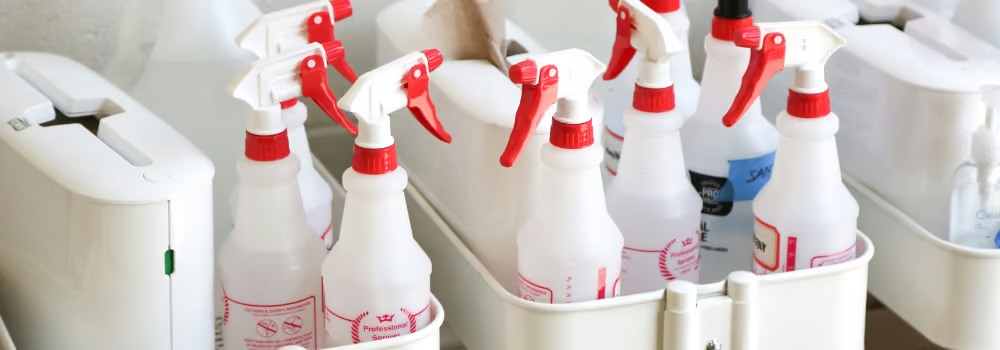












































%20-%20thumbnail.avif)




%20-%20thumbnail.avif)

%20-%20thumbnail.avif)

.avif)




%20-%20thumbnail.avif)







%20-%20new.avif)