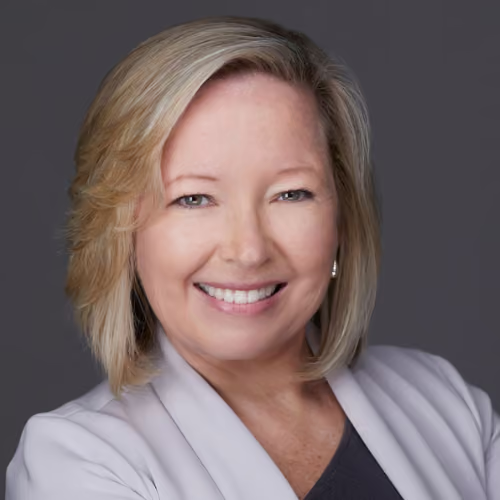
Host: Frustrated by the poor performance of his email outreach, today's guest finally decided to just pick up the phone and to his surprise, it worked. Andrew Kurzrock bought a ductwork fabricator a little over an hour from his home in Northern Virginia. After awkwardly calling the receptionist back a few times when she didn't put him through correctly, he was finally able to leave a message on the voicemail of the owner and he got a call back. Thanks to the owner's wife, we learn in addition to the story of how he acquired this 22 employee ductwork business, Andrew and I discuss how he structured the deal. Ductwork demand is tied to construction, which as you know, is notoriously cyclical. So Andrew was careful to give himself room to weather those inevitable periods of soft demand. You'll hear us talk about over equitization, using less SBA debt and more of his own cash to buy the business. This is an important consideration as you structure your deal. More equity means a lower rate of return, yes, but it also means less risk. So if you're not optimizing for irr, Andrew is not. But instead for cash flow or a long term hold, or just becoming an owner without living on the razor's edge, consider bringing more equity to your acquisition if you can. It's easy to be wowed by how little of their own capital a business buyer put into a deal. Guilty. But it is not always the best approach to put in as little equity as possible. Listen for this segment in today's conversation with Andrew and here he is, Andrew Kurzrock, owner of Hopewell Sheet Metal Manufacturing. Welcome to Acquiring Minds, a podcast about buying businesses. Mind My name is Will Smith. Acquiring an existing business is an awesome opportunity for many entrepreneurs and on this podcast I talk to the people who do it. If you ask owners in the ETA and search community which insurance broker provides highest quality work, great outcomes and has a practice dedicated to searchers and acquisition entrepreneurs, one name comes up again and again. Oberle. Oberle Risk Strategies has worked with hundreds of searchers over nearly a decade and is in fact led by a two time successful searcher, August Felker, which makes Oberle a specialty insurance brokerage for searchers by a former searcher. And if you've got a business under loi, Oberle will provide complimentary due diligence on that business's insurance and benefits program. An easy no risk way to get to know August and the team at Oberle. To take advantage. Check out oberly-risk.com that's o b e r l e-risk.com link in the notes. Andrew Kurzrock, welcome to Acquiring Minds.
[3:27] Guest: Thank you, Will. It's an honor to be here.
Host: Here we are on January 2, making you the first interview of 2026, Andrew. You bought a ductwork fabricator in my neck of the woods, actually, the D.C. area. We are neighbors and there was a lot of thought in your selection of this path, obviously the business itself, but ETA broadly. Let's dig into that. Give us a little of your background to start, please, Andrew.
Guest: Yeah, sure. So, well, I'm a Boston boy originally, grew up outside the city, grew up with a big love of science and that, that plays a real important role in who I turned out to be both personally and professionally. You know, but for me, it was never about go, you know, winning a Nobel Prize or being on the cutting edge. I loved, I loved what you could do with it, right? So like I grew up working on a race car and ended up thinking that I could be the guy who went to, you know, be the, like the leader in nascar, right? Who would be the new engineer, applied to college to be a mechanical engineer because I was going to take it to race cars. Turns out I got into my physics classes in college and it was very clear quickly that being a mechanical engineer was not going to be for me. But, you know, it was sort of early mid 2000s. Iraq war was going on, if you remember. A lot of the things about that war were it was all about were they pursuing a nuclear weapon? And all these questions came about of, you know, it's physics, it's science, it's engineering, but it's also so what, it's about people. And so I switched paths, ended up in politics and international treaties, but always based in that science. Graduated college, became a research scientist at one of the Department of Energy's national labs. These were the folks that go all the way back to the Manhattan Project. Really, really, you know, phenomenal institutions in the United States. And I had, I mean, I think the best job in the lab, right? I had these PhDs on speed dial. Like, thank God. Well, I did not have to go get my PhD in physics, but I didn't call one, right? And then, you know, my job was the, okay, so what, what does this mean for those UN inspectors who are going to be looking at a nuclear facility, things like that. And it was a great place to start a career. The nice thing about the national labs is they're very, very risk averse. They've got really strong risk management. And this is one where sort of, if you're going to go off later in life and do eta. You got to know the rules to know when you can break the rules. And it was a good education for me in risk management. Spent about six years with labs, got to touch just about every national security issue under the sun, you know, and sort of looked in the mirror at a certain point and said, hey, I see what this career path looks like. Is this what I want to be doing for the rest of my career? Yeah, the bureaucracy was grinding me down. And I don't mean that in a political way. I mean it's just, that's the nature of, of a government job is it's inherently about consensus seeking, about policymaking and it moves slowly. And you know, sometimes that's a good thing. Right? You don't want sort of half cocked decisions about nuclear materials, but if you got a really great idea, you can't go and implement that too quickly. So I left, I went to business school, went to the Yale School of Management and talk about being in the right place at the right time.
[6:53] Host: And before we hear about that, Andrew, why business school?
Guest: Ah, honestly, it was optionality was. So I actually originally applied, I was going to do a joint degree in public policy and in business because I was like, I don't just want to be a policy guy, I want to make organizations better. And I think this is when I was, I was feeling sort of some of that peak frustration with some of the management of a large organization. And I actually, you know, in hindsight, I don't think the labs were necessarily any better or Benny any worse from a bureaucratic perspective than any other large organization. I think it was just a law of large, large organizations, not a law of government, but it was a big, slow moving organization. And so I was like, well, if I'm gonna spend my career in this one or similar ones, I better know how to run them. And so that was, where do you go to run organizations? You better Business school. And so that's, that's, you know, that was my, you know, so, so why Yale? Why now? That's, that was the degree that I needed and when I needed it.
Host: That's interesting because I do feel like that's the traditional reason for the business school, for the mba, which is grooming managers of large organizations. I think it's got a broader appeal today getting an mba. I mean, entrepreneurship is of course a big draw for business minded people, but traditionally it was about grooming America's next generation of managers. And that is how you saw it
Guest: as well that's right. That's right. And Yale makes a point of being the business school that's not a business school. Right. They call it a school of management, not a school of business. And it actually, it started out that it wasn't a business school, that it was the Yale School of Organization and Management. And, you know, it's really about whether you're in the public sector or the private sector. You know, this is the degree to help you manage and lead. And so for somebody coming out of the government, wasn't sure whether he wanted to go to the private sector, wasn't sure whether he wanted to stay in government, I mean, it was just. It was the right place for me. You know, if you sort of rewind back and asked me, then where are you going to be? I think it was totally credible that I went back into government.
[9:01] Host: Okay, well, the plot thickens about how you go to business school program to learn how to manage large organizations, and here you sit in the back office of a very small organization. So let's carry on.
Guest: Yeah, I learned an immense amount in business school. I mean, effectively having never been in the private sector before. I mean, I learned accounting, I learned corporate finance. I learned all the good things you needed just to operate a business. But two really important things happened. I got to spend some time at an organization that is a complete 180 from what I had grown up with in government, a big Fortune 500 called Amphenol. Amphenol is an electronics manufacturer. They are highly decentralized. They are an operations machine. They happen to be based in Central Connecticut, about 20 minutes from Yale. And they were looking for an acquisitions intern the summer that I was looking for an internship. And it was just right place, right time, and had a phenomenal summer with them learning how to do acquisitions. I mean, I got to see, you know, we call. Told it the internship was, you know, womb to tomb. And for those folks who are in M and A. Right. It's the tombstone is what you get at the end of the deal. So it's from first germination of an idea through the diligence, you know, all the way into acquisition. And the fun thing is there's no integration. A key thing for Amphenol is when they acquire a business, the whole company comes and the whole team comes. There's no let's squish this into another division. It's. It's very decentralized in that way. So, okay, so I saw what something very different from the government looked like. I mean, even though it was a big company. It's really this confederation of mid sized businesses. And then, you know, so, okay, we're thinking there is other types of organizations out there in the world and this was pretty darn cool. I like running organizations. I talked to a lot of general managers of amphenol companies about what it meant to run a company all day long. You know, is that actually a job you want or not? And then the other big thing that happened was A.J. wasserstein started teaching at Yale. And Professor Wasserstein is a very successful searcher. I think, you know, to a certain extent invented the category, you might say among, you know, along with a number of others is also a search investor. And you know, it was early in his academic career, but is now an absolutely prolific writer and you know, winner of Yale's teaching award is. He's an amazing teacher. You know, it's pretty common in business school. There are some classes that get really popular and you know, you have to. There's a system of bidding in most business schools of how you get in sort of like an auction. I was really lucky like because he had just started, you could still get into his classes. My understanding now is they're basically chock a block, you can't get into them. But day one, I had never heard the word search fund. I mean I came from the US Energy Department, right? Like, I mean it just never comes across your, your, your world. And day one, AJ walks through a really simple LBL model for a classic traditional search and what an outcome could look like. You know, and he put all the caveats around it, right? Nothing is guaranteed. There are downsides, there are upsides, but you know, sort of this is a cocktail napkin version of what a traditional search looks like. That was very cool. That was like nothing else I had ever seen before. And so you sort of fast forward through the second year of business school and I've got a choice.
[12:36] Host: What did you like about it, Andrew? The financial possibilities or the running an organization or what?
Guest: It was the combination, right? It was the be a CEO on day one with a high risk but, you know, high reward path to a great financial outcome. You know, I think one of the things that AJ really impressed on you, on me was would you rather be, let's say, you know, you're 30 years old when you start out. Would you rather be 35 and have failed but you tried well, you know, five years into a search or would you rather be the SVP pushed out of your corporate career at 55? Which one's riskier and you know, certainly a professional hazard in corporate America is getting, you know, pretty far up the totem pole and getting. Yes, ahead has to roll for whatever reason. And you know, being able to look back and say that you control your own destiny, that was, that was really appealing to me. Just, you know, having seen it, it was like, yeah, that, that seems very credible. Is, you know, the company man thing doesn't, doesn't necessarily work anymore. Well, that.
Host: I feel like you had an insight there or AJ had an insight that is counterintuitive to most people where being the captain of your own ship, owning a business is actually feels less risky than the corporate path. I think most people consider the corporate path the less risky option. But as we. A theme that comes up here time and again is if you consider yourself a business of one and your employer is your customer, you have 100% customer concentration. A single decision can collapse your revenue to zero and then you're without a business. Yes. And, and in fact, also counterintuitively, this will, this came up on an interview just before this one that people may have heard with Jerem, who went on a search in his late 40s. Actually, the higher you go, the more risky it becomes. Because if you are the head to roll at age 55, it is very hard to find another position, a like position. Whereas if you get laid off, fired at 30, there's a much broader supply of jobs that you could slot into. So the risk, actually, even though you're making more money, you're more accomplished, you're more established in your career, as you go, the risk, risk actually becomes that much more acute into your. The, the, you know, the, the narrower the pyramid becomes and the higher you go in it anyway.
Guest: Yeah, I think we, we'll. Maybe the last element there is, you know, is it, is it cool at age 55 to have on LinkedIn that you're the, you know, LA fancy pants of whatever? Okay, maybe. But we had a bunch of speakers, as is very common in, you know, business schools, you know, folks who were CEOs of all different industries. And what, what I kept coming back to over the course of my time in business school was that nobody really talked about the work, so to speak, whether they were in consulting, industrial, cpg, like it didn't matter. They all talked about the people they worked with and, you know, when they talked about what did that work mean to them, it was never about the title, it was never about the hierarchy, it was about the relationships. And suddenly it becomes, ah, if that's actually not going to be so fulfilling to, you know, future me that, you know, you climbed, you climbed to the top of the mountain. You did it, um, it's actually going to be the people you did it with. Well then that, that starts to say, well, gosh, if you could hit the financial outcomes that take care of your kids, take care of, you know, everything gives you that financial security and you've got some modicum of control and it turns out at the end of the day, what really matters is who you worked with anyways. You know, suddenly some of those trade offs that might seem to be naturally in favor of corporate America or working in private equity, you know, very, very, you know, rigorous high hours roles, suddenly those trade offs don't necessarily look so good anymore. And so that was in the back of my mind too.
[16:27] Host: Okay, so, so this class, getting in AJ's class was eye opening, more than eye opening to you and it really influences your future trajectory. Please take us further down it.
Guest: Yeah, so, so I had a choice to make finishing up business school. Do I do the traditional search or do I go back to Amphenol, a great manufacturing company where they hire MBAs to be their next generation of general managers. So basically they run you over the course of three or four years through various positions in the company. You succeed at that, they'll put you into a role running one of their businesses. Little bit of soul searching and ultimately looked in the mirror and said, I had no business running a business when I had never worked in one before. I mean, I had never worked in the private sector a day in my life. I was going to come in and lead, lead a team. Right. You know, how we should price things, how we ought to handle HR issues, how we ought to do. I mean, just it in my own head, you know, right or wrong, it just strained credibility.
Host: And, and were you right now that you're, you're what, four months into your acquisition, were you right at the, your instincts at the time that you weren't yet ready?
Guest: So I certainly wouldn't have been ready to buy Hopewell. Being in the position to buy this company is totally driven by everything I learned in my path. Is there a business I could have bought and been successful with? Maybe. It would have been a pretty bloody path. And so I, you know, I'm, I'm much happier having gotten the corporate education. And then, I mean, there's nothing that scares me in this business at this point because of the experience that I've had. Now look, there may be days that are scary, but I'VE I've been fortunate that I've seen a bunch of things leading other businesses before and so good times, bad times, you know, the HR problems, the people problems, the financial problems. That world has been stretched enough for me that the things that I'm running into here just aren't. It's, it's not worse than some of the things that I had to go through before. And so that, that gives me quite a bit of confidence stepping into this business.
[18:37] Host: Even though you have the personal guarantee, even though it's all on your shoulders, even though you don't have the corporate backstop that you did when you were experiencing all that stuff for the first few times.
Guest: Yeah, yeah. And, and you know that gets to the risk management. Right. So part of stepping into this role is I leaned very heavily on that risk management history that I'd picked up from the government of how do I get comfortable with those risks, how do I get comfortable with the personal guarantee? And so it's not riskless by any means, but I feel very comfortable with the risks that I've taken.
Host: Looking to secure an SBA loan to buy a business Meet Pioneer Capital Advisory your go to partner for sophisticated buyers who want deals closed quickly and on the best possible terms. The Pioneer team has closed more than 100 SBA loans averaging timelines well below industry standards. Founder and owner Matthias Smith and COO Valerie Stash bring over two decades of SBA lending experience. Matthias and Valerie have built a team that meticulously works your deal from underwriting to close. You'll have a full bench working on your behalf. Sales associates who streamline onboarding M and a financial analysts who craft investor grade lender decks and an operations team that manages every step of the closing process. Who with institutional level rigor Pioneer is not a single person but your true deal team. Visit pioneer cap.com or click the link in the notes. Let's get into the acquisition. So take us quickly through those years at Amphenol and how you then decided to it was that. That it was time to search. Yeah.
Guest: So basically you know as as advertised went through a series of sales and business development roles. Did well in those did acquisitions for a year for the sensors element of the business and then stepped into two different general manager roles. First one was a position sensor business. Second one was a temperature sensor business. These these ended up being large businesses. You know one was about 600 employees in two locations. One was about 1800 employees in 10 sites around the world. And you know I was the job was to be out There with the customers, with the employees, you know, with, with the vendors as need be. But, but out there, you know, leading the teams and helping guide the teams. It is a travel heavy job to be a general manager of a business like this. In 2024, I traveled 200 days a year, you know, and it worked. You know, my, you know, my wife and I, you know, we both traveled a bunch for work. So, you know, this was life. Life was going sort of, you know, as, as about. But then we had a little baby boy and that and.
[21:36] Host: Perfect, perfect.
Guest: Pause.
Host: Just. Andrew, to be clear, you were the GM.
Guest: Yeah.
Host: Of an 1800 person business. You were in charge of the P and L for that business. Yeah.
Guest: Oh, wow.
Host: And then second and also for a 600 person business.
Guest: Yeah, they were both. I mean they're, they're super businesses. Super businesses. And you know, yes, I, I led them. And you know, you weren't, you weren't doing it by yourself. I mean, by, at the time you're leading an 1800 person business, there were three local general managers that I was overseeing in India, China, South Korea. We had plant managers in the uk, in Mexico and Pennsylvania. But, you know, they were, they were large businesses and you were playing with, you know, some of the largest companies in the world in the medical space, in the automotive space. And so, you know, I, yeah, I got the chance to see the China ev. Trade wars up close and personal. Mean, like, you know, if you, you can read the Wall Street Journal and see what's going on, you know, in there over the past two years. And like we had a, you know, we were playing in that. And that was, you know, gave you a real sense of what good competition looks like, what really aggressive competition looks like. As, you know, you look at, you know, duck today and I'm like, okay, I can do this, I can do this. If I, if I've been through that one, I can do this one.
Host: Yeah. Yes. That's. It's quite a bit of experience. Okay. You have a baby boy, you and
Guest: your wife, a little baby boy. And my wife and I sort of look at each other and say, this isn't going to work. It's not going to work in the way we want it to work in that, you know, it was important to us to both be around, to be local, to be, you know, raising little boy together and 200 days a year on the road 12 time zones away, just like it's not going to cut it. Okay, so then you say, well, this isn't going to work. What Are you going to want to do? Well, I really enjoy running businesses so, you know, taking, let's call it, you know, daddy track and moving to a regional sales role, like that's not going to fly. Well, maybe it shouldn't be so global. What if you switched over to a private equity backed company? Still very rigorous, very growth oriented. Okay. You're still going to be doing this, you know, 60, 70, 80 hours a week. Like does that take you where you want to be and you've got still, you know, AJ's class in the back of your mind. And to me it was just this no brainer, like there was no other choice. Right. Like I am going to buy a business because it allows me to have a more local life and still lead a team, work on something really interesting and grow it and check all those boxes sort of personally and professionally that I wanted to do, but do it here in the greater Washington D.C. area, which we had decided at this point was, was home for us. So we were happy to put down roots here. I say the other big element Will is part of the compensation package at Amphenol was stock options and the stock had done well. And so originally where I was looking at a traditional search, you know, this was not retire early in your 30s money, but it was certainly, it was enough and you know, really lucky that this could serve as the equity inject for a business that was me, plus an SBA backed loan and that would, that would do sort of a reasonable size deal of what I was looking for. So it was this combination of, you know, what do I want to do and do you have the capacity to do it? That started to converge at this, this same point.
[24:57] Host: And so because you had this nest egg from your infinite stock, that's why you chose self funded search over traditional. Is that what I'm, what I understood?
Guest: No, I think it, it's what enabled me to do it. Right. So it was pretty clear that what I was looking for next was control and that I was looking to not have a boss, not be part of a larger corporate and that, you know, to go, yeah. And I just started to get, you know, familiar with what's now, you know, termed as an independent sponsor. But okay, that's great. But let's be clear, the, you know, the owners of the business, the majority owners of the business are the people who are putting up the capital. So, you know, if that was the path that I was going to choose, I should have just flipped over to private equity. Right. You know, that, that why spend the years and the risk doing an independent sponsor route, just go work for a PE company, go reach out some recruiters see, you know, you work that path. I never got far down that road to figure out financially would the outcomes have been the same. But I suspect they would have been, let's call it just broadly similar, you know, assuming sort of equal success on the back end. And so it became very clear that, well, you don't actually really want to take on outside equity for the type of project that you're looking at. Do you have the, then do you have the personal capacity to look for a business that's of the right SDE size that can support the growth you're looking for? You know, this sort of plays into the whole conversation of do you want to go small, do you want to go big, do you want to go somewhere in the middle? And you know, the answer is, the answer is somewhere in between. It depends on the facts. But that all together of where do you want to go and can you actually get there is what drove me to say that this is going to be a self funded self finance search.
Host: You had said in our pre call that you also thought that certain corporate paths like the amphenol path, if you'd stayed on it would actually have been more financially rewarding. Yeah, over time. So, so it wasn't. It's. I mean we've just heard you say that ownership and freedom was a big part of your motivation here. It's not strictly a financial calculation. But do do that financial calculation for us. How, how do you see corporate being more remunerative over time than buying a self funded, than doing a self funded search in a business that, you know, it could be throwing off a million, over $1 million a year free cash flow after you pay it down your SBA loan over time.
[27:26] Guest: Yeah, yeah. And look that. So I would call that, I would class that in best case outcomes where you've gotten to that point from at least from an SBA deal, you know the size that I was looking at where you're now growing this, you've paid down the debt. So even, let's say you've grown it, you are not going to be personally enjoying that million dollar a year cash flow for five, six, seven years down the line unless you've got some crazy growth that's allowed you to, to achieve that. Um, yeah, so okay, so that, that's a, that's a great outcome. There is also the, you know, sort of float along or the business does poorly outcome or the you don't Close outcome. So, so, so sort of take this on a probability weighted basis. The search path is great outcome times the low probability of great outcome. The corporate path. Yeah. At least the company I was at has a, you know, a strong track record. A company I very much believe in. It's a super firm, believe in the future of it. And so, you know, you've got this base comp. You believe that, you know, the, the business can do well. Maybe you get a bonus every year. Plus if you believe in those stock options, they can be, you know, great. You know, for me, look, promptly as soon as I left, you know, when you leave, you got to sell your options. But within like 60 days after I sold mine, the stock went on 100% tear. I mean, so it's like very clear at least where we're sitting now. I mean I am significantly behind by taking the search path, but versus the, you know, the corporate path. I will say though, you know, well, like I didn't travel a single day in 2025. I was just looking at, you know, you get your sort of year end wraps. I didn't spend a single night for work away. So, you know, how much is that worth? I mean that's sort of where you get back to what are you looking for in life. But that was clearly the train, the
Host: probability, you know, it wouldn't have been prudent for you to weight very heavily the probability that the stock was going to double in a year.
Guest: That was, that was a pretty aggressive run up. And I, I think it, I think it's not unreasonable to think that given where the company is positioned and the type of markets it's in, that future growth will look like the past. I just, I don't think that's crazy. You know, it's been a compounder for many, many decades now with a supermarket position. So sort of I, even though I, you know, sold my options, I'm, you know, proudly a shareholder, you know, myself sort of personally and you know, excited to see the company grow, you know, onward.
[30:01] Host: This is great background. Andrew, tell us about the parameters of your search once you decided to go down the SBA self funded path.
Guest: Yeah, so, you know, very much a believer in the, you know, Walker Diebull buy then build, you know, the framework of have a very clear, you know, problem statement of what you're buying. So I was buying a product business with, let's call it a, you know, mid six figure SDE in the greater Washington D.C. area. You know, if somebody told me that there was a fabulous opportunity In Denver wasn't interested. It was basically there's this phenomenal little app I found, Drive, you know, for, for that tells you drive times. So I live in Washington. I live on the west side of the city. Turns out it takes you the same amount of time to go 70 miles west as it does to go 20 miles east because of traffic. That's Washington. Right. You know, and, and so the, the search was actually not a geographic search. It was like a time weighted geography search just because sure, we, we have a house, right. We know where we live. And so is basically an hour and a half driving was what we were looking for.
Host: An hour and a half driving radius. Because that's pretty, that's, that's a big radius.
Guest: It is, it is. And so, you know, so when you realize, when you start to say, all right, I'm, I'm looking for, you know, the classic search, right. Is you've got to look nationwide because to find a great business you have to have a very full aperture. Well, so first I'm going to say I'm looking for a technical business. You know, one of my skills is I'm really good at technical sales. Right. So I do a terrible job running a UPS store franchise because. Not because it's not a good business, but because it doesn't let me differentiate on the stuff I'm really good at. Yeah. Versus where it's.
Host: Yeah.
Guest: You know, I would love to tell you about why the temperature sensors we made were the best ones. Right. That's, that was my prior career. So it had to be a technical business. It had to fit within this geographic box. You better start loosening up and saying it's got to be within 20 minutes of my house. Like that's not going to fly. The other element just realistically is in Fairfax County, Virginia is a services county. There is very little manufacturing very close to the Washington D.C. area. I was open to technical service businesses, but I love playing with real hardware. And so you just have to recognize that that's not going to happen in Fairfax County. That's not going to happen in Arlington County. You're going to have to move a little bit further out from the urban core to see that.
Host: You know, it's interesting, Andrew, because you do seem like a great fit for the kind of services business that services the government. And there are countless here kind of consultancies, services businesses and in technical ones, ones that are in cybersecurity, msps, all manner of white collar consulting style services businesses, but that are delivering a technical outcome or at least consulting on a technical outcome. And you with your, with your background and your interest in government in policy seem like a great candidate for that. Those don't have the tangible product that it sounds like maybe was, was something you needed but react to that profile of business and why you didn't go after that.
[33:28] Guest: Yeah, so I'm actually, I'm getting a little bit of a physical reaction here. So it was. No, because it was, I mean it was something that I looked at and it was part of the thesis was, you know, do I want to go look at one? And I looked at this business that was a contractor to Department of Defense. It had, I had previously had all the right security accesses I would need. I mean it was like back in my old world. Exactly. And when I say I'm feeling it, you know, viscerally that I actually, I had this pit in my stomach as I'm reading the sim, like what's going on here? So then you start to ask yourself like why am I really reacting to just reading about a business? And you know, it became clear to me as I sort of unpacked it that I didn't want to go back into that world. That ultimately a government contractor is led by its client. And so, you know, everything that I was looking to step away from, from the, you know, the large organization that is the US government I would be going back into now. Sure. Might you have the great financial outcome? Yeah, maybe. But it, it wasn't how I wanted to get up and spend my day. Was waiting for a contracting officer to approve a contract MOD or next year scope. And you know, similarly the, the national labs would have been a great place if I wanted to continue to do government work and government implementation. I should have stayed at the labs. Maybe it wouldn't have the financial outcome but I mean they're still, yeah like they're great places to work. So I actually put. One of the things I did that I would recommend to folks is start making a no list. And it just, it makes it so much easier. You know, you got your buy box but after like the third metal finisher I looked at and I realized that I didn't want to pay the high. You know, I wasn't comfortable with the high capex required in metal finishing. I just put it on my, like I actually wrote it down, the no list. And so government contractors were on the no list, metal finishing was on the no list, machine shops were on the no list. And it just, it became really important to me to just say that structurally These are not businesses for me.
Host: It's great Andrew, because as thoughtful and analytical as you are, that decision to not go back into government was very much just an emotional one. You just, it just didn't resonate with you. And, and that is that, you know, what might be called the X factor is probably, should be everybody's sort of criteria. Number one. What, what, what excites you to get out of bed in the morning, don't do some. Don't buy a business or enter a category that you feel like you should because your resume sings to it. But, but because you really want to and it turns you on and, and so good that you listen to that. And this wasn't all just an intellectual exercise for you.
[36:13] Guest: Yeah, yeah, I know. It actually it surprised me that it, it hit so viscerally I was like okay, yeah, that's a sign. Listen to that sign.
Host: Yeah, yeah. Great. Machine shops are metal finishing. So those seem actually kind of similar to the business you bought. So why were they nose?
Guest: Yeah, so metal finishing can be a great business. It is, it's a. There's two elements of it that I didn't like. One is different surface treatments come more in and out of vogue. And so now you've got a little bit of innovation risk that you've got to worry about. The other element is there are high capital costs around plating equipment and maybe the third tied to that, one of the elements, you know, environmental remediation is really big in that space. You're dealing with, you know, some nasty chemicals. And so you know, whether that drives newer better materials or that means you have to buy new equipment for a self funded searcher, you know, plunking down mid six figures on a new piece of equipment or going out of business or having to pick up and move to a different state because your state has banned a particular process. Like those are nasty places to end up when you've got an SBA loan. So we talk about some of the risk management. Right. Like that, that fell. Even though that could be, you know, you've got long term customers, you've got design in. Like there are other folks who have other capital structures who might see metal finishing as an awesome opportunity. The way I wanted to do the search, it just didn't fit with how I wanted to do it or you know, what I, what I was comfortable doing.
Host: Yep. And just to underline then essentially it was they're kind of heavy capex businesses and there is technology risk because the, the types of finishing, the plating or whatever as you put it can, can change rather more rapidly than we're comfortable with. And you mentioned the remediation so the
Guest: environmental this is where you know like if you were, you know this isn't metal finishing but you know PFAS is now being pushed out of the supply chain. Right. So if you had a PFAS reliant process you need to re engineer that. And so this is the sort of stuff that when it comes to an environmental perspective and by the way that's for good reason. So I'm not saying that the environmentalism is bad but you know, if you've got a 10 year note that you better pay every month, you know, are you really going to bet what the future of you know, material sustainability looks like in 10 years? That's a, that's a big bet.
Host: Right. And then machine shops.
Guest: Oh machine shops. A little bit high capex. I also struggle to see how you could differentiate there aren't it's similar to metal work and fabrication. There are some differences in the type of fabrication business I'm in but very often in those, you know, if it's quick turn you're building to a spec, you know it's tough to see how I use my technical sales to differentiate match that that business,
[39:04] Host: you know. Enzo Technologies as one of the leading IT managed service providers serving the search community led by Nick Akers, an acquiring minds guest who bought the 35 year old business. The team at Enzo regularly works with searchers and their acquisitions and one feature
Guest: of acquired businesses that Enzo is seeing
Host: over and over is the need to implement cybersecurity promptly during the transition. So many acquired small businesses either have glaring vulnerabilities, lack security best practices or both. That step one to de risk the deal you just closed should be addressing these issues. INSO is your full service IT MSP for post close stability.
Guest: They assess your target surface the biggest
Host: risks in plain English and and give you a day one through 30 plan to cut exposure, prevent downtime and even find cost takeouts like bloated telecom bills. Check out enzotechnologies.com in Z O or email Nick directly at nicknzotechnologies.com
Guest: so my full time job was searching for a business to buy. I did both an inbound search and an outbound search. First thing I did was I called every broker who was a member of the Carolina Virginia Business Brokers association, you know and introduced myself. These were not long calls but either found out where they posted their deals or got on their mailing list. So you know, within you Know, a week, two weeks, you're starting to see some of that inbound deal flow come in. Also spent like two $300 on a couple of databases and started just culling through databases of manufacturing technical businesses within an hour and a half of my house. My original outbound plan was send emails. This was not a mass, you know, bulk email campaign. There were no interns because the style was I was looking for a really niche business. I thought the right way to do that was for me to position myself as basically business owner to business owner. And you know, given my background, we're very similar. And so it's a, it's a transition not to a searcher who doesn't know your business, but somebody who is basically, call it an insider who's been in manufacturing, who's just looking for the next business for them to run. And so it was a very, this
Host: business owner to business owner. Sorry, how did you position yourself as business owner? Somebody who had run a manufacturing business, you mean?
Guest: Yeah, and so, so the, the read that I had was, you know, search is very popular. There are lots of folks who are reaching out to business owners. And how are you going to stand out in that, that, you know, sea of folks who are reaching out? And so the position was don't be a searcher at all. You know, even though, at least, you know, for the audience of this podcast, right, it's very clear what I was doing was a search fund. You know, instead it was basically I'm, I'm a, I'm a, you know, I had a little LLC for the search, but I'm a business owner just like you. The only difference is my business doesn't have any operations yet. And so I got to go acquire my first operations. But, you know, I ran manufacturing before, I'm going to run them again. We're sort of just in this, you know, inter regimen right now until I buy the business and love it. And that was, that was so, you know, the business was not called search partners. It wasn't called Andrew Capital. Right. Like, I wasn't emphasizing that I was bringing money because that was sort of the least important part. Right? It was, I am going to step into this business and run it. And so what you should know is that I'm an, you know, I'm an operator, an industrial operator, just like you.
[42:52] Host: And so, okay, so the pitch was, I'm an industrial operator just like you. Here's what I have done. It is a, I am going to operate, be operating and owning a business, you know, this time next year. Just the question is which one?
Guest: That's right.
Host: So it's just, it was just kind of this flavor of foregone conclusion that I may not own a business right now, but it's going to happen. And so is it going to happen with you, Mr. Owner?
Guest: Yeah.
Host: Interesting.
Guest: Very. I love it. Okay.
Host: The vibes there, I guess is what was different.
Guest: Yeah. And it, for, you know, if you've, if you've. And this is one where, you know, you've got to be authentic to who you are.
Host: Right.
Guest: I mean I, there was a reason that I just, I wasn't talking to folks who didn't run technical businesses because my ability to walk into a digital marketing firm and say that I'm, you know, I'm a marketer. I just haven't bought my marketing business yet. Like that's not credible. I mean I've never done that.
Host: Yeah.
Guest: But, but for my slice of businesses, folks felt very quickly and I got some feedback from, from owners, you know, folks who maybe we didn't close the deal but you know, built a great relationship that they knew they were talking to somebody who was like them on the phone that came through. So that for me was good feedback that it was working. I tried. So you talk about digital marketing. First thing I did was I reached out over email. Turns out I didn't know about the concept of email deliverability. Like I didn't know that was a thing that just, you know, some people get sent to spam boxes because I'd never done that before. So my, my email outreach just absolutely sucked. I'm pretty confident that less than 10% actually made it to the people who I was intending to send it to.
Host: But even though, Andrew, you weren't doing bulk because usually deliverability is a problem when you're doing bulk outbound. But it sounds like you were actually sending a small quantity of, and manually sending individual emails.
Guest: Yep, Yep. Bespoke loved handcrafted emails, you know, but still. Yeah, didn't get through. I think I got too cute. I didn't use a dot com email address. My, my, the, the LLC that I created is called Triple Product Enterprises. So I had the brilliant idea of doing, you know, Andrew at Triple Product Dot Enterprises. I think that in hindsight was a really dumb choice that, you know, email systems don't know what to do with a unique top level domain, which is what that Dot Enterprises is, is a, an unusual tld.
[45:18] Host: Yeah. Yeah. Interesting. Okay. Don't, don't know myself but I hear
Guest: the logic and I'M still, I am by no means an email marketing guru. I'm sure there are some folks who are just rolling their eyes at, you know, my, my lack of even basic knowledge. But basically what it did is it forced me to say, well, this isn't working. What are you going to do next? Y. So I started writing, you know, the, the beautiful, you know, letter hand signed and then put it in a priority mail envelope. Because everybody opens a priority mail envelope. Right. And that was a reasonable customer acquisition cost for me. If it closed a deal. I think I went like 0 for 15 on those. Just completely.
Host: Yeah.
Guest: 0, 0 feedback. And so.
Host: And Andrew, in the messaging of both the emails and the physical mail. Yeah. Were you talking about how that you were local?
Guest: Yeah.
Host: I'm surprised because it feels very much like you would have success. You would have had success. I mean it was a very, these were very, as you said, bespoke res, I would have thought resonant emails. So anyway. Or in messages, the physical as well.
Guest: So yeah, you know, and this is where it's, you know, it didn't, it didn't work for me. But what did work for me was finally, and I know one of the things about myself is I don't love cold calling. Right. It's something I've learned how to do, but it's not my favorite activity. I would be terrible as a sales development rep who just had to call, you know, cold call day. But finally, in a just fit of peak, I was so frustrated that like I had, you know, done my whole follow up sequence. I was like, you know what, screw this, I'm just going to call them. And so I picked up the phone and you know, said, hey, crazy question, you know, I'm local, went through the whole bit and said, are you, you know, interested in having a conversation? And yes, like, and I went, and I was like, oh, that was, that was crazy. I booked a meeting out of that. So I did it like four more times. And I mean I had well like a 50 hit rate picking up the phone and calling people, which I think for cold calls is, you know, a wildly hot high ratio. And so wildly.
Host: Especially with business owners.
Guest: Yes.
Host: Of any kind. I mean busy people. So you would get their email addresses somehow scrape them, find, excuse me, their phone numbers and they would be direct cell phone numbers. You get a small business owner on the phone and cold and say, hey, I am local and potentially interested in buying your business. Have you ever thought about selling, let's meet. And 50% of those became meetings.
Guest: Yeah, yeah. Basically, if it wasn't a cell phone number, you just call the front desk and if you know their name. Hey, you know, I'm, I'm Andrew, I'm calling from Triple Product Enterprises, interested in talking about partnership. You know, can you put me through to so and so you got to be careful because you know, folks who work at front desks are pretty much trained to screen this stuff.
[48:08] Host: Right.
Guest: But at the same time, you know, telling the person at the front desk, hey, I'm calling the owner to go buy a business. Right. Like you want to protect their confidentiality as well. That's not the right, you know, foot to start out on. And so, so, you know, it was so partner.
Host: It was the key, the key phrase.
Guest: Yeah, yeah, at least that was the one for me. And so, you know, one of the businesses that I identified within like the first 60 days of my search was a company called Hopewell Sheet Metal Manufacturing. It was right at the edge of my geography. It's about an hour and 15 minutes away from my house and they manufacture custom ductwork. And they had a one page website that was really, really, you know, call it thin, but you look on Google, Google Maps and you see like 20 something cars in the parking lot. You see a pretty decently sized facility. And one of the things I learned at Amphenol is looks can be deceiving. One of the businesses I worked for was a very large, well renowned electronics business. And their website was horrendous. Like not befitting, you know, the industry leader that they were. And so that's fine, but let's look under the surface. And by the way, having a junkie website just means that, you know, your website is not how you acquire customers. And in a lot of technical businesses, the website is not how you acquire customers. It's, it's word of mouth, it's history, it's the catalog sitting on the engineer's desk. It just, the website doesn't matter. Anybody's going to call you. They just Google it and they use the phone number on Google like, you know, that's. Sure, yeah, they don't, they don't need a website. And so, well, all, all of that,
Host: plus oftentimes if the business is under marketed, we see that as a great lever that we, we know from, you know, the outset that we could probably pull. So we, we like these 1990s websites, these thin websites, these are green flags, not red ones. So carry on.
Guest: Absolutely, absolutely. And I mean it was pure, pure luck. I mean, I will also say it's like the harder I work, the luckier I get. But I mean this, this deal basically should not have happened. So first of all, I call the front desk. I'm looking for the president of the company. His name is Dave. I get routed through the phone tree like four times. I call the front desk back four separate times because it just keeps pinging through, it never actually gets to the voicemail. So finally I get and leave a voicemail. Don't hear back from him. I'm about to sort of hit my, my follow up and, and finally he calls me back. He and I hit it off. The timing is right. He's of retirement age, he's looking to transition. There was something about my message that just sort of spoke to him and you know, he'd be happy to chat. It turns out later he told me that he mentioned it to his wife and was like, I think it's some sales guy. I'm not gonna, I'm not going to call him back. And his wife said, yeah, you know what, give him a call, see what he's got to say. And you know, that, that turned out to be the deal that, that ultimately I closed on. You know, Hopewell is a phenomenal business. Founded in 1981. It celebrates its 45th anniversary, actually about the time this podcast will probably air. April, February 18th is going to be the 45th anniversary of the business.
[51:21] Host: How fun.
Guest: And we're going to celebrate it. It's pretty awesome. It's, it's a, you know, second, now third generation family owned business that has a very interesting market niche. You know, for a, for the residential market. The ducts in your home, they're typically, depending on where you live in the country, they're either flexible or they're duck board or they're pretty commodity pipe. But when you move into commercial, everything is custom and every architect specs the building out a little bit differently. And so this fit very much with my prior world in electronics where you had custom and configured devices here, even though it's just coils of steel and sheets of steel, everything is a little bit different. And you also had your straight pieces of duct get made in a highly automated way. But anytime you do a bend, and now, you know, if you go, go to a brewery or a coffee shop, if you look up, you'll see that, okay, you got a straight pipe, fine. But whenever you've got a bend or a transition or an end, that basically has to be done by hand, it's extremely custom hand work. And so you're not going to Find yourself that you've been out automated because just it's not efficient to automate that kind of work. And the other thing is, because this is steel that's hollow in the middle, it's extremely inefficient to ship. And so what you find is this is a very regional industry and so you don't have to worry about somebody having incredible scale in the heartland of the country or overseas and shipping it in because the diesel fuel costs more than the duct. So you're just. I am never going to compete with somebody in Atlanta, Georgia. Georgia is not going to compete with me. It's just non economic. And so for somebody who is looking for risk mitigation, knowing that I can sort of quantify who my competitive field looks like, that was a really strong green flag to me.
Host: Let me stop you there, Andrew. A couple follow up thoughts to that. I thought it was such an interesting point and it reminded me of that feature in another business that we've talked about on acquiring minds, Pallet manufacturing. So where it doesn't make sense to ship pallets on yet other pallets. So pallets remains, pallet manufacturing remains pretty fragmented, pretty local and unlikely to change. The other question though then becomes what does that mean for an inorganic growth strategy? If even that's what you're thinking. And I'll tee you up by a phrase that really, that really stuck with me after our pre call String of Pearls. I love this. So talk to us now about how you might expand in a fragmented market.
[54:08] Guest: Yeah, so. So Hopewell is a super company and if there's anything about the deal, we can come back to that. But let's just sort of talk about this, which is a super company and you know, my goal is to grow this business. At the same time it's very clear that at a certain point the geography from Hagerstown, Maryland won't make sense. You just, you won't ship into the Northeast, you won't ship into the Southeast, you won't ship into the Heartland. And so is there an opportunity, whether it's, it's probably more likely inorganic than organic to put together, you know, a series of America's best duck shops that. And I guess maybe I should have said you get a choice, right? You are either the lowest price, highest volume or you're the best quality. We are that best quality, best value position in our market. And I think there's something to that. It's, there are industry standards, there are choices you can make in how you manufacture the duct. And our customers rely on that. And so can you start to take that model and find like minded businesses elsewhere where you can sort of, you can start to say that basically to larger contractors or not even just in each of our markets we're going to be the best and we're not necessarily going to look for synergies and cross selling and all the things that, you know, big corporates love, but we're just going to be a good family of businesses. Frankly that's about six steps further on than where I am today. And I'm not sure that's even the right answer right now. It's make this the best business it can be. But certainly as you think about growth, you know one, one lever is, is inorganic. But I think that's, that's down the road. We gotta make the most of the opportunity we got in the mid Atlantic first.
Host: But recognizing that that is many steps ahead. If you did contemplate an inorganic kind of consolidation or roll up strategy, it actually seems like the profile of this industry is similar. Industry is similar to what you saw at Amphenol, which would be decentralized. So you would. Because, because this is sort of a local services business or a local fabrication business. It serves its local customers. You probably wouldn't if you bought 5 and 10 more of these up and down the east coast, you probably wouldn't try to try to homogenize them. You probably leave them as they are with, you know, whatever the improvements here and there, which is your skill set. That, that was, that's kind of the, the Amphenol playbook.
Guest: Yes. And you, you have to leave them. I mean people, I mean this is a manufacturing company that serves construction. So much of this business and the goodwill in the business is the relationships. I mean people in western Maryland have been saying go to Hopewell for 40 years. Right. If we now say you're going to come to Andrew Sheet Metal, I mean like, I mean that's a complete vaporization of goodwill, right. And you know, some of our customers we deliver to, others come and they pick up right from the shop. You know, it's part of folks daily routines who are in the commercial contracting world. And so we. You don't upset that apple cart, right? It's gotta be run in a decentralized way now. Sure there's things you want to improve. There's nothing wrong with having aggressive growth goals. But you got to know who your customer is and they, they don't want a new and improved integrated solution. That's, that's not a win. It's Keep delivering them a high quality product on time and get out of the way. Like that's the business.
[57:36] Host: Well, Andrew, that, that's a great point. Although what I am hearing is other what we might perceive as weaknesses in our world in this opportunity. First of all tied to construction. We just heard that you're essentially in the construction business. So I want you to address that. And then also despite the fact of our there kind of being natural moat in that competitors from outside geographies are unlikely to come into your geography, it I still suspect that within the geography the dmv, there are a lot of players or a handful of players like this. And it seems like a difficult business to differentiate. It seems like a commoditized business. Even though you talked about there being, you know, there being a lot of one off work at the joints or whatever, the connecting pieces of the tubes. So how did you see the, the differentiation of this business? And, and because you, that's clearly something you care about. You talked about in machine shops that that was a feature of that industry. You didn't like that. It seemed to be hard to differentiate within. So construction and differentiation, take those two.
Guest: Yes. Yeah. So construction basically came. So you either accept the risk with the cyclicality of construction or you don't. You either want to be in that industry or you don't. And you know, the classic search fund answer is contractually recurring revenue, low cyclicality. And so, you know, I've walked away from both of these. None of the business that we have is contractual. But that sort of ties back to. Well, okay, that is those, call it the, the rules with, you know, the HBR guide to buying a Small business are very often tied to a rookie CEO who, you know, you're doing this straight out of business school and you're doing it with other people's money. And you've got to be able to exit within the classic, you know, PE five to seven years. Okay. And those are pretty good rules if those are the required, the constraints that you're putting onto the deal. But for me it's different. Right. I don't have a five to seven year window where I must sell. So you gotta have, you know, a revenue that you can sell to somebody else. I'm not taking outside money. I'm not a rookie CEO. And so now it's, well, let's look at what the opportunity is. You know, construction is a highly relational industry. It will have downside. But if you can, you know, structure, I think both the purchase price and, you know, what you bring along for work, working capital that you believe that you can cover a downside scenario. You know, look, maybe not a extended 2008, but you can handle a, you know, a rough period. That's something I could get my head around. And it ultimately, you know, as I diligence the business out that came down to the risk is the risk. What do we know about the market? And basically the answer, you know, to all the construction forecasters for the D.C. area is eh, it'll be tepid, it'll be fine. It's not gangbusters like some parts of the country. But it's also not in a deep slump. Will that hold? Who knows? But basically the best intel I could get was that the market will stay flat. It also helped that Hopewell 41 years has been through downturns before. I mean it saw Covid, it saw 2008, it saw the late 80s and it survived. So really it's on me now to just not do worse than Hopewell has done historically and we'll survive the next downturn. It's like, okay, can you do that? Yeah, I can do that. So I guess that would be, that would be the construction element and maybe just the last element on construction is, you know, very commonly. Look, construction can be a rough industry. I think one of the things that was important is we're not actually a contractor. We are a manufacturing company. And so we provide a product rather and we don't do any of the install out on the job site. You know, we have customers who are, who are in the commercial construction industry. Ton of respect for that industry. We understand the working capital cycles tied to that industry. And at the end of the day this business played back to what I did, which is manufacturing not being out on a job site, which is not my background. So I would be a lot less comfortable buying a commercial mechanical contractor versus buying a manufacturer who serves mechanical contracting. So I guess that was one. Will you have to remind me the second one you wanted?
[1:01:58] Host: The differentiation.
Guest: Yeah. So differentiation. I think this is actually the biggest question mark in this acquisition. The question mark that I've got is whether this is going to be sort of again in sort of the walker die bowl. Is this a small, low growth but low risk, enduringly profitable business or is there a real opportunity to build a platform? And so this is where there's just where did I put my entrepreneurial risk on this one? I think we can grow it. I really do. I also recognize that the nice thing that people are loyal to Hopewell and you know, I Very much intend to continue to earn that loyalty. Also means that folks who don't use Hopewell today are probably pretty loyal to their ducked guy. So how are you going to get them to switch? And this was where betting on the background in technical sales and being able to be enthusiastic and learn the industry and have a team that's got an average of 17 years of experience. I mean, that's our average tenure at Hopewell. Okay. If you've got all that together, do you think you can grow it? If we do, it'll go great. Great.
[1:03:08] Host: Well, Andrew, let's go back now to the cyclicality. Something you just said about construction in the, in the natural cyclicality and being able to absorb it based on, I don't think you said this, but between the lines based on how you structured the deal. Yeah. So let's, let's hear about that and tie in now your kind of long term view, because choosing no investors, choosing self funded search, choosing long term view, choosing how that plays with risk mitigation. They're all, they're all facets of kind of the same strategy. So talk us through it all.
Guest: Yeah, the question ultimately was is, you know, is this the right business to buy? And because there was no sim. Right. You know, you're putting this together all by yourself. And so, you know, I'd gotten to see the, the tax returns, but you know, the, the, the question was how do you manage the risk tied to this deal? Because I've cranked up the risk in a couple different areas relative to call it your classic search. And so certainly, you know, purchase price was one of them. I, I won't go into too much of the details here, but it was a number that I could get my head around and that also worked for the seller. And that's sort of the headline number because, you know, as you look back at 41 years of history, 44 years of history, you know, Hopewell has probably never been as leveraged as it is today. Now it's within reason. But you know what has made it successful in 2008? Well, it wasn't in the middle of a big LBO at that time, so it could survive. Right. And so I was very sensitive that I was putting some stress on the company. And again, you know, it's within the parameters, but you got to recognize what you're doing from that capital structure perspective. So that was one element. You know, the headline news was how much debt are you putting on the business? And that mattered a lot. Lot. And I didn't take it down to the SBA minimums of 10% equity. You know, call it, whether you want to call that over equitizing it or just calling it, you know, a reasonable amount of equity based on what you thought the business needed. You know, worked really hard on the working capital cycle because there is some seasonality in construction. So how do you make sure that you're managing the acquisition and how much, how much cash you need at the bank because you're coming right at the end of the busy season and doing that in a fair way to both buyer and seller. I mean, that, that took some time for us to figure out. That was the other element that I would say is big, you know, as you're managing the risk is the working capital. And then the third element is really a post. Call it a post close, you know, post close item, which is don't rock the boat, you know. And so I, you know, from day one, it was really important to me that we talked about there are a lot of things that aren't changing, right? Your salary yesterday is Your salary today. Your benefits yesterday are. Your benefits today are. The way that we go to market isn't changing. It was not important to me to get out in front of every single customer because in some cases the prior owner has never worked directly with the customers. So why do I need to insert myself in that relationship when it's working great now, by the way, there were other customers that we had a lunch with very quickly and made sure to hand off that relationship. But, you know, those were some of the biggest risks that I could see as I went through the business was economic downturn. And basically you're caught with your pants down and then harming the relationships with your customers and your employees. The third one, and this was important was, you know, it was an SBA backed loan. I was able to get a line of credit as well that we didn't have to dip into on day one. But, you know, ensuring that I would get the same terms from our vendors that the seller got. The seller was really confident that I'd pick up the same terms. I was less confident that I'd pick up the same terms. But I knew and sort of, okay, go all the way back to, okay, what's your plan B if, if you don't get those terms? Well, knowing that it would be pretty nasty, it would be pretty expensive, but I could, at least in the short term manage by tapping into that line of credit. That helped me check that box off the diligence list that, yeah, I can Get, I can get around that risk, by the way. It turns out that the answer was somewhere in between. Our biggest, you know, one of our largest vendors was willing to provide the same terms. That was huge. But some of the other vendors, you know, it absolutely have been to, you know, cash up front or put it on a card. And it's only over time that you can work back those terms. So, you know, that was a real risk that I'm glad we had some backstop for.
[1:07:48] Host: And to be clear on those terms from vendors, this was an asset acquisition, asset purchase, not entity.
Guest: It was, it was an asset purchase. So, you know, we made clear, same team, same business, but we've got a new legal entity. And so as we cut over the terms from the old legal entity to the new legal entity, that was a new conversation. That was a new credit application from me as the new owner. And, you know, some vendors, they, you know, saw it as a continuation of the old business. Others said, wait a minute, this is a brand new minted LLC that doesn't have any history. Our, our corporate policy is we don't give terms in the way that we gave to somebody from 1981. Okay.
Host: Did you think about doing a stock purchase or had you followed the conventional wisdom that you just didn't want to carry that risk forward?
Guest: We thought about it and we, we evaluated it both ways. Ultimately went with an asset purchase for the, the legal history considerations. Not, not that there were any red flags. It was just, you know, it's a long term entity. There's a lot that builds up over 44 years.
Host: And the working capital. So you got a. Excuse me, the line of credit you got, you pushed for that from your SBA lender.
[1:09:01] Guest: Yes.
Host: To get sort of as much as you could at that moment, recognizing that it would be hard, if not impossible to get access to credit at least for a couple years post acquisition. You had the foresight to do that and you could make the argument convincingly because, hey, guys, there's they're working capital consideration. Hey, guys. Meaning lenders.
Guest: Yeah.
Host: There are working capital considerations in this business. Give us a, give us a generous line of credit. And they did.
Guest: And it was, it was actually two things. It was both the line of credit to support, to support the deal, but also making sure that baked into the amount that I took out from the bank included working capital. And not every one of the, I worked with a loan broker. Not every one of the banks that put in an offer was willing to entertain working capital within the, within the loan. Some said oh, working capital. That's what your working capital line is for. Well, wait a minute. If this is permanent working capital for your business, it can't go on the line. You're never going to get ahead of that because you will pay off that, that term loan over, you know, the 10 years, let's say eventually that will become your permanent working capital. But the line, you will never get out from under that problem.
Host: Say more about that. Make the distinction between working capital as line of credit in working capital as cash on balance sheet. First of all, what define those two, what's the difference?
Guest: Sure, sure. So you know what part of the assets of the business is. You've got to have cash in the bank on day one, right? So in addition to you've got ar, you've got ap, but you actually need cash and that's your cash float. And so when you're buying the business, typically at least our deal was a debt free, cash free business. So the seller keeps his debt, the seller keeps his cash. Well, that's fine, that's great. So you're now buying the business, the assets of the business. You're buying the ap, you're buying the ar, you're buying the inventory, you're buying the machines. But there's one piece that's a real piece of the business that you didn't buy, which is the cash in the bank account. Why don't you usually buy the cash? It's because a dollar is worth a dollar, so what's the point in paying for it? But you can't forget to bring that dollar with you. You've got to either fund that out of your equity inject or you know, what I chose to do was go to the bank and say, hey, I need to take out X dollars to buy the ar, the ap, the machines, the goodwill, the business. But then I also, one of the assets I will need to be successful in the business is cash in the checking account on day one. And so that's got to be additive into your term loan. So why do you put it in the term loan and not in the line of credit? Because some of the folks in the line of credit, some of the banks, they said, ah, oh, that cash, that's called working capital. We have a working capital line of credit for you. That's what this product is for and it's really important. And Heather and Driessen has a phenomenal webinar with you. Well, I will plug this one that she goes through this in much better detail than I can. And Heather is Wonderful. The key is that's a permanent part of your business, that cash in the bank. So the way that the term loan works is over time, first you've got a big liability, but over time that liability turns into equity. You, you sweat it off over the years, the line of credit, actually you don't, right. It goes up and then it comes down. It's, it's not meant to be a product that amortizes over time in the same way. And so what you find is that if this is, what is this cash? You know, you're constantly getting receivables from your customer. You've got cash in the bank now, you got to do the, you know, pay the payables later. You are not going to be able to get out from under that debt on your working capital line because it's not meant to be used for a permanent asset in your business. It's meant to be used to cover that gap between AR and ap. But this isn't meant to cover a gap. This is a permanent part of the business. And so that's why you can't put your, call it, your, your checking account, your cash on day one into a line of credit.
[1:13:07] Host: Right. And many of the lenders didn't understand that.
Guest: It sounds like, I wouldn't say many, but some. And you know, that was, that was an important one to catch because that's a, that's a bad news day if you realize that you've got, I mean, you know, a big hole basically in your balance sheet of something that you thought was going to be an asset, but now it's, it's not right, because it, you're not going to be able to amortize that.
Host: And to distill what you just said there, a line of credit is meant to be something temporary. You, you, you dip into it and then you pay it off as the need arises. But it's not, as you keep putting it, true permanent working capital. That is, that is a, that is a feature of the business like the building is or like the capex is or like the people are. That is fixed and always needs to be there. You don't want that to be a credit facility. You want it to be cash on the balance sheet.
Guest: That's right. Yeah.
Host: Great. Thank you for that, Andrew. This is SMB, the nuances of SMB. But so critical, as we always hear, working capital is what newbies often get wrong. So always good to double click on it before we leave. The how you kind of mitigated the risk and thought about the terms of, of your project here, you mentioned over equitization. I know you can't say much about revenue, I know you can't say much about SDE and multiple and all that, but can you give us percentages on your equity injection? To, to be more specific about what you mean by over equitizing.
Guest: Yeah, it was probably close to 25%.
Host: 25%, yeah. Which is significant. So often, you know, it's 10 or even less, although less so these days as, as lenders tighten up, so 25. And your idea there was that therefore the debt would be 75% loan to value, which reduces your debt payment, gives you the ability to absorb some of that cyclicality. Just, it just makes for a more cash, healthy business, which is prudent in a cyclical business. And happily, you had the cash to do that. We'd all like to equitize our businesses a little more. Oftentimes people do the minimum that SBA allows because they don't have more money to do it. But you, because of your Amphenol stock day nest egg, could had the luxury of or had earned the ability to, to, to put some more cash toward this project.
[1:15:41] Guest: Yes. Yeah. And I think maybe just the last element on the, the equity that was an important consideration for me was, you know, it was a, it was a meaningful chunk, but it wasn't every last dollar we had and, and we thought about, you know, well, should we minimize the amount of debt we take on by using every last dollar or should we, you know, lever up as much as we can and, you know, crush irr if it's successful, or should we try to find that happy middle ground and that, that's ultimately what we settled on. And the reason for that is if you do get in a bad way with the lender saying, well, I put in 40% low, you know, equity, you know, like that doesn't pay the, that doesn't pay the, the payment every month. Right. Saying, well, you know, it's a lower payment, you've got a problem, you owe cash. And that having that mitigation of being able to say that.
Host: Yeah.
Guest: At least for a short period of time. If, you know, for whatever reason, right. The building burns down, there's no revenue coming in. That ability to say that I am not going to get myself in a bad way with the SBA because I've got at least the ability to keep making those debt payments for a short period of time, that, that helps. At least for me, that helps sleep at night as opposed to Saying that I've got less of a total debt hanging over me or conversely, you know, I went down to 5, 10%. You know, we're crushing it on IRR, but one hiccup and we got problems with the SBA.
Host: Yeah, great point and let me just a couple follow up points there. Lenders will, will talk about what you're talking about basically having some personal capital after the deal. You're not using every last dollar as personal liquidity and they want many. Increasingly as I, as I just mentioned, lenders are tightening up as they do that. One of the other things that they look at is the borrowers, the, the entrepreneurs personal liquidity post transaction. They like to see some there for this very same reason that you just articulated. They, they want to know that you buyer have some rainy day money and you're not using every last cent. I really also like the point Andrew, about how, you know, there's, there's a spectrum here of how much liquidity you put in. I keep focusing on putting in as little as possible as kind of the, the reflex of many searchers. But you, you might also argue like just put in as much equity as possible. You know, why not just, you know, if you can, 50% equity. So your SBA, SBA loan is, is 50% of the deal. We hear about that rarely. You considered it, decided against it for the personal liquidity point. But you did also say that that would hurt returns for the reasons that you're putting that much more equity in and you need to generate that much more of a return. It's going to be, you're using less leverage, so less return. But you were actually not super IRR focused anyway. No, at all. So that's another reason probably why you even considered more equity into the deal. Super IRR focused type searchers, certainly people in private equity land, that's, that is their, you know, key metric and their KPI, it wasn't yours at all. Talk about that.
[1:18:44] Guest: Yeah, I realized I didn't know how to run a business to maximize IRR and let me pull on that. So you know, amphenol, they're very clear about this in their public filings that the way that they grade themselves is on their revenue growth and on their profit growth and they're very good at that. And so I had been raised in that system where I'm really good at growing revenue, I'm really good at managing cost and growing both profit dollars and profitability as a percent. And basically the thesis to Wall street for this publicly traded company was that Our stock price will reflect the opportunity and the success that we have in our operations rather than, hey, this is a highly levered company that we're going to do these three things to, you know, meet these returns. It's just, it was a, it's a different fundamental approach to shareholders of who we are and what you should expect as a shareholder of our company. And so I was actually, I was working my way through an LBO model and trying to, you know, I was trying to model out the Hopewell deal and seeing what my number would be. And I realized that it's actually just not me that I am not, you know, I just, I didn't grow up inside private equity where that was, you know, the key way to work. And that for me now in this project to bring a mindset that isn't how I know how to run a business, just, it wasn't gonna work. And, you know, that also sort of tied into the capital structure that. Okay, so who did I have to convince that this was the right way to run the business? Well, it was the investment committee, right? So that's me and my amazing wife. And I mean that, right? We, we make these investment decisions together. And so you pitched it to her of, hey, I think this is the way we should grade ourselves, you know, of whether we've been successful in this activity is, is not, you know, following this IRR metric, which I think really it, it, it drives some of the, you know, cost cutting and the growth at all costs. Because, you know, there's only two ways to grow your profit, right? It's either revenue up or cost down. It's sort of an iron clad rule of math. But instead, what if we did it the way that we knew how, which was, let's grow this business. Grow the top line. What does growing the top line mean? It means your customers like you more today than they did yesterday because they're putting more of their dollars with you. Either that's with new customers or more wallet share with your existing customers. Like that's the only way it works. And then, you know, what is your ability as a manager to manage your costs? That shows up in the profit line. And so if you're doing those two things right, you're going to have a just fine outcome. On the other side if you, whether or not this is a business that you hang on to forever, or if this is something that gets sold, like the rest of it sorts itself out if you keep growing a business that is meeting customer needs and managing its expenses.
[1:21:43] Host: Hmm, interesting. So the strategy, there wasn't a question of am I going to sell after five years or am I long term hold? Because that's usually where the question of IRR versus MOIC comes in. Instead it was how to build a business in a healthy way the way you had been trained that you knew how. And that just wasn't a very IRR friendly approach. Yeah, you knew how to. And you knew how to build a business in this other way that wasn't focused on IRR that happened to be sort of long term oriented but not because you are some ideologically committed, compounding Berkshire Hathaway style person. It was really just, you know, you were trained in how to build a business a certain way in that way was from a long term oriented company. And you're going to, you were going to bring that knowledge to bear here.
Guest: Yeah. And I think maybe I'd push a little bit harder on it Will, which is that, that very question. Right. Is this going to be a roll up? Is this going to be a, you know, single grand slam? Is this going to be a forever hold? Like that question of tell me how the story ends. That's a fundamentally a private equity question. Right. The way that private equity works is you got to tell me how you're going to exit before you tell me how you're going to enter.
Host: That's.
Guest: That is the nature of the business. Because if I'm going to give you my money as a, as a limited partner, I need my money back. How am I going to get my money back? You got to explain that to me or you got to explain to me that you're now entering into a forever hold transaction. And we just, we didn't, we didn't see that as a useful analysis for running a family business.
Host: That's a profound insight that really having investors orients you to putting the exit before the entry, the cart before the horse. Not necessarily, it's not, it's not wrong headed. I don't mean to suggest that, that. But how, how you have to think about your exit almost before anything else because you have the pressure of investors if they're not explicitly long term, indefinite hold investors who central question is how are you going to return my money to me and so how are you going to exit this investment? Really subtle but profound point that I have never heard put that way. Thank you. We're getting toward the end here, Andrew, and we haven't even gotten into operations. You're only about four months in. I think that we can turn our attention. I want to make sure you speak a little bit to your thesis. Driven diligence was it? Which was a key feature of your, of, of your process here. And so let's hear about that and then we'll close with how it's going.
[1:24:32] Guest: Yeah, sure. So we got into diligence and one of the things that became clear to me very quickly is, you know, especially, I'm not a Twitter user, but I'm a LinkedIn guy. And, you know, everybody on LinkedIn has your quick checklist for diligence, your 10 things you need to know, your industry best practices. And it, it really worried me quickly that you were going to get all this data. But then the question becomes, what do you do with it? You know, is it sort of like, you know, almost think of NASA mission control, right? You know, insurance, go, hr, go, you know, Q of E, go. And then, well, if everybody said go, we launch. And, and are you actually.
Host: What's wrong, what's wrong with that approach, Andrew?
Guest: So I don't think you actually. So I think all you're doing is now it's a checkbox exercise, right? You haven't actually, you have, you've checked the boxes, but have you tied those checkboxes back to your fundamental thesis? And so you, you know, I, you know, I came from national security and there was a, you know, in the aftermath of the Iraq war, one of the things that the US Intelligence community did was they did some soul searching. How did we get it wrong? I could geek out about this stuff for hours. Well, I won't. But suffice it to say, one of the things that the US Intelligence community did on the backside of it was they improved. Call it their analytical methods. How do we know what we know? How did we compare what we know to what we don't know or what we think might be out there? And, you know, there's a lot of tools that, that the community used to do that. But one of the big ones is something called an analysis of competing hypotheses. So, you know, folks, remember the aluminum tubes in Iraq? Were those aluminum tubes for rockets or were they for uranium centrifuges? You've got various pieces of data that will tell you, well, it's more likely one or it's more likely the other. There's a whole host of critiques of analysis, of critique of competing hypotheses. But what it seemed to me was there was something to pull from that. And so my thesis for Hopewell was that Hopewell was a compliant, stable manufacturer with a certain amount of SDE that I could grow. And so instead of thinking insurance, hr, financial, legal, due diligence, let's push on every element of my thesis, which is compliant, stable, certain level of SDE that I can grow. And then let's take all those data points and say, well, does the data support this thesis I have, or does it support some other thesis? Now, you don't have to go so far as to say, is it a good business or is the seller an outright fraud? And I proved the seller's a fraud. No, that's not the point. The point is to say, you know, okay, do we believe that the business is compliant? Okay, well, there's going to be some elements of legal, there's some hr. This business has a great bunch of benefits. So have they complied with erisa for the 401k plan? You know, does all this stuff start to come together? Same thing with the sde. Right. So, well, does this business actually have the SDE level? It has. Well, this is where your Q of E comes in.
[1:27:48] Host: Right.
Guest: But that also comes into your post close conversation, which is just because it made X dollars for the seller, is it going to make X dollars for me? Are the property taxes going to change just because there's a new owner? In this case, the answer was no, but in other cases, the answer might be yes. You know, Will, you've had people on the podcast who have told stories about, you know, it turns out some of the revenue came from a family member, the supplies came from a family member, and suddenly, oh, the new guy. Well, the prices for you are 20% higher. You know, for us, we, we do have good benefits here. Am I going to be able to secure the same rates for benefits and for health insurance that the seller got? Because you can suddenly find that just because it was X dollars before. Well, it's not going to be X dollars for you. And that means not just listening to the seller, but what are the data points? Who did you talk to? Matt o', Brien, a previous podcast guest of yours helped me think through trucking insurance because we have a fleet of 18 wheelers in the business. And so, you know, Matt doesn't have. He's not correlated with the business. Right. His perspective is one that's totally unrelated to the, you know, no financial interest in the deal, no knowledge of actually the company that's involved. So you can take his data point, but it's totally independent of what the seller or the seller's broker told you because they've got different interests and motivations. And so I Worked my way through the deal that way of, you know, do we believe the business is compliant? Do we believe it's stable? Do we believe that the employees are not going to leave? Do we believe that there's not some great next technology that's going to replace duct? So I went to the two biggest trade shows for, you know, H Vac, right? These folks don't know anything about Hopewell Sheet Metal, but you start asking them, hey, tell me about that Flex duct. Would that ever replace commercial buildings? No, no, absolutely not. First of all, the code doesn't allow it. Second of all, it's really inefficient. Okay, well, what about that fabric duct that you see that, those, those fun pieces of fabric in like gymnasiums or in pools? Yeah, they got this niche. But you're not going to see that coming out of a, you know, a large air handling unit because it just doesn't make sense. Okay, so we can start to get our head around the fact that galvanized steel is a really good product for moving air. That's not going to be replaced anytime soon. This business has stability to it. And, you know, I looked at credit reports, I looked at industry reports. You know, folks should use their local small business development centers who can get you these reports for free. They're amazing. I talked to a bunch of score mentors who had been retired from the H VAC industry and got their perspective. And basically you start to put together all these data points and you say, well, I've got market data, I've got people, I've interviewed, I've got, oh, yeah, there's one guy who is the reporter for Sheet Metal. There's like one guy in the country who reports on sheet metal. And so I talked to him about it and he's the guy who would know if, oh, you probably don't want to get into sheet metal because there's a giant PE roll up that's about to take everything out, Right? Like I wouldn't know that. I didn't come from this industry, but he would. And so you start to put that all together and say, yeah, you know what? This is an opportunity I'm excited about. Hopewell really is a stable, compliant manufacturer that makes good money, that I do believe I can grow. And when you get to that point and the data is all indicating to you that your thesis makes sense and it's not just what the SIM told you, it's not just what you want to believe, then you start to say, yeah, a personal guarantee, that's something I can get my head around. I've structured the deal and this gets back to the equity points. I've structured the deal where I think I can manage some of the risk, some of the cyclicality. And then, you know, here's what we see as the growth opportunity and will. The last thing I'd say about just, you know, for me, who's also got, you know, somewhat of an analytic personality, it also let me identify materiality. So you got to a certain point where you say, oh, I found X, Y, Z, you know, whatever it was, whether it was on the people side, whether it was on the market side, it's like, okay, go back to your thesis. Is this really going to keep you from buying the business? Yeah, yeah, I get it. You might need to put an indemnification around it. Like you might, you got to deal with it in the purchase agreement. But is this really a walk away issue? And it was very useful for me because when you're getting down to closing the deal, there's always a. But one more thing. There's always something that comes up. There's always an issue. And like our, you know, every deal has them. It helps you having that thing that you can go back to and say, you know, this is my touchstone of what I was looking for it. For me, it was really helpful in putting the appropriate weight on things that seemed like a crisis, but maybe were, maybe weren't.
[1:32:38] Host: Great point, great point. Yes. Because the diligence exercise is not just about finding the skeletons, finding the red flags. It's all, it's also going to be about learning which imperfections you can tolerate. Because of course there will be imperfections. There's no perfect business. There's weaknesses. There's going to be weaknesses everywhere. But figuring out what is a red flag, weakness versus a tolerable weakness is part of the art of the exercise of diligence. Yeah, Andrew, we're a little bit over. Tell us how it's going. You closed in August or September of 25? Yeah, September of 25. Tell us how it's going and then we'll let you go.
[1:33:13] Guest: Yeah, we're, we're doing great. It's been a successful transition. So the approach we've taken, it's crawl, walk, run. The first thing was just get the basics right, continue to deliver for our customers, make sure the employees got paid on time and keep paying our vendors. If you can do that for 90 days, that's enough. And that, you know, not everybody subscribes to that view. Right. There's some Folks, you got to get in there and really lever it up, you know, really improve it as quickly as you can. One of the things I recognized is, is especially in the industry we're in, the last thing you need is any little, any little hiccup. It's, oh, the new guy comes in and now Hopewell can't deliver anymore. That story makes it around the industry before you've even gotten out of bed. Right. And so, you know, that's. That stability was very important to me to make sure that we made this a clean transition. I was incredibly lucky that the sellers have been amazing partners to work with all the way through. We had a really smooth handoff. We just had our holiday party a couple weeks ago. We were able to celebrate the living daylights out of them on their retirement. And that was, that was really fun.
Host: Oh, wow.
Guest: You know, and now it turns to growth. And you know, let's, let's talk about really, you know, we talked about, you know, thin websites and, you know, a lot of word of mouth marketing. But how are we going to sharpen our game around, you know, which of the customers we want to be targeting and growing with? How do we do that? That's how I plan to spend my next quarter. And then from there it's, we're off and running.
Host: Andrew, how many employees are at the business? Just to give people a sense of size, because we can't talk revenue. Really.
Guest: Yeah, we're 21 employees.
Host: 21 employees. Okay. And the, and, and most of those
Guest: are technicians, the vast majority. So we've got a small estimating team. We've got somebody who works at the front desk and handles the office. Otherwise everyone's either a sheet metal mechanic, touching, touching metal, or indirect. You know, we've got a shop supervisor, we've got somebody who handles the, the blueprints, and then somebody else who handles our materials.
Host: Great. And the size of SBA debt that you took was not approaching the limit of 5 million?
Guest: No, no. It's going to call it a mid size SBA deal.
Host: A mid size SBA deal just to, just to kind of give people a rough sense of the size of the business here. And you're. Again, I know that this is, you know, a couple of years from now, if at all, but your sense that the growth of this business could be buying like businesses in other geographies and, but being very light on the integration, if you were to do that, does that feel directionally still like a play?
[1:36:06] Guest: It's a play. Whether it's the play, not at all clear to me. And then that's also. It gets back to what's your goal. Right. I mean, one of the things, one of the. The reasons to embark on this journey. Right. Was that I didn't. As much as I loved our team in Tijuana, Mexico, and Pyongyak, Pyongta, South Korea, in China, I didn't like spending 200 days a year away from home and in those places. So this, you know, this notion that we're going to crush it, and now I'm going to be in Atlanta, Kentucky, Boston, like, what am I playing for? Because I know that play. Right. You've got to be present in your businesses. At least that's the way I was raised in business. That's the way Amphenol taught me how to do it. That's the way I think you got to do it if you're really going to be active and lead it. And maybe at that point, you're running the group, but you can't be an absentee. You got to be there with your customers. You got to be there with your teams. I don't know any other way to do it. Other folks are maybe smarter, more efficient than me, but I don't know how to do it. That's not me. And so is that the life I'm looking for? Maybe. Maybe at a certain point, maybe not. But, you know, certainly that opportunity may be out there. I think the bigger thing for me is let's just, we're going to grow the business and the rest of it'll sort itself out. You know, how do you do that? Right. You keep making your customers happier tomorrow than they were yesterday, and maybe that's. You serve more of them, maybe that's. You serve them better. But we'll just keep doing that with things that make sense, and the rest of it will sort itself out.
Host: And on the question of lifestyle, the fact that this business is an hour and 15 minutes from where you live, I hear Hagerstown. And I think if that is pretty far away from where you and I live. Yeah. Hour and 15 minutes is. Is, in fact what it is. How is that working? Are you there every day? What does the. That commute look like?
Guest: Yeah, so I'm there every day. I'm incredibly lucky that I go against traffic. If it were the other way around and had to fight traffic every day, this deal would never work. You know, it is. It gives me. It gives me plenty of time to listen to Acquiring Minds. I mean, that, you know, the podcast was very important to Me as I was searching. I'd listen to that a lot in the car. It does give me a lot of time to listen to audiobooks. It's right on the limit of what's too far. It's not too far. It's a sustainable distance. But you know what I love? It was 45 instead of an hour 15. Sure. But if I've scored a, you know, 98% that now I get to be in my bed every single night. We've got a growing family, you know, you get to do all that, you get to lead the business, you get to grow and sure. Maybe you're spending a little bit more time in the car. I'll take that trade.
Host: Sure.
Guest: Great.
Host: Anything that we didn't get to Andrew, that you wanted to.
Guest: Yeah. I've got a really small tactical one for searchers out there that I think is just changing. I almost screwed up the equity inject in a big way. I think as banks see fraud, they are making it increasingly difficult to send wire transfers, especially wire transfers to anyone who is not a trust company for buying a home. Again, this was not a private equity, multimillion dollar equity inject, but it was sort of on order of like a down payment on a house. But it was going to an attorney trust. It was not going to a property trust company. And so the bank wouldn't send the wire transfer. Just wouldn't do it. So on the day of close, I had to get a cashier's check and thank God that the bank of the SBA lender's attorney was in Philadelphia. I drove it from Washington to Philadelphia to counter deposit it to then be able to have the equity where it needed to be to close. It's a crazy little thing, but I appreciate that banks don't let you send big wire transfers to anyone anymore. But I hadn't heard about this from anyone, but I guess this would just be the, you know, for folks who are getting close to close, make sure that your bank will support the closing mechanics to an attorney trust account. Because mine didn't.
[1:40:14] Host: An attorney trust account, which is a little different than what banks expect, which is escrow.
Guest: Escrow. That's. And maybe that's right. That's what. So it's very easy to send something of this size to a. Call it a real estate escrow account, but it's got to be a real estate escrow company. And a lot of banks are tightening down on this. If you want to send it to a trust account. Doesn't fit within the box.
Host: Yep, yep. Well, that would have been unfortunate. So great, great tip.
Guest: Yeah, it's a small thing. 10% of teapot. You would solve it. Everybody solves it. But when you're getting down to the end of the deal, make sure you watch that little data point.
Host: By the way, you mentioned Heather. Did you use Heather?
Guest: I did.
Host: Heather Anderson. Heather's wonderful and she does monthly webinars with us where she talks about unpacking all things related to financing your SBA acquisition. Very experienced and successful and a really wonderful T shirt as well. The, the last. Also minor, but I want to leave the audience or double click on something you said. The Small Business Development center, sbdc. These are SBA run kind of chapters, physical locations, offices where you as small business owner, prospective small business owner can go and access resources like industry reports, right?
Guest: Yes. You nailed it. They are incredible resources. I am a huge proponent of them.
Host: Did you go to the one over here at George Mason? Is that where ours is?
Guest: Yes.
Host: Yeah.
Guest: The team over there is amazing. They also support and provide a location for Northern Virginia. Basically a search meetup that's run by Justin Willis. It's a phenomenally supportive community and facility. And I mean the, the research that, that they were able to get me access to was. Yeah, if you're at a big company, it's thousands of dollars to get these research reports. You know, it's just. What's the steel industry doing in the United States? So huge, huge opportunity to get really high quality research at a very reasonable price, namely free.
[1:42:24] Host: And is that like an IBIS report sort of thing? Yeah.
Guest: So there were a couple, there was IBIS World, there was icfo and look, are these reports the end all be all? No, they're not. But two things. One, when you're working on your financial model for your SBA loan, it's really helpful to be able to cite, you know, well, I think these growth rates are reasonable because here's a well respected report. And two, it helps you sanity check. You know what your own. Either the Sims, you know, visions of grandeur or your own visions of grandeur are with. Hey, here's one other data point. Great.
Host: I didn't realize that those reports were available for free via SBDCs. That alone is a reason to go connect with them.
Guest: Yeah. Amazing, amazing resources.
Host: Andrew Kurzrock, thank you for sharing with the audience. A really thoughtful as I, as I keep saying, analysis of, of this path and how you executed. Congratulations on being in a business that you're obviously really excited to be in today. We'll look forward to your updates over 2026 and beyond, and we'll provide a link to your LinkedIn in the show.
Guest: Notes Will thank you very much.
Host: Hope you enjoyed that interview. Don't forget to subscribe to the Acquiring Minds newsletter. We send an email for every episode with an introduction to the interview, a link to the video version on YouTube, and soon key takeaways, numbers and more essentials from the interview. For those of you who don't have time to listen or watch it, subscribe at acquiringminds Co. You'll also find all our webinars there on the website, both those we have coming up and recordings of past webinars. At this point, There are over 30 webinar recordings, a wealth of information on all the technical nitty gritty of buying a business. Acquiring Minds Co.


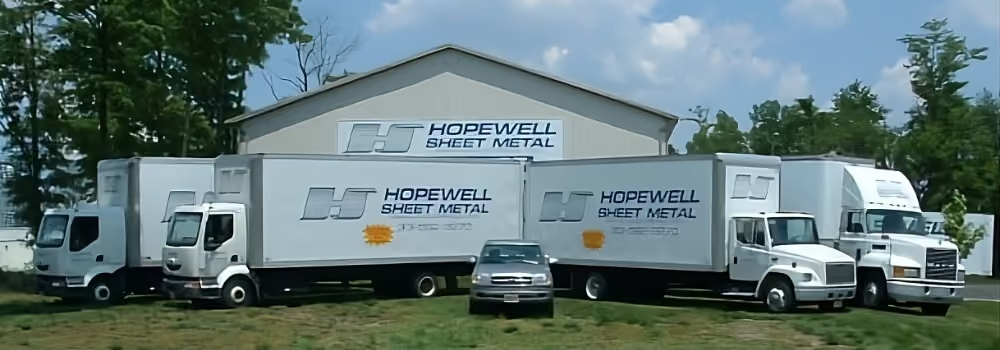

















































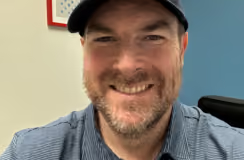






%20-%20thumbnail.avif)





%20-%20thumbnail.avif)

%20-%20thumbnail.avif)

.avif)




%20-%20thumbnail.avif)








.avif)