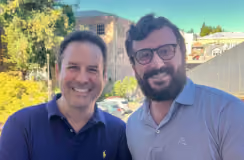
Host: The title of Adrian Pinto's first appearance on Acquiring Minds was Building a Blue Collar Empire. Today, Adrian returns to share how this project is going 16 months later. Quite well actually. Among other things, he has doubled sales since he acquired the business. We spent time on how he's done that. Listen closely there because you'll learn what B2B sales looks like. If you don't already know. We also spend time on the business of landscaping, which is a favorite among searchers. Acquiring Minds has had four guests that bought landscaping businesses, the most of any type of business. Adrian has some surprising observations about landscaping. You might want to complement this episode with the Costub Dio episode of last week. Like Adrian Kostub is a thoughtful former private equity guy who bought an outdoor services business, tree services in Kostub's case. Okay, please enjoy this follow up with Adrian Pinto, owner of Georgiascapes. Welcome to Acquiring Minds, a podcast about buying businesses. My name is Will Smith. Acquiring an existing business is an awesome opportunity for many entrepreneurs and on this podcast I talk to the people who do it. I want to share an update on the Acquisition Lab. As you know, the Lab is a highly vetted cohort based accelerator and community for people serious about buying a business. After going through the Lab's month long intensive, you have ongoing access to almost daily Q and A sessions with advisors, regular live deal reviews with Walker Deibel, author of Buy, Then Build Potential Deal, team introductions, and a very active Slack group with other searchers on the path. Well, the update is that the Lab recently passed 60 businesses acquired and for well over $100 million in aggregate transaction value. Also, all members now enjoy lifetime access to the Lab because when you buy a business, it's often just the first of many and the Lab wants to support you in every deal, not just your first. Lastly, check out my recent interview with Shane Ursum, episode 105. Shane acquired a business with over $1 million in EBITDA in just six months and he attributes a lot of his deal success to what he learned in the lab. Check out acquisitionlab.com or email the lab's director, Chelsea Wood. Chelsea then build.com Adrian Pinto welcome back to Acquiring Minds.
Guest: Yeah, thank you for having me. Good to be back.
Host: Adrian, you were a guest back in February of last year, 2022 having bought a landscaping business in the Atlanta area. So I wanted to have you back on to share with us how it's going to get started. Adrian, please just remind people a little bit about your backstory and about Georgia Scapes, the business that you Bought?
Guest: Yeah, sure. So my background was really financial in nature. So I did a couple of years of investment banking out of college at Credit Suisse and then I went to private equity and worked at two different private equity firms for about four years. The bulk of that time spending in the kind of mid market buyout space. Specifically looking at industrial companies at a place called Greenbrier Equity Group. And after that second firm then is when I decided to make the shift into kind of ETA and move forward with Georgia Scapes. And so Georgia Scapes were a commercial landscaping business broken up between commercial maintenance at apartments, shopping centers, businesses, HOAs, things like that. Then we have an enhancement group which focuses on kind of upsell projects at those maintenance customers. And then we have a third division which is what we describe as our builder group. They do the high volume installations for track home builders. We work with some of the big US home builders doing the sod plant and tree installs when they do a neighborhood. So we'll sign a contract for the life of the neighborhood and install kind of behind them every time they're completing a home. Great.
[4:09] Host: And do those customers then become recurring customers in some way or is that really just a one and done? Big, but one and done.
Guest: Yeah. So there definitely is an opportunity for that. And something I probably didn't appreciate when I took over because the prior owner never pursued it. He wasn't really a big fan of maintenance in general, which we can kind of talk about why, but that is definitely something that we have started to pursue a lot more. And so I would say at most of our install customers we will do some form of maintenance. Whether it's the whole community, it could be, you know, the model home and the spec homes that they're building. But yeah, that, that's something we've definitely been pursuing more and you know, has been received pretty well from the builders because I think they like to work with just one party ultimately.
Host: Cool. And Adrian, give us a sense of the some numbers around Georgia Scapes if you can. And if there's been a change, hopefully a positive change, what it was today and what it was when you bought it. Start us, start us off with what was it when you bought it?
Guest: Yeah, so when I had entered into the why it was a bit under 3 million of revenue. Today we're on an LTM basis, we're a bit under 6 million of revenue, which is pretty exciting. For about 18 months.
Host: Yeah.
Guest: Margins, you know, I would say they were higher, you know, candidly before I took over in large part because the prior owner kind of wore several hats himself, which we.
Host: Classic story.
Guest: That was something I, you know, I think I probably, you know, underappreciated and frankly under diligence just how involved he was and what might be needed, you know, rehiring, you know, wanting to replace him and so, you know, adjusting for that and, and, or factoring that and then kind of adjusting for some one time stuff. You know, our margins are, you know, probably low, like low teens, I would say is probably pretty accurate.
[6:02] Host: Great, thank you. Doubling revenue essentially. Even if, even if your margins are a bit less. Sure, sounds positive. Give me just a high level, how you feeling? And if you want to grade it on 1 to 10, go ahead and do that. This was a big life decision and you got off traditional finance path and into the small business ownership path. Reflecting back, was it a good move?
Guest: Yeah, I mean, you know, it's interesting because I think at times it's hard to take that step back and like look at it holistically and say like, okay, like, you know, look at how the organization has changed, look how we've, you know, developed our customers, you know, we've grown our, you know, grown the business financially, you know. And when I do that, I think it, it helps me like, you know, frame what's got begun on and I think I feel frankly more positive about the situation. I think it's easy or at least for me, you know, to get caught up in any one, you know, thing that might be going on that you're kind of trying to solve a problem and then, you know, that causes stress or whatever and then, you know, you know, that frustration that kind of builds through that. So I think when I look at it, you know, overall, it's definitely been a positive experience, both because of the just overall outcome to the business, but also I think like personally I cannot, I guess over oversay how much you learn, you know, just doing, you know, ultimately doing this relative to being like in an investment role. Right. Like I, I think when you're in an investment role, you look at things very theoretically and you, you know, you learn to calculate things the way that you know, essentially the books tell you to calculate them. And then I think when you're in this seat, you learn like how it actually works in practice and how different that is. And so, you know, one thing that I've realized at times as I've reviewed like other businesses or given advice to other people or talked to some of my friends still in PE is like, I think my perspective on just like business Value or evaluation has developed, like, dramatically for the positive. You know what I mean? And it's probably made me, I think, a lot better, you know, investor or just, you know, general kind of, you know, viewer of businesses, which is, I think, kind of like an anecdotal positive of this whole situation. But, you know, something that I didn't necessarily anticipate occurring as much as it has.
Host: Mm, that's fascinating. Well, Adrian, part of your backstory was that you, in your role, roles in pe, saw there's just kind of this great kind of anecdote where you saw these blue collar guys who'd built enormous businesses and sold, you know, we're selling them for, I think, like, nine figures and. Yeah, and. And you said to yourself, you know, and they. And they hadn't. There hadn't been some masterstroke, some genius at work. They just kind of been kind of growth oriented and been at it for a long time. And. And there they were, multi, multi millionaires. And you said to yourself, well, that looks fun, and I feel like I could do that. Do you feel that that observation of yours was accurate, or do you. Do you feel like you. You were maybe oversimplifying it? You're. Now that you're in it, you're like, wow, it's even more impressive what they built, or is it basically all intact?
[9:15] Guest: Like.
Host: Yeah, that's still, that's still the plan.
Guest: Yeah, it's a good question. I mean, I think probably both. I mean, I, I think I probably underappreciated some of the difficulties certainly, with doing it both in terms of just like, you know, the pros, you know, the process of, you know, going out, finding these businesses, buying them, you know, like, it, you know, it takes a lot of work. Certainly. I think I've also probably underappreciated, like, the dedication it takes to stay in the same business for 30 years and do that. You know, like, in all of those instances, for the most part, they were people that had been doing it for a really, really long time. And so I think what I probably underappreciated was just how important, you know, how, like, important it was to have that, you know, long presence in a business. Like, I, I think viewing it as something that could be done in two years in getting anywhere near those scale, you know, I think I probably way overestimated, but I do. I definitely think the opportunity still exists, certainly, especially if, you know, you have kind of the right, you know, financing structure in place or partners or whatever that is. I think the. I think the opportunity sets 100% real. I think I probably just, you know, the speed of all of it, at least the speed doing it yourself, I think is probably where I, you know, under, you know, underestimated things.
Host: But you, through acquisition, you probably still feel that you can, if you choose to pursue that path, do it faster than the three or four decades that it took some of these people that you were seeing.
Guest: Yeah, I think so. I mean, and that's probably in part because of risk appetite and, you know, just how aggressive people are. You know, on M and A, you know, I think like I would have an ability to be more aggressive than, you know, some of these individuals that I had met in the past. So, yeah, I definitely think that that is probably true. But yeah, I mean, the whole notion of like going about it yourself and trying to execute all that M and A at the same speed that we're talking about, but without, you know, any partners or, you know, financing partners, whether it's debt or equity, I think that part is definitely more difficult, right? Like, if you're going to try to organically grow a cash base that you're going to then deploy for acquisitions, that's going to take a really long time. And that's in part because I think that especially in landscaping, right, like, it's a moderately capital intensive industry, the margins are somewhat thin, right. It's not software. And so the idea that you're going to be able to effectively grow your own business, right. And make investments into it, both equipment people, all of that, while also building, you know, the cash needed to go then acquire a bunch of other businesses, I think is difficult unless you just didn't really have much appetite to grow your business. Right. And I mean, that's certainly something I've thought about at different times, which is like juxtaposing what's gone on for us, right? Like kind of doubling the size of the business with what if we didn't try to do any of that and just focused on, you know, maximizing cash flow and using that to deploy into acquisitions and like, what would that look like, basically?
[12:25] Host: You mean, sorry, building up your own cash flow enough that you would not, you would not need a lender partner to go out and do acquisitions.
Guest: Yeah, right. Well, I think, yeah, I think instead, basically instead of us trying to maximize our organic growth, right, which has obviously taken money to do that, you know, the alternative would be like, let's just try to be flat, right? But we'll, you know, try to maximize our margin. So we'll operate as Thinly as possible, with as few people as possible, with, you know, as old of equipment as possible. But in turn, we'll generate much higher free cash flow, which then we may be able to go out and you, you know, deploy into acquisitions, you know, and that's like, you know, it's just an alternative route, which I've thought about, but ultimately, I think for a couple different reasons, have, like, you know, shied away from.
Host: Since we're on the topic of acquisitions, one of the things in our first conversation that we talked about was just the opportunity. I mean, landscaping is a. Known to be quite a fragmented industry. You know, suburban neighborhoods of America are crawling with landscaping businesses. And I remember you observing, you know, landscaping trucks once you were in Georgia scapes. It's like you'd never notice them before and now you see them everywhere sort of phenomenon. Do you still feel like, aside from the point you just made about how you allocate your own capital, do you still feel like there are a lot of acquisition opportunities? Like, how. How has that view of yours developed?
Guest: Yeah, I mean, I think the answer is yes, but I have. I'd say, like, I would say that I have tightened my scope around what those. Those companies would need to look like, you know, both financially. Revenue profile in order to be attractive. So I think when you. And initially at that discussion was probably like, right when I was starting to kind of dive into the, you know, target universe and what these businesses look like. And I've had subsequent, you know, discussions with owners, people that I've kind of proactively reached out to who've said, yeah, I'd be open to a discussion. And I think as I've gotten under the hood and learned a little bit more about their businesses, I've seen that, you know, the. Their revenue mix doesn't necessarily align very well with what ours looks like. And so, you know, if you just purely care about scale and, you know, you don't really care about, you know, being a pure play in any, you know, by any sense of the word. Like, I think you could go out and you could buy a bunch of stuff. But I think I've been more hesitant for one in one, for one reason, just because the businesses that I have thus far had those interactions with have not, you know, had the same kind of makeup that we want or that we kind of desire to be. And so by buying them, it would kind of take us further away from our goals, which obviously you don't want to do. And the other thing is, like, obviously over the last Year has been still kind of a pretty crazy time in terms of like, valuations and stuff like that. And so I think in all of the instances where I've had detailed discussions with owners, right. And there's been multiple instances of Lois put out, really, I mean, valuation has just been a real big challenge. And I mean, I would say that, like, for businesses of the size that I've spoken with, I think the expectations have been somewhat unrealistic, even by the standards of certain business brokers. You know, I'll have discussions with someone they're representing or like a third party. I'll say, hey, I'm talking to this guy. I'm just curious your perspective. Like, this is what he's asking for. And I think generally, you know, the wants of a lot of these individuals for the size of businesses that they have have just not, you know, been tenable. So those two kind of factors have led me to sit on the sidelines thus far with the acquisitions. But I mean, I still think that that's a super important and viable, you know, growth path, for sure.
[15:59] Host: Well, I, I assume the other factor here is the fact that you are growing quite nicely on your own. Thank you very much. So, you know, you've, you've doubled revenue. So if your own organic growth is. Looks so nice that, you know, removes one of, one of the other reasons to acquire and. But Adrian, just to have people anchor the time here. So when did you buy? What was. What month did you buy?
Guest: July. And. Or like beginning of August 2021.
Host: Okay, so basically it's been about a little over a year and a half to double revenue. Yeah, you were saying.
Guest: Yeah, I was just going to say to your point on the, you know, comparing versus organic growth. That's completely right. And so as an example, like, there was one small business I was looking at, it was quite small, right? I think it was. It was like four or five hundred thousand of revenue. Two crews, maybe a little more than half of it was maintenance and it was all commercial. So in that sense, it was somewhat interesting, but only interesting if you could literally just have those crews just start reporting out of your office just as kind of basically an aqua hire. And the issue though, was from a valuation perspective, what the owner wanted still was a lot of money. And when you start thinking about what that is actually providing you, so it's bringing in. So let's say $300,000 of maintenance revenue, maybe some kind of reoccurring install revenue. But you, you know, you think about, okay, what am I going to have to pay for that. And what is the my opportunity to just go get that organically. And I think what we've seen over the last 18 months is like what that gentleman wanted for his business. I think we could have deployed organically into, you know, a new crew or two and you know, all the other resources basically needed to go get that growth and it would have been easier and cheaper to do so than just buying it from him basically. So I just haven't, you know, in those instances it's like it's hard to justify, you know, even a super simple deal like that when we've been able to pretty easily get the revenue growth that we want.
[18:00] Host: August Felker is a two time successful searcher. First with a traditional search fund. The second time around he did a self funded search. Today, August runs Oberle Risk Strategies, an insurance firm with a dedicated practice group for searchers and acquisition entrepreneurs like you. If you've got a business under loi, Oberle will provide complimentary due diligence on that business's insurance and benefits program. A great no risk way to get to know August and team. They love helping searchers. They've worked with hundreds. Oberly is a specialty insurance brokerage for searchers by a former searcher. Check out oberle-risk.com O B E R L E- risk.com link in the show notes. Well, I want to get into how you have done this organic growth. But first an observation. It's just so interesting how people can arrive at such different strategies. So listening to you now, I'm reminded, I mean it's almost like plucked from the interview with Logan and Bradley in Austin who bought a landscaping business and struggled with it for a while and then eventually it was a phenomenal growth and exit. But you know, they were finance oriented guys and when they got into it they had this plan to like buy a million dollars of EBITDA a year, every year for five years. So very, very inorganic M and A M and A approach to growing their business. And once they got in it, they realized that frankly, dollar, just simply dollar for dollar, it was cheaper to grow organically than inorganically. It's just, it's just a better use of, of your capital. And so that's all they did. Maybe they did one tiny acquisition or maybe they looked at one, but, but little to no acquisition. All organic growth and very nice organic growth. Meanwhile you have like a Mike Bodkin who has been on the podcast a few times and Mike is very acquisitive. Um, and, and so you know, and. And appears to be doing it. Doing it well. And. And doing it more. So. So just totally. Just interesting. But. And. And sorry. And Mike Bodkin is also in landscaping, so. So two young sets of. Of acquisition entrepreneurs, both in landscaping, both, but. But taking very different paths. Just an observation.
Guest: Yeah.
Host: Adrian, let's hear about your. Your organic growth. So how, you know, in brief, how have you doubled revenue in 18 months?
Guest: Yeah, I mean, I would say it's been a combination of things. Right. So, you know, candidly, there has been growth with our existing customers, which obviously, like, I have little to do with that. I think that you could argue, like, our team's ability to serve them properly helps, you know, kind of support those relationships and continue to funnel work to us as they take on new properties or whatever that may be. So, you know, the customer service side of things, certainly, but I would credit, obviously, the team with that more than. Than me. I think for me, the, you know, like, what my big focus has been is like, when we, when I took over the business was identifying kind of what I felt like were areas of weakness in terms of our revenue profile. So, you know, we were very light on maintenance when I took over. We had some customer concentration on the. On, you know, other sides of our business. And so for me, I wanted to kind of look at each one of those individually and come up with a strategy for how do we tackle that. So if you take the customer concentration part first. Right. So the biggest thing there was identifying who would be other customers that would fit that division and then figuring out who are the kind of decision makers at those customers, you know, getting contact information and just, you know, outreach. And in that instance, it was somewhat easier because there was, you know, we knew kind of who that universe of customers were. Right. If you think about, like, the big builders in the U.S. there's, you know, there's, let's say, 40 of them or something. And so we were able to kind of, you know, pretty easily kind of scope out those customers and figure out who we should be, you know, in contact with and devise a plan to kind of go after them. And then on the maintenance side, you know, that. That side is more of kind of just a land grab because it's. The universe is enormous. And so there it was more. The strategy was more around who are the types of properties that we would want and then who are the, you know, the companies that either manage or own those types of properties, and then who at that company, again, would be the decision maker? So an example on the maintenance side was apartments have been something that we've always been really strong at for me, in terms of our customers. And so what we did was we joined the Atlanta Apartment association, which sends out a booklet of all of the apartment owners and their buildings in Georgia. And so from there, you know, now I have a list of. I forget. I mean, it was, you know, hundreds and hundreds of buildings with, you know, dozens, if not 100 apartment owners. And so I could take that information. I could use some of these online resources to look up those companies and get a list of their employees, which I think they aggregate from, like, LinkedIn and whatnot, and they even have emails for those employees. So once I was able to do that, all I had to really figure out was like, who at these places is actually going to make the decision? Which, as I came to find out, with apartments, it's almost always the community manager. And so I would then send mass outreach to these community managers, basically saying who we are, what we do, you know, and ask for either a call or an introduction meeting. And once we had that, it would give me a chance to kind of talk about who we're currently serving, you know, and so they could see, like, hey, we serve some of your competitors. We do a good job there. Here's some examples. And then, you know, if they were interested, basically, they would be, you know, they'd say, come give us a quote. You know, we'd like to see, you know, some pricing for our landscaping, basically. And basically what I found was that, you know, for every hundred emails I would send, I would get about four or five responses asking for, you know, quotes to be given. And then our close rate would be maybe 20 or 25%. So if I sent 100 emails, I would get, you know, we'd get one new win out of that. And certainly there's no telling, like, you know, there are no guarantee the size of that win rate. So sometimes it would be a huge property, and sometimes it would be a tiny property. But what I found is that, know, I can send a hundred emails really easily with this whole strategy. And so we would send, or I would send, you know, a thousand emails, you know, maybe once a month. And that would, you know, that thousand emails would give us, I don't know, maybe 10 or 15 or 20 different, you know, meetings for proposals and whatnot. And, you know, we'd close a, you know, a handful of them. And so just kind of staying on top of that and just recycling that process has been pretty successful for us. And it's not even just been on the apartment. That's where we started on the apartment side. But then we've shifted it to being in the ways and we've won't through that. Which generally I would say in landscaping are kind of the gold, you know, the gold standard of customers. We've won some businesses, you know, shopping centers, all sorts of different properties. And I feel like every time I redo that strategy, there's, you know, hundreds of new contacts that, you know, we could reach out to because obviously those types of positions are shut. You know, they're shuffling in and out people all the time. So it's pretty endless, I would say, in terms of the opportunities.
[25:31] Host: Two quick reactions. I mean, when you say a thousand and then you say endless, I mean, there, there aren't, of course, there aren't literally endless amounts, of course. So, you know, I mean, are there really more than 10,000 apartment buildings in, in, in Georgia? Probably.
Guest: Why?
Host: But more than 20,000?
Guest: Yeah. So if you just looked at apartments. Agreed. Right. I think once you start bringing in all the HOA property managers, all the commercial office property managers, you know, the shopping center property managers, banks, you know, doctor's offices, all this. Right. I mean, yeah, there are tens of thousands, I would say. And. But I agreed. Right. Like, there is a finite number. I think one of the things that I realized though is as I was mentioning is like, they really th. Those positions change pretty frequently. Like every, you know, if I, if I go look at one apartment today and then I go look four months from now, it's pretty common that they will have a different community manager at that point in time. Which doesn't mean that there you have any more likely chance of, of winning the contract, but it does give you another opportunity to reach out. The other thing is, you know, for at least in my opinion, like, more outreach is better than less. And so even if it's the same person, I'm probably going to reach out more than once a year. So, you know, I can kind of do this whole process and reach out to thousands of people, but then recycle that whole process all over again in June.
Host: The same list.
Guest: Yeah, yeah, exactly. But I mean, I do think it is true to say that, like, it's a law of diminishing return. Right. Like, the more you do this, the less you're going to get ultimately. But I think what I've also seen is that by doing this and initially getting some of these relationships and winning some contracts, then you start getting that like organic growth from the, from the existing customers, right? Where they're like, hey, you're doing a good job from with us at this one place, I'm now in charge of another one. Can you come quote that? Right. And so you start, you start developing like your own, you know, kind of internal growth engine with your existing customers. So the combination of those two factors I think is what has, you know, driven a lot of our, our growth thus far on the maintenance side.
[27:36] Host: Well, Adrian, what you're describing is, is basically a pretty traditional B2B sales process. Certainly anybody who's worked in, you know, B2B software will be painfully familiar with
Guest: it because this is what they do, I'm sure.
Host: Yeah, but, but maybe a lot of listeners kind of aren't and, but, but the question would be like, at what point are like, do you hire somebody to do that if there's such a clear ROI and there are people, B2B salespeople who do nothing but this all day long? When, when does it make sense for you to invest in a human, a full time human to do this for you?
Guest: Yeah, I mean, I think that that's, that's definitely something, I think that's in the cards probably for this year especially just because obviously, you know, there's a lead time required before, you know, you start really seeing any success from, you know, a new salesperson. I think the reason we haven't done it thus far is just that one, is it hasn't been that, you know, it hasn't been that much of my time as I was mentioning. And two, we've just allocated kind of our, you know, our spend on hires elsewhere that have felt like bigger needs. And so if this means I have to spend a little bit more time on this each month, you know, so far it's, I think that has made sense. But I agree, I mean, I think as you get bigger and in order to keep any, you know, any similar level of growth, right. Like you're going to need that much more know, proposal opportunities and end quote, you know, all of that. So I think at some point in the semi near future it'll probably need to be kind of a full time position. And yeah, I completely agree. Like, I think this is another example of something that someone in this industry or someone in sales would look at what has occurred and say like yeah, that's pretty obvious. I think for me coming from, you know, my background and you know, I had never done anything like this before and so this was all kind of trial and error that, you know, led to us kind of Putting in, putting in plan in place, this approach.
Host: Yeah, well, you know, I'll pat you on the back, Adrian, for essentially inventing a B2B sales process. It was already out there in the world, but you discovered it all on your own and you know, just because you didn't know about it and then figured it out, a lot of your competition, not searchers, but you know, 50 and 60 year olds whose businesses who you're competing with probably really don't know about this. So it's a, it's a way for you to pull ahead as well, right?
Guest: Yeah. I mean 100. I mean, I think that like the mom and pop owned businesses are absolutely not doing this. You know, I think the ones that are, the ones that are big enough that they have some form of sales, you know, in place and then, you know, we were competing against them. But even there, I mean, I think like, I think that there are things that we can use to our advantage, whether that's maybe being a little bit more creative in our approach or, you know, I think I'm pretty, I'm a pretty like communicative person. And so if we get an opportunity to do something, I'm going to respond right away, I'm going to meet them right away, I'm going to follow up right away. And I think, you know, for the feedback that at least that I've gotten, I think is that people have appreciated, you know, this kind of middle ground we play in where it's like we seem to have the resources that support a larger organization or at least make us come off as an larger organization, but like with the nimbleness of kind of a smaller team. And I think that's something that, you know, you're not going to find if you're at Brightview or something like that. Right. So. And I think that, you know, me being involved in the process a little bit. I know and I've been told by some of the customers we've, we've learned we've landed, I think is, is appreciative by them because they kind of see like, oh, I get to deal with the owner. That seems like that, you know, probably means that I'm going to be taken care of a little bit more. So anyway, I think, you know, us kind of flexing how we're perceived by the customers, whether it's as a big team or a small, lean, nimble team, I think can, you know, be used to our advantage also.
[31:28] Host: Yeah, yeah. And to the point about hiring somebody for a bd, like a full Time BD person, like their conversion probably will be a little bit less than yours because people do to work directly with owners. So you're probably going to convert customers just a little bit better than, than the person you hired to do it. But who knows?
Guest: Yeah, but on the flip side, you know, like there's a lot of things that I don't do, you know, which I think a traditional salesperson would be doing. Right. Like I don't attend industry, you know, industry meetings and I'm not going, you know, where they might have a lot of like apartments there. You know, there's, there's a lot of, I think stuff that like a dedicated salesperson would be doing. Whether it's just, you know, drop ins at apartments or, you know, places, you know, all of that stuff. Right. Like, I'm not doing that. I mean truly I'm kind of doing, I would say the bare bones and just kind of focusing on like that back office high volume outreach just because it's something that I can kind of easily do without a lot of, you know, a lot of hours spent on it. So I think that that's where having a dedicated salesperson will be a big asset for us because it allow us to, I think, have a little bit more kind of comprehensive sales approach.
Host: Adrian, we've been talking about landscaping indirectly a lot. Now just give us a two minute lay of the land of landscaping. You mentioned, you know, that it's kind of there's this bottomless pool of customers. That's good. But of course the barriers to entry and landscaping are also extremely low. It's hard to build a moat. Very competitive. So kind of address those two things. And then also the, the commercial. Well, why don't you address that and then I'll have some follow up questions because I got about three of them here. So that one first, please.
[33:14] Guest: Yeah, so I mean I do think it is a largely a bottomless pool of customers, especially when you're in a larger city. You know, the, the like I said the way. I mean, I think if you were, there's obviously rankings of customers, right. And so if you're going to be super selective and you're going to say I only want the highest quality, you know, World of Coca Cola. Right. Which would be like one of the kind of top properties in all of Atlanta. If that's all you're focusing on, then like, you know, you may have a difficult time, you know, winning new business. I think if you're willing to kind of cast a wider net and say anything that's commercial where they're just kind of a centralized property manager I'm open to then I think, yeah, I mean I think it's, it feels endless to be honest. And again, if we were doing this for 10 years and had been, you know, we were 10 times the size maybe at that point I wouldn't feel the same way. But like where we are right now, it feels endless. And in terms of the competition component to it, I mean, I think that that is true, but it's not necessarily the case on commercial stuff as much and that's not necessarily because, you know, all of the long tail of mom and pops wouldn't do commercial stuff. I think the barrier to entry really is that a lot of commercial things, especially as they get more and more reputable, they want some form of credibility with their landscaper. Right. So if you're a pretty high end apartment or if you're an HOA or if you're a, you know, a decent sized shopping center, they're not going to take, you know, Adrian Pinto Landscaping with his one truck just because the price might be a favorable. Right. They're going to say well what else do you do? Oh, you just do a handful of homes. You know, that's not interesting to us I think where we're like one of the things that's been really helpful for us and was even more helpful in the beginning was going to these meetings and being able to list a couple of our key customers who the prior owner had established relationships with. Like if we didn't have those initial relationships, I don't think we would have been able to build off of that. But since we did and we were able to build off of it, now it's that much easier because now our, you know, our list of customers is, is quite large and it spans a lot of different management companies and whatnot. So I think the barrier to entry on the commercial side is that kind of initial reputation and kind of resume of, of properties. And once you're beyond that, you know, I think at our size, like for your average property we can compete just as well with Brightview or Russell who's a huge person here, or Yellowstone because your average property doesn't really need all of this extra kind of sophistication that those guys might offer. Now again, if it's World of Coke, I mean I would be, you know, candid to say that like I think we would be, it would be difficult for us to win that versus one of those guys because there is a lot of, you know, process and systems and stuff that they have in place that I think if you're a huge customer that's paying a million dollar contract like they're going to want, which we, you know, aren't quite there yet. But I think for our, you know, our kind of sweet spot of customers, like we can just as easily compete and in some ways I think better because as we were talking about, you know, me being involved a little bit or some of the kind of the, the nimbleness of our organization, I think can help us in those instances.
[36:29] Host: Well, and let me just make a shout out here for, for acquiring a business, as if I need to on this podcast, but what you described about the value of the resume of the roster of businesses, of clients that you already had and how that got your foot in the door. You know, a lot of times the question in this world can be like, well, what are you buying really in a business? And landscaping in particular? Because in theory, despite you just kind of showed how it's not true. But in theory, the barriers to entry are low and somebody can, you know, hop in a truck and have, you know, go to pick up, you know, $1,000 worth of equipment at a Home Depot and be in business. But what you're buying is reputation, your existing customers and of course, cash flow and you know, the resources to, to, to do stuff immediately and to pay yourself immediately. But that, that, you know, client roster should not be understated. I mean that's, that's extremely valuable that, that just repeating what you said back to you. That's kind of the engine that's allowed you to, to one of the engines that's allowed you to really kind of get in, get, get some more clients.
Guest: So Yeah, I mean, 100%. And I, I, that's definitely not something I thought about when I got into this, to be honest. Like, I think if I would have seen the initial maintenance book and it would have been just, let's say all random banks, right? Like, you know, something where you're just going in, you're mowing, you're blowing, you're getting out of there. I don't think I would have given it a whole lot of thought versus what I bought. You know what I mean? I would have been like, oh cool, it's still commercial, it's more properties, but they seem to make it work profitable profitability wise. So like, great. I think in reality, if that would have happened, it would have made it that much harder when we initially started kind of getting some quoting opportunities because they would have Said, what do you do now? And we would have had to have told this apartment, oh, we do, you know, four, you know, 200 banks. And you know, they're like, okay, well, that's not that applicable. So I think the, the book that we had definitely helped me quite a bit in those initial meetings, just because we were able to kind of point to this and, you know, give them pictures or tell them to drive by those places or introduce them to some of the, you know, our customers as references. And that was know, it was really helpful.
Host: Great. More on landscaping, commercial versus residential. So is it fair to just say commercial is better? I feel like everybody that I've talked to in landscaping is like, we can, you know, we can, we can talk this to death. But like, let me just boil it down for you. Commercials better. Your. Your thoughts?
[39:00] Guest: I think, yeah, I think that that is somewhat changing. Like, I mean, there has now been a couple examples of some residential businesses at the Pennsylvania level that have done really, really well and sold at huge multiples. I think my biggest view on it is that the ratio of customer service effort or like account management effort to revenue or profit for a given customer is much worse on the residential side. So if, you know, if you are, it's your home, right, like, and you're paying us, let's say, 750 bucks a month. So maybe it's a, you know, a nice size yard, I could totally understand you as a homeowner wanting to speak with someone once a month or once every other month and ask a couple questions and maybe have someone swing out and take a look. But the reality is we have commercial customers that want less account management than that, and they're, you know, four or five times the size. And so I think if you were to have a, you know, a neighborhood of 200 individual homeowners where you actually service the homes, but you're also your, your customer contact was the home, not like an HOA. You open yourself up to 200 of those discussions any every month or quarter or whatever it is for a relatively not huge amount of revenue for any one of those customers. So for me, that's where I struggle with the most. And one of the reasons we kind of shy away from it is just I don't think that our processes are necessarily set up to handle that level of account management.
Host: Yeah, well, and I think that would be kind of the con. One of the many conventional reasons that people like commercial rather than residential, because the. I don't think the work is. Is that different. Yes. I mean, Essentially, I mean, the, the skill set for a landscaper, the guy actually doing the work is probably pretty similar. Right. He could go to somebody's home or he could go to an office building. Correct me if I'm wrong, I would
Guest: say, yeah, I think maybe a little, you know, on residential, they might, you know, sometimes homeowners want to speak to the landscapers a little bit more. And so they might, you know, you might need someone that's a little bit more commercial, um, in. In that they can have that kind of interaction. Um, but yes, work wise, I think it's largely the same. And residential has some, you know, some positives. Right. Like the ratio, I think, of upsell. So them spending money on extra stuff can be better relative to the, you know, their monthly maintenance bill. Because most homeowners want to do something every year. You know, I think your pricing power can be a little bit better. Even though there's a lot of competition, if it's a higher end residential, you know, they're probably going to be a little bit more accepting of, you know, price increases and things like that. So I think there are positives, certainly. But for us, I mean, the account management is why we've shied away from it. Because we have had some opportunities where people have come to us and said, hey, I'm retiring. I have $100,000 of residential maintenance customers. I'll sell it to you for, you know, one or two times monthly, you know, the monthly revenue. And we just looked at it and said, like, it's not about the customers, it's. Or, you know, it's not about, like, the price. It's just we can't service that, you know, from an account management perspective.
[42:02] Host: Yeah, well, and account management's a very. Yeah, it's a very real cost. I'm just reminded of my days in SaaS, working in SaaS businesses where these, you know, a software product in SaaS would start targeting kind of consumers or maybe even prosumers, as they were called. But eventually the evolution was like, it's just a better customer to go to the, what they would call enterprise sales. Like bigger, bigger companies buying your SaaS product, it's just a higher quality customer, they need less handholding and they. And they pay you more. So, you know, you win twice. So cool. Then the third point on landscaping is maintenance versus project, or there was another word that you used, design, installation. And the conventional wisdom certainly among my guests would be that, like, you know, recurring revenue. So maintenance is where it's at, like more maintenance. The. The Austin guys, Logan, Logan and Bradley, that's how they transformed the business and, and really like made it into the saleable business that it was, was they took a business that had just a little bit of maintenance and a lot of design, installation, construction project work and flipped that you. So tell me if you basically agree that that's, that's the right strategy for you and then also answer why your previous owner didn't feel that way. He didn't like maintenance. What's not to love about maintenance?
Guest: Yeah, I think that that is actually the conventional wisdom. I think I've found amongst a lot of people that have kind of done this for, you know, 30 years and you know, they may be a bit older and you know, kind of focused on just cash flow and things like that. Like, it's pretty common view, I think that like maintenance, it's a pain, right? It's relative. You know, I'd say it can be, it's generally thinner margins, the capital intensity is a little bit higher. And part of that is because on the install side, a lot of times you can use subcontractors, which means not having to, you know, put out as much of the equipment yourself. Whereas on the maintenance side, you know, generally that's all in house. And then the other thing is like the operating leverage in maintenance is pretty minimal. So you know, a crew, if you have a, let's say a three person crew that works four days a week, which is pretty standard in Georgia, you know, they can only do so much revenue, right? And at some point they're, you're going to need to go out and get a new crew, which means another truck trailer, mower, etc. And that amount of revenue that they can do, like it's not huge, right? Like, let's say it's $20,000 of monthly revenue that one crew can do. So 250 grand a year, that could be two contracts, it could be five or 20 contracts, but you know, so somewhere in that range. But what that means is, you know, you could go get a new crew, you know, you fully, you know, equip them with everything they need. You win a couple of contracts, you know, they have a pretty full day and then all of a sudden you win one or two more things and all of a sudden they can't do that. And so now you have to go do this process all over again. And so I think for companies that are growing a lot maintenance, the negative view of maintenance is just that it's, it's a pain to schedule. You know, you're kind of constantly having to manipulate schedules with weather. Every time you win new properties, you kind of have to change things around. It's more people. So it's know, just the labor issues in terms of finding people, keeping people, you know, people somewhat. Two, you know, two people are out today. What are we going to do? How are we going to change things to accommodate that? And then, like I said, the operating leverage side of things, where, you know, you're not getting a ton of incremental revenue for every dollar that you're spending on new equipment, which is a challenge. But of course, all of that is juxtaposed with the contractual recurring nature of it, which is appealing to me. And I think it is a necessary balance to any business that has, you know, project or installation work. I think the middle ground, and we may have talked about this last time, but so our business, as I was saying at the beginning, does a fair amount of what we describe as this builder work. And so to me, that the builder work is pretty clearly kind of this middle ground of what I would describe as like, reoccurring, because we are signing contracts for the life of a neighborhood, right? So we win a neighborhood, there's 300 homes in it. That means for the next 300 homes, we know exactly what we're going to make per home for, you know, as they're building those. And generally these. These neighborhoods are built, let's say, over, you know, six to 12 months. Let's say if it's 300 homes, maybe it's longer, but, you know, you kind of know the speed that they're building at. So maybe it's one a week, or maybe it's two a week. And so you actually do have some visibility into what your weekly or monthly revenue is going to be on that community. And you also have visibility in how long you're going to maintain those levels. And so unlike, you know, a traditional kind of general contractor project where it's, hey, you know, we bid on this, we want it in six months, it's going to start, it's going to take us three weeks, and then we're going to finish, and we have no idea what we're going to do afterwards. This is definitely closer to the maintenance side because there is an element of visibility and consistency and all of that with the work. And I found it to be a pretty appealing. I mean, there are challenges with it, right, because there's more material costs and all of that than there is with maintenance. But I found it to be a pretty attractive side of things. And like I said, a good middle ground where it's not necessarily maintenance, but there is a ton of opportunity there. And that's, you know, been a driver of our growth as well.
[47:40] Host: Very interesting. Okay, so maintenance. Maintenance has its, has its problems other than the low margins. Was, was known to me, but these other ones I hadn't, hadn't considered or heard.
Guest: Yeah, the labor thing's huge. I mean, I would say almost every single person I've talked to that's, you know, been in it for 20, 25, 30 years, they all grasp at the same thing, which is like, oh, it's such a pain. Like, you know, having to, you know, handle, you know, people being out and how am I going to move things? And I got to call customers and say, I can't do it today. Because two people, you know, that side of things, it really is. But a logistic.
[48:15] Host: But Adrian, don't, don't those things also occur in projects? Same thing. A guy doesn't show up for work and so then you got to talk to your, your client. It's a project based contract as opposed to recurring. Sure.
Guest: If it's, I mean, if it's a go, sure. But if I think if it's a one month installation, let's say on like the far other end. Right. The GC side, if it's a one month installation, someone being out any one day probably not having a huge impact over on the overall scope of the project. Whereas if some, you know, if your crew leader is out on a day where you have to go to, you know, an hoa, the other two people on the crew might not have driver's licenses or maybe they just have less experience, whatever it is, that one person being out could screw up the whole schedule. And then all of a sudden you have to shift that back a day and tell his other two guys, hey, you can't work without him because you don't have enough experience, whatever that is. So I think that the relative impact is higher in maintenance. The other thing is on the project side, like I said, if you're subcontracting any of that work, you're not really taking that risk or that you're not necessarily being burdened by the pain of one person being out on a crew because it's really up to the subcontractor to go find someone else.
Host: Yeah.
Guest: Yeah, that's great.
Host: Just a couple more questions, Adrian, then we gotta wrap. I think I have three more questions here. One thing that I have, it's only recently occurred to me to ask is under, like when diligencing the quality of the work that the, that your crews do. So what if you had got, when you got into the business, did you find that your crews do good work? Because. And, and, and isn't there a chance that you find you get in and it's like, oh, we're actually like not. We don't we do we? Yeah, we do shoddy work. And just to your point about how you were like, you know, the existing, the existing book of business allowed you to say to prospects, you know, go drive by this property that we do and see the good work that we do. Well, you know, there are landscaping companies that don't do good work and you might have bought one of those. So is there a way to diligence the quality, especially as an outsider now, you know, landscaping. But when you were buying this business, you didn't the actual quality of the end product or end service that, that the business you're considering delivers?
Guest: Yeah, no, I mean, it's a great question. I did not look into that. And in hindsight, I mean, I think that that is certainly important now. I mean, I think that there's ways that you can, or there's data that you can use that kind of correlates to that. Right. So like if you have, let's say you have a high quality customer and you've had them for 15 years, I think the chances are you must do pretty good work. Right. But nonetheless, like, I definitely think in hindsight it would be worth saying first, you know, obviously I want the maintenance list. I'm going to drive by some of these properties and just see how they would look. I also want some examples of some projects that you've done. I want examples of stuff that's been in house. So I know, you know, the in house guys, how they've done it, not just, you know, stuff that maybe subcontractors have done. And I, you know, I think, you know, spending a little bit of time and looking at those I think definitely would be important. I think for me, when I got in, I mean I, I did, you know, drive around the properties and I would see, um, you know, how our stuff looked and you know, felt like even with a naive eye, it seemed like, okay, this looks pretty good to me. So, you know, that gave me some, I'd say some peace of mind. But there definitely, I mean there's definitely been, you know, a couple instances early on where maybe we got a customer call about something and I didn't understand the dynamics of like oh, it's, you know, fall and there's obviously a lot of leaves. But if we, you know, we get a customer call and they say something about, you know, a leaf issue, and I, all of a sudden I'm like, wait a minute, are we doing this wrong? You know, are we not doing what, you know, we're supposed to be doing? But that's just because I didn't really understand what was going on. Right. And so I think, as I've learned the industry a little bit more, I've learned to understand, like, when, if a customer ever says something like, is it a normal thing? Is there a reason for it? Is it our fault? Is it someone else's? And, you know, that helps. But the good news overall is, yeah, I would say that our team is pretty strong and, and does really good work.
[52:31] Host: Good. When we talked in our pre call, I asked you, would you buy the same size business before? Typically, people are always like, you know, bigger. Bigger would have been better. Bigger is always better. And, you know, we know that going into acquisitions and then once you're on the other side of it, you really know it. But you actually had, you agreed with that. But basically you had a slightly different take on that question and thought it focused on the wrong thing. Do you recall?
Guest: Yeah, I mean, I think, and correct me if I'm wrong, I think my perspective on it was around want, like, basically making sure that the business was of a size that had the necessary people to kind of, you know, replace the prior owner and kind of be, you know, run on its own, I guess, going forward. Without the prior owner.
Host: Exactly.
Guest: Because I think what I found was like, from a size perspective, it was what I was looking for at the time. But then as I got under the hood, you know, post close, I found, oh, well, the prior owner was doing this and maybe he was a bit involved in that. And those are things that I'm not necessarily capable of doing without committing 100% of my time to it. And so we're going to need to go hire someone to fill this void. And then as a result, all of a sudden, from a financial perspective, like know you have less earnings than you thought you were going to have, so.
Host: And that's precisely what happened to you. Right. I mean, you get in there and you're shadowing the owner. You've already bought the business, you're shadowing the owner. After a couple days, you're like, what was it like? I'm not sure I'm going to be able to do all that. So tell Tell that, tell that.
[54:04] Guest: Like, I, yeah, I mean, I, I, I mean I truly probably think Monday and Tuesday of that week were like the most stressed I'd ever been because it was apparent, apparent from literally hour like two that the prior owner did ever like, did everything for a part of the business. And you know, I shadowed him, went to some customers, I saw him interacting with his customers and I was like, I'm not sure that I'm gonna be able to replace him. Like, it was in this kind of, it was in our, you know, one of our more construction oriented groups. And it was, you know, just something that I have no familiarity with. And yeah, I mean, it was just apparent like, you know, I'm not going to be able to replace him with this. And so I had texted him basically the third day and I was like, you know, I'm not sure that I'm the, you know, the right person to kind of replace you in this part of the business. And he was basically like, yeah, you know, I've kind of been thinking about that too. I have someone that I think you should meet. You know, he's got a great background in that area and I did, I met him and he's great and we hired him and he's been a great hire, but it wasn't something I was anticipating. And so then when you think about what the now kind of pro forma earnings look like, it's, you know, less a high level manager. And so I think in hindsight for me, when I, you know, if I was going to review a business to determine, you know, is it an appropriate size? I think the really key thing would be to make sure you unpack. Like, does it have every single hire that you're going to or employee that you're going to need in a, you know, post close universe? And if the answer is no, then, you know, you should look at the earnings adjusted for that. Despite how you figure out valuation everything like you, you know, you're going to need a certain, you know, size of earnings and you better make sure that this business will have that adjusted for, you know, the hires that you need to make. I just fortunately got really lucky that in addition to or while all this was going on, our business also just started kind of taking off and we were getting a lot of growth on kind of every side of the business. And so financially we were able to support that new hire. I think on the flip side, like, if things would have gone the opposite way and we would have had a kind of a struggling period of time Post close financially would have been tough too, because all of a sudden we're burdened by this extra head. So it worked out for me. But that's definitely, I think I told you. I mean, there's definitely some areas where I look back and I'm like, wow, that was a risk that I took that it maybe worked out okay, but like, I'm not sure I would take that risk again. And this is probably one of the biggest areas where just, you know, not having a 100 clear point of view on what the owner did and whether I could do that, you know, turned out to be a challenge. Although, you know, we figured it out.
Host: Do you recall any of these other high risk risks?
Guest: Yeah, I mean, I think like, not, I mean, you know, doing an asset sale, right? Like having to mean having to go to some of these customers post close without speaking to the customers pre close in a business that has customer concentration is a huge risk, you know, because you're basically just making a bet that they're going to say, okay, no problem, I'll keep the business with you. And we did lose one customer and it was a pretty big one. We fortunately grew with enough other customers that it didn't matter, but it was, I mean, again, if had we not grown those other customers, it would have been a sizable impact. And it was purely because they said, well, I was friends with the prior owner and I don't know you and I know other people in this space, so I'm going to take my business to them. It's like, okay. And it could have been a lot worse, frankly. So, you know, that I think that's one area again, in hindsight where I look back and I'm like, I understand why I took the risk, but like, I don't know if I would take that risk again. I mean, that's a huge risk. Another, smaller risk, but another one is just like on asset quality. I think I just kind of took the, you know, prior owner, you know, he said, oh yeah, everything's in working condition. And you know, we, you know, obviously you could see in their financial, they're spending a bunch of money on repairs. And he was pretty candid about that. Like, you know, it's not new stuff, but, you know, it works. And you know, I'm not, I haven't been lying to you about what we spend in repairs or anything. And so I again was like, okay, well, you know, I know what I'm getting into. And then I think I got there and I was like, I came to find out from talking to employees and stuff that like, oh yeah, like, you know, these three things have barely been working for years and you know, so that's just another area where it's like I took a risk of just kind of going with it without having a mechanic go in, evaluate things, figure out what is that true cost going to be post close to either fix stuff, repair it, and you know, it worked out okay. But like, you know, there were some of the costs that we incurred post close, I think could have potentially either been avoided or been maybe adjusted in purchase price because the quality of the assets was maybe a bit under what I was anticipating.
[58:37] Host: And owner seller would be open to that. Right. While they might not be comfortable introducing you to some of their biggest customers or to the employees even, they, they should let you audit the, the assets. Right?
Guest: Yeah. And honestly, he said he would it it. So it wasn't that he was hiding it, it was just that like amongst all the other diligence streams I was doing at closing, I just didn't honestly get around to having someone go there. I'm not sure how amenable he would have been to purchase price adjustments because, you know, one mechanic said these things need to be fixed or whatever. But he definitely was open to allowing me to go. But yeah, the customer thing, I understand why his perspective is like that, but he did not want that. Same with the employees. And again, I understand that, but I do think that that's also a risk because if you're buying a business with one kind of key manager, let's say, aside from the prior owner, that person leaves, you're in a tough spot. Now in my example, he spoke with her and so he verbally told me that she was comfortable with it, but I had no assurance of that. So all I could really do was, you know, kind of put on the charm post close and make her understand that like this is a great thing for everyone and you know, she's going to get, you know, there's going to be a pay increase and I'm here to support the business and do everything I can and help her any way I can. And fortunately we have a great relationship. But like that also, you know, pretty big risk.
[1:00:02] Host: Sure. Adrian, let's wrap with a final question. Earlier you had talked about how this process, when that process of going down this path, buying this business, has made you better at really evaluating drivers in a business, small business overall. Whereas from your perch in P.E. it was, you now reflect back that it was kind of more academic. You really have a instinct for Things. Now overall, in addition to that, what muscles would you say you've developed and what muscles have atrophied?
Guest: Yeah, I mean, certainly the sales thing for me, right. Because that's never something I've had to do before. That's not a component. I mean, there's relationship components of private equity and investment banking, but there's not like, you know, outreach and sales and things like that. So that's completely new for me. And I think that components of the kind of financial analysis that I do on a daily or weekly basis is, is different, like truly getting, getting in and understanding all components of cash flow and as you said, like being able to kind of anticipate what the month or quarter might look like based off of kind of higher level, higher level level factors that are occurring. So customer demand is doing this. What does that might mean? What might that mean for, you know, cash flow over the next few weeks? I think I've got a bunch better feel for that stuff now. I think on the flip side, you know, so things that have atrophied, like I do a fair amount of, you know, Excel kind of financial analysis now I'm not doing, you know, true, like modeling, you know, and, you know, that type of stuff as much anymore and certainly things more related to like the debt side of things. So, you know, private equity type debt, you know, bigger company issues that, you know, we're not, they just don't affect us. And so I have not been involved in, you know, kind of debt modeling or anything like that for quite some time, which I'm sure if I was trying to get back into, like, I'd have to, you know, kind of relearn components of. But I'd actually say, you know, and this may just be my personality, but I, I've been surprised how much, you know, Excel stuff I still end up doing, you know, because I maybe am, like I said, forecasting cash or trying to, you know, review different numbers or whatnot. And then I end up kind of, you know, getting into Excel and spending a lot of time there. So I would say that I haven't quite lost those skills yet.
Host: Do you, do you feel like you've earned your stripes as an operator? A true operator?
Guest: Yeah, I think so. Yeah. I mean, so we've had a couple instances. One of our key managers was out sick for a month in November. And that was an example or a time where I was like, I basically just was a divisional manager of a landscaping company for a month, right. Where like all day I'm just taking Customer calls, directing crews, helping with ordering. And I think that that was something where because we had such a strong. Or that he's still with us, everything's good now. But because we had such a strong manager in that division, I, you know, didn't really have to be that involved. Right.
[1:03:11] Host: And.
Guest: And I probably took that for granted at times and maybe was too uninvolved to the point where, like, I didn't, you know, I didn't have my stripes, as you would say. Like, you know what I mean? Like, if he was out, it would have been difficult for me to replace. And then all of a sudden, I was forced to replace. And I think the first week was like drinking from a fire hose, you know, learning all the dynamics, understanding customer issues, all this stuff. But then by the end of the month, I think in looking back on it, I think it was a good thing for me personally, just because it allowed me to understand so much more of that division. It allowed me to. I think I appreciate things a lot more, you know, that he deals with now also. I think it allowed us to have an outside perspective on how we were doing things. And we've actually, like, made some changes to our processes and stuff coming out of that where, like, you know, he was so in the weeds for so long that he, you know, didn't take the time maybe to think, like, hey, how could we improve certain things? I also was thrown in for a month, and by the end of the month, I was like, I don't not know why we're doing, you know, this like that or like, how we were scheduling certain things. Like, we gotta improve some things there. And he was, you know, when he came back, he was totally on board. He's like, no, you're right. Like, I hadn't thought about it, but it makes total sense. So I think it's been good for all parties involved. But, you know, that's an example of a time where, like, I definitely would say that I earned my stripes, you know, in this business.
Host: So, Adrian, if people have questions, what's the best your preferred way that people reach out? LinkedIn, Twitter, email. What do you like?
Guest: Yeah, I mean, I'd say, you know, I'm pretty responsive to DMs on Twitter, LinkedIn messages. People can send me an email directly. I'm always happy to chat. I think, honestly, one of the coolest things coming out of our last discussion, Will, was just the network of individuals that I've been able to build. Both people that have just reached out to me proactively. Like, hey, I heard you on this podcast. People that, you know, I know you've introduced me to has been great for me. I mean, so I think that that's, like, a pretty awesome, you know, kind of side element of everything you have going on with this podcast, which is just, like, it cultivates a huge network of people. I was talking to a guy the other day who just closed on an acquisition in Nevada, and he was, you know, he was asking me things about our business, and his is not in landscaping, but I was telling him. I was like, listen, I would find someone, even if they're only four months further down the road than you. Like, find someone that has done an acquisition in your space because, like, it's like dog years where, you know, four months of someone's being down further down the road is like three years. And so what you could learn from that person is incredibly high. And I've been able to pick up on, you know, from people like Mike or, you know, others that you've introduced me to who are, you know, a few months or years past me. It's like, I think that, I mean, that's a huge resource for people. So, I mean, I'm a big advocate of. Of that. So anyone that I can be helpful with, whether it's landscaping or just, you know, SMB in general, I'm more than happy to talk to you, but I definitely suggest people find other people to speak with. For sure.
[1:06:03] Host: Yeah. The concept of a peer group, by just. I feel like it's in the air. I mean, it's. It's always been valuable and always been well known for people who have had them, how valuable they are. But I just feel like in the last month, I just been hearing this. This mantra. Peer groups, peer groups, peer groups. So an important point, and I think
Guest: it's partially because it's like, people, you know, especially with, like, the actual, like, closing of the deal and stuff, it's so similar, you know, what everyone goes through. And so, like, in that, you know, it, those discussions, like, what I've gone through, I can have that discussion with someone. And in my experience, it's so applicable to them because it's such a similar process. So, yeah, I mean, I feel like this is an industry. SMB in general is just something that is, like, really, it makes sense, you know, completely to have that peer group.
Host: Adrian, thanks very much for coming back on, sir. This has been an education, as always, when talking to you. So thanks very much for your time. We're about 35 minutes over our 30 minute mark, but it was. Every minute of it was worth it. So appreciate all the time you've given me.
Guest: All right. Well, I appreciate it. Thanks for having me on.



































































%20-%20thumbnail.avif)





%20-%20thumbnail.avif)


%20-%20thumbnail.avif)

.avif)




%20-%20thumbnail.avif)