Host: Most business owners in the US will have heard about private equity roll ups consolidating fragmented industries. But while consolidation is a mature concept here, it is less so in many markets around the world. Today's guests Francisco del Rio and Diego Silva are bringing it to an industry in their native Chile. Francisco was itching to do something entrepreneurial and he connected with former classmates from business school who had rolled up 200 veterinary clinics here in the US. He liked what he heard and thought a similar model could work in Chile, even though he knew nothing about the veterinary industry. Flash forward he's partnered with Diego. There have been five acquisitions total and by the end of next year, 2025, they aim for that number to be 15. Now you'll notice that many patterns in their journey are actually similar to those of their US counterparts. For example, it's difficult to find owners with decent businesses willing to sell for a reasonable price. Many of the owners are technicians first. In this case, veterinarians and the business side of their businesses suffer from neglect. So there are low hanging opportunities in simply introducing CRMs, variable compensation schemes and other operational best practices practices. All of that is familiar, but there are other elements to their journey that are different. The trust building takes longer in an environment where small businesses are rarely sold, let alone sold to strangers. Accessing capital and financing is more difficult because Chilean investors are also not used to seeing roll up ventures. On the positive side, the market is untapped, so so there's a great opportunity to be first movers with a powerful model so we can all learn from what Francisco and Diego are building down in Chile. But especially those of you who may be wondering if you can be among the first to bring ETA and roll ups to your own home market. Here they are, Francisco Del Rio and Diego Silva, owners and builders of Latam
Guest 2: Vet
Host: Announcements Office hours this Thursday, November 21st about the waterfall with attorneys James David Williams and Bill Barlow. The equity waterfall is the term for how proceeds profits are distributed in search deals. So it defines when and how everyone on the cap table in an acquisition is paid or paid back. And it is crucial to understand. So come get a primer on this core concept in business acquisition. The Waterfall as in office hours. All your legal questions are fair game, not just those related to the waterfall. So come get any legal question you have about your deal or your search answered by James, David and Bill, whose entire practice is devoted to business acquisition. That office hours is this Thursday, November 21 Noon Eastern Link to register for that is in today's show notes or on The Acquiring Minds homepage Acquiring Minds co. Welcome to Acquiring Minds, a podcast about buying businesses. My name is Will Smith. Acquiring an existing business is an awesome opportunity for many entrepreneurs, and on this podcast I talk to the people who do it. You know that one of the most common levers to pull in a target acquisition is technology updating the systems of a business that may still be running off a spreadsheet or even pen and paper. But tech is complicated with tons of solutions out there. So choosing the right cloud platform, CRM, telephony, compliance and cybersecurity, not to mention implementing all that, is a job in itself. Acquiring Minds guest Nick Akers knows this firsthand. As a former searcher who now owns Inso Technologies, Nick has seen the tech challenges searchers face when acquiring businesses. His team at Inzo regularly works with searchers and their acquisitions, offering a complimentary IT audit of the target company. Nick takes a personal interest in all their searcher clients, drawing from his own experience in the search phase. Enzo dates back to 1989. So this is a company that has managed the tech for hundreds of small businesses over decades. And one last thing, no long term contracts with Enzo. A big differentiator. Check out inzotechnologies.com I N Z O or email Nick directly@nicknzotechnologies.com and don't forget to tell them you're a searcher. Francisco Del Rio. Diego Silva welcome to Acquiring Minds guys.
[5:10] Guest 2: Hi, nice to meet you.
Host: You two are doing what I'll call an entrepreneurial roll up of veterinary practices in Chile. And I call it entrepreneurial because you're not private equity guys, you're a couple of scrappy entrepreneurs figuring this out as you go. And it's a super fun coincidence for me. My wife is Chilean from Santiago, where you all are sitting right now and my sister in law is a veterinarian with a practice in Santiago. So Hola Daniela. I wanted to make sure to give her a shout out. So we have a very unlikely overlap there and I'm excited to get into it. Francisco, I'll go to you first. Please give us some background on yourself. Then Diego, we'll go to you.
Guest 2: Yeah, well thanks for having us again. My background is I started engineering here in Chile the first five years of my career. Then I work in finance related stuff first at a big conglomerate doing all type of of investment analysis from buying bonds and stocks to buying companies. So very broad range. Then I moved to one of their companies and did corporate finance there for a while. After that I went to a US to get my MBA at Harvard. After the mba, two years there, I came back to Chile. I worked for bcg, the consulting company, for one year and a half almost. And after that, I moved to another conglomerate, a financial conglomerate, to do strategy. And in between that transition is when I decided I wanted to do something of my own. So I started thinking of ideas, analyzing this and that. And then I remember some classmates of mine from Harvard, did this veterinary clinic roll up in the US they have their company called Alliance Animal Health. They have around 200 hospitals at this point. So one day I just called them up, hey, tell me about this. Sounds interesting. What do you do? How does it work? What do you offer to the vets? After talking to them, I started investigating a little bit the landscape here in Chile. To be honest, I knew nothing about the veterinary industry, but it seemed interesting. So after a while and doing so much research is okay, I gotta jump in the pool, as we say here. And we started looking for our first practice to buy. I looked for some partners, and that's a little bit of background before telling you more about Latin beds.
[7:51] Host: Great. Well, Francisco, a couple follow up questions first. So if these Alliance Animal Health guys were your classmates. So this is not. They've rolled up 200 clinics in how long? Like what, how. When were you at Harvard, in other words? Four or five years ago?
Guest 2: I. I was at Harvard from 2016 to 2018. Okay. If I remember correctly, they started that while we were at Harvard, so they probably started in 2017.
Host: Did you have any private equity experience?
Guest 2: You've.
Host: You've shared with us that you were doing a lot of finance stuff, but any that you would call private equity,
Guest 2: you could say that in my first job it was some sort of private equity. Because you. We did acquire companies or evaluate companies to acquire. And then in my summer internship at Harvard, I also work at a smaller P firm in New York.
Host: Okay, and then just two questions, more on your motivation. Francisco, you had said that, I guess going from BCG to the other company, while back in Santiago is when you decided that you wanted to do something on your own, to be. Do something entrepreneurial. What was that decision about? Why did you make. Why did you feel that?
[9:12] Guest 2: A lot of personal reasons while working at BCG that, you know, is a very demanding job in terms of time and dedication. Looking around, I sort of projected myself 20, 30 years down the road and I felt like I wanted to spend more time with my family. Family that was creating at the moment. Right. And I felt like BCG didn't give you that opportunity. And the only way to really own your time is to have your own business. Right. Of course it's going to be tough, especially at the beginning. You're going to have to put in a lot of hours. But hopefully if you make something grow, then you'll be able to manage that better than if you're always working for a company. Sure.
Host: And did people think, go ahead, sorry.
Guest 2: And I was going to add also, there's always that feeling of wanting to do something different, something new, something that you want to add to the, I guess to your country in this case, or to the local economy and create something that hasn't been done at least here.
Host: And did people think you were crazy to leave these great jobs to do this project?
Guest 2: You always find a little bit of everything. Some people think you're crazy because, hey, you have a great job, great salary, great role, you know, why are you going to give all that up to start from scratch? Pretty much the. There's always people think like that, but there's also a lot of people that gave me great support, especially my wife. Hey, this is the moment. We don't have kids yet. If you don't do it now, it's only going to get more difficult to do it. So this was the time to do it. Great.
Host: And then finally, of all of the entrepreneurial things you could do, start a business, start a veterinarian clinic, I mean, you weren't a veterinarian, so that's probably why you wouldn't have started that. But. But why did the 200 clinics, the alliance story, resonate with you so much? Or that path, why not some other entrepreneurial venture?
Guest 2: Yeah, good question. I. I did take my time analyzing a lot of opportunities in different industries, you know, different styles, let's say, roll up from scratch, et cetera. And this one was the one that made more sense to me in all the aspects I evaluated. I evaluated growth potential, starting point from scratch, or no potential to get to a certain salary in one, two, three years, et cetera. And this one, it's the one that added the most points to put in a way. Right. It's a growing industry, It's a proven model, hasn't been done in Chile, so it checked a lot of the boxes for me. Great, great.
[12:35] Host: Well, certainly having a model that you can look at these, these classmates of yours having phenomenal success with 200 clinics, that would be inspiring.
Guest 2: Great.
Host: Thank you. Francisco. Diego, your turn. Yeah. Tell us about yourself, please.
Guest 3: Thank you, Will. So I am from Santiago, from Chile. As you know, I have a bachelor degree in business and economics. For the first, I will say seven, eight years of my career. I work for a big corporate company and CPG company specifically. On the wine, of course, Chilean wine.
Host: And I know it well.
Guest 3: Yeah, pisco. Chilean pisco exportation. So during these years I was traveling through the world and selling wine and pisco to supermarket restaurants, cocktail bars. And I know it sounds like that's the perfect job, but you want to hang out with your friends and not with random bartenders like, and five times per night. So. But while I was doing this selling wine and pisco, I was developing my passion and my hobby, which is dog training and dog breeding, specifically some kind of breeds. English, et cetera, Irish, et cetera, Bisla, Brittany, et cetera. So at one moment I decided, okay, I don't want to sell wine anymore. I just want to drink it, but not sell it anymore. So I want to get a job on the best veterinary management company of the world. Is it in Chile?
Guest 2: No.
Guest 3: Is it in Latin America? No. So I had to apply for jobs in the US but as you know, when you came from a foreign country, applying for a job is not easy. So I decided that getting an MBA from a US Business school was the perfect path for me to get my goal. That's why I applied to Duke. I get my MBA at Fuqua Business School. During those two years, I work part time, then full time internship. Finally I got a full time offer at Better Bed, which is a veterinary tech located in Boston. And at that moment, my life was perfect. You know, like I got, I got everything I was looking for. I got the job. I was there with my wife and two of my dogs. All the family together were very happy going and moving to Boston. But at that moment, I met Francisco. He told me everything about Latin Bed, what he was developing. And for me, at that moment, the first thing I thought was, oh, this guy was faster than me. So he's developing this cool thing. I'm not part of it. Because my plan was to come back to Chile in a couple of years and do it by myself. Something similar. But he invited me to be part of Laugh and Bed. So I had to decide with my wife and my two dogs, what, what should we like do now? So I quitted. Like, I rejected my, my, my, my job offer as director of business development at Better Bed. And I came back to Chile to join forces with Francisco and change the veterinary industry here in Latin America.
[16:09] Host: What do the following acquiring minds guests all have in common? Doug Johns, Morley Desai Tim Erickson, Chirag Shah, Shane Ursum. They all went through the Acquisition Lab, the accelerator in community for people serious about buying a business. But they represent just a sliver of the Lab's success stories. The number of deals across the Lab's cohorts now stands at over 120, with over $300 million in aggregate transaction value. The Acquisition Lab was founded by Walker Deibel, author of Buy Then Build, the book that introduced so many of you to the very idea of buying a business. The Lab offers a month long, intensive, almost daily Q and A sessions with advisors, live deal reviews with Walker, Deal team introductions and an active community of serious searchers. Check out acquisitionlab.com, link in the notes or email the Lab's co founder, Chelsea wood. Chelsea@buythenbuild.com by the way, the timing Diego if you had met or heard about Francisco just a few months later, you would have already accepted the offer at Better or you would already be working at Better Vet. You might not have said yes because you might have felt a commitment to stay at Better Vet or something. I mean it seems like the window of time for you and Francisco to meet was narrow and you and it was right at the right moment or no, maybe you would have quit. Maybe you would have quit Better Vet whenever Fancy's cooking.
Guest 3: Better Vet was like what was, was I was looking for. It was veterinary industry, veterinary tech. It was a startup. But the startup that has been at that moment, it has been growing sharply. Like the founders were like very smart, very talented people. Like it was in Boston. I love Boston. So it was the perfect formula for my happiness or like I thought that. So it was a very, very, very difficult decision because as an international or international student, your goal usually is to stay in the us, get a full time offer so you can get a visa to work there. So and that's very challenging. So like I was, I achieved that and having it in my hands and had to say no, you need come back to Chile, like start your business and pay for your mba. It's like, oh, it's not a very rational decision, you know, but as I always say, like if you want to, if you want to look like, do everything as people think you should do, it's just like reading a book. I think you should write your own book and taking decisions that are not rational sometimes it's how we should live life. And you could stay, but you try it and if you success you will say like, okay, I was right. But yeah, this is how I see It. And of course, my parents at the beginning were like, diego, you have to pay your mba. I know, I know, I know, but trust me, trust me, this is an incredible idea. This is incredible market. I really love it. This is my passion. And Francisco is the smartest guy, the smartest guy I ever met before. So it has to work. It will definitely work.
[19:47] Host: Well, that was beautiful, Diego. And I feel like that was a perfect. Your metaphor about writing your own book is a perfect. Perfectly captures the kind of spirit of an entrepreneur, I think. Love that. So, so, audience, you, You've heard them say, let, Let him. Vet is the name of the enterprise. Latin, Latin vet.
Guest 2: Great.
Host: Okay, guys. Francisco, so back to you now. So you've. You've get us into the. I guess the search or the first acquisition. What is it, this plan, how does it actually start to take shape? Do you raise capital, et cetera?
Guest 2: Yeah, perfect. Well, so as I said, I talked to my friends from Alliance Animal Health. I did my research about the industry here in Chile. Like I mentioned, I knew nothing about the veterinary industry, aside from taking my dog to the vet one or two times. So I started doing research online, sizing the market, reading papers, talking to the friend of the friend who. Who is a veterinarian who has a veterinary clinic, to see if what I was thinking about doing made sense to them, if they thought that could be helpful to them. So I did my research for a while. But then there's a point. You can do so much research, then you just have to go and do it, right? So I said, okay, you just have to go and do it. I need to find a clinic and buy it. I just need money for that, right? So I went to two friends from university, told them about this idea. They loved it. So we decided, okay, let's do it. Like I said before, let's jump in the pool and go buy a clinic. This was late 2019, very early 2020. And then boom, the pandemic hit, right? So everyone's in lockdown, very limited, at least at the very beginning here in Chile. Lockdown, very limited, moving around the city. But we're very excited about this idea, and we had all this momentum from doing the research, talking to some veterinarians. So we just kept that going. But that made it difficult because then the first part of our search was done via phone, right? We wanted to talk to a veterinary owner, and we couldn't go to the clinic to visit it. We couldn't go have a coffee in person. So everything was done by phone. So at the Very beginning was like, hi, this is Francisco, I'm coming back from the U.S. i have this amazing idea that will help you run your practice much better. This, that I did my mba. So I know this is going to work. Of course, what, what you're going to think if someone's calling like that, okay, this is, you know, another Nigerian prince come or something. So we had a lot, a lot of, of rejections. But then finally, just by knocking on doors, we got lucky and one of the clinics opened their doors was we, we had chats, you know, we started getting their trust. We, we, we did some arrangements to, to meet, you know, in one of our apartments with the owners, you know, those, you, at that point you had to go online and get special permits to go to a hospital, for example, right? So we got one of those permits to go meet secretly with the owners until we found this right clique that wanted to sell to us, two veterinarians. One of them wanted to leave, at least keep working as a veterinarian. Keep working. He's a dermatologist, but he was very, very tired of all the admin part. So he wanted to sell, to get rid of that and work only as specialist. So that worked perfect for us. We bought his share. The other veterinarian stayed in the clinic and that was our first acquisition in early 2021.
[24:05] Host: Francisco, when you're cold calling, what is your pitch to all these, to all these veterinarians? Even though it was a lot of rejection, what were you saying?
Guest 2: Well, this, we have perfected that initial pitch a lot. Of course, like I said, we got a lot of rejections. It's not especially if you do it over the phone at the beginning, right? It's very difficult. But we first approach them with this idea of, okay, we're going to help you with the admin part. We know this is difficult for you. You're going to get money and everything is going to be great for you. But at the beginning, we had to also deal a lot with more the trust part of. Hey, who are you? Francisco El Rio. You might have studied in the US right? But the veterinarian, I don't know you, you don't have any veterinary background. No one in the industry hear about you. So we've been perfecting that a lot, trying to understand what veterinarians work. It's more gain their trust, don't go directly offering a business proposal, but sort of get to know them, obviously. Now we try to meet them in person first, go for a cup of coffee, go for a Dinner. And then after that we start building on what the business case is, that at the very beginning, now it's a little easier because, you know, now the industry knows who we are. This consolidation trend has already started. So once you approach them, they know what this is about.
Host: And the idea that you were proposing to buy their business is that very notion that somebody would buy your small business or your practice, your veterinary practice in Chile. Was that even something that people had heard of or was it. Was it. And maybe that's why they thought it was. They thought they couldn't trust you because it was so weird. But I mean, I guess are clinics transacted at all in Chile even. Even between each other or was it just totally kind of like. What are you talking about?
Guest 2: Yeah, it's very uncommon here that someone buys a small business. Sometimes it happens, you know, but it's sort of an internal thing. A junior veterinarian buys the clinic from the older guy who's retiring, things like that. But someone random coming from outside knocking on your door, I want to buy your business. That's very unheard of. So as you mentioned, that was also one of the points at the beginning. And they come with all questions like, why do you want to buy my clinic? This sounds weird. This might be a scam. If you buy my clinic, what am I going to do after that? Being a veterinarian is all I know. So if you buy my clinic and you push me out, what am I going to do after it? So we, we face a lot of those issues at the beginning.
[27:04] Host: And what was your answer to that last question? Because if you're approaching just all veterinarian clinics, the idea that they're going to be retirement age, they're not necessarily going to be at retirement age. So they are going to have to figure out what to do after selling to you. What was your answer?
Guest 2: Well, that's part of our model where we buy 50, 51 to 70% stake in the clinic. We want the veterinary owner to keep a large share of their business, 30 to 40%, because that way he keeps working in what he likes. He has obviously a huge incentive to keep working to make the clinic better, which is also a win win situation. And it's also easier for him to sell, as you mentioned, because he's going to keep having an income and he's going to keep doing what he loves.
Host: And in your first acquisition, was that what happened? No. You said one of the partners left and one of the partners stayed. Can you share kind of what the terms of that deal looked like.
Guest 2: Yeah. So one left as an owner of the clinic. He kept working in the clinic as say external specialist. Right. Dermatologist. So he works for that clinic. And he also works in two, three more clinics as a specialist. The other one stayed with his share. And we sort of. This was an SME before, Right. So he decided everything. So the terms was we've sort of formalized he working as a veterinarian. So we made an employment contract, but then everything else is lit according to our shares.
Host: But the terms. The model that you just explained where he retains a big ownership chunk, was that the model for this first acquisition as well?
Guest 2: It was the model for this first acquisition as well, but it sort of worked naturally that way. Right. Because these veterinarians got 50% each. So we acquired once the 50% of the guy retiring, the other one kept his 50%. We do have an agreement with him to buy an additional 10 to 20% down the road. But obviously at the very, very beginning, he didn't want to be a minority owner in his own company. To some unknown people. They, he was the first clinic. So they did take sort of a leap of faith, you know, letting us in when we. No one in the industry.
Host: Sure, sure. And how did you, how did you do your own due diligence on this? What does it look like? Let me provide a little more context to this whole interview, you know, because you're doing this in outside the U.S. i just want to provide a lot of visibility into the, the doing it in a market where this isn't as common. I mean, Even in the U.S. small business owners being approached by strangers who are not private equity, but young people is on, is still, it's increasingly common, but it's still kind of like a little odd. But as you've said, at least in the veterinary industry in Chile, it's unheard of. And there will be a number of people listening to outside the US in markets where entrepreneurship through acquisition and roll ups are not well known or not as mature as in the US So I want to just, I want, I'm kind of educate, I want to educate those folks on what it looks like, what it looked like for you guys to do this. So back to my question. Yes, Diego. Yeah, talk to me.
[30:50] Guest 3: Just, just to give you an example. In the U.S. like for the ETF space, you had brokers so you can buy or like do a search for companies through brokers. Here in Chile, you don't have any kind of broker for any kind of company. It doesn't Exist. If you say ETA in Chile, it's like. Oh, it's like the time you are arriving to a place like, it's kind of a similar word, you know, eat. Yeah.
Host: So
Guest 3: there's like huge gap in between, like the small and medium business acquisition mindset in the US compared to. To other Latin American countries. So in any industry, not only the veterinary industry.
Guest 2: Great.
Host: Okay. Well, that was kind of my, my, my prejudice, my assumption. So thank you for validating it. And, and as we know here in the US even, you know, get having the conversations with owners and, and asking them for their financials, I mean, it's a very fraught, high friction, delicate process. That's really what this podcast in large part is all about, is this process. So. So already it's difficult here and in a less mature environment or less whatever. Yeah, mature as in your case, it is that much harder. So. And I think a lot of people listening, particularly outside the US will, Will be able to relate to what you guys were. Are. Were and are experiencing. So, Francisco, so, so, so what does it look like to get the financials, you know, to. Yeah. And, and do the due diligence. Due diligence on this business.
Guest 2: Of course, getting the financials at the beginning is an issue. As I mentioned, there's huge trust issues. Right. So first, we work a lot, as I mentioned, in gaining their trust. We go out to dinner, we go out to coffee, we have a lot of talks with them. So by the time we ask for the financials, there's at least some trust built. Also, we try to do it as professional as possible, so when the time comes, we proactively share with them an NDA. Obviously, they have no idea what an NDA is, but we, you know, by explaining them, hey, this is to protect, this is to protect you. This is to keep all your information confidential. This means that I cannot go and use this information to put a veterinary clinic in front of yours and compete, all that. So they feel a little safer after practically sharing that with them. Right. And then after getting the financials, well, my previous partners, you know the one I bought this first click with my university classmates and I, we both had financial background. He had worked also in corporate finance. So we did at least the valuation, the analysis and all that due diligence, all on our, all on our own. And lot of questions with them, a lot of questions to the, you know, their accountant, things like that. But we did all that analysis. Then we did hire some boutique lawyer firm to help us with more the legal part. Right. See that the company was properly formed, that there were no lawsuits or things like that, that they had paid their taxes. But we did replicate a lot of our corporate finance M and A experience into this smaller deal
[34:39] Host: and how. What does the valuation look like? So in, again, in the US we have a rough. At least in our. In the world of eta, we think in terms of, you know, at the low end, two to two and a half all the way up. But call it, you know, three to four. Four and a four and a half X of earnings is kind of, you know, the ballpark.
Guest 2: Yeah.
Host: What, what. How did you even. They probably had no sense of even how to think about the value of the business themselves. So how did that conversation go?
Guest 2: Yeah, well, we, we did. We also didn't know very well, you know, how to. What the multiples were for a veterinary clinic here in Chile. The best reference we had was the US no comps, what my friends had bought. But obviously a US multiple is not a. You cannot apply to Chile. But that was, say, our ceiling. So then we sort of took a random guess. Say, let's say if in the US the multiple for vet clinics at that point was say six times in Chile, maybe three to four.
Guest 3: Four.
Guest 2: So we just took a guess with three to four. We tried to go a little above what the minimum we really wanted to pay because we prefer. At that point we said we want to keep talking. We don't want them to get offended by our proposal. So let's go a little over what we want to pay to be sure. This is going to be one clinic. It's something we can compensate in the future also. But then, as you say, on their side, they have no idea what their value is in general. But this case was very particular because as I mentioned, these were two partners. One of them wanted to leave, so they had already agreed on a price between them. The guy that stayed was going to initially buy his partner's stake, but then we came right with a larger offer. So this guy is okay, either you pay me what they want to pay me or I will sell to them. So in this case, they sort of had a price which was much, much lower than what we wanted to pay. But it was a good learning experience for the future cases that the. Usually now they are a little more sophisticated. They hire some external consultant to help them with the valuation in some few cases. But as we mentioned briefly before the podcast, these types of business owners add a lot of emotional value to their business. And that makes the conversation very difficult because on one Side you have us talking very rational financial valuations. And on the other side, you have someone that's putting value on I don't 20 or 30 years of work and this and that, you know, so having two terms is, is very difficult.
[37:58] Host: Yeah, yeah.
Guest 3: On that situations, when somebody tell us, okay, I think my practice worth say a thousand and according our DCF and multiple analysis is 500. And they say no, because the sentimental value it has to me, we always say to them like, okay, what happened if you go to buy a new car and the owner of the car tells you that the car worth like 30% more because it was his first car, would you pay more? Do you think it's. It's a correct price? And they say, of course not. Well, it's the same for your hospital.
Host: I love that.
Guest 2: I love that.
Host: Okay, excellent. So let's let. I want to make sure we get Diego here. We're getting to where you enter the story here, Diego, but we still got a little bit more to go on this first acquisition. Francisco, tell us so you've, you've entered anything more to say about the transaction itself? Because I want to hear about what it is like as operator.
[39:10] Guest 2: No, I would say at least for the first transaction, I think we got lucky. There's always a little bit of luck, I feel in all of these situations. And I think we got lucky. We had a difficult time getting to this first clinic that opened up their doors and welcome us and was willing to negotiate with us. But after that, I would say the negotiation was pretty easy going. They already had a number, our numbers higher. So there wasn't much negotiation on the value. Everything was pretty smooth. So I guess we had a little bit of luck factor in, in this first acquisition.
Host: And you bought it in cash. You and you had these two other partners, not Diego at the time, you guys pooled your resources and bought it in cash. Or did you take, did you somehow are there bank loans to finance this sort of thing in Chile?
Guest 2: So we put 50% cash our savings and then 50%, it was three of us who bought this first leak. We went and get personal loans
Guest 3: at
Guest 2: least in Chile, I imagine similar in other countries outside the U.S. if you want to get a loan for a company, you know, Latin bet, who was created a month ago and has no track record at all. Banks here don't loan you money for that. So we had to go and get personal loans that will then lend to the company to make this first acquisition.
Host: But when the bank is loaning you this money, they're asking you what are you going to use it for?
Guest 2: Right, they're asking me what I'm going to use it for. So I tell them I'm going to use it to buy a veterinary clinic but they, they really don't care. They care that I'm the, the final guarantor.
Host: The guarantor.
Guest 2: Guarantor of that, of that loan.
Host: Yeah, yeah. And I assume it is guarantor. There's a kind of the, the what we would call in the US a personal guarantee. So obviously, I mean it's a personal loan so they're going to come after your assets if you don't pay it back.
Guest 2: Exactly, exactly, yeah.
Host: Running payroll, paying your bills, closing your books and producing financials. These are critical tasks every business owner must do or oversee. But spending time on them distracts you from the leadership in growth work you want to do. So let system 6 do it for you. Owned and led by a former Searcher, Chris Williams, System 6 is a leading outsourced finance team for hundreds of SMBs, including over 50 searcher acquired businesses. Chris, Tim and the System 6 team understand firsthand the challenges, the opportunities of jumping into a business as its new owner. So whether you own your business already or have one under LOI, talk to System 6 about how they can give you time back and improve your financial operations. Mention acquiring minds and they'll provide a free review of your books and financial ops. A $500 value. Check out system6.com, link in the show notes or email helloystem6.com okay, now you buy this business, you've as I recall from the pre call, you and your two then partners are keeping your jobs. So tell us about what happens then as owners now of this business.
[43:02] Guest 2: That was I'd say ups and downs for a period, you know, one to two years because we kept our jobs. We had this on the side. It was sort of a pilot, right, test run to see if the veterinary industry made sense. What we had learned from the US we could apply it here in Chile, all that. So we did work a lot of extra hours let's say to keep this going. So we had our nine to not even five, right. Because everyone was working, consulting, bcg, stuff like that. So we had our nine to nine jobs and then after that we would go see the clinic, we would meet with the, there's like an admin person in the hospital, right? So we would meet with him to see numbers, to see how things are working. Hey, let's try this, let's try that. This isn't working. So we did a lot of extra hours to put it away, late nights, weekends, et cetera, to try to keep this working. I say lots of ups and downs because obviously we couldn't dedicate as much time as we wanted. So that also brought us some, I'd say discussions with our veterinary partner because we went there, right, promising, hey, we're coming from the U.S. we want to replicate this model. We're going to help you with this, with that your clinic is going to grow. But that at the beginning at least, right, with the first clinic and dedicating only partial time was very, very, very slow to pick up, at least at the beginning. So that brought us discussions. We had to explain to him the situation in the long run. It worked. After two years, sales grew, EBITDA grew. We did some improvements. We took care of admin stuff that the veterinary owner didn't want to take care of. So we took some load off his back. But it was a very slow start doing it on the site. So it was constantly trying to look for a way also to do this full time, you know, but that, that's sort of the having a full time job and trying to go do this full time sort of from scratch, living the salary and all that is difficult. So we are trying to constantly raise capital on the side. But it was the pandemic again. So raising capital for a business when half the countries in lockdown was very, very difficult. So we had to survive in this situation for around two years before we were able to raise to. Before I would met Diego, had a partner who was willing to do this full time with me because the other two guys had some personal reasons not to do this full time. And before we could raise money from investors.
[46:09] Host: Okay, so, so, so those first two years were a little bit slow going because you guys are, the three of you are in your jobs, the owner is a little frustrated with you because the, the value proposition has been we're going to come in and bring all these business best practices and make your clinic more profitable, more efficient. Happens slower than he wanted, but it does eventually happen. During these two years. It's still pandemic time. And raising capital therefore was going to be hard and you would have, you needed to raise capital to be able to devote to quit the job. So there's a bit of a, a bit of a catch 22 there. Also, it might have been difficult to raise capital because you bought one, but you hadn't yet made improvements. So if you went to a capital provider and said we're going to do this 10 more times. They say, well, you haven't even demonstrated that it works the first time yet. Exactly. Okay, well, but it does work. It just takes a little bit longer. So, so let's get, let's bring in Diego here. So your two other partners decide not to proceed. I know it's. You don't want to speak for them, but can you, can you maybe say anything about that? Was it like that? They just didn't think that this was. They lost faith. And you continued having faith in the plan or can you say anything?
Guest 2: Yeah, no, I'd say it's more personal reasons. Right. One of them wanted to go to the US and study. So he went to the US and did his MBA program as I had done a few years back. So he had that interest before doing this full time. He was considering it, but he wanted to do that first. And then the other partner likes the business, thinks there's potential, but he has more personal reasons. He had four kids. He has four kids at the time. So I'm considering doing this full time because I have a full time job with a salary. This guy has exactly the same situation, but with four kids to take care of. Making that decision is hard. I totally understand that. It wasn't an issue, it wasn't a discussion. Very valid reasons if you ask me. But then on my side, it's like, okay, I still need someone to do this with because I cannot do it alone. Right.
[48:35] Host: Great. And so how, how do you guys connect? I don't think we got that. Maybe we did.
Guest 3: Remind me, it's kind of in some way funny. While I was working at Vettervet, at some point I was stuck with kind of a tech issue I wanted to solve for my team. So I contacted a very smart friend who was studying at Stanford to ask, ask for him advice or proper advice. And he told me, hey, Diego, you should meet another guy that study in Stanford that has a veterinary business in Chile. And I was like, oh, who's that guy? And he connected me with that guy who was the. Francisco's friend, who. One of the three guys. So, so I talked with him and he said, you should talk with my partner, Francisco. And that's why I was connected with Francisco.
Host: Great. And Francisco, you were looking for a partner. What was your pitch to Diego, who had just got his dream job, by the way. Diego, I have to congratulate you on deciding you wanted to be in an industry, figuring out how you were going to break into that industry without yet being a Veterinarian applying to business school in the US which itself is a year long process. Getting into a great business school going, then getting a great job. I mean it's really, you really are a long term planner and, and you really, you really did it. And then having the balls, excuse my bad language, to leave that, leave the dream that you'd made happen for yourself over four long years or longer and do this other adventure. It's really, really admirable. I digress. So, so Francisco, what was your pitch to Diego? How did you, how did you peel him away from his, his. The dream that he just started to enjoy?
Guest 2: Yeah, well, more than looking for a partner, just to clarify, I was trying to make this work, right? So we're looking for potential investors. I was willing to do this full time, you know, etc. Etc. But always thinking, well, doing this with a partner is always better than doing it alone, right? So I always had that in the back of my, of my mind. And then one day I get the call from this random guy, right, hey, I'm living in the us I like the veterinary business. I want to see what you're doing. So I talked to him, he told me all this background we just, we recently heard and I say, this is the guy I need, right? This is the perfect complement to, to what I'm looking, to what I need to what I'm looking for. I'm more a financial guy, very engineering stereotype, you know, with square minded as we say here, you know, and this like dog lover, he's working in something similar in the US Extroverted. You know, this is, this is the person I need. So I. He. He what? He told me he, he was thinking about doing this potentially in the future. So, you know, I took the two, three things that I thought could resonate with them and I did try to present it at, as, hey, this is a once in a lifetime opportunity for you. I didn't tell him that, of course, at that time I just tried to show it as, hey, this is a once in a lifetime opportunity. Come here, we're going to work this together. I just barely got started, so we're gonna grow this together. Let me know if this resonates with you sometime in the future. And I guess again, lucky coincidence, it worked out.
[52:33] Host: How long did it take you to get back to Francisco, Diego and say yes?
Guest 3: I would say like the final decision was around two to three months after our first conversation. But I did my personal due diligence on Francisco too. Yeah, I had to do that.
Host: How do you diligence a future partner? This is a great question actually.
Guest 3: Yeah, Just to find like mutual connections and ask them what do they think about Francisco. Yeah, that's the only way.
Guest 2: Because you can pass the test because
Guest 3: you can read a CV and his CV is like, you know about it. It's incredible. But a co founder is like getting married.
Host: Yes.
Guest 3: It's more deep. Like it's deeper than a cv. So asking a few people that know him from high school, like a girl that dated him, to the best friend of my wife, and everybody said incredible things about him. So it was like, okay, I. There is the idea. It's working. They have one hospital and the guy is like. Is not only very smart, but also like very.
Guest 2: A very good person.
Guest 3: Which for me is very, very important. So should I take the risk or should I wait? And my wife was like a key element on this decision because she studied in the US too. He did a master at the engineering school at Duke. So our plan was to stay in the US we both working together. Not in the same company, but. But. But in the US So she was a massive help. And she told me, I know it's risky, I don't have like the guts to do it, but I know you have it and this is what you love. This is what you are looking for. You have my support. If it works, cool. If it doesn't work, it's fine. Like the worst case scenarios like you will need at that situation, you will have to look for a job. And it's the same thing you have been doing the last few years. So it's not a big deal.
[54:57] Host: Excellent. And by the way, personal diligence, talking to the ex of somebody that is a great.
Guest 3: In Chile. I just want to clarify because. Because if Kata. Francisco, wife. Francisco's wife is listening to this, I went, it's not an ex. It's just a girl he dated a couple of times. Not an ex girlfriend. Just like that. Francisco. Sorry about that.
Host: All right, great guys. So you decide to hook up. What does we. We're not going to have time to go through the subsequent four acquisitions. You've done five. Maybe pick one of the five to tell us about what was maybe the most educational one of the next four. Was it the second one or was it a later one?
Guest 2: Oh, great question. I would say one of the later ones because one of the later ones is where we had to go through, let's say, the full process of convincing someone to sell. As I mentioned, the first clinic they opened their doors to Us, but one of the guys already wanted to sell to his partner. So they were sort of in that mood. We had to convince them we were the right choice. But they were already in a. The selling guy was already in that mood versus the three others. It was more of a cocoa. Someone that hasn't thought about selling, someone that hasn't thought about having a partner, you have to convince them about selling and having a partner after that. You have to convince them that the right person to sell to is you. Right. So we had to go through that full process with those and particularly in one of those, we also had to compete against another consolidation company here in Chile. So we also had competing bids and offers. This guy is telling me this, this guy is offering me that. So I would say that's the most important or relevant acquisition to challenge.
[57:19] Guest 3: Challenging one, I would say challenging, yeah.
Host: And did you, did you win because you offered more money?
Guest 3: It's not, it's not only about, it's not only about money. Will it at some point when you connect with the people you are looking to partner with, like, that's what, like generate a difference in any kind of negotiation. Because of course a person, it's the same analogy with like looking for a co founder, they are looking for partners because they are stealing. Like, they're still being like owners of their veterinary practices so you can offer them more money. But also, and from my point of view, what makes the difference is sharing with them the values your company has. What's like your plan for the future. Who, who's Latin vet? Who is Francisco? Who is Diego? We are not a private equity, we are not a fund. We are Latin vet. We are different and we have a plan. We are here to make a change in the veterinary industry and we want to invite you to be part of us, you as a, as an owner of a hospital. But also we want you to include, to include your experience, your leadership in latinbet too. And for him, his name is Jorge, by the way. Great person, pretty smart, pretty straightforward. And I just want to say that sharing all of these make sense to him to join us. And it worked.
Guest 2: And to complement what Diego said, I think it's very important. This is going to sound maybe very cliche and what you really like every negotiation book, but to understand what the other person wants, what their real interests are. Of course, if you go buy someone and offer 3x more money than the competition, you're probably going to buy that, right? But if you buy something at 3x, your competition, it's probably not Going to be profitable, right? So when you're dealing in, I mean, you're competing by price, but after that you want to make this attractive to him in all the other interests, those that person has. Maybe that person wants to retire, maybe that person wants to build a house in the beach, but maybe that person wants to keep working as a specialist, like our first acquisition. Maybe that person wants to be part of a bigger challenge, as the case with Jorge. He's a veterinarian, but he has a business mindset. He likes challenges, he likes creating new things, he likes learning, he likes being in an entrepreneurial environment. So we offer him that, we offer him to be a part of latambet, to help us build latambet, not just be someone running a hospital. So learning the real interest of the people help a lot in making that difference.
[1:00:38] Host: Francisco, you say it's a cliche, it's negotiation 101 and I agree with you. But that point that you make does not come up with my guests very often. A recent guest, Scott, brought it up, but it's such a good point and it's so easy to forget, as basic as it is to. And part of, part of that is probably my fault because I just, I jump to often with my guests, what did they pay? So in my, in my listeners minds, I'm reinforcing that.
Guest 2: You know, what do you pay? What do you pay?
Host: What's the multiple you get? And, and it's, it should be much more nuanced than that. You really should understand another cliche, the why behind why somebody is selling. And, and, and you can ask them, you can just ask them. And it's so much more effective than not asking them because the good news is you can offer to often deliver it. It's often not more money, it's often something that you can give to them. So anyway, I'm really glad you brought it up. Diego?
Guest 2: Yeah.
Host: What were you going to say?
Guest 3: Yeah, yeah. I want to say two things. The first one is there's like a typical question I usually ask, ask to them and is what's your dream? What's your dream? Tell me, what are you like, perfect scenario? What's your dream? What are you dreaming about? Your business, your life? Because if you understand that you are able to make like to create a proposal, like I can say, yeah, proposal that's suitable for what the person's looking for. The expectatives of this person are aligned with what you are offering. And for us, I think that's a very important part of Latin bit. And the other thing I wanted to say, if you want to just to wrap up this part of the conversation, what we are doing, we are not acquiring business, we are, we are acquiring minds.
Host: Well played, Diego.
Guest 2: That was great.
Host: Okay guys, well let's, let's do wrap up the acquisitions a little bit and let's hear about some of the operational improvements. So because I think those will be valuable to maybe to people outside of the, of the, of the vet world.
[1:03:05] Guest 2: What are.
Host: When you go into a clinic and you see opportunity there, what, what are, what is the typical opportunity? The operational improvements you can make? The quick wins.
Guest 3: Yeah, I mean the typical quick wins you can make are related first of all, with, I would say the way, how they manage their information, the data. Usually veterinary hospitals here in Chile don't use a suitable veterinary management software. So all the data they have it at an Excel, just like over a paper. So we start working with our own veterinary or CRM software to start collecting all the data about like not only about the pets, but also about supplies, about KPIs, et cetera. So that's the first thing.
Guest 2: Clients, of course.
Guest 3: Of course. And clients too. So just to give you an idea, now if you go to a veterinary hospital, usually you need to keep all the sheets about related or your medical records are on sheets, they're not digital. So changing that, it's like a. It's definitely one of our most important quick wins and having that yet. Then the second one of course is economies of scales. We negotiated with the most important suppliers and distributors from Chile, so we have a special prices. So each clinic that start working with us, they have a special like, like better prices for. Not only for surgery supplies, but also for pet shops or any kind of pills that any pet needs. In addition, we focus a lot on the teams. So we implement employee benefits since the first day of our partnership. Currently there are small. These are all small companies. So they don't have any kind of employee benefits like insurance or discounts like mental health and kind of help programs, etc. So we have our own Latin bed employee benefits plan that we implement on each of the hospitals. I would say. Oh, of course, Inventory, yeah, that's an important one. They don't. Or hospitals usually don't have like an organized inventory management system. They don't use a fight for lifo, not at all. Nothing, nothing related with that. They just buy according to like their gut feeling. So just making some arrangements in the way how they think physically like manage all the inventory and then how they put all of These on, like, on a data data set. Then it allow us to start like buying all this inventory with like diminishing all kind of the. I said you don't said caducation. You said Francisco Exploration Expiration. Sorry about that. Yeah, you reduce almost to zero the expiration rate of all the supplies the hospital acquired.
[1:06:42] Guest 2: I would mention two more. One sounds very simple, but it's creating KPIs and displaying them in some sort of power bi panel or something. You know, the veterinarians running these businesses now, they're just worried about, you know, doing their surgeries and seeing dogs and all that, but they don't. They're not worried about looking at the business from, let's say from above, right? So by creating this very simple panel with some KPIs, you instantly change their mindset to analyzing this as a business that has lots of moving parts. That sounds very simple but has a big impact. And the second one, I would say is variable compensation. And I would say there are two groups here. Many of them don't have variable compensation at all. So obviously introducing variable compensation is always a way to move people or to do more, to push further. Another group, when you tell them about implementing variable compensation schemes, they say, oh, I tried that. It doesn't work. But variable compensation, if you ask me, is not as simple as it sounds because the variable compensation has to be an amount that moves you. And sometimes the variable compensation they offer is very little. Sometimes it's very complicated and it has a lot of issues. Diego worked a lot in the. Related to sales, right? So we brought those big corporate variable compensation models to here and they proved very, very efficient and brought results very quickly.
Host: Can you give us just one example, Francisco, of a, of a, of a variable compensation model or the KPI that it's tied to or the employee group that it's targeted at Just, just to give us a concrete example.
Guest 2: So what we were reviewing today, actually, it's. So the people in charge, once a client goes to a veterinary clinic, right? They, they go see the doctor. So the doctor says, okay, they, this is the procedure or the surgery you have to do. And at least in Chile, how it works is they give you sort of a proposal, right? This is the procedure you should do. This is how much it's going to cost.
[1:09:20] Guest 3: Kind of a budget.
Guest 2: Yeah, surgery budget kind of, right. But then there's an issue trying to convert that into the client actually doing that with you doing it and doing it with you. Because they say, ah, it's so expensive. I'm going to do it somewhere else or no, you know, what my dog has isn't very urgent, so I'm just going to postpone it. Right. So we focus a lot on that conversion rate. And the people in charge of doing that conversion are the receptionists of the, of the, of the clinic. So we gave them a compensation based on this. And in, in three months after implementing this program, they improved the approval rate by 40%. Wow.
Guest 3: Huge. And one, one important thing is like, you need to give a variable incentive, but also you need to give them the tools to achieve that incentive to achieve that goal. So like just talking about the situation Francisco mentioned, what we did is like, we created like a, like a protocol about what should you say, how like it's like a conversation, like a chat, like a situation where they speak with a client like through phone and what should they tell them and to achieve the goal of approving the budget. So it's like client, hello, like receptionist. Hi, my name is Diego. I'm calling you from Latin, from latambed. I'm calling you because I want you to ask you how is your dog doing? And then good, bad, and then you continue and said like, if the person says is not interesting, interested, ask them why. And if the reason is because it's too expensive, then go to page two where we have all the discounts available for this kind of situation. So you need to train them to achieve the goal you are trying to, to like achieve. And it has been working pretty well.
Host: Sales scripts, man, that's. That, that's. You learn something out there, pounding the pavement, selling pisco to bartenders around the world. Diego. You know, I'm struck, guys, that I'm trying to figure out here what's. What's so different about doing this in Chile versus the US Because a lot of what you described getting, you know, getting rid of the paper and putting in a CRM and tracking data and business best practices like, like commission sales or variable compensation. This is, I mean you could, that could be a small business in the US there's no different. I mean that pattern appears again and again and again on this podcast in the US and everywhere else. So it's really not that that differentiates doing this in Chile. So I guess, I guess the things that make it different for you guys is there's more friction talking to sellers because it's newer to them.
[1:12:45] Guest 2: That's different.
Host: Your. It's a probably a better. It's probably a greener field, a more open opportunity because there aren't people doing this in Chile. So, so if you can figure out the formula, the upside is probably bigger. You know, you can kind of grab the market. You mentioned competition earlier. I want to make sure we talk about it. It's not, it's not, you're not the only guys doing this now. And then, and then the other thing probably would be access to capital. We should, we should talk about that. Now. I'm having to rewind our, your story a little bit. How are you financing all of this? And Francisco, start us with, you know, how did you resolve the problem of being able to afford finally quitting your job and going all in to do this?
Guest 2: Well, so financing is a big issue. As I mentioned, the first we acquired with personal funds, but then fundraising to say, formally create a company dedicating to this full time, that was a long time. And of course you have to make sacrifices, but you're always trying to minimize those sacrifices. Right? So we did get some, some outside investors early this late 2023, early 2024, which allowed us to do this full time. I did take a big salary cut compared to what I did before. But, you know, you're hoping to make a huge business that's going to, you're going to get, say, compensated for that in the future. I did take a salary cut and if you ask me now, I probably should have done that earlier. Right. Sometimes trying to play two saves us waste time. We could have done it this earlier, but we did get investors and we're constantly talking to investors, right? This is a business where you're constantly buying new businesses, so you constantly need capital, so you're going to constantly need to raise equity. So we're constantly talking to different investors, pitching this to them. But that access here, I would say is one of the main differences with Chile. You obviously have a smaller investor base. They're willing to take less risks, if you ask me. So that's, that's difficult and that the debt part is also more difficult because getting debt based on cash flow here is very, very, very difficult, right, Peggy? Practically, it doesn't exist. So you're sort of in a right egg chicken kind of situation because you need money to grow, but then you need size to get someone to lend you money. So you're constantly doing this, right? So you go to an investor to give you money, but then you're going to get diluted. So you want to get debt, but no one's going to give you debt. So you need to grow the business. So you're constantly moving in that loop and I'd say that's probably the biggest challenge here.
[1:16:26] Guest 3: I want to add something to Francisco. One of the things we did to diminish this risk or the risk of this kind of egg chicken situation is to establish our company in the U.S. so Latin bet, it's a C Corp. Located in Delaware. So the reason of doing that is because we want to be open for American and other international investors to invest in Latinbet, as I think I mentioned to you, I'm not sure, but one of our investors is the partner of private equity from Chicago. So one of the main reasons, the main reason why we created or where we established our Siri Corp. There was because we wanted him to be part of Latin B. And now as we see this is, this is a great opportunity not to look for like potential investors in Chile or Latin America, but, but also worldwide.
Host: Fantastic. Go ahead, Francisco.
Guest 2: So, you know, earlier we talked on how acquiring SMEs here in Chile or outside the US it's not very well known. So it's difficult to go knock on someone's door and tell them, hey, I want to buy your business. Right. On the other hand, I'd say it's a little similar with investors. Right? Investors here are not used to these kind of businesses on their side and they're used to more, let's say traditional investing, you know, the stock market, PE funds, things like that. So if you go pitch them, hey, I'm going to do this search fund, I'm going to do this entrepreneurial acquisition business model. They haven't heard it very often as well. So you also have to convince them on this sort of new business model, on this new investment model and investment strategy. So it's sort of a similar challenge on the other side of the table.
[1:18:43] Host: Yeah. Well, guys, this is one of those things though, where when you're the first mover, it is much more difficult. But later you emerge as the leader. I mean, you guys will be big names in Chile in 10 years as some of the earliest consolidators in the country. And search fund ETA, people coming up behind you who are 15 years old now will come knocking on your door and you'll have relationships with the institutional capital in Chile. I mean, it's, you know, long term, if you're successful, you will be rewarded for the, for the kind of creating a market here, really. So it's pretty exciting. Great. Guys. What the owners of the clinics are doing is what we call in this model, they're rolling equity.
Guest 2: Right.
Host: So they're, they're retaining 40% or whatever it is of their businesses and rolling that into the, the pro rata share of Latam. Latam Vet. So but to typically the promise there by a PE shop, let's say doing this is a, you know, the quote unquote second bite of the apple that there will be another exit event for these owners where they'll be able to monetize that ownership that they retained that they rolled. So you've got these owners who are essentially invest, investing in Latam Vet. You've got the capital providers who are obviously and explicitly investing in it. So, so what is the grand vision here? Is it exiting in five to seven years like every playbook, or is it something longer term? And if it's longer term, how are you going to provide all of these folks who have invested in you?
Guest 2: Liquidity? Yeah, good, good question. So I'd say it's both, both of those situations in a way. So we're creating a business that we, when we first started doing this with Diego, we had this conversation a why? What kind of business do we want to build? Do we want to build something that is going to last three, four or five years and then we're going to exit or no? And we decided we wanted to build something that we could work for the next 20, 30, 40 years. So we're building a business that's financially sustainable. We're building a business that we think is adding value in general terms to the economy, creating something new, etc. And we're creating a business that we think it's fun to work for and that we can create new things in the future. Right. So that adds to sort of creating a business that's going to be there for the long term. Of course, as you mentioned then you have the issue of, well, what are you going to do with investors? That sounds very nice for you as the operators. But the investors want their money back, right? So in our pitch to them, we, we sort of told them this, the same story, right? So we're going to, we're going to build something in the next three to five years that's going to be big, it's going to be profitable, that's going to be efficient in the next five years. Say that a PE fund from the U.S. i know, middle Eastern fund, you know, from Abu Dhabi comes and wants to buy you. Of course, no one, no one's gonna be, you know, stupid. And if they offer you a ton of money, then, okay, you're gonna sell it and then you're gonna build something later on. But at least here in Chile, also, investors do have, I'd say a preference for businesses that are cash flow generators in the long term. Right.
[1:23:04] Host: That's nice. That's a great, that's a, that is not, I would say the culture of investor, private equity investors here. Everyone's always looking for an exit.
Guest 2: Yeah. P is the case. But we went, our investors are mostly family offices and the family office obviously wants to make a return, but they don't have an urge to exit a business. Right. A family office has more of a long term view. So if in five years you sell and get a huge chunk of money, amazing. But if you're getting, you know, nice dividends every year, that also works for them. So it's very important to your initial question to obviously focus on who your investors are going to be. Right. Because if you have someone pushing you all the time to sell, sell, sell, you know, might not get the best deal you want.
[1:24:04] Guest 3: Also, also when, when you like create a company just thinking about the exit, sometimes you put a deadline and when you have a deadline you stop innovating and you stop adding value for, to the industry.
Host: So
Guest 3: from, from our perspective or what we dream about is to change the veterinary industry in a positive way. Improve the of course the veterinary medicine, giving more investment, trying to help the veterinarians to study abroad or work with universities. Improve of course customer experience and help the industry at all. Because as we see, as we see it's like, okay, let's sell this in five years. So I need to increase my revenue sharply at cost very fast. I don't care about the service because I need a fast result. But if you do that sometime the quality of the service decreases. So, and there are some results like some kind of like examples of this in the US So our vision is to create value and all the time trying to improve the medicine and the customer experience.
Host: And so to be clear then guys, you where some of your investor capital came from is family offices in Chile or were you saying that that's the culture of family office?
Guest 2: Okay, okay.
Host: And I will say both.
Guest 2: It's the culture and it's many of our investors.
Host: Yeah, well, and I think it's fair to generalize that point beyond Chile as well that, that family offices in the US as well are more long term or oriented. They're not, they're not always thinking in five and eight year funds. I think that's a fair generalization. I hope I'm not wrong there. Okay guys, tell me a little bit about the difference between knocking on Those doors or calling for the first acquisition and how hard that was. And once you were in the game, once you were actually owners of a clinic, did it become a lot easier? And so, so if it was the second acquisition, it must have been. Those conversations must have been a lot easier because you have real credibility at that point. Tell us about that and then tell us about what it's like now. Now you probably have a lot of inbound people are coming to you wanting to sell.
Guest 2: Yeah, I'd say in general terms it is as you mentioned, of course, the first one is very difficult. No one knows you. The second one's a little easier, the third one a little easier than the second one, and so on. Right. It's still sort of a new thing. So we still have to convince a lot of people to sell. You know, it's only like this last year, couple of months, this has become sort of a more well known thing in the industry. So I mean, we do have those difficult conversations. Definitely easier than the first one though, when obviously no one knew who we were.
[1:27:31] Host: Yeah, okay, but it's not easy yet. People aren't coming to you yet. You're not just more deals than you can handle. It's not like that.
Guest 2: Well, we do have more deals than we can handle more in the negotiation phase. But now I would say the difficult part is more it's convincing them to sell. Right. Because they never heard that before now. Because they know we're doing this and because they know there's a new competitor in the industry. Now the conversation is different. Now you have to convince them to sell to you. Right. Rather than the other guy. Sure.
Guest 3: We have been doing a strong brand awareness work during the last year because of course that acquiring more hospitals give you more credibility to acquire the next one. But not only that, you need to get into the industry to meet the people, the leaders and, and do, and, and, and to start like not only talking with them if you want to acquire the hospital, you want to talk with them, to know them. And that's why we're starting working with some veterinarians to help us to reach new, new, new, new new veterinarians. And that's why we have been participating in some conferences, veterinary conferences, and going there, sharing with the people. And that has been like boosting our brand awareness not only as people who acquire hospitals, but also like meeting in person, sharing with them, and just in some way making friends too. Because not only you need to meet people because you want to acquire quieter hospital, you can also meet great veterinarians that don't want to sell, but are incredible people. And they can teach you a lot of things too.
Host: Guys, the. So Chile, for the audience, is a country of, I think you said 18 million. And it's a country where the capital, Santiago is, you know, unlike the US where it's kind of multipolar and there are a bunch of big, big cities and centers of gravity. Santiago is it. And everything is, is well below that. So, so all of that to say it would seem like you could establish awareness for Latam Vet across the entire industry very quickly. I mean, it's just. How many vets in Santiago are there? You know, how many, how many clinics are there? A hundred, max. So it seems like you could. Yeah, it would seem like in smaller countries you could establish awareness for what you're doing quite quickly. Or am I wrong?
[1:30:34] Guest 2: Oh, you're, you're very right. Chile has around 2,000 veterinary clinics.
Host: Ah, okay, so a thousand in, in Santiago or more then?
Guest 2: Probably, yeah, kind of a thousand in Santiago, a thousand in the rest of the country, but a lot smaller than the US Right, Or Europe. So you can definitely build brand awareness fairly quick. Right, which is what we've been doing this year, as Diego mentioned, and going to seminars and conferences and visiting thought leaders and things like that. Great.
Host: All right, guys, well, let's start wrapping up here, but let's return now to not the vision, because you've already shared. Well, you've shared, you've shared kind of the vision in terms of short term, medium term and long term. That, that, that there is a long term vision here. And you've tried to ally yourself with capital and, and clinics who understand that. But let's talk size. So you just told us 2000 clinics in Chile and you've acquired. I'm using clinic and hospital interchangeably. You guys use those words?
Guest 2: Yeah.
Host: Okay, you've acquired five. So in Chile alone, in Santiago alone in Las Condes alone, you could, you could 10x maybe your current portfolio. So there is a very high ceiling here. What realistically is. And just to use as a benchmark, we have your, your, your buddies, Francisco at Alliance, who've done 200 clinics in over seven years in a much bigger market, the U.S. so there's a lot of room to grow here. There's a whole lot of room to grow here for you guys. And oh, and then of course, notice the enclave. In case the audience hadn't noticed, your brand is not Chile Vet, it's Latam Vet. So you are thinking about this as a continental Play not just Chile. Respond to all of that, please.
Guest 2: Yes, we, we definitely are thinking big leagues from the beginning. That's why we call it Latin bet. As you mentioned, typical, at least for a Chilean based business. Typical growth path is then expanding to Peru, Colombia and Mexico, which are say the main countries in Spanish speaking latam, you know, Brazil, it's Portuguese, so it's always considered a little different. Right. So we always.
[1:33:18] Host: You. Are you intentionally neglecting your neighbor to the, to the, to the east that has like 45 million people? Argentina. No,
Guest 2: Argentina is a special case. Right. Have you heard about that saying that there's four types of economies in the world? Developed economies, developing economies. Japan and Argentina.
Guest 3: Totally.
Guest 2: You always are looking to, to, to Argentina, but they're going through their whole particular situation right now. Right. So at a hundred percent in annual inflation. Yeah. You know, it doesn't make much sense bringing outside money.
Host: That is kind of a, a path that, that other. That to follow out of Chile, Peru, Colombia, Mexico.
Guest 2: Yeah, Peru and Colombia. Most Chilean companies go to Peru and Colombia. And then if you want to make the bigger jump, you go to Mexico, which is a huge country. Right. So if you want to go to Mexico, you have to do it big time. You have to put resources into it. So that's what we're thinking. And in terms of size, we're thinking at least 100 clinics between all of those. Chile, Peru and Colombia, we've identified starting in Chile, of course. What are the say, neighborhoods, comuna sort of neighborhoods or cities. Right, municipalities, I guess the 30 municipalities where we want to be in Chile. And we can have one to three hospitals in each of those. So that brings us to say 50 and then we can do another 50 between the other two countries.
Host: And the comunas that you're targeting in Chile are all in Santiago?
Guest 2: No, no, it's half and half. So it's most of the comunas in Santiago. Not all of them, but most of them. And then the larger cities around the
Host: country and the, the hundred clinics across the three countries. Peru, Colombia, Chile. Over what time frame?
Guest 2: Five years.
Host: Five years. Did you say that I missed that? Okay, yes.
Guest 3: Just to give you an idea, our, our plan is to have at least 15 hospitals at the end of the next year.
[1:36:08] Host: Oh, 15 by this time next year or in about 14 months. Yep, yep, yep, exactly. Okay, so then obviously your pace of acquisition is accelerating. Something's going, Something's going.
Guest 2: Well, yeah, that's the plan. Right?
Guest 3: Yeah. I mean for. There's some things that usually people think that when you Acquire a hospital. You are kind of improvising it, but it's not our case. We have our own structure. We created our own personal CRM where we have all the hospitals in Chile with all the available data and we can make some clusters and target them. And we have a list of where we want to be and when we want to be there. And of course, we have the contact of at least one person on each of each hospital. So when we say 15 is. Because we know how fast can we go. We learn a lot during the last years about how can we do it like in the more efficient way. And now as an. As we mentioned, our brand awareness has been improved. All these negotiations, like time periods have been decreasing. So according to our strategy and according our kind of business model, 15 is a. Is a conservative projection.
Guest 2: Very exciting.
Host: Anything to. We're going to wrap up here. Anything that I didn't get to, that you guys wanted to make sure to mention. And then I'll conclude with a final question.
Guest 2: We are looking to build the largest and most professional veterinary ecosystem in Latin America. Right. And that's sort of our goal that I guess we never talked about, but we want to build a veterinary ecosystem across Latin America, which involves having a large hospital network with very good medicine, but then also be part of everything that surrounds that. You know, that there's a lot of other complementary, I guess, businesses and things that you can later build on and be part of. I guess the custom. The pet owner journey.
Host: Yeah, yeah.
Guest 2: And that's what we're looking for. Right.
Host: Well, I will say that a lot of people who are doing acquisition ETA will. Will say something similar, that they can envision all of the adjacent opportunities.
[1:39:00] Guest 2: Right.
Host: I think, I think that these ETA journeys have to be really mature for that actually to come to fruition. Because if you just, you had. There are so many clinics to acquire.
Guest 2: Yeah.
Host: If you just focus on that, it could take you years and years and years. And that. And that is not to minimize what you just said about adjacent opportunities or building an ecosystem. It's a compliment. It just goes to show how deep this opportunity is, how much, how much. How rich it is. Just do just buying clinics, let alone whatever kind of ecosystem, adjacent stuff you might want to do at some later date. Yeah. Well, I guess the last question is now that you're doing this, you're doing a consolidation in Chile, is it one of these where you look around at all the businesses that you're, you know, you're walking down the street in Santiago and you're like that industry would be great for consolidation. That industry would be great for consolidation sort of thing.
Guest 3: Oh, let me answer this one. Let me answer this one.
Host: So, so, so please, please do, Diego, and just, and, and answer it from the perspective of somebody listening who may not be from the US and who may be their native market, doesn't have PE all over the place. And every industry has been looked at by pe. It's, it's a green field, virgin territory answer. Talk to those people, please.
Guest 3: Diego, Just going to say that half our conversation are about boring businesses. We talk about this all the time. We move through Santiago using Huber, and all the time we are like, look at this kind of car maintenance company. Oh, boring business. Okay, Boring business. We are all the time looking for any, any kind, any kind of business. Like we go to buy a sandwich. It's like, okay, restaurants, consolidation. We go like, like to kind of. You can imagine. Because that's why I started laughing, because we talk about this all the time. The opportunities here are like huge. And I don't want to say more because we want to take those opportunities. But, but definitely there are like plenty, plenty of companies or industry here where you can get into doing ETA not only as a consolidator, but also kind of a search fund or like just like a poor player ETA entrepreneur.
Host: And, and so you don't believe that there was something specific to the veterinarian, the veterinary clinic industry that made it more, more ripe for this opportunity? You may have been able to choose.
Guest 3: Yeah. Otherwise there is one thing, of course, you have a trend that it's, it's a growing trend, you know, that like during the last five years, because of COVID and like humanization, the number of pets in not only Chile, but worldwide, like increase a lot. And also people perceive their pets like, you can't say now that you are a pet owner, you're a pet parent. And like, it implies that people are having less kids. The childhood rate has been decreasing and the like pet parenthood rate or cat parenthood rate has been increasing and the willingness to pay for those services has been increasing too. So you have a growing industry, you have also a fragmented industry, which is like a lot of veterinary hospitals, like just single players. And then you have a great opportunity to develop ETA or a boring business strategy. And I would say that there are not so many industries like these with this kind of resilient, like growth here in Latin America.
[1:43:01] Host: Yeah, well, certainly that's a great point. Of course, the pet space is, is notorious for how much, how Much. It just, it's unstoppable what, what consumers are paying for their pets. And that trend, I think is now 20 years old, but accelerated even beyond what people thought it could during COVID So yeah, tailwinds there. Good, good to pick an industry with great tailwinds. Francisco, you want to get in on that question?
Guest 2: Well, yeah, I would say it's pretty much my state of mind to put it away. Consolidation. It's very much as you mentioned, now you walk down the street and just by going into this before this, obviously the veterinary industry was unknown for us. Right. And now you walk down the street and now you see, ah, if the veterinary industry is poorly managed and has this, this, this and all these other things and room for improvement, you say, ah, maybe the bakery down the street has the same issues. Right. Or the meat store or the laundromat or this and that. So I'm constantly thinking about that and figuring, okay, hopefully we can make this work so then we can also start doing this in other, in other industries. But it's definitely top of mind for us right now once we got into this consolidation business.
Host: Yeah, well, one at a time, guys. Get the model, do the model at latam Vet, make it a success and then, and then turn your attention to others.
Guest 2: Exactly, exactly.
Host: Well, very interesting. Congratulations on such a, such an entrepreneurial venture. An entrepreneurial roll up. I think it's super cool. I love that. You know, I know where. I know Chile so well where you're doing it and we'll have to hear from you in a year to see if you got to 15 and beyond.
[1:45:08] Guest 2: So yeah, hopefully in person when you visit.
Host: Well, I may have a trip down there coming up, so we'll. I will take you up on that, guys. We'll have to get, get a drink somewhere. How can people reach out to you if they have questions? What, what do you prefer? Email, LinkedIn and email.
Guest 2: Email is fine for me.
Host: Okay, yeah, great.
Guest 3: Yeah, me too.
Host: We'll include your emails.
Guest 2: Yeah.
Host: Okay. Francisco Del Rio. Diego Silva. Thank you very much guys for coming on. Really appreciate it.
Guest 3: Thank you so much, Will. And thank you for your podcast. I listen every time I go for a run. So like, your voice is connected with sport to me. So yeah, it's a healthy, It's a healthy voice.
Guest 2: Okay, all right, good.
Host: Well, I appreciate you saying that, Diego.
Guest 2: Thank you. Thank you for.
Host: Thanks guys.
Guest 2: Very fun conversation.







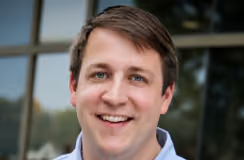
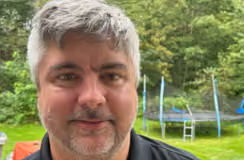
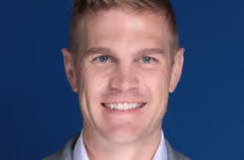
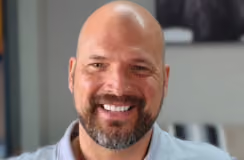


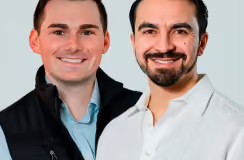





%20-%20thumbnail.avif)

%20-%20thumbnail.avif)

%20-%20thumbnail.avif)
.avif)

%20-%20thumbnail.avif)