Host: We often hear guests on Acquiring Minds talk about the steep learning curve of becoming an owner for the first time. The weight of making payroll, handling people problems, the buck stopping with you. And while that reality is important to shine a light on, so too is the good stuff, the thrill of being captain of your own ship. After all, I think many entrepreneurs would say that not the money is why they choose this path. Today's guest captures it beautifully. Michael Johnson is having the time of his life. His words. The $480,000 STE printing business he just bought has given him agency like he's never felt before. He was able to use his business's resources to help people recovering from the hurricane in western North Carolina, a decision that at his former job would have taken three weeks of paperwork and and ultimately not been his to make. See if you don't find his enthusiasm contagious. Also, you'll hear us refer to the one pager Michael went to market with. You've heard of writing a buyer profile? Michael did a kind of a spin on that and it worked well for him. For reference, we've included a link to that one pager in the show notes okay, here he is. Michael Johnson, owner of SpeedPro Northwest Raleigh Announcements Chelsea Wood has run Acquisition Lab for five years and in that time has witnessed the searches of hundreds of aspiring buyers and had calls with thousands of them. So Chelsea knows what separates those who succeed in closing a deal from those who don't. And next Thursday, December 12, she's hosting a webinar with Acquiring Minds to share her observations with us. In this one hour session, Chelsea will dive into the key mistakes she sees searchers make and how to avoid them to ensure a successful close and ownership period. This is part two of Chelsea's presentation last month on the same topic. There was so much to say. We split it into a two parter and it's not just a presentation, it's a live office hour session with with time for Q and A. So bring your questions and take a big step forward in your own acquisition journey. Come learn from Chelsea's expertise and avoid the missteps that trip up many first time buyers. Next Thursday, December 12th noon Eastern. Register in today's show notes or on the Acquiring Minds homepage. Acquiringminds Co. Welcome to Acquiring Minds, a podcast about buying businesses. My name is Will Smith. Acquiring an existing business is an awesome opportunity for many entrepreneurs and on this podcast I talk to the people who do it. August Felker is a two time successful searcher. First with a traditional search fund. The Second time around he did a self funded search. Today August runs Oberly Risk Strategies, an insurance firm with a dedicated practice group for searchers and acquisition entrepreneurs like you. If you've got a business under Loi Oberle will provide complimentary due diligence on that business's insurance and benefits program. A great no risk way to get to know August and team. They love helping searchers. They've worked with hundreds. Oberly is a specialty insurance brokerage for searchers by a former searcher. Check out oberly-risk.com O B E R L E- risk.com link in the show notes Michael Johnson, welcome to Acquiring Minds.
[3:53] Guest: Will I'm so excited to be here. Thanks for having me. Thanks for the, thanks for the podcast. I really would not be here without your podcast and all the guests you've had on. I've connected with a lot of them and managed to transact. So I'm just so excited to be on this side of it.
Host: Awesome. Well, congratulations, Michael. Thank you for that. We're gonna, we're gonna hear this story today. You're only a couple months in to ownership of a printing business, a business you found very quickly in your search. So interestingly, printing businesses are not uncommon among searchers. I think you might be the third, maybe fourth Acquiring Minds guest who bought in this broader category of printing. So we're going to spend time on what it is that draws searchers, of course, what you liked about your business and what particular niche you operate in. But we'll get there. Start us off with some background on you, please. Michael.
Guest: All right, so I've always been a hustler. As a kid I when I got candy from Halloween or Christmas or whatever, I wouldn't eat it. I'd save it and wait for my brothers and sisters to eat all of theirs and then I'd sell it to them a few months later. Kind of price gouging.
Host: Michael But I respect what you want.
Guest: I was making money, okay. And the government was not interfering with my operation. So that kind of always been a hustler and graduating college or I'm sorry graduating high school. I 911 happened in my junior year. I joined the Marine Corps. Just didn't know what else. I was kind of angry and emotional and joined the Marine Corps. So went infantry, was an anti tank missile guy, machine guns, two tours in Iraq, Katrina relief effort in New Orleans as well. Those were kind of the highlights of it. Getting out of the Marines. I got out as a sergeant which is pretty good. An E5 got out of the sergeant didn't really know what I was going to do next. Started working in restaurants and kind of taking some classes, and I'll say from there, got a job at a metal fabrication shop. Actually, it was my fiance's stepdad. It was his business. And I worked there for several years. And they. With the thought of maybe taking it over one time, I always kind of getting out of the Marines, I had kind of an entrepreneurial itch, but didn't quite know how to do it because I didn't have any money or education or anything. So. But then all of a sudden, this. This happened. So I started working at the metal fab shop. Worked there for several years and ended up not. Ended up not working out. And I left there after a couple years with really no money, very little education. I. I started on the floor, worked up to operations manager and then left. Once again, no money, no education. So got back to school, finished my degree, started working at a crane and rigging company. They had actually just done an acquisition of a smaller. They were out of. They were from Greensboro. I'm in North Carolina. They were in Greensboro, North Carolina, and they acquired a location in Durham. So I came on after the acquisition to run their operations, worked there for several years. And I. But I knew that entrepreneurial. It kept burning in the background, and I. I got my schooling in and the school said, you need money. You have to have money to. To be an entrepreneur. And it's like, well, let me. Let me start figuring this out. Let me see what I. What can I do to make some money? So I just started doing anything I could, whether it was, you know, buying and selling, doing some retail arbitrage, driving some Uber in the. In the off hours. And after a few months of that, I had a. Had a couple thousand dollars. And then I was like, well, maybe there's a business that I could just buy instead of find. Instead of, you know, instead of starting my own, I could buy something. So I started. I started on Craigslist and there's a section for business. And I started looking around there, and all of a sudden I found a vending machine for $3,000. So, Will, this is actually my first acquisition. I went to my wife. We had about $10,000 in savings at the time. And I said, honey, I'd love to take out 3,000 of that and buy this vending machine.
[7:35] Host: And Michael, how old are you at the time?
Guest: So this was 2000, 16, 2017. So I guess was it 2024? I'm about to turn 40 next year, early 30s, I guess.
Host: Yeah.
Guest: So 31, 32.
Host: Okay, great. Maybe $3,000. Vending machine on Craigslist. 30% of your savings.
Guest: Yes. Acquisition number one.
Host: Acquisition number one. What does wife say? Or now at this point, she's your wife?
Guest: Yes, yes, we're married at this point. She said, when are you going to pay us back? And I told her within a year. I said, I think I can pay, pay us back within a year. And she said, okay, do it. And so, you know, took out, took it, went, did a little cashier's check, wrote up a little one page. We're transacting for this amount. This is the serial number on it. You're not going to bother me anymore. Now, this vending machine was at a hotel and it was in the employee break room. So it wasn't for the guests or anything. So it was on the cheap. You know, guest vending machines, hotels, right, you can sell a Candy Bar for $17 or some, you know, you can sell for ridiculous amounts of money. This needs to be a little more price conscious. But the guy I bought it from, he actually had a lot of off brand stuff in there. And there was actually another vending machine right next to it too with competing products. So quickly I got, I realized that the off brand stuff wasn't selling and that was just kind of knowing your, knowing your customer a little bit. These are most of my customers I felt were the night shift for the, the, the venues or for the events. So when there's a conference in town and the waiters and bartenders are there, they get hungry, they get some cash from tips and then they come back and have a munchie. And so they want Doritos at that time. They don't want Tom's potato chips, they don't want some off brand crap. They want Doritos. They want Cool Ranch, you know. And so I got rid of all the off brand stuff, put this stuff in. One day I was in there and just fill in the vending machine. And I usually there was nobody there, but they happened to be a bunch of cleaning ladies sitting around and I said, hey, what do you guys want to see in here? And they said Peanut M M's. And I ran to Sam's club, grab a case of Peanut M M's, came back, gave them all peanut M M and filled it up two rows of peanut M M's. And I came back to fill the vending machine two weeks later and the competition was gone. And I started, I was within about three months, I was bringing in about 400 extra dollars in, in profit. I was making about 800amonth on that thing, and about half of it is profit. So $400 a month for, for years and years on end, which, guess what? I didn't need it to live on it. Just after I paid back the savings, the loan to myself, that just went right into kind of my business account.
[10:08] Host: So. So a bit of a vending machine turnaround story there, Michael. But also it does suggest that, I don't know, maybe, maybe it was just this one case, but that there could be money in vending machines. Vending machine routes are little businesses you'll see, transact, or see for sale on biz. Buy, sell. Did you ever get the, the inkling to, to build a vending machine Empire? $400 a month for a couple of Sam club's runs. Sounds pretty good.
Guest: I, I did. So I started. So one of the issues I saw too, was I wasn't always going through, like, candy. The candy bars, they usually expire six, nine months later. So I. You didn't have, didn't have a problem with those. But the chips are a lot of times only 30 to 45 days, so you've got to move them. So I was throwing out some inventory as it expired. And so I just kept on Craigslist and watched for new machines to come available. I ended up with three machines. The other were in smaller locations, maybe doing 100, you know, 50 to 100amonth. And. But then Covid hit and everything kind of shut down. But I was right up. I had just bought my third machine right as Covid was hitting. So that way I was, and I think I was. I would say I should have been closer to $500 a month, had everything played out, at least, and it could have gone to more. But, yeah, I was, I was actively engaged in it. I kept on craigslist just looking for it. Anytime I heard somebody, I, I, I. The people that were in the vending machine industry in the, in the area, you know, I knew them. They, I talked to them. I said, if you guys are selling anything, let me know. Some people had ridiculous expectations like they wanted, like they'd be at a. I know I looked at a few locations where they were doing, you know, $300 a month, and they wanted $6,000 for it. And I'm like, I'm not, you know, that's ridiculous. Well, the machine's worth that. And I go, the business isn't right. I understood that. And this is before I even knew about buying a business and multiples and all that. It just seemed ridiculous to pay $6,000 to make $300 a month or whatever.
[12:00] Host: Excellent.
Guest: Yeah, I think vending machines are great business. I, I would probably still have my route had Covid hit. Not hit at the time. It did. And new baby and all the other good stuff that we're going to get to.
Host: Okay, well, a first success, a first feather in your cap as an entrepreneurial venture. Then what?
Guest: So I kept working and I was making the money on the vending machines and I started and I. So at this point I had a little bit of cash, I started investing it because the market, this was 2017, 2018, the market's going just straight up. Anyone, any stock you buy, you're just going to make money on. So I just, I started investing in trade. Well, really trading more. And I started writing about it just because that's, you know, I could just put that content out there. Maybe somebody picks it up, maybe it doesn't. If nothing else, it's a journal of my experience. And so I wrote that, I wrote a blog for about two years. You know, I put it up on a real website, you know, so I was hosted, I had an editor looking over things. And so two years, I think I spent a grand total of maybe 8 or 900 bucks and never made a dime off of it. I think I had 12, 12 followers. So one day I'm at a stock, a stock trading conference and all the while I am still working my W2 for the crane and rigging outfit on 9 to 5. So I go down to the stock trading conference and they say, by the way, we're looking for writers to join our team. If you're a writer, go talk to Lisa. And so I go in the back, I talk to Lisa. Lisa says, yeah, give me your email, I'll give you mine. We exchange. And then she gave me a gig and said, all right, here you go, here's a gig for you. And I think, I think the first month I wrote for her, I made eighteen hundred dollars writing. And so I was very able to consistently start writing for her and making about $2,000 a month or so. And so the story goes that all that money I spent getting into it right in the years, just getting those reps showing up, showing up, writing that blog. And the first month that I actually started making revenue, I was able to basically pay myself back for everything I had put into it and then buy a brand new computer, which is the computer I am talking to you on
Host: Right now, what do the following Acquiring Minds guests all have in common? Doug Johns, Morley Desai, Tim Erickson, Chirag Shah, Shane Ursam. They all went through the Acquisition Lab, the accelerator in community for people serious about buying a business. But they represent just a sliver of the Lab success stories. The number of deals across the Lab's cohorts now stands at over 120, with over $300 million in aggregate transaction value. The Acquisition Lab was founded by Walker Deibel, author of Buy Then Build, the book that introduced so many of you to the very idea of buying a business. The Lab offers a month long, intensive, almost daily Q and A sessions with advisors, live deal reviews with Walker, Deal team introductions, and an active community of serious searchers. Check out acquisitionlab.com link in the notes or email the Lab's co founder, Chelsea Wood. Chelseaivethenbuild.com so Covid hits, right?
[15:09] Guest: I just moved in. My W2 moved me into an outside sales position. Covid hits Nobody wants an outside sales guy coming around. I so I was kind of doing both for a while because the market was going crazy. The, the content we were putting out was just doing remarkably well. And so I basically sat at home with two computers for a while and was answering, you know, answering emails and scheduling things for the cranes and whatnot. And then over here I was writing a, writing a blog post or, or a newsletter for the, for my client. All right, so, so Covid's hitting We've got a baby on the way. August of 2020. Baby. Arise little Everly. She's the best. But it was a very difficult birth and I just kind of coming out of it, I knew I could not do both anymore. And so I actually was, I call up Lisa to quit and tell her I couldn't write for her anymore. I didn't have the, I just didn't have the bandwidth. And she asked me, what does it take to make you full time? And I said, 20 cents a word. And she said, done. I was like, oh crap, I should have asked for more. So I think I was making like 15 cents a word at the time. And I go, you know, 20 cents a word and guaranteed. I can't remember exactly what I asked for, but like just so many newsletters and blog posts a week. And she said, done. Absolutely. It's, it's, you know, we can absolutely do that. We put it in writing. And next day I went and put in my notice and they said, well, if, you know, if you're good, you can just leave. And I Go, all right, I'll just leave. And so that was. So at that point, I was a solo entrepreneur. And I did that for the, for the next two years. And I actually, Lisa, ended up that changing over. But I managed to have, have enough contacts and move to a different agency and work there for a while. So two years in, I'm solo entrepreneur. But then everyone starts getting called back to the office, and the price to stay at home got real, real cheap. And so all of a sudden, like, the. I. I couldn't get 20 cents a word anymore. People were offering 7 cents a word and whatnot. And I just, I'm like, I'm not gonna go play in the mud. I tried a few other things, just trying to get something else going to stay to, to keep my own, you know, stay a solo entrepreneur. And eventually I just, I ran out of Runway. I ran out of cash. I knew I basically had a number. I'm like, if I'm under $40,000 in cash in my business account, need to go find a W2. And that was always, always that level that I had. So I got below my $40,000, went and found a W2. Okay, carry on. So, so I started selling steel for one of my vendors. When I was fabricating, I bought steel from Chatham Steel. I. I saw an ad online for them. I called up the outside sales guy, hey, can you put me in, can you put my resume in front of whoever needs to see it? He said, absolutely. Within about a month, I had a job there. So started working on a sales desk, making some commissions and saving back up. I sat there for about a year and a half, and in April 2024, I had better than $50,000 in cash again and said, okay, it's time for me to start looking for a business to buy. Because I go, this time I just need to. I can't go do it by myself, right? I can't be the janitor and the accountant and the producer and accounts payable and receive. You know, I just, I know I couldn't do it all. So I kind of said, okay, the next thing I do, it's going to be a business and it's going to be existing and it's going to have employees to do the day to day. And then I kind of start. So I. Once I had the cash around to start the search, that's when I, you know, I started googling and let the, let the algorithms take. Take me where they needed to take me. And sure enough, found Walker DeBell's book
[18:44] Host: and, and when is this? Now, Michael.
Guest: That's April this year.
Host: April. Okay, we're so we're at April 2024. You. You do a little Googling and find Buy, then build by Walker Dibel.
Guest: Yep, that's it. Great. Okay. And of course, in his first chapter, I think he references the Harvard Business Review, how to Buy a Small Business. So I put the book down for a second, order that book and pick up and read again. I think I went through Walker's book in a weekend, maybe four days. Like I just ripped through it. I was like, this is great. This is such great information. This is giving me some of the step by step that I, I didn't know. And it's also just opening my eyes. Also discovered acquiring minds. I had a 40 minute commute in each direction going from. Because I lived in Cary and I was driving to Durham. So I was like, it was a, you know, I was putting in an hour and a half every single day and just put this podcast on and started listening to it. And it was just such a, such a great resource because it's coming from so many different directions. Right. Yeah, there's a lot of the MBA guys, there's a lot of private equity guys, but there's also quite a few people like me who kind of got scrappy and just did it.
Host: Any stories that you. That were particularly impactful that you can remember?
Guest: I remember Don Bluth just because he was a Marine and his story came on when I already was under loi, but he was a Marine. And Dan Verboski, he's a Marine in the sign industry. And so I'm in the print industry. I'm in this. It's a, I'm in a weird. In between the sign and print industry. Okay.
Host: So.
Guest: But I reached out to Dan, I reached out to Dom and they both, they both came back to me within a couple days. And I, you know, I even talked to Dom. I've talked to Dom a few times just on the phone. Got to give him my background and him asking questions about it. I reached out to Jesse Sapphire up in New York City. We've messaged on LinkedIn a few times as well. So I don't know if there was one story that necessarily stood out and inspired me, but it was like I was just hearing the right things at the right time. Like, I wonder, one of your guests came on and it might have been Dan Verboski there that said if you were in the military, you have the skills to do this. And if, you know, if you were an nco. A non commissioned officer, which is exactly what I was. I was, you know, and I was always a hustler there too. I was making, we called him crack deals. There was no actual crack transacting, but like, I would trade like, you know what ice is worth in the desert? It is worth gold. All right, it is. And I had access to ice, so I could make some, I could go around and make some deals and, you know, get light bulbs or get some electrical service or get an, get an unregulated Internet connection, something like that. So, So I was always, always kind of making the crack.
[21:14] Host: Is that how our military operates? I don't find this reassuring.
Guest: What's that?
Host: That everybody's horse trading their supplies while at the, you know.
Guest: No, you're not. I don't know. I, I, I was very good at it and I, I made things happen when I needed to make things happen.
Host: Fair enough.
Guest: I even got, I got a Nam, a Navy accommodation medal. And it's funny, the write up, I didn't do anything in the write up because they could, I don't think they could put that I was horse trading, but they were like you, obviously. They were, they were, they were very happy with my contributions. Well, and part of that too was I was working on a military transition team. So I lived on a base with about 25Americans and about 3,000 Iraqi soldiers. And so there was a whole lot of just figuring things out. And there wasn't a playbook for training up a military, a new military. And also the people that we're working with, they like, there just wasn't a good, there wasn't a good organization. You know, not to get political too much here, but like, we had the whole anti Ba' Athist party in Iraq. Well, there was only one political party in Iraq, so if you were in the government or knew how to run things, you were a member of the BAATH Party. And now we just kicked out everybody that knew how to keep their army and infrastructure running. So there was just crack deals had to be made.
Host: Wow. I bet that was an experience.
Guest: Yeah. A whole nother podcast.
Host: Yeah. Okay. All right. So you're, so we're here. We are in April. You're. You found Buy, then Build in the HBR Guide. You're reaching out to people that you're hearing on acquiring minds. What does your search end up looking like? Financial criteria, first of all, and then after that we'll sort of industry, etc. Were you looking to.
Guest: Yeah, so I, I took Walker DeBell DeBell's advice and went industry agnostic. And I put together kind of a little one pager which is inspired by him. But I know he talked a lot about putting out that search criteria. I put out a one page sheet. A little bit about me, a little bit about why buying a business is a great idea and then also where the money's coming from. So my requirements were at least 150,000 SDE and multiple employees throughout the day to day. And I also wanted to look for a company that was eternally profitable. You know, something that just. And was dealing with repeat customers. That was. Was another high, high item that I wanted to. To reach the business. Also would be looking for some sort of operational advancement or need a new sales or marketing strategy. Something that was either running well and poised to grow or something that just needed to be kind of gutted and fixed and made more efficient.
Host: Oh, you were, you were willing to do something that was not in good shape, that kind of.
[24:00] Guest: I was open to something in good. Not in great shape that I thought I could get better and make it run better and more efficiently or something that was running really well. That what. That was poised to go to the next level.
Host: Sure.
Guest: And I just had a few things. I, I actually limited. I said I don't, don't want to pay more than $2 million. And that was just because I was looking at like home equity and cash on hand and everything. And I go basically, if I have to come up with 10% to 200,000 is about as much as I can as I can come up with personally. And, and also I wanted to make sure I could get my hands around it. I didn't want to take on a $10 million company with outside investors and all this. And it was, it might have been just too complicated for me. I wanted to make sure it was something that was small enough that I could get in there, get my, you know, roll up my sleeves and, and fix if I needed to, essentially. Okay. And then just couple things. I said no tech, no retail, no restaurants, kind of. I think that those are pretty standard excluders, although there's been people that have been successful in those fields.
Host: So. Yeah, we've had a couple of great stories about restaurants at least.
Guest: Yeah, the restaurant, I want to say that that one, the college town, that was a really great story. I can't remember exactly who that was.
Host: Yeah, Jared Burke, another. Another vet. There you go up in New Hampshire.
Guest: Oh yeah, he was a vet too. Yes.
Host: This one pager, Michael, was something that. What you attached to reach out to outreach to brokers or what did you do with this one pager? Exactly.
Guest: So I didn't, I just want, I started creating it, had it. And I was about to start reaching out to brokers, but I was also cruising, you know, biz by sell. And then this, this printing and this print company pops up and I go, oh well I'm industry agnostic. And then I'm reading through it and I go, this literally meets all the criteria. So I reach out to whoever posted the ad and I figured out what the company was very quickly. They didn't say what it was, but they didn't hide it very well either. Like the person it was, I, her name was Kate that had posted it. While you search her name and sure enough comes UP Speed Pro LinkedIn. So it was pretty obvious what the company.
Host: So the owner posted it directly or no, the, the broker did and then you could go, ah, okay. So it was a franchise.
Guest: Yes. So this is a franchise. So the franchise, the corporate franchise franchisor posted it, kind of acting as a broker. So I reached out to them, they hooked me up with, with the salesperson for the franchise and they basically pre qualified me. I think he was actually the first one I sent the one pager to. I said, hey, just so you know, I'm on the search. This is my criteria. Here's a little one page about me. He said, oh, this is great. Nobody has something like this. Gave me a couple forms to fill out, you know, basic, your basic, you know, do you have some money? And I think, you know, just basically your financial situation. Yeah. So I filled out the form. They pre qualified me to be, to be a franchisee and then they introduced me to the owners.
Host: And so you had, you said that you had basically $200,000 of your own money was going to be your ceiling there.
Guest: Yes.
Host: Great. And you wanted 100. That $150,000 of SDE that you were, that was your floor on earnings potential. Where did that come from? Just based on kind of replacement income or lifestyle or. Where did that come from?
[27:10] Guest: Replacement income? I kind of looked at it as probably there would be two, there'd be three thirds there if there was. And this is something I heard on your podcast, like $50,000 was going to be for my income. Just a bare minimum replacement, you know, that's not putting anything into savings, not contributing to a retirement account or anything like that. Just bare minimum, keeping the bills paid, 50,000 to pay the, I'll say to pay the loan. And I figured with the other 50,000.
Host: Was that to reinvest in the business? To put back into the business?
Guest: Yeah.
Host: Yeah.
Guest: So. So, yeah, so that's, that's kind of where my head was at on it. I didn't. My wife was making a really good income at the time, during this.
Host: Well, I was going to ask, so $50,000 for you with a family. Now you have baby everly who's now 4. Do you have any other kids?
Guest: Just the one right now.
Host: Okay. 50,000 doesn't strike me enough to support, you know, a single person in a major city, let alone three. But you've just answered it. Your wife has. Your wife has a job. Were you expecting to be able to push that 50,000 number higher over time? I mean that.
Guest: Yes, yes. This was. Give us more color on that. This is the bridge I need to. I need to get over right now. If I can. If I can make $50,000 a year, I know I can pay my bills based where we were at that time. Like I said, my wife was making about 120, 130 a year at that point too.
Host: Okay. Okay. So. So you were calculating kind of the full family income.
Guest: Yes.
Host: Excellent. All right, and then what did you feel about the fact that this was a, A franchise business? Well, actually, first, Michael, tell us a little bit more about this business.
Guest: All right, so we'll get into franchise. I'm. I'm. It was fascinating. So I'm really just starting my search and you know, they say, get. Let your network know I'm part of this run group. And I mention it to the guy I'm running with, Stefan, I go, Stefan? Yeah. By the way, I'm going to look at a business I might buy this week or this coming week. And he goes, really well, what kind of business? And I go, it's a printing business. And he goes, did you know Brian is. Has a printing business and he's tried to sell it? And I was like, I did not. I thought Brian was an engineer.
Host: Who's Brian?
Guest: Brian's another guy in the run club. I've been running with him for three, four years. Like I said, I thought he was an engineer. He's an engineer by trade, but apparently has a sign and printing printing business that he's been running for 16 years. So I run up. No, actually it was his full time. He just. He's a certified engineer when he needs to be, but he just. That's his thing. He runs the business. So.
Host: Okay.
Guest: For some reason, it just never came up in conversation. I guess over the Years running with him, we usually talked about kids or something, you know.
Host: Sure. So what does Brian say about the experience of being a printing business?
Guest: All these repeat customers. He doesn't advertise, and he's doing about half a million bucks a year. Just him and one other guy. He's got. He's basically running the same equipment that the guy over at Speed Pro is running. Some of his equipment's a little nicer, Some of it's a little not nicer, but, you know, it's. They're in the same space. And he has just kind of a different niche. He has different customers that come to him and just keep buying from him year after year after year. And that's the nice thing about the print business, or at least where I'm at this wide format business is these are not super high ticket items. So there's not a whole lot of competition. You can go other places, but, like, once the problem is solved, a lot of times this is a very small item on the balance sheet for people or on the expense report. So it's like the problem solved. Let's just keep working with the guy. Yes, I could go shop it out and save $150 maybe. But it's it for most businesses, it's not worth the hassle. And we're in the B2B space, which is really nice because once again, time is money. It's not. I know Michael's going to do it. I know Jeff or John or Brian's going to do it. They don't, you know, once the problem solved, the problem solved.
[30:59] Host: And what does wide format mean? What does wide format printing in. In the B2B nature of this printing business, maybe you kind of break down a lay of the land. Most people think. Printing business, they think, you know, what is it called? FedEx Kinkos.
Guest: Yeah.
Host: Where you go in and you get a hundred copies of whatever you needed printed. But that's obviously not what we're talking about here.
Guest: Yeah, no. So that's. That's the small. Small. And I. I'm learning all this too. So if any print guys are listening and I mess it up, I'm sorry. But that's basically the small format. Yeah. They'll do flyers, business cards, brochures, booklets, things of that nature. We do, basically, we have printers that are 54 to 60 inches wide. And so we print things like graphics and decals for vehicles. We. We could do full vehicle wraps. 50% of our business here is vehicle wraps. We do trade show displays and some of that is printing and then putting it together with some hardware to give you a really nice display. We do wall murals. So those will print off in, in sheets. Even what you see behind me here, if you're watching on YouTube, this is a wall mural that we put up and it's actually put up in series of 54 inch wide strips. And so most. And we've been doing those. I do those at churches now. A lot of churches. It's actually a low. You can go and I can put up a big wall mural for $3,000 and you know, compare that to like a, a renovation project. You're probably looking at, you know, $20,000 to start something. You can get a really big impact from a wall mural without a whole lot of investment.
Host: And some of this stuff, like you touched on with Dan Verboski, some of this stuff does start to feel like the line between this and signs is blurry.
Guest: Yeah. So we do. And we are. Yeah, that's it. A lot of the wide format people would argue they're more on the signage industry than the print industry. So we do also a lot of signs in terms of interior wayfinding. We do a lot of signs at the mall, at our local mall here, you know, but a lot of the temporary signage too. You know, the Santa line starts here. You know, donate to this cause this coming week or this coming month. So I hope, hope that's kind of showing a little bit of what we do. I'm actually doing a, a light. A home show. They're doing a big home show at one of the local convention centers here. And we're doing the, the schedules, the entertainment schedules, the seminar schedules, the wayfinding, and then we're putting some banners up outside. And so that actually is a little bit adjacent to Adam Markley with his flagpole and banner business, which Adam Barkley actually ended up. He, he was a great connection. At the 11th hour of the deal that I made that he. I want to, I want to say,
[33:30] Host: I want to hear that story because it's a, it's a good one and what Adam told you was great. So we're going to, we're going to get there in just a sec. But, but Michael, the. So, you know, it's often said that kind of printing is dying. Frankly. What they're talking about there is kind of small format stuff. And, and let's take Jesse Sapphire as an example. He does small format is what he is. That's the correct vocabulary.
Guest: Yeah. And he actually met. He does some wide format too. He was an encouraging note when he was on, because I had, because he even said wide format is growing. That's a great space to be in. And I reached out, I'm like, thank you for saying that. You just, you know, took another brick off my shoulder.
Host: Oh, good, good. Because, because he does small, as I recall. He does small format, but he has this incredible niche of basically big Wall street firms who need, you know, hundreds of pages for investor, you know, memoranda and stuff like that. So, so it's this niche where they still, there's a lot of demand for pieces of paper to be printed with words on them. But in general, in general, that is, you know, obviously going away with the digitization of information and digitization of everything. Right. So that, that's where the kind of printing businesses that are. The printing industry that is on the decline, first of all. Is that true? Is that your understanding as well?
Guest: So, yes, that's, that's the research that I've seen. Even, even when we got to the valuation, they, they said that this is not a, they didn't call print a growing industry.
Host: Okay. But then the wide format stuff actually is growing and it's a completely. Obviously different markets. It's more marketing.
Guest: Yes.
Host: Okay.
Guest: All right. Yeah, A lot of it's last mile marketing or just those billboards, you know, you know what it, I think it's about $10,000 to get a billboard and actually have it put up on, you know, next to a highway. And then you're paying rent every month on it too, which could be anywhere from, you know, one to $5,000 where you can get a vehicle wrap for three, three or $4,000. A whole wrap looking awesome. And it's a one time fee. You don't have to, you know, it's good for three, four, five years sometimes. And everywhere you go, you're advertising to your customers your part. If you're a plumber and you parked in somebody's neighborhood, well, guess what? I don't, I don't know a good plumber to call. I do, but then they're always busy. And so every time I see what I was like, even before I was even looking at this business, I would take pictures of that so I could remember it and find their phone number when I needed a plumber or when I needed an H Vac guy.
Host: And so just by the way, on vehicle wraps, I've never seen it done. Don't know how it's done. So you all print it? Do you all do the wrapping as well?
[36:07] Guest: So we Hire out the wrapping. I have third party contractors that come in and do most of the wraps. Little decals. If it's just like a door decal with your name and a phone number, we'll usually install those in house because Those are usually three to $400. They're rather, they're pretty, they go on rather quickly. The full wraps, a full van wrap like you take like maybe a sprinter van or something that'll take two people an entire day to do. And, and so I like to keep my employees working, making sure my equipment is running and let the installers do the install.
Host: Okay, great. Very interesting. So how, what did this business look like in terms of numbers, please?
Guest: So they advertised 480 in SDE and they did about 1.1 million in 2023. And so those numbers look.
Host: So those, those numbers to you looked amazing.
Guest: They look great. Right? I'm well within my maximum purchase price and I'm well over my SDE target. Like just checks all the boxes, repeat customers, multiple employees on site. I have a background.
Host: How many employees, Michael?
Guest: They were running to five people total. But it was a husband and wife team selling.
Host: Okay so. And so husband and wife plus three.
Guest: Yes.
Host: So for many guests that's going to sound like a very, very small business. But for you, you were coming from having done a vending machine solo and having to wear all the hats. This was feeling like a bigger business than you, what you were used to. And it was checking the box of you don't want to be the person doing everything. So here, there, there's this five person business feels, feels great.
Guest: And Brian, Brian, it's funny. Brian shop, my friend, his shop is literally right there. Like I can throw a stone and hit it. And it was so funny that they're in the same, basically the same parking lot. And the fact that he was doing for 16 years half a million dollars with him and another guy and he was bringing home, you know, in the 150sde range and it's just him and one other, one other guys. So it just seemed like, okay, this is very attainable. And also I, I was the crane and rigging outfit and the fabrication. Those are small businesses. A few more employees. I think that fabrication wise we would, we would vary. We'd be up to 10, 10 employees at the slow season. Go up to 20 when we get busy. The crane and rigging. We had about 20, 25 employees out in the field doing the work. So I don't, I. Small businesses don't scare me. I had done so much with small businesses and also. And working at Chatham Steel. They're part of the Reliance Steel and Aluminum, a massive, massive conglomerate. I was so miserable there. No offense anyone from Chatham that's listening. It just wasn't a fit for me because I. They wanted me literally tied to this sales desk. I couldn't go into the warehouse and do a stock check because they were worried I'd miss a phone call or something. And I. And, and then nobody at the. But it was all kind of the bickering. Nobody wanted to do a stock check for me. So where normally I could. At a small business, right, I could just walk out and do a stock check and come back where there I would be. I would wait two days sometimes for a stock check. And obviously the customer didn't wait two days. They went and bought it somewhere else.
[39:12] Host: Yeah.
Guest: So I, I realized that the big conglomerates, the massive. Was just not for me. I had no fun at Chatham Steel, I'm sorry to say. I just. It was, I was miserable. But I managed to make. I knew the business enough. I was able to make some good commissions on it, but it was just not a good fit for me. So I. I figured I'd be better off in a smaller business. And five employees is, I think, perfect. You can do a lot with five people. Right. And also there's a huge potential for growth with this as an industry too. I'm like, in this. There's a couple other franchises in the area and they're doing two to three times the revenue I am right now. So. Yeah, like I just.
Host: But franchisees in your same network in the Speed Pro Franchis world?
Guest: Yep. Yeah. Apex, they're doing almost 3 million. I think they, they might do more than 3 million this year. And then the Raleigh one, I think they might be around three or four or something. I mean, they're.
Host: So what was your assessment that this, this store was doing so much less than neighboring ones?
Guest: Well, it was basically the owners, they. So Jerry and Kim, they. Jerry was a. He was. He worked for an aerospace. He was a VP director level person. 2008, 2009 collapse hit and he got laid off. And now him, you know, he was, he was. I don't know exactly what he was making, but he was making a good salary. But in. When layoffs happen, you start targeting those big numbers that you don't necessarily need. Obviously the C suite stays because they're the one making the decision. And the people that are putting things out, they stay because we need to keep producing. But the middle management level, they start getting cut. So all these VPs and directors are out there hunting for the same jobs. And he said, this ain't going to work. And so they took out, if you've heard of the Robs program, they basically use their IRA to buy this to start up this business. And his, his, their whole thing was 15 years. We're going to run this for 15 years and then we're going to retire. And so 20, 24 was 15 years and they were setting out to retire. So they, they never wanted to grow too big. Yeah, just because they, I think they were just basically looking to replace the income they lost from that layoff. And they did that and they had. And I probably bet you they made a lot more.
Host: That's a perfect narrative for you to get comfortable that this business is, is not realizing its full potential, that this was a husband and wife team who were basically just trying to ride something out to the end of their careers, hitting a certain income threshold, but they weren't hungry to get as big as possible. So you coming in younger, with some hunger could, could in theory push it much further than they have. And then, and then you have these great benchmarks of these neighboring territories or neighboring stores in neighboring geographies that are doing so much better. There's, it's not, it seems that much more realistic that you could double your business. An SBA loan broker, as opposed to a direct lender, doesn't work for a particular bank. Instead, the broker pairs you with the right SBA lender for your deal based on industry terms, risk thresholds, then helps you navigate the process better than many lenders themselves do. Matthias Smith of Pioneer Capital Advisory is just such a broker. Matthias worked at two of the country's top 10 SBA lenders. So he's been on the inside of the SBA process and knows well the pitfalls and hurdles and how to avoid them. He struck out on his own to laser focus on the ETA in search space. Our niche is his niche. You'll see Matthias at all the ETA conferences. He's closed over 30 search deals since starting Pioneer in May of 2022, including some acquiring minds. Guests, to learn more and get in touch, go to pioneer capital advisory.com or click the link in the notes. Okay, so is 1.2 million 480, 480 in SDE and 15 year old business you just finished telling us. And tell us about how the negotiation goes with. What did you say their names were?
[43:21] Guest: Jerry and Kim.
Host: Jerry and Kim. So. Or I guess you Go through the broker for the franchise or the salesperson for the franchise. Take us through the, through the negotiation and transaction because there's a couple of interesting twists and turns.
Guest: Yeah. So I mean, they, they, they want a lot of lawyer involvement, which a lot of sellers don't. They were very happy, like, even when I wrote them. So I met them, I, I, you know, I showed up enthusiastic. I used the method of, you know, interviewing for the CEO position and taking everything they say and just believing every number they put out there and figuring you follow up and you figure the rest out in due diligence. Right. And so I came in there enthusiastic, excited about the business. And it's true, I'm an enthusiastic guy. This is me every single day. Well, so I hope it's, I hope it's coming across. But basically, once the, once the sales guy made the introduction and pre qualified me as a franchisee, he said, now it's up to you to figure out the rest. So, you know, I, this came about so quickly. I had just, I had just reached out to Live Oak and they gave me a nut. You know, they said, okay, sign up for our office hours. That's next Tuesday. And I go, okay. So I signed up for the office hours. But like over the weekend, all of a sudden I'm like, I'm gonna go see this place. And then Brian's talking about he's actually got his business, he's trying to sell too. And I'm like, I gotta talk to a banker. And so I just, Then on Monday morning, I get out, I go to the SBA's website and they have a list of professional preferred lenders. And I started going down the list and calling every single one of them, emailing. Most of them never reached back out to me. Huntington even never reached back out to me. Live Oak told me to go, go to the office hours, which I did. That's, that's a fantastic resource. Anyone can go to it. Just go to Live Oak and sign up and you can. They have office hours every Tuesday.
[45:00] Host: Lisa Forest.
Guest: What's that?
Host: Is that, is that the one hosted by Lisa Forest?
Guest: There was, there was not a Lisa on it. Okay, maybe she was, maybe she's the normal. There was, there was two guys, I can't even remember their name. It was very informative. They, they put out a lot of good information. It's completely free. So, you know, if you're curious on financing, go sign up for that. You don't even have to transact with them. The deal was pre qualified through Live oak. But they were just very, very slow to respond. So I ended up getting a hold of somebody at Truist. Todd took my call day one. Todd got the deal over the finish line at the end of the day. And I, Todd, Todd will still take my call today. So I found my, found my banker just by going down a list and calling people and harassing them. And you know, if I got told no or didn't get called back, I moved on to the next. I basically, Todd told me get, he goes, bring me in an loi and then we'll, we'll go from there. So I, I, I, after meeting with them, after seeing the business, I wrote them this little one page loi and they came back with a list of things they wanted on their loi from their lawyer. So I wrote a five or six page loi, hired my own lawyer, and my lawyer said, well, I can, I can tweak that thing for you. And sent it with about three days for them to think it over. They let it expire. And I said, okay. Well, I sent a couple emails. They said, ah, we're thinking about it, we're thinking about it, blah, blah, blah. So I reached back out to the franchisor and I go, hey, you know, this business is really cool. Do you have anything else in the area? And he said, yeah, Greensboro is actually looking to sell. So I went out to Greensboro. I, I spent a day with him. I kind of, I took a day of PTO and went out to the Greensboro location and hung out with him. He was really cool. He let me in during office hours. We were hanging out for about a half day together and I said, okay, you know what, I think I'd be willing to move. I'd be willing to relocate if the wife is. And the wife said, yeah, you know, I'm working remote anyways. You know, maybe we keep me close to the airport so I can get up to Pittsburgh from time to time. And yeah, let's, let's, let's see if we can make that one work. So then the night I get back from seeing Sterling's place in Greensboro, I think the franchiser might have been nudging people behind the scenes a little bit. And so that night, 9 o' clock at night, I get an email from Jerry with a revised LOI and saying, we're ready to sign this at 5 o' clock tomorrow. Oh. So I said okay. So I stayed up late reading through it. Didn't see anything too terrible in the loi. I made a couple little tweaks sent it back and said, this is a document we signed. And they said, okay, that's good. And we met at 5 o' clock and signed it.
Host: Michael, is there anything back in this. Back and forth with them in their. Lois. And that they dragged their feet for a few days and that the franchisor, the salesperson for the franchisor had to nudge them. Is there anything to glean from that? Anything that, you know, they put into the LOI or you put into that your lawyer put into the LOI that we can learn from or not really. Just kind of a lot of boilerplate and maybe the process.
Guest: A lot of boilerplate stuff. I mean, they really made. They changed the LOI to be very much in their favor. Their lawyer did. And I didn't want to. I just didn't want to have a lot of back and forth. You know, time kills. Deal. So I go, let me just sign the loi. Let me give them. I think I give him a $10,000 deposit for earnest money. And so I was willing to risk that. And then I send the LOI to my lawyer, though, and she looks at it and she goes, you realize that they. The way they wrote it was basically that they could. They could basically take that $10,000 and run if they really wanted to. And I said, well, because it was
[48:33] Host: like one of these that was like if for any reason. Something, something, something. Yeah, basically the only reason you forfeit
Guest: this deposit, the only reason I could back out is if I discovered some financial information was inaccurate, that they misrepresented something. And I said, well, I can almost guarantee there's one number decimal place off somewhere that I can have it out. And I go, and if their only goal here, and this is, you know, as my lawyers preaching to me about how. How terrible this LOI is for me, I said, well, you didn't bat an eye asking me for a $7,500 deposit. And end of the day, if I lose $10,000 on this deal, I will have learned a whole lot and. And I'm not gonna be happy about it, but I'm gonna lick my wounds and get up the next day and go. The other thing I'd say is, you know, just. I didn't. When they let the LOI expire, I said, okay, and I moved on. I went and kept looking for other deals and kept searching. I wasn't going to just sit around and wait for them to come back to the table. I knew that I was a pretty qualified buyer based on interactions. I've had with people I know they were talking to. They were, they were talking to other potential buyers too. And I kind of just, you know, I, I said I gotta let these cards play out. If they're, if they think they can find something else. They never negotiated on price. They offer. They asked 1.6 million. I offered them 1.4. They never negotiated on price. And but yeah, I don't.
Host: So in all that back and forth with the Lois, the or with the loi, all the versions of that, the, the price was not something that they were.
Guest: Price never changed. Nope.
Host: Screwing around with. So you, you they want asked 1 6, you came back with 14 and they didn't touch that. Okay.
Guest: Correct.
Host: And then you. So you after some back and forth after them kind of ghosting you momentarily. Yeah.
Guest: Two, three weeks of silence. So. Yeah.
Host: Yeah. And you really had moved on in your mind?
Guest: In my. I had to because I couldn't. I wasn't like it'd be great if they come back. But also I'm, I'm listening to the podcast. I'm understanding that there. These things take time. It might be two or three years before I find the right business. Right. It. It. And to transact on the first one, that's ridiculous. I got my at bat. I wrote an loi. Now if nothing else, I've got a great boilerplate that I can take to the next one that's been lawyer reviewed. I've m done. The interview, the initial interview, I, you know, I've learned more terminology. I didn't know what APA was an asset purchase agreement. They mentioned that on the first phone call and I'm like googling it. I'm like, oh, what is apa? Okay. You know, so I'm trying to fake it till I make it right. So, you know, for me, I was looking at it even when I first saw that business. I go, let me get a rep in right. Let me get an at bat and just see what happens. I know I can go and buy a course for 10 or $20,000. I go, or I can spend some money and just try to do a deal and see what happens. Yeah. And I'm a, I'm one that I don't mind. I don't mind failing. I don't mind falling on my face because I usually learn a whole lot in that process.
[51:28] Host: Yeah, well, you do strike me, Michael, I mean just hearing your story as somebody who's. Whose personal balance sheet has kind of gone up and down and up and down and you're not afraid you're not afraid to lose money, which I think comes from your experience being able to get yourself back rather quickly to, you know, build your, kind of, build your, your net worth back up from, from zero here and there.
Guest: Yeah. I mean, essentially. Yeah, because end of the day I could, I could sell. I'm a great salesman, especially with, you know, certain industries. And you know, I, I, I'm not toot my own horn. I just know that about myself. I know I can go out and get a job. And the, you know, the theory it's, it's been floated a hundred times on here is let's say I take this business and run it into the ground and declare bankruptcy. And you know what I have to do tomorrow, I have to go get a job. So.
Host: Yeah.
Guest: And you know, and working at W2, I go, okay, so my worst case is my today, my worst case is I have to come back here and tuck my tail between my legs. And even going visiting some of my old employers on sales calls, I jokingly walked in and said, hey, wonder if you have a job application. My old boss at the crane and rigging outfit, he goes for you. I absolutely would hire you to harpy Michael. I appreciate that. Unfortunately, I'm taking taken, so. But I, you know, I've, I've always built good relationships with my employers. And I think it speaks volumes just about how I do business that at the fabrication shop, I managed to get hired by both one of my vendors and one of my customers.
Host: Yeah, yeah. No, it's, it's a great point. And it is a great kind of backstop to have so much self confidence and market validation from people who've tried to hire you would, would have you back in a second. That you can pretty readily get a job if you have to in a pinch if, if everything else goes to help. Okay, so you. Okay, so it's 1.4. The LOI is signed then. What?
Guest: So the LOI signed. We actually, it was so funny when we got the day we signed up. Jerry was like a little kid and we used a ceremonial pen to sign this thing. And that's why I had a little more confidence. You know, obviously the lawyers looking at it and saying, I don't like this clause and I don't like this clause. But Jerry's excitement when I walked in on that Tuesday or Thursday afternoon to use a ceremonial pen. And as soon as I walked in the door, he brought me to the back. Look, we're wrapping the, we're wrapping the van for you. We're Putting a fresh wrap on it. So you have a great start. I found, I think some of that was actually required by the franchise, but I let him take credit for it, you know.
Host: So what's your point here, Michael? That his excitement to do this transaction made you feel like what?
[54:04] Guest: That he wanted to do the deal and he was excited to have somebody excited about the business. And I came in excited and I'm still excited. I'm having the time of my life here just, you know, running the business day in and day out and having, having it all on the line. And the fact that, like I said, he was actually. He was just like a little kid with all these little things for that I was able to kind of get over some of the clauses that his lawyer wanted to see because. Yeah. So could I have negotiated the LOI for another three weeks and paid lawyers another 10, 20 grand? I'm sure I could have, and I'm sure my lawyer would have taken the money, but I just. It didn't seem like a good use of capital to me. And once again, what's my risk here? 10 grand? Maybe it sets my search back a couple months. I'll go get some more commissions.
Host: And so the fact that the loi back and forth with them was a little. Not smooth. They ghosted you and so on, and they came back with a really unfriendly LOI to you. Didn't seem like it soured the relationship. In fact, when you guys get to the signing table, everyone's feeling warm and cuddly.
Guest: Yeah, yeah, absolutely. So. And also, I didn't look at it from the my law. I didn't send it back to my lawyer before signing it. I just signed it.
Host: Okay, okay. So they were making changes right there at the signing table.
Guest: They made changes and then sent them to me the night before. And I. Even if you're in the legal profession, know anything about it, that's like, that's a really bad. It's a really lousy thing to do to somebody. To send somebody a document at 9 o' clock at night and say, let's sign this tomorrow. That's. That's not nice. But they did it and I tolerated it.
Host: Okay, okay. All right. So you sign.
Guest: I signed. We started due diligence, period. You know, one of the first things was I asked my lawyer, I go make sure that they own the business and have the right to sell it. And the next day, turns out they owned 1.2% of the business, and they had. And that's when I discovered the Robs program and all these layers and everything. And so they owned.
Host: What. What did you say, Michael?
Guest: They owned 1.2% of the business. Their trust owned 98 point something. The balance, 98.8%. And so it was like, oh, okay, so that's. That's a new discovery. Because Jerry and Kim signed the loi. Their trust did not. They did not sign it as a representative of their trust. So it's just kind of one of those things like. Okay, so now we obviously have to sort through this and make sure this is where lawyers are important because I don't know, I'm sure I would have discovered that at some point. Right. But like, they looked at that and said, oh, look at the tax return. Look who actually owns it. Then we need to get. And they were like, we need to review all the trust paperwork to see who would set up anyone else that has, you know, a controlling interest in it or anything like that. Which obviously I did not have any of that pre loi. So right then and there, I felt like I had the out I needed at, you know, with. With our 30 day due diligence that I could. I could take my money back and run if I needed to. Yeah. And so, Michael, just to be clear,
Host: that whole ceremonial bit with the. The pen and the night before changes to the document, that was the LOI signing. That was the loi.
[57:05] Guest: Yeah.
Host: Okay, so. So it sounds like that was. That was treated with a lot more weight than typically than getting. Getting an LOI Typically. I mean, sounds that. That sounds like it was treated with the ceremony of getting the asset purchase agreements assigned.
Guest: Yeah, no, yeah, it was. I think the LOI was more ceremonial than the apa. The APA was signed by a docu sign circulated on a Tuesday afternoon at some point. You know, like.
Host: Interesting.
Guest: Yeah. So the LOI was kind of more of a statement. You know, we went and did a 30 day due diligence. I had my accountant look at the numbers. You know, basically he kind of verified. Yeah. That he. It was funny because he goes, to me, he goes, now I can't tell you this is a good business. I can look at the numbers. I go, you can look at it and tell me if there's red flags or whatever. Right? He goes, oh, yeah, that's what I'll do. And so I met with him and he went. I gave him a week or so to go over the papers. And then we met and we kind of talked through it. And I remember as. As I'm leaving, he goes, this is a Good business. And so it was just funny that he even said that he couldn't do it, but then ended up saying, yes, this is a good business.
Host: Great, Fantastic. What do you think that he saw? Just the quality of revenue, the repeat customers, the.
Guest: Exactly, yeah. Just see the grow. He saw the, you know, the numbers have been growing over the past three years. They survived Covid, they pivoted because 30% of their pre Covid, 30% of their business was trade shows. And so that business disappeared overnight. Just gone. Right. 30% of your revenue. But they were able to ramp up on the vehicle wraps. And so, you know, they, they made it work and they pivoted and they had it. I guess their equipment is versatile enough that you can do quite a, quite a few things with it. So if one, one particular sector or industry is dragging a little bit, you can try to push the other ones.
Host: Yeah. And Michael, just on the vehicle wraps. 50% of your revenue comes from vehicle wraps. I'm just asking myself like how many vehicles are really wrapped? When I drive around town, of course doing acquiring minds, I now notice this sort of thing. I don't feel like I. For all of the kind of types of businesses that might have wraps, the plumbers, the landscapers of the world, etc, I don't actually feel like I see that many full on wraps where it's like a nicely done entire vehicle wrap. It still seems like it's not that many vehicles on the road. So I'm just wondering like how many people are really knocking on your door to do a vehicle rep?
Guest: I mean I, I am. If you wanted to sign up for a vehicle wrap today, it's the 11th of October, I would have to put you on the 7th or 8th of November, man.
Host: And so what is your capacity? Like one a day to print?
Guest: I can do, yeah, I can do one to two a day depending on like if some of them do a three quarter wrap or a half wrap, I could do two, I could do like two three quarter wraps in a day. And so now it does take a little bit time in planning because we print the material and it's eco solvent it's called. And so that actually creates a chemical bond between the, the ink and the, and the vinyl. And opposed to just printing where you just put a layer of it on there, we can do that, but it stretches better if you use this printer. But that takes a day to dry. So we have to print it, let it dry overnight, laminate it the next day and then cut it out on our, on our cutting Machine. Basically, if you're familiar with a Cricut, I have a giant cricut that just cuts it out for them. So it's a. Basically one day to print, one day to laminate and wrap or laminate and cut, and then another day to install. So we do have a little bit of a process to get it all ready.
[1:00:34] Host: Okay. But roughly, you're selling one of these a day, one to two of these a day sort of thing.
Guest: Wow. I mean. But I have a fleet customer right now with 16 box trucks.
Host: And of course, a fleet order will fill up a month.
Guest: That's a hundred thousand. It's about a hundred thousand dollar project.
Host: Oh, great.
Guest: So, yeah, so those, those things do come. And you know, also the great thing is some of these, some of these companies are growing. I, I'm so excited when they bring me, hey, we're putting two new vans on the road. We're putting two new trucks on the road. And they bring, they buy them. Half the time the dealership delivers them to me and they. We wrap them and we get them out the door.
Host: Okay, back to the transaction. Carry on. Where were we?
Guest: All right, so we were in due diligence. There wasn't a whole lot of leaves
Host: by saying, this is a good business. That's where.
Guest: Yeah, well, he. Yeah, yeah, he finished saying that. Even though he said he wasn't going to say that.
Host: Right.
Guest: Love you, Tim. Sorry if I'm dying, if I'm dropping dimes on you here. He's still my accountant.
Host: He's.
Guest: He's awesome. I really like doing business with him. And So I met July 9th. I've got my notes here was our last day of due diligence. We ended up. We had our initial LOI, said 30 days of due diligence. About a week before that came up, I talked to the banker. They said, we need more time. I went back to Jerry and Cam and said, I think I go five more business days. I think July 4th is on a Thursday. I go, we can't count July 4th and we're not counting July 5th. So that pushes due diligence out to July 9th. I talked to the banker the morning of July 9th. This was Ronnie, not Todd. Todd cut. Ronnie's the SBA guy. And so I call up Ronnie. I go, ronnie, how are we looking? His exact words are all positive feedback. But I don't have a commitment for you today. I said, okay. I go, but it's. You're. You feel good. You feel warm and fuzzy. He goes, yeah, I mean, he Goes every. It's all been positive feedback so far. So he kind of, you know, kept his cars a little close to his chest, but let me know that things look good on his end.
Host: Okay.
Guest: So then instead of asking for another extension, because I just didn't want to, I let. I let the due diligence money turn cold and kind of had that. Okay, going into. Going behind the moon, right? The dark side of the moon here, coming out the other side. Let's see what happens.
Host: And.
Guest: Oh, the next day at 10 o' clock in the morning. Ronnie call. My phone rings. It's Ronnie. I, you know, I'm at my W2, I walk out into the parking lot. I literally jumped in the air when he's like, yeah, we got a commitment. We're doing it. And so just. I remember just that moment of excitement because I was actually worried that the cameras at my work were catching me. Like, nobody's this happy at work.
[1:03:04] Host: What's this?
Guest: But it was, it was just, I don't know, it was really exciting and just kind of this, wow, we're actually doing this. I'm. They're going to loan me $1.4 million or 1.3 and change. Whatever. It came out to be awesome.
Host: It's an awesome moment.
Guest: Yeah. And then, so we got in the next. I'll say they sent me a letter, a commitment letter. Me and the wife signed it, send it back to them, and then, you know, we get an introduction to the closing team. Closing team is like 10 people. It was outside lawyers, internal lawyers. There's a closing representative, Alicia, she's really cool. She was great to work with, too. All these people at Truest Bank, I can't say enough about Truest bank, to be honest with you. They were good. Even when they were like, here's the commitment letter, by the way, we want a 7, 500 deposit. I said, okay, I'm actually taking. Driving to Charleston right now. And like, no problem. We'll let Charleston's bank go to this. Go to this bank and we'll let them know you're coming. And like, sure enough, like, before we even check into our hotel, I went, I swung by the bank, gave him the check. I was in and out. The bank manager came out, was happy to have me there, shook my hand and everything. So it was like everyone I dealt with at Truist the whole time was just awesome and just made the transaction, made me feel like my business mattered where. I felt like, you know, $1 million to a bank is. Is nothing, Right? But I Don't know. I really like them. Can't say enough about them.
Host: Great. Nice plug.
Guest: Yeah. So we're getting towards the closing table and everything. Every step of the way there's this. You get a whole new list of things you're needed. I got a lot of compliments from people on this, is that nothing sat on my desk for long. When the bank sent me a list of 20 items, if I could knock out 16 of them that night. I knocked out that 16 and said, I'm. Here's where I'm at on these other four. You know, waiting on this person, waiting on this feedback. My lawyers looking over that, my accounts looking over that. Here are the answers and all the documents for everything else. Once again, closing table. Another list of documents. Just started knocking them out, knocking them out. One of the things from the bank was we need a valuation valuing this business at $1.4 million or more. And so this was this, I think the biggest hiccup of the, of the whole deal now because the valuation, it came back and we were about two or three weeks out from closing and actually had two hiccups very close to each other here. And the valuation came back at 1.2 million, 1.18 to be exact. And I was like, well, crap, they're not going to go for that. And I was so focused, convinced that this was deal was going to go through. I had actually stopped listening to your podcast, Will. I had gone out of searcher mode and I was actually listening to Jesse Sapphire's owner operator podcast, which is, you know, really good. Cause this started to get in that mode of owner operator. Cause I know I'm going to be getting my hands dirty in the next, in the next few weeks. And I was, you know, trying to get in that mode and this valuation came in and I go, I, I gotta get back in searcher mode. I need to be thinking about this. Cause I need to know, you know, I probably need to be looking at other deals. Cause this one's probably falling apart. I had to get that in my head too, that I need to be willing to walk away at this point. Because I, I can't do something that I, if I can't do it, I can't do it. If the money's not there, the money's not there. And so the banker basically said too that I couldn't. I, they wouldn't even if I showed up with the money or the sellers offered to take a note, they weren't going to transact above this number. And I Was trying to think of some crack deal way of maybe I can hire them as consultants for a little bit to balance it out. Maybe I can cash out some more of this and that and just trying to figure out what, what can I do? Maybe I can borrow some money. And I. So I fire up your podcast that morning on the way into work and Adam Markley, his interview was on, I think it just come out that day. And I was like, this guy is awesome. I need to talk to this guy. So anyways, so I, I get to work, I send him a message on LinkedIn and I go, well, I need to still be a good person and be a good person to do business with, even if this deal is gonna. Is at. On its deathbed right now. So I forward the appraisal to Jerry and Kim and say, let's talk this evening. We always had a kind of a seven o'. Clock. Anytime we needed to talk, it was always seven o'. Clock. I think they wanted to get home and have dinner first. And so we set up a 7 o' clock meeting and I sent Adam that note and I didn't, you know, didn't hear back from, didn't hear back from, you know, work ends at five. I drive home and it's six o'. Clock. My wife, and I'm going to interject this. Two weeks before this, my wife had gotten laid off, which also, that was kind of our other big hiccup because they had, you know, looking at financials, the bank and everybody else, they always asked, what's the household income? And my wife's making a nice paycheck. And then she got laid off. And I remember the. She got laid off at 9:00 in the morning, called me, talked about it, talked about it. She goes to kill the deal. I go, it might. I called Ronnie. Ronnie, got a level with you here. I don't need to have any more sunk cost in this. And he goes, no, I think we're good. I'll double check with some people, but I think we're good. Let's keep carrying on. I go, oh, okay.
[1:07:58] Host: So why do you, why do you think that it didn't factor into their underwriting?
Guest: I have no idea. I really don't because I thought that that was an important part of it, how I was going to be able to make, make the debt payments. But basically I think there was enough revenue in this particular deal. They grow.
Host: Yeah.
Guest: That this can work. So yeah, they, they came back and said, no, we're good. We weren't going to ask you. He goes, I would have, we would never would have known we weren't going to ask for pay stubs or anything like that. And so that was kind of good to know. But he goes, I think part of it too was, was the relationship I had built with him. The fact that I, I called him up and was honest with him when it happened, we hit a snag. I didn't try to hide it. I didn't, you know, I just said, let, let me be open and honest. And I think for Ronnie and Todd, they were kind of like, this is the guy we want to do business with because he's not just going to miss a payment. He's going to call us if he's having a problem, right?
Host: Yep.
Guest: And so I think a good portion of it was just the relationship I had built with them over the past couple of months.
Host: It's a great point. It probably was those two factors that and the, the numbers out of the business. 480,000 is, you know, that can replace your entire family after, even after debt payments, even after reinvesting into the business, even after some J curve that can, that you'll have enough left over to, to meet the 170 total family income with that, your wife not having any money or any income W2 anymore.
[1:09:15] Guest: Okay, yeah, so my wife is. So I get home, my wife had a, some sort of networking call that she was taking because she's obviously on the job hunt because, like, we need, we need to act like we're not. This deal's not going to go through still. We still need to be prepared for this thing to fall apart. So she's obvious, she's out there looking for jobs, taking interviews, doing the networking. All the good stuff you do when you're, when you're on a job hunt. So she steps out, it's like maybe 6, 6:15. She's on the front porch. I've got Everly inside and Everly's being rambunctious. And then Adam texts me, or Adam messaged me back on LinkedIn. He goes, I've got five minutes. Send me your number. And so that's Adam Markley. I texted him and I go, I'm with a toddler. And he goes, I don't care. So he gets on the phone with me and he goes, I, I, I understand you're in a situation. I go, yep, I'm meeting with them in 45 minutes. He goes, give it to me, I don't care. Just tell me what's happening. So he Kind of skipped the pleasantries. I told him the situation, the offer, where we're at now. We basically, the bank says, It's 1.2, it's nothing. And he goes, you just been handed a gift, Michael. Don't look at it any other way. You've just been handed a gift. Because you know what? They have sunk costs in this, too. And there's. And they are. No. No private equity is going to come after them, right? This deal. They would be in the exact same boat with any other buyer. So if they want to pull out and hope they can find something better with a different SBA lender six months or a year from now, that's just not going to happen. This is their boat. And they know that as much as you do, that this is the number and this is the transaction. He goes, so what you do is you go and get on that call and you tell them that. You tell them that the bank is the bad guy. You stay the good guy.
Host: And.
Guest: And when it gets awkward and silent, you sit there in silence. And I said, thank you, Adam. I knew this in the back of my head, but I needed to hear it. I needed this coach in this moment. He goes, no, anytime, dude. Keep. Keep my number. Let me know how it goes. And he actually followed up a lot of times. He was sending me texts. Like, it was like 7:15. How's it going, man? So Adam's. And we're actually. I'm excited. We're having lunch next week. I'm going to be in Denver, where he's at for corporate trading, where speed pros corporate headquarters are. So we're gonna have. Have dinner. That's. That's his. His payment.
Host: Well, what. And so what happened in the moment with. So they.
Guest: There was. Yeah. So it was an awkward silence. I basically told him that I, I. I mean, I. I was. I really thought it was. I. I hated the fact that it was not the. I wasn't able to get the deal I proposed across the line because I do like to be a person of my word. So I was upset about it. And I think that that did come across, that I wanted to be at 1.4. The bank is telling me this is where we're at. We're at 1.2. There. There is no deal. And I go tell. And I. Tell me what you guys want to do. And they said, well, we'll think about it. And I said, I'm going to continue to pursue this until you tell me not to. And they said, okay. And we never actually had an official, yes, we're going to do this. That price is okay. But within a week, we did have the APA sign with the new price. And so amazing.
[1:12:14] Host: Adam Markley.
Guest: He's the best. He's awesome. So many people. Todd took my phone call on a Monday morning when I'm just going down the list. Right. My banker, you got this podcast out there and just started interviewing people and getting. And building this community up. And, you know, Walker Deval had the insight to write a book. And so it was just. There's so many factors that came together. A lot I owe this deal to. To basically, you know, to all of those people. Any one of those chain links disappears, there may not be a deal.
Host: Mm. Well, and Michael, how did you. Can you break down what the deal looked like? That 1.2, where all the pieces of it came from, your equity, SBA, et.
Guest: Yeah. So, so the deal, the, the, the project total is 1.3. So basically we're going to give them 1.18. They were going to add $100,000 in to the project total for working capital and closing cost. And that was going to leave me with about $60,000 in working capital. Working capital. I had to come up with 10%. So I actually just took that out of my home equity. We had almost 200,000 in a HELOC. We took $130,000 out of it. And I, you know, wrote them a check or wired the money. We had to wire the money. Yeah. Then the bank came in with the rest. And so, yeah, I think that that's pretty much it. Did I miss anything on that?
Host: I'm sorry, did you say seller note?
Guest: Sorry, no seller. No, no.
Host: And why was there no seller note?
Guest: They didn't want to do it. They wanted to be free and clear, and I wanted them to be free and clear. And if the bank was willing to back that deal with no seller note, I was fine with it. For me, I thought it was just. It'd be less complex.
Host: All right. Congratulations, Michael. I'm. I'm out of breath over here listening to. Listening to you. All right, so. And that was what was close. What was closed date? August.
Guest: So we closed on August. I'm sorry. No, it was August. Goodness. August 15th. So, yeah. So the funny thing is though, the week. Week, I'm gonna close on a Friday and take over on a Monday. And so that. It was pretty solid at that point. So my W2, they never knew I was searching. And so that Monday, I went ahead and put in my two weeks notice Hoping that they would pay me out, because I knew that sometimes they just kick people out and pay them the two weeks. So I kind of hope they would do that, but they didn't. So Monday goes by, Tuesday goes by, and I'm. I was so checked out once I gave my notice. Like, I kept up appearances, great. But once I gave my notice, I was just checked out. And so. And they didn't ask me for really anything. Exit interview, nothing. They just told me, go back to my desk and work it out. And I go, okay. So then Wednesday comes around, or Tuesday night. I never. One of my bosses was out of town. The other one was just on the phone all day. Never had a chance to talk. I sent him an email just saying, hey, I've got a. A thing I got to do on Friday, on Thursday afternoon. And then hopefully maybe I can cut out a couple hours early on Friday. And that. That would be my last day. And so I got to work the next morning, and my boss that was out of town called in, and they said, you know what? Just. We got some pto. Take the. Take the rest of the week off. We'll pay you out your pto. We appreciate you, dad. If we ever need anything, call us. I said, all right, cool. So. So I walked out on a Wednesday. Finally, just this relief, huh? I've got all this room to breathe. I've got the whole weekend to work on the deal. Get all these little. All these little things in order, you know, finish the employee handbook, blah, blah, blah. I am home for literally one hour, Will. And my lawyer calls, and she goes, well, there's a hiccup. They don't want to give up keys until they have money. The bank doesn't want to give over the money until you have ownership. So the best thing to do here is we close on Thursday and you take over on Friday. And I got crap. So I went from having, like, the whole weekend, I had, know, Wednesday, Thursday, Friday, plus the weekend to work through everything, to now I have basically a day and a half to get my ducks in a row. And I said, well, let's do it. Let's. Let's push through. And so we kind of. We accelerated the timeline kind of at the last minute. You know, day one was a little awkward because of that. We. We took. I took over on a Friday. All the employees stayed. We gave them a dollar an hour raise. We added two. Two holidays to the calendar. And my wife came on, too. I go, hey, you haven't found a job yet. You. You want to Come work for me. And so she's, she's been working here too, ever since. But then like, but Jerry and Kim being lawyer heavy were like, even once the money hit their account, they wouldn't let the, the franchise had to switch over the account. Basically the, the system into my name. And so Friday morning shows up. They still are physically, they have a hold of the business, but it technically belongs to me. But I'm not able to do anything until the money hits the account. And even after the money hit the account, Jerry goes out and calls his lawyer for 30 minutes before he actually gives Speed Pro the nod to, to flip the switch over to my ad. And so, but one of those things, you get through it, right? What am I going to do at that point?
[1:17:00] Host: And your wife working in the business. So you're paying her as an additional employee.
Guest: Yes.
Host: Yeah, so, so that's, that's more expense than you were expecting. But I guess, but I guess Jerry and Kim were also basically paying themselves the equivalent of two salaries. So it's, it nets out to being the same more or less.
Guest: Essentially, yes. Given they didn't have the debt payment. I have.
Host: Right.
Guest: But the nice thing, one nice thing about Truist, and this was different, so I did end up Live Oak and Truist both made offers to me because I kept them both alive for a moment. Live Oak offered me one month interest only. Truist offered six months interest only. So that was one of the big differences that I didn't even realize. I thought it was, I thought that was kind of SBA boilerplate stuff. I didn't understand that until I got both those offers. I didn't know that somebody was going to give me an offer of, you know, six months interest only, which is great. And if you think about it, because that your, your most vulnerable, vulnerable spot is in this two to three to four month range where you get into a little bit of a cash crunch because like, you know, they took out and sold as many, as many jobs as they could. They took as much revenue out of the business as they could in those final days. You know, I came in on, on that Friday with an $18,000 backlog. Backlog. Today I have a $65,000 backlog. And we've been holding that $60,000 backlog pretty steady for, for several weeks now.
[1:18:18] Host: So how's it been? You said you're having a blast. Tell us more.
Guest: I mean, I'm just, I don't know, I like solving problems. I'm so glad that like now I Can solve problems. You know, when my last W2 drove me nuts because I would just report the problem and then, nope. Most. It took, like, somebody a week to solve the problem or it just didn't get solved, or they, you know, there was, I don't know, the fact that I'm in control of it. I can let the customers know when we have a snag or we have an issue and just kind of work through it with them. Where I've worked at, you know, like my last W2, like, they would just go radio silence when they hit a snag, and we would just miss. We would just miss deadlines. We'd be three weeks late, and we'd say, oh, we're working on it. We'll deliver tomorrow. And the customer's like, no, no, you're not going to deliver tomorrow. You know, you've lied to me so many times. So the fact that I can run the business and build those relationships, you know, and then, you know, the things happen. But I think also, it, like day one, somebody misinstalled a little printer, this cleaning pad that goes on our flatbed printer. So this flatbed printer is like $140,000, I think, brand new. It's a little $20 cleaning pad. And you just put it in there, and the print heads clean themselves off on it. And somebody didn't put it in. Right. And the print heads actually hit it for two weeks. And then all of a sudden, the print quality got really, really bad. And it took a tech a whole day to figure out how to do it and what was happening with it. And then I had to replace their six print heads. They're 500 a piece. So they all had to be replaced. But we replaced it, Right? So I spent six or I spent $4,000 basically to get it from my normal vendor. Didn't have it. So I had to pay a higher markup at a different vendor, plus overnight shipping and all this. But I don't know. These are just things that happen. And, like, I also. I didn't lose my mind. I know who. So I. I could easily blame Diego and say, diego, you idiot, how dare you break this machine? You should have known how to install that. No, you guess what? That pad was visible to everybody. Like, you can see it through a window. And there's, you know, obviously Jerry and Kim were here for four weeks afterwards. They could have seen that it was misinstalled. I have a production manager. He's got 25 years in the business. He could have seen that it was misinstalled. And also he did that maintenance on the day he got a big shock that I took over the business, right. So I go, I'm, I'm at fault here, you know. So I kind of spread the blame out and said we, but we learned the lesson and I threw out the pad and I go in his water. Under the bridge now. I didn't cry about the money. I knew I'm going into business. I know I'm going to spend money. I know there's going to be things unforeseen are going to happen. You know, one of my, my vehicle wrapped printers dying. I can only run it at its very slowest speed right now and it's obsolete and it takes two weeks to get tech to look at it and it's a four week lead time on parts. So, you know, so guess what? We, we spent about 20 grand to buy a new printer and that's, that's getting installed next week. But I think it's just been nice that I've been able to make these investments. Right. And show that we're not in here trying to squeeze money out of the business. We're in here trying to build the business. You know, I was just, I was just telling you we delayed 30 minutes. My, my main sales lady, Beth here, she, her computer has just been horrible since we switched over the system. Everybody's looked at it. I don't. And it just, it's just not working. I go, I'm done fighting with this thing. What's a new computer cost? 400 bucks. So I got her a new computer and she's like, somebody bought me new equipment. She was so excited. Like, you know, and I looked at the year of the old one too. It's from like 2010. I mean, so like, yeah, how long can you limp along a 14 year old computer for? So like I was excited to be able to do that because guess what? Now she's not having to reboot her computer. She's making sales, which is, I think what she wants to do anyways, Michael.
[1:21:49] Host: To start closing us out. So you'd gone down and looked at that Greensboro location and hit it off with. I think you said his name was Sterling.
Guest: Yes, Sterling Kelly. Yeah.
Host: You know, one of the, one of the big appeals of buying into a franchise system is that acquisitions can be much more seamless. Programmatic is a word you'll hear. Do you feel like either his business or some of these other territories that are doing so well are realistic acquisition targets for you in the near term?
Guest: I think so. I've texted with Sterling a couple times. I've not been able to get him on the phone. He said he's still there. He does have a buyer and they're working through the apa, but I don't know exactly where they're at. Like, I don't know. They didn't do an LOI Was my understanding they were going straight to the apa, and so I. I'm not sure where he's at right now. I've. I've tried to call him literally three times in the past week, and it just goes to voicemail. So I don't know. I'll reach out again. I think there's potential there. There absolutely is. But if he's very close to the finish line, you know, maybe he just doesn't want to hear it from me. I, I would think, if anything, I would, you know, if he's near the finish line, I was going to congratulate him and wish him well and whatnot, but I don't know. He hasn't taken my call for some reason, so. But Brian's. Brian does need to sell, actually, and he is still for sale. My. I went. I got an LOI from him after I bought this, but my bank said they wouldn't do a deal until they wanted one year worth of financials.
Host: And so from you in your new business.
Guest: Yes, correct. I was like.
Host: And Brian is your running. Your running group guy?
Guest: My running group.
Host: So he's selling?
Guest: He's selling, yes.
Host: Oh, and he's the one who. You can throw a rock and hit his shop.
Guest: Yes.
Host: Oh, that would be great.
Guest: Right.
Host: Bolt on.
Guest: Yeah. Now, fantastic.
Host: But by the way, being in a franchise system, what does it look like to be able to or not buy a business outside the franchise system?
Guest: So they encourage it. I asked this question early on, and I said, what do you think of this? And they go, oh, well, if you want. If you did that, we would give you reduced, reduced royalty on that business for like the first couple of years. So they encouraged it, essentially. They had no issue with it. They said, yeah, bring on the business. You know, Speed Pro.
Host: Fold it in. But then it becomes folded into your Speed Pro correct business.
Guest: All the customers would get like a tag on them, and every sale on those would be at a 2% royalty versus a 6 or a 4%.
[1:24:07] Host: Interesting.
Guest: Yeah.
Host: Okay.
Guest: So they, they're. They're encouraging it. Speedtro is not that big either. We're a hundred and about, 120 studios countrywide. They're pretty flexible. You know, like it's not McDonald's where here, this is a menu that you are going to sell. They go, no, sell what works for you. You know, not everybody does vehicle wrap. Some people are doing a lot more of the wall mural. Some people are doing more window wraps, you know, per those perforated windows that all the retail outlets are doing. And so you know, it. You're kind of allowed to pick and choose which, which markets you want to go after and what offerings you want to make. And you know, if you, and also like you, we can sell each other's stuff. Right. Like if I, if Greensboro, he has a sewing machine. I don't have a sewing machine. So if I wanted to sell a sewing flag or a sewn banner, I could have Sterling, if you take my call, I could have Sterling make it for me and I'd buy it from him and then mark it up and sell it to my customer.
Host: Anything more to say about working in the franchise system? Just not Speed Pro specific or otherwise. Just the feeling of being in a, in a franchise system or the, or the on the ground realities of being in a franchise system.
Guest: So I ultimately look at as a positive. I try to be a positive guy. But even like looking at the deal initially, kind of going it over with the wife talking about, you know, how it all works, what, what makes sense, what doesn't make sense. Like end of the day, yes, we're going to sign a personal guarantee for the loan. The truist does not want our house. Like they're, they have no interest in coming and getting our house. They have interest in working with us and getting their. Getting the loan paid back. The, you know, I think I just saw my commission or my royalties. I just paid Speed Pro over $4,000 today for last month's royalties. They don't want that money to shut off. So I look at that as a positive that if I'm having an issue and I have a snag, I can go to them and say, can you help me with this? And they'd be like, yeah, because I really want that revenue to keep coming in. Right?
Host: Yeah, yeah.
Guest: And so that was the viewpoint. I went. I took it on as. And so I kind of just thought, okay, especially since I'm new to this. I'm. It made it so I don't feel like I'm completely on my own. I have asked the owners. There's a group, a group email that only the owners are on. If you have an issue, send, send a question. Somebody will answer it every Single question I've sent out, except for how do you get at and t to change over accounts? Somebody, somebody answered. So, so I, I look and was
Host: there, and was there training offered to you to come in as a new franchisee and run. Be running a printing shop with, you know, really high, expensive, involved equipment.
Guest: So I am going to business training next week in Denver. So no, I came to Denver.
Host: Of course that's where you're gonna see Adam and take him to dinner.
Guest: Yeah, but like, no, I came in. No industry experience. I don't know. I mean, everybody, you know, they asked for your resume. The bank wants your resume. The franchise wanted your resume. Nobody ever asked me more questions about it. They once I gave my resume, everybody was happy with it.
[1:27:02] Host: So what is the expectation of your day to day, Michael, by the bank, by the franchisor, by your employees? That you'll become do some of the printing work yourself or. No, that you'll just be working on the business as a manager.
Guest: So that, that is my goal. I, I have no intention of learning to run the equipment. I mean, I jump out there from time to time and do some of the, the more tedious things that any, you know, any monkey can do. But I have yet to load a roll into the printer. I have yet to run a board through the flatbed printer. I have yet to run the laminator. I think if I'm doing my job correctly, I won't have to do those things. Even back at the fabrication shop. Doc. Doc, our shop foreman. Love, love you, Doc.
Host: He.
Guest: I remember I worked on the shop floor for a while and then I went into the office and then like from time to time I'd go out and try to help in the shop. And Doc came to me one day and he goes, Michael, I want you to, I want you to understand what I'm telling you. You are really good at that office work. You're really going to do it the business. And I said, okay, Doc, I'll leave. Thank you, I appreciate it.
Host: He's manag is managing up? Yes.
Guest: Yeah. He goes, stay up. He basically told me, go, go sit. Go stay in the office. Go make another sale. Okay? He goes, if you don't have anything to do up there, that's a problem. You should be work, you should be selling something. I go, all right, thanks, Doc. I appreciate it. So I'm not a good welder.
Host: Well, you know, I mean, that's what mo so many acquiring minds guests want is to be, to be working on the business, not in the business. So and having your employees employees kind of encourage you in that is, is probably a good thing. And it also just means that you know, at least Doc I don't know about your other two have really got it dialed. They just kind of you know want to do their technical work and have you stay out of the way. That this is, this is probably a sign of quality.
Guest: I think that that is what I brought to this business. Jerry and Kim, for lack of a better term. I've heard them from former employers, current or former employees and current employees they describe basically as micromanagers. You know they were very, very hands on on, on every single project that came in and you can even see it, look at the Google reviews. Jerry and Kim did this. Jerry and Kim were awesome. They all got great reviews. But it was all about Jerry and Kim. I tried to not be that. I was actually so excited. I've gotten like three and one of them named Beth. Beth is so good to work with. I was so excited when they named Beth not me as because that, that she's out there. She's able to sell like I you know I think they, they had a rule for her. Anything over 500 they have to review. I go if you're good with it, quote it. I go if we screw it up we're going to learn from it. And you know, I go if you want my opinion on it, I'm happy to give it, I'll look it over but if you got it, go, go make a sale. And you know we're gonna make mistakes. We're gonna have a four thousand dollar screw up that we're gonna make. We're gonna replace some parts and it's gonna happen. I'm gonna sell a project. I already did. I sold one project for $1,200. I think I, I got it out the door for 1500 so. But you know what I did but we did it. We satisfied the customer. $300. Am I really gonna cry about that? No, I'm gonna, I learn now I understand that how, how that project should have gone and I'll know better next time and I'll sell it for four grand.
[1:30:11] Host: You know Michael, anything else that we didn't get to any other things that we you wanted to make sure was said that I didn't ask one thing
Guest: that actually so right after our pre call the other day I got an email from my landlord and they are western North Carolina was hit very hard if you remember from Hurricane Helena or Helene. And people want to do something right and they don't know what to do. And so our landlord emailed us and said, here's a list of things that Operation Airdrop needs. Can you. We will be by your place in two days to collect is anything that you can find. So I sent that list to my customer list. I sent it out on social media. I dropped it off over at my kids daycare school and we filled the conference room with exactly what people needed. Then they came over. Then the landlord came over, gathered it, took it to, took it to western North Carolina. And Operation Airdrop had pilots flying over places that were cut off, dropping literally life savings replies. And my last W2, if I wanted to send that email out, I would have to go through three weeks of legal before I could send an email like that. But I was able to engage my community so quickly. It was so just. I guess I'm trying to think of the word here, but it was just like empowering. Not empowering, just. It just showed that I was on the right path because I was able to do something so quickly. And. And it also just showed me how important small businesses are in communities. And then so even in my run club, I go to my run club on, on Saturday and Philip, who's this Frenchman, really cool dude. You know, once again, I've run with him for years. I didn't know he was a pilot. He was like, he was like, oh yeah. I was out flying for Operation Airdrop this week and I was like, yeah, bringing things, you know, bringing things in. And so I don't know. That was something that was just really cool to me. Validating. That's it. That was the word. It was validating. Validated the value of small businesses in the community and how we can impact our community in ways I didn't think I would be able to like. Being a positive impact in the community is. Is always been a top priority with this. I want to give people a good wage. I get excited when I hear my employees talking about not scraping by. Oh, I'm. Did it. Did I tell you about the motorcycle I just bought or we're saving up to go on this big trip. Like, I'm so excited that they're able to do that, that they're making enough money from the business to be able to do more than just get by so little. Things like that that I've kind of seen in the past few couple months, just, they've been very validating that I'm on the right path and doing the right thing.
Host: A beautiful note to end on, Michael. Thank you for that if people want to reach out to you, how do you prefer they do that?
Guest: LinkedIn. You can find me on LinkedIn. Michael Johnson. Probably best to link through you because I'm gonna be. There's a lot of Michael Johnson's out there. But you can also, you can, you can hit me up on, you know, the Speed Pro Raleigh Northwest, which is, it's a bit, I don't know, the naming isn't the greatest. That's my territory, but I'm actually located in Morrisville, but we're in the Raleigh area. But if you look up Speed Pro Raleigh Northwest, that you'll find me there. I manage those social media accounts for Facebook and LinkedIn. But just don't confuse that with Raleigh because that's word. Word's great too, but it's just. That's not me.
[1:33:30] Host: Okay. Okay. Awesome. Michael, thank you very much for coming on. Great story, great enthusiasm, great Speed Speed Pro. Just, just really wonderful to hear that this is, you're having so much fun and feel so validated by the, the, the early steps down this path.
Guest: Well, I, I'm, I'm so thrilled to be here. As I said, from being a listener to being on the podcast, this is a little dream come true for this year. It's been a, A crazy year for me, but I wouldn't have it any other way. So thank, thank you for having me on and let me tell my story and everybody out there listening. It's just do it, you know, you can do it. It's. It's all possible.
Host: Perfect point to end on. Thanks, Michael.
Guest: All right, thank you. Will.


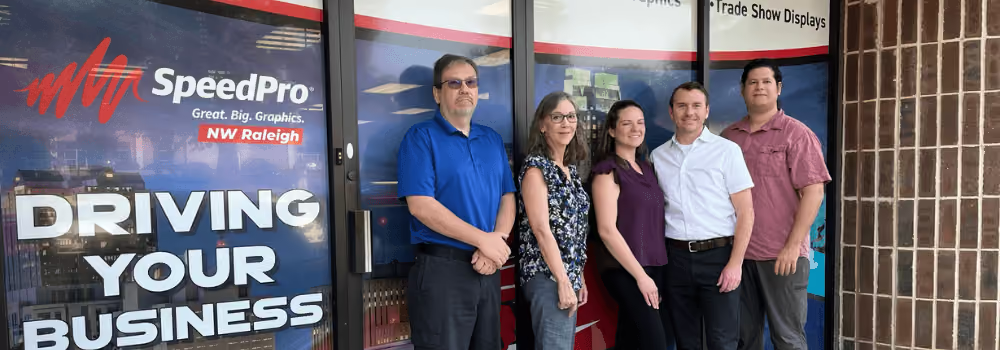






















































%20-%20thumbnail.avif)





%20-%20thumbnail.avif)


%20-%20thumbnail.avif)

.avif)




%20-%20thumbnail.avif)