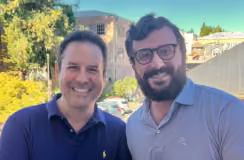
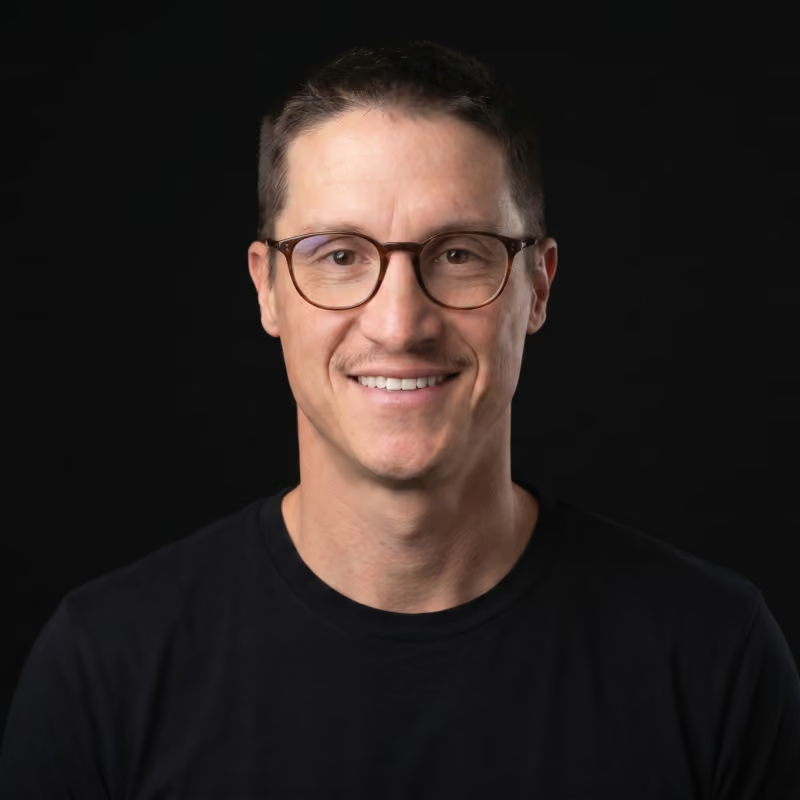
Host: I've been tracking the journey of today's guest from afar, so I was thrilled to finally get him in the seat. Costub Dio bought a $2 million tree business in Seattle just over a year ago. Costub comes from New York Private equity and we spent time on his decision to jump from that world to this one. We talk about the big differences between the two, and that conversation really highlights what it feels like to own a business if you never have. So even if you are not coming from private equity, the picture that Costa paints of his life today as a business owner will be valuable to understanding whether this path is for you. And we talk a lot about the tree business. It's particularly helpful to hear him contrast it with the other trades businesses like H Vac, Plumbing, Landscaping. Lastly, you'll hear how Costub brings a certain intellectual curiosity to business that I really appreciate. See if you do too. Here is Costa Dio of Bluma Tree Experts. Welcome to Acquiring Minds, a podcast about buying businesses. My name is Will Smith. Acquiring an existing business is an awesome opportunity for many entrepreneurs and on this podcast I talk to the people who do it. August Felker is a two time successful searcher, first with a traditional search fund. The second time around he did a self funded search. Today August runs Oberle Risk Strategies, an insurance firm with a dedicated practice group for searchers and acquisition entrepreneurs like you. If you've got a business under loi, Oberle will provide complimentary due diligence on that business's insurance and benefits program. A great no risk way to get to know August and team. They love helping searchers. They've worked with hundreds. Oberle is a specialty insurance brokerage for searchers by a former searcher. Check out oberle-risk.com O B E R L E- risk.com link in the show notes Kostub Dio welcome to Acquiring Minds.
Guest: Thanks Will. Happy to be here.
Host: It's a treat to have you here. Costub. You are a familiar face and voice in our world of buying small businesses. You were on stage at SM Bash last year in Orlando. You'll be on stage again in Austin here next month. And your story in summary Kostub, you're a former private equity guy who got the bug for search and are now owner of a tree services business in Seattle. So we're going to hear that story, see what we can learn from you and your experience and of course learn about the tree business. Let's start off please with a little background on you.
Guest: Kostup yeah, well thank you Again for having me. So I grew up in the Seattle area, in the suburbs, in Redmond, went to middle and high school in Seattle and then moved out east for college, which sort of led me down the finance track. I was always really curious about how businesses worked. That's sort of what took me to a school that had an undergrad business program and where I learned that being a professional investor is a job you could have. Which seemed incredible to me once I learned about it. And honestly, it was incredible. I spent a few years with Bain Capital in Boston doing distressed debt special sits investing. That was a lot of pretty funky situations, like good businesses with bad balance sheets, working at restructuring, figuring out ways to solve that. A lot of time spent on first principles, like what is a good business? And that definition looks very different in institutional investing than it does in small business world. But a lot of first principles, like learning there just the fundamentals of how to think like an investor. Decided the credit was a little bit too far removed from the how does the business work? Question that I was trying to answer. And so that led me to more traditional private equity to get on the equity side of the table. So I went to a firm called Searchlight Capital Partners, which is a generalist PE firm based out of New York City, but with a specialty in media and telecom. Got to learn from some really just incredibly bright and driven investors and spent almost three years there as well. And as I was there, I kind of started to learn that I'm still not getting it. Like I was missing something fundamental about how these businesses run. You know, we had two deals at Search that go really well and I didn't really understand why. Right. I looked like one of the deals was the one I worked on. One of the deals was an older deal that I was sort of staffed on later. And when I looked at the original underwriting and thesis, it just didn't quite click for me. And the answer is really management execution, right? In those deals, like we were able to find and select and put in really amazing operational talent manager talent who could come in and really do amazing work with those businesses. And so when I was sort of making the decision, do I progress in private equity? And you know, I was sort of moving into the next role at pe, where you're in the carry of the fund and getting equity and all of that and you're really signing up, you know what I mean, for P.E. at that point, I sort of made a choice of like, hey, I think I want to look a little bit More like the CEOs of the portfolio companies I worked with. The partners at my PE firm are incredible and in a league at the top of their league, so to speak, in that world. But I was like, hey, I think I'm missing something on this other side. So even if I do want to be a professional investor, long term, I was missing this element of how do you even identify great management talent? Or what does it mean to be a great manager of a business? That was part one and part two was in P.E. you have to sell your businesses, which I found just kind of frustrating. I ran the sale process for one of our businesses that I thought it was one of the best businesses in our portfolio and it was at the end of Fun Life, it was time for that business. It was a good outcome for everyone involved. It was a good outcome for management, a good outcome for our investors. But there was some level of man, we turned around a business, grew it really well. It's a cash flow machine now. It's a great brand and now we just got to let it go. And so those were sort of the two driving forces that led me towards search and specifically self funded search. As I started exploring the space, like most searchers here, you learn from other searchers who are a year, two or three years ahead of you. And so I had a couple colleagues, former colleagues from Bain Capital, who have gone down the search path. Justin Vogt is one of those. He's pretty well known in the search space. He was at Stanford Business School at the time while I was sort of learning about this. And then I had another friend who was sort of, he's doing his own little roll up. And so between those guys I started to learn the different paths and it landed basically on a self funded search. While I was working somewhat part time for the PE firm, I focused on brokered search only because I didn't honestly have the time to do proprietary search. And working part time for the PE firm extended my Runway. And in search, which was kind of a win, win all around.
[7:16] Host: And Kostab, let me, let me stop you there before we get too deep into your search. You know what strikes you, hearing your kind of background and what kind of drew you in here. You sounds like you said you didn't know that professional investing was a thing as late as going into college. So you were definitely as much of a kind of thought leader as I consider you in search. You were not somebody who is like, you know, investing as a little kid or, you know, not a little kid, but even, even in adolescence. I mean A lot of people who end up in private equity or investment banking have been picking stocks since they were eight, you know, with, you know, 50 bucks given to them by their father or something, right? You didn't even realize that there was a world of, of high finance out there. So that's interesting.
Guest: I knew about stocks in high school, right. And I kind of like messed around with that with like some of those like fake money type investing things. I didn't really realize that there was a whole world dedicated to it. Like my family is all engineering type world. My dad is on year 29 at Microsoft, my little brother is now on year two at Microsoft. You know what I mean? And so that's. And like my aunt is at Apple and my uncle is at Facebook. That's the world that I came from. And so learning about that ecosystem of institutional finance was very new to me and kind of amazing. It was just like, Dan, like my whole job is to just learn about random businesses all over the country in the world and decide if we think it's investable or not. Like, what a cool job.
Host: Well, that brings me to my next observation, which is that it seems like your, your draw to the world of business and finance is very much an intellectual one. You said, you said the first, I think the first thing you said was you've always been curious about what makes them work, but I don't hear in your voice kind of like the hunger to make a lot of money, which may be crass and people may not want to acknowledge, but is definitely there in a lot of people in this world and certainly up and down world of finance. Do you have that hunger? Is that, is that, or did you, or I mean, is that any part of your motivation or is this purely an intellectual exercise for you?
[9:18] Guest: Yeah, it's a great question. I mean, look like one I'm coming from like a general background of privilege, right where I came from, a family with kind of white collar parents that put me through private school and college. And so it wasn't like a pressing issue in my life that I was chasing money. It, I want to make money, but it was never like I sort of had a soft understanding that like if I went down a variety of paths, I would be able to create a life for myself that was comfortable, that I could kind of raise a family with and all of that. So I think of finance more of like this was a very fun intellectual exercise. I'm just lucky that the thing I got really interested in happens to pay a lot of money.
Host: Yeah, you sure did. You could have gotten interested in some other academic exercise that, as we know, doesn't pay. Great. Okay. And so just to recap for the audience what. Because my. I wanted to ask you directly what, how you got the bug for search. You were in pe. You saw that first of all, you didn't like the model that required selling, which is kind of intrinsic in the classic PE model. And I want to ask about that a B. You felt like there was this piece of the puzzle that you understood in an abstract way, but not in a real tangible way. Namely that like execution operation is like what separates, you know, success from failure in PE and the businesses you hold. Go ahead. Just for the novice, why is the PE model a flipping model or flipping is pejorative. But like, why is it always, why is it always selling when you have, of course, you know, Buffett, Warren Buffett would be the canonical example of like, he only buys businesses forever. Why isn't that the model? Yeah, why is it always this seven year hold thing?
Guest: I mean, it's primarily a function of how funds are structured, right? So like private equity investors, they raise a pool of capital from institutional investors like pension funds. And the pension funds make a commitment to the fund. So if you raise like a billion dollar fund, maybe, you know, whatever, you've got 20 investors who have each committed 50 million bucks. They don't give you that money. Right. They've just given you a commitment for it. You have. The way these PE funds are structured is you usually have four years of an investment window. So you have four years during which you're allowed to call on those commitments from those guys and say, like, hey, have a deal, you got to give me the money, let's go. And then you've kind of got this 6ish years, like a 10 year total fund life, 6ish year. Time to go create value and then harvest the, the deals, right? And those LP like your investors that are called LPs, they are expecting a return of that capital. Now look, as private equity has evolved and kind of matured as an industry, you are seeing a lot more of longer term vehicles where PE funds will sell a business from one fund to the next fund or they'll put that fund into a standalone entity that they can own for longer, that they call these like continuation vehicles. So it's, it's happening. But the, like, the math of a private equity fund and the structure of a private equity fund fundamentally involves selling your business and realizing an exit. Because then also the fund managers are paid as a Percentage of profits. Right. And it's really hard to say what the profits are until you've sold your business.
[12:54] Host: Yeah. Yeah. Well, I don't want to start critiquing here because I'm clearly no expert, but it just, it feels like there would have been sub models or alternative model. I'm just. I'm just surprised that this kind of like one rather rigid model has persisted and there hasn't been more variety over the years when. When, I mean, certainly down here, people are, you know, in small business land are think about buying and holding forever. At the other end, Warren Buffett thinks about buying and holding forever. And you, in the belly of the PE beast, were also frustrated by this reality that there was always had to sell.
Guest: So anyway, I mean, the one other element I'll note will, is that, like businesses, as they improve in quality and get larger, their cost of equity capital should come down. Right. Because they're becoming a higher quality business. Private equity is fundamentally like an alternative investment vehicle. It's a way for large investors to attract higher returns. Right. It's not meant to be a low cost of capital source of equity. Right. And so, like, the way you're generating your return is you're buying a business at a high cost of capital, you're improving it and growing it, and then hopefully exiting it to somebody with a lower cost of capital, which, like, the best option of that is you IPO it. Right. And like, public equity investors are going to have the lowest cost of capital amongst equity investors. So in the classical sense, that's how it should work. Now, like, you've got these like, PE darling deals that just jump from PE fund to PE fund to PE Fund until the music stops. That's like a different issue, right? Because you're not actually changing your cost of capital fundamentally. You're. But like the whole zero interest rate issue, right, over like 20 years has effectively allowed the cost of capital to come down without actually changing the type of owner of that business. But really the way PE should work is that we are a high return type of fund that allows businesses to eventually become a good deal for a low return fund.
Host: Okay. I had never heard it put that way. That's fascinating. Returning to your story, Costa. So now please tell us, take us through your search. And I know it took twists and turns and evolved and kind of give us an abbreviated version of all that.
[15:05] Guest: Yeah, I mean, the only other element I will note in leaving PE is that I was also just realizing that to stay in pe, you kind of have to be At a certain level of commitment to it and a lifestyle to it that I just didn't see myself sustaining. And so I kind of looked at the different search models and it was like, hey, if I'm going to spend the next five to 10 years of my life really grinding on something, I wanted at the end of that to have some more time freedom. And I think in private equity you sort of end up after 5 to 10 years making like a crazy amount of money, but not necessarily a lot of time freedom yet. Right. Like when you're a partner. Whereas here I can kind of see that vision. And so that was the other draw to search. But yeah, I went through the search process, was doing it the way a bunch of searchers were probably listening to this or in the grind of it, trying to look at whatever 5, 10, 15 deals a week, primarily brokered, like I mentioned, because I didn't really have the time to do proprietary. Got very close on one deal that fell apart and then basically, you know, one of the things that I talk about is I think I had to go through like a grieving process of realizing that, oh, like I'm so used to looking at businesses that are 50 to 200 million of EBITDA plus like we're talking about like top one to five in any given niche globally. Right? That's the type of businesses I worked with. They're just really high quality businesses. And not all of them were, but a lot of them were. And like, I think small businesses are awesome. Clearly, right. I'm in this space, I put a ton of personal risk in my business, but the reality is like, they're not as high quality as like a 200 million EBITDA business. Right. And I think I had to go through a little bit of a grieving process of like, oh, the business I buy is not going to be as high quality as what I'm used to looking at. I think that's probably the case for like anyone coming out of private equity who goes into search. Once you get through that and you figure out the compromises you're going to make to get a deal done, it got a lot easier and a lot faster. And it became more of a question of, hey, what risks am I willing to take? What risks am I not willing to take? And then can I find a deal that's reasonably priced that contains the risks I'm willing to take and not the risk I'm not willing to take? And so anyways, that, that sort of led me down the path. I eventually focused my search on Just Seattle I initially started nationally, then I started only looking in major cities where I'd want to live. And then it kind of occurred to me, I was like, hey, like a big part of the reason I'm doing this is to potentially own it forever, right? Like I don't want to have to sell it, right? And so I would love for this to be in a city that I could really envision myself living forever. There's a lot of cities, in theory, I could live in forever. I just knew Seattle was practically a city I could live in forever. And so I sort of focused my search there, which honestly turned out to be a really good move because it was so much easier to connect with sellers and brokers because I could tell them where I went to high school, I could tell them my parents live here. It was just a lot easier to make those connections and then not to jump too far ahead but post close. These small businesses, for the most part, especially if you're buying a service contractor like I did, they're hyper local businesses. Like our entire Google Calendar is organized by neighborhood name client name. I know all the neighborhood names already. Like I didn't need to learn that. And so that's honestly been an advantage to be operating in the city I'm from. Like I understand it culturally, I understand it geographically. And so once I focused in on Seattle, while the deal flow slowed because there's not as many deals, the odds of any given deal felt like they went way up.
[18:52] Host: I want to share an update on the Acquisition Lab. As you know, the Lab is a highly vetted cohort based accelerator and community for people serious about buying a business. After going through the Lab's month long intensive, you have ongoing access to almost daily Q and A sessions with advisors, regular live deal reviews with Walker Deibel, author of Buy, then Build Potential Deal team introductions, and a very active Slack group with other searchers on the path. Well, the update is that the Lab recently passed 60 businesses acquired and for well over $100 million in aggregate transaction value. Also, all members now enjoy lifetime access to the Lab because when you buy a business, it's often just the first of many and the Lab wants to support you in every deal, not just your first. Lastly, check out my recent interview with Shane Ursum, episode 105. Shane acquired a business with over $1 million in EBITDA in just six months and he attributes a lot of his deal success to what he learned in the lab. Check out acquisitionlab.com or email the lab's director Chelsea Wood chelseieve.com you know, as I hear you talk about the benefits and already knowing the geography of Seattle and you know that to an outsider could be learned relatively quickly. I guess the culture of the place is not. That would take that, that is an advantage in your, in your operations. But what strikes me as the largest advantage of all is what you said that like. So it actually, it actually helped you get better deal flow by brokers. Kind of being more open to like a hometown boy than some outsider. That there was a, a currency there that was valuable.
Guest: There was definitely a currency there. And honestly, more than the brokers, it's the sellers, right? They, they want to, they want to know who you are in almost any other city. I was New York City private equity guy in Seattle. I was, hey, I want to move home guy.
Host: Yeah, totally, totally. That's, that's strong. Well, first of all, I want to plug some of these questions are going to be follow up questions to answers you had in an interview with Alex Bridgman on Think like an Owner about a year ago, 10 or so months ago. Great interview. I encourage people to go back and listen to that. Don't want to repeat much of that interview here, but just add to it. So you talk about the grieving process in your conversation with Alex. What. But give us a little bit more color on that here.
[21:21] Guest: Sorry.
Host: Quick aside. Funny, Costa, that you had to reset your expectations of the qualities of the business from companies that were doing 200 million in EBITDA down here to, you know, half a million in ebitda. Did you just think you were going to get that 3x multiple for free? I mean, I mean, right. So, so yeah, not even that.
Guest: It's. I just, you have to remember, right. When you work in private equity, you have no idea what's happening in the businesses. Right. You interact with the C suite only if you're lucky. You're kind of doing it monthly. If you're like and as an associate in PE but is primarily at like boardroom meeting. It's really sanitized. So it's not even just quality of the business. It's also like you're just getting to see the guts of a business for the first time. Truly.
Host: Well, what were some of these, some of these expectations that you had to let go of? Do you remember anything concrete?
Guest: Yeah, I think there's three big ones in small business. One is some level of concentration risk. Two, which is either customer side or supplier side or like franchisor is another way of thinking about Concentration, risk. So that's number one. Number two is owner dependency. And then number three is revenue quality. Right. Recurring versus reoccurring versus one time. And I think like, those are three items that are all on a spectrum. Right. And I was like, I was thrown off, I think, by especially owner dependency. Right. How much these small businesses revolve around their owners and just the act of the sale and the transition is truly like you're ripping out a spinal cord from these businesses and like sticking in a dude in his late twenties who's never run a business.
Host: Yeah. But Kosov, I do want to ask because at least in theory, if you go a little bigger, the conversation about size of business that you'll buy. You haven't told us what you were targeting, but I know you've talked about this. Go a little bigger. A million dollars, you know, 1.2, 3, 4, 5, if you can find it in SDE. One of the arguments for a business of that size is not only, well, more cash, that's good, more room to screw up, that's good. But also it's a signal that there's probably a man management layer there. Or, you know, maybe not a layer, but maybe two or three people. It's not just totally, totally, totally all in the owner's head. Now that's theoretical. That do. How do you react to that? Like, why. Why not go for a 1.5 SD million SDE business where there's going to be at least two or three people who the business also leans upon and will give you some room to learn things. And it's not all in locked in the owner's head.
[24:21] Guest: There are two reasons. One, I felt really strongly about being the majority owner with governance control once I went to that size. I just don't have the personal capital to be able to retain majority control, most likely. And that retaining majority control to me was important for a number of reasons, but primarily having the time freedom down the road, having control of my life, not having a for sale event at any point, and even I have investors in my deal, but sort of being aligned with my investors that, hey, we might not sell this for a long time. I will return capital through cash flow, but we might not sell this for a long time. And as you go bigger, you need to start getting bigger investors who have more interest in having capital returned. So I was number one and then number two. Honestly, I was kind of down to be in it. I didn't feel a pressing need to buy the business, do one to two years of work on it and then lift out, which listen, that's a great strategy also. It's probably a better strategy to make more money faster also for yourself personally. But a big part of this for me was just getting to do the work and be in it. And so yes, I would love to build our business to get to that point where there is a middle manager layer and the business is just structurally sounder. Right. Like it just needs to be less owner dependent. Like now it's pretty owner dependent on me. Right. And like that's not good either. But I. It wasn't.
Host: Well, and the time freedom. Time freedom has been, been. Been such a motivation for you. Sorry.
Guest: Totally. No, no, no, you're totally right. So like we will get there. But I kind of wanted to do it.
Host: Yeah. Okay. So after grieving for the loss about the loss of quality, one of, one of the key points there being owner dependency, then turned around and totally embraced it. So the idea of buying, buying a job.
Guest: Correct. And I bought an incredibly, incredibly owner dependent business which we can get into.
Host: Okay, okay. Okay. Well, let's do get into it. So tell us about the business that you found and bought and any numbers you can share to give us a sense of size.
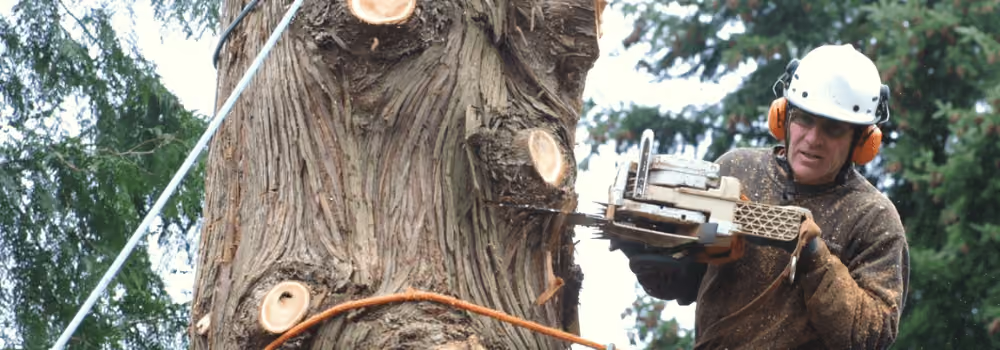
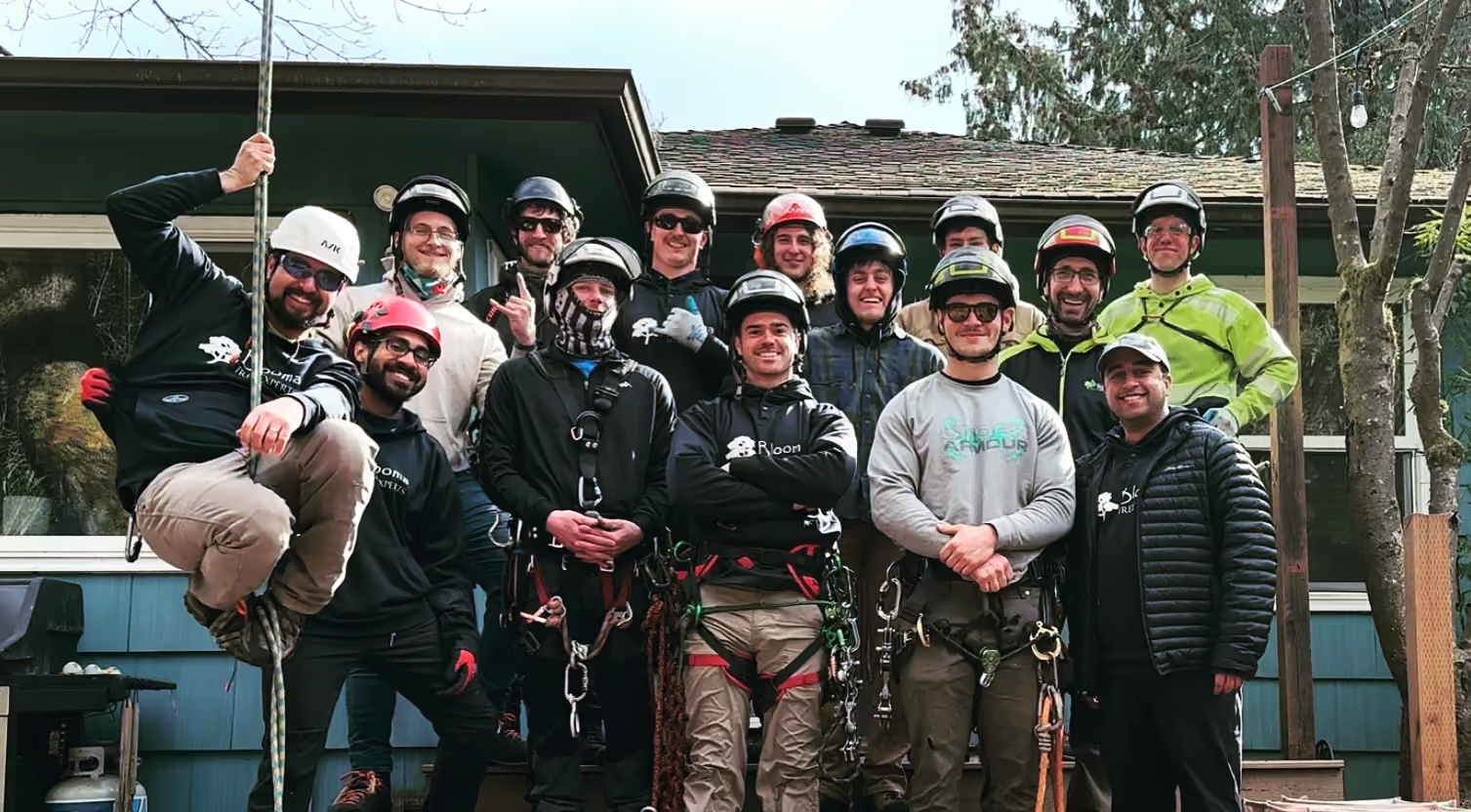
Guest: Yeah. So it's a tree service business located in Seattle. This is basically residential and commercial tree pruning, tree removals, tree like stump grinding after the removals. We recently launched Tree Healthcare, which is a great service servicing. We do something like 800, 900 jobs a year. We've got two crews, so about 14 employees at the moment. And it's a really great business because it's focused on tree pruning. That's what I really liked about it. A lot of tree businesses in the country are focused on tree removal, which tends to be higher ticket. But you can only remove a tree once, which is, you know, it's failing. And so for us, you know, when I started looking at this business, that's what got me excited. It's like, oh, you've got a huge base of customers that, you know, we don't. You don't need your trees pruned every year for the most part, depending on the type of tree. But we've got this base of clients that come back to us every other year, every third year, every fourth year, pretty consistently. We've got an email list of 7,000 clients which is significantly larger than the number of clients we service every year. And so that was a foundation I really liked in the business. Like I was saying, the company was heavily owner dependent. So it was a father son team who are both excellent arborists, excellent tree workers on the actual cruise, and really great with clients as well. And basically the way it works is we had two crews, the dad and the son. They led the two crews. They were each in the field four days a week climbing trees, and on their fifth day, they were doing sales. And that was it. There was no other salesperson. There were no other crew leaders. It was two crews being run by the dad and the son, and that was the whole business.
[28:30] Host: Wow.
Guest: The. The son didn't want to take over the business, you know, just in terms of, like, he'd sort of seen his dad go through it and kind of, you know, just didn't want that level of headache, which I respect. And, you know, he has a young family and so wanted to focus there. So the question was really, when I met with them was like, how or how could. How are we going to transition this business to anyone else? Right? And the answer ended up being like, hey, we just got to sit down and figure out a plan. And we figured out a plan. The plan more or less worked. It's still. We're not 100% of the way there, but we're now sitting. It's about 13 months from the transaction. The dad, he retired three months into the deal. We replaced him with an internal promotion to crew leader that we had identified before closing. And he's been great. It's worked out really well with him as a crew leader. And then the son, he agreed to a 12 month transition, which is the max allowed by the SBA. And that also went incredibly well. He really came in and he put in his 40, 50, sometimes 60 hours a week, really supporting the business through that transition. And then finally he left about a month ago. And we found a new crew leader just in, you know, open hiring, who we brought in to take his spot. And so, like, and then while that was all happening, we also had to solve, like, the sales side. So we've hired new ISA certified arborists to sort of handle sales. We've had some, like, fits and starts with that, like, gone through a couple different people, but I feel like we finally landed at a. At a comfortable spot that the business right now feels stable, you know what I mean? Which, like, when you're in a small business, like, feeling stable is a luxury. And we're finally, you know, we're past both. Both the sellers are gone now. We've now had a month with both the sellers gone. And, you know, I feel like we've figured out what that infrastructure looks like.
[30:27] Host: Yeah, yeah, you've. You've sort of finally completed the transition. The transition is now no longer in process. I guess if you were going to have to make some of these additional hires because the a father and or son were doing so much, then that reduced the SDE that you negotiated against for the multiple.
Guest: Well, so that's the thing, right? Like, during the transaction process, I sat down with the dad primarily and said, like, look, like, I get you've been making this much money and that's how we base our deals off of. But the reality is we're gonna have to make a lot of replacement hires. And so we need to, like, get aligned on that. And like, let's walk from what SDE was to what it really should be. And he engaged in good faith around that. Right. And we reduced SDE by a lot in the LOI process. You know, it's a pro forma. Right. We don't really know if you're going to be able to hire people for that amount. You know, the business used to be run out of the seller's home, whereas we obviously needed to lease like a real commercial building. So you have to make some assumptions around what that's going to cost. So we pro forma'd a lot of expenses as part of the underwriting and diligence process. And that was a discussion with the sellers. Right. And they didn't agree with all of it. For example, they felt like some of it I didn't need to replace, we could do in house. And so the number I was sort of thinking in my head was a little bit different than the number they were thinking. But the key is that this wouldn't have worked if the sellers weren't extremely understanding and aware that this business is not going to generate the same income that it did for them. Right. Because we need to make all these new hires. And therefore the multiple I could pay had to be based on the earnings I could generate. And so I think a lot more about what is your buyer's EBITDA or buyer's discretionary earning. That is a much more relevant point to me than what is seller's discretionary earning. The problem is the sellers don't necessarily care about that. Right. In this deal, the sellers understood that point and negotiated in good faith around that point. And that's why a deal was able to get it done.
Host: Yeah, yeah. Give us some numbers if you can, on. On revenue and ste or whatever you feel comfortable sharing.
Guest: Yeah, it's. It's in the ballpark. Of 2 million revenue. So on the smaller end, for sure, of, you know, small business search deals, so to speak.
Host: And we can say 15 to 20% margins.
Guest: It's honestly hard to say because of the amount of performing that happened. Right. But, you know, it's, It's. It's a. It's a higher margin business than that, hopefully, but I'm not sure yet.
[33:08] Host: Okay. Okay. Well, Acosta, one of the things that I heard you say in the aforementioned interview with Alex is that one of the. The values that you thought you brought to your search, you were a generalist in private equity, so you didn't have particular industry experience, but you had looked at a lot of industries and you'd become a. A quick study on industries. What did you like? Tell us about the tree business and the tree industry and what you like about it. And then. And then take that to what you liked about this business. You've already mentioned that you like that it was pruning focused versus tree removal. But what else? There must have been more, too, that you liked about it, but the industry first. What did you find when you. When you looked under the hood?
Guest: Yeah, exactly. On the industry level. Yeah. One of the key things about this industry is it looks and feels a lot like H vac plumbing in that you've got really skilled people in the field. It's a little bit different than H vac plumbing because it's a little bit more artistry driven. It's science and art. Right. Especially in pruning a well pruned. Like 10 arborists could work on the same tree, and it would come out looking 10 different ways, and they could all be. Right. And so that's like. There's a little bit of artistry there that was appealing to me because, you know, it just. There's a. There's a level of. It's just like more of this, like, skilled tradesman type of a field where people take a lot of personal pride in, like, their gear. They take a lot of personal pride in their practices and their techniques. And what that meant to me was you can actually build a culture. Right. Like, if you don't have people that take that kind of thing seriously, it's hard to build culture around it. And, you know, we're not an industry that is like churning guys at minimum wage. Right. And there's a lot of contractor businesses that are like that, that are pure manual labor. And, you know, this is a physically taxing job. Right. Don't get me wrong for our crews, but I can in good faith Tell people like, hey, if you start here, you know, in minimum wage, I mean we are starting as higher than minimum wage, but in that vicinity, like over seven to 10 years, like you can double your pay, right? It's hard to make that statement in commercial landscaping, right? Unless they actually move up into management. Whereas in tree work you can move up that type of a pay scale just by becoming a skilled tradesperson within this field. Right. And caring deeply about it and the practice of it. So to me that meant like, hey, I can actually build an employee and small business culture that is focused on growth for both the business and for the individual and start to attract people who are excited about that growth, right? Like I talk about to our team, I talk about the idea of like, hey, I want people here who are viewing this as a career, right, and not a gig. And don't get me wrong, there's a ton of tree companies that are like, pay by cash, they pay on a day rate basis. Guys come in for a couple months, they leave, they get laid off in the winters. That's alive and well, don't get me wrong. But there's this sort of different echelon, I think, of professional tree companies that are really building a really good place to work. And because it's the skilled trade, we can charge the prices of our clients required to allow us to make a good place to work and pay well. And like, we pay for medical, we pay for dental, we have a 4% 401k match. I have better benefits here than I did in my PE firm. You know what I mean? That to me, felt like I could build something and it's not just a financial endeavor of like, hey, can we get EBITDA from X to 2X? And then with like SBA leverage, the math all works. Like that's all there in the background, don't get me wrong. And that's important as well. But here I felt like, okay, this is like I can build something cool, I can build something fun, I can build like a place I want to be every day. I can build a place that other people want to be every day. And I'm kind of rambling, I know, but that is inherent to the structure of the tree industry, right? Like by the time somebody picks up the phone and calls an arborist, they've already given up on their landscaper. So they know they're going to have to pay for a skilled trade, right? Very few of the clients who come to us, they've self qualified by the time they call us that they know they're going to have to pay a certain number for the level of skill that our guys bring to the table and that's structural to the tree industry. And as a result I can actually invest in the team to get them to that skill level.
[37:53] Host: But let me ask you, Khosab, I've heard you say that it's a very mom and pop industry, highly fragmented. I think I heard you say in Seattle alone, which granted is kind of a mecca for the tree business, but in Seattle alone there's like 50 tree businesses. So in many of those are not cultivating culture, are not trying to give their people a place to have a career and grow there, as you said, they're just churning and burning people. So I would imagine those people are. With that it would be a very competitive business because it's so fragmented and because they're a lot of your competition is just paying people in cash and burning through them. So how are you. Which, which makes you a more appealing place to work. Yes, but also it anchors prices lower because. And you don't want to compete on price. So how did you reconcile that dynamic in the tree industry in Seattle?
Guest: Yeah, so that, that, that's definitely a part of it. And there's way more than 50, there's like 50 I could find on Google Maps, you know what I mean? And so for that, that's a little bit a function of the market you're in. Right. So the Seattle market specifically is a really great market for tree work because you have this mix of clients that are pretty wealthy because Seattle as a city is pretty wealthy when you're talking about homeowners. And they actually care a lot about trees. That's a cultural value in a city like Seattle. That the environment and the home landscape and sort of the urban canopy, those are all kind of values held by, not by everyone, but in general it's a thing that like cities like Seattle and Portland care about a lot more than other cities in the country. And so you have this mix of people like with a willingness to pay and an ability to pay that they're actually looking for like arborists, they're looking for people with certifications, they're looking for people that are using science based recommendations for what to do with their trees. And honestly the former owners of this business, they did a really good job of cultivating a client base like that. They didn't chase the price comp competitive jobs because it's just not the client base you want to actually build this business around. Does that limit your ability to grow? Yeah, for sure. You can't grow as fast if you're trying to qualify your client base like that. That's okay. You know what I mean? I'm okay with that. It's part of also why, as an aside, why this is such a fragmented industry. Right. Like there is a roll up in the space called save a tree. It doesn't strike me as the most roll up industry because it is like the barriers to entry are low. It's pretty easy for somebody to set up their new tree company. They can start with like pretty bad equipment and a really old chipper and then eventually get a decent chip truck and a good chipper. But it's not that hard to get started. It's really a function of like, does your client base want that type of a tree service or are they going to you as a tree service? Because they're looking for professionals.
[40:58] Host: Great. Anything else about the industry that you liked or should we move on to what? Any more about Bloom Bluma within the industry that you liked?
Guest: No, I think that hits the big stuff. Yeah.
Host: Great, great. So but while we're on the point of roll up ability, so despite its fragmentation, you, you then are not going to be out there buying, buying up your 50 competitors. That's not necessarily. I'm sure there's some opportunities there, but it's not, it's not the obvious like charge forward playbook right now.
Guest: I'm definitely open to it and I will look at them and I have looked at them. It's a little bit more of like buy a phone number and a website. Right. You're not buying a lot of assets in these types of deals for the smaller ones. And so unless you're going out and buying something pretty big, it's hard to pay a multiple of cash flow for it because the vast majority of these are like an owner plus two employees. Right. And the owner wants to retire. And so in that scenario you're really buying a client book that you're hoping converts to you and you're probably hiring the two employees and you're maybe buying a truck. Right. So when you're talking about that type of a thing, it makes. What you really want to do is pay almost for like lead generation. Like that's the way I would think about that. It's not really like buying a business, so to speak. Now I think that could be a great strategy for us to. It's hard to hire people. I love the idea of sort of finding great small companies smaller than us and saying like, hey, Are you exhausted of the admin side of your business? Are you exhausted dealing with workers comp every month and quarter? Do you just want to be a great arborist? Like, we would love to have you, right? And like, that's. I would love to hire a crew at a time, so to speak, and pay that owner, you know, a fair share of the client base he's bringing or she's bringing to the table. So, like, that to me feels like a really cool, powerful model that I haven't figured out how to do it yet. Right. But I am open to that. But the straight up just like buy a business and have the owner leave, I think is pretty tough in this industry unless it's quite large.
[43:15] Host: Well, your point about employees and the team, I mean, in these really fragmented situations where acquisitions might be tiny, it's just a way. It's. It's acquisition of, of your tiny competitor is a euphemism for hiring. I mean, you're basically just hiring. You're basically getting labor and that. And that can be really valuable. I mean, it's a way to get, you know, even if it's a team of two guys and each have seven years experience, like, that's a win. Really hard to find two guys like that. So.
Guest: But it just changes how you look at stuff, right? Like, you're not buying it for like the EBITDA multiple. You're like saying, like, hey, are these guys good culture fits? Are they. Do they have good experience? Like, there's a lot of different techniques in tree work that different people practice different ways. Like, we need people who practice, like, our style of tree work just a
Host: little bit more on the industry itself. So hearing what you just said about Seattle and Portland as well, and having people who. Having a citizenry who that cares about the urban canopy. Is the tree business made up of people who love trees or. Because I've always, you know, I remember as a kid when my dad, you know, hired an arborist to come over and, you know, chop down a tree in our yard. You know, I was like, oh, I don't. I love that tree. Don't. Don't kill that tree. And, and, you know, tree huggers, I mean, the pejorative for environmental people are people love individual trees. So there always has struck me in this industry, like, even if you're not a tree hugger, there might be like a little bit of a nagging discomfort with the idea that you're out there hacking down beautiful trees, even if they need to come down for all kinds of good Reasons. So comment on that. Who the people who are actually doing this hacking and work in this industry, are they bloodthirsty for trees? Do they actually love trees or all of the above? Like some yes, some no. All of a sudden, across the board,
[45:05] Guest: it's definitely all of the above. There is a dynamic of. There's an interesting dynamic that there's one end of the industry that is sort of like PhD type people, right? Like, they can really study trees as an academic science, and they're the ones that are really progressing. Some of the, like, your knowledge around trees, like, how do trees recover from wounds? Informs how you prune them. And so they're the ones doing studies on trees are kind of like humans in that sense that they can kind of heal their own wounds. And so as an example, they used to say you should cut the branch all the way back to the trunk. Now they've learned that you should actually leave a couple inches off, and that allows for better healing of the tree. So that stuff's coming from PhD world within arborists, right? And then at the other end, you've got the guys who are actually doing the work every day. And so for a chunk of those guys, it's a job. And so for the guys that it's a job, a tree to be removed represents money, right? It's pretty straightforward. But then there's this big amount of people in between those two ends that are like, hey, they love the job, they need to make money, they're practical about it, but they find trees intrinsically interesting and exciting to learn about. They feel bad to see a really cool specimen tree go down, even if it's for a good reason. So it ranges, right? And I think there's an. You kind of have to have a deep respect for what trees are. And the fact that we can take a tree down that has been around for 50 years in four hours is kind of a bummer. It's not what I want to focus on as a business either. But for me, my ideal setup as a business is we are able to prune a tree multiple times over its lifetime for a client, and at some point, that tree is no longer a good fit for where it is. And so at that point, we remove trees. And so tree removal will always be a part of our business, but it's not sort of the focus area, right? And not only is it a great revenue quality area, like, I think, like, it's not good for the business in general to focus on tree removal because it's all one time revenue But I think just on a values basis. I'm a Seattle kid also. Right. I like trees. I don't want to be cutting down trees if we don't have to. So there's a balance there. You strike with your clients and understanding ultimately you are a service provider to the clients as well. Right.
Host: A little bit more on the culture of this industry. It's a, it's a. You had said, I think I just referred to it a minute ago, that it's a passion industry. People really, the arborists really get into it. They love it. And not just the PhD types, but also the climbers and the, and the pruners. And one of the things that was so such a happy detail to hear in your, in your earlier interview was that you were, were expecting the, the fact that you were an outsider and knew nothing about trees, frankly, was going to be something that, you know, you had to, you had, you would have to sell yourself to your, to your, to your new employees because you were an outsider. And this is an industry where people are really committed to the work and you found that in fact they were very open to you and they were eager to teach you and you were an eager student. And so that was kind of a non issue that. Do you think that, that you just got lucky there or do you think that people in our, in our shoes, the searchers over, are overly concerned about that? Because I too think about that and it makes me really nervous to buy into an industry, particularly an industry like you're describing, where people are really passionate to be in this industry. It's, they see it as their life's work. And I've come in, you know, sort of opportunistically. Yeah. So, so has it. And a year later, has it continued to be fine?
[49:10] Guest: I mean, the, the answer to that question is yes. Like, the guys have continued to be super welcoming and sort of supportive of my learning of the tree industry. I climbed a tree for the first time a couple weeks ago, which was fun and the, the guys are sort of teasing me as I did it, but they were also supporting me and actually teaching me how to do it. You know what I mean? So that was cool.
Host: That is cool.
Guest: Yeah. Look, I have a sample size of one on this, right. So I could be wrong. I think there's an element of like, yep, searchers are probably a little bit too afraid of kind of being accepted, but there is something industry or like business specific for me, which is that it's a really young team. Right. Like, I think the median age roughly is like 26. And so it's also kind of a physical. It's a really physically labor intensive job. It's hard to do as you get older. There are older folks for sure on crews all over the city. But the reality is I think having a younger crew, especially as a younger new owner myself, I'm 29, that helped a lot in terms of just them being welcoming to be. I think it would have been tougher frankly if we had like five. If like half the team had been in the industry for 20 years and they were like 45, you know, that much older than me, I think there would have, it would have been harder for me to kind of enmesh in with the team.
Host: Yeah, great. I'm glad I asked because I do think that that was, that that's a, a big difference. Buying a team of 20 somethings versus 40 somethings. Kost up about the. You had said that the like the end product, the end service that, that your team delivers happily is, is a really good one. Like you're really, you guys, your, your crews are really good at what they do and that's actually not something I hear people talk about very much. They'll look at, they'll of course research Google reviews and they'll kind of do what they can. But to, to be able to really assess the actual competence in aggregate of the team and crews that you're buying, especially as an outsider, again returning to that theme like is near impossible and you know, because especially in this small business world, as we all know currently, the current market dynamics are such that there's so much demand for services. You have a lot of not great business people and crews out there doing work and they don't, they're not especially good at what they do, but demand keeps them in business. So did you get lucky that your, your, your crews are so good at what they do and, and if not, like, is there any way you think that you can diligence this other than as I said, looking at Google reviews and Yelp reviews, but even those aren't going to be very helpful because the consumer might not really know be able to them themselves assess the quality of the work?
[52:03] Guest: Yeah, that's a tough question. There's a large element of luck for sure. I think this is not something I recognized while I was doing diligence. It's something that became clear to me after the fact. But the fact that the two owners were still running the cruise every day went a long way in terms of ensuring a certain level of quality. And they very sincerely believe that quality was a competitive differentiator for them. Right. So they had like a personal driver to have be a high quality like provider. But they also understood just financially and strategically they needed to be high quality. And they were in the field every day ensuring it was high quality. So like the challenge for us now is to be able to maintain that quality without an owner on every crew. And you know, there's ways to do that and that's sort of part of our operational challenge that I feel good that we will be able to do. But in terms of like coming into the business, yes, it was difficult that there was not this like middle manager layer and the owners were so involved. Flip side of that is part of the reason they were so involved is because they are so fanatical about service quality. They didn't want to delegate that to anybody else. They wanted to be the end all, be all of quality. To be clear, I still got lucky. I had no ability to assess somebody's tree work. I could have got to 100 of their jobs and still had no idea if these are high quality jobs or not. But I think that's, that was an interesting, in hindsight, that's an interesting dynamic that like, oh, the fact that they never lifted themselves off the cruise is a good indicator that the quality levels are high.
Host: Yeah, well, that's I guess a good insight because I think for a lot of searchers, if they see that the seller is going out on the crew four days a week, that's going to be a red flag. Like, oh, this is too, this owner is too in the business. I can't and they'll walk away. But there's actually, here's a reason why that could be a really good thing.
[54:08] Guest: Now the question is, can you like actually systematize it and make it exist outside of that owner? That's a hard question, but I feel confident that we can.
Host: Let's talk about change management a little bit. I've heard you talk about, you know, you heard from everybody before you did your deal, before you did your acquisition that you shouldn't change anything. And yet when you got in there, you were, you saw stuff that you were really just itching to improve as you saw it, to change for the better and then, and then. But you were disciplined and recognized that. Oh, you waited recognize that, oh, it was good that I didn't change that because here's the why that things were
Guest: the way they are.
Host: So now 13 months in, tell us, tell us what you've changed. What You've learned about change management when you felt comfortable and how you knew you were smart enough about your business to make changes. Just kind of open ended about change.
Guest: Yeah, I mean I like when you think about these small business deals, especially if you're using SBA financing, so there's some risk involved on the debt side. Like your number one priority for the first couple years is to not break the business like full stop. Like, yes, we want to grow for sure, but number one priority is don't screw it up and like actually figure out what's going on. Right, right. And so to that end, like, yes, have I tried to change things for sure. And I have changed something successfully, some unsuccessfully, but I just want to make sure that's clear up front that like making improvements in the business in year one just was not a priority relative to me just learning the business. Especially by the way in a seasonal business. Right. Where every season looks a little bit different.
Host: Yeah.
Guest: That said, the changes like I think the change that probably has been the most impactful that we were able to pull off reasonably well is moving from QuickBooks to a real CRM system which has a number of benefits but primarily means that we're actually like we take payments online. All of the contracts go out as an email, not just as like we used to just give them a paper copy of the estimate and then they would call us if they want to do the job or not. Whereas now they still get a paper copy. I haven't changed that, but every paper copy also gets typed up, emailed to them with an automated three day reminder. And so the change, that's a good example of a change because those are changes that don't really impact your service provision at all. It was a lot of change for the office team and luckily the office team is me and one other person and she's super down to try these kinds of things and is really open to change, which is amazing. So it's just me and her figuring this out. And that's the kind of change that's a lot easier to implement and can be pretty high impact without a lot of potential negative repercussions on your service providers. The guy's actually out there the field. And so for better or worse, even with that addition, we're still sort of parallel processing the old way and the new way where our work orders are still the handwritten copy that the estimator wrote up. I haven't moved that to the print, the emailed copy or the typed up version. So we're slowly making those changes. But I think I've tried to focus changes around things that are less impactful on the cruise. The one maybe major caveat to that is if there's something that feels mandatory, for lack of a better term. We never had safety meetings before and so now we have weekly safety meetings. Now it took me several months to put that together and I needed to hire somebody to lead them because I just don't have the subject matter expertise to do that. But that one felt strong. That was, you know, like that's the sleep at night risk in this business is somebody hurts themselves badly. It's a really dangerous job. And so like implementing safety meetings. So now we have that once a week, every Thursday morning. Actually today we took four hours off to do aerial rescue training. All of the guys were just in a training session with some trainers I brought in. That I think is a change that I feel good about and felt mandatory.
[58:19] Host: You had talked in your interview about reference materials for customers getting, getting some, some suggestions on how they kind of maintain the work that your, your crews have done so that they don't need to call you back out or their beautiful tree doesn't die prematurely or what have you, have you done any of that stuff?
Guest: Nope, not at all. Still on the list, we now have an arborist who specializes in plant and tree healthcare who was a new addition in December. So that's something that. It's one of those that in theory I would do in practice. It just wasn't going to happen. I needed a hire for it and now he's sort of taken the lead on sort of the. In between all of the tree pruning, what is the healthcare services we can be providing for trees.
Host: We're bumping up against time here, Kosta, but I want to hear, I want to hear just kind of about. I have a bunch of questions about your new life. Comparing it to pe, comparing it to your expectations. But before that, let's, let's ask from a guy who is. Comes from private equity and has seen kind of the magic of financial engineering. Your thought on hold cos. Because you're still, you're only 13 months into this business. But of course they're talked about all over Twitter. You see it, I see it. We know we, you know, mutual, mutual people that are doing it.
Guest: You
Host: do you see for yourself buying outside of this industry if you get to the point where you can kind of step out a little bit of your day to day, or do you see going deeper into your industry, you personally and then abstract out and maybe give kind of a general. General thought on it.
[1:00:06] Guest: Yeah. So for me, personally, I'm not sure I'm gonna have the energy to do this again, frankly. Maybe if you buy something bigger to our earlier conversation, but this is taking 110% of my. Just emotional energy, social, like, all of it. Right. It's a real grind. And so. And not in a bad way. Right. I'm excited about it, but that is what it is. I'm not sure I'm gonna have what it takes to do it again necessarily. Maybe I'll feel differently in the future, but right now, when I'm like 13 months in and a lot of months to go, it doesn't. It just. I can't imagine buying another business in a different field. I do love investing. Right. And investing as a craft I really enjoyed. And so I would hope over time to free up hours in my week to go invest in other businesses. And not as a primary, not as the active sponsor, so to speak. But I would love to back other searchers. I would love to really back searchers in the tree space. Right. Because it's one industry I know pretty well now. And so in my mind, I would love to sort of take on more and more of an investing role over time. And so that is a form of Holdco. Right. Like, one of the things that's attractive about being a Holdco is you get to be like the capital allocator, sort of sitting above all the businesses and deciding where should the capital best go. I have a hard time imagining there being another business that I'm running alongside this one that I'm sort of allocating capital between. But this is a pretty low capital requirement business, so there will become a point where it is throwing off cash that I will want to allocate elsewhere just because the business won't need it. Right. We have trucks, but other than that, you don't need a lot of capital to go into the business to grow it. It's more of a people business. So I do look forward to basically being able to build that type of capital allocator role, which is sort of allocating that. That cash flow into other investments more broadly. Like hold codes are like an awesome structure. Right. I mean, they're not new. Right. They've been around since forever, and they're kind of getting rebranded and kind of coming back into the. The whatever, the Twitter sphere. I think it's just a. It is harder than it looks is probably the obvious thing to say. And I think the. I think getting it Right is hard to define, right. Like it is easier to get a hold co write financially than it probably is in terms of like the lifestyle you want or the social life you want want or everything else you want. I don't doubt that a ton of the people in the SMB ETA community could pull it off. I'm not necessarily sure it's the right answer for them in their life or their priorities. And this is different for everybody. But I know for myself I probably could have made more money if I stayed in pe. That isn't going to be the right lifestyle for me long term or the right life priorities for me long term. So in the same way, yes, I could build a Holdco eventually, but doing it for a financial outcome is not going to be sufficiently interesting.
[1:03:28] Host: Great answer. And just going back to what you just touched on, you probably could have made more if you'd say it in pe, but it's close.
Guest: Well, if I could have made it in PE for more than 20 years, I definitively would have made more in PE. I think. I think the odds of me making it another 20 years in PE were very low. So I think the odds are better in small business
Host: and aside from everything up to the acquisition itself, all of your ability to diligence and quickly learn industries and understand deals has being all of your private equity experience served you post acquisition and if so how it
Guest: has not super directly but I think the biggest area of it is and I've spoken to a lot of other small business owners about this, there's this constant undercurrent of anxiety when you run and own your business that is like I can't tell if this is going well or not. I think it's going okay, but I can't really tell. And I think what's nice about the private equity background is it kind of gave me a toolkit to really build KPI dashboards to really understand the financials so that I'm really on a weekly and monthly basis able to objectively assess the business and see how it's going. And for me that has been a huge advantage where that kind of vague anxiety I can sort of define as how many weeks of backlog do we have? What is our weekly margin profile looking like? How what is our week to week revenue looking like? And if I can see those be consistent like I can appropriately tell myself not to be anxious about it.
Host: I'm just, I just find that curious Kosa because it's not a complex business and I just wonder if that anxiety is just because you're still kind of getting the feel for having all of this on your shoulders as opposed to there being some, you know, elusive details to the business that you still don't fully understand. This is a theme with you. Cost of feeling like you just don't understand things to their, to their, to their absolute fullest. But I mean, you know, yeah, you look at your backlog, you know, are your employees happy? Are your margins where they should be? I know I'm oversimplifying, but it is a simple business and just making sure, you know, you got enough in your pipeline coming and no one's quitting on you and your equipment. It's good working order. It would seem that you could rest easy enough.
[1:06:10] Guest: But the problem is how do you know if your backlog is consistent? How do you know if enough leads are coming in? You have to measure it, and there were no ways of measuring it before closing. And most of these businesses have no way. And so if you talk to small business owners, out the gate searchers turned operators, I think you'd hear pretty consistently, or I'm saying, when I've had these conversations, I've heard consistently, they're watching the bank account, they're watching the bank statement go up and down every day and they're not entirely sure why and they're not entirely able to unpack why. And it's really easy to slip, like AR days, account receivable days might go from like 14 to 60 because there was some system or process for that that you just didn't quite pick up in the transition and you're just not seeing your cash convert and you don't really know why and you don't feel good about it, right? And that's the kind of like, cash in the bank account is the very, very, very last output of a ton of systems that come before that. And so the further you can kind of get analytical up the chain of the business, the much more easily you can kind of quell the anxiety of watching your bank account go up and down every day. And I think that like a lot of small business owners I talk to, they, they, they struggle to specify why their cash is moving up and down every day.
Host: And you feel like you're, you're closer to having a complete answer for your own business, but maybe still only 90% of the way there.
Guest: And to be clear, I'm like, way worse at a bunch of other stuff, right? Like, I'm not as good of a, like I'm still working on learning how to be an organizational leader. I'm still working on how to like build organizational values and all. And like, I hate documenting processes like that. Stuff I find really like, I find SOPs like not interesting. That's stuff I need to get better at. What I am good at because of PE is being able to really drill down on like what are our numbers, what are our KPIs and so like are things going well or not?
Host: A couple more questions for you, Costa. Just talking about kind of the anxiety and what you've heard from other searchers who got into businesses and were watching their bank balance go up and down and not being quite sure why and just kind of this, this, this just whole kind of emotional lifestyle change. Have you had you Reg Zeller, I think we both know like, and he talks about the fetal position moment that many new new business small business owners will kind of inevitably have in year one. Have you had a fetal position, bathroom floor, 2am moment yet? Any panic attacks or is it just persistent low grade anxiety at all times?
[1:09:00] Guest: I wouldn't go fetal position in the bathroom at 2am Bad. I would say they have been plenty of calls to my SMB peer group of yo, this was a week. Can we talk about it? You know what I mean? That, I mean honestly for me, like having an essay like a small business peer group of other owners, like, I think if I didn't have that, I would have had a lot of those 2am nights.
Host: And I'd like to distill this. We've, we've touched on it a number of places. But I wanted to ask you what muscles you think you've built in these last 13 months and what muscles have atrophied?
Guest: Hmm, that's a good question. What immediately comes to mind? I think I've really built a good muscle around patience. Coming from New York City pe, that is not like a skill I had per se. Nor was it rewarded. Right. Like being patient was not really a skill that was rewarded. I think I've learned to be a lot more patient and let the business come to me to some extent and not try to force it in a direction I wanted to go in because it's a loose collection of people. It's not my willpower that determines whether or not this business is successful. It's whether or not I can paint a vision that's sufficiently compelling and interesting to the people that work with me. And doing that requires patience. Allowing them to get on board requires patience. And also just feeling successful in this type of a role requires patience because it just takes Longer and the like. One of the big differences between this and PE is in PE you do these like major deal sprints that are 60, 70, 80, 100 hour weeks and then the deal closes and you like did the thing and now you've been, you've completed an accomplishment and now you chill for a couple of weeks, then you do it again. Right? Like that's what PE lifestyle looks like. Running a small business is a lot of really small days, a lot of little problems you're dealing with day in, day out. And then you look back on a couple months of that and you're like, oh, wow, we made some real progress here. But you almost don't notice the progress as it's happening. And so that requires a sort of different type of patience because you don't have these big moments of like, yes, we did it, we got the deal done. So that it just requires a slightly different appreciation in terms of atrophying. I don't think I have the same. It's like the other side of that coin, right? I don't think I have that same fire that is required in PE. Like, I had no problem at 3am Sort of firing up the model and really doing hard work from, from like 3 to 6am that I don't, I don't have that now. Like, I honestly, I just, I can't do that anymore. Like, I'm trying to build a life that's sustainable and enjoyable. And so it's not like I don't feel bad about losing that muscle, but there was a certain amount of like just pure drive and grind it out hustle that I think, like, it's very unique to New York City style of private equity and normalized there that I, I think that muscle has atrophied
[1:12:23] Host: great. And just overall, 13 months in, how would you reflect? Last question. How would you just reflect on the whole thing? I mean, we've touched on so many angles of it, but just like, you know, distill it for us. This was a giant life decision, professional life decision for you. Is it kind of on a scale? Let's do a scale of 1 to 10. Of 10 being, you know, this is everything that you'd hope for and more. What would you give it and why?
Guest: I'd give it a solid like seven, which is. And it has been really fulfilling in some ways. I didn't expect it to be. It's been primarily like, I think the like, business side of it, like the pure numbers and the financials and all that. I'm probably more Like a four or five. Like, I'm chugging along. We're doing. It's going well, but not, like, it's not. I'm not, like, knocking it out of the park. And I'm also not failing. It's going fine. Right. What I've found really fulfilling and I've been really happy about is, like, the seeing people on our team improve is really fulfilling. And, like, watching them actually improve and being able to give them a raise because they deserve it and, like, they've become more productive for us and they're higher. Like, they're doing better quality work. Like, that's awesome to watch and witness them go through that kind of being involved in the industry, building a whole new peer network outside of my business alone. Right. I joined the board of directors of our regional chapter of the International Society of Arboriculture. I'm getting to work and talk to some really cool arborists who have been in this space for 20 or 30 years. These are just conversations I wasn't having 13 months ago. And I'm having a lot of fun doing that. And also just being back in my hometown, I feel much more like a member of the community here than I ever did before. Right. Like, we are touching, you know, some 900 clients a year that are homeowners all around the Seattle. The greater Seattle area. Like, we're working on, like, the physical landscape of our city every day. That's. Yeah. It's been more fulfilling than I thought it was going to be. Like, I didn't quite realize how much I would enjoy that. Like, I mean, I've gone to two freaking Seattle city council meetings things, and given public comments on changes to the tree code that they're considering. Who does that? I'm in that parks and rec world now, but it's like, yeah, I feel like I have a vested interest in our city now. I feel like I'm not a homeowner here. I imagine that maybe this is what it feels like if you're a homeowner in a city, but I feel like I have a vested interest here. I have roots here, and building a really good small business is an important part of the fabric of Seattle. Right. In many ways, just in terms of the people of the business and the trees and the houses we work on.
[1:15:17] Host: Yeah.
Guest: So anyways, not to, like, but, like, I know. Really fun. Yeah.
Host: Well, I love it because you're kind of exhibit A of this. This kind of cliche about how, you know, high finance masters of the universe, you know, move things around in the, the world that is their chessboard and like, really are completely disconnected without how it affects, like, everyday life. I know that's a really cruel characterization, but, you know, you hear it a lot. It's in movies, it's everywhere. Meanwhile, but now you're, you know, kind of living down here, you know, on, on planet Earth, running a real small business in a real city where things, you know, it feels maybe less like some giant intellectual exercise and more like, you know, real people, real city and real day to day stuff. I actually, I loved that. And before I let you go, Kosov, I just wanted to ask you about the industry because you'd mentioned it a little bit earlier to me and it sounds like, happily, you really like your industry a lot and you're meeting a lot of interesting people. Is there any advice there about thinking about, like doing some diligence just on the industry? Is it an industry that you want to play in for the next 10 years or, or, or what? What. What would you say to people who are searching?
Guest: Well, the one thing is like, you don't generally want to buy in an industry that is purely passion driven, right? Like, restaurants are often a function of pure passion. And like it, like, the passion is so high that it offsets margins. Like, people will take margins lower because they want to do it so badly. You don't really want that. That's too much. That's a tough industry to live in. This is awesome because you've got really passionate people who understand this is a profession that they need to make money and that they need to get paid for the skill set that they have developed. They need to get paid for the danger they take. So this is that kind of in between, which is fun, which is like, people are passionate about it, but are true professionals in every sense of the word. And so when you're in the diligence process, I think going if you can go to one of the industry conferences is if you can use your network. Like, I spoke to three different tree company owners during my diligence process, right. Just through asking enough people and bugging them about if they know anybody. Just those conversations kind of illuminate so much about what actually happens in the industry. And you pretty quickly will start to figure out, like, hey, is this something I'm excited to be a part of for potentially 20, 30 years? Right. It's a choice.
Host: Yeah. Costa, what is the best way people want to reach out? How do you prefer Twitter? LinkedIn? What?
Guest: I think LinkedIn or email is best? My email, it's my initials kdlooma tree.com. i'm also on LinkedIn. I'm active on LinkedIn, so feel free to reach out on that as well.
[1:18:13] Host: Okay, great. And so just to say again, for anybody who's going to SM bash, you will be there on stage at the end of April and I will see you there in person. Thank you very much for coming on Costa. This has been a fascinating conversation. I. I knew it would be. You're. You're so fun to always fun to get your, your thoughts on things. So a really fun conversation for me. Thanks a lot.
Guest: Appreciate it, Will. I enjoyed it. I'll see you in Austin.



















































%20-%20thumbnail.avif)





%20-%20thumbnail.avif)

%20-%20thumbnail.avif)

.avif)




%20-%20thumbnail.avif)