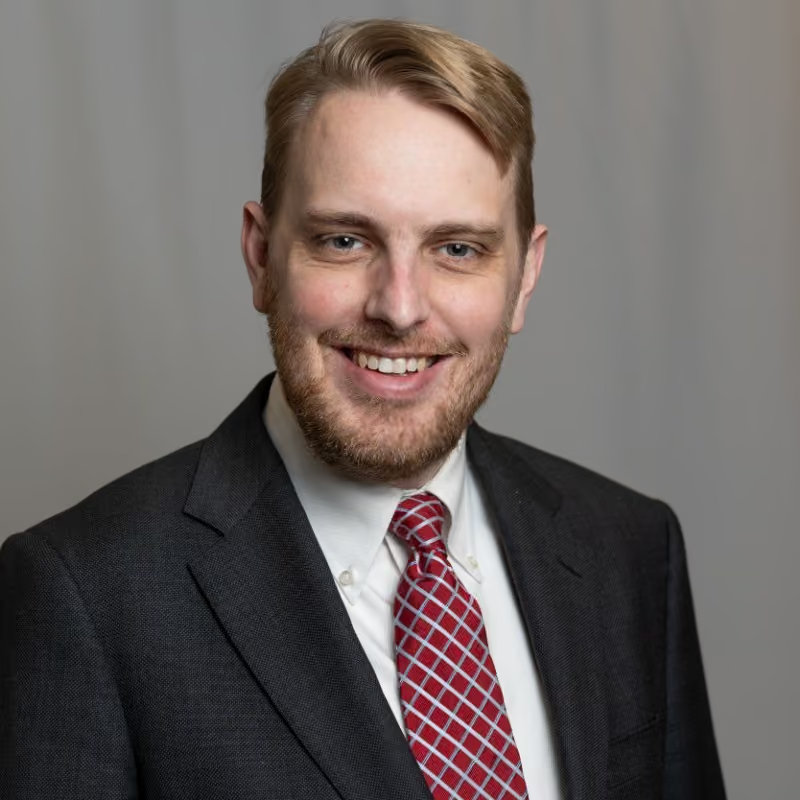
Host: For many guests on Acquiring Minds, buying a business is a path to a lifestyle. It's part of a larger vision of what they want for their career, their time, their family. Today's guest is a shining example. Dan Drake and his wife wanted to move to Bend, Oregon. Transplants from the Midwest, they were living in Seattle, but really had their hearts set on settling down and raising kids. And in Bend, that beautiful growing community of 100,000 in Central Oregon. Also having children and going from parental leave back to the rigidity of work when that leave ended made them value flexibility more than ever. And finally becoming part of a community. Dan was drawn to how being a business owner can embed you in the fabric of a region. So when he decided to search, his geographic criterion was tight just Bend, Oregon in the surrounds, which meant he was likely going to have to compromise on other criteria. And he did on size. The business he bought generates just $140,000 in SDE and has three employees. There's obviously a lot of risk there, which Dan and I spent time on, but recall, there's a vision. Some of that risk is absorbed by Dan's commitment, by his intention to not just generate a return, but to become a member of the Central Oregon business community. As a cpa, Dan is as cognizant of the numbers as anyone of the quantitative elements of this business, but he's also factoring in the qualitative elements of what owning this business will do for his and his family's life. Here he is, Dan Drake, owner of Industrial Applied Electric Announcements A Webinar Tomorrow Friday, Johannes Hoch will do a presentation on how to move fast when evaluating acquisitions so that you avoid the notorious long multi year search. Increasing the velocity of your deal analysis will allow you to look at more deals and arrive at the one faster. Johannes and his partner ran a two year search in two months and closed in under six months. And he's going to show us how they bought an artificial turf business in Texas and have grown it considerably. You can hear that story in episode 186 from October of last year. So come here Johannes. Explain how to look at deals and quickly decide go no go, a key skill for an efficient search. That's tomorrow, Friday, November 1st link to register for that webinar in today's show notes or on the Acquiring Minds homepage on acquiringminds co. Also, don't forget to sign up for alerts at Smith List, the job board for operators and leaders of small businesses. For some of you, buying a business right now is less your priority than simply operating and leading a business. You want to get in the seat. Well, Smith List lists amazing opportunities to do just that. Many of the roles posted there are from within the searcher community, owners who have bought businesses and are now looking to hand the reins to an entrepreneurial operator. Which is probably you if you're listening to this podcast. So head to smithlist.com and sign up for the alerts so that you're notified as we post new job opportunities for entrepreneurial operators like you. Smithlist.com Smithlist.com. Welcome to Acquiring Minds, a podcast about buying businesses. My name is Will Smith. Acquiring an existing business is an awesome opportunity for many entrepreneurs and on this podcast I talk to the people who do it. August Felker is a two time successful searcher, first with a traditional search fund. The second time around he did a self funded search. Today, August runs Oberle Risk Strategies, an insurance firm with a dedicated practice group for searchers and acquisition entrepreneurs like you. If you've got a business under Loi, Oberle will provide complimentary due diligence on that business's insurance and benefits program. A great no risk way to get to know August and team. They love helping searchers. They've worked with hundreds. Oberly is a specialty insurance brokerage for searchers by a former searcher. Check out oberly-risk.com O B E R L E- risk.com, link in the show notes Dan Drake, welcome to Acquiring Minds.
[4:58] Guest: Hey Will, thanks for having me.
Host: Dan, you and your wife had wanted to move to and settle down in a town that the two of you loved, Bend, Oregon. So when you set out to buy a business, you looked there but that was going to be something of a challenge. Bend, Greater Bend is still pretty small, I think 250,000 or so of the entire area. But here you sit today, owner of a business in resident of Bend, Oregon. So let's hear how you pull that off. Dan, start us off with some background on you.
Guest: Yeah, so resident as of four days ago. So we just finally, finally moved. I have on the business. We moved from Seattle, Washington. So that's almost regional. It's not a very large move. So yeah, I have been in accounting and finance as a professional for the last 10 plus years. I got my CPA out of college. I worked for a big four accounting firm and seven years since then I've worked in your typical financial planning and analysis roles that companies as large as a Fortune 250 and as small as a tech startup which turned out not to be Small, but it did end up failing. So I learned a lot of different things, but it was always in, even the tech startup was in a fairly tangible industry. So trucking, logging, sawmills, electric utilities. So most of the work that I supported, even though I was a blue collar person, was very much your workforce. That was your hard working, honest, worst steel toed boots type of people. And I was fortunate enough to get out in the field a lot and I, I really like those kind of things. But finance was definitely my, my reason for being in my passion. So it was kind of a good setup to where the story will go.
[7:03] Host: Exactly. Good, good combination there of, of passion but interest and cultural interest. Carry on.
Guest: So my wife and I have been married for seven years, so we've been together for quite a bit. We've moved already from the Midwest to Seattle. So the idea of us moving again wasn't probably as daunting as it is for some. We weren't necessarily leaving any family behind. The area that we'll be talking about, Central Oregon Bend is where we live, is fairly close. It's almost considered regional. It's about a 35 minute flight, but it's a six hour drive. So it's, it's not something that's commutable per se, but it's something that my wife and I have been visiting for seven years now, ever since we moved to Seattle. And we love it. It's a smaller community, but it's growing, it's thriving. It's one of the fastest growing metros of its size in the US it's got a lot of people who are retirees moving in. It's got a great outdoor culture. It's got a very supportive small business network which I found and I've really liked. So it's been a place that has always attracted us and after being professionals, having experience, we started a family. We're expecting our second here in a couple months. We decided like, hey, this, if you really want to do this business acquisition thing, this would be the place to look. So that's what kind of launched us in all of this.
Host: And what about business acquisition itself? How did that come on your radar? Why are you not still a CPA carrying forward in that on that the path that you were on?
Guest: Yeah, so I definitely have always liked working on more of the value creation, the investing as a discipline as opposed to the bread and butter like a lot of accountants are. Type A. Well, okay, the everything balances or we've got a great process. It's rock solid. I actually Always found that was really boring. So I've always really tried to find extracurricular activities and deal support strategy, all the things where, you know, you're closer to an operation, but there's a financial motive behind it, and then you're creating value out of something. I've always really liked that. For the last four years, I used that interest and did start investing in real estate. So we got up to five rental properties, and then each deal we did was larger and more complex. So that definitely gave me a very, I would say, dip your toes in the water feel for eta, but it definitely has some core concepts that overlapped. So that absolutely gave me a lot of confidence to think about ETA as a path. I had some friends who've kind of been in different investment banking, corporate development type roles, and then they had mentioned, okay, you know, rolling up these smaller companies. There's a lot of value. It made sense to me and ended up finding your podcast. I think just search for it. And I listened to probably 10 in, like, a week. And that was a really. A big, oh, okay, this is great. I kind of understood most of the language. I had to Google what SDE was, but figured that out fairly quickly, like, okay, just think eita. And then from there, I just kept listening to different podcasts. I read the Bible, Buy Them, Build, and started thinking about financing. And then, boom, before you know it, I'm like, all right, let's. Let's do this search. And, wow, it's been a rush.
[10:49] Host: Well, Dan, but let me just push a little bit more on the decision to do. Sounds like you. Your taste for how you wanted to spend your time basically was more strategic than it was being a cpa. So you were. You were looking for a change, or it was inevitable that eventually you'd stop being a, you know, a W2 accountant and go off and do something. Because, I mean, I understanding your. This appeal to you, but still, it's. It's a big decision. So I'm just wondering what the catalyst was to dive in.
Guest: Yeah, the catalyst was becoming a father. I think actually having like a. Okay. The flexibility is definitely one of the things that attracted me to ETA. So our daughter's 2, so about a year and a half in, my wife and I both had our maternity paternity leaves, respectively. And then we go back to the daily life, and it just didn't seem like enough. And that, I think, really put a lot of gas on the fire. And we didn't know we were expecting when we started this search, but we knew it was a possibility, but that was a. It was a big family kind of timing. Like, okay, the timing's right. If we're going to expand our family, let's get ready to move to Bend. This feels like the time for you to start your search. So it was kind of a family establishment. Parallel was like, all right, let's go. And then we were fortunate. I think this search. The search didn't go as long as we expected, which is great, but throw in another kid. So, you know, we'll take what we can get. But it's definitely no shortage of balancing different things.
[12:40] Host: Sure. Well, perfect segue. Okay, so you make the decision. You're in. You're based in Seattle at the time, and you're basically. It sounds like you've got your heart set on Bend. So we know that is, you know, kind of constraint number one or criterion number one. You want to be in Bend, Share a few. Well, on that point, would you have considered anything outside of Bend? And what were you going to do if you didn't find anything for literally years, which could have happened?
Guest: Yeah, I think after understanding the deal flow later on, I entirely agree. It could have happened.
Host: Yeah.
Guest: I think we were going to give it a try for probably up to two years and keep on keeping on with what we had in Seattle. We could have gone for a little bit, and we weren't necessarily in a huge rush, but why not cast the line and see what you get? If we would have gone longer than two years, I think we would have had to do some sort of reassessment on what the way is to do this. Maybe it would be something like starting a franchise from scratch as opposed to acquiring. But there really wasn't a plan B at a period of time. It was, give this a go. If it doesn't work, figure it out. But we didn't have any sort of. Well, if this doesn't work, we're in a bad spot. But we. I think I just would have been a little impatient and tried to get some sort of creative.
Host: Okay, great. Well, then beyond. Beyond geography. Now, what were some of the other criteria?
Guest: So I always think of the three criteria that are on this podcast all the time. It's location, industry, and size. So I definitely was pretty aware that, okay, you definitely make your. Your most strict criteria on your region. What I was looking for was something in the industrial or construction supply chain. Now, I knew about Bend going in that that actually was a strength of that region. So even though I went with, I wouldn't say an Ultra specific industry. I definitely pared it down a bit, but I didn't say like, oh, it's got to be like some sort of home services, etc. I did know going into that market that looking for something in the construction or industrial supply chain would probably be fairly favorable and present, but it's still a smaller, smaller region. So I knew that made that search harder. And then the third was I was looking at a purchase price of up to $2 million. And then I was looking at, you know, SDE that would fall into those ranges based on, you know, what its multiples were. But realistically, in my head I was looking for something around 300,000 SDE.
[15:43] Host: 300,000 STE.
Guest: Okay, okay.
Host: And that would mean that half of that SDE or more would go to your loan. And so you were figuring that you'd pay yourself probably 100 ish, 125 because you need to have some money there for the J curve and to reinvest in the business. Is that what was penciling? How was penciling for you?
Guest: Yeah, so I was thinking if I could get to six figures, we wouldn't have to really make any change in our family's lifestyle. My wife has had a, has had a great career. She still has a great career and she retained her job. She, she works remote in finance. So we had, you know, I had a backstop, I had the, yeah, the confidence backing of my wife. So we didn't need to have any sort of very large financial near term outcome to make this work. So I kind of looked at it as an asset. I'm like, great. So we don't have to stress, we can really focus on doing this the right way. Be sure not to take outside risk. But we don't need to try to squeeze performance out of this thing year one. So anything in the six figures was going to give my family all it needs in terms of, okay, we're happy with where we live, having our second kid. We're probably not really going anywhere. So.
Host: Yep. Yep. Great. And of course Bend is going to be more inexpensive than Seattle. Of course, I suspect Bend prices. It's probably every, every native Bendian, I don't know if that's the word, is probably complaining about real estate prices because I suspect that market is, is hot with all the Seattle transplants and California transplants flooding the place.
Guest: Your intuition makes you feel bad? No, we, I've told my team, like, I'm sorry, I'm part of the problem, but your intuition's dead on.
Host: Yeah, yeah. Every Every kind of non coast. I mean, you know, Boise or wherever. You're hearing that a lot.
Guest: Yeah, that's a great, that's a great proxy too. If you were to say like Boise to Ben, like those are definitely similar cultures. Yeah, yeah.
Host: Well on the SDE number spoiler folks, he Dan bought a business with smaller SDE just shy of 200. So we're going to get there and redo the math with the business that you did buy. So tell us that, start telling us about that business, tell us how you found it, what your search look like and let's get into it.
[18:14] Guest: Yeah. So I went back in my notes versus the pre call to make sure I had my listing sde, et cetera. So I think I said something just shy of 200. I was fairly shy of 200.
Host: It was otherwise known as 150.
Guest: Yeah, it wasn't even that. It was 140.
Host: Oh really? So okay.
Guest: I knew that going in that was something that I had a pretty strong disqualification about. But with Ben's deal flow being fairly light, so I have to at least go in and see. You don't know what's under a rock until you turn it. So I went and I visited reach out to the broker, set up time to visit the business and you know, you can't make this up. The I couldn't meet the owner because he unfortunately fell and had to go to the hospital. Wow. But I was in town so I was like, okay, well let's just do it.
Host: What do the following acquiring minds guests all have in common? Doug Johns, Morley Desai, Tim Erickson, Chirag Shah, Shane Ursum. They all went through the Acquisition Lab, the accelerator in community for people serious about buying a business. But they represent just a sliver of the Lab success stories. The number of deals across the Lab's cohorts now stands at over 120, with over $300 million in aggregate transaction value. The Acquisition Lab was founded by Walker Deibel, author of Buy Then Build, the book that introduced so many of you to the very idea of buying a business. The lab offers a month long, intensive, almost daily Q and A sessions with advisors, live deal reviews with Walker, Deal team introductions and an active community of serious searchers. Check out acquisitionlab.com, link in the notes or email the Lab's co founder, Chelsea wood. Chelsea@buythenbuild.com
Guest: it was marketed as industrial supply for mining, logging and construction. Okay, and here's your ste located in in the middle of Bend. I was like, oh, that's A good location. Okay, great, let's go check it out. And went in, met with the broker and the warehouse itself. Like it definitely, you know, seemed a bit older, seemed a bit outdated, but you could tell like, okay, you walked in immediately to the building. It's like, okay, this really is in the middle of this town. So that's, that's good. And then when I walked in, everything was fairly organized and clean. Like it definitely looked like, okay, like this place is definitely a, it's a business that runs. It's probably not as modern for what I'm expecting, but good feeling. So then talk to the broker. Going over the SD and 140 just, it wasn't, it wasn't big enough to actually pay for any sort of lifestyle after debt service. You know, all the different things about buying smaller talked about on the show, back of my mind, I was thinking about that the real estate was also owned by the owner. So I learned that after talking to the broker and of their SDE not included, you could do an ad back. $90,000 of rent was paid to himself annually. So you're really looking at like a230 if you buy the business. So I sat there and I didn't really think I'd get traction, but I was like, hey, I got to try it. And I told the broker, like, hey, I like this business. It's just not big enough though for me to take the risk, move my family down and buy this thing. If we can buy the real estate with it, that's different math. I had had an SBA banker at the time and we went through buying a deal with real estate versus not doing a 25 year amortization versus a 10. And I knew if we got real estate on the deal, okay, that's actually going to have a pretty similar like monthly cash outflow for debt service. But then I could add in that rent. So I'm like, okay, that's great. I'm going to try to write an offer with that. So I kind of did a pre loi with the broker and then he gave me feedback that yeah, they'd be interested in selling the real estate. So then I drafted a full loi, sent it and it got accepted. So it was a deal that I wouldn't have done without the real estate.
[23:03] Host: Let's unpack that a little bit more on adding in the real estate. So understanding that $90,000 in rent was being paid to this real estate being paid to this landlord, landlord was the owner. So if you also become the landlord and Owner of this real estate, that 90,000 you can count as money to the owner, otherwise known as ste.
Guest: Okay, yeah, yeah. But it was, it wasn't presented as. So I almost had to like make my own sd.
Host: Yeah, yeah, okay, got that logic. Why though? I think I heard you say that if you bundled in the SDE and bought the whole package that your debt service would be the same. How is that?
Guest: So I had a, an SBA lender who I was working with before this and I really, really liked it. I really liked him. And we were going through different scenarios and what he was presenting to me is if you buy a business without real estate, we go SBA. It'll be a 10 year amortization. And this interest rate. If you can buy a business that includes a purchase of real estate, and this is all I believe through the 7A SBA. 7A. If you can get a deal that has real estate included, we can get you a 25 year amortization at a lower interest rate. So because of the purchase price of this building, like it was still most of the price, but lower interest rate and stretching out that amortization by so much, it actually made what the monthly debt service would be in just sheer dollars. With real estate at a real estate price or without real estate, without the real estate price, it made it basically the same monthly debt service. And I was like, okay, great. So my cash outflow for debt service is about the same. But now I get this rent that I don't have to pay, so that's really like net more free cash flow. And I think having the real estate just made me feel safer about taking on that risk as well.
[25:07] Host: Amazing. That sounds like great enhancement to the deal. Just the point about the stretching the 10 year amortization on purely the business. If you just bought the business, but lumping in real bundling in real estate, it becomes a 25 year amortization. I believe that's. Isn't that only if the real estate represents more than 50% of the total package? It could your real estate represent more than 50% of the total package?
Guest: Yeah, it's not even close. So that's why I'm probably not even aware of that limitation. So our purchase price is like 80 plus percent real estate.
Host: 80 plus. Sorry, what is the 80 plus percent? The business is 80 plus percent and the remaining 15% is the real estate.
Guest: Other way around, about 80% of our purchase price was the real estate.
Host: Oh, okay.
Guest: Yeah.
Host: Right. So then it, then it does make sense.
Guest: Yeah. So I didn't run into that 50% threshold to anybody even bring up to me because I was never even close to it. So I can't confirm or deny, but that sounds like it makes sense. Exactly right.
Host: You weren't close to it in your favor. You were so over the line and it was never even a topic of conversation.
Guest: Got it.
Host: Super. All right, a little bit more about the business. So how old, how many employees? And just tell us a little bit about what being a supplier is. What are people doing day in and day out?
Guest: Yeah. So our business turns 50 next year. So founded in 1975 and founded by the. By the then owner. Three employees. So that's two full time equivalents, but three total. One is our warehouse manager, one is an outside sales rep, one is our accountant. They all have tenure over 10 years. So they've had a lot of established time with the business. They're all experts. Like they, they all know very much what they're doing, how to do it, which has been very helpful to me and I've learned a lot more about our business since. So we would be. If you, if you considered us like an industry, there's an acronym called mro. It's Maintenance, Repair and Operations. Granger would be like your largest public company comparison. That would be where we fit into an industry. We have a specialization that is. Is a differentiator in the fact that we carry a very wide range of electrical components for heavy machinery that are critical for uptime. So when it, when an excavator goes down and they need a new starter or alternator, those things, given how broad the age and specs and models of these different machines are in the field, our key competency is we have a wide array that nobody else has and you can come in, get your thing and get back up and running and then we kind of fit nicely into. I think other guests have talked about in manufacturing where if you are a small piece of your total customer spend, it's a nice place to be because you're critical, but you won't necessarily be scrutinized. That's where we kind of fit into in that downtime equation, what you'll spend on a critical electrical component at the register versus what it costs you to be down for an extra day or two, the math isn't even close. So that's where we fit in quite nicely. And then we'll also sell other more standard maintenance supplies, shop supplies, kind of with that service model. So we definitely. We would probably be called a dealer. If you looked at a supply chain so our customers are business to business but we are the last touch point before its end user. So yeah, no, it's good. We have a lot of vendors. We almost have as many vendors as customers. I don't necessarily think that's good but we're fairly concentrated. So we have about 100 customers plus our kind of retail agriculture and we have a good customer base. There's some seasonality. I'm just learning it and really how I've assessed it is our name of our game is inventory management. So that is you know, two months in plus diligence. That's what I'm, I'm learning about the business and that's, that's how I understand it. But it's been in terms of a lot of other businesses that I've worked in that are very capex intensive. This business is actually like okay, it's digestible to get into right away.
[30:11] Host: What do you mean in terms of learning it, your learning curve?
Guest: I have a lot to learn but my checkbook isn't as scared as say if I had to buy a bunch of new machines or equipment with an inventory management business. A lot to learn about what our customers need and our delivery models, etc. But if the, you know, I kind of was prepared to maybe have something in manufacturing you would have, you know, the same things that your, your customer expectations, supply chain management, etc and you'd have capex maintenance, potentially huge outflows. With this inventory management model I'm like okay, well I get to take most of that piece out. Like if we spend money on it, we can probably sell it. Is it at the profit we want? Not necessarily, but that's. I think Ben, if there's like one thing that's helped me sleep throughout this whole process is as I got comfortable with this business I was like okay, inventory, at least that's a risk that is fairly manageable.
Host: Interesting because it is, I mean obviously inventory, especially if your core value proposition is having inventory is having the things that your suppliers need. That is why you are in business to carry the inventory so they don't have to. And your, so your specialization, your value prop is, is inventory and it's also long tail inventory. It's not just having you know like an e commerce with you know, a handful of hero products you just make, you know, you're, you're constantly having to buy more as they go out the door. But the, you know, the exact mix of what you're maintaining is not complex and here I would imagine it's quite complex. Having to know, you know, how many carburetors you should have in stock for 150 different models of, you know, whatever vehicles I'm not going to try to name because I don't know their names sort of thing. Right. And let me, let me tie that question, where I'm going with that to all the, just the obvious question to ask. Here is your key man risk. So it's tiny business, three people. And while your three people are experts, that's of course both pro and con. Pro because it's a quality team. You got con because if your warehouse guy walks out the door, does anybody know how to answer the questions, you know how to find the product that the, the customer needs. So I put all that on your plate.
Guest: Something is, I definitely assess as, and this isn't necessarily key man risk in terms of leaving, it could be retiring.
Host: Yeah.
Guest: And I think that's entirely possible that we all are very happy working together, very amicable, but we still have key man risk just because of, of time and, and it's time to go enjoy the rest of your life.
[33:11] Host: Exactly.
Guest: So that's, that's something that I think all, all of our positions including so our, the owner is, is staying on through all almost the end of the year. And he himself is, mechanically, he's, he's a genius. I've been told by several of our customers that nobody has a deeper knowledge than him. So you know, in my mind and how I'm thinking about the future is accepting like, well, we can't, we can't replace that because I don't think anybody can. So we have to use our customer reputation and our current service model to win going forward. We'll be able to, you know, the other individuals in the business can help troubleshoot but I think unfortunately we might just lose that. I'm going to try my best to help find talent that can. But that's a key man risk that I think pragmatically I look at and like that's maybe not recoverable. We'll do our best to fill in needed, needed knowledge gaps but I don't think that's going to work. Now the other two individuals on our team, the sales manager and the warehouse manager. Absolutely human risk as well. And how I think about that is getting our team a bit, I would say over resourced so that we can have a little bit of slack to fill those holes when they inevitably come up. So that, and then I've got a lot to learn too. I hope to have at least enough working Knowledge to cover any near term gaps. But I do want to be very cognizant of that's how I will become working in the business versus on the business. So yeah, no, it's, it's there, it's. So I'll just. Without being too specific, when I came into the business, the average age of our employees dropped by about 15 years. And I just, you know, you added one employee, so that's kind of where we're at with retirement risk. Yeah.
Host: Yeah. Well, the, the good news, Dan, is if you, when you figure this out and you crack the code of how to kind of somehow bake in the necessary knowledge into the organization rather than having it all cooped up in the owner's head, you have added a tremendous, tremendous value to the, to the organization. And you emerge on the other side of that process with a far more valuable, resaleable if you ever want to do that business. So, you know, it's, it's. So the thing about these stories is so often that the flaws or weaknesses are also the opportunities. And if you can, if you can fix those things, then you've added a tremendous amount of value and really built equity into what you bought.
[36:04] Guest: Great.
Host: And, and so speaking of tiny team and guys who are older than you buy a lot and you being the, you know, big city guy rolling into town and the fourth wheel, how's the chemistry? How does it feel to, to, to be the new boss of a very small team that's been working together for 10 plus years or.
Guest: Yeah, so I've. Something that's probably not as common in these deals is I met the team before we closed. So there wasn't a day one speech that, hey, this is the new owner sold the business. It was known that the business was on the market. Ben's a small town, people talk. So I think that was known by the employees for almost a year before I, I made an offer. And I wasn't expecting to meet the employees. I tried to be very respectful and the broker and the owner just didn't have any like needed secrecy behind it and even encouraged me to ask and talk to the employees. So like, okay, well this is unusual, but okay, great. Like let's kind of use this as like almost like a diligence tool. And that was a really good thing for me to have is it added a level of diligence. I was able to start that chemistry and kind of almost get a head start on day one activities by spending, I don't know, probably five or six days total with the Two employees, and then I guess if you include the accountant, but she was more kind of the data provider. So I interacted with her quite a bit, but in a different capacity. So I was able to talk to them. And I've been fortunate enough to a lot of the jobs I've had. Like, I've been out in the field and had my own pair of steel toe boots, been out in trucks, you know, been out in workers trucks, going to harvest sites, and, you know, all these things. And I've always liked it. So it wasn't my first time kind of getting out and talking shop. So I was able to, you know, use some of that experience in my interactions. But both the employees, we just. We got along well, and it was pragmatic conversations. Like, I could kind of tell right away, like, okay, no, this is. This isn't any sort of, okay, let's make a good impression, or let's be really abrasive. It was. It was just kind of realistic. And, you know, here. Here are the things that we don't have that I want to succeed in my role. Here are opportunities. Here's some things that are risks. But it wasn't overly negative, overly positive, and we were able to develop a really good rapport right away. So, you know, I probably spent 10 to 12 hours with the employees before we closed. And, you know, one thing that I tried to do, I wouldn't call it an olive branch because it was. It's something I genuinely want to do, was I wanted to understand, like, okay, what are the things that, like, you would want most important to you that would help you do your job better? And what I. What I try to do is learn what those were, and then, like, week one, week two, deliver that to the employees. So I was able to do that. They were pretty simple asks. One was a. Like a credit card for taking customers out to lunch, and then the other was an inventory system, POS system, which, I mean, it's not done, but I bought it. So it kind of gave me a good opportunity to get off on a good foot. And one of my favorite parts of that job is at the end of the day when the sales rep comes back and the warehouse manager's kind of wrapping up orders us just like BSing and talking about what's happening out in the field. And that's probably the part that I was like, okay, this is great. Um, really, like, this team chemistry is good. But, yeah, let's see. I mean, I'm two months in. Anything could happen. But so far, it's been. I don't want to be naive, but it's. It's been like a really fun place to. And really fun people to spend time with. But I think going back to your original statement, like keyman risk is. Just because it's fun doesn't mean keyman risk is not there.
[40:46] Host: Well, and then just on that point again, did you. When, as you were getting to know the team, even ahead of the transaction itself, were. Did you venture to ask about that? Hey, guys, how long. Yeah. Do you anticipate sticking around? Or will you stick around or. See, I'm even struggling with how you. How you would ask that delicately. But did you venture to do so?
Guest: I did. One was more venture.
Host: How did you ask it?
Guest: And the other one was more. Um. Ventured for more. Yeah. Yes. One came to me and I went to the other individual. So. And this goes back to the. The pragmatic interactions that I could tell right away, I was like, okay, this is not overly scathing. It's not overly positive. This is. They're. They're realistic about this. This means I can probably. I had a. A good feeling trusting what they were saying. The sales manager, second interaction we've ever had. He's like, hey, I love what I do, but, you know, I'm this old. I'm not going to say what it was. But he's like, I'm not sure how much longer I have. Just want to let you know. So right away, I'm thinking one of the first things you do if you do clothes in this business is you start searching for, like, a sales rep. So, yeah, was able to talk to him a little bit more about that. And I was like, hey, understand, like, you've given your life to this business. You need something that fits your lifestyle. And if this doesn't, like, all the power to you. And thanks for building this business to what it is. Would you be willing to help train somebody in the interim? And without a. Without a pause, he said, absolutely. So I thought in my head that, okay, like, right away, you're gonna have to start building out a workforce if you close.
[42:47] Host: Yeah.
Guest: Now, funny enough, we've continued developing rapport. And I mean, I talked to him almost every. Every day, and I've asked him three or four times, like, okay, like, just let me know when you're gonna retire. Let me know when you're gonna retire. He's like, I get high on selling, and I keep. I wanna keep doing this as long as I can. So I'm not. I'm not trying to Retire anytime. You know, he's him and I have, he's probably given me some of the best, like strategic insight to our customer value proposition and our offerings and where to go next. And he's got a ton of energy and I wanted to make sure to just kind of empower him to, to make decisions. And he's told me he's like, hey, I really like where we're going. So I want to go as, as long as I can go. Which still doesn't mean that that key man risk is gone. But I would say at least in the near term, I'm feeling okay. So then the other individual, I just more straight up asked him and we had some rapport developed and said, hey, like this decision is entirely yours, but how long have you been here and how long do you want to be here? I think you've got great talent, we want to keep you, but if you have any thoughts on where you want to go, now's your time. And he very much adamantly said like, no, this job's been, been good for me. He worked in the trades beforehand, so he doesn't go out in the field and do harm to his body, his knees like he does like he used to. So he likes that and it's worked for him. So, you know, I can't take everything at a 100% face value. He's also a lot less of a true retirement risk if you think about age. So I didn't have that risk in the back of my mind. But given his tenure and given what he said, you know, most important thing, I want to make sure he is enabled and happy to execute. And then I hope that those things will solve the key man risk as well as adding a little bit of slack functionally in our workforce. Because these things will happen when and how, I don't know. But we'll want to be prepared.
[45:10] Host: A PEO run by a searcher for searchers if you're running a company with less than 100 employees and providing health insurance to them, you may secure better benefit plans at a 15 to 30% discount through a professional employer organization or PEO. Aspen HR, run by search fund veteran Mark Sinatra, understands the needs of search operators and provides HR compliance, flawless payroll, HR due diligence, support for your acquisition, and Fortune 500 caliber benefits, all for a fraction of the cost. And tis the season to evaluate your employee benefit plan. Most new clients reach out to Aspen 90 days before year end or their renewal date. So before they get slammed, check out aspenhr.com or contact Mark directly@markspenhr.com before we get kind of get into the more about the future of your business, the plans for it, there was a number of details to the actual negotiation and the terms of the deal and how it changed and how you benefited from that. We've touched on the real estate component a little bit, but talk us through that point where you offered and then got a counteroffer that was actually sweeter than the original offer.
Guest: So I had mentioned I had a great SBA lender. I don't know if I can call. Yeah, I'd love to. So It's Jeremy French, KeyBank. Okay, incredibly helpful, had confidence in me. Great at service, also great at consultation. And he is who I worked with to get this deal prepared and to be backed. Backed by him when I go in and finance the deal. So in my initial LOI proposal, the purchase price of the real estate in the business was going to be just under 2 million and it was going to be financed by an SBA loan and the interest rate at the time I think we were thinking is going to be just below seven. So when I delivered that, I got a counter two days later and said, hey, we like the terms of this, this deal and the timing, it makes sense, we like it. We would like to do seller financing on a 25 year note with a five year balloon. And they added just under a hundred thousand dollars in price to the real estate. So it just brought it to 2,050,000. So they did counter to slightly higher price, but they offered a interest rate of 5%. So even with that higher price, my monthly outflow was still lower. And I went back to my, my banker and said, hey, like, I do really appreciate your help. I just want to confirm with you because here's what my gut says, this is a great deal versus what we have. And he said like, hey, I want to close this loan with you, but don't turn that down. Like that's a bet. That's a great deal. So yeah, they countered at a 5% interest rate at a similar amortization structure and 10% down, which is about what we like was the same thing that we did on the SBA side.
[49:02] Host: So and in return just wanted a hundred thousand extra dollars over 25 years.
Guest: Yes. Yeah, now it is a five year balloon, so. Right. So technically it would be at the end of year five, but I mean the way it's amortized and the way we're paying for it, and it wasn't even 100, it was like slightly below that but yeah, over that time period, when I just looked at the, you know, comparable debt service between our offer and theirs, I was, wow. Yeah, theirs is definitely better, so we're going to take it.
Host: But even on the point about debt service, and I may be about to say two things that are different but are actually the same anyway, even on the point of your debt service, monthly debt service being low with their lower, with their counteroffer, they also, the total purchase price of the business, when you add in not just the principal, the purchase, explicit purchase price, but all the interest you pay over the term of the loan, that number would also be. They'd also just in total get less money because at a lower interest rate and you add up all the interest, it's probably going to be less than $100,000 they're taking home less than even with an additional hundred thousand dollars than they would have with your first offer. Do you find?
Guest: Oh, probably, yeah, I, you know, I never even thought about that, but yeah, probably, you know. And their motivations as sellers were, I would say, way different than what a lot, A lot of what we hear on your show in terms of, you know, we're looking for a retirement, a legacy. You know, they had an explicit interest in providing some sort of income stream for their, their children, potentially so. And then they also had an aversion to taxes, so they love spreading things out as much as they could. And I couldn't sit here and tell you, like, oh, no, mathematically, I think if you do any reasonable, like, you know, time value of money at present value, I couldn't tell you like, oh, no, they're looking for the better deal. I think they're just looking for what they wanted and what, you know, their lifestyle and maybe some conceptions about like, oh, but I paid less taxes, so I went. So I wanted to make sure to negotiate for what was important to them and what wasn't that important to me. So, yeah, I, I definitely am not sure it was. You know, if you were to take that to like a true investment committee or a board of directors, they would say that's the right move, but was the right move for them. And yeah, that's. I thought the deal was worked well. And then I think one of the more important things that I didn't fully appreciate until later in diligence was not having a bank in diligence made things less of a headache. There were a handful of things that I think we'll talk about later in the deal that if there was a bank involved, it would have made things a lot more challenging versus we were able to have, I think more like face to face conversations like, okay, with this thing coming up, here's how I think we should address it.
[52:15] Host: Well, let's, let's, we're going to get there in just a sec, Dan. So, but let's, let's put a pin in it until we do. To be clear, then, you bought this business and real estate and the real estate is really more than 80% of the value here.
Guest: That's correct.
Host: Let's not forget for 10% out of pocket and then the seller financed the rest. So you basically bought a seller finance business almost fully seller financed business. No banker, your banker, Jeremy French of Key bank said take the deal, didn't try to get you to do the SBA loan. And, and as we're about to hear, that was a positive because there was a complication that a bank really would have hated that you were able to manage through. But also, as we know, SBA loans are quite onerous to get across the finish line, so you got to skip that headache as well. So what's not to like? That's good. And it's also just a reminder, thinking through, like, wait, he just countered. My seller just countered with an offer. That feels better for me. It's. Who is, I think it was Scott Walton who, who recently just talked about the way they approach sellers in the negotiation is to really try to understand what the seller actually wants. The temptation is to haggle over price, to haggle over some single number or, you know, two or three numbers around seller, no percentages, you know, and final purchase price, but really trying to understand what their motivations are, the motivations behind the motivations is, you know, a far better way to approach a negotiation. Even though so, so often we forget. And your case here is a perfect example. This seller who's already in his 80s, so he's probably, you know, he's probably not optimizing for the most money for himself possible anyway because he's on the older side, had these other motivations that you eventually learned, which is kind of income for his family.
[54:21] Guest: Yeah, no, that's, that's a great point. Um, I had just for a different professional project before, several months before, I wrote a book called Negotiate Without Fear. And I actually referenced that book quite a bit in my loi and further discussions. And it just like you'd reference your podcast guest. I thought about those things all the time. Like what's important to you, what's important to them. Okay, that's Your contentious things. Price is usually that. And then what's important to them, not important to you. And then the. You give that. That's, that's what that book would tell you. And then what's important to you and not important to them, you tell them that and that. I mean that book actually I referenced it probably four or five times throughout and that helped substantially throughout making a deal that's going to work for both sides. But I think that was the fun part of it was there was more creativity in. Okay, well you don't have to just like focus on just price, like craft something that fits both parties well.
Host: Great. Negotiate without fear. And so your kind of key takeaways is the motivations. You bucket them. The motivations that are important to both parties. The motivations that are important to you, not to them. The motivations that are important to them, not to you. And you have those three kind of buckets.
Guest: Pretty clear. Yeah, it was helpful because it was, it was, it's straightforward enough that you're like, okay, that's, that's how I should approach this. And it for. In this experience, it just took a lot of asking of this, mainly the seller's broker. I think almost every time I had a phone call with them I was like, okay, so what's important to them? Is this important to them? And then if everything was important to me, I would state it explicitly.
Host: Great, Dan. Okay, now to this thing that we've been hinting at that happened in diligence. What is this thing that happened in diligence?
Guest: Yeah, so this is something that if this happened with a SBA lender, this deal either wouldn't be done or I'd have either less hair or more gray hair. So thank. Thankfully I don't. When I got the diligence on or the original listing and the financials for this business, sales had peaked in 2022. They came down 6% in 2023. And I wasn't necessarily originally alarmed by that. The SDE numbers that I quoted were a three year average. They weren't off of that 2022 high. And going into, let's see, it was the LOI was accepted in April and I started diligence in May. So on my first diligence trip I got year to date April financials. So I knew coming in I was like, okay, well sales are down 6%. And you know, there's a variety of reasons that trend potentially could continue. It could be the 2022 Covid peak of so many things in construction. When I got the financials back for 2024 year to date April, they were down 20% versus 2023 which was down versus 2022. And immediately I looked at that, said some four letter words and started getting into kind of pro forma P and L and debt service free cash flow situations. And what I saw was there would not be a lot of cash flow left for me or if this trend continues, I might be in a default position fairly quickly. That's not good. So I put together a fairly simple P L with its projected debt service, put it in a slide deck, sent it to the broker and then we had a meeting. So I said it to him like pretty, pretty candidly. He was been a, he was a great broker. He was really good at being realistic and I would say had some good business sense compared to a lot of brokers that I had, I had dealt with in the process. And it wasn't a long time to get to the punchline. I said like, hey, if these trends continue, here's what this debt service is that we've agreed to. Do we really want to be putting my family in a default situation right away? That's a risk. He said he completely understood it was reasonable. I said, give me some time, I'll come up with a proposal. So long story short, because I probably spent three or four days trying to okay, what's the best way to do this? At the end of the day, I kept the purchase price the same in my offer, I kept the five year balloon term the same in my offer. And I said here's what I would like to do. I still want to give you the same amount of cash over five years, but as opposed to having a straight line every single month payment, I want to start at a lower level and then each year ramp up and then what I will be doing is actually paying you more in year four and five. So I'll just give some quick context. So this is something you can kind of understand with math. Originally, the loan's monthly debt service was going to be $11,000. With this new proposal, year one starts at $6,600 a month and then year five ends at $15,000 a month. So what I really was doing was like betting on myself and then asking for more Runway near term. So and I would have other things like I'd have time for the, the property to appreciate since that's such a big collateralized piece of that loan. But there's definitely more risk at the back end. But my gut was the more kind of safety I Have in the early years, the higher my chance of success. So that ended up getting accepted.
[1:00:48] Host: It makes sense, Dan. But one thing that jumps out at me is particularly since you're now doing this negotiation without a banker and you guys can as to use your word, be creative, do whatever you want. Really. No rules.
Guest: Right.
Host: You didn't tie it explicitly to performance. You, you baked in a performance basically which is, you know, give you a lot of room in the early years and in the out years. Like you said, you're banking on yourself. You're betting on yourself to have grown into those heftier payments. Why not tie it to performance so that it's, you know, basically risk neutralized at that point?
Guest: Yeah, no, I actually thought that thought that way. So throughout my diligence process I had two really good mentors and friends that had investment banking experience. One of which actually had like pretty specific experience to my region and. And business type. Am I allowed to do a shout out for them? They were probably the glue that really helped me. So Nick Coleman Arrow was a friend of mentor I had in another professional life that we were still close but he had investment banking and corporate development experience. He helped me a lot with the cash flow projections and your valuation and then brought. Brian Oatway was also had that same experience and he had experience actually in my region buying similar sized businesses as a corporate development leader. And those two I think really filled the gap for me not having an SBA diligence program. They helped me do a lot of those things. And when I was working with them, I went through that earnout proposal and like we just kind of went back and forth and like, okay, if we do this, if we do that. And we both kind of independently got to like this is going to be too complex for somebody who's a small business owner.
Host: Yeah.
Guest: So let's like what's the easiest way you could do this? So that's why I went this route. If real estate wasn't on the deal, I wouldn't have been comfortable doing it. But it did really make my year one and year two. You know that gives me a lot of room to succeed and I would say a good safety net that any like near term stumble. I've got a lot more grace period which will be nice.
[1:03:20] Host: Well, let's also talk about so year one, year two and then you just mentioned year five is the balloon payment. So we often hear balloon payments is. Are part of the structure of a deal. Talk to us like we don't know what they are. And with A specific, this specific follow up question. Do the borrowers, you, in this case, when there's a balloon payment involved in an acquisition, expect. Do you expect to pay that balloon payment? No. Right. You expect to refinance into a different loan. Right. Start us, please, go from there.
Guest: Yeah, that's a great question. Because even some, you know, really smart, intelligent friends I've talked to about this, like balloon is always something that. Wait, what, what's a balloon? Yeah, you got to pay the whole thing. So a balloon is, is a structure where like your mortgage is 30 years and you pay the same amount for 30 years.
Host: Yep.
Guest: A balloon payment, it's got two key terms. The amortization schedule would be like your 30 years on your mortgage. Okay. You're going to divide these payments to interest and principal be 30 equal years of payments. That exists for balloon payment or for a balloon loan for the amortization. So when I said a 25 year amortization, you have your. Okay, let's assume you're going to buy this real estate. And what would 25 annual equal payments look like with that interest rate? Great.
Host: Right.
Guest: Okay, so then here's the kicker. It's a balloon. What's that mean? So when you get to the end of the balloon period, in my case, the end of year five, you actually owe what's left on the, on the mortgage. Oh, okay. So if you pay your house down by $100,000, you bought it for a million, now you've paid down 100,000, you've got 900,000 left at the end of year five. Okay. You now owe $900,000 to the bank. Like, whoa. Okay, that's. How do you do it?
Host: You owe it all. Like you got to pay the whole thing. The remaining balance principle right there, right then and there.
Guest: So that seems pretty extreme, but it's something that, you know, I have some friends in the commercial real estate industry in banking, and it's something that I think I've, I gained a little bit of comfort with beforehand so I didn't have to like fully learn that concept. But the, the idea of like, okay, well, yeah, there's a balloon payment, but you're probably just going to refinance it. So I have two options. One is the option that most people think about is you'll refinance with the existing bank. I don't have an existing bank, but I did work with the, my SBA lender Jeremy, on. Okay, so what would we do in this, you know, balloon payment period? You kind of walk through the options and even walk through options like, well, we could be in a cash out refi situation where we're actually handing you a check versus just refinancing the loan. So I was like, okay, that's, that's good to know. Let's cross that bridge when we get to it. But there were, you know, viable exit strategies that way. And then the other is not always common. The broker made it clear to me that the seller may want to either extend this loan like, okay, as opposed to having a balloon. Balloon do. We'll just like either extend the balloon term or like let it go into perpetuity. Now there's reasons why I wouldn't want that. But the broker came to me and said like, they're also interested in renegotiating the terms once we get to the balloon. So I thought having multiple options was good. Who knows what I'll be looking for or what I'll want at that point. But it is kind of an, an odd like expiration date in a deal. It's like, okay, so now you got to figure out what to do with this. In my case, like $1.7 million that you owe.
[1:07:34] Host: Well, it. A few things. So it interesting to hear that the seller probably is also thinking that there will be some sort of non balloon event happen at five years. And then, so then you wonder, well, why even. Why did they want a balloon payment to begin with? Why don't they just have it be a 25amortization over 25 years, no balloon payment.
Guest: Right.
Host: So I guess, who knows. But then the other thing about balloon payments is it feels like they are. Generally no one expects the balloon payment to actually be made as such. I mean by the borrower. Excuse me, the, the, the, the seller will get their payment at that time, but the borrower never really expects to pay it the whole principal down at that time. There will be some sort of, like you just said, the, some of these, a menu of options, refinancing, refinancing with cash out. So it's. It you. So you wonder what the purpose is and maybe it's just kind of kicking the can a little bit. Let's get these, you know, in general, I mean, like, what is the purpose of balloon payments in general? Kicking the can a little bit. Let's get these five years done and then five years later we'll renegotiate the whole thing.
Guest: It feels like that. I mean the joke in real estate, right, is lend and extend. Yeah, it's like what we did. I mean most of the load is real estate. So we're not way off base there, but yeah, it's like, hey, I'll pay you, but give me time.
[1:09:05] Host: Okay. Interesting. All right, well, we've, we've really covered the, the, the, the acquisition itself. Anything more to say before we start kind of wrapping up and by talking about the future and how you feeling and et cetera. Anything more on the deal and acquisition?
Guest: Yeah, I mean, I think the, the big things were covered with the, with the, like the actual, like bread and butter. Okay, here were the terms. Here's how we did it. Closing itself was pretty straightforward. Not having a bank, like diligence and closing actually felt a lot more like one. One event.
Host: Dan, you had that, you had that moment. This is now. Tell the moment where you bump into the person in the airport who knew the business. That was.
Guest: Yeah.
Host: A Data point of 1. But it does, it did feel like a signal from the universe.
Guest: Yeah, I think. And I, I could kind of talk about the before and the after because this is the same thread, but it's, it's a signal for the universe. It's like immediately like, okay, that wasn't a blip. This is, this is real. I'm very happy about this. I ran into a. Somebody at the airport. I was just waiting at baggage claim. Yeah, look at, he's wearing a company branded T shirt and it's got persons crane service on it. So I just thought, hey, I'll give it a shot. Hey, sir, just curious. Do you buy from Industrial Applied Electric? And immediately this guy with no, no sort of context whatsoever. Oh, Houston. That's the seller's name. Oh, yeah, we, we love working with this team. They're, they're great. They can help us solve all these different, like downtime issues and electrical issues that nobody else can do out here. They've, they've been really good for us. Why do you ask? And then I had to on the fly, like, oh, you know, I'm thinking about maybe taking a job there or something like that. So that was something that wasn't on my diligence plan, but with, you know, no context, no preparation. That's a great data point. I've been out visiting customers. That's what I've been probably spending about half my time doing now is on the sales side. So I've met eight of our top 15 customers and most of our customers, without me asking, will say your critical offerings for like, electrical components and uptime. Nobody else in the region has it, period. It does not exist. So that's something that Validates our value proposition. I expect our business is going to have a good floor because of that. Like, we'll always have that market, at least in the near term. I don't know if that market's big enough to attract competition now. We don't want to just sell those things. We want to sell your broader shop and maintenance and parts to our construction and excavation customers. But that just having that kind of reputation from our customers that, like, oh, if you need this hard to find thing, go there. That just gives like a really good foundation. Like, okay, great. Yeah, there's something that's always going to keep this. There's a. There's a secret sauce that's always going to work. We want more than just the secret sauce on the Big Mac, but it's good to at least have that kind of poured as a foundation. So, yeah, that was the big thing in terms of diligence. That was a green flag. Another thing that was really helpful to me and something I think about a lot and why I've really liked. I think just this ETA journey is it really for me. It took a village of people to help me. So when I look at my list of my team and extended team in the diligence process, and then now the team that we have at Industrial Applied Electric are our distribution and parts dealer. That's the business we're in. None of this stuff I could have done on my own. I had great help from my. My two mentors and friends. I used an SBA Score mentor. I now have an S. Small Business Development Council mentor locally. My SBA lender was really helpful. And then I also had commercial real estate individual who I. I didn't even necessarily pay, but he just really helped me out with kind of evaluating, like, hey, this property, what are its uses? What are its value? I got an actual appraisal and was able to kind of talk strategically with the appraiser. I got an environmental assessment, was able to understand environmental risks. And it was just a huge team of people that helped me tremendously. I learned a ton. I would not have been able to do this without them. And I definitely. It makes me think about just like always paying it forward. And what's kind of fun about this business is like, our job is to help people. Like, if something breaks, we help them fix it. So that's kind of my full circle on, okay, there's so much that you can't accomplish without help, but a good full circle is like, well, we can go help others build this region. So that's what our customers are doing for like because they're actually building the region. Like that's what our value proposition is, is to help those build Central Oregon.
[1:14:43] Host: Well, your, your Tagline on your LinkedIn is serving those building Central Oregon. So I love that and I know it's a big part of it. And it also reminds me that in our pre call you'd said that just being in the community of Bend, I gathered that it wasn't the construction crews building Central Oregon, but just the, the town and the, you know, the everyday people. Being in the community was a big motivator for you as well. I mean you're, you're a couple who, you know, pulled up stakes from the big city and moved to a relatively small town to settle down. So this is kind of your, this is you, this is you starting a life that will go many years.
[1:15:26] Guest: Absolutely. Yeah. So that's, that's something that's really important to my family, to myself and why I'm really happy that I was able to buy an established business that has a reputation is being a part of the community is something that gives me so much energy and something that I want to do is be a part and give back and help serve said community. The business wherein I get to interact with individuals all around Central Oregon. And I hope to have even more interactions across this area, get involved as much as we can, whether that's, you know, business, philanthropy, etc, but this is where we want our kids to go to high school, our two and a half year old and our soon to be newborn. So that's. There's a big value to what, why we came here and there's great value to the, to the business we purchase because it does come with a great reputation.
Host: Fantastic. Well Dan, let's close by thinking about the future, strategizing a little bit. I don't know if you heard my episode with Matt Durndak who bought DHS equipment, which is. Which is basically a supplier of construction vehicle parts. Construction parts. I mean it sounds like a very similar business. I know you've got a niche. His might be broader and his is, his is DHS equipment was quasi E commerce. I mean they've got a website where they take orders but a lot of it is really just a kind of a funnel where eventually a customer is on the website and gives them. But gives them a call and then it's a phone interaction. Not sure you heard that episode, but you know, it feels like the, the workings of that business and the workings of yours are quite different. Is the direction that you take your business that direction or something else or no change in direction, just growing, just sales and just basically growing your footprint or what, what's. What, what would you, what is your ideal next five years look like?
Guest: Yeah, so I, I definitely need to listen to that. I have not listened to that podcast, but that sounds incredibly relevant. What my vision is is to focus regionally as opposed to E commerce and expanding past Central Oregon, at least near term. I think there's going to be reasons that we kind of explore and foray into E commerce, but it won't be strategically. It'll be more likely just to liquidate excess inventory and you know, maybe we find something that's not a substantial amount of effort that does open a new sales channel. But what we're focusing on is growing in, in the region. So that's Central Oregon. That's not just Bend, but there's five or six cities in that area. We're focusing regionally first. And what, what we're most focused on is right now like the business. We write an invoice. Like we have to probably walk before we can crawl. But I do have kind of some near term objectives and some longer term visions that I'll speak to. When we write an invoice to a customer, it's handwritten. We keep a white copy, we give them a yellow copy and then we mail them a pin copy a month later. So triplicate, baby. Yeah, with, with a pen and a paper. We don't have an inventory management system. We don't have any sort of POS system that tracks sales. That's the number one priority right now is counting all our inventory, getting into a system allowing us to place orders electronically that will manager inventory. And those are the foundations for us to even give our regional customers an opportunity to order online. Because right now our website is a picture of our warehouse. It is almost entirely word of mouth and relationships. So near term is just getting our inventory and offerings digitized. So then we can start having an online presence for our existing customers and manage our inventory better and allow us to do even things like let our customers pay by like ach, as opposed to we write checks and we get checks for everything. So that's, that's really the near term. But inventory being our core competency, like we have spent money on that. We're about halfway through counting. We've got about 4,000 UPCs counted. We probably have about 7,000 to go. So we'll get there, but that's the foundation. But really longer term and I've started doing this meeting with our top 15 customers to understand their needs. There's a lot of offerings that our different customers have that we don't currently serve for a variety of reasons. But I want to make sure that where we can serve different needs, I would say profitably, we'll do that. So the really the midterm proposition. So we're still thinking about focusing regionally. Expanding regionally is grow with our existing customers with new offerings that they want, and then from there think about acquiring new customers. I do know that there are customers that are some of the big players in construction that we don't have. We do have, luckily, a lot in the region. But yeah, like right now I'm thinking about internally growing with our customers with new product offerings and then expanding into new customers even in our same industries. That's probably where I start thinking about another salesforce individual. And I think, I mean, the market's big enough. I've kind of done some chat, GPT, market size, etc. The market's big enough that if we do, we could grow with our customers successfully. There's enough meat there that I think we could definitely make this business 20, 30% bigger. But if we go expand into new customers regionally, I think that's how you start thinking about, okay, in five years, double our sales is what I believe is true just based on the size of the market and its growth. So in five years, I kind of did peg that, like, all right, double your 20, 23 sales. But right now, get your inventory, sell, sell to your existing customers and then start acquiring new customers. After that. I feel like I could be kind of getting distracted with like, oh, take over the world with E commerce.
[1:22:38] Host: What else, Dan? Anything that we didn't get to that you wanted to mention?
Guest: I don't think I would have done this without your show, Will.
Host: Well, thank you.
Guest: Like, that's. This is was a very important thing for me. Hearing other people's stories and people from all walks of life gave me the confidence to do this. This is the kind of thing I think you'll read about or hear about, but will sometimes feel like it's reserved for, oh, it's got to be like a, you know, an investment banker, a big MBA or big executive, etc, and hearing all your guests. And I really enjoyed how the formats of the episodes were so much crafted around, okay, what's this person's personality, experience? And they're all different. And you know, some I really resonated with and others, I mean, it was good to actually Understand like, okay, that's not either a, I'm not into that space or I'm not into that style. Great, I know that. And then others I find like, oh, okay, this person's either similar to me or I like their style or I'm learning a lot about this. It was really helpful. So I do want to say thank you for putting the show out without listening to many, many episodes. I don't think I would have had the. The confidence to go after this, but your guests inspired me to do so.
Host: Well, I appreciate that, Dan, and not only do I appreciate it and you saying it here, but I also feel like you nailed what I try to make. The value prop of the podcast, which is the stories. So showing so many ways that this can be done, and then also the variety that it's not a particular type, and making a point to have a lot of variety in terms of background and style of business and size of business and aspirations of the entrepreneur and etc.
[1:24:22] Guest: Etc. There.
Host: The, the paths are so varied and, And I'm committed to showing all those paths. And so thanks for noticing. Really appreciate it.
Guest: Yeah, thank you. That's. That's the biggest thing I had was thanks for your help. And without getting into detail, this is the most engaging, fun thing I've ever done to make a living. Two and a half, Two and a half months in. This is. I could go on and on about all the things I've loved about it, but it, It's. It's a lot of fun. So that's, that's my story. In terms of two months in. How's it going? It's awesome. It's not necessarily easy, but it's a lot of fun.
Host: Oh, that's. I'm so glad you said that. I should make that one of my questions. Give us a. Just before we close 0 to 10 on the fun scale or on the, on the rewarding scale.
Guest: That was great. Dan. If people want to reach out who
Host: are not as far along on their path as you now are, is there a way that you like that they do that?
Guest: Yeah, please. So LinkedIn is going to be my best direct way to do it. And then I'm going to say this so I have a. So I have a reason to update our website. And then we are also. Our website is iae bend.com so that is for me to build into something before this gets published. And if not, it'll be a fun little. It'll be a fun Easter egg for your guests. But yeah, LinkedIn will be the best and, you know, paying it forward and helping and giving experiences. It's helped me tremendously. So, yeah, I absolutely love doing those kind of things. So thanks for asking that, will.
Host: IAEBen.com and remind us the full name of the business.
Guest: So it's Industrial Applied Electric.
Host: Industrial Applied Electric.
Guest: Got it.
Host: Dan Drake, thank you very much, sir. Congratulations on your acquisition and not only making an acquisition, but doing it in the town that you had your heart set on, you and your wife had your heart set on.
Guest: Thank you, Will. Thanks for thanks for hosting me. It's been an honor. And thank you very much. Best of luck. And thanks for inspiring me and so many others to do this.
Host: Thanks, Dan.













































%20-%20thumbnail.avif)




%20-%20thumbnail.avif)

%20-%20thumbnail.avif)

.avif)




%20-%20thumbnail.avif)