Host: Today's interview is one of those stories. An ambitious, well meaning entrepreneur buys a business and the whole enterprise unravels. Justin Willis spent every last dollar of the $1,000,000 in his 401k to acquire the business, then inject money into it to cover payroll. Nothing worked. We hear the painful details, financials that weren't what they seemed, dysfunctional relationship with a toxic seller, what a confession of judgment is and why you should run the other way if you see one. We also hear about the emotions of this crucible. We hear about the leadership required, how you have to remain steady handed even as things collapse around you. Now I do want to sound a note of optimism in this otherwise shattering story. Justin sees himself doing this again at some point, buying another business. He's proud of the work that he and his team did to improve the mess they inherited. As you'll hear, things were on the right track when it all came to a screeching halt. So this isn't his final chapter. What hasn't killed him has made him stronger. And finally, a request. Consider sending Justin a note of support. A note of thanks for doing this interview. His email and LinkedIn are in the show notes. These horror stories are in fact hugely beneficial to others considering this path. If just one person who hears this interview decides to do a quality of earnings when they otherwise wouldn't have, or pushes back when they see a confession of judgment in their deal docs, well, years of pain might be averted. So if you would let Justin know how much we appreciate him putting himself out there like this. Okay, here he is. Justin Willis, former owner of a construction business in Northern Virginia Announcements Due Diligence Office hours this Wednesday, October 16th, Max Lummis and his team at LCS return for a live session devoted to answering your questions on all things related to the process of due diligence. These due diligence office hours with LCS have been so valuable. Kicked off by a presentation from Max and his team, then followed by great questions from you, the audience. You'll recognize Max's name. He's my partner in Mind's Capital and his company, LCS is a forensic accounting firm that does the quality of earnings Q of ease for dozens of search acquisitions every year. So come get your due diligence questions answered by one of the most active diligence teams in the search ecosystem. That is this Wednesday, October 16th, noon Eastern. Link to register for the webinar is in today's show notes or on the Acquiring Minds homepage. AcquiringMinds co. Then next Thursday, October 24th attorneys James David Williams and Bill Barlow, whose entire practice is devoted to business acquisition, return for legal office hours. This month's topic caps Tables 101 How Capital Structure works when buying a business. So that's negotiating your relationship with your partner in the search, structuring your deal for outside capital, investor capital seller equity roles, post closing, employee equity and more. As office hours, there will be ample time to answer all your legal questions, not just those related to cap tables. So come get any legal question you have about your deal or your search answered by James, David and Bill that is next Thursday, October 24, noon Eastern. Link to register for that webinar is in today's show notes or on the Acquiring Minds homepage app acquiringminds.co. Welcome to Acquiring Minds, a podcast about buying businesses. My name is Will Smith. Acquiring an existing business is an awesome opportunity for many entrepreneurs and on this podcast I talk to the people who do it. August Felker is a two time successful searcher, first with a traditional search fund. The second time around he did a self funded search. Today, August runs Oberle Risk Strategies, an insurance firm with a dedicated practice group for searchers and acquisition entrepreneurs like you. If you've got a business under loi, Oberly will provide complimentary due diligence on that business's insurance and benefits program. A great no risk way to get to know August and team. They love helping searchers. They've worked with hundreds. Oberly is a specialty insurance brokerage for searchers by a former searcher. Check out oberle-risk.com O B E R L E- risk.com link in the show notes. Justin Willis welcome to Acquiring Minds.
[5:21] Guest: Thank you Will. Great to be here. Thank you for this opportunity.
Host: Well Justin, you and I were on stage together for a fireside chat at Georgetown University a couple of weeks ago where you shared your story to a room of 450 people. It took courage and humility to share that story because it is not one that ends well. And so today we're going to share that same story in more detail for for the Acquiring Minds audience. And before we start, I'll say now what I said to you at Georgetown. We're so appreciative that you're willing to do this, Justin. It's it can't be pleasant to revisit such hardship, to recount all the painful details, especially publicly. But as you and I have agreed, people considering buying a business need to hear the stories where things go sideways or worse. So you're sharing today is a huge Contribution to the ecosystem and we thank you for it. Let's get into it. Justin, start us off with some background please.
[6:32] Guest: Who were you?
Host: What were you doing when you got the notion to buy a business?
Guest: Yeah, so I grew up as a pretty hands on guy. Always fixing stuff around the house with my father and that led me to an engineering degree at Virginia Tech. Started with aerospace. It was a little too theoretical for me. I wanted to touch in the field of stuff. So I transitioned over mechanical engineering at some point after school. Started working for a local engineering firm. A lot of R and D stuff, interesting work. Not too long after I started working there, they were bought by a larger corporate entity. The culture and everything began to change as expected. And that was kind of my cue to go look at some other opportunities. So at that point I became a consultant. Worked with a lot of the same customers, but a pretty wide diverse set of projects. Engineering, R and D, motorsports, aerospace, wastewater treatment, construction project, program management, all kinds of stuff. So the diversity was great. Did that for about 20 years and just got to a point where there wasn't much opportunity to grow both individually or even financially. Kind of tapped out. I was mid career. That's pretty depressing that there's not a whole lot more left. So I started looking at other things and very fortuitously I had a dinner with a friend of a friend on a work trip. His name was Rick. Rick was a private equity guy and he opened my eyes to the SBA and the lending possibilities. And after that dinner I was off to the races with researching and finding everything I could to learn more about how to leverage this resource and buy a business.
Host: Couple follow ups here. Justin. So just this point about reaching what felt like a ceiling, what does that mean? That, that you, that you weren't going to be able to like steps. Steps up in earnings weren't going to happen anymore or you were going to become a manager and didn't want to do that. Like why do you feel like you tapped out, as you put it?
Guest: Yeah, as a consultant you're giving other people advice and recommendation, recommendations on what to do. Right. You're not an employee. You don't really hold that much influence into the situation. So you end up giving a lot of information out and it's ultimately up to somebody else to do something with that and you can't make those decisions. So sometimes that information is used well and sometimes it's not. And sometimes you feel like you're just wasting your time talking to people, trying to help them. So for me it was. There was very little opportunity to have more influence in an organization or a business or whatever that thing was, and actually drive change, choose the people, the teams, and the direction of projects that I was working on.
[9:32] Host: Ah, okay. So. So actually, it sounds like what you fatigued of was giving advice as opposed to being the protagonist. Implementing, executing.
Guest: Right.
Host: Okay. Okay. Your PE contact, Rick, he introduces you to the sba, typically. Well, not always, but a lot of PE is. Our buying business is well above SBA range. SBA is typically kind of targeting the individual. Again, not always. So. So just curious, where did he play in the PE world? Why was he so familiar with eta? Because a lot of people in private equity don't even know what ETA is, even though effectively doing it, he had
Guest: transitioned to a different role. And where he was currently, they were exploring the opportunity of investing in people and then having those people go out and secure SBA loans. Um, so that's what he was recruiting you to do that? Yeah. In hindsight, maybe I made the pretty quick decision that, well, do I really need somebody else to help me do this if I can go and get the loan myself?
Host: So you liked this idea when you discussed it with Rick. You liked the napkin math, presumably, and you also liked that it would get you in the game as opposed to being a. A consultant. Not that consultants aren't doing work, obviously, but that what you kind of felt consulting lacked. This delivered in spades.
Guest: Yeah. A lot of opportunity, a lot of growth potential.
Host: And. And what did you say more about how you felt about the. Just the financial. How this could change your financial picture? What did your financial picture look like? And how did you fantasize that this might change it?
Guest: Yeah, initially, it wasn't a financially driven decision. It was the financial part of it for me was more, do we have the financial wherewithal to get into this opportunity? And we did. I'd made a good living for a long time. We had saved a lot of money. We had a pretty decent 401k. So for me, it was less about the wealth building going forward and more about being super excited about having influence, impact in an organization that I could grow and be a part of. That actually belonged to me. The financial wealth implications didn't really start to sink in until I got more into the numbers and started running models. And that's a huge upside, obviously, but it wasn't the initial hook for me.
[12:02] Host: Interesting. Okay, so you would have kind of done something like this without the financial upside, maybe, and that was just ended up being gravy for sure. At least in terms of how the, you know, the ideal would have played out.
Guest: All right,
Host: you, you mentioned your net worth. You mentioned being mid career. Can you put some numbers behind both of those? How old are you at this point and what is your net worth if you can share your 401k? At this point in the story, we
Guest: had right at $1 million in the 401k and we had equity in a home, but liquidity other than that was relatively minor. So it became obvious to me that unless I could find a way to leverage the 401k, it was going to be difficult to us to come up with enough equity for any type of significant deal. So that led me to this Robs rollover business startup. You've talked about that with some other guests. So that was the mechanism by which the door really opened. Okay, we've got a significant 401k. We can use that now in conjunction with lending to buy a business in the future.
Host: And how much equity in your home did you have given that that will come back around.
Guest: Yeah, so we bought pre Covid. So we've lived through the appreciation of COVID and artificial or not, you know, hundreds of thousands, Many hundreds of thousands of dollars in equity. Yeah, yeah.
Host: And just curious on the tactics here, did you consider a HELOC taking that equity out of the home rather than out of your 401k to do this?
Guest: Yeah, I didn't, you know, at the, at the time I back of the napkin math, I was looking to maximize the SBA 7 loan. So I was looking, I didn't think I was going to have enough equity in the home to do that. So that pointed me to the 401k
Host: and, and so to just reverse engineer what you just said, maximizing the SBA loan means buying a business whose purchase price is $5 million or north of $5 million. If you have to bring 10 or so percent of that to the table plus transaction costs, that's a minimum of half a million bucks, but maybe closer to 6 or 700,000 depending on. And in fact you went higher than that, as the story goes. But so, okay, so it was going to require that, that chunk that it was going to require more money than you had equity in the home. It was going to require what you had sitting in your 401k right where. And you. Sorry, did you say how old you were at this point?
Guest: 43, I think 45. Now this was only a couple years ago. This whole thing started for me at the end, tail end of 2021. And then I really started searching very early 2022. Like New Year time frame
[15:07] Host: and family picture.
Guest: Yeah, Married, one daughter. She's five now, so do the math. We, we had been married a while, which was a good thing as we progressed through the story. Some stability in history there, but relatively newborn. And we had just moved into our house not too long ago. So small family, but nonetheless some responsibilities.
Host: And you are in the Northern Virginia area. So in fact, we're not far from each other.
Guest: All right. Yep.
Host: And so by the way, what does your partner wife say to this project?
Guest: She's all for it. She's over the number, last number of years. She's seen my dissatisfaction with my career path, not that it's a bad one, but she understands I'm yearning for something more, some opportunities to create and do something else. So she's very supportive of the idea.
Host: All right, Justin, so tail end of 2021, you decide to do this. You, you and you get cracking. Early 2022, what does your search look like?
Guest: We'd moved around a little bit, both individually and together. So we, we're pretty happy up here in Northern Virginia. We liked our house, so we started with a geographical search. We didn't really want to go too far. So that is the usual stuff. You know, I started looking in the surrounding counties, you know, 30ish miles. And I was looking for something hands on, you know, given my background. I like to touch and feel whatever it is that I'm my project is. So that, that quickly refined the search. And then based on the budget, we had three things there. So, you know, I started with all the usual resources, biz, buy, sell and looking and talking and refine. Pretty quickly you find out the things you don't want to buy. And what ended up coming to the top for me over and over again was construction based on the. The tailwinds of the industry. Northern Virginia, there were a lot of opportunities in that arena and I had some background that could transition over to that.
Host: Say more about the tailwinds. What, what are, what are these tailwinds for? Construction.
Guest: Yeah. So specifically to Northern Virginia and D.C. there's a large stability of government funding here for a lot of things. But unlike other parts of the country, we don't see the same as severe cyclical ups and downs as other places. So construction here is booming. Has been for a couple years, especially post Covid. Some other contributing factors here, besides the government itself are the data centers, which I think there's more here in Loudoun county. Than any place else in the world. And those are large projects requiring a lot of resources, a lot of subcontractors, and a lot of support.
Host: And it was so great. You just made it. You just made the bullish case for construction. In our geography, the bearish case for construction is just broadly, is that it is cyclical. Is your answer about how you got comfortable. First of all, did you recognize that had you listened to enough of the pods or read enough, that construction is actually considered not a great category for buying a business because of the. Of the notorious cyclicality? Did you? Were you aware of that?
[18:27] Guest: No. So backing up the resources, even including the podcast for me, didn't exist when I started my search. I mean, they existed, but I wasn't aware of them. Right. So when I started this, it was literally buy, then build the book, and then I expanded from there. But I didn't have a lot of advisors or resources to lean on or leverage, including podcast or even search funder and those things. So it was very much a discovery process for me. I've got way more, way more inroads and sources of information to draw on now than I did then.
Host: Yeah, well, just to be clear, the arguments that you made for construction in this geography, you know, you always got to be obviously more nuanced about industry assessments and prognostications. And, you know, if you're in a strong, robust geography with a lot of construction happening, then, you know, the argument for construction holds. But it is one as we as listeners know that that is, you really got to convince yourself that the market is there for it because it's notoriously cyclical.
Guest: Yeah. And there's a lot of risk that
Host: you can't control in terms of the working capital and how you get paid. Collections, all those things.
Guest: Yep, yep, yep.
Host: Which of course we'll spend time on. A PEO run by a searcher for searchers. If you're running a company with less than 100 employees and providing health insurance to them, you may secure better benefit plans at a 15 to 30% discount through a professional employer organization or PEO. Aspen HR, run by search fund veteran Mark Sinatra, understands the needs of search operators and provides HR compliance, flawless payroll, HR, due diligence, support for your acquisition, and Fortune 500 caliber benefits, all for a fraction of the cost. And tis the season to evaluate your employee benefit plan. Most new clients reach out to Aspen 90 days before year end or their renewal date. So before they get slammed, check out aspenhr.com or contact Mark directly at mark aspenhr.com so you're dialing into construction before we get to the business that you did buy or any. Anything to say about ones you didn't or things you looked at or. Not really.
[21:00] Guest: I looked at a bunch of things. We were open. You know, I said it was a geographical search, but my wife and I met in North Carolina and I. I did look at a couple businesses down in the Charlotte area, and they're another good market. Yeah, I mean, North Carolina is growing, Carolina's in general. So there are a lot of. There were and still are look like a lot of good opportunities down there. But ultimately this one really quickly checked all the boxes and we started proceeding with this one.
Host: Tell us about this one.
Guest: It was a construction business subcontractor specializing in paint and industrial flooring. It was a $8.5 million deal. And I think there were. Well, I'll go over the deal structure. About 60% of that eight and a half was 7A. And then there was 20% of conventional financing on top, and then another 20% of seller financing. And then we brought 830ish k as equity to the deal. The business had about 40 employees at the time, 12 million in revenue, and the SDE was quoted like two and a half million, something like that. It was a significantly sized business for a first. For first deal.
Host: Yeah, sure was. Okay, so 2.5 million in steel and you acquired it for 8.5. So what is that, three and a half ish?
Guest: Yep.
Host: Okay, so. So also very favorable multiple. If all this had held, that would have been a pretty screaming deal for two and a half million bucks of SDE or ebitda. How did you feel about that size? That is, that's a, that's a big bite for a first timer, as you just said. Are you saying that in, in retrospect, or did you realize that too at the time?
Guest: I think I realized it, but in retrospect, it's obviously more clear. But you know, looking at the process, to me it was. It was going to be about the same amount of work, the same amount of overhead, whether we did a smaller deal or a bigger deal. So I, you know, there's a tipping point, a threshold as far as what you're going to be able to pay yourself in any of these deals. And you got to have a large enough business that will sustain whatever income you expect in addition to the debt payments. So a smaller deal for me was, was going to be challenging if we wanted to maintain our, our standard of living. So maximize the, the 7,85-million it seemed to make a lot of sense. All the PGs were the same. It, it was all the same, but there was more opportunity if you started higher up in the, in the price bracket. So that's the way I looked at it.
Host: And what kind of lifestyle or, or salary, basically, were you, Were you needing to replace or were you aiming for.
Guest: Yeah, I was looking at. I think I needed or wanted maybe 160k a year, maybe.
Host: Tell, tell people a little bit about the loan that you got. We, we always hear about the $5 million limit of an SBA, but that, that peripassu exists, which is, you know, basically conventional financing on top of the sba. If your lender is willing to do that. Sounds like that's exactly what happened here.
[24:15] Guest: Yes. Yeah. So the SBA was maxed at 5 million, or I should say the 7A was maxed at 5 million and the deal was 8 and a half. So there's a gap there. We, we filled some of it with seller financing, but yeah, there was $1.7 million added to the deal. Conventional financing, pretty much the same term, same rate. I think it was seven. I think it was seven years, if I remember correctly. Same bank. I don't know if that ever happens with two separate lending institutions, but it was effectively all worked as one deal and then just that 1.7 was added to make up the difference.
Host: It would seem that the bank liked your deal. Not only are they give you the full 5 million for SBA, but then the 1.7 conventional on top of it. I don't know if the logic of a bank is that if they're adding conventional financing on top of a 5 million SBA, that, that's a vote of confidence in the deal and in the sponsor.
Guest: Searcher.
Host: You. I assume it is, but how do you, how do you react to that?
Guest: In retrospect, it wasn't a slam dunk. It wasn't as if the bank said, yeah, this is great, we want to do it right away. There was, you know, we went through all the usual practices, projections, industry analysis, and for me, and what I convinced the bank of was there was a lot of upside with the business. So ignoring the valuation that we came up with, the bank was still a little bit weary of the deal, the valuation of the deal, more specifically, not as much about the project nature, the project or the construction nature of the business. So for me, that was clearly the data center. A lot of the business that the company was doing was in the data center industry that was growing like crazy. There Was tons of money getting thrown around. So there was no shortage of work to be had in that specific market.
Host: Okay.
Guest: But.
Host: Sorry, so. So the. The bank was uncomfortable. To the extent they were uncomfortable, it was with the valuation. Even though we both just finished agreeing that the multiple you were paying for that much ste was pretty good.
Guest: Yeah. So getting a little bit more detailed, the business was actually. Actually consisted of two separate entities. It was a construction business and then there was another janitorial S corp as part of this deal. We looked at it as one, but it was really two businesses. The janitorial business and the construction business had a lot of overlap based on the contracts and the customers and the work sites. But the janitorial component had a huge Covid bump based on Covid cleaning. And that was the largest variable for the bank. Trying to get comfortable with how does that forecast out over time.
[27:13] Host: Okay. Anything more to say about the terms of this deal or should we get into. Okay, so. Well, actually how about this though? This is maybe one of the most important details of all. What is your relationship like, your interaction like with the seller during the negotiation and the acquisition?
Guest: It was good. Great relationship with the broker. The broker definitely helped make this deal happen. Died and came back two or three times. There were some other offers in there. It took about six months to close this deal from January. We closed in at the end of June, Met with the sellers probably four or five times. At least the relationship was good. We were both on our best behavior. You know, we're selling to each other, so not really any indications of issues pre acquisition.
Host: Your gut's not telling you anything raise any flags? Okay.
Guest: Yeah.
Host: It's interesting because as we're about to hear, in fact, the seller was a terrible person to be doing business with. And. No, but what's interesting is that, is that so often the. That people, you can tell, you know, people often in our world say of a seller, I just. I just got a vibe. I can't put my finger on it. So. So it's unfortunate that. That he was. He was on such good behavior, obviously,
Guest: because it's easy to look back and pick out little things that were indicators. But at the time there wasn't anything that. That stood out or was enough to. For me to come to that conclusion.
Host: Okay, so you consummate this transaction. What does the transition look like?
Guest: Day one is starts off in a bad way. The. The seller is already blowing up at me over the phone. There's a mix up about the schedule, when we're going to introduce everybody. To the deal when I'm coming into the office and the mix up's not on my end. And so immediately there's some friction there that the seller wants more influence and control over the way this happens. I get that. But it's not well coordinated. So we get off to a bad. On a bad foot right away.
Host: Say more here, Justin. This is where you show up, day one. And he hasn't.
Guest: What is it? He hasn't. And then, you know, he calls in a, in a fury. What are you doing there? Well, this is what we coordinated. Where are you? That's not what we decided on. His mistake leads to miscommunication. And now I'm at the business. Nobody knows who I am besides the president, who I've already met ahead of time. And the owner's not there or the previous owner's not there to coordinate and smooth and grease the skids and do the introduction. Right. So we end up having to cease that and reschedule the introduction of, of the business being sold and me for another day. The, the seller later apologizes for that. But you know, how he handled it at the time was totally unacceptable.
[30:20] Host: Did you, at this point, were you. Was this kind of like an oh shit moment or, or were you able to write it off? Just one and done. Maybe he's stressed. Whatever.
Guest: Yeah, I wrote. Everybody was super stressed. I mean, leading up to the deal, I, I could see it in them. We were super stressed trying to close the deal. Everybody was doing their best to close the deal. There were a lot of last minute things that came up, but everybody was, was doing a great job of just let's figure it out, move on to the next thing. So stress was high and I gave the sellers a tremendous amount of grace. Understanding this was a huge transition for them in every way, shape or form that I probably didn't understand. So this to me was, okay, mistake, let's move on and, and we'll move on to the next thing and figure it out.
Host: Okay. So you push through that very clumsy kind of day one.
Guest: Yeah.
Host: Then what?
Guest: Yeah, we get into the business and I really start learning what's behind the curtain, so to speak. Everything really seemed to be held together with, you know, bubble gum and band aids. Everybody seemed overworked. The owners had not really been intimately involved with the business for at least a year. Some would say that's a good thing. In this case it was not because they didn't, they hadn't addressed issues that were growing and they didn't know what the ground truth Was about personnel, lack of attention to detail, stuff like that. There had been very little capital investment across machinery, equipment, any of that stuff. And there was really not much in the way of process or structure. So, you know, it's all the normal stuff you hear about a small business. I shouldn't have been surprised by all that. But the. I quickly understood there was a lot of work to be done to make this into the business that I thought it should and would be and that you paid for. Yeah, yeah.
Host: What the ground truth, you called it on personnel, what was not what it should have been with respect to the people.
Guest: So the wife. So there were two sellers, husband and wife team. The wife had been running all the finances and accounting. And I had hired a controller prior to the acquisition to come in and start on day one, which was great. It was probably the best decision I made throughout the whole process. Because the previous seller was going to transition out of that role. There was. Because she had only come. She. I think she came into the office like one day a week. There was an accounting staff, There was somebody doing ar, somebody doing kind of payroll, someone doing ap. Out of that group, there was the one person that was kind of doing a decent job. The accounting department needed a lot of work and we had not the best people in place to start fixing stuff. That was the biggest hurdle besides personnel. You know, it's a construction business. But the president we were very fortunate to inherit an incredible president that stayed on during the transition. And he ended up having and maintaining a lot of the relationships with customers, resources in the industry. Had it not been for him, it would have been a very difficult transition even at that point in time.
[33:51] Host: And certainly one of the appeals of the business must have been the presence of a president. So you were going to be able to come in and kind of in theory start working on the business rather than in it or sooner than later, since there was somebody who was already the executive running things, keeping the trains running on time. This president.
Guest: Yeah. What I didn't realize is that president was super saturated with trying to pick up all the balls falling off the table that the previous owners weren't taking care of themselves.
Host: Okay, what else do you find? So as we start, how's the revenue? How's the quality of revenue in this, the claimed revenue, and more importantly, maybe claimed ste.
Guest: Yeah. As we start getting into the books, we start to find and recognize issues, discrepancies, gaps. The first one is the wip, you know, the work in progress report we have.
Host: What is that for people who don't know.
Guest: Yeah, it's basically, it's a list of all the projects upcoming and in process, you know, how much is the project, what's it going to cost and how much money you're going to make off each one. So that WIP is really kind of the bible for a construction business of this size. And we start looking at the contracts and the projects that are being bid and as we're starting to get into some of these projects, the, the margins are not what they should be. So the pro forma for the, for the data we received prior to acquisition, the gross margins were blended, I think about 39% across the board. As we, as we start actually doing some decent job costing and accounting on these, we're closer to 30. So why is that happening? So we start looking at the jobs and how they were bid and we've got a lot of jobs on the books that were bid super low. And we don't know the extent of this at that point in time, but over time we come to the conclusion that over the course of the last year, because construction bids happen over a long period of time, the WIP is probably, we're probably going to lose about a million dollars on jobs over the course of the next year that we should have had in profit on those jobs. So they were super low bid. And we come to the conclusion, rightfully or not, that these, these jobs were bid and won. In order to be able to state a certain revenue prior to the acquisition, we fire that estimator that was involved with all that. That doesn't really fix the problem today, it just addresses the problem going forward.
[36:36] Host: Now this would also be the moment to ask about equality of earnings. You did not do one, right? Talk about your decision to not do one. And do you think having done one would have caught some of this stuff?
Guest: Yeah, I'm pretty convinced that having completed a quality, a good quality of earnings report would have found or at least indicated issues that we would have discussed prior to acquisition. So yeah, we didn't, we didn't pay for one. We had all the books, we had all the, all the information. I looked at it with a variety of CPAs, other smart accounting people and you know, we came up with our own valuations. We looked at the data. We didn't dig super deep though. So, you know, we didn't have access to the actual accounting software, so to speak, where you really got to get in this. This required more of a forensic effort to start finding some of this stuff. So yeah, although I hope, like the quality of earnings may have. May have pointed to some of that stuff. I'm not entirely sure we would have gotten all that information out at that point in time.
Host: One thing to say here, too is that there are. There's definitely a wide range of quality of earnings that you can, that you can buy. So, you know, at the low end, there's kind of a $5,000 version on up to well into the five figures for quality of earnings. And presumably that correlates with the depth and how forensic the quality of earnings, how thorough the quality of earnings is just to, just to explain to the audience. But it, it certainly doesn't sound like you were, you know, dismissive of the, of the idea that you needed to, to do some real financial diligence here. You just did your. You just kind of, you just kind of home rolled it, did it yourself, and took it around to CPAs that you trusted.
Guest: Yeah, exactly. We kind of did it internally. And, you know, there was a valuation that was outsourced by the bank preceding the sale. I look at it as kind of a rubber stamp, but we got that report and it didn't indicate anything that we should dive deeper into.
Host: And just curious, Justin, did you not do a formal quality of earnings because you were trying to save money or what?
Guest: I didn't think we needed it. It was less of a financial decision. And everything to me, not that I was an expert at that point in time, everything looked like I thought it should and other people agreed with me. So it was, it was, well, do we need to spend another 20 or 30k on a quality of earnings to confirm what we think we already know? And I decided at the time, no, we, we don't need to do that.
[39:17] Host: Okay, so as you are finding the ground truth of the numbers here, the financial, the whip, the work in progress, the profitability of the jobs, or lack thereof, what do you do, you bring this to the seller?
Guest: So, no, right now we're information gathering. And pretty soon after the sale, the relationship with the seller began to deteriorate to the point where I felt like they knew there. There were skeletons in the closet. And I, and they probably weren't going to be forthcoming with helping me find them, kind of tying into the whole accounting thing. Not long after the sale, this was probably a month in, the sellers both came to my office. My wife was there and said, hey, we'd like to sit down and have a talk. Absolutely, come on in. And they, they proceeded to ask if I would terminate a specific employee. Now, this employee worked in the accounting department. And up to this point I had no reason to even consider terminating this woman. She was doing great work. They said, well, we want you to terminate this person. We promised some other employees that we were going to get rid of her before we sold the company, but we couldn't do it because of that, because of the transition. It wouldn't have been a good idea. I'm sure you understand that. But now we need to go ahead and fire this person. I said, well, I can't do that in good conscience.
Host: Unbelievable. Unbelievably presumptuous.
Guest: Yeah. And it was total listening mode for me. I just sat and listened and I said, I understand, but that's not going to happen. Right. And the next, the next couple sentences were really what solidified how the sellers were viewing this transition relationship. The next sentence was, I would, I also want you to stop, start copying me on all of your emails so that I know what's going on around here and if we can't agree on, on any of these things, then we can't work together going forward. And it was almost like, is this really happening? Is this a joke? And it was definitely not a joke. So I didn't say much at the time. I said, I just kind of concluded the conversation and we went our separate ways. But after that, we didn't really have much of a working relationship. And coincidentally, that employee that the sellers wanted us to terminate at the time had had background dirt on the accounting department. She, she was shown and told to actually remove jobs from the WIP that were not profitable or losers so that the, the margins would look better and that WIP would look better when they shopped it out to the surety and the banks and all these other people. So that to me indicated that there may have been some personality things going on internally with that employee. I never saw any of that. But there was probably an ulterior motive for, for wanting to get, get rid of that person. Coincidentally, that employee was still around as one of the best workers and the rest of the accounting department had been either left or let go. So I feel pretty good about the choice I made at the time and others agreed with me.
[42:55] Host: How did you interpret the fact that this seller and his wife or the sellers, everything had, you know, their behavior had been sound up until that day one.
Guest: You.
Host: But you can explain that to yourself by, well, everyone's just under a lot of stress. Deal closing stress. This moment where, you know, we might say shit got weird. Yeah, you know, it's like it's Such an escalation and so sudden. Yeah, you must have just been disoriented.
Guest: Totally. It totally caught me off guard. And you know, the first thing, I'm still in discovery mode. Like, I'm trying to figure out the, the lay of the land here. I've got 40 employees. I don't know who's doing good work, really. I don't know who's doing bad work. I don't know necessarily what everybody's responsibilities are. I've got like a thousand balls in the air. I'm trying to drinking from a fire hose. And so the first thing is like, well, maybe this is true. Maybe I do need to fire this employee, but I can't make that decision right now. So let me, let me dig into this a little bit. So, you know, I started having conversations and asking questions and you know, my gut was right. Like, there's nothing wrong here with this person. I went and talked to our president right away and you know, he. We're still trying to figure out who is who. Right. Like, can you trust me? Can I trust you? Are we in this together? So there's, there's just so much. There's a lot of instability and not enough trust at that point in time with anybody to make really sound decisions.
Host: Okay, well, that. So. So the relationship going forward with the seller is dysfunctional. This moment just kind of craters it.
Guest: Yeah, for sure.
Host: Then what?
Guest: Let's see after that.
Host: Well, let me ask you this, Justin. At what point your emotional state, like when it, when it becomes clear that the business you bought isn't what you thought, quality of the business isn't as good. Revenue and profitability certainly isn't as good. The seller's getting weird. Have you gone fetal yet? What's your. Where's your head at?
[45:06] Guest: No. So all this doesn't happen at one time. Right. So really this happens over the course of the next probably five or six months, accumulating data information, putting the puzzle together, finding out additional issues. So the stress just continuously amps up over time. We talked a little bit about working capital earlier. Construction, extremely capital intensive business. Part of the deal was a. It's really like a line of credit, but we called it a sweep account. So part of the deal was the sellers got to keep a couple million dollars of AR prior to sale, but they were going to leave that in essentially an escrow account for us to access for the first year business as a line of Credit. Free, like 0% interest. Right. I wouldn't do that again, but it sounded great in Theory because we didn't have a line of credit. Right. And we knew we were going to have to weather the working capital requirements over the next number of months. So a couple months in,
Host: you know,
Guest: we got some, I think we got $1.2 million of working capital from the actual, actual closing. We go through that relatively quickly and you know, we're not, we're not spending or buying anything other than what the company needs. We're not even making our debt payments yet. So we had a six month stay on starting our lender payments. Lender payments were like $93,000 a month. So the first six months we don't have to make lender payments. We're just paying employees and all the usual materials for vendors. So a couple months in, we don't, we're out of money. We need to access the sweep account. And I think we had done this once, the sellers were okay with it and we went back and said, we need to make payroll, right? We don't have any money this month and they wouldn't do it. They said, we don't think you need to. I said, well, can you explain that to me? Well, we don't think you're using the money effectively or wisely. I don't understand that. So from day one we had provided total read access to all of our accounting records to the sellers, trying to make them comfortable. So they still had a login. They can go in there at any time and look and see all the transactions, the ledger, you name it. So there were no secrets to be had. But there was clearly an insinuation that we weren't managing the finances correctly. So I had no choice but, but to tap out the rest of our 401k. So we'd used 830 for the transaction. We had another 170k left. We went ahead and made that transfer to make payroll and pay some vendors that month. So our 401k was gone at that point. And then we got to go back to the table with the sellers to figure out how this sweep account, this line of credit is going to be accessed in the future. It was really just a power play by them to say, hey, we're in control here. And there should have been much stronger language on who and how that sweep account was accessed in hindsight. And the lawyers start getting involved at that point. Right. So that's an added communication barrier because we don't have a working direct relationship with the sellers anymore. That makes everything even worse.
[48:37] Host: Running payroll, paying your bills, closing your books and Producing financials. These are critical tasks every business owner must do or oversee. But spending time on them distracts you from the leadership in growth work you want to do. So let system 6 do it for you. Owned and led by a former Searcher, Chris Williams, System 6 is a leading outsourced finance team for hundreds of SMBs, including over 50 searcher acquired businesses. Chris, Tim and the System 6 team understand firsthand the challenges, the opportunities of jumping into a business as its new owner. So whether you own your business already or have one under LOI, talk to System 6 about how they can give you time back and improve your financial operations. Mention acquiring minds and they'll provide a free review of your books and Financial Ops, a $500 value. Check out system6.com, link in the show notes or email helloystem6.com this sweep account structure Justin, is this a common structure? I've not heard of it. So just to again state it for the audience, it was about, what did you say, 2 million bucks in accounts receivable. So as as payments from work done are coming in, that was work done on when the seller still owned it, that money goes into this account from which you can draw credit, you can, you can borrow and then you'll have to of course, pay it all back. But yeah, so that's an interesting structure. As you said, it eventually it essentially becomes your line of credit, your.
Guest: Yeah, yeah. I don't, I don't know how common it is. I haven't heard anybody else doing it, but there was a concern by the bank that we weren't going to have enough working capital, rightfully so. And this was a way to address that.
Host: Yeah. And so reminding the audience, it was one point, you got 1.2 million in working capital. So when you, your purchase price included one 1.2 million liquid for right to operate the business. Now, how did you calculate that 1.2 million number? It sounds like the bank felt that you just said that it was being underestimated. How'd you arrive at 1.2? What's the math there? Curious.
[51:08] Guest: We looked at the bank records and the pace of projects and even over the course of the year, the industry is pretty cyclical. What we didn't account for was summer is super busy, so there's tons of expenses going out the door, including wage and then you're not going to collect that AR for at least 60 days probably. So there, there's a gap there that I hadn't accurately accounted for in that working capital requirement. And we didn't have enough margin to weather the summer peak of activity.
Host: Well, this two things there. This is a great reminder that, you know, seasonality, we would consider that a weakness in a business, but it's something that can be managed around. But it what for our purposes as business buyers, when you actually buy the business, when you close matters significantly if you close in high season versus low season, as you, as you painfully felt. First point, second point. The talk to us now about collections and how hard they are and how important it is to be aware of it.
Guest: Yeah, I think when we average AR was aging, AR was probably 80 some days. When we got the business, we had whittled it down to closer to 60 over the course of the first year. But you know, some customers are a lot better than others about paying out. And in general, in commercial construction, most of These contracts are 60 days if you're lucky. So assuming your vendors and you're, you know, we were paying our employees, I think every two weeks at the time, maybe every week. I forget subcontractors as well, we had a large contingent of those. So all those funds were going out. All our vendors accounts were 30 days. So there's a negative, negative cash flow there on a cash collection cycle I was able to take to close that gap over time. But you're still waiting 60 days to get paid and that, that adds up over, you know, 20 or 30 customers pretty quickly. Yeah.
Host: And that dynamic, was that something that you didn't understand or you did know, but it's kind of like you didn't really truly feel until it was your PNL to be responsible for.
Guest: And I did not thoroughly appreciate it prior to acquisition.
Host: Yeah. And then finally taking your last penny, your last 170 out of your 401k just to make payroll, knowing that payroll is going to come right back up again in two weeks. I don't know. Is that what you said, you pay your people every two weeks?
Guest: Yeah, I think it was, I think two weeks at the time.
Host: So how did that feel? Was that fetal or were you just kind of in survival mode, kind of sort of thing like.
[54:01] Guest: Yeah, it was very much survival mode and just problem solving each new thing that came down. So I, every time something reared its head, I viewed it as, okay, this is another challenge. After we fix this, then we can, we can start moving ahead. But every time you fix one thing, another obstacle got thrown in your way. So the like drawn on the payroll or on the 401k to make payroll. It sucked. But I looked at it as a temporary Pain. Okay. We're going to get this back in the long term. I'll do whatever I need to right now to make the business to live as it needs to, and then we'll figure out how this all washes out in time.
Host: Yeah. Gotta say, Justin, I mean, you just explained why you were kind of getting comfortable making. Doing this stuff, but still, people of a shakier disposition might have be panicking. And now, having heard your story a couple of times, you seem pretty even keeled in the face of all this adversity. You just explained again, you just explained kind of intellectually why you were able to kind of the logic behind all these decisions and that there was strong logic there, but still, I mean, clearly this is not going in the right direction. You've put everything in. So again, I think a more delicate person would have panicked a long time ago. There isn't a moment of panic in your story, is there?
Guest: I have my times.
Host: Oh, you do? We just haven't gotten to them.
Guest: Yeah, but I mean, my panic is much more internal, so I'm pretty introverted by nature. I deal a lot of this. I deal with a lot of this on my own.
Host: Okay.
Guest: But column is contagious. I've got a lot of people looking at me as all of this shit is happening, wondering how we're going to figure it out. Right. Between my wife and the people at the business, some of them know what's going on and some don't. You know, the president is getting blow by blow what's going on. So he's already pretty stressed. So one of my biggest jobs throughout this was to be calm, maintain an even demeanor, and shepherd people through all the challenges. Now, it didn't mean I wasn't torn up on the inside trying to figure out how we're going to solve the next problem. But worrying doesn't do any good, and getting other people riled up doesn't do any good solving those problems either. So, yes, I was fortunate enough to be able to keep my shit together amongst everybody else, but it's still pretty painful experience.
Host: Yeah. Yeah. Calm is contagious. I haven't heard that.
Guest: That's.
Host: That's great. I also think that there's so much in. There's so much literature out there about qualities of a good leader. I'm sure calmness is one that's talked about, but I feel like maybe it isn't talked about as much as it should be. You know, whatever the visionary tech types, Steve Jobs or Elon Musk, they're not Known for their calmness, their steadiness. Maybe it's more of, kind of in. On the military and military contexts, you would hear about that quality of leadership, but I just feel like it's one that is overlooked a lot. And this story perfectly captures why calmness, steadiness is such a. An essential leadership quality, at least in when you're experiencing, when the team, the organization is experiencing severe adversity. So kudos to you.
[57:35] Guest: That's great.
Host: Where were we? Okay, so at this point, you have said that. That the seller, your interactions with the seller are no more. You're communicating through the lawyers at this point. What else?
Guest: Let's see. The. We Talked about the 401k funds. This. some point in the, in the fall, the seller directly calls our lender and tells them we're running the business into the ground.
Host: Wow.
Guest: Like literally even.
Host: Well, I guess during the transaction, you've had access to the lender.
Guest: Yeah, yeah. So I get an. I get a call from the lender on a Friday afternoon like, hey, how are things? Like, things are fine. How are you? And eventually it comes out like, well, I just got an odd call. Well, you know, tell me about that call. So at this point, it changes from a founder who has his feelings hurt that he's not being involved with things to now a more active pursuit of trying to undermine our success in the business. So it goes a degree deeper there. And now we've got an adversary rather than just somebody pesky in the background that's making things more difficult. And there, you know, there are a lot of other knickknack things. We didn't get all the accounts, email accounts, passwords, credentials. You didn't? Nope. There were email accounts they wouldn't turn over. There were iPads with, you know, IP on them. There was when we did finally get one of the email accounts, all the emails had been deleted in an effort to just cya. Yeah. Little did they know that all those can be recovered pretty easily in today's age. So there was a lot of little stuff like that. And I don't know where we want to fast forward to, but.
Host: Well, here's a question, Justin, as you're now experiencing this seller's personality, that this seller that's become a saboteur really of your efforts, what are you hearing from employees? Is everyone like, oh, yeah, he was a nightmare, or is there a schism where there are. There are the faithful to him and. And then the faithful to you? Or how's. What's that looking like? What Are the. Yeah. What has the team's kind of dynamic?
[1:00:03] Guest: Yeah, it's certainly a tale of two cities. I. I think everybody, many saw him for who he was and had very negative experiences and stories to tell. Employees, vendors, customers. I spent a lot of time massaging relationships after the fact, and I remember
Host: calling one people that had. Had been treated poorly by him.
Guest: Yeah. I remember calling up one of our GCs. I said, Hey, I understand we used to do business together. Can we schedule a lunch? And they said, well, don't bring so and so I'm happy to meet with you.
Host: Wow.
Guest: So there was a lot of that. And then there was the other side of the coin that had drank the Kool Aid, we always used to say. And they thought he walked on water and could do no wrong. They didn't see who he really was. So trying to navigate those two pools of people, depending on how valuable they were to the business was challenging at times.
Host: Was he charismatic? Why did the. Why did some people think he walked on water?
Guest: Yeah, he was a salesman. Right. So he was able to project a very positive front. Somebody who was important and knowledgeable and had done all these great things in the past, and people really subscribed to that. The things that came out of his mouth over time and just those who
Host: were loyal to him. Did you find that you needed to kind of do a purge?
Guest: Yeah, yeah. We started parting ways with people. Accounting was part of that. The estimators were part of that. It was a husband and wife estimator team who were both pretty poor at their job anyway. So establishing. Trying to figure out who was loyal to the previous ownership was relatively easy to do. And then. Yeah, then we had to part ways because. Because not only was all this stuff happening, but there were also. Information was also leaking to the previous owners on stuff that was happening. So there were multiple fronts. Here I was trying to stick my fingers in all these holes in the dike while keep the business running at the same time. Holes?
Host: Moles. You had moles in the organization?
Guest: All of the above.
Host: Well, it's so unfortunate that those who are loyal to him were the very people who controlled the kind of financial picture. The estimators and the accounting folks. I mean, these are the people who we got to be careful of making accusations. But cook the books. I'm using that very, very lightly. But are able to manipulate the financial picture of the business. The estimators and the books. People together can. Can paint a picture of financial performance that isn't true.
Guest: Right.
Host: Okay. Am I jumping ahead by, by bringing up the confession of judgment, which is, which is kind of.
Guest: Yeah. So let's back up the stage for that and why it happened. So say March time frame. So that we mentioned the seller financing part of the deal, $1.7 million. The payments on that promissory note to the sellers were contingent upon meeting a 1.5 debt to service coverage ratio that was stipulated by the bank. It's in the, it's in the paperwork. So the first of the year comes around, we don't have our numbers closed out for 2022, so we went ahead and make, I think we make two sellers notes payments for January and February because things are already shitty and I don't want to make them any worse. Right. So we pay them the first two months. By March, we've cleaned up enough of the books to figure out what our numbers are and we haven't met the ratio. We're not at 1.5. So we communicate this with the bank, we communicate this with the seller, say we're not there, we're not obligated to make any payments, we're not planning to make any payments. And by the way, we don't have any money anyway. We need every penny we can scavenge for working capital. And they're not happy. The sellers aren't happy with that. They said, well, basically we still want our payments. We don't really care if you're meeting the ratio or not. The bank goes so far as to send them a letter, says we're not allowing to them to make any payments. Shortly after that, there is a legal complaint made with the court by the sellers that we are defaulting on the promissory note. So now again, lawyers added to the equation. So there, at that point there was a threat of a garnishment or a confession of judgment. A confession of judgment was a tool, an implement, a legal implement attached to the promissory note. So that confession of judgment says if we don't make payments, the seller can take that piece of paper which says confession of judgment on it down to the courthouse, to the clerk and tell them that we haven't made payments and the clerk can then garnish our accounts to collect those funds. So in March we said with the back and forth, we just went ahead and made another payment, said we're going to make another payment now and then we're going to work this out with the lawyers and then that's going to be the end of this. We're not going to do this anymore. So March comes and Goes, we think it's all done. We're, we're still not profitable enough to make any sellers notes payments. We're actually in fact working with the, with the, with the bank to skip a couple months of payments based on where we are financially.
[1:05:47] Host: Skip payments to the bank?
Guest: Yes. So we've coordinated with them. We said this is the situation. Yeah, we need a little relief here. They were very kind enough to recognize that that would be a good thing. And then in, so that was March in June's the, the one year true up. So that's where that sweep account line of credit comes back into play. We had gathered so much dirt, so to speak, at that point we said, we're not paying you this. I think it was $2 million. We said, here's, I think we paid like 830. And then we had a spreadsheet with all the other stuff. You know, there were, there were IRS audits. The, we had to move offices and the, the electricity was not being paid for at the previous office. So we didn't get the security deposit back. The whip, there were all these things that added up to quite a bit of money. So at the one year true up, they said, well, we don't agree with that, but we're willing to make you an offer. So they, at the one year true up they said, we, well, we're willing to settle on the Delta. I think it was $1.2 million of true up. We'll give you a 10 year loan, interest only, and at the end we'll forgive the note. So the numbers worked out pretty well. I said, okay, done deal. We can put all this behind us and start moving forward. Two weeks later they rescind the offer and things start going really poorly at that point. Point the, the previous owner begins to solicit employees, including our president, and starts working with nearby competitors. So now we've got all this other crap in addition to violations of the non compete, non solicitation agreements. So like worse keeps getting worse, right? In September is the infamous confession of judgment that you bring up. So September, I think it was August 30, September 1, it was a Friday. I get a call from our bank, hey, we just got a letter from the court that says all of your accounts are garnished. Okay, why? Well, that's what we're asking. That's what we're calling you about. So the sellers had used that confession of judgment and gone down to the courthouse and given the clerk the notification. And the clerk had 30 days prior sent notifications to our bank, which includes all of our checking accounts, our line of credit that we'd established at the time. It was a half a million dollar line of credit and all of our customers, all of our GC customers. So we had like $5 million of AR at the time. So $5 million plus a half million dollar line of credit. And I think we had maybe, I don't, I don't know how much money we had in the bank at the time, but it's all frozen, it's all garnished instantly, overnight, and we didn't have any opportunity to cure or combat that in any way. So now we've got a business running a whole lot of cost on a daily basis, and we don't have any way to pay anybody. That was the beginning of September. The first week we were able to make payroll through some creative movements of money based on what was left. And then I think the surety, one of our sureties, which was fantastic, actually paid payroll the next week, expecting that this was all going to get fixed in the court. Right, because we knew this had happened in the court. The garnishment, the confession of judgment, but nobody in their right mind thought it was done legally. So the lawyers are all working to file emergency motions to have this fixed, stayed, whatever you want to call it. Three weeks rolls around and none of this is fixed. The court will not hear any of the emergency motions by us. Our surety, or even the bank, our lender, all try to influence the court to at least hear the case prior to the court. The trial was not for October, not until October. So September 22nd, we shut the doors, we send everybody home, we walk off all our job sites, and the company is, is no more after that. As soon as you walk off a job site on a construction contract, they're not obligated to pay you anything anymore. And then all the balls start falling off the table.
[1:10:26] Host: Justin, why, let me just understand this legal thing situation. Why did, do you think that the, the judge was unwilling to hear your side, especially when you had all these, all these other entities kind of lobbying them to do so?
Guest: I have been told that by numerous other attorneys that I've consulted with and even elected officials, that this specific judge has a very poor reputation and was not well equipped to deal with this matter to begin with. He's probably not going to be in his seat next year from what I'm told. So I think we, we drew a pretty short straw on, on the judge, which exacerbated all these issues.
Host: Okay. And then bigger Question. This confession of judgment thing, how is. How is there such a. How does it exist that unilaterally a seller, so the seller, who's got a seller note, who's the junior lender, can claim that you haven't paid them and cause this horrible freezing of the accounts and ripple effects. Why are there no. Why are there no ways to protect against precisely what happened?
Guest: Yeah, so it's not supposed to happen, which you obviously noted. The clerk only knows that piece of paper at the courthouse. They don't know any of the backstory. They don't know there's a secured lender. They don't know there's a standby agreement with the SBA that's supposed to prevent this stuff. So there are these contractual governance terms that are supposed to prevent this. But ultimately, tactically, there's nothing preventing in this case, the seller from actually using that as a tool to totally destroy the whole thing.
[1:12:28] Host: And this confession of judgment, is this something that people need to watch out for? Had the clerk been doing this the way they were supposed to? Is it fine to have in there, or would you tell everybody, like, if you see these words run sort of thing?
Guest: Yeah, I would. Don't sign one run. But it goes. Going back in time, the confession of judgment should, in my opinion, not have ever passed scrutiny from the bank or the closing attorneys. It's legal in Virginia. I've been told it's not legal in other states. That gives you an idea of how it's viewed amongst other localities. Yes. Ultimately, don't sign it. I signed something that I shouldn't have. I have spoken with others. Heather Anderson got in touch with me not long ago, and she had a customer here in Virginia, and they were pushing for a confession of judgment. So we talked a lot about that, and ultimately they didn't do it. So it's a really bad instrument. It's very aggressive. You could view it as predatory, but ultimately, yeah, don't sign one, you give away all your rights, because you've literally already signed away your confession on that note by doing so. And then you've given control of it over to somebody else.
Host: Yeah, certainly. Again, Just the risk of belaboring, like, how did somebody else not catch this? The professionals, the attorneys whose job it is to catch something like this, and then your lender, who. Whose own. So. So they're the senior lender, so they get paid before people below them, namely the seller. So if the seller can basically collapse, could basically cause the business to shutter its doors, then the lender is going to get screwed, too, because they're not going to get their loan paid back. So you would think that the lender. It would just be all kinds of red flags for the lender. We're not going to. We're not going to allow a junior lender in this deal when we're the senior lender to have so much control over our future debt payments.
Guest: It may have been an oversight. It may have been a new thing. Maybe they hadn't seen it before, or maybe this particular team had not seen that instrument before in conjunction. And maybe it just got lost in the. In the paperwork leading up to closing when everybody's trying to do a thousand things.
[1:15:01] Host: Yep. Well, your seller sure seemed to know what it was all about.
Guest: Yeah.
Host: Okay, Justin. Well, that's horrible. But. And I have to ask, that day where you just literally close the doors and tell everybody to go home, what was that like?
Guest: Probably one of the worst days of my life.
Host: Yeah.
Guest: The frustration of knowing that something is wrong but not being able to do anything about it is just a burden that you can't imagine, you know? And for me, it wasn't the fact that I was going to have all these issues come to find down the road financially. It was, you know, Bob's not getting paid this week, and Bob's got a mortgage. And we got 40. We had 80 employees at that time, 80 people that are still owed wages and have bills and mortgages and all that stuff. And not to mention all the subcontractors. Right. We had probably at least 40 subcontractors at the time. So it was the whole ecosystem that was being impacted. It was. Everybody loses. Everybody's getting screwed in this deal. And so there's. There's no logic in any of it. And trying to convey or communicate why somebody would do this to all of your partners, your customers, your employees. You just sound like such a kook because it doesn't make any sense.
Host: Yeah. Before. We're going to start wrapping up here, Justin, but before we get to the aftermath. So that was. That was last year. So it's been a year. Right, Right.
Guest: Yep.
Host: Yep. It was September 2023, correct?
Guest: Yeah.
Host: So it's been a year. So I want to hear about the aftermath and, of course, lessons learned. The biggest things that you would. You would want to impress upon the audience. But before we do that, tell us too, about actually the. The actual improvements you made to the business as you saw it. So. So you were making progress.
Guest: Yeah, we. So financially we had made great progress. So let me go back to the numbers, because, you know, going in, we had, I think I quoted $2.5 million of EBITDA. Was. Was quoted in 2021. That didn't turn out to be the case, as we saw. So in 22, we netted. So we ran the company for six months. In 2022, the business netted $122,000, not making any debt payments. Even so, not nearly as profitable as was expected. Right. So in 23, we had done a lot of work. We had grown revenue to. We were on track for $18 million. So we went from 12 to 18, and then we were on track for doing $1.8 million of EBITDA that year as well. So we had really turned everything around. A lot of effort, a lot of work by a lot of people. But we were at the tipping point. And that was the other frustrating part of this whole sequence is in September when everything got shut down. We were kind of at the precipice and we knew everything had gotten to a point where we were going to be comfortable going forward. From a cash flow perspective, employees, businesses, processes, benefits, all this stuff had kind of been worked out and we could see, we could see the future. Really unfortunate.
[1:18:18] Host: This might sound trivial, but is there a part of you, your emotions, that feels proud of what you did as a silver lining?
Guest: I'm probably most proud that I'm just still breathing. More than anything, I'm most proud of just weathering the adversity than I am anything, because all this other stuff is kind of chump change in the end. Right. So perspective has been a part of my daily self talk throughout this whole process. So understanding what's important, what's not important. It's hard to be proud of all these things for a business that doesn't exist anymore. It just doesn't matter. So, I mean, pride doesn't get you anything in this world.
Host: What do you tell yourself to keep perspective?
Guest: We're healthy.
Host: Hard moments. Yeah.
Guest: I mean, I've listened to some of your other guests who've arguably had tougher times, different challenges, sick spouses, sick children. We've been, we have numerous times said, we're healthy. Thank God we're healthy. We've got a healthy girl, she goes to school, we have a roof over our head. Things could be a lot worse. I'm not saying things aren't difficult, but things could be much worse than they are. And I'm happy to have those things that we do have.
Host: Wonderful perspective, Justin. Okay, let's, let's hear about what, what the Aftermath has been what. What happened after you shut the doors these last 12 months.
Guest: So September, the business shut. October, that was the actual trial. The judge didn't agree with any of it. Didn't change anything. In December, the bank.
Host: Oh, sorry, Justin. So to be clear, when you do a confession, when a confession of judgment, that triggers the. Then a trial, your wages are garnished until that's reversed at the trial.
Guest: If it's reversed. Yep. So there.
Host: So it also triggered a trial and then. But the trial didn't go your way because. Same judge.
Guest: Exactly. Yep, same judge. No way around that, apparently, unless we drew a different straw. So the judge, you know, listened to everybody and said, no, I don't think so. A quote that somebody told me it was employee. One of our employees said, there's a couple different types of lawyers. Some of them say they know the law, but it's more important that your lawyer knows the judge. So I couldn't help but wonder what's going on in the background that I don't even know about? Because it all seemed like such a show to me at the trial. The argument seemed compelling, but it didn't matter.
[1:21:01] Host: Yeah, but actually a little bit more on that, Justin. Like when you saw the other side. So you're looking across the courtroom at your adversary here, at your seller and his.
Guest: No, he didn't show up too.
Host: So just the attorneys.
Guest: Yeah. Too cowardly to show up in person. Just the attorneys.
Host: But could you see any force to the arguments they were making that to help you empathize with the fact that with the judge who chose in their favor. Was there any. There must have been something where it's like, oh, they are making this sound like I'm the bad guy here.
Guest: No, it was all technical jargon for the most part. It was. It was precedent and. And verbiage in the complaints. And there was. There was no context of all this other stuff that had happened. And it was only about the confession of judgment, this paper, what allowed them to do that. And so all the other stuff didn't get discussed. I see. Yeah.
Host: All right.
Guest: So that's October. In December, the bank sells off all the assets of the business. There wasn't much. I think there was maybe a half a million dollars of equipment. And I spent at the time. I spent a couple weeks going around to job sites and even people's houses collecting equipment and tools for the bank in a box truck. I had some help from some of the employees, stuck around for a little while and helped me. Thank. Thank you very much. But, you know, after that, it was me literally showing up and with a box truck throwing shit in the back. So the bank would have as much as possible. So they auctioned everything off in December. That's a dent. Half a million dollars is a dent when you're talking about five or six million dollars on the loans.
Host: Yeah.
Guest: And then in, I guess it was July, we get a foreclosure notice from the bank. And this was not that I knew that wasn't going to be a possibility, but the bank had not communicated that to me. So the bank filed that paperwork in March. And then we get a piece of paper in the mail in July that says your house is being foreclosured, foreclosed on, and auctioned in September. Okay, great. Thanks. Appreciate the heads up. So now I'm in, you know, emergency mode trying to figure out how to retain the home. We're still working out a deal with the bank to try to do that, but they had a second.
Host: You're speaking currently, like, as of right now. September 18, 2024.
Guest: Exactly. Yep. So. So we think we have a deal, but there's nothing in paper. I don't trust anybody to do anything at this point. So there's still a lot of ramifications to trying to retain our house. The bank has a second deed. Bankruptcy may or may not be part of our future based on all the personal guarantees. So there's still a lot of very complex and interwoven aspects to all this to see if and how we can salvage anything, including the home at this point.
[1:24:16] Host: So you're really still in the thick of it. I mean, kind of knowing whether or not you're going to lose your house is one of the biggest questions of all. And also have to go through bankruptcy.
Guest: Yeah, it's a. It's an unsettling daily presence. You know, I spend quite a bit of time still talking to creditors and attorneys and the bank and a lot of people on a regular basis, both trying to gain information and knowledge and figure out what our options are, but also just massage the situation the best I can. So it's in no way, shape or form is this over for us. There's still a lot of things to work out over the next probably six months to a year.
Host: And what about your own ability to put food on the table?
Guest: Yeah, that had been an issue. Thankfully, my wife went back to. She was a dental hygienist. She had come into the business as well to work when we acquired it, which was actually a blessing. Working with her turned out to be a pretty positive experience, despite some concerns we had. So she went back to work getting a normal job. I went back to consulting with previous customers and clients. And so putting food on the table is the easy part. Right. We have what we need on a regular basis, but trying to figure out the long term implications of that are a little bit more complicated.
Host: Okay, Justin. Well, it's an excruciating tale. Do you. Let me ask you last question. Kind of on the, on the emotional
Guest: piece,
Host: the darker emotions here. You must. Well, putting words here, I would hate, and I use that word, you know, sparingly, the seller. I mean, I would harbor rage toward this individual who, you know, you might bump into around town sort of thing. How do you feel about your adversary in this, all this?
Guest: Yeah, I agree with all that. It's not productive. It doesn't change anything. All those thoughts and emotions or feelings are still valid, but you know, they don't accomplish much, unfortunately.
Host: No, no. But hard to control at the same time. Okay, Justin, well, from, from your battle scars here, what do you want to leave the audience with?
Guest: Yeah, there's. So there's quite a few lessons that to take out of this. The biggest one is people and character assessment. Trust, integrity, character are still paramount when in a business relationship with anybody. The way I had previously viewed buying something from somebody is different now. You know, when, when you buy a business from a person, you are doing business with that person and they have a significant amount of influence, control, leverage over how that whole transaction is going to go both during acquisition and afterwards. So character assessment is critical. I'm not sure I would have done anything different there. But you know, word to the wise for others as they search, I would have gotten the seller out of the picture as soon as possible. I really thought they were going to be valuable and needed during the transition. That did not turn out to be the case. So think about that. And I've heard that from other folks getting into businesses. Never underestimate the motivation of somebody to sabotage your every effort. And no process or software package is going to fix or replace bad actors. So, you know, all this really still boils down to people. The attorneys I had on the deal team were insufficient to deal with the complexity of all this from day one. So bad on me. But you don't necessarily know what somebody's limitations are until you get into a process. So having the right deal team and advisors is very important and you got to do that early. You can't be reacting down the road once stuff like this happens.
[1:28:20] Host: And so attorneys that know transactions as opposed to attorneys that in your case maybe didn't or didn't have a lot of transaction experience.
Guest: Yeah. And it's not just that. It's having attorneys that are willing to be proactive and assertive and aggressive on issues rather than constantly reacting to an opponent. And we were always on our back foot playing catch up. And that did not service well over time. Okay, last on the people list is the partner. The partner you choose. In this case, it was my spouse who's been incredibly supportive, who has probably dealt with this a lot better than I have most of the time. And that's been a critical piece. So whether that partner for you is a spouse or a business partner, it can really make the difference between success and failure, whether that's family wise or business wise. So again, be careful who you choose to do this with. I think we talked a lot about these other things already.
Host: Well, through them, just to reiterate.
Guest: Yeah. Confession of judgment. Right. Don't sign one. Yep. The Q of E. Qv. Yep. Lender. I would, I would. If I was to do this again, I would probably consider or opt for a smaller bank who might have a little bit more interest in your success. So when you deal with a big bank, your failure is a small piece of their piece. But when you deal with a smaller bank, they have a more vested interest to make sure you're successful because their bottom line is going to be affected more significantly.
[1:30:05] Host: And the bank that you dealt with is a big national brand. People would recognize.
Guest: Yeah, yeah. And they were like reclosing, working with them. They were great. Right. Very well oiled machine, for sure. I would have liked to have had more support from everybody throughout this. And the bank's on that list. Yeah, yeah, yeah. We talked about the Q of E institutional line of credit. It took us probably eight months to get a real line of credit after the sale. It would have been nice to have had that going in if at all possible.
Host: Oh, I feel like I missed that. You got a line of credit that was not that sweep account thing that you had with the seller.
Guest: Yep. So we had to switch banks. Referral. Referral. Referral. Finally found a bank that was willing to give us a line of credit if we moved our money over there. That was a half million dollar line. Five hundred thousand. Yep. Oh, yeah.
Host: Oh, yeah.
Guest: Okay. That was garnished in the end, so it didn't matter.
Host: Yeah.
Guest: Last couple of things.
Host: Go ahead, Justin.
Guest: Just.
Host: I want to just circle back again on the seller and trusting the Seller. Because that is probably the biggest detail here. Although these other ones are, they're all quite important, the ones you just rattled off here at the end. But now we all know. I mean, it's a cliche. I mean it's, it's a, it's a, it's, it's on the 10 Commandments of buying a business.
Guest: Right.
Host: Trust thy seller. We know this. And you knew it. And yet he was able to, to obfuscate his bad intentions or whatever his bad character. You said at the top that there were. Now reflecting back, there were a couple little things that you maybe were tells. What were those? And, and I guess bigger question is just like push yourself to answer. How could you have diligence his character better?
Guest: Yeah. Ideally, being able to interact with or interview employees, vendors and customers would have probably given me a lot of that information. Now, a lot of times that's not possible. Right. But interviewing the people that had experience with him would have most likely highlighted some of his character flaws. He had some other weird things. Like, you know, he was, he was deathly afraid of accountants and attorneys. And in hindsight, that's because they're data driven professionals and they speak on information instead of rhetoric and lies. So. And that was an indicator that, that I just didn't pick up on like, okay, a lot of people don't like attorneys. I get that. Yeah. Yeah. But he had this other weird thing where he'd never look anybody in the eye when you were talking to him. He'd never look in the eye and I never knew what it was exactly. Maybe it's some physiological thing, but in hindsight it's weird. And I don't know what that means.
[1:33:18] Host: Riffing on your point about. You said it at Georgetown, where you had thought in the past about buying things very transactionally. So your, your, your analogy is, if I buy a used car from a sleazy car salesman, I'm okay that they're a sleazy car salesman as long as I'm not getting ripped off. Because I'm not, I'm gonna drive my car off the lot and that'll be that. But with a business, when you're buying from a seller, you are effectively partnering with this person, at least for a moment in time. So it's, it's not, we call it the transaction, but it is not a transactional interaction.
Guest: No.
Host: And, and my riff on that was, it's almost like ask yourself about the seller. Imagine you met this seller and you both had a business idea that you liked. Would you Do a zero to one with this person, Would you, Would you. Do you like, do you trust this person that much that you'd start something from scratch? You know, it's a proxy. It's not a perfect analogy, but if your answer is, oof, no, I wouldn't start a business with this person, well, then maybe you also shouldn't be buying their business.
Guest: Yeah. Or there's gotta be enough protection in place so that there's a clean cut in some way, shape or form. And there's other ways to probably accomplish that. But you're buying all of that baggage, whatever the seller had, you're going to buy and, and retain some of that. So if you're not comfortable with that or can't figure it out, it's something to consider.
Host: Yeah. Okay. Last thoughts.
Guest: Let's see. Going forward. So many times this has been a huge psychological learning experience for me, but oftentimes looking forward has been the only thing to keep me moving. Meaning what's the future hold? What's positive? I'm highly motivated to do this again. Just because I had a really poor experience doesn't mean fundamentally this wasn't a a good idea and isn't for other people. So I will figure out a way to do this again. I don't know at what point in time that's going to meet financing from some other source. So anybody out there that's interested in trying to help me figure out non SBA financing would be greatly appreciated. I'm still trying to find the right people to help navigate the whole SBA situation. Continue to talk to people on that
Host: front and, and you invite anybody who might be listening that can help to reach out, please.
Guest: Yep. And the last thing on Last Thoughts is just I'm happy to share my story. It sounds odd, but if I can help others prevent some of the same mistakes, offer the lessons that I've experienced, I'm very willing to do that. The community has been very communicative and supportive of me to those I've reached out to, who I'm total strangers to. It's amazing what people will share and discuss with you, from authors to people on your podcast to people on the Internet. So don't be afraid to reach out and ask for advice, guidance, resources. It's amazing what people will share even if they don't know who you are.
[1:36:40] Host: Well, that's great to hear that there's been support coming back to you and hopefully you'll hear more of that after this. This episode airs. Justin, at the risk of sounding like A cheerleader for ETA here we gotta highlight the point that, wow, even after this, you want to. Basically this path, you want to do it again. That says a lot about your belief in buying businesses.
Guest: Yeah. All the same things exist for the reasons that I wanted to do this before are the same reasons I want to do this again. Opportunity, growth, being in having flexibility, influence and impact on an organization. Those are all still things that I want to be a part of. So it didn't work out with this one. I'm not going to get that as an employee. I'm not going to get that as a consultant. I'm probably only going to get that professionally by having a large equity share in some type of business. Whether that's outright ownership or otherwise.
Host: Anything else, Justin, that we, that we didn't get to.
Guest: I'll leave you with this. I always slept good. I never had a sleepless night. And I say that because I worked my ass off and I had a clear conscience. And at the end of the day, all we have are our values. Don't compromise on what they are because it's the only thing you might have when everything else goes to hell.
Host: Wow. Totally. I love that your seller ain't sleeping well. No, but that's, that's. Yeah, I love that when everything else is taken from you still got your values and you slept soundly with a clear conscience. Really, really poetic and powerful point, Justin. Thank you again for doing this. This will be an episode eagerly listen to. This will be an episode that travels and has legs and has life to it and people will listen to it well into the future. So you've really done the community a service by coming on, exposing your whole, this whole ugly episode in your life for us to, to pick through and learn from. Very generous. Thank you very much, sir.
Guest: Thank you. Will.


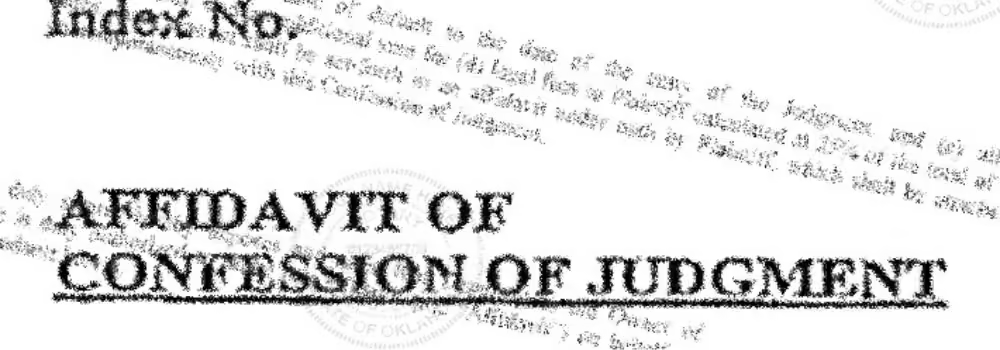


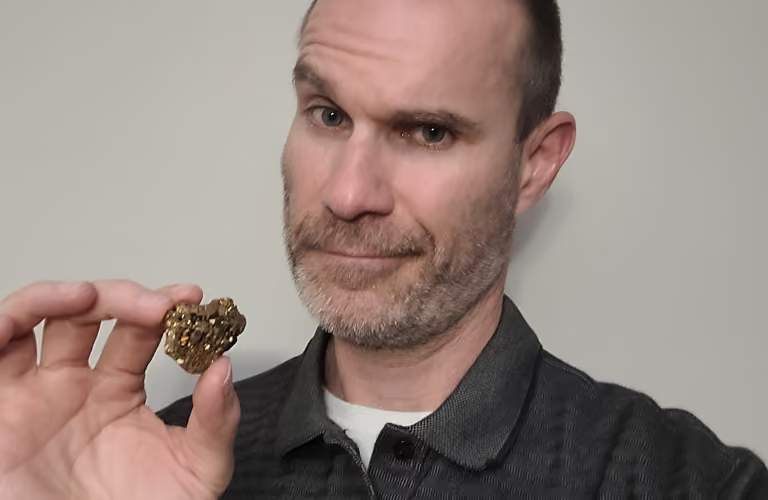


































































%20-%20thumbnail.avif)





%20-%20thumbnail.avif)



%20-%20thumbnail.avif)

.avif)




%20-%20thumbnail.avif)