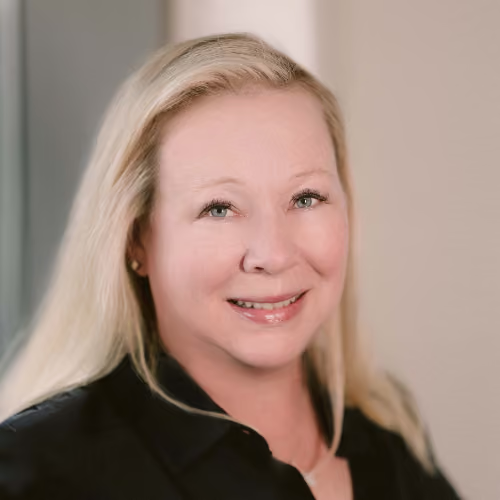
Host: Today's guest had for years entertained the notion of one day becoming a business owner. Well in her early 40s, with a toddler at home and traveling too much for her corporate job, Alicia Miller decided the timing was finally right. This was 2013, and franchising was the most obvious path. Probably still is for most people. But Alicia, without the benefit of the books or the pods or the general awareness of entrepreneurship through acquisition, arrived on her own at the insight that we celebrate on this podcast that buying an existing business, an existing franchise business, in her case, would be better than starting from scratch. The first half of today's interview is Alicia's story of acquiring a portfolio of Sylvan locations. Sylvan is in the education and tutoring category and how she improved, grew and sold that portfolio a few years later. The second half is a distillation of what Alicia has learned since post Exit. Alicia remained in the franchising space, but with a focus on private equity, and she's recently published a book about the intersection of franchising and private equity and what you would be owner need to know given the trend. So if you're thinking about buying an existing franchise business or businesses, this conversation is a primer on how to carefully choose a franchise system where PE is or might eventually become active. It's a key consideration if you expect to one day exit the business you buy. And to that point, this is an appropriate lens to apply to any industry you're eyeing. Even if you're targeting independent businesses, not franchise resales. Private equity's presence in an industry has as in a franchise system can have effects that are seismic. Here is Alicia Miller, former owner of a portfolio of a dozen Sylvan locations and author of Big Money in Franchising. Welcome to Acquiring Minds, a podcast about buying businesses. My name is Will Smith. Acquiring an existing business is an awesome opportunity for many entrepreneurs, and on this podcast I talk to the people who do it. Running payroll, paying your bills, closing your books, and producing financials. These are critical tasks every business owner must do or oversee. But spending time on them distracts you from the leadership in growth work you want to do. So let system 6 do it for you. Owned and led by a former Searcher, Chris Williams, System 6 is a leading outsourced finance team for hundreds of SMBs, including over 50 searcher acquired businesses. Chris, Tim and the System 6 team understand firsthand the challenges, the opportunities of jumping into a business as its new owner. So whether you own your business already or have one under LOI, talk to System 6 about how they can give you time back and improve your financial operations. Mention Acquiring Minds and they'll provide a free review of your books and financial ops, a $500 value. Check out system6.com, link in the show notes or email helloystems6.com Alicia Miller, welcome to Acquiring Minds.
[3:41] Guest: Thanks for having me.
Host: Alicia, you have authored a book called Big Money in Franchising, Scaling your Enterprise in the era of Private Equity. It is a book about how entrepreneurs can and should think about the universe of franchising now that private equity is so active in that world, the opportunities it presents, and, of course, obviously, the things to avoid. When I first heard you talk about the book, my interest in you was piqued further because your own foray into franchising was buying a group of existing franchise businesses. So you were also doing entrepreneurship through acquisition, as we now call it, which of course is the subject of this podcast, Acquiring Minds. So I wanted to invite you on for your story of buying, growing, and exiting those businesses and then explore everything else you've learned since and poured into this great book. So start us off, please, Alicia, with your life. Before getting into franchising and buying businesses, what path had you been on?
Guest: Sure, let's do it. Before franchising, I was following a fairly traditional sort of corporate career mode. I had worked in high tech for the better part of 20 years, and I loved it. I really did love the space. I loved the innovation I saw. I loved working and partnering with engineers and marketing folks to, you know, bring this technology into the world. And I loved the travel and, and the team and everything. But what changed, I think, for me was, like many people, you know, I had a lifestyle change. I had a baby, and I had to get off airplanes. And it was very clear that the career I was building in high tech was, you know, what I loved, which was go to market. So that's sales strategy and sales execution. That means you need to be in the field and working directly with customers. So I was building a career for a place that I no longer could, for a destination I no longer could go. So I had to. I had to give it up to be the kind of mom that I wanted to be, which is, you know, around a lot. And so franchising came onto my radar because I'd always wanted to run my own business. But I'm not an inventor. I mean, I do actually have a patent, ironically, based on my prior days at Motorola, but I'm not an inventor of a business. I wanted basically a business in a Box. And that's what franchising is at its core. It's a distribution model. So that you can find a model that works and you can get it running in your local community and run it. That's what I wanted to do and that's what brought me into franchising in the first place. And I haven't left. I'm, this is going to be it for the rest of my career. I love franchising.
[6:34] Host: Great. And when you turned your attention to franchising and said you'd said you wanted to be a business owner, was that, was that something that you'd entertained throughout your career or, and kind of maybe inevitably ended up doing? Or did you really only start thinking, did that really only occur to you when you considered what options you could take away from corporate?
Guest: A little of both. I had entertained the option many times over the years, but for various reasons I just couldn't take the leap and take the risk. You know, that corporate salary can really seduce you into sticking around, especially as you start to climb the ladder and you get rewarded for all that good work and then you have stock options and other things that might bind your wrists and not make it so easy to leave anymore. But thankfully I've got a really understanding husband and we kind of sat down and talked about it and he said, you know what, I've got a corporate career too. So if we're going to take a risk and start a business, one of us can do that and one of us can keep the so called, you know, stable corporate job, which as we all know, corporate jobs aren't always stable. But and that's the bet that we made, is that one of us is going to go do this entrepreneurial thing and the other one's going to stay in a more of a traditional corporate role. So that's how we thought through it as well.
Host: Well, good bet. And by the way, how does he feel these days?
Guest: Good, good. Except that, you know, my, my current consulting business, which I, you know, I'm still very involved in franchising, has me on the road a lot more. And so we have sort of dueling travel schedules that we have to manage because we still have, you know, a kid at home, so that's okay.
Host: And at the time when you considered or learned about and got serious about franchising was the concept of buying an existing business a non franchise and we'll call independent for the purposes of this conversation, business on your radar at all.
Guest: I did, I actually worked with a local business broker and did some Searching on my own for a local business to buy. But I, I pretty quickly realized that I would be very much on my own, learning a new business, a new sector. And I just felt more comfortable with the franchise model where not only did I have the support of the corporate team and an actual, you know, playbook to go and run, but I had other franchisees that I could work with. You know, it's very lonely when you run a business sometimes and having peers in an organization, other entrepreneurs that you can lean on and build friendships with and borrow best practices from, to me just was a much more comfortable fit for what I wanted to do.
[9:11] Host: And what year is this? And how old were you at the time?
Guest: So this was 2013, so I was 43 and had a toddler at home.
Host: Okay, great. So tell us about your search, as it were, and how you ended up with the businesses that you did.
Guest: So I think because of the stage of life I was in, I sort of gravitated to child services, naturally. And one thing I would do differently now is I would open my aperture up to consider other sectors because there are a lot of really attractive franchise businesses in other sectors that weren't really on my radar. So sort of things like gutter cleaning, window washing, painting, health services. There are just so many other businesses that are interesting to me now that I know more about them. But at the time I sort of, because I had a little kid at home and I was looking for some flexibility and had sort of education on my personal radar, I did spend a lot more time investigating child services businesses. And as I was thinking about it, you know, I, I wanted to build up a business and sell it within a fairly short amount of time. So the average 85, if you believe FRAN data, 85% of licenses in the United States, franchise licenses, are 10 year agreements. So it's pretty long. And I was having trouble visualizing 10 years in the future, but I could visualize five that seemed like something I could get my head around. So I'm like, all right, what kind of business can I run and build up and then sell within a five year arc? To me, that screamed you've got to pick an existing business, run it, improve it and sell it, maybe consolidate other units, for example, instead of starting one from scratch, building it up and, and doing that. So pretty quickly I gravitated to systems that had resale units available where I could get enough of them that I had a nice chunky asset to run together with a lot of units, a team that I could, that I could work with and you know, when you take over a portfolio, some of the units are great performers and some are in the middle and some are underperformers. So I knew that if I could lift the underperforming units or close them and swap them in for, you know, other locations that are better, that over time I could probably hit my objectives in that more narrow time frame. So that's what I focused on.
Host: Well, you were thinking like a private equity person. How appropriate.
Guest: I didn't know it at the time.
Host: Yeah, yeah, this was kind of a entrepreneurial private equity, or at least I should say the model of private equity just done at the individual entrepreneur scale. And just this point about five or ten years. So you, the light 85% of licensing agreements in the franchise universe are ten year long. Ten years long, meaning what exactly? What does that mean?
[12:14] Guest: So you're in that franchise agreement for 10 years and then it, when you renew, most agreements require you to. This is very state dependent, so you've got to get a franchise attorney to help you when you're thinking this through. But generally speaking, you're signing a new franchise agreement at the then current terms, whatever those are, and you don't even know what those are going to be are right what those are going to be ten years from now. So that's another reason why I had a much more narrow time frame in mind for myself. But you know, the longest franchise agreement is 36, I think 35 or 36 years. There's some in the restaurant sector and there's, there are other quite long legacy agreements out there and there's also systems that are, you know, two years, five years, much smaller. So you know, you got to think through what your own time frame is and what you're doing and what you want to do. Some franchise agreements have a minimum guarantee. So that is if you decide you want to, you, you don't want to do this anymore. You're still in that franchise agreement and you owe them money as if your unit was performing at the average level. So you've got to read that agreement very closely and be certain you've got an asset you can sell. Not just close, but sell when you're ready to move on, move on and do other things in your life because then whoever you're selling it to picks up that obligation for the remainder of that agreement.
Host: Okay, so to be clear on these agreements and their lifespans, it doesn't mean that you have to stay for 10 years, but it would mean that you'd have to find somebody Else to take over the agreement from you to see out the duration.
Guest: Yeah. So you've got to build a sellable asset. If you can't sell it, you can't exit. The only other way to exit is to close. But depending on your agreement, you might have liabilities that you still owe to the franchisor.
Host: Okay, so your, your thought was that you wanted, you know, a shorter time frame, five years and you, in, in your exit plan was to, you know, even if you were in a system that had 10 year agreements, you would exit this portfolio to, there would be a taker and they take over the, the agreements.
Guest: Great, great.
Host: All right, and you liked education, so what, what did you find?
Guest: So I initially gravitated toward early childhood education daycare. And I was living in an area where every. I knew this because I was a busy mom looking to place an infant in daycare and everybody had a wait list and I'm like, aha, there's a business opportunity there. Right. They all have long wait lists to get in. And so I looked around and there really weren't any brands of scale that had territories available. And all the existing brands with scale, like a Goddard or a Primrose were already sold out in my area. So also they didn't, they didn't like having multi unit owners. They really at that time preferred single or maybe two unit owner operators. And I was looking to maybe own more than that. In retrospect, I think I probably still could have dug some more there because if you can make a great living with two units, why would you want to own, you know, 20? Right. So but from a complexity standpoint, but at that time there just really wasn't anything available. So I kind of moved on from that. Next I looked at various child education and entertainment concepts and I gravitated more toward the education side because I felt like even though it's discretionary spend, people spend money on their kids education, they prioritize that. And I didn't have any particular affinity to say sports concepts or something like that. So that's how I ended up finding the academic support sector franchising. And that's, you know, sylvan learning is one that came on my radar pretty early. And as it happened they had a number of units for sale that were resales, that were had experienced some amount of distress because the owner had sort of gotten ahead of his skis, had too much debt, had over, expanded into markets he shouldn't have been in, and corporate ended up taking them over and needed to sell them because they're not in the business of running units themselves. This is I think, a pretty much 100% franchised system. So they were looking to sell them and it was a number of units all within driving distance of the place that I lived. So it started to look like a bit of a match and that's when I started digging into it.
[16:43] Host: A PEO run by a Searcher for Searchers if you're running a company with less than 100 employees and providing health insurance to them, you may secure better benefit plans at a 15 to 30% discount through a professional employer organization or PEO. Aspen HR, run by search fund veteran Mark Sinatra, understands the needs of search operators and provides HR compliance, flawless payroll, HR due diligence support for your acquisition, and Fortune 500 caliber benefits, all for a fraction of the cost. And tis the season to evaluate your employee benefit plan. Most new clients reach out to Aspen 90 days before year end or their renewal date. So before they get slammed, check out aspenhr.com or contact Mark directly at mark aspenhr.com Tell us a little bit about what the category offers. You gave us a name, Sylvan. First of all, give us some of the other names. Sylvan, what are some other brands we might recognize?
Guest: Sylvan, Mathnasium, Kumon, Huntington Learning are all in this space. It's there's a good history in this space. I like that as well. This isn't necessarily a new sector. It's a sector that continues to innovate, but it's a proven sector. I liked that Sylvan's been around for a long time. They offer tutoring. So when you think about tutoring, this is mostly reading and writing and math homework help. They offer STEM classes and robotics now and some other things. But really it's they're focus is kids in elementary school through high school, some college prep. It's not as much of an emphasis for them. I think it was about 10% of the business or 15% at the time. So it wasn't college prep heavy, but really more around kids who are falling behind in school or wanting to get ahead and getting some remedial help to help them accomplish that.
[18:47] Host: So so it generally the category targets kids having a hard time as opposed to the kids excelling who want even more. That's not who it's for.
Guest: It's both. But I would say it skews more toward kids who need some help. And this is partly for kids and partly for parents. There comes a point, and I'm seeing this now with my kid Is there comes a point where you're kind of rusty on the middle school math and you learned pre algebra differently than they are learning it now. And, and I had to go and buy a workbook and reeducate myself about pre algebra. It's just, it's been a while, right? So parents get to this point where it's like, well, it's beyond my ability to solve this around my kitchen table. They're getting frustrated. Homework is becoming really stressful for the entire family. And it's just one of those things that it's easier to get, you know, a third person involved and to get some help. We even had students whose parents were teachers who were sending them to us. And one lady I remember in our, in my Cincinnati, one of my Cincinnati schools said, I'm a math teacher and my kid is failing math. It's really bothering me. I need to get, you know, outside of myself and get him some help because clearly I'm not making it happen. And you know, any parent will tell you sometimes your kid will not listen to you, but will listen to somebody else on the same topic. And you know, it just, it is what it is. There's, it's, you know, I was worried at the time about the, all the online tutoring options that are available to people. And what I've realized is there really is no substitute for that one on one help. When you're sitting over a piece of paper together and you can walk them through how to do fractions and you can watch them do it and correct their work. It's just, there's something that happens that's magical when it, when an instructor is working well with a child. So I like the model. It's in some ways similar to swim schools if you think about it. You know, at the time I swim schools weren't even on my radar. That's another category where if I had it to do over again, I would have looked at that one much more closely because those are a great model as well. But if you look at a swim school model, they'll put, you know, four kids in a lane and each kid takes a turn over a 30 minute lesson, right? So you've got one instructor, four kids. The tutoring model at that time works similarly. You have three to four kids around a table, one teacher each, you know, doing work because they've got to do some independent work and then the teacher helps them with some work so that the ratio, the staffing ratios made, made sense to me. Other models have kids working on their own and the teacher will walk around so you can get an even higher teacher student ratio going. But it made sense to me. They got a mix of one on one help, but they also got time, you know, to do the independent work.
[21:38] Host: And the concept of remote, this was pre Covid, so it wasn't quite on our radar like it is today, but it was, I'm sure, on your radar. You didn't feel like that was something that would disrupt the model? You weren't too threatened by that because as you just said, you thought that there's something about the in person experience.
Guest: No, I wasn't worried about it. And it had been around for a while anyway and it didn't seem to put that much of a dent in these, any of these tutoring concepts. So I, I wasn't too worried about it.
Host: Okay. All right, great. Okay, so you, the Sylvan portfolio or group of businesses are distressed in your area. All within driving distance, I think you said. How many of them were there? How many units or locations? 11.
Guest: 11, 11 schools. If this goes on the list of what I would do over again or what I would do differently, they were within driving distance, but there was a long drive between the farthest schools. Right. So some were in my immediate market and some were three hours away in two different, opposite directions. So if I had to do that over again, I would not have purchased units that were so far away from me because here I am trying to avoid traveling and now I'm driving three hours to get to oversee a school. Okay. That's still travel. So yeah, it's still time on the road and away from my family and potentially an overnight. So if I had it to do over again, I think I would have been more disciplined about finding opportunities that were closer to me and I could put my eyes on them more frequently, at least initially. Once you get the hang of it, I think, you know, having starting to consolidate a bunch of units into a, know a bigger territory, depending on how much you want to travel or the infrastructure you can afford to watch it for, you would have made more sense. But initially it was a lot of
Host: driving because part of this is, I mean if you, if you, the number of units you have reaches a certain critical mass, it's necessarily going to mean more geographic distribution. So. Yeah, but just doing this for the first time or initially a challenge, six hours, I guess, between the two furthest look at it. And where was this? What region?
Guest: Northern Ohio, all the way down to Louisville, Kentucky.
Host: No. Okay, can you tell us about this portfolio? The revenue? It Was generating, put some numbers. What can you tell us about it? To add a little bit more color.
[24:06] Guest: So it's tough because I'm under an NDA and so there's only so much I can say but this. Each of these schools should have been kicking off, call it $100,000 in profit per school. Rough and tough based on the F the franchise disclosure document. And many of them were performing well under that. A couple of really strong performers with great center directors were overperforming and therefore compensating for the fact that some were underperforming. But the real thing I saw was there were a bunch of locations that were just tired. They really needed to be revitalized. There wasn't much marketing in these locations. Some of them were nearing the end of their lease and needed to move to a better spot. Better parking, better visibility, smaller footprint. Some of them were in these very old legacy, I don't know, hard to find buildings. And I just realized that some of these just needed to move. And I was able to successfully renegotiate rents and get landlord assistance on revitalizing these and bringing them up to, you know, an updated standard and make them look a lot better. So that was a big focus initially to improve operations, also swapping out some of the talent and putting people in those schools who were more engaged in the front office. I didn't have to worry about the educators so much because they were all great at what they did. It was really who was running the location on a day to day basis needed was where the work needed to be okay.
Host: And the. So they should be reaching $100,000 of earnings per location across 11 units. That would be $1.1 million in STE. You said there were some underperformers, but you also said there were some over performers. I know you're bound by what you can say, so I'm going to just assume that the portfolio was generating high six figures, maybe a million bucks a year in. In earnings. An assumption you can neither confirm nor deny. But a sizable, a sizable business even with those underperformers. How did you buy this business, buy this portfolio?
Guest: So Sylvan needed to sell it because they were running it. So I wasn't negotiating with a, a franchisee. I was negotiating with corporate. And if I had to do it over again, I think what I didn't realize was how much they wanted to sell it. Not because these units were bad, they obviously were as a group were performing reasonably well, but because they just weren't set up to mount to run these units. They didn't. They had someone sort of as a side job on the operations team running it. And I think I could have negotiated an even better deal if I had understood that a little better. Also, I was willing to take on some of the projects, whereas if I had it to do over again, I would have cherry picked the best locations and said, look, these are underperforming locations. You deal with them. Right. So I was basically taking on an unpaid job to go and turn some of these locations around. And I was betting on myself that I could do it. But I think probably a couple of them, I just would have said, I'm not taking these. And if you guys aren't willing to do the deal, that's fine. You know, the willingness to walk away when you're in a negotiation is really important to maintain all the way up right to the end, even if you put a little money into escrow, for example, to, you know, keep them talking to you, being willing to leave that money on the table and walk if you can't get what you want to make it the best possible deal to move forward. That's definitely a learning that I took from that experience. But I still, I still acquired it for, you know, low fives, basically. I mean, I was paying for the fixtures and not much else because it was at the. Because some of the units were underperforming and because corporate was having to support the overhead. It was not a profitable business from corporate's perspective and they wanted it to be sold. So.
[28:28] Host: So when I said a million dollars in earnings or high 7 FIG. 6 figures in earnings, in fact, the portfolio wasn't generating any earnings. Yeah, it should have.
Guest: Each. Each of the locations should have been kicking off a hundred, but they weren't. Right. So there were some that were well over that and there were others that were break even or under collectively. It wasn't a productive portfolio and that's why they wanted to sell it. And this was after they had quite closed a bunch of units. So these were the remaining. These are the remaining units.
Host: Wow. Okay. All right. So you basically pay low five figures for an unprofitable business.
Guest: Yeah.
Host: Okay.
Guest: Yeah. So I'm walking in and taking it over, knowing I'm going to have to put money into it. So I didn't get an SBA loan. This was just funded from myself and I had budgeted, I think at the time I had budgeted about 300,000 to, you know, do some moves, do some, renegotiate some of the leases and hire some More people and, you know, invest more in marketing. There were just, I, that was the budget that I had kind of started
Host: with, and plus what you, what you acquired them for.
Guest: Yes.
Host: Okay, so, so 325, 350 sort of thing all in is what was what you were kind of projecting pro forma. Okay, well, just on your point about negotiating with them, I, I, so my, my little napkin math was, was way off. The, the over performers were not coming close to correcting for the underperformer. So you were losing money or the portfolio was losing money. On the other hand, there is maybe, maybe they would have had a lot of options, Alicia, other than you, you know, other, other franchisees, of course, but presumably they probably had reached out to those, those obvious contenders already and been denied. So if they're still holding on to this portfolio, it may be, may mean that they don't have an obvious buyer. But I guess I'm just saying from your perspective in your, your, your point about the, the psychology of being willing to walk, this was a turnaround. Yes. But also a pretty magical opportunity for somebody who liked this category, who decided on her own before seeing this opportunity that she liked this category. And here you can get a sizable portfolio in your geography in one slug. It's pretty appealing.
[30:51] Guest: Yeah. And I saw a clear path to what was going wrong in the underperforming units. Right. In each one had a different story. You know, one was literally in the wrong location and nobody could find it. One had a center director that didn't know how to sell. One had an absence center director that wasn't there enough. And just little, little things like that. Plus across the board, they weren't doing any marketing at all. Right. So because the owner had been in distress, the first thing he did was cut marketing. Okay. Well, sales go down. So those things were fixable in my mind. And, and you know, it proved to be, it proved to be true.
Host: Great. So you, you get in there and we're not going to do the whole story because I want to make sure we have time to get into what's happened since and your learnings there. But I guess you've just given kind of a preview of what you did. You made these corrections, you moved some locations, you gussied up some of the tired locations, you put the right people in the right seats and got rid of some of the underperformers. So a classic sort of turnaround that might be too strong, but a light turnaround.
Guest: Yep. Yeah. And I also opened one new unit in my local market was a hole in the market, and I, I put a new one in as well. So I did go through. I'm trying to think I had to have moved or re. Or remodeled at least six of the locations, plus I opened a new one. So I did go through that real estate and construction process as well. That had a lot of interesting learnings from it. So, so yeah, the, the portfolio as I left it was in much better shape. But what one big learning that I took from it was I, I knew that if I built it up and revitalized it, that there would be buyers because they had consistent interest in this franchise over decades. Right. So that I felt reasonably comfortable with. What I didn't understand was the absence of private equity as buyers at the unit level puts a bit of a ceiling on what you can get, what you can sell these businesses for. So if I had it to do over, I would look more seriously, more closely at sectors and at franchise systems that had enough scale where you could consolidate a much bigger portfolio over time and build a much bigger, chunkier asset to then sell to a private equity firm. And that didn't exist in the Sylvan system at the time and still doesn't. There really isn't any PE in there. So that narrows your group of buyers to other franchisees, small franchisees like myself. And that's when I realized I had to kind of bust it up. So instead of selling all 11, I. I broke it up into basically regions, so three regions, and eventually found buyers for each of those regions. But, you know, if I were to do it again, I would enter a much bigger system with many more consolidation opportunities available and with the end game of selling it to a private equity firm. But that means PE already has to be sort of in the system or reasonable certainty that they're going to enter the system in order to build that, build that up.
[34:12] Host: And how many units did Sylvan have at the time?
Guest: Oh, they had about 500 at the time.
Host: So you consider that not a very big system?
Guest: No, I think I do see it as a big system. But the challenge, what I didn't see at the time was there was no private equity in that system. With 500 units, there's plenty to consolidate. Right. And that was my initial. My initial thought was, well, I'll start with these 11 and I'll see if I can double or triple it, you know, within a short period of time. And what I realized is it's just not. No one is coming in wanting to buy 35 units in that system. It's just not happening for various reasons. But there's other systems where that is much more the case. So, for example, Planet Fitness, Orange Theory. More than half of those units are owned by private equity. Big chunky, you know, 50100 centers all in one, backed by one PE owner. So some systems have it and some. And some don't. So that was a. But that's a learning process for me. And, you know, that's why I say if I had it to do over again, that's one thing I would think about differently.
Host: Well, I assume that's one of kind of the biggest things you want to leave the audience with. So we're going to, we're going to start pivoting here in, into, into your key learnings. But before we get too far away from your story, if you had turned these businesses around, these 11 opened another. So your total portfolio toward the end is 12, right?
Guest: Yeah.
Host: And, and you were then. And it sounds like even though it was distressed, you were able from day one of your purchase to be working on not in the business. None of these locations needed you to go be managing director or be at location.
Guest: Correct? Correct. Yeah.
Host: So you're, you're, you know, business, the business, the role of the business owner doing strategic things, doing, you know, real value, additive things from day one is very appealing to a lot of this audience. And then you emerge from doing all those things with a much healthier portfolio. Did you ever consider holding onto it is where I'm going. Did you ever consider, you know, I don't need to be married to my original plan of selling in five years. Now I have 12 units that are all, you know, humming along beautifully, generating, you know, $1.2 million in cash flow. Let me hold on to this and maybe, and maybe buy more. No, you were committed to the plan. Why?
[36:32] Guest: I was committed because by that time I realized that my, my available potential buyer market was not going to meaningfully change if I held onto it for another five years. So that's when I realized that, okay, I've done my. What I set out to do. It's ready to sell, so do it.
Host: Okay. All right.
Guest: Yeah.
Host: Okay. So now as we do pivot into what you want to leave the audience with, people considering buying into franchise systems first. Give us a little bit of, like, kind set the stage for us in terms of private equity's role in the franchising universe. You spend a good deal of the, or, you know, the first, the first section of your book is really kind of a history lesson. It's fascinating about how franchising evolved and private equity evolved kind of in parallel. And then, then the two met and, and kind of more recently than you might think. It wasn't until the 90s, I think you write where things started, where the two started, you know, courting each other. And it's only, it's only accelerated. So set the stage for us here in 2024. Private equity's role in franchising. What do people, what context do people need to understand?
Guest: Sure. So this is, this is really the book I wish I had read before I invested in franchising at all. Right. It just, I see so much more now than I did when I first came in. I'm much better educated about what's going on. Private equity has been probably the biggest sea change in franchising in all of franchising's history. And franchising has been around for a century. So this is a very big deal that it has had such a big change over a very well established huge sector of our economy. What they changed are a couple things. They have cherry picked the biggest, best, fastest growing brands. Anybody who wanted a PE partner at this point has had plenty of opportunity to, to get one at the franchisor level. And also now even at the multi unit franchisee level, as I said, there's, there are PE firms rolling up big systems. Right. So that changes things for everybody who doesn't have a PE partner. So if you think about it, there are 4,000 active franchise brands that are still offering a franchise license for sale. 700 of them have gotten PE backing at either the franchisor level, the franchisee level, or in some cases in both. But that's 20%. So there's a long tail of brands that have not yet attracted private equity. Perhaps they will, perhaps they won't. A lot of them never will. They're too small. They're not really attractive to PE for various reasons. And I didn't know that coming in right now. I do now I can look at a brand and say, okay, that guy's never going to attract private equity because he's not building something vest valuable that private equity can get behind. You got to think about traditional PE firms. Mandate is very clear. They've got, their model is they pool money from limited partners in a blind pool. They go invest in businesses, they try to grow them, improve them and then they sell them usually within about a five to seven year time frame. I think the average hold time now is about seven, seven years. So they don't, they don't have time to mess around with a mess. They don't really want a teeny little, you know, business. They don't have time to grow it into something huge and meaningful. So that means they've focused, they're very focused and they've cherry picked their way through franchising now pretty effectively. It forces them to, you know, dip down a little bit and to buy some smaller brands. But it's changed the landscape of franchising pretty dramatically. There you look around in private equities everywhere, everywhere now. They're everywhere. At conferences, they're everywhere. At any kind of franchising event that you go to, bankers and private equity firms are everywhere. But they've also helped. They've professionalized franchising in a lot of positive ways. Not everything they've done has been perfect, of course, but that lens of how do you build a more valuable business over time, specifically in franchising, is an important, I think, lens that has brought franchising forward and the way they've done it is focus on franchisee profitability. You know, you can't grow a business if franchisees aren't happy and profitable and wanting to buy more units. It's that very simple. So when private equity comes in and buys the business, if they stay focused on delivering value for franchisees, the business grows. They make money, franchisees make money. You know, hopefully everybody's happy when they screw up and you wouldn't think that they would, given all the incentives to get it right. But when they've messed up, it's because they've lost that fundamental equation. You know, they've taken too many fees out. They haven't really focused on that relationship with franchisees. They haven't ensured that they are satisfied and profitable. You know, smart money can make dumb decisions and you know, we have seen it happen. But by and large, PE's entrance into franchising has been pretty positive for the industry.
[42:05] Host: And there's a, there's a few chapters in your book devoted to the bloopers, I think you call them, where it has created value but destroyed value.
Guest: Yeah, I'm being generous calling them bloopers because these are people, these are franchisees, livelihoods. Right? I mean, we, I, I don't make light of it in the book. You know, there is really no excuse for screwing this up. It's the franchise model is so clear on how to be successful and you know, I get frustrated when I see people who should know better mess this up.
Host: An SBA loan broker, as opposed to a direct lender doesn't work for a particular bank. Instead, the broker pairs you with the right SBA lender for your deal based on industry terms, risk thresholds, then helps you navigate the process better than many lenders themselves do. Matthias Smith of Pioneer Capital Advisory is just such a broker. Matthias worked at two of the country's top 10 SBA lenders. So he's been on the inside of the SBA process and knows well the pitfalls and hurdles and how to avoid them. He struck out on his own to laser focus on the ETA in search space. Our niche is his niche. You'll see Matthias at all the ETA conferences. He's closed over 30 search deals since starting Pioneer in May of 2022, including some acquiring minds guests. To learn more and get in touch, go to PioneerCapitalAdvisory.com or click the link in the notes. Alicia, you're talking now from the perspective of franchisors being acquired by private equity. But that's one dynamic, and probably the biggest one. But a close second would be private equity rolling up individual units. So active at the unit level. Say what? Give it. Give us kind of a primer on that dynamic and how it changes things. And I guess this goes back to your Sylvan story, like that's where you want, you want to find those buyers, but go ahead.
Guest: Yeah, yeah, full circle. Some systems are going to attract private equity money at the unit level and some will not or will not until there's much more scale. So the first thing they have to see is, is there enough scale? If you're only 50 unit system, there's not enough, it's not chunky enough for a traditional PE firm to come in and want to roll that system up. They'll wait until it's bigger. But if you've got 500 units now, you've got at least the potential for a PE firm to want to come in. And the math is really simple. At the unit level. They want to try to acquire units depending on the system, right. For three times cash flow to maybe six or seven times cash flow maximum. When you consolidate all of them together, they want to be able to sell it for 8 to 12. Okay, now you've got to build a pretty substantial cash flowing platform to get that higher multiple. But you can see mathematically it's pretty straightforward what you're trying to do. You're trying to take a bunch of little units which by themselves aren't as attractive and you're. And by building back end systems, building a robust team that can run this many units together, you can build a pretty substantial and attractive asset for then the next guy to come along and acquire for that cash flow. But not every system will let in private equity into their system. They don't want to, they like having those smaller owner operators. So a good example of this would be Carol's. Carol's was a multi unit franchisee in the Burger King system put together by private equity. They, they consolidated over time. Corporate ended up buying it back at some point. They built a lot of value there. But corporate has signaled that they're going to bust that up. Rather than having a thousand units, you know, they're going to bust it up. And they, they said that they only want owners to have 50 units going forward. So they're just ebbs and flows. You know, when systems say well we're going to let it, we'll let PE in, they don't. If, if PE is too, too big a part of the system or one owner gets too big, they start to get nervous. Right. Because it puts more risk in for performance for the overall portfolio.
[46:24] Host: Right. Well and you have just identified one of the risks that buying existing businesses in franchise in a franchise network presents that buying independent businesses don't, don't have which is, there's this third party involved which is the franchisor and they can make decisions that really affect your, the trajectory of your business, your, your exit, your etc. I mean everything. So there is that risk which is a very big one. But just to, to in the defense, in defense of franchising. Of course there are a lot of things to really love about it from a programmatic acquisition is the, is the phrase you'll hear perspective and, and, and those are, you know how quickly you can consolidate because and, and so often that the, the integration is kind of pre baked. You don't really need to be integrating the businesses because they may already be using similar systems. They obviously under the same brand, same processes. So you can really move quickly if you find, if you find owners that are willing to sell you. The target list is, is, is, is right there. I mean you can, you can see all the franchisees that you need to reach out to. So you just kind of start smiling
Guest: and dialing up your due diligence. You can talk to a lot of people in the system really fast and if you think about it, something like half of the units, I read this somewhere. Half of the units, existing franchise units the United States are owned by baby boomers still. All those people need to retire at some point. So There's a lot of acquisition opportunities out there for somebody who wants to be an acquisition entrepreneur.
[48:04] Host: Well, and let's talk about that for a second. How do you think about acquisition entrepreneurship? Buying existing franchise resales, which is what you did, versus de novo, you know, building units or territories from scratch?
Guest: I've done both. For me personally, I prefer acquisition entrepreneurship. It's for my season in life. That's just what I'd like to do. But there's a lot of 2.0 franchise concepts out there that are kicking butt. They really have disrupted their sector. And you would think sectors like for example, treats and desserts, you'd think, well, everything's been done. And then a disruptive brand or you know, beverages feels like it's been done. And then a disruptive brand like Swig comes in and reinvents the category and makes people think differently about that entire category and gets some win behind it. So the right franchisee who's interested in taking that risk of building out new units in a system that's proven and disruptive, I think that's, that can be exciting too. It just personally wasn't a good fit for me. But you know, there are some legacy concepts that I wouldn't buy into. I would if I were weighing the two. There's some 2.0 concepts that I think are more attractive. And each sector, you can, you can kind of go through them and there are opportunities on both sides of that.
Host: You know, it's funny that I feel like there's this, this theme, this Goldilocks phenomenon in how you choose a franchise brand. I've heard you mention it twice now, just now with new, newish brands or non legacy brands up and comers where proven but also disruptive. So, so, so there's business there, there, there's product market fit like they, they got something that works. So it's proven. So you've derisked there, but it's still got, it's still disruptive enough or there's still enough Runway there that there's a lot of future growth to come. Yeah, you know, that's got to be a pretty tight window that you find a brand in.
Guest: Yeah, you've got to really do your homework about what, what's disruptive and is it, is it disruptive in a way that's going to give you tailwinds to make that an effective brand. So let's, let's look at another category that I looked at initially, which is early childhood education. Right. There are very well established brands in, in daycare and, but yet there are, there's still room for disruption. And so a good example would be Tierra Encandada, which is founded by a friend of mine, Kristen Denzer. They are a multilingual daycare operator. So you learn Spanish in immersion. Spanish immersion language classes along with daycare. It's a simple idea, but yet very disruptive. You're getting more for your value there. You're teaching language to children at the time in their lives when they are most likely to be able to pick it up rather than learning it like I did back in the old days. You don't get a second language until you hit high school. Well, by then your brain is already wired to make it difficult to pick up a second language. Much better to pick it up early. All the research tells you that now. So, so here she is, she came in and created this disruptive concept with organic food and language immersion. And she has done quite well and now is private equity backed as an emerging brand in the daycare space. And you could argue that daycare is a very mature sector. But yet disruption happened. And for the right franchisee, that might be a much more attractive option than trying to consolidate in a well established system.
[51:54] Host: It's so funny that you mentioned that particular franchise system, Alicia, because my child at daycare age, we looked at the Tierra Encantada Encantada here in Northern Virginia. It didn't work for us for a variety of reasons including location, but we did, we do have our daughter in a Spanish immersion daycare. So you're preaching to the choir on that one. And I actually, so I did look up kind of the backstory of Tierra Encantada and you know, she's Minnesota based, your friend, right?
Guest: Yeah.
Host: Didn't it come out of Minneapolis or something? Yep, it's great. Okay, back to this Goldilocks theme. The other one was PE being, you know, not too active, but somewhat active. Or, or, or like you could see, you could see that it would be a system would be ripe for PE to get in imminently. Um, let's, let's dwell on that one. You see this in both independent and franchise, where you hear this, you hear people developing theses around, well, private equity is not here yet, but they're bound to come here. That always feels like a big risk to me. It's like, how can you possibly hang your thesis on, you know, private equity getting involved in your category or in this case, your brand? Am I wrong to think that that is as risky as it sounds?
Guest: There is risk There. Yeah, the, the risk of the unknown. So I can look at a brand now. Now that I've done all this research and have worked with so many private equity firms over the years now I can see which brands are likely to attract PE and which ones just won't. Right. But I think it's risky for somebody new to franchising to try to figure that out. And just having a founder say, oh, we get phone calls all the time. Well, so what? That doesn't mean anything. These guys look at so many deals in so many sectors. Just because they're getting phone calls does not mean that there's an imminent deal going to happen. And franchisees also need to think about, you know, do you want to be in a PE backed brand? In theory, having private equity in that brand can help propel the brand forward in a way that is positive for franchisees. But as I've said, not in every case. Sometimes they come in and make changes that franchisees don't, they don't like. They add fees, they might add new suppliers that kick more rebates back to the parent. They might raise marketing, they could raise the royalty. There's lots of things they could potentially do coming into the business or change the model altogether that franchisees don't like. So you've got to really think it through. You should never buy into a franchise system because you're in love with the management team. You know, this happens a lot with more emerging brands. You really just kind of get on board with that founder. You really get excited about what they're building. But you know, that can change that. You know, time passes and you know, you used to enjoy calling the founder and, and connecting with, with her directly. Okay, now you've got to submit a help desk ticket because PE took them over and they're, they're trying to drive scale. Right. You, that's not a sustainable model to everybody call the founder when everything, you know, they need help.
[55:01] Host: Sure.
Guest: You've got to, you got to mature the business. It's a natural part of the evolution of growing a franchise. It just happens a lot faster when you've got PE involved. And that pace of change can be really jarring to franchisees if they're not, you know, ready for it.
Host: Yeah, well, but, but let's do focus on the assumption that somebody wants to buy into a system where private equity hasn't already gobbled everything they can up and, and they're either just taking an interest or like you would predict pretty strongly and eventually they will. You had said that some franchise systems just never going to attract private equity interest. Maybe that's the better way to approach this. What are obvious disqualifiers so that people can know to avoid what you're about to tell us?
Guest: They're the same red flags you should avoid as a franchisee. Okay, so first is unit level economics are just not attractive. Okay, so the pri, the PE firm doesn't have confidence that franchisees can make money and are willing to expand. They're not going to be interested in it. The average performance of that system at the unit level has to be pretty good, right? It has to be worth the franchisees effort and time. Otherwise what do you do it? Right? So you can't have one wide variation between low performers and high performers. That also looks very suspicious to a PE buyer and should look suspicious to potential franchisees, an unbackable management team. So especially emerging brands can often have this cult of personality where just the force of that entrepreneur moves things forward. But at some point you want to drive scale. That means systems, process, technology, stack training, you know, get these things open and profitable as soon as possible. If those, if the scaffolding's not in place, it's not as attractive to a PE buyer and shouldn't be attractive to that franchisee either. Keeping in mind that emerging brands, they're not, they're not profitable themselves at the corporate level until they hit at least 30 units, 50 units. It depends on the franchise system. So you've got to be certain that that brand is reinvesting in support and adding people. Otherwise you're, you know, you're joining a system that's not quite delivering on what they need to, to make you successful at the same time. So there's this, this tension point where PE can come in and say, well, we're willing to, we think this is a great system. We like the model what they, but what they're, they haven't been able to invest in is say the tech stack. Okay, well PE can come in and fix that, but they can't fix and aren't willing to fix a fundamentally broken model, typically where franchisees aren't making money. So that's same thing you should want to avoid.
[57:52] Host: And was this true, is this true for legacy brands as well? Because I hear you say emergence emerging brands, but also the same for legacy.
Guest: Let's pick, let's pick the big daddy legacy brand that got picked up by private equity, Subway. We, everybody knows thousands of locations of Subway continue to close United States. And we'll need to do so. They're in the wrong places. They're not profitable units, they're not sustainable. Right. But the reason that Roark was willing to bet on that is because there's an equal opportunity to open thousands of units of Subway internationally. Now as a whole, this makes, you know, subway kicks off $725 million of cash flow a year, so certainly attractive to a private equity buyer. But, you know, the, the units in the United States that need to close, that's small comfort to that franchisee. Well, just be, you know, at work's level, they can go open new units somewhere else in the world and they are offset so their royalties are protected. But that, that doesn't help the franchisee in the US that needed to close. Right. So there are legacy systems that need. It is, it is healthy to close locations that the demographics no longer make sense. Right. Markets move, a freeway exit might move, a big employer might move. You know, that stuff happens. But a lot of these legacy concepts have a lot of cleaning to do before they're going to attract new investors. In the United States in particular, Subway is one of them.
Host: What about a legacy system? One of the appealing things about a legacy system, to your point, to your earlier point points, is that there are a lot of units, so there's, there you, I mean, you can fish in a barrel here. Lots of paths to accumulating big portfolios.
Guest: Yeah.
Host: And because they're legacy systems, they probably also have older. The demographics of the owners are going to be more boomer level. So lots of retiring owners, so lots of units that are going to be coming up for resale. How to square that with a system that maybe such a system doesn't have any private equity, doesn't appear to have any private equity interest. And I'll put, I'll put two brands on your contextualizes with two brands. First, Burger King. I know there's a lot of stories about Burger King. I don't know the history too much here, but I know the names Alex Sloan and Matt Pearlman, two guys who I guess in 2010ish started, started accumulating a portfolio of Burger Kings. And now that portfolio has become quite large. At the time, Burger King was already a legacy brand decades old. Another would be Brian Beers and Midas. So Brian has been on the podcast, he, he's accumulated, he and his brother have accumulated a portfolio of Midas locations that are doing over $40 million a year in revenue now. And he's a big advocate of finding systems where there are boomer retiring owners, legacy systems because the roll up can be so fast as he's done. How do you so maybe answer my question and try to also tie in those, the Tories, the stories of those two systems in recent years.
[1:01:02] Guest: So I think in both cases there were opportunities, lots of buying opportunities, which means you can be selective and be really careful about what you're buying and what you can fix and what you can't in the timeframe you have. Right. And I think especially in the Burger King case, I remember hearing a podcast that they did where they talked about how they were able to negotiate with the franchisor and also with landlords to make a lot of very smart updates to their units to bring them up to code, essentially up to the current branding that immediately delivered on both that investment. They got a payback on that very quickly, but they also, it helped lift sales. So if you can find those opportunities, then you can run the numbers and you know, the math, the math works. But not every legacy system presents those opportunities and not every unit within the legacy system is equally valuable from that perspective or fixable from that perspective. So it really takes a lot of discipline to sort through not just which systems you should even be looking at the first place, but once you get into the system which are these units are fixable. And this takes me back full circle to my own story of that portfolio that I picked up. You know, if I had to do it again, there's a couple units I wouldn't have picked up. I would have said, instead of 11, I'm only going to take these eight or these six or whatever. I think on a grander scale, the guys who've rolled up Midas and Burger King, I think have been disciplined along the way of trying not to pick up things that can't be fixed and focusing on their own objectives. Not, you know, you can, you don't want to be in a, in a position where you're fixing corporate's problems. You've gotta, you're trying to build a business for yourself. So be selective of which units you're picking up.
Host: And but to your point about thinking about franchising in private equity and the intersection there, as always, who's going to buy from you? You, you buy, you build. And then you need to have some thesis about who you're going to be selling to in a brand like Burger King or Midas. Do you think there are probably in Burger King, there are. I know less about Midas. There is going to be a buyer of, of a big portfolio that's doing $40 million a year, because that's a pretty legacy brand. That's very legacy.
[1:03:29] Guest: Yeah. I think along the way, you need to be communicating with buyers and gauging potential buyers, gauging their interest as you go along. And that's kind of the same thing I did is I was keeping tabs on potential buyers, incoming franchisees who were looking at existing units as well as new units. You can do the same thing, but you've got to start getting feedback from those buyers first before you even buy. But secondly, as you kind of go along, take their temperature. So it's difficult to time the market perfectly. And you want to make sure that at the point at which the best opportunity presents itself, you're ready to move. Right. You've got to have your books ready to go. It's got to be ready to sell sort of at any time. And I think that's kind of what ended up happening in the Burger King system where they. They built it up and they consolidated a bunch of units, and then corporate said, guess what? We're going to buy that back. And that turned out to be a great exit for them.
Host: Going back to your Sylvan example, and then we'll start wrapping up here. Alicia, the. You. I think I heard you say that, you know, that wasn't a great system from the perspective of selling to private equity. Did I hear that correctly?
Guest: Correct. Yeah. There's no. There's still no private equity in there.
Host: What is it about that system you think private equity stays away from? It's a big system. It's a legacy system. The unit economics are solid. Assuming you have units that are performing as they should be, it's kind of durable demand. You know, you think that there's kind of this evergreen demand for tutoring and in person tutoring. What don't they like?
Guest: I think two things make it a little challenging. The first is that it still is very dependent on the skills of that center director. It's not like running a gym where, you know, people can go online and sign up for a membership on their own and enroll in their local Planet Fitness. Right. You don't have to have a really great salesperson necessarily, although many of them do, of course, trying to get, you know, members to convert. In a tutoring concept, you're asking parents to sign up for what could be a year of services, and you've got to have a pretty good salesperson in that role. Well, the harder it is to staff that role, the less interested a PE buyer is, because, remember, they're not the operator themselves. So if there's some special sauce required to be successful at the unit level, that is a hard hire, that makes them less interested. The second thing I think is that it may be that corporate hasn't let them in. Right. So there has to be a tipping point at which the corporate team says, okay, we're going to now allow PE to come in and help us start consolidating these under great, under great operators. They just maybe haven't hit that point yet. And they're not the only one. There's other systems where they haven't let PE in yet and that's okay. That's just. They haven't gotten to that point where they think it's a good idea. That just means that when you're thinking about that system, you can't count on that buyer materializing at some point because there isn't evidence yet that they're going to let them in.
[1:06:41] Host: Really fascinating what you said about the. Essentially there's. At the unit level in Sylvan, there's kind of a key man risk problem where these things, the, these employees are not as. This is going to be kind of a loaded word, but are not as fungible, maybe as P would like to see its people, that you can easily replace all of the employees up and down the stack.
Guest: Yeah, I think that's true. There's. There are definitely models within franchising that do better with an owner operator model. They just, they just do. And that's okay. But that means that that's probably not the ripe area for you to go. And if you want to build a big consolidated business, that's going to be tougher for you to, to do it, to make it work.
Host: Excellent.
Guest: Alicia.
Host: Fascinating. Any topics or takeaways that you want to leave the audience with that we haven't already hit on?
Guest: I think continue to do as much due diligence as you can. Don't get too enamored too fast with something. The entire franchise sales process is designed, designed to get you interested and move you forward quickly. Once you start talking to a particular brand, I would say put the brakes on, really make sure that that sector and that brand is worthy of your time before you go too deep. Because once you go down that road, it's going to be harder and harder to keep your, your, your aperture open to be looking at other options that come up. And there's a lot of really terrific options in franchising. So.
Host: So let's actually end on that note. You remain. I mean, you've made franchising Kind of your, your profession. You're a consultant now, by the way. Tell people what you do today other than write books about this.
Guest: I work with franchisors who are preparing for their first institutional capital, so trying to help them build right in the first place and on their growth strategies. I also work with private equity firms on their due diligence and, and trying to help them find companies that might be a good fit for their portfolio.
Host: Okay, great. And you are obviously bullish on the entire universe here of franchising and for acquisition entrepreneurs specifically, maybe leave them with a thought. You've already said that you like that path as opposed to de novo development. Anything else to add?
Guest: I think really think about what, what your lifestyle is, what you want as an entrepreneur, and how you can contribute to your community in a meaningful way will help you sort through which brands make sense and which don't for the community that you live in. And I think once you have that vision, you can take it forward in a much more meaningful way. That's when it becomes more real. Is, you know, seeing yourself in that business every day. I would say if you're seriously considering any franchise concept, go spend time with franchisees in that market and see what, what they're doing every day and what they're, how they're working with employees, how they're working with customers, what they, what that business means to their local community. I mean, small business powers this country and you can underestimate the power of that small business to your community. Go, go sort that out before you move forward.
[1:09:53] Host: Great note to end on, Alicia. How can people reach out to you?
Guest: I'm on LinkedIn. Alicia Miller, you can also find me@bigmoneyenfranchising.com There's a link there for the book and you can also leave me a message there. Easy to remember.
Host: Big Money and Franchising. The book is same name. Big Money and Franchising. Scaling your enterprise in the era of private equity. Alicia Miller, thank you very much for coming on and sharing your thoughts. Congratulations on the book.
Guest: Oh, thank you.















































%20-%20thumbnail.avif)




%20-%20thumbnail.avif)

%20-%20thumbnail.avif)

.avif)




%20-%20thumbnail.avif)