Host: Do you want to be rich or do you want to be king? You may have heard this framework which gets at your psychology as a business owner and entrepreneur. Are you motivated by making as much money as possible? In that case, you're the want to be rich type. Or are you willing to leave money on the table in order to retain control and protect your position as captain of the ship? You're the king type. Today's guest is a king. Michael Kelker did consider doing a traditional search fund, but when he landed on doing a self funded search instead, it became clear that that was the right path for him. His vision here crystallized. He wanted to build and hold indefinitely with an eye toward creating a legacy business for his family. He named the entity that he used to buy his business after his three daughters and he jokes that it's a family office just without any money. And what did Michael buy? A pallet manufacturer that did 2.5 million in sales with about half a million dollars in earnings. So you're going to learn about the pallet business today, which is a business that depends heavily on wood since most pallets are constructed of it. And you may recall that lumber prices spiked during COVID Well, Michael was only a few months into the ownership of his business when he found himself in the eye of that particular storm, his raw material costs quadrupling. He tells the story and how he survived. Here is Michael Kelker, owner of Timberline Pallet Announcements don't forget the webinar Today, Thursday, September 12 how big a business should you buy? It's a theme that comes up over and over in Acquiring Minds interviews in Acquisition Labs Chelsea Wood is going to host a live Office Hours to help you arrive at an answer for yourself. For your circumstances come with your questions. We're going to leave a good chunk of time at the end for Q and A. The link to register for how big a business should you buy? Is at the top of this episode's show notes or right on the Acquiring Minds homepage. Acquiring Minds Co. Then next week we've got two more awesome webinars planned. Next Thursday, September 19th a due diligence Office Hours Max Lummis and his team at LCS return for a live session devoted to answering your questions on all things related to the process of due diligence. You'll recognize Max's name. He's my partner in Mind's Capital and his company. LCS is a forensic accounting firm that does the quality of earnings for dozens of search acquisitions every year. So come get your due diligence questions answered by those who do it professionally week in, week out. That is next Thursday, September 19th at noon Eastern. Link to register in today's show notes or on the Acquiring Minds homepage acquiringminds co and then the next day, next Friday, September 20th, searcher now owner Costub Dio is hosting a session on how much you should budget for a self funded search. Costub is a popular thinker on all things search. He's been on the pod to tell his story of buying a tree services business in Seattle and he's going to break down exactly all the costs involved in in the actual searching part of buying a business using the self funded model. This is extremely helpful since many of you have a vague sense that it's expensive to conduct a search, that you'll likely need thousands of dollars, but costub is going to explain it in granular detail and give you some hard numbers around all those costs and time frames. That is next Friday, September 20th at noon Eastern. The links to register for Costub's webinar and the due diligence office hours in today's webinar. How big a business should you buy? They're all in today's show notes and on the Acquiring Minds homepage acquiringminds Co. Hope to see you in the webinars. Welcome to Acquiring Minds, a podcast about buying businesses. My name is Will Smith. Acquiring an existing business is an awesome opportunity for many entrepreneurs, and on this podcast I talk to the people who do it. You'll recall hearing about the inaugural M and A Launchpad conference on Acquiring Minds back in the spring. The event brought together searchers, seasoned business buyers, owners and private equity investors for a single day to go deep on buying businesses. Well, it was such a success, the organizers are hosting a sequel in October. Walker Deibel, author of Buy then build is keynoting and 30 other experts will be on hand sharing their journeys to acquire, operate, scale and exit their businesses for significant returns. It's happening October 26th in Chicago. Use code acquiringminds@malaunchpad.com for a $200 discount. So if you missed the event in the spring, here's your chance to attend in Chicago on October 26th. And with a $200 discount, go to Malaunchpad.com or click the link in the notes and use the code acquiringminds all one word. Michael Kelker welcome to Acquiring Minds.
[5:59] Guest: It is great to be here.
[6:01] Host: Michael, you acquired a pallet manufacturer.
Guest: Yep.
Host: You did so in your 40s with a family of three kids and your Wife. So this was a mid career pivot and I love such stories. Yeah, let's hear yours and learn about the pallet business. Please start us off with some background on you, Michael.
Guest: Sure. Born and raised in New Jersey and actually lived out there for all my life until I went to college. Went to college at the University of Scranton. Got my psychology degree and I did like anybody, like anybody else with a psychology degree, I went into something that wasn't psychology. Went into it for a couple of years working in New York, which was great. Got an opportunity to live abroad for a year in London, which was awesome. By that point I kind of knew I didn't want to do technology anymore. And I had some really good mentors that be like, you'd be good to get an MBA. So I went and got my MBA from Georgetown, Co Hoyas McDonough School of Business. And between my first and second year conventional MBA, you know, traditional. And through my first and second year, I got an internship at Pratt and Whitney, the aircraft engine manufacturer up in, you know, Hartford, Connecticut. And I went and I did that for the summer and I said this was everything I wanted it to be. I love manufacturing. I love being able to touch and make and influence stuff. When I was on the, in the technology side, I kind of had that feeling. And sometimes like if you turn off the server, I don't know if anybody cares, but this is, this is like I was helping, you know, helping on the, the jet engine that powers the F22, for example, you know, on a project I had, I'm like, this is amazing. I'm keeping America safe. Or this is a real thing. It flies. Aviation's awesome. So at a business school, I went into a leadership development program at Pratt and Whitney, stayed there for about five or six years, did a variety of different functional roles, all, you know, kind of service and manufacturing related. Bounced around a few more years and what I found in some of it honestly is probably me. But I worked for a few years at a position I do really well for a year or two. And then after that, I realize now it was probably me started losing focus. Wasn't, you know, just wasn't the same time to move on. Every time we moved on, we moved again. So there I was sitting in the Quad Cities, which is right on the Mississippi between Illinois and Iowa, living on the Iowa side and working at the airport on the Illinois side. And it was time to move on. And I told my wife and I said, I want to do this crazy thing I've been talking about Forever and see if there's a company I can buy. And she said, do we not have to move again? And I said, maybe not. And she said, that's enough, that's enough for me. Let's, let's try it. So, you know, then I started my search.
[9:04] Host: Let me, let me stop you there, Michael. So a couple of follow up questions. First of all, on Georgetown, did you know that the annual ETA conference co hosted by Georgetown, UVA and Duke, I believe ceda, I think it's pronounced at Southeastern ETA Conference is going to be hosted at Georgetown in September this year?
Guest: Yeah, I did and I thank you for reminding me. I wish this was a thing when I was in school. I graduated in 2006. It was just getting started and I don't know if at that time it would have been right for me. I mean, the leadership development program and some other stuff I did was so instrumental to kind of the business leader that I am today and the pivot and pivot between industries and everything else. But boy, had I known about this, I don't know, 10, 15 years earlier, I probably would have actually jumped in earlier. So I'm happy to give back any way I can.
Host: Well, I'll be there on a panel. So if you do end up going there, we'll get the chance to meet in person. Yeah, I'm just across the water here in Arlington. Great. And then Michael, you said that you presented this to your wife. This crazy thing I've been talking about for years, I want to do it now. So if you didn't learn about it as an MBA or in business school, when had you learned about it?
Guest: So there was a, a gentleman that worked for me who's since become a really good friend, who I realize now that I've educated myself more on the lingo and stuff, that he ended up searching for a company and he ended up buying it as an independent sponsor for a lower middle market private equity company. So he went, he partnered with them and he opened my eyes on that, that was, that this was even a thing by this point. The reason we met each other and actually worked really closely together is I was running a facility for a private equity owned company. You know, it's a general manager and he was my director of operations. So I moved on from there. He ran the plant for a few years and then he ended up doing a search and partnering as an independent sponsor with a different private equity company. So I forget exactly how it happened, but we were talking, I'm like, what are you doing now? He's like, I just bought a company and now I'm a CEO. And I'm like, how did you do that? And he's like, he's like, Mike, I, I've worked with you. He's like, you could do this. And so we just started talking. His name's Luis Coriano. Fantastic dude. He's doing more of the private equity route. Um, obviously I'm, I ultimately became a self funded searcher through an sba. So there's a lot of reasons that we're doing it sort of differently. But he was the mentor that went and said, here's how you find companies that can work. Hey, I sent out, he sent out the traditional letters to try to, you know, prospecting and get interest. And he really helped me on my way and I would not be where I am without his help, you know, and he needs to hear it if he hasn't already. Right, Great.
[12:18] Host: You hear that, Luis?
Guest: We thank you.
Host: And, and when you say, Michael, that you went the SBA self funded route and he went the kind of private equity, independent sponsor route, just differentiate that for, for us and, and kind of why you think he did that and you did something else. Let's hear about this kind of the, these differences in flavor of buying a business. So
Guest: when you really get down to the core of it, for me it was very much about control. And that's one thing that when you're working with a private equity company, in my experience and everything I've heard and kind of my own personal experience, they are always going to retain the control because they're the one bringing the majority of the money and they're the ones doing the deal together and they have the LPs and everything else. So because they're bringing all those resources, you can get a much bigger company and you can own a piece of it. And if you're able to hit the targets and you're able to sell within that five to seven year window that they typically want to see, with that huge, you know, huge growth curve and everything, that can build value. If you're willing to do it and you're willing to put up with it, and you guys are all still agreeing and the board isn't fighting and all those other things that come along with it, you can do really well. You can make a lot of money. For me, I didn't want pressure to sell. I wanted control. And I was willing to get a much smaller company in order to make that happen because I could bankroll myself and some of the resources and People that came in with me and we'll get into that in a little bit. But, but by doing it I have the, I'm the majority owner of the company. Nobody, unless I default to the bank is ever going to force me to sell. Honestly, the way that it's all written, even some of my partners, they can be extremely unhappy with me, they can make my life miserable, but they have no legal control. So that was really important to me. It's like if I'm going to do this, I'm going to basically wager my family's happiness and security on doing this. I'm going to be in control. And so that's why I ultimately went the self funded route. Not, not for nothing, it doesn't hurt that when I tried a traditional searcher PPM and get funded in the search mode, I had some great conversations with some great investors, all of which passed on me. So there may have been some of that too.
Host: Well, I, I, I want to get to that in just a sec because that is a big part of the. You ended up on self, as you just said, self funded, great. And then one just kind of on your backstory. One other detail is that the idea of small business was something that was familiar and even romantic or sort of heritage for you. Correct. Is in your family say a little bit about that?
[15:14] Guest: Yeah, and I'm glad you brought that up again. So my mother's side of the family, my grandfather and his, his brothers had Swingle manufacturing. They actually built diners, you know, the old classic diner where you get breakfast and breakfast 24 hours a day. And they, they started back in the, you know, late 40s, early 50s with the silver cars that you see and went all the way up until the late 80s when they finally, late 80s, early 90s when they finally shut it down. So it was a tremendous amount of pride and I do remember going with my dad who was a salesperson in the company over to the plant and there's just something, there's something about manufacturing and something about tangible goods that's just so important to me. And I can't, I can't describe it. It's kind of one of those if you know, you know, kind of things. I can get excited about the idea of technology and software, but the reason I get excited about it is it helps me build real stuff. I could never see myself running an abstract thought consultation type business unless again, it was focused on tangible stuff. It's just for some reason, it's so compelling for me and some of that is because of the background of the family. And my father, after doing the sales for diners, once that business closed down because he actually couldn't find a buyer. And I think that's part of what motivates me too in some ways. But my dad went into remodeling and you know, additions and stuff for houses. So making stuff is just. I've just grown up that way. Even though my parents will tell you I never really wanted to do the work, but I wanted to be in the process. So I guess that's why I'm in the management side now.
Host: Well, it's interesting. You're the, you're the second interview, I guess now I've had one interview before this. So. So just before this airs, the, the week before this airs, Michael will be Mike Day, who was very much an engineering kid, an engineering professional and also this strong orientation toward physical products. And so when he, when he went the tangible. And so when he went out looking for a business, he too insisted really that it be a manufacturing business, which is ultimately what he bought. So. So it is a personality type, it seems, if you will. He also happened to buy in his 40s, so I don't. And he's called Michael, so the coincidences don't stop. But I think the only thing that's
Guest: really notable there is. Yeah. Is that you both is the profile in your 40s and you're Michael. And that's just the way it goes.
Host: Running payroll, paying your bills, closing your books and producing financials. These are critical tasks every business owner must do or oversee. But spending time on them distracts you from the leadership and growth work you want to do. So let system 6 do it for you. Owned and led by a former Searcher, Chris Williams, System 6 is a leading outsourced finance team for hundreds of SMBs, including over 50 searcher acquired businesses. Chris, Tim and the System 6 team understand firsthand the challenges, the opportunities of jumping into a business as its new owner. So whether you own your business already or have one under LOI, talk to System 6 about how they can give you time back and improve your financial operations. Mention acquiring minds and they'll provide a free review of your books and financial ops. A $500 value. Check out system6.com, link in the show notes or email helloystem6.com let's circle back now. So you've said to your wife, I would like to do this. She as long as you don't have to move. And you said, probably don't.
[19:16] Guest: She gave it your Blessing, gave it her blessing.
Host: Do your best and you proceed and you evaluate some of the options you decide against the Luis path of independent sponsorship, quantum quasi private equity. You do consider traditional search, which actually, traditional search actually does look a lot like private equity. It arguably is a, a niche of private equity. So you didn't totally dismiss it. But what did you find when you went out talking to traditional search fund investors? Say more about what you hinted at earlier.
Guest: Yeah, and what I'll say is I, I mean I feel so fortunate having found the search community in general. I'm very regular attendee of the Chicago, you know, the Chicago booth, Northwestern event. I think it's fantastic. I've made friends. There's people that you know, I've, I've met up with that I try to mentor and kind of bring them along. Anybody will give time to you. You know, when you call them, I mean it's very welcoming that way. Now it doesn't mean they're going to give you the money. And what I got very consistently was for, for the handful of people I, I talked to and they're the names that everybody talks to. And so it doesn't, it kind of doesn't matter in that regard. But the feedback I got is what I would summarize as I really like you, I believe that you will be successful. So when you get the deal, let me know. I might want it. But the profile to bank somebody as an assurity of the return of investment as best they can. I wasn't really willing to relocate. I had a very specific objective of what I thought I wanted to do. I said I wanted to do more of a manufacturing firm. I'm a little older, which is a double edged sword in terms of how,
[21:05] Host: how old were you at this point?
Guest: How old am I now? I was like 42. Okay, something like that. 41. 42. And, and so have more experience. But in some ways that also means that I do, I have stronger opinions and life experiences and stuff. My experience on the traditional search fund, they love the idea of somebody coming out of their mba. They are so hungry, they have virtually no restrictions and they're saying I'm going to find the company and I'm going to do everything it takes. And I don't care if it's in some town you've never heard of in Oklahoma. If it's the right company, I'm going. So as an investor it's like, hey, this is a pretty good bet for me, I think. And it's funny because now I'm Kind of a little bit in the other chair. I've talked to these people and it's like, hey, you know, you could totally be successful or two or three months from now you can get a call from one of your buddies offering you a CEO gig and you'll take it. So I understand why they, they passed. No, Archie, actually my mom. My mom did, so. Thanks, Mom.
Host: Well, I was going to ask you, you mentioned investors.
Guest: Yeah.
Host: So you did raise money from mom and who else?
Guest: Well, so I raised money for mom in the search fund and then in the search fund and luckily I had just enough to make it until I was actually able to get the company, which, which is a whole other timing thing that I can't take credit for. The, the other investor that came in is now currently my cfo and he came in when we had a target, when we actually had a, an equity offering. And at that point, that point I was actually way more selective. Like I really had a much better understanding of how big it was, how much money I needed to do, how much did I have to raise. So I wasn't just talking to anybody at that point point. And ultimately we ended up being my mom rolling over from the search fund Brandon, named Brandon Barons. He's, he's my cfo and how we met and the whole thing is a whole other story because we were not, we didn't know each other when I started this process at all. And, and my own savings and literally I was one of those people that drew out of the retirement to make sure that I could finish the capital stack on this SBA7 loan that we took.
Host: So really it was, it was kind of friends and family. It was friends and family.
Guest: Yeah. No, there are no, what I would consider professional investors in this. And yeah, and again, that's, that was one of the things that was sort of non negotiable for me. I mean, the company, we haven't talked about the parent company, but GBR Riverdale, named after my kids, Gretchen, Rachel, Bridget, GBR Riverdale. Riverdale is actually the school district that they were in in elementary school. I like to joke it's my family office without any money, but maybe that'll change. It'd be nice if it changes, but this for me was always a legacy play. It was about doing something that I can love, that's building something for my family and for the future. I didn't want to have the pressure if I thought it was suboptimal to sell. I didn't want to have a bunch of LPs that were going to force me into it is as simple as that.
[24:27] Host: And this optionality or excuse me, this legacy, this building something for your family, is that because you envision them one of the GBR or one or more of them in the business or. Not necessarily. It's just this really valuable business that the family owns and it's optionality and who knows what that looks like or what benefit that delivers in the future, but it's clearly beneficial and it's something that you want to just have indefinitely and see what comes of that holding.
Guest: Yeah, that's probably the reality of it. They're right now, they're all pretty young. I mean, obviously we own the company or Timberline now for over four years, but the kids are 9, 11 and 13, all girls. The last time that they visited Timberline anyway, the, the, how do I put this delicately? The oldest did not envision herself going there for work. Let's put it that way. It just, you know, and so maybe they don't. And actually what I guess what I really hope is we have another company. We, we have another companies we acquired. It's not we're talking more Timberline, but we've done it. One didn't work and it wound down. There's another one, a recycled auto business that we're currently working on that's kind of our project too. On the GDR side. That's almost, almost a separate conversation. But the, the vision always was kind of a family of companies that, you know, I wasn't looking to take over the world. I wasn't looking at being filthy rich or anything. Provide a nice comfortable opportunity and life, you know, for the family and something that, that I could truly love. And, and if they love it and come in, great. If in the future it just ends up getting sold, great. It's all about the best for your kids. But everybody has a romantic notion of oh, and my kids will take it over. I hold it. I don't know if I'm banking on it.
Host: Well, happily your 13 year old, how she feels today is unlikely to be the same way she feels at 33. Now at 33, she may still not want to be in the pallet manufacturing business.
Guest: So let's not hold our breath.
Host: But lots can change between now and then. Before we get too far away from your experience with the traditional search fund investors, this is very top of mind for me because I've been preparing for a webinar that I'm doing right after our interview now with search investors. And there is this, the message you got from them that, hey, you don't fit the profile, so I'm not going to fund your search. But you look and feel and smell like somebody who can do this. You just aren't close enough to my buy box. I think it's such a powerful point because it can be discouraging to people when they are rejected by investors. No thanks, says the investor. But you just always have to remember that just because an investor says investors have different criteria than you have and what you're doing with your life and projects. So just because they say no to you, it's not necessarily because what you're attempting is not viable or won't be successful. And I just, I, I, I intend to make that point today on the webinar. And it's already come up with you and me here, sort of.
[27:57] Guest: Yeah.
Host: Although it doesn't really sound like you were discouraged. It sounds like you just took it as feedback and carried on your merry way anyway.
Guest: But, well, it's probably a polite way to put it. I wasn't going to quit. I wouldn't say that. I didn't get off and I'm like, ah, another one. But, you know, I'd heard a lot too, that even for people that have been successful in raising, you know, traditional search funds, that the hardest is the first one. So they go and they're like, shopping, and they're shopping and they get this feedback. And then it gets to the point where they're still talking and they're like, well, who else is in? And then all of a sudden they'll fall like dominoes because they're comfortable with those seven people, and they go, boom, boom, boom, boom. I'll take all your shares and you're fully funded. So it just, As I went on further and I got the feedback and I thought about it, I'm like, you know, and I will tell you, control and control. Control was huge for me because at that point I'd felt I'd had some really good jobs where, like, in, you know, general manager type jobs where I had a lot of influence and kind of managerial power within these things, but I didn't have control because it wasn't corporate and maybe it was private equity, maybe it was just a large corporation. And I just said, you know what? I'm not a good employee anymore. And all I'm doing is changing the nature of being an employee if I don't have the control. So it just, it made sense to me and I'm glad it, I'm glad it worked. Out. Because now looking back, I realize how it almost didn't timeline and money and resources and Covid and all these other things that happened right when we were buying. You look back on it and you say, nailed it.
Host: I landed that thing.
Guest: Well, yeah. Because it did.
Host: And we're about to hear that. We're about to hear it, Michael. But before we get there, I just want to. You're reminding me of this great framework. Do you want to be rich or do you want to be king? Do you want to be rich? Do you want to be king?
Guest: Sure.
Host: I think that. I think that's what it is.
Guest: Yeah.
Host: And the. So the kind of what that captures. Is the king prioritizes control, being master of his own destiny, his own fief or empire. But maybe. But maybe less wealth. Ultimately, do you want to be rich is you're just prioritizing for your balance sheet. So just taking you and Luis, and obviously, we're not putting words in his mouth, but somebody like Luis, maybe, who in five or seven years, if he's successful, going the more kind of private equity, independent sponsor route, is likely to emerge younger with more wealth than you. So maybe that would kind of fit into the wanted to be rich path. Whereas Michael Kelker wants to be king. Not trying to get filthy rich, not trying to get rich as soon as possible, but being kind of master of his destiny is really what matters, actually.
[30:48] Guest: So he. He operated that company for nearly seven years, I think, and he's transitioned. Transitioned. Now I think they're getting towards like the private equity company's getting towards the end. I'm sure they're looking to sell whatever. He did it for a while, and then it was kind of time for him to move, move on, and now he's exploring options, and I wouldn't be surprised if the relationships he's built, that he tries to build his own private equity company and. And he can do it tremendously skilled. But I'm happy with my path for sure. Great.
Host: Okay. Anything more to say about your search before we get into your discovery of Timberline?
Guest: The one thing that I will say, whether I guess I'll say it now rather than segue in, is that I got tremendously lucky because I found Timberline within the first six months of my search, and that doesn't happen very often, and it's 20 miles from home. Tremendously lucky. Again, another thing I look back on and I'm like, boy, did that work out. Because that was not my search criteria. My search criteria literally was about a 200 mile circle. And my plan was, my plan was if I have to be gone during the week, I can still get home on the weekends if it's a practical matter and you can't commute it. And I always prefer to do that. But I'm really glad that's not how it worked out.
Host: Yeah, I mean, 200 miles, that's what, three and a half, four hours potentially. In which case. Yeah, you would have, you would have been spending your weeks there.
Guest: Yeah, it all seems like a good idea at the time.
Host: Well, Timberline, you discover it. How did you find it?
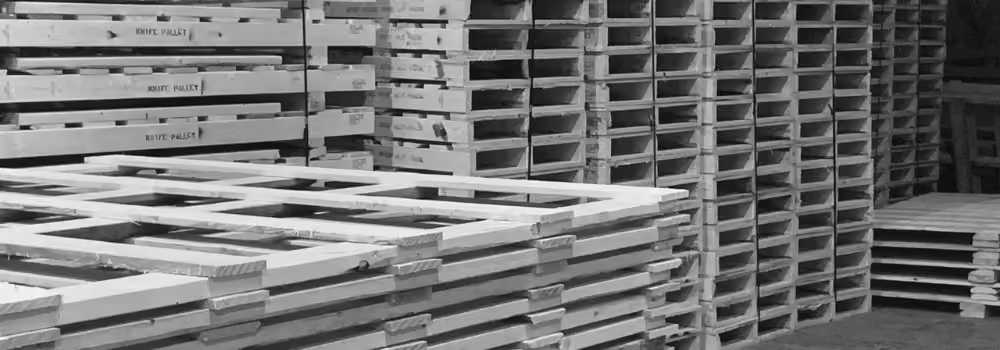
Guest: So I've been networking around, you know, you go to sessions, you just try to get the word out like any other, any search, job search, whatever it is. And somehow. And I forget exactly where I met him, but there was a vice president of commercial lending at a local credit union that I talked with at some point. And he contacts me and he says, you're still looking for a company? And I said yes. He's like, well, we've got one that I know about that we decided not to bank because we didn't like the buyer. But I've seen the financials. It's like, this is a solid company, it's been around for 40 years. You should take a look. Because their deal just fell through. They had an app, they were going to have an out of town buyer and something happened. I think it was like personally related or whatever. And he just, he backed out. So my initial impression is the heck would I want to do with like a pallet company? I was looking for machine shops. I was looking for, you know, high value added kind of stuff. That's what I was comfortable with. And I said, okay, what the heck am I going to want to do with pallet shop? But hey, I'm looking for a business. He said, it's a good one. So we go and you look into it and it's like, well, okay, blue chip company, you know, it's like got real company, real customers. It's been a John Deere supplier like literally from the beginning, 40 plus years, all these other, you know, like real companies. I'm like, okay. And I'm looking around and saying, okay. So it's just two by fours and two by sixes and nail guns and saws. I'm like, okay, I think I can figure that out. So for some reason I said, yeah, you know what, I think I can do this. And the financials made sense. Profitable company had had been for years. So it was doing about two and a half million in revenue and on two and a half million, they were putting about 500,000 in SDE down, depending on the year and how you look. So it was bankable. And it's obviously that banker. And, and the thing is, it was kind of nice about it is I already had an in on where to bank it. I didn't then have to go and sell a whole bunch of banks. I literally went to him and said, okay, you can give me a good rate. He said, yeah, I'll give you a good rate. So that part was, was super easy as well. And, and the sellers were unlike some people that in the search process, these sellers were motivated because as far as they're concerned, they got left at the altar. So they already had all their plans and they were going to be done in a month and you know, all this kind of thing. And, and, and so when I came in, you know, I might have saved a little bit of money, maybe, maybe not. There was a whole thing of valuation and Covid. Because this was right, right at the end of, literally it was January of 2020 was when we were doing this whole thing. So like right before everything shut down. But a lot of it was just sort of smooth. It was just the right opportunity at the right time. And I said, okay, yeah, I can, I can do this. This makes sense to me.
[35:30] Host: And Michael, how do you feel about that SDE of 500? Is that larger, smaller than you were targeting? It's a little bit smaller than the ideal. Ideal.
Guest: But yeah, it was, it was on kind of the bottom band. I always said like half a million was probably the lowest, you know, that I was looking at. Everybody would always kind of like more. But you know, when I looked at it and I looked at what, what the, what the debt load was going
Host: to be,
Guest: you know, relative to sort of the standard of living I was hoping for in margin, I'm like, okay, I can get comfortable with it for sure.
[36:05] Host: And the 500,000 of SDE on two and a half million of revenue. So let's call that 20% net margins. That seems pretty good for manufacturing as I understand it, particularly when, you know, manufacturing something that you yourself just point out, pointed out is pretty undifferentiated, pretty, pretty simple and low moat, kind of low moat manufacturing. Yeah, I'm surprised that there. That they're were so profitable that their margins were that strong.
Guest: Part of the reason is that it's the business very deliberately avoided the commoditized areas. So when you conventionally think of a pallet, when you think of the things that there's just, there's, geez, I don't know, there's billions of them out in the world right now. And you think of 48 by 40, you go to the supermarket, you see a pallet, you're at Costco, you see a pallet. Those are highly commoditized. The margins are, are really, really slim because everybody can do them and you've got some real Goliaths and the industry that are just pumping out tens of thousands of them a day. This business was more of an export focus for manufacturers and they really was focused on the custom solutions for manufacturers. So I don't make 48 by 40s virtually at all. I, I make a few, I do a little bit of recycled, it's all kind of a hobby. But twice a week for a supplier for John Deere that actually goes with a harvester. When it's shipping out of the harvester plant for John Deere, there's a crate, it's, it's approximately 9 foot wide and 3 foot high. And 45 of them fit into a 53 foot container. You can only fit 45 of them and that's a load. So this is very, it's very custom, it is sort of labor intensive. But the, the fact that it's a, a individualized solution for them, not something that is just, you know, being able to walk kind of in the open market very easily is why some of the margins are better. And we try to be really efficient and that, that is pretty critical.
Host: And this point about providing custom solution solutions, custom build crate, pallet handling materials to your customers like the marquee, customers like John Deere, does that mean, I assume that there's heavily recurring or reoccurring business, that these relationships are pretty longstanding. Once you kind of develop something custom,
Guest: yeah, they're, they're very sticky. And that was another thing that was really attractive to it. We're not working with brokers. People aren't calling and saying, hey, I need a truckload of this and we'll never see them again because that's not the product we're doing. Our customers, frankly, we've had in many cases for decades. And it's because we try very hard to have a very high customer service. If anything goes wrong, we fix it. We'll do anything to make it right. And frankly, we keep our promises and we stay out of the way and we have reasonable pricing. So when you add all that together, we, you know, there's this little slogan that we've never really Developed, but it's kind of in my head something like, you know, I try to make the last thing you think about the last thing you think about or something. Something like that. It's not. It's not a fully formed slogan yet, but. But the concept is there. Regardless of what business we support, they don't care about the box unless the box isn't there or it's wrong. If you're there on time supporting them, if you jump when they get in trouble because they didn't realize they're out, that just builds tremendous customer loyalty. And we do everything we can to reward that. And. And because we're not doing the things that are easy to. To farm out to other people. I mean, there's. The biggest thing we do is 300 inches long. Why do companies don't want to touch that.
[40:19] Host: 300 inches long. What is that, 25ft, something like that?
Guest: Yeah, give or take. I have to get out the calculator. But. But yeah, I mean, they're. They're long enough. You. There are a lot of pallet companies out there that love to buy a machine and build something that's no more than 50 to 55 inches. So. And we, you know, quite a bunch of the work that we support is actually more for augers. When you think about, like, combines in the ag industry, they've got those long augers in front that are, you know, chewing up the corn or, you know, whatever they're doing, those things can be, you know, 17, 18ft long, and they need to be created. And that's the kind of thing that we've. We've specialized in. And because other people don't want to do it, it allows us to have a little bit more margin on some of that. Other things are more heavily competed, and we don't. And we try very hard to buy wood, which is our number one cost driver for sure. Labor is number two. So we try to buy smartly and also make sure that we work as efficiently as possible.
Host: Well, Michael, I. It sounds like you're a niche within the pallet. Larger pallet industry, which probably. That's probably how the industry works. Like you said, the commoditized stuff with which we're all familiar is probably just commoditized, been commoditized away, and it's just some giants cranking those out still. Can you. As you considered this acquisition, you must have looked at the pallet industry. Now you're inside it, you're an expert. Is there something more to teach about the. The pallet business? The pallet. The pallet industry, it's not one that we think about unless you're in supply chain. A Although interestingly somebody has introduced me to another entrepreneur who bought a pallet business pallet manufacturer. So there you go. It's probably a bigger industry than we think. Give us the 101 on the pallet business.
[42:21] Guest: Yeah. So I had to go and research my facts. But Basically in the US it's a $15 billion industry. There are literally thousands of pallet producers. Everything from, especially when you start talking about recycling and, and stuff like that, it moves everything. Literally everything you see on a truck, virtually everything you see in a store that got to a shelf, it probably got there through using a pallet globally. And I forget the number again, I have to look it up. But I think it's on the order of, you know, something like almost a $200 billion industry globally because it facilitates commerce. It truly does. So it's the kind of thing that nobody thinks about it until you say how am I going to get that thing over there? I have a fork truck but I can't just do it. It needs to get created, it needs to get palletized. There are some tremendously large, in some instances private equity backed conglomerates that just to have nearly full automation on these things because the pricing is so, is so commoditized. But it's also a highly fragmented industry. Especially when you get more like us in the way that you get a smaller operation. We're 25 people, 25 hard working people. We're 25 people and we've got our 30 companies that we support within a certain distance. Because you don't really ship the box.
Host: What do you mean by that?
Guest: You will find corrugated box companies, pallet companies, anything that's bulky that actually would end up doing a lot of error. The shipping cost starts outweighing the regional production cost. So it's not like there's only one place that they're producing all this stuff. If you're making something and it goes in a box, you will find power companies around there and you will also find like corrugated boxes and some of these other sort of enablements to the manufacturing because it is. Even with the, the labor raid in China, the, the idea of producing all that stuff there and then shift shipping it all the way to the US to then, you know, get paired with whatever this widget is that somebody's making. It's just completely uneconomical. So it's not that you don't ship it, but historically pallet companies. The reason that there are so many of them and also why it's such a highly fragmented market. It's another kind of classic search fund type profile is because that pallet company is probably supporting whatever their customer base is within 100 miles. Because once you're further than an hour or two by truck, the economics usually stop working.
[45:21] Host: Well, I had to test this idea, Michael, ahead of our call. So I put in pallet manufacturers into Google Maps and sure enough There's a couple D.C. area. Yeah, exactly. Two or three.
Guest: Yeah, yeah. So we have.
Host: And they looked very mom and pop, you know, they looked kind of know 10, 20, 30 year old businesses with pictures of pallets on the website. You.
Guest: So one of the things we're working on right now, it's actually we started to move to eos, which is a topic depending on time, I'd love to talk about later. One of my rocks for Eos because it has transformed our business and we're continuing to learn. But my rock for this quarter is revamping the marketing materials and updating the website. You would be amazed though in the kind of industry it is. Yes. 20 to 30 years old, the amount. They don't even have websites. Our customers know how to reach us. I've been supporting them for 20 years. It's like, well, are you getting any more? It's like, why would I. 20 years ago I wanted more, but hey, I'm good. There's very much a lot of that which is, which is fantastic for the customers I want to retain. Challenging for the ones I'd like to get
Host: because it's one of these where customers are really sticky. It's a mature industry. So getting new customers means stealing them from one of your competitors?
Guest: Yeah, for the most part, especially a couple years ago, the ramp up and the whole, you know, Covid economy and all the stuff that kind of happened in the craziness in transportation. There was tremendous growth because the demand on the industry was extreme and we rode that and it was quite, quite an exciting time. But now that things are a little bit more normal and I do think the economy's, you know, kind of trending downward, it becomes a zero sum game for sure.
Host: Well, it, it also though makes for an industry where acquiring your regional competitors seems like a logical way to. Way to grow. Inorganic growth.
Guest: Growth.
Host: Is that something that was part of your thesis or is. Has taken shape since you've been owner of Timberline?
Guest: It wasn't. It wasn't part of the thesis as in, you know, I didn't say on this is going to be a rollup, but we are definitely looking at that because you're right, it is the easiest way just, just to grow. So we are. We're not actively seeking right now, but there is a profile that. On stuff. We don't do that. If we found something that wasn't too far away but differentiated customers and you know, we don't. For instance, we don't do any hardwoods. You don't get on the technical aspect of it, but basically there's two. There's fundamentally two produce types of producers. The ones that use softwoods, you know, pine, spruce, and that's us. And the ones that use hardwoods or, or, or hardwood or mixed. We don't do hardwoods. So if there was another producer of the right size that was only 50 miles away that was more focused on hardwood stuff, I'd absolutely be interested in that.
[48:27] Host: But sorry, why wouldn't you be interested in your softwood competitor down the block as a way of growing? Because to grow your revenue otherwise means trying to steal their customers. Why not just buy them and therefore their customers?
Guest: Yeah, no, it's worth looking at. But then you sort of get in the whole thing of. Rather than possibly trying to. Well, okay, if the economics work, absolutely. Always kind of look at it and just sort of say, yeah, is that a good way to grow? Then do you consolidate? You know, do you sort of like shut them down? Do you have the F2 plants? In a very short period of time? In a very short area. But yeah, no, we're absolutely, we're absolutely looking at it. For me, I'm always. Right now I'm kind of on this. As the industry is slowing down, there's a roller coaster ride. There's tremendous growth and the bubble has popped. And now I won't say depression, but we're definitely a little under. So where my head is right now is additional opportunities, new new opportunities, potentially new new markets. So I default there. But no, perfectly good, good, good point.
Host: And in terms of this depression that you're. That the industry is going through or this, this pretty severe lull.
Guest: Yeah.
Host: When you described. I assume that the industry is very tightly correlated with trucking. When you made that point about anything that ends up on a shelf was sitting on a pallet at some point. You'll hear the same thing about trucking. Anything that's on a shelf got there at some point, a truck touched it or it was sitting on a truck. So pretty. Pretty tight correlation there. Of course, there's been carnage in the trucking industry this year.
Guest: Yeah. And I would, I kind of argue you go up a step, it's sort of manufacturing because they're making it, they're making it, it's getting sold. It's got to go somewhere. And all that is, is tied together. And as a, as a company, Timberline is, is where we are in the Quad Cities, is the world headquarters of John Deere. AG is a big driver here. AG has been having their challenges as well. Commodity prices for farmers is, is very low. So it's a challenge. But I mean, company's been around for 45 years. I don't think I'm messing it up that bad. So we'll weather it. Just new opportunity, new opportunities. And I don't want to. We always need a fair price. But I do think it's a lose lose if the only way you win is cheaper because it becomes a race to the bottom. So we're being judicious.
[51:00] Host: An SBA loan broker, as opposed to a direct lender, doesn't work for a particular bank. Instead, the broker pairs you with the right SBA lender for your deal, based on industry terms, risk thresholds, then helps you navigate the process better than many lenders themselves do. Matthias Smith of Pioneer Capital Advisory is just such a broker. Matthias worked at two of the country's top 10 SBA lenders. So he's been on the inside of the SBA process and knows well the pitfalls and hurdles and how to avoid them. He struck out on his own to laser focus on the ETA and search space. Our niche is his niche. You'll see Matthias at all the ETA conferences. He's closed over 30 search deals since starting Pioneer in May of 2022, including some acquiring minds guests. To learn more and get in touch, go to PioneerCapitalAdvisory.com or click the link in the notes. Great, Michael. Let's return to the story here and hear about the adventures and actually closing on this business. So Covid plays a role. It's January of 2020. You like it, you want to go after it, then what happens?
Guest: So we go get, you know, I get the financials. So about a month or two prior to that, I met this gentleman named Brandon, who now is the, the cfo, you know, and my partners. And we met again. He was working as a banker and we met him, I met him at a coffee, networking, you know, session. And he said, oh, that sounds like a lot of fun. You know, he's like, I've been doing community banking for 20 years. I've loaned to tons of people like you. Let's do coffee. So we went. We did. We kind of did coffee. So in. I found Timberline. And then what I found was as I got more data and I'm, you know, I was an mba, so I'm able to kind of pour through the financials and everything else. But I kept going to this guy and saying, hey, what do you think? Because it turns out that he was literally a block away from where I was doing a co working, renting an office. You know, in the search, he was a block away. So I kept starting to just like knock on his door and being like, hey, you got a minute? And he's like, sure. And I go on and be like, is this forecast too optimistic?
Host: You know what I mean?
Guest: I'm just trying to bounce all this stuff off him. And then we kind of went through that and it was kind of building a relationship with this guy and negotiating with the owners. And then it got to the point where we settled on a price. We're actually doing the due diligence, moving through. This is now, you know, January. I think we, I think I initially started talking on maybe November, December, but it's all very compressed timeline. Um, and, you know, started to talk with them. I'm, I'm getting to know this banker guy and I'm putting together, you know, basically the, the investment thesis, you know, and, and going through all this stuff and we finalize on the, the final price. We're basically through, almost through due diligence. Now it's February, March, and everything gets shut down in 2020 for Covid. And I'm like, what do you do? I mean, I'm still in the due diligence. I've got some earnest money out there, but I'm still in due diligence. I could, I could have backed away, but I'm looking at it and I'm like, well, revenues, they, they support what Illinois considers an Illinois based business, what they consider essential businesses, manufacturing. So I'm like, so they didn't really miss a beat. And the way that they operate, everybody is, you know, at least four to five feet away from each other. I'm like, okay, so we're legal. And so it kind of went through a little bit of a gut check. And so went. And I said, okay, I'm going to keep monitoring it, but we're not just going to stop. We, we figured out, you know, the final, final price. We got through the due diligence by this point that Brandon had went from the Casual, like, hey, you know, yeah, I'll give you my opinion or whatever to kind of say, hey, when you get this together, I think I'd like to see it. So, like, somehow I, I convinced this guy that I was worth banking on and that he wasn't. He knew that his bank wasn't going to fund it, weren't a good profile for his job. He was talking personally. So we're going all the way down the process. We go for the appraisal. And they had just had an appraisal like eight months before at the other deal. And so they go and they said they got to refresh their appraisal. I think for sba, it needs to be within six months or something like that. We just passed the threshold of what the banking institution that we chose, which, who was actually the one that, that original gentleman that gave me the lead, so he was going to underwrite it as an SBA lender. So all this stuff's lining up and then we go for the appraisal. And the appraisal comes back. It was originally higher than what had been negotiated before on, on the original sale that fell through. Our price was a little bit less. The appraisal came back even less. And, and I was shocked. I was like, nothing's changed. Like, literally nothing. Nothing has changed. I mean, maybe sales are off 2% or something. And so I go, and I'm just trying to ask him, I'm like, hey, what's going on? And the answer that I got was basically like, eh, Covid, we don't know what's going to happen. I'm like, but the revenues are still the same. They're holding firm, the margins are, if anything, they're getting a little bit better because everything's shutting down. So people aren't building houses and stuff. So like, lumber's getting cheaper, like, what. What's going on? And they basically said, well, it's all unknown and we need to hedge risk, and that's in valuation of business. And that's it. So, yeah, I ended up having a. I think, think I forget exactly what it was, but I think it was around $100,000 shortfall to valuation now,
[57:32] Host: because the, because the seller was still going to want their number just because the bank has value less.
Guest: Yeah, we, we talked about it and they basically gave me. And I don't know if it was a negotiation tactic or not, but they kind of came back with, you know, hey, we really like you, but we've already agreed to accept a little less. And now we've got two people that apparently are willing to buy about this amount. We're not different. If we got to wait another year, we got to wait another year. We're just, we're not moving. So they, they just.
Host: I have to say that was bold of them. You'd think that a seller in the midst of, you know, peak Covid would be like, wow, any, any buyer still sticking around. Now let's, let's get out. I mean, it, it was just like an uncertainty.
Guest: Maybe it was just good negotiation and I was a sucker. I, I don't know. But, you know, I believed them. But what they did do is they basically, they did it as a seller's note. So they were willing to, willing to do that. So I didn't need to go back and either directly raise more money or mess with the amount of equity that was going towards the 7A. So we worked it out and it was one of those things where in the 7A, I packaged it up as a total number, but in the total number, a certain amount of that was actually coming back to cover working capital. So we actually tweaked it that the valuation of the business was lowered by that amount. I think it was around 100,000. Maybe it was 150, I forget. But it was lowered by that amount. But then we adjusted for the purposes of the deal, the working capital number, and then the owners helped finance that aspect of the working capital. So everybody was willing partners. All the fundamentals, as far as the business itself was still there. But it was a very uncertain time. I mean, for sure. And if you think I didn't wake up occasionally saying, am I being foolish? Because what if in six months the sky does fall? You know, I'd be lying.
Host: Yeah, well, it was a very uncertain time. So I applaud your courage there. Although of course, we know that buying when there's blood in the streets is a great moment to make moves. But on the other hand, the fact that the business is happily carrying on through Covid, it's being stress tested before your eyes and scoring very well in, in this, you know, once in a generation moment. So in some ways you could argue that the value, I mean, if you put aside the, the giant question of what will happen to the macro economy with COVID if you put that big question aside, you could argue that the business valuation should be higher because it's basically been, it's been tested. And so now it's a, it seems like a less risky bet.
[1:00:27] Guest: Right. And then again, and I'll take that for when somebody walks around and wants to give me, you know, 10 million for it, I'll, I'll entertain that offer.
Host: So what was your final, what did the final purchase price and structure of the deal look like?
Guest: So it was 2.22 million was the total, the total purchase price. But of that approximately four. A hundred thousand was considered working capital type adjustments. So the business itself was about 1.8 million is what it was valued up.
Host: Okay, all right, great.
Guest: And it was nice that the banker and you know, with the 7A, they didn't, they didn't push back on, on us financing that, that stuff. Like I said, it was, it's a solid company. It's been around for a while. The companies they support weren't going anywhere.
Host: And so what did you, how much equity did you have to bring? Well, pretty much percent down.
Guest: It was a 9010. They, they let us kind of do the, do the minimum. And again, I think it was a conf. A combination of confidence in me, you know, in my experience and my ability to do it and the fact that they just felt so comfortable with the robustness of the customer base and, and reasonable margins.
Host: So it was your equity Check then was 220ish, give or take. And some of that came from your now partner, some of that came from your mom and, and some. And the rest of it came from you personally.
Guest: Yep, yep.
Host: Great.
Guest: Yeah, I should have, I should have refreshed my memory, but all those numbers, if they're not quite right, they're very close.
Host: Y. Yeah, no, appreciate it. Thank you for the transparency, Michael. Okay, let's hear about. So, so as it turns out, as enthusiastic as we are talking about how the business is being stress tested through Covid, in fact, there were many chapters of COVID as we all remember. And this was before lumber prices went crazy, which is your, your number one cost in the business is lumber. So turns out to have been a terrible time or I mean, it's been. You've survived, but you were about to endure a very scary and almost historic kind of business moment. I mean, what lumber did did was, was not something that happens but once a decade. So tell us that story, Michael.
Guest: So there, there I was in the, the fall of 2020, you know, still trying to figure out the business. You know, you're still learning the, the owners by that point. I'm pretty sure I had a six month, we had a six month period where basically they, they, they were going to continue to assist, but they were slowly moving out. But there was always no animosity or no, no challenges, like, hey, if you need something, just call me. But it was funny. One of, the, one of the younger of the two partners, about three weeks in, he kind of looks around one day and he says, you got this. Call me if you need me. You know what I mean? And I did occasionally. But anyway, he calls me in like December and he says, hey, I watched the, and I forget which exactly what it is, but it's like an agricultural news segment. He says, I, I watch it all the time. He's like, get ready. They are forecasting that it's in the next month or two. It's going to go nuts. He's like, get ready. And I'm like, okay, great, I'm ready, right? I, I wasn't ready.
[1:03:56] Host: Well, well, could he, Was he more specific or was he just like, some kind of storm is coming. Don't know what the nature of it will be, but well, so hunker down.
Guest: We do have a concentration, I would say it's sort of a concentration issue right now for sure. With some of the news coming out of John Deere, they're downsizing quite a bit, doing adjustments. A lot of news coming out. Both our metro area and also our business specifically is heavily influenced by John Deere. And John Deere was basically all their forecasts were going through the roof. You know, a combination of the, you know, the, the, you know, the Trump jobs act as far as some of the stimulations and bonus depreciation, other things that had kind of been in the works already. Covid, you know, people staying home and so the food market kind of changing and all this other stuff just meant that John Deere's forecasts were like going through the roof. So the work we do direct for John Deere as well as a lot of the sub tier suppliers that we support, all their forecasts were going through the roof. And that's when he was saying just sort of get ready. It's not like he was predicting a particular thing. He's just like, hey, they're going to want to ship a lot, you know, get ready. Right? Yeah. And so that happened. So all the forecasts started going up and then, and this is in, in spring of 2021. And then right about that time, you started hearing a combination of the shutdowns and everybody decided with their extra money that they're going to remodel the kitchen and they're going to put on the addition and they're getting their dream space. So anyway, the building went through the roof. So Then you know, by within six to nine months, the commodity price for wood, which basically depending on how you look at IT, is between 50 and 70% of the cost of my product. You know, on any given thing, it's a, it's a pallet. If it's a palate, it's more commoditized, easy to make pallet. That content is higher relative to price. If it's more the specialty stuff and a lot of labor in it, obviously it changes, right? But huge number one driver, without a doubt. And it's going up and it's going up and it's getting scarce and then you can't get it and it's going up. So we got to the point that by the fall of that year, and this is where Brandon, the banker who did invest, who shortly after, about six months after investing for a personal reason, he ended up relocating, and he called me up and he's like, hey, I don't want to get another job at another bank, which you need help? And I said, yes, I die for a cfo. So he came on kind of full time working remotely in this period of time, but he was a banker and it was such a massive help because we're going back to the bank and saying our working capital, we can't afford this. We've been able to work through with our customers and said, guys, we're not doing this for fun. Look at the commodity pricing. Look at, look at this bundle of wood that, you know, used to cost, we'll say a thousand dollars just to make the math easy, is now $4,000.
[1:07:23] Host: We need.
Guest: We were changing prices like, you know, quarterly, if not monthly, just riding it up because there's no margin to take those kind of swings. And wood was getting so scarce that literally you were buying anything you get your hands on. And we got to the point where I was just, I was over committed. Call it panic buying, call it whatever. I had this order book that was full and it literally is, how fast can you make it? Because the demand was so strong, I was able to justify my pricing. And because a combination of the demand and the fact that we're able to do a reasonable justification and be like, hey, I'm not gouging, I'm not taking advantage of gouging. I'm telling you, the wood is this much and we need to make margin. So we got to the point that we're going back to the bank and saying, can we need more on our line, we need more on our line. And then we got to this One instance where literally we had about a million five, a million five in lumber that was committed to, that was on its way or already in the yard for a company that the real valuation of the company was 1.8 million. So we basically have as much WIP and inventory as the value of the company in this time period. And we went to the bank and I said, look, I might have messed up, but I'm doing it because I've got product and the order book is full. This isn't all speculative. I just got to do the work, but I really need another half million dollars. And they worked with us and I'm so glad they did. And I'm so glad, glad that to appreciate Brandon in his time period because he, he likes to say, he's like, he talked to these guys and say, okay, let's talk banker to banker, right? He kind of, you know, inside jargon, but he went and he, he walked him through it. Here's the order book. And so we ended up the, the SBA. We had a, an SBA line of credit. You know, SBA backed that. Initially we added 150,000. At its height, it went up to a million. And then they gave us a Bridge loan for 120 days to cover that other half a million that we couldn't float. But we went and we told them, we said, okay, the wood's coming in. Wood's coming in. We're going to be cutting into product within 30 days. It's going to get shipped out within another 30 days. The accounts receivable is going to be coming back and then we're going to be paying off the line. We're done ordering for a while, you know, and we just, we just worked through was a very, it was a very tense time, but we had a plan and it worked. And in the end we ended up completely repaying that note in the timeline. And actually, I like to think that it gave us a tremendous amount of credibility with our banking partner because we laid out a plan, we showed them how it was reasonable. Not only was it was reasonable, it was truly achievable because then we did, and it was about a year after that we'd fund, fully extinguish that line all the way down, including the working capital line. So yeah, we brought back a million and a half, extinguishing all that. By that point, the lumber pricing, both in terms of pricing, it wasn't 3 and 4x anymore, so it had normalized somewhat. But also we just gotten better with our inventory and our Discipline and ordering and understanding lead times and everything else. So it was, boy, it was quite a time. I'm glad we lived through it largely unscathed. Yeah. But it was a great learning experience as well.
[1:10:58] Host: Yeah. Well, congratulations on kind of making a really big strategic move in your. Early in your tenure in an uncertain time and, and having it work out.
Guest: I mean that, yeah, the workout sounds
Host: like it was skillful. Yeah.
Guest: The one thing that at this point, and this is, this is one of the lessons I'd say kind of for. For honestly any entrepreneur, but. But also somebody who's new into the business, you're going to get your value. You've got your investment thesis and everything else, but you're going to get your value out of the business and grow the value of the business by being a combination of understanding what's always worked for that business and trying to innovate and do new things. So some of the growth we did really was because I said yes to stuff that we typically didn't do. Now, a few of those, I found out exactly why we don't do it and we don't do it anymore, but in the balance, we're better for it. We did additional wood sizing and stuff we don't do. We went after stuff with a level of sophistication that historically they didn't do. And during that time, was I biting off more than I can chew well on a particular day? Possibly guilty. But as far as making the business better and being committed and all in and driven to make it my own and also, you know, grow. It was a tremendous time and you know, nights and weekends and we were throwing out equipment that had been like forklifts that had died, that they stuck in a corner for 15 years because we needed the space. It was a tremendous time. It's one of those somewhere between I'd never do it again and it was the best time of my life. I don't know which guess depends. Ask me on the day. But it was. I mean, honestly, I'm glad it all worked out in the end.
[1:12:59] Host: And Michael just kind of related to that. I just want to understand how learning the industry went. I mean, you were trial by fire. You were having to kind of play on hard mode, an industry that you were just learning. But for somebody who was coming from completely outside the industry, always interesting to hear from researcher and what the, what that curve, that learning curve looked like, especially for anybody out there who might be considering buying a pallet business or other manufacturing business, but not really know anything about that industry, what did it look like to learn
Guest: was definitely assembly without a manual. But you know, you, you, you try to research as best you can through whatever your resources happen to be, but really what you're doing is you're learning. You're learning from both your customers and also your employees. The gentleman who now is our, our we, we have two main leaders, main production focused leaders in the business now. Kind of a change we did when we went to EOs. But the one gentleman, he built like hand built pallets for about 10 years. So there is nothing you want to know about how they would build and why. Quality of wood, hey, that looks bad, but it's fine. That doesn't look that bad, but let me tell you why it's problematic. I mean, I learned his name's Leo Morales, I learned a tremendous amount of him on how you construct a pallet. This is easy to build, that's hard to build. It doesn't really look like a difference, but it may take another 10 seconds. So things like that, like, you know, and you're getting that from the employees that you can trust and learning and frankly, being humble enough to be like, I own the company, but I know nothing. You've been here for 12 years, you know everything. Help me, you know, I mean, like, like do that. And also having a similar sort of humbleness and talking to the customers and the former owners like, hey, why does this company insist on that? And be like, well, 10 years ago this happened. Okay, thank you for telling me that because I think it's doing stupid and I might have said something. So it's, it's stuff like that. But otherwise, you know, it's definitely one of those things that at some point you just got to do it and be committed.
[1:15:29] Host: Yeah.
Guest: But I think it's worth doing. But, you know, and this is kind of in life, I'm a confident, I'm a confident person. I mean, even just the risk of doing this and with sba, I mean, basically virtually everything I have can be clawed back if it fails. And it takes a certain amount of chutzpah to do that. Right. But don't be arrogant and recognize, especially if you're going into a new industry, you have a lot to learn. And even if you're an industry that you think, you know, you don't know the customers of that company and you don't know the people and you don't know what truly makes it great, the only way you're going to learn is with, you know, open ears, asking the right questions. And being humble.
Host: Great point, Michael. Well, we're not going to have time to do your eos, but I. So I want to. But I do, I want to close with just some kind of reflections back. So it's been for years. Years. So you closed. Did you say it was June? It was June 2020?
Guest: June 2020. June 5th.
Host: Yeah. So you just were on July 18th, as we record. So you're just, just over four years in the business.
Guest: Yep, yep.
Host: So first of all, quantify it for us. Where is revenue? Where is revenue for the business today?
Guest: So right now, revenue is about double what it was when we bought the business business. The funny thing is because of the commodity prices, it had gone up
Host: three
Guest: times, but a lot of that was passed through and it basically was passed through on the material side. But it is, it is double what it was because that, that whole 2021, 2022, that massive demand, I mean, we grew along with it. And the, the pricing was all elevated because the lumber was elevated. So it's in some ways now is a much better apples to apples comparison because in 2022 we had an $8 million revenue year. But. And you're like, whoa, you went from two and a half to eight? It's like, yes, but about 4 million of that was, you know. Well, let's say 3, 3 million of that was elevated material cost. Yeah. So you can't look at it and be like, you know, I mean, we did it. We're like, hey, we, we had an awesome year. But if you really look at it, it's not that way. But when you look at June 2020 to the run rate for this year, yeah, we went from two and a half and we're on a run rate for 5. And to your point about revenue being.
[1:18:24] Host: Being directional but not being the whole story, what does EBITDA look like?
Guest: EBITDA is definitely better in some ways, but also we did a tremendous amount of investment. We did a. So from the EBITDA perspective, yes, it's better. No going to fully elaborate in some ways, but we were, we were largely able to hold margins on a lot of it. So as we've grown and gotten more efficient, we have done a lot of additional investment. We put over a million dollars back into the company, both in terms of building improvements, fixes, upgrades, and new machinery. So from an EBITDA perspective, it is, I would say it's percentage wise is roughly the same, but in a practical matter, a lot of that is going back to pay the bank for a lot of the Equipment and stuff. So the future is bright, but it's not like the cash flow has gone through the roof.
Host: Yeah. Last question for you, Michael, about the future being bright. Four years into this adventure, given the growth that you just described, the ups and downs, the lumber adventure, etc. How do you feel now about the, the overall project, the overall plan, in your kind of vision of a legacy business, a family business situated for us now and how you think about it?
Guest: This was the right choice for me. I can say without reservation that even when I'm really stressed or really worried, I'm still happier than I was for that last five years, kind of working for somebody else. The business itself. We've got a great team. I know you said we don't have time to kind of go in the whole EOS thing, but we did start EOS about a year ago. Our implementer is Andrea Jones. I promised that I'd do a shout out and we did it very intentionally. Bilingual English and Spanish because two of the leadership team are actually native Mexico Spanish speakers, strong English. But that whole process and setting up the leadership team and setting up clarity of goals and values and everything else has just put us in a great position or I just have tremendous confidence in the team, you know, because it's not about the saw, it's about the people running the saws. And with that, I'm really, really kind of optimistic for the future. We're, we're in a challenging point. We talked about the pallet thing. There's definitely a strong softening. I won't say depression, that's really dramatic. But the ag industry is having some challenges. Our main customers laying off. We've got challenges, but I believe in the team and I believe in our value proposition. And so, yeah, I'm absolutely optimistic for the future and I wouldn't have changed the decision. I'm glad I didn't get cold feet, you know, four years ago due to Covid, let's put it that way.
[1:21:29] Host: And Michael, just the point about the team. I'm hearing you talk about the team. We're not going to have time to get into it, but we did a little bit on the pre call and you're kind of, you seem, you kind of smile as you talk about the team. Yeah, I'm going to, I'm going to project onto you and you tell me if it's, if it lands. One of the things that so many of my guests experience when they buy a business, they do it for reasons of financial reward. Autonomy, freedom, captain of their own Ship, et cetera, et cetera. They get into it, and they discover that actually creating a culture and doing right by their team is incredibly motivating. Sounds squishy. Sounds like marketing blabber, but. But they say, absolutely does. Straight face. No, this is incredibly rewarding and motivating to me in a way that I had. I didn't. It wasn't really on my radar.
Guest: Yep.
Host: How do you react to that?
Guest: I absolutely resonate to that kind of statement to use them. I'm involved in EO too, and so, you know, resonation and people tell stories. I. I completely, completely. I completely agree. I've always been somebody that loves working with teams, loves working with people. I was a psych major in college. You think, I'm not interested in people? I mean, I've always been that way. It's tremendously powerful when you know that somebody has your back and it's kind of. And it's mutual. And when we went through the whole exercises of creating the company values as part of the EOS program, you know, we have. We have four. Sorry, really quick. One team. One team. Confienza. Spanish word. It means more than confidence. It's like, you can count on the people. They're like family. We're better. Which is sort of a combination of our continuous improvement sort of mentality, you know, trying to be better than we were last month or last year, and then what's next? Which is a combination that we do look forward to. And also, we have a work ethic. We're not done and waiting for somebody to tell us what to do. We're done. And we're saying, hey, what's next? I love those values, and I love. And I, you know, and I will light up and I will talk like a meme or a zealot, because I just. I truly believe in them. And I love the fact that there's a Spanish word in there, because it absolutely reflects the 75% of our employees. Employees that are Spanish speaking. And that was because one of those employees on the leadership team kept saying, confianza. Confianza. We said, yeah, confidence. Everyone's confidence. And he's like, no, confianza. And then we started to really understand what that meant. And we said, boy, is that. Is that perfect? And everybody on the team, we have to have confianza with each other. And if we do, we can accomplish anything. And I'm so blessed to have those guys and girls.
[1:24:34] Host: Fantastic. Michael, we'll leave it there. If people want to reach out to you with a question. Do you have a preferred way they do that?
Guest: Yeah. M. Kelkertemberlinepalot.com timberline palette no S And
Host: remember, audience, just to have done your homework and if you ask Michael to get on the phone with you, come with sharp questions and be very respectful of his time. He's a busy man. But you seem like somebody who would would help.
Guest: No, I'm very helpful. Yeah, I love it.
Host: Go ahead.
Guest: No, I love it. I'm where I got to because I've had good mentors and people helping me along the way. You know, happy to do the same if I can.
Host: Great. Great. Appreciate that, Michael.
Guest: Thank you. Will. This has been fun.
Host: Great. It has been, it's been a great interview. Thank you. Michael, congratulations on your your first four years, first of many in Timberline and for bringing so much transparency and, and you know, the the heart as well to, to this to the interview and to your your project. So thanks very much.
Guest: Sounds great. Thank.















































%20-%20thumbnail.avif)




%20-%20thumbnail.avif)

%20-%20thumbnail.avif)
.avif)




%20-%20thumbnail.avif)