Host: Today's story might make you want to buy a franchise business Corey Robinson shifted his attention to buying businesses. After a successful run as a real estate investor, he had amassed 140 properties, but even a portfolio of that size didn't cash flow enough to replace his W2 income. He heard about buying businesses from his Mastermind group and got busy. Corey bought a portfolio of four batteries plus locations in November 2022. Less than two years later, he's grown from that base to 12 locations total. And as of this recording, he's got two more under LOI. So Corey was a guy with a corporate job just two years ago. Today, he's got 12 batteries plus locations and growing, doing about $10 million in revenue and over 1 million in EBITDA. Not bad. We go deep on the topic of Programmatic Acquisition in a franchise system, how it can be a great strategy to move fast. As he's done now, there is a second chapter to Corey's story, which we get to Toward the end, his confidence bolstered by his success with batteries Plus, Corey then bought a $4 million H vac and plumbing business, this one independent. That acquisition did not go very well. You'll hear why, and it sobered him up a bit. These last two years have been incredibly productive for Corey on paper, but it has taken a toll on his personal life, on his health, on his family. Looking back, he believes moving a little more slowly, more thoughtfully, may have served him better. Listen for his reflections there. Finally, on that strategy of buying into a franchise network in Programmatic Acquisition, Acquiring Minds recently hosted a Deep Dive webinar on the topic. You'll find it on our website acquiringminds Co in the webinar section. Highly recommend you watch that presentation with Connor Gross. Okay, please enjoy this interview with Corey Robinson, owner of 12 soon to be 14 batteries plus stores and an independent H Vac and plumbing business. Announcements Two great webinars coming up at the end of this week. You can register for each of them in today's show notes or right on the Acquiring Minds homepage. AcquiringMinds Co this Thursday, September 26, attorneys James David Williams and Bill Barlow, whose entire practice is devoted to business acquisition, return for legal office hours. This month's topic is Deal Structure. James, David and Bill will go over some basics like asset deals versus Stock deals. But they're also bringing along a tax expert to go over Freorg qsbs S Corps versus Partnerships and other topics they frequently get asked about by searchers. So come with your tax questions this month. That's this Thursday, September 26th, noon Eastern and then the next day, this Friday, September 27th. Searcher Dave Lewis, who bought a blue collar business, recently hired an operator to take over, allowing Dave to step out of the business while retaining ownership. A major step in any searcher's journey. And Dave is going to walk us through how he recruited, hired and most importantly, trained this operator to replace himself. That is this Friday, September 27th, noon Eastern. Register for both of these webinars in today's show. Notes or right on the Acquiring Minds homepage. Acquiringminds co. See you in the webinars. Welcome to Acquiring Minds, a podcast about buying businesses. My name is Will Smith. Acquiring an existing business is an awesome opportunity for many entrepreneurs and on this podcast I talk to the people who do it. An SBA loan broker, as opposed to a direct lender, doesn't work for a particular bank. Instead, the broker pairs you with the right SBA lender for your deal based on industry terms risk thresholds, then helps you navigate the process better than many lenders themselves do. Matthias Smith of Pioneer Capital Advisory is just such a broker. Matthias worked at two of the country's top 10 SBA lenders, so he's been on the inside of the SBA process and knows well the pitfalls and hurdles and how to avoid them. He struck out on his own to laser focus on the ETA and search space. Our niche is his niche. You'll see Mathias at all the ETA conferences. He's closed over 30 search deals since starting Pioneer in May of 2022, including some acquiring Minds guests. To learn more and get in touch, go to PioneerCapitalAdvisory.com or click the link in the notes. Corey Robinson welcome to Acquiring Minds.
[5:22] Guest: Thanks Will. Thanks for having me. I'm really excited to be on the show today.
Host: Corey, the timing of our interview is perfect. I just yesterday hosted a webinar on why and how to buy an existing franchise business. Your foray into buying businesses saw you buy six batteries plus locations and in short order you've grown your holdings to 12 plus 2 more under LOI as I understand it, that's correct. So really great story of buying your way in and then continuing to scale through a programmatic acquisition strategy. But you've also now bought an independent business or independent businesses. So we'll have the opportunity here to contrast working within and outside of franchise system. So lots to cover. Let's get into it. Corey, please start us off with some background on you.
[6:14] Guest: Yeah, so Corey Robinson I I grew up in LA or just outside of LA spent the, the first 17 years of my life there, Moved to the Midwest to go to school, follow my, my dad out here. My dad, my stepmom moved in the mid-90s to the Midwest to be closer to her family and get out of the rat race that is California. So I've been in the area, so western Illinois, eastern Iowa since 2001. Married, four kids. Worked at a few different roles in corporate America and worked up my way through operations, operational excellence, some continuous improvement stuff, safety and risk management. It's kind of where I ended my career. Kind of a long time real estate investor kind of got into that. As my career grew, right. And I had discretionary income, I was trying to find a place to put that money, started getting into real estate investing and that's kind of led me to this path today where I'm acquiring businesses.
Host: Okay, so, so let's understand a little bit how you, your entrepreneurial kind of progression. So you were in corporate when you started buying real estate on the side, correct?
Guest: Yeah, I was an executive for a food distribution company. So I was making really good money. So was my wife. We just realized like, you know, that the, the rat race, we were never going to get to where we wanted to be real quick. And you know, we had some friends that were in real estate and just started looking at that as a, you know, a possible opportunity to grow our wealth and maybe give us a little bit more freedom. We knew it wasn't going to be a quick thing, but we figured, you know, we were going to start now rather than kind of putting all of our chips in the stock market.
Host: Okay, and how much of a portfolio did you amass?
Guest: Yes, over three years. I think we started in 2018 and kind of stopped towards the end of COVID We bought a little over 40, I think 42 or 43 properties. Today we're sitting just short of 140 doors is what our current portfolio is. We've sold a few off over the past year or so, you know, as the climate has kind of shifted in the real estate game. But really most of our stuff is just kind of a long term hold type of play.
Host: So 140ish units you said, or doors and are those. Some of that's got to be multifamily. That can't be 140 houses, correct? Yeah.
Guest: So we've got anything from, I think we have 16 or 17 single families up to 38 unit apartment complex. So.
Host: Great. And even with holdings like that, it wasn't enough to devote yourself to Basically managing your portfolio and growing your real estate portfolio more and quitting your W2.
Guest: No, no, the cash flow, let's, you know, push off of that. You know, if you, you take that, you know, $100 a door per month, it just didn't add up to. And I have a partner, pretty much a 50% partner on everything. And then if you looked at, you know, our incomes prior to all of this, making up, you know, 200, 250, $300,000 a year in W2 income just really didn't make sense. I didn't want to take a step back, you know, on our standard of living. We had a pretty comfortable life. And the thought of kind of regressing to go off and manage tenants just didn't seem like the right move for me, you know, and that's, that's kind of why we, we pivoted into small business.
[9:26] Host: Okay, well, that, that's actually a good. For people who don't know real estate very well, that's a good rule of thumb. So basically, $100 of cash flow per month per door. So if you have 140 doors, that's $14,000 a month in cash flow and which is what, 160, $70,000 a year. Now, of course, you're building equity. When all of those are paid for, you will have a fortune. So there is that. But to get to $250,000 a year of cash flow from your real estate holdings takes. Yeah, well, probably. What, what's the math on that? Just another probably into 200, 250 units.
Guest: Yeah, we figured if we could get to 300, we could make an exit. But, you know, the landscape changed so much post Covid that and interest rates started to creep up. It just made it really hard to, to find deals that cash flowed. Cash flowed at all, let alone cash flowed what we needed them to. So everything has kind of switched into more of that, you know, appreciation play and the debt pay down play and the tax advantages that we get from
Host: having good, important points. It's not just about the cash flow per door. Okay, Corey. And so what. How old are you at this point in the story?
Guest: When we started buying real estate, I was 36. Okay, 35.
Host: 35. So you bought real estate for three years, you said? I think so. You were 38. And then what happened? Why did you buy business or learn about buying a business? Give us granular detail on that, how that evolved.
Guest: Yeah, so there's, there's a couple of reasons.
Host: Right.
Guest: As we were looking at different Asset classes and realizing real estate really wasn't going to be kind of the end all, be all that we hoped it was going to be. Start looking at different avenues and through kind of my real estate progression and, you know, growing and evolving as entrepreneur, you know, I started to get involved in a couple of different masterminds, and in those masterminds, kind of, you know, everybody's doing something a little bit different. Everybody's kind of into real estate, but everybody's coming into real estate from a different perspective and a different, you know, career, profession or different entrepreneurial journey. The whole real estate investor community really started to talk about different, different aspects or different asset classes. And as I started to hear about small businesses, that's what really piqued my interest. I looked back at, like, my career and thought, you know, I've really gained all of these fantastic skills through the past 20 years or two decades of working. And I thought, man, I could really kind of put these in play and utilize them to do something, you know, for myself and continue to kind of grow my portfolio. And so that, you know, that conversation just continued on. And then I, you know, I went down the path, I think that most of your, your listeners do, and started to read things like Buy, then build, and started to listen podcasts like yours and realized like, hey, this is a real avenue that I could chase. And so, you know, I kind of started to work through refining my, my buy box and figuring out what I wanted to do. And that kind of led me, you know, into writing a couple of Lois early on that didn't go anywhere, but it was like, great to go through the process and have those conversations. And then, you know, I'd say a little bit, you know, six months or so into that journey, I just really, like, started to really narrow the scope and realized, like, I'm still working. Like, it would be great to find something that I could buy, one that would offset my income, but two would kind of allow me to jump into business, like, not alone because just going from corporate America, which a lot of the skills would transition, but I knew, like, I had the foresight then know, like, not everything's going to transition, like, not all my skill sets going to fit a small business situation. And so that's, you know, I started to kind of refine that and understand, like, hey, you know, franchising is the way to go. So that's, that's really where how I ended up, like, targeting franchises and exiting my W2.
[13:12] Host: Okay. And, and. But your understanding of the opportunity of buying Businesses. Of course, the napkin math is way more compelling than buying real estate, but it usually means becoming the owner operator. And yes, there's exceptions. I feature them. People who retain their W2 while buying a business because they immediately hire an operator. Those are the exceptions though, not the rule. So when you entertained this asset class, you envisioned having operators in keeping your corporate job or leaving your corporate job once and for all and becoming the operator.
Guest: Yeah, initially I envisioned that what I would utilize the business cash flow for would be to buy more real estate. So I had the kind of the foresight and the expectation of going into SMB and acquiring a business as an investor, not as the operator. And that was like from day one that was always my intent, you know. And then it quickly evolved into like I have too much on my plate. You know, this is a little bit more. Even though I had an operator on my first acquisition, I realized like this is a little bit more than I thought it was going to be. I felt like I was kind of doing a disservice to my family and to actually my W2 to my career because I just wasn't as present as I should have been and feel like they're getting everything out of me that they should and same thing on the home front. And that's really what kind of evolved that situation into deciding like, hey, you know, this is going to be a full time gig and I'm going to exit my W2 and go into SMB acquisitions kind of full time.
Host: So those that slug of batteries plus locations that you bought in one go, those six had an operator and you were in your W2 on the other side of that transaction then you chose to leave your W2 but on immediately after you bought those, you were still employed.
[15:06] Guest: Yeah, for about six months.
Host: For six months?
Guest: Yeah.
Host: Okay. Okay. Some franchise systems franchisors will actually market the possibility of you franchisee not having to work in the business and maybe even keeping your job. I, I'm not, I, I'm not so versed in different franchise system marketing to know how true that is or how common that is. But I think it is, it does happen that the promise can be this is an arm's length, this is more of an investment than you becoming a small business operator was. Was batteries plus like that?
Guest: Yeah, very much so. They really want their, they're really looking. I would say their strategy is they do have like one and two store operators coming in. But I think that they, they put a lot of energy into the multi store operators because they really Want the operators to be, or the owners to be more of a, like a brand faster, to be thinking more strategically. I think that they see the value of the owner kind of having a different perspective on the business than, you know, somebody that's in the business every day operating it. As a store manager. It's really hard I think, you know, as a store manager, as the owner and the store manager and running the day to day to kind of take a step back and think about how you're going to help grow this business and how you're going to partner with corporation on, you know, evolving the business in the future. And so I think Batteries plus is kind of taking the stance that, you know, we want, we want our operators and our owners to kind of be a level above the store so they can really think about, you know, the next moves and really add value to the company as a whole rather than, you know, being so focused in the operations.
Host: That's great. Well, and it's one of the things that came up in the webinar yesterday. Connor Gross was the host of that webinar. And Connor talked about when you do your franchise brand selection and you're evaluating a brand from the perspective of somebody who wants to buy, buy in and then buy multiple, you certain franchise brands just want them to be, want their franchisees to be owner operators and then others don't. So there's a spectrum. Sounds like. And of course for this audience, you're going to want to target those like batteries plus where they want strategic acquisition minded, aggressive, hungry, ambitious type owners. So great. And Corey, before I want to spend more time on your selection of this business in this franchise brand, but before we do, you thought your two decades of corporate would, there would be some translation of those skills, some transfer of those skills into small business ownership, small business investing specifically. What, what, what skills did you think were going to be relevant here? Because they are very different context.
Guest: Yeah, So I think that the things that transition, the things that I thought would transition well are the things that did transition pretty well. So, you know, being an executive in a big corporation, you know, my, my focus was mostly on leadership development and strategy. Right. No matter what your function is, you can be in finance, you can be in operations, you can be in hr. The higher up the chain you go, the less that you're really involved in the day to day, as you know, will. And it's like the mindset really comes how do we develop our staff and how do we create a path forward to get to where we want to Go. So I thought that those skills would be the ones that would really transition well. And as I found out, as I transitioned, got more involved in the business, I found that those things really did work well. Because most small business owners, traditionally, I won't say that they're. They're not bad leaders, but most of them have been in that space, you know, their whole life. And I come from an area where I'm constantly growing, constantly learning different leadership skills, constantly learning different ways to make the business move forward, using different tools, creating different systems. And so all of that, I think that transitioned very well. The things that didn't transition well were the things, you know, managing from a financial statement. That's what I'm accustomed to, right? The money's always there, and, you know, I'm focused on cost and sales or budgeting, and it's like all of that stuff was the stuff that's like, oh, you know, I know how to read a P, L. I know how to manage to a P and L. I know how to manage to a balance sheet. I got this. What I. What I had a hard time figuring out was the cash flow piece, right? Because it's like, oh, you know, like, we're making money this month. Like, no big deal. Like, we can go spend, you know, do this, we can do that. And what ended happening, you know, shortly after I bought the business, you know, I want to make all these improvements. I want to invest this money into the business that I just bought. Well, we hit a really, like, slow patch, slow time of year, like February, March, you know, when it's real cold, the real cold season is over and there's kind of a lull in the business. And so that, you know, our revenue drops by 30, 40% during those times. Well, I was out spending money, you know, that I probably shouldn't have been and just tank the cash flow and put myself in a relatively difficult spot. And I was really fortunate that I had my W2 and had a really good income, because it allowed me kind of weather that storm and learn that lesson. But it was like those were the things that did not transition at all, because it was like, you know, most of the executives, most of the managers and corporate, like, the money's always there. Like, you don't have to ever really worry about the money in small business when you're. When you're the owner. Like, that is like, that's the life. You know what I mean? That's the life force of the business. And it was a. That was a hard transition. And A hard lesson to learn. But everything else I felt like, especially the leadership side, I mean developing my staff, aligning them on a common goal, creating framework around the different systems we wanted to use, all of that stuff is really showed up really well in our business, you know, and it continues to show up well in my, my batteries plus business. Cause we're, we're doing really well. I feel like our staff is really aligned and understands our goals and we continue to march towards them. And so I think that that's something that I had, that I was able to bring to the table that most, I won't say most, but a lot of small business operators just, just do not really understand
[20:55] Host: what do the following Acquiring Minds guests all have in common? Doug Johns, Morley Desai, Tim Erickson, Chirag Shah, Shane Ursam. They all went through the Acquisition Lab, the accelerator in community for people serious about buying a business. But they represent just a sliver of the Lab's success stories. The number of deals across the Lab's cohorts now stands at over 120, with over $300 million in aggregate transaction value. The Acquisition Lab was founded by Walker Deibel, author of Buy Then Build, the book that introduced so many of you to the very idea of buying a business. The lab offers a month long, intensive, almost daily Q and A sessions with advisors, live deal reviews with Walker Deal team introductions and an active community of serious searchers. Check out acquisitionlab.com, link in the notes or email the Lab's co founder, Chelsea Wood. Chelsea buythenbuild.com I want to hear about the deal and how you found it and your search and so on first But I also want to share with the audience that you are what was the, the award within the batteries plus system that you received?
[22:14] Guest: It's the MVP like the franchisee of the year for 2023. Yeah, okay, right.
Host: And so I embarrass you by telling the audience that Corey, or maybe not, maybe you like it because I just want to people to understand they're listening to somebody who really is excelling at this and, and there's a lot to learn from you. Okay, great. So to your search, you decide that though you have a lot of confidence in the transfer of these skills that you've spent 20 years building in corporate, you first time is being kind of an entrepreneur or small business owner. And so working within the system within a system within with frameworks and playbooks appealed to you. So you decided from there that you were going to do a franchise or buy into a Franchise system. And why not? Why buy a business as opposed to start? Because, frankly, often in franchise land, people, the franchises are often trying to sell you on de novo, you know, do stand up a new location, start a new territory. But you were already coming at this from, no, I'm going to buy an existing business where business is.
Guest: Yeah. So I, there's lots of reasons, I think, that went into that decision. One, I was still working in, my original plan was to continue to work. Not only that, I worked in the risk management, risk engineering field. And so I'm always analyzing things from that perspective. You know, what is the, the least risk that I can acceptively take on? And so, and then like, not only that, the community I had around me, you know, listening to the people on your podcast and reading the books and talking to my network, you just realize one, statistically, how many businesses are transferring hands or should be transferring hands, and that, you know, that transfer of wealth that's happening or not happening in many instances. And so the opportunity, it just didn't make sense from my perspective to go in and put all of this work and effort into trying to grow something from scratch when I could just go out and, and buy it. Because my, again, my intent was always to kind of be that investor. And if I was going to have to go and grind, you know, 60, 70 hours a week, it kind of took away from everything else that I was doing and took away from, you know, my values in life. I wanted to be home more. I wanted to focus more on my family. I want to focus more on my health. I want to spend more time with my friends. And I wasn't going to be able to do that if I started from scratch. So it just really didn't make sense to me. And I knew, like, what is going on in the small business world, it's not exclusive to independent companies, right? I mean, it is. A lot of these brands are going through the same thing. And I had a couple of guys that were in franchises that, you know, couldn't explain that. Like, there, there are people looking to exit and there are people helping these franchisees exit. So it might be a little bit easier because you actually get somebody on the other side that knows what they're doing trying to help you kind of get this acquisition done. And in terms of like the franchise development group for these different franchises, because they kind of lay out the terms and kind of help move the process along. So from that it just, you know, made a ton of sense. Yeah, starting one up just never crossed my mind.
[25:19] Host: Very interesting. And, and so let me just, let me just repeat basically what you've said. 2. Two key things, because there will be a lot of people listening to this who entertain buying a business and keeping their W2. And as perilous as that can be, it does in fact sound like it's more realistic if you buy a franchise. Although you decided that you did want to leave your W2. So. So we'll get to that point in the story and further. I mean, if you think about buying a small business almost more as an investor, if you feel like that label suits you better than entrepreneur or operator, it does feel like a franchise system could be. I mean, a lot of the risk is mitigated. I mean, there's a lot already there that you're getting for your franchise fee. Point one. Point two is just what. How this dynamic, the Silver Tsunami, let's call it is, exists not only in independent businesses, but in these legacy franchise brands. A lot of the owners are themselves looking to offload their portfolios. It's happening there as well, and lots of good opportunities. And of course, you have people like Brian Beers that I know. You know, he's been on the podcast who, who pitches this as a. This specifically, you know, identifying a legacy brand. And in his case, it was Midas. The. The auto body. I guess it's an auto body chain repair.
Guest: Yep.
Host: Auto repair. Excuse me, auto repair. And he's just, there's, you know, he knows that franchise system well, and he's rolled up dozens of locations from retiring owners in the Philadelphia area, and he thinks that's a playbook that can be followed in a number of legacy systems. So Silver Tsunami, both within and without franchise systems. Great. Thanks, Corey. So, okay, how does yours. What does your search look like, the actual mechanics, once you've dialed in this buy box. And by the way, also, what size are you looking for in terms of sde? What, what. What does your balance sheet look like? What can you. What. How much equity can you put toward this project?
[27:22] Guest: Yeah, so I guess I'll start with the, the equity piece. You know, I had a couple hundred thousand dollars that I could move around knowing. You know, I kind of knew the, the SBA guidelines. I'd done a lot of research on that and talked to a lot of people about that. So I kind of knew where I was at, and I knew that I needed something like in the 5 to 600,000 SDE range. You know, the thing about most franchise shops, like not at McDonald's or stuff like that, but that are higher volume revenue. But most of you know, places like batteries plus Midas, you know, those, those home services or those auto repair shops, like they don't churn. One location doesn't churn, you know, 3 or $400,000 in SD unless you're very fortunate. Usually you're looking, you know, 80 to 120,000 a year off of one location SD. So I knew that I needed to get to 5, 600,000 by the time I covered my debt service to get to a point where I was making enough income to at least come close to replacing what I was making. So that's really, you know, what I looked for as far as the search went. I kind of went all in. You know, I talked to a lot of people. I'm very fortunate to have a large network of entrepreneurs that are doing very similar things. So I start, you know, Biz by Sell. I started to talk to every broker that I could find. I created kind of a business profile with some financials and some information on there that made me seem like more of a legitimate investor. And I, you know, contacted as many brokers as I could. I talked to local CPA firms, wealth management firms, a lot of the attorneys, you know, in my area, just because, you know, I know that I use them for different things and they would know who might be looking to exit the business, whether it be, you know, today or whether it be, you know, a couple of years from now. And so, you know, I really filled that funnel pretty full. And my buy box was I wanted something simple like I didn't want something like, you know, elaborate. I didn't want a SaaS company. I didn't want anything like that. I wanted something that I could easily understand that was resilient to, you know, macroeconomic trends and something close to home and something obviously that was multi unit. And so the batteries plus really just kind of fit all of those, all of those boxes, you know, and I was able to check all those off. And it just made a lot of sense with that refined search.
Host: And was it just sitting there on Biz by Sell?
Guest: It was listed with a broker that I had made. I didn't make contact with that broker, but I made contact with a broker that knew a broker that had just gotten it. So it did make it to Biz by Sell, but we had already been in contact before it actually hit the website.
Host: Great. And so this six unit portfolio of batteries plus, what did it look like? What were you. The numbers around it?
[30:06] Guest: So correction, I guess on that. So I had the first purchase was four. I bought two. Two more right after that. So the. Yeah, so it was doing about as 3.3 million. Top line, bottom line was just short of 500,000. So it was about I think 490 SD.
Host: Okay. So 490 SDE across four locations. So each one doing call it 120, 125. Yep. In SD.
Guest: And that had the like office manager and operations manager as part of that package as well. So I had the operator and the administrator kind of as part of that deal.
Host: So I assume that this was really marketed. Of course a lot of listings on biz by sell and buy brokers are marketed this way as you know, just buy this. This is an investment. You don't need to get involved. Runs itself. I mean was that kind of the language on, on the sim?
Guest: It wasn't actually. It was not a, you know like a. This is just a passive investment type of marketing ploy. Yeah, they, you know, the old owners were I would say relatively involved and I've remained relatively involved up until late. They were doing some of the HR stuff, some of the hiring. So and they were still doing some of the backup filing, you know, sales tax and stuff like that. So and some of that stuff I found out later. But you know they, they did have a kind of a day to day involvement still. I would say it was limited, but they were still there. So.
Host: Okay. Okay. So. So it was one of these classic kind of. They had operators at the locations to keep, to keep the businesses functioning, the trains running on time. But the back office, they took a lot of the back office on.
Guest: Yeah.
Host: On were handling themselves. And do you have any sense of how many like hours a week cumulatively between the. There was a husband and wife?
Guest: No, it's just two investors actually. Yeah, a man and a woman that were friends. They're real estate investors together and yeah, they bought this to increase cash flow and yeah, they're both. And they both said they working 15, 20 hours a week in the business which I found to be pretty accurate.
Host: So for you that would mean replacing 30 to 40 hours. So it would become a full time thing for you if you didn't hire that away. Okay. And so you buy these four and quickly learn that you're going to need to.
Guest: Yeah.
Host: Find 30 or 40 hours in your week.
Guest: Correct. Yeah, I started doing a lot more than I thought that I was going to initially. I mean I knew that there was going to be some level of work and I thought that in talking to the, the leaders that were in the business that I could do a pretty good job of delegating that. But what I didn't anticipate through that was like one, the understanding I had to get to understand the business and the culture and the tasks that were being completed. And so that's really what took up a lot of time because I was pretty good at going in and tearing everything down and delegating it out. But it just took time to really understand all that stuff. And I think that's really where I started to get into the situation where like I'm, I'm doing that. In my real estate business we kind of had internal property management and I was kind of going through the processes and systems and trying to delegate all of that stuff out and get it off of my plate while trying to do the same thing in the batteries plus business while work. And so it's like, you know, I only had limited bandwidth and I was kind of not showing up everywhere in my life like I should have been. And so that's where, you know, the thought was like, okay, like I'm at a point where I, I can make a transition and make the jump and just, you know, go on to the next acquisition. So yeah, that's, that's really where I ended up. Cause it was just, I knew like once I disseminated between what everybody was doing and what needed to be done, I could easily either hire somebody else or one. Most people are not day to day. Their plate is not full and their schedules are not optimized. And so it's like I, I knew there was opportunity to give them more and that's what I did. It just, just took time.
[33:51] Host: I see. Give more people who are your employees, give them more responsibility. Responsibilities.
Guest: Yeah.
Host: So. So for those six months, you're kind of doing back office of your real estate portfolio back office and learning the. Your batteries plus businesses and then do your, your W2, your corporate job and your family. So. Yeah, so. So it's a lot. So after six months you decide, first of all, you must have, you decide that this isn't tenable. You're going to devote yourself fully now to being a small business owner, operator, investor, entrepreneur. And you might, it must have been proven to you to take that leap that these, that you had bought good businesses, that the, that there was money to be made here. What did you find? Was it no surprises, no curve? No, it was as advertised. Half a million bucks a year.
Guest: Yeah. Yeah. No, no J curve, which I'm very, very thankful for. At the same time, I wish I would have learned that lesson maybe a little bit earlier in my journey. No, no, it's a very predictable business. If it's managed well, which this business was managed very well. It's, it's pretty predictable. Like we know kind of what traffic is going to be from a retail perspective in and out of the stores. Our business to business customers are pretty reliable in what they order and when they order it. And all of that transitioned very well. It was just some of the, the small things that, you know, I assumed that people were doing but found later that the owners were doing and they were pretty minimal. But one, the one big thing that added up, like I got into a little bit of a sales tax issue with the different states that I operate in just because it was like, you know, six months into, it's like, wait, these aren't being filed. And I'm not really, you know, the, the mail is being, you know, going to different locations, going to the office for the business and some's coming to a P.O. box here locally. And maybe I just kind of ignored it, but it was one of, they kind of got me into a little bit of trouble there. But that was like, really, I would say the, the worst of it. And that was just, you know, my ignorance on how the, the business ran and all of the regulatory things that I needed to be responsible for that. I, I just didn't know. But outside of that, I was still to this day very happy with that acquisition. And that probably led to some arrogance, you know, and some, you know, feeling that I could go out and just continue to do this at scale really quickly like we did with real estate, which, you know, later in the story we'll get into how that.
[36:25] Host: Good teaser.
Guest: I learned my. Yeah, my lesson.
Host: Tell us about Batteries Plus. There happens to be one close to me. I've driven by it and noticed it and said to myself, what is, what is that? And then coincidentally meet you. But I was completely unfamiliar with this brand. So. Please tell us what Batteries plus is all about.
Guest: Yeah, so Batteries plus is a national retailer of all, all types of battery products from A to Z. So essentially we do everything from a, like a watch battery all the way up to semi bus batteries and everything in between. And so I think a lot of our businesses based off of kind of those niches, like a lot of people come in looking for like specialized batteries and then realize like, hey, they could buy everything through us and we have trained, dedicated staff. I always look at it like if you go into an ace hardware versus going into A Home Depot. You go into Ace Hardware. Like, their staff is very knowledgeable, knows where everything is at, knows the applications really well, and our business is set up kind of the same way they are. You know, our retail associates are much more than just salespeople. They, they really have a lot of training, a lot of knowledge about the different products that we carry and how they apply, you know, how they apply to the applications on the field. In addition to that, we do like device repair, so we work on iPhones, Samsung's, iPads, all of that stuff. Replacing screens, replacing batteries. And we do, I would say minimal work in the lighting space as well, you know, and there's some other retail items that are in there and then we do like exit signs and stuff like that. But the. About 90% of our business is really just made up of exactly batteries.
Host: And I mean, I heard you mentioned B2B. So there's a B2B component here.
Guest: There is, yeah. It's, you know, you'd be surprised the amount of batteries that go into a place like a hospital or warehouse. We got others like trailer manufacturers or like one of our biggest customers is the, like the road signs. You know, there's batteries powering all of those blinkers that are on those road signs and they consume a ton of batteries. Municipalities consume a lot of batteries too. Pretty much everybody in every business does. And so that there's just a ton of volume. So yeah, the, the business has always kind of been semi focused on the commercial or business of business aspect. I would say in the last three or four years, it's really turned towards focusing on growing that part of the business or that sector of the business just because the opportunity is there. Historically there's been other competitors in that space, but we kind of have a unique value proposition that we're kind of, we have these reload retail locations all over the country. So many instances, you know, if the facilities managers from local hospital need something right now, you know, they can send somebody over to one of our stores and pick whatever up underneath their commercial account rather than having to place an order online and waiting a couple of days to get it. So it allows us to kind of wiggle our way into some of those doors and get some of those commercial accounts and have them, you know, source all of their battery products right through us. So.
[39:22] Host: Well, let's, let's lean on a couple of this. Let's, let's. Porter's five forces this. Although I still don't have those committed to memory. But I just want to, I Want to stress test some of the value proposition here because it's fascinating to me. So these are stores, basically these are retail environments. So you get retail traffic, consumer traffic, and then you've got this whole commercial line of business. So on the, and by the way, what's the split roughly between commercial and retail or about 70?
Guest: 30.
Host: 70 commercial?
Guest: No, 70 retail.
Host: Oh, 70 retail. Okay. So for the retail piece, I'm surprised that, I mean batteries seem just like so well suited to be purchased online because for example, you know, if I think about like a watch battery, those little flat disc looking batteries, right, I bought one of those for either a watch or my daughter's toys or whatever. And you know, it's got a little etching on the back of like R232 or whatever it is. And so I like just promptly like I think the, the reflex of practically any consumer would be like, okay, I'm going to drop that right into Google and then I'm going to see an ad that takes me to Amazon or wherever and it's going to be at my doorstep tomorrow. So this seems like a very, the retail piece of. It seems like a very vulnerable because commodity, because batteries are so are such commodities. I mean one battery is just as good as the next. So it's not something that I need to look and feel and touch before I buy it, which is, which is kind of the types of retail products that have been protected more from Amazon. So, so anyway, address that. How is it that this, you continue to have such good walk in traffic from consumers who are buying now everything on Amazon?
Guest: Yeah, that's a really good question. And it was a really big concern of mine when I got into the business. And I would say from the perspective of like small batteries, like the watch batteries, your double A's, your AAA's, there's definitely. They're everywhere, right? You can go to Home Depot, you can go to Walmart, you can order them online, there's a million different avenues to get them. So we always look at those things as more like an add on. Like you know, we'll definitely beat the price of anywhere else and somebody's already in the store for something else. The value proposition for this business is really that batteries are deeply regulated. It's so a car battery something to that, you know, a lithium battery. There are a lot of regulations around the shipping of those products and the licensing that has to go into the shipping of those products. So it's not like UPS is just going to drop one at your house and due to those DOT regulations. That's really what safeguards I would say the business against the e commerce businesses and just getting things sent to your house. And not only that, the other part of it is, is, you know, a lot of people don't know the exact application. Like it's pretty easy, okay, I need a double A or I need a AAA for this device. But if you need a battery for your lawnmower or your motorcycle or even your car, like that's a little bit more complicated search. And so going into the store is definitely more likely, especially amongst the older demographic. And not only that you can't get it like that's the other part. You can't have it shipped to your door and just go and install it in your car. You have to go to a retailer of some sort. So that's really been, I mean that's what sold me and that continues to hold true to this day. So.
[42:32] Host: Well, the other thing that interests me is that I would imagine, let's take a, like a car battery perfect example yours Batteries plus is very, is a very horizontal business. So you sell batteries into all different industries, categories, products. Whereas if I have a car battery problem, I'm likely to go to a vertically focused car retail place. Like a, I'm so bad with cars. Like what, what's what, where do I go get my car parts?
Guest: Well, you can go to autozone. You could go, thank you. I mean any of those places. Yeah, absolutely.
Host: So yeah, So I feel like I would go to a place where I otherwise get my car issues addressed or motorcycle issues addressed or lawnmower issues addressed rather, you know, so I'd go to a vertically focused place rather than a horizontally focused place. Focus, place. I think I have a car problem first. I don't think I have a battery problem first. Now I might be beating this to death. And the answer is. Well, some people do they just think about batteries? They go to Batteries plus. But do you maybe any response to that?
Guest: No, I, I think the awareness about our offerings is the biggest challenge that the organization has and they're very well aware of it. Like so educating our customer base is important and making sure that our marketing and advertising really illustrates everything that we do is an important, important, important part of the business and one of the focuses of the business as a whole. Because it, it is a challenge and it is, you know, there's much better known competitors in the space. But you know, I don't know, 60, 70% of the batteries we sell are car batteries. And so, and not only that like you can come in, we've installed car battery for you. So there's another value proposition that goes along with it. So you come in order, you know, buy the battery, our associates will come and put it in for you. So, you know, in what we see is a lot of returning customers, I think is what happens as we can get people in the store and understand what we do. There's just a ton of opportunity there. But the challenge is getting them into the store. And it always has been. That's always been the challenge of the business.
Host: Great. And then on the commercial side, the. You've already addressed that. One of the key value propositions is that if that hospital administrator needs to go, needs a problem solved right now, pluck something off the shelf, they can, they know that they can go to their local batteries. Plus, because I, because I would, I would kind of, I would, I would think it has the same vulnerability that I just described on the retail side about horizontal versus vertical. Hospitals have their distributor that provides everything to them, every possible thing, the thousands and thousands of products that hospitals need to function. And so I would, I would have just thought that batteries would be among those thousands and thousands of products. So they essentially already have a place, a supplier for their batteries. In your point, your answer, I guess is yes, they do. But in a, in a squeeze. And they need it today, they need, at this hour, they go to you.
[45:14] Guest: Yeah. And I think what we're able to do, right, is especially the higher volume customers is we offer better pricing and better service. And so that's where we beat out kind of these all in one supply houses that supply places like, you know, these big factories or these hospitals. And so just because of the volume that we purchase as an organization, right. I mean, we, we can offer better prices. And we're fortunate because most, most people that are doing this type of ordering are in engineering and facilities and maintenance of some sort. And so we do a really good job of developing connections with those people because they're, they're typically the ones almost always that are purchasing from us. It's not really, you know, there's no administrator, there's no person in procurement that's setting up these accounts. Usually it is typically that facilities or maintenance director, manager that has these relationships and owns these relationships and just wants the, the accessibility that we offer. You know, a lot of it is relational. Like our sales team is in there talking to these guys, getting them what they need and make sure that they understand, you know, that they can come into any of our stores. And get the same pricing that they get when they order, you know. And when I look at it from everybody's under the gun, coming out of corporate, like everybody's out of the gun always to meet budget or beat budget, you know, reduce costs. And so for us, you know, you order batteries through somebody like Granger or Fastenal or one of these other places, like their prices are going to be so much higher than what we can offer.
Host: Okay, well, despite my squeezing the value proposition here, Batteries plus is in fact a legacy. It is a legacy franchise. It's what, 30 plus years old? It is and continues to grow. Sounds correct.
Guest: Yeah.
Host: I don't remember. This is not a. Something that was, you know, that's kind of declining. This is the demand for it and where it's positioned in the market seems as robust as ever.
Guest: Correct? Yeah. If you look back over the past couple of years, I think we've opened more stores in the past three years than like the 10 years prior to that. So there's been a lot of opportunity. There's been a lot of relationships that have been built with places like Department of Defense and other national retailers. National organizations. Yeah. And there's just been a big push to continue to expand it. I mean, as we electrify the country, the need for battery power comes greater and greater. And so, yeah, it's, it's one of those things that's not really going away. And I think it's just ripe to continue to grow and offer an opportunity to people like me looking to jump into a simple business.
Host: Well, you're quite the spokesman for the brand here, Corey. Like, like the MVP franchisee should be. Yes. I would imagine one of the other appealing things here is that the technical prowess of your employees in your frontline workers or your technicians. Because I think one of the challenges to compare it to, let's say, contrast it to, let's say quick service, where you're getting, you know, people who are very low skilled and there's a lot of turnover and that, that is probably pain point number one on businesses like that. In your business, I imagine the retention is much, much higher because it's harder to get the job. It's a better job. It's intellectually stimulating, I imagine, for a lot of people. Anyway, I'm putting words in your mouth. What do you say there?
[48:32] Guest: Yeah, absolutely. I think that, you know, it's. On average, it probably pays a little bit better than most everyday retail associate type roles. And there are a lot of different avenues. There's a lot of different training, there's a lot of different opportunities because of the technical knowledge. And there's a lot of, a lot of us as owners and managers of this business trying to retain those folks because it, it's not, I wouldn't say it's incredibly hard. It's not like getting a tradesman in there, but it, the learning curve is pretty steep. Right. Because there's just not, there's a lot of knowledge that needs to be retained for us to continue to show value with our business. And that's, that's always going to be the challenge of this business. And so getting people from zero to where they're fully trained, I mean it's a six or eight month long process to get them, you know, doing device repair is very technical, very tedious type work. And it's very sensitive work. And so it takes some practice, it takes some time. And through that practice in that time, like there's some costs associated with that. Not only the training, but we break devices, you know, we, we screw up or break a, you know, $1200 iPhone. I mean that's on the business to take care of. And so those are added expenses to the business that we chalk up to kind of the learning process. So we do what we can to retain our employees. And I feel like a lot of them stick with us because it is kind of a more of a techie type job and there is like a lot of continuing employee development that goes on in our business.
Host: We've talked about how the franchisor is looking for franchisees who are ambitious, who want to have multiple units, who think strategically, which again for this audience is the type of franchise brand French that you want to buy into, type of franchise or you want to partner with. Were there any other characteristics of the franchise brand? Corey, of the brand and the franchisors, these people, you are, it is really a partnership that you liked. When I say, and then when I say brand, I don't mean batteries plus its value proposition. I mean the kind of culture of the people of, of the franchisor.
Guest: Yeah, so I, I'll, I'll take that and elaborate on a little bit. So for those of you that don't like, understand franchising, most franchises roll up underneath kind of an umbrella or a parent company where you know, you know, I don't want to name drop any of them. But they might have 6, 10, 12, 14 brands. Right. And then they have a shared services type office, kind of like a whole co setup where they service all these different brands across their Portfolio with shared people. So one marketing professional might be focused on four, six, eight brands, which was really a turn off to me. It wasn't something that was like going to end my search or going to stop me from purchasing with one brand or another. But as I got into my search and started to realize like the value that those people brought to what I was trying to do, because I wanted the support, I wanted the knowledge, I wanted dedicated people I could go to to help move the business in the direction that I wanted and help me understand. And as I talked to more and more franchises, the more and more I realized, like, man, their team is broken up amongst all these different brands. And as somebody that was had split focuses all the time, you know, even operating at a very high level. But I had split folks all the time. I realized, like, I never gave everything as much as I, I should be giving it. And the thing that I really enjoyed and appreciated about Batteries plus. While being owned by private equity, the leadership team has been fairly stable. Not only that, the shared services, the corporate team, they are dedicated 100% to batteries plus. From the CEO all the way down to your customer support reps, everybody is the Batteries plus brand. What I think that brings to the table is alignment. These people are dedicated to building the brand, supporting the brand and making the brand better. And for me, like, that just, that was a lot, that meant a lot to me because I knew like going into this, being fresh into this, I wanted, I wanted those support people, I wanted to make those connections with people at the corporate office so I could, I could leverage that relationship and we could learn from one another and continue to grow our partnership. Because that's how I view this. It is a partnership. Like, I rely on them for a lot of information, for a lot of knowledge and a lot of direction. Um, and going to somebody that, you know, spends a quarter of their time focused on my brand just didn't seem to work. Um, and I got the opportunity to meet the executive staff. They did a. They did have a lot of, I would say turnover kind of as I was coming in. Um, they had some new, you know, executive leaders with new ideas. And for me, that was really big too. I'm, I'm a. I like to keep things fresh, I like to keep things moving forward. And I feel like, you know, corporations stagnate when the people at the top are there for too long. Right there, there should be some churn, there should be new ideas coming in. And I could see that through the business. Like there are new leaders coming into the business and they were trying new things. They weren't all working. You know, they were piloting different programs, but at least they were looking to evolve. And for me, that, that meant a lot because I, you know, I'm going into this long term and I want a company that's looking to adapt, you know, their technology, their offerings, how they show up for their customers. And as I got to know the brand, as I got to know the team, I realized like that's they're really focused on growing and evolving the business. And you know, the things that we talked about earlier, like, you know, this legacy brand that, like, you know, they peaked and they're just kind of slowly dying off. That wasn't the case here. And I seen that resonate, you know, kind of in the corporate team.
[54:02] Host: Great, Corey, that was awesome. And just to kind of add a little more color to what you said about the shared services thing. So I think the classic brand that people will have heard of is neighborly private equity. It's one of them and then there's another one, something capital. And you hear about them commonly and yeah, they own all these franchisors, these franchise brands. And so I. And so they're, you know, big private equity shop and so. So yeah, I guess they have the shared services model. So you were worried that your digital marketing team at AT Batteries plus might be working on three or four other brands and so they're just less immersed in your brand, not thinking about your brand as much. But you found with your. With Batteries plus that while it is owned by private equity, the people are devoted just to the. All the specialists at at in the mothership are devoted just to your brand.
Guest: Correct?
Host: Yeah. And that was appealing for you. Interesting criterion. It sounds like a good one to surface before you buy into a brand. A PEO run by a searcher for searchers. If you're running a company with less than 100 employees and providing health insurance to them, you may secure better benefit plans at a 15 to 30% discount through a professional employer organization or PEO. Aspen HR run by search fund veteran Mark Sinatra, understands the needs of search operators and provides HR compliance, flawless payroll, HR due diligence support for your acquisition and Fortune 500 caliber benefits, all for a fraction of the cost. And tis the season to evaluate your employee benefit plan. Most new clients reach out to Aspen 90 days before year end or their renewal date. So before they get slammed, check out aspenhr.com or contact Mark directly at mark aspenhr.com Also Aspen HR is proud to Sponsor a discount for the Self Funded Search Conference, September 13th through 15th in Dallas, Texas. Tickets are selling at self fundedsearchconference.com use discount code aspen24. That's aspen24. Self Funded Search Conference.com. okay, one other big picture question here, Corey. Anything on your identity going from corporate guy to franchise guy, Was that no big deal or did it take an adjustment?
Guest: Yeah, it was, you know, I'm glad you brought that up. It was a big adjustment. I, in my late 20s, decided to go back to school, school, worked on finishing my bachelor's, finishing my master's, and really rose through the ranks of corporate America really quickly. And I kind of hung my hat on that. I was really proud of kind of where it came from versus where I was and the security that that, that degree in that profession really offered me. And so I went through, you know, through this whole period of buying the business until the time I quit. I think that was one of the biggest struggles and one of the reasons I, I kept both for as long as I did, had the security of knowing like I had income coming in. But then I had like this profession that I. Profession that was deeply immersed in and very deeply tied to. And I wouldn't even say it wasn't a, a profession or a job that I hated. Like, I didn't hate it by any means. It was just on this journey that I was outgrowing, I guess, my profession. And it took a long time to realize how my identity or, you know, how I seen myself was really holding me back. Because going from, you know, high level employee with a career path that is well laid out, well established, and all the security that's associated with that to going to the unknown. Even though I was pretty successful, doing pretty well in the entrepreneurial space, it was scary to make the leap to go from, okay, like, I know I can pay my bills tomorrow to I'm just kind of winging it and hoping that this all works out. And so that jumps was, you know, and I think it's for all entrepreneurs, it's, it's a struggle. But for me it's like I didn't hate my career, I didn't hate my job. I was very vested in it. I was very vested in the business that I worked for. And leaving the business and leaving all of that behind was, was a big deal not only for me, but I think for my family as well. Because it's like, you know, you go from, we have a really great life that's supported by the income of my, my Secure profession to, you know, the unknown and the roller coaster. I mean there's been. It's been a roller coaster since then.
[58:40] Host: So I, but correct me if I'm wrong, but I think I also heard that the status that the corporate identity conferred on you was also something you had to learn to let go because that probably. Probably a lot of people feel like that, you know, there. It does feel like a little more statusy to be well positioned within a big, you know, corporate environment versus a guy out here running a franchise or even four franchises or 12 franchises. Those of us who are entrepreneurs know that of course we respect the small business owner more or we. We like the status for in our mind is. Is higher of. Of the small business owner entrepreneur. But society largely, it's probably, it's probably. There's probably frankly just more status in the, in. In the court with the corporate identity. And you in particular, we didn't go into it today, but I know from our pre call that you had had a rough. A rough upbringing and a rough time in your 20s. And as you just finished telling us, you went back and got your degrees in your late 20s. So, so what you, the status that you found yourself with was probably was harder one than. Than others. And you. And you got it really fast. You ran after it in your late 20s. So. So it was. You're probably clinging to it more than a lot of people and, and a lot of people do cling to it.
Guest: So.
[1:00:00] Host: Is that all accurate or no?
Guest: It is. No. I'm glad that you, you brought that up.
Host: Yeah.
Guest: Cause I think, you know, we're conditioned to. To think that way, you know, think that success is, you know, this, this W2 path and you know, getting to the kind of top of the hill within a big corporation, having that security and I think for me, like tying that back to my childhood and you know, every. All the insecurities related to that rough upbringing, not having anything and then kind of building something myself, having that security made it a lot harder because it was, you know, I never wanted to go back to that situation that I was in. And I always looked at like, you know, I was conditioned to believe like, this is what success was. Fortunately, like, you know, I had started the journey of growth and development along before all of this and realized like, hey, you know, being tied to this title isn't everything, but it's still. There's still a lot of processing that had to go in to get to the point where it's like, okay, like I'm okay giving this up and moving on to the next thing. But yeah, it's okay.
Host: So let's hear broader context here is so called programmatic acquisition franchises make that really easy. So one of the promises is if you're acquisition minded, you're in a system and then buying more units or territories of that system, the integration is super light because they're already all using the same systems. Everything is already familiar to you, the playbooks, the processes, etc now. So I, I, I, I basically want to hear if that's true. So and let's do that by hearing how your first acquisition or two after you bought the four, what did that look like? So tell us about the first, I guess store number five that you bought. Unless you bought five and six together. Were they a pair of.
Guest: They were. Right. One after another but they were separate. Yeah.
Host: Okay, so tell us about five and then maybe six. And is it true what they say?
Guest: So yes, it is somewhat true what they say. I guess I'll lead with that. The systems, the processes, once you understand that. Well it is the playbook is well established and so going in and instituting the playbook is pretty easy. The things that, that they don't tell you is, you know, you have to then create alignment and integration into your company culture and the way that you run your business, they provide the systems, but that doesn't mean that that's how your business is ran. Right. And so understanding how your company culture and the, the processes you follow and what you focus in on how that's going to integrate into other businesses, that's the challenge. But it makes it a lot easier because you have to deal with that stuff no matter what if you're moving from one location to another. So you have all the systems, everything around you so you can just focus on those key things. And so rolling into acquisition number five, I mean it was always my intent from day one to grow. I'd watch Brian Beers's Journey and a few others and it's like, okay, I'm in, I'm in the system. I know it's kind of a closed circuit. It's not real easy to come in the side. Everything's going to funnel to me before it goes to anybody else. And so what I did is like I just started asking the questions. So we have a, we have representatives from the corporation that visit all the stores and work with all the owners, you know, in each geographical area. So my first meeting with our director of sales from corporate, I just asked like, you know, who's of retirement age in my area and who's looking to get out. And you know, I procured a couple of names and that day I reached out to them, you know, via email because I could go through the database. I had all their information right in front of me because we use a shared database. And I just started sending emails to these operators that I knew were thinking about getting out, were of age to get out, and had long, you know, businesses that were well established. And that next one acquisition was adjacent to the markets that I operated in. Definitely not a, a well ran business, but that came with its opportunities from a financial perspective. Um, and then store number six was a little bit tighter, ran just the kind of a bad company culture. Um, but those kind of fell right in line. We know once I was in and we just made offers, the first one we paid cash, it was a hundred thousand dollar transaction. Oh, go ahead.
[1:04:20] Host: Yeah, that first one. So tell, tell us about the, the business in terms of profile, revenue and, and earnings.
Guest: Yeah, so it was, at the time it was only doing about 600 or not even 600. I'm sorry. one point in time it was doing about 650,000 in revenue. When we came across it, it was doing just over $500,000 in revenue and essentially nothing on the bottom line. But we knew like, we'd seen its past performance. We knew with our buying power and kind of with the systems we had set up that we could make that store pretty profitable pretty quick. And it was a newer, it was only I think 7 or 8 years old at that time. I mean it was established, but still a lot of room to grow. So we bought that, you know, essentially just for the inventory that was on hand.
Host: 100 grand for 100 grand in cash, you paid?
Guest: Yep, yep.
Host: And getting the inventory, the location, and you thought if you could get it profitable that your, what you were seeing in your own businesses was that your typical, your average batteries plus could do, call it 120. So if you get this thing on the right track, you'll get your money back in a year or two. And then, and then in perpetuity, you'll have, you know, 120 coming in every year from that store in earnings.
Guest: Correct.
Host: Okay. And then number six. What, what, what was the story with number six?
Guest: Yeah, number six was another like person that I made a contact with right around the same time, was thinking about getting out, but kind of went back and forth and so kind of got put on the back burner. We completed acquisition number five and that owner thought he could get more money for his business. And it was a, it was a much larger store, very stable store. And so he went out and tried to do so and found out over the course of a couple of months that, you know, the numbers that I was talking were more in line with the reality of what was out there. And so he came back after that initial contact like four months later and you know, decided that he wanted to sell. So we negotiated terms there. His store was doing a little over 800,000 which, so is, it was netting about a hundred thousand a year and we bought, purchased that one for about 300,000. So three times SDE. And that was all done. I think we put 10% up and the rest of it was all done via seller note. I think that was a 15 year term, 6% interest rate, you know. And you know, I just went through the SBA process. I knew I was going to pay 10, 11% so. And only get a 10 year term. So that one worked out really well and continues to amazing.
[1:06:51] Host: So you put 10% down. So 30 grand, call it.
Guest: Yep.
Host: And 90% seller note at a great rate of 6% and a great am of 15 years.
Guest: Yep.
Host: Awesome. And by the way, that is something that Brian Beers says that can commonly happen in these businesses, in these franchise systems, these legacy franchise systems that you can get awesome seller financing once you're in. You can get really seller, really great seller financing because there aren't, there aren't a lot of buyers for these.
Guest: Well, not only that, the other, I think the other component about that is like there's a little bit more security in doing business with us versus somebody else because we've already been vetted and they know. Yeah, you know, the, the situation, we have to go through the whole process, we have to go through in order to become a franchisee and then we have a reputation within the business. So for me, like if I was going to sell, I'd be looking at another franchisee as well just because I do have some level of reassurance that this person knows what they're doing and has the, the ability to pay me back. Where I think in any other situation, like you have to build that relationship.
Host: Yeah.
Guest: And in the franchise circuit, I would say it mostly exists already.
Host: Fantastic. And okay, so let's hear a little bit more about the, the integration. So, so you integrate these two businesses in the systems and that really is pretty seamless. No big deal. But in number five, you've got to write the ship. So the, the, the culture, the business performance needs to be fixed and Number six, which was a healthy business still, but from under different owners, so different culture. So talk a little bit about how you inter integrated culture or how you approach that, how you unify these with your existing portfolio of four. The part that you said was hard, that wasn't just so seamless.
Guest: Yeah, yeah. So a lot of it came down to, you know, the leaders that were not in the stores going in and identifying kind of where the gaps were and getting, I would say the people were the biggest part of that. Both equations. We needed to get the people that were on board out of the business and get people in that at least knew no better into the business, start to kind of change the company culture. And so we systematically did that. We'd go, we spent time, and my leaders spent time in these stores evaluating associates and leaders in the business to see if they could, you know, really acquire the skills and fit into our company culture. And those that could, you know, we worked on aligning them to the expectations of our business. So our operating policies, the way that we sell. And we, we had a, you know, a group of KPIs that we focused in on. And so as we go in, we would focus on training the folks and, you know, really reviewing and discussing our KPIs and our scorecard and why those things mattered and how those things, how what they did impacted those numbers. So a lot of it was like an education piece and then, you know, giving them access to the, the resources that they'd never had access to, to. So they really depended on the store manager, which was the owner, where we kind of already had this, you know, shared services group that were really experts in all things batteries plus that they could go to. And then we opened that up not only there, like to our communication channels. So now these associates and managers had the opportunity to directly communicate with other store managers in our business, which they had never been able to do before, and ask questions peer to peer and, you know, collaborate in a work environment that was not just this small, tiny silo and realize and learn, not learn what they needed to do and how they needed to do things from their peers. They, they're much more apt to go ask the questions of their peers through the, you know, things like Slack like we had, which, you know, a lot of these owners don't even know that exist. They're able to kind of ask their peers, you know, what they need to do here and what they need to do there. And then my leaders would kind of come in and enforce that message. And those that wanted to play ball, you know, and really wanted to follow kind of our systematic processes for selling, for how we conduct our from an inventory perspective, how we greet customers. Because those are all the things like batteries. Plus doesn't really give you, they give you guidelines but that doesn't mean that's how you show up. We enforce all of those things and those that, that wanted to follow the script started making more money. We had bonus programs like where they never had them before, they were making a little bit more money. And those that didn't like we, we just kind of carved out of the business and brought leaders and associates in that wanted to kind of be a part of what we were building.
[1:11:23] Host: Yeah, yeah, fascinating. And so you were kind of creating a mini version of, of for your managers and associates of what a larger franchise system offers, which is this knowledge sharing across locations. And you kind of created that under the Corey Robinson family of locations with Slack basically.
Guest: Or they had weekly meetings as a team. You know, there are all these different ways where they, they had the ability to collaborate and then offered my leaders the like, my more senior leaders the opportunity to set expectation and drive accountability across the entire organization. Like we have four numbers that we still focus on to this day. And everybody knows all of the tasks that we complete should be the roll up into driving these KPIs. And so my leaders know like this is what we're focused in on and this is what we're going to talk about. And these, this is the training that you need to do and this is the education you need to have. And I'm going to hold everybody to the same standard in which we have a standard. Everybody needs to operate to, you know, this level, the certain level in all of these different KPIs. And I think that structure and that standard design helped us a lot. And that was things like, you know, we had inventory processes that were aligned with batteries plus. But a lot of people just don't follow where we like we have rigid inventory processes to make sure we're controlling our costs. So doing things like cycle counts every week and making sure that we're balancing our inventory levels on a normal basis was like something that was completely new to them because they just kind of, you know, fly by the state of their pants and just do whatever or they'd never been exposed to it. So now they have ownership of these different aspects of the business that have created them, created headaches for them in the past. We have a systematic way of attacking them, you know, and a set of SOPs or guidelines on how you should be doing these things. And it's like, for them, it's like, you know, many of them, the light bul just went off like, like I never had all this support or all this direction. Like now I'm clear on how to do my job and what success looks like in my job. And I think most people want that and gravitate towards that. And so what we found is that in many instances, especially in these one operations, that doesn't exist, right? That company culture and that system that everybody operates in doesn't exist. And we come in and create that and most people gravitate towards it.
[1:13:38] Host: That's, that's fantastic, Corey. And so I was going to ask later, but I think that this was the answer that like, what sort of the corporate skill, like establishing KPIs, establishing North Stars, some of the structure of a corporate environment, how you get a whole team rowing in the right direction in the same direction. What some of that looked like, that was this. So everything that we just heard you say was kind of you importing your 20 years of corporate knowledge into this small business environment, correct?
Guest: Yeah. You know, I knew my job coming into this was create a vision and then what, what's going to lead to that vision? Right. So I knew where we wanted to go. I knew I wanted to be one of the best operators in the system. And so I spent a lot of time like deep diving. What does that, what does that really mean? My vision is to be one of the best, you know, top two or three franchisees in the system. How do I do that? And some of that I knew, and some of that I studied from the other very successful franchisees in the business. And so creating things like core values and then creating policies that support those core values and then creating metrics for everybody to get behind. Like, that's, I think for me having a system is much more important than the system. Right. Just creating a system within your business that people can grasp onto is key, is the key. It's not like who system. You know, people operate on things like eos and a million different things like it. But I think that the, the secret is just creating a system and following the system and you'll be successful. And that's really what's playing off here. It's like we, we. I knew how to create the system and I knew that if we just kind of towed that line and all talked about the same things, focus on the same things, that we would, you know, drive towards them and eventually be successful. And that's what we've seen. It was just really understanding what are those levers that we can pull and focus in on to make us more profitable, to make us more well recognized within the business.
[1:15:29] Host: Wow, really impressive. And congratulations, Corey. I mean this is just working so well. You just sound like a super sharp operator. Okay, so you're up to. So here we are at about 50. Excuse me. 70 minutes into this interview. We need to start wrapping up the batteries plus startup part of the story. And I wanted to give just a few minutes. We're not going to have time to do a deep dive into what you characterize as your. Your arrogance going into just buying other businesses because. Because you were crushing it so, so hard at batteries plus. So we need to give a few minutes to. To that it's not all been easy peasy for you. The but last. So so you are. You went from six, the six that we've heard about. You bought another six batteries plus and then you've got two more under LOI. So you're on the eve of having 14, starting from four, getting to 14 and how long.
Guest: So my first acquisition was completed in November of 2022. That was the first store purchase. And so we're set to close by the end of August on the 14th.
Host: So less than two years.
Guest: Yeah, less than two years.
Host: Look at that. That's awesome. And where are you by the way?
Guest: What I live in just outside of Clinton, Iowa. So eastern Iowa, just off the Mississippi.
Host: Okay, great. Anything. So, so, so quickly just bang through. The other six that you bought, was it all at once or was it piecemeal or what?
Guest: No, so it was. So I bought the 5 and 6.
Host: Yep.
Guest: And then I bought 7, 8, 9 and 10 in a different area. So I bought those four stores in North Dallas market. I closed on those in November. So a year after the first four store purchase, I closed on those. And then in December of last year, 2023, I closed on two more in the Des Moines, Iowa market. So that pretty much closed out Iowa for me. And then the next two stores that we're acquiring are also in the kind of the North Dallas area. So. And we have one territory that we have to develop sometime next year. So it'll be 15 essentially.
Host: When you say closed out Iowa, what does that mean? You bought all the territory?
Guest: Yeah, but I mean there's like one or two stores. One or two stores out there still. But I own. Yeah. All the major metropolitan areas in Iowa.
Host: Okay.
Guest: Essentially.
Host: And anything to say about buying a portfolio of units that are that you have to fly to get to.
Guest: I would say for me, working. I worked remote for like five or six years prior to Covid, so I. I spent a lot of time in dispersed teams. So I knew that I needed just to buy like a cluster. Like, I needed to have a leader over top of the stores. And so I know, like, if I could buy a cluster in a different market, I would do that. And for me, like, Dallas. Dallas Fort Worth just made a ton of sense. You know, it's slated to be the largest metropolitan area, you know, I don't know, in the next 30 or 40 years. Tons of people moving there, tons of activity. And so when I looked at growth opportunities, it just, you know, they're just organic growth opportunities. And it's very densely populated, especially that north Dallas market. It just made. It made a ton of sense. And for me, from my local small airport, you know, I've got multiple flights to Dallas Fort Worth every day. So I can be there in an hour and a half. I can walk into my airport five minutes before I board, you know, being DFW an hour and a half later and be to one of my stores, you know, 30, 40 minutes after that. So I can get there actually quicker than some of the stores I can get to, you know, here in the Midwest.
[1:19:03] Host: So, no, no.
Guest: Great.
Host: And then just remote management of these teams just. I mean, you'd already. We've all gotten kind of used to that. So, no, no big deal just as
Guest: long as we have. We're very fortunate to have a really good team and a really good leader down there. And we all kind of fly down, you know, at different times throughout the year to just kind of check on things. And yeah, they've really immersed themselves in our culture and is. It's really been a great fit. We've been very fortunate with that acquisition in many ways.
Host: So, Corey, of the. From your portfolio of batteries plus businesses, what is the aggregate revenue? What are the AG. What's the aggregate earnings, or EBITDA? So before.
Guest: So of the 12 right now will be right. Somewhere near 10 million in revenue. EBITDA, we expect to be about 12%. So, you know, 1.15 to 1.2 EBITDA cash flow, you know, net. After all of that, we're expecting, you know, about half of that.
Host: Oh, even with debt service. So after death service, after everything. Great.
Guest: Yeah, maybe a little short of that, but, you know, I would say 400 to 550,000. Great.
Host: And you wanted to replace, what was it, about 250 was your corporate salary great? So did that handily. Looks like you double you a couple
Guest: of years if I stop buying stuff. Yeah, it would be great.
Host: Right, right. But you are not going to stop buying stuff. So tell us quickly about your misadventure into buying an independent plumbing h vac business.
Guest: Yeah. So in September of 2023, we closed on a. A $4 million h vac and plumbing business that was doing just short of 700,000 SD. Really a well ran business. You know, going into that. The first few months were great and we got into H Vac and plumbing because of the real estate portfolio. When I started my search, I really wanted something in home services that could, you know, somewhat integrate into what we're doing in real estate. Because the plan was always to continue to expand that portfolio. And when I looked back at like, where do we spend money in our real estate portfolio and what can we not easily bring in house? You know, the H Vac rose to the top. Plumbing would have been second. When the, when something's wrong with the furnace or ac, we always just farm it right out to our, you know, who we've partnered with in the H Vac world. And I thought, man, if I'm going to get into this, like, it just makes a ton of sense. The more research I did about it, the more I realized, like, it's a hot business, it's a hot industry, everybody's getting into it, the margins are fantastic. And I was like, yeah, this is a no brainer. When I started my search, I couldn't find anything, which I'm very thankful I didn't. And then as I refined it like that kind of went to the wayside. But through that whole process I made contact with a lot of brokers and they brought that back to me. It happened to be about an hour from me and I thought, you know, I know the market and if my plan is to buy that and to expand back towards home, this makes a ton of sense. It was big enough that I, you know, had some cash flow, would be able to make some money off of it and be able to take that money and go and acquire more. Little did I know that it's much more complicated business. One, I didn't have the framework of a franchise and two, it's very seasonal. Three, tradespeople are very hard to manage. And four, going from a 1990s era way of operating the business to current, you know, 21st century technology and professionalism is not nearly as easy as I thought it was going to be. So the Owner stayed on in that business until the end of the year. So 2023, we wrote out was pretty good. Didn't have any real complaints. I didn't spend a ton of time there, and things kind of went off without a hitch. Beginning of the year, owner vacated his spot, was retired. He was in his 70s, retired, walked away. And I came in thinking I was gonna make all these grand changes now that I knew the business a little bit. Little did I know that nobody wanted to deal with those changes. And so I had a key staff jumping ship left and right. We switched from pretty much pen and paper way of doing business, which was they had it, like, down. I mean, completely. They were accounting for every dollar, doing time and material, and we're very profitable at it. But we were going to switch to service titan. We're going to take everything electronic, we're going to go flat rate. We were going to wear uniforms, we're going to rebrand. We were going to do all of these things. And then the. The winter of 2024 hit. I'm losing people. And across the industry, you know, things really slowed down. It was a really warm winter in the upper Midwest, and the industry as a whole was just kind of slowing down going into election year. Now, there's a million reasons as to why that happened. You talk to any of the main major manufacturers, I think they're all down about 20%, kind of across the board. And so all of those things just snowballed into a situation where I was there all the time. I was running out of cash, you know, and I was very, very fortunate to have batteries. Plus I have a real estate portfolio. It's kind of keep me afloat through all those times. And the other part of that was like, I'm there trying to learn the business, trying to settle my people while I'm panicking because I don't know how I'm going to pay the bills. I don't know, you know, how I'm going to make payroll this week without pulling money that I really don't have for my other businesses, because I've already started to drain them. You know, my partner and I at the time, you know, we're just trying to find capital to keep things going without really kind of getting to the root of what was going on. And we were fortunate in the way that, like, people were leaving. So, you know, my senior, my most expensive people were leaving, which was. Was very bad. But the same token was good because it definitely lowered our payroll to some effect. But, yeah, it was a really nasty process to go through that J curve. It was really rough. You know, we cut revenue in about half during those months and had to go and kind of backpedal and I. Not only that, we cut revenue in about half. Service, it's very expensive. We had a consultant that was helping implement it. You know, we upped our marketing. We have all these additional expenses kind of going into the business to try to modernize it at a time where we don't have the revenue, we don't really have the skill set, we don't have the leaders that know how to implement meant this stuff. And I am, I have a lot of other obligations that I was trying to attend to. So I wasn't there nearly as much as I was needed to be. My son switched schools. I had commitments at home that I needed to. I had commitments, you know, travel commitments that were made all over the place. So everything was just kind of unraveling through that process. And fortunately I was able kind of as the, the year went on progressed, spring started come, business started to pick up. I started getting freed of my other obligations, spend more time there. We started to kind of stabilize. We pushed some of the non critical stuff off and just kind of focused on our implementation of Service Titan. Kind of doubled down on that. And those that wanted to get with that program continued to stay, found ways that we are wasting money. And then I brought more leaders, like as things started to get better and better, it's like, okay, like I don't want to be the operator. That was never the intent. So I just started hiring more key leaders into the business. Even though I couldn't really afford it, I knew like I just needed additional help. And so those getting those positions in and filled and uncovering some of these really large problems helped us a lot. So we were some of the big things that happened through that. Like when we switched from paper, like logs essentially and paper invoices into Service Titan. The guys in this industry, they essentially get paid for what they bill, right? So if you're a plumber, you're H Vac tech, you bill eight hours a day, you get paid every hour a day, you bill six hours a day, you get paid six hours a day. There might be some shop time and some other stuff in there, you know, sprinkled throughout. But now it's like as we went back and audited, it's like, hey, we're paying like an extra day, an extra day and a half to every guy that we're not billing out across the entire business. And so we're losing, you know, 20, 25% of our revenue, and our payroll is up 20, 25% on our labor. The guys were coming into the warehouse, just grabbing parts out of the warehouse and not billing them on the invoice. So when we finally got our books all settled down from the. The transition to service time, we realized, like, our material cost was actually higher than our material revenue. That's what, you know, that's what we pay the bills with. And not only that, we had vendors coming in just, like, supplying our warehouse that we. I, like, I really didn't even know. They just come in, restock stuff, and the guys would take stuff out. And it's like, it was just kind of this nasty cycle that we're in. So we stopped that immediately. We put everybody kind of back on paper, time cards in our collections. Our AR got out of control. My office staff, with all the changes, was so focused on making sure everything was right that we just kind of forgot about, like, we need to get money into the business. And so we, like, really focused on collecting our money. And so since that time, things have gotten much better, actually. Now I'm sitting at home most days. I wouldn't have been home doing this, but, yeah, so there was a. It was a nasty J curve to go through. It was very steep, very hard. Definitely made me a much better leader in that situation. And I think that, you know, when I think about the last six or eight months of my life and my journey, it's like all those things, like, everything that came before that, like, came what I would say, fairly easy. And I don't know if arrogance necessarily the right word, maybe a little ignorant, but I thought, man, I can just. Just like real estate, I can just keep stacking, keep stacking, keep stacking, keep going. And I quickly realized, you know, over the last six months, like, that's not. That's not the way to do it. Running lean on cash, just buying to buy, is not going to make me successful and get me to where I want to be. So I really have, like, changed my outlook and how I'm going to focus my time, my acquisitions going forward through all of that. And now I know, like, you know what to watch out for. My acquisition, I think the biggest component of what I learned is I never wanted to be like, the general manager, be there day to day. But I went into this situation thinking, like, I can just. I can. This is one more thing I can add to my plate and go and do and what I should have done. Looking back Is I should have, before we even closed there was like, I should have hired an operator because that was always my strategy rather than thinking like, oh I could just another thing I can deal with and manage through like the people are the key component to this and no, and knowing what I wanted and who I am was the other key component to it. It's like I should have just hired somebody at a high level, paid the money, had them come in and oversee the day to day operations so I can continue to focus on strategy and growth and getting into some of those, you know, those rabbit holes that a lot of people don't look into rather than just thinking I could do it all myself, make it all work. Because it, you know, it was, it was not a fun journey and it, it cost a lot of capital and a lot of heartache, a lot of nights of lost sleep.
[1:30:31] Host: And so that was really helpful. Corey, that hiring a general manager or operator, excuse me, would have been the key thing kind of that you did wrong if you had to, or what you would tell your 8 month younger self to do differently. Anything else? What about, what about the kind of like don't make changes for 6 months thing? Did too many changes too quickly. That kind of jumps out at me. But how do you feel about that?
Guest: Yeah, it absolutely does. I, you know, and I try, I knew that going into it and I, I tried to, you know, it's been like four months without making any real changes and switching to a system that completely changes how you do your business was probably not where you should start with the change. You know, making small changes and seeing how the team reacts to those would have been where I should have started and I should have given it a little bit more time. But I thought like, I have an opportunity because you know, come January things are slower and the team needs time to train and like we need time to get everybody on board with this. And so I thought if I'm going to do it this year in 2024, I need to do it now while we're kind of in a lull. But I didn't understand all the impacts that it would have and I was ill equipped to manage through it. So yeah, I think starting slow with your changes and seeing how people react and ensuring that you have somebody there that can manage the change effectively, switching to something like service type from a paper based and then being there two days a week and hoping and praying that your consultant is directing your team the right way to follow up on it is, is not a very good plan.
Host: Okay. So managing the a big change like that really closely be and having your hands on it directly. Well, Corey, the despite the fact that you had such a hard time in the H Vac business, so that does doesn't sound easy, you've still made remarkable progress in 2ish years. So in some ways it feels, I mean, this is going to be really inspiring and energizing to people how much you can accomplish in two years. So am I overstating it or how. What would you tell people who are watching or listening to this and want to immediately go out and buy some franchise units and get, get going as you have?
Guest: Yeah, I think there, you know, there's a cautionary tale to it like it doesn't come without a high level of sacrifice. And I wish I had had the foresight today that I, you know, then that I do today because it's taken a toll, you know, I mean, personally I've spent a lot of days, you know, working and from sun up to sundown, many days, probably more often than not, you know, I've had my loved ones at my side working very similar hours. It's been very hard on my family, you know, and I wish that, you know, looking back on it all, it was a fun ride. It's really exciting to be where I'm at today. It's really exciting to have gotten through all that I've put myself into. But it has had its negative impacts on my personal life, on my health and on my family. And so I would caution people that if you have other outside obligations and you have concerns about that, to not go down this journey. I don't think it's one for everybody. And I would say most people probably shouldn't try to go at this as fast or as quickly as I did without having one. The ability to sacrifice, which I really didn't have, and the right skill set. I think there's a lot of things that I was able to bring to the table and a lot of backing that I had that most people don't have. So without those things, without being willing to give so much up and to have a lot of support around you, I don't know that, you know, you should jump into this like I did.
[1:33:59] Host: And the skill set, of course, is the 20 years of corporate, the leadership that you'd had. And, and you know, I think key point here is not that this, you would forewarn people about this path, but just how quickly you went on the path.
Guest: I mean, I think it's a great
Host: hair, so you could have saved yourself some gray hair by just maybe being a little. Moving a little more slowly.
Guest: Yeah, I would definitely caution anybody to getting into, you know, the ETA space. I think it's a great space. I think it's a great opportunity, and I'm very happy to be in it and continue to be in it. Just how quickly I've come at it, I've learned a lot of hard lessons the hard way. And I think that going a little bit slower, being a little bit more thoughtful and methodical in your approach will help a lot because there's just a lot of things that had to be learned really quickly at the expense of other things in my life that I didn't know as I went into it. So I definitely want to caution people on that side of it.
Host: And to be clear, the entire project, you would characterize that way, or is this just the H Vac, the H Vac nightmare, or Batteries plus two? You also felt like you moved a little too quickly?
Guest: Well, no, I wouldn't say that I moved too quickly in the Batteries plus side. I think it's just everything combined. Right. So the. The H vac space, you know, jumping into a different industry like that right away, while I was still building and still trying to figure out the Batteries plus business and then taking all the hardships related to the H vac business, like those three are things that it just all kind of compounded. And when things weren't going right, you know, it seemed like nothing was going right. Instead of having one problem deal with, I had three, four, you know, and five problems to deal with. So that's. That's really been the challenge. And splitting your time, you're coming into something new and trying to learn, trying to learn a new industry, trying to learn a new team, trying to figure out how to operate at best and meet customers and do all those things, doing that with split focus and you being the person responsible for that, it's very challenging. And so I just don't see where it really makes sense for many to go down that path.
Host: And so what about contrast for us? You've already touched on it, but more. Say more about independent business versus franchise.
[1:36:02] Guest: Yeah, independent. So, you know, I went from a very simple business with a framework on how to operate it to a pretty complicated business without, like, a real, clearly understood framework on how to operate it. So there's a lot of things. I think that one of the things in independent business that I didn't account for was competition. They are ruthless in this space. In a smaller town like My competitors at every band have tried to take my people have tried to kind of throw us under the bus, kind of talk bad about us to our vendors and to the community, call OSHA on us. Like, I did not expect that coming into this at all. And it's not something that I had to deal with in the franchise space at all. Losing talent, like, that was not something that I foreseen either. But the other part, I think the biggest component of that is, like, what I was able to do in Barriers plus to create kind of this vision and these systems around this vision was I couldn't do that easily in this independent business because there were so many little things that needed to be shored up that weren't there. Like, you know, Barriers plus provided tons of policies and procedures, and we're already following a lot of them. So I just kind of built on top of that where none really existed in this business. Like, everything was like, you know, they had a Word document on how we pay commission. There's like, there's no attendance policy. There's no dress code there. You know, there's none of this stuff. And it's like, yeah, trying to just switch it all overnight wasn't just didn't work. And so for me, like, changing the way that it came out the business was. Was really hard because that's what I was accustomed to at a high level, operating at a high level. Coming into this without understanding all the variables and trying to make all these changes and standardize and structure this business, it just was too much, too fast. And. Yeah, and the other part of this, I think that I learned too, is how relational the business is. The customer base is loyal to you. As long as you show up and do what you've done in the past. Your commercial accounts or your commercial customers, it's the same way, like, they had a relationship with the old owner that kind of got them through, and they got special treatment depending on who they were from the old owner that I wasn't aware of and that, you know, I really didn't want to continue to provide that really is, you know, drastically impacted that business as well. Any price changes, anything like that. It's amazing how sensitive some of the community is to. To things like that and how much your competition is willing to capitalize on that. I thought that, you know, arrogantly thought coming into this business, like, oh, it's just a bunch of old tradesmen that own these businesses, and they're not that savvy or that wise. Why they may not, you know, do Service diet and be on all these crazy platforms like I am. They're paying attention and they're willing to pounce on any opening that I gave them. And so like I have to commend them on it. I'm not real happy about it, but it's like, you know, going into this, I just, those are just things I didn't think about. I didn't understand that. I wish I, I would have spent more time learning, learning the relationships and the competition and the lack of structure in the business before. I would have tried to create that. But that was like, that was the only way that I knew how to manage too. I'd been doing it for so long that way and it worked so well. Matters plus that I completely had to come at it from a different angle and a much slower approach.
[1:39:16] Host: Few quick reactions to all that. Corey. This is just so solid. Thank you. The interesting how you characterize like not having any processes, you know, SOPs or anything in the business rules in the independent business where you have all of that in the franchise. It's, it's actually analogous to why we like entrepreneurship through acquisition. You're getting so much. So compare zero to one versus buying a business. You get so much when you buy the business. Well, now you could take that. You know, the next level of abstraction is, you know, buying an independent franchise versus an independence you get versus an independent business. You get so much with the franchise now. I mean, I don't, I'm maybe getting too enthusiastic about the franchise option because there are downsides to it. But it sure your story at least as a microcosm of this sure seems that makes the franchise option seem pretty compelling. On the other hand, let's not forget too that there's a little bit of apples and oranges comparison going on because you bought in two completely different industries, two completely different businesses and home services has become, I mean I heard it characterized and said on this podcast as a bloodbath. In the last year it's gotten very, very competitive. There are searcher interest, there's private equity interest. There's, you know, everybody is, is, you know, wrapping their vans and, and, and upping their, you know, the brand is dialed in the. So everybody's putting in service titan, trying to optimize their pricing and just upping the game. Upping their game. And you're in you getting into it in late 2324. There are a lot of really hungry, smart, ambitious people in the service home service game today. So that really also may be perhaps the biggest thing kind of the biggest dynamic here of all that that you were feeling. So let's not, let's not over prescribe franchise versus not as, as the crux of the story here. So. But now with some stabilization, how do you feel about this business? Or how are you feeling optimistic? Are you feeling just relief or what? What. How do you look at the next three and five years in this business?
Guest: Yeah, a little bit of both. Right. I definitely am feeling some relief, which is fantastic. We got money coming in, we're able to catch up on our bills. I've got operator in place, leadership team. I've got a stable team now from a tradesman perspective. So I'm definitely feeling relief and a little bit optimistic. We are, you know, so where am I going from here? I am not completely clear on which path is going to bring about the goal, but I am exploring a couple of different paths. We do have an acquisition coming up of another shop or two shops that will be completed hopefully next week. I just talked to the bank this morning. They're waiting on one appraisal to come in and that's being done in house, which is fantastic. I can avoid the sba and that was.
[1:42:16] Host: What do you mean shop, Corey?
Guest: So H vac shop.
Host: Sorry, just another small H Vac business.
Guest: Yep. So two. Yeah. So the, the owner that I'm currently purchasing from has two shops and they're about 45 minutes from my current place of business and kind of creates a triangle and it's actually more towards home for me. So I'm kind of working my way back to home. So that, yeah, that's doing that business is doing, I think 2.4 between the two shops and revenue. So smaller for sure. It's doing, you know, about 10% SD. So he's, he's made it very clear like he's built a really good business, well ran business, but just doesn't have the business acumen. So to get it to where it's kind of the next level and to really optimize the profitability. So we're, we're definitely completing that one. We have opportunities to do some other acquisitions, but we're kind of in a, in a hold phase of figuring out where we are today and what the next steps are. The goal is to be at a $50 million in revenue, top line and maintain that 15% EBITDA, you know, between the plumbing and the H vac. So now what is, I think changed in my mind as I look at my, my big goals is how are we going to get there and all the things, and I'm glad you, you kind of illustrated all the things that people like me are up against. I'm in a tertiary market, which has helped, but the, the operators that are a little bit larger in size are, they're not dumb. They're aware that like, hey, private equity is flooding, you know, our industry with money and bringing a lot of things that we've tried to hold off for, on for so long and a lot of money into the industry. And so competition is getting tougher and tougher and private equity is showing up in places where I never thought that they would show up. So I'm really kind of at, you know, a crossroads on what to do next. Do I continue to try to go at this by myself or do I tuck in with a fundamental and start to build, continue to build that way and escalate my path to 50 million while I'll be enriching some private equity fund through that process. You know, there's definitely an opportunity to make this a little bit easier on me, especially from a capital perspective. So that's really like, that's what's sitting on my mind with that business today is like, what, what's the right call and what's the right path do I, you know, to get to 50 million? I mean, I had a 10 year plan to get there. Um, I could probably get there in three or four years if that with private equity's help.
Host: But Corey, this, this sounds suspiciously like you're already talking to somebody.
Guest: Well, perhaps I, I wouldn't say I'm talking to somebody, but I would say that I'm. Yeah, the conversations are upcoming. Yes.
Host: Okay. Okay. So sorry. The 50 million goal in revenue at 15% margins is just for your H vac plumbing.
[1:45:08] Guest: Yep.
Host: Not. This is not batteries plus.
Guest: No, my hold code, I think today is at like 22 million. So. Yeah, I, I mean I could probably in the next few years get to 50 million in the holding company between all across my portfolio.
Host: Everything. Yeah, well, I count, let me just count that really quick. I count 10 million in batteries plus. No, that can't be right because you've, you're about to have 16 locations. So if they do well, they don't do a million dollars.
Guest: Yeah, batteries plus should account for close to 12h vac and plumbing should account for 16 and a half. Yeah, six and a half. And then I have. So one of the other things that I'm working on is kind of partnering with other searchers as somebody has been through the process many times and Has a large network now and has all the contacts to get these deals done. So I am working on working or working on building out a list of potential operators and partnering with them on acquisitions. You know, there's a few different groups that are doing things like this. I'm just doing it more on a more intimate, more one on one type basis. I'm not marketing it, but what I'm doing is like we completed a pretty large landscaping lawn care business acquisition about a month ago, which I have partial ownership in. But I'm not the operator. I'm kind of more of like, you know, the consultant helping direct them as they go through. So that part of that business, you know, should get me up and over, you know, in the, my holding company up and over 20 million.
Host: And are you the, like the sole investor in a deal like that? Yeah, or the, or the anchor or primary investor. And so you get some significant chunk of the equity and become coach consultant to the searcher.
Guest: That's correct.
Host: Okay, and you think so, Sorry, going back to the 50 million number, you think without. Well, you wanted to get to 50 million in just plumbing H vac. And when you talk about doing it in a few years, that is with the help of a private equity partner.
Guest: We had a 10 year originally we had a 10 year plan to get to 50 million and that was all done, you know, in house by us. But yeah, with private equity, I expect that could more than cut that in half.
Host: Well, Corey, you're, you know, you're, you're solidly now in kind of capital allocator territory. Quickly, quickly kind of moving out of operator and into investor primarily role. Right. Although I don't know, as recently as a few months ago you were in that H Vac business trying to fix things.
Guest: It's a little bit of both, but yes, I'm to trying. Trying to, yeah, depends on the day.
Host: So as a capital allocator, thinking strategically about where to put your resources and your money. Excuse me, your time and your resources. Why not go all in on franchising which has, has done so well for you. Why not buy another 30 batteries plus or find another franchise system that you like? I mean that seems to be where things, where your capital went the furthest. You grew super fast. Why not all in on that?
[1:48:10] Guest: Yeah, that's a good question. I think part of the reason today, right now is right I have these assets in the home services space. It's like what do we do next with this? And as I look down the road, I'm looking at okay. You know, my return, return on equity. Right. Essentially I guess is how I'm looking at it. Barriers. Plus don't churn a ton of capital or don't a ton of cash flow off of them. You know, collectively, obviously there's some pretty good money be made. Now as I look down the road and the opportunities to gain, you know, equity, capital, cash flow, I'm thinking about this business just because one, it's like it, it's so hot, there's so much money going into it and it's like, how do, how can I capitalize on the situation that's going on today? And I think that as I look down the road and think, okay, if I were to partner with private equity or sell to a fund, I can continue to do what I really enjoy to do, doing right, which is acquiring. I can go find more businesses, I can go underwrite more deals, I can go bring more businesses into mine and continue to grow that. And I can do that pretty much at a, a pretty quick pace. I've done it pretty quickly myself with almost unlimited funds. I think about how quickly I can do that and then I think about the payback on all of that time and effort. And so that's really what I'm looking at, like how quickly could I grow this business with the help of some capital and what would be my return on time and what would be my return on capital, my return on equity at the end of all of this? And as I look at the two different businesses, I know that, you know, the quicker route to a large payday is definitely on the home services side.
Host: Great. So, so batteries plus is kind of, you could incrementally stack $100,000 of earnings acquisition by acquisition, which is nice and you've got, certainly got that playbook dialed in, but it would be incremental kind of linear. Whereas you feel like H Vac plumbing because of the, the heat, the white hotness of this industry. You feel like there could be a bigger pop. Sooner.
Guest: Yeah. And I think you look at, you know, arbitrage allows me to pretty much buy, I can continue to buy at 2, 3, 4 multiples across these tertiary markets and combine them into something that you know is worth 10 times SDE or 15 times SDE, you know, and then you tuck into a fund and you know, maybe they're looking to exit at 20 times SDE, you know, on a 500 million dollar business. So that's, that's really what I'm looking at. It's the, the linear growth versus the Exponential growth. And it just makes a lot more sense in the home services space.
Host: Very interesting. And so just lastly, you see yourself of all of this activity over the last 2ish years, doing deals, finding acquisitions and putting that together is where you, what sparks joy for you.
[1:51:09] Guest: It is, yeah. It's the, you know, it's the thrill of the deal.
Host: Yeah.
Guest: And I can probably add, it seems
Host: like you're a good operator too.
Guest: Well, I'm an okay operator. Yeah.
Host: Well, right. Maybe, maybe the H vac experience wasn't, wasn't the quite a feather in your cap, but what you did in your batteries plus sure seemed like you were operationally really burned a lot of value.
Guest: Yeah, I think that, it's funny because I think that I do have those types of skills, but the main longer I'm away from corporate America and the longer that I'm away from doing all that day to day, the less that I really want to do it or I find the discipline to really take that and run with it. And so I was very fortunate, like coming right out of my job and into that to be able to have the discipline to sit down and create all this stuff and make sure all this stuff happens today. It's like, you know, I continue to be kind of a wanderer. Right. As an entrepreneur. Like I, nobody's really structuring my time or what I do. And I find that I, I more and more gravitate towards the things that I really enjoy and the networking, the acquiring, the chasing the deal, the underwriting the deal. You know, all the analysis that goes into that, partnering with somebody and helping them change their life is really like, you know, after completing that, it's really rewarding to see what I was able to do in that situation, how much easier I was able to make it on somebody because the first one, you know, I was lucky to have a big network. But I, I went at it, you know, I did all the work and everything myself. And I realized like, my network helped me a lot through that and I was able to like, help the next person tremendously by, you know, knowing who to contact, when to contact, what documentation we needed, being able to, you know, do the due diligence ourselves and teach somebody how to look at things. I thought that, you know, is actually probably my favorite acquisition to date. And it's one that's really not even mine, that I'm not even really responsible for. So it's like I want to gravitate more towards that side of things and, and help others kind of get into the space.
Host: And Corey, if so you're talking to the right audience. So there are a lot of would be buyers listening to your voice right now. And if they wanted to work with somebody like you, something of a investor slash consultant slash coach slash mentor even I know it's deal by deal, but roughly. Well, how much of the business do you. Do you see yourself owning of their business? Do you see. See yourself owning?
Guest: Yeah, so I want to stay under recourse. I don't, you know, and so I don't want to sign documents. I don't want to be liable. I'm a little bit of a control freak. So if I'm going to sign on the dotted line, I want control of that asset and I want these people. I want everybody that goes into I feel like it's their business. Like I'm just really there to support and you know, part of the payment to me and part of my continued be continuance of support and help is comes from me being vested in the business as an interest. Even if, you know, we don't necessarily get along or whatever, I'm still gonna have a vested interest. So yeah, staying under any recourse or any signing. So under that 25, 20%?
[1:54:07] Host: Yeah, 20%. Great. All right, Corey, great interview. Wonderful, interesting story. Moving quickly here in the last two or three years. Been an eventful couple years for you and I think it's going to inspire people if they somebody wants to reach out. How do you recommend they do that?
Guest: Yeah, I need to get better with my social media, but LinkedIn and Facebook are probably the two that are most active on. So it's just Corey.Robinson83, I think on Instagram and then Corey Robinson, LinkedIn and Facebook.
Host: So Facebook and Instagram are a fair place to hit you up.
Guest: Yep.
Host: Not too personal.
Guest: Nope.
Host: Okay, cool. Cool. Well, everyone, Corey is. If you do reach out to him, as always, make sure you do your homework. His he's very busy as we gathered from this interview. So treat his time respectfully if you do choose to reach out. And we. I thank you Corey for giving me so much of your time. Really a great interview and a fun story. Much, much applies.
Guest: Yeah. Well, thank you very much for the time and thank you everything for everything you do for our community. You know, before you there wasn't. I mean there's a lot of people that have come up since then, but the platform that we all have because of you is very much needed and a great resource for all of us.
Host: I appreciate that Corey. Really cool. Thank you sir.
Guest: Thank you.
Host: I hope you enjoyed that interview. Make sure you subscribe to the Acquiring Minds channel below. We are now publishing twice a week, so tons of new interviews and stories to come. Stories that will help you along your own path to acquiring a business.




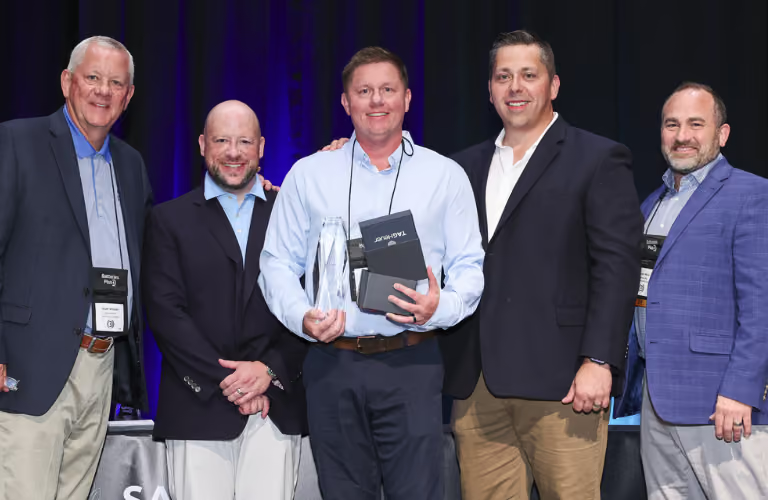

























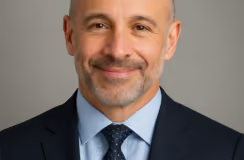



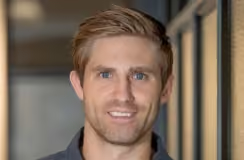







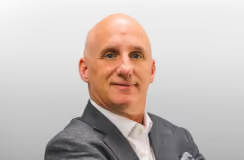


















%20-%20thumbnail.avif)




%20-%20thumbnail.avif)

%20-%20thumbnail.avif)

.avif)



%20-%20thumbnail.avif)