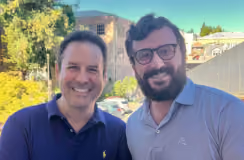
Host: Fair to say that most acquisition entrepreneurs are ambitious? I think so. Buying a business is a big swing. Takes a lot of wherewithal, takes a lot of vision. Today's guest might even be more ambitious than many of us, or maybe better said, he's acting out his ambitions sooner and more boldly than many. Gundwolf, going by his Twitter handle, made a bundle online and recently took those Internet winnings and acquired a $4 million H VAC business. And this is not just some crypto kitty who placed a few NFT bets and is now a multimillionaire. This is a guy, despite his mellow vibe, with singular focus and determination to make it happen for himself. It's a cool story about a 24 year old kid. Enjoy. Welcome to Acquiring Minds, a podcast about buying businesses. My name is Will Smith. Acquiring an existing business is an awesome opportunity for many entrepreneurs and on this podcast I talk to the people who do it. Acquiring Minds is going to be recording live on Wednesday, April 13th. The episode will be something of a debate about the merits of two models of search, self funded search on one side and traditional search funds on the other. I'll have two guests, each a proponent of one of the models. Greg Jeronimus acquired, grew and exited a business with a traditional search fund model and now invests in searchers himself using the same model. Robert Graham acquired and now leads his business as a self funded searcher and also now invests in searchers himself using the same model. Both of these individuals are articulate and strong proponents of their respective approaches to search, so it is going to be a high quality debate. My goal for you, the listener, is is that you come away with a stronger sense of the pros and cons of each model self funded in traditional search funds and have a much clearer sense for which would suit your own search. Again, it's Wednesday, April 13, 10am Pacific 1pm Eastern over Zoom. The link to register is right at the top of Today's show notes. April 13th see you there. Register in the show notes Guntwolf thank you for joining me today on Acquiring Minds.
Guest: I'm happy to be here. I enjoy your podcast. Like I said, no one's ever addressed me by that name so don't know how to feel about that.
Host: Well, you go by Gundwolf on Twitter and we're not revealing your full name today, so I'm going to stick with that pseudonym for the interview, so we should both get used to it. Your story is a really fun and interesting one, not to mention making the 40 year olds among us feel like we've, you know, been sleeping through life. So I don't want to spoil it all. So suffice it to say, you made a bunch of money online and then decided that you wanted to use that money toward buying a business that felt less ephemeral, less precarious, and more long lasting. And now you are the recent owner of an H Vac company. An H Vac company. So not so. So you, you completed your, your goal in, in, in kind of diversifying your business interests. So this is going to. So let, let's just get right into it. Let's hear it. Start us off wherever you think is appropriate, Gund Wolf. And we will go from there.
[3:51] Guest: I mean, basically, basically, I've always been interested in business. I didn't grow up with money. My mom's a secretary, my dad was a policeman. So I didn't grow up with money. But I've always been attracted to that side of things. And when I graduated high school, I decided to go into engineering just because, because I felt like it was a challenge and it was basically a degree in problem solving. And then also I felt like no matter how big I messed up in business, if I had a degree in engineering, I could always fall back on a pretty decent salary so that I went down that path. And in college I started several businesses. I started three and none of them really had big success. So I graduated and went to work at a Fortune 5. It's a well known, I mean it's a company everyone knows. But I continued working on a marketing business that I started in college and it was nowhere near big enough to support me during college. But I took the sal. My new salary and basically was investing all of that into the marketing business. And eventually I was making more from it than I was my job, so. And I hated my job. So I ended up leaving about the week before COVID hit and it was great timing and moved back in with my dad and continued scaling that business and it basically just grew to, it grew bigger than I ever imagined.
Host: So let's, let's. Let me pause you there so I can get a few more, A few more details out of you. How old are you now?
Guest: I'm 24.
Host: 24. So when you talk about graduating college, this would have been 3ish years ago. What year did you graduate?
Guest: Yeah, 2019.
Host: 2019. Okay. And when the marketing business. Oh, first of all, the job that you had that you got when you graduated, do you think that you hated it because of that particular job or did you? I mean, especially now that I kind of know how this story unfolds. Are. Do you just see yourself as somebody who's entrepreneurial and just not, not well suited to nine to five life?
[6:15] Guest: Yeah, I think it's. Everything I do really comes back to independence or freedom. And it's, I mean, money ultimately allows you to have that freedom, but
Host: being
Guest: able to have complete time freedom, work out when I want to do, think about or study, read when I want to, and really just go down the path that I want to without having someone telling me what to do, I enjoy that independence of freedom. The responsibility, the risk of being out on your own and hourly salary, those to me are not motivating at all. So when I, when I was on salary, I mean, you get paid the same no matter what you do. And to me that's just not, it's not motivating in any way at all. So the more you do, it's not the more you make, it's the more work they give you. So I just have always known that I wanted to do my own thing and that's, that's the path. The path I guess I've always pursued.
Host: So it was a matter of time before you stepped out to become an entrepreneur and it just happened. Basically, after your first little taste of corporate life or 9 to 5 life, you were ready to take the plunge?
Guest: Yeah, I was ready before I started.
Host: And you'd done entrepreneurial things in college, so you'd already been experimenting.
Guest: Yeah, yeah. So I've always been fascinated with that path. I've read all the books on it. I mean that I was the, I was the guy reading those books when everybody else was at the party in college. I did my fair share of partying as well. But eventually, yeah, I was looking for that path.
Host: This marketing business that you said you started in, in college and continued on during your job year, how long were you in the job? About a year.
Guest: Yeah. Yeah.
Host: And continued on there and then fell back on when you quit the job or didn't fall back on, it was thriving. Tell us about what that, tell us about that business.
Guest: So that's a affiliate marketing business that it's all ppc, pay per click ads. And yeah, when I was at that last job, I was basically taking my salary and plowing it into courses and into just any, any business model trying to get some kind of traction. And eventually I purchased a course that allowed me to get traction and I didn't have an absolute home run millionaire overnight with it in the beginning, but it did allow me to quit my job. So I quit my job with honestly very little savings. And I can't, looking back, I can't believe I, I did that. But with just. Yeah,
[9:16] Host: so. Well, and let's. For the audience who might not totally understand what affiliate is, let me try to describe it. And then you correct me where I, or I misspeak. And you said PPC ads. So you're paying for ads on the social networks or on Google. So Google or Facebook or YouTube or what have you, you're advertising and then, so generating traffic and then sending that traffic to a landing page of some kind to try to capture interest, maybe an email address of the individual who clicked and then, or send them directly to a product that they then buy. So, and then, so the point is you're, you're acting as a bridge between the person who clicked and the service or product that's actually being sold. And you're taking a commission there. You're the affiliate. So far, so good.
Guest: Yeah, you're basically a commission salesman for tons of different products that you're not employed by. You just get paid, paid based on every purchase. So you, you pay for the ads and then whatever that arbitrage is on what you spend on ads, what you, what your revenue is minus what you spend on ads is your profit. It's really simple. P and L
Host: And there's, you know, this is one of the most common ways to quote, make money online. And there's a lot of courses around it, there's a lot of attempts at it because you can make a whole lot of money, which I think you ultimately did, but it's also really competitive and really difficult. So, so talk to me a little bit about the nature of this business and, and that competition and how likely somebody is to be successful or not at it. Because here you are really young and been really successful at it. But it wasn't easy and as you said, it wasn't overnight. So talk to me just a little bit about your experience in this world of affiliate.
Guest: Yes. Affiliate marketing. Online online marketing in general is just cutthroat. I mean, it's a very, it's a very tough industry. And I mean, every day something's changing. People are trying to get into it all the time. So you're competing with people all around the world. There's no geographic barrier for people to be your competitors overnight. And so, yeah, coming from that space to what I do now, I think it's just a huge advantage compared to the blue collar Space I find myself in now, coming with that mindset, that continuous growth improvement mindset. But yeah, to what you were saying, affiliate marketing, online marketing in general, especially with paid ads, you can make significant sums of money very quickly. I mean, as soon as you get one ad that works, you can scale that up there. There's. If you have a broad type product, there's no limit on how much you can make in a very short period of time. But it is kind of like a gold rush. There's no business there. It's just a cash flow machine so you can get knocked off the next day. So it's really, it's really a gold rush type feeling. But so, I mean, I think the key is just taking your money from that and investing it into real assets
[12:43] Host: and just to give people a sense of how much money there is to be made. I think you, you found yourself inspired coming home from a conference in what, San Diego. And do you recall what I'm getting at? You met people there that had made ridiculous amounts of money. Tell me, tell people about that.
Guest: Yeah, so really what solidified everything for me was actually meeting, meeting people in person who had done these insane numbers and just shaking their hand and realizing they're just normal people as well, and then committing everything you have to make that reality your own as well, that vision, that idea, your own reality as well. And so, yeah, I mean, I went out there, I was meeting people who had done $20,000 in a day in profits and higher than that. So back then, I mean, I was still at a 9 to 5 job. And those are astronomical sums of money. And I still have journals from back then. I can go. That is one, one of my best tools I have is just journaling. But so I can go back when I was at that conference and look at exactly what was going through my mind that day. And yeah, it was like, it was like a dream.
Host: And so you had already been dabbling in this world when you went to that conference. You weren't yet successful or making very much money and you came back with a renewed zeal to, to, to, to really make a lot more money, take it to the next level. Correct?
Guest: Yeah, yeah, that's exactly what it was. I was struggling, just trying to get some basic traction and I went out there and met, met those people face to face and I had a, had a breakthrough not long after that. It was a while before I was making the kind of hitting the numbers that they were hitting is about a year. But just going out there meeting them was enough. That I was able to quit my job and create an income just off that.
Host: So did you ever hit $20,000 in profit a day?
[15:02] Guest: Yeah, so the highest I ever hit. It's kind of weird how you, I mean, just on ads, the highest day I've ever hit was over 60,000 in revenue. And that day was, is 120% ROI on my ad spend. So I made 35,000 profit that day.
Host: Incredible. And is that like an outlier or for a few weeks in that timeframe, are you making around the same amount of amount day after day?
Guest: Yeah, that's an outlier. I mean, you can do it, you can do it on a consistent basis. And I know plenty of affiliates who do that. I mean, the highest I've ever kept consistent numbers at was probably 30,000, $40,000 a day for a couple weeks. But I mean, still, you only have to get a few of those monster winners. And it's hard to keep your motivation high when you're doing those kind of numbers as well because it's, it feels, it doesn't feel like gambling as much because it's educated. Well, you're looking based on past performance and trying projecting forward on what it's likely going to continue doing. So it's not really, it's not really gambling. It's more like a gold rush, like I was saying, mining for.
Host: Well, it's, it's like. And with a lot of experimentation. Right there's. You're experimenting with the messaging of the ads. And you know how that, how well that convert how. Basically you're creating these marketing funnels and every step of the funnel can be refined and mixed and matched and just iterating, iterating, iterating before you find some kind of magical sequence that like ding, ding, ding, ding, ding. Like that's a jackpot. Is that a fair characterization or do I misunderstand?
Guest: No, that's exactly how it is. It really is like drilling for oil. You're just drilling here. You go 10 miles down the road, try to drill here, different depths, different locations. But yeah, it's all comes down to testing. And I mean, you can use a lot of the old school marketing books, like the old school direct response guys, all that stuff still applies today, but you can apply that stuff, these ads, and once you get a winner, you just scale it up. So it's different than these, these businesses we're all interested in buying. Because if you want to double your revenue, you literally go and hit edit on your budget and double your budget. It's not like, well, I want to double my revenue. I have to add 20 more trucks. I have to hire 20 more people. It's a whole different world. It's interesting, but it's like I said, there's a reason it's cutthroat industry.
[18:01] Host: Well, and I want to get into why. More about why you want to diversify away from it. But I also was struck in our pre call about how committed you were and how spartan you were in your lifestyle as you made this decision to become like those guys that you met at the conference. So you come home from the conference and tell me about this year of educating yourself and experimenting and what you had to do, what it looked like to finally achieve your goal in affiliate.
Guest: Yeah. So really I'd been living that spartan lifestyle for probably a year before that. So, yeah, I mean, I had a pretty solid salaries and engineer, but I would go back to my tiny little apartment that was one minute away from work. So I cut down on driving time and I had an air mattress in there. I didn't have furniture. I had a foldable table that just had my, my computer and stuff on it because I was putting all my money into courses and ads and testing, trying to invest to get some kind of traction. So I don't. I mean, even now.
Host: So it's you in a, in a barely furnished room, air mattress in the corner, the soft glow of your laptop that's. That's on like a foldable table and you're in a foldable chair night after night after night. After coming home from a night of work, from a day of work, well,
Guest: I would usually do it the opposite. So I would actually wake up around four in the morning and I would work for. I'd work from like 4 till like 8. And then I go to work. So. And I work when I came home. And it's not like I had a girlfriend or anything or dog or cat, so. Or I don't live. Yeah. Or a life. And on that front, really nothing. Nothing has changed. I live a pretty similar lifestyle still.
Host: I could see the air mattress there over your shoulder. Well, that's remarkable now. And were you. I mean, did you get discouraged ever? I mean, you know, you're spending all this money, you're spending all this time, you're getting up at 4 in the morning. These are, this is like. I mean, this is such a. It's almost a cliche story of entrepreneurship where you're banging your head against the wall, likely being discouraged every day. And then, and then, you know, eventually you do make it so.
Guest: What.
Host: What was that? Yeah, what was your headspace like during this time?
Guest: Yeah, I mean, it definitely was. There are ups and downs. You have challenges, you have walls, and those are. Those are very real in that space. Because there's no real in that world. There's no real. Just kind of getting a plugging along. It's like you're either losing money or you're making money. You're either basically at zero and testing. So you're losing money or you're making a lot of money. There's no in between. So you have massive swings when you're winning. It's okay and everything. Especially in the beginning, you get super excited, but eventually those numbers don't mean anything. It's just. You just become numb to all that. So, yeah, I mean, a lot of time you're just trying to not. Not be sitting at zero because of how that makes you feel. You're just trying to keep progressing. So. Yeah, and kind of going back to what my Twitter name is, I'm just thinking back, I not thought about this stuff in a long time, but I remember one. My name, my Twitter name, Gunwolf. That doesn't mean anything, but I read a lot of fantasy and stuff. That is one of the hobbies I have. So I have a little bit of life fantasy books. But yeah, I remember reading some of those books and stuff, and the characters going through trials and me trying to relate to them. I remember. I remember going through that. So cool.
[22:07] Host: You tweeted here, and I think you were referring to your affiliate, your affiliate experience, or building this affiliate business. Solid partnerships, taking shots on ambitious projects and a bit of luck, and your world can quickly change. And I think I've seen you tweet something else similar, this theme of, like, you can go. You can kind of go from zero to a lot quickly if you're. If you're constantly taking shots, if you're hungry, if you just keep moving forward, progress as you kind of. The theme you were just kind of touching on. Can you tell me just a little bit more about that philosophy of yours?
Guest: I kind of have the same philosophy that every day we have a million different pathways that open up. I mean, every day you have. You have infinite number of opportunities available to you, and those go down millions and millions of different paths. And that's actually the wallpaper on my. My phone. It's a similar image to that, but it basically shows how many paths open to you every single day. And so I believe that every day you can get closer or every day the decisions you make can put you closer or further away from. From your goals. And that's pretty obvious on the surface level, but that's compounded out throughout your life. I mean that really adds up. And so yeah, in the last, I mean just looking back over the last few years I've had, it's hard to believe how fast that has happened. And that's kind of what I was saying earlier. I feel like just having very crystal clear goals and vision and ideas on where you want to end up and focusing on that every single day. I mean I journal every day, I meditate every day. I'm constantly going on walks and I exercise every day. I have pretty rigorous habits in that area, but I think those things just add up to. It's like, it's like doors open themselves and yeah, I'm pretty. A lot of that's woo woo to some people, but I've just seen so much of that stuff happen that I. Yeah, that's just kind of a operating philosophy I think and live by.
[24:33] Host: Well, I will say, Gun Wolf, that a lot of people take daily walks. A lot of people hit the gym a lot and they have healthy habits and you know, and, and those people probably almost certainly do do better in life or are or have healthier lives than the average or the people who don't do those things. But I think what differentiates you is, is it's not just those healthy habits. It's. It's taking the initiative to, to really work at unusual goals. It's you know, working in the glare of your, of your laptop from 4 to 8 every morning in a sparsely pop. Sparsely furnished apartment. I think that's more. And you could be, you know, there are probably people who do that. Chugging Gatorade, eating Doritos for breakfast, totally malnourished and under gymmed and yet making a lot of money. So it's. So these things complement each other. Discipline and healthy habits of course complement a thriving business life. But I see it's much more. Your success is much more than you know, your, you know, your gym hitting and meditating. It's, it's that you, you take the effort, you make the effort, sustained, persistent effort to, to you know, in this case find a funnel, an affiliate funnel that really works.
Guest: So yeah, yeah, I mean I think you're right. Some it. It. There are more, there are more pieces to it. Yeah.
Host: The. So let's talk about. So we haven't even gotten to your acquisition, but one more. So you finally are finding success after much long nights or long mornings doing affiliate and you. But it's extremely competitive and, and really you're not building a real business in the sense that there's no brand, there's no product, there's no, it's just, it's like you said, it's like from one day to the next, are you going to find that, are you going to drill in the right place and find more oil or not? And the second you don't find more oil, you've built no equity. Is that a fair characterization?
Guest: Yeah, the whole, there's very few affiliate programs or products where you're actually building a brand. A lot of it is just direct response marketing. So yeah, I mean that's one of the biggest things I was looking for was some kind of durable asset that I could put my time and effort into.
[27:04] Host: Now I imagine so. Are any of the other people that really successful people in this, in this world that you've gotten to know and worked with, do they do similar things, take their money out of the, you know, these digital, these precarious digital businesses and put them into more durable assets? Is this a common playbook?
Guest: Yeah, my part, I have a few partners and a lot of what they're focused on more is real estate. They bought several resorts and stuff like that and they're not, they're not actually
Host: in, not a condo at a resort, just to be clear. The resort itself.
Guest: Yeah, so they bought resorts and things like that. So they've actually gone down more the expat path. And so that's, that's one routes and I know a lot of people in the, in this industry go down the NFT web 3 space and so I look at that stuff as well and that stuff kind of goes in line with some of my other strengths. But yeah, I see massive opportunity in this as well.
Host: So yeah, I would think real estate would be the obvious one. I mean the big complaint for a lot of people about real estate is that you have to have money initially to get in, in like a meaningful way and you got to have time and as it you starting younger have, have. So you have the money and you have the time to really to build an incredible real estate portfolio. Why, why did that not attract you?
Guest: I mean that was kind of the two paths I was really going down over the last year or so, even into the acquisition process of this business. It was like, why do you want to go and buy an H Vac company and try and build that up when you can just invest the money you have and live passively and just go live in Mexico for next five years and just continue building what you have online and going down that route. And I still don't really have a good answer for you on that. One of the things I could say is that I don't think it's zero sum. I don't think it's one or the other. I think I can focus on this for a couple years until I have all the pieces in place and have the systems and people and momentum going that I can go and take some time off. But at this time in my life I feel like I need to be doing those active, active investments as opposed to the passive. So 10 years from now maybe I will be just looking at passive investments, the real estate space. But for right now I think I need to continue trying to maximize, trying to put my time and skills, the strengths that I have into my work to maximize the return.
[30:05] Host: So, so that brings us then to the company that you bought. You see this opportunity in buying small businesses. Is that just something that, did you see it on Twitter? Did you come up with it on your own? How did you, somebody who's so immersed in the digital world, how did it occur to you to maybe go out and buy a sweaty blue collar business?
Guest: Well, so I guess I do have some. Well, I'd say probably everyone, everyone who has any pays attention to modern events at all has uncertainty about the future. And yes, I do think the web three routes is probably the highest ROI route to go and spend full time. I think that there's other opportunities like this where I can go and have an asset purchase an asset that is likely to continue performing and increasing in, have see increases in revenue or just industry growth, even though, even if it's not exponential like crypto, and continue to see that growth whether we're in a recession or in a boom period. So that's kind of how I was looking at home service businesses or started looking at them was that yeah, it's not as easy as my. It's. The business model is not as simple as the past business I've been in. But you're likely to still have a business in any conditions as long as you just keep showing up every day, keeping your employees happy and doing, just getting the job done. It's. And then you have an asset where, I mean, two days after you buy it, you could sell it if you want to, if you really want to, but I just haven't had that before. And so for now this just seemed like the best path to Go down
Host: just one, follow up to that. I understand. So the recession, I mean you chose a very durable style business. H Vac is not going anywhere. But as you open your mind to small business acquisition, there might have been digital opportunities, not in affiliate, but in E commerce or just still kind of
Guest: more,
Host: more in line with your immediate skill set of just being online and stuff. Did E commerce or I don't know, a SaaS or something, some online business that's non affiliate online business, did that tempt you at all or you just really wanted to kind of diversify all the way off the Internet sort of thing?
Guest: Well, when I first started off, I was on Facebook running ads on Facebook. And for anyone who has ran ads on Facebook for an extended period of time, they know how quickly you can be shut down on Facebook. At one second you're running, the next minute you don't have a business. And very few businesses online unless they just have just a tremendous brand, tremendous organic traffic. They're heavily dependent on Google, on Facebook, on big tech that can just flip a switch and you're done. And that was something I wanted to get away from. I still do have some of that risk in terms of people search for H vac companies on Google and they're local and that's wherever they rank you is oftentimes how much business you're going to get. So I do still have some of that risk, but it's not completely dependent on an algorithm change. Whereas right now I have so many competitors in a local area, when you're online like that, it's hard to create a moat. So I did want to get away from that concentrated risk of Facebook and Google because I dealt with so many shutdowns through both Facebook and Google.
[34:10] Host: It's funny, digital businesses, I mean my history is kind of online. Back in the day studied computer science, so my natural inclination is to buy an online business. But the more I just think about categories of businesses, the more I just look at so many online businesses and despite their attractiveness with them being digital, lower friction, you know, you can really, once you find something that works, you can turn on the ads and scale quickly, remote, etc. Etc. Etc. So many of them feel extremely flimsy, like they're not very durable, to use your word, or defensible businesses, obviously businesses with network effects and you know, the businesses that we see in the headlines are much better defended businesses. But the ones that I'll see on any of the brokers who sell online businesses, many of those just feel like they're just not, they're not very, um. Yeah, defensible would be the word.
Guest: So yeah, you're one algorithm change away from not having a business and that, that's terrifying when people go and use debt to acquire these businesses.
Host: Yeah.
Guest: So if I were going to go down that route, I have no problem with the startup route, but I would be very hesitant to take on debt, to take on or to acquire one of those businesses. Especially, especially the Amazon focused businesses. That's, that's terrifying to me.
Host: So because Amazon can compete against you or.
Guest: Yeah, I mean determine where you come
Host: up in the results and.
Guest: Yeah, and I mean Amazon, it's, Amazon's already thinking about that. They're already doing it. Amazon Basics or whatever essentials, whatever they came out with. So it's, you're just, it's just a, you're just, you have a timer and you're just waiting for them to take your whole business. And that's not what I want to be up against.
[36:13] Host: Yeah. Okay, so how. Tell, tell, tell me about your search. What did your search look like to find the business that you acquired?
Guest: So it mainly focused, it mainly centered around Biz by Sell, honestly. So not, not anything special. So the way it worked was I was on, I was looking at all these businesses on Biz, Buy Sell. And of course I'm a young guy, so it's tough to get brokers to take you serious on there. So I found a business that I was looking at is a H Vac company and I wanted to get someone's opinion on it who was in the industry. And so I knew a friend of mine from high school college. His dad owned an H Vac company. So I texted him and said, hey, do you think your dad would care if I reach out to him and ask him some questions about, about the industry and just a business I'm looking at and everything. He said, no problem. So I eventually got on the phone with his dad and I didn't know him, he didn't know who I was, anything like that. But we of course, with my age and stuff and he, I explained a little bit about my background. He thought I was looking for a business that was distressed, bankrupt, completely. You get for basically nothing or just assuming the debts. And after I explained to him that I was looking for a business in the 4 to 5 million dollars range, he was quiet and he said, I think you might be looking for a business like mine. And it went down that path and then we eventually closed about now.
Host: Did you expect him to do that? Like, were you potentially. Was this, like, oh, help me buy a business and thinking that maybe this, it would end up exactly this way that you bought actually his business?
Guest: I mean, that would have been a too good to be true. Hope that's a. I mean, yeah, I guess that could be in the back of your mind, but I was just trying to make contact and I did not think that he was in a position to sell. I just didn't think that was going to happen.
Host: So thank you for volunteering those numbers. So you're looking to buy a business enterprise value of 4 or 5 million dollars. So rough math that tells me that you had somewhere around a million bucks in cash to spend of your own money. Assuming an SBA loan, was it an SBA finance acquisition?
[39:01] Guest: Yeah, it was.
Host: And so the million dollars in cash, roughly, well, that's, that would be 20%. So maybe if you're only bringing 10% to the table, half a million bucks and the seller brings the other half a million. I mean, just give it, give us a sense, if you can, of the cash that you. Of your own cash that you'd earn through these affiliate wins that you were going to deploy into this acquisition.
Guest: Yes. I don't want to say exactly how much, how much I built up with the affiliate stuff, but, yeah, I'd built up a very large amount in a very short period of time. I mean, a year and a half before I was at a job making a normal entry level engineering wage or salary. So I felt that going down the SBA route was worth it for me because it allowed me to use leverage to buy, like we were saying, just a durable asset. So that was a risk I was willing to take. And yeah, I did have many doubts along that process. It was a long process. So there was plenty of time to reflect on. Am I just stupid or did just. I mean, you're just questioning yourself the whole time and just trying to reaffirm why you think this is a good decision. So, yeah, usually you're going to buy, of course, for three to four times earnings, and that's similar to what we were looking for here. I was looking for really a bare minimum of the businesses I was looking at. I didn't really want to look at anything that had below $350,000 EBITDA. So that was kind of, kind of the low end of what I wanted to consider. And yeah, the range I just mentioned was on the higher side of where I was at at the time, because I started that over a year ago. I started the process Over a year ago. And since then, I mean, the affiliate stuff's continuing to go on, so.
Host: Super cool. So this gentleman says, I think you might be looking for a business like mine. And I think I recall from our pre call that you had said, like, this was a. This guy's H VAC company was like a name around town. You, you know, they sponsor kind of one of those. These local sponsors, you know, their names on the. The little league team or something. So it was actually a brand name locally that you remember from childhood, is that right?
Guest: Yeah, that's exactly what it was. I mean, they were on the. Well, you just said it, but they were on the. They were sponsors on the scoreboard at the baseball stadium. I saw, I mean, people going around school, growing up, just wearing the logo on shirts and stuff. It was just a cool brand because the guy's son wasn't much older than me. So he gave. He gave out the shirts with the logo on it to his friends. They all had the hats. It was just cool to wear that. So, yeah, I grew up seeing the company.
[42:12] Host: Yeah, that's so. That's so cool. And so the 10 month. Tell us a little bit about the acquisition process. 10 months is a long time. I think that's probably above average for a small, you know, $4 million. So. So what was the final acquisition price,
Guest: by the way, is right at 4 and 4.
Host: So for a $4 million acquisition, you know, I feel like that's a long. A long acquisition process. I mean, they're always notoriously longer than you want them to be, and they. And they feel even longer. But 10 months, I think, feels even a little bit longer than that. So tell us a little bit about that. Why was it. What were some of the challenges that you encountered along the way?
Guest: Yeah, so we were actually supposed to close at the end of September, but that got drug out another two and a half months. And so it was. It was. Yeah, the week before Christmas, we finally closed. And I had been in the business since October 1st, when we were thinking we were going to close right in. Right in that time period because the seller wanted to introduce me to the team and help quell some of their fears and all of that. So, yeah, I'd been. I'd had an office here and everything for three months before we actually finally closed. I'd been shadowing and just getting to know the business. Of course I. I have an engineering background, but I don't know how to actually go out and fix a unit myself. It's all theoretical knowledge. So I. I'm still learning a lot. I'll continue to be learning, learning a lot. But, yeah, that process, it was drug out as well, because neither I nor the seller had experience in this sort of thing. He'd acquired many businesses over the years, smaller asset purchases, but he had never gone through the selling process, and we were both probably too optimistic on that. And then also the beginning of it, I mean, probably the first three and a half to four months was just the initial warm up of, are you actually committed to doing this? Are you actually willing to give your baby away? And because it is like a. Oh,
Host: I thought he was asking you, but I guess you were both. Both asking each other.
Guest: I mean, in both ways, it's like to this day, I mean, we work together still, he's still here. He's basically the gm, and I get to focus on some of the other stuff. But, yeah, I mean, even up to the final day, of course, I have questions in my mind of, is this really gonna happen? Is this actually gonna happen? So, yeah, a big, big part of that time period was just filling each other out and going through the initial financials. And like I said, I hadn't done this before, so I was consulting other people, leaning on advisors and trying to get investors and stuff, because I didn't want to put all my cash into it either. I was with. Plus, with my age and all of that, getting an SBA loan for that amount of money isn't a small feat. So if I was able to get investors to also give a limited pg, that goes a long way in the eyes of a lender to say these investors are. They're willing to put their money on the table for this kid. And yeah, it was just. It was a long process.
[45:44] Host: Was there at any point friction with the. With the seller where there was a personality thing or some sort of uncomfortable disagreement, or was it all just the attendant process, all the stuff that you just described, Just this stuff just takes time. Or were there actually some. Some uncomfortable, sticky moments with the seller?
Guest: Yeah, there was a lot. So, especially towards. He and I get along well, but at the end of the day, when you're negotiating a significant deal for both of you, there are some points that you're not just talking about numbers. I mean, there's an emotional piece in there, especially for him. So, yeah, I mean, we get along really well. But there. When you're going through those negotiations, things get difficult. There can be some, especially if you're in the same office together across the hall from each other on on zoom calls with lawyers. So that can. Yeah, there's some tension, tension involved with that stuff.
Host: Any examples that you can share of
Guest: particularly uncomfortable disagreements on, on some of the clarity on the books in terms of how much inventory there actually was. We have a purchase price and then maybe a month before we're about to actually close, we had an agreed upon inventory. The real inventory number comes back that he'd been having done. It took like two months to get that done. And it's actually $300,000 higher than it was initially stated. So what's going to happen there? Are we increasing purchase price? Are we increasing seller notes? Are we going to be able to do this anym. So just stuff like that. I mean, it's tough, tough conversations. And the SBA loan process isn't a small feat either. I mean the amount of paperwork involved, especially if you have a large fleet, all those vehicles all checking all those boxes, I mean, there's a lot involved. And so I tweeted about it before, but just having. I feel like there isn't enough emphasis put on the relationship the seller and the buyer have. I mean, you really. There's some periods where that's the main thing holding it together because you're both very frustrated and things could easily fall apart. So going back to the fundamentals of just realizing why you're trying to do this and that you do like each other, you're not adversaries as much as attorneys want you to believe.
[48:31] Host: They pitch you against each other. Yeah, yeah.
Guest: Anytime you get the attorneys involved in anything, things go south. So, yeah, just being able to come back to the basics.
Host: Well, that point about the importance of your relationship with a seller just ties into the time point, how long it takes a deal to get done. Because the only way that humans can get comfortable with each other and start to like each other is with exposure to each other, I. E. Time. So if, if, if the solidity of a relationship that you have with a seller is important, then necessarily that's just gonna, there's just gonna be some months there. It's just gonna require some months.
Guest: The.
Host: So the opportunity that you saw in this H Vac company and the expansion and so on, why had the seller not grown larger?
Guest: Well, once you, he also didn't grow up with money or anything. So once you get to a certain point, you have a steady thing going and you're at a certain age, why push harder when you already have a good life? So that's the one. I mean, that's the biggest point you have A happy family here. He considers the people here to be his family. So why disrupt things? I mean, for what, more money? You already have the money.
Host: And speaking of his family, meaning the employees at the company, you were introduced, you said early October and didn't actually take ownership of the business until the end of December. So talk to me about, in fact, I think the first tweet of yours that I saw was about that, you tweeting about the, you know, hello, the introduction, you, you know, you, the prospective buyer being introduced to the rest of the team. So tell me how that went especially, I mean, that's always uncomfortable. But you know, 25, 24 year old being, being the buyer being introduced, I imagine makes it even more interesting.
Guest: So, yeah, it was, that was a whole challenge in and of itself. So, yeah, you're going up in front of there's, I guess I think there was 44 employees at the time. So we had a meeting, we had a meeting on 31st September and I met with all the office staff. And so you have people who are very nervous. They've heard stories about what happens when a business gets purchased. The new buyer comes in and just looks to cut every cost possible, automate everything, just change everything. And he's going to come in and take away their healthcare benefits. He's going to take everything. And so you have people thinking that it's just a lot of uncertainty. So no matter what the former owner told them, at the end of the day, they need to hear it from you. They need to hear you come in and say you're not just going to cut costs. You understand? You're just not looking to do that. You're looking at the other side of the business, the growth potential. So, yeah, we had one separate meeting for the office people, then the next day we had a meeting with all the field guys, the service technicians and the installers. And that's definitely an intimidating process because they come from a very different background than I do. So they're blue collar, hardened men. I come from a white collar environment where I've not, I've never had to go out and turn a wrench on a unit. So, yeah, one, I mean, one of the things coming into that meeting that I told them was just the fact that I already said on this podcast, but I didn't come for money. My mom was a secretary, my dad was a policeman in the military. And I wasn't, I didn't grow up with a silver spoon. And I had businesses in the past that I made successful and that's why I was able to do this. And after I got through my speech and stuff, a couple guys came up and said that they really appreciate that I had said that because they had worked for people in the past who had just inherited the business and they didn't understand. And so I think that gave me some credibility from the beginning. They were willing to give me the benefit of the doubt.
[52:59] Host: Yeah. Yeah. That's powerful. I can imagine. Gundwolf, we are approaching time, but I have so much more we could talk about. I want to make sure that we give just the business of H Vac a few minutes because that is one that is commonly talked about in acquisition, entrepreneurship. It's. It's a really attractive target for. For. For many and who are looking at home services. So why did you like it? And what have you found? And. And also. And specifically what have you found as an outsider who didn't know anything about, you know, anything. Anything about H Vac?
Guest: I feel like that's a hard. I feel like it's hard to get all of my. To answer that completely because of so much I did not know that I now forget. I did not know back when I started. Like, I'm serious when I say I learn just such a massive amount every single day. Just in terms of the technical details, the business side. Just reading the books on running an H Vac company. I think these businesses are phenomenal businesses. You have the ability to provide cuts, provide superior customer service and be rewarded for it. I mean, it is a people business and I think a lot of investors forget that. How much you can improve the business by just focusing on service, just excellent service. That's one of the things I'm focused on now and just improving the business in all those types of ways to win customers, to add subscription revenue, to add divisions, add products, services. It really is a good opportunity to expand from as a platform.
[55:04] Host: Imagine you're talking to somebody out there who knows nothing themselves about H Vac, but they're considering buying an H Vac company. What would you advise them or tell them about. Learning the business?
Guest: Yeah, basically I would have to say that I couldn't do this if I didn't have the support of the former owner. So as I mentioned before, he's acting as the general manager and I've assumed the. Almost like a CTO role in the company. That's not the right term, but it's just I've been focused on improvements, growth efficiencies, changing pricing structures, adding products, or just changing some of the ways we do things to make the business better. So if I had jumped in day one and the seller was leaving two weeks after I'd purchased the business, I mean, I don't think I could have done that because I, you do need a technical background to be able to do this. I mean, it's not, it's not something that you can just jump into and learn in two weeks. It's, it definitely is a huge learning curve. So I, I wouldn't recommend trying to go down this route unless you have someone trusted that you can rely on that has at least H Vac experience. So that was, I mean, getting the loan that I did and all of that, I really had to play up on, I had to play up on my business experience, I had to play up on my technical experience as an engineer and then I had to play up on my managerial experience managing people in the past because those are all critical in this. I mean it's all three pieces. And so yeah, having the former owner here to help transition some of those relationships, having a phenomenal team in place that is continuing to run the business. I mean I've left and gone to a week long training already since I've owned the business in December and had zero problems when I came back. So just having a phenomenal team in place, it's hard unless you're buying a skill. I mean, if I was buying a company half the size, it's not likely you're going to have those key managers in place that operate autonomously. They probably operate better when the owners aren't here than when the owners are here.
[57:38] Host: So let's close with your thoughts on growth. So another tweet that I saw of yours was just did a site visit with $120 million H vac and electrical company 15 years ago. They were a struggling two man operation. So that's quite, that's quite a 15 year run. Tell me what you saw there and, and then how that informs your own vision for growth of your business.
Guest: Yeah, one of the most striking things about the business, I didn't know the business's history before I got there. I thought it was a business that had been around, started in early 1900s or something. But I got there early and I was reading, I was reading their book in the lobby and I saw that they started in 2004 and it blew me away. I mean you'd think I'd know more about the business I'm about to visit before I got in the lobby, but that's just being honest so one of the most striking things was just their culture, the way they treated their employees. It was like a family. And we have that now, but it's on a much smaller scale. So, yeah, that company had 500 trucks or something and they've been able to scale up that culture as they've grown. So I think obviously you have to have the basics, you have to have solid processes in place, solid compensation structures, be able to reward your people. But it's also those other parts that I think a lot of the analytical people like me forget the human aspect. And that is probably one of the biggest learning curves I've had or parts that I've had to learn since I've started is just treating your people very well because they're the best, the greatest asset that you have. So investing in them, giving them training, giving them opportunities for growth, that's one of the things that I wasn't looking at when I was looking for a business to buy or I was ignoring, considering to be a smaller part of the equation. But the team that you're purchasing has a significant impact on whatever the future is you're expecting.
Host: And you've kind of felt that learn that only since you've gotten in the seat and you've learned it quickly.
[1:00:02] Guest: Yeah, yeah. I mean, up until now, everything I've done has been fairly lone wolf type stuff. I was a manager, an engineering manager at my past job. But that doesn't compare to this where you're, you're steering the ship, so.
Host: But you do see a day where you, you could both grow and instill a strong culture and take good care of your people and maybe step back out again and, and move on to other business ventures.
Guest: Yeah.
Host: Like when I, when I hear, when I hear people talk about a place with a really strong culture and, and, you know, just taking care of the people, I just kind of assume that the, the leaders of the business, the owners of the business, to have that culture be so strong, they have to, you know, be in the business themselves or, you know, just be, be present, very present. And so if your goal is to, you know, eventually do something else with yourself, that seems like, that seems like a difficult. How do you reconcile those two things? But maybe I'm wrong. What are your thoughts on that?
Guest: Yeah, I mean, it's definitely, it is definitely not a easy task. I mean, finding that person who can take over the GM position afterwards, that'll probably be one of the hardest problems I try to solve. And maybe I don't get it right the first few Times, but eventually I think you can find that person who cares about the team as much as the owner would. So. And I think compensation structures is a big piece of that. Yeah, yeah. Maybe you might have to give a piece of equity, a small piece of equity, or obviously profit share is kind of a given, but I think it can definitely work. It's just giving people the right incentives. So the culture that the companies that make up Berkshire Hathaway have, I don't know. Honestly don't know how well those cultures function. But, I mean, going back to, like, what Warren Buffett and Charlie Munger are always talking about, it's all about incentives. I mean, that drives. Almost all human behavior is incentives. So I'm huge on incentives, and that's one of the biggest things I look at. But I think if you give the right incentives, you can. You can achieve all those points you just mentioned, especially when you. You have a company in a smaller area, a smaller region, where there is a very clear impact that the company has on the community. All the people in the company can feel like they can see their impact. So maybe we have a unique advantage as opposed to someone in LA where it's hard to see your impact.
[1:03:03] Host: Interesting. I would have thought that buying a business in a smaller town would make it. You'd feel like that was a disadvantage, especially when you look at geographic expansion. And maybe that isn't a disadvantage from that perspective, but I hadn't thought about the advantages that come with it, namely what you just said.
Guest: Yeah, there's definitely pros and cons. Hundred percent. So we're not in a very small region, but we're not in la.
Host: Like I said, Gundwolf, this has been really an interesting conversation. People can follow you on Twitter at that handle, which I'll put in the show notes. Is there any other way that they can or should get in touch with you if they want?
Guest: No, that's. That's probably the best way. Great.
Host: Well, thank you very much for your time today and for. And for sharing all the details of this story.
Guest: No, thank you for having me on. I've. I've enjoyed the conversation and like I said, I enjoy networking with people, people going down this similar path. So I met a lot of amazing people just through Twitter. So it's. It's pretty remarkable that that's a free tool. So, yeah, feel free to reach out to me.
Host: Great. Thanks for coming on.
Guest: All right, thank.
Host: You.































































%20-%20thumbnail.avif)





%20-%20thumbnail.avif)

%20-%20thumbnail.avif)

.avif)




%20-%20thumbnail.avif)