Host: Small six hours away, bankrupt. These are a few of the characteristics of the business that today's guest Jens Scrudno bought. Those were the bad, but there were also the good. 117 years old, strong, brand differentiated, high quality product and cheap. Jens didn't pay much for the business. This is the story of how Jens worked his way through finance and then startups and arrived as the owner of Dovo, an old business manufacturing an old product, straight razors. This is a turnaround story and Jens acknowledges that he chose for himself a very difficult task for someone who'd never even bought a business before. But as you'll hear, he's drawn to outsized challenges to proving the haters wrong. But it wasn't just an emotional decision. This is a guy who read Benjamin Graham's the Intelligent Investor as a teenager, so he thinks like an investor, always seeking value, risk, reward, asymmetries. And he thought the downside here was limited, while the potential to restore this centenarian to its former glory represented big upside. Now, of course, that's theory. Then there's reality. This acquisition has ended up being extremely difficult and everything has taken longer than predicted. But Jens has survived and stabilized Dovo and he's gearing up for the launch of a new product that he's optimistic will dominate its category and catapult its revenue. Enjoy this roller coaster ride with Jens Grudeno, owner of Dovo. Announcements Live Virtual Events Webinars are coming back to Acquiring Minds Tuesday of next week. So Tuesday, June 11, two attorneys who specialize in small Business acquisition are hosting office hours. James David Williams and Bill Barlow of Barlow and Williams are going to walk us through the do's and don'ts of your loi. They'll focus on how Lois can stand out both for good and bad reasons, what you can do to get a competitive edge and to avoid common pitfalls. We're going to leave ample time for questions. Any questions, not just those related to the presentation. So treat this like office hours. Come get any legal question you have about your deal or your search. Answered by James, David and Bill, whose entire practice is devoted to Small Business acquisition. It's Tuesday, June 11th at noon Eastern. Link to register is right at the top of the show notes where it says Register for the webinar. Tuesday, June 11th noon Eastern. Link to register right at the top of the notes. Also, Smith List, the job board for operators and leaders of small businesses that we just launched a couple weeks ago has some amazing opportunities listed. The response to Smith List has been very exciting. Here's a sample of the roles that searchers and sponsors and hold co owners in our ecosystem are looking to fill A general manager to run an $8.5 million home services business, a general manager to run an eight person landscaping business, a GM to stand up and grow a new branch of a residential electrical service company in a new market, a GM to run a niche equipment dealership, the platform acquisition of a roll up and the president of a medical trust administration business. These are all operational and entrepreneurial roles. So if if you're not ready to buy a business but you want the opportunity to run one, check these and others out@smithlist.com link in the notes and Final announcement. The self Funded Search Conference is coming back around September 13th through 15th in Dallas. Come meet other self funded searchers and learn from two packed days of highly tactical content. There was a wait list last year, so you should probably not wait. If you want to attend, get your ticket@self fundedsearchconference.com okay, on to today's episode. Welcome to Acquiring Minds, a podcast about buying businesses. My name is Will Smith. Acquiring an existing business is an awesome opportunity for many entrepreneurs, and on this podcast I talk to the people who do it. What do the following Acquiring Minds guests all have in common? Doug Johns, Morley Desai, Tim Erickson, Chirag Shah, Shane Ursam. They all went through the Acquisition Lab, the accelerator and community for people serious about buying a business. But they represent just a sliver of the Lab's success stories. The number of deals across the Lab's cohorts now stands at over 120, with over $300 million in aggregate transaction value. The Acquisition Lab was founded by Walker Deibel, author of Buy, Then Build, the book that introduced so many of you to the very idea of buying a business. The Lab offers a month long, intensive, almost daily Q and A sessions with advisors, live deal reviews with Walker, deal team introductions, and an active community of serious searchers. Check out acquisitionlab.com, link in the notes or email the Lab's co founder, Chelsea wood Chelsea buy, then build.com Jens Grudno welcome to Acquiring Minds.
[6:15] Guest: Thank you. Happy to be here.
Host: Jens, you've got an unusual story and you bought a fascinating business. A 117-year-old manufacturer of straight razors. So this is an old school business with an old school product. Let's get into it. Jens, start us off with some background on you, please.
Guest: So I didn't start in the shaving business or I didn't even work there before. Not at Wilkinson or something the way I got into it is maybe just to go back a bit to my childhood. I read the Intelligent Investor by Ben Graham when I was 16, 15 and that was my life goal, to be just as Ben Graham and then his disciple Warren Buffett. To find proper companies that most people don't like, they don't see the value that have a certain moat that are special in that way. And then for other people invest their money and my money and then become wealthy and own lovely businesses and then sail away to next life. And tried that for 10 years. So from when I was 16, then studied finance in Munich with engineering, founded investment club in university and wanted to prime people in the investment club to follow the ideology of value investing, to think long term to be a investor that, that really understands the business and thinks like a business owner and did all that did my cfa. Started at Pimco after university in Munich, they have a trading office there. Then went to another company that does portfolio management for Goldman Sachs and others. And there had my portfolio and had the role exactly that I wanted. So basically had my dream job 10, 11 years later than um, then when I had the idea and found out that I found it pretty. Not boring, but not challenging enough. Right. It was like you're an investigative journalist that's better paid but you're not building something. You're still watching from the outside judging investing. And then it turns out well, most of the time hopefully or more than 50% of the time, but there was no building, there was no, no creativity involved.
Host: And yes, let me, let me stop you there. So because if you had from such an early age decided you wanted to be an investor, I'm surprised that, that this, that what investing lacked the kind of the building the creativity wasn't something that you realized before. I guess it was only once you really became a practitioner that you that it really, that you really realized that you weren't going to be building anything. You were just going to be kind of reading and moving money.
[9:09] Guest: Yeah, the idea was amazing. The vision was really great and I got exactly what I wanted with below 30, which was amazing. And I felt quite proud when I signed the contract to actually started working there. But then very early midlife crisis hit where I realized everything I was working for and suffering for and working on weekends and summers to do my CFA while working quite, quite hard and doing my own investing. That just went, went away. Right. And then I've had to figure out okay, what, what do I do now? Right. Once you realize those 10 years were working to A direction that, that, that's not what you want to do. That's not going to be your passion. Not even for more than one year. What are you going to do? So, not really knowing what I wanted to do, I went to a friend, asked him because he was in Berlin and Germany is compared to United States, not really a venture hub. Right there, there's Munich, where I was living back then and working, and then there's Berlin. And Berlin is the big hub where all the money is. The larger corporations, the venture investors were all in Berlin. So the whole community is there. I tell them, look, you know, Rocket Internets, that's the, the copycats large company that copied multiple companies quite successfully and they built one new venture I knew and then I was able to join quite in the beginning so as employee number five and so employee number five
Host: of Rocket Internet's newest venture.
Guest: One of their, one of their ventures in the hospitality region. It was a more specific version of Airbnb basically for students, right? So short medium term housing, three months, six months for people that are only in Germany or in Europe for a semester or something, or two semesters, and was able to join early. We built the company to 150 employees within five months, which was quite intense and crazy to take part of and then got scaled down just as fast. And I said, look, this was fun, now let's build something that's more sustainable. So joined another venture through a recommendation and a friend who with an investor team that built multiple businesses before and sold it, one to Rocket Internet, actually one to a Japanese investor back then for 180 million. So they had cash, they were building multiple business at the same time and one was in the, in the luxury goods space. So it's basically buying and selling luxury watches, right? And there were some other marketplaces at that time already, but they say, look, why don't we do it? We build other businesses, let's try this now, right? So there before foundation I was able to join, which was also fun. They were quite intense and quick and efficient builders. So that was fun to actually join, to set up multiple divisions from buying, selling the whole AdWords infrastructure and everything like that. And then after half a year I said, look, this still doesn't feel like myself because the ownership I had was minuscule. And I said I'm going to try something on my own. I started two businesses on my own after reading four Hour Work Week. So I got brainwashed right when it came out basically and said, look, let's try to do everything with freelancers. And me and the freelancer army, that didn't turn out at all right. I did that for one year, burned out completely and said, look, alone is not the best, with no investors is not the best. You need someone to exchange ideas, right? You need someone to bounce, to actually tell you, let's not do this. Because I'm someone that dreams big, that wants to do everything at the same time. So I need someone that structures my thoughts, that says, we're going to run here. And then I say, yes, sir, and then I run therewith and then have my new ideas again. Right? But actually to stay focused, I need someone else. So I founded a company together with the venture builder, also in Berlin in the medtech space. Basically something completely different. Again, it was an intelligent adult incontinence pants. So adult diapers.
[13:21] Host: Smart diapers.
Guest: Smart diaper, yeah. To basically say, keep people, especially in care homes in Germany and around the world from staying in their excrements for longer than they should be. Right? To basically tell the nurses, look, you have to do something. And then they can still decide if it's at night to wake them or not. But to provide better care also with movement sensors, to say if someone falls, if someone has decubitus or something, or skin that is prone to decubitus, to then move them if they can't move themselves. All those funny things after three and a half years, roughly, and building the team there and building the tech there, which took a lot longer, took a lot more money, a lot more resources. I went out of that business or I knew I'm going to go out there after a couple of months. And during the time at the luxury Watch marketplace, I got to know the employee, the first employee I hired, he became a friend. He built an agency, an ad agency, and he worked for the company that I then bought afterwards, Dovo. And he told me, look, I have lovely company, love it so much. They're bankrupts.
Host: And this friend of yours from the, from the. The rocket Internet business. Sorry, from which business?
Guest: From the luxury Watch.
Host: Right.
Guest: Platform.
Host: From the. The luxury watch marketplace. Correct. Had an ad agency he's working with. One of his clients is a business that he is a business or brand that he respects, but he sees that management is running things into the ground or the business isn't doing well.
[15:01] Guest: No, it was already bankrupt, basically. Tell me, look, they're not paying my invoices. They declared bankruptcy and it's a huge shame because it's the largest manufacturer of straight razors. That's a tiny, tiny niche Business. It's not a huge business. It's. It's a niche in a niche in a niche, basically. But they're the largest ones. They have a extremely loyal community. Not many companies exist, but there's basically three big ones. It was Dovo, there's one in France and another one here in Soling in Germany. And we got to talk, we talked for hours and hours. And he basically said, look, they did so many mistakes. If you just don't do those mistakes, it should be okay to actually run the business and grow the business and make, make it viable again and grow the business. Right. And invest in new products and new new markets and stuff like that. So from there to actually acquiring the business was quite intense because.
Host: Let me, let me stop you getting there. Were you receptive or did you need to be convinced? Because this is obvious. This is a very different entrepreneurial path than what you've been doing, which was very kind of traditional startupy stuff. Buying a struggling manufacturer, that's a century old business is quite a pivot. So did your friend have to sell you on this concept? What was your give us kind of the evolution of your thinking about actually opening your mind to doing this?
Guest: He didn't really need to sell me because he talked about the business and the products before already. So I knew roughly what the business is and the products. I never shaved with a straight razor before in my life. The things I bought, few of us have.
Host: I mean, it's as you said, a niche within a niche within a niche.
Guest: Quite scary.
Host: Yeah.
Guest: Yeah, it does tried it and it is quite scary.
Host: Yeah.
Guest: And it's a shrinking market. Right. So when the company was founded, it BMW up to 50 employees back in 1906. But now, like I said, it's very, very few people. Probably one in a thousand people. Guys actually shave with a straight razor.
Host: Yeah.
Guest: So I knew it was a niche, but what I had was pattern recognition a bit. Right. Because from priming myself over years and years in value investing, the number one thing I wanted is a good free cash flow margin. Plus, no one can disrupt the business, right. So there's no innovation that can disrupt us. No new market entrant can really come in because it's so hard to actually manufacture those pieces that you need years and years of experience even in one position. So even in one part of the production process that you can't. Just, for example, if you now want to build a new one, how do you get the people? How do you get the knowledge? That's super specific. The machines are not even manufactured anymore that we're using here. They're 67 years old now. So I understood that what I was searching in companies in my prior life, all those things made check, check, check, right? Hard to disrupt innovation, can't disrupt it. No new market entrance really. So there was a huge moat around the business. Very loyal customers, the B2B customers, so the dealers plus the end customers. Even though the production quality went down over the years before buying it, even though maybe the customer service wasn't the best before and the sales effort wasn't the best and stuff like that, they still stuck with the brand because the brand was so powerful and the products were still really, really good, right? So everything that I was primed or I primed myself for more than 10 years before I found in Dovo, right? And it just, it lit up in my, in my head. So I tried to convince myself not to do it. And it, it was hard to not do it, right? It was just a quite easy sell. The only problem was I never bought a business before. I had no idea how to finance it. I didn't have the money to finance it. I didn't know how much to pay for it. Um, I didn't know how to buy going concern because once you buy it right, the next day you have to pay invoices. After the first months there's a team, they have to be paid. And I don't know nothing about the industry. I actually moved to Munich two months before buying the business and that's 600km away. So I didn't know the city, I didn't know the industry. I didn't know anything about production, about sourcing, about product design. So it was quite intense. But I said, look,
[19:27] Host: it's worth the
Guest: risk because everything else was so good from the strategic point where the company was settled that I couldn't say no.
Host: A PEO run by a searcher for searchers if you're running a company with less than 100 employees in providing health insurance, you could secure better benefit plans at a 15 to 30% discount through a professional employer organization or PEO. Aspen HR, run by search fund veteran Mark Sinatra, understands the needs of search operators and could be a great solution for you to receive HR compliance and diligence support, a powerful HR tech platform and Fortune 500 caliber benefits, all for a fraction of the cost. Check out aspenhr.com or contact Mark directly@markspenhr.com A couple follow ups Jens so you knew nothing about nothing when it came to buying a business or manufacturing or Transitioning a business. But I will ask, given your years in finance in Germany, you never encountered people in your professional circles that were in private equity?
Guest: There was one, one friend I actually knew from university, so from the investment club. He was a. He was an officer there or a director there in the, in the investment club and he was then a director already quite young in a. In a restructuring consultancy. So with him and quite a bit of time investment of him, four shares after acquiring it, we, we managed to do it right. So from financial modeling of course I did that many, many times. So that's, that's something I didn't need to get any help with. But dealing with the whole process of contracts of the employees, right? Contracts with a lawyer that does the bankruptcy proceedings. I had no clue, right how to strategically somehow find out are there other bidders? What would they bid? Right? What do we have to bid in order to get the deal without knowing are there for sure other. Other bidders and stuff like that. The whole process. He was, he was a big key in that, right. And now he's almost not involved in all anymore but in that transition phase. So leading up to it to the buy and then the months after, even half year after he was very much involved. Right. And he had experience a lot with, with production businesses in way, way worse states.
[22:02] Host: So. Well, but Jens, I still need to, I still need to press you because sure you are somebody who has studied for 10 years Value investing and this seems to check boxes. I also actually want to press you on that. I'll come back to it. But still just in terms of a life path of buying a business where you basically you have this one contact who kind of has done restructuring. Kind of vaguely tangential to private equity, but it's not like you know other people in your professional network who bought a business. So, so just aside from the intellectual exercise of value investing and then feels like that it's still a, a big decision to take your whole career down this direction. So I'm just kind of pressing you on that. I mean there, there's. There's kind of personal and emotional features to this decision as well. And, and frankly maybe this would be a good time to. To bring up something that I asked you in the pre call too. So. So indulge me the reputation. I've always heard of German culture with respect to business is that it's very risk averse that it does not, it does not accommodate failure very well. So the, the thing that at least Americans tell themselves it seems pretty true especially in Silicon Valley. You try something, it doesn't work, you fail. No big deal. In fact, everybody pats you on the back for at least having tried. And that in Germany, it's definitely, that's definitely not the case there. There it is. Still, it is it. You are looked at as crazy to take big risks. And then if you do fail, people are going to say, rather than patting you on the back, they're going to say I told you so sort of thing. Now that's a stereotype. I have no idea. Please tell us if that is in fact the culture of Germany and the business culture of Germany. And then if so, tying it back into my previous question, like, how did you. What was the emotional content of your decision here? This is a crazy decision. Let's be honest.
[24:10] Guest: The very short answer for the, the German versus United States part of looking at failure and at risk, that is 100% true, I think, right? I lived in the United States when I was a kid for, for two years, and then one year in Canada when I was older a bit. And that's 100% correct. So there was not one person that told me this is a good idea. Not one. And I think that also is something that. That's my character, right? So for 10 years I was doing one thing and people said basically, why are you doing this? Why are you doing the CFA and stuff like that, you're going to fail and stuff like that. So once I get told too many times that something doesn't work, I want to do it. But that's all my life. It's something. If someone tells me something at school or something, do this and that not so good because I won't do it. I will do the enough to be good, but not the excellent. As soon as someone tells me this is almost impossible, I actually want to do it, right? So also in Berlin, those were things that were industries and areas and products I had no clue about. And that's what excites me, right? Because it. I don't know how to explain it, but once something is hard enough that most people don't do it, it becomes easier in my mind. Because if I am the one that is willing to suffer, don't sleep much, have pain, have high ups, but also very high downs, I assume that more people don't want to do it. And that gives me a heads up because then if you do those things, they become a lot easier. And I think if you do this, the things where most people think they're not really risky, that's where everyone is right. So those things become quite risky because you're fighting against everyone. If you go in areas where people think it's too small, it's a dying business who shifts with a straight razor. Zing is in a bit in decline. So what the business actually is the ERP system. The whole IT infrastructure doesn't exist. Right. There is no sales organization here and stuff like that. Right. That means if no one is bidding, the price is tiny. That means the risk is tiny. There's only three companies in the world still doing this. Those other companies, you can easily look at what they're doing. For me, something that seems to the outside as quite risky actually reduces the risk and brings up my excitement because I think there's no competition there because other people are not willing to even look in there. From parents to friends to colleagues. Everyone was saying, you're completely nuts, don't do it. And that's why I said, okay, everything else checks. And if so many people tell me not to do it, there has to be something that's worth the risk at the very least.
Host: There's no competition.
Guest: You know, it's interesting that's correct because
Host: I thought, I actually thought when we talked on the pre call that your thing about if people say it can't be done, then you go, you run directly toward it was more of this like, you know, this kind of rebellious, defiant personality, which maybe it is also that. But now I. Now as I hear you describe it, it almost sounds like more of a strategic calculation. When people are saying this can't be done, it means you run towards it because in fact there's going to be less competition. And if you can figure out those hard problems, then the whole market is yours sort of thing, the whole opportunity is yours.
[27:31] Guest: Both is true. I'm a rebel through and through from kids, right? If someone tells me don't do it, I'll do it. Which if. If you go on the wrong path, that's not a good thing. Because if the law tells you not to do something and then you do it, that can lead down a dark path. If you channel it into business or other fun things that are legal and that are really good for society, then that's good thing because you're willing to risk things maybe that others aren't. Right. And, and the second part that you mentioned, actually going directions where other people are not going because it seems risky. And that is a de. Risking in my mind. That came in the last month actually, because you're trying to figure out every time there's A downturn or something in business, you or I at least try to figure out am I doing everything wrong all my life because I'm always going in situations that are super hard. Right. Am I just self manipulating and going somewhere where I'm destined to fail? And that came in the last month actually because there was again a quite hard time. And I'm like, why am I doing this? Why am I always going in directions that are super hard? And so that came actually with now 37 years old and a couple of months ago, because I'm a rebel and if people tell me that's too hard, that was quite obvious a long time ago. Yeah.
Host: Okay. Okay. Well, I'm glad we got you on the other end of a, of a personal revelation and I'm sure we'll, we'll return to this when we hear some of these war stories, which we will. I will say too though, when you think about investing, particularly value investing, Benjamin Graham was also very influential to Warren Buffett and Warren Buffett is known for his invest when there's blood in the streets concept. Be greedy when people are fearful. Be fearful when people are greedy. Something like that. To win big and investing, in fact, one of the cardinal rules is that you do have to take counter, you have to go counter to the crowds. So to, to make big wins in investing. In value investing, there's a similar dynamic there. If too many people are in a position, it sort of by definition means that you're not going to have a big win there.
Guest: Yeah, that, that's what I was, I trained myself before. Right. So I was also looking mostly when I had the fund for one years for, for one year looking into special situations.
Host: Right.
Guest: Where not blood in the streets, but there had to be something wrong with the, with the perception or something wrong with the structure of the company or something wrong with the situation that people either didn't understand it correctly, but you have to have an ego and have to be humble to say, look, I'm betting against 97%.
[30:13] Host: Yeah.
Guest: And in more than half of the time I'm going to be correct. That, that, that's not, not easy.
Host: Right. We're about to hear whether or not this particular going to the right when everyone else was going to the left. How it's panned out. Let's return now to the business itself, to Dovo and for the audience. That's Dovo. I do love the brand. Does that, is that have some German language meaning or something or is it just an invented or is it a last name or Something.
Guest: It's actually the first letters of the second names of the family names of the founders.
Host: Okay.
Guest: So it's doab, D, O, R, P, that's the D O and fos, V, O, O, S, that's the vo. And they just put it together. It's nice to have that short name because people recognize it and the URL is quite short, so you can spell it out easily, but it's the founder's names put together.
Host: Yeah, it's great. And it's universal, so people from different languages can pronounce it all easily. Okay, well let me push back a little bit on, on the opportunity that you saw. So you've kind of already addressed some of these, but let's, let's have you address it directly. Why did you not feel, why is this not an industry that's in terminal decline, so getting smaller every year? It's already a niche of a niche of a niche. But why, why did you feel that that trend wasn't going to continue or at least that demand for straight razors was going to stabilize or even grow?
Guest: I had no clue if it would, that if it would do that. So from, from what I saw and, and your experience, especially in Berlin. Right. So if you're in the, in the hip, in the hippest city in a country, in the, in the venture hub where all foreigners want to be expats and stuff like that, that is Berlin. It's the most vibrant city by far and the largest city by far in Germany. Then you get a vibe for certain trends. And I know during that time when I bought the business, the trend was going into being in touch more with your local stores. Right. Because you had the cheap fashion, the fast fashion, from Zara to I don't know what. Right. So everything is outsourced to China, to Bangladesh and to, to India and Pakistan. So people wanted to spend more to have a higher quality or perceived quality. Just for if it says made in Germany, made in Portugal, made in Spain and made in United States.
Host: Right.
Guest: So that trend was still quite strong and growing. The other thing was the everything retro, right. We have new phones now. Everything is going into an accelerated technology, technological development. And then there's always this counter pull to stay close to your roots and old things are nice, from fly fishing to everything else that doesn't involve technology.
[33:10] Host: Right.
Guest: And you have certain things that I saw in luxury watches, for example. Right again, pattern recognition. So luxury watches I dug quite deep into. And it's also something you don't need, you don't Need a watch that costs anything because you have your phone, you have a watch there. You can get a watch for €10, basically. So it's something you don't need. But people invest huge amounts of time, they invest huge amounts of funds into acquiring collections into. Even if they, if you have one watch, that's fine, right? And you can give it to your, your son or daughter and stuff like that. That's cool. But people have 10, 20, 30 and some people invest millions in their watch collection and not any new technology. So really something that is mechanically and that is, that is put together by hand. Right. And that was on a, on a huge increase. Same for fine wines, for whiskey and stuff like that. So I saw everything going up as, as, as people started also to want to have something where they actually are not in a technology, technological space where there is no innovation. Right. Fine wine that's 20 years old, that becomes more valuable. There is no, of course, the production and stuff like that. There is technology involved, but not in the product itself. And same with shaving, the barbering, the grooming trend was in an increase. You saw more and more brands like Wilkinson, Dove and I don't know what, Unilever, all those brands having more store space in retail for male grooming, male creams and all and whatnot. Right. So hygiene, hygiene products. So it went from there's one product for beard care, if at all, to there's a huge aisle of it, right?
Host: Yeah.
Guest: So men invested more in their appearance, in products for their appearance and stuff like that. So all those trends were in the back of our mind somehow, consciously, unconsciously, and I thought the perception of the product of wet shaving. There were small ventures in the United States, in Germany that had double edged razors, at least that blew up quite a bit. Right. You had Harry's Razors. They bought a company, I don't know, for 80 or 100, 180 million euros or dollars in Germany, a very old company that did quite nice blades. So Harry's Razors is producing in Germany. So the, the trend was clear that the direction at least could go up. Right. It's not completely declining. And I thought, okay, it's probably declining because the companies that are involved have no clue about how to actually sell the product to a younger generation. Right. So if everything I learned before is true from value investing and everything that I acquired somehow in Berlin, so the, the more innovative ways to get to customers, if you put that together, I thought, okay, is worth a try. Especially knowing that the old management lacked a lot in exactly the areas where I thought I could accelerate in and build those up. And yeah, of course it's always a risk, but it was more like an optionality. Right. The amount to pay to buy the business was quite small as I didn't have my own money. I took money from everyone that I knew and that wanted to join the ride as investors and consultants, therefore, also. So for me, the personal risk was quite low. I was able to learn, could be a learning experience, if not financial profitable. I didn't invest money because I didn't have money really. And the price to pay at that point because it was already bankrupt, was extremely small. So very little downsides. With a potential very high upside, it's basically buying an option within, in my opinion, a very skewed risk reward ratio into, into reward regions.
[37:11] Host: Well, I feel like that's really the headline. I mean, because that, that calculation is. Supersedes all the other ones about the trend, the, you know, the demand for straight razors or, you know, ultimately, if you can distill a decision into low upside, high upside, low downside, that crystallizes a lot of the other variables. But, but speaking of other variables, let me just press you on one more. So this idea that these things, these straight razors are actually hard to manufacture is counterintuitive to me, who knows nothing about manufacturing. Because, and I'm gonna, I'm gonna sound insulting here, I don't mean to, but it's basically, you know, a piece of, a sharp piece of metal. It seems deceptively simple. And I would just think that I could go on Alibaba and private label some straight razors tomorrow sort of thing, recognizing that they're not going to be the same quality. But so anyway, just address how you thought about. I thought about that and disabuse me of the notion that these things are actually not that hard to produce.
Guest: I, I can compare it to, to anything else. Right. Of course you can go to Alibaba and you actually find not the exchangeable blade, straight razors, the, the Chevette that we have also in our portfolio, but really straight razors for $3, $4 landed cost here in Germany. But it's, it's like with watches, right? You can buy a watch for exactly the same price or you can buy a watch for 1.5 million from Audemars Piguet or something.
Host: Right?
Guest: It's if you want a proper quality that actually lasts for generations. Right. Because we have razors here from 17, something. I just got shaved in a webinar that we did with a barber from, from Gent from Belgium with a razor from 1720. They still work if you, if you, if you hold them properly, if you treat them properly. That's just beautiful, that is. So you can always get cheaper stuff with everything. Also with wine, you can get a wine for €1 in Germany, right? If you, if you buy it, you can also get a wine for a couple thousand dollars. And there is a difference, right?
[39:25] Host: Yeah.
Guest: If it reaches a level, you won't feel the difference. But we cannot manufacture below a certain cost here, right? We have 10 people involved in the production. Some people need three to five years to actually be in what they're doing. Really? Really. That they know and they have a production quality with a certain amount they can produce every day that it becomes very viable for the company. And almost no one in the world can still manufacture certain steps in a razor. That's why only three companies are still left. And I think in the next years there could be only us and another company. So there's 120 work steps if you buy one on Alibaba. Because the first thing I did when I bought the company was buy everything there is just to have a comparison, a baseline of where are we at at the moment? Because the feedback I got from talking to end customers, but also to dealers was that the quality declined over the years because it wasn't the focus anymore of the old company, because it was only a part of the company. They had shaving, they had scissors and they had nippers and manicure items. And they only bought the shaving parts because the other parts were super, super bad from financial position. And the shaving business was something where I said, look, it's a round business, it's one topic. And we can really focus on male grooming, male shaving, so it's easier to have a brand that is more niche from the consumer. So that's what we did. And we have 10 people now involved. So 10 people we took over from that business that are now involved the production process. We hired two more that are involved now because we have to start early to train the people. Right. Because if you want to increase production, it takes sometimes one or two years to actually have them trained. And replicating that process is not that easy. So the first thing was really buying everything that's on the market. Also from Alibaba, right? About 10, 10 of the, the. The cheapest ones and mid priced ones from Alibaba just to compare them, compare the steel, compare how their hones, compare the materials and it is like buying a watch for three, four dollars or buying a watch that is actually 1,500 or $5,000 from, from Switzerland. You feel the difference?
Host: Yeah. Well the other thing is, is like your target market are going to be people, men who appreciate that. They're going to be people who are drawn to quality anyway. Part of the reason they're they're buying this product, a straight razor versus just a Gillette or an electronic razor is precisely because they have a taste for quality. So it actually helps you in this category because the, the very type of person who would choose to to shave themselves with a straight razor is going to be the very type of person who's really attuned to quality to begin with.
[42:25] Guest: So yeah, anyway, it's the same like with, with watches, right? There. There's a certain amount of people that for products they want certain things, right? Some want watches that are self winding and are handmade in Switzerland. Others want the technological stuff, right? Everything, everything new. Most people want nothing of both. They're in the middle. They just want something functional. It's same with the straight razors, right? So the shaving market is huge. You have the people that always buy the newest thing from Gillette that is vibrating and has five blades and stuff like that. Then there's the mid market that buys the, I don't know, that's one fourth of the price of the, of the top products. And then in that market you have the traditional wet shavers which is also these double edged razors, right, that have these two edges that you put in. That's a bigger market definitely than straight razors. And then of that submarket you have the straight razor enthusiasts, right? Because that's the most work and you have to actually learn it a bit, right? It's not that hard as people think. It's actually quite easy to get into. And I never cut myself with a razor so far. But you have to invest time, you have to hone it sometimes, right? You have to get a leather strop and you have to get informed and actually try it out. Right? So that's going to be a super tiny subset of that category.
Host: Great, Jens. Well, let's return to the plot here. So you start looking at the business and what do you see? Like how are you going to assemble the deal to buy this business?
Guest: What do I see? The first time I went actually to the company I wanted to run out again because I was never in a really old business that especially never moved. Right. So now we're in a new setting here. So we moved into an old forge in the same city in Soling. But the old business was still in the old facilities from 1906. And they built more and more building parts. And you went in there and it was complete chaos. Right. So I was in. In the financial markets. I was in consulting before I went to Berlin. And everything's hip and all those coworking spaces and everything's new and everyone's with their MacBook Air and Pro. That was my. My life so far. And then I go in there with the guy, the friend that is in restructuring. And first we're in the. In the business area or the old offices, which was already quite interesting because everything smelled like cigars and stuff like that. Not because people were still smoking there, but in the sales room and stuff like that. They had carpets that were brown. I'm pretty sure they weren't brown when they were put in there. All the walls were brown because everyone was smoking over years and years and decades. Right. That's how you did sales. Everyone was drinking and smoking. And after discussing everything also with the lawyers, we went into the production facilities. And that's where I basically said, okay, I'm doing a huge mistake and we have to leave. Right. I'm not going to go right away, but once we're out here, we're gone for good. Because if you move yourself, right, if. When I move from Berlin to Munich, you always throw stuff away, right? You see stuff for the first time after some years and you throw it away or you give it away or you sell it or something. It's the same with businesses. Once you move, you kick out 2/3 of whatever you have from machines to stuff that is still in stock that you never will ever sell again. That just takes up mind space. And that was never done. And they bought businesses and businesses over the years in the 50s and 60s, they bought so many businesses that they never threw stuff away. They never had to. They had huge rooms that 7,8000 square meters and they never threw stuff away. So everywhere you went, everything was full of raw material, of finished material, of stuff. No one knew what it was even used for. Everything was old, everything was from. Everything was black on the floor and stuff like that. It didn't look like Mordor, but it felt like it for me because I had the contrast to the everything shiny financial world and startup world. Yeah. So for me it was a shocking. I said, I'm never going to turn this around. It's complete chaos. I'm never going to ever be able to do that. Then we went out. I said exactly what I felt to my friend in restructuring. He said, I knew you were going to say that, and believe me, I saw so many businesses. This is one of the better ones. Right. So he actually brought me in again to say, okay, let's have a look.
[46:47] Host: But what did he see that you didn't? Or was it basically just. He also thought it was bad. He had just seen worse and knew that in the scheme of businesses that needed to be turned around, this actually isn't that bad. What did he say?
Guest: It's above average. Right. It's nothing shocking or something for him. He saw a lot worse and it was actually above average. Right. So if I wouldn't have him again as someone that says, okay, this is the baseline, this is actually quite good, I wouldn't have done it because it was really a shock for me. Right. And after we moved, now if you walk around, you sound traumatized.
Host: Yeah.
Guest: This is a therapy session here. It's the first time I'm talking about this again. But now that we moved, we built everything new here and we still have the old machines and stuff like that. So that's why it's actually quite interesting. Right. It's this contrast from. We went into an old forge, you can't really see it, but next to me you have still these real big steel constructs from the old forge, and around that we built offices. Um, so you still have the contrast between old and new. But back then it was. It was a shock for me. Completely culture shock. Right.
[48:02] Host: Well, what convinced you that you should do this?
Guest: Same as before, it met every criteria that I was looking for. In a business, it's almost indestructible. Right. If something survives for 116 years, there is a reason. Right. After six years, that's luck. After three years, it's luck. After 20 years. Maybe because there was no economic downturn, big one or something in that industry. But if you survive 116 years, they have to do something, right? Right. There has to be some knowledge in production. There has to be a brand that is so strong that people still buy their products for 118, 516 years. And the product itself, once you have them in your hands, once you see how they're produced, it's very easy to become a super fan of the whole process and the company and the brand and what it represents. Especially if you know that only 2 handful of people are actually still able to do certain production steps in the whole world. And all those things just told me this is something worth saving. So you at least have to try. Even if it's not financially viable in the, in the medium term or something, it's worth saving and trying.
Host: Well, let's get a little bit more about the business. So you've 116, 17 years old. What about the size of the business revenue? Can you give us any numbers to give us a sense of the financial size of the business?
Guest: Before I go into the size roughly from how it developed, Dovo had a, I think maximum amount of employees 34 years ago of 150 people.
Host: Right.
Guest: So it's a medium sized business. It was very, very profitable. And they became quiet, they grew quite a bit of an ego. So they thought, okay, the brand is so powerful, the products are so amazing, everyone loves us. We don't have to have sales, marketing and stuff like that because everyone's coming to us. Which was true at that time. Right. So they, every, every smaller customer, they just turned down and said, now you're not worth it. Then Pakistan, especially for, for cutlery, managed to actually produce products that are getting better, better, better, better, better, right. And then once they actually do the same designs and you cannot almost tell the difference from, from the pictures when you buy something, it becomes harder and harder unless you really build the brand that people want to buy that. Right. Because you're going to be ten times more expensive sometimes or five times more expensive. Right. So you have to have a certain aura that you build about the, about the brand that people are actually attracted to it. And that was really done. And that wasn't done, I think in all of zoelling with really powerful brands that just went bust.
Host: Right.
Guest: Even in the last three and a half years, while I was in zoning, many really strong traditional brands from 1700 something, 1800 something, they went out of business or got bought because they were about to go out of business.
[51:01] Host: Right.
Guest: From 150 people, they went down to 100 people to 80 people. They went up again a bit after James Bond in Skyfall, gods shaved by Ms. Moneypenny in one scene. And actually the demand for straight razors quadrupled during that time. And as Dover was the largest manufacturer, of course Dover profited immensely. So before the management actually wanted to shut down the razor business because it was declining, declining, it's not worth it. We're going to focus on scissors. And because of that movie, it catapulted them up again, right. So they hired people again and that ebbed out after two to three years or something. It went down because everyone had a Straight razor and tried it and many people didn't like it, maybe. So it went to a steady state again and everything else declined. And then when they declared bankruptcy, there were 45 people, so we took over nine people and now we're 17 people again. And from, from revenue, they were at, I think 10 million maybe seven years ago at the high time, where the cutlery was still in decline. But they had this, this bump after that, it went down to 6 quite fast. 4 million, 3 million. When we took it over, it was roughly 3 million. But the 3 million was with all other parts, right. So it was already small that we only took over the shaving business. And that was only one third of the normal business, right? So while we sold the old stock still in the beginning, after turning over, we still had full warehouse. We sold that off. That gave us revenue, of course, which was super nice in the beginning, right, Just to get the free cash flow for something we didn't even build. But that was, that, that was a natural end, right, because once the warehouse is empty, then there's no cash coming in. So during that time, you have to really fast build the business that's still remaining. And that's the shaving business. Right. So we grew this shaving business roughly by 20% every year over the last three and a half years, while the other parts went down quite fast.
Host: And the shaving business, the razor business, how big was it without the other two? Without the scissors and the manicuring back
Guest: then, plates back then, maybe 1.4 million or something.
Host: So you basically bought a 1.4 million tiny euro manufacturer.
Guest: Yeah, the, the, the portfolio that was, that was shedding at that time. Right now we're gonna try to reach above 3 million again this year, which is quite nice. If we're lucky, we're going to reach 4 or 5 because we're launching new products that are quite unique and no one has in the world, right. We're developing for three years and I can't announce yet what it is, but there is a personal designer, a knife maker that we worked with that in the exchangeable blade, razor parts, worked for two and a half years to build something that's just truly amazing. So every barber that has it gets goosebumps and teary eyes. And we actually developed this with a barber house chain that's called Barber House in Munich. They also have one in Hamburg. So we developed it with their barbers together and got their feedback, did some workshops. And now after two and a half years, actually we're launching production very soon, hopefully in eight weeks. So that could be something that actually doubles or triples the revenue in one to two years because it's so unique and no one else has it.
[54:43] Host: I want to, I want to hear about what the plans are for the future, but before we get there, we need to hear about all the pain that you've endured to, to get where you are now. But just one, one quick follow up question on the power of the brand. So like if I go to my hipster barber, you know, in kind of a retro barber shop that are popular, will he know the Dovo brand? Is this something that like everybody around the world who's in the business of giving men straight razor shaves will recognize?
Guest: The better one will know the brand, but they most likely won't use it because almost no one is still shaving people or their clients with straight razors. In the 80s with AIDS coming up and the people being scared of everything, of a blade and syringes and stuff like that, they, many of them stop doing it, right? And then after a certain time, if almost no one does it anymore in a barber shop, then getting into it again because you need a lot of experience, not on yourself, right? Because if I do it myself, I feel the pressure and I can really control what I'm doing. If I'm about to shave you, that takes a lot of experience because I have to be completely sure I don't cut you, right? Because if you're before work or during work, right, at lunch break, you come in and you have a nice white suit and you have an appointment afterwards, you cannot cut your clients at all costs, right?
Host: So getting, not to mention the pain,
Guest: the client's not going to come back for pretty sure, right? So most barbers are not using those, right? They're using these exchangeable blade razors. They throw the blade away afterwards. It costs 5 to 10 cents to use one and that's it. So what we sell into is largely or almost exclusively the, the private person, either through dealers, most of our revenue, but also through our websites. But it's the end customer that either has one knife or two knife or gets into it. And then actually we have some people that have 200, 300 knives that are collectors. So that's our, our customer at the moment. And now the new product that we're bringing out, that's not exclusively for barbers, but the barber is going to, is going to want those. Pretty sure it has functionality that no one else has. From design perspective, from how you can actually use it. That's quite unique. So that's opening a completely new market for us.
[57:09] Host: Okay. There's kind of an interesting how you approach strategically your offer price. Let's get through that the actual transaction. And then I want to hear us, I want to hear you really share some more stories and at least what the transition was like as you took over this business. So talk to us about the transaction.
Guest: Transaction. So I had no clue what we can actually bid for it. So if there's other bidders and at that time where it's actually okay, how much do we bid for this? How much do we say we're going to be able to pay for this or want to pay for this while figuring out how to pay for it? Because banks didn't want to give money for a bankruptcy like that, especially a declining business. It's too small. There's no security because all machines are already written off there. There's no hard, hard assets. Right. So it was completely impossible to talk to banks. We talked to them, but they basically said it's uninvestable for us. Right. There's no collateral behind it. And personal guarantee how much money you have in the bank. That's, that's, that's not enough. Sorry. So I got money from private investors and they said, I'm going to invest this, I'm going to invest that. So I had a sum in mind that I was able to raise. And then the friend was very helpful in figuring out how much we, we should bid. Because during the process of discussing the price and everything, we got a hunch at least weren't 100% sure, but we got a hunch that we're the only bidders. And once you know that and you have someone at your side that does transactions day and night, he's able to figure out how much the lawyer that is trying to sell the business or wind it down, how much he would have to invest from the assets still in the business to wind down the whole company. And then you calculate that. You say, look, it's X. And then we said we're going to bid 10% above that number. And then he actually doesn't have any work or less work than winding it down. And he has to say yes because he has to go to court and say I maximize the amount for the, for the people that are owed money. It was a gamble. Could have just been the case that they said no because there is another bidder. But we had a hunch from discussions that were actually the only ones and that turned out to be true in Retrospect, Right. So we were able to aim quite low. We had something in mind. We figured out, okay, there's probably no other bidders, so we're able to go to half that amount.
Host: And so just to repeat what you said, you figured out what kind of the liquidation value of the business would be if this, if this, if this fiduciary basically couldn't find a seller, excuse me, couldn't find a buyer, what they would, what liquidating the assets would yield. And as long as there weren't other bidders and you could provide a premium over that liquidation value, in your case, you just kind of chose 10%, then it's an easy decision. They get 10% more money. They kind of have to accept the offer because as the fiduciary, you're providing more financial compensation than the alternative. And oh, by the way, it's also easier because there's no wind down. You just, they just give you the keys and it's your problem.
[1:00:42] Guest: Correct. Now it's your problem. Have fun.
Host: Right. Okay. Well, that's it. That's it. That was an interesting, very logical calculation. Makes sense and obviously it worked. Can you give us a sense of what you pay? So as you know, now in our world, we typically value profitable businesses a multiple of earnings. I assume this was, the business wasn't profitable, that's why it was in bankruptcy.
Guest: The, the whole business wasn't profitable, but the, the shaving part was profitable actually. So the one that we took over was profitable. And there was, there were many people in, in sales, at least they had the name Sales on their desk, but they weren't doing sales. Right. I understand sales is, you have a very large part of your, your salary that is based on what you actually do. Right. Are you successful, learn a lot or not, then not. And they weren't doing sales. Basically the old management said, look, we're so powerful as a brand, we're not going to go out from ourselves and ask if you want to buy our products because that's beneath us. We're not going to do that. Right. So they actually didn't do sales. They were flying around, but they were doing customer service or chatting with people and stuff like that. Right. So I didn't take over that part either. Right. From the office perspective, I only took over the really skilled people in that area that were, that were working.
Host: So, and, but, but still, even though it was profitable or what you took over was profitable, you still didn't value the business based on the earnings of the business you value. You Valued it based on basically completely.
Guest: Of course, internally we said this is the value that we think this business will bring us over the next couple of years. Right. What the potential is discounted cash flow model. And just saying, okay, what do we think this can be if we expand the portfolio, especially in certain topics in certain regions and acquire new customers and, and shift from B2B because it was 100% B2B where you give 50% of the revenue is basically going to your dealers. Right. If you have more people coming to your own platform, to your own website. Right. You. You earn double, basically. Right. So if we shift that through marketing into that direction, even just doing that without growing the amount of. Of products that we sell, that should be quite nice. Right. So just from what we pay, that was purely. He has to accept this offer if there is no other bidder. That was the only logic for us at that time.
[1:03:11] Host: And, and then, but then also I assume your analysis showed that this offer price that you gave the difference between that and what you. Your internal valuation of the business. That there was a nice differential there. That.
Guest: A huge one.
Host: You were so. So you were kind of. You were doing that. That beautiful. That beautiful conclusion where it's like I'm buying it for less than the asset. So if I flipped the business almost, I could probably. I could probably earn a profit tomorrow.
Guest: Yeah. In an ideal life, and very optimistically that would have been the case. And then life happened. Then reality hit.
Host: Right. But also part of your calculation of what the business was worth was also not just based on the inherent value or the profits or the earnings, but you were also really thinking you were going to try to build this business back up. So you were also thinking, of course, what this can become. You were dreaming about what it can be year three and year ten from now.
Guest: Yeah. So the going value is a lot higher than what we pay for it. It's again, optionality. Right. If we pay a bit for this option and if it turns out that the going concern is where we expected in that range, there's a huge upside. If it doesn't turn out that way, then we almost risked nothing. Right. Compared to buying it when it's still going concern and not in bankruptcy.
Host: Well, Jens, this analysis sure feels like. I mean, we've said it explicitly. Very little downside, no downside. And yet it's been brutal.
Guest: And yeah, that was a lie. Yeah.
Host: Okay, so you buy this business. What? Tell us. I'm just watching the clock here, Jens. We don't have. We. We have to convince Condense three and a half years of pain into a few minutes, but start wherever you want. Maybe the transition or what, whatever it is, what, what is so much worse than you thought going in, the biggest
Guest: hurdles were implementing new ERP system, new website backends, moving the whole company, the whole production, Among many, many other things. And one partner that was one third of the revenue. So it was Dovo and Merco. They were in Dovo and the company was the same owner. So Merco does double edge razors, Dovo did straight razors. The administrative work was done by Dovo, but Merco was separated by the owner before the bankruptcy years before, because he actually thought Merkur is going to go bankrupt and it shouldn't pull down. Dovo, that was exactly the upper. The opposite, right? Merko was profitable and Dovo went bankrupt. Still for him it was of course good. Right? So we were the largest dealer for Merko products. And actually all our dealers that we sold to thought that it's one company, right? So what we did is basically buy from Merkur finished products, ship it out with our products, we make a profit margin, not as big as our products, but still quite okay. And that was one third of our revenue. And one and a half years ago, they stopped delivering us without any notice. The notice was weeks after, if not months after, saying we don't have capacity anymore to deliver to you. Right. And they found someone else to do that in. Zoning didn't tell us, poached our clients and so on and so on. That was quite dirty, but that felt quite harsh. Right? Because if one third of your revenue breaks away, that's tough to handle in a time where many dealers that are stationary because of lockdown, they're not able to open the shop. And many old school retailers, they don't have online presences yet. They can't sell online, they can't shift the whole demand online. So you had COVID lockdowns, huge bump to less quantity sold, less demand from us, then one third of the revenue breaking away while we're preparing to move the company to the new location, which cost roughly half a million euros. Right. So for a large company, that's nothing for us because I'm trying to invest everything in new product development and everything else. That was quite, quite a bit. Right. So it was five times more than I expected. I had a reference from another company in Zilling. Moving company and then moving the machinery, the whole electronics in here had to be redone. We didn't have. I didn't have that on my Radar, right. That was €180,200,000 alone. So everything came at the same time. You had to move the company because we had to get out the old factory. One third of the revenue breaks away. COVID lockdowns weren't really in our favor. Plus selling the old products. So scissors and stuff like that, that went almost to zero. And at the same time there were still some bookkeeping issues with. With the old company that quite a large amount of our funds were still locked with the bankruptcy lawyers. Yeah, you know,
[1:08:48] Host: I'm hyperventilating just listening to this. However, I will say none of those actually challenge your thesis. They're all sort of incidental things that would each be a big challenge in its own right and then together are possibly fatal and probably aged you by 10 years. But. But happily none of them made you feel that, oh my God, I was wrong about something structural here. Structurally, all of your. Your analysis was still pretty firm, right?
[1:09:22] Guest: Correct. The external market perception was correct that more and more people are investing more and more into their, into their products and their hygiene products and. And expensive hygiene products. What was quite nice was of course the retailers went down in what they bought from us because they couldn't sell. But at the same time people that are at home more, they are searching for new hobbies. Right. So what can you do? Of course I can invest in watches, but what if I don't have money? I can do more gardening, I can buy new plates and cutlery and stuff like that. But I can also see if I. Straight razors are fun to do. So it wasn't as harsh as for others, I think because more people got into that as a hobby. And still the thesis, like you said, still big moats. The brand is quite strong. Those were still completely, completely there, especially when the dealers didn't buy. More people bought from our website. So that went up during that time.
Host: Yens, I want to ask about one other vulnerability I meant to ask or risk in the business that I meant to ask earlier, but now that you're actually have bought and are in the business, you can maybe give some anecdotes about this. Given the amount of time it takes to train people to produce your blades and the very few people in the world literally who exist with this skill and how nine of them or whatever, 11 of them work for you, it would seem that there's a lot of, a lot of key man risk there. Maybe not not an individual, but each, each and every one of those technicians or skilled craftsmen is very, very valuable. Now I guess on the other hand, because their skill is so particular, they probably. It's not like they have a lot of options of where to go. So there's kind of a mutual codependence there. But still it would. It seems like something that you need to protect yourself against losing your people, even a single person. Talk to us about that.
Guest: In the beginning, that's that that was correct. So there were some work parts that only one person could do. Right? So when they were on vacation or they were sick, that was an issue, right? Because it's not a process that can go around or something. But it actually it's. First you do this, then this, then this, then this.
Host: Right?
Guest: So if one link is missing in that production chain, then things build up. They're gone for one or two weeks. It takes months sometimes to actually bring those, those parts down again. Now we have trained four people that weren't in the business before. So we hired them and trained them. So now I'm relaxed. But in the beginning that was an issue, right? From other businesses in finance and in Berlin. I know that sometimes if you're one year in a company that's almost too long, right? And you need something new and flashy and shiny. Now the new ventures there and they got more funding. Now I'm going to move there.
[1:12:38] Host: Here.
Guest: I think the average age at the company is 13.5 years. And some people are here for 33 years. They did their training here and they're still here. So there's no big fluctuation, right? So one person in a key position left. Now I hired two for that position. Now we have three. Right? So there's redundancy. So that's fine now. But for me it's also positive, right? So if it's so hard to actually train the people and have the people, it's also tough for others that would want to go into this area. So for me it's not impossible, but it's going to be super, super hard to build something in that area. But not impossible. You can do whatever if you really want to.
Host: Well, it's your favorite theme again. If you can solve this problem, then the, the opportunity is just yours. Nobody else is going to be there. And, and you can really just further expand your moat because you have you figured out how to skill people up in this very, very scarce skill and you. They all work for you.
Guest: Yeah, yeah, that's good. They should stay here.
Host: Jens the so to be clear, we're calling this a turnaround. But in fact there it was profitable so, so what I, I wanted to. One of my questions was going to be what does the triage exercise look like when you get into a business that's basically slowly dying? How do you arrest. How do you arrest that? Process the, the death. But it sounds like it. And then, and then on top of it, you had these, whatever, four or six crises that all happened as you became new owner.
Guest: Just looking at. There was more. Okay, okay.
Host: There was more.
Guest: Send it to you afterwards.
Host: Yeah, so. So I'm, I'm going to put this back on you then, I guess. Where should we spend our, our, our last few minutes, at least on the war stories? What can people learn from your experience? What story is most illustrative or most educational for the audience?
Guest: I did a short video, actually started a TikTok channel, funnily enough, and posted one video so far this week just for myself. Even if no one watches, I don't care because I start forgetting certain things. Because you're so involved in that for three years you forget the learnings that you had. And in the beginning, I was actually writing a diary once a week also to the investors, right. So I can go back there, what I thought and stuff like that and what changed. But still, the big learnings, you normally forget quite fast if you don't write them down or if you have them as a video, even if it's super, super short. Right. So there's too many video. And I basically said, look, the, the seven things you shouldn't do when buying a business, because those things I did and they were all something that, that the next time I'm 100% avoiding. Because they're quite, they're avoidable and they're quite bad if you do it. If you do it right. So the, the first thing was don't buy a business out of bankruptcy, especially the first time, if you're used to that. If you're into that business of buying businesses out of bankruptcy. Good, right? If you have experience, if you learn the experience at a private equity company and then you do your own thing, that's completely fine. Doing it for the first time, I would highly avoid. It's insane. It's just complete mayhem. And the likelihood of succeeding are quite low. Right. It was completely dumb luck from myself and the investors that were still here. There's one thing why it worked and that's that the brand was so powerful that even when the clients knew Dovo is in bankruptcy, they still wanted the products. Right? Because sometimes or most of the times one company goes bankrupt the next I'm not going to order with them because they might have my money and I don't get my, my stuff. Right. The products, I moved to the next one. But the brand was so powerful that the, the demand didn't go down. Right. So it was just luck, Right? Of course I knew the brand was powerful, but it was more powerful than we actually anticipated. Right, so out of bankruptcy, people buying big. No, no. Right.
[1:16:49] Host: And just to be clear, Jens, when you say don't buy out of bankruptcy, do you mean also don't buy a turnaround or do you specifically mean a company that is officially in bank the bankruptcy process? Don't buy one of those bankruptcy or
Guest: both in bankers bankruptcy, okay, There's a couple of months where your suppliers are scared that they don't get their money, where the employees are scared and traumatized sometimes where the customers say what's going on? So if you write them an email, if you call them and say, look, everything's fine again, who says they actually will deliver to you again? Or who says they don't want cash upfront instead of 60 days payment terms, stuff like that. Right? So what you're buying and what you're getting afterwards, the mayhem afterwards, you. It's hard to assess, I think from an outside perspective if you don't know what questions to ask, who to speak to and stuff like that. Right. So I think it's a lot harder to assess than, for example, transition, where someone is, I don't know, 70 years old, 60 years old, they don't have anyone taken over the business. Then you have a seller financing, for example, one year, where they teach you everything. But the customers are still there, everything's a going concern and there's no traumatizing from the suppliers, from the customers and from the employees. So in retrospect, it was completely stupid. And funnily enough, I actually bought a book. Buy then build. It's a really good book. And the key takeaways are don't buy for out of bankruptcy. Second key takeaway is don't take money from friends and family because if it goes bust, you won't have some family members maybe that are still, still close enough with you. Or will you lose friends? That's what I did. Only money from friends and a bit from family. So I did that. What was said, don't do it in an industry I didn't know. Third thing that you shouldn't do, according to that really good book in a city that you have no clue about, that is especially six hours away from your actually Town where you're living and you have to go back and forth the whole time. Twice.
[1:18:51] Host: Let's link. Let's linger on that one.
Guest: Yeah, yeah.
Host: Six hours away. So the difficulty of that speaks for itself. So we don't have to hear about the difficulty. What I guess I'd like to hear about is how. How you rationalize that to your.
Guest: To yourself and my kid and my dog.
Host: Oh my God.
Guest: My friends.
Host: Was this just one more of Jens's hey, if it's hard, I'm doing it. Sort of. Sort of rationalizations.
Guest: No, it was miscalculation and I'm very optimistic. So I need someone that actually kicks me in the butt and tells me you're too optimistic. Right. This is more realistic. So the assumption was the first year we restructure internally so production process, we move the company and everything like that. Then second year is investing in growth, new markets. So sales going to Saudi Arabia, to Qatar, to South Korea, South America, where we're not that powerful yet in the market. And third year growing more, maybe getting more investors and then thinking about, okay, buying similar business under Dovo as then a brand hub basically and repeating what we did before. Right now we're three and a half years in. And from the one year restructuring internally it became basically three years. And this year we're able to. To invest in marketing and sales.
Host: So you're finally, you're finally getting on the plane to go to South Korea three years later.
Guest: So it was that, okay, I don't have a kid yet. So back then I didn't have a kid yet. I didn't have a dog yet. My wife was working quite hard in Munich, so she was also okay with me being in Zoling because after work she didn't want to do anything but sleep and watch tv. And I was here, okay, because I didn't have any friends here. I was completely focused on restructuring because that's what I needed to do. Didn't sleep much and worked 100, 120 hours a week and I could do that. So first, second year that then we want to get a baby. That was planned already. Now he's one and one year and four months and now it becomes quite hard to actually put that time in right. So if I would have a kid back then I'm 100% sure the business would have failed. So the dumb luck would have actually be only dumb and no luck because I, I couldn't put the time in right. You, you have sleepless nights. The. The kid is sick or something. You have to take care of the kids and you want to take care of the kid. Of course you want to see the kid. That wouldn't be possible. So I wouldn't have bought the business with a kid. 100% sure.
[1:21:23] Host: Well, Jens, I, I mean, I think a lot of people who are having a kid wouldn't want to buy even a healthy business. I mean, there's just, there's just too, it's, it's too much at once, Let alone a turnaround. Let alone a turnaround that's six hours away. Now with this six hour away thing. Are you, were you. Did you take an apartment in small. Okay, so you had.
Guest: Okay, yeah, yeah.
Host: So you had a place to crash. So you'd go down, you'd take the train six hours away or whatever and stay there for a week, or stay there for Monday through Friday and not sleep and just work, work, work, work, work, work, work. And then go see your then girlfriend on the weekend.
Guest: In the beginning was actually Monday to Friday or Sunday even to Friday or Thursday. And then it went down to Sunday to Thursday, Sunday to Wednesday. And now I'm going at 4 or 5 in the morning with a train on Monday and then going back on Wednesday. So tomorrow again at roughly five. Right. The good part is those train rides, that's 12 hours where I'm completely offline and I can actually work in the zone. I don't have to transition. So it's actually going straight from zoning to Munich. And that's where I can do deep work.
Host: Right.
Guest: Because when I'm here, there's always questions, there's always problems. I'm going to suppliers because all products that we actually have in one of these razors are manufactured in zoning, even the packaging and stuff like that. So that's pretty cool because once I'm here, I completely focus on work. No distraction. Once I'm home, I'm home. I also work in a home office in the basement. But I can always go up if the, if I want to see my son, see my wife and stuff like that. So that's a good thing. So I scaled it down to two nights away now.
Host: So what does that mean? Monday to Wednesday morning?
Guest: Wednesday evening, yeah.
Host: Okay. I think that was number four of what not to do.
Guest: Don't you remember the worst economic downturn imaginable? Even though you're in the downturn already. So that was clear, right? The first. Like it was completely in the lockdown. We moved Munich in the lockdown and we bought the business basically knowing that it's Complete mayhem.
Host: When did you buy? Did you say end of 2020?
Guest: October 1, 2020 was when we, when we took over. Oh, by the way. Yeah. If you live in Germany and you have politicians that destroy the complete energy infrastructure with funny policies because they're playing Sim City or something, then of course you have the highest energy price in the world. And if you have machines to run that eat a lot of energy, plus you have to heat the whole place, then your energy bill triples during the same time. So that was not too, too, too nice. Right. So in an economic, in an economic downturn to buy business, also not too easy because you don't know how long it lasts and how the market reacts. Right. Because we had no clue. What were the other points? Good question.
[1:24:22] Host: Well, I know one of them because you, you surfaced it in our, in our pre call which was how small the business was buying.
Guest: Oh yeah, sorry, I forgot that. Tiny, tiny business.
Host: Tell us about that. That, that, that's a very common theme on the podcast, this question of size and, and, and you. It can be argued both ways and often it depends on one's experience. But you come out emphatically where I
Guest: at the current time, I wouldn't buy a business that's manufacturing that has a high fixed cost basis that is below 5 million, preferably 10 million in revenue. Right. 10 million is going to be tough because you have other bidders for the company. 5 million is a sweet spot. I think if you want to buy a smaller business, bring it to 10 million or 15 million or 20 million. But I didn't have the funds to hire someone similar to me with a more structured attitude because again, you have keyman risk, right. You have the people involved inside that are here sometimes for 33 years. But you need new minds coming in to somehow slowly push the people into a certain direction. And if you're the only person inside, it's tougher than if you have someone that bounces and supports and you can cry about certain things with them easy on into other people. So I didn't have someone in the company that is also quite senior and more of a generalist that can work on certain things, right. Where you can split up, you do marketing and sales and focus on that. And then I focus more on the internal restructuring, production process, sourcing and all that stuff. So it's basically all on me somehow. And that's unhealthy because you're pulled in every direction. If you're working on 10 topics, you're you basically working on nothing. If you're split in two, you become not double insufficient, but I think three, four times as efficient. Right. So you should at least have the free cash flow in the business at that time to hire someone that is of course higher priced, maybe gets a share of the revenue or gets a share of the company or something or options or something like that, but is incentivized also and is senior enough to take over roles and big projects by themselves. Right. And Dovo was not big enough for that. I couldn't hire someone that cost six digits and then gets a bonus and stuff like that. I was talking to people that I wanted to hire and the compensations they expected was just too high. We couldn't finance it. Right. So if you buy something for 2, 3 million, it's going to give you a salary that's not too large though. Right. But you cannot hire a second person. That's tough.
Host: Well, it sounds like when I hear what you described you needed, it sounds like a partner or short of a partner, at least a president. Somebody who's both operationally can help you with operations, but also can be a strategic thought partner and also somebody who you can give strategic projects to. So honestly, even if you'd had the money, finding that, you know, finding that perfect person can be challenging. It sounds like. Or I know from the pre call that you're actually now at a place with your revenue in earnings that you can afford such a person. Have you found that person yet or are you looking end of the year
[1:27:34] Guest: probably it's someone starting that has experience in marketing, especially this year. Hopefully again in not too distant future if everything turns out correctly. And end of the year I'm trying to find someone that also takes a role here and manages production, sourcing and stuff like that. All those things.
Host: Okay. Okay. Jens, I want to ask you. We're going to kind of leave the plot now and I want to. Although we'll return to it at the very end and hear what you got planned now for years three and a half through 10. But I want to ask some. Some theme questions. You read Buy then build late late in your journey. For many of my. All of my audience will. Will know the book after I bought the company. Okay.
Guest: I did all those mistakes that are here to not right.
Host: Right. But of course. And of course one of the books. The biggest takeaway of the book is. Is in the name. It's. It's an encouragement for entrepreneurs to buy existing businesses and build them rather than start from scratch. But I think it'd be interesting for you to give a minute on how you think about ETA entrepreneurship through acquisition versus startup. Zero to one startup. So you did like the smart diaper that was pure 0 to 1, creating a market, et cetera, creating a product, creating a market, et cetera. And, and then, and then also you have this interesting window into the Rocket Internet guys who, whose business model unapologetically is copying businesses that work, you know, online businesses that work often from the us but I'm sure from markets around the world and importing them or tweaking them into Germany and maybe other markets or maybe Europe wide. But the point is they copy, they look at what's working and then they copy it, put it into markets where it doesn't already exist. And I think that that is an interesting model and relevant for us here because one of the big value propositions of ETA is that you don't have to worry about product market fit. You're buying something that already has customers, already has revenue, already has demonstrated demand. So I guess how do you feel about these three categories? ETA 0 to 1 and then that kind of hybrid, the hybrid where the copycat model, where what rocket Internet is basically doing is they're trying to minimize risk by taking models that have demonstrated to work new business ideas, but that have demonstrated to work in other markets and then just introducing them into markets where they don't yet exist. How do you think about those three today, three years, three and a half years into your ETA journey, if it
[1:30:33] Guest: wasn't the situation where everything went in a direction over the last two and a half years that weren't anticipated, I would again for the next, whatever I would do now with that experience, I would go for acquisition again, but not out of bankruptcy, but from someone that built a proper business, puts their life in it. Sometimes in multiple generations or something where there's a powerful brand, powerful customers, customer base that are repeat buyers and stuff like that, and are too small to be acquired by PEs or something as a platform investment, right? So if you're at 3 or 5 million, you're not interested in, if you're a PE, you're below their radar, they're too small. And in that area, if you have something where you feel that could be a moat, and especially even with no innovation on the marketing side, sales side, that it's a viable business at steady state, even at no growth, that's something I'm quite interested in. And it could be something completely different, could be something completely boring, where you say, okay, I'm going to sell toilet paper, whatever Right. And I do a subscription model or I don't know what. Right. But combining something very basic that from the product has no innovation whatsoever. Right. So it cannot be disrupted. You will always go to the bathroom and eat toilet paper. Right. People will always love certain things. Right. And beard will always grow. So if you have something that, that was built by a founder on some generations and they just won out because they're old or they just don't want to do it anymore or they're burned out or something and you can actually get seller financing, that's super, super interesting. And I would rather go for that than startups because the whole fairy dust stuff in Berlin was fun to do it. Right. To fail in nine out of 10 times and scaling and you feel super powerful and then two weeks later everyone's fired. That's super interesting. Right. And then after you did that, that's also fun. But I think more viable and more for something that I know if someone is an MBA or someone has already experience in business and knows what good business is and bad business is. You worked in companies and you see, okay, this is really bad here. But they're very good at HR here, they're very good at sales and you can combine those things. So after a couple of, couple of steps before. So you worked at Unilever and they know exactly this, you work for BMW and you know exactly that. You combine those things into something that's very traditional, that is super, super powerful, I think. Right. So you have multiple experiences. You put into something that is very basic and very easy to understand from the product itself. Straight razor is you, you buy the raw material, you grind it a bit. Of course it's 120 steps, it's super, super hard. But I can explain it to my 4 year old son, 6 year old son, they understand every step of it. Right. And those business are quite interesting I think because then if the, the go to market strategy, you can innovate in that. Especially if you worked at a company that did it before. You can apply something to something old. Could be a shoe manufacturer. That's super loyal customers. Clothing is always something I wouldn't go into because I don't like that I have to chase or do trends with straight razors. They don't look too much different than 100 years ago. There is no trends. I don't have to chase stuff. Right?
[1:34:08] Host: Right.
Guest: There is no innovation in the design or something most of the time. So I would go for acquisition but not out of bankruptcy. But someone wants to go out of the business. They want a fair price. I don't have the money, right? Let's. Let's have one year transition, half year transition and then you get the money over three or four years. So that is something I would do a lot more than completely from zero. Because the hardest side I think is getting product market fit. That's insane, right? That's. Most ventures go bust because they don't have product market fit. They have something, they have some vision and stuff like that. No one needs it. They don't test early enough. They don't have user research. They don't go out and be embarrassed by the product they have because they're too afraid. I would go for acquisition always, especially now that more people and also more sellers are willing to go for seller financing. Right? That, that's something more people hear. It becomes more common. You don't have to explain it. You. I think you find more people actually selling it and you have many, many people in an age at the moment, a huge amount of people and it's growing even that want to go out of their business. They want to sell it, right? They want to retire. And that is just increasing, I think. I think it's a trend that's going to not last just half a year or two years, but even in five years and 10 years you have a great chance of buying extremely well run businesses, sometimes for very low compared to what they turn out in free cash flow every year because there's no alternative. They can shut down the business, but there are no buyers for certain things right there. Especially no pes and sometimes no other companies because they're just not interested.
Host: Right?
Guest: They basically say in their mind, okay, if they go out of business, then I have more of the market. Or that's what I found here in zoning. Also I would rather close the business and selling to a competitor to not lose face. Which is completely insane in my opinion. Right? Because instead of having the people that work for me have jobs again at another company, at a competitor and I get money, they would rather close shop. So if someone neutral comes in and takes over the business, that they would do, but they don't know how to sell the business. Most times there's no platform where you just upload your company CV and then you sell the business or something. So I would go for acquisition over venture always because you don't have to acquire new customers. That's super, super tough.
[1:36:43] Host: Jens, we talked a lot at the beginning about how value investing. You applied the same lens of value investing to this opportunity. As you did when you were buying public equities and educating yourself on the entire framework of value investing. Now that you've been in this for three and a half years and seen how difficult it was and, you know, learned that whatever the analysis is or the spreadsheet says might not actually be what life is. When you're the owner operator, do you feel like the exercise of being a good public equity picker and a good small business buyer is actually quite, quite different? Or do you still feel like what works for public equities works for buying a good small business as well?
Guest: I think it's the same mentality. So for public equities, it's also finding things that the market undervalues. And it's always, it's with people. If I hire someone, I want to find people where I see that they have more value in my company for the price that they charge for the salary than others. Right. They're valuable more here or they're underestimated from their cv. And if you really talk to them, you actually figure out, okay, they're insanely talented in certain aspects. It's same for market opportunities. If I launch a product and I go with the flow and follow a trend, everyone is most likely going to see that trend and you're going to compete for everyone, for the customer. If you build a market because you see certain things, thinks that no one thinks or everyone says that's a stupid idea, that's a chance where you can actually launch a product that has excess returns compared to the development cost or risk that you put into. So I think it's the same thing. Can you spot certain things that other people think either don't make sense. There is no market for it. They hate the topic. It could be a sin business that most people can't invest in it. That's why it's underpriced compared to the cash flow that it actually generates. But I think it's the same mentality. It's for projects, for people, for going into countries. It could be a country where people say, okay, it's a huge risk to go in there. There's only corruption, stuff like that. And if you actually manage to go in there, you're the only one that's in that country because you managed to somehow build contacts and I don't know what. Right. I think it's the same thing. Figuring out what most people think doesn't make sense because that's where if you are in there, people have to catch up. So if we launch the product within this year, now, hopefully in the next eight to 12 weeks, I chose a material, I chose a functionality that took us two and a half years to develop, and we're going to patent to do the same thing. It's going to be super, super tough because the amount of work we put into it and how much we failed to do. A very simple looking part. Yeah, that was insane. And it took so many iteration steps by actually very, very known knife makers to get to that part. So there's again a huge moat. No one brought that to market because also some people that we talked to said it's impossible to combine it into one product. So many people thinking it's not possible. Many are thinking there's no market for it, really, because people aren't willing to pay X. I believe that if people pay €2,000, €3,000 for scissors and you can get scissors for €10 too, it's for other tools too, in the barber space, because you use it every day. X amount of times, right? 16amount of times, 12 times or something, right? So it's something people actually. That's my tool, right? That's my life. Identify with. My tools also, right? So if I have a scissors that cost 1, 600 and it cuts even just 5% better, I still identify with something and I cherish it more. And that's part of me because that's the one thing I work with. Same for barbers. If they have something that costs 10 years, you cherish it less than something that you pay maybe 200, €300 for, especially if it lasts for 10 years. And you guarantee that because it's made of titanium and I don't know what, that it does not get destroyed. You have lifelong guarantee, you see, when you talk to the and you give it in their hand, they actually use it. They become quite emotional, and they never became emotional about the product that we're going to launch ever before. When talking about them in the interviews in the workshops, there was no, no, no sparkles. It's like you're talking about water. No one cares. So that's again an opportunity. Just like with businesses, just like with going into countries where other people underestimate the potential. But it takes time to find those, right? Because it's super, super interesting also to follow trends, because everyone's making money over there. Why don't you jump on it? The investors tell you, why don't you jump on it? It's a trend and everyone's jumping on it. Why are you so stupid? Until it breaks down completely and you said look, but then everyone's like, yeah, but no one thinks about the times before. Right. You when others are making money, it's quite hard to say no. Just like in investing.
[1:42:02] Host: Jens, let me ask you also about manufacturing and particularly old school manufacturing. So you. We've already touched on it that you really. There's really a craft here. It takes a couple of years to skill people up and there are very few people who. Who know how to do what your people do. But that's very much your particular case. Can you make any generalized observations about getting into the manufacturing, the world of manufacturing for people who might want to buy a manufacturing business? You did. You had no experience. What can you tell other people who have no manufacturing experience but are contemplating buying a manufacturing business?
Guest: I think everything's learnable no matter how hard it is. I just underestimated the amount of uncertainty in projecting time something takes and cost something takes. Right. So if you're in a service business, if you're into the investing business and stuff like that, it's people doing things. You're writing code and people say code is hard. No, code is quite easy I think compared to the physical world. Right. So for me the calculation is it takes double the amount of time at least most of the time, three times and three times the amount of money. So if you do a realistic calculation, if it still makes sense, if you do both cost and time times three, then you can do it. Otherwise not, I think because I was hugely optimistic with everything. The new product we're going to launch, that was one year production that we calculated, it's two and a half years now. Again, we had the double edged razor that we launched. It's the best razor ever. We have collectors that buy it because they buy every razor that's coming out and they're writing us really emotional messages. They're calling us, saying what you did is perfection. And we did it all in zoning. No parts from China. So zoning and a neighboring city. And it took two and a half years also to manufacture it. And the plan was actually six months because we were working with companies that did similar products before and getting that correctly because with the razors you have the blade gap, right? So the blade comes out. If you want to shave securely and fast and you're still sleepy in the morning, you want to cut yourself a difference of 0.01 millimeter. You feel on the skin, it feels differently.
Host: Wow. Right.
Guest: And then if you have a product that has tolerances in the production, so zinc die casting and then you have multiple Layers until you have the chrome plating. And you know that if you have chrome plated parts and they're put into the fluids to have the chrome plating, if you have a product in the middle of that plate or on the outside, how much chrome attaches is different. So figuring out how to perfect that took two and a half years and we think it's six months. So sometimes perfection is really really bad. But then once you launch the product that is super valuable because the people that use the product and buy the product, they feel what went into it because the some people have the comparison right and they actually become emotional when using the product because they think okay, this is how something can feel. This is how something can look. Even if you open it at at parts where normally no one cares about. But even if you open it, it's beautiful, it's polished, right? There's nothing there. And at a price point where we manufacture in Zing and we're still competing with things that are basically drop shipped from China. But yeah, lots more time, lots more money and everything that can go wrong will go wrong. Murphy's Law.
[1:46:00] Host: Okay, Jens, round us out now with the what. What are, what are the plans for the next. However long you have planned into the future. Is it maybe five years? What is it?
Guest: The plan was a three year plan when we bought the business, right? We had a financial plan, stuff like that. Where, where do we want to be? How much do we want to sell to B B2C channels? At what time? Like 30% after three years or something. All those things were nice predictions but nothing turned out to be to be correct, right? So I, I am someone that hates planning because I say the amount of time that goes into planning and then it turns out completely different anyway. It doesn't make sense. The I can just work on something instead of planning. So I tend to plan not enough. There should be a bit more planning than me doing. But that's why telling 5, 10 years is not really easy for me, right? For me it's okay. We still want to shift from B2B to B2C because we have the customer direct where we get the feedback direct we can talk to them directly. The margin is higher of course. That's number one thing. You want to reach 30 to 50%. At the moment we're still at 15B 2C which is nice coming from zero, but we want it to be double by now. Yeah, that didn't turn out the way it would. But this year is focus really going to the BTC channel? Because I need the feedback. Right. You can book a call, the 10 minute call on our website, it's always me answering the people and talking to them and that's the, the best feedback you can get. And the feedback gets stuck in the, in your dealers. Right. If they get feedback, then most of them not going to pass it on to you almost never. Right. So if you want the feedback to iterate on the products and stuff like that and develop something the market wants, you have to have a certain amount of people that actually use the product and give you feedback. Also, for example, we have, I don't know, a couple thousand people on Instagram. That's not a huge followership. But if, for example, we launched this product and we had three different scales. So two weeks ago I put out a question, hey, which scale do you want? And then we ask, okay, 40 want these, 30 these and I don't know, 30 this. Right. So I knew we can launch all three because they're all going to sell. Right. So I plan less than before because every time I plan it doesn't work. And then I feel like.
[1:48:24] Host: And you've wasted the time planning.
Guest: And I say, look, just do your best, whatever you do. Of course you have cool core things you want to work on. Right. So the next big thing is doing lots of content to educate people on certain issues. With a barber now that we're working very close with and that we're also in business with now. So shifting to creating content that is long lasting, not paid for. Right. Not just AdWords, of course, a bit, but mostly together with him educating and showing the beauty of those products, how they're made and how they're actually used in his barbershop because he's one of the best barbers in Europe. Right. So YouTube lasts forever. Of course you can put paid ads there, but once people see I think that our product are just beautiful also in using them, I think that's going to attract people in the mid and long term. Short term is AdWords, but I'm not a big fan of that. It's just create beautiful products with beautiful packaging. People will use it and try to give it to other people too and have that they have the same experience. Right. And the biggest thing is going to be the launch. Yeah.
Host: And but for in your own, the trajectory of your own personal career, do you see yourself being at the helm of Dovo indefinitely? Or maybe you buy other businesses or maybe you sell Dovo or what do you think for your personal path here? Or is the answer the same I don't will, I don't plan.
Guest: We're gonna see, right. I think once the business is triple the revenue which we hopefully reach in not too long distant future. I think the optionality is there to do multiple things. And I talked to a couple of people that bought multiple businesses in Germany and have it under one roof, right? So they have one holding and they have multiple other businesses that they took over and they're doing it very, very successfully because they can have one marketing person or two marketing person at the holding level instead of every company, two people, right. So your margins just become better. And they were also quite old school business, right. So the oldest soap manufacturer for example, we're manufacturing together with them soaps and on Friday hopefully we get the samples and then their mindset is very similar. And I think that could be something viable that we said, look, we went through hell with Dovo. Now I know what to do and what especially what not to do. And now let's find some other business where we can have people in the holding structure, HR and stuff like that. Because you don't need one person or you don't have anyone in HR here. It's just way too small the business but be more efficient and then have multiple companies. A mini, mini, mini, mini version of lvmh, for example, where you have number one businesses in certain areas, but the areas are just tiny and there's a huge mode because the market is almost too small for others to come in. You have very loyal customers living a happy life and you grow Those businesses at 20, 25, 30% maybe a year going forward because the market is big enough. Right.
[1:51:21] Host: Because at that rate they're not going to stay too small for too long.
Guest: Yeah. And then you have more cash flow to invest in more business hopefully. Yeah, right.
Host: And Jens, we haven't, I don't think you've directly told us what is this new product, what is special about it? What is it?
Guest: We already have exchangeable blade razors but they're comparable to many, many others other manufacturers. Right. So people, the, the barbers don't use these things here, but they use very small ones where you can break the double edged blades, you put them in and for every new customer you have a new blade, you throw them away, that's five cents or something and that's it. But there is no functionality in that thing. So if you talk to barbers, you do a workshop with 20 of them. One barber doesn't like this. With everything that's out there, one's complaining about their product they're using here. So we collected everything that people don't like. Everything they would have in a perfect world, if it can just do this and there's magic happening and try to combine everything of those things in one product. We worked with a designer and he managed, I don't know how together to put it all into one product that is 10 times better than what I would even envision. And also the barbers.
Host: Right.
Guest: So it's something specific for barbers, for shaving. It's not a straight razor. Right. But it's these exchangeable blade razors but with functionality that does not exist yet and that is very, very nice for their everyday use. Especially all the functionality can be actually done with one figure while looking insane. Looks like a mixture from Audemars Pig. If you have the design of the Royal Oak from Audemars mixed with a Rolls Royce Phantom. It's a similar design language made out of matte titanium. Yeah, I don't want it to tell too much, but I. I think it's going to. It's going to be quite successful. And that. That is one thing again, optionality. We. We invested little money in the development so low, low risk took some time, but with a huge upset potential. And those bets I want to also do do going forward. Right. So things that aren't comparable, that don't exist yet from. From certain perspectives and then do one or two of those launches a year.
Host: Well, there you are back. Back in zero to one entrepreneurship.
Guest: Yeah.
Host: Recognizing. It's a restart.
[1:54:01] Guest: It's a restart up. We restarted the.
Host: Yeah, and you're not. I mean this is a. This is a marketplace that you understand with customers that you already have and user research that you can do easily. And so it's. It's not launching a smart diaper into the world where you have chief production
Guest: issues because 200 per second almost are being churned out and you have to print electronics and then you have to invent new methods of printing electronics. That was in Berlin. It was completely insane. There was so many unknowns at once with inventing new technologies, writing patents and stuff like that. That was completely different game now.
Host: Well, you probably would have thought that pumping out straight razors would have been comparatively a lot easier. But it turns out actually that's really hard as well.
Guest: It's a lot harder.
Host: Jens, if people want to get in touch with you, how do you like them to do that?
Guest: LinkedIn. I'm very hard to reach because I'm never on LinkedIn. I don't have time. It sounds stupid but every second I'm working normally so easiest is either via WhatsApp or via email. And email J Grudno that's G R u d n ovo.com right? Or if. If people don't know that I read almost every email coming into the infoovo.com so every email that comes in here through service at Dovo or something I somehow read, even if I just fly over it.
Host: And Jens, if people want to be made aware of when this new product hits the market, what's the how should they do that? Subscribe to the newsletter on dovo.com, follow DOO on on Instagram Dovo Instagram which
Guest: is at Dovo Zollingen or newsletter on our website which is dovo.com so we'll tease it in a couple of weeks and then once we launch, everyone through the newsletter will get a one in a lifetime discount on the product and have it probably a couple of weeks before everyone else.
Host: Well, your excitement for this launch is infectious. So yeah, I want to talk about
Guest: it and show it, but I can't yet.
Host: Jan, congratulations on surviving these three and a half years. And while it's taken longer than you planned that it would and and projected and hoped, that's so often the case in all things in business and in life. So you're not alone there. But speaking of being alone, you chose a very independent path and I applaud you for that. And it's a really neat business and a really neat story. So thanks for sharing it with us.
Guest: Thank you for letting me share it and hopefully preventing from other people doing
Host: similar mistakes, making those mistakes, but buying a business you endorse.
Guest: Yeah, 100% always would do it again. I think it's a lot easier than starting something from. From scratch.
Host: Yeah. Thank you, Jens.


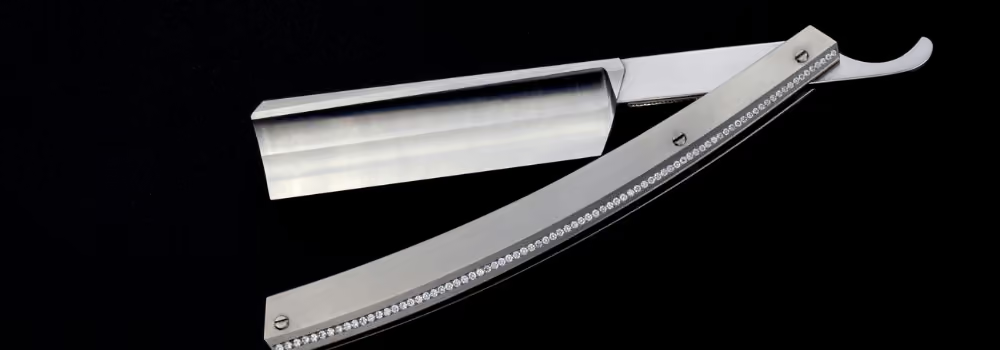






















































%20-%20thumbnail.avif)




%20-%20thumbnail.avif)

%20-%20thumbnail.avif)

.avif)




%20-%20thumbnail.avif)