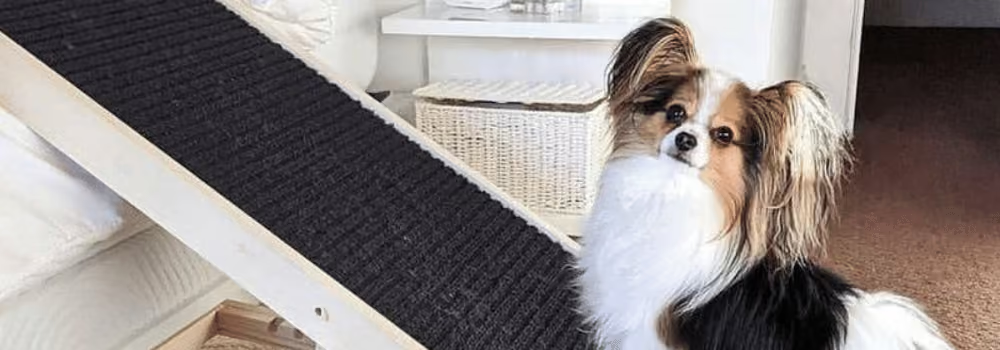
Host: You buy an e commerce business doing $30,000 a month. It's in the pet space. There's a lot of obvious improvements to be made with the business, including turning on Facebook ads. So you do that and a month later the business is doing $150,000. The month after that, $250,000. The month after that,. $400,000. So in a few months you've grown monthly revenue from 30 to $400,000 without really changing much. That is the dream. And it's what happened to today's guest, Ramon Van Meer. Now, if you're a My First Million podcast listener, you may have heard Sean and Sam refer to their buddy Ramon, who has sold many millions of dollars of dog ramps. Well, that is the same Ramon, as you're about to listen to here on Acquiring Minds. I was so thrilled that he agreed to come on. And by the way, if you like this story, you'll also like my interview of a few months ago with Keith Leimbach, who also bought an underperforming e commerce business and grew it tremendously in a short amount of time. So check out episode 68 from April for that. Okay? Please enjoy this interview with dog ramp king Ramone Van Meer. Welcome to Acquiring Minds, a a podcast about buying businesses. My name is Will Smith. Acquiring an existing business is an awesome opportunity for many entrepreneurs and on this podcast I talk to the people who do it. August Felker is a two time successful searcher, first with a traditional search fund. The second time around he did a self funded search. Today August runs Oberle Risk Strategies, an insurance firm with a dedicated practice group for searchers and acquisition entrepreneurs like you. If you've got a business under loi, Oberle will provide complimentary due diligence on that business's insurance and benefits program. A great no risk way to get to know August and team. They love helping searchers. They've worked with hundreds. Oberle is a specialty insurance brokerage for searchers. By a former searcher, check out oberle-risk.com o b e r l e-risk.com l link in the show notes Ramon Van Meer welcome to Acquiring Minds.
Guest: Thank you, thank you for having me. This is. I'm very excited.
Host: Ramon. You are the $35 million dog ramp guy. You acquired an E commerce business in the pet space. You have subsequently grown that into an eight figure enterprise. More than just dog ramps now. And you put out a Twitter thread about this story, which is how I know that piece. Although I've actually heard you on A number of different podcasts. So I kind of know your story. I don't think that all of my audience will though. So I want to hear a lot about Alpha Paw, which is the E commerce business, but also your entire story because it's a good one. So before we get into the whole E commerce acquisition entrepreneurship story, start us off with your background. You are originally Dutch, so you grew up in the Netherlands. Tell us about that and how you ended up in the States.
[3:26] Guest: Yeah, I can do a very short version. I grew up in Holland, dropped out of school when I was 15 ish then because I always wanted to do, you know, be become an entrepreneur and have done like almost a million different gigs or try to start businesses. Had a construction company actually when I was 19 ish for a couple years. Yeah. Did a bunch of different from construction company to promoting EDM raves and anything in between. And then when I was 28, I actually moved to the States and that's when I started buying and selling Internet businesses or online businesses. And yeah, I bought a pet business a couple years ago.
Host: Okay, great. And Ramon, why was it that you moved to the States?
Guest: Well, the reason I moved was a. I always was impressed about the United States and wanted to. To build my American dream. And I also met the mother of my son in that time period as well, so.
Host: Okay, but you had, you had had an idea about wanting to be an entrepreneur in the States from being in the Netherlands.
Guest: Yeah, because I love the Netherlands. I love Europe. I have family all over Europe. It's not as easy for an entrepreneur to build businesses there. There's just a lot more rules, regulations, taxes, and it's just not as I think where in America, if you want to, if you work hard, it's just easier for entrepreneurs.
Host: So when you come here and you start buying and selling websites, you said this was about 12, 13 years ago.
Guest: Yes, correct.
Host: Okay. And so what of all of the things to do entrepreneurially, why buy and sell websites? Especially at that time when it was less well known, less done than it is today?
Guest: Yeah, because I did like the fact of. Especially with a lot of online businesses where like with my construction company there was always sort of. It's similar like a service company. It's like the more revenue you do, the more people you have to hire. It's almost, you know, it's not scalable versus an online business. It's much easier. Scalable where, you know, I had an. A blog about soap operas. And you know, even if we did $500,000 in revenue or 4 million. My overhead was almost similar. That was almost the same bas. It's so much easier to scale and also easier to sell. With a traditional or brick and mortar, you're kind of a little bit stuck. Like a buyer has to be in the same location versus I've sold businesses to people in Singapore, in the other side of the country. So the buyer pool is much larger as well then to sell.
[7:03] Host: Yeah. Also more competitive, the world of online business. So, yeah, that's the one counter to that. But let's. I want to hear about the soap opera blog that you just touched on. That's one of your big stories. It's a remarkable story. But not even the main event today, but just before we get there. So you're buying and selling websites. Are you technical at all?
Guest: A little bit. Very basic.
Host: Okay, so yeah, so buying and selling,
Guest: but cannot build my own website. You know, I was just hired somebody to do that basically.
Host: Okay, and so what were this buying and selling of websites? Like what were kind of the size of businesses that you were buying? Were these really tiny sites or what?
Guest: Yeah, I literally started with, you know, buying something for 500, $2,000, making some improvements and then selling them for 2,000 and then buying something for 2,000 and then selling them for 4,000. Really started small. And then, you know, after a couple months, I bought a pinata website, actually a website that dropships pinatas for 6,000, made some improvements, made my money back in two months, and then sold that for 22 or 25. I don't remember. Thousand in two months. Months. And that's when, you know, it started scaling. And then I did not buy this website, but I started it because I didn't have. There was a website for sale that was writing about soap operas. So that's when I got the idea. I didn't have enough money to buy it, so I said, like, you know what, let's just build it myself, see how it goes. And that's, you know, by now, you know, so far the biggest exit that I have because I started with nothing and then sold that for, you know, close to $9 million two and a half years later, three years later. So, yeah, yeah.
[9:17] Host: Ramon, this is a podcast about acquisition, entrepreneurship. So the stories of starting from scratch, we don't. We don't want those huge success stories of starting from scratch.
Guest: Yeah, we should. Don't start businesses. You buy businesses.
Host: Guys, thank you.
Guest: Ye.
Host: Thank you. No, but we're going to get into that story a little bit because it's Too remarkable not to. But I will just plug somebody else's podcast which you have told that full story of the soap opera blog on an, I think a pretty early episode of my first million. Sean Puri interviews you. And so if people want to hear the hour long version of that, it's very worth listening to. Fascinating. But taking you back to this point in time, are you doing this full time, this kind of website flipping? Is this making enough money for you that you're doing it full time or is it a side thing?
Guest: No, it's full time. But now I've bought this pet business, you know, close to four years ago and that's, you know, the only thing I'm focusing on right now because it takes up all my time. But yeah, flipping, buying and selling businesses has been my full time job for the last 12 years.
Host: So. So when you got here from the Netherlands and you started pretty soon after that buying and selling websites and it was pretty much pretty quickly or immediately how you could support yourself and you could do it full time. Because I think the typical story is somebody starts buying and kind of flipping in your case websites kind of as a side hustle and then over some amount of time they accumulate the capital and the expertise to go full time with it. Sounds like you went full time pretty quickly. Pretty immediately, yeah.
Guest: And it was more that I had no other choice basically. So because I came here on a student visa where I didn't had, I couldn't work basically get a job. So I had to work for myself regardless. But it was, yeah, because when I was buying and selling business, I also had with one of my best friends an online travel business that basically paid my bills and then the buying and selling was just all extra. But even with the online travel business, it was like I did the marketing basically it was the same type of work I was doing when I was flipping websites.
Host: And these websites that you were flipping, they were content websites and E commerce dropshipping websites. It was kind of a range of all the various digital types of websites of businesses.
Guest: Yeah, I really didn't matter what it was, but most of them were content because that's, you know, fairly easy. You don't need a lot of expertise or a huge team. And I did a couple dropship websites as well because similar with content, with dropship you also don't need a big team. I stayed away from software type businesses because, you know, you need a developer. Like it's just a different type of business.
[12:27] Host: Yeah, yeah, I want to ask you about that in a Second. Okay, so let's hear just the quick version of the soap opera blog story. So you said you saw another site, I guess on Flippa. You're using Flippa primarily for these website acquisitions. That was in the soap opera space. It was too expensive to buy. So you said to yourself, let me take a swing at doing something in this niche, but I'll start it from scratch. And then two and a half years later you sell it for about whatever, approaching $9 million.
Guest: So what is the.
Host: Yeah, totally crazy. Can you kind of give us the two minute version of that story? It's amazing.
Guest: Yeah. And it was totally unexpected. It was not like, hey, let's, let's build a $10 million business. Let's do soap operas. I was just like, you know, I was just happy with building a quote unquote passive business that can, you know, support, you know, pay my bills, basically. But it started really slow. But then as you know, as soon as it clicked, so to speak, then it started actually growing exponentially. But it was one of those things where this was, it had all, it checked all the boxes. And this is, I'm talking now, looking backwards. This was not like for me looking forward like, oh, this is all the boxes. This is a great idea. I was just, you know, trial and error. But it was one of those things. It's like it's a very niche market often and I do it same when I come up, try to come up with new ideas. I was like, we always go for like, what's the biggest idea? Or what's the billion dollar business? Or what's the biggest market? Whatever the next idea is, we want to target the whole country. Soap operas was a niche within a niche. It's like daytime TV but then also even soap operas. But still 9 million people watch soap operas. So it was an overlooked niche. I don't think a lot of Internet geeks or wizards or Internet marketers were saying like, hey, let's go into this niche and with content. For the people that may be thinking about buying a content site, it's very important that you always, whatever topic you choose, it's important that there's enough new content because you want people to come back to your website. With daytime tv with Sopapras, and I didn't know this again when I started it, they run almost every single day of the year. It's five days a week. I think they only have a handful of blackout days. But Besides that, it's 50 times weeks a year. There's new episodes. So you can Always write about new stuff and then add on the fact that Facebook at that time was still very easy and quote, unquote, cheap to build a huge fan page and a huge community that I then use to drive traffic to your website. With any idea or any website that you want to buy. You always have to think, okay, the product could be amazing, but how I'm going to get the right audience or the right traffic to my website to either consume your content, buy your products, or buy your service. And at that time, I utilized Facebook pages and then later Facebook. Facebook groups. Facebook group, Facebook pages don't really work as well anymore, but Facebook groups definitely still works.
[16:21] Host: Yeah, so, yeah, so there was this. There was this kind of. The two big opportunities that intersected were an overlooked niche, but a big niche because soap operas, you know, you said it's a niche within a niche, but then you also said it's 9 million people, so it's actually a sizable market. It's a whole industry, you know, in Hollywood. And it was overlooked. And then it was at a point in time where there was this new platform or new ish or newish opportunities via Facebook that were still not competitive and you could acquire users or viewers for pretty affordable.
Guest: Exactly, exactly. Because at the end of the day, whatever you're going to do, service brick and mortar or like, well, brick and mortar, I'm not sure. But anything online, it's all about like, okay, what is the value of a visitor or, and how can I acquire that visitor for cheaper? You know, so with content, I made money from banner displays. I work together with Google or other ad networks that will pay me to display banners on my website. And I would get paid for each thousand visitors, I will get paid x amount of $. So if I can just acquire thousand visitors for $2, but I get $4 from Google now, you know, now you
Host: have a business now you've got your CPM arbitrage going.
Guest: Yes, exactly.
Host: You know, I would, I would think that the, the soap opera viewers aren't the most lucrative demographic. I don't know, maybe I'm wrong. The stereotype would be that it's kind of moms. And you know, moms do control the pocketbooks of families. I'm speaking in total generalizations and stereotypes here. So maybe I'm totally wrong about the demographic. But you know, one of the other things that when you do a content site or you do some sort of niche, you want to look at like the value of the people or the value of that topic and how much disposable income there is there. You know how much, you know how much advertisers and what sorts of advertisers want to reach that demographic are so pop reviewers a good one or what? How do you answer that?
[18:34] Guest: Yeah, and it's also no genius a plan beforehand from me. I learned this afterwards or during the average audience or visitor was like 45 years and older. And I didn't know that, but like you said, even in a married household, it's the woman that makes almost all buying decisions from cars to credit cards to shopping, you know, from all the way from cars all down to shopping. So it's a lot of advertisers want to reach that. Plus 45 years and up has a high, pretty high disposable income. I had an. At the same time when I had a soap opera website, I bought actually that one I bought on Flippa, a content site about wrestling. Wwe. Not a fan. I don't really watch it. Please don't get offended. I. I think it's great. I think it's. But I bought it because I saw a huge opportunity because I almost, I thought like, oh, wrestling WD is almost like soap operas for men because they have storylines and they have, you know. Yeah, exactly. And. But unfortunately the, you know, I don't remember the exact difference, but it was almost for the soap. Like just as argument's sake, for the soap opera website, for each thousand visitors I will get $2. At a wrestling site, for each thousand visitors I will get 50 cents was almost a quart because the demographic was less, you know, less, you know, advertisers that will be interested younger demographic. So I agree with you. That's when I learned like, okay, the work is exact the same, but if you pick the right topic, your. Your outcome, you know, could be so much higher. So I would always advise to people not just look at what you're passionate about or just like random topic, but also think about like, you know, the work is the exact same. But if I write about investing versus about, you know, toys, you'll make 10, 20 times more for the same amount of work.
[21:08] Host: Totally.
Guest: Now investing, typically when there's more money to be made, there's also automatically more competitors in that space too. But you know, I definitely learned that with the wrestling and it's a cool story. I bought it for 20,000 on or 18,000 on Flippa and then I think it was 12, 14, 15 months later sold it for 220 or 240. I forgot.
Host: So that would be an amazing outcome if it weren't overshadowed by your soap opera story.
Guest: Yeah. The only reason I sold it is almost like, yeah, and I don't mean this in a braggy way, but it's like, yeah, my soap opera was making much more money. You know, I wanted to just focus more time on the soap opera where I could have a higher return on time, basically, than the wrestling. So I sold that one. But still an amazing outcome. And. Yeah, and I bought it on Flippa.
Host: Yeah. I actually want to get your opinion on the marketplaces and how they've evolved over the years for digital businesses. But just one other thing that I heard you say a second a few minutes ago that your soap opera site kind of got started. It kind of was slow at first, and then there was a bit of an inflection point, a tipping point. What happened at that tipping point? Did it just Google start paying attention to the site? Or was it something like what happened where there was mediocre growth and then quick growth?
Guest: Yeah, I think it was like, almost. Sorry, English. Sometimes my English is not. But it was like it took some time to build up the fan pages and then as soon. So I started making 50 cents a day from Google AdSense and then a dollar, and then it took a couple weeks to get to $10 and then 20. But right away I focused a lot on, okay, now 100% of my traffic is Facebook fan pages. That's never good. Doesn't matter if you have brick and mortar. You don't want to have 100% of your income from one customer. Right. If you have a plumbing business, you don'. Just have one. Because if the customer goes out of business or chooses a different vendor, then you're screwed. Same with online businesses. You don't want all your traffic to come from Google search or from emails or from Facebook or from podcasts. So right away, I really focused and invested all my profits back into building an email list, starting groups on Facebook, tried to get my website into Google News. And I don't know how I did it, but it got accepted in Google News and that started to drive SEO. So I really was focused on, you know, building a diverse, you know, diversification of traffic sources. And like, the email list, you know, I'm still, man, I wish I could replicate that, like very quickly went from zero to 800,000 people. Yes. And the biggest. And this is maybe, you know, hopefully somebody can use this trick. I've half of Those emails over 400,000 I collected by creating a quiz. And for sure people have seen it before on Facebook, it's like find out what character you on are.
[24:48] Host: Yeah.
Guest: And click on it and you get these silly questions. Are you a morning person or evening person? Are you. Do you like to drink wine or water or beer? And then you. So you have these 10 questions that are totally random and then it shows like, oh, you are just like this character on this soap opera. But in order to see the results you had to give, you know, your name and email. And Yeah, I collected 400,000 emails almost virtually free. Like I did boosted some posts here and there, tried to get more, but a couple hundred dollars max.
Host: And you always wonder with a marketing tactic like that if even though you capture the email address, are those people going to be engaged with the content that you start sending them. But I guess if they're interested enough to take a quiz about what soap opera character they are, they're probably really into soap operas and welcomed your email.
Guest: Exactly. And then of course this is a whole nother topic is then you can build email flows to make sure you have only email the high, the people that are really high engaged in your list. But that's why I like this, this niche too is because these people love soap operas. So whatever. I did a quiz, a puzzle and giveaways like people were eating it up. So it was almost versus, you know, the audience for the wrestling. Didn't that, you know, tried it there, it worked okay. But nothing compared to the soap operas because I think, you know, the younger demographic, more tech savvy, more, you know, not they're interested in wrestling but it's not their whole life, you know.
Host: So yeah, it's funny because I think of wrestling fans as just rabid fans. Although I guess soap opera fans are kind of the joke about soap opera fans is also that they're really, really into their soap operas.
Guest: So yeah, like if you have to sit down and Because I've watched, you know, pieces here and there, I've never really watched a whole because it's just like so it's so slow basically. But if you know, you have to have a lot of commitment to sit every single day from one to two basically and watch a show.
[27:10] Host: But yeah, okay, Ramon, so you have this incredible. So that, I mean that's just an unbelievable story. You make a life changing amount of money from this sale and you did it in a short amount of time, two and a half years. And so now you're looking at your. Can I ask how old you were at the time of acquisition, at the time that you sold your Soap opera business.
Guest: Yeah, I have to. 36. 37.
Host: 37. Okay. So still many years of a career ahead of you and so you're looking around at your opportunities and what are you thinking? Digital has treated you well, so obviously you want to stay in digital. People know that the end of the story here is that you buy E commerce but go back into your mind, your frame of mind at that point and what were you considering next and how are you making that decision?
Guest: Yeah. And by the way, looking backwards, don't take my advice like I wish I've done something different, but I.
Host: Wait, wait, you wish you had done something different than the E Commerce?
Guest: No. Then. So when I sold the business and I got the money looking backwards, I actually should have took a break and really think about what's going to be my next step. Instead I bought several online businesses. I bought an E commerce business, I bought an YouTube channel, a content site and a SaaS business and then a couple other things. But I basically bought three totally different online businesses that you. Looking backwards it's now like of course it's very. Makes sense but you cannot really share resources even or like to, you know, to build a team around a SaaS business is totally different than an E commerce and totally different than a YouTube channel. So you need different skill sets, different people. It's a totally different business. So looking backwards, I wish I just, you know, really was more, you know, thought it through of okay, what's going to be my next step, my next project and then really just go on there versus just buying a couple random businesses.
Host: Yeah.
Guest: So I bought a pet business that you know, went from. I bought it for $300,000 at that time was doing $700,000 in revenue, close to $200,000 in EBITDA. And I was able to buy it for fairly cheap, especially you know, considering the valuations now are even higher. But I bought it for 325 plus inventory.
Host: Wouldn't it be great to have experts at your back when buying a business? People to help you polish up your pitch and processes as you go to market, as a searcher, then help you evaluate opportunities once you get some deal flow. Such experts exist buy side advisors. But they'll cost you to the tune of tens of thousands, even hundreds of thousands of dollars. But another option exists, the acquisition lab. The lab is a do it with you buy side advisory service, not do it for you. Founded by Walker Deibel, author of Buy Then Build, the lab represents Walker's vision for what is most needed to make a Searcher successful and available at an accessible price. It's cohort based and you will come out the other side of your cohort prepared to go to market as a savvy searcher with a tight message and process so brokers take you seriously. Pre approved for a loan and with an entire community at your disposal to help you along the journey to buying a business. To learn More, check out acquisitionlab.com link in the show notes.
[30:58] Guest: The reason why I wanted to buy it was because the website was old, there was almost no paid marketing, so there was a lot of low hanging fruit that me as a marketer thought, okay, I can buy this and I can double, triple, quadruple the revenue and then increase value and then flip it. That was actually the idea when I bought it
Host: to flip it, to just optimize it over a relatively short amount of time and not build it into a big business. And Ramon, let me ask you. So this Alpha Paw is the name of the business. Alpha Paw, the Alphabet acquisition was your E Commerce acquisition while you also bought the YouTube channel and the SaaS and the, and the other. Okay, and what happened to those businesses when Alpha Paw started to take off? You divested yourself of them, you sold them?
Guest: Yeah, the YouTube channel I still have, but it's more. And this is this maybe a good story too. It's like, you know, a lot of podcasts focus on success stories and I think that's great. The YouTube channel is actually not a success story. I bought that for over a million dollars. I used an SBA loan. Probably you talk about SBA loans on your podcast because that's, you know, how you can buy businesses with little money down. It was doing around $60,000 in revenue a month and I forgot to profit. But you know, it was a YouTube channel so there was not a lot of overhead for, because of several reasons. But YouTube made a couple algorithm updates, Google made search, made algorithm updates
Host: and
Guest: it's now doing, you know, probably 10,000amonth. So it basically almost breaks even for my SBA loan. So now granted that if I only had that business and did not have the E Commerce and all the others and I could have focused more on it, I probably could have made it work. But it's definitely not a success story. So I know this is maybe not a positive to promote, but I think it's very important for people to know that, you know, this business was 10 years old and was historically very stable. But then YouTube decides to do, you know, an update that could affect, you know, either go, you Know, in some cases, it could affect you positively. You know, can up. Go up in rankings. In this case, it went down, and it, like, went like. Like, it took a year, but slowly, you know, went from 60,000 to 50,000. 50 to 40, and, you know, 45.
[33:59] Host: Well, Ramon, as a content guy, a guy, you know, who had, you know, made his fortune producing content and recognize the value of SEO, you. You. You understood that a YouTube channel was vulnerable to algorithm changes. So you. I'm sure you saw that risk. And so when you saw the algorithm change, you bought the business with an SBA loan, then you saw the algorithm change occurring, you probably panicked because you were sophisticated enough to know, like, what this means, that this is really, really bad news because there's so much channel concentration. I mean, there's just. There's just the YouTube algorithm. Like, your entire channel depends on. On that. On how the algorithm favors the channel or not.
Guest: Yeah, exactly. The only. Because my, you know, going back to the pet business, you know, that was growing. You know, we went from $700,000 when I bought it the first year, we were able to do $7 million in revenue. Next year, $18 million. It was growing so fast. I, like, my mindset was like, okay, you know what? The YouTube channel, I just, like, I can put 10 hours a week trying to fix this or grow that a little bit, or I can put the 10 hours back into the pet business, and where would. Where is my return on time the highest? And I made the decision to just like, I will fix the YouTube channel later when I sell the pet business and, you know, focus, you know, put all my energy on the pet business.
Host: Just two things about the business.
Guest: Yeah, go ahead.
Host: Okay, so just two things about the YouTube channel before we really dive into alpha. First, I'm surprised you could get an SBA loan for a YouTube channel. YouTube. YouTube channel. You're the first person I've heard to be able to do that. Did. Did you have a hard time getting that loan? Did you have to really look for a lender who would do that for you?
[36:00] Guest: Well, the broker I use quite light brokers, introduced me to an SBA broker. I don't know. It's official. Steven Spear and.
Host: Yeah, E. Commerce Lending.
Guest: Yeah, I mean, I cannot compare how easy or much more work it was than in other sba. Like, it was a lot of work because at the end of the day, SBA is government, so it's just like, you need a lot of paperwork and, you know, I need to. I think they pulled up a traffic ticket Hat eight years ago and I had to explain that. So it's definitely more work than a traditional bank but it's totally worth it. It was not a lot. It was just collecting a lot of tax returns and paperwork and I think it took you know, months or something to close.
Host: And the channel, can you tell us what the channel is or what it was about, what the subject matter was?
Guest: Yeah, it was like a listicle channel. So you know, top, you know, the top 10, you know, podcast microphones. Oh sorry. The top, you know, all kinds of random facts and you know, lists and yeah, I'm gonna, I still own it and I'm still, you know, my plan is to revive it and work on it later. But yeah, that's why, you know, I bought a couple businesses that had no synergy basically it was not like they couldn't complement each other and you know, if I would have, you know, can do it over if, if I would buy different businesses or multiple business I would have at least done it where they complement, complement each other or in the same category. But you know, you live and learn like this, you know, I make more mistakes than you know, then wins so.
Host: And then, so what attract what attracted. Go ahead. Your SaaS business.
Guest: Well, very quick about the SaaS business too. I bought that one also in Quiet light brokers and we ran that for close to two years. Was very, was very, very passive, almost on autopilot and but decided to sell it so I can focus more on the pet business. And yeah, I bought that one I think for 500,000 and then sold it for you know, not a lot more. But I made profit on it.
Host: And what was it? What did it do? The SaaS?
Guest: The SaaS was a to do app similar. Nowadays you have a lot, you have todoist and there's tons of these, you know, productivity apps on your phone. But this was really, you know, this was built 14 years ago. This was before the iPhone and it was, you know, I still like the product. It just with SaaS again you need technical people around you like a co founder ideally. So if you want to buy a software business, you know, you know, look for a technical co founder because even if you don't have to build more onto it, you still have bugs. You know Apple makes a new update or Chrome makes a new browser update, you know that can crash your website. So you always have to have, you know, you're always going to have development work doesn't matter, you know how you spin it.
[39:41] Host: So yeah, the E commerce business, Alpha Paw So one of the things in your, in your thread that on your Twitter thread that you talk about is like, you know, you, when you look at, for a business to buy, you look at things for things that you can improve. So you're looking for some, some weaknesses in the business where you can really come in and add a lot of value. Did you see that? You've already touched on a few of those again, but let's, let's go through those again. So it was under optimized. It was, you took it to Shopify. So. So indulge me and go through those again and yeah, and then I want to ask a follow up question about how you would tell somebody else like if they were looking at an E commerce business today, what you would advise them to look for.
Guest: Yeah, yeah, so similar like real estate. I would always want to buy something that I can improve and increase value. I will never buy a business from a fellow Internet marketer that I don't see like at least 2, 3, 4 things I can change that. Hopefully you know, you know, you know, you don't know, but hopefully you have a high confidence level that it will increase revenue or profit. In the case of Alpha Paw, it was, they were first, they were not doing paid advertising so they were not running Facebook ads, Instagram ads, YouTube ads, nothing. So there was $700,000 in revenue, was pure coming from organic, pretty cool, you know, pretty good, you know that they did that. But I thought okay, running Facebook ads is a no brainer. Secondly, they were not doing any email marketing even to their existing customers. They were not sending updates or you know, hey, new product launch or anything, let alone capturing emails from people that visit your website, you know, or doing contests, you know, or you know, do a quiz. What kind of breed are you? You know, you have to give your email and then you know, you get emails from us. So then third one was the website was very, was based, was built on Magento or something. It's like an E commerce platform and the website was just like design was not like, didn't look good. The copy was not great, the pictures were not great. You know, the company was built by two guys from Australia that you know, did an amazing job with products but were not as, you know, experienced in Internet marketing. So I just did very simple. I right away moved the website from Magento to Shopify, made new pictures from the products, rewrote the copy, the sales copy on the website. I started sending emails to customers and added a pop up to the website, connected that to Mailchimp very simple and cheap email, esp. And then I created some simple basic video ads and posted on Facebook or did Facebook ads and then see how it went. And that's when, when we started Facebook ads, that's when we were from, you know, doing $30,000 one month to 150k the next month to 250k the month after, 400k the month after. And that's when I saw like, hey, actually this is fun. This is growing really fast. You know, everything is amazing. Let me just focus on this business and try to, you know, make this big.
[43:31] Host: Yeah. And what year is this now, Ramon?
Guest: I bought it November 2018. So early 2019 is when we saw this hockey stick growth.
Host: Yeah. One of the things that people often wonder when they acquire a business is like, why am I the one lucky enough to get this business? Like lucky enough. There are a lot of e commerce. I mean now there's huge amounts of e commerce buyers out there. But I'm sure even in 2017 and 18, other people looked at this opportunity, other people looked at the business if it was probably on Quiet Light's website publicly and passed on it. So you had to convince yourself that you saw this potential in this business, even though these other people who are also sophisticated e commerce buyers chose against it, did that. You know, it's kind of like if I'm the one buying this business, more savvy people, more, you know, better resourced people have passed on it. Why? What do they see that I don't that made them pass on the deal? Did. Did you have that thought process at all?
Guest: Yeah, because in this case, I didn't buy it on quite like this one. But the reason why I was able to buy it for so little is because they were trying to sell it for a while and couldn't. And I think the reason was a lot of their financials and all these things was a little bit of a mess. And it was not an easy business to take over because they had three PLs in UK, in Australia, in the United States. And it was like a very. It was not a clean business. Like they didn't have their ducks in a row. So I think that scared off a lot of buyers and you know, I think. But again, I was more lucky than anything. I don't think people, including myself, I didn't know that rams dog, like so many people would actually need and buy dog ramps. Again, same with the soap opera side. I bought the dog business not thinking, oh, we're gonna 10x or like, you know, 30 exit. I thought, oh, we'll just do a couple small things. We go from 700k to 2.5 million and I can flip it for, you know, four times and make my money back. And, you know, it just started to grow much faster than I expected. So I think nobody, including myself, saw like, oh, dog ramp. You can sell $35 million of in dog ramps. Basically. I didn't even know people use dog ramps. When I saw the listing. I didn't like, yeah, it was a totally new thing for me. I have a pitbull. So I don't really, you know, my dog doesn't need any furniture or help to get on the sofa. So yeah, I think that that was particular. But that goes back like most of my quote unquote success. CIS were not one billion dollar ideas at the time. That makes sense. It was not like, oh, this is going to be huge, or hey, I want to buy something that makes me, you know, a billionaire. No, there was like, my successes were all like me thinking like, oh, this is great business and I can maybe, you know, 5x my investment.
[47:07] Host: Yeah. And so would you advise people? Is that kind of like, don't overthink it. Don't necessarily, like, maybe markets or markets are bigger than you think. Is that kind of the takeaway there? I wonder what the advice is there.
Guest: Yeah, I think first that, you know, the doc ramp is a niche business too. Soap operas was a niche business. Wrestling is a niche. I think niches are very powerful. I don't know how to translate it into a brick of mortar type situation. But especially online, I think, don't overlook niches. Like, I know a person that makes a lot of money selling knitting equipment. I know an other person that actually sells knitting patterns and makes millions of dollars selling just patterns who could, you know, it's just like the weirdest things, but because they're in a niche and actually the nicher you can do, the easier it is to market. Actually, in my opinion, like, for me it was, oh, if you have this breed, you are, your dog is very high risk of getting ivdd. Here's a product that can, you know, potentially prevent that disease. Boom. And that was basically the hook. And so I think, you know, going into, don't be afraid of niches. Actually, I look, I love, you know, niches. Of course it has to have a specific size. You know, if the topic you're looking into only has like, you know, 10,000 people, you know, potentially, you know, interested in it, that's too small. So, yeah, I don't know if it's
[49:02] Host: helpful, but no, that's great. Ramon. One of the things that people in the world call it the world of search. So a lot of the acquiring minds audience are people who are looking for traditional businesses, not digital businesses to buy. And they're typically going to buy a business that could be a 20 year old, 30 year old business from the retiring owner, founder. And there are a lot of businesses out there like that, but not a lot of high quality ones. And so the process of search and finding a business that is really worth it to buy with an SBA loan, finding a good business is hard and it takes searchers 6 months, 12 months, 24 months to find those businesses. In the world of e commerce, do you think that the opportunity that it's like that, that it's kind of a needle in a haystack, that Alpha Paw was a needle in a haystack or like when you used to or maybe still do look at Quiet Light or other e commerce listings, you just see opportunity everywhere. Like I guess what's the ratio of business listings for sale e commerce businesses that you see to ones that you actually think are worth buying for an entrepreneur?
Guest: Yeah, I think especially in the last couple years the buyers, the size of buyers of course increased, but the size of sellers too. Like the listings. Also I think it's less because I also we talked about it before we started recording. I'm looking at because of my friend Cody Sanchez sees the preacher of buying brick and mortar, boring brick and mortar businesses. So she got me a little bit hooked on that. So I'm just snooping around on Biz Buy, Sell, whatever the website is for traditional. But like you said, the whole experience is horrible. I think I've submitted a form, I saw a business like, oh, I want some more information and learn about it. Not per se buying, I just want to learn about it and more. I barely get response. First of all, it's just like a whole, just more cumbersome process versus with the online businesses. Probably because it's online. When you go to Quiet Life brokers, you see a listing, you fill out your email, you get within two minutes you get access to their whole business. Their P&Ls the summary. They already did all the work.
[51:45] Host: A video recording with the founder, like it's amazing.
Guest: Video recording, yeah. And then you send an email, hey, I want to talk with the buy or seller. The next day you have an interview. And then brokers like Quiet Light, they also have access to funding, so they have access to SBA Lenders, they have access. Right. That can help as well. And actually they even pre qualify listings too where they already did all the hard work. With an SBA lender, if you were interested in buying it, you just have to do the personal side that is far less work. So they, you know, everything is much smoother. So I think long story short, it's definitely, you know, I would not rush it. You know, when I bought Alpha Paw like I'm always looking without really being in the market. So I'm always like looking on this website because I just love, you know, window shopping and learning. But I think it will still find something that you're comfortable with that's in your price mark or in the range that also now with online businesses, unfortunately, while it's good for the sellers now there's so many buyers, maybe it changed in the last two months because of macro trends changing, but up to a couple months ago it's not unheard of that somebody got 10, 15 different offers. Right. Like so that's I think more where you find a business that you like. Now it's a whole other story of like you getting the business without, you know, overpaying too much.
Host: Yeah.
Guest: Because there's a lot of buyers in this, this world. But yeah, there's if I always recommend centrica.com spelled with a C, they have a marketplace engine. Maybe you've already talked about it in your show. But you know, that's what I, you know I sign up with their email list so every, every day or whatever I get basically email with the latest
[54:08] Host: listings so that they aggregate from all the, all the various brokers so you don't have to go from Quiet Light to whatever website closers to FE International. They're all right there.
Guest: Yeah, there's like, there's so many now even you know, because the whole industry grew, right. Like you know, more buyers, more sellers, also more brokers, you know, on the market. So there's like 20, 30 different ones. So yeah, Centurica and then also Centurica does the due diligence for you. So for first time buyers or even if you're not first time, that's something I really highly recommend is to hire a due diligence company.
Host: But Ramon, when you get these listings email to you from Sincherca, so you're keeping an eye on the market and just window shopping is your impression. Do you often see listings that you're like, oh, that I would, you know, if I weren't already working on Alpha Paw, I'd love to buy that that seems like a great opportunity. Like how often do you have that sensation? And, and it kind of to compare it to Biz Buy Sell. A lot of people who are looking for traditional, traditional business on Biz Buy Sell, they just don't feel that way very often. They're going through all these listings and they're like, oh no, no, no, no. You know, none of these are really very appealing businesses. Is it the same sensation that you have when you're looking at the Centurica listings or is it. Or no, it's in fact it's like, oh no. There seems like there's opportunities everywhere. Competitive, but opportunities everywhere.
Guest: Yeah, I think definitely online and I'm trying to think maybe what the reason could be. I think there's more opportunities online. If you go to Centurica now I will bet you there's over 10 pet related e commerce businesses for sale versus if I go to Bizbuy Sell and I want to buy a donut shop. In Austin where I live, there's maybe one donut shop and so maybe it's that maybe there's just more because it's you know, online you're not, you know, locked into a location. So maybe that's just more listings. And so I do have that way more. I have to protect myself to really like not get too excited because I know, you know, I don't have the bandwidth to buy another business. So.
Host: Yeah, you learned that lesson.
Guest: Oh man. Yeah, like, oh man, that looks amazing. We can do, you know, I could do XYZ and then I start daydreaming what I would do with that business. Business. And but yeah, it's definitely. I have that a lot. And I don't to your point, I don't actually have the. But I also have never bought a brick and mortar website or sorry, brick and mortar company. So when I see those listings, I don't really know is this a good deal? Is this nuts? This is like that's why I'm just trying to learn basically versus with an online I very, because I've been doing it for so long very quickly can assess. Oh, these are the low hanging fruits. Oh, this is where it's underperforming. Oh, the value is pretty, you know, the asking price is pretty reasonable. Oh, these are red flags that you know, I should look out for versus with a brick and mortar. If I look at a donut shop, like I don't know, like what, what does an average donut shop do? I don't like revenue wise, how many people do they have running the donut shop and is that more or less than average or things like that? Because of my lack of experience, I don't really have a good sense yet.
[58:03] Host: Well, it raises the question then why are you looking at traditional businesses? What has Cody Sanchez said that's been so convincing to you? Especially as a guy who's already demonstrated his ability now twice to build digital businesses of really respectable size?
Guest: Yeah, it's a good question because I think you know the reason why I still working too is because I like learning. I like, you know, I like doing and trying new things. I think similar like with real estate. Like I think it will be cool to own something that you can touch and go to. And my son, I have a 12 year old son and you know, you know, not that I'm buying a donut shop but let's keep with the donut shop that my son can, you know, just work there or whatever, brick and mortar, you know. And probably I'm going to look more something closer to the passive side where I don't, you know will probably not buy a plumbing website or company. Sorry where you know, I have to actually work as a plumber. But yeah, I think it will still and I think there's, I think it's similar like a soap opera niche. I think it's overlooked by the online Internet marketers. I think there's a like because I know several people that do brick and mortar roll ups and they're printing money. They're printing money like and it's more
Host: what are the roll ups in
Guest: Funny enough plumbing. I know plumbing, a phone like an Internet service. So Internet service polls or something. I know dentists, I know vets like you know all these because they're in the vet space. And I think in dentists it's a pretty common thing where like pes buy like you know, owner operated dentists and then the only thing they do is okay, we can right away share resources. Marketing, bookkeeping, accounting, customer service, all these can be taken off the plate and run and do a roll up and it's very more stable than E commerce. E commerce is fun when it goes up but I go to the emotions every week where we have a tough week where revenue doesn't go well or Facebook ads are not performing or container ships are stuck in front of the port. We all read the articles last year where supply chain still to now. No, it's horrible for us and it was a very tough year last year because of that. All these things. I think it's Less with brick and mortar.
[1:01:17] Host: Two last questions for you, Ramon. And on this point about E Commerce and the difficulties of E Commerce, what would you say for somebody out there who's listening to acquiring minds, who's kind of intrigued by E Commerce but maybe they don't know a lot about it or what would you tell that person that they should like? If they like this, they'll like E Commerce. And if they don't like this, then they should really stay away from E Commerce. You've kind of just answered that like, if you can't handle ups and downs, there's a lot of ups and downs in E Commerce. Anything else like that that either you would tell somebody is a real pro of E Commerce or a real con of E Commerce.
Guest: Yeah, I think with E Commerce there's a lot of moving pieces. So you have to be able to move with the punches, not just emotionally with revenue, but also, you know, there's so many things that can go wrong because it's, you know, something is produced in China or Vietnam or wherever it is, then it has to be, you know, then you have to deal with a freight company, then you have to deal with an import, you know, the customs, they have to deal with a trucking company that gets it to the warehouse. And you have to deal with a 3 PL company. And then you have to, like there's so many. So you need to know a lot and that's only operations. And then you have to talk about marketing and then you have to talk about website and then you have to talk about customer service. So, you know, with running an, you know, successful or like a large or quote unquote large E Commerce, you just need a lot of people. So it's not, it will be very hard. I know a couple people that do it with a very small team. But in general you just need, you know, a big team and you need to know a lot about, you know, a lot of things. It's definitely not a 9 to 5, you know, you know, versus my content site. I mean, I did work, you know, weekends and stuff because I wanted to, but I didn't need it to. With E Commerce you just, you need like this, you know, because you're talking with people in China, you're talking with, you know, so, you know, time differences.
[1:03:33] Host: And on my first million, Sean Puri talks about I'm doing an E Commerce. He's doing an E Commerce business. And I think I've the story that the inspiration to do an E Commerce business, he tells the story of being with you and your phone is like the cash register ding is just going off constantly as you guys are hanging out representing your Shopify sales. And so he's like, man, what is this all about? That sounds pretty good to just have my phone ding with a new sale every, whatever it was, 10 minutes or half an hour. So that would give somebody the impression, obviously it inspired Sean. That would give somebody the impression that it's like the money is just coming in passively to use that dangerous word. But. But you're telling us that your E commerce business is anything but. It's really a lot to manage.
Guest: Yeah. And I think it's also like you have to. One of my friends actually always talks about is you have to figure out yourself what type of business do you want on a personal side? Because I know several people that have an E commerce business but are considered a lifestyle business meaning they're not really focused on high growth, they're not really focusing on selling and but it's netting, you know, over a million dollars and they're selling, you know, it's almost like on autopilot because they, they hired a couple people that they trained. They invested a lot of time in training them and it's basically the same products, the same ads, the same email list and but they really treat that business as a lifestyle business and that is, you know, and they work less than 40 hours and well, that sounds pretty good. Made the decision.
Host: Yeah, netting a million dollars a year for less than 40 hours a week.
Guest: Like yeah, give me that. I wanted to see if I can make. Build Alpha Paw into like a huge business and sell it for you know, 100 plus million and that's why I, you know, okay, let's focus on growth. Let's focus on you know, and you know, so it's also within the E commerce similar to like with content, there's different types. Like maybe you know, you sell a product that is made in the US and you just do one product and then it's a much easier, you know, operations like we have, you know, 50 products so you're dealing with 50 different manufacturers and you know, getting, making sure to understand when to reorder, when is, you know, what's the sales velocity. If you just have one or let's say five products, then yeah, you can do that by yourself or a very small team. If it's manufactured by one company in the US it also takes out, you know, several steps of not dealing with a fright company customs, you know, so we do our fulfillment in house. You know, there's another story. But you know, Most people use a 3 PL so there's less headache. So you can definitely build, quote unquote, a lifestyle more passive than I'm doing business in E commerce.
[1:07:09] Host: Ramon, the last question I want to ask you is about circling back just to the whole theme of acquiring minds and really why I had you on here to tell your story of acquisition entrepreneurship. I've heard you say in other interviews that you're a proponent of acquisition entrepreneurship because you're a 1 to 10 guy, not a 0 to 1 guy. But in fact you have done both. You have done 0 to 1 and, and your biggest exit was 0 to 1. So just talk to me a little bit about that and why for somebody who's been so successful starting something from scratch and yet you remain kind of a big proponent of acquisition entrepreneurship and in fact see yourself more as a better acquisition entrepreneur than a start from scratch entrepreneur. Why is that?
Guest: That? Yeah, and I think this is one of those things that there's no right or wrong. Basically it's the same debate as, you know, building a team in house versus remote. I think it's all based on personal preference. It could work both ways successfully. Sam, I think he tweeted a couple days ago he likes to build versus buy because you know, when you build from scratch, you can put your soul into the business. I forgot his tweet. Right. So there's different roads to success. I've done both. What I think, especially if you're new. I also have done Internet marketing for the last 12 years on the day to day. Right. I know a little bit about, well, I know a lot about SEO, a little bit out of email, Facebook ads. Like I know everything that is needed in order to start your own, you know, business. If you're new to it, I think it's safer and have a better and less risky to buy something that's already rolling. I can give an example of the alpha paw. Including in a cell came patents to the product, all the contracts with manufacturing a website domain, SEO traffic, a customer list, trademarks, you know, a Facebook page with 2 million likes, an Instagram account with 400, you know, followers. So they had a whole bag of assets that if I would start that from scratch, it would have taken me a year if not longer to get to that same level. So it buys you speed in my opinion. And you can literally just focus on buying something that lacks the skill sets that you have. So if you are good at sales, you can buy a good B2B business that sells leads or whatever where you can see opportunity. Like, hey, with my sales skills level, I can, you know, triple the leads or triple the sales. Or if you're a good designer, then find websites or things that like really have a good product but horrible design that of course will, you know, affect conversion rates. So I think with buying something you can find, you know, it's the same with I said it in the other podcast. You can buy a lot of build an apartment building and then, you know, rent it out. That works. A lot of people make a lot of money doing that. The downside is it will take one to two years before you even start seeing return on your investment. Or some people find an existing apartment building that is a little bit, you know, run down and they fix it up and then increase the rent and that's how they increase value. Both ideas work. There's not right wrong. But I think, you know, especially if you're new to it. Same to building. Like I would never buy a lot and then start building. I have zero idea about like how difficult it is, how much it costs, how, you know, permits. But I have a good friend of mine that that's what the only thing he does. He buys lots.
[1:11:28] Host: Yeah.
Guest: And builds, you know, gas stations and other stuff on it. And that's his niche. But then I have other friends that buy apartment buildings, make them better, improve them and flip them. It's the same with Internet marketing or Internet businesses. So I think it's a safer bet for people that are new to Internet businesses.
Host: Great. That's great, Ramon. That was awesome.
Guest: Sorry it was a little long answer
Host: but yeah, how can people find you on Twitter? What is the Twitter handle? And I will be linking to the your viral Twitter thread, but tell people what the handle is please.
[1:12:11] Guest: Yeah, Ramon Van Meer. I don't know actually if it's all together, but if you search. Ramon Van Meer. I'm not super active lately on Twitter, but I'm going to try to be more active. But if you have questions, DM me, I always try to answer as many DMS as I can to help out. Cool.
Host: I could see audience members sometimes want to ask guests about a particular deal they're looking at. So I could see people looking at e commerce deals reaching out to you and asking if you might glance at it and give your quick opinion. So if that's something you're open to. Yeah. Awesome. Awesome Ramon, thank you very much. What a story. Really glad I, I got you on here. I, I've, I've kind of followed your career from afar. So I was. I was honored to that you came on the pod. So thanks very much.
Guest: Yes, thank you too. Bye.



























































%20-%20thumbnail.avif)





%20-%20thumbnail.avif)



%20-%20thumbnail.avif)

.avif)




%20-%20thumbnail.avif)