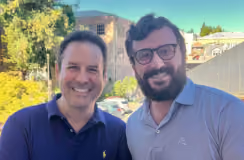
Host: Sam Turner is building a Holdco. It's sort of a roll up in that he's targeting just H Vac businesses and he does intend to exit and realize multiple arbitrage, but he's not looking to integrate the businesses or centralize operations necessarily. So call it what you will, I call it pretty cool. And what's especially cool about Sam's venture is how clear his goals are. He has his number that that is there is a timeline and specific dollar amount or pound amount. In Sam's case, he's British that he's targeting for himself and from this clear goal he's backed into what his Holdco's revenue margins, EBITDA and even exit multiple need to be to reach his number. He shares it all with us. Hint his number starts with two. But this isn't all about cold hard cash for Sam. As you'll hear, he's got a variety of motivations. He left a successful corporate career in his 40s to embark on this journey to buy small businesses and it was not without a lot of reflection, that decision. He took months to understand himself and develop his why, his purpose. So we actually spend the first part of the interview on this decision and only then do we get into the nitty gritty of his search, including all about his first acquisition. He's now about to complete his third, getting a loan without the benefit of the sba, how the businesses he buys are run, and by whom. Why h vac buying big vs buying small and much, much more. Please enjoy this interview with Sam Turner, buyer of H Vac Businesses. Welcome to Acquiring Minds, a PODC about buying businesses. My name is Will Smith. Acquiring an existing business is an awesome opportunity for many entrepreneurs and on this podcast I talk to the people who do it. August Felker is a two time successful searcher, first with a traditional search fund. The second time around he did a self funded search. Today August runs Oberle Risk Strategies, an insurance firm with a dedicated practice group for searchers and acquisition entrepreneurs like you. If you've got a business under loi, Oberle will provide complimentary due diligence on that business's insurance and benefits program. A great no risk way to get to know August and team. They love helping searchers. They've worked with hundreds. Oberle is a specialty insurance brokerage for searchers by a former searcher. Check out oberle-risk.com o b e r l e-risk.com l link in the show Notes Sam Turner thank you for joining me today on Acquiring Minds.
Guest: Thank you for Having me. Good to be here. Been a fan of the show.
Host: Awesome. I love that. Sam, you left a successful corporate career to go out and buy small businesses. Now that is a familiar pattern among my guests. So you are in good company here on Acquiring Minds, but still a highly unusual and adventurous path to take. So we want to hear your story and what you're up to. Also, you're English doing this in England. So many non American listeners and American listeners alike are going to be curious and eager to hear how you finance your acquisition, your acquisitions in an environment where you don't have the sba, which is this great luxury that we have here in the States. So we will spend some time on that. But start us off, Sam, with your background and what it was that led you to want to go out and buy H Vac businesses.
[3:46] Guest: Yes, sure. Thanks. Thanks, Will. And thanks again for having me. So I actually started my career when I left school playing professional football, which is soccer for you guys, but professional football here in the uk. And I say that because I did that for a couple of years. I wasn't in the end good enough. And that taught me sort of a lesson about, you know, I saw my, my friends doing well and I wanted to succeed at something. And I think it was a turning point in my life to be driven by something and really wanting to succeed. And I will say to people, it's not that I have any more capability than anyone else in terms of the career. It's because I probably wanted it more than others for probably that reason. So I left that and I had a career within the tourism or travel industry with some pretty large travel providers or travel players here in Europe. I qualified as an accountant. So I have that, let's say, string to my bow. Did various finance roles. I got to move to Spain. So I spent 10 years living in Spain, which was fantastic. A few months living in Singapore, which was also brilliant. And then the last four years living in Switzerland, which was fantastic. And I moved back here to the UK only 10, 11 months ago. So I was responsible in the end through a number of different roles, but fd CFO roles of what was multi billion dollar or euro, as we were based in Europe, businesses that were part of a listed business, but then it was sold to private equity for considerable sum. We then set about actually acquiring our two largest competitors and integrating three businesses at the same time, which is, which is a challenge. And that's, that's taught me something about what I want to do or what I don't want to do. In terms when it comes to the strategy for the, the group going forward. So I don't have any intention of integrating these businesses together. Partly from my experience of what, what, what happened, which was, which was, which was quite painful, but there is sometimes value to be had. But I think that you can also destroy a lot of value anyway. So through that process, we went from being a 3 billion euro company in terms of sales to about 6 billion. We're combining the three businesses together. It's a pretty big business. But it was through that integration process really, that I decided that I didn't want to stay. I didn't want to spend the rest of my career in the corporate world. And I think that was for probably three reasons. One, I was on a plane every week. So I was living in Switzerland. I had two young children. And being on a plane every week just became not where I wanted to spend my time away from my, my family, my wife and my kids.
[6:45] Host: So you were, you were living in Switzerland, but traveling out of Switzerland or around Switzerland. Okay.
Guest: Yeah. So we, we had a global business. We had offices all over the world and I was responsible for the time, the sort of global commercial functions. And we had close to a couple of thousand people in those functions, but located literally in over 100 countries. And we had offices in, I don't know, something like 60 countries or something like that. So it was a fairly not tedious because it's great to travel, but when you do it for so long and you have actually young ones at home, etc. It becomes tedious, even though initially it seemed to be glamorous. So yes, I was on a plane from Switzerland going to and from different, different places. One of the other sort of factors or two other fact, one was the travel. One was the fact that there was actually a lot of politics in the organization. So there was a lot of pressure to obviously deliver results. We had management consultants all over the place, which added to the sort of tension and discussions with maneuvering and all this kind of stuff. So we had effectively the McKinsey consultants, which, you know, one of the large ones for the best part of two years with us. So the politics I didn't, I didn't enjoy at all. And the last one was for me, probably, probably I didn't agree with the direction of the business in terms of where it was going. And I also felt like I didn't, I wasn't able to make the decision. So I was responsible for or accountable for a large chunk of the P and L, the sales and the margin of the P and L. But I couldn't actually make sort of key decisions with regards to certain things that I wanted to do. And I think that sort of culminated in, for me a period where I really didn't enjoy being in that corporate culture. And I, I really sort of reflected hard on that and thought, you know, I need to, I need to do something else. And thankfully I, I agreed amicable terms to, to leave, which was, which was great. And I still, you know, have a lot of respect for the guys leading that business and still keeping in contact. I then took some time to think, reflect, which I'd never had in my career because you're always kind of running 100 miles an hour to get to the next leg on the corporate ladder, so to speak. And I really took time, probably three to six months, to step back and really think about what it was that I wanted to do, what was my purpose in life. I sort of did a lot of reading, reflection, speaking to different people, and I got some clarity on what it is that I wanted to do. What did I want to achieve, what was my life about and where did I want to spend my time? And it's through that period of time that I decided that I wanted to build a group of companies. But not just for the sake of the financial implications of doing that, which is obviously part of it, but more because I wanted to create a platform for small businesses to prosper and to be actually stronger as being part of that, that platform. I like working with small business. A lot of my clients effectively were small owner managed business. So despite we were a large corporate, we worked closely with small businesses, helping them grow. So I love that aspect. I love growth and looking for ways to grow businesses and I love developing people and management teams. And these are probably my two passions. So it's developing the growth in the business and the growth in the people involved in the business. And I just felt that this ticked all my boxes in terms of flexibility, working when I want to work on my terms, having control, being able to make the decisions and spending time on where I'm investing my time on things that I actually like, like doing.
[10:56] Host: When you spent those three or six months doing the kind of introspection and figuring out how you wanted to spend your life, I wanted to ask you what, what the answer to that process was. What, what was this deep, you know, what was going to be your why or how you wanted to spend. This is the second big chapter of your career.
Guest: Yeah, I mean, what I came up with is almost A purpose. And the purpose is around being able to influence, inspire and empower and help other people. That's kind of, that's the underlying concept. But then I have a number of strands to. Well, how does that look? And it's the different sort of different areas of my life, the most important things. And what does that look like in each of those boxes? And this fits within. It ticks a lot of those boxes in terms of where, where this fits. So, for example, I have the boxes around health and fitness, which is, which is, I think, critical and a fundamental aspect of, for me, being successful. And, you know, if you, if you're, if you're not focused on exercising and whatever, which I don't do enough, but I think, you know, I start to feel less productive, et cetera. So that, that is a kind of a. That's one. But family and friends in terms of being able to spend the time with. With them creating wealth. And for me, creating wealth is not about buying the next yacht or Lamborghini for me. I have a very clear ambition to help a number of people with, with that wealth in a certain sort of place. That's important to me.
[12:39] Host: What do you mean there, Sam? You mean you have a very specific project or a recipient of this, of this future wealth?
Guest: Yeah, so. So I have, in my own mind, or not in my mind, it's clearly, it's clearly written down. I have it all documented in terms of a targeted, let's say, number of people and what I want to do with that in, in. In certain. In a particular country. That's important to me that I spend a lot of time in. And therefore, you know, it's kind of almost like the numbers are worked out also in a way that says, well, I can help this many, many people if I've got this amount of wealth built, if that makes sense. So. Yeah, so. So I guess wealth creation is important, but it's not important for me in the sense of having the latest stuff or even from a legacy for my family or in terms of handing it down, which I'm. I'm not clear about, you know, what's the right thing there or not in terms of kids, but more about, you know, for me, it's very clear about, you know, can I. Can I influence and can I. Can I add and can I contribute significantly in the, in the world? And that's, that's effectively what. What I want to do.
Host: Yeah, you know, it's, it's funny because you're, you're. I assume you, you had A great salary while you were running these divisions within a multi billion, multi billion pound company, excuse me, Euro company, I guess it was a European company. But, but this wealth creation that you're talking about is I guess tied to your latest endeavor, which we're still, haven't started yet, we're going to get into. But you're just talking about it very confidently. You just know you're going to, you just kind of know you're going to build wealth. It's like a foregone conclusion.
Guest: I think so. And I think I even challenged myself to say, am I thinking big enough? And I think that's part of sort of a key aspect is spending time obviously in the right circles with the right people and getting inspired and continually challenging yourself to think, to think big. And it's almost like that for me there's risk in what we do and we'll talk about that in terms of some of the challenges involved in doing it. But I think my honest opinion is what I want to do and the wealth that should come along with that is, I don't see as terribly complex. I, I don't see as, I mean, for me it's relatively simple. It doesn't mean to say it's, it's, it's, it's easy to do, it's, it's hard work, but it's not complicated to do. So I, I can understand very clearly A, B, C, D, E, F, G. And actually that gets delivered. And I, I'm very clear on, well, let's deliver A, let's deliver B, let's deliver C. So yeah, I'm not saying it's going to be a foregone conclusion, but yeah, I feel like that will happen though. And that's my strong belief. Yeah.
[15:32] Host: And that belief or that playbook and that kind of. It's going to be hard, but it's simple to follow as long as you stick to the plan. Is that specifically this entrepreneurial venture that we're talking about, that basically the plan you're talking about, the playbook you're talking about is buying H vac business 1 and 2 and 3 and 4.
Guest: That.
Host: Yeah, they're one of, they're one and the same.
Guest: Yeah, yeah, exactly, exactly. So, so, so what I have, in terms of, I think it's important that people don't talk about money very much, especially here in the uk maybe. I think it's different in the us. I think you're a bit more open with that and I think people are a bit prudish here. To talk about. I have a target to create a net worth of X by why date. And I have a very clear and I don't mind to, to explain to people because for me it's not, it's not about being boastful, it's about almost creating accountability because if I tell my, my wife and my friends or my family or whatever, look, this is what I want to do because that enables me to do this, then, then you know, if I don't deliver that then I've already, I've already communicated that to people. So rather than just well let's hope for the best and see, see where we get. So for me that's just the way, the way I work. I think this, those numbers are then worked back to what do we need to deliver from, from a business case perspective in terms of this and this will would get us pretty much to those numbers in, in that kind of five year kind of timescale that we're, that we're, we're talking about.
Host: And are these, these numbers, these very specific numbers, both your goal and how you get there, Is that something you can share? Not in this moment, but in a few minutes?
Guest: Yeah, I'm happy to kind of give the high level around that. I mean there's no sensitivity. It's my, it's my, it's my view of the world and it's what, what we want to, to do. You know, I've shared that with, with investors clearly because I wanted them to come on board with the journey. I've shared it with lenders and maybe I shouldn't have shared that with lenders. Maybe I should share more conservative view with lenders. But you know, I'll learn from those mistakes. But, but yeah, I'm happy to go into some detail.
Host: Right. Well and it's, it's going to be a, you know, largely American audience here, so nobody's going to blush when we start talking big numbers. But so the, okay, so the actual, so you talked about those three or six months, the process that you went through to arrive at, to arrive at this plan, how this, this plan and this idea of acquiring businesses was going to really hit in that sweet spot of where your skill set lies. But the very concept of buying small businesses is, is, you know, it's not in the air here and I, and I think it's probably even less in the air in the uk at least according to what you told me on our pre call. So, so that is an, as a concept was that where did you get the idea I mean you're probably evaluating other things too, like maybe starting a business from scratch, I don't know. So. So the actual specific idea of buying small businesses, was that your idea? Was it somebody else's? Did you read a book? Talk to me about that.
[18:50] Guest: Yeah, so it's a good point. I think you're right. It's even less so in the uk. I was in Switzerland at the time, but clearly my. Most of my network.
Host: Right.
Guest: So most of my network, I have network around the world but most of my friends and people I talk to would be in the uk so that would be most familiar. And it's not that common. I would say you're right. And lesser in the. So I spent a lot of time researching around things and I was quite big into at one point wanting to do property investing. We have some property investments and it was through the process of looking and researching in the property space that I uncovered some content around buying businesses. And there was several people that were providing content. So I actually consumed a lot of content from, you know, sort of free content. And then I signed up for a few courses as well. Not just the one, I signed up for two or three, I think it was three different programs and so invested in those programs to build my knowledge as much as possible. So it was through there and it was through one of those programs that I got to meet other people as well. And we sort of created a bit of a group together that met every week, a bit like an accountability group that I bizarrely, I'm also facilitating one of those now as a facilitator and I had my first kickoff call today, so that was interesting. Good timing. But. So we had this kind of accountability group on the back of doing this training program. Three or four days of training in terms of the, the tech, more the technical aspects around how to, how to acquire businesses and, and therefore a small number of us actually continue to meet together every week, talk about deals and actually then created the view that we, we would go into some sort of partnership together by helping and supporting each other. So, so that's what we did. We set up a, I would call it a loose partnership and I'll describe exactly how, how it works. But we set up a partnership, we have a brand, a website that is Advantos Equity Partners and what that is effectively is there's five of us, two in the uk, one in Germany, one in Sweden and one in Norway, so kind of European. We're also looking for a US based partner to come on board and what we do is we bring deals and opportunities respectively into that kind of forum and we agree together whether we will go forward individually, whether other people want to invest in that and come on board to do joint ventures etc. So that's the kind of loose partnership framework that still means. So for example, in the UK H vac piece I said well this is what I now want to do. Thankfully, you know, three of the other guys wanted to invest something into that so they are involved from an investment point of view and one of the others is a non executive director on there, on the board effectively in terms of my group. So they're all quite involved in that. And likewise the guys are doing some other deals in mostly software and technology based businesses to be honest, because that's more their background. So we have kind of reciprocal investments in each other's businesses as well as, you know, we share ideas around, you know, raising capital or deal structures or whatever. So that's, that's, that sort of, that, that's effectively how I source the kind of information about, about that and where, where the idea came from and that's how I, how I pursued it. And at the time. Go ahead now at the time I was, I was still in Switzerland so and at this point we, we weren't 100 clear where we were going to live because you know, if things had gone the other way we would have sold my former business. Maybe I wouldn't have needed to do anything because we had investments in, in the company as well as part of the management team. But so we, we weren't sure where we're going to live. So I didn't really act on that for some time until we knew that we were going to come back to the uk. And then I started really doing the search in the UK but, but initially also I wasn't clear on 100% clear on the sector that I wanted to focus on. So I was a little bit scattergun initially.
[23:30] Host: Well, I want to get into how you, how you chose the industry that you did. But first I'm just curious about courses and I, because I'm sure a lot of the audience will be as well because they're probably looking at the, the buffet of courses out there and wondering what they should take. Can you share which courses you took and you know, what you, what you thought of them even?
Guest: Yes. So I'll sort of, I won't talk individually about what I think of each of them because probably that's maybe not, not, not, not fair to sort of play one off versus the other. But I think I did a course which is like a, like a membership group as well afterwards, called the Harbor Club. Yeah, yeah. Jeremy Harbour. I did the Carl Allen course, which is more into the details around leverage, buyouts and how to do LBOs. And there's also a guy in the UK which is probably, maybe on the, on the, on the smaller business side, a guy called Jonathan J. So I did, I did some content and courses with those three. I think on the whole, in hindsight, I probably didn't need to do all three. But I think what, what, what is useful as part of that is the contacts and the network that you get as part of that. I mean, in the sense I've got, you know, partners effectively, that I can. I. I meet with every week, we discuss stuff. I've got someone to talk to about deals. They're investing in my deals, you know, so you build a network. I think that's invaluable because it can be a bit of a lonely. A lonely task. Yeah, so that's, that's great. And obviously some of the content, I mean, for me, a lot of the content, when it comes to looking at how to structure for me then became quite natural. I've done acquisitions in the past as part of my corporate role, so we'd acquired businesses, so I knew how the process was. I knew how to look at numbers and evaluate whether deals make sense or not and those sorts of things. So a lot of the content maybe is less relevant for me, but it depends on where everyone's at. But overall, I think that there is value, if not just because of becoming part of a network and having access to people and contacts and skill sets and expertise that you didn't have before.
[25:44] Host: Yeah, yeah. And so even though your M and A experience from the corporate life, corporate world, I assume the size of those deals was something else altogether. The things that you learned through those deals carried through to these relatively tiny acquisitions that you were.
Guest: Yeah, yeah. I mean, I, I think the basic process, the basic process in terms of the stages, you know, the, the, the heads of terms or loi, you guys would say, you know, the, the DD phase and, and the, the different aspects of components of that in terms of financial, legal, tax, commercial, almost people as well, if you want to, you should do. Should do that. So they've got a. Various stages of the process, the share purchase agreements and, you know, all the. That meaning that's the same, really, in the same broad process. And then how to, how to look at whether deals make sense or not from a Valuation perspective and from a structure perspective, again, there's a lot of learnings that you can take. The principles are the same. Obviously, what's very, very different is the way you source deals is completely different. The negotiation process and the. The importance of actually building relationship, I think, is completely different because you're typically dealing with people that have never gone through the process before. If you're dealing directly with a business owner that wants to sell or is prepared to sell and through the conversation ends up doing that, it's a very different kettle, or a very different, I would say kettle of fish, but that's maybe an English term. Very different scenario. Very different scenario, obviously, than a big corporate transaction where it's 90% about the numbers and the technical aspects.
[27:31] Host: Yeah. The courses that you named. So you learn about buying, first you look at property, real estate, as your path to build wealth and then you learn about buying businesses and that just kind of intrigues you more. And that's also got the people aspect.
Guest: Exactly. I think I kind of had the two side by side and I like to do some of the analysis in a fairly structured way. So I probably. I probably had some kind of scoring mechanism as to what. What. What made more spreadsheets based on. Yeah. What sort of criteria? But I think the people aspect, you know, the people aspect is less relevant in property. I mean, property is. Is great, but it's. It's less. Less dynamic, isn't it? I mean, it's probably less interesting, let's be honest. And I think the upside potential is less. Right. Also, probably the risk is less, to be frank. I think the risk and return in a small business acquisition perspective is much higher. And then it's a case of do you back yourself or don't you? And do you have the skills and do you have the belief in what you can do together with a team and the team that you build to make that a success? And I think there's a certain amount that you've got to back yourself. It's not just going to happen. But I think, yeah, the people component was probably the biggest element and being able to work and develop with people is. Was super important to me.
Host: And then. So you take these. You learn about these courses, you take them. I hadn't heard of the. I'd heard of Harbor. Sorry, the gentleman's name is Jeremy Harbour.
Guest: Yes, Jeremy.
Host: Yeah, Jeremy Harbour. And the overall brand is called Harbor. What?
Guest: Harbor Club.
Host: Harbor Club, yeah. Yeah. That was early in my own foray into this world. That came up a lot. I haven't heard much about it later, probably because that's kind of. Probably has more of an international clientele and orientation. Jeremy Harbour is himself British, but lives in Singapore or something like that. Do I have that right?
Guest: Yeah, he does. He's just moved to Dubai, actually. But. But yeah, yeah, yeah. It is a very international audience and community. So, yeah.
Host: And so here in the States, as as often happens, we just have a kind of a more insular. We have, you know, the common names that are at an American. And the Americans do those. Okay, so how do you arrive at the specific plan? Why H Vac? And. Yeah, so tell us why the H Vac industry and then also tell us about the structure of what you're building and how that plan came together.
[30:10] Guest: Sure. So I think there was two strands to why I landed there. So the first strand is I talked to a number of businesses. I said initially it was quite a scattergun approach. So I got to speak with businesses in very different sectors. So you then get quickly to learn the environments, the sectors a little bit in a bit more detail, the numbers in a bit more detail, the profiles in a bit more detail. So actually, where you think you can add more value in a bit more detail. So I think typically what I found was there was an opportunity, I think, to. To potentially add more value in these types of industries that I think typically are run by. By the engineers that have come up sort of through the ranks that, you know, they were on the tools and now they've come through and they've kind of reached a plateau. And you see that time and time again. And I heard of conversations and I think then having the skills to kind of see how we can grow the business, I think in that concept in these types of businesses was really interesting. The second point was the criteria that I had. So I had criteria around and I wanted to build a group. So it needed to be really a large industry, a fragmented industry, a fairly robust industry. So I didn't want to be in a space where, you know, Google or Amazon could come along tomorrow and completely take your business away. Obviously, I'm not. At the same time, I'm not particularly tech savvy. So whilst I love what technology can do, I'm not very interested in being in the detail of a technology company. And I think to be at the forefront of that, you constantly need to be on the forefront of that because things change so rapidly. So I think that was. I wanted to steer clear of. I wanted to have businesses that were. Had some interesting, I would say macro Trends. And I think this, the H Vac, if you think about what's happening with the climate, the whole climate agenda, the need to be efficient with energy use, the energy prices, all of that, I think, is there's a strong underlying trend to having to have more efficient systems in place. And therefore, for me, I see that as a kind of an overarching macro opportunity, or tailwind, if you like, in terms of that, that space, you've got to be, you've got to do it right and you've got to put the jigsaw together correctly. But I think there's an opportunity there
Host: as well, and that's because you perceive that H Vac technology will be evolving rather rapidly to keep up with more energy efficiency and therefore there will be more spend on new systems, new equipment by consumers.
[33:06] Guest: Absolutely. I think the actual spend in the marketplace will be, will be growing over time. So it might not be a 20% a year growth, but it will be a growing industry because of that macro trend, which is important. I also think there's going to be certain areas of the industry that will benefit more from, for example, government funding or incentives, because governments have a mandate to be whatever the carbon footprint impacts are. And for example, here in the UK, 95% of homes are fitted with a gas boiler. So to heat your homes is gas. But for new homes, that needs to be. The government have already said no new homes from 2025 can have a gas boiler. That's a fundamental shift. For example, now that, that's, that's one thing, but then what about the next thing will be we need to retrofit all existing homes with some more efficient energy, because obviously new homes is only a portion. So there was going to be a lot of money that's coming in to sort of incentivize those things to happen. So how you put the piece of the jigsaw together to be at the forefront of that is, is part of the equation, in part of the overall plan, in terms of how, how we do that. So there's some criteria there. I think the other criteria financially is valuations, because there is so much of fragmentation. You've got this real pyramid that the long tail of this pyramid is super, super long. There's like 38,000 businesses just in the UK H vac industry.
Host: Wow.
Guest: And obviously many of those are very small, therefore you've got this whole huge long tail of businesses, which means the valuations at the, that level in the long tail is super low. And you've got then, then it sort of goes up like that. So there is a natural arbitrage because of that long tail in terms of the pyramids, there is a natural multiple arbitrage opportunity by just putting companies together, not even together, but as part of the same group. Because, you know, multiple multiples increase as risk reduces. And if you've got 10 businesses in a group, even though they're not one business, the risk is obviously less than buying one, one business.
Host: So actually, let me, let me dig into that a little bit, Sam, because this was in our pre call we, we talked about this and it was something that as I was reviewing our, our notes, my notes of our call caught my attention. So yeah, my, and maybe it's just my lack of sophistication, but my understanding of multiple arbitrage is that the reason that that arbitrage exists is because the entrepreneur has assemble these fragmented pieces into something that is, is now more holistic and integrated. So I, I thought the whole, the whole reason for multiple arbitrage or the key, you know, one of the key reasons was that in fact these 10 tiny companies are now one integrated entity earning 10 times the revenue. And so you've got, you know, and with that comes economies of scale and yes, less risk, as you said, but just, you know, kind of synergies and economies of scale. But you clearly, you know, from, from your, from, from your, your bad experiences in corporate are, you know, are kind of anti integration. I don't want to, I don't want to overstate it, but clearly like you've, you've made this decision, you've now referred to it a couple times that you're, you're not huge on integration. It almost killed, you know, it was, it was a really bad experience for you in corporate. And then now in your own, in your own endeavor here, you're not trying to integrate. So anyway, square that circle for me. Why I, you, you don't need to integr. Get to get to optimize your multiple arbitrage.
[36:57] Guest: Sure. So there's a couple of things. Firstly, I think, and just to be clear for anyone listening from my former employer, it's not that I'm saying it was the wrong decision to integrate. It was a painful experience for sure. But the value proposition of those companies was almost identical and therefore actually integrating probably made sense in that, in that context, what I'm trying to do is buy businesses that are complementary, that have slightly different value propositions and therefore it doesn't make sense to, you know, combine those into one hotchpotch of a company providing 100 different services, there's no focus, there's no accountability, there's no, you know, that just for me, that just wouldn't work. Not just because of the experience that I've gone through. But to answer your point around valuation, I think it's an interesting discussion for me. I would put the valuation, the multiple, when we talk about valuation, down to a number of things. The first is risk. So when risk is reduced, multiples increase, which is why obviously people love the recurring revenues, they love the very predictable numbers and where there's a tailwind and there's a management team in place and etc. Etc. So risk is one factor. Now I think if you have a number of businesses in slightly different, with a slightly different value proposition, servicing slightly different customer bases, etc. That's diversification. So number one, you definitely reduce risk by adding businesses despite you're not integrating. So you reduce the risk multiple increases. Number two is demand. So on the demand side, if you look at the number of people that are operating in that pyramid, you've not got, you know, down in that long tail, you've not probably got enough buyers for sellers because there's just so many thousands and thousands of businesses that probably most of them too small, won't sell, will end up closing. Obviously when you get north of probably 1 to 2 million pounds EBITDA, you then start to get interest from institutional players, some small niche private equity, etc, so that increases the demand for those business. So those two factors, you will increase the multiple as a result of those two things alone. The third point I think that impacts is clearly the growth potential in the business. So if you're buying a business that has been flat and has always been flat, and will always be flat, the multiple will be one thing. If you're buying a business that's growing 10% a year and has done that for five years in a row, then the multiple is different because the payback is much quicker. So I think that's where your question around, well, does that make sense to actually have more integration? Because then you can scale more quickly, you can do whatever. I don't know. I think the answer, so I think, I think what we want to do is we want to focus on the platform. The concept is you take businesses, you put them on a platform, you give them the ability to actually enhance their margins. So their EBITDA margins by a number of benefits that we will look for as part of the acquisition. So we will look for is there cross selling opportunities which naturally then can Cross sell into each other's customer base. That's a growth potential. So that's getting the growth without actually putting together. Are there buying opportunities because you're using some of the same suppliers. And actually as a group we can then look at how do we coordinate some of those activities? Yes. Is there expertise that can be leveraged across the group? So we've got, I just mentioned about the more sustainable technologies and that sort of thing. So my idea is we would have an expert or one or two expert companies in the group on different things that then could transfer that knowledge internally into the businesses in order to increase, enhance their ability to raise their performance further. So enhanced value we will create. Now valuation, as you know, is two principal things is the multiple and it's the profit. So what I'm saying is, well, the multiple will naturally increase because of risk and demand. The growth is, I guess, arguable as to whether it's better to integrate or not. But certainly what we can do is influence the EBITDA number as well by enhancing the margins of the businesses in the group. On top of that, I think I would say two things. One is we're not saying that we will not take cost opportunities where it makes sense. So it may make sense over time to have one function that performs a service for other businesses in certain things. It's not to say that everything has to be individual. It's just not the priority. And it will only happen if actually each business agrees that that makes sense to do because they can get it for cheaper, they're incentivized by their P and L and therefore it makes sense. Everyone kind of wins. That's the philosophy that I have. And the other thing is, from a value perspective, it's not like I have a definitive view that I would need. I want to exit the business by then. So yes, the wealth creation aspect is part of it, but it may be that we continue to build this over time, we hold it for longer and we create something. I'm as much interested in creating a platform that is collaborative in nature so people and the businesses can collaborate together. We create a framework to do that. And actually for me that's, that's, that's. I would love to stand back in five years time and say we've got a group that's actually working like that. And, and we've created value for each of those businesses, each of the customers that they serve and each of the suppliers that they serve as well, and the stakeholders around them because of the platform that we put in place. It's not all about the numbers, but for me, obviously the numbers are part of it, but I think there's enough value in what I've described.
[43:05] Host: Yeah, what a vision. That's great. Now, Sam, in the States, H Vac is. It's almost. I mean, it's really hot right now. There's a lot of activity there. There are a lot of searchers looking to buy H vac businesses. There's a lot of private equity looking to already active in H Vac. So it's quite competitive. It's of the kind of. Its cohort of kind of blue collar businesses, electrical, plumbing, that's kind of. It's kind of often in that same basket. It appears to be the hottest by far, actually. So anyway, is it not or, you know, is it not super competitive to buy an H Vac business in the uk? Are there other people out there like you doing this or bigger outfits, private equity outfits doing this?
Guest: So I think it's not as hot as the US and I say that because of all the content that I listen to, consume, people talk to, etc. I hear that a lot in the US. I don't hear it so much. It's not that there aren't people, because part of my network, I know that there are other people in that space, but I come back to, well, it depends where you're looking, isn't it? So if you're looking at maybe this, the kind of sweet spot which is here, before you get into here, in terms of where the, where the pyramid is, I think that that is not, is not, is not a seller's market still, and therefore the buyer still has some strong leverage in that scope because there is just isn't. You know, I think if you go past, for me, if you go past a million of EBIT or ebitda, it's probably where the demand is a little bit more and maybe the value starts to creep up and therefore it starts to become a little bit more expensive. But then, hence the multiple arbitrage piece that's talked about before. So the three businesses that. Let's assume that we close the one next week, fingers crossed, the three businesses will be about £15 million in revenue and about 1.4, £1.5 million in EBITDA. So that's an average of just under half a million pounds each in terms of EBITDA for the business. So from a typical, I guess, searcher point of view, that's probably on the small side in terms of the individual business and therefore maybe at that 1 million plus is you're going to get more of that. But I think that's at that level. There's not a huge amount of demand given the number of businesses there are at that level.
[46:09] Host: I'm sorry, at the smaller level.
Guest: At the smaller level.
Host: Yeah, yeah, yeah. Okay. Yeah.
Guest: Basically I, I think this, the sweet spot, I think is, is between half a million and a million of, of ebitda, I think is the, is the sweet spot for, for me and what, what we would look at, I mean I would look bigger, I typically won't look smaller now because I think it's just perhaps not worth the effort because the process is largely the same. It's actually more difficult to finance smaller deals, as you'll probably know. And therefore I think sub half a million I think becomes less interesting. But if you went sub half a million, I mean probably the value is even cheaper.
Host: But in fact your first acquisition was sub half a million. And we're just about to get into that. The audience is saying, come on, get to the. Can we hear the story for Pete's sake. But just want to comment that on the sweet spot that you just described. Half a million to a million and ebitda, that's exactly what we say here. Maybe a little bit more than half a million, 6, 700 to a million is kind of the sweet spot that people talk about here for a self funded searcher. Okay. I thought there was something else on H Vac that I wanted to ask you about. All right, maybe not. It may. Or maybe it'll come to me. So let's get into your first acquisition. So you started actually, if you don't mind. Sam, tell people how old you are.
Guest: 44.
Host: 44, okay. And you set out on your acquisition, like started searching like officially seriously, in December. No, that was when you made the acquisition.
Guest: That's when we made the acquisition. It took about four and a half months and it was probably, you know, four months or so prior to that in terms of searching. Four or five months. So yeah. So what is that? Six, four or. Yeah, about 15 months or so in 15, 16 months ago that you started.
[48:24] Host: Okay, yeah. And so, so about eight months of searching.
Guest: Yeah, search plus the, plus the deal process before, before closing. Yeah. And about seven months post completion. Yeah.
Host: Great. And so you acquired this first business in December 2021. And so. Okay, so now let's get into it. If you would share, share the size of the business, the EBITDA of the business, the terms of the deal, if you would. And then, yeah, and, and well, I'll just say at the outset here. So, so I, I know that the, the ebitda was about 350 and you, we, we, we just heard you say that you wouldn't buy less than half a million now in ebitda. But, but you know, just looking ahead to our conversation, what I would say on that is like it did get you in the game and I think that there's value, a lot of value in that because now you've got two other acquisitions that have happened in short order and now you're looking at, if assuming this third deal closes, you're looking at one year at EBITDA, 1.4 million. So in, in the content that you may have consumed. And here in the States there's often this debate for searchers about you know, buy big or buy small. Despite what I just said about the sweet spot being 750 to a million or 600 to a million, there are still those who say just, just don't over play that in. Some, some people would argue it's more important to just get in the game because if nothing else that, that, that really unlocks deal flow often. So if you find a business doing for 400 EBITDA, consider it, there's value in just getting in the game. So with all that, please, please tell us about your first acquisition.
Guest: Yeah, so, and I, I'll, I'd like to respond to that. So if I, if I don't respond then remind me on the, on those, on those points. So I actually, I actually found, so I was looking in, in different places, talking to brokers, contacting businesses directly. This lead actually came through a contact on Search Funder actually on the platform. So that was interesting because I was kind of registered there. It wasn't registered with a broker but with an accountant who was the company's accountant. The process. So the business is actually, there's all the heating and plumbing elements of new build residential homes. So when you get like large developments of 100 homes, 200 homes, etc, so they're fairly large scale contracts. That's the kind of core of what the business does. It's kind of, it's not a consumer based business, it's working for big, large developers effectively. Yeah. And the, the, the conversation was quite reasonable I think in terms of expectations. There was a little bit of back and forth around where we ended up. The business was about 5 million pounds turnover, business about 350 in terms of EBITDA. So it's probably average margins, if not maybe a bit on the low side for the industry, but not far from average. We agreed in the end we had a couple of goes at the structure because the numbers changed halfway through. And we renegotiated a little bit of the deal where I agreed to pay a little bit less if I paid a little bit more upfront. So in the end we settled on a multiple of, I think it was 3, exactly 3x of the underlying EBITDA that we sort of went through a process of understanding what the underlying EBITDA was. So we, we structured that in a, I think it was 2/3 upfront and 1/3 that was then deferred over a 3, 3 year period. And that's typically the kind of structure, 3 or 4 years that we would look, look to sort of annual equal installments in terms of those, those numbers. The way, the way we financed that is we had, as I said, I had some people I was working with that were also investing a little bit. I also had some other contacts that were, that I approached in terms of investment who, who are willing to pledge also some capital for the next sort of two or three deals which they have done in terms of where we've got to for these three. And so we put down, you know, an equity element. I can't remember the exact numbers, but it was probably close to 20% of the, of the, of the value in equity obviously then the sum deferred and the rest. We got a cash flow lend from an alternative lender here in the UK and you touched on it earlier. It's quite complicated to do that. You can typically have the asset based lenders but in these types of businesses there's not a lot of assets. The only assets they have really is the debtor book. I didn't really want to go down that path because you start messing around with impacting customers and who the customers pay and actually it's quite expensive. When you work it through, it's a little bit more complex. So I opted for, I had a couple of options but I opted for a lender that was willing to give a cash flow lend. But the term of those is nothing like what you get in the US we dream about those terms and there's those deals. So you know, you could, you're paying considerably more from an interest perspective. And the term is over five years and it's amortized, it's typically one year capital repayment free. So interest only for one year, which gives you a little bit of breathing space and to build the, the cash number and then the rest amortized over the, over the four years. So that's, that's what we did. And the agreement with that lender was also, they were, they were interested in the, the buy and build approach and the project plan and actually that particular acquisition was below the minimum threshold for them. So they, they, you know, they actually sort of, we had a, we had a credit approved amount, let's say, of double what we used for the first business, always with the intention of doing more going, going forward. So that's how we, that's how we finance the first deal and that's what the structure looked like. I would say the other two deals are not dissimilar to that in terms of multiples and therefore for me, at that kind of level, the half a million ish kind of level is you're looking at probably a 3x EBITDA number and you'll typically have to put in not in all cases, there are more creative structures, I understand, than people have done without, you know, putting it in equity at all. I just think it's much, much harder to do and, and also it's more risky. Obviously you have more leverage in the, in the business. So, so that, those, that kind of, that structure is kind of typical for the other two deals that we've got. So all on similar structures, working with the, with the same, the same lender. Although that's been a bit painful, the process is a bit painful but, and yeah, hopefully we'll get the third one across the line next week.
[56:02] Host: Sam so a couple differences with what my audience, my American audience might be used to hearing on the, in terms of the deal, the, on the terms of the deal, the seller note one thing, so you said about a Third, so a 33% seller note, whereas in the States it's typically going to be 5, 10, 15% is more, is more common, maybe maybe 20%. And so the, and then yeah, of course, as you said, the amortization. So with that shorter amortization schedule, then your debt burden is going to be much heavier. On the other, on the other hand, you're financing much less, it's much less leverage. So if there was, if it was 20 equity 33% to your seller notes, that's 53%. So roughly 47% of the deals is coming from the bank. So that's a, that's a smaller sum. So I guess that kind of cancels out the fact that you have a more aggressive amortization schedule and you end up with a debt burden that maybe is kind of similar to what a US searcher would experience would you say,
[57:11] Guest: well, well, you still got the challenge that you've got debt either way. So you've got debt either from, from a seller note perspective or from a bank perspective. So in reality what it does do is it makes the numbers tighter obviously with it with a, with a 10 year amortization and an interest that's you know, 4 or 5% or whatever it is that you, you, you guys will have access to. That makes it far easier to meet the debt service cover ratios which effectively is the key ratios that the lenders will look at. It makes it far easier. Not only it makes it far easier, it gives you more flexibility about the price that you pay. I'm not saying that you want to pay more but for example, it just simply doesn't work to pay more than. So even if we had a great business that was a million EBITDA that had everything right with it and it was clearly worth more than 3x, you probably couldn't pay more than 4x because the numbers just simply wouldn't work from a debt coverage perspective. Clearly that's when the private equity guys and trade buyers etc are more interested in that and they can afford to pay a bit more and therefore maybe you get a bit priced out at that level because it just simply doesn't work. So yeah, I mean it's a tighter remit to work with to make those numbers work and there are, you know, the lenders in the UK so really I think it's a disappointing set of alternatives and options for people in the UK and I think, you know, the government should, here, should, should look at, look at that because I think as a result of that I think we'll end up having a lot of businesses that just have got nowhere to go because there's just not enough options to do. And one of the reasons, and coming back to one of the points you said about buy big or small. Yeah I think is a great, it's a great point. It's a great question is yeah, actually I don't mind buying a slightly smaller for the first one because it's the first one and actually I want to do 2, 3, 4, 5, 6, 7, 10, etc. So really it doesn't, doesn't matter so much. And you're absolutely right, it gets you in the door, gets you in the game and things become infinitely easier as a result. Both lending conversations, investor conversations, conversations with sellers because you're credible, you've got a business in this space, just changes the dynamic. So you're absolutely right. On the flip side, if this was going to be your only business, then maybe I would hold out for a bit for a bigger business, if that makes sense because the process is still the same and it's obviously going to take you longer to grow. And the other thing is it typically is more difficult to finance. So actually I'm surprised in the end that I managed to get that one through because. And now I see that the debt markets tightening a little bit given where inflation is going and everything else and the risk appetite is reducing. I think getting anything done that sub 400,000 EBITDA is more challenging from a lender perspective. They just don't want to know.
[1:00:34] Host: Sam, give us just for other English British listeners and maybe European listeners who again non SBA buyers, a bit of the lay of the land. So as I, as I recall there weren't many lenders like you that you could find that understood the buy then bill model in the uk. So just finding, finding somebody, yes, you found a bank to do it, but like it was hard. First of all, do you want to give that bank a shout out just because maybe save some people, seriously, save some people some time. Like if it took you looking under a lot of rocks.
Guest: Well, what I would say is contact you people. Contact me. Because ordinarily I would say yes, but the experience over the recent weeks has not been what I would have expected and hoped and therefore I don't want to plug something that for me the moment is not perfect, albeit I was very happy with the first process. I think the challenge now, as I said, is in recent weeks the inflation's gone through the roof. Our first business has had some, some implications of that because the nature of the business model, it had a lot of fixed price contracts with its customers, therefore margins have been squeezed. It's still profitable, but it's not profitable where we wanted it to be. So, you know, we've explained all of that and it's kind of understood, but that's put some more concern, let's say, behind future deals. Even though we're changing the, the focus on the business model a little bit to be less risky from that perspective, I think the risk appetite is reduced. We were also moving between one fund and another fund in terms of where the money was coming from. That gave some complications. There's a whole host of external circumstances that meant actually the process has been far more painful this time. But I would say yeah, if anyone wants to contact me, I'm happy to kind of then talk them through that. But I think it's probably not appropriate for me at the moment to kind of plug something that I'm still waiting for the final outcome of.
Host: Yep, fair enough. Okay. The, one of the other things that struck strikes me about this, this first business that you acquired is that it's new construction versus maintenance. So one of the things here that is often talked about in these types of business, home services businesses or business like deal with the hardware of the home is is it construction? And, and obviously maintenance is what you kind of what you want because there's, it might not be recurring but it's reoccurring and so on. So is you, you have, you're nodding your head. Obviously you under, you understood that dichotomy, but you still went for a new construction. Like more of the revenue comes from new construction. Was there any. Did you need to get comfortable with that? Did you need to get your lender comfortable with that? Was that a question? Did you tell yourself, well, you know, this is only my first acquisition, so subsequent acquisitions I'll be more focused on getting a maintenance, a maintenance heavy business sort of thing. What was your thought there?
[1:03:31] Guest: Yeah, it's a great, great question. I think a couple of things. Firstly, I knew that this was my first and it wasn't going to be my only. So when it comes to looking at the entire portfolio, you're going to have a bigger, more sort of recurring contractual maintenance components. Secondly, what this business had for the good and now actually almost then it's kind of come back to bite me to a certain extent is it had some certainty of revenue because the contracts they had, you know, most of them spanned the next 12, 18 months. So, you know, we could predict quite easily that the next 12 months, 18 months revenue, we've already got, we've got a contract for that. So there's very little risk in delivering the next 12, 18 months, if that makes sense. Yeah, so that was, that was got me comfortable and everyone comfortable that, you know, you had a good pipeline of business that was already committed and you've got a bunch of tenders that are out there as well. So, you know, we feel quite comfortable. The issue is the way that it works in new build construction is typically you're looking at, you know, having to fix the prices that you, you give, which is fine in a normal environment. And over the last 10 years hasn't really been an issue. Literally the last 15 months has seen inflation go through the roof on materials especially, which has meant that we've had to kind of pedal quite quickly to Renegotiate some of those contracts and to make sure we're doing everything from a supplier based point of view and those sorts of things. But that's why I got comfortable because we had predictability of revenue at least for a window in advance. And secondly that I knew that yes, we could also build out as part of the group the maintenance component. What we also want to do with this first business is actually grow the consumer side of the business, which is a lot more maintenance driven because it has the infrastructure to build off. It's about 5, 6, 7% of the business today. And we believe that that can be 25% of the business in a few years. So that again will naturally de. Risk. The other point is obviously the, the price that you pay is dependent. If you've got a business that is, you know, is, is 100% maintenance that's got, you know, recurring or reoccurring revenue, then the price tag is going to be probably a little bit higher.
Host: Yeah, sure. Great. Thank you for that. We are, we're, we're going a little long here, Sam, but I have a few more important questions I want to ask you. One is circling back to your, the overall structure of what you're building. You are not an owner operator. You're assembling these businesses. And so are the sellers who I presume are oftentimes the founders. Are they staying in the business as general managers? And you're. Yeah. So what's that look like?
[1:06:28] Guest: No, it's a, it's a combination. But again it's another sort of great point. I mean these are, these are, these are the kind of crux questions. Right. So in two of the businesses the owner will leave and the, the number two employ, that's kind of the natural number two in those businesses will step up. And in first case has already stepped up to be md. In the other case which was the one we closed last week, a couple of weeks ago, the owner is staying. So he just wants it to be in an environment where it could help him scale the business and grow the business going forward as part of that deal. Obviously part of the future component or the, the deferred component we have as, as an earn out. So performance based in, in the, in the other two we don't. If the seller is, is leaving. So there's that kind of difference, I guess nuance. But yeah, what we look for is either one of those two options. Either there's a very clear number two that actually naturally can step up or the, the, the, the, the, the Seller is, Is wanting to continue in the business and wants to maybe play a bigger role in the group.
Host: And in the cases where the number two is going to step up, is that negotiated and agreed upon before the transaction occurs? I mean, do you. Because, because you, you, you, Sam, have to get comfortable with that number to yourself as part of your due diligence, you know.
Guest: Yeah, it's a trick. It's a really tricky one because in the first case, obviously from a seller point of view, they're in a tricky situation as well because they can't bring other people on board because if the deal doesn't happen, then that puts them. Jeopardizes their own position and contradicts their own authority, if you like, because people then understand that they're going to sell. So it's a very difficult balance. And in that case, we left it very late to get that contact with the number two. So we took a bit of a risk there, to be honest, and we got, obviously we got the cv, we've got the background and, and, but yeah, it was two weeks before the deal completed that we actually got to speak to, to the, to the number two. So that was a bit. But it turns out for me, I think there's a great opportunity with him to. And to develop him as well. And I think he's doing a great job stepping up. So, so that's, that's worked out well in the other business where the number two is stepping up. The. The owner brought him on into the picture quite early in the process and therefore we've, we've met, we've discussed, we've kind of talked, you know, we've been able to have that dialogue through the, through the process. Yeah.
[1:09:11] Host: I mean, I imagine for these number twos, it's really big news. I mean, a common theme with, in this world is that the team that you're acquiring, just the change in ownership can feel very disruptive and, and unsettling to the larger team, just the change in ownership. But for these number twos, they're, they're, they're, they're not only getting a new boss, they're getting the promotion of their lives all at once. And you were. And you worry that a number two might say, look, I don't want to, you know, they might just say, thank you. No, I just don't want to be. I don't want that level of responsibility, even though it represents progress in my career.
Guest: Yeah. And I think it's really a critical one to navigate carefully that aspect. And I think when we start to build out the group a little bit more. So for example, I'm in the process now of recruiting a CFO from a group perspective because it just makes sense with now three looking at more to actually have that. But part of their role will be to go and spend time with each of the businesses helping them to improve the way they govern the, the business, the information they have in the business, etc, so as to kind of help help bring up. And also going forward we'll have, you know, maybe one or two other roles at a group level that can really be supporting the businesses. But at the moment, yeah, for me, for example, big part of my emphasis will be really supporting those people. Now I'm not an industry expert so they've got the expertise typically when it comes to the industry, but actually they're stepping up from a more junior role to a more senior role which has implications. Right. So I think to be really close to them through that process. We're looking at how we can build a program around developing the MDs and all them have sort of some external development and coaching etc running, running the businesses. We're also looking to implement probably an operating system so we'll work on the same basis in terms of, I don't know if you've heard of the. Whether we choose this or not to be seen, but the EOS system so, so that, that is something that we're looking at closely and probably will go with I think which will be really helpful because we'll probably have some facilitation with that. So it'll be helpful for those guys also to give them the framework to help them to manage because typically the frameworks in this business around even having a very clear strategy to how you manage performance just isn't really there. And how do we know whether we're doing a good job each week? It's very through feeling versus any kind of data metrics who's accountable for all these things that can I think be developed. So yeah, a lot of careful support and development and investment in those people I think is required and not to be underestimated. And I think that's probably something I did underestimate and something that now we're trying to make sure that we're focusing on providing that support.
[1:12:17] Host: Well, although on the other hand, one of the big boxes you wanted to check with this whole pivot in your career was to develop people. And so, and so I guess since you were insulated from the teams, because you're sitting, you know, at corporate, if you will above really, really the end of. The only individuals that you'll interact with directly on any sort of regular basis will be. These will be the, what did you call them? The MDs or what we would call them here, the general managers. And, and so those are the people that Sam is going to be developing. That's scratching that itch of you wanting to develop people.
Guest: Yes, but, but also I think there's for example the, the typically the finance managers, the people managing that function in a business, because I'm naturally that way. I spend, tend to spend a lot of time with them as well already so helping, helping them as well. So I would say it was not just the general manager. So we'll be a little bit more involved and I'll sit in the management, management meetings every week with the, with, with the general manager and his team. Oh. So you know, I'll be, I'll be a little bit involved in helping them more through transition as we kind of set the new kind of structure, frameworks and stuff in place. And because obviously the first business has had some challenges from a margin erosion perspective, it's then being called me to sort of be more and more involved, I would say week to week operationally to support what do we need to do to turn the corner and actually deliver the right set of actions to this. So yeah, it's a bit of a hybrid at the moment. I think going forward it will be more general manager only but at the moment it will be a little bit more hands on. So I will be at the moment, for example, probably one day a week in each business, the three businesses for the coming couple of months at least, whilst also looking for the next ones.
Host: So these businesses then are all geographically close to you?
Guest: Yeah, all within an hour and a half, hour and 45 minutes, something like that.
Host: And where do you live?
Guest: Just north of London.
Host: Okay, one question then we're going to wrap up here about the culture, cultural fit between somebody buying a business and a blue collar business and then, and then the team that operates at that business. Oftentimes it's kind of a white collar person, you know, somebody from, with a financial or corporate background buying a blue collar business. And there can be, there can be, you know, difference of culture there to, to say the least. You know, the uk, I mean I've heard, I've heard English people themselves say this isn't my American stereotyping, the Brits, but I've heard English people themselves say that the, you know, kind of class still plays a, a greater role in the UK than, than maybe other places. So it's like that those strata are more felt among people than, than in other places. Correct me if that stereotype is totally off. But so that would just kind of make more pronounced the difference between white and blue collar folks. Anything you want to, anything you want to say to all that? Anything to say?
[1:15:35] Guest: Well, I think it's a point to be, it's another point in terms of for me the difference between actually somebody and no disrespect to somebody that's to going that's, you know, come out of business school, done their MBA, read all, got all the theory, got all the PowerPoint decks ready to go. The difference between somebody like that and somebody perhaps like me who's had, you know, years of experience of leading, managing large teams, of actually going to the ground, being on the ground with people and actually being able to span that difference, like I said to you before is yes, I understand the corporate stuff and what, what needs to happen, big picture and you know, all of that, but I'm also humble enough to actually roll the sleeves up and say right, how the hell do we get out of this and actually be on, be on the front line. And I think, you know, that for me would be a watch out because I, I see even my, even in my corporate life I see people coming in fresh, think they know everything and it's like you have no effing clue how the reality works. I mean you just don't. And I think sometimes you have to have the experience to know and have, also have the credibility. So if people know that you've done X, Y and Z, you're so much more credible. And I think there is a big watch out I would say for people and coming in from that, not a lot of experience going into that blue collar environment or any environment really in terms of managing leading people teams. P Ls the reality is not all, you know, is not all roses. You know, it's, it's, it's tough sometimes, it's difficult sometimes, you know, the PowerPoint goes out the window. It's about actually you're dealing with local emotions with people which is very, and in small businesses is, can be quite rife and it's very different to corporate culture in that regard. And you have to be quite careful about, you know, what you say and how you say it and all those things. And the emphasis on you know, just team and bringing people on the same page is, is really, really important. And that's not, I don't think that's taught to you necessarily at business school and doing that stuff. And I think there's a big watch out. And I would be hesitant for somebody to come in that hasn't got real life experience and say, there you go, drop you into that. I mean, I'm not saying it can't be done. Clearly it has been done time and time again. But for me, I would just imagine it in one of the businesses that we have and the pushback would be enormous. Yeah. So I guess it's a watch out for people and try and be humble. Try and be on the same page. Try and understand, try not to impose. We need to do this from day one, at least in my mind. You know, the first weeks are around learning and understanding and not about right. You're doing this wrong and that wrong. I mean, it's like, yeah, you probably can see they're doing this wrong and that wrong, but you have to bite your tongue. So is that experience, I think, is really important and I think, think giving that some, some, some really intentional thought. If you are in that camp of not a lot of experience going into, to own a business, place an emphasis on that and get some support on that. I would say.
[1:18:42] Host: Yeah, yeah, yeah. I mean, at least two of my guests have said six months that they, they won't touch anything. They won't make any recommendation. Just six months. They're students and. Yeah, and, and one of the other points I'll just make here that my guests have made, and I'm just repeating is, is that often when business that you've acquired that you think is wrong, you learn maybe two months later, oh, that's why it was done that way. There was a re. There was a method to the madness. Good thing I didn't try to correct it because I would have been wrong to try to correct it because it wasn't correct. I was, I was. My interpretation was incorrect.
Guest: Yeah, yeah, I think that's right. I think six months is, is depends on the circumstance. I mean, sometimes maybe you, you can do it much quicker than that, but give yourself some time. I think is the best, is the point.
Host: Yeah, yeah. Sam, last question. I want to circle back all the way back to what you, what we talked about in your own plan to build wealth for yourself. And like, you, you know, and you, you have a certain number, you know, that, you know, x number equals helping Y people. So can you add some more color to that and, and numbers behind that and we'll, and we'll close out with this.
Guest: Yes. So, so, so what What I want to have from this venture is, is a £20 million.
Host: I love it.
Guest: £20 million exit. And I say exit, but more exit. That's for me. So in terms of now I have investors involved, so I don't have 100 of the equity. I have the majority of the equity. But the way that plays out is to build the group to about 60 million in revenue. This is pound 60 million revenue and, and about 10% EBITDA margin to 6 million. And selling it just under 6 is the business case. I think we've got so 5, 5.7 or something like that. In terms of multiple, you know, we're buying at three, three and a half is what the business case suggests. So that, you know, plus the fact that you've got then the investors obviously to get the return that we promised, plus whatever debts left over, et cetera, would get you to the 20 in terms of the, the exit. So that's, that's what we're trying to aim for.
Host: And that is within five years. I recognize that maybe that's not super specific, but is that at least a rough timeline?
[1:21:04] Guest: Yeah, the business plan. And the business plan is 26. Yeah. So it's actually, that's four years from now, effectively. So we were supposed to be at 22 million, for example, at the end of this calendar year, December. So that means one or two more businesses this year. So it's very sort of clearly stepped up. So the next two years really focus on acquisition and then a year or two, 18 months of really sort of bedding down and actually helping, you know, develop all of those benefits across the group that I talked about earlier.
Host: And really, I mean, you, you can, you can do such an accelerated acquisition plan because you're not doing much in these businesses. I mean, yeah, you're trying to improve them and many of the things we, that we talked about, but, but you're not. Because there's not this big integration process that's happening with all of these. Like you buy them and you just let them continue on with it with, you know, with the improvements that you put in place and the learning and the education, all that good stuff. But there's not. They're not really disruptive. They can kind of, these acquisitions being acquired for these businesses is not really that disruptive. They can continue on their merry way.
Guest: It's, it's incremental, isn't it? So it's incremental. So yes, we're going to do, we're going to sort of provide an operating system, whether it's a EOS or something that helps businesses on the same page, creative vision, create a clear scorecard, create clear accountability charts, create clear governance and frequency and all that kind of stuff. That's just good management in terms of a small, small business. Yes, we're going to help in terms of the collaboration across the group and how, how, how we put that together. Yes, we're going to help in terms of some of the strategic skills, financial skills that we'll have at the group level. And yes, there might be some savings that we can do along the way in terms of operating things once on behalf of the group. But apart from that, the core of the business will be borne out depending on the strategy that we develop together with the MDs or the general managers of the business. And it will be like you say, it will be more, a little bit more incremental as opposed to transformative in terms of each individual business.
Host: Yep. The twenty million dollar number, how did you arrive at that number? Why is that your goal?
Guest: It's pounds, not dollars. Although there's not.
Host: Sorry, right.
Guest: Not so much difference these days. Yeah, £20 million. I mean, I've got some calculations behind, but I think it stemmed from the amounts that, the quickness of the amount that I want to deploy into these vehicles around philanthropic elements alongside the amount that I would still need to create or have some wealth to live and whatever else. So I've got some calculations around that and what I think we can do with that. Now listen, that might change. We might decide that this is going so well and we're thinking too small and we should be looking at bigger and we should be looking at this and maybe that changes. But that for me is, is probably a year old now in terms of that, that set of numbers. Great.
[1:24:15] Host: Thank you for sharing this. I love the transparency. And Sam, do you, this is a leading question. Do you wish you had done started doing this 10 years ago?
Guest: Yes, yes I do. Although I would say probably not before 10 years ago. So maybe, maybe, maybe five years ago would have been optimal. And the reason I say that is because the experience for me in traveling around the world, in all the different experiences, regardless of the fact that I didn't enjoy the last few years, the experience and what I learned from all of that, I think was invaluable. And I think just the traveling aspect, when you think back about all the places I've managed to be and spend time with and see and is phenomenal. And I wouldn't take that back. So maybe a few years earlier, because I think then we could have done even more. But I don't disregard the value that I've had, and I'm very thankful for that in terms of the career that I've had as well.
Host: Yeah. Yeah. It does sound like a phenomenal experience to have had such a global experience for those years.
Guest: Yeah.
Host: Sam, what a conversation. Thank you. This was great. Really cool to hear from somebody across the pond doing things slightly differently, but many things are the same. Just really refreshing and cool to hear what you're doing.
Guest: Great to be on and thanks for having me, Will. Thank you.
Host: Yeah. Great. Well, we'll have to have you back and see how the progress is going. Thanks, Sam.
Guest: Good stuff. Thank you.





































































%20-%20thumbnail.avif)





%20-%20thumbnail.avif)


%20-%20thumbnail.avif)

.avif)




%20-%20thumbnail.avif)