Host: Today's guest had had a long career in corporate an aerospace engineer at Boeing who eventually became a manager and after that, a strategist. Mike Day ultimately decided it was time to step off that trek. The decision came during COVID and as you'll hear, there were a number of factors. But in some ways, Mike's story fits a familiar pattern. He realized he didn't want the life that those ahead of him on the corporate ladder had, and at the same time, he just craved more freedom. Enter Entrepreneurship through Acquisition Today Mike has owned American Spray Technologies for over three years. AST is a manufacturer of texture spray machines used in new home construction that does north of $4 million a year in sales. One of my favorite themes of this interview with Mike is risk. How he thinks about it. How he mitigates it with real estate. How he correlates it with the price of a business. Also, listen toward the end where Mike helped me do my job. Coming to the interview with a few key learnings from his journey that he wanted to share with all of you. We cover a lot of topics here, big and small. Enjoy this interview with Mike Day, owner of Astronomy Foreign. Welcome to Acquiring Minds, a podcast about buying businesses. My name is Will Smith. Acquiring an existing business is an awesome opportunity for many entrepreneurs, and on this podcast I talk to the people who do it. An SBA loan broker, as opposed to a direct lender, doesn't work for a particular bank. Instead, the broker pairs you with the right SBA lender for your deal based on industry terms, risk thresholds, then helps you navigate the process better than many lenders themselves do. Matthias Smith of Pioneer Capital Advisory is just such a broker. Matthias worked at two of the country's top 10 SBA lenders. So so he's been on the inside of the SBA process and knows well the pitfalls and hurdles and how to avoid them. He struck out on his own to laser focus on the ETA and search space. Our niche is his niche. You'll see Mathias at all the ETA conferences. He's closed over 30 search deals since starting Pioneer in May of 2022, including some acquiring Minds guests. To learn more and get in touch, go to PioneerCapitalAdvisory.com or click the link in the notes. Mike Day welcome to Acquiring Minds.
Guest: Thank you Will. Happy to be here, Mike.
Host: After a career in corporate first as an engineer, later as a manager, you decided to step off that track and into ownership by what else? Buying a business. We want to hear the story. Please start us off with some background on you Mike.
[3:12] Guest: Sure. And just, and thanks again for having me, Will. I really appreciate this program. Great. Okay, so I grew up in the Houston area. Pretty nerdy kid. I always liked Legos and tearing apart toys and things like that. So I was always kind of mechanically minded and math oriented. And so as I grew up I decided engineering was the right field for me. I also was a real aviation nutrition. Um, my dad is a retired helicopter pilot and we would go flying in small airplanes. And so I definitely wanted a career in aviation. And so aerospace engineering seemed like a great path for that, maybe professional piloting, something like that, but, but aerospace engineering was what I ultimately decided. So I went to University of Colorado in Boulder and got an aerospace engineering degree and then was hired right out of school by Boeing. So got to move to Seattle, which is where I still live. So spent my entire post college life here in Seattle and worked for Boeing and basically what was my dream job at the time, designing the cockpit, designing the flight instruments for the pilots on the Boeing commercial airplanes. So super exciting dream job as you
Host: said, for a kid who is engineering, math minded, aviation minded, first job out of school, designing cockpits. I mean it really is. Yeah. I mean just to repeat what you said, it really does seem like a dream. Go ahead.
Guest: Yeah, and so that was, that was great. Although you know, aerospace is a very cyclical industry and so after two and a half years or so they went through a downturn and I and a lot of the young engineers that were hired got layoff notices, some were laid off, some were found other positions. But while when that happened I went and found another job in the Seattle area in the industry from a mid sized company that makes airplane electronics, avionics systems. And that was a pretty formative experience for me in the sense that I knew that the big company wasn't necessarily always going to protect me. So I, you know, I knew that this couldn't always last potentially. And working for the mid sized company was really great. I grew a lot there. I spent about six years there. But then I felt that I had topped out in the small company because it had a very flat management structure, great people and great products. But I wanted more. And so I went back to Boeing. I'd maintained my connections and they were starting an exciting new program called the 787 at the time. And so I went back and again had a wonderful multi year experience there, in total about 16 years with Boeing between my two stints. And so in my longer stint went back to the cockpit design and then matriculated up through management layers, managing engineering teams, developing new products, and then ended up transitioning into corporate strategy after a few years because I became more interested in the broader business. The engineering work, while exciting, was kind of the same thing over and over again. And I just became more interested in the business side of things, so ended up becoming a corporate strategist, working on some M and A and product development and things like that. And so while in that job, in order to grow, they recommended my, my mentors recommended that I get an mba, which is something that I never wanted to do before. I, I felt like after aerospace engineering degree I was done with, with school. That was hard enough, but by then I was interested enough in the growth that, that I wanted to get an mba. So I did a, a hybrid program offered by Rice University in Houston where you work full time and then you're attending mostly online, but some on campus weekend activities. And, and so while doing the mba, I was introduced to the idea of search and eta.
[7:29] Host: And that's where, why did it resonate? You see, it seems like you were doing great at Boeing and 16 years. On the one hand one might say well yeah, time for a change. On the other one might say, well if you were somebody who didn't like that environment, you probably would have stepped off it much sooner. So what was it?
Guest: Yeah, so there was a confluence of events. I started school January of 2019. This is my second year of school, was during COVID and then the company was going through struggles. It's been beaten up a lot the last few years. At that time we had the 737 Max crisis. We were dealing with the industry then downturned during COVID and the outlook just wasn't great. Still great people working on great projects, but the long term outlook had dimmed. And the second thing was as I was growing in my career, I was feeling less satisfied with my contribution. I liked managing teams, I liked mentoring younger employees. But the grind of non stop meetings and the corporate bureaucracy had really gotten to me and it sort of, it just drained my enthusiasm for that kind of life. You know, people talk about looking up the hallway, looking at the people one or two positions above you.
[9:00] Host: Yep.
Guest: And I did that, you know, senior leaders that I admired. I thought about that job, which would be exciting and you'd have a lot of respect, but what you traded for that, you know, long hours, tons of travel and for what, you know, a nice salary. But money at that point was not a major motivation. So that just kind of soured me on on the corporate growth idea. And so when I heard about eta, it was just a spark, you know, it just completely grabbed my attention and.
Host: But in fact you hadn't been somebody who'd been entrepreneurial before. The idea of starting a business or doing something entrepreneurial was not in your, on your resume or necessarily in your DNA, if you will.
Guest: That's right. I, over time I, you know, and then certainly in retrospect I been around people that were business owners and entrepreneurs, that type of entrepreneurship, but I never really thought about how I would achieve that. During these years of living in Seattle, my spouse, my wife has worked for a couple of different startups. So I was familiar with that ecosystem and saw the grind that people go through and the kind of ideas and ego it takes for founders to succeed. And I knew I definitely didn't have that. I didn't have some earth shattering idea nor really like the fire in the belly to start something. And so the idea of buying something just wasn't even something I knew about.
Host: And how old were you at when you're in this hybrid MBA program, Mike?
Guest: Yeah, I thought I'd be the old guy. I actually wasn't the oldest, but I started that program in my mid-40s.
Host: Okay, so you are making the decision to pivot out of a long and successful career and do what will, what will probably, probably be what you do for the remainder, be that 10 years, 20 years or however long you choose. So big decision. And is there anything though that's drawing you to it? You're talking about what's pushing you away, pushing you off of the corporate pack. But is there any, what's the, what's the carrot to, to, to, to the stick here?
Guest: Yeah, yeah, absolutely. A number of, of draws. The first one being control, control of your time and flexibility to do what you want essentially that was probably the biggest appeal. My wife and I, or my wife had been through a health scare a few years prior and that really was kind of a wake up call for us to, to just get out yolo, you know, make life happen and start to make our lives the way we want them to be. And part of that was figuring out how to be less tied to office jobs if we could. So this was a major carrot was the flexibility of owning a business that, that can bring. Secondly, you know, being a mid career person or mid life person, two professionals and, and we never had children. You know, we had invested prudently over the years and, and we're getting interested in real estate. You know, we had bought a Couple of properties by that point. And the returns are good, you know, can be good, but are not. It's a real long term prospect.
[12:37] Host: Sure.
Guest: And when I started to see the numbers, the return that you should expect from a small business acquisition, it was really shocking and motivating that at a minimum, you should be seeing 20% return on your equity versus owning a piece of real estate that would never return that in one year. So those people figuring out how to grow our wealth so that we can retire and achieve flexibility were kind of two big carrots that attracted me to it. Mm.
Host: Well, those are good ones. And just for that quick math that you did for us, the 20% return on equity, that is assuming, kind of, kind of very crudely assuming you buy a business in cash for 5x, so after five years, you're, you're, you, you're getting 20% every year. So. Yeah, that's where that was coming from.
Guest: Yeah. And we can talk more about it, but that's the framework that I learned in the MBA program. And the way that the Jones School at Rice teaches it is not so much multiples, but more about a risk buildup. Some of your guests have talked about this, but coming up with the risk buildup and the return you should expect based on the risk you're taking on with this specific business. But yeah, ultimately it's. Yeah, yeah.
Host: Okay. Well, well. And let's just jump forward a little bit to say what your now role is at rice 2 for a little extra context. What is that?
Guest: Sure. Yeah. I'm, I'm a professor or a lecturer at the Jones School. Now, there are a few of us who support the program, the online program, who are the live session instructors. So the students in the course watch asynchronous material from the lead, Professor Al Danto, and then we fill in and essentially teach and have the, the ongoing weekly conversations with the students.
Host: And it's a way to give the ETA course at Rice's MBA program.
Guest: Yes, Rice's ETA course, which is called Enterprise Acquisition. And when most of us start the class, we think it's going to be about M and A, but it's really small business buying.
Host: Okay, well, I want to hear more about the kind of risk framework that you're saying is somewhat different than the way that ETA or the napkin math is often taught. We'll return to that. Running payroll, paying your bills, closing your books, and producing financials. These are critical tasks every business owner must do or oversee. But spending time on them distracts you from the leadership in growth work you want to do. So let system 6 do it for you. Owned and led by a former Searcher, Chris Williams, System 6 is a leading outsourced finance team for hundreds of SMBs, including over 50 searcher acquired businesses. Chris, Tim and the System 6 team understand firsthand the challenges, the opportunities of jumping into a business as its new owner. So whether you own your business already or have one under LOI, talk to System 6 about how they can give you time back and improve your financial operations. Mention Acquiring Minds and they'll provide a free review of your books and financial ops, a $500 value. Check out system6.com, link in the show notes or email helloystem6.com so let's hear about what's next in your story. So you're turned on to ETA and what this Buy Sell.
[16:23] Guest: Yeah, yeah. So let me kind of set the stage. So we are I start the ET ETA class in the summertime and we are on a vacation from our normal jobs, our nine to five jobs. And but I'm still doing my coursework even though I'm on vacation. And, and just in the first section of the material I'm just so energized about this whole concept of ETA and super excited about it. And so I decided I'm going to take this time while I don't have to do my day job and just see what this is like, really apply myself to the class using the framework as if this is what I'm doing is searching and see where it goes. And and so yes, it started with biz by cell. You know, the typical process quickly found the, you know, the local brokers in the Northwest who are big and do a lot of deals and just started networking and making introductions and learning more about it. But at this point I was not I was pretty sure I this would be something I would eventually do, but I was not yet seriously considering leaving my job yet.
Host: So you start kind of going through the motions to get a taste and does that then pull you down your search proper or, or no, do you pause and go back to work and what happens then?
Guest: No, absolutely. By the end of the week I've seen enough even just with the limited listings and then having networked with brokers who share listings that aren't directly on Biz Buy Sell. I'm absolutely energized. And by the end of the week I'm thinking this is what I'm definitely going to do.
[18:11] Host: What was it in the week that you liked? I mean because you actually what you were doing was the least fun part the search, which nobody likes talking to brokers. Was it just kind of envisioning yourself in these businesses that whose sims you were looking at or you actually maybe you did like the mechanics of searching. What was it?
Guest: Yeah, envisioning myself in the businesses, but also just seeing what was out there. When you start looking, it's just so fascinating how many different kinds of things, whether it's the obvious stuff like restaurants and car washes, laundromats to like a million different niche companies that, that do a million things. And yeah, that was eye openening and just seeing all that possibility. The other thing I did was looked at broker sites with closed deals. Some of often they'll list deals that they've successfully negotiated. And that was a way for me to see the types of companies that get transacted even if they weren't currently for sale. And that's how I also, you know, directed myself towards other brokers who had sold some of the types of businesses I would be interested in based on my criteria.
Host: Well, just want to call out your use of the word possibility there. I think it is one of my favorite words and it so applies to the, the epiphany of the possibility of buying a small business is, is possibility itself. There's just so many interesting corners in which you can explore. Okay, so keep going. So how does your search start to start to seriously take shape?
Guest: Yeah, so after I'm very fortunate. I'm a, I'm a one loi and done person. The first real loi I submitted was the business that I bought. But it took, it took some time to get there. So over the following several weeks, couple of months, I, I was just using all my spare time to look at deals, continue networking, start talking to banks. The nice thing about being in class was that I was already doing a framework and the framework that we teach at Rice is a very methodical process starting with coming up with your criteria and what are you all about. And then, you know, coming up with your, we call them eliminators but things that would, that you wouldn't consider in a business. And then, you know, so I was just doing my assignments, but I was using them for real in my search. And so that it was great, a great motivator to just keep, keep going with it. And, and so after a few weeks I had three candidates that I thought were actually realistic. And so that was about the point where I'm starting to have serious conversations with my wife about, you know, I think this might Be my next chapter. I might seriously consider pivoting to this and, you know, quitting the corporate world and starting to have those conversations.
[21:16] Host: And I want to hear how she responded. But first, what were your criteria and your eliminators?
Guest: Yeah, so unlike a lot of search. Well, I started with a geographic search. So I. We are very connected to the Seattle area. We love the nature and we have lots of friends here. And so I wasn't considering moving. So I, I felt like anything within a few hours drive of Seattle was a possibility. So from Portland, Oregon to the Canadian border was the geographic search region. And then I, unlike a lot of searchers, I was not interested in services. Not home services, not SaaS, not anything that was kind of virtual. Because of my engineering interest and my love of anything mechanical. I wanted something that made a physical product ideally, you know, that we could brand as Made in America. And I just was really attracted to this idea of manufacturing and physical things that I could really get my hands on and dig into. And so that was the kind of businesses that I was looking at. And it was everything from instrument manufacturers that make measurement tools to outdoor equipment, bicycles, people that provide parts to the aerospace industry and other industries. So all over the place. But there's a lot of companies that do a lot of interesting things with physical products, which is what I wanted.
Host: So that does then become pretty narrowly defined. You want a manufacturer manufacturing. I mean, that's what that. That's what that is.
Guest: Of course, ideally. Although for example, I looked at a, a company that does home generator installations and in fact a fellow searcher ended up buying that business who comes to some of the events here in Seattle. So that's Corey, is it?
Host: Is it Corey?
Guest: That's right. Corey. I think you've talked to Corey.
Host: Yeah, yeah, yeah. He hasn't been on the pod, but we've talked. Oh, oh, offline. And he's has a, an ad on Smith list for. He's trying to explain he is expanding to Portland actually. And so he's looking for somebody to run. To run that.
Guest: That's right. So. Yeah, yeah. And so that kind of thing. More, more than just a server home services. It's like a little more technical.
Host: Okay, okay. And how did your wife react as this when you brought this to her? Very well.
Guest: I have a great, great spouse. We have a great partnership in that sense. And where we had come from was she had been the one for many years who had the riskier career. She took more risk in. She worked in the advertising industry and then in startups here in Seattle. And so there were times when she left a company, did some consulting, whatever happened, and we could use my health insurance, for example. So I always had kind of the stable corporate job while she had the freedom to do a little more risky things. But by this time in our life she now had a more stable job with a mid sized company. And so she was.
[24:25] Host: Felt like it was your turn.
Guest: Yeah, exactly.
Host: Well, what you were about to embark on, not to take away from the risks your wife had taken earlier in her career, but this is quite a bit riskier I think, than, than what she and some of her stuff.
Guest: Yes. And we'll talk about things like personal guarantees later. But yeah, in terms of the personal risk, it is arguably riskier than working for a startup because you're not personally invested in the startup.
Host: Right.
Guest: In the same way. Right.
Host: But yeah, we will return to PGS because you're actually not somebody who is, you know, I think you have a, a more understanding acceptance of the, of the PG and the risk there. We'll get to it. Okay, so you got three candidates. What is, is it. Do you want to talk to us about the two that didn't make it or should we just jump to the business you bought?
Guest: Well, I will say first that the business I bought originally was eliminated because it only has one market, which is the construction and home building industry. Really. And I was, I thought I was being smart by having criteria that that was ideally you would serve not only a. Have a broad customer base, low customer concentration, but also have multiple industries as your customers so that you could sort of survive downturn. So I had originally kind of eliminated it, but then came back to it after convincing myself that the home, the construction industry is pretty big. But we can return to what that means in the last. Subsequent to buying hasn't been a great ride the last year, broadly speaking because of everything that's happening in the home buying and selling space or not happening as the case. Yeah, exactly. One of the ones that I was really interested in made a specific kind of instrument that basically was a very. The moat was intellectual property and they had a design on a tool that measured a thing that pretty much everybody on earth who needed to measure that thing would use. And so I was really excited about that. The challenge or the thing that ultimately kept me from making an offer was that well, the other deal was starting to go, but the seller was either a PhD or very skilled in that chemistry space. And he was the one going to like conferences and talking up, you know, he was the expert. And I couldn't see a way that I could fully replace him. So it was kind of a key man risk thing where you'd have to come up with a way maybe, maybe he consults and he still is the face of it. But that was one of the biggest reasons why I didn't love that one. Plus, it was a little smaller in terms of revenue. And ste. The second one I eliminated was, was more of a passion business. So I, I love the water. I love boating and, and boats. And this was a shop that did small boat kind of repairs and engineering service and sold small boats and engines and associated parts and things. And I was originally kind of thinking, well, do what you love, you know, be in the environment you like to be in as your job. But two things. One was it wasn't generating enough cash flow. And secondly was the, again, the owner was pretty involved day to day. He was doing some of the work, some of the mechanical work. And finally, I was worried that if you do the thing, if your job every day is the thing that you like, you're going to start to hate that thing. And I didn't want to.
[28:24] Host: It's not crazy if you didn't say it. I was going to say it. Beware turning your passion into your income.
Guest: That's. That really finally stopped that, that path.
Host: Yeah, yeah, yeah, yeah. But it must have been tempting because I, I, I know you said you like boats and boating, but I'm not sure you did say. I know from the pre. Call that you and your wife are out on the water. Boating is a big kind of hobby of you, how you spend time. So that, that must have been quite tempting. What a, what a lovely compliment to the lifestyle you wanted. Right?
Guest: Exactly. Yes. Yeah, that was the.
Host: Right.
Guest: Yeah, yeah.
Host: Well, good discipline. Okay. And so tell us about ast. Yeah.
Guest: American Spray Technologies is a manufacturer.
Host: American Spray Technologies.
Guest: Yes, go ahead. American Spray Technologies is a manufacturer of large pumps. These are industrial machines sold to commercial contractors who need to apply thick, heavy materials, often drywall texture. That's the main market. But also fireproofing and certain kinds of paint and other thick products that are mixed in the machine and then sprayed through a very big hose for efficiency. So these are on trailers or mounted in box trucks. And it's something I didn't know existed before I saw the SEM for the business.
Host: Well, of course, I didn't either. But it also does sound like one of those where now that you describe the application, it would seem to be widely used and therefore I would think that kind of a giant company. I don't even know the giant companies in construction hardware, but that, that one of those big names would be already be a manufacturer of this product of which probably tens, hundreds of thousands are sold a year or at least being used a year.
[30:23] Guest: Yeah, you would think that. But as I, as I learned in due diligence and now in operation, the big player is Graco in these kinds of paint and material pumps. They're a, you know, a large international company, publicly traded company based in Minnesota and they sell similar machines and we do compete with them with a small portable product. But it's all portable. It's all small stuff that you could roll into Home Depot or out of Home Depot. They don't make big trailer mounted. Our machines are anywhere from 150 to 500 gallons of material. So it's a very large machine. So that prevents some of the offshoring and some of the, you know, possible threats like that, like being manufactured in a lower cost place. But also it's a niche. And so there really aren't that many of these machines across the country as you might imagine. There are a lot of the small machines, tens of thousands, but it's a much smaller niche market for the big, what we call spray rigs. And there are only currently really three manufacturers in the country that make them.
Host: Ah, okay.
Guest: So I think it's too small of a market for a big public company.
Host: Yeah. Yep. And average order value or average cost of one of these rigs.
Guest: Yeah, they're a big purchase. It's something in the order of 30 to $70,000, depending on the size. So it's a piece of construction equipment like, like you would buy like a excavator or other tools that a contractor would use.
Host: Well, it is physical manufacturing. Check that box. Engineering, you know, appeals to your engineering proclivities. You've already told us you didn't like that. It's kind of served a single industry. What, what other things to say about what you did or did not like?
Guest: There are a lot of things to like as I, as I started to dig into it. It's been around a long time. This, the, the, this company has been around since the mid-1960s. And in fact the seller was himself a searcher, although it wasn't called the Search back then. He bought it. He was also a corporate refugee from aerospace. He bought it in 1994 and owned it for 25 years. And so that longevity was certainly appealing. You know, when I started to look at this, you hear the Word texture. And immediately most of us are turned off because you think popcorn ceilings, 1970s, thick texture and a lot of, you know, if you do a web search around texture, it's how do you remove it, how do you scrape it off, how do you, you know, that kind of thing. But as I dug into it, I realized that or learned that for large home builders and commercial projects, apartment buildings, the vast majority of construction today uses a light texture to smooth out the walls before they're painted. It's just the standard thing you do in most of the country. There are pockets where they don't. But that and the fact that drywall wallboard, it's a really boring, in a good way, part of the construction industry, it's such a benign material and it's kind of the perfect material for what it's used for. It's in every built space that you're in for the most part. And there's not really anything that's going to disrupt it anytime soon. And so those aspects really started to catch my interest.
[34:21] Host: And sorry Mike, to be clear, this would spray so wherever drywall exists, but in a very large, on a very large wall. Because you said that this is not the portable. You guys don't produce the, the portable version of this that would, that, that a home builder would do in the living room of a new home. Give us an exact, like, like a precise example.
Guest: Yeah, no, we do. It's absolutely used in new homes and that's our main market. So this, the portable machine, it's a little bit counterintuitive perhaps. We do make a portable machine on wheels that you can roll into a building, but that's usually used actually for like a high rise or a place that's hard to access from the outside. Our main use case is in a new development. You can park our trailer in front of three or four new homes, start it running, and the applicator can walk from home to home with the 300ft of hose in some cases and spray multiple houses in just a few hours with just a crew of one or two people. So it's a huge labor savings value proposition. And so new home construction is really the biggest market because they can knock out a new home in a matter of hours versus the alternative, which is a much more manual lease labor intensive process with a smaller handheld little sprayer or in high end construction, what they call smooth wall, which takes a lot of labor and is very expensive.
Host: And to be clear, so this is a. Some it sprays a film, a layer of something on Top of drywall. So up goes the drywall and then the guys will spray using your product?
[36:07] Guest: Yes, yeah, yes, that's right. They join, they tape. You'll see the tape joints, which is a paper tape. And then they'll do a few layers of joint compound and then spray the texture, which is just another form of joint compound. It's all of it, all the material is this gypsum based, very benign, ground up from the earth product. So it's pretty cool. It's not petroleum based. You know, it's, it's just a very boring, sensible product.
Host: And so anybody who has home building experience who might be listening to this, would they instantly know what this is?
Guest: Oh yes. Yeah.
Host: Okay. Okay. So this is really.
Guest: Okay, great.
Host: Well, it sounds really, really interesting. But again, so that's your current market. But this does have other, other applications, your current market that you serve primarily. But it does have applications where some other substance needs to be sprayed in some kind of industrial strength way.
Guest: That's right. And thickness too. It's the, the, the, the innovation or the, the niche is a thick material and so fireproofing that you'll see in a parking garage covering all the metal structure, that kind of flaky looking stuff. Our machines will spray that log homes need chinking between the logs. That's a thick product that, that our machine spray deck coatings on certain Navy ships. In fact, there's a small market for that that we are in. So, so any kind of thick product. But I should mention not things that need to be mixed. Like if you think about spray foam insulation, that's a much more complicated system that has to control heat and mix two chemicals together in a very precise way. And those are very, very expensive specialty products. Ours is a much simpler machine.
Host: Great. Now let's hear about the business of the business. What did it look like in terms of, well, employees, but also revenue and SDE margins. All of any of that that you can share, please.
Guest: Yeah, for the two years prior to the sale, it was doing in the low 3 million in revenue and was returning about half a million in sde. So that was right where I wanted to be as a searcher, you know, that kind of sweet spot of about a half a million SDE and that's with 16ish employees, 13 full time and a few part timers. And very importantly for me and my criteria was a management layer which is rare at this size of business, but for me was worth additional value. That there was essentially a GM managing day to day operation and the seller they always claim to spend a little time in the business, but as I, as I learned, he really was only spending a few hours a week on the business. So those were kind of the key, the key metrics I was attracted to.
[39:20] Host: And the GM being in the business was attractive for basically the obvious reason that you just have somebody there so you can come in and have a backstop or start focusing on strategic stuff, working on the business, not in the business. All that good stuff. Was there anything. Was that one of your, was that one of your criteria or was it just a nice to have and this business had it?
Guest: No, since I was searching a fairly broad, I mean, even though it was a geographic search, I would, I was considering businesses a couple of hours away or more. I, it was very important that there was somebody running day to day so that I, unless if there was a crisis, I'm happy to be there every day. But I, I wanted to only have to be present part of the time. So that was a very important criteria for me.
Host: Okay, but were you envisioning your, your time involvement in the business being less than full time, or you just mean boots on the ground, your own boots on the ground, less than full time, but you were going to devote your full time to the business wherever from, either from home or on the ground?
Guest: Exactly. Expecting to make this my career and devote full time, but just to have the ability to not physically have to be present and everything that brings with it all the interruptions and good things, but it prevents you from working on the business.
Host: Where was it based after all?
Guest: In the south part of the Seattle metro area, about 35 miles from home, but unfortunately through the worst traffic path between where I live and where, where the business is. So that was not ideal, but certainly within easy driving distance.
Host: Great. And just say a little bit more about the sweet spot. 500,000 SDE being the sweet spot. I've often said on this podcast, parroting others, that if you can get it, 750, 800 is the. Is the sweet spot and the more the better. 500 to be the sweet spot, while common probably is maybe sounds a little bit lower for quote, sweet spot than people are used to hearing on this podcast. So what are your thoughts on sweet spot? How many times can I say that in a paragraph?
Guest: Yeah, so that's a great point. And in retrospect, maybe I would have now, knowing what I know and, and having been in this space a lot longer, I might have wanted to go bigger. I'm totally happy with my situation and that I didn't but here's the. Some of the background additionally is I was not intending to take on investors, so I was somewhat limited in deal size based on what I had accumulated, what we had accumulated over the years through our investments. And one of the decisions my wife and I had made, totally independent of this process, was we had purchased a investment condo, investment property that was a condominium several years earlier. And it, it would generate a small income, but it wasn't a good use of equity. The, the return was pretty small. So we had already decided that we were going to sell that and purchase, look for a, maybe a triplex or quadplex or something, with the idea being we could lever up to something that should produce a better return on our equity while we were, you know, that plan had been in motion. Then I learned about ETA and started doing the research and discovered some of the benefits of bundling real estate in a deal. And so my pitch to her was, well, what if we don't. What if our investment property is an industrial building that's part of this deal and that's how we apply this capital? And so that the value of that and some of our savings was kind of limiting me in deal size without having to take on additional investors.
[43:26] Host: And you didn't want to take on investors because you didn't want to have to answer to anybody, primarily.
Guest: Yeah, yeah, exactly. I liked the idea of total control. I had a business school cohort, Buddy, who was ready to write a check. He was really excited about my search. He was also doing a search. And, and so we. That was a really useful sounding board because we talked through, you know, I shared with him my progress and, and we talked through what it might look like, what the terms might look like as an investor. And he was great about being willing to be silent and, you know, all that. But I knew that I would always in the back of my mind, be thinking about not necessarily answering to somebody, but every decision I make that affects the bottom line is going to affect somebody else outside of me. Yeah.
Host: And Mike, just back on the real estate bit. So you, your point was that you. This was kind of a way of positioning to your wife, exiting the. Your current real. Your current condo, but staying in real estate by buying a business that had real estate. So it was kind of like, we're not getting out of real estate altogether. We'll still have a real estate investment. It'll just be bundled with this business that I buy. Is that. Did I get that right?
Guest: Partially. I think I was pretty heavily. It was more than A nice to have that real estate be part of a deal. Not that we would get out of it. The proposal was just we'd still have investment real estate rather than it being a triplex, it would just be an industrial space that my business would be the tenant of.
[45:16] Host: Yeah.
Guest: So it was just a different play. But, but the intent was always to try to use most of those proceeds for a real estate part of the deal. And if, if I did find a perfect business that didn't come with it, well, then we would still go do something else in real estate with whatever was left.
Host: And what is your, what is the appeal of real estate? I mean, just that's where kind of you want to have money parked for long term. For long term wealth building for diversity.
Guest: Yeah, yeah. And when we talk about kind of risk, that's a big piece of how I feel, how I got comfortable with the deal and the downside possibilities.
Host: You'll recall hearing about the inaugural M and A launchpad conference on acquiring minds back in the spring. The event brought together searchers, seasoned business buyers, owners and private equity investors for a single day to go deep on buying businesses. Well, it was such a success, the organizers are hosting a sequel in October. Walker Deibel, author of Buy then build is keynoting and 30 other experts will be on hand sharing their journeys to acquire, operate, scale and exit their businesses for significant returns. It's happening October 26th in Chicago. Use code acquiringminds@malaunchpad.com for a $200 discount. So if you missed the event in the spring, here's your chance to attend in Chicago on October 26th. And with a $200 discount, go to Malaunchpad.com or click the link in the notes and use the code acquiringminds. All one word, foreign. Let's talk about that now. Although actually first, what was the size of the business? What was it selling for? I don't think we got that. And how are you going to structure it?
Guest: Yeah, so there's no price as a lot of this was not a biz by sell type listing. This was a broker, you know, a private broker listing that I was, that I found through the process of networking with brokers. And so the SIM had the numbers and, and you need to come up with evaluation. But luckily I had just done that homework assignment and so I had my, my, my MBA style way to value and so I came up with a kind of a pre loi proposal that included the real estate and the, and the business together. And the. I had a purchase price right around 2 million. So about a 4x EBITDA.
[48:07] Host: And what was your, your MBA process for coming up with evaluation? It's interesting. You know I, I kind of take it for granted because so often my gu. The price of the business is on the listing one way or the other. And but there of course are occasions where it's just this is for sale. Bring, bring us an offer. And certainly in larger transactions that becomes increasingly common. And so I'll get the question from listeners from time to time, how do you value a business? And I realize we talk so much about multiples. We're backing into a multiple based on what the asking price is. But going forward and you originating what you think the multiple should be and therefore the purchase price should be, we spend virtually no time on this podcast on. So Mike, how did you come up with basically forex and how did you value. Come up with that multiple and come up with a real estate value, please. Yeah, so the, if you can condense it into two minutes. I'll try.
Guest: Yeah. So this is this the standard method that we teach at the Jones School, but it basically comes down to cash, free cash flow. You have to determine what is the business throwing off free cash flow. And this is different than EBITDA or SDE because it basically it's, it's the sde but you have to subtract what it costs to replace the owner, whether that's you or whether you hire an operator. So let's say ste is 500,000. In my case, let's say the owner was working half time. So we'll put in 500,000 for that. So you're left with 450 of free cash flow. You also have to subtract capital expenditures. What does it take to keep this business running? If it has equipment, vehicles, whatever. In my case there wasn't really. It's a nice thing about this manufacturing business is it doesn't actually have a big capital component. And so that's your free cash flow number. Then you do a risk buildup to understand, you know, what this money you're bringing to the deal as an investor, what could it get at the risk free rate? What could it get in the equity market? You build up to a number and for a small business acquisition, the kind of industry standard is it should return at least 20%. So that's starting at that 5x multiple. And then you start to add risk. So you assess the business for all the standard things. Customer concentration, key man risk, you know, whatever. Just the, the whole list and you sort of try to, you then inch that risk lever up and you may come up with then a specific company risk that's anywhere from zero if it's totally unrisky, up to maybe as much as 20% if there's a lot of risk or it's turning into a turnaround. And so that range, if it was much riskier, you would expect a 40% return total on your investment. And so that's only like a two and a half times multiple.
[51:28] Host: Fascinating. So, so let me just repeat back to you. You started kind of 20% middle minimum. And that's already baking in the risk of just being in this asset class, the small business, versus all these other places where you could deploy your capital that are far less risky, like the stock market, stock market index or what have you. So that's kind of the starting point. And then you, as you assess the additional risk particular to this business, you kind of probably somewhat arbitrarily assign further risk prem, further risk values to each of those items that increase the risk. And what that's doing is bringing that 5, 5, 20%, that 20% number is going up, or if we translate that to multiples, that 5x number is coming down. The multiple is getting smaller, I. E. The purchase price is getting cheaper or less expensive to account for risk. So the riskier it is, the less you should have to pay. Very interesting. I mean, it's totally intuitive, but it is a different angle to come at this.
Guest: Yeah. And I like it because it's not just a multiple and you're arguing about multiple. It feels like there's a little more. I mean, it is, it's not a total science. There is a lot of estimation, but it just feels like something a little more concrete that you're assessing the risks of this, this specific company. Not that every plumbing contractor trades for 3x. It's like this one has a management layer or it doesn't, or it has 60% of revenue from one customer. You know, all those things should bump up or bump down this risk premium.
Host: Right. Right. Now, of course, what it doesn't take into account, probably many things, but one that immediately comes to mind is supply and demand. So if a lot of people want to buy that H Vac business, that's going to push multiples up. And that has absolutely nothing to do with the risk profile. That's just competition in the market for this asset. Doesn't really take that into account in any way.
Guest: Correct. And what I would say about that is as we, as the great Al Dento of Rice business says is it's okay to overpay for a great business. In other words, you're going to make it up in the long run. And another way to think about that that I like some of your guests have said, is if you don't buy this one, the opportunity cost of letting all that SDE go by till you find the perfect one in six months or a year, it's going to have made up that difference anyway. Potentially.
[54:11] Host: Right, Exactly. So, so yeah, everybody, if you're thinking about, if you're negotiating between 3 1/2x and 4x with a seller and remember what that half X that you're disagreeing about represents, it basically represents six months of sde. So if you don't buy the business, walk away and another six months comes and goes there you've, you've kind of left that haven't earned that money that you would have otherwise. Now, of course, the. But the other thing about multiples and what you pay for the business is it, is, it does inform the loan payments that you have. So that's, that's important to not forget as well. It's not just about the SDE opportunity costs. Go ahead.
Guest: Yeah, so. So all that being said, that's all great in theory. When I actually made the proposal to the broker pre loi, she said, that's great, but it's significantly below what.
Host: Yeah.
Guest: What we'll accept. And so, so I had to. The great thing to me about there being a real estate component was I was able to kind of, I was able to basically increase the offer on the real estate more than I increased the offer on the business to make my. In a way that made me comfortable. And I let the seller decide how he was going to allocate that. So he was already going to accept the real estate offer I had made. But in talking with a buddy who's a commercial real estate broker, he gave me some, you know, kind of an estimated value that was a bit higher. And so I went up to that number, which luckily it did appraise for. And that way we were able to meet in the middle. Otherwise, just buying the business alone, I think I would have been pretty. I would have been above my comfort level. I don't know if I would have gotten there. But, but that was another benefit of having the bundled deal.
Host: But there was one purchase price, right?
Guest: That's right.
Host: Right. And so you increased. You met his number by. In your, by in your own mind, basically effectively raising the price of what you were paying for. The real estate. And kind of that's how you saw it. And you let him on his side see it as you've just now increased the. The business valuation by that much.
Guest: Yeah, but it wasn't, it wasn't in any way shady because the bank and everybody. It was very clear. I broke down in the loi. The two components. This is how much I'm offering for this. This is how much I'm offering for this and the deal terms. So it wasn't, you know, know, he could have then turned around and traded it to somebody else like, well, here's an offer. Can you beat the offer on the business? You know.
[57:04] Host: Yeah, yeah. No, not that you were manipulating, but it was kind of like he had his number and you figured out a way to, to get to his. He had like a primary number he wanted to get to, and you figured out how to get there for the package.
Guest: Yes. And that is one of the key, the core principles that is so important to these deals is understanding the buyer's needs. And there's almost always a way to find some common ground. You know, it's the old adage of you name the price and I'll name the terms.
Host: Yeah.
Guest: There's often some way that, that you can resolve the difference, unless it's just wildly out of. Out of, you know, out of range. But that is also an advantage, I think, of a brokered deal is a good broker, slash intermediary. They're going to educate the seller. Their interest is in getting a deal done fast. And so they will help the seller with this, you know, expectations on price.
Host: Yeah. Yep, exactly. Have you said everything you want to say, Mike, about real estate and your kind of how it got you comfortable with risk? And have we said everything you wanted to say about risk? Because this was a big feature of our, of our pre. Call. But maybe we've. We've had everything or.
Guest: No, no, I think there's a number of other aspects of this because now that I. Now that I teach this material, this is a very big theme that comes up is people perceive acquiring a small business as sort of excessively risky versus a traditional job. And, and so just in my case, the risk was really tamped down by having the real estate component. And so, for example, if all I do is keep this business alive at the same level, churning along, maybe I'm inching up to cover inflation or whatever, but I don't grow it at all. It still can pay the rent on the building. And so at the end of however many years it will have bought me this piece of real estate which if I step my fingers today and it was paid off or nearly paid off, we could have a comfortable retirement simply on the income of this commercial building.
Host: Yeah.
Guest: So to me, you know, I'm, I'm doing everything I can to grow, absolutely grow this business. But as a kind of worst case scenario, if it did go to zero, I could lease the space to somebody else and I'd have a lot of problems to deal with if that happened. But I could lease the space to somebody else and, and still make my loan obligations.
Host: Yeah.
Guest: Another piece of this risk concept is that you do all this work to come up with criteria for a business that all the, you know, risk, recurring revenue, customer concentration, all the typical things, those don't change unless there's some huge shock or some major disruption in an industry. Those are still true after you take control. And so there's still intrinsic asset value to the business, which means that you could turn around and sell it again. And that's something my banker said to me late in the deal when I was, I might have been teeth gnashing about some aspect or the PG or something, but she said, you know, we're not wanting to come take your assets and take this away from you if you decide in six months that it's just not for you. We want to work with you to remarket this business and get it, keep it going. You know, they're not trying to bankrupt people if they can avoid it. And so those two things, the fact that I had a backstop with the real estate piece and that unless I really messed up or something terrible happened, the business will always have value and I may lose money. Yes, it might be significantly painful, but not so much that we couldn't survive.
[1:01:24] Host: Yeah, yeah. Mike, you know, you're the second person to say the point about you can resell the business if it's not for you in as many weeks. I think Rob Carpenter said it, his episode will have aired by now, but hasn't yet. He bought much smaller businesses, $200,000 in three cleaning franchise territories. But he still, I mean, his point was like this, I'm doing, you know, I'm committed to doing this. But it, it's, it's not necessarily forever and ever and ever. And I, it sounds like you kind of directionally are similar. Like you, you, assuming things go well, you do intend and want for it to be basically indefinite. But it, it's not maybe the marriage that it's sometimes held out to be that it's that it's kind of a forever thing. Now I'm, I'm treading so lightly because of course we all agree that this should be taken extremely seriously. This is big boy stuff to buy a business and to get in there and operate a small business. We all know that. And it, I'll never tire of reiterating it. But there's a point in there too that's like maybe let's not over state that assuming it doesn't absolutely collapse and go to zero, if you just find that you just need to not do this, you can probably read the business probably still has a lot of value, especially if it's just basically chugging along where you bought it and you can turn back around and sell it. It'll be messy, you'll lose a couple years of your life, you'll likely lose money and all the transaction fees, but you're not going to be bankrupt, ruined. And you know, it's not going to be the nightmare that it's some now sometimes held out to be. Right?
[1:03:18] Guest: Yeah, knock on wood. And two other things in my case that were also that calmed me about it. One is there's a large installed base of these machines across the country and we sell parts and that's a significant, not insignificant chunk of our revenue. And so there should always be kind of this tale of support. And so even if sales of new equipment tanked, there's the support and service element that we could survive on. And furthermore, because I have a GM running the day to day, if all I was in doing was in maintenance mode, then probably the best use of my time would be go do something else. So I could be a consultant back in aerospace or I could do something else just to pay my own personal bills in that, in that, you know, in that scenario.
Host: Yeah. Yep. So. So you actually think if sales had collapsed just the maintenance and repair, the business could have held on just on that revenue?
Guest: Well, in a much smaller way, I mean we'd have to. You'd lose people and it would be very painful.
Host: Yeah, but it wouldn't go.
Guest: That's the other. Another aspect of this is I see myself almost as a steward, rather, I mean, I am. I enjoy being the owner and that's my role and I take it seriously. But because it's been around for 55 years, I don't want to be the guy that destroys it. I want to steward it as long as I can or as long as makes sense for me onto the next person. Because I don't see this industry significantly Changing, you know, all the elements are there in terms of the United States population growing and the need for millennials to buy homes. And these macro things are good for this type of business. Along with the difficulty of finding construction labor. You know, we're mechanizing. We're bringing that efficiency value proposition to home building. All those things make it feel like it should always be, you know, there should always be a market for this.
Host: Mike, before we get too far away from the, the risk framework or the valuation framework, what did you call it? What do you guys call it at Rice?
Guest: Well, it's, I mean it's a cash flow based valuation. We do a risk buildup.
Host: The risk buildup maybe. I think that was.
Guest: Yeah.
Host: What the term I was looking for. Just before we get too far away from that. Also wanted to say that what can be the reason I'm. If a buyer is looking at a business, which they likely are, that already has an asking price attached to it, you can use this separately, this, your analysis, this risk buildup analysis to try to see if the business is under or overpriced. Now again a lot of this is just going to come down like, like you found it's just going to down to seller emotions and market dynamics. But at least it gives you some, some framework through which to analyze if something is over or underpriced. So, so it's, it's not just useful. It's not only useful in the case where you need to come up with your own valuation because the business doesn't have an asking price even if there's an asking price. You can kind of check their, check their work by using this exercise. So I really like it. I'm surprised it's taken 250 episodes to come up.
[1:07:01] Guest: Absolutely. Yes. And I would absolutely encourage people to. Yeah. To do that. And I do it as I look at sims all the time. I use my same course material and I just plug in the numbers from, from the business.
Host: Yeah, yeah. And of course some of it is, is, is intuitive when we do it without realizing it. So if you're going, if you're negotiating back and forth with a seller and they're saying 3.8 and you're saying well yeah, but you've got all this concentration over here. So I want 3.6. You're effectively doing this.
Guest: But yeah, and I just to leave before we leave price, you know, price is a big deal. But again the whole buyer seller relationship seller needs is equally if not more important. And I, so in my case I found out Later I've become friends with the broker and we occasionally meet up for lunch. And she did share that I was not the highest offer. So the fact that my background and maybe the fact that I wanted to bundle the real estate, that combination maybe made it more attractive to the seller. But he could have sold for more. I don't know how much more. But, but so there's always other elements, you know, that's why it's so important to understand what you're bringing to it and what the seller's needs are. Yeah, yeah.
Host: And so just going back to your purchase price, you said it was about 4x that you offered and then inched
Guest: it up via the real estate. So I ended up paying 2.8 for the real estate. So the total deal was about 4.8.
Host: Okay, 2 point million plus 2.8. 2 million plus 2.8 million for the real estate. Catch.
Guest: Which really helped my debt service because now the 7A loan bundled the real estate because here in a very expensive market, the real estate was more than half the value. And so I had a long amortization schedule. And that really helped debt payments in the beginning, back when the rate was six and a quarter, I think. But so that was great in terms of the acquisition. It ended up really burning me as interest rates went up.
[1:09:15] Host: Well, sorry, why did it burn you? Because it wasn't a fixed rate.
Guest: Correct. Yeah, it's just a regular 7 a loan with a variable rate that adjusts every quarter.
Host: Okay. Important nuance that I hadn't gotten before. So. So first let's, let's back up. Thank you for calling that out. I can't believe I almost let that slip by. But reminder for the audience, if you're buying a business with real estate in a bundle and the real, the valuation of the real estate is more than half of the total bundle, then you can amortize the entire loan over 25 years versus the traditional 10. So that's a seriously decreased loan payment and very attractive. And. But so okay, so that's point number one. Great. But this important point you made is that that will almost. Because SBA 7 loans are typically variable rate. Not always, but typically your real estate is also going to be at a variable rate, which is not good in a rising real estate rising rate environment. And also, and also an exception to the rule with real estate where typically real estate are fixed rate loans.
Guest: Exactly. Yes. So I'm paying on that big multimillion dollar building by the end. I've since refinanced to conventional. But towards the End I was paying 11 and a quarter percent and my annual debt service was like an extra six figures. It was over 100,000 more that I hadn't planned for. That, you know, had just was coming out of my bottom line. So it was very, very painful to have the real estate be under that variable rate. I couldn't have done the deal otherwise. I didn't have enough money to buy the real estate conventionally. So it allowed me in, but it was just a painful period when rates
Host: were going up and then the refinancing. How did, why were you able to pull that off later and was it as simple as that or what? There must have been a rub to that.
Guest: Not easily. I mean, it took, it took some doing. And one of my lessons learned is I would use a loan broker the next time. But the value of the real estate had appreciated over the three years. And so I had more room to take out a conventional loan against and reduce the debt on the business. And then that same lender offered a new business loan at a fixed rate. And so in the total package, I was able to reduce my total debt service and refinance.
[1:12:01] Host: All because the real estate had appreciated nicely in three years.
Guest: Right.
Host: So when you see that equity buildup, that gives you options, but you shouldn't, you, listener, shouldn't assume that will happen potentially.
Guest: That's right, yeah.
Host: Okay. And the earlier you'd said that you got comfortable with the concentration in the home construction home building market. You gotten comfortable with that. And then I think I heard you say, but actually now that I'm in it, I'm a little uncomfortable with it. What is there to say there?
Guest: Yeah, So, I mean, it turns out I was right and trying to eliminate businesses that are totally beholden to this market because the last year we had Covid tailwinds, I should say. So, you know, that 3 million my first year turned into 4.2 or so. I mean, significant growth the first year and then grew more almost to 5 million revenue the second year, which was 2022. So we had great Covid tailwinds. I was doing some things in the business, but mostly I just inherited great processes and people. And you know, I should say that the seller, during his 25 years of ownership had done a lot of the things that we suggest you do to a unsophisticated business. He had digitized the drawings for the machines and he had, you know, provide, brought in a kind of a business caliber accounting system and had processes. And so I inherited all that. And that was part of the value proposition and paying a high multiple. And so that was all great. So I didn't have to do a lot to enjoy increasing revenues and some nice tailwinds from that perspective. But now there was certainly a lot of struggles. We had a lot of supply chain struggles and other struggles during those two years. But in terms of revenue, it wasn't difficult. But subsequently 2023, and you'll hear this from people in home services and other related industries to construction, it's just been flat. You know, it's just been. People are on the sidelines waiting new home starts, which is the best metric I have for my market, are low, you know, are down and flat because of interest rates. And so there's just this waiting game that most people in this type of industry are in waiting for things to pick up again. And so that's been difficult. So we did have a, we did go down about 10%, 10, 12% in 23 from 2022.
Host: But you're still well above where you bought, where the revenue was when you bought the business.
Guest: Yes, but there's the J curve to keep in mind. So I'm also, you know, I've, I made significant investments. I implemented health insurance, which the company didn't have. I'm investing in a new product, developing a new product line. People were kind of. Were underpaid, you know, when I took over. So I'm definitely in that J Curve trough. And it doesn't help that revenue is flat when you're trying to. To grow.
[1:15:16] Host: Yeah, yeah. Well, it's funny what you said, Mike, about how digitizing the business and some of that, some of that, those things that we often searchers often will go in and do had already been done and you paid up for that. Where some of the other stuff that's more expensive to do, like health insurance and properly paying everybody. He let you tackle that one? Yeah.
Guest: Pretty smart on his part.
Host: So Mike, you. Let's just hear now, kind of stepping back. You were a guy who was in corporate for call it 20 plus years and now you bought this business. What's it like maybe emotionally or the responsibility or. You know what we hear that it's so difficult and gritty and dramatic. Told a small business to own a small business. And everyone underestimates that compared to the cushy corporate life. So speak to to that was the, the romance of this that you had been chasing when it made contact with reality. Did they agree or what?
Guest: For the most part, yes. I mean, it's in a good way. I've right away felt tremendous satisfaction, you know, from ownership. But I came into it from a very humble position, you know, no ego. In other words, coming in to learn, not intending to make any drastic changes in the beginning. And those first few months were really just a fire hose of learning all the details and getting to know the business and the industry and then, you know, just doing a lot of listening, getting to know the team and that kind of thing. And that was hard. I mean, hard work, but a lot of fun and kind of learning about this new baby of yours and all the little intricacies. And I like details, you know, I still, I see all of, for example, the credit card transactions every day and I like to see, oh, this drywall guy in North Dakota bought this part. So I like details and, and so learning them was fun, but just very challenging and time consuming there in the beginning. But this is a part of that. I would advise a younger person who's maybe interested in this path. If you're in a corporate environment that offers leadership opportunities, advocate for those, even if maybe you're unsure that you want to be a leader. Because having a job as a manager with that level of mentorship and processes in an HR department I think is really useful. And I think I benefited greatly from having senior leaders mentoring me and having the processes of a corporation. So that now being in my own company, I've seen everything in terms of what people, you know, all the people issues and how they're resolved and how you work through them in a big business culture. And those processes are not always the right thing for a small business. But my comfort level was totally fine with managing people, being a leader, that kind of thing. So that piece to me was smooth and fun and I would hope my team would say the same thing. But yeah, so, so that part of the transition was well oiled because of my corporate experience as a leader.
[1:18:45] Host: Well, it's such an important point, Mike, because I think that is probably challenge number one for most searchers is, is the, is the people piece. You know, these are people businesses and it's messy and if you're inexperienced there or even if you are experienced there can be very, very challenging. And, and what about the other theme that comes up so often? Going from a corporate office environment to a manufacturing environment which is going to have a different culture.
Guest: Yeah, I mean it's definitely a blue collar business. These are, majority of the guys are turning wrenches or welding and grinding all day. And I already liked the idea of that. I worked some with people in aerospace that were machinists and mechanics. So, you know, I can kind of relate reasonably well. But there are certainly things that you have to tread lightly on. For example, I do a monthly, as a culture thing. I implemented a monthly barbecue where we just do hot dogs and burgers and we hang out together in lunchroom for an hour. But I, I can't remember how I decided, but I felt it was important that it be on the clock because for somebody who's clocking in and out, they want to be in control of their time. And to me, I understood having been around people that punch a clock. Break times, lunch times are significant. You know, it's important to people that they're not beholden to the company during those, those times. So when we have our group meetings or our, you know, lunch, if it's a lunch and learn or our monthly barbecue, it's on the clock. Because I don't want people to feel like resentful that I'm interrupting their personal time. And that just is, I think how a lot of hourly workers might see it. Or I just want to be respectful of that.
Host: Yeah, that's a, that's such a great insight. And by on the clock you mean they're being paid?
Guest: That's right.
Host: Even, even if it's kind of ostensibly a chill session and everyone's just having, having burgers, they're being paid for that.
Guest: That's right.
Host: Any other or any challenges about not specifically in the business, supply chain issues or what have you, but just going from middle managed corporate, middle manager to small business owner or just smooth sailing all day long?
[1:21:13] Guest: Well, other than the, the business itself, challenges that have been difficult at times, supply chain and Covid and stuff like that. No, the kind of personal cultural change has been totally great. Yeah. It's the flexibility, you know, the sense of satisfaction that has just been totally fine. So yeah, I mean, and the evidence is Monday mornings I'm excited to get up and go to the shop.
Host: Yeah. Yeah.
Guest: For example.
Host: And Mike, you know, we, we've gotten a clear picture of you as somebody who is an engineer at heart. Could this business have been acquired by somebody who was not an engineer? The, the, the, the technical aspect of putting out a prop, building a product is it, does it require your expertise in, in, you know, natural talents or not?
Guest: I think it's a nice to have. I don't think it was required. I think that's one of the things that swayed the seller about my profile that I was the right buyer. But one thing that I've learned and That I advise other people is whatever shortfall you have, as long as you recognize what it is you can bring in talent to. To help, you can always buttress yourself with experts, you know, contractors, that kind of thing. And for certain engineering tax tasks, I do have a couple of contract engineers that support me, for example. So, no, I don't think it had to be an engineer, but I think the owner, the seller, really liked that I was. And I'm enjoying it. That's where part of my satisfaction comes from, is new product development and solving technical problems, that kind of thing.
Host: So you have the expertise to actually contribute to new product development. To read these plans. I don't even know what they're. They're not blueprints, but the plans and. Yeah, whatever.
Guest: Make suggestions and drawings and it's a. More how mechanically things work. I just like to dig into that kind of thing. Thing anyway, so for sure, that's part of the fun. The fun of it.
Host: Okay.
Guest: I want. Before we get off. Totally.
Host: Yeah.
Guest: Can we go back to the deal process for a moment?
Host: Yeah, please. We're wrapping up here, Mike, so if there's anything you have said.
Guest: Yeah.
Host: Oh, good. You. You go. Okay.
Guest: So they say that there's all these. At least a few things that are deal killers that'll crop up. And so part of what I didn't finish saying, I guess, is that the total process from LOI acceptance to close was about six months. And that was not the intent. The intent was to do it in about three months. But after, after LOI and initial due diligence got going, the lender that I had chosen to go with,
[1:24:14] Host: you know,
Guest: was all was going well and sort of out of the blue, after about two and a half months, just called me up and in fact, I was on a plane and so it was a voicemail and said that this deal isn't going to work for us. Basically, we're done. And so I did. I was at your. Your lender webinar earlier.
Host: Oh, great.
Guest: This exact point came up, which is that is a risk of. I won't name that lender, but all sounded good from the sales guy, from the guy that tries to, you know, get the deals in the pipeline and never gave me an indication that this wasn't going to work or that there was a lot of risk. And so after two and a half months of all this work, I had no lender. And that could have easily killed the deal. But fortunately by then I was almost at the end of the LOI period. But fortunately, by that point, I think then the seller and I had developed enough of a relationship and mutual trust that he gave me some grace to try and find a better lender. And that's what I had to do and was able ultimately to do that. And I would. I'll call out Gulf coast bank. They're a small business lender and Connie Casteldo was the, was my banker who made the deal happen. So that was really what stretched it out was having to switch lenders midstream, reset the process.
Host: So the takeaway is kind of, first of all, realize that the front facing folks at banks who are out there with the SBA loans and saying that they can give you a loan are salespeople. Nothing wrong with that, but they are, they're bringing in deals. They're not the ones, they're not the, the underwriters who are going to be really crunching the numbers and really, really looking hard at your deal. So just recognize that dynamic that they're not, that they're not the decision maker and they're looking to hit quota or whatever, whatever their incentive structure might be. Again, nothing wrong with it. Just it's, it's not totally clear necessarily to the, to the naive eye what's going on there. And you want to, as early in the process of talking to a lender as you can, really press to make sure that the people who will be the decision maker, the underwriters, the underwriting folks, are going to smile upon your deal.
Guest: Yes. And I think now in retrospect, you know, I started out on this process doing the advice, which is talk to a bunch of banks. And so I talked to a bunch of regional banks in the Northwest and I got references from brokers on what bankers to talk to. And that's a lot of work. And they all want to see the deal and they all want to see your personal financial statement. And furthermore, you don't know if they, they close a lot of SBA loans without a lot of research. So I think in retrospect, one of my lessons learned is that I would go ahead and use a broker the next time and just let that person's expertise and context, let them shop the deal. And me as a, as a, you know, as a risk or as the borrower around, and then you at least have a partner to get you through with the bank. And you do pay for that. Some, I think some, sometimes you, the borrower doesn't directly pay, but you can roll it into your deal. Your deal fee at the end, the fee that the broker Takes. But I would definitely take advantage of that next time.
[1:27:55] Host: Well, and to be clear, the way it's usually positioned is that the bank that you ultimately go with is compensating the broker. Now, I guess there can be some argument about that eventually that that makes its way to you lender. I mean, excuse me, you borrower. And that ultimately you're eating that cost and it's kind of tucked in there somewhere, but at least it's positioned as the bank's pay, not you, you borrower.
Guest: Right, yeah, that is how it's positioned.
Host: Yeah, yeah, yeah, yeah. Okay, great. Thank you for that call out. What else, Mike?
Guest: Yeah, yeah. The second deal killer was all around the note, the seller note. So the deal structure, which we didn't finish, was that it would be like 80% financed. All of my equity from the condo sale would roll in as the cash, and then the seller was going to have a seller note of forget what it was. Roughly 12% of the deal that was all fine and agreed to months before we actually got to the issue, which is the standby. And so I. My own naivety and lack of communication from maybe the bank and the broker. I don't know. I don't blame anybody in particular, but once the seller saw the actual wording of the standby feature, which is that the bank decides when you can pay the seller note, maybe after two years, you can request to start making payments, he did just did not like that level of uncertainty. He, I think, trusted me that I was going to do everything I could to pay his note, but he didn't want a third party determining it. And I think maybe also saw that, yes, I'm the right person to take over, but there is risk that something could happen and the business wouldn't do as well, and the bank would say, no, you can't pay the seller note. So we ended up having to do a late retrade to eliminate that in order to get to the finish line. So I was able to. The deal would have died, I think, if. If I hadn't been able to eliminate the seller note. And again, on the theme of finding a way and. And finding good terms, we kind of split the difference where he accepted a slight reduction in the purchase price, and I gave him a very nice consulting agreement for one year that kind of paid about half of what he was going to have loaned me. So because the SBA allows the one year, you know, consulting from the seller, he. He didn't actually have to be around, you know, it was sort of a declining Consulting agreement where for the first few months it was a lot more and then it tailed off. But that way we were able to overcome this issue that otherwise would have killed the deal.
[1:31:02] Host: Great, Mike. And to be clear, on the full standby, what that means is that you don't actually. A full standby seller note is you don't pay it until whenever it is. Two years, five years. Right. And you're. So you're just. You're just paying the bank back in those inter. Whatever that time period is. And I guess the bank can decide then the bank determines when you pay, can start, or could pay the seller note.
Guest: That was my understanding. Yeah, that's my understanding. I'd be curious. I haven't heard from very many sellers of actually how it works, because once things are in motion, it's kind of up to you to decide what to do. But you do have to submit financials to the bank. So it's in your best interest to be totally open with everything. And I don't actually know how it would have worked in terms of requesting to make those payments.
Host: Yeah. Okay. Anything else?
Guest: Yeah, if you want to talk. Just a few, like, kind of what would I. What have I learned? Or what would I do different.
Host: Sure.
Guest: One small thing is the payoff date. This almost was another deal killer. But we got to closing. We picked a date at the end of a month, at the end of March, on a Monday because of a pay. You know, that was when the payroll period started, and we thought that would be the cleanest. Almost the end of the quarter and the beginning of the payroll cycle. And we signed everything and literally went to escrow. Millions of dollars are sitting in escrow waiting to be dispersed. And the lender on the building wouldn't accept the payoff because they only accept payoffs in the first 15 days of each month of the year. So people blew. All the attorneys were upset, and people hadn't seen this before, which subsequently I. I've asked on SMB, Twitter, and I think Heather Anderson was like, yeah, that sometimes happens, but. And nobody in my deal had heard of this. And so we were in limbo for two weeks while everything got redrafted. We had to have the signing party all over again. The seller at that point was taking a huge risk because I had taken over the business and I was the new owner. But on paper, you know, he had not paid off his building loan yet anyway, so we had to redo everything. We got through it, but it was a huge hassle. And. And it's not something I've ever heard somebody talk about. But make sure you understand the lending, the selling banks payoff date.
[1:33:40] Host: Yeah, great. What a. What a irritating detail.
Guest: Another thing is the PG and the fact that again, mid. Midlife person, you've accumulated some assets, in our case, some real estate. And a feature of the personal guarantee is putting liens on anything that you own, any real estate that you own, your home and any other real estate, but only if it's. If you have more than 20 or 25% equity. And subsequently I've learned that if you open a home equity line of credit, even if you don't use it, then the bank doesn't consider that as long as you go over their limit, you know, as long as there's not a lot of equity there, then they won't put a lien on it, which is just a piece of paper, but it prevents you from having flexibility. If you subsequently want to refinance a property or do home improvements or whatever, you have to your bank, your business bank, your SBA lender is now in a position on your property, and that's a hassle. So I would have taken out home equity lines on all on my home if, If I had known that ahead of time.
Host: Sorry. To be clear, you take out the home equity loan to protect against the SBA lender being able to have a lien against your property. Yeah.
Guest: Just because they don't see enough equity there.
Host: Right.
Guest: To bother, essentially.
Host: Right, right. Okay. Because you. So you kind of convert all that equity to cash or to a loan to yourself.
Guest: It could be a line of credit as far as my understanding. Even if you don't access it.
Host: Right.
Guest: Just there's another bank in the way and they won't be third position.
Host: Oh, that's quite a tip.
Guest: Yeah. So I don't know if that causes other problems, but I know of other searchers who have done that successfully and I might try that if I did that again.
Host: Wow. Okay, great. Great. At least to look into.
Guest: Yeah. And another, Another point on the pg, you know, the unlimited aspect of the PG is something I intellectually got my mind around and got more comfortable with. When I think about. The fact that once you own the business, you're completely in control of everything. And two bad scenarios are. One is that something happens, you did your best, but you. The business fails. That's one scenario. Another scenario is some kind of fraud where somebody builds up a bunch of cash and leaves the country. Whatever. The SBA quote unquote, isn't a magic pot of money. They're just backstopping the bank. So when the actual lender gets all it can from that defaulted borrower, now they turn to the sba, who makes them whole. Well, those dollars are ours as taxpayers. We're paying, you know, that's. It's all probably only a few cents to each of us, but intellectually, that is how I kind of part of the way I got comfortable with saying, okay, this is the right thing to do, because we as a community are backing one another through this SBA program, which is wonderful and makes the US the best place for entrepreneurs in the world anyway. So it's still uncomfortable in some ways, but that's part of the way I got comfortable, but with it.
[1:37:25] Host: Interesting. So. So the backstop of the 75% that the SBA guarantees these loans to the lending banks is the giant American community supporting.
Guest: It's our one another.
Host: Great, great.
Guest: It's our tax dollars.
Host: Well, that's a very wholesome perspective, Mike. Thank you. In this time of partisanship and.
Guest: Exactly.
Host: Election cycle. I like it.
Guest: All right, a couple other things, if you'll indulge.
Host: Keep going.
Guest: Yeah. So the last kind of major learning is, you know, we talk about it a lot in the space, but the stress and responsibility was something I didn't foresee. In other words, the. Yeah, it's. You understand, this is all on your shoulders. But we. When you actually day to day, looking at your bank accounts, looking at your receivables, cash flow, payrolls coming, the bank payments coming, maybe somebody's late, a customer is late in paying or whatever, that really is more stressful than I realized it would be, you know, in terms of sleepless nights and thinking about, okay, well, if by Friday this cash hasn't come in, you know, what am I going to do? And always having a contingency plan as a way to help with that. But it is much more stressful than I would have imagined. And so that's something important. And I'm a very relaxed person. If you talk to any of my friends, I think you would hear that from them that I'm very easygoing. But I would caution people that this path is very stressful at times. And that's just. It's a lot of responsibility when you have this team of people depending on you to pay them so they can pay their rent and feed their families and all of that type of thing.
[1:39:21] Host: Well, I'm glad you. You mentioned it because. Because that was one of the things I was wondering about when I talked about how does it feel going from Corporate to this.
Guest: The. The.
Host: There's a psychological shift that occurs and it's certainly heavier on this side of things.
Guest: Yeah, exactly. And I think an important. So counterpoint to that is having advisors, having people you can talk to. You know, it's another thing that you hear often is it's kind of lonely. And so some kind of peer group I would highly recommend, in my case the Rice Alumni Network, sponsors MBA alumni peer groups of entrepreneurs and business owners. And for me, I joined one of those. And that's a great space, you know, to share these kind of stresses and provide each other advice and that kind of thing. So I think that's really important. And a lot of. I know a lot of operators have said the same thing.
Host: Yeah, absolutely. You hear it routinely, the value of peer groups.
Guest: Yeah, yeah, all right. Yeah, sure. The last thing maybe is kind of the Acquiring Minds community and how open and helpful people are. So for example, Casey Clark, who was a guest of yours, he's the CEO of Cultivate Advisors. Sure, yeah. Early episode after his appearance, I reached out to them and ended up signing up. And I have a wonderful coach advisor, slash business advisor who, who has helped us tremendously. And I definitely recommend Cultivate as a small business focused consultancy that has really helped with our sales process, implementing a new CRM, helping me with cash flow forecasting and a lot of other things. So.
Host: Oh, that's great. That's. That's great to hear, Mike. I, I hadn't. I know Cultivate as a business itself is doing very successful, is. Is very successful, is growing a lot. So. Great to hear that. Thank you for sharing that.
Guest: Yeah. My advisor is called Rudy Franco and he's. He's a superstar. So that's been a wonderful relationship to have. And just a couple other. A couple other notes after Shane Ursum was on, I think the first time I reached out to him because I was going to be at a trailer. Our. Our main product line is delivered on a trailer and he sells trailers. And so we met at an industry event and he's a great guy and actually owe him a follow up because we might have some ways that we could work together in the future, but another cool little connection through the Acquiring Minds ecosystem.
[1:42:10] Host: I love it, Mike. I love it. I said recently how I have this, actually when we announced Mind's Capital, how we have this, that there are these connections that happen just like the ones you're describing that are kind of. I'm completely unaware of, but I hear that they happen. And it, and it sure makes me feel Good. And it's kind of exciting to think that they're, that it's sparking these connections and, and not. And not just kind of peer and friend connections, which of course are valuable, but also actual, you know, commercial business being done. Thanks. Thanks to acquiring mind. So that's great.
Guest: Exactly. Yeah.
Host: Are you done, Mike? Because I, I still got, I still got it.
Guest: Yeah. Those are my main items.
Host: Those are great. Thank you for bringing so much, so, so much preparation to this. I really appreciate it. I only, maybe I only have really. I really only have one other thing that I'll close with which is what would you. You are a little bit older than my typical guest. You're just a few years older than me. So we're, we're similar there. What would you tell people who are mid-40s, mid career about this path? Talk to, talk to them for a minute.
Guest: Yeah, I think that the main thing is it's not as risky as you might think. That seems to be the main hurdle holding people back. If this is something, a path that you think you would like to do, then you should absolutely dive in and explore it. I think a lot of us, where I was getting to the point in my career, I felt pretty trapped, sort of in aerospace, like I don't know that my skills were getting transferable to other places. So it's almost like you feel penned in, hemmed in as you get more experience. And so the MBA was a step towards broadening myself and then I didn't even know that it was going to lead, lead to eta. And so yeah, that's the main thing is it's, it's not as risky as you might perceive.
Host: Well, one thing that I will say about the, the value of doing it mid career is what you said earlier, that you have all this management experience and that's something that a 25 year old or a 30 year old or even a 35 year old might not have. We heard commonly that vets and people coming out of the military are well positioned for this because the military trains them in precisely that leadership. But a corporate or commercial career, private industry career doesn't necessarily or doesn't until later or doesn't as you said, unless you raise your hand and you really, you really reach for kind of management training and leadership training as you did happily. So, so that, that seems like it's been a great advantage for, for you that if you had done this 15 years ago, you wouldn't have had.
[1:45:12] Guest: Yeah, absolutely. Management experience and just life experience, you know, a few gray hairs probably helps in the room with sellers, with banks, you know, with, with people you're trying to win over and convince you can be the right steady hand to successfully lead this thing. Which isn't to say you have to have gray hair, but I don't think it hurts for this type of thing.
Host: Well, we'll leave it there. Mike Day, really, really great interview. Congratulations on buying AST and doing this pivot in your career and that it's going well. Not to say that it's been easy, of course, but you seem pretty content and even though there's a bit of a lull in the industry at the moment, I assume you feel that long term prospects are consistent with your thesis?
Guest: Yes, absolutely. Definitely excited about the future.
Host: And Mike, if people want to reach out, is there a way that you like them to do that? Email LinkedIn?
Guest: Sure. LinkedIn is the best way. It's Michaelday D E Y and just
Host: a reminder audience, that if you choose to reach out to Mike, please have done a lot of homework, treat his time respectfully. This is a community where people help each other. But let's also make sure if we're asking for people's time, that we are intelligent and respectful about doing so. No, just picking your brain. Come with some, some, some strong questions and some pointed questions for Mike if you want to get them on. If you ask him to get on the phone. Mike Day, thank you very much, sir. Great interview. Appreciate it.
Guest: Thank you very much, Will, and thanks for everything you've done for the community.


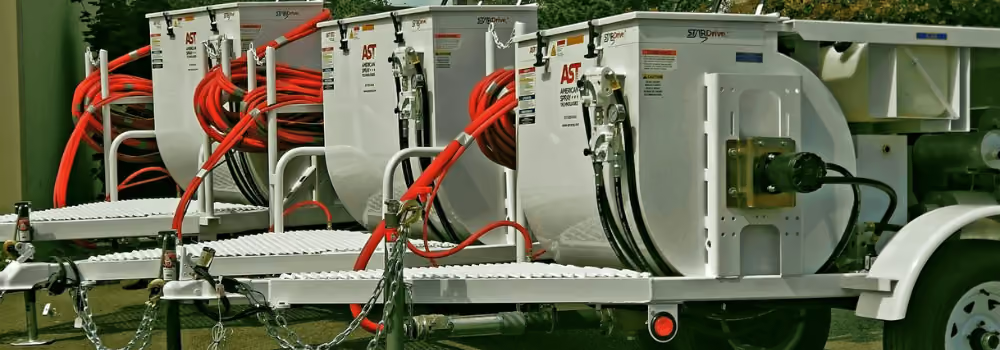


























































%20-%20thumbnail.avif)





%20-%20thumbnail.avif)


%20-%20thumbnail.avif)

.avif)




%20-%20thumbnail.avif)