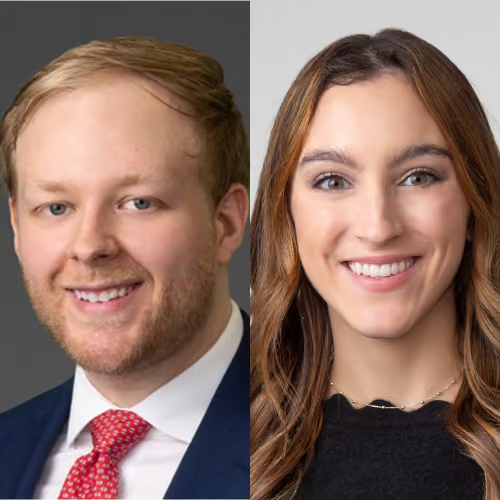
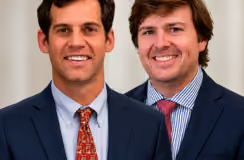
Host: You've heard multiple Acquiring Minds guests lament I love this path of having bought a business. I only wish I'd started sooner. Well, today's guests, Meredith and Michael Schlinkert, don't have that problem. Meredith was just 25 in Michael 28 when the couple started considering the prospect of buying a business a couple years later. And they are the owners of Background Connect, a background screening provider for employers and others that need to run background checks, drug tests, etc. Fascinating business. White collar, remote, great margins, something of a moat, tons of reoccurring revenue and lots of revenue per employee. The business was generating almost $1 million in revenue with just three employees. Seems like a great fit for buyers whose criteria was pretty tight, non blue collar and had to be in their local market. Houston and of course we also discuss going on this business buying adventure as a couple. So this makes a perfect complement to Kristen and Gabe Perez's interview a few episodes ago. Note the contrast. Kristen and Gabe had four kids when they bought their business, while Meredith and Michael don't yet have any. So couples at both ends of the spectrum buying businesses. Lots to enjoy and learn from here with Meredith and Michael Schlenkert, a young couple and owners of a business I personally like a lot. Background Connect announcements Don't forget the webinar this Thursday, August 29th, when attorneys James David Williams and Bill Barlow, whose entire practice is devoted to business acquisition, return for Legal office hours. This month's topic is the main legal diligence issues that arise during a transaction. There are over 10 very specific issues that James, David and Bill see time and again when working with entrepreneurs buying businesses, and they're going to walk us through how to handle those issues. As always, there will be ample time to answer all legal questions related to buying a business, so not just those about legal diligence. So come get any legal question you have about your deal, your target, your search answered by James, David and Bill it's this Thursday, August 29, noon Eastern. Link to register for the webinar is right at the top of this episode's show Notes or right on the homepage of Acquiring Minds. Acquiringminds co. Welcome to Acquiring Minds, a podcast about buying businesses. My name is Will Smith. Acquiring an existing business is an awesome opportunity for many entrepreneurs, and on this podcast I talk to the people who do it. You'll recall hearing about the inaugural M and A launchpad conference on Acquiring Minds back in the spring. The event brought together searchers, seasoned business buyers, owners and private equity investors for a single day to go deep on buying businesses. Well, it was such a success, the organizers are hosting a sequel in October. Walker Deibel, author of Buy then build is keynoting and 30 other experts will be on hand sharing their journeys to acquire, operate, scale and exit their businesses for significant returns. It's happening October 26th in Chicago. Use code acquiringminds@malaunchpad.com for a $200 discount. So if you missed the event in the spring, here's your chance to attend in Chicago on October 26th. And with a $200 discount, go to Malaunchpad.com or click the link in the notes and use the code acquiringminds. All one word. Meredith and Michael Schlinker, welcome to Acquiring Minds.
[4:16] Guest 2: Thank you for having us.
Host: You acquired as a couple an interesting white collar remote business which we're going to spend quite a bit of time on as well as, of course, your story and in particular buying a business as a couple. Meredith, why don't you start us off, please, with some background and then, Michael, we'll go to you, of course.
Guest 2: So I grew up here in Houston. I went to school for finance and commercial real estate finance and after graduating I spent about four and a half years in commercial real estate. I enjoyed it a lot, I learned a lot. But after a while I kind of realized that it wasn't necessarily something that I wanted to do long term. I loved the people, but I felt kind of stagnant in what I was doing. But I wasn't sure exactly what I wanted to do. And at that point, Michael had found the ETA space and kind of introduced it to me. And through multiple conversations we decided to kind of go through this path.
Guest 3: So my background will is I'm an attorney, went to law school and was practicing in private practice for several years doing transactions, a lot of M and A financing, that type, similar really to the ETA space, but frankly at kind of a bigger scale as, you know, traditional private equity or investment banking type deals within that realm. I had discovered the Harvard Business Review guide to buying a small Business several years ago and read it and the concept really intrigued me primarily because, I mean, I was working hard on these big deals and seeing my clients get most of the benefit, most of the payoff from closing a deal. And I wanted to replicate that process for myself and really kind of jump into the seat and be a principal in what I'm doing rather than just advising on someone else's work. So I, you know, upon finding ETA and discussing the process with Meredith, it really just seemed like an opportunity to jump into being a part of business rather than just advising others doing business.
[6:20] Host: Well, Michael, it's interesting. I've had more than one guest who come from private equity, typically as analysts or even maybe even associates within private equity and seeing, you know, where the value collects in a deal and typically their observation is sure with the partners, but also with the entrepreneur who's selling the business and saying to themselves, well, gee, that looks nice, I'd like to be in that person's shoes. So you were kind of one or one step removed from that because you are a vendor of the private equity firms, but maybe sort of a similar, similar thing. Although it sounds like, or as I recall from the pre call, you weren't being enticed by the sellers and entrepreneurs in these transactions, but by the private equity partners or no.
Guest 3: Yeah, no, that's generally correct. I mean, go ahead. I, I think, look, the entrepreneur, the entrepreneurial aspect of it is certainly enticing as well as far as having a business, growing it and getting it to the point where it's ready for sale and just deciding, having a lot more flexibility what we're going to do with life after that point. But I'm not a founder at this point. I don't have a particularly great vision of some revolutionary idea or service or even just a better way to do things than everyone else is already doing. So I really like the idea of buy, then build as far as just finding something that works, finding a way to work it, make it work better, especially as is a common theme in this space, looking for an entrepreneur who may be a little bit out of touch with the latest technological updates. And he's really kind of looking to wind down their business and yearing to settle down off into retirement. That's really kind of what we were looking for, was just an opportunity to take something that already existed and keep on growing and building it.
Host: But just one other thing about what kind of the influence of where you were working as an attorney was that you all, as attorneys do, charged really high fees or build really at really high rates. And many of your, the clients that could afford this work were private equity shops. And so, you know, connecting the dots, you're like, okay, I guess there's a lot of money in private equity.
Guest 3: Sort of, I mean, absolutely, yeah, my, my rates were astronomical. I couldn't afford to hire myself. So the fact that I see these firms, you know, hiring me not just for a couple hours here and there, but working me around the clock constantly keeping me busy, it makes you realize, man, the real value in this kind of ecosystem is in owning the business and having access to those cash flows and just being able to weather the expenses, whatever they are.
Host: Yeah, sure. Sure thing. Great. And so after getting your hands on the books and being enticed by ETA and taking this idea to Meredith, how old are the two of you at
[9:07] Guest 3: that time when we started talking about it? Yeah, I was probably 28 and I guess Meredith would have been 24 or 25.
Host: Okay, 28 and 24. 25. How old are you now?
Guest 3: Now I'm 30 and Meredith is, as of yesterday, 27. 27.
Host: Okay. Happy birthday.
Guest 2: Thank you.
Host: All right. And you're doing this younger than my typical guess. I'll have, I'll have late 20s people on often, but usually it's people more in their 30s and 40s. I wonder if there's anything to say there. Why do you think you guys have the confidence to do this early? Why do you think you got turned on to it earlier than. Than many of my guests? I'm just, I. I wonder what the. If there's anything to learn from that.
Guest 3: Yeah, I mean, I would say my confidence from pre acquisition, just the actual deal process of searching, finding a deal, and trying to tie all the ends together to get a deal done. My confidence was sky high because of my work. I mean, I do basically these deals at higher levels of sophistication day in, day out, or I did an entire life totally. So I was very confident that if I found the right opportunity, we could get a deal done, assuming we could make the numbers work with our financing side and, you know, our equity. Equity down. And frankly, Meredith comes from an entrepreneurial background in our family. So I felt confident that once we acquired the business, we could figure out how to get this thing operationally running and frankly, improving very quickly there. I'll let you jump in.
Guest 2: Yeah. My parents both own their own companies. They're both real estate related, so a residential brokerage firm and a commercial real estate development company. So it's always been around and they've been very helpful since post acquisition, just dealing with managing and QuickBooks and all the little things that come with operating. So it definitely has been helpful to lean on them at times.
Host: So Meredith, on the one hand, you're getting away from the family business of real estate because you were in real estate finance. You're stepping away from that. On the other hand, you're getting closer to the family vibe of small business ownership. Do you think that you were always destined to be a Small business person, owner, entrepreneur.
Guest 2: I think I've always thought about it. I don't know if I would have done it this early on. I think I'm a little bit more risk averse than him. So I think Michael definitely helped push me. I think I might have done it, you know, maybe in 10 years or what am I? But I think this early on my career, I wouldn't have necessarily done it myself.
Host: Well, Michael, I like what you say about, you know, that when we think very, very broadly, crudely about the skill sets here needed, it's getting a deal done and operating. Getting a deal done gets a ton of the attention, including on this podcast. But we all should be aware and I'll recognize that of course that is but one step that's, you know, that's getting to the starting line, forgive the cliche. And then after that is really when all the hard work starts and to really be successful at that, it's this, it's almost more important to have the, the operational chops to make a business go than it is to get a deal done. Although both are necessary. The getting the deal done and the financial aspects of that. And it's the most technical piece really, and the steepest learning curve, at least it appears that way, and therefore the most daunting and intimidating. So surely, yeah, you coming from an environment where you're doing that for bigger deals for, and you had a couple years of experience at this point, that was a big advantage.
[12:51] Guest 3: Yeah, absolutely. I would say, you know, thinking about it, I think attorneys make great business buyers from that perspective in that they're very much masters of process and able to get deals done. I'll say most attorneys you talk to probably don't make great business buyers from the perspective of not being too risk averse. And I think that's probably where I differ from your traditional attorney profile is I'm, I wouldn't call myself risk seeking, but maybe risk premium seeking. If I can find a good deal, I'm willing to bet on myself to try and make it work.
Host: Any, anything to say about that, Michael? Why you have that, that little quirk in your personality that most attorneys don't, which I have also observed.
Guest 3: You know, honestly, it's a family thing. I would say Mama raised a gambling man. I, I grew up playing, you know, Texas hold' em poker games of all sorts with my family most of my life. And it's really, I've found that if I want to win anything, whether it's a game small or big or, you know, a Race of competition in life. I need to play and I need to be willing to risk loss.
Host: Well, we, we understand all that, Michael. So I. I guess the better question is how did an entrepreneur end up as a lawyer? Not how did a lawyer end up as an entrepreneur?
Guest 3: Well, yeah, I'll say. I mean, I graduated with a bachelor's in psychology, didn't quite know what my next step was at that point, and found law school was an easy path to at least kind of keep the wheels turning and start working towards something. I knew that it would bring me, I suppose, credibility with whatever my next step ended up being. And in this case, my next step ended up being going to business owners and talking to them about why we would make the best stewards for, you know, taking their business over and bringing it to the next level. And I think having a legal background brings a lot of credibility, that there's a level of professionalism some other small business buyers might not have at the surface.
Host: Totally, totally. So valuable. Although it is funny that you did the old I got this useless humanities degree.
Guest 2: Yes.
Host: Now what do I do?
Guest 3: I don't say, I mean useless in the job market, but the psychology aspects have been very helpful to me, really, in everything I do. I mean.
Host: Yeah. All right, so before we get into what the search looked like, the parameters, etc, how, Meredith, did Michael finally convince you? How did. How did he. How did he get you over the hump?
[15:07] Guest 2: It definitely took a lot of conversations. I think what finally convinced me is when I started looking with him at the different businesses for sale and kind of picture myself in those roles. I think that really sent me over the edge where I, you know, thought about it a lot more, and I was still not happy with where I was at. So I think just imagining yourself in those shoe steps and talking about it and knowing that I had him and my family as support, I think really helped me.
Host: So you were being pushed in the sense that you wanted to change, and you were being pulled eventually by the sense that you actually did what a lot have the experience that a lot of us do, which is you browse listings of businesses for sale and you kind of start fantasizing a little bit. Oh, that seems like that'd be fun to run that business sort of thing. So it kind of.
Guest 2: Right.
Host: Wet your appetite a little bit.
Guest 2: Exactly.
Host: Okay. And. And mom and dad were supportive because they're small business people.
Guest 2: Yes, very supportive. They're actually.
Host: Were they excited by this or were they, like, what was their reaction?
Guest 2: Yeah, they were very excited about it. They Were very proud of us for doing it, especially at this young of an age. And we're excited about the possibilities of what we could grow this business to. They and they we can get into it later. But this business is great because, you know, anyone can be our client. So there's lots of potential for growth. So yeah, that was exciting.
Guest 3: Just from my perspective on her parents, I mean, they were excited, but pretty hands off as far as letting us lead the show. I mean, this is, you know, our deal front to back, but, you know, we've had a lot of fun with it. We've really been enjoying the stewardship of the business and kind of operationally running the thing. Now they're talking to us about, like, how they want to get a deal done. They want to see what it looks like to potentially buy other businesses.
Host: Interesting. And they're what, in their 50s?
Guest 2: They're in their 60s, actually.
Host: 60s.
Guest 2: Yes. Early 60s. I know, I love it. Not the typical buyer profile.
Host: No, but. But no reason why they can't be successful and then some with all the experience they already have. Great.
Guest 2: Yeah, we'll see.
Host: Well, if they do it, connect me with them on here. Running payroll, paying your bills, closing your books and producing financials. These are critical tasks every business owner must do or oversee. But spending time on them distracts you from the leadership in growth work you want to do. So let system 6 do it for you. Owned and led by a former Searcher, Chris Williams, System 6 is a leading outsourced finance team for hundreds of SMBs, including over 50 searcher acquired businesses. Chris, Tim and the System 6 team understand firsthand the challenges, the opportunities of jumping into a business as its new owner. So whether you own your business already or have one under LOI, talk to System 6 about how they can give you time back and improve your financial operations. Mention acquiring minds and they'll provide a free review of your books and financial ops, a $500 value. Check out system6.com link in the show notes or email helloystem6.com all right, guys, so what was your search going to look like? Parameters? Share, share, share the process and the plan.
[18:44] Guest 3: Yeah, sure. So the biggest specific thing that we had in our search was a geographic constraint on Houston, Texas. I moved here a few years ago and have loved the city. Meredith's from here, has lived here most of her life other than college. And frankly, we had been lobbying my parents for years to move down here as well, and we got them here. So if we had found another business and moved away right as I convince my parents to move here. That wouldn't have been a great look. You know, we're trying to settle some roots down and really build a family. So that's a tough constraint obviously because when you're just looking in one market, the pickings are a lot slimmer than if you're able to look statewide or nationwide. Certainly beyond that. We were a self funded search, so there were some size constraints but we had a pretty good amount of flexibility there. And we had been working with a loan broker, actually Matias Smith I think, who advertises with you. I'll give a shout out to him. He's a fantastic job at his work. Anyone in this space really should go work with him and find the best loan financing opportunities they can.
Host: Awesome. So we felt for the audience. I did not know that you guys use Matthias, so that's great. This is not a plug. Sometimes we do plug him, but this time it's not at all. Go ahead.
Guest 3: No, it's authentic. Can't speak highly enough of him. Great guy. Great. So we had a pretty good idea of what we could afford just between we were self funded so we didn't raise outside equity at all. So we knew what our equity down payment stretch was. We knew approximately how much financing we could get and we were looking potentially at seller debt. Other than that, I mean it was really your typical searcher profile search. Right. Enduringly profitable, not a lot of swings, just given the nature of the timing. We were searching. We were aware that every business that's in existence had to deal with COVID Some businesses were more heavily impacted by that than others. But we kind of had to discount, you know, 20, 2021 a little bit in that analysis. But I would say those are kind of the big picture parameters, parameters of our search. I don't know if you can add.
Host: You were. This is 2022 now that you're searching.
Guest 3: Yeah, we had started searching in 2022. I'll say I was working full time while I was searching, which is a little unusual. So I was kind of searching part time mostly looking at broker deals for that reason.
Host: Meredith, were you going to add anything to the parameters? Actually I know I recall from a pre call you did have one that was pretty strict.
[21:01] Guest 2: Yeah, I wanted a business that I could easily wrap my head around. I think there is some businesses. I feel like home services is one of the biggest businesses that people got into and I just didn't think that me as a 26, 27 year old woman could. I mean I think it Would take time to learn a lot about the particulars of home services. And so we ended up purchasing a B2B business. And I think that was something that we both were more comfortable feeling like we could learn and grow it pretty easily.
Host: I want to press you on that. I mean, people buy a plumbing business, they don't expect to learn plumbing. Or is it maybe that like a trades business and going from white collar to blue collar, being a young woman, was it that thing, that aspect?
Guest 2: Yeah, it. I think it was. I think I felt more comfortable in this business to business kind of white collar environment that we both came from and felt like I knew kind of how in general they run and how I could potentially grow it. And I think that I could wrap my head around that better than the more blue collar.
Host: Well, that narrowed your search further because trades blue collar businesses are way more easy to find, way easier to find. Which is why so many searchers. Yes. On acquiring minds are usually buying. Are buying those businesses. So at this point your, your, your search criteria is pretty tight. White collar, Houston based.
Guest 3: I would say so now I'll say if I found a perfect opportunity that was blue collar, I might have spent more time trying to convince Meredith to, to broaden that aspect. Yeah. But thankfully we ended up finding something that really ticked all of our boxes.
Host: Yeah. And I'm eager to get to it because I, I really like your business. And Michael, can you give me a little bit more visibility or specificity on your numbers when you said what you could afford, etc.
Guest 3: Yeah. I mean, without getting super specific, we had planned for, you know, a down payment equity injection at the start of no more than around 300,000.
Host: Okay.
Guest 3: We ended up going with the number lower than that, which thankfully we wanted to preserve liquidity as well. You know, obviously no one can predict the future. And having an adequate amount of cash reserve or liquid securities and reserve available to weather whatever storm may come was important to us. So we didn't want to stretch ourselves too thin.
Host: Sure you were. But you're prepared to go up to 300, which would mean very crudely, potentially as much as call it a $3 million business with transaction costs probably less than that, but let's say crudely 10%
Guest 3: big picture, that was kind of the top range of what we were potentially looking at.
Host: And so 3 million if we assume 20% margins is a 600,000. If you assume 5x. If you assume it trades for 5x. Is that what you're assuming?
[24:07] Guest 3: Well, I'm sorry, 20 margin. Yeah. Yeah. I'm sorry.
Guest 2: Yeah.
Guest 3: 3 million is the purchase price, not the revenue. You're right.
Host: Although they're often, they're often quite close.
Guest 3: Exactly.
Host: Yeah. So a. So let's say seven, call it 750. That would trade for something like 4x which would be nice. That's actually, that's actually kind of the ideal. And, and that's actually the ideal. But typically at that range people think they're going to get, have to have some investor infusion or some investor equity there. So, so 3, 300,000 starting point is, is pretty, pretty good and nice that you didn't even have to use all of that because now you're, you're liquid. What was the plan in terms of division of labor, who works in what, when, etc?
Guest 3: So yeah, so the timing worked out kind of interesting. I was actually in the process of switching jobs when we finally kind of found our target, got under Loi. It was funny. I, we signed Loi and I think the same week I submitted my resignation from private practice I was switching to another firm but they gave me a couple of months off to really focus on driving the deal home, which was just worked out perfectly for us. But our plan going in was really as we kind of previewed for me to run the operational aspects of getting the deal done, for Meredith to be involved in all of that and start seeing and learning how the business works and then for her to take the lead operationally day to day post closing. And I'm really here kind of to help with big picture concerns or if there are specific legal aspects to weigh in.
Host: All right, so you are going to be the deal guy and, and Meredith is going to be the operator. I'm simplifying. Obviously you guys were going to be working on everything together, but that was kind of the, the, the division of labor. Michael, are you, do you ever see yourself stepping off of the legal track or are you going to remain a full time attorney indefinitely? Obviously you're going to have a hard time saying what's the long term plan for you.
Guest 3: Michael, I would love to be in a place down the line where whether it's building background, connect to a larger comp, to a larger organization involved, or whether it's starting a hold co and trying to find another acquisition or potentially even multiple and really partnering with other operators. I see ETA really this kind of space as my future. For now though. I enjoy being an attorney. I work for the government now. Without getting into too many details, I'm kind of the stability and the risk aversion that Meredith sought through our process. So, you know, I don't expect to ever give up my law license, but I do anticipate that 10 years from now I will not be a full time attorney.
Host: Meredith, anything to add?
Guest 2: No, I mean, I think that he's very excited about this space and I think that he's only going to be happy long term if he does something himself, Whether it's helping me with the background connect growth, or if it's doing another deal and operating or doing a Holdco like you said. So I think that would be his plan long term.
[27:18] Host: So. So the vision is do this first deal, wrap your arms around it, get it stable, grow it, and then probably either expand it as maybe, maybe this business just has so much growth in it that you just continue with that. But if not, it becomes more of a cash cow. You buy a second business and you basically are kind of starting to build a bit of a family empire. And Michael, eventually you turn your full attention to this empire building. But for now, as you transition into this empire building, you are. Your W2 is providing security and safety net, right?
Guest 3: Absolutely. And to be fair, it's meaningful work I do at my W2 that I really enjoy.
Host: Okay. And anything to say about searching together? Were you just both kind of. I mean, how did that work? Were you both on Biz by Sell or did you have a list of local Houston brokers? And Michael, you call this half, I'll call the other half. What, what did that look like? Was the mechanics a little bit.
Guest 3: We were both browsing listings from Biz by Sell as well as, you know, a few of the other online brokerage listings, especially those with a focus on Houston and this area around Texas. I would say most of the time I would be approaching brokers, signing NDAs, getting SIMs, reviewing things. And if I found a deal that looked like it passed sniff test, I would bring it to Meredith and we'd kind of sit down and discuss it over dinner.
Host: Did you guys ever disagree on a business?
Guest 3: Yeah, I would say so. I mean, there's one in particular, I think that was. It was a franchise retail actually that Meredith was interested in. The substance of it was. What was that? A spa. And it seemed like an interesting opportunity. Meredith was interested in the substance of it, but as we kind of drilled down into it, I was concerned that A, it was a little bit further away from us than we would have liked. A little bit of a hike, given the geographic constraints we already discussed, we weren't going to be moving for the business. And then B, just Not only the managerial aspects, but managing retail employees I think is something that can be difficult.
Host: You're nodding, Meredith. But there was something you liked about this opportunity.
Guest 2: I think that I liked how the franchise offered support. This was our first deal. We're young. I think I liked how I could lean on that. And similar to the deal that we ended up doing with the seller being involved. So I think that offered support as well. That made me feel more comfortable in going further.
Host: Well, spas or med spas at least are hot, or at least they were. I don't know if they still are. But that was. That is an area of, of like activity.
[30:07] Guest 3: Absolutely.
Host: Yeah. Before we move into hearing about the business that you, I guess, agreed on and went forward with, you had mentioned just offhandedly building a family. Michael.
Guest 2: You.
Host: You convinced your parents to move to Houston. Meredith, Your parents are already there. You're from there. So is there a timing? Is there for maybe other couples listening? Is there some sort of like, did you want to do this before you got serious about building a family sort of thing, if you know what I mean? Like, if kids are just like, we got to do this now, sort of. Sort of.
Guest 3: Kids are in our future for sure. I think, you know, timing on that is still tbd. I don't think we felt pressed to get the deal done before we were ready to have kids. But, you know, we were looking before we were ready to have kids and we found obviously the business that we ended up acquiring and liked it, went after it. I'll say that's something we're still thinking about today is, I mean, okay, now that we've got this business, Meredith particularly be given Meredith is the operator. What does, you know, that process of actually having children look like when she's going to need to take some time off?
Host: I'm in the throes of that myself. It's always a tricky one.
Guest 3: Well, congratulations.
Host: Well, thank you. Thank you, sir. Okay, so let's hear about Background Connect. Enough teasing.
Guest 2: So, Background Connect. We're a pre and post employment screening company, so our bread and butter is background checks. We also offer 52 different services. So our most popular are drug screens, verifications, occupational health screens, motor vehicle records. So any, any screening that a company wants to do for a potential employee, we can help them with that.
Host: So most people will understand this, but just to be clear, an employer wants to hire somebody, but one of the steps is to do a background check on that person.
Guest 2: Right.
Host: And is that basically something that all employers do for all hiring or not all Employers for all hiring, it just depends.
Guest 2: No, I mean it's up to an employer what they want to do. We, we advise that they do a standard for this role. If one person's getting a background check, then you should do that for anyone who's in this role. But it's, it's completely up to them employers what they want to do, if they just want to do a standard background check or if they want to add on drug screens or anything else that they might want for that particular role.
Host: Well, just so, so just to wrap up, employers hire people and they at their discretion, choose to do background checks. And as you said, it's not background check or no background check. There's, there's a suite of checking that you can choose from and sort of, you all offer that a la carte. So they could, you can do the standard and then plus this XYZ, ABC sort of thing.
[33:01] Guest 2: Right.
Host: And, and then you all run. So they outsource that step in their hiring process to you. You do these background checks and we'll get into the numbers here in a minute. We don't need to go there just yet. But this is a volume business. You're doing a lot of these a day actually, right? At least the number of orders you're receiving per day is in the dozens sometimes.
Guest 3: Yeah, absolutely. Yep.
Host: Okay. You were going to say, Michael?
Guest 3: Oh, I was just going to add on. I mean like Meredith said, not every employer does background checks for every employee. We really recommend especially for any employee who's going to be critical to the operations of an organization that it's important to at a very minimum, do a cursory background check and make sure that they're not convicted felon, don't have specific issues that are going to cause concern. Some industries are regulated in respects that, you know, for dots. Most, most people who are driving around interstate freeways are required to get physicals. We can help with a lot of that type of issues. And then frankly in some industries it's the norm for companies to require their vendors or suppliers to background check their employees. So it really, it's, it's an industry specific ecosystem analysis of whether companies are performing these background checks. But they're more or less always recommended so you know who you're getting into business with.
Host: And then so as we consider quality of revenue in the business, like in a business like this, it's not, it's not the highest quality where it's some sort of contracted recurring revenue, but you're seeing a, I imagine a ton of Repeat business from these same employers who, whenever they hire somebody, they basically send you guys an order. As long as you continue to deliver them service, they'll continue to come back. So tons, huge quantities of repeat business. So pretty high quality revenue, you might say.
Guest 3: Absolutely, yeah. It's not contracted recurring, but it is just reoccurring naturally, so to speak.
Guest 2: Yeah. And some of our clients have processes where, you know, if they have a bunch of employees that work with children, they'll redo it every year. Even if it's it, they're still working for the company. It's not just when they're applying for the job. So we have that reoccurring. We do motor vehicle records once a year for a lot of our clients as well. A lot of our trucking clients. So we don't have contracts like Michael said. But it's nice because a lot of our clients will have reoccurring outside of just the normal hiring process.
Host: So you may not have this at your fingertips, but if you had to say roughly what percentage of your orders are coming from clients you've already served?
Guest 2: Almost all of our. Our clients are reoccurring. Yeah, we have a few that will maybe do for a year, but for the most part, we get a good amount. Almost all of our clients will do something each month.
Host: Wow. So every order that comes in, the dozen that come in today, you will have already have. Those are going to be all existing clients or clients that you've worked with before.
[36:07] Guest 2: Correct.
Host: Great. Okay. And so this is one of these. Like how big is this market? Now, obviously there's a lot of hiring that goes on in a country of our size, but you're also serving the local market, as I know from the pre call. So it would be hard for me to pin how big a company something like this could be. Tell us the numbers of this particular business, please.
Guest 2: Yeah, I mean, we can do everything remote, which is amazing. So we have clients all over the the country and some that we do international screens for. So it's really a huge market and we're able to serve a lot of different industries. We do not only do we do pre employment, but we help nonprofit organizations with volunteers, screening volunteers. And there's a lot of. There's some people who want to do it on a potential business partner. So there's a lot of different ways that someone might want a background check or a drug screen or whatever it might be. So, yeah, it's pretty good market.
Guest 3: Sorry. When we purchased that grant connect, it was doing just under half A million in cash flow or EBITDA revenue was almost double that. So ticked under a million. And then our purchase price for your context was between three to three and a half times that cash flow number. And as Meredith kind of alluded to, this is not a large organization within the industry. I mean there's a lot of room for growth. This is really a drop in the bucket.
Host: How many employees?
Guest 3: So we have two employees as well as, as we'll get into. The seller has kind of done an extended transition period with us. So between the seller and two employees, we've got three other bodies working with us, with us on this.
Host: And but Michael, you're not full time in it. You're not, you're not even. You're correct, you're supporting Meredith. So you don't count as basically zero hours Meredith, you're full time. The seller continues to be involved and two other people. So four people are generating a million and a half, excuse me, a million dollars in revenue. $250,000 ahead. And before you got there, Meredith, was it just three people? Was it just the seller and these two employees?
Guest 2: Yes.
Host: So 300,000 plus per head. That's, that's a lot of revenue per employee. But I mean another way to look at this is the margins, right? So 50% margins, net margins. So what's not to like? When I said the thing about the local market that was. I'm jumping ahead a little bit here, but we had talked a little bit about the kind of acquiring more of these in other geographies and Michael, you'd made the point that there is. The relationships really matter here. So in many of your customers in fact are, are local to you or local ish to you. And so buying a background check, a background check company in Maine isn't as trivial as that because some local background check company up there is probably going to have local relationships that you coming in from far away that's going to be a little, a little dicey. So, so that's why I was saying the point about a lot of these being local customers. But respond to all of that.
[39:32] Guest 3: Yeah, absolutely. I mean as we mentioned, we can service customers anywhere in the country and I think on one off cases we can even handle inter international searches as well. But beyond that, the way that we're acquiring customers and the way that the industry really runs especially kind of at the level we're working at is customer satisfaction, customer relationships and customer service. So being local, being able to go out into the industry, talk to HR folks, talk to organizations around Houston for now and get in front of them and explain to them why it's so important to be doing these searches, what the benefits, what the value it brings to their organizations are and why they should be working with someone who's responsive and able to handle any issues that may come up in their processes is important. So for us, frankly, we found that getting in front of people and being real humans is one of our competitive advantages. If we went and bought a background check company in Maine, assuming we kept an outpost office there, sure, we could do that and keep relationships there, but then we'd be spreading our attention between people in Houston and Maine as opposed to if we went to Austin or Dallas, for example, it'd be much easier for us to take a bus over there and stay there for a day or two and talk to people.
Host: And now is this, but is this an industry where there are a lot of background check companies? Is, is, are all employers using third parties to do these background checks? Or do some companies do it in house or, I mean, I, I, I'll say other than Checker, the big startup YC startup that I remember was a big deal and may still be a few years ago out of Silicon Valley, I wasn't even aware of this as like a category of business. So is this like there's 20 of these in every city and I just didn't realize it or what, what is, what is the, the lay of the land look like in terms of actual businesses devoted to this service?
Guest 3: I don't think there's 20 in every city. That would be a lot, I think for example, in Houston, I don't know off the top, but I would guess or five.
Guest 2: Yeah.
Host: Okay.
Guest 3: Mostly smaller shops. There are a few really big organizations within the industry. Those look like Checker or higher. Right? Is another big one.
Host: Higher.
Guest 2: Right.
Host: Okay.
Guest 3: And you know, they tend to service larger organizations where you've just got massive volumes and they're doing kind of lower price and probably frankly lower intensivity review into each search.
[42:01] Host: Well, I, I recall a, a colleague who may or may not have been on this podcast who worked for Uber. And while Uber was growing, Uber had an insatiable demand for some sort of background checking. You need to background check all your drivers. So they were industrial scale needs of background checking. Probably something where they turn to a checker or some or you know, powerhouse like that. Yours is going to be, you know, classic sort of boutique service versus industrial scale service.
Guest 3: Absolutely.
Host: When I got off our pre call and was so enthusiastic about your business and searched around the D.C. area for businesses like this. I didn't spend a lot of time on it. Maybe my search terms were wrong, but all I could find were fingerprinting businesses like where you go and. Yeah, I guess. And I'm, you know, I'm near the federal government, so I don't know if that's common or that's something, you know, specific to the DC area. But I couldn't even find what looked like an equivalent to your business. I was also searching Google Maps, and since yours is sort of a virtual business, maybe I should have. Maybe there isn't an office. Anyway, react to that. What are these fingerprinting businesses? Is it tangential to your business? Is that a service line that you do offer. Could offer? And then why did I have a hard time finding a business like background connect in the D.C. area?
Guest 3: My initial guess, as far as why you're having trouble in the D.C. area and why they're focused on fingerprints there is. It probably does relate to the federal government and all the government contracting that's going on up there and then needing to be sure that I know for security clearances you've got to have fingerprints done. I don't know the specific nuances of that. There is a pretty good amount of overlap in our industry of background checks with personal investigation. I know of a few agencies that do both, like PI services, private investigation as well as background checks. So they kind of do the whole shebang. But that's less focused on employment aspects.
Host: That's more focused on what clearance?
Guest 3: Well, potentially security clearances or, you know, if you've got a cheating significant other or someone you think may be cheating, if you've got personal situations that you'd like investigated further or, you know, if your daughter is dating a new guy and you want to know if he's a good guy or a bad guy, if he's got anything on his record, you might go to one of those outfits. Right, right.
Host: Sorry. But you said that personal investigation and fingerprinting is. There's an adjacency there. Is that what you said?
Guest 3: I think so, yeah. I think because you can search with fingerprints, you can search if anyone, you know, if that person's basically been arrested and any jail organization has uploaded their fingerprints, has fingerprinted them and uploaded that to their files. Anything to add on that?
Guest 2: Yeah, I think fingerprinting is. We don't currently offer it. I think it's an additional service that would be for, like Michael said, a higher clearance or something more secure that you need for Whatever reason, and it might not necessarily be for employment. So it is something that we could get into, but I don't think that it's something that we're really looking at at the moment.
[45:15] Host: Okay, and how old is Background Connect your business?
Guest 2: It's 10 years old.
Host: And is there anything to learn about the market from the origin story? Your seller, the founder, what did they, how did they do this 10 years ago? Was there a, did they perceive a gap in the market? Maybe a gap that still exists? For example, like this is, this is. Again, I'm just kind of trying to decide if this is something people should be looking at in their markets, these types of businesses. I mean, because I'm so enthusiastic about it.
Guest 3: Yeah, absolutely. So I think the seller, as far as he's described to us, really noticed that there was a gap in the market as far as these. So Background Connect is what's called a consumer reporting agency. It's significantly regulated under federal law, especially the Fair Credit Reporting act or fcra. So you've got to make sure everything you're doing is in compliance with that. Our seller had some exposure to the area and realized that the existing consumer reporting agencies in the market were not as customer service oriented as most business to business service organizations could be and probably should be. And with his background, he felt confident that if he could learn how to operationally handle these reports, he could handle it in a customer service oriented manner and really, you know, keep these organizations happy, help them smooth out their hiring and review and compliance processes and get things done fast and cost in a cost efficient manner.
Host: An SBA loan broker, as opposed to a direct lender, doesn't work for a particular bank. Instead, the broker pairs you with the right SBA lender for your deal based on industry terms risk thresholds, then helps you navigate the process better than many lenders themselves do. Matthias Smith of Pioneer Capital Advisory is just such a broker. Matthias worked at two of the country's top 10 SBA lenders. So he's been on the inside of the SBA process and knows well the pitfalls and hurdles and how to avoid them. He struck out on his own to laser focus on the ETA and search space. Our niche is his niche. You'll see Mathias at all the ETA conferences. He's closed over 30 search deals since starting Pioneer in May of 2022, including some acquiring minds guests. To learn more and get in touch, go to pioneer capitaladvisory.com or click the link in the notes speed you just mentioned. So let's get more into the weeds of the actual service delivery here. Tell us more about speed. You get an order and what do you have to then go do? Obviously, it depends on what they've ordered, but give us kind of an average order and how quickly do you have to turn it around and what are you doing on the back end? What is a background check? Exactly.
[48:22] Guest 2: Yes. So as far as timing goes, if it's just a background check, then we can typically turn it around in one to two days. It depends. We look criminal records are all in a county level, or almost all of them are in the county level. So we are looking at each county that this person has lived in and seeing if there's any records. And each of these counties, timing depends on the counties. So there's some counties that are in more rural areas that might take a little bit longer. There's some that even aren't even digitalized records. So they have to manually pull records. But for the most part, it's pretty digitized, it's pretty fast. And we can get it turned around within a day or two. If you're going to do drug screening or verifications, that's going to take a little bit longer because the applicant needs to go perform the drug screen. That could take a day or two or three. And then verifications, it depends on how fast the applicant gets back to us to verify that they graduated from this school or worked at this company.
Host: And on the background checking, where you're going to all these counties so you first figure out where they've lived. There's a record of that somewhere. And then you go county by county and you go to their websites or something in the case where it is digitized, which is going to be most cases, and you're manually plugging in their name sort of thing and. And into the county website to see if anything comes back and assembling that into a report.
Guest 2: Yes. So we get their Social Security number and that's able to give us an address trace. So we can see everywhere they've ever lived. And then we add each of those counties to the report. And as you said, we go online, a lot of it is public information. And we type in their name. It depends on the county. Some of them you can put in your date of their date of birth. To be able to report any, any case, any charge, you need two verifying information. So date of birth and middle name is our most common one. But we're also able some of the records will have where they were living at the time. So we're Able to confirm that with address trace. And yeah, we go from there. We just look online and get that information. And some of it is not online. Some of it we have to use vendors to help us gather that information. And that can take time, but for the most part, we're able to find it online.
Host: And you mean. So for some rural county you might have this vendor means a person on the ground in that county who will go physically check for you.
[51:03] Guest 2: Correct.
Host: Interesting. And all of the digital aspects of this feel rote, like it's, it's a process and you just kind of, you know, social list of counties they've lived in. County website, check, county website, check, county website, check. Assemble into a report. Feels very automatable. You know, where I'm going with this feels like the sort of thing that AI or tech is, is. Is bound to disrupt. How did you guys get comfortable with that? How do you think about that?
Guest 3: I will say from a. As I kind of previewed, from a compliance perspective, you're required to have an individual actually go do this investigation and confirm this information. The Fair Credit Reporting act and other state law on this matter provides a lot of consumer protections and for good reason. I mean, we're talking about people's employment and their livelihood, their ability to create a living and support themselves and their families. It's important that you don't want a bunch of false positives showing up on reports. So what can happen a lot if you're not careful is you've got a hundred thousand John Smiths across the country, and a lot of them have lived in the same place or been in the same place at the same time. If you start reporting issues for this John Smith, when it's John A. Smith, when it's John B. Smith who's applying for the job, you're going to run into issues with the Fair Credit Reporting act, with FCRA very quickly. There are aspects of state law that are both always evolving. You know, you've got to keep your eye on and keep track of as well as just jurisdictional issues that depend on the facts of the time. For example, we've got people now who are applying to jobs with employers based in Louisiana, but the applicant lives in California and will be working remotely from California. California, Does California state law apply? Well, we've got to go figure that out because frankly, California, as you would expect, has a number of consumer protections above and beyond Fukra that Louisiana doesn't apply. So there's a regulatory overlay. And then frankly, as I mentioned, it's a Customer service issue. When we've talked to customers in the industry who have used these bigger, bigger vendors such as checkers, such as Hire. Right. We've noticed while they're able to handle large volumes, the customer service they're getting is not top notch, especially on a per report basis. So for organizations that are smaller, that are growing, that need to make sure that they're collecting and cultivating the right group of people, the right team, but need to be able to do that fast, we're able to jump in and handle it. And like I said, you need to have an actual human handling these reports in order to ensure you're complying and to ensure you're really doing a thorough investigation.
Host: And you believe that that will remain the case for the indefinite future? That as everything moves to AI, the regulations won't soften with respect to that?
[54:03] Guest 3: I don't think they'll soften. I think they may even strengthen to some extent, if I had to guess. But, you know, I guess time will tell.
Host: Well, you're also touching on something I wanted to ask, so we'll do this now.
Guest 3: The,
Host: like you said, this is, this is. We're. We don't want to treat the people who, whose backgrounds are being checked as commodities and just orders in, in a database that need to be processed. This is really sensitive for folks, for people. So there is an, there is, is there an element of this that at times presses against. I don't want to say your ethics that's too strong, but that you, that not everybody might be comfortable with, with, with a business like this or a process like this. We all understand the background checks. It's not like they're, it's not like to your point before, it's not like this is PI. These are, this is a personal investigation business which feels way closer to a line, but it still may feel a little bit like an enabling of something that if, if we are on the other side of it would make us uncomfortable. Did you guys feel that at all? Am I overstating it? How do you respond?
Guest 3: Yeah. So I, I mean, that was certainly something we looked at and a concern we considered. But frankly, you've got to look at it, the situation holistically. If a given applicant employee has a criminal past or a criminal record, a history there, we don't want them not to be employed. But at the same time, we can't just overlook that history in determining whether they're suitable for a given job. I mean, if you had a daycare and they weren't running background checks on their employee applicants and you found out that the people watching after your children were, you know, let's say a convicted murderer. Would you feel happy or safe or would you trust that daycare going forward? I think the answer has to be no. So really you've got to look at it as these organizations need to get the best information they can in order to get the best people and the right people in to do the job that they're performing. And what that is, what those qualifications are, are going to differ job to job. If you are, if you have a violent criminal past, you're probably not going to be in a great position to be working with children going forward. And is it perfect? It's not a perfect world. It kind of is what it is. But if someone finds themselves in that situation, we've got to look to our justice system and hope that that person was at least involved and culpable in whatever led them to being there.
Guest 2: Yeah, or someone who's operating heavy machinery. It might be a good idea to do random drug testing every once in a while so you are comfortable and no one gets hurt. I also want to note that we're not making the decisions if someone needs to be hired or not. We are just giving them this report of facts and they get to decide as the employer if they're going to hire this person.
[57:11] Host: Yep. Great, guys. So going back to the service delivery and the speed and the volume, we mentioned before that this is a high volume business. We mentioned before that there's only four people there. So walk me through an order. First of all, what is the average order size, give or take?
Guest 2: I would say about $120. And that would include a background check and probably one other screen, whether it's a drug screen or a verification or NVR.
Host: But included in that 120.
Guest 2: Yes. Okay, so the, the typical just criminal is about 60 to $80 a person depending on how many counties that they lived in. So we charged per county. Once you get past the county that they already live in, which is included in our basic package, we charge per county after that.
Host: So it's linearly correlated with the amount of additional work you need to do. Is, is what you're charging the. So let's do some quick math. Call it a million dollar a year business. Million dollars a year is $3,000 a day. Roughly $3,000 a day, $120. Average order value is what 25 is. 25 orders give less than 30, more than 25. So you're doing. And there's eight hours in the day and they're four of you. So how so? I mean that just seems like a lot to be doing every day, I guess is my point. Is it a mad scramble or is it comfortable or is it talk to us about the fact that this is like a high volume business? Is that something you've ended up liking or does it feel always like you're putting out a fire sort of thing or under the gun to deliver, you know, the next and the next and the next and the next, the next?
Guest 2: Yeah, it depends. Some days are slower than others, obviously. I think it is interesting when you don't know in the morning what that day is going to hold because you can't predict. I mean sometimes our clients will let us know ahead of time if they're going to put in a lot of orders, but for the most part you can't predict. So it is interesting. At times we've gotten pretty good about being efficient and some of that 120 is, you know, a drug screen. Well, the applicant will schedule their own drug screen and we'll see the time period that they're allowed to go in to take the drug screen and we'll get the results automatically and put it in so it's not a bunch of work there. For verifications, we have the applicants send us materials that will verify that they worked at this company or graduated from this university. So it's not that much work. And for the backgrounds themselves, since we're doing it so often, we've gotten pretty efficient with it.
[1:00:02] Host: But you're not using for example overseas, overseas folks to do this because it sounds like a lot of the work could be done is done via the web classic sort of, you know, call center in the Philippines doing this work.
Guest 2: No, no, we're not currently. Maybe that's something that we'll think about in the future, but not right now.
Host: Okay. You mentioned the seller being in the business. How's that going? What's that like?
Guest 2: It's been good. Like I said, I. That definitely made me feel more comfortable in pursuing this company knowing that we had someone who has been doing this for 10 years who could take his time teaching us. So we're aware of all the nuances and so that's been great. There's definitely some growing pains of stepping on toes sometimes just he has a certain way that he's always done things and we're making changes but for the most part he's been very receptive to everything that we've done. We've made a Lot of technological changes. So he's been very impressed with all of that. He, he wasn't necessarily able to make those changes himself. So he's excited about.
Host: Because he's not as tech forward as you. As you all.
Guest 2: Yes.
Host: Okay. All right. So there was. Even though this is just a very process oriented. Well, every business is process oriented, but this is very, kind of like even, maybe even much more so. Every order looks and feels very similar. Even though that's the, the nature of this business. He hadn't dialed in a pretty tech forward kind of automated where he could or, or tech efficiencies where he could. So that.
Guest 2: No, no, I think he was comfortable with where he was at. He was getting reoccurring business. He, he didn't want to take the risks of making a lot of changes when he was nearing retirement. So. So he knew that there was definitely improvements that could be made, but he wasn't necessarily willing to make those before he sold.
Host: And when you've had stepping on toes moments, how have you handled that, Meredith?
Guest 2: It's been mainly when it comes to managing our employees. He's used to saying, hey, do this, do that. And I've been having to sit down with him and be like, hey, I would like to talk to our employees and be the, the point person moving forward and, and also with our clients, I'd like to be the person that they talk to in this transition. I want them to feel comfortable with me running the show. They're used to him. So that has been a particular. I think that's something that was nice that he's involved. Still is because our clients, even when we initially told everyone that we had made this change, a lot of our clients were a little bit weary about it. And he was able to get on the phone and, and comfort them. So I thought it was interesting because I wouldn't have expected it to be as much of a, I guess, pushback like they, I didn't think that they would care as much.
[1:03:19] Host: Yeah.
Guest 2: As they did. So it's been good to have him for relationships and sales, but I think the managerial aspects have been what we've been having to kind of figure out through time.
Host: Chain of command sort of stuff. Okay. Yep. Well, this thing about clients actually caring more than everyone thought when they learned the business was sold. That goes again to the point about buying one of these in some far flung geography is easier said than done. Sounds so. So it sounds really like the, the clients because I just envision, you know, clients just send you once they've gotten comfortable with Background Connect. They just email you over an order or maybe you have some portal. They just, you know, it's almost like, you know, self serve, buying something on Amazon, like background check please sort of thing, pay with my credit card or whatever it is. But no, it sounds like there's actually that that human touch is still something that all your clients expect or some of your clients expect.
Guest 3: Yeah, I might jump in here just to add, I mean that's all true. And I think the reason that's all true especially is because of the downside situations. If we send a report to a client that says, hey, this person that you're looking at hiring, this applicant has this history you should be aware of and the client determines they would like to not hire that person anymore because of that history. Like I mentioned, you know, it's a common theme. There are a bunch of aspects of federal and potentially state law that need to be applied and frankly, the client, the companies, the hirers need to know that you, as the consumer reporting agency are doing everything by the books, have ensured complete compliance with the law and that they're able to make the decision not to hire this person fairly in accordance with law and just to minimize the risk that they're going to get sued or anyone involved is going to get sued. You've got to be able to handle these applicants and talk to them about what was in their report.
Guest 2: I think our selling point of having really good customer service also ties into that. So these, we were mainly dealing with human resources people. So these people are very comfortable with calling us to ask us questions or to get more information about things. And so I think that is what ties into them feeling a little bit unsure when there was a chain of command change because they were used to talking to the seller and having that relationship. I think it also depends. There's some clients who were referred to us and depending on their personalities might not be calling us as much or have the personal connection. So they might be what you were saying of just putting in the orders and waiting for the results to get back. But others are a little bit more hands on and want to talk to you about certain things. So it really depends.
[1:06:29] Host: Growth. Obviously it's getting more clients as it always is, but how do you envision doing so?
Guest 3: So we've got natural outreach, you know, word of mouth. We really encourage our clients to talk to other organizations they're aware of that might need help with this regards or anyone else who either has a service provider they're not happy with or doesn't have a service provider and needs to look into doing these background check services or employment screening services. We are continuing to build an online presence which was pretty close to non existent when we acquired the business. And frankly we're starting to go out into our local market in the Houston area and attend events especially related to the HR industry and just talk to people, get the name out there. Longer term, I think we'd love to hire specific sales staff to help with this, but right now we're kind of figuring it out as we go. Anything to add?
Guest 2: I think the only thing to add is there's. We've thought about maybe going into different industries. So we're thinking credit checks for apartments could be a huge market that we could get into. So I think there's, there's lots of opportunity, whether it's number of clients but also range of services.
Host: But credit checks, that is, isn't that fully automated? I mean isn't that just a log into Experian or whatever and pay a flat fee and I get the person's credit report sort of thing?
Guest 2: Yes, but if it's connected to someone already doing a background check, then you can have it all in one report and all in one place. Mm.
Host: So it would be something, an a la carte option on top of somebody wanting a background check.
Guest 2: You wouldn't do credit checks either way
Guest 3: but do a standalone.
Guest 2: Yes, we could do it. Yes.
Host: And the seller founder was proactively doing any marketing or sales or was this all a word of business that grew? Word of mouth.
Guest 2: He was in the beginning, but the past few years he hasn't been because he's been comfortable with the sal size that it was currently at and didn't want to expand more than that. So he hadn't. Hasn't been doing sales or marketing for a number of years and that half
Host: a million in earnings was that way. Was that for the pri previous year or previous number of years or what was more, what was the history of what were the earnings year two year, three, year four in the past.
[1:09:09] Guest 3: I don't have the numbers in front of me but, but it was not tremendous growth. I think 2020 was a particularly down year as you would expect. Not a lot of people were hiring and as I previewed we kind of excluded that from our analysis. If there's, you know, another black swan event, we'll deal with it as it comes up. There was probably minor growth, I, I would guess 5ish percent year over year outside of the COVID anomaly that's desirable
Host: in our world, actually.
Guest 3: Absolutely. Like I said, enduringly profitable. Yeah, it's right.
Host: Anything. I didn't ask about the business, guys, I want to start closing us out here in return to kind of the personal journey. But anything about the business or about the industry that you think is interesting, that people should know or tell everybody why it's such a crappy industry and they should stay away because you guys are going to roll it up?
Guest 3: Well, it's difficult to break into just to understand how to operationally fulfill these orders. If you see another consumer reporting agency for sale, look at it. I think it, you know, for us, it's a really good opportunity. And if you don't like it for yourself, let us know because maybe we will roll it up. But really, just if you're going to jump into this or if you're considering this, be very wary of the legal compliance aspects of Fukra and applicable state law. That's something we are continuing to work through to this day. And I imagine, frankly, it's just in an inevitable aspect of the business is you've got to be on top of what you're allowed to do, what you are required to do, and how those two things change over time.
Host: And Michael, are you bringing your legal training to bear on that or do you guys have counsel that you, that you lean on?
Guest 3: Yeah, we have outside specialist counsel, but me having an attorney background has been very helpful as far as just being able to read things and talk to outside counsel in their language and their lingo and pick up on these concepts, I think, quicker than we would have otherwise.
Guest 2: Yes, for sure.
Host: Just a side point about the size of opportunity here, the total addressable market, industry, whatever you want to call it, the fact that there's regulation here, the fact that there's kind of enough attention put on this category of business or this service, suggests that indeed, there are a lot of companies out there that do this in, to, to, to the, to the point that they need to be regulated.
Guest 2: No, yeah, right.
Guest 3: Yeah, I mean, it's. Yeah, there's certainly a number of players nationwide in the market, but.
Host: And this other thing about the regulation, other point to make about the regulation too, is that that's also a bit of a moat. I mean, if this was just so easy to do this, then it would have been commoditized away by now, probably so. So the part of the service that you're delivering to your clients is, in fact being compliant, being on top of the legal requirements, doing everything, you know, dotting eyes, crossing T's.
Guest 3: Yes, Absolutely.
[1:12:00] Host: Meredith, anything to say as. As a now operator of one of these businesses or is Michael covered it? Are you working in the business or on the business?
Guest 2: I would say that I am about 5050. I was talking to Michael about this the other day. I think currently our size kind of, it makes more sense to work a little bit in the business, but we'll see moving forward. I think that kind of relates to. To starting a family as well. What that's going to look like, whether we hire someone to operate or find a different path, who knows? But currently, I would say about 50, 50.
Host: And so the 50% of the time that you're working in the business, you are doing background checks yourself.
Guest 2: Not necessarily doing the background checks, but talking to clients, figuring out different ways to improve processes, policies, making it more automated. Sometimes I'll be doing background checks, but for the most part, I'm making sure that we're pushing things along, getting our employees to be on top of everything.
Guest 3: Yeah. Managing employees as they fulfill.
Host: Okay, guys, well, to close out the. Let. Let's talk about doing this as a couple and a young couple at that. Has this changed your relationship at all?
Guest 3: I mean, yes, absolutely. But I, it's, you know, I would quote. I think the old philosopher, an old philosopher said, no man ever steps into the same river twice, for it's a different river and a different man. I think the process of acquiring a business has changed not only us as a couple, but each of us individually. I've seen a ton of growth in Meredith as she's kind of stepped up to operate this thing, learn how to lead it, and frankly, drive the organization forward. I've seen some, although probably more modest growth in myself as well throughout the process. And frankly, I just. A lot of it as well is we have a lot less time than we did a year ago. We are always dealing with an issue with the business now, and that's a good and a bad thing. I mean, it's exciting. We have this thing to always be working on and working together on, but, you know, there's always a stressor. It used to be that we could close our eyes and forget about everything else for a little bit.
Host: Yeah, yeah.
Guest 3: Anything bad?
Host: Said the couple without a child.
Guest 2: Right.
Guest 3: Yeah, exactly. So that's.
Host: Well, so you're just. You're basically just getting a taste of what it's like to have kids. This is like getting a dog. What, you guys have done the trading wheels before? Having a kid.
Guest 2: No, I'm kidding.
Guest 3: Go ahead.
Host: What are you going to say? Meredith.
Guest 2: No, I agree with what Michael said. I think we've both grown a lot. I've never been a manager prior to this, so there's a lot of growth in that. And wearing all the hats that comes with operating a small business has been interesting, but it's great that we're able to lean on each other through this. Michael knows basically almost as much as I do about the business, so I think it's, it's great that we can talk about this in the evenings, on weekends, and, and we're excited about the potential, so we'll see.
[1:15:15] Host: Well, yeah, no, Michael, please.
Guest 3: Sorry. One last thing I'll add on this is I, I think we found that our strengths really complement each other well. I'm able to think about big picture and kind of address big picture concerns very well, while Meredith's very detail oriented and on top of everything and making sure we're not forgetting about any, any issue at all.
Host: Well, the point about talking about it at night and on weekends, I'm, I'm reminded of Doug John's different stage of life. I think he's in his early 50s. He and his wife bought a business he's been on twice and he did joke that they talk about the business constantly. You know, they bought it together. And so, and so this is like they just default to talking about this to the point that it kind of maybe crowds out other things that they might talk about or spend their collective time together talking or thinking about. So it's that. But again, you know, the analogy to kids, like that also kind of happens when you have kids anyway. But it sounds like you are kind of experiencing this phenomenon that you're all kind of always talking about the business.
Guest 2: Yes, I would say so. I'm. So far it's been great. I mean, it's been six months, so we'll see. But I think we're very passionate about it and really excited about it. So it doesn't, it doesn't hurt our relationship. We love talking about it.
Host: What about the way people react to you as young people, for example? I suspect this gets into a little bit of the stepping on toes Meredith that you were referring to earlier. You as a mid-20s, late-20s woman and the founder who started and ran this business for 10 years now reporting to you and his employees, becoming now your employees. And there's probably 20 years, maybe 30 years of difference in age between you. That's got to be, that's got to be a dynamic.
Guest 2: Yeah, I think it has been interesting that the closest in age employee is 13 years older than me. So it. I think it's more internally my confidence in that than anything that they have said or acted to me. I think I have to kind of remind myself, like, I'm their manager. Like, this is what I say, you know, to an extent, obviously, but I think there's been some insecurity in my own beliefs of that. But I don't think that anything that any of our employees has said or acted around me is reflecting that.
Guest 3: And I don't see the direct interactions between Meredith and the team because I'm more removed. But just from talking to her, I mean, she's getting in there day in, day out and really leading by example and grappling with whatever issues are coming up in the business day to day. So I think my expectation, my understanding is she's really building respect within the organization from everyone seeing that she's not bossing people around and telling people, do this, do that. While she doesn't have any skin in the game or any kind of direct involvement in the issues or understanding, she's not, you know, a surface level manager. She's engaging with the issues and trying to help everyone get jobs, get done.
[1:18:34] Host: Yeah. Well, and the other thing I think about this dynamic is that, like, while maybe a reflexive reaction of employees to some young person or young couple coming in and buying the business is maybe initially negative, at the same time, eventually it dawns on everybody what a big risk this represents for you all and how much skin in the game you have and. And kind of how much initiative you're taking to do this. And there's got to be begrudging or otherwise some level of respect just for just that comes from the realization of that fact.
Guest 3: Yeah, I'm sure.
Host: And I say that to everybody listening who buys a business, not just for the. The two of you great guys. I like your business.
Guest 3: Thank you. Will, we love your story.
Host: Oh, thank you. Appreciate that, Michael. No, and you guys have a really neat story. The doing it as a couple, doing it young, finding a really cool business. Thrilled to have you on. People have questions. How can they. How can they reach out?
Guest 3: LinkedIn is probably the best. Meredith and Michael Schlinkert. It's an intimidating last name, but I'm sure you'll have it spelled on the podcast for him.
Host: Good deal. Meredith and Michael Schlinkert, thank you very much for coming on.
Guest 3: Thanks.
Guest 2: Thank you all. Sa.





























































%20-%20thumbnail.avif)





%20-%20thumbnail.avif)


%20-%20thumbnail.avif)

.avif)




%20-%20thumbnail.avif)