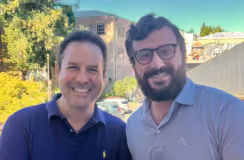
Host: Brendan Van Buren has seen search from two angles. He's a successful searcher himself, having acquired a fencing business in 2018 and he started a search accelerator at Carnegie Mellon. So he closely observed and invested in a number of searches. In today's interview we dive into both these experiences. I pressed Brendan on buying a fencing business, which is essentially a construction business. Construction businesses are known for being both highly cyclical and project based, two attributes that investors typically tell searchers to avoid. Really valuable to hear his answer to that because as you probably have seen on Biz, Buy, Sell and elsewhere, there are a lot of construction related businesses for sale out there. And then we also get Brendan's perspective on the art of search and what he's learned by working with and investing in other searchers. Here is Brendan Van Buren, owner of Promax Fencing Systems and co founder of Generational Transfer Entrepreneurs. Welcome to Acquiring Minds, a podcast about buying businesses. My name is Will Smith. Acquiring an existing business is an awesome opportunity for many entrepreneurs and on this podcast I talk to the people who do it. Top of the list for most acquisition entrepreneurs after they close on the business is digital marketing. Is the business doing it properly or at all? Has the website been touched since 2005? In many cases that website is going to need an overhaul. Eversight is a firm that works with searchers to do custom redesigns of their websites for a flat monthly fee. So you don't need to spend down your precious working capital for a custom redesign of the website. That and all ongoing support is baked into their monthly fee. So your website cost is simple and predictable month after month with the assurance of knowing that you can ping the folks at Eversight for any changes you might need and you will talk to a human. Call or email your Eversight rep, make a request and expect your changes live in hours, sometimes minutes. There is so much going on when you transition that business you buy. Make the website management easy by putting it in the capable hands of Eversight. Check out Eversight.com searchers E V E R-S-I T E.com searchers Brendan Van Buren welcome to Acquiring Minds.
Guest: Thanks for having me Brendan.
Host: You have the unusual background of having both successfully bought a business but also founded and run, served as director of a search accelerator and one closely tied to Tepper, which is Carnegie Mellon's business school. So we are going to get multiple perspectives from you over this next hour. Start us off Brendan, if you would, with a little personal history. Where are you from and how did this career in search begin?
[3:15] Guest: I grew up In a small town, Holidaysburg, Pennsylvania. No one would have ever heard of it south of Altoona, which is a small city in Pennsylvania that no one would have ever heard of. And I worked for my or my family. The reason we were there is my family's business was located in an even smaller town called New Enterprise, Pennsylvania. And the town the company was called New Enterprise as well. And it's not your average family business. We did just shy of a billion dollars in sales with 3,700 employees. So a pretty large family business. I'm fifth generation company was started in the 1929. So, you know, right around the great depression era construction business. I went to undergrad. All intensive purposes. I was going to go work for the family business. Once I got there, I realized there's a lot of branches within five generations. Something that you never really think about whenever you're growing up. My dad was chief operating officer and all of a sudden after I started working there after undergrad, he decided he was going to quit because he was just tired of the stresses of all the family members. And so he did a search. Didn't know what search funds were, but he went and bought a precast concrete manufacturer which was actually a subsidiary of the family's business. I wouldn't work for that. Ended up at Carnegie Mellon afterward with our goal is, hey, we're going to go buy more businesses. And so I applied to a bunch of business schools. Carnegie Mellon's very only about two hours from where I grew up. And so it just was a really good fit. And that was kind of how I ran into search was once I showed up at school, one of my classmates, Rob Southern, his dad's Jim Southern at Pacific Lake. His he just, I happened to run into him second week of class or first week of class and he's like, hey Brendan, you gotta check out this search fund thing. You told me, hey, you guys want to go build a bigger portfolio? You're looking to buy more businesses? You know, I think really what you want to do, Brendan, is search. And so I just spent the next months and I guess year and a half looking into search and exploring that while I was in school.
Host: And let me jump in here. BRENDAN on but you and your father had already decided you were going to go out and buy businesses. So what did you like about that notion if you hadn't yet been exposed to the concept of capital S search?
Guest: Yeah, well, he just bought this precast concrete manufacturer which was much. I mean we're talking about going from running 3,700 employees to running 100 employees. Right? And so we're managing 100 employees. And that's a very nice jump, I guess, from a workload. And you also start to realize you can have more impact whenever you're trying to grow a billion dollar business. To go double that business is a lot. To go double a business with 100 employees is much less. And so that lift is a more exciting endeavor just from a, hey, you can have make little tweaks and those little tweaks have a much bigger percentage impact. And so I was working for his business for about eight months before I started school, got into Tepper, while I was working there, was applying while I was still working for my family's business, but got in, but I started doing little projects for it while I was there with a couple of different sales things. And those sales things started leading to bigger revenue turns. And then I also worked on a couple of operational incent initiatives. And you can see just little tiny, I mean one thing, we just, we made a little tiny invention inside the company to allow us to more quickly pour box beams. And so those little, little incremental changes made nice impacts to the bottom line. Whereas if you went and did that at the family's business and all of a sudden, you know, you add a couple hundred thousand dollars to the bottom line, that's a very little, you know, it makes a little dent. You know, it's hard to, you know, it's, it's nice to make a $200,000 dent, but no one really appreciates it whenever you're talking about a much different percentage.
[7:39] Host: And so in the background, did you have any kind of thesis around the silver tsunami and people, people retiring and the transfer of boomer businesses, any of that?
Guest: Or was it really just like you
Host: had seen up close how a little bit goes a long way with these small businesses?
Guest: My dad had a hypothesis related to it. You know, we didn't really do much research, but he'd always, I mean, my grandfather was still chairman of our family's business and he always, you know, there's all these 70 to 80 year olds or 80 to 90 year olds that are running all these businesses across the country. And so you just try to picture that on a scale. The way I look at it is if you go to a beach community, think about the, and this is even what we used to talk about the back then. But it's go to a beach community, walk along the beach and, and look at how many two to $10 million houses there are. The vast Majority there's. I mean, some are owned by hedge fund guys, but a lot of them are owned by small business owners. And so you're talking. I mean, and that's. So you go walk the beach of Hilton head and there's 400 houses there. And that's just on the beach. You go in blocks and there's even more. And you know, that's. That's where you want to be. I think, at the end of the day is you want to be able to retire to those beach communities or the same thing if you. I mean, I'm a big skier, so you go out to Jackson Hole or you go out to Aspen or Vail or go up to Stowe in Vermont, and there's just tons of these houses. And so that was kind of where, you know, there's a lot of these people and a lot of them are getting older. And we'd always talked about that and maybe they were running inefficiently. You know, that was yet to be determined. But it's more of, hey, there's a lot of businesses out there and people need to eventually retire for them. And so we just. It was a slight hypothesis, I'd say. We hadn't really made a foundation of it other than, hey, Brendan, let's go buy more small businesses now that we did this and kind of create our own portfolio. Those are really the conversations my dad and I were having, I guess, pre Tepper, before we even learned about search funds.
[9:52] Host: Great. So you have kind of this hypothesis about, about the potential across America of small businesses. Many, many, many of them, and probably lots of opportunities for acquisition and optimization of those businesses. You go to Tepper, you meet Rob Southern, whose father is at Pacific Lake, tell people what Pacific Lake is. For those who don't know, Pacific Lake,
Guest: say one of the large search fund investors. So they. They usually take one to two units in many search fund opportunities. They're one of the earliest people to go raise a fund to invest in search funds. The original search funds were invested by individuals. And as as many of those individuals had success in the late 90s, they started making more and more money and showing and it was incremental. And now there's 200 searchers at any given time. And back then there were tens of searchers, maybe the whole decade. And so as those people made money, they started reinvesting in search. And some of that was raised at companies like Pacific Lake or some of those guys went and showed those thesises to wealthy individuals or family offices or I don't know if they're in pension funds and stuff, but they started raising money from other individuals and are reinvesting that money in the search community.
Host: So it's really kind of one of the marquee names in traditional search fund investing and kind of a pioneer in the institutionalization of the asset class.
Guest: Exactly.
Host: And so Rob Southern says, hey, you and your dad want to buy businesses. Have you heard of search funds? He tells you about it, how cool it is, you get fired up. Continue, please.
Guest: Yeah, so what I basically did was spent the next 12 months just researching search funds. One of the most common things that searchers do is go reach out to other searchers to learn about search funds and their successes and their stories. And so I just started going on different websites, whether it was Pacific Lakes website or Anacapa's website, and just was looking, hey, who searched? And I just would send them emails. I guess even then I was learning how to search by doing this because you just cold email people and the search community is incredibly helpful. So I got great response rates and everyone was excited to tell their story. And so you started to hear about the story. I took over this, became the son or daughter they never had. Which was also something that Jim Southern from Pacific Lake really pitched whenever he came and talked to our classes about search funds, was, hey, you know, you're going to go step into this business and you know, for whatever reason, they, they aren't passing it to the next generation. Maybe they didn't have anyone, or maybe they're the next generation became really successful, or maybe they just, for whatever reason, their, their kids or lack thereof, can't take over the business. And so you step in and take over that role and you create a great relationship and find the mechanisms that start to allow for growth. And that's what I started to learn. I also started to learn, how do you search? What type of goals should you set for yourself? And I just kept working through that. During that time period, my dad and I would talk pretty regular about the conversations that I was having. And I guess he kind of started pointing out, hey, what do you do with the pipeline after you close? Because you start sending out all these letters and start getting referrals and recommendations and start talking to business owners, and maybe they're not ready to sell now, maybe they're not ready to sell for five years. What do you do with a lead like that? That was where we started the inkling of, hey, let's create a platform to allow us to take advantage of that inefficiency that you go build this giant pipeline, it all closes down on itself after you buy the business because you leave it and you're going to go run the business. We also, you know, great operators aren't necessarily ready to go search. So hey, can we help, you know, people that are going to be good at running businesses but maybe don't have that PE or consulting background or the sales background to go make the sale to buy a. Search to buy a company and wait,
[14:21] Host: I'm sorry, so on the operators. But you meant. So you've got these opportunities maybe that come in, post your own acquisition and you don't want to let those opportunities go nowhere. So you. But you. What was your concept of putting operators in those businesses and you would buy the business instead of them?
Guest: No. So it was. What we say is you can be a great searcher. You might not be a great operator and you might be a great operator, but you might not be a great searcher. And so could we help the great operators who might not have the personality to go search? Go search. And I think great traditional searchers have a little bit of both of that. I guess if you equate it. I don't know if you've read the book Bring down the House. No, it's a really interesting book about the movie 21 is based off of that book. And so Bring down the House is about a. Is about a guy who starts counting cards and there's people that are really great at counting cards and there's people that are really great at gambling. And so a lot of times they pair the card counter with the person that was great at gambling. Every now and then there were diamonds in the rough who had the jovial personality to gamble and make money at it while they're doing that. And also smart enough to count the cards, the diamonds in the rough. I think a lot of times go to search funds and so could there be some great operators that aren't searching because they just don't have that personality? It was something that we played with. I think at the end of the day you really want to be good at both. But we could help train people to become better searchers. Was one of the early hypothesis that we started to develop while I was still at Carnegie Mellon.
[16:08] Host: You already know that business owners are making amazing use of virtual assistants, often based in the Philippines. And while virtual assistants are helpful, virtual professionals are transformative. More Staffing is a boutique agency that hires a players in the Philippines not for task execution but for deep competency work. Think controllers Operators, supply chain managers. Moore staffing helped an e commerce company build their entire supply chain, analytics and finance team. It saved them over $400,000 and enabled them to build the in house expertise of a much larger business. Global staffing is increasingly the norm and building the muscle within your business to take advantage of it will be crucial in the years ahead. So if you're sourcing the next management hire within your business, make sure you speak with more staffing first about the pool of capable, affordable managers they can connect you with. Check out MoreNow co. That's MoreNow Co. And so where this is going is that this is the inception of gte, your search fund accelerator. And so how do you, so you have this inkling, how do you then
Guest: kind of package it?
Host: What is the final, the final entity that you build look like?
Guest: Yeah, I think any entity. You just got to jump in. And so we just started, hey Brad. And do you have any classmates that might also be thinking about searching? Maybe you and that classmate can start and we'll just start, you know, we'll start up gta. Maybe we'll be able to raise some additional capital from some additional piece. So we, we started to talking to other, I guess families that we knew in Pennsylvania that might be interested in investing in these type opportunities. Got a couple people who are like, yeah, we buy businesses with you. A couple of them have already had already bought the business with my dad. And so it was, hey, we have a couple of these limited partners, let's go find a couple more. We found some more, started raising a little bit of capital for generational transfer entrepreneurs. Hey, I had a classmate, Gabe, he and I had been talking for the entire year about hey, you know, I think I might search too. And so I was like, hey Gabe, you want to join gte? You know, we'll pay your salary. Just kind of, you've heard my pitch before. And so he decided to join in. And then I, I do what all searchers do. Once you make a decision, you send out an email to your whole network and say, hey, I'm going to, I'm going to go search and this is how I'm going to do it. And one of the guys who I talked to had already done two other searches like, hey, I'd be interested in searching again, can I join your guys platform. And so myself, Tom, who was the Tepper alum who emailed me and Gabe, we were the first three initial searchers and our premise was we'll start searching, we'll build the pipeline and people will follow behind our footsteps. So we'll buy companies and someone will replace me, someone will replace Tom, someone will replace Dave. And that's how we bootstrapped. I think a lot of people, the people who maybe are better funded or get a little bit more capital right up front, they go. And I guess search fund accelerator is a good example. They go by class. We were just going by pipeline. So once a pipeline was getting close or a searcher was getting close, we'd call up people who had been talking to us and we'd hire those searchers from our backlog. And that.
[19:42] Host: That was once a searcher that was in. That was currently participating in gte. And GTE is generational transfer entrepreneurs. Entrepreneurs. Generational transfer entrepreneurs. Once one of the. The searchers were getting close to looks like they were going to close and buy the business and no longer be a searcher, but they would still have this pipeline that they built. Then you would go out and look to recruit their replacement as the next searcher. And that's kind of how you were. Had this rolling enrollment in gte and you and these other two guys were kind of the first. Your first cohort in your own search fund accelerator.
Guest: Yes, that's. That's exactly what we were doing. And you know, part of it was just we bootstrapped. We bootstrapped this platform instead of going and raising maybe as much capital as some people typically do with the hope that we just keep going and it start building momentum, which. Which it was. I mean, and our theories were working. The first deal that we closed on was actually Tom's, and that was something that Gabe and I were. We were just at a networking event and ran into someone given our pitch. And they. They told us, hey, I have a business owner who might be interested. They explained the business a little bit to us, and we're like, hey, that really fits what Tom's looking for more than what either of us were looking for. Let's make an introduction to Tom. And so it was really, you know, searchers helping searchers inside the platform and that. So that was the first deal we closed. Once we closed on that, we brought someone to replace Tom, and I actually closed on my company about a month later. Promax. And so that was the initial phases, and we replaced myself. Gabe then found a company. Another a year later. He actually built a great pipeline, and two of his leads then led to two more deals. And so the platform idea was really working pretty well. We just, I guess then Covid hit and we were just so focused on the company's four LPs that we'd purchased at that point, that I think we just lost a little bit of momentum during COVID We started rebuilding it and relaunched later in the year and then ended up pivoting to the traditional search fund investment for several different reasons, one of which was just bandwidth and how much management it took if you're the only L. I mean, if you're the GP for all of your silent LPs, whereas I think in the traditional model, none of the LPs are all that silent. They like to help each other. And so our model we built was more having silent LPs and that just. We felt like we had a lot of responsibility there, which we did. And that just caused us into, I mean, my dad and myself just to start running into some bandwidth. Well, we hypothesized to deploy as much capital as we'd like to, we'd start running into a bandwidth problem, you know, maybe not this year, maybe not next year, but at some point we're going to start having more searchers than we could directly manage, which really goes, you know, into the search funds. Searchers manage themselves and get mentored from the search fund investors. And we were getting maybe a little bit too much in the weeds as we progressed. Everyone was fighting for the lives during COVID and maybe that just was us over managing because of that situation, but it just caused a little bit of a strain from our personal bandwidth. Also, as we were pivoting and starting relaunching search, we had a very good liquidity event from our family's business, which just meant that we wanted to get more capital deployed. And the traditional search fund investment seemed like a better means of getting our capital deployed. And we felt like, hey, hey, we can still provide very similar value. We've searched for five years. We can help others learn how to do that, and at the same time, we can help mentor the searchers that are searching. And so we made that pivot in the middle of last year.
[23:54] Host: And so now you're more of just a traditional search fund investor.
Guest: Exactly.
[24:00] Host: But what becomes of your original insight there, that there's this great exhaust value from previous. From previous searches? Are all those pipelines now just dying? And, and what do you think somebody should do there? Because it is an interesting problem and opportunity.
Guest: I think it's still very much there. I think what other searchers, you know, as I've progressed, have done to help with that is they, they go and some of them pass each other their pipeline if they can after they finish or if they get leads, they've made contacts and send some stuff over their way. I don't think that's a perfect solution. I think some of the other accelerators have also done this and they're running into some success. So the hypothesis, I think, was accurate. Just the way you'd have to manage it is bring a lot more people in. And we just really like the idea of this personal mentorship. And so you start to bring all these consultants. They might help the businesses on the other side. You could hire some private equity guys that help with the search. And so you could build this giant company. We just, I guess my dad and I were looking, what do we enjoy the most? And that's mentoring or giving advice to searchers or having conversations like we're having right now. And that just in order to do that, we really recognize that if that's what we want to do and we wanted to deploy a certain amount of capital into the search fund space, then we really need to make this pivot. Our hypothesis seemed very accurate. It was working really well. Unfortunately, Covid probably killed some of the pipelines that we had going because we really just. The transitions during that time period. We did buy two businesses during COVID and didn't rehire those searchers. And so it just kind of was fading. And so when we went to relaunch, we had to relaunch the whole pipelines that we had. There were still a lot of leads that we were able to reuse and resend lists. It just, I guess we just didn't relaunch all that great from that perspective. And I mean, that being said, it took us three years to build the momentum because I started searching, I was searching and had a pipeline, same with Gabe and Tom. And we started building this whole thing up. And once we started recognizing the momentum, we were in the middle of closing on two companies as Covid hit. And whenever I say hit, I mean, my company was shut down for an entire month. We own a whole bunch of haircutting franchises. And those franchises, some of them were in New York. And that industry was shut down for like three or four months completely. And so we were focusing just so much energy on keeping the businesses that we had. I mean, some of them thrived, but, you know, making it and thriving as best we could, that we just didn't have the energy to go relaunched the pipeline. And we're in the process. We were. Then we ran into the capital liquidity event, just decided, hey, let's, let's mentor people that's what we really enjoy doing, or that's what my dad really enjoyed doing. Let's refocus and move into the traditional search fund space.
[27:35] Host: It's interesting about this concept of pipelines that you build up and that are really, really valuable and then you just kind of leave them on the shelf when you, the searcher buy the business that you buy. So there's all this value locked up in the pipeline, but at the same time, to use the metaphor again, the shelf, the shelf life of, of these pipelines is really short. You can build this momentum and have this great pipeline, but it does, it's not good for very long because those, those opportunities, you know, obviously the, the sellers find somebody else to buy their business or choose not to sell or whatever. So if you don't keep that momentum going, it can die very quickly.
Guest: Yes. And you could resend lists, but you don't have the same odor conversations. And so all those leads that you had once, if you don't transfer them quickly, they, they die pretty fast. Yeah, yeah, because they do close or the owners change their mind. I mean it's one of those things, as one thing I always like to say is you make your own luck in search of. And so you're sending out all these emails, you're talking to owners, you gotta find the owner at the exact right instant. Once you get three or four months passed, that owner might change their mind just because whatever life situation that happened at that instant that made them think, hey, I'll call Brendan back, I might be interested in selling that life event or inkling just passes and fizzles. And so they're like, yeah, you know what, life isn't too bad. I'm going to keep doing what I'm doing. And so if you don't take advantage of them, they can dwindle. I think a lot of traditional search run investors, they, they like the idea of a searcher building their own pipeline each time. And part of that's because they learn a lot about the searcher in those early months, about how they manage people, how they're building the business. And, and so in that early mentoring and early learning, if you, if they just give them a pipeline, they don't learn, hey, is this guy going to be someone I want to invest in or is this person going to be someone that I want to invest in? And so I think if talking to some other traditional searchers, they really like the fact that you have to go start from scratch and build your own pipeline because they see a lot about, hey, is this person good at sales, this person good at managing processes? And, and so they learn a lot in the early phases of the searcher. Because although they are spending 20, 40, 60,000 bucks on the searcher, I think a lot of search fund investors still view that as an option. And so if they aren't liking the searcher in the first year of their processes and the person comes across a so so business, I think they're less likely to, to invest in them because they didn't see, you know, the great strategies or the processes being followed or sales methods that they think makes a
[30:33] Host: successful operator really interesting. I had not, I had not considered that. Yeah, well, let's, let's get into your own acquisition. Brendan here. Promax.
Guest: Yep.
Host: A fencing business. Talk. Talk to me about the business itself when you found it and kind of give me the quick story there because we still got a lot of topics I want to cover.
Guest: Yeah. So sent an email after about actually a letter, physical letter to Russ sometime September, October of my first year of searching. And he called me back, said, hey Brendan, I'd be interested in talking. We hit it off pretty well on the phone. After two conversations I was going to be close to this area and so I gave him a call, said, hey, let's get together and talk about your business. I'd love to learn more. And showed up here. What I figured was going to be an hour, maybe two hour conversation ended up being five hours long. I could say we probably only talked about the business for maybe an hour or two, maybe an hour, probably not two. And we just talked about everything else. We have a lot of similarities and I think that that speaks to what makes a good opportunity isn't always the perfect business. It's finding a good relationship because you're going to be able to step in for them. And so talk to Ross. He explained his business to me. We're mainly a commercial fencing company. We do a little bit of residential. I was fairly familiar with the industry. We would use a company like Promax as a subcontractor at New Enterprise whenever I was a general contractor, liked the subcontracting space, talked to him, ended up working. I mean, that being said, even a great relationship, if you aren't able to grade on terms, you won't close on the business. And so we spent the next three months negotiating terms, then spent the next four or five months negotiating the asset purchase agreement and ended up buying the company in June. So from first conversation to close was still about nine months long.
Host: Wow.
Guest: And during that time period, you know, we're building a relationship, had a lot of in person meetings, would, you know, going back and forth. Lawyers always bring, you know, contention into a deal, whether it's your lawyer or their lawyer. And so something would come up. He and I would have to get on the phone and try to figure out some middle ground because both of our attorneys are telling us, you can't accept this. And so, okay, well, if neither of us can accept it, I guess we're not going to close on this company. But we ended up figuring those things out. And like I said, with all the similarities, I mean, he's a big skier, we both play a fair amount of golf, and just both of us grew up working in construction. I labored for four years before starting my career as a project manager. And he started in the fencing business as someone who'd never put a fence up or done any construction, but started as a laborer. And so we had a lot of those similarities as we started talking about our experiences. And I really think that helped us close. It's also helped us grow a lot because if I come up with an idea, I pitch it to them or even whenever we're. Before we close on a company, one of the things that we always told our searchers at GT was figure out what they would do to grow the business. If they don't have any ideas, that's not a great sign. Because they've been in the industry for 30 years. They might not want to do those things because it might be a lot of work or it might be just beyond the capital that they want to invest. But if they don't have solid ideas on what to do to grow, then it's one of those things. Well, I don't know how great of a business it is. And so early on we were going over some of those ideas that we had with Russ, whether it was some acquisition opportunities. Acquisition opportunities. So much so that there was some incentive written into the asset purchase agreement for recommendations and that allowed, you know, that just incentivized him to help us buy companies. And so he's made some great introductions. We're actually working on acquisition right now. Hopefully we'll close on that. We're almost through the incentive period, but he's still making referrals like that for us.
[35:07] Host: And when did you close?
Guest: We closed in June of 2018 and
Host: he's still involved in the business. That was four and a half years ago.
Guest: Yeah. And I mean, you know, our contract said, hey, you know, we'd like you to, for the, we'd like a six month transition period. We were pretty specific, you know, him working full time, 90 days then, and me following around. And then the next 90 days we do the opposite. I do everything. And he would just, you know, make suggestions throughout the day. Then we kind of shifted where he just come in a few days a week in the mornings and just gave advice or we'd talk him through some issues if there were any, for the next six months. And, and then he just, you know, I, you know, we built a great relationship. So he was in here last week actually cleaning up some files. We ended up BSing for, I don't know, an hour and a half about, mainly skiing because it's winter, but we ended up just talking and during, when he comes in and a lot of times it's, you know, we're just spitballing some ideas too. It's like, hey, we're looking at this. Or we were talking about that acquisition opportunity a little bit while he was here last week and you know, talking about, hey, what do you think about transitioning in this way? And he just gives great advice and a lot, I mean, and at this point he's not, you know, on the payroll or you know, even have a consulting, you know, billing is consulting anymore. He just, you know, we have a good relationship. He enjoys coming in and seeing, I mean, a lot of these people that are here, you know, he, he hired them and you know, he still has relationships with some of those employees as well. And so it's just, he likes to come in and he, he's retired and.
[36:49] Host: Brendan, what, what, how big was the business? Give us a sense of the size that when you bought it, they, they
Guest: were between 12 and $13 million in sales and they'd averaged about $2 million in EBITDA over the past few years prior to us buying it.
Host: Okay, that's great. And so let's talk a little bit about why you liked this business. I mean, it's, it's basically in the construction industry broadly. And that is kind of what's in your own background, even in your, kind of in your DNA, your family's DNA. But construction businesses are often ones that, that our searchers don't like. They're very project based and let's, let's talk about that as well, project versus recurring. But they also can be very highly cyclical construction businesses. And I know that there's an incredible variety of construction businesses. So this is a very broad generalization. But just talk to me about why you liked this business and how people should think about construction businesses as searchers.
Guest: Having grown, I mean literally grown up going to construction sites since I was three, heavy equipments or heavy machinery has always been exciting. I started working, but one thing I started noticing is some jobs that we would send out, you'd get one or two subcontractors and that was it. Versus the 10 general contractors that were bidding on stuff. And at the same time, my dad had bought his material, his material business where they make precast concrete products and those niche manufacturers and the niche subcontractors, at least my hypothesis was that they could demand slightly better margins than a general contractor, which just was something that I was going in with and started looking at and exploring. Whenever I was searching, I ran into several different companies and they, they were all proving, you know, that hypothesis was pretty accurate. And I, I just decided, hey, I, I really like construction. I think I can manage the people well. I think I, I, you know, in worst cases, I can always, if someone leaves, I can always fill in for someone. And it just felt comfortable. I wasn't a big software person, you know, despite going to a school known for its computer science program, Carnegie Mellon, sure. I was not a computer scientist. And so I was a construction person. I wasn't even an engineer. So I just really liked the idea of building something tangible with, with my hands and company building it. And so I was looking at the space. There are risks associated with construction. Everyone fears the cyclicality. I think a lot of the cyclicality goes Back to the 2007, 2008 crash of the market and the Great Recession and what that did to contractors. Now I think if you look in more the commercial industrial space, they were impacted, they were destroyed like they were in people that primarily served the residential markets at that time. So I was definitely looking more industrial, commercial type contractors. But at the end of the day, they're still cyclical. Like if the, you know, if people aren't, don't have money, they're not going to go build a building. They don't need to. So the way we looked at that is, okay, throw a bad year in, throw two bad years in your model. What does that look like? Okay, don't pay more than that or don't leverage it more than that. And that's really how we like to look at it. You know, they're just. Construction companies end up not trading for as high of EBITDA multiples on average because there are more risks associated with them, mainly associated with the cyclicality, but also, you know, you're bidding stuff and so it's eat what you kill every single day. There's no if you screw up a bed, you screwed up the bed. It's not some recurring revenue stream that's going to keep churning cash flow for you. You got to go bid everything. You got to look at your estimating processes and procedures to run the business. But it goes back to a lot of those houses on the beaches and a lot of those houses in the mountains. They're owned by contractors. And so you're going to learn a lot. You know, clearly they make money. And so you know, how can you better, how can you manage that risk? And that was really how we looked at it.
[41:44] Host: And I and will lenders, will SBA lenders or search lenders. I mean it seems like a logical defense to me. You simply model it in, you model the cyclicality in and you negotiate down the multiple so that everything pencils and, and does that. But does that assuage lenders or are they a little more kind of more narrow minded on this point and they're going to say sorry, we don't, it's too cyclical. No matter what, you know, you, no matter what your model looks like.
[42:16] Guest: I think it depends on the bank or the lender. But at the end of the day there's a lot of construction companies and I can tell you for certain, a lot of them have debt and so they're getting it somehow. And so clearly people lend to the industry. You gotta find businesses that have the theme of consistently profitable, enduring businesses. And so those could be construction companies, they can be software companies in our opinion. But if it's not enduringly profitable, a bank's not gonna lend to you. So you've gotta get your bank comfortable. You really don't want to buy a construction company though that didn't have proof that it was consistently profitable. Now where a lot of people don't like construction businesses too is the High Cap Acts. Promax and other smaller contractors don't necessarily have the capital expenditure exposure that someone that has a fleet of large construction equipment. I mean we've got skid loaders and pickup trucks. Much different than having a fleet of, I mean I mentioned a type of equipment, but you probably wouldn't know it and maybe the listeners wouldn't either.
Host: We'll try it.
Guest: Say it anyway. You know, a, a 1200 excavator which costs like a million dollars or you know, you don't have these, you don't have to have a large fleet of 100 ton dump trucks like, which are super expensive equipment. We're talking about a fleet of skid loaders and the banks get pretty comfortable with skid loaders. They're pretty easy to resell. So the capital that you need is stuff that most banks are pretty comfortable lending for. And so you just gotta model it in, I mean we're working with the bank right now for this bolt on acquisition and we've gotten them very comfortable with our past performance with the acquisition, past performance and are working through how do you lend on the cash flows instead of just the assets which that's where a lot of, I think a lot of banks see the assets and they're very ready to lend to those, but they're not quite as ready to lend on the cash flow, especially for this industry. But you know, you work with bankers and you, you just, you send it out to enough bankers and someone is going to get interest. You know, right now it's tough to get perfect financing but there's other times where it's really easy to get financing and they look at a deal and they're like, oh yeah, we'll, we'll throw money at, at that because you know, we think it's a good opportunity. So the answer is you can, yeah.
[45:02] Host: And, and Brendan, for, for the, this audience, the acquiring minds audience is going to be a, it's going to be more weighted towards self funded searchers rather than traditional searchers. So buy smaller businesses than 2 million EBITDA. Not everybody, but probably the majority. So does anything that you just shared about thinking about buying, about how you would buy a construction business thinking about them, is it different if we talk about an even smaller business than the one you bought, like a business that, that has, you know, 500 to a million in EBITDA versus the 2 million that yours had?
Guest: I think at the end of the day, if you can model it, you can make it work.
Host: Okay.
Guest: You know, you still got to model downsides. Maybe a downside on a, on a smaller business is a little bigger, maybe it's a little smaller because they don't have as quite as much overhead. And so it's hard to say, you know, it's really a case by case thing. But if you can model it, especially with an SBA loan, you know, if you can have very consistent, you know, strong earnings over the historic, the past five years, I think it's pretty easy because you're going to put up personal guarantees on an SBA loan no matter what. And so, you know, they can get pretty comfortable pretty quickly. With that type of stuff.
Host: Okay. Okay, great.
Guest: I.
Host: Let's circle back a little bit to your relationship with the seller, which you have already explained how. I mean that just seems to have only deepened. But you found that that was really important and you had read. So what was it somebody at Pacific Lake who said the son or daughter be the son or daughter they never had. And that seems to have worked out with you.
Guest: Talk a little bit, shed a little
Host: bit more light on that approach. And then also the shadowing, I heard you say the shadowing. You shadowed him for the first 90 days and then he shadowed you during the transition. So two part question. First, talk to me just about being the son that he never had. Russ.
Guest: Yeah, I mean, I can't say that I am the son that he never had, although he didn't have any kids. But you want to build that relationship and that you want to, you know, that you want to see the owner to see that there's a good, clear transition to you like they would a kid. And so that's what I think you're trying to do. Was Jim Southern who came and talked to us. He, he gave, it was one of those aha moments whenever someone comes and talks to your class. He came in and he just put the model of search fund on a screen and showed how the returns work for a searcher. And it's just like whoa. And then he's like, and the best way to do this is to build a great relationship with the owner and that's becoming the child that they never had for whatever reason. I mean, a lot of times these guys, I mean Russ is in this scenario. He just didn't have any kids. But you know, a lot of times they're, you know, this is a successful business and so that's probably been running for 30 plus years. Their children, while they, especially as they're growing the business, they very easily became doctors and lawyers and you know, professionals because the person was a well recognized and respected person, person in the community. But they didn't want to live in Wichita, Kansas. They wanted to be somewhere else. And so they became a doctor. And so there's a lot of times where it's that situation. So it's not that they don't have great kids. It's more of they don't have the secession plan. And most of the times owners view that as passing the business to the next generation, being their own generation of, of descendants. And so the best you can to have similarities and create that great relationship, like you know, a father, son relationship. I think it just makes it easier to work on the business and in the business, especially during that transition period.
[49:02] Host: And so then talk to me about this, the, your technique, your technique particular to your search where your transition, where you shadowed him for 90 days and then he shadowed you. By the way, that doesn't strike me as crazy, but I've never heard it laid out so cleanly like that. Is that what you prescribe for, for other GTE searchers? Is that kind of your own view of the best practice?
Guest: That's something we like to do. You know, a lot of it depends on the owner too, on what they, you know, how quickly do they want to retire, you know, how quickly, you know, do they want to get their hands free and clean of the business. But it is really helpful to have the other. You're taking over a successful business, something that's been enduringly profitable for years, if not decades, and you're following their success. And so what are they doing that's making them successful? And over that 90 day period, you get to see a lot of their management techniques and what they're doing. You also get to say, hey, our hypothesis on this growth strategy, I think it's a good hypothesis because you're following them for 90 days and you're going to discuss those things. But there's no point in rocking the horse too hard over the first 90 days. I mean, the difference between going and executing that strategy on sales, on a business that's existed forever in 90 days versus day 90 to 180, there's really no, I mean, sure, it'll help your bottom line, it could help your bottom line a little bit. But there's so much to learn in the business that you don't even know that it's really helpful to have that transition time. And then the next 90 days, they're running a successful business. So, you know, getting their advice while you're now managing, I think is also really helpful. And so, you know, we would usually have some type of debrief, you know, around lunchtime or at the end of the day where he'd, hey, Brendan, I saw you did this. This is probably what I would have done there or, you know, saw, you know, don't forget to talk to the VP of estimating about this or, you know, what, whatever those, those ideas that he would have things that he would have done different and then, you know, doesn't mean you have to do them. It's just he, you know, giving advice on, you know, what he would have done in those Situations, it really does help you learn. I would, especially during that first 90 days and a little bit during that next, the 90 to 100 days, I took copious notes. And then at the end of the day, I would get on my computer and I'd read through all my notes and retype them all. So I've got a journal of, I think I stopped after, I don't know, 150 days, but I've got a journal of the first 150 days. And just like Solly did this, hey, maybe whenever it gets time, we can also execute on a strategy this way. And so I just took all of any. Any idea that popped in my head while I was learning from them. I wrote in the. Wrote in the notes. And then every couple of weeks I go back through and read through those. And that. I think that really helped me transition. Doesn't mean it's perfect for everyone, but they're running a successful business. And so you don't need to go upset the cart on day one. It's not a workout. And so if it's not in distress, you don't need to go make changes right off the bat, you know.
[52:21] Host: And so what you're, what you're saying is really like, focus your energies on a smooth transition, on absorbing and learning as much as you can. You growth, you know, on day one or day 91 is not the priority here. The successful transition and learning, learning, learning is.
Guest: Exactly. And maybe it's a little bit specific to the type of workforce, but, you know, I had to go build relationships with the 52 people that were at the company whenever we bought it. And first thing, I mean, I literally tried to make sure I learned every person's name within, I guess, 24 hours. So much so that I was Facebook stalking to make sure I knew all the employees names. But. You're trying to continue those relationships because I guess really in the services businesses, you're buying a. You're buying the people, right? So the owner has all those relationships, and over some period of time, you need to then have all the relationships by shadowing him and not upsetting the cart early on and learning. I think that really helped them, other employees at least respect the decision of the previous owner to transition the business. And in most cases, yeah, I imagine
Host: from the perspective of everybody else, just seeing you at his elbow for 90 days and then when you take over him at Your elbow for 90 days just gave them some level of comfort that this was being, this transition was being really, you know, tended to extremely carefully and Methodically.
Guest: Exactly. And I mean it's their career too, you know, so that, you know.
[54:03] Host: Exactly. Well, exactly.
Guest: And so they're, you know, what's going to happen to my job? Am I losing my job because some new owners in here and you know, by, by doing, you know, very little from a changing processes or anything like that upfront, it really does help keep the employees encouraged about the acquisition. Great.
Host: That's great, Brendan. Well, congratulations on a successful acquisition. That was June 2018. And so it's been four and a half years. And just quickly tell us what the business looks like today.
Guest: Yeah, well, the past two years we've done, you know, double sales for the most part. We really close to doubling EBITDA. Had it not been for some material spikes in 2021, which we still were feeling through 2022 and even a little bit now, we would have doubled EBITDA both 2022 and 2021. And had we not been shut down, we would have been fairly close. Probably 60% growth, 70% growth in 2020 20, but we were shut down for an entire month.
Host: So how have you doubled sales in four and a half years when you know, the business had, had existed for decades before that and you were able to double it in a relatively short amount of time? What were tap two or three things that you've done?
Guest: So we focus, I mean we focused on both organic and external growth. So we've opened a new office in State College, Pennsylvania. We purchased an office about 30 minutes north of us. We've done a couple tuck in acquisitions which is really just buying some crews and their equipment. I guess it's just been, hey, let's do this. Talking to the estimating team. Hey, how can we bid more? We've added, I guess two more estimators and gone a little bit more out of the market from a geographic standpoint, just trying to grow. Like I said, we've done that both organically and through acquisition. We're working on another one right now that would lead to even more EBITDA growth if everything transitions smoothly. I guess it's just listening to everyone that's here and just riding the wave and you know, not being afraid to invest the money. And so, you know, hey, we got to go hire some more people. Okay, that has a cost to it. But if, if there's, as long as there's work to bid for more people, I'm going to go hire more people with the hope that it's going to lead to more jobs. And that's, that's what we've seen, we've bid some bigger work than probably they traditionally would have bid. I, I can't say that's because I was here. I think a lot of it was just we provided the capacity from an estimating standpoint, we added the capacity from a project management standpoint. We've bought a lot more equipment as we've grown to handle additional.
[57:07] Host: And was it one of those things where Russ was just kind of at the end of his career and less interested, less energetic or less lower risk appetite and he just didn't want to do those things, but could have just didn't want, simply didn't want to.
Guest: I think it's a little bit that I think it was more of he loved having complete control or he very much liked having complete control. And so I've loosened the reins in terms of, you know, I hired an operations manager who managed specific things. I've allowed more estimators so that we can, you know, grow. And I don't need to, you know, I know every employee's names, but I don't have to manage every employee directly, whereas he managed a lot of employees directly, which just becomes a bandwidth issue. You can only do so much. I think a lot of times that 50 employee limit is what a person can manage or handle if you're flat. And so we've added tiers to the organization to allow us to grow. So I think it's more of. He was afraid of implementing tiers to allow processes to work. I mean, he built great processes and they followed them. He just went and double checked every single process. I count on my people or the people we've hired to check on those processes so that we can keep focusing on more growth.
Host: It's so interesting that is such a common pattern where the founder of a small business just can't let go of the reins.
Guest: You know, you'd.
Host: It's a little counterintuitive because you would think the Russes of the world, because they know every, they know every corner of the business because they've built it all, how comprehensive their knowledge is about everything would allow them some comfort to loosen the reins, but it, it doesn't, it's the opposite effect. And, and maybe they just, maybe it's just habit. They're just habitually like. Or, or maybe it's that they, they remember how hard it was to get things going and they, and they, and they can't take for granted that, you know, that the business will operate if they're not just, you know, tending to every Detail, but, but anyway, it's very common. And then a buyer will come in and say, you know, we really don't need to be, we don't need to be micromanaging things. And in fact, you're getting in your own way here. Founder.
Guest: Yeah. And I mean he did a great job. And I mean he did grow the business and it basically grew every year over the past probably eight or nine years before I, you know, small increments. And he just was, even as I'm running the business and we're transitioning, he's like, if you hadn't bought the business, I know I needed to hire these three people. I just don't know if I could have gotten myself to do it. And he knew that was the next step. Otherwise he was just going to add way too much stress to his plate if he wanted to keep growing. I think that's part of the reason he answered the letter. He's like, I know there's more growth. I just don't know if I can get myself to let go of all the day to day tasks that I manage to let us get that growth.
[1:00:15] Host: Okay, I want to start wrapping up here, but we still have a few really interesting topics to get to. Brennan. So let's go back to your GTE time and the searchers that you worked with, you went through your own successful search and then looked, had a window to a handful of others. Were, were there any patterns that you saw these traditional searchers that you work with, common mistakes that they would make that you can help, you know, people listening avoid?
Guest: I think, well, the first, most common one is not sending enough letters or communications out, whether, whether that's proprietary or broker. I mean, you got to send a lot of communications, whether it's contacting a lot of brokers every day or sending out a lot of emails and letters to owners every day. One of the main causes of that is getting too hyper focused on an opportunity. So you get really excited about an opportunity. It's your first time you're getting financials from an owner and you just start focusing a lot of energy on that and not putting the energy into making sure that you're getting the lists created to send out. And so what happens is you just, you get focused and then your pipeline starts to dissipate because you're not sending out enough communications or you just start. And I think this is what happens to a lot of searchers is they think that they're going to get better hit rates than they do and so they get overly optimistic or hyper focused on one industry. And you just don't get the letters, emails, phone calls that you need to do in a day to lead to successful search. Other things that get in the way or cause those problems is, you know, you start, you're managing your own time, you're not working for someone else. You're not even working for a business. Like, you know, you can say once you buy a business, you, you work on your own time too. But I mean a lot of stuff that you're here for, the, the business itself does dictate some of the time that you have to spend. I mean like I have to be here first thing in the morning and when the guys get out a lot of days just to make sure that I hear what's going on and can make the proper decisions. Whereas whenever you're searching, you get distracted by a cool networking event or just your family, some family thing that you gotta do and you're like, oh yeah, I can squeeze that in the middle of the day. And as a result you start losing the opportunities to hand out letters and emails. Cause there's always another day to do the exact same task. Cause you're doing the same thing every single day until you close on the business. Whether it's maybe you're making a model, which is more fun, or maybe you're talking to some banks, which is more fun. But you're sending out a lot of emails and trying to get to a lot of no's quickly. And as a result if more fun or distractions pop up, you end up not focusing as much time. So it's just that managing your own schedule from a search perspective, I think searchers make the error on and then getting hyper focused on the deal. Both of which can lead to lack of communications getting sent out. Great. That's great.
[1:03:35] Host: And to the point about proprietary search versus brokered search. So as traditional search GTE was, is traditional search focused, you did a traditional search and in traditional search, proprietary outreach is the expectation is the norm. But you know, proprietary search is quite painful. And you get, you know, it's a lot of energy for just a trickle of response. And you just, you know, as you pointed out earlier, you just have to be hitting a seller just at the right moment, you know, the right day of the week maybe where they just had a bad day and they just decide they want to sell this business and up pops your email or something like that, or your physical letter. But, but because it is so, the numbers are so look so bad in proprietary search. A Lot of people just will say, it's just not worth it, just go brokered. But you clearly don't, don't, don't subscribe to that. And so can you kind of, can you defend proprietary search versus the people who would say not worth the time, just go broker.
Guest: I guess since I'm so relationship based, it's easier to build a relationship on the proprietary opportunity because there's no intermediary, there's no broker managing that relationship. Eventually you can start talking to the owner, but even then, the broker is always like, well, I really like to know when you guys are talking and sometimes you can even get the owner getting yelled at because you call them directly or they call you directly. And the broker's like, hey, don't do that. You know. And so the getting to manage the relationship, I think is one of the biggest opportunities there. It's easier to become the son or daughter that they never had. Doesn't mean you can't under a broker deal. It just means that it's more difficult from creating a relationship perspective. I really like the idea of sending out letters to industries that you like. I think it allows even the letter starts building a relationship. I mean, one of the reasons that owners responded to me is they'd heard of some of the businesses that I'd worked for or had, you know, knew that those were, that I'd come from a family business based on my background and that really incentivized owners to give me a call. And so, you know, you get it. You get to highlight the narrative better from, you know, how you're communicating with people or whenever it's a proprietary deal versus proprietary.
[1:06:02] Host: Yeah, because in literally, in your opening outreach, be it a cold email or a letter, you can just provide some personal color about yourself that immediately warms them more than if a broker is like, hey, I have some guy who's interested in hearing about your business.
Guest: Exactly. And it doesn't mean you can't close on brokered opportunities. I mean, people do it every day. I just like the relationship side, you know, I, I can't, you know, like I said, whether it's, you know, some searchers will make the argument that you get a better multiple or, you know, whenever you get a proprietary deal, that may or may not be true. I can't, you know, at the end of the day, business is worth about what it's worth whether you're going through a broker or through, you know, through an owner. And most owners, especially of the proper size, are intelligent enough to seek some Type of advice relating to the value. We build a lot of our models based on things owners tell us. We build a lot of our advice from or strategic initiatives based on those early owner phone calls and conversations. I think it's just easier to get those onto the proprietary relationship building side versus the brokered. Have someone kind of in the middle. You know, I think things get hidden easier. So I think you end up and then you end up with dead deals a lot of times on the some. So like if you have a really good investment bank, they try to bring that stuff out because they know it kills deals. Whenever you got a regular intermediary, they're trying to help get the business owner's business sold. And so, you know, we've killed a lot more at GTE broker deals, led to more killed deals during the due diligence process than proprietary deals did.
Host: Really? Because the intermediary had kind of tried to
Guest: over polish something. Yeah. And a lot of times it was something HR related that I think the business owner would have gotten you to earlier had the broker been like, hey, we probably ought to not mention that right off the bat. And then you go discover during diligence. I can't tell you that's a fact. I mean they're clearly anecdotal because it's not a big enough sample size, but that's just something we noticed.
Host: And Brendan, what about the other X versus Y question in search? Traditional versus self funded. GTE was a traditional search fund. You were pals with the son of the Pacific Lake guy after all, and you did a traditional search fund. Again, a lot of the listeners now are going to be self funded search folks. What would you tell these listeners to say? Hey, open your mind to traditional. Look over here. This is what's better about traditional.
Guest: I guess the one thing is I always say it's to each their own on this topic because everyone, I mean what I did, although raise, I mean traditional esque still had a lot of family backed money because we were creating it versus Gabe who who worked for gte, I'd say who was really a traditional search versus me who still had some family money in the opportunity because we were creating GTE using family money. But the traditional, I guess it all depends on how big of a company you want to buy. It's much easier to buy a larger company if you have a whole bunch of wealthy people versus doing it all yourself. If, if you find that business under tradition, under a self funded, you can close. What I've learned from other search fund investors is that once they start coming to the search traditional search fund invest, I guess investment group, the terms look a lot more like search than they do self funded. So once you have to leave the SBA realm, you really get closer and closer to getting search fund economics from how much common you end up with at the end of the day you might be able to get a little bit more under the under a self funded but compared to not paying yourself for that time period, it's I guess it's tough. But if you can afford to do a self funded and it gives you a lot of autonomy in terms of where you're searching, it gives you autonomy and type in terms of the types of business you're looking at, there's a lot of benefits. But if you want to buy a larger company and you want to, you're going to end up with very similar economics and you may as well pay yourself while you're searching instead of having to take a big haircut. And so that's really if you can afford to self fund, there's a lot of benefits. If you are eating hot dogs and rice Roni to make it so that you're self funding, I would say that's probably. There's much better ways to search under the traditional method there.
[1:11:10] Host: The ramen search.
Guest: Yeah, the ramen, which I don't know how many there are but it's still one of those things like you can pay yourself a really good MBA salary and raise a traditional search fund and go get very good economics. You can scrape things, use your own capital, eat into your savings for several years, possibly buy a really good company and still end up with similar economics. Unless you get just that diamond in the rough where you get great seller financing, all SBA and can put in very little equity on your own and have a couple, I guess, less sophisticated search fund investors in your deals.
Host: Brendan, couple more questions for you. Early on in our conversation you were talking about how gte this concept of being strong at search versus and or strong at operations and how ideally people are both but often there is kind of one or the other what makes somebody strong at search and what makes somebody strong at operations.
[1:12:19] Guest: I guess this is. This is like the engineer versus a salesperson, right? Which which person is going to better run the company? You can make arguments that either one will be great at running the company that they're buying. I would say though, the engineer gets very much into the minutia and likes and can make a very good operator, but they're not going to make a Great searcher. The salesperson will probably make a very good searcher and they might make a good operator, depending on how good they are at managing whatever processes are purchased at the company. Ideally, you still find those diamonds in the rough that can both, like I said earlier, that can both count cards and be jovial enough to bet large figures at a poker table. So you can get people that are good at both. But, you know, because at the end of the day, you got to work hard, you got to be smart. And so if you can work really hard and be smart, you can be good at both search and running the business. But there's people that have run businesses and manage people that aren't going to be great searchers in a lot of aspects. And that's just they have all, all the knowledge in terms of managing a company. I mean, a lot of times they have had many direct reports, they've had to let people go, they've had to manage processes, but they've never had to value a company. They've never had to do cold calls, they've never had to do emails. And those were the kind of the people that we were looking at in a lot of aspects in gte. And even now, because we think you can be taught to search, if you're a hard worker, you just might not have that innate charismatic ability to search right off the bat, which, I mean, those people exist. A lot of them close on businesses and search fund pretty quick. But there's also a lot of people that are really good at managing that have just no inclination for how do I go buy a business? And those are the people that we like to help a lot at generational transfer entrepreneurs.
Host: You know, I've never heard like search skills being so correlated to salesmanship or sales skills as you just laid it out. Makes sense. But I never, you know, I don't. The concept of being a good salesperson for my guests doesn't come up a lot one way or the other.
Guest: Yeah, I guess you're selling yourself whenever you're searching. Right. You're showing yourself to a business owner. And so, I mean, I can tell you I didn't come up with the idea. I don't remember who talked to me about it, whether it was a searcher or in some class. But having that jovial sales personality, which I can't say I have a great jovial sales personality. My sister, she has a phenomenal. She's one of those people that could sell anything. And that's what she does. She's a salesperson but those skills, being able to sell yourself is super valuable in search and being willing to pick up the phone and do those cold calls to someone that you've never met. That's very salespersony versus operationally focused on running a business and having people that directly report to you. I guess, you know, we've hired several people that have come with military backgrounds. I think those people are very process oriented, you know, but not all of them make great salespeople. But you know, they've managed people in the thick of battle. You know, they, you know, they, they, they've learned how to manage processes very successfully, you know, but maybe they're not the best salesperson. Not. There's plenty of military people that also can make great sales. So I'm not trying to. But you know, that's, those are the type of things that, you know the difference there. And if you can sell yourself, you can more easily buy a business.
[1:16:23] Host: One last question for you, Brendan. So back to sort of back to traditional versus self funded. One of the, as you yourself said, one of the things there is the autonomy that you have or don't with traditional search. Your investors are going to probably be wanting to see an exit. Not necessarily, but there's going to be more voices there, more pressures there perhaps to sell than if you were totally self funded. So what is your future plan with Pro Max? Did you buy this with the idea that you would one day sell it or is this a buy and hold forever type situation?
Guest: I think. Well, I've always looked at it as I'm going to make that decision at some point. And with Promex going off of my dad and my original hypothesis is you can buy businesses and keep growing your portfolio and hold onto those businesses. So it's always an option to keep holding the business and use it as a profit generating engine, whether to make future investments or do whatever you see fit. Every time it comes up or is mentioned, I usually run a model and look at personally what does the cash flow look like for myself. If you still have good growth opportunities in front of you and you like the people that you're working with, which both of those are true at Promax. And there's not necessarily a need to do that at any point in time. The, you know, the other opportunity is what opportunities are you going to have out there to sell and when. And so we've explored it, you know, there's always reasons to do it. We have other investors inside of Pro Max. I've had conversations with them as well. So it's like, hey, how do you want out? There are. For a couple of them, there are actually different. I guess they're put options at some point where they can try to, they can call their buyout if they wanted to. Just because there is so much Van Buren, I guess, money in this opportunity so that we're not locking them compared to like a search fund that has multiple investors.
[1:18:41] Host: We.
Guest: So I've looked at it. The most recent model I ran says I should definitely wait several years before making any type of decision. You know, I really don't see. I do like everyone that's here. There's still a lot of growth opportunities if you generate a really good return for the first five years. And that's the reason that you're trying to sell is to hit some really high internal rate of return threshold, be it 35%, which is kind of the search fund target, or maybe you're even higher than that, like 50 or 44%. But if those investors, what else are they going to do with that capital if the Future still is 20 or percent return for the remaining capital? There's still a good argument to be made there that, hey, let's just keep holding this. There's been some studies done. I think it was Will Thorndike who did them. A pretty prominent search fund guy. And what he said is the first five years, the people that have sold those search fund companies, he then did a study. What do they do with the next five years? The next five years, there's actually more internal rate of return capture than the first five years. Those are businesses where the searcher stayed and they went and found a private equity company or something. And those people then continued to grow the business. And those next five years produced, I believe it was, higher returns or at least as high returns as the first five years. And so, and that's the person's been there for five years. They're doing a great job running the company, otherwise they wouldn't have generated those returns. And so there's a lot of opportunities to be had in the next five years from a, hey, they now know what to grow. They've now worked off all their debt. And so they have a whole bunch of capital they could deploy and reinvest inside the business. And so there's a whole bunch of stuff that once a person's in that business for five years that they can now start pulling additional triggers on. And so it's a really interesting, you know, study to consider. And it was actually, I think a presentation that he gave. I wasn't there for it, but it was relayed to me. Those next five years have a lot of potential. So that's one of the things that I kind of ran my internal models on and it's like, well, the next five years could have some really nice growth to them as well and probably a little less stress because we probably have less debt compared to EBITDA and everything during that time period.
[1:21:27] Host: Yeah, exactly. You've gotten out from under so much of that leverage as well in the second five.
Guest: Yeah.
Host: Brendan, this has been really great. Is there anything I didn't ask you about your own search experience, your philosophies on search GTE construction? We covered a lot of ground.
Guest: Yeah. It was great talking with you, Will. I don't think I have anything else that we can mention. I always love to highlight everybody has different preferences for search, so look and build kind of your own decision matrix on whether it's best to go self funded or traditional. And just no matter what you do, don't let the relationship be a second thought. You know, make sure it's one of your priorities. Whenever you're talking to business owners and
Host: where GTE is now, you actually will invest in self funded search deals as well. So if listeners have a deal, should they consider reaching out to you?
Guest: Yes, they can reach out to me or, you know, someone at GTE and you know, we'll, we'll definitely look at it. We've, we've considered several opportunities and made some commitments recently in, in the self funded space. Great, great.
Host: Well, all your contact information will of course be in the notes. Brendan Van Buren, thank you very much, sir, for coming on and giving so much time.
Guest: Thank you, Will.





































































%20-%20thumbnail.avif)





%20-%20thumbnail.avif)


%20-%20thumbnail.avif)

.avif)




%20-%20thumbnail.avif)