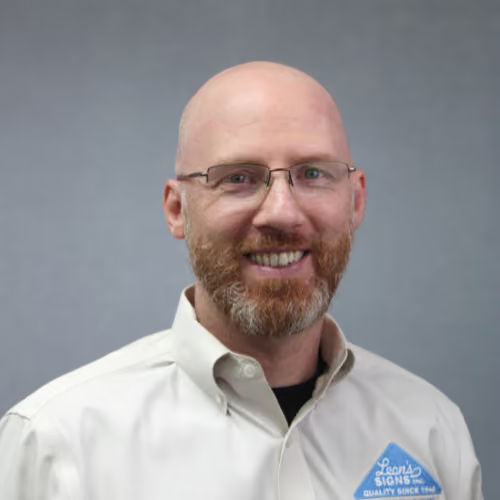
Host: Today's story is about the hardship of owning a small business. Back in 2017, Dan Verboski bought Leon Signs in Tyler, Texas. The sign manufacturer was 72 years old. $2.3 million in revenue, $650,000 in earnings seems sturdy and in fact the business has gone pretty well, at least on paper. Dan has doubled both revenue and sde. But behind the scenes, the journey has not been rosy cash flow crises, defiant employees, bad culture, hiring, missteps, burnout and depression. Leadership in learning it is a key theme of this conversation. You'll hear how Dan has evolved in that department, which has been fitful and painful at times. Now, in many ways, Dan's is a story of victory. He's a successful entrepreneur. He owns his own business doing over a million dollars in sde. He has an airplane that he flies as a hobby, but the toll it's taken to get there has dimmed his sense of accomplishment. Dan's story is one to keep in mind as you travel along your own journey to become an owner. And at the end, you'll hear us refer to his upcoming appearance in Houston. I've since confirmed the date that he will be on stage in Houston at the ETA Circle event. That's July 10, so go meet Dan as well as other Texas searchers. Etacircle.com to register for the event. Link in the notes okay, here's Dan Verboski, owner of Leon Signs announcements. Don't forget the webinar happening today, Thursday, June 27th how to buy a Business and Hire an Operator at Once hosted by Matthew Saskin, who bought a $5 million towing business and while going through his deal, found and hired an operator to run the day to day of his new business. Matthew's owned the towing business for over a year and a half. Now his operator is there running things and Matthew has kept his day job the entire time. He's going to teach us how he's done that. It is today, Thursday, June 27th at noon Eastern. Link to register at the top of the show notes where it says register for the webinar. If you can't make it, register anyway so that you receive a link to the recording after the fact. The webinar is sponsored by System 6. System 6 provides bookkeeping, payroll, invoicing and other day to day finance services to over 200 companies including more than 40 searcher acquired businesses. So register for today's webinar on buying a business and hiring an operator at the same time. Link at the top of the notes. Also, some amazing new opportunities listed on Smith List, the job board for operators and leaders of small businesses that we launched recently. A landscaping rollup is seeking a VP of Finance to lead M&A. They've done seven deals already. Four more are under LOI and another 20 are in the pipeline. This is a fantastic opportunity for someone with a finance background who's drawn to search and acquisition entrepreneurship. You will be dropped midstream to run the M and A of a fast moving rollup. Also, a towing business is spinning out one of its functions, a profitable function, into a standalone business. They're seeking someone to take this entity to market and build a team and a business with it. There's existing revenue and proven demand. You'll have the backing of the parent business and you'll participate in ownership. So if instead of buying a business right now, you want the opportunity to run one, to lead one, check out these opportunities and others@smithlist.com link in the notes okay, on to today's episode. Welcome to Acquiring Minds, a podcast about buying businesses. My name is Will Smith. Acquiring an existing business is an awesome opportunity for many entrepreneurs, and on this podcast I talk to the people who do it. What do the following Acquiring Minds guests all have in common? Doug Johns, Morley Desai, Tim Erickson, Chirag Shah, Shane Ursam. They all went through the Acquisition Lap, the accelerator in community for people serious about buying a business, but they represent just a sliver of the Lab success stories. The number of deals across the lab's cohorts now stands at over 120, with over $300 million in aggregate transaction value. The Acquisition Lab was founded by Walker Deibel, author of Buy Then Build the book that introduced so many of you to the very idea of buying a business. The Lab offers a month long, intensive, almost daily Q and A sessions with advisors, live deal reviews with Walker, Deal team introductions, and an active community of serious searchers. Check out acquisitionlab.com, link in the notes or email the lab's co founder, Chelsea Wood. Chelseauythenbuild.com Dan Verboski welcome to Acquiring Minds.
[5:54] Guest: Thanks. Happy to be here, Dan.
Host: You've been in your business for seven years and when you and I connected for the pre call, the biggest emotion I felt from you about this journey was frustration. Now you've doubled the business during your tenure, so on the surface things look good. But behind the scenes, as I understand it, this has been a slog. Fair. Is that a fair way to describe it?
[6:22] Guest: That's. That's a fair statement.
Host: Okay, well, this is going to be an important and illuminating story for the listeners, Dan. So let's get into it. Please start us off with some background on you.
Guest: Okay. I been an entrepreneur since I was a kid. I mean, just in terms of, of having that vision of doing something. I was the, the proverbial kid with the iced tea stand or the, the lemonade stand that was, that was from age 10 or 11. I had a dump truck to haul gravel in high school and went to the Marine Corps after I got out of high school. I was there for six years after the Marine Corps College. Got a degree in entrepreneurial, Entrepreneurial management and then worked for a grocery store called Aldi as a district manager for five years. Love that. Some of my, my formative years in terms of how I manage and how I thought of, of how things should work. Worked for a couple years for Target as a store manager and then went to the State Department. I was in the State Department for about two years. A little over two years and two and a half. I was posted to Brazil and one tour in. I had a really great tour. I had a great time in state. But I, it was, I'm not a government worker. I'm, I'm an entrepreneur. And it took that experience to help me figure that out. So came back to Texas with my wife in 2017 and bought a business. Just had, had set out to look for a business. Thought it would be in real estate because over the years I had bought rental properties and I thought, hey, property management is something that really, a lot of people really struggle with. So I thought we can do this better. So I had started calling a list of brokers. But at the same time, Dan, let
Host: me stop you because, because there's a. I want to slow you down a little bit and I want to ask some follow up questions.
Guest: Go for it.
Host: So first of all, how does somebody go from managing a Target to the State Department? Did give us a little bit on that pivot.
Guest: So Target. Leaving Target was not my decision. Leaving Target was when everybody between me and the president was new. And then the third time I met my boss, he let me go. That was, that came as a shock. So I had suddenly went from 60 hours a week of work to about four. But I took that opportunity that year. I bought five houses and I just took kind of a year to figure things out. And during that year I had applied for the State department position at 4, Foreign Service Officer and I got in. So I had, I had had a plan in my head to buy, continue to buy rental real estate and Then retire young. But what that year taught me was I actually, I don't think I'll ever retire. It was for first three or four months, it was great. For the next six, it was really boring. So I, I decided that wasn't, that really wasn't what I wanted. I didn't want to sit around and collect rent for the rest of my life. I wanted to add value, contribute somehow instead of just being a rent collector. So I, I set out to do the next thing and State Department was a really awesome opportunity. Very thankful to had that opportunity. It was, it was amazing. I met my wife in Brazil and so, I mean, it's really done a lot of great things. Fantastic group of peers I had there. But at the end of the day, I'm not a government worker. So for me, that wasn't, that wasn't the final stop. So after, after my first tour, despite it being a really good tour, I said, I, I just need to do my own thing. I'm feeling, you know, that point. I'm in my mid-30s and I'm, I'm thinking if I don't do something soon, then I'm not going to, I'm not going to have the energy maybe at 50, to take on a startup or buy a business. So I pivoted at that point.
[9:45] Host: Okay. And going back to your real estate investing year, so you accumulated five homes, five doors, single families.
Guest: Yes. Well, so I had, going into that year, I had five properties, which I had. I had started investing in real estate around 2002. I mean, I grew up, I grew up super poor and I mean, it was just money was always a worry. So I grew up thinking, man, I don't want to have to worry about money. So after I had left the Marine Corps, went back to college and had no money again. And then 9, 11 happened and I got activated along with a lot of other people. So I was back on active duty. I said, hey, I got a year, maybe two to figure out something financially to do. So I read some books and I decided I was a real estate investor. So I bought three houses in 2002, three, four that era. And as it turned out, one was a terrible investment. Ended up getting foreclosed on and went through that whole process. So I learned, like to learn things the hard way. And, and that was how I learned the hard way in real estate. But, you know, 2007, 8, 9, start picking up more houses. So I think I had five houses going into 2014, and then I bought five more in 2014, which I just figured out how to buy houses, no money down, and basically cash out, refinance, long term hold. And then when the market took off, really around 20, 15, 16, I started selling the houses and that formed the amount of money that I used to buy the business.
Host: Okay, all right. So you were at one point thinking that you could be a real estate investor only or accumulate enough of a portfolio that you could retire early. But then that became less appealing when you got a little taste of it and realized that you're just more of a doer than a sit on the beacher. Okay. And, but you also, during this experience, you have the insight that real estate, the property management is something that is not done well. Often people are often not pleased with their property management business.
Guest: Right.
Host: So that planted that seed. So you're in Brazil, decide you can't be a. Oh, by the way, how's your Portuguese these days?
Guest: It's actually, it's not bad. I have to brush up. Every, every year pretty much we go down and visit her family and it always takes a little bit of a brush up session to, to get me back into fluency, but, but I get along okay.
[12:04] Host: And you and your wife here, back in Texas speak English, I assume, to each other?
Guest: Yes.
Host: Okay. All right.
Guest: Unless we want no one to understand what we're talking about and then we switch to Portuguese.
Host: Yeah, sure. My wife speaks Spanish, so that one doesn't quite work for us because too many Spanish speakers around. Portuguese. Portuguese a good one. All right. So having a great time, really fulfilling as a diplomat essentially in Brasilia, I assume.
Guest: Yes.
Host: Yeah. But decide that being an entrepreneur is your true calling. So you set your sights back on the States to do something entrepreneurial. So do you, so. And how, what does that look like? Do you start actually searching for a business to buy from Brazil?
Guest: Yeah. So I decided that real estate was, was my thing. So I started coming back, I think the beginning of 2017. I came back to the States about once a month, I think. I attended the, the NARPAM conference in Vegas, national association of Residential Property Managers and just started networking. I got a list of brokers from the state of Texas and just started calling them one by one. I rented a little office space, just a little, I don't know, 10 foot by 10 foot, little space to just have someplace to go to start making calls and really just started, started calling people and figuring out who's got a portfolio of properties that they could sell. Now during that process, we moved back, I think May 2017, and I had, I Knew a lot of people in Fort Worth because I'd lived here for years before, lived there for years before. And I started just mentioning in my network, hey, I'm looking to buy a business, probably property management, but open to whatever. And it came back around that somebody had a sign company for sale. So I met the guy representing the seller and we talked about. And I think within a month and a half I had a handshake deal and in October we closed, I think we had a handshake deal right around the 4th of July and we closed in October. One thing I've learned. So I've been binge listening to your, your podcast in the last couple months or last couple weeks and I can say that I knew breathtakingly enough if anybody who is listening to a few of your podcasts knows 10 times more about buying a business than I knew. I mean I, it just, it seems like when I listen to these stories about these people that bought these businesses, I, I feel like I just walked in off the, off the street and flip flops eating a candy bar and so yeah, I'll buy that. I mean it just, it seemed to go really, really easy in retrospect or at least with the benefit of knowing how what other people have to deal with. But now, I mean listening to this and being involved with ETA Circle and just different things. My wife got an MBA recently, so we're just kind of learning through the grapevine of how everybody else has does it while it, that really seems breathtakingly easy how I bought the business, although that was, didn't turn out to be that way later.
Host: And, and so we're getting ahead a little bit here. But do you feel that your naivete, for lack of a better word, is why on the backside of your transit transaction, in other words, your, the years of operations have been harder because maybe you chose a business that if you had been more educated on buying a business, you would not have bought. Is it that or not necessarily even
[15:07] Guest: I, I would have bought this business. I would have bought it different. So one of the number one things I didn't do is I didn't buy the ar. And this is a business with about a, I don't know, call it a 10 to 12 week cycle between the time you sell a job and the time you, you bill a job. And then of course you get typically another 30 days to, to get that, you know, to collect on the money from the job that you bill. So I, within three months I drove it off a financial cliff that was, that was A bad decision and I was, I was uneducated on the market, on what this industry is. This is a very, very small industry with 100,000 people. And I having more knowledge about what this, what that meant to a business owner would have been very beneficial for me earlier in the game. I, I just would have benefited from, from being, you know, going from being proactive instead of being basically completely reactive for probably my first year or two.
Host: Okay, well let's, let's go ahead and get into it. So when you are kind of working your network back and forth worth to find a business putting out feelers saying property management but open to anything sign business comes across your desk. What did you like about this business? What did it give us some of the bullet points on, on the business and tell us what you liked about it.
Guest: So at the time it was a 72 year old business. This said it was owned by the third generation owner and her husband and they had, they had owned it for about seven years. They had reasons that, medical reasons that they wanted to step away and retire. They didn't have any children. The numbers look good. This, this was a business doing 2.7 million a year with about 650,000 in SDE. So it said, hey that, that seems like something I can work with. Yeah, so that was. And really, I mean aside from an entrepreneurial degree 10 years before this, I didn't really have any experience looking at financials. I did have a group of people so my CPA was involved in it, the banker of course. I had a consultant and then my attorney who all were part of this team. And I had them all looking at it. And I mean throughout this whole process I'm thinking there's no way the bank's going to give me money to buy this thing. But if they do, sure, it looks like a great business, I'll give it a shot. So it was a little bit more kind of driven by if they'll give you the money, it seems like a good business.
Host: And the cost of the business. Did you have any sense for what something like this should cost and that kind of napkin math of paying for the. I mean you're a real estate investor so you probably understood this concept well. But, but high leverage and then paying down the loan out of the proceeds of the business and hopefully having some left over to pay yourself and reinvest in the business. That kind of standard format you figured out on your own?
Guest: Yeah, I mean it was just get back of the napkin math, Google some things and I mean the number I had in my head was six hundred and some thousand dollars like oh, I'm gonna have six hundred and some thousand dollars a year like to, to do whatever I want with. And, and that's really not how it works. And so yeah, and of course I, I leveraged the, the hell out of it. So the seller took a note that was, I think they took about a 600k note.
[18:14] Host: The.
Guest: I put maybe a hundred thousand into it. 150, 000 which was mainly just working capital. And then the bank financed the rest which I want to say I paid one. Then I had the real estate too. So a million dollars in real estate plus call it 1.6, 1.7 for the business. And pretty much all of that was financed. So then when I bought it. So then of course I got to grow the business because if I can keep my debt payments the same but increase the, the amount of money coming in, then that seems to work. So it was, it was buying a business in an industry that I didn't know with people that I never met, which was also one of the lessons. I would never buy a business again without meeting the employees. And that's, that's a, that'd be a red flag for, for many reasons but so I had all these things working against me and then I needed to grow the business and you know, make payroll and that sort of thing. So very shortly, I think my first year I sold another house or two and then my second year I sold another house or two until I got down to one house because I think I'd sold five in advance of this and then got all the way down to one because got to keep the doors open. I mean it's on that personal guarantee. The bankers are smart when they have you do that.
Host: A PEO run by a searcher for searchers. If you're running a company with less than 100 employees in providing health insurance, you could secure better benefit plans at a 15 to 30% discount through, through a professional employer organization or PEO. Aspen HR, run by search fund veteran Mark Sinatra, understands the needs of search operators and could be a great solution for you to receive HR compliance and diligence support. A powerful HR tech platform and Fortune 500 caliber benefits all for a fraction of the cost. Check out aspenhr.com or contact Mark directly at mark aspenhr.com well I was going to say Dan that it seems like you got a pretty solid deal for a business doing 650,000 and, and a million dollar piece of real estate for what did you say for. So the two.
Guest: Yeah, so 2.7 total.
Host: Call it 2.7 total now. So on 650 in revenue. So that's what, three and a half. A three and a half multiple. Do I, do I have that right? No. Four and a half. Four and a half.
Guest: But I think three and a half. Three and a half, thereabouts, because it was basically as a multiple of ebitda, which was less than the sde. But, but that came out to, I think it was about a three and a half multiple of ebitda.
Host: Okay, okay.
Guest: All right.
Host: And the real estate aspect of this, how did that factor into your thinking? Was it just part of the deal? So you were like, okay, I'll buy the real estate or did you, did that appeal to you as a former real estate guy? Former, former and current real estate guy?
[21:05] Guest: The real estate was okay. I mean, I didn't want to rent from somebody else. I didn't want to have, you know, that variable to have to deal with. That said, this is not, this is kind of the industrial part of town. So I think most of the years I've had it, I get a notice from the tax department every year that my value has gone down. So I owe less taxes. So there's, there's that. So maybe. So I'm not going to get gentrified out. So that's, that's the good side.
Host: Okay.
Guest: All right.
Host: Well, and, but then of course, what you paid for the business is not really what you paid for the business because subsequently it sounds like you had to put more and more money into the business as you sold down your real estate portfolio. How much additional money do you think that you, you, do you think you put into the business?
Guest: Well, the time I bought it, we didn't have a single truck under 10 years old. And so my, my first year, I think we spent maybe close to a hundred thousand dollars on vehicle repairs, which I decided was crazy. So I needed to recapitalize the business because they had not been doing that, which, I mean, I get it, you're trying to sell a business. Why, why buy quarter million dollar trucks left and right? So I needed to do that. So that's, I probably bought a million and a half dollars worth of trucks in the last six while expanding the fleet. So, you know, some, some of it's just replacement, some of it's just a brand new truck that we, we didn't have before. So, so trying to get the average age of the fleet down so that they're more reliable. Yeah, that's, that's been a big, the big capex expense. And then just, just things along the way is. I mean, we've got the same amount of square footage we had, but we need new offices, we need new phones, we need new computers. And so just, just doubling the size from 17 employees to 32 or so that we have now. I mean that, that's carried its own costs.
Host: Sure. But I'm trying to understand how much you came out of pocket for this because a lot you, what you hope is that a lot of the, the money that you have to put back into the business is coming from the profits of the business itself.
Guest: Right?
Host: That's, that's the, the, the design doesn't always work out that way, but it sounds like you had to come out of pocket a number of times. Do you, do you have any sense of how much additional did you put another hundred into the business over the years?
Guest: 250 or 300, which I, which alone. And then I slowly paid myself back that loan over. Over several years.
Host: Okay, so let's get in now to the operations. So the is, is kind of the first slap in the face this AR problem. You didn't get the AR with the business and then to, I think financial cliff was your, was your term of choice. Talk to us about what happened there.
Guest: So, yeah, I mean, just it by January. I bought it in October. By January, the bank account's running low. And I said, man, I put 150,000 into this. You know, me just very limited understanding of, of this level of financials is like, why, where's my $650,000? Like that's, that's. This thing's supposed to be producing money. Where is it? And then, so that was the first hurdle which, you know, I had more money to put into it, so I did. It wasn't a game changer. But culturally that was probably the biggest difficulty for, for years. This is a, this is a business that had been doing things. I mean, so. So 2.7 was say our sales year of 2017. Number hadn't changed since 2010. A lot of people had been here for a very long time. So I discovered that, you know, so I, one of my values, personal values is just growth. I, I want to, I want to be better tomorrow than I was yesterday. And, and that is, that is intrinsic to me. Organizations have values too. And when I think their value was, was more stability. The way we did it yesterday is the day we're going to do it today, and the day we're going to the way we're going to do it tomorrow. And so this new guy coming in, talking about change, talking about growth, I mean, it was like a, hey, whoa, this is, this is too much. Slow down. You know, and so I think that was, that was never received well. And, and when you're in a specialty trade, I mean, there's probably 50 people in my industry within 100 miles. So, you know, if I have a salesperson that's not working out, or a fabricator or an installer, it's not like I could just put an ad out and I get 50, 60 applications from other installers. No, there's. There's not. So, so that's, that was probably a year in before I realized how hard it was going to be to grow a business in a smaller market town of a hundred thousand people. Specialty trade. That was probably the hardest part of the business for me.
[25:28] Host: Okay, so. So two things there, the cultural resistance to change and then the related problem or recognition of a very thin pool of talent in your local market. So, I mean, that just presents problems on its face that if somebody quits or moves or whatever, you're going to have to replace them. It's going to be hard to replace them. Right. But also, I think kind of the way these two points are connected is that. And you'll hear my guests, some of my guests talk about it is, you know, people get off the bus when, when, when the owner comes in and wants to introduce a new culture. The people who don't like this new culture will leave. They'll either be let go or they'll choose to leave. And you replace those people with people then you've chosen. And so you cycle in a new cohort of employees, basically. Right. Who are amenable to your culture, your new culture. And so that was not something that you were going to be able to do very easily, maybe, or all in a, in one fell swoop, maybe gradually. Which is, I guess, is indeed what's happened because.
Guest: Right.
Host: Jumping ahead again a little bit, you have one employee from that time that has remained. And, and the other 32 or 33 are all people you hired subsequently.
Guest: Yes.
Host: So. So you've done it, but it's taken seven years. And would you say that today your culture, the culture of Leon's is the name of the business Leon signs is Dan's culture.
Guest: I wouldn't call it still.
Host: No.
Guest: My culture.
Host: It's. It's the culture you want.
Guest: Okay. So when I got here, it was their culture, the employees that were here and For a while it was my culture because this is what I want. And now I have a group of people that I would say it's our culture because I'm not the only contributor. I'm not the only contributor to what I want this place to be. There are other people who have that level of buy in who say, I want this to be the kind of place that I enjoy working. That's what I've said since I got here is like, I want to have the kind of place where I would have wanted to work 10 or 15 years ago. I want the kind of place where. And I've said this to every employee, I continually say it, it's never not been true that if your ability ever outweighs your opportunity, just raise your hand and we will delegate more to you. So that's the kind of place I want and other people contribute to that. Everybody that's on my administrative and sales side all started as a project assistant, which for us is an entry level position. So everybody that's in those positions has stepped up, volunteered, and they've been able to, to do more. So I would say that now it's, it is the culture I want. It is not necessarily Dan's culture because I, I think of how I would want. There's not everything is how I want it. But part of this journey is figuring out that maybe that's okay. It doesn't have to be my culture because I'm not the only one that works here. Other people investing their lives and careers in this place and you know, as long as it's a positive culture, I mean, we've got some, we're an EOS run company, so we're very specific on our values. We talk about the values, we hire to them, we hold accountable to them. So since we're all aligned on those things, I'm okay with that. And those values didn't just come from me. I mean, it was something that we, an exercise we did as part of the EOS process to come up with those values. I would chose a slightly different set, but it's okay. Again, it's not, it's not my culture. It's. It's more our culture now.
[28:41] Host: Okay, okay, well, let's rewind back to the early days where the culture is definitely not your culture or a culture that you would like. And it was a culture that needed to change. Can you give us a sense of what it was like, what did it feel like, and really try to communicate here to people who might be out there searching for their own business and what it can look like and feel, feel like to get into a business that you've now acquired and are responsible for and have a personal guarantee against and find out, oh, this culture, this culture, this place doesn't feel right.
Guest: Well, for the first three months I had the owner, so, so the, the husband, wife, owner, which, that's the other thing. I replaced two people with decades of combined experience in the sign industry. And by the time they left three months after I'd gotten here, that was, I mean, that was, it was just me and those two positions. The, when you first come in, there's a honeymoon stage. Oh yeah, you know, let's follow you. Let's, let's do this. My first inclination that this might not be the culture that, that I was envisioning was in. I think it was December 2017. So I'd been here maybe two months. I'm having a meeting with all the employees and I'm talking about some upcoming changes. And I said, hey, at the time we had an indoor smoking policy. We're not, we're outside city limits. So it was, it's legal to smoke inside the building. And I figured this is some low hanging fruit. So at this meeting, I'm in front of all the employees, I'm kind of smirking a little bit. I say, hey, guys, this year we're, we're going to, on December 31st, we're going to end the indoor smoking policy. So effectively we're going straight from 1965 to 2018, which I thought was kind of a clever thing to say. Like I, you know, laugh at my own jokes or whatever, but they didn't, there was, there was just, I mean, there wasn't a whole lot of smokers, but it was just like just, just deadpan faces, you know, And I, I said, okay, all right. That wasn't, that wasn't funny. But we still did it. And that was, I, I think I maybe would have changed things slower, I think I, I, looking back on it, I, I, that was probably, you know, it's not like somebody was in my office blowing smoke in my face. It probably wasn't, it felt like low hanging fruit. Like, hey, I can come in and make an immediate improvement and that will be, you know, give me some buy in that sort of thing. That's not how that worked. It was, that was the, probably the first gauntlet when they said, okay, yep, this isn't our guy. And, and they just, they resisted so hard. And even though there weren't many smokers,
[31:03] Host: so it was really kind of resistance to the concept of change. Not this particular change.
Guest: The, the idea of change was just completely foreign. I might as well come and speak in Portuguese. I think it was just, it was that different that, you know, no, this works. Why would we change this? Well, because, you know, like anything else, any, any institution, any organization, you're growing, dying or dead. We're not growing and we're not dead. So what does that make us? So, I mean, and there was a, obviously a personal motive because if I don't grow the business, I mean, I didn't take a salary for, gosh, probably. I mean, I, I took maybe, let's call it 25, 000 a year. I took for maybe the first two years. It wasn't until the fall of 2020 when I said, hey, you know, I can finally afford to pay myself more. So three years in, I gave myself a salary. And I think at that point I bumped myself up to 50 or 75. And I don't make a whole lot more than that in terms of what I pull out is not a whole lot more than that now, because every time we make money, I'm thinking, okay, let's get another truck. Let's get, you know, we need, we need a new printer. We need to do, you know, what is, what is the thing that we need? Because in my mind, I'm running a marathon, not a, not a sprint. So I'm more interested in what our profits will be in 2030 than I am in 2025, which is probably, probably a little too forward thinking. But yeah.
Host: And Dan, now let's bring back your point that if you were to buy a business today, you would meet the employees, which of course is not always possible. Indeed, it's often not possible, obviously for the reasons that the owner doesn't want to scare the employees and often the buyer doesn't want to scare the employees. But there's all kinds of pretty clear reasons there. But if you had met the employees or in your future acquisitions, what will you be looking for? An openness to change or just good chemistry or what?
Guest: Yeah. So of the values that we have, one of our values is growth minded. And when we sit down with new employees or we're talking in during reviews, that's my number one value. Because all the others, if you can grow, if you can learn, than anything else we could do together. But if your immediate reaction to change is, no, that's not, that's not for me, then, then we're really kind of stuck. Because even if we run perfect today, which we do not. The world out there is changing. I mean we just got aluminum in metal tariffs announced two weeks ago that that will affect our business. How's that going to affect our business? We need, you know, can we, can we pre buy metal? Can we, you know, what can we do? So I mean all that stuff's always changing. So even if we're perfect, we still have to change and we're growing. So what works at a, a 5 and 6 million dollar revenue company doesn't work at a 10 million dollar company. And in turn that won't work at a 15 million revenue company. So it's, it's the number one value I search for. So I guess I would if I couldn't meet the employees. If we go later to acquire something new, another location or whatever and I can't meet them, I at least need some measure of way of measuring that. Is this your value? Are you going to be excited about new career opportunities? Are you going to be excited about hey wow, we've got, you know, we've got a few new people, we get to train them or is that going to be, you know, wait, we don't, we, we don't want new people And a lot of, I mean this is a, this is a industry with a hundred thousand people spread across 30,000 businesses. So the average, average business has three people. So I mean we're, it's hard to find a culture that is actively thriving and growing without bringing people in from outside the industry.
[34:37] Host: A couple thoughts here, Dan. One is that one thing I kind of feel like I've gotten from guests is that in the trade specifically there, the idea, you know, the kind of the growth mindset thing is maybe less present than in you know, white collar land. I hate to make the blue collar, white collar stereotypes, but just kind of big career ambition, do big things. Growth, growth, growth, growth mindset like you've said, maybe just isn't as, as, as commonplace as it is in a, in a, in an office with people who are all trying to have capital C careers. I'm treading very lightly here. But can you react to that? Do you think it was just the culture of Leon signs or do you think that this might be a little bit more endemic to this type of work across the industry or across trades?
Guest: I, I think you can certainly enforce or go against a culture in your industry. I think that, I mean I, I spend enough time around enough sign company owners and another sign, another visit their shops to know that growth minded and in our Trade specifically is not, you know, it's not. Maybe it's not rare. Maybe not every company has, hey, let's change, grow, get better. But it's not unheard of. Now if we separate and say, okay, the people that work in my office or sell the signs and the people that build and hang my signs, I would say most people who build and hang signs are doing that because they like to make things with their hands, or they like to work outside and have the independence of being on their own truck with their own helper, or they, they like to just take metal and make cool things. And so maybe that guy doesn't want to be the president of the company. Maybe that's, you know, that's, maybe. I wouldn't say ambition is uncommon in my, in my billable team, but I think it's, I think it's not why they come to the sign company. I don't think they, Somebody, somebody seeks out a job here and say, hey, can I start a defabricator and one day be the president? Whereas the person who's selling or the person that's, you know, coming to the office, maybe they do think that. Now. Yeah, I, I, I struggle to say, say that the people don't want to change, just tradespeople in general, because I, I see the guys walking around and, and you know, they have pride in where they work. And one of the things we, we talk about, one of our values, always do the right thing, and sometimes I get pushback from our guys. Oh, wait, why are we giving the customer this? You know, it's their fault. And I said, well, because it's $200. And you can take your, your shirt where you walk around, your logo on anywhere in town, and if people know who you are, they say, oh, yeah, y' all do good work, you know, and so we have that reputation, so you have that pride. And so it's, it's just one of those things where I think that's important to them. I think it's important to me. And, and I think it carries for a lot.
[37:36] Host: Fantastic. Thanks. Dan. You had another story about dealing with employee challenges. There was a toxic employee in the business. You care to share kind of what happened there? Just to give people, you know, a picture of what can happen.
Guest: Yeah, so, so maybe if I can't meet every employee, I want to meet the, meet the employee that's going to be the person running the operation. So we had, I would absolutely call this a, a bad culture. When I bought it, maybe the first, first few years but when you have an employee who's, who holds your electrical license, because, I mean, we're an electrical sign manufacturer, so we have to have a master electrician on staff. So if that person has different ideas than you do, and mine did have different ideas than me, and we locked horns at the end of the day, I mean, yeah, that quote unquote, that person needs a job. But I mean, I don't have an electrical sign manufacturing division without a master sign electrician. So first of all, I'm in a situation where somebody's got power over me.
Host: Yeah.
Guest: And I, I said it more than once my first year or two is, is it dawned on me for several months in, it's like I'm just the monkey signing the checks. Like, I, I don't, you know, I, I say something and then I leave the room and it changes and it just, it very blatantly changes. And so I got this, this person who by the way, had two family members in the business who is actively working against me. And it was just, it was unhealthy. It was, it was the relationship over, over years. You know, I finally got to the point, point where I got a coach at one point and it was, it was so, it was wearing on me so much, and I know it was wearing on him, on him a lot too, is that we just weren't getting along and this was toxic. And I, I, he, he did something very blatantly. You know, I had a whole group of employees standing in front of me and I'm talking about how, how important our employees are to us and how important our business is and, and you know, how much we care. And he's, I didn't find out about the time, but he's standing behind me rolling his eyes, you know, scoffing and, and in front of everybody. And so I find out about this afterwards and at that moment, it was pretty much our come to Jesus moment and said, okay, one, one of us is, one of us ain't staying and I own the thing, so we gotta figure this out. And over the course of the next few months, we, I, I basically held him accountable, which, the specialty trades. That's a whole another topic about holding people accountable about accountable in an industry like this. But I held him accountable and, and he left and he's doing his own thing and, and I, I think it, that was really the best thing for everybody. But I mean, it was, that was the moment when he left that we started to change in a positive way as a company. And that's Where I probably did it a year or two too late. But, you know, I fear, fear of, of what happens if I, you know, I'm trying to run a, run a $3 million business, trying to be a $4 million business. And what happens if I lose the guy that's, you know, that holds our electrical license? Well, now I'm suddenly going to be running a $2 million business, but my bills ain't going to go down. So, so how do we handle that? And so I, I was just, I felt stuck for years and it, and it took a toll.
[40:41] Host: Well, let's really get into this, Dan. This, because this is the pattern here is probably one that happens a lot to people and they don't know how to get out of it. And maybe there isn't a clean answer, but if you were now coaching somebody who finds himself in a similar situation where they feel like an employee has them by the, you know what, because of a license or some other power dynamic and there's a toxic relationship, that person obviously needs to go, but there's a big, big cost and risk to letting that person go. What do you advise? What should you have done differently? Because it sounds like other than let them go a year earlier, maybe that, maybe that's the answer.
Guest: Like, I don't know that that me personally, and that's. In that time and that headspace, I could have done anything different. But, but after that, I mean, I made, I made the decision that nobody was going to hold me over a barrel. And so I've, I mean, I've, I've had, I've locked horns with employees now that they're absolutely key to the organization. And I just know this is, this isn't how we're going to do it. You know, this is, you know, if it has to be, I'll push as hard as I have to to get what I want. But this is, this is just how it has to be. If I, if I lost, if I lost a key employee tomorrow, I've got enough network of other sign company owners now that I could, I could muddle through until I found somebody. I've been willing before to pay people to move from different markets to here. I've, I've hired some signed professionals from outside of our market. It's very hard to do. It's expensive, but it's doable, you know, and, and really, it's really hard to manage this size business in a small market. So, so in the long term, what will insulate us from this is, is if you can be a part of a bigger company or for us acquire another company our size or bigger and so that we've got a bigger pool of people. I mean that, that is probably the only right answer because I mean I, I, I think it's just hard to for somebody like me who, who didn't know anything about sign industry to hold accountable somebody who knows 20 or 30 years more about this industry than me and a very technical knowledge and then hold that person accountable. And, and, but if I, I think if I had been able to do that, I can't say the relationship would have been salvaged. But I said I would have said it would not have gotten as far as it did. It would not have gotten as toxic as it did and as, as blatantly going against me as it did, it would have been it had been nipped in the bud or we'd have parted way sooner.
[43:07] Host: Yeah. And so when you did let him go, what, how did you deal with this problem of the license and, and his 20 years of experience walking out the door?
Guest: Well, fortunately Leon's little brother is still alive. We have a good relationship over the years. Leon himself, founder of the company, passed 20 years ago, but his, the younger half brother and he had worked in the company for over 50 years, maintained his electrical license. So there for a year or two he was our electrical electrical licensee of record which allowed us to keep going. And then we just have been able to hire. We got really lucky in 2020 with the way Covid changed things for one of our biggest competitors. They, a lot of their people left and we picked them up. So we ended up hiring I think half a dozen experienced sign people in 2020, which was kind of a once in a generation opportunity. So that's, that's been, that's been beneficial for us. So we have, we have an employee now who carries our master electrician license. But we have, we're actively investing other people to. Let's, let's get our journeyman licenses. Let's, let's move up and get master licenses as we're able. We pay them more for it, but even if they're not our record holder license like or licensed record holder, but we encourage people and we try to try to train and develop to the, to the extent that we can.
Host: Well, it sounds like what in that moment or with that relationship with that employee and how you've kind of changed is what you decided what the kind of before and after was afterwards, no matter what pain there might be of having to let an employee go it's less pain than insubordination. This guy was being openly insubordinate.
Guest: Yes.
Host: And you were absorbing and absorbing and absorbing it because you needed him. And then you decided at some point you couldn't take it anymore and decided no more. And, and it sounds like that's now your orientation going for you forward. You will not tolerate insubordination even when an employee has, you know, this or that, you know, leverage over you or, or has some sort of, you know, there's some sort of risk to letting them go.
[45:22] Guest: Yeah.
Host: First of all. Yeah.
Guest: And thing I want to add to that.
Host: Yeah.
Guest: You know, when, when you've, when you've taken everything that you have, your entire life savings, you, you've sold or leveraged everything you have, and you put it, you know, going, you put it all on black and you say, I'm going to let it ride. I'm tied up in this thing. So either I'm going to succeed or I'm going to be bankrupt in my 30s with ban and some dollars in personal debt hanging over me and have to go rebuild that. So the fear of that was, had I been in a stronger financial position where I, yeah. Maybe didn't have a personal guarantee or had my own money that I used to buy it or something like that, where I could have just said, hey, okay, I'm willing to go down to 2 million for a couple years to get this figured out. But, but it just, it really felt like I was trapped. I couldn't shrink the company. I couldn't get rid of him. I couldn't. It was very, I mean, and just figuring that out, I would, I would, I would talk to people, I would talk to, you know, business coaches, that sort of thing, and I'd tell them the story. And it was always like, huh, yeah, that sucks. I mean, yeah, it does. And, but I don't know what to do about it. So I think never getting myself in a position of, of leverage where I must take course of action A, I can't take course action B or C, because I can't afford it. I have to take courses. So I limited myself in how I bought the business. And I, I should have. I, I won't do that again if I buy another.
Host: So one of the things we talked about on the pre call too is that like there's going to be some level of kind of misbehavior or people are, you know, employees are going to do things that you don't like. And this really kind of goes for all small Business ownership. And if you're coming into small business ownership, being the leader, owner of a business for the first time, part of what's difficult is that of course you have to let some of the misbehavior just go and then other misbehavior not. You have to discipline it. And figuring out where that line is is really, really difficult. And maybe there is no clear line that just is you, you arrive at the line and therefore it's clear going forward. It's every case you're kind of deciding, not deciding, deciding, not deciding. Parents will recognize this. This is the, this is the same thing. Not to sound paternalistic about employees, but this is the same thing with children. Like your kid's not going to act perfectly, but you can't just walk around correcting them and disciplining them for everything that they do wrong all the time. You have to choose when it makes sense.
Guest: Right.
Host: And so open insubordination was a pretty clear violation that couldn't go unpunished. And, and that was a wake up call to you. But talk more about this theme. Do you feel like you found, do you still feel like you're looking for that line all the time? Have you gotten used to, have you built a muscle there? How do you deal with it today? Or how have you evolved and gotten better at it?
[48:10] Guest: Well, it's funny that the further you go in the journey of leadership, I can look back seven years ago and say, see what all my gaps as a leader, because my gaps as a leader become the gaps as us as an organization. But during this process of trying to figure this out, I mean I, I worked so hard. I mean I, I completely burned myself out. Like 2000, I mean 20 and covet hit and 21. I mean I, it was probably 20 and 21 were probably two of the hardest years of my life because I, I burned completely out and I, I still had to come to work. I mean, there was days I just didn't feel like coming to work, but it was, it was just, I don't care if the place burns down kind of thing. So when you go through that, it's, you know, it's, do you catch me on a bad day? You know, to catch me on a bad day, then it's, it's, you know, I'm going to be a lot more rough on somebody than maybe if it's a good day. But there's a lot, it's almost like having, having gone through that. I can tell you that it's, it's almost Like a raw nerve that, you know, I, I, you almost lose control of your emotions. Like, I didn't want to get so angry, but I got so angry, you know, I didn't want to get, you know, and it's just, you lose that resilience of, of maybe saying, hey, let me, this, this seems like a bad situation. Let's step back and look at this for a minute. And it just, you become very reactive and very harshly reactive. And I think that's, that under undermined my own progress because it was, it was, it was very hard to deal with, you know, when you're, when you're trying to recover from burnout. But you can't just take a month off. Like, I mean, I, I have been essential in this business for seven years. I mean there's very, very small periods of time that I've been able to pull out, take a week or two off or whatever, but I've never been able to work myself out of the business. So to go back to your original question about figuring out where that line is, I think I'm a lot better at it now. And I worked very hard at being consistent. And now that I've got a regime of, of being, you know, I invest in my physical health, my mental health. I work out all, almost every day. I've got a 10 minutes of meditation most days, do walks with my wife where we just kind of talk things out. My wife was in the business, which was a complicating factor because she was kind of a fly in the wall to see all this stuff for the first couple years. And then she ended up leaving to, to do her MBA or leaving, leaving the business to do her, her mba. So now we can talk about the business. And she's not emotionally invested. So I've got somebody that I can kind of just vent to. I've had a couple different coaches over the years that's been very beneficial through associations, through the Texas Sign association and the World Sign Associates. I've got groups of people that I know that I can call and say, hey, this sucks. What, what would you do about this? And so just, I think a combination of all those things has allowed me to be a better leader and then just practice. I mean, I have done everything wrong in this place that you could have done wrong. I mean, I've, I've made some serious screw ups. Maybe not everything you, you could do wrong because we're in business, we're making money.
[51:09] Host: Yeah.
Guest: But it's just, it's been a really, I'd Say this is in, in addition to being the hardest experience of my life, which up until now was learning Portuguese in six months, that was, that was previously the hardest experience. The, the contrast of running a business and being successful is that you cannot simply put your head down and work harder. Everything else I've done in life, aside from learning a language, Marine Corps, just put your head down. Yes sir, no sir. And work harder. Retail, all the target, just, just work harder. That's all you have to do is just work harder. And you get to a point in language learning like business, where just working harder isn't enough. You have to work smarter. You have, you can't just be active, you have to be productive. You have to be working on the right things. And so, so just learning all that and figuring out having enough time in my day to step back and be the visionary and not just the sales guy, not just the, whatever it is that they, you know, have to do around here today. Sign something or make a decision or, you know, it's, it's hard to, hard to get in that perspective. But, but when I have been able to, that's been one of the, the things that has allowed me to grow and, and to stay with this business without completely just burning out and selling it years ago.
Host: And the, that burnout period, how did you get through it? Did you just kind of muddle through and therapy and meditation habit and start going to the gym kind of like little by little? Or was there, was there something more dramatic that you did to really pull yourself up?
Guest: It was, I mean, it was. There was a period of a couple years. I was just, I mean, I think for the most part I maintained positivity at work as much as I could. I don't think I was a black cloud around here every day, but it took a lot of energy to not be a black cloud around here every day. And my leadership team got to see some, some ugly moments where I just was not happy. But by and large, I mean, I would just, I would just go home and just collapse. I would just lay around, I'd fall asleep at, you know, 4, 5, 6 o', clock, whatever time I got home and I would just sleep to the next day and then drag myself out of bed and go do it again. And I think just, I mean, I don't think my friends and family enjoyed being around me very much because I just, it took all my energy to be positive here. I knew I couldn't come in and just start throwing things and jump up and down. I mean, that's you know, people gonna think I'm crazy, and then they're gonna quit. Then where will we be? So I was doing my best to be positive here, but. But outside of here, just. Just not. I didn't really have anything going on. Yeah, I was just depleted. And so. So over time, you know, I. I could logically step back and say, this isn't the person I want to be. This is the life I dreamed of. I mean, I own a business. I mean, as of a couple years ago, I own an airplane. And this is like, I'm. Why am I not happy? You know, like, it's. It's me. You know, it's. It's. I have all these things that I said I wanted. I spent my whole life dreaming about. Now I have them. I need to be a little bit more positive. And it just. But. But you can't just flip a switch and say, oh, okay, I was negative. Oh, now I'll smile and be positive. That's not how that works. So we just. It took a lot of effort, a lot of just. I mean, my wife was absolutely pivotal and going through this with me and kind of helping me, you know, reason through it and think through it. And, you know, she's. She's always planning vacation, so we would, you know, on a Friday afternoon, we'd punch out, we'd go to, you know, go to the beach or, you know, rent an Airbnb somewhere or go somewhere, do something. And so that was. That was helpful. And then. And then last summer, I just. I finally made a decision where I was mentally healthy enough to say, hey, I'm just gonna. I'm just gonna be the most positive person I know. I just. I just really have to invest in that. So I got back into running. I had been. I hated running when I was in the Marine Corps. Now it's like, hey, I get to run. I don't say I love it, but it's. It's something that gives me health, and it makes me feel good. So I run, I work out, just. I just invest in myself. I spend quality time with my wife. I do the meditation, and It's. It's. I'm 90. Back to the mental health that I think I was at in the peak of my, you know, 15, 16, 17, that era. But I'm not. I'm not 100 there, but I can see it from here. So that's been. Man, that is something. It's been quite a journey, and it's been. It's taken a toll on me. I Mean, but I think it's, it's something coming, having come through it and, and I'm still here and I, the business is still here and we're doing okay and, and I, you know, it feels like I'm not out of it maybe like there's still days that it's just like, oh God, this you something happens. It really sucks, you know, now what. But by and large it's, it's taken me to a different place and a different level as a person where when I came into this thing, I kind of had this, maybe not, I wouldn't call it entitlement, that's too strong of a word. But it, you know, you bought a business, you bought a multi million dollar business. There's kind of this feeling like, hey, I made it. Like I'm, Yeah. You know, I'm good enough in life that I did this thing.
[55:58] Host: Yeah.
Guest: And that's why I think the last seven years have been the most humbling of my life. It's like just when you get there, just when you get to the, what you think is the finish line, like, hey man, I made it in life, that's actually the start line, you know, and so now I'm, I'm self aware enough to know that hey, if, if something good happens tomorrow, okay, let's, let's take that with a grain of salt because the backside of that might be something different that follows it. So I think that journey of kind of the investment in myself and going through that and being here to speak about it is transformational for me and it's helped me become a better person and hopefully a better leader.
Host: Dan, we just, I think we need to understand better how you know, you're doing in and with respect to the business because you yourself said, you know, you're, you're quote, living the dream. We all recognize that's naive, but you know, if you on paper it looks great, you've doubled the business, you have a plane. But then I also just heard you say we're still here, we'll, we're still standing, as if the business is barely holding on. So, so give us, if you can, a clear eyed sense of how healthy the business is. Yeah. And then tell us about this plane.
[57:14] Guest: So when I say we're still healthy, we're still here, there were, there were months or maybe even years at a time in the worst part of this thing that if somebody had just walked up with a check that made any kind of sense that I've been like, here, here's the keys Take it. I hate this place. I mean I, I did not like being here. I did not like this company. I did not like my life. I mean it was very, very visceral feeling that I felt negatively about this place. I would have given it up in a heartbeat. So going through that, it's like, okay, well that didn't happen. I didn't, didn't want to be bankrupt in my 30s and just shut it down. And you know, no magic buyer appeared at the door with a multi million dollar check. So you know, just one step in front of the other. I kept going. Last year was, was fantastic for us. We sold just under 6 million. I think SDE was about 1.4 million. So I bought two new trucks, cash, because we needed two new trucks. So now we're positioned for more growth. Now there's some key things we need to do before we can grow. But, but in terms of, of what we've been able to do financially, yes, that is, you know, money. Money is not something that makes you happy, but the lack of money certainly is something that makes you unhappy. So, so we're past that point point where we're hopefully mostly past that point where, where money is going to be an issue of, of something we have to worry about. I mean I haven't worried, worried about making payroll in years. I mean, so that's, that's helpful. But the plane. Yeah. I always want to be a pilot. So 12, 15 years ago I went out and got my pilot's license. I flew for a few years but. But then didn't have the money. And in the fall of 21 I decided to get back into it. So I have a small four person airplane. I take my, my flying quite seriously. I'm not an idle person. So when I'm not here, if I don't have an active activity, I, I tend to just end up working because I want to do something. So flying is hard. It's, it's difficult. I've been working on my instrument license for about two years. I still haven't gotten it. That's been its own frustration. But it's. Flying is something that allows me to apply myself to that is difficult, which my mind needs. But isn't this place. So even though it's hard, I go do that and that recharges me because I took my mind off of this. Whereas if I just go back and try to watch television or something that's this idle, then I tend to just. My brain continues to work on this place. So I need something active. So for me that's been great. Plus it's, hey, I get to fly places. That's kind of cool.
Host: Yeah, for sure. It's a really cool hobby. The $6 million. Understanding that revenue and money is not the core of the story here. But still 6 million bucks. Do you think that you're, that last year is sustainable or do you think that that was kind of a fluke and it'll come back down?
Guest: I think I had to pivot this year to be the sales manager again to make that sustainable because I think it takes work. I mean and one of the things, one of the great things about having a, an almost an 80 year old business that's, I mean we, we're, we're not the, the, we're the, the biggest company in them doing business in the market. So we're not the biggest company in the market, but we're, we're, we're doing more business in the market than, than, than any other company. The reputation, I mean people, whether we did their sign 20, 30 years ago or, or, I mean it's just, the phone just rings so we don't advertise. I've never spent any advertising money. I mean I, I tried Google when I first bought the business. I, I spent $500 a month on Google for two or three months. Then I turned it off and nothing ever changed in the business. So that was my one experiment with advertising. We have a big sign that we have out front here on a, on a road of 20 some thousand cars a day. So that's, that's our advertising. And people, people know us, people know us by reputation. We, we never let customers down. If we, if we screw up and it happens, then hey, what does it take to make this right? If it takes $1,000, we spend $1,000. If it takes a $5,000 from time to time it has, we have spent the $5,000. We never leave the customer hanging. So I think that the reputation there has kept us going. Now in this market, let's say, let's say within 100 miles of here's $12 million, $14 million sign market, we got 5 million of it, but we got the most of the top of the five man, or 5 to 6 million of it. I think, I think it's going to be sustainable because our goal is, I mean our next, next milestone really is to get to 10 million but we're gonna have to operate in other markets and I want to operate in other markets because I mean there's, if I can get an Office or buy, you know, buy something in Dallas, Houston, something like that. Then we. This business isn't about equipment and trucks and buildings. It's, it's about the people. Can I get the right amount of talented people in the business and if I can have a branch somewhere else, I get access to a whole new group of talented people in addition to the ones that we've already hired and brought on in our training here?
[1:02:03] Host: Yeah, Dan, where is Tyler exactly?
Guest: So we are halfway between Dallas and Shreveport. So East Texas. Okay. Okay.
Host: And how long from Dallas, how many hours?
Guest: About 90 minutes from Dallas, about three and a half hours from Houston, about an hour and a half from Shreveport, which we already operate in Louisiana. We, we have, we're licensed over there now. So we send trucks in Louisiana, but we don't have an office there.
Host: Okay. And just to be clear on getting from 2.7 million to 5 and 6 million without advertising, it's just the reputation and, but if you, I mean the reputation was strong before you got to the business. I mean it's an 80 year old business and so it was a 73 year old business at the time when you bought it. So how, I still don't quite see how it's just grown so much if you're not doing anything different from a marketing perspective.
Guest: So one thing I've noticed about the sign world, and it's not just this market, but it's other sign companies, is it's very much like if you need a plumber, you might call five plumbers and two or three of them might call you back. But I mean this is again, a business industry of 100,000 people spread across 30, 000 businesses. So if they're too busy, they just don't return your call. I've, we've, me and my sales team have probably heard 100, 200 times over the years, oh, thank God you called us back. We called three sign companies. Y' all are the only ones that called us back. We call people back. We, you know, you call us, you're going to get a call back, you email us, you're going to get an email back or a call back. And so I think that has been a big part of it. The growth of Texas has been a big part of it. So people are coming here. We really only have one big competitor and we're after completely different parts of the market. They want big chains with hundreds of locations and we, we totally want the one off church, the one off restaurant, the one off local business. I mean that's Our, that's our bread and butter. We're happy to have, I mean we did a 40, 40 branch bank rebranding last year. We're happy to have that business. But you know that you rebrand them once that's they're done for another 10 or 20 years. So, so I mean we, we, we want all the people that are opening new businesses or the churches or the government office or the non profits. I mean that's, that's been our bread and butter. And they're, you know that the other smaller companies are not calling them back as often as they should. The bigger companies want bigger fish. So we're kind of in a sweet spot in the market where if we just execute at a high level and price appropriately, which is what we're doing, then we, we capture more of the market. We've also stopped doing things we used to have a, we used to do a lot more I guess banner work like smaller, you know, $7,000 banners. We, we rarely do that now unless it's, it's a long term customer. We used to rent our crane out. We, we stopped doing that. We don't do vehicle wraps anymore. So we've really kind of focused on what's, what's the highest and best use of our time. And it's custom signs. So somebody's opening a business or opening something, we go out, we meet with them, we figure out okay, what kind of sign we going to put in your wall? What kind of sign? We're going to put a pole out, out front. Service. You know, obviously we, we, we got service signs after they're, they're out in the world. We've backed everything up with a five year parts and labor warranty. Parts and labor. Which means if they're 75 miles away from me and we did their sign four years ago and they have a problem, I'm going send in a truck 75 miles out but we're going to fix it at no cost. So I mean it's just I, I think that we're executing well on enough things that that's getting us traction. And again, I mean I can't can unders. Overstate that. There's hundreds of people moving I think number herbs, 1200 families per day or something moving to Texas. And we're, we're not the biggest city in Texas but we're, you know we're, we're one of the fastest growing cities in Texas. So East Tyler, Texas is, is your
[1:05:53] Host: town is one of the fastest growing. Yes. I thought you kind of meant the Dallas metro. Wow.
Guest: Yeah. We're far enough away from Dallas that we don't really do business in Dallas. We do business kind of up to Dallas, but it's, I mean, there's, there's enough people that, that move out to East Texas because not everybody moves from wherever to want to live in a big city. Some people want to live someplace a little bit more calm. Tyler's 100,000 people, 250,000 in the county. I mean, it's really, really calm and tranquil. I mean, I think a lot of people, a lot of people want to come here and raise families, start businesses, all that. And I think we've been, we've certainly been a beneficiary of that. If our market wasn't growing, I'd say, I can't remember the number now, maybe 4 or 5% per year, then, you know, we wouldn't be. But also, it's, it's. We're also taking a lot of, A lot of market share from other companies that don't want it or can't do it. And as long as we keep executing at a high level, I think we, we can continue to, to at least maintain the market share we have, if not gain more.
[1:06:49] Host: That's great, Dan. Well, I want to hear a little bit more about just this, get an education from you on the sign business. The way we'll approach this is when I hear you describe the dynamics of the sign business, where people, you know, there's enough demand and not enough supply. So the, the mom and pop businesses are calling sign providers and not getting calls back. Right. And so you, you wonder, and then squaring that, with your experience buying an existing business and all the cultural problems you had to deal with and so on, you wonder if starting a signed business almost would, would have been easier, would be easier for some enterprising small business owner out there. Now, that entrepreneur is not going to, let's assume, like you, they have no sign experience, but maybe if they can find three or four people and maybe offer them equity or something, you know, and they're calling people back and just over delivering on service, if they couldn't do really well without the SBA loan, the pg, the toxic culture that they're going to have to spend years fixing. This is actually not a question I often ask, but I should react to that.
Guest: The sign companies that I've seen become sign companies like sign manufacturers. I've never seen or heard of somebody coming in and becoming a sign manufacturer overnight. What I have seen is somebody that's that's maybe a print shop or a banner shop. Maybe they added a truck and now they're doing some face changes, which is just, you know, changing out the plastic face on the sign. And then they do that for a couple years and now they've, they hired an electrician. So now they, now they're starting to manufacture signs and then they don't start building. They'll buy from a wholesaler and then they'll, you know, buy those signs and then go hang them up as though they built them themselves. And that's, that's kind of a shoe into the market. Or if they've already got, you know, if they've got sign experience, maybe they go buy a truck and then they, they run that truck around. They buy their signs from a wholesaler and, and then maybe they add a second truck later on. I mean, that's, that's kind of the, the natural way. But from outside the industry. Yeah, I think buying, buying a print shop, banner shop, you know, something like that. And then kind of ramping up to a sign company. Sign manufacturers is probably the most common route. But of all the people I've met and talked to, I've never heard of anybody ever just showing up and opening up a sign manufacturer overnight. The people are the, the key. I mean, if, if you don't have the right people, if somebody decided tomorrow they, they wanted to come to Tyler, Texas and open a sign manufacturer, they would have to take our people to, to do it. And so it's possible. Yeah, you could probably pay these people a few dollars more an hour and probably a lot of them would leave. I mean, we wouldn't. Right. So. But then you're in a position of what now you're gonna be the highest person in the market because you're, you've got the most to pay for labor. So how does that make sense? You know, so then, yeah, I've just never heard of it. And it'd be a big risk for somebody to come in from outside the industry, which actually benefits us because, you know, we, we've got, there's some barriers to entry to competing with us. So we kind of the, the plus minus of a specialty trade. It's harder for you to get in and compete with us. But you know, at the same time our, we better treat our people like gold and make sure that this is a good place to work or the first person that comes sniffing around with a new business, they'll leave. And I don't want them to leave because we don't have a business without them. So, so something you said a minute ago, you know, equity, you know, give people equity in the business. Yeah, I'd love to figure out a way to do that. You know, we still, we still carry debt, we still are growing, so growth eats cash. But I'd love to find a way that we can take the benefits of what we're doing as a business and eventually get, get the employees more in. Invested in that. And I've tried different things over the years of hey, let's do a bonus for this or hey, let's put an incentive for that and various degrees of success. But I think that's along with training. I think if we can execute on those, like somehow get, get a financial model that makes sense and rewards people for what they're contributing to the business more directly than maybe a yearly raise and an excellent training that enables us to scale maybe not quickly, but, but more quickly than we could otherwise because we're able to take people outside the industry and inside to, to inside the industry and develop them really quickly. I think, I think those would be key success factors for, for us and for really any business. I mean, if probably any business outside the sign business. I mean, you know, I think that's probably success factors for all of us.
[1:11:14] Host: Well, let's have a minute just on the sign business, Dan, so if somebody listening is looking at buying a sign business, what would you tell them to watch out for? What kind of g. Give us some bullet points on quick education on, on the sign business. On the sign industry. You've, you've made it very clear that it's a thin talent pool. So that's going to be problem number one.
Guest: Right. I've only ever looked at one other sign company. Someone randomly had assigned business for sale that they approached us with. And I, I didn't see the margins in there that I thought I should see that, that we have. So I mean, that was, that was the number one thing is, I mean, are we making money? A lot of businesses are not very sophisticated. We have, we have one good software in our industry, ERP software that runs to run your business on. I think I'd look at profitability. I'd look at who, who the people are. I mean, I want to see. You see a lot of businesses in the sign industry that are second, third, fourth generation. You know, how involved is the family? Is the family, you know, is, is it just. Are they just here to collect a paycheck? Are they contributing? What's the tenure of the employees? I want to see 20 and 30 year employees, but I don't want to see only 20 and 30 year employees. If they, if their junior employee has 7, 8, 10 years in the company, that means they don't know anything about training. They don't know any. I mean they've never trained anybody or they're training people when they're leaving. So why are younger people leaving? And the younger generation is, I mean, they're more fickle than we were, you know, when we were coming up in the business or in any business, you know, 20 years ago. It was a different time. And I think that younger people, they get kind of a bad rap of, you know, they don't want to work. They're, they're not, you know, they're too snowflakey or they're too, you know, they're too sensitive. They, then I think that that's, that's true to a point. But at the same time, the old school way that, that sign businesses are a lot of doing, you know, yelling at people and you know, throwing things and you know, that kind of, that kind of managerial behavior that mainly went away in the 80s. I mean none of us that were growing up during that time ever walked away from a butt chewing from a guy like that and said, man, I'm going to work harder for that guy. So I mean, you know, in that, in that way they've got it right, like, hey, let's, let's have a positively reinforcing environment. So, and I think that's hard for, for an industry like this. I mean, when your average employee count is three, you don't send people off to Dale Carnegie training very often. You don't, you don't invest in the professional leadership development of people. So a lot of these people, I mean, have had bad habits that have never been corrected for years they've just been allowed to get away. Well, he's got our master electrician license. I guess we got to put up with it. You know, it's just, and they never, they've never had the coaching, they've never had the accountability. And I don't, certainly not everybody, but it's more common in this industry than I have noticed in other industries I've been in. So that would be, if I were looking at a company, that would be something I'd be looking at.
[1:14:14] Host: Okay, that was great. And is there kind of a threshold, Dan, on how big or small, like do you need a certain critical mass of revenue or size of employees? I, I, I would, I would think that you maybe Number of employees would be the key indicator there because too few employees in an industry with already a really thin talent pool and not a lot of young people coming into the industry, that would be something you'd be too scared to touch. React to that.
Guest: Yeah. So I think that one reason, one of the reasons I wanted to get from, from 17 to 30 or 40 as quick as I could was, was I wanted redundancy. You know, it's. This is at 17 people, you know, you're, you're. We're doing all the same stuff, actually more stuff at 17 than we're doing now. There were fewer things with more people. But I mean, if you got one person that can do vehicle wraps, then you have one person, that person's out. You committed to a customer to wrap your vehicle today. Well, you can't. That person's out. I mean, you've got 17 people. You've just got one people, maybe two that can do each of your jobs. So everybody is, is, is an essential employee at 30. We're almost, we're at the point where we've got. Several of our jobs are done by multiple people. Okay, this person's out, this person's sick, this person's, you know, on jury today. What can we adjust? And we, we're able to adjust. I think our ideal headcount would be north of 50. Like at 50. That for me would be a, a good target number because now we've got economies of scale because a lot of things will, you know, we don't have to get, I mean, payroll, for example. I mean payroll we run weekly here. Having more people doesn't necessarily need. Mean I need to add another payroll clerk so I can, you know, I can get some economies of scale. And then you've got redundancy. And when you've got redundancy, then we've got the ability to train. I still think that that big, big goal of mine is to have the best training in the industry. So. But we've got to have enough people to do the training, but we've got to train the people to get there. So I think that the critical mass is probably north of 50. I think there are a handful of signed companies that have hundreds of people, the big national companies. And I think you can. I mean, that certainly has its own benefits, I'm sure, But. But I think being just big enough to not be too small for me is probably, probably at least 40 more. More probably in the 50s.
[1:16:35] Host: Okay. And this pro. So essentially what I'm hearing is that you're going to try to solve the thin talent pool problem yourself by basically building a training function within your organization as opposed to whatever. I don't know what the alternatives to that would be. Just hoping that the market serves you people. That's clearly you've decided is not going to happen. So you're going to need to train
Guest: them up yourself or well and there's good professional development opportunities. This past, every year we have a sign show, it's either Vegas or Orlando called the International Sign association. They have a trade show and this past year it was, they, they looked like they really ramped up their game for training. So we spent four or five people out there to just go to all these different courses that they had and learn different things. And that is, you know, other industry professionals in a specific competency, whether it's project management or sales or, or wrapping or whatever that is going out and giving classes. And I found that very value added. So I think that'll be one way that we continue to invest in our people. If we can get more professional training, professional leadership training, professional the hard and soft skills. We as a company have a subscription to the Fred Pryor seminars so that we're able to get people trained on whatever we need to train them on. Soft skill wise, we've got to come up with a better way of doing the hard skills thing. I think it's an industry problem that the associations that we're part of are all talking about it. So there are resources out there, but at the end of the day, the person spending all day every day in the shop or on the trucks or you know, in the office, we still have to have the infrastructure and the plan there to adequately train them. And I think if, if, if and when we can add we can master that skill, then we'll be able to take what typically takes, you know, five year signed person. We'll be be able to do in three or four. You know, I think that's, that's a, that's a key thing that I want to be able to do. Our mission is, is to build success with employees and customers. So, so to back way up to the beginning about why I bought a business. Yeah, I want to build something and grow something, but I didn't. It had to be something. It was pretty broad. I wanted to morally agree with it and I wanted to do something good in the world. Sign company I like tell people when they're interviewing, hey, we're not flying things into space and we're not curing cancer. But if you're a small business, church, nonprofit government agency. You can't be found. You're not in business without a sign. So we can do a little bit of good there. But my real passion is to develop people to their potential. I want to take somebody that's got the right motivation, the right attitude, and just wants to just invest themselves in something. Then, hey, let's, let's make that available for you. Which goes back to my thing where I tell people, raise your hand if your ability outweighs your opportunity, we will put more responsibility on you. And we have, and we will, and we continue to do it. And I think that's the combination of the attitude of the person who wants to invest themselves combined with the right resources to be able to hand to them when they're ready to take that more responsibility. I think that's one thing we're executing at a fraction of what I think we can and should be doing. And that's where I want to spend more of my time focusing.
[1:19:36] Host: Well, that seems to fire you up, Dan. That seems like a. Yeah. Pretty motivating for the future because. Because I'm just. I. I'm just had the sense maybe a little bit that you. It was. It's been such a hard last few years emotionally for you that it might be hard to ever refall in love with the business, even if it's going well.
Guest: Yeah, I mean, I think there was certainly a period of time that I could not see feeling energized, like on a daily basis. I mean, certainly that when you're burned out, like every. I mean, even the, the good things in your life, you still, you know, you, you have a negative, sour disposition about them. And, and I, I certainly did. But, you know, it's one foot in front of your other, one foot in front of the other, and I'm still here, and I've made it through that time. So for me, it's like what, what I want to do. You know, I, if somebody walked up and handed me an insane amount of money for the business tomorrow and I was, I was out of here, I'd probably just go buy another sign company. I mean, it's, it's, it's what I know. It's. It's where I think I could contribute. I mean, it's, it's, you know, it's, it's fun, you know, and it's, and it's. It feels like a place I can make a difference. Because I think that there are gaps in our industry. I think, I think customer service is One of them, even companies that I consider to be really good companies, and I know the owners sometimes fall flat in their face on customer service. And I think it's, I think there's a. Maybe not is not as rare as it should be an attitude in this industry where it's like, yeah, I mean, who else are you going to call? I mean, it's just, you know, like, if you own a building and you need your elevator service, I imagine there's probably not a whole lot of elevator service companies out there. Yeah, it's. It's kind of the same in signs. So I think that, I think that we can do better as an industry. And, and yeah, I want to be a part of that. I'm in now at this point. I'm a signed guy. So it's, it's going forward and, and yeah, continuing to figure out what I can do different. One of my favorite examples of this. So there's, There's a guy, John wooden, coach at UCLA, 1960s until the 60s and 70s, his team. I'm going to butcher this. But it was, it was 10 of 12 NCAA basketball champions at 10, 10 to 12 years. They won 10. They won championship, the NCAA championship. And he's got Wooden on leadership. A few books out there that I've read over the years, and the thing that I think is understated is that John Wooden coached UCLA from 1948, and it wasn't until the 60s that he, that he really started winning championships. So 20 years. And of course, he'd been, he'd been a coach even before UCLA. So, so let's call it 30 years of coaching before the man wins his first championship. And so that's one of those things I take, I take strength from and say, hey, that this is, this is a guy that did it for decades before he won his first championship. You know, we're having winning seasons, we're making money and, you know, we're able to carry on, move forward, buy, you know, more equipment, you hire more people. And so the, you know, it's, it's. And I'm only seven years in, so if I just pull out a little bit and give myself a little, little perspective, it's not that bad. So it kind of, it's one of those things that helps me stay in a positive mental head space is like, hey, yeah, I'm still making missteps every day. I'll probably walk out of this office after this interview and go do or say something wrong. But, you know, it's, it's just Learn from it and grow and, and keep moving forward.
[1:22:51] Host: Yeah. Well, Dan, I'm, I'm reminded of something you said earlier which, about your, how much you have grown as a leader and as a manager and looking back at year one and year two and, and some of your gaps as a leader you now see very clearly because you can see the, the after effects of those. Or, or maybe you've just matured enough that you just see even in the moment, looking back, reflecting on a moment like that was not the right decision there. A lot of people who want to buy businesses now are, don't have any small business ownership or leadership experience. They come from corporate wherever and so they're going to go through a trial to become leaders in this context. And so I just wonder if there's anything more you can share with us about gaps in your, in your own leadership ability that you've filled you. We already spent some time at the top talking about some of these episodes. The, you know, you're not going to let anybody have, you know, have you over a barrel. Things like that. Anything else, anything else that you would tell to people who haven't been in your shoes about what you've learned along
Guest: the way on leadership? Okay, so one thing that, that my team continually, the, the members of specifically my leadership team who are, are comfortable giving me feedback and I, I try to be open to feedback for everybody. But, but nobody's going to tell you that you're too much of a private person except for my leadership team. They, they will say, hey, you're, you're, you need to, you need to open up a little bit and let people know who you are. I'm very, I mean my Marine Corps time is, is, you know, and I'm just, I'm just naturally a private person. I just, I like to have my personal life personal, personal and my professional life professional. And then that's just my personality. That's, you know, and it's, I'm not, I'm not an out there person. I, I barely have a social media anything and I'm just a quiet person that keeps to himself except for I, I have a business and so even stuff like this, this podcast, six months ago, I wouldn't have done this. This is just, this is not my, this is not my lane. Like I'm out here. People can watch this, hear me. That's. I'm, I'm a very much a private person. So what my, I have a person in my organization who's, who's very good at the people Component and I have her help me do interviews because I don't read people that well. And, and I'm just, I'm very much an internal processor and she's an external processor. And she's, she's telling, hey, you got to be out there. You've gotta, you've got to let people to get to know you more and, you know, let them see your real person. And it's like, I mean, that, that for me is just, it's, it's out of my comfort zone, but it's also a place that, that I think you do have to be real with people. And, you know, I'm very, I'm very proper and, you know, I don't swear a lot and that sort of stuff. So it's.
[1:25:35] Host: So you're a customer is what you're telling us. We should all cuss more.
Guest: Hey, you know what? For my installers that carries weight, I don't get their attention. I can drop a customer and say, oh, okay, now he's serious. So just, I mean, just meeting people where that speaking the language and I think just, just.
Host: So what you think you came off or come off sometimes as, as guarded as, as, as aloof, sort of. Even though I say so, at least
Guest: it's a feedback I've gotten.
Host: Okay. Because, I mean, you're, you're scaring the introverts in the audience of which I, you know, I consider myself that. And do you. Is it that, you know, are introverts going to need to pretend a little bit? Is it, Is it that? Or is it something maybe subtly different? Because, you know, the latest in, in leadership literature says that, you know, introverts are actually, they make great leaders, even if they're not the, you know, they don't call attention to themselves and they're not glad handers or whatever. Turns out they can be great leaders. Is it that or is it something else?
Guest: Okay, so you hit on a good point that I want to, I want to talk about. So let's pull into personality profiles for a minute. If anybody that knows Culture Index, I'm an architect. I'm A, high A, low B, low C, high D, very, very wide pattern. And so I am, I'm very much a structural introvert. I don't recharge from being out here talking to people. Now, when you're the business owner, consistency and positivity are key. So I bring that energy to the table because that's what my employees need now. My employees. But I'm also a big believer that all personality Types can be a leader. I've got other people in the organization who are. Who are low A's that are still leaders in the company. It doesn't make. Is a autonomy. You know, you don't. You think that you need a big, strong leader, kick the door open, you know, hey, let's get all together. We can do this. That's a different. That's a leadership style. It's one potential leadership style, and it works for some people, but other people who aren't wired that way don't need to be that person.
[1:27:27] Host: Okay?
Guest: I am still an introvert, and I'm very transparent with my team that I am an introvert, but I also, I do things. So we've had four people in the business who are still employed with us who at one point had leadership positions. I promoted them, didn't work out. We demoted them, Took. Took the responsibility back away. So after the fourth one, I said, huh, this. Probably everybody else is noticing something that I'm not saying. So I got my team together and said, hey, guys, I got a confession. I'm terrible at picking people for positions. And then when we put people in positions, I don't support them as well as I should. And that's kind of a big step for me because I don't, you know, who wants to be the boss and going out in front of people saying, hey, everybody, I screwed up, but now I own it. Like, sometimes I. I mess up on a. Yeah, I still sell. So if I sell something, I make a mistake on it. It's like, yep, I. I messed that up. Let's. Let's figure out how to fix it. So I think just that kind of transparency. And I tell people, like, yeah, I'm not. Y' all aren't gonna see me at the bar on a weekend, a happy hour. I mean, it's just. That's not my. That's not my scene. And I. I think that the people. I've let people kind of get to know me a little bit. You know, these employees want to know, hey, you know, what's. Your wife's still down in Houston getting that mba and, you know, I'll talk about that stuff, but a few years ago, that would have been. I would not have done that. So. So even being an introvert and. And fully recognizing. Because Culture Index is a part of our business, which probably switched to predictive index, but that's different story. But. But everybody understands. We've read all our profiles. I've read my profile to the entire company. I've read their profiles to the entire, each of them and the whole teams. We've looked at each other's profiles. So I'm very transparent. Hey, this is, you know, where I get my energy. I go home, I read a book, I do something, you know, I don't, I don't go to happy hour. I don't meet people. That's not what I do for fun and to get energy. But that's, you know, that, that's just where I get my energy. That doesn't make me any different of a person than, than somebody who loves the other human beings and loves to go out and meet new people. That. That's just a different trait. And because of that, this is, this is how I receive information. This is how I process information. I'm a low C, which means I like to process. I'd like to process now. I like to make a decision now. I'm urgent. So, so understanding. Yeah. And I'm very transparent with everybody. Show my profile and read it to them. And, and I think helping, helping do that from time to time helps them understand a little bit more about me. But yeah, you could be an introvert, but still be a little bit vulnerable with your team and a little bit open and say, hey, I'm. I'm, you know, I'm. I'm a human being just like you. And, you know, it's, it's a sign for me that when I can walk around and joke with my employees like, hey, I'm not. I'm not that aloof guy that they're afraid of and, you know, they get nervous when I'm around. I don't want that. I want to be, you know, I just, hey, man, what you doing over here? You know, and just have those conversations that, that for me is fun and rewarding. And it seems as though the more I've been able to give that of myself, the more, more I, I get of that. I know people, I know their personal stories. I mean, I, I know what's going on in their. In many cases in their personal lives. Not everybody, not everybody wants to share. And I'm not going to pry, but, but I think just getting to know people in a little bit different level other than just I'm the guy that signs the paychecks and sells some signs, I think is. Is helpful. And I would, I guess you're asking me what other business owners would. Who are introverts want to do. I'd be comfortable with the uncomfortable. Be a little bit outside your comfort zone and be a little bit Vulnerable with your team. Don't be so closed off because, I mean, they're, they're all looking at me or whoever the business owner is. They're all looking to you and they take their cues from you and they want to know that, you know, you care about them and really good book. Radical candor. Challenge directly, but care personally, you know, and I, I, no, no problem challenged directly, although I've certainly struggled with it at points in my, in my time here. But care personally? Yeah, that's. That, that does not come now. I mean, I care, but, but demonstrating, that is not something that, that comes naturally and it's something that I've been working on myself. And you, anybody can care. I mean, you don't have to be an introvert or extrovert to care. I mean, but demonstrating is going to take a little bit more work.
[1:31:20] Host: Right.
Guest: For people like me who might be a little bit more closed off. Yeah.
Host: Fantastic. Dan, thank you for that, really. And thank you for coming on the podcast. For somebody who, this isn't, they're their natural comfort zone.
Guest: I really appreciate it.
Host: This is going to be really valuable for people. Dan, just before I let you go, I want to ask just a couple more questions here about your growth as a leader. We, I know from the pre call you had kind of self diagnosed as being a slow firer. We've already heard a couple of examples of that. But is, is there any more to say about that? Is that, is that kind of like a, you know, conflict avoidance that you've had to get over or, or what if there's more to say, Please.
Guest: Yeah, I think that especially during the early years when I was, or say the worst years, when I was going through burnout, that, that line that we talked about, like where do you draw the line and beyond that, you, you, you hold accountable. I didn't draw that line as often as I should have. I mean, it wasn't necessarily conflict avoidance. It was maybe more self preservation. I mean, when you're burned out, when there's nothing left to lay on the table, it's like, okay, I, I can tackle this thing today or I could just go home and sleep. You know, I, I probably made that decision too often to just go home, to go home and sleep and, and not deal with the problem. So 20, 20, 21 kind of going through that, that, that toxic phase. I think I've been better at it, but not as quick as I want to be. Now we had an operations manager I hired a few months ago and it was clear by Six weeks in that he wasn't going to make it. I gave him feedback for two weeks and by eight weeks he hadn't been able to improve on that feedback. I, I terminated him. I mean, that's just, hey, this isn't going to get any better. Let's just, let's just move on now. And so I think that's, that's something that I've been actively working on and it's, it's better because I have energy, I have time to, to think about it and say, hey, this, this isn't working. Uh, my, my team's comfortable giving me feedback on what they're seeing, so all the things kind of add up to, to make it better now. But yeah, certainly, certainly the, the burnout was a big part of that and, and just not being, not being urgent and strategic enough on, on the personal decisions I needed to make.
[1:33:30] Host: You'd also mentioned to me that you've been really isolated through this journey. You've gotten involved in the industry, you know, some people now, but not having kind of PE or at least not in the early days, it's taking you a while to build out a peer network was detrimental. Say more about that.
Guest: Well, I think it comes down to being an introvert. I mean, we, we tend to, we tend to be an island on ourselves. And yeah, I mean, I think people, people who are naturally extroverts are going to be a little bit better at building those relationships and those relationships are there. I mean, I have, I have people that I, I know talk to and respect and that consider friends and the wsa, the TSA and just, you know, other, other sign company owners and people in those organizations. And I think that I now am better utilizing those, those relationships both for what I get out of them and what I give to them. I think I'm, I'm a better, I'm a better support for my friends as, as I am and as I'm getting in return. And I think that, that just that it took me some time to get to where I'm comfortable telling people, hey, I'm, I'm really screwing up. And I don't know if I'm having a business in six months. I mean, that's a tough conversation to have with people that you don't know well. And, and you know, then you tie up the fact that you're 70, 80 hours a week in your business. Well, when do you have time to go out and make those, those friendships and build those relationships? And, and I mean, it's not my Natural tendency Anyway, when I'm 80 hours a week in this place like I'm certainly not going to go out and try to you know, talk to other sign company owners. I'm too tied up here. But, but you know, ironically once I make those relationships and I have a couple good people now that I can pick up the phone and say hey man, I'm having something going on. Let's talk about this both inside design industry and out. I think that's been very beneficial to have. I tried joining EO my first year. It didn't work out. I wasn't really in the right forum for me and it was. It's a long way from here distance wise and so it didn't work out. I think something like that or a Vistage or one of those groups that have, have forum groups. I'm in a forum now in one of my sign associations and that's, that's a helpful group for me and I think that that's, that's been help that that's, that's been something that's helped me get through that better than otherwise should otherwise would have and I should have done it a few years ago get got more invested some, some years back.
Host: Well you hear about the value of peer groups now a lot in our world and in a number of kind of startups if you will around giving entrepreneurs who have recently acquired a business a place to go to to lean on peers is something you're seeing more and more and, and the value of it is recognized more and more. So actually I'll, I'll tie that to my last question, Dan, given that you are only now listening to Acquiring Minds just kind of to acquaint yourself with with me and who you're going to be talking to for 90 minutes but you're kind of realizing how much education there is out there today for all this stuff. Not just Acquiring Minds, all kind books and other podcasts, etc. Anything that when you're consuming this content or that you have felt is really, really valuable that people who do know know that you didn't. Are you like man, if I had known that. Oh boy, they're, they're so lucky. They know this sort of thing.
[1:36:56] Guest: I gosh, I've listened to about six of these lately of yours which I want. Yeah took 12 hours by the. Because these are, these are long podcasts. But I could, I mean just, just knowing that just hearing the questions that they've asked and the, the diligence process they went through. Uh, cause most of the People that come on here seem to talk about, you know, what, what it's like to acquire. Now mine's, mine's been seven years, but just hearing what they've gone through and the steps they've taken, is mind blown. I didn't know that was a thing. I didn't, oh wow, you're supposed to check this and do that. I mean, just, just, I'm just listening to these things. I'm thinking, man, that is, that is. I didn't know that. I didn't even know you should, should even think about that. So, so, so the podcast, the ETA Circle, which is a group in Houston that is kind of a bunch of searchers and getting together like, and, and networking and talking to business owners, that sort of thing. I think that's, that kind of stuff's really neat. I, I wish I gotten more involved in this years. I mean I don't think your, your podcast actually existed in that time. But, but go getting involved in and educating myself and, and realizing that, that buying a business is a job, just like getting a job is a job. I don't know why I didn't equate it to, you know, there's a lot I didn't know. I had people around me that, that I thought knew nobody recommended. Actually my CBA actively recommended that I didn't buy the ar. So, you know, there's stuff that, that he said, well, it's only worth a dollar if you, you know, why pay a dollar for it? Okay, true, but let's pay 90 cents for it. You know, like let's, but let's buy the AR because I don't have but X amount of dollars and I'm going to drive this thing off cliff. Let's, let's do a, let's do a cash flow analysis and see if I should be buying the AI. I mean, just stuff that, you know, seems painfully obvious now, but after listening to a handful of your episodes, like most people listening to your stuff know way more than I did coming in buying a multi million dollar business. So I'm glad it worked out
Host: well. Dan Roboski, this has been really a fantastic look into what's been a really hard journey. But I'm optimistic for you. Seems like you, you're the worst is behind you and you got a foundation now for hitting that 50 employee number and beyond $10 million and beyond expanding to a second location, second market. We all hope all of that for you, but especially thank you for, you know, as I said a minute ago, for getting out of Your comfort zone and coming on a podcast, something that if we, if Reed had introduced, Reed of ETA Circle, had introduced us six months ago, you would have said no to. I guess you'll be on stage at ETA Circle. So now you're, you're getting sucked in, man. You're going to be on, on all kinds of stages going forward here.
[1:39:34] Guest: Well, it's, it's like I said, number one, number one value growth mindset. This is not my, this is not my normal thing. But hey, you know, and like I'm, I'm the first to admit, especially after seven years of seeing everything that I'm doing wrong to say that, hey, just because I haven't tried this doesn't mean it's not a good thing. So, yeah, I'll give it a shot. I like to meet new people and, and yeah, you know, I've been through enough bad stuff now and done enough stuff wrong that hey, maybe somebody learns from this. I mean, I, I, I've got to where I, where I was. One thing I didn't talk about enough was that the people that have helped me along the way, those five houses and I bought no money down in 2014 that led to me buying a business was from my college mentor that, you know, he, he, he chose to be the second lien holder and made that possible for me. So I mean there, there's been enough people along the ways, along the way that have allowed me and given me a hand up that really, you know, I'm kind of at that point now where, where yeah, I need to be doing that in reverse. I need to be, I need to be helping the next person up. And I think that's, that's important for me. So this is, you know, if I stay inside these four walls, that, that's never really going to happen. I've got to get out there and say, hey, I, I would like to be a resource. I would like to help people and answer questions and be some value to other people that are maybe considering or walking the same track that, that I've walked.
Host: Yeah, yeah. Well, Dan, I think you really are in a position to, to help a lot of people coming up behind you on this journey. So if time permitting, I encourage you to do that. And I also think that you're a great communicator, so you should be in front of the camera or on the other side of the microphone or whatever it is on stage. I'm really surprised to hear that this is so uncomfortable for you because it feels very natural. So do more really, really great performance here.
Guest: Appreciate the opportunity to be on here and talk with you and, you know, you know, to just even be exposed to this and listen to some of your podcasts recently. I mean, this is, this is a really good thing you're doing, and I'm just happy to be a part of it. I appreciate it.
Host: Cool. Cool. Well, I appreciate that, Dan. And if people want to reach out to you, how do you like to
Guest: be reached out to LinkedIn? Dan Verboski? That's, that's the, the one social media that I actually, I wouldn't say I maintain it that well, but, but I'm on there and, and message me through LinkedIn is, is probably the best way to, to get a hold of me.
Host: Good deal. And when is the ETA circle that Reed is putting together? When you'll be there?
Guest: I. I don't remember. I would, I want to say this 10th of July, but I think he's, I think he's still solidifying that. But I want to say it's the 10th of July.
[1:42:00] Host: Okay. Okay. Well, I think it's in July as well. I think that much I know. And Houston.
Guest: Yes.
Host: Right. So ETA circles. Great. ETA Club. Right. Run by Reed Pennebaker, I guess is how you pronounce pannaker. Oh, Panaker. Okay. But run by Reed Penneker. And Reed put us together. Reed's put me together with a couple other guests, and he's gonna bring you live to, to tell more about your story at that event. So Google ETA circle if you're going to be in Houston in July, everybody, and go meet Dan in person. Dan Verboski. Thank you very much, sir.
Guest: All right. Thank you very much,
Host: Sam.































































%20-%20thumbnail.avif)





%20-%20thumbnail.avif)



%20-%20thumbnail.avif)

.avif)




%20-%20thumbnail.avif)