Host: The business that today's guests bought was doing eight figures in revenue with just nine employees. That is a lot of revenue per employee. It was a decades old business, high quality revenue and since 2019 when they bought it, partners Steve Reese and Danny Fields have grown it to over 20 people and they acquired the assets of another business. They expect to grow to 60 employees by the middle of this year. Sounds like a smashing success, right? Well, this story is a perfect example of how you gotta look beyond the headline numbers when it comes to business stories while they are fired up for the next chapter. Steve and Danny were in fact frustrated by slow growth after they bought the business. And that second acquisition, well, it was as much about survival as growth. So this interview is catching two entrepreneurs right as they graduate, hopefully from Slog to Sprint. And they make a profound point about doing a traditional search fund, which is the path they chose. Everyone wants growth in their business that is universal. But if you're going to do a traditional search fund, there is a growth mandate. You will not come out with a big win unless you really grow the business. You buy in sba, self funded. By contrast, you don't need to grow the business. You buy as much to see a great return because you use so much leverage after 10 years. And as long as you haven't screwed it up, you can own 65, 80, maybe 100% of a business worth millions of dollars. There's a profound difference there, one that Danny and Steve have felt okay. Please enjoy this conversation with Danny Fields and Steve Reese, owners of Holland Supply. Quick announcement everyone. An event you should know about. In May, the M and A Launchpad conference is bringing together searchers, experienced business buyers, owners and private equity investors for one day to go deep on buying businesses. Walker Deibel, author of Buy Then Build is one of the keynotes. And 30 other experts will be on hand sharing their expertise. It's happening May 11th in Houston. The organizers are running a promotion just for us. $200. Off with the code acquiring minds go to malaunchpad.com and use the code acquiringminds all one word or use the link in the show notes. Welcome to Acquiring Minds, a podcast about buying businesses.
Host: My name is Will Smith.
Host: Acquiring an existing business is an awesome opportunity for many entrepreneurs. And on this podcast I talk to the people who do it. Most business buyers acquire their target company using an asset purchase, which means that you've got a brand new legal entity that needs to be ready on day one to properly employ your new team. Payroll, HR documents, tax accounts, workers, comp Benefit plans like medical and 401k. You need to make sure all of that is transferred or set up on day one. Aspen HR understands this challenge and the delicate timing that searchers have to juggle. Led by a successful former searcher, Mark Sinatra, Aspen HR can assist searchers to ensure a seamless transition for the employees. If you are structuring an asset purchase, contact Aspen HR for a free consultation. They'll walk you through their proprietary checklist for asset purchases that assesses your readiness for HR payroll and benefits. Check out aspenhr.com or contact Mark directly@markspenhr.com Danny Fields. Steve Reese. Welcome to Acquiring Minds.
[4:11] Guest 2: Thanks for having us.
Host: The two of you partnered to do a traditional search that resulted in the acquisition of Holland Supply Company. You've made two more acquisitions, and today we're going to hear how all of this has come together. But let's start off Danny and Steve with some background on each of you. Danny, why don't you go first?
Guest 3: Sure.
Guest 2: So I was born and raised in a small, very rural farm town in Indiana. While there, I kind of hung out with a group of friends who had a, a, an interest in, in the military. And that guided a lot of my interest and desires to join the military. And I ended up going to a military college in, in Virginia called Virginia Military Institute. While I was there as a freshman, 911 occurred. And obviously that's a pretty impactful event. So that kind of solidified my, my desire to join the military. And so I graduated in 2005, earned a commission into the army and spent about nine years in the Army. Started off as a logistics officer and then shortly after moved into Army Special Forces. And so after about nine years, I left the army and moved to Houston. Really just kind of on a whim, just kind of made sense based on the opportunities available in Houston. And when you end up in Houston, you end up working in oil and gas. And so I was working in oil and gas and it was there that I decided I needed to get my mba. So ended up applying to a few different programs, got accepted at Rice University here in Houston and decided that's where I wanted to get my mba and met my business partner, Steve Reese on day one. And pretty shortly after meeting Steve learned that we had similar interests, wanted to do similar things, were both interested in some form of entrepreneurial pursuit, but we hadn't really identified what exactly that looked like. And it wasn't until Steve brought to me kind of this idea of the search fund. He sent me an article and I read it and it just clicked. But yeah, we met in 2015, and we launched our fund in 2017, just a few months before we graduated. Our MBA program at Rice spent a little over two years searching until we found Holland Supply and closed that deal in 2019.
[6:51] Host: Perfect. Thank you, Danny. Steve, your turn.
Guest 3: Yeah. I grew up in South Florida in the Naples area. And I didn't have, you know, Danny and I have some parallels in our background, especially, you know, the military is the common thread and then business school. But I didn't have anyone in my family who had been in the military. I guess I didn't really have a sense of what I would do. But my parents started to go through a divorce when I was a teenager. It was very disruptive. I wasn't able to hang out at the beach and ride dirt bikes and four wheelers by the Everglades as much as usual. So that was terrible. But it wound up, you know, I wound up kind of heading in the direction of being a bad kid. And I had a relative who, although not having been in the military, went to this military high school and asked me if I'd be interested in going. It was Massanutten Military Academy in Virginia. So I, for whatever reason, I agreed to go check it out and then also was interested in going. So I went. And that really changed a lot for me at that point. It was kind of difficult for my mom because I was an only kid. So she's going through a divorce and now her only kid says he wants to go to a boarding school. That was tough on her, but ultimately I think she would agree it was great for me. I got a couple really great mentors there. And that kind of naturally, I became interested in the military and naturally pushed me towards going to the Citadel. Went there for college, was interested in joining the army, so did the ROTC program, and commissioned as an infantry officer when I graduated and served in the 82nd Airborne over in Afghanistan for a deployment during my four years in the Army. And when I did reach that four years, I got out of the army and landed with one of the military recruiting companies working with them. You know, these are companies who help veterans get jobs. And I was working with them as a recruiter and also for a little while as an account manager in Austin, Texas. And eventually one of their clients called Intermec Mechanical Services, you know, I. I had a colleague who had been offered a job by them, and after getting on, he saw they were growing more. They, they had asked him if he knew someone else. And just through a Referral. I wound up getting hired there, and that was a really great start, I would say, to my business exposure and learning outside of the military, because at the Citadel, I studied English and philosophy, so nothing business related whatsoever. It's kind of heavily invested in going into the military, being an infantry officer, and thought I would probably stay in a career there. The reason I didn't, I wound up having just some issues with my legs over the four years. A lot of kind of impact day in and day out. Running my body wasn't really holding up too well to that. That's why I got out anyhow. You know, didn't have a business background, but really started learning a lot just through doing and having these mentors at Intermec. I got involved in all kinds of different things, from setting up a new business unit to putting business systems in place, to working on the diligence of an acquisition and then staying in that acquisition afterwards. And it was during that time I was there for about four years, and during the second two years I was in business school. I was, you know, I had got into Rice and was going to the Rice MBA program where I'd met Danny, and, and that's where we started talking about wanting to buy a business. And everything that I had been exposed to at Intermec gave me a lot of confidence to do that. I think it showed the human side of business to me. I worked for these people who had been out on their own as entrepreneurs, and I was involved in, you know, creating new business units and the other things I mentioned. So I saw, like, there's no, there's no perfect person who's. Who's got a silver bullet on how to build a business or buy and sell a business. There's a lot of experimentation in it, and you don't always have perfect information. So I was comfortable there. Wanted to go back to business school to actually get some business education. That's why I went into the MBA program in, you know, in the second year of that, as Danny and I started talking about what we wanted to do next, he kind of, he told the story there, right?
[11:21] Host: We.
Guest 3: We stumbled on the idea of buying a small business and growing it. So that's what we wound up doing. Steve.
Host: So going to a military high school really does fix a bad kid.
Guest 3: No, it can turn out all kinds of different ways. Right.
Guest 2: I can attest he's only gotten worse.
Host: Yeah.
Guest 3: Yeah. It was funny when I first showed up there, you know, it was my decision to go, and, and I think I called home pretty Shortly after getting up there and starting and saying like, hey, this isn't what I thought it was, I, I should get out of here. And at that point, you know, the money had been paid and the decisions have been made and my mom was, was tough and she said nope, you need to stay, you need to spend some more time, see how it goes. Right. And, and it did wind up being something great for me at least. And I think, I think for most kids who go there for there are a variety of reasons why kids go into that school, but I think you, it's a much smaller student base and you get a lot more focused tension where you can focus on academics or sports and you're just not lost in like a 1000 person class like you could be at a public school.
[12:37] Host: Danny, I remember from our pre call that you maybe, and maybe both of you had some entrepreneurial DNA that there had been small business in your, in your backgrounds. Give us a little color there.
Guest 2: Yeah, actually Steve and I both do and I think that was largely what led us to kind of pursue this, this journey. You know, I'll let Steve share his specific story but you know, I grew up in a family where you know, I mentioned earlier it was very rural. And what I mean by that is I grew up in my great grandparents farmhouse and you know, population 3, 501 stop light kind of town. But in spite of that, my, my father had actually inherited or purchased a small business from his father. So my grandfather started a gutter and siding business. So they, they install gutter siding soffit. And really my grandfather started it just to keep his children out of trouble during the summer. And that you know, it ended up growing to the point where it was a profitable business and, and warranted somebody taking over it when my grandfather was ready to move on. And that was my father. My father stepped into that role and he, he, he still runs that business. My, my mother and father are both in that business and still run that. And so I grew up around that and I spent most of my summers, you know, earning lunch by, by joining alongside my father and, and helping him go out and do estimates and collect some of the tear off gutters and, and take that to the scrap yard. And so I, I got to see that and I got to see how you know, hard work can, can be something that is, is something that can pay off. There's a lot of stress that comes with it, but there's also a lot of freedom that comes along with that as well. And so that was something I was exposed to at a young age and it was something I always, I always respected my parents for for sure.
Host: August Felker is a two time successful searcher. First with a traditional search fund. The second time around he did a self funded search. Today, August runs Oberle Risk Strategies, an insurance firm with a dedicated practice group for searchers and acquisition entrepreneurs like you. If you've got a business under loi, Oberle will provide complimentary due diligence on that business's insurance and benefits program. A great no risk way to get to know August and team. They love helping searchers. They've worked with hundreds of. Oberly is a specialty insurance brokerage for searchers by a former searcher. Check out oberly-risk.com O B E R L E- risk.com link in the show notes. Okay guys, well let's return here to your at Rice, Steve, you, I guess see this article, maybe it's your, your own first exposure to the concept of a search fund, but you send it over to Danny. You guys have already kind of decided you want to do something together. You both have some kind of itch to do something. You see this concept of a search fund, Rice has an ETA conference or a day long event of some kind. Were you also then able to take advantage of any ETA resources at Rice?
[16:05] Guest 3: So Rice didn't have that conference at that time, but Rice has taught an enterprise acquisition class for a very long time. I mean one of the, one of the people I met at Intermac, one of the President of the Americas who had hired me there, had gone to rice, you know, 10 or 15 years prior to us, and he took that same course there with a different professor. But no, so I, I hadn't even taken the course really. I had been talking to a friend who was finishing up at Harvard Business School, another former military officer named Travis Reese. I said, travis, what do you, you know, we were just catching up, said, man, what are you going to do with that fancy Harvard degree when you graduate? And he was like, well, I'm thinking of doing a search fund. And I had no idea what he was talking about. So I asked him what a search fund was and he started explaining it and that it really caught my interest, right? And then he told me about some things I could check out to read up on it. So I did. I. While we were in school, I started reading up on it. I found a lot of material online, shared it with Danny and we were like, okay, we're doing this. And then we signed up for the enterprise acquisition Course. Right. And then we started reading everything about it. But no, Rice didn't have a conference at that time. In fact, I would say that Rice's like philosophy on, on buying a small business is very different from the typical search fund method. I mean, from the traditional philosophy on it. I think the traditional search fund method, especially today, it's become so, it's become very well known. It's a very formalized vehicle. But business businesses, small businesses have been being bought and sold or handed down for like hundreds of years. Right. And the folks who taught this stuff at Rice, they didn't really take an interest in the traditional model. It was more, hey, how do you find your own financing through a small regional bank. What's it like to collect equity investments from friends or family or high net worth individuals? How do you source that kind of stuff? Like how do you look for the alignment between yourself and what business you want to get into? And how do you do diligence and kick the tires on the robustness of a company? But none of it was the traditional search fund stuff that you would see at Stanford. It was more like this has been getting done for a very long time and here's a way to buy a company.
[18:33] Host: Well, it was teaching you self funded search.
Guest 2: Sure.
Host: And the irony there being that self funded has this fancy multiple syllable name to it when all it really means is just buying a business and figuring it and figuring out where you financing.
Guest 3: Yeah, exactly.
Host: And that's what it has always been. It has always essentially been self funded. Self funded is really the norm. Traditional, what we now call ironically traditional search fund is more of the recent innovation that is the exception, not the rule.
Guest 3: Yeah, yeah, yeah.
Guest 2: The fundamentals are all the same. You still have to source, you still have to finance, you still have to operate. I mean all those things are still true regardless of, of the path, the specific path you choose.
Host: Yeah.
Guest 3: I like Danny's description of his dad when, when he took the business he was like he inherited or purchased the business, like we don't really know. But the business changed hands. Right. And, and then he was running this company. So there's, there's many ways to do it.
Host: Great, well, perfect segue then. So how, given that Rice is to the extent that, that you're kind of being influenced by the class you ultimately took, you're in, you're being influenced in the direction of self funding. Even though it wasn't called that, you ended up doing a traditional search fund. So how did that decision come about?
Guest 2: I think for, for both of Us it was, it was largely similar reason. I mean to do a self fund, self funded search you need some nest egg of capital to rely on in most cases. Not, not that it's required. I mean there are, there are ways that you can do a self funded search and still work a full time job that has benefits like healthcare. Steve and I are of the opinion that that's a much longer process. That timeline was something we weren't really, didn't really want to pursue and so we knew we wanted to go, you know, all in on it. And you know, is, is as, as crazy as this might sound. You know, the military does not offer a lucrative career path in which you make a lot of money and have a lot a large nest egg to fall back on when you get out. So we were in a, both in a position where, you know, a salary was important. We wanted to search full time. I had a child that was, that was born in 2016, so he was a brand new baby. So healthcare was important to me. And so knowing that we couldn't work somewhere and search but that we both kind of needed a salary and we needed health care, the traditional path just made the most sense for us for that reason. You know, I think had the circumstances been different financially then we would have certainly pursued a self funded search over a traditional search. But for our particular circumstances that was just the, the situation we were in. Yep.
[21:48] Host: And why do you say that had the circumstances been different, you almost certainly would have done self funded?
Guest 2: Well, I think it just comes down to the economics. You know, you've got a lot more control over the search. You, you know, there's no one really influencing what you do or don't buy. The decision is ultimately entirely up to you. Not to say that that isn't really true in the traditional search fund, but you know, if you take somebody's money, obviously they have a say in, in, in, in where you look and how you look and it changes things. Right. The, in the economics are certainly different as well.
Host: Anything to add there, Steve?
Guest 3: I think Danny hit it. But no, the biggest piece of that is the ownership, right? You, if you buy a company, if you go through the traditional search fund route, whether you're partnered or single, you're going to own somewhere. You know, you come, come out owning somewhere between 15 to 25% of the company. Like if you fully vest. But if you don't go that route, if you figure out how to do it on your own, you're probably going to come out owning, you know, greater than 50% of that company. It really comes down to the negotiation with who put some equity in with you if you need an equity injection when you're trying to get that deal wrapped up, but you'll very likely own more than 50%, so you just make out much better in terms of ownership and control.
Host: Danny, you mentioned the. Not. I'm putting words in your mouth, but you, you have a boss of sorts when you do a traditional search fund, because you haven't investors and investors who own a material bit of the part of the business. I mean, well over half. Is that something that now that you're in this project and have been for a number of years, that you feel. I wouldn't.
Guest 2: I mean, I guess the question is kind of. It's more around, like, how involved are those investors? I. I would say, I mean, we have great investors. They, they intentionally.
[24:06] Host: We.
Guest 2: We picked investors that have broad experience, you know, whether it's finance or operational or in banking, whatever the case may be. We, we intentionally picked investors that had kind of a breadth of, of experience that we could fall back on because we didn't. Now, I think Steve and I would, Would always agree that we would prefer to own more the business, and if there's a path to do that, I think we would pursue that. But I also, you know, have to recognize that had we not had their capital to begin with, we wouldn't be in the positions we are. So, I mean, do, do we feel it?
Guest 3: Sure.
Guest 2: Yeah, absolutely. We've got, we've got a board. We, we, we, you know, we have quarterly board meetings. We spend time with, with most of our board members. Even beyond that, you know, kind of monthly phone calls, not anything formal, but we just give them a call just to check in. Not that it's a requirement, but because it's helpful and it's, it's good to kind of share that information and, and, and maintain those relationships, but certainly not anything negative. I think we're pretty happy with, with who we have on our board and who's on our cap table, and we feel that for sure. But again, I'll say if there's an opportunity for us to own more, we would always want that.
Host: Great. Okay, guys, well, let's get into the search. If you did a traditional search fund, there's kind of a playbook there blasting out emails. In your case, what did it look like in. What year is this now? 20.
Guest 3: 2017.
Guest 2: 2017. March, March of 2017, we launched our fund. You know, I think the best place to start here is just to remind you that Steve and I did not have any experience doing this whatsoever outside of, you know, the theory that we learned in the classroom. And I'll steal Steve's analogy because I like it. You know, when we first got into this, we wanted the repetitions, we wanted to do this ourselves, we wanted to learn the process. We had just raised some money that allowed us to get an office, pay for all of our overhead. Right. And knowing that we wanted to get some reps in and talk with business owners, we went out and we bought some data and we started emailing business owners. And this was really a spam approach where we were sending, you know, one to 200 emails a week. Really weren't screening who specifically they were going to. We had, we had purchased data for specific SIC codes that fell into, you know, the financial criteria that we had. We had determined, but we weren't really filtering who specifically they were going to. So a lot of the phone calls we got were, you know, these were low quality phone calls. The, these companies haven't really been vetted. All we really know is that it fits a specific SIC code and may or may not fit the revenue profile that we've asked for. But Steve's analogy was, hey, let's just throw, let's, let's, let's throw as many bullets downrange as we can. Bullets being emails, because we need the repetitions and you cannot hit a target unless you shoot at the target. And so for us, it was send as many emails as possible just so we can get as many repetitions as possible. Get getting on the phone with a business owner and getting to know as quickly as possible, figuring out what is acceptable to say, figuring out what's unacceptable to say or ask on the phone call. These are very important things. When you've never sourced a deal before and you've never asked a business owner if you can buy his business. Right. That's a, that's kind of an intimidating thing if you've never done it, if you've not. If you don't come from a private equity background, if you haven't spent time, it is an investment, investment banker or doing those sorts of things. That's, that's kind of an intimidating ask. And so we, we wanted to get those repetitions.
[28:11] Host: And how long did it take, how many of those conversations did it take for you to get comfortable saying, hello, sir, ma', am, I'd like to buy your business?
Guest 3: Yeah, not too long. I think that we got really comfortable with that and with the screening process and Just handling those conversations in a couple months. The problem was that we held onto that strategy for like six or eight months. So at the point that we realized, hey, we got a lot of the reps in, we kind of understand how to have the conversations, how to screen, but our quality is just really poor. In other words, our conversion rate is crap. We are sending emails. We're buying data from a data provider and saying we'd like to get the emails or the phone numbers of people with these kinds of titles like president, CEO, director, right? We want that. And these SIC codes send us that data. And then we would drop it into an email campaign and we would start sending it. And I mean, sometimes these were like hundreds and we didn't go through and clean the list up so we could. We were sending wrong emails to the wrong people all the time. And, and it became pretty clear that we needed to have a much higher quality process, right? So at that point, it wasn't like we developed it. We actually went to a conference with one of the search fund investors, it was Pacific Lake Partners, and they had a couple searchers doing a panel talk. And they talked about how just tailored they were. And we kind of mimicked their process, right? Which was take a lot. There are, there are some things in here that we brought in from other talks that we heard or other techniques, but most of this came from, from those guys. And it was spend a whole lot of time up front researching the industry, go to trade shows, talk to the salespeople in the industry, reach out to people in government regulation positions who regulate that industry. Learn as much as you can about, you know, is it growing? Are there competitive threats? What's the policy risk? How do businesses make money? Is there any, you know, concentration? Is there a dominant party who's kind of really making it difficult for all the other players in the space? Like find out who's got, who's really good at what by talking to all the salespeople. If you go to trade show and you start asking them questions about the businesses or the competition, sales folks will usually talk quite a bit and tell you a lot, right? So that was, you know, we would do some online research, pick a couple industries, then get out and start really knowing them. And then this is very time intensive, right? But even at that point, we hadn't fully committed to that industry. But once we had some of those conversations, did that research and, and got to the point where he said, yes, this is an interesting space, then we would start making a very careful list of all the Prospects. So if you're going to these trade conferences or trade shows, they'll give you a list of all the attendees and of course you're there. So you can also go around and pick up all the brochures, talk to all the people. But then you can start through learning the language of that industry and talking to the people in it, you can usually start to kind of size businesses. For example, maybe it's like dermatology practices, like a med service kind of industry. And you find out, well, for every physician or for every nurse, you're going to make so much in revenue. Or each location usually brings in like, you know, however many million a year. Or maybe it's a field service company and you start to learn for every truck on the road, they usually make 2 million a year in revenue, whatever it might be, right?
[32:00] Host: Yeah.
Guest 3: And then all field service companies, not all, but many, like on their website to display a big aerial photo showing you their entire fleet. So then you just say, all right, I know, 2 million per truck, and they got 15 trucks. And so you're sizing the business, Right. At this point, we had learned the language, understood how to size. It became an interesting space. And we got the list of all the players. And then we would start making very tailored letters, like physical letters that we would send and hand sign and, you know, by hand, we would write on the envelope where the, you know, the address, and we would write in red pen, confidential. So we were doing everything we could to put a personalized touch on it and within the body of that letter, when they read, was completely tailored to them and their business. We had mentioned things like, you know, we, we see that your father, Earl, started the business in 1968 after getting out of World War II. We're also veterans, right? Whatever we could find as a point of connection, and sometimes not a point of connection, just a fact about the business to show them we cared enough to research it. Right. And at that point, our rate went from when we were spamming people from maybe a percent conversion rate, having conversations. And that percent that converted from email sent to having a talk turned out to be poor quality and typically went nowhere. It went from that to like a 40, 50% response rate that were all pre qualified targets and wound up in good, rich, engaging conversations. So that was a much better approach. The irony is that's not how we bought our business. Our business came in through a broker who had found Danny's profile online on Search Funder. And after he found Danny's profile, Steve let me pause you there?
[33:54] Host: Let me pause you there because we're going to get to that story, but I want to double click on a few things here.
Guest 3: Yep.
Host: First of all, it's so funny to me how many people who've done a proprietary search and actually eventually saw, you know, quote unquote results from their proprietary search, meaning they were. Have they. It felt like they were building a pipeline that could go somewhere. Still, even if they had that much success, which is by itself hard to get to, to actually figure out proprietary search method that actually generates decent leads and enough volume, still didn't find their business using the proprietary search.
Guest 3: Yeah.
Host: So observation number one. Observation number two is, guys, you really, you really swung. You did the total spam method, like just totally unpersonalized spam, and then you swung hard in the other way.
Guest 3: Yeah.
Host: To doing incredible upfront work, going to conferences and then. And then personalized handwritten letters. You know, I'm just for the audience. I understand this was a learning process for you, but for the audience, I wonder, is there a sweet spot somewhere between those two? Because the latter method, when you went to conferences and so on, I mean, sounds great, but how many conferences can you really go to? I mean, it would take so long to learn an industry. You know, you could probably only tackle a few industries a year with that, with that method.
Guest 3: Right.
Host: How many, how many industries did you guys tackle and then how. And in what time span?
Guest 2: Probably a couple dozen. I think the question of, of, you know, of where's the sweet spot? I think it's almost like asking the question like, what's the silver bullet? And where should we be spending time sourcing? Right. And our, our takeaway from this is that there, there is no silver bullet. There is no one place that you should be spending your time. In fact, you should be spending your possible nook and cranny. Whether it's a trade show or a personalized written letter or a spam message, you should be doing everything. And I think our story is perfectly aligned with that. I mean, we can get into it in a minute, but as Steve mentioned, we didn't even find our business in any of those ways. And that's one of the number one pieces of advice that I give to searchers when, when, when they reach out is I say you have to look everywhere. Whether it's having a conversation with your barber and letting your barber know what you're doing. You never know, that might be where your deal comes from. It could be from a personalized written letter. It could be a trade show. It could be, you ask 10 different searchers and you're going to find out they found their business in 10 different ways and you can't, you can't do just one thing. You have to do them all.
[36:47] Host: Yeah. Okay, so search Funder.
Guest 3: One thing though. When we did swing hard in the proprietary direction, we had already developed all the email campaigns with the intermediaries. So there we kind of had two campaigns going. Intermediary. So like estate planning attorneys, small business accountants, those types of folks who would, maybe they've got a customer or a client who's ready to sell their business, right. And they would know that, or business brokers or intermediaries. And then we had the direct sending emails to business owners. Spam. We kind of did away with the latter, but we kept the former. Right? We kept the intermediary stuff going because it's more transactional. And every two to three months, hey, we're still here. Just as a reminder, this is our criteria. Have you seen anything interesting? Like pretty short emails with bullet lists of criteria because it's transactional with those folks. And, and that is one thing we always recommend to searchers is like, hey, up front, get comfortable talking to, like, this is from our experience, get comfortable talking to business owners, having that discussion. Set up your proprietary channels, or I mean set up your, your like campaigns with intermediaries and get those running and then spend most of your time proprietary. That's. In the end, I think we, we both agree at this point, the total spam reach approach directly to business owners was like 0% value. I think that's the one thing I would completely ax if I did it again. I would not do that.
Host: Right.
Guest 2: I'll just add one last thing here, Will. And when, when I say that you have to do everything, I mean everything. And here's an example of, of, of Steve's kind of determination. There was one day, you know, we worked in a co working space in an office, and one day I was like, Steve wasn't there. And I called Steve, where are you? And he's like, oh, I'm at such and such town. I, I went to this business and I, I went to go walk in and meet the owner. I mean, it wasn't even a letter, it wasn't an email. He, he physically went there to knock on the door and go talk to the owner. And I was like, all right, well, we'll see you after lunch. Um, so, I mean, when I say everything, it's everything.
Host: Yeah, well, it's, it's interesting. It's everything but in at least in Steve's opinion everything minus if you. I guess you said if you were forced to act something what it would be is, is the spam approach. And you know, it's funny because that also is the first approach that most people take or most people who are doing a proprietary search like that's almost synonymous with proprietary search in some people's minds is blasting the blasting out emails. So interesting that for guys who are so open minded and experimental that really that that's at the bottom of the heap in your experience. Although it makes sense. Yeah, I mean it's spam. After that I would put like.
[39:39] Guest 3: So what Danny was talking about with knocking on doors is I think I had focused on an industry and I and it was a very fragmented industry, service industry, some something like field service where there are a lot of providers within every geography and we were in Houston so I kind of made a. I picked them out on the map and then I made a route where I was going to drive to each one and knock on the door. Right. And spent a whole day obviously. But I would say I think that that was way more valuable than sending out a bunch of emails blindly because at least you're putting the personal touch on it. You're. You're going there in person to say hi face to face and your chances are still very low. But I think that personal approach is just heads above the. The spam.
Host: Well and to Danny's earlier point about like doing a lot of that, that proprietary spam outreach has a dual purpose of not only hopefully finding a target but getting some practice, getting some.
Guest 3: Yes.
Host: Getting some conversations that, that in person stuff. Knocking on doors will do nothing if not get you comfortable having a sit down with a business owner. If you're walking into the office and saying hey sir, madam, can I buy your business in person? First time meeting?
Guest 3: Absolutely.
Host: And by the way, anything to share there. Steve, did you have a script that you eventually arrived at by the end of that day that you thought was effective?
Guest 3: Well, I can't recall that. I mean we're talking seven years ago now, so I don't remember.
Host: Well, do you remember if you felt like you were getting anywhere with that approach by the end of that route?
Guest 3: I did wind up speaking with one or two business owners. It didn't go anywhere but you know, it, it was what I expected. I expected to fail and I failed at it. But I did have one or two conversations. I was just trying something new. Sure, sure.
Host: Great. Good for you. All right, all right. Now, so take, take us to how you do find the business. You were about to say Search Funder.
Guest 2: The Search funder, yeah. When, when we launched our bond in 2017, search funder was relatively new. It might have been brand new. I just know it was at least relatively new. I created a profile on there and I kind of forgot about it. You know, it had some of my work history, which, which pointed out my time at GE Oil and Gas. And again, that profile had just kind of been sitting there in the background. Meanwhile, unbeknownst to us, the, the, the seller of Holland Supply, you know, he hired a kind of a boutique investment bank and he was pretty adamant about finding folks who he had, who had industry experience, who understood, who understood the industry, who had some familiarity with the products and who had potential to be strong operators. That was, that was something very important to him. And this boutique investment banker, he, you know, being somewhat familiar with search funds, he kind of started poking around and found Search Funder, specifically found my profile. And then, I don't know why we never asked him. We found my profile and then he reached out to Steve to ask Steve about the business and whether or not we'd be interested in it. And that kind of, that started the conversation. But I always joke and say, you know, we could have, we could have just sat on a beach for two years and drank my ties and surfed and, and still found this business. And I think that, that, that speaks wholly to the idea that you need to look everywhere. You know, this could have obviously been very different for us, but the, we were kind of at the right place at the right time, which is just so much of search is just fate and being in the right place at the right time. But if you aren't in every single place that you can be at every time that you can be, then you'll never be at the right place in the right time.
[43:36] Host: Well, that's the thing, Danny, is like the way I see this is like, yeah, you just fired up a Search Funder account on this new website, took you a few minutes, then you forgot about it. But, like, you probably only did that because you were so immersed in search and so desperate to find anything. I mean, you were just doing anything you could. And so while, like, the, the marginal amount of time that it took you to sign up for Search Funder seems like a whim, really, it was part of a larger story where you were just trying to be everywhere. You know, the phrase is, the, you know, the harder I work, the luckier I get or Increasing the surface area of luck. The moment of luck feels like luck. But really, you know, if you had been on the beach for the last 24 months, it wouldn't have happened because you would never have gotten around to getting a search funder account. But I, but I, of course, And also I'll say, you know, on the other side of the table, this boutique, this guy at the boutique bank is doing the same thing. He's like, you know, I'll just look, you know, I'm looking for a needle in a haystack. What's this search fund thing? There's some new website about search funds where these MBAs are going on and talking to each other. Yeah, I guess I'll go in there and see if I can find, you know, something. So it's kind of like he was doing the same thing on the, on the other side. He wasn't just using the, the traditional formal channels. He was trying something newfangled. But, and, and then just the last observation is on both sides, when you're representing a seller or when you're a buyer looking to, for a good business, it just takes one, right? It just takes one. So doing these things with the idea. Yeah, I mean it's kind of you're looking for a needle in a haystack, but all it takes is one and then it's all worth it. So.
[45:25] Guest 3: Yep, I, I will say that. Broker.
Host: Yep.
Guest 3: So he had been an investment banker for a long time, right. He had been kind of through this, through this process a lot. And he was, even though he went on search funder and that was kind of a new thing. I would say looking back on it, he was pretty targeted. So he knew because of some of the dynamics in the industry, it was very unlikely to get a strategic acquirer in that position. And between that and the company size in the staff being older and needing, needing someone who would come to it, not kind of suck the business up into a larger corporation or anything like that or relocate it. He really understood, I need probably some younger entrepreneurs who are going to be willing to come in here. And he was aware of the search fund space. Right. So that was the first targeted approach of matching. The second layer of that was he started going through people's profiles and he did end up telling us later he clicked on or he, he stopped on Danny's profile and then did research on us and research and reached out to us because we had oil and gas backgrounds, which within the search ecosystem is, I would, I think is a minority in this business that we bought was also in the oil and gas space, but more of the utility space. It's far, far downstream. Oil and gas, we're providing products to utilities. But then he also realized, okay, these guys also have an in. Like they've got some industry background that's going to be relevant here. And he was 100% right. Like when we started talking to the business owner, between the things Danny and I had worked on in Danny at General Electric with the actual products, with one of the divisions of GE that sold products to Holland and me on the natural gas space, with some of the projects I had worked on at Intermec, and some of the mechanical concepts and services I was familiar with, we hit it off with, with the seller immediately. Like, Danny knew some similar people. I was able to speak the technical jargon with him. And there, there was almost instant rapport from that standpoint. And I think that's really where it all came together. Had that rapport not been there, if it was an industry that we weren't familiar with, I think it could have been very similar to the other four. Lois. We signed where we didn't have experience and it all fell apart. Right. But like, we had some experience that we saw the value and we were able to communicate it to our investors in like a credible way.
[48:07] Host: Well, it sounds like this broker was this investment bank, boutique broker, was looking for a unicorn. Some young people who have some oil and gas experience who want to buy a business, you know, I mean, how, how many boxes was he checking did he have? A lot. And you guys just checked every one. So lucky for everybody. Well, perfect segue then. So tell us about Holland Supply Company. What, what is this business?
Guest 2: So Holland is a distributor of natural gas products for utilities. Gas utilities. So we buy from a handful of, of manufacturers and we resell those products to, to gas utilities within kind of a defined territory. So Holland covers the Midwest. And you know, it's primarily gas measurement and, and pressure regulation equipment. There's a handful of other kind of ancillary things to that, but that's really our core competency or bread and butter. And what I mean by that is, you know, if you use natural gas at home, you have an ugly gray box on the side of your house that's measuring how much gas you're consuming. So the gas utility knows how much to charge you each month. And next to that ugly gray box is kind of a cylinder saucer shaped device called a pressure regulator. And that is dropping the pressure into the house so that it's safe to Use inside the home for all the appliances that use that gas. And again, that's kind of our core competency. Everything from the residential products up to kind of larger industrial. You can go a little bit further upstream. Upstream, but larger industrial products of the same, same function.
Host: And. But is it mostly residential? I mean, is that more than half your business?
Guest 2: It's a big piece of our business for sure, just because, you know, you think about the volume of, of. Of gas users in, in the United States, it's primarily, primarily homes.
Guest 3: Right?
Guest 2: Primarily homeowners make up the big chunk of that. Of course, businesses use natural gas like, like restaurants and manufacturing plants and hospitals and schools. But there's far more residential consumers of gas than there are, you know, commercial and industrial consumers of gas.
Host: And so the kind of hero products from your, your. The. The products that you distribute from your product line are these meters and regulators. And for, for a mental picture, it's like what we would have on the side of our houses. And so your customers are primarily local municipal or municipal utility companies, or I guess they're not municipal, typically they're bigger than that.
[51:01] Guest 2: But yeah, it spans the entire range, everything from a municipality. Um, you know, we've got some customers, some utility customers that only have only service a hundred gas customers, and then we have some gas utility customers who have literally north of a million. So it, it spans the entire range there, kind of depending on the utility, but they all, they all need the same products.
Host: And can you give us a sense of the size of the business, both in terms of revenue and employees and history of the business? How old is this business?
Guest 2: Yeah, this business was founded in 1968. It was founded by a man named Earl Wathen, who, prior to working at a large gas utility, Columbia Gas of Ohio, he was actually a Navy frogman during World War II, which is the predecessors to the Navy SEALs, which was, you know, going back to the previous story, kind of one of the other immediate connections we had with the seller, Steve and I both having military backgrounds and what we did in the military was, was instantly something he recognized and appreciated. So that was kind of another source of connection. But Earl had started this business in 1968. He was an engineer at, at a utility and decided he didn't really want to lead. He didn't really want to be a manager of people. That was ultimately the. The utility had told him, hey, look, you're going to manage people. And he said, no, I don't really want to do that. And they said, well, we're not really asking You. And so he found an alternate path and started Haul and Supply and became a distributor of these products. And Earl ran the business from 1968 until about the 80s. And his son Craig had continued in the business. And Craig had really tried to grow the business. And at the point that Craig went to Earl, you know, Craig had said, hey, look, in order to grow this business, we need to, we need to hire folks. And Earl said, well, if that's the case, I want nothing to do with it. I don't want to manage people. I didn't want to do it 30 years ago and I don't want to do it now. So you take the business.
Host: It's just the two of them in the 80s, it's just the two of them.
Guest 2: Yeah, Earl's. Yeah, it was really just the family. It was run out of the garage. You know, Craig. Craig would, would help, you know, in some cases, change out some components, deliver the product, help sell, and then they would, they would, you know, lick envelopes and send out invoices from the kitchen table. And it was in the 80s that Craig said he wanted to grow the business. So the ownership transferred to Craig. He moved it out of the, out of the garage into an actual facility, began hiring employees, and it kind of grew from there. He added new product lines, expanded the territory, and kind of made it what it was when we bought it in 2019. But when we acquired it in 2019, it was, it was still very lean. The company was still very lean. So, you know, financially it was kind of in the low eight figures and had eight employees, including Craig. Because when Craig stepped out and Steve and I stepped in, there were nine total employees, of which Steve and I, at the age, at the time we were 33 and 36. We were the two youngest employees in the business. And even with us being at 33 and 36, the average age of the nine employees was 55. To give you a sense of kind of the tenure of the employees that were there, which. It's a double sided sword. It's good and bad. It's good because this is a technical business that requires a lot of technical understanding of the products. And the employees certainly had that. They had that tenfold more than most people we've come across because they've been in this company for decades. The downside is that half the employees kind of had their foot out the door. They were ready for retirement. So, you know, that required some kind of immediate changes and created some immediate challenges for Steve and I. But overall, you know, we saw, we Saw a company that was performing very well almost in spite of itself. You know, had a tenured staff, was doing very well, had systems and processes in place. But more than anything, what we liked about the business is that it wasn't, it wasn't like your typical box in, box out distributor. In other words, we weren't just buying stuff and shipping it. We were providing value, the business providing value in some way. And there's lots of sources of value that we, we uncovered once we started doing diligence. But those sources of value are really what gives it.
[55:49] Host: Danny, let me. Can I pause you there?
Guest 3: Sure.
Host: I want to get into. I want to ask a question and I think it's. It's going to tee up that answer.
Guest 3: Yeah, yeah.
Host: But let's just highlight for a second. You gave us a. A vague revenue number, low eight figures. So let's be conservative and say 10 million. Okay. In revenue with nine employees. So this business is doing over a million dollars in revenue per employee.
Guest 2: Yep.
Guest 3: Yeah. Yeah.
Host: Now that seems like a lot, am I right?
Guest 2: You are correct.
Guest 3: I mean. Yeah.
Host: Okay.
Guest 2: Yeah. I think by just making sure, just
Host: making sure that that's as impressive as it seems.
Guest 2: Yeah. That was actually one of our investors, that was kind of the first thing he pointed out is. I cannot believe like the revenue per employee of, of this organization. And you know, revenue is one thing, but the earnings had to be there as well. And they were.
Host: And, and well, Danny, can I ask you what margins look like? Because my, you know, understanding very broadly of distributed distribution businesses is that margins are, are pretty tight. So what do margins look like?
[57:03] Guest 3: That was a key finding in diligence. We looked at the margin. We said, this isn't like a distribution business. This looks better than we would expect. And that's when we started finding the sources of value, you know, that it really wasn't just a box in, box out distributor. The margins were higher. And that's because there was some kind of value being provided there. And we can explain that.
Host: Yeah, I would like you to explain that, but can you give us a range of margins?
Guest 3: Yes.
Guest 2: Also, our criteria was our, our criteria was we were looking for margins. This was our financial criteria. It's on our website. We were looking for margins north of 20%. And it met that, it met that criteria.
Guest 3: Well, I think the website was 15. We were looking for.
Guest 2: Yeah, we.
Guest 3: I.
Guest 2: 15 to 20. Yeah, but it was.
Host: Yeah, okay.
Guest 2: So it, it met the criteria.
Host: And in a typical distribution business, of course. Typical. That's an enormous category. But how much better Than quote, typical is 20%.
Guest 2: Yeah. So a typical from what we learned is 5 to 10% for a traditional box in, box out distributor. So more than double.
Host: More than double. And by some metrics, if it's 5% to 20%, it's four times as good as. Okay, so now please do tell us, how is this business able to not only generate so much revenue per employee, but also keep margins in a, at a really fat level compared to other distribution businesses?
Guest 3: Yeah, I think there are kind of two buckets here. One is the actual activities in the business and one is for the folks out there who think about businesses like assets and just like major levers. What are you doing to conserve cash or raise margins? We'll, I'll explain that to you. The first one was on this, the activities of the business. The value was on the sales side and in a workshop. So on the sales side, although many engineers at utilities are. They're engineers, right? They really understand like physics concepts and principles. They understand everything about their entire system and they know how to regulate pressure, but they don't know all the different devices that different providers offer. And so if a utility engineer calls and says, hey, we've got a new development that was built. It's all restaurants on the bottom floor and it's residential apartments for, you know, the second through the fifth floor. And we need to run gas to all of these. You know, we, we were awarded the contract to serve this development gas. Can you help us pick out a pressure regulator or like a regulation and metrology set? Well, from that point forward, there are a whole lot of questions that have to be asked to really spec the correct product and not only the correct product, but the right configuration of that product. So the sales team is going to be asking questions like, okay, what's your line size, what's your pressure in that you're feeding and what do you need to drop that to after you drop it? You know, what's the linear feat on that pipe between the regulator and where it's going to feed into the application? What kind of application is it? Is this like in, in some of these restaurants, do they have any high efficiency systems that might very quickly draw upon that gas? Whereas the residences on the second through the fifth levels are going to be very steady draws on the gas and in lower volume. So you're going to have to pick different products that are going to feed the right volume, the right pressure and, and it becomes fairly complex. Right. So they're guiding the customer to which product is going to be the best fit for the application. And then sometimes there are trade offs. Sometimes you might have two or three products that could work. One may not be in stock right now. You know it's going to be another 10 days. One might be more expensive, One might really nail the application for exactly what the engineer wants to do, but for like double the cost of something that gets within 5% and is still safe. Right. So then they're talking through all that. That's the sales side is the educational, consultative sell with the customer. And then the other side of, of the value is. I talked about the configuration of a product. Right. So like our most simplified product can be configured 120 ways because you've got different parts that can be changed in and out of it. Now we don't hold 120 configurations. We hold the most common sellers and then we hold the parts. But we've got technicians and we've got pretty robust training programs that we've developed for this now where we've got each product, all the mechanical or electrical procedures that can be executed on each product, and then like a library of start to finish pictures each step. How you do that to train technicians? Right. We've developed that since coming in. A lot of it was tribal knowledge before, but our technicians know how to do all this. Right. So on the sales side, let's say from that conversation I just explained, they selected a product or a couple products, then that's going to pop up in the fulfillment queue in the warehouse and in the workshop. And the workshop supervisor is going to assign that order to the technician who is suited to do it. Right. And there might be more than one person who could do it. But then what they're going to do is if it's that product that comes in 120 configurations or can be, and we've got configuration five, but we need six. They're going to start making the mechanical changes to the device and then they're going to test that device and make sure it works exactly the way the customer needs but before they ship it out. So those are like the sources of, of value. And then there's just. How would an investment banker think of this as an asset? Well, it was because the business owner changed Nothing for like 20 years and didn't reinvest very much and ran everything. You know, he, he was extremely frugal and he was not optimizing for growth. At a certain point after running the company for four years, he was clearly like just optimistic, optimizing for profitability. So he was very cost Conscious and was not making growth efforts to do new stuff. And I think that allowed him to, to fatten the margins a bit.
[1:03:31] Host: Steve, you just said for the last four years or 40 years.
Guest 3: 40. He ran.
Host: This was Craig. This was the site.
Guest 3: Yeah, yeah, yeah, yeah. Okay. Yep, yep.
Host: The. Everything you just described on the sales side about the, the consult, the consultative nature of the sale, the hand holding, the configuration, the deep technical expertise to that is offered by your team is that therefore to say that your competitors don't offer that they, they got a catalog, figuratively speaking, and they just expect their customers to, to pick something on their own out of the catalog and say, give me five of these.
Guest 3: We have competitors who also do this. I would say that. And you find this in many industries, maybe you've got, you've got different players, but they're all, they've each got something that differentiates them from the rest of the crowd. And we are really, really good at this. On a specific group of products in our portfolio to the point that, you know, first of all, those products are, they're complex, so they're not easy to learn, they're difficult to learn. And I think that's really where it came in. But because we became really good at that on those products, what others really
Guest 2: don't also allows us to do well is, is focus on lead time. So lead time in our industry is everything. Lead time is king. So I'll give you an example. There's actually, there's actually some products in our portfolio from some of the manufacturers we, we rep where you can order it today and it'll take roughly two years for it to show up.
Host: Wow.
Guest 2: Imagine placing an order for something today and it shows up in two years. That requires an immense amount of planning on the utility's part to kind of forecast exactly what their needs are going to be in two years. And no one can do that. Well, and admittedly, you know, no one can also. No one can. Can stock the types of volumes that, that some of these large utilities require on an annual basis anyway. But what I can say is because of our, you know, upfront technical ability to, to size and in, in some of those cases where Steve mentioned where they have a few different options, we can say, hey, look, we've got option A in stock. Option B is also another option, but it's not going to be here for three more months. But our inventory in the combination of, of expertise on the front end plus the expertise in the warehouse, what it allows us to do is ship 70% of our orders within three days, which is, which is huge. I mean, when you have a portfolio of products that, you know, if, if the utilities were able to order these directly from the manufacturer, in most cases they're going to take six months on average to show up. You know, every product kind of has its own individual unique lead time, but on average it's about six months across the board versus us. You know, being able to deliver 70% of the orders that come in within three days, that's, that's a huge source of value for our customers.
[1:06:30] Host: Sure. Well, that sounds, that really does sound like a differentiator, Danny. But of course, carrying lots of inventory ain't free to you guys. So, so, so, but, but the carrying cost of all that inventory offs more than offsets, I guess the, the, is more than offset by the additional revenue you're or, or margin you're able to drive from doing so, I guess.
Guest 3: Sure.
Guest 2: It definitely complicates the equation.
Guest 3: Right.
Guest 2: You've got to not just have inventory, but it has to be the right inventory. And the team has to know how to make those specific changes and still test the product and make sure it works properly. So it's, it's not just a dollar.
Guest 3: I think we look at it like more like balance sheet income statement. Right. That the inventory is going to be, it's going to be cash that's tied up on the balance sheet. But if that results in income going up on the income statement, then it's worth it. Like, this is about growth.
Host: Sure.
Guest 3: And I think that's something we also found early on. Right. When we were doing diligence on the company and trying to get a better, just get our arms around what are levers for growth. If you look at, even in publicly traded large companies that focus on reselling a product, whether it's like McKesson in the health care space or it's Amazon or many others, look up distribution companies, those that are growing. You're going to see inventory going up like significantly year on year.
Host: And all of this value that you, that you all just described, there's a lot of kind of nuance there. And, and so did you figure all of that out during diligence before you sign on the dotted line, or is this only things that were revealed as you got your arms around the company as its new owners?
Guest 3: Yeah, we figured out the sources of value during diligence. Yeah, we didn't really. We understood them a lot better as we started running company, but we, we found them during diligence and recognized them
Host: and Is this something that the owner also recognized, Craig? Like, you know, you know, these, these are why we out, you know, beat out X, Y and Z competitor because we carry lots of inventory because our salespeople are basically consultants. You know, I think he inherently knew
Guest 2: that, but I'm not sure that he would, he would say it in those words.
Host: Yeah.
Guest 2: Would you agree with that, Steve?
Guest 3: Yeah, I think he knew it in a completely different way. He knew it from a standpoint of like, hey, this is how my business runs. Danny and I were looking at it like most MBAs who are going to run a search fund would, which is like, hey, if I stack this next to other companies, what makes it different? Like how does that happen relative to another company? I don't think that Craig thought about it that way because he was born into and grew up in this company his whole life. It's just this is what he knows
[1:09:21] Host: water he was swimming in, as it were. And so you had mentioned, I think Steve, that as an example customer, somebody's putting up a new building, new construction, you know, retail ground floor, five, five floors of residential, of apartments or what have you or some new. I think you also said like some new big development somewhere else. Anyway. So is the, is the business tied to new construction is my question?
Guest 3: No, I mean if you look at the gas industry, this is kind of like a market sizing exercise, right? But there are like 140 million residences in the US and about half or 70 million use natural gas. So if you've got like a 3% depreciation rate, that's about 2.1 million have to get replaced every year. And the grid has been in place for decades and like you know, over 100 years. So the, the largest portion is, is maintaining the installed base and then growth is on top of that.
Guest 2: So to your point, will it is tied. The, the growth of the business is somewhat tied to our ability to capture new growth of, of of new gas customers. But most of our business is, is the, the replacement. Like like Steve mentioned, it's, there's a very large installed base of, of gas infrastructure in, in the United States. It's been there for many, many decades that has to get replaced year in
Guest 3: year out every single year. And I guess there's also another nuance layer in there between just maintenance and actual growth like real estate growth and it's retrofits. It's, there's a new technology that's going to be cost saving so we're going to retrofit something older with that or it's hey, they installed a regulator in a meter set that allows, you know, so many cubic feet per hour. But now that neighborhood has grown, you know, two times over the last 20 years. And they need a new regulator, a meter, because they have more gas that needs to flow through that set. So, so they need to upgrade the size for the volume. Right.
Guest 2: There's also a lot of regulatory oversight. The regulatory environment is changing, especially now, frequently, and those regulatory requirements in some cases require those utilities to go back and rethink how their infrastructure operates. And like, to Steve's point, that creates retrofit opportunities or opportunities for new technology.
Host: Steve, it was pretty interesting what you said about, if you think about, you know, the universe of possible customers or at least the end customer, the 140 million homes in the U.S. 70, half of which use gas, natural gas, and take a 3% depreciation rate. And you know that there's just going to be a predictable rhythm of, call it reoccurring revenue. Those probably might not have been your customers if they, if they're, if their boxes are decades old. But it's, I think it's a, it's a great way to build some reliability of revenue, quality of revenue feel into your business if you can't just say, you know, beyond just is it recurring, is it reoccurring or is it one time, is it project? You know, it's, you can really kind of start to start to. Yeah, like I said, reliability and quality of revenue, even if it's not technically reoccurring or recurring.
[1:12:53] Guest 2: Yeah, I think that's spot on. I think, you know, every, every searcher is looking for recurring revenue of some of some nature. This certainly is not recurring ne revenue, but I think the way we've described it is that it behaves like recurring revenue. It's not a subscription. But to your point, large install base getting replaced annually, it still behaves that way.
Host: Well, and you guys now have the tenure of six or so years in the business to have your own data set. Has it been where orders just kind of come in pretty reliably for, for replacement homes sort of thing like, like the model would suggest?
Guest 3: Yeah, I mean it, you, you start to see those kinds of trends with certain customers. Right? So yeah, answer is yes, but it's like customer to customer because when it comes to policies, there are utility commission rules, although they, they vary state to state, but then even within those rules, obviously there's an ability to interpret it and then for utilities to set their own policy. So each utility is kind of like a snowflake when it comes to how they manage their operation.
Host: So now I want to return to the question that's been on the tip of my tongue and we've already been glancing off of the, your experience, your both of your experience in oil and gas. This is clearly a very technical business. Although you, you guys might be talking about it with such confidence because you, you know, you're now, you're now industry veterans, you've been in this for six or seven years. But for a searcher who might have come across a business like this today and, and not have the industry experience, how much has, did the experience that you guys have, how much was that actually relevant? Was the broker right to, to grab you guys or could he, could he have grabbed somebody else?
Guest 3: Speak for myself, I'm going back to discussions we were having with, you know, financing parties, equity investors, banks, at the time when we were trying to close the deal. I, I don't think this deal would closed if we didn't know what we were talking about there and didn't have the experience with it. We just wouldn't like conceptually, I don't think we would have come up the learning curve quick enough to really during diligence, be able to understand what was in front of us when we were at, on site visiting the company and then have to turn around. You know, first of all, like fact check that on our own, understand if it was true or not. And then second, you know, after we arrived at the answer, yes, this is valuable, these things are true. Be able to relate those concepts and the technical concepts and the industry trends to investors and bankers. Like if we didn't have the industry experience, I don't think it would have closed. That's my thought.
[1:15:51] Guest 2: Yeah, I'd agree with that part. I don't think that there's anything necessarily unique about the business itself that, you know, it's not like Steve and I are the only two people who could come in and run this business because we have industry experience. I think plenty of people could come in and, and do well after understanding, you know, operationally how the business functions. I think what we had was kind of a little bit more understanding of the market and the industry that it served. And to Steve's point, I think that's what got the deal over the line with some of the, some of the, you know, the bankers and the investors because, you know, let's face it, you mentioned natural gas and people immediately are scared. It's, it's, oh my God, this is a Fossil fuel. That's a bad word. I don't know anything about oil and gas or energy because I mean in, in the search fund community, I don't know that there's ever been another deal in, in this space. So it was, it was new. This type of deal in this industry was, was unique to all of our investors and we had to get them over that initial education obstacle of hey, look, this, this isn't a cyclical environment. This isn't, you know, this isn't the volatile oil and gas environment that you're probably thinking of in your mind when we say oil and gas. And so there was a lot of education that we had to do on our part to educate the investors and the bankers that, you know, this is a stable industry, this is a good place to be.
Guest 3: Yeah. Their concerns were much more about the
Host: market than about, and, and so how
Guest 3: this widget does what it does.
Host: Uhhuh. And so when you say oil and gas, an investor is going to say cyclicality and volatility. Thank you.
Guest 2: Yep.
Host: The precise two words I was looking for, cyclicality and volatility. That's what oil and gas screams to everybody.
Guest 2: Yeah, yeah.
Guest 3: And well, I mean to people who don't invest in it. Right, yeah. Right.
Host: The point is.
Guest 3: Yeah, and I think that's where we really had to, when we were talking about that with them, what we were really doing was delineating different parts of the energy market because there's absolutely a part of the energy market that's highly cyclical and volatile and you're not going to get away from that in that area when like we're not in that area. But we had to be able to articulate that and explain where we are in the energy market to them.
[1:18:18] Host: What of the fact that you're in the fossil fuel business for, for you know, very forward looking people. How do you, how do you neutralize that concern?
Guest 3: Well, I mean, you don't really neutralize it. I think you just have to talk about how much energy gets used and where it comes from and how quickly new sources of energy can actually be established and serve a material amount of people. Right. So like there's, there are 330ish million people in the US and there are plenty of experiments out there for new technologies. Solar, wind, so forth. Even stuff like growing algae and then burning off algae to create energy because it's just heat transfer. Right. But like let's say, and let's say you do, you can create, you can grow algae, burn it off and generate energy to Recharge a phone or send electricity to a stove so you can cook dinner on it, Right? Well, the next question is like, well, how much energy does it take to serve like 10% of the population in the United States? Because that's 35 million people, that's a lot of algae. And how much would it cost to do that? And, and how long would it take to set up all those farms? Right? Well, think about having to build, build windmills or having to build solar panels and having to install all of those, right? The same way, I mean, it kind of comes down to like the availability of the energy source, the cost per Btu, the infrastructure that's already in place to actually carry the energy. Once it, once the energy is generated, how do you get it to a user? Right? And then finally the carbon intensity of that and the big sources right now are petroleum, nuclear, renewables, wind and solar, natural gas and coal. And really what's going on, what's been going on since about 2005 is coal has been tapering off. And as it tapers off, about 2/3 to 70% of it is picked up by gas and the remainder is picked up by renewables. And the reasons for that is, you know, around 2000, we found out in this country, as new production techniques were developed and technologies were developed, we found out we had more gas, natural gas in this country than we could even consume in the next 100 years given population growth, right? So super cheap, very available, and the grid is, has been in place for over a century. So easily transferable for a customer to use. And then finally, carbon intensity, if you change a carbon fire power plant to a natural gas fire power plant, you reduce the emissions by half. So all these discussions about how do we lower emissions, how do we meet the Paris Accord goal, right? Like pre industrial levels, if you can do one thing and you can reduce emissions that are currently going out into the atmosphere by 50%, that's clearly the biggest lever that anyone knows about right now. So there's a huge switch to natural gas, right? Like, we don't really have any doubt there's going to be a day where renewables are making up a significant chunk of energy consumption. But right now it's not significant. And it's because of all the things we just mentioned, the time to build them out, improvements in energy storage, improvements and transmission, so you can actually move it in the investment to make all that happen. And then there's a lot of loss, like with solar, as you transfer the electricity, the capacity factor, how much energy you lose after it's initially generated is I believe greater than a third. Right. So you generate like 100 megawatts and you're left with less than, less than 70. It's just an uphill battle. It's not going to be like many journalists put these salacious headlines out there that would make us all think energy is going to change and we're going to be living on a new energy system next year. That's not the case. Like just physically speaking, to get all this done, it's probably going to take another two, three decades.
[1:22:33] Guest 2: Yeah, I think, you know, Steve and I are not anti renewable. In fact, like Steve said, we recognize that there's a place in our, in the grid for renewables. And I think what a lot of the headlines would have people outside of the industry believe is that there's this, there's this option for either or. And it's not, it's not, it's not either or. It's actually both. And it's, it's a conversation of not either natural gas or renewables. It's both natural gas and renewables. It's, it's, you know, reality has to set in there and you start talking about the cost, you start talking about the availability, the reliability of each of these different types of energy. And again, I think the more you understand, the more you realize that it's a conversation of both and, and not either or. But you know, I, I wish the media did a better job of, of rather than the either or conversation focusing on, on how it has to be both.
Host: That was a great explanation, guys. I'm glad I asked. Okay, we're going to start wrapping up here, but all we've done is arrive at your ownership of this business. We haven't covered any of the, of the intervening six or so years. Sorry, you clo. You closed in 2019. I keep saying six years. So it's been, it's been what, five years?
Guest 2: About five years. Yep.
Guest 3: Almost five.
Host: Five years. Okay.
Guest 3: Yeah.
Host: So give us the bullet points on those five years.
[1:24:03] Guest 3: We just drink my ties and surf.
Guest 2: Yeah, that's all we do.
Host: During your search, after your search, surfing
Guest 3: on the beach, man, so many bullet points. The first phase was, I mean, assimilating ourselves into the company and really understanding it at a more granular level. So we spent a lot of time with each part of the team doing the jobs they do right next to them or just asking them to show us. We also, it was, that was the technical side of it. And when I say technical, I don't just mean the products, I also mean understanding the market better. Like just getting more in touch at a granular level with the whole company, all departments, everything that it does. Right. Another part of that was trying to start upgrading the company because it was a distribution business. We now were going to be audited and there was no inventory system
Host: so
Guest 3: we needed to bring some new softwares into the company and that was a lot of cultural change. So we managed our way through that and it took a long time and it was a quite large project bringing a new ERP into a company that was running on dos.
Host: Dos, man, I haven't heard that word in a while.
Guest 3: Yeah, yeah. Black screen, blinking cursor, that's all you get.
Host: There it is.
Guest 3: So there was that. And then the final part was the team. Danny alluded to it earlier, but the team had been here for a really long time. We knew we were going to need to bring new people in, kind of have like a right seat, left seat ride so newer folks could learn from those who had been pretty open and told us, hey, I'd like to retire in the next year or two. But the timeline got compressed, you know, with within I think a year, the most valuable employee passed away in his sleep and another one retired and a year after that. So at the two year mark, a third employee retired and that those three were the entire sales force. Right. So as this was going, Danny was building up a new sales team and getting them in here and learning. So we had almost 100% turnover, you know, within two years. And now we've still got some of the original, original company or original staff. But that was the, the third big component was the team kind of shepherding this retiring generation out and, and not so much that we were pushing them out. They were willingly saying, like, I'm ready to retire, but we had to find a way to retain the company's technical competency because that was really the core of value.
Host: Yeah, exactly. It took said the sales process was so much about that kind of technical consultative handholding.
Guest 3: I mean we were very involved with this like bi weekly meetings where we would, prior to the meetings, set a plan with new employees who were learning from the sales staff a very detailed plan on what they needed to learn, how they were going to learn it. And the folks who were retiring, all of them had worked here, I think greater than 20 years and that's an emotional time for them. They're getting ready to step away, wondering what retirement's going to be. Getting told by Steve And Danny, these 30 something year old guys who just bought the company they worked at for a couple decades. And Steve and Danny are telling them, I need you to teach someone else everything. You know, they've, and they've never done that before. So we had to be very involved. We had to set the plan and then we had to handhold the plan very religiously by like having bi weekly meetings with everyone and sometimes getting an open, like sometimes forcing the training to happen. Right. Being as kind of delicate as we could. But some things just don't happen. I'm sure, you know, you've got your own background in business and in small businesses there are just moments where you have to be hands on to make sure things get done like that.
[1:28:07] Host: Well, I mean this was just a giant exercise in change management. You know, a phrase that you hear a lot in our world. Obviously give us something. You were doing poorly in this chain, in this, in this two years of change management that you then corrected and did and did well that the audience might learn from.
Guest 2: I think you could easily just say inventory management. Are you talking about like a function in the business?
Host: No, actually I'm not. I mean like you guys were like, okay, we have to, these are the things we need to change. We're going to put for example on an inventory management system and, or you know, get this tribal knowledge on paper, whatever all the many things were. But you, you know, you're bumping up against this, you know, this ossified culture and resistance and, and, and so you got to sell it, persuade people to do it, get on board and you probably were pretty clumsy to begin with and you know, met more resistance because you didn't say the right thing or whatever. Did you get better at it and, and if so, how?
Guest 3: You know, I hate to turn your question around, but Danny and I have talked about this before. The thing we learned the most in the military or the thing that we've agreed was the most valuable lesson was adapting to culture and building relationships. I think on that level we probably did well at that, but it was at, at the cost of driving any kind of growth within the first like year and a half, two years. That's probably what we did bad at. We had, we had to be so immersed in the operations and so like manage the relationships with the people and manage the change so closely. That was all laying a foundation that we could use for growth later. But, but we didn't focus on the normal things that people would focus on for growth right out of the gate. I think maybe that's the answer of what we were bad at.
Host: Well, I, but you were bad at it. So do you feel like you could have accelerated that so that it wouldn't have taken a full year or so before you could start flipping levers?
[1:30:03] Guest 3: Well, bad at. When I say bad at it, it is starting to grow fast. Like we didn't start to grow quickly, right?
Guest 2: Yeah. I don't know that we could have done both. I mean, if, if, if there was a way we could have done both. I think it, it's, it's beyond me. There's, there's plenty of people who probably listen to this podcast who are far smarter than us, but, and who have probably done it. But outside of just finding more, more people to do more things, which, you know, the, the balance sheet didn't support, we. Using the resources we had, we, I think we focused on the things that we felt were the priority at the time.
Host: Well, on growth, you eventually did get there. What, what has growth looked like or where, where does it stand today?
Guest 2: It's been, it's been a journey for sure. So there's, there's of course, organic growth. We've added some other product lines. We've, you know, we've signed agreements with some other manufacturers, expanded our, our territory. We've started offering new types of technology. So we've had some organic growth from that, from that respect. You know, at the beginning of the podcast, we talked about how we just recently finished an acquisition. So that's, that's on the inorganic side. So as, as a distributor of measurement and regulation products, we buy a lot of pressure regulation products. And we found an opportunity with one of our manufacturing partners to acquire a couple of their product lines a couple years ago. And so that was kind of our first foray into, into manufacturing. We, we approached them and we ended up acquiring those product lines. When we bought them, the lead times were, you know, over a year, probably around 70 weeks. 70 week lead times. And we've brought those down more recently to around 20 weeks. But you know, again, those two product lines did not come easy. We didn't buy a going concern. We didn't buy an operating business. What we bought were assets. We bought the manufacturing equipment, we bought the inventory and the ip and we had to transfer everything from Pennsylvania to Ohio to a new facility. We had to stand up a new erp, we had to hire a new team, develop a new set of company values. You know, we, we inherited more than a year's worth of backlog of orders. And it was.
Host: You essentially started. Well, you Bought the assets of a manufacturing business, somebody, a vendor of yours, and then you started, took those assets into a shell company and basically restarted it, say. Yeah, including with all new staff. And so you kind of have a parallel company now. You did not absorb it into Holland, correct?
Guest 2: Yeah, we intentionally made it separate because Holland being a distributor, we know that it's, it's, you know, the activities that Holland needs to be good at are different than the activities that our other company, Utility Solutions Group. Group needs to be good at. A distribution and manufacturer, although there are some similarities, are two completely different activities. And we wanted to make sure that the teams were able to develop unique skill sets and we didn't want to combine them, so we did that intentionally. But you know, we started a couple of years ago with that first acquisition with that, that, that manufacturing partner of two product lines. And then in October, so four months ago or so, we acquired seven other product lines from them. And it was under the same kind of structure where no employees in the deal, it was just assets again. So we had to, with that one, you know, more, more product models requires us to, to grow the team even more. So we had to hire, we've had to hire about 40 new employees as a result of that acquisition.
[1:34:02] Host: Wow.
Guest 2: And we're still in the middle of that. We're, we're transferring and, and standing up production. So it's, it's an ongoing process, but we are kind of, you know, we're knee deep in that right now.
Host: So what are you guys today? Distribution guys or manufacturing guys?
Guest 3: It's a vertically integrated manufacturer. Right. So like now, I guess the way we look at that is Utility Solutions Group owns the design, owns the electrical intellectual property and makes these. And then our go to market strategy is to use distributors, one of which we also own. So with that particular distributor, we're vertically integrated. But we've got, you know, we've got, we combine all of our distributors, the utility distributors and the commercial industrial. We've got north of 20 distributors and we own one of them. So yeah, the, the vertical integration is kind of a small piece and, but,
Host: and so what is the strategic play being ver vertically integrated? Are you able to offer more competitive pricing sort of thing if somebody buys from, you know, buys your prop. Product manufactured by you via your distribution company via Holland?
Guest 3: Sure, that's a possibility. I guess all the generic kind of economic implications of vertical integration are there like, okay, like what you mentioned or like, you know, it's reduced cost, it's, there are some intangibles that are pretty valuable, like the cross training between the manufacturer and the distributor so that the folks at the distributor who are really smart on the application learn more about how it's built and the people at the manufacturer who are really smart on how it's built learn more about what customers think of it and how it's applied. You know, there's somewhat reduced inventory holding cost because it's on a net level. Because if you own both companies and you can also manage the production schedule more closely than an external party would have, then you can kind of shorten lead times right to distributors.
[1:36:21] Host: What is the lay of the land look like in terms of size of businesses? How many employees in revenue is Holland's the distribution company and how many is Utility Services Group? How much and how many if you can.
Guest 2: So Holland is now. So we were, like I mentioned, we acquired Holland, including Steve and I was nine employees. We're now north of 20, I think 22 or 23 somewhere in that range at Holland. So we've more than doubled the employee count. The, the revenue is increased from where we started. I don't know, somewhere in the vicinity of 50% at Holland. And USG Utility Solutions Group, the manufacturer, you know, as you mentioned, was kind of a shell company. We started the, the entity in 2021. 2021, with zero employees other than Steve and myself. And that company is, you know, probably by the middle of this year will be around 60 employees.
Host: Well, that's an interesting turn, right, to have gotten into the manufacturing business.
Guest 2: It's been a ride for sure.
Guest 3: It's a lot of ups and downs. It's a labor intensive turn.
Guest 2: Yeah, it's been a lot of work for sure. I mean we are absolutely in every sense of the word, like we are running two companies completely now. Fortunately, Holland is with established process that's been around for a long time. It's been a little bit more hands off, which has allowed both of us to focus a little bit more of our time on the standup of Utility Solutions Group and the acquisition that we just finished there. So pretty fortunate there. But it has been very hands on, very labor intensive and certainly a lot of work and a lot of emotional roller coaster riding for sure.
Host: How close are you going back to Holland? How close are you to that north of a million dollar revenue per employee number these days?
Guest 3: We're not close to it.
Guest 2: We're not there. But we're working our way, we're working
Guest 3: our way back for sure.
Host: Okay.
Guest 2: Give us a few more years. Okay.
Guest 3: Yeah. I mean, look that goes back to saying the, the former owner, owning it for 40 years, probably the last 15, 20, he was just maintaining what he had. Right. He wasn't trying to grow. He came in to grow. And you know what that means. Lots of investments, lots of new headcount. And it, it takes a lot of time for that to start paying off. Yeah. More time than you want. Always. Always. Yeah.
Host: Guys, anything that we didn't get to that you'd like the audience to know
Guest 3: if you're going to buy a business. I, I've got one thing. Yeah, right. I think the number one characteristic. Well, I'll put it this way, because there are different flavors. We talked at the very beginning about you want to do self funded, you want to do traditional. If you do traditional, it is an investment. Right. You have investors who would like to make a return. And the way that happens is through growth. There are also some financial engineering tricks you can do, but really growth is the number one thing. Right. So if you're going to do a traditional search, I think I would really say the number one thing to look for is a growing company. If it's already growing, the momentum's there. That's something that's really hard to get if it's not there. And I think that's what's going to make it worthwhile to the searcher, the operator, in the long term is something that's already growing.
[1:39:50] Guest 2: Yeah. The only thing I would add is just know what you're getting into. I mean, I think there's a lot of, I don't know, I actually don't know what the data says. I don't know enough of this. But I would assume there's plenty of people who pursue a search in kind of the idea of, of this sounds like a good path for me. It sounds good. It sounds interesting. I like the idea of the financial independence. I like the idea of, you know, the status of having the, the CEO title or ownership without really knowing what's involved in that. And I can tell you, like, it's, it's a day in and day out grind. Every day feels like a grind. And I'm sure, you know, every, every entrepreneur's experience is different. But I would also assume that most, most people who are in the seats that Steve and I are would agree that it's, you know, it's different than just showing up to a 9 to 5 plan. You're going to miss birthdays, you're going to miss family events, you're going to miss weddings, reunions. One day you're going to be excited about a really big sale or an opportunity that's, that's in your pipeline and you're going to ride that high until the next day when you're concerned about liquidity concerns because a customer can't pay you. And every day is just a journey. And every day there's new problems to solve. And as the owner, they're your problems and no one else's.
Guest 3: Sure.
Guest 2: We've got employees who take emotional ownership in the business and they love what they do and they're passionate about their jobs. But without having their name on the cap table, they don't truly own the risk. And so that risk is yours and yours alone. And just know what you're getting into. And you can do that by just go out and interview as many people as you can. Not just the, not just the ones who have been successful with search, but also the ones who have been unsuccessful. Find a broad array of people who have, have done search whether they've been successful or not, whether they've enjoyed it or not. And just speak to as many possible people as you can to really know what you're getting into to make sure that it is really a fit because it is absolutely a journey every single day.
[1:42:09] Host: And. But just before I let you guys go, Steve, just on your takeaway here that, that you would recommend people, particularly traditional search fund folks, that they buy a growing business. Is Holland the right kind of business that you, that you're recommending people buy that was. That was growing or. Or not? Because it did take you a while to grow. Does it apply to you or not?
Guest 3: I was saying that because we are the cautionary tale. I mentioned that we staved off big growth efforts for a year or two because we had to keep the core of the company together. And had the company already been growing, that wouldn't have been a sacrifice we made. Right. Like ultimately, especially as a traditional search, this is an investment. You're taking investors capital you need to make, make them a return on that. Right. And every day counts. So if the business is already growing, that's just easier to do. I guess what I was getting to was that wasn't our situation and so it's taken longer to create that growth and that's just more time that, that we weren't creating that return. We're glad where we are now. But it would have been nicer to have that, have that move along a little bit faster. And I recognize that might be the grass is always greener. Like show me an Entrepreneur who thinks their company grew fast enough. Right. Like, they're. They're probably not exactly. So.
Host: Yeah, yeah. And. But I also. I had the impression from your previous answers that it wasn't growing because that you didn't come in there and it wasn't growing like crazy because. Or you couldn't grow it like crazy because you had to kind of do some change management there for the first 18 months. But was the market opportunity there to grow if you could just get everybody on board because it. Because you have.
Guest 3: Yeah, yeah, ultimately.
Guest 2: Yeah.
Guest 3: Yeah, that was there through the strategies that Danny brought up. New products being added to the portfolio and building out a sales. Sales and marketing kind of engine. Right. The team and the resources on the marketing side. So, yeah, it was there. It just took us some more time than we really wanted for that to start, for us to execute those strategies and then for those to start bearing fruit.
Host: But. And. And then the acquisitions were those kind of. Because you thought you had exhausted. You were getting impatient for growth maybe, or you thought you had exhausted kind of whatever kind of organic growth you could do at Holland.
Guest 3: So it started.
Host: How did those fit into this whole. That your whole kind of like, takeaway for the audience?
Guest 3: It started by necessity. Danny, do you want to talk about that one?
Guest 2: Yeah. This was. This was part opportunity, and it was part of survival. So our. Our manufacturing partner had approached us and said, hey, look there. There's a couple of product models that. That obviously Holland's familiar with. We sell a lot of them that we're just not able to manufacture. This was kind of peak of COVID when there were a lot of labor constraints. And this particular manufacturer, they, you know, their. Their factory was in a very rural part of. Of Pennsylvania, very small town. So already labor constrained you. You double on top of that, the. The COVID constraints, and they just. They had to allocate labor to other product lines. And so there were many months that a couple of these product lines just were not getting built. And so the backlog kept going out and out and out. Meanwhile, Holland was not getting deliveries. So that's kind of where we recognized the opportunity. We approached them and said, hey, look, I think the solution here is that we acquire these, we move them to Columbus, Ohio, where there's a better labor market, and we become the manufacturer and we begin manufacturing and selling. And that ultimately being. Ended up being the right solution. But, you know, part of that was the opportunity, and the other part was survival because we saw. We saw a situation where product lines that our distributor relied on and needed to sell to the market in order to remain profitable, were not readily available. And there was, there was a potential outcome here where, you know, these product lines either were going to become unmarketable because the lead times would become so long, or they could be, they could be so immaterial to the manufacturing partner that they discontinue them, or maybe they divest them to a different acquirer who already has their own distribution channel and turns off haul and supply. And so it was this combination of opportunity mixed with survival, and that's what led us to, you know, the same realization with the remainder of the product lines we just acquired in October. It was still kind of the same thing. We, we couldn't afford for them to turn them off or, or divest them to someone else.
[1:46:43] Host: Well, with all of that in mind, and, and Steve, you're, you know, you're saying the business hasn't grown as much as you would have liked. On the other hand, you know, who, who's what entrepreneur is growing as fast as he or she would like. Net. Net it out for the audience though. I mean, is, are you guys feeling, how are you feeling about this whole project at this moment in time?
Guest 3: We're really excited for this project. That's, that's me thinking to the future at this moment in time. To answer your specific question, it's, it's a major project. We relocated seven product lines into a new, you know, 114, 000 square foot facility. And we've expanded the team rapidly and it is a, it's a big project. And so there have been a lot of hours put in and we've, it's also exciting at the same time. Right? Like, it's a lot of work and it's stressful. But if I remember back to my army days, there were some times where I realized, like, the people I had were way better at their jobs than I could have been at that job. And it created inspiration for me, even though I was the leader. And we're seeing that a lot these days. I mean, you know, we've, we've now got an HR department, we've got an engineering department, we've got a supply chain team, we've got a maintenance department. These people are doing pretty incredible things that, that Danny and I don't have the skill sets to do, but it was about building the right team. So it's stressful. It's a lot, but that's the upside of it. And then I think in, in the near future, 6, 9, 12 months from now, as the production is really rolling, we're gonna, we're gonna see a very large piece of growth from doing this.
[1:48:26] Host: Danny, anything to add about how you guys feel about the, this immediate project in front of you or really the entire story here, the entire Holland adventure?
Guest 2: Yeah, I think it's just it, it kind of goes back to being at the right place, the right time. I mean, you know, you, you said earlier, you probably said in a better way than I did that, you know, you end up working enough and the, the luck ends up happening. But, you know, I, I, I think these, these two acquisitions we just did for the manufacturing company, you know, part of that was just being at the right place, the right time, having a relationship with the manufacturer, and it's been a lot of work. But, you know, I echo Steve's excitement about the future. I think, you know, not only do we have will, we potentially have two businesses that are doing, you know, well, but we're contributing to an industry that, that we're, we're passionate about and that we've both built relationships in and being a part of that and, and now having kind of a platform in a thesis that we can take into other markets. You know, maybe this means that maybe the next step is we, we, we expand out of the gas market into water and electric. I'm not saying that's definitely going to happen, but I think what this gives us is the option to potentially do that. We'll, we'll reevaluate here in a year or so, kind of see what things look like. But I think having that option on the table is certainly something that wouldn't have been possible otherwise, and that's exciting.
Host: My sense, guys, is that you're a little bruised maybe from, from how hard this has been, but very, very bullish on the next two and three years.
Guest 3: Yeah, I think that that's pretty awesome.
Guest 2: Yeah, I think that's a great summary.
Host: Yeah.
Guest 3: Okay.
Host: Okay. Well, we don't want to over. I had the impression that this was nothing but, but, you know, growth and success. So I'm glad, I'm glad we've kind of clarified here that this is, you know, that these acquisitions, for example, were not just offensive, but also partly defensive and that there's, there's, it's not been without some, some real pain here and that the best is yet to come. If people would like to ask one of you, one or both of you questions, what's the best way for people to reach out? Do you like LinkedIn? Do you like email?
Guest 2: Yeah.
Guest 3: Either work.
Guest 2: Yeah, LinkedIn's great. I get a lot of requests on there. I've actually got my email. If you click the little contact Info button on LinkedIn, you can find my information there.
Host: Okay. We will link to both of your LinkedIn profiles in the notes. Steve Reese, Danny Fields, thank you guys both very much for, for taking the time to share your story. Congratulations. Despite the fact, Danny, that it's a daily grind, you seem to be grinding in the right direction these last five years. So pretty, pretty interesting business and really interesting that you kind of have two businesses going now, manufacturing and distribution. So congratulations to you both.
[1:51:24] Guest 2: Thanks for inviting us. Will really appreciate it.





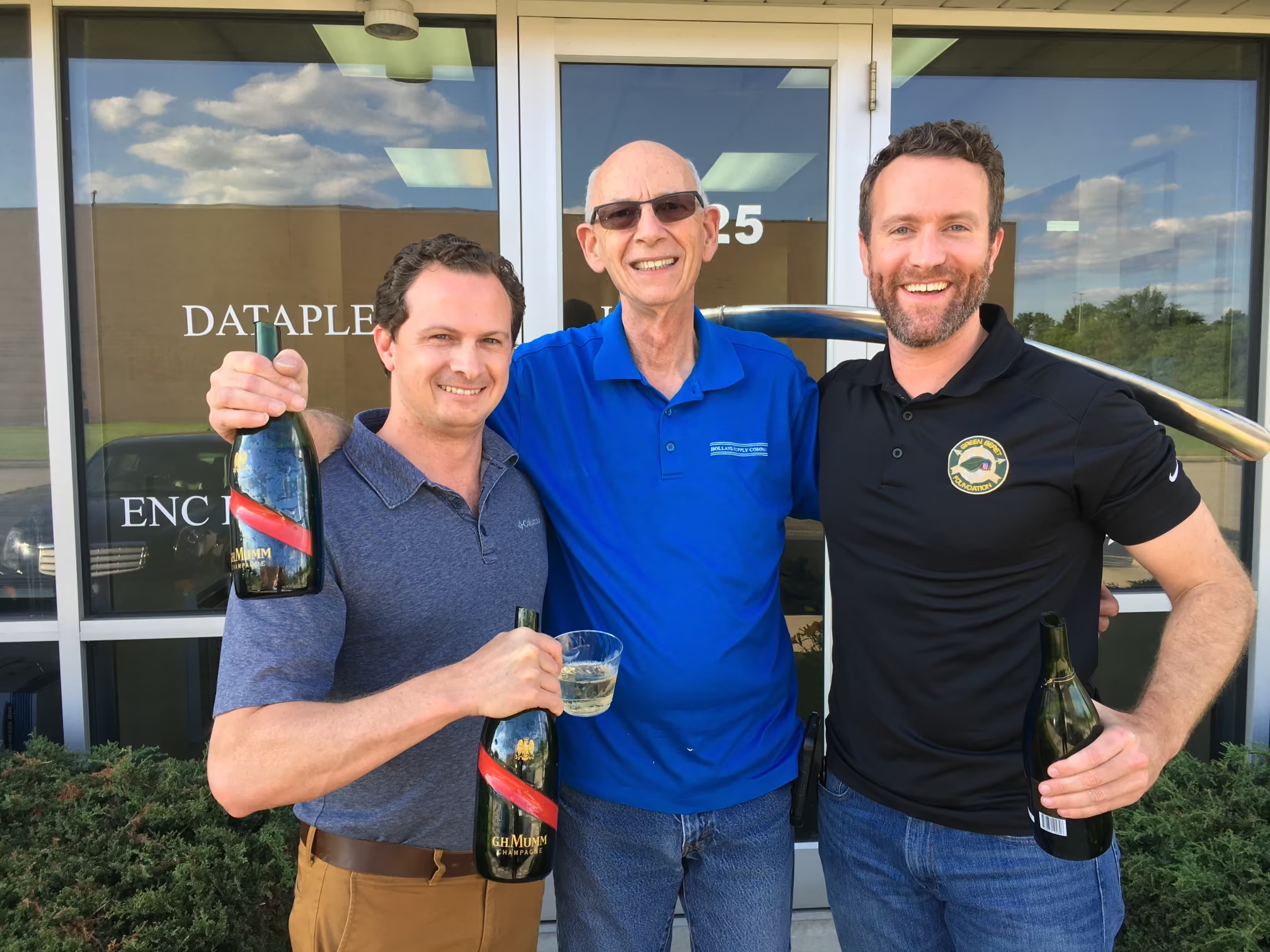





























%20-%20thumbnail.avif)


%20-%20thumbnail.avif)

%20-%20thumbnail.avif)
.avif)



%20-%20thumbnail.avif)