Host: You've heard of the self funded model of buying a business, which is what the majority of guests on Acquiring Minds do. You've also heard of the traditional search fund, and then you've probably heard it debated about which style is better. Self funded versus Traditional. Well, today's guest, Derek Turner has done both. He acquired a business as a traditional search fund in 2018 for the next chapter in his career. He bought a business self funded at the beginning of this year, 2023. So in this interview you'll get real color about what the two styles of buying a business are like from the inside, directly from an entrepreneur who experienced both. You're going to hear two good stories in the process and topics like why doing a geographically constrained search is great, why you should be skeptical of growing a small business quickly, hiring a GM or operator and being realistic about doing that, the peril of bad sellers and how to diligence that risk, if it's even possible, and the value of having a good relationship with your investors. This interview was a treat, really a packed episode. Please enjoy it. Here is Derek Turner, owner of Roll A Shield. Welcome to Acquiring Minds, a podcast about buying businesses. My name is Will Smith. Acquiring an existing business is an awesome opportunity for many entrepreneurs and on this podcast I talk to the people who do it. The purpose of Search Investment Group, known widely as sig, is to enable entrepreneurs to buy their own businesses and maintain control and majority ownership. SIG helps the searchers it partners with source acquisition targets, submit offers, get through due diligence, find the right lender, raise equity and close the deal. Over the last two and a half years, SIG has helped 16 entrepreneurs buy businesses and across those 16 deals, the businesses have averaged 2.4 million in adjusted EBITDA, with the searcher retaining on average 72% common equity ownership. Now, if 2.4 million sounds large for a self funded search, you're right. SIG is a vocal proponent of buying big and they enable the acquisition entrepreneurs they partner with to do just that. To learn whether SIG is a fit for your search, go to search investgroup.com that's searchinvestgroup.com Derek Turner welcome to Acquiring Minds.
Guest: Good morning. Great to be here.
Host: Derek, you have acquired two businesses. The first was a few years ago under the traditional search fund model. The second was much more recently and it was under the self funded search model. And that is the business that you own and operate today. So in this ongoing debate about traditional search funds versus self funded searchers, it'll be really fun to Hear your perspective because here we have in you an entrepreneur who has seen both models from the inside. What we're going to do, because we have two stories we need to watch our time, we're going to, we're going to hear both of those maybe in slightly condensed form and because I want to make sure we have time at the end to also visit a few topics that, that you and I talked about on the pre call that you've tweeted about. So that's kind of the lay of the land. Let's start off, Derek, with some background on you and please take us up to what it was that led you to want to buy a business for sure.
[3:47] Guest: Well, thanks a lot for having me, Will. I grew up here in Arizona and that'll factor into a lot of my story. My mom's a violinist and my dad is an entrepreneur. So I grew up seeing a lot of risk taking on his part. Doing a startup in the 90s in Phoenix was a much harder slog than most people experience today, even in this environment. So grew up kind of seeing risk taking and growing up here in Arizona, but went to college in New York City and decided after I graduated to move to Detroit, Michigan, which was a city I'd never been to before. But I had heard about this very kind of vibrant entrepreneurial spirit that was happening there and ended up joining two different startups over a few years there, kind of early stage startups. I was on the founding team of one of them and got to really get two key learnings. First, I would say I learned that I hated trying to find product market fit. So the slog of just starting at zero with a product that you were trying to make the world care about and then, you know, eventually finding it that that journey. I have an immense respect for entrepreneurs who do that. After doing it twice, I just, I know that I do not like doing the 0 to 1. But what I did love and the biggest learning from that time was that once we had product market fit and suddenly we were an operating business creating value, dealing with all the challenges of growth. I loved that. I loved leading in that context. I loved learning in that context. And so that kind of set me up that when I went to business school and I heard about search funds, it connected both of those dots. It bypassed the 0 to 1 and the product market fit search, but it really amped up the operational side, the leadership side, and taking a business that already existed was already healthy, but had a lot more potential. And so after I heard about the search fund Specifically the traditional search fund model. I was pretty much on board from the first time I heard about it. It sounded like it could be kind of a scam because it sounded too good to be true. And so I ended up talking to like 70 different searchers and search investors while I was at business school to really make sure it's what I wanted to do. And by the time I graduated, I had raised a small traditional search fund, small because it was going to be focused only on Arizona, my home state. And so got some traditional search fund investors to back me on that. And in June of 2017, started to search in Arizona, largely the metro Phoenix area, because that's where, you know, 80% of the population is, and started searching then.
[6:31] Host: Great, thank you for that. And when you say it seemed too good to be true, what was, what was so too good to be true about the traditional search fund model that they would pay you to just look for a business to buy or the economics or what?
Guest: Yeah, so. Well, I was 27 when I started at business school and the idea of someone backing me to buy and run a business seemed a little bit far fetched. And the idea of just giving money up front for the search also seemed unusual. Now my, I had a relative here in Arizona that when I told him about a search fund, he's like, oh, that's, that's called a grub stake. And apparently back in the mining days, when people go look for a, you know, you know, gold out in the mountains, they would, they would raise money to pay for grub for their food. And in exchange, the investor who gave them that money would have a stake in whatever gold they might find out in the wilderness. So the search fund model may not actually be that young.
Host: Great. And going further back, there is a celebrity politician involved in your past that I noticed that went unmentioned. So part of the reason you ended up in Detroit was because you met whom.
Guest: Yeah. So I had heard about Detroit and I was researching in my senior year of how to get to Detroit because I was just taken by this whole idea. And as I researched what's in Detroit, how to get connected to startups there, I ended up hearing about this thing called Venture for America, which was billing itself as Teach for America, but for startups. And they had just launched, they just announced, and they ended up having a table at the Columbia Career Fair. And I went down to the table and there was just one guy who was manning the table and it was Andrew Yang, who is now leading the, I think it's called the Forward Party and ran for president back in the 2020 election. So, yeah, that's my run in. I was the first person. My, My point of pride is that I was the first person to sign the dotted line and be a Venture for America fellow. The program has continued to grow and thrive even as Andrew's gone into politics, and it's a great mission to create jobs in cities that otherwise wouldn't be attracting top talent.
Host: Yeah. Yeah. Well, at the risk of sounding cynical, you know, that's a card you can play when Andrew Yang becomes president. You can, you know, you call him up and say, hey, remember when I was your first. Your first signature?
[9:03] Guest: Yeah. Maybe I can get an ambassadorial position at some obscure country.
Host: Yeah, right. And also, of course, Andrew Yang is associated with UBI Universal Basic Income, which is. Is kind of back in the headlines now. That AI is going to eat all our jobs. Is he still. Is he still big on UBI and talking about it everywhere?
Guest: I think that's still a big part of his platform, and it's been something he's talked about for a long time. I mean, he, He's. He's been worried about the negative impact of some of the technologies that we've been developing over the past 10 years and the human impact. And I would say I share his concern about that.
Host: Yeah. Yeah. Thanks, Derek. Now taking us back up to starting the traditional search fund. So one of the critiques of traditional search funds is that you traditionally are. Your investors will not want you to do a Geo Focus, a geographically focused search. Yeah. But you, you were in. In. In the Phoenix area, in Arizona, I guess, larger Arizona, largely. So how did you convince them to let you do that? What does that actually look like from somebody who did do a geo search?
Guest: Yeah. So that was an uphill battle. And I got some advice from some folks who said, you know, don't talk about the Geographic Focus, just raise a search fund. And then if it turns out, you know, everybody ends up kind of searching and they're where they live anyway, so just kind of keep it under the radar and do it that way. I was uncomfortable with that. I wanted to be super upfront that, you know, if our investors. My investors saw my pipeline a year into the search and it was 99% in Arizona, I didn't want anybody to be surprised by that or frustrated by it.
Host: Yeah.
Guest: And ultimately, you know, I think the Geographic Focus has a lot of value add, and I think that there's actually a lot of investors who have come around since 2017 to the value of a geographic focus because, you know, the common kind of perspective is you need as broad of a search as possible. You want to have the funnel as big as possible at the top and you want to be focused enough that you have an industry that you're going after. I think that rationale can be kind of inverted to say that if you're looking geographically, you can be really focused and kind of have a really intense concentration on a certain area. And then you just need to be flexible on what kind of industries you're looking at. A lot of search investors will use the geographic focus as a proxy for a lack of commitment. So they'll say, well, if you're not willing to move to the most obscure part of the United States, then you clearly aren't bought in enough. And I'm not sure if you're really ready for this. And you know, I guess if I said yeah, I want to search in Arizona because I think it's just, you know, a comfortable place to live, that would be a tough sell. But there's a lot of value to geographic focus that actually I think increases your likelihood of success. I'm not going to say it's a dramatic improvement, but when you're looking locally, you can treat every lead as valuable. You're not doing massive campaigns where you're going to send an email to 50,000 people and all you need is one person to respond. When you're Metro Phoenix has probably 8,000 search acquirable sized businesses that are in the right industries. And so each one of those leads is, is precious and you need, you need to treat it as precious. And so you change your, your tactics a little bit. I did a lot of directly cold calling these places and these owners. I did a little bit of email, but it was all very much custom to them. And because you're local, I think that your response rate is a little bit better because you are much more of a real presence. You, you are not an abstraction that's in their inbox. You are a real person they might run into in the supermarket. And then I think that actually the biggest element here is the velocity of your pipeline. Because if you're searching in New York and you find a target in Colorado, what is it going to take to get you on a plane to spend 400 bucks for the flight and 300 bucks for the hotel and all the other expenses? What is it going to take to get that expenditure to be acceptable to you? You're going to have to get a lot of information and a fair amount of confidence about that target before you can even get in person. Relationship building started when you're geographic. My, my, my approach every time was I would get an owner on the phone and within 30 seconds my only goal was, can I just take you out to lunch? I'm not going to try to ask you what your EBITDA is over the phone. I'm not going to ask you for financials when they've never even seen my face. I'm just going to say I'm local. I like what I can see so far about your business. Can I just buy you lunch or can I just come visit you at your office? And then when you get there and you sit down with them, two things get. There's kind of two options. One is you very quickly learn that this business is not worth your time because people tend to be a lot more upfront and tell you a lot more in person. So you're going to learn that this is not the business that you want and you're out 40 bucks for lunch and you've killed a deal and you can move on. And that's a great thing. The second possibility is that you learn things that you wouldn't have learned over the phone. And not only do you get information from that interaction, you have dramatically accelerated the relationship, building the trust that you have with that seller. And so then the velocity of that deal, I think it takes off a lot faster. And so if you think of search as a sales role, the only bad outcome is silence. The second place finish is a no and the first place finish is a yes. And I think that a geographic focus allows you to have a higher concentration and a faster arrival at the yes or, or the no, which are both very valuable outcomes.
[14:36] Host: Yeah. Yeah, well put. Derek, have you thought about this before?
Guest: I get.
Host: Great.
Guest: I get a lot of geographically interested searchers who, who are interested. And yeah, I'm a big fan. Especially because I'd be lying if there wasn't a little bit of a chip on my shoulder from a couple of investors who just off, off the, off the bat, just geographic focus, no can do. Sorry, I don't even want to talk about it. And so I, I like seeing searchers overcome those kinds of hurdles. Great.
[15:06] Host: Well, that was, that was quite convincing. And just one follow up on that. When you, you said your first and only real goal from that cold call, if, if they seem at all receptive to a conversation is just to get them to lunch so you don't pre screen the business. I guess you've probably pre screened the business in the first place to even, to even reach out to them. But you don't do any qualification on the call itself.
Guest: No, so, so you'd be surprised by how little qualification I did even to get that to the phone call level. Because what I learned was, you know, research. And this is true of a lot of the people who are maybe coming from consulting or some of these kind of more blue chip careers, is that analysis feels like progress when it actually isn't. And so it can feel really good to be doing industry research and oh, like I've got this list of 100 companies that I want to call but you know, let me, you know, it'd be responsible. The responsible thing to do was for me to spend 20 minutes researching each one before I pick up the phone. And what I found was that that just slows you down. What I would do is I would just, you know, take out the restaurants, the retail, the construction, the real estate, the easy stuff to take out. Yeah, I would look on their website for two minutes or so and then if, if there was nothing glaringly wrong, then I would start calling. And most of the time they don't pick up. So that's the first thing. And then when they do pick up, the searchers tend to think that when you get a business owner on the phone, they're going to start grilling you on their business. Like, why are you calling me? What do you know about my business? Why do you think that you could run my business? At least in my experience, 95% of the time you get a business owner on the phone and they just want to tell you how great they are and how awesome their business is and they're not going to start grilling you. And so what I would do is I would do very little research. I would call and once I got them on the phone, I would get that, that time together with them, set up and, and then in that intervening, you know, five to 10 days, then I would do a ton of research because then I've got somebody on the hook. I want to do as much as I can. I would go way deep and I'll get really rigorous, but it made no sense to get rigorous before you even know if they're going to pick up the phone, if their company's for sale, anything like that.
Host: August Felker is a two time successful searcher. First with a traditional search fund. The second time around he did a self funded search. Today August runs Oberle Risk Strategies, an insurance firm with a dedicated practice group for Searchers and acquisition entrepreneurs like you. If you've got a business under Loi, Oberle will provide complimentary due diligence on that business's insurance and benefits program. A great no risk way to get to know August and team. They love helping searchers. They've worked with hundreds. Oberle is a specialty insurance brokerage for searchers by a former searcher. Check out oberly-risk.com ob r l e-risk.com link in the show notes and the script. So I know that you're, you know, you were kind of, this wasn't overly orchestrated. I mean your point is that you kind of had a very large bias to action here. But the script that if you actually got one of the owners on the phone, you can you give us a sense of what it sounded like?
[18:08] Guest: It was basically the generic searcher pitch. It was, hey, I'm a local, I'm an Arizonan looking for a business to acquire. I really like X, Y and Z about your business and I don't know if you've ever thought about retiring but I would love to have that conversation with you. Would you be open to that? It was very generic. I would do enough of that. Two minutes on the website. I would get enough to say, you know, not, not sound like an idiot, but at least it would just be, you know, here, here I am, I'm in Arizona. I'm looking for a great business to buy. I don't know if you've thought about retiring but that's, that's what I'm looking for. And so the retirement angle I think usually took away some of the intensity of like I'm here to buy your business instead of hey, retirement is, you know, is something you might have thought about and I'm a solution for that desirable thing instead of maybe becoming a little bit more direct from the start.
Host: Yeah, yeah. And how many lunches like these did you go on?
Guest: We searched for 10 months before we closed on the business and I'd say I'd take out three months because I was like very. We ended up doing diligence on two businesses simultaneously. So the final three months were just not. No hope of keeping the pipeline alive. So you know, let's call it seven months of actual searching. And in that time I probably sat down with about 100, I would say business owners. So it wasn't a huge amount. We, we probably did, we probably did a like 1500 people, 1500 businesses were in our follow up campaigns. And I should mention we, I say we because I had a partner for the search. So a good friend of mine, who I knew from my speech and debate days in high school was getting his MBA at a different school at the same time. And we ended up pairing up to do the search. And so he was from Arizona, and we named the search fund after the high school that we went to together. So we both had that approach.
Host: Okay, 100 owners, 100 in person meetings. Great. Okay. Well, Derek, again, we need to just be aware of how long we spend on, on, on your story. Anything more to say about the search process before we dive into the business that you found?
Guest: No, I think the only other thing would just be the amount of follow up and that that kind of parlays into the acquisition, because the company that we bought, we closed in April 2018. But to give you the timeline to lead up to that, we started reaching out to that company at the end of August of the prior year. And I called and emailed them as kind of a paired set of activities for, I think, 11 times over three months before I got a response. So I got my first response from them at the beginning of December, and then by the beginning of February, we had the LOI signed and we closed at the end of April. So I tell searchers all the time that follow up is the forgotten part of search in my mind, and it's follow up that is relentless. I think a lot of searchers, especially who come from more elite backgrounds, think that the rudest thing in the world is to call somebody three times over a month if they haven't gotten back to you, because that's, you know, they don't want to talk to you. But if you treat this like a sales role, you treat silence as the enemy. You assume silence means that they just haven't gotten around to responding to you. And you never assume that silence means no. And so that leads you to follow up relentlessly because you're just trying to get the yes or the no, and you're not going to get too concerned about bothering somebody in the process.
[21:35] Host: Derek, do you have a sales background in any of the. Did you gloss over a sales role at some point? Because you certainly seem comfortable in what many people consider a very uncomfortable process.
Guest: Well, in one of the startups, when we were just trying to find product market fit, that at some point involved cold calling hundreds of businesses, trying to get them interested in what we had to sell. So, yeah, it was a sales job, operations job, HR job, typical startup.
Host: Okay. And actually one other thing on your search, any thoughts on doing this proprietary outreach So a lot of my guests, and they've been pretty convincing to me are just like, look, proprietary outreach is basically, you know, the ROI on that's not worth it. That's the broker's job. Even if you can get somebody who, you know, an owner who's willing to talk to you, you then have to explain to them like, you know, what, what evaluation is going to look like, what a process is going to look like. They're going to be skeptical, skeptical the whole time because, you know, they recognize that your incentive is to talk them down. I mean there's just so much education and expectation setting that goes into it. All, all these reasons not to do, not, not to mention just all of the follow up and kind of the sales process that you're just describing. Now, traditional search funds, there's an expectation that you will do that. You're looking for larger businesses likely, they're not likely to show up on biz by sell or necessarily in broker search. So you're at your investors kind of expect it. But anyway, given that you've done it, how do you respond to all of that?
Guest: So I think it comes down to self funded or traditional. If you're traditional, you need to get a larger business. If you're looking for a larger business and it gets banked or brokered, you're in a competitive process with people who will pay a higher price than you. That's, that, that's not 100% of the time. But in general, my experience with this is that whenever I was searching for business over, you know, a million or a million and a half in ebitda, if it was represented by a bank or a broker, there would be private equity involved and they will pay a lot more than me every time. And so in the traditional search, I think proprietary is important. I think that I never saw a great deal from brokerage. Now that might speak to the Arizona market and how it might be underrepresented in terms of brokers, but that was the case for traditional. For self funded. If I'm looking for 500,000 SDE or a million or less in SDE, I would probably agree and I've been really surprised as I've gotten to know the self funded community over the past, you know, year that there is so much success with brokers and I think that it's a function of there are more businesses and more brokers and less competition under the million and a half or a million. And yeah, so for a self funded searcher, a proprietary is probably not worth the time Unless you have a very specific niche. But if you're traditional, you know, brokers and bankers are necessary, but not nearly sufficient as an outreach. Great.
[24:35] Host: Okay, Derek, let's get into the business that you bought. So tell us quickly the story of finding it. I assume it follows the outline that you just gave us. And then tell us about the acquisition process, please.
Guest: Yeah. So the company that we bought was in the engineering services space. So we offered a service that helped city and county governments, specifically the public works director at those city or county governments, a way for them to assess the current condition of their streets and their sidewalks, and then more importantly, to build a five year optimized financial plan for which streets to repair and when. So the best analogy here is if you have a fleet of 100 vehicles, one way to spend your budget on fleet maintenance is to just buy a new engine for every vehicle that needs a new engine. And you don't spend any money on oil changes because you're going to spend all your money on engine replacements. That's extremely inefficient as you can imagine, because pretty soon if you don't do any oil changes, you're going to have most of your fleet needing massively expensive repairs. So the right way to spend the money is to actually proactively be doing oil changes and then selectively do larger repairs. The same is true for streets. If you only repair the streets that have the worst potholes and you ignore the better streets, you will end up with a snowball effect of a massive problem with your biggest asset as a city or a county needing too much repair that you could ever afford. And so what we would do is we would take a look at your condition currently using these expensive laser vans that would scan every mile of your streets and then we would have analysis done using all that data to say, okay, in year one, you do this treatment to that street, that treatment to that street, and then you spread it out over five years so that the aggregate health of your street network at the end of those five years is optimized. So very obscure. What we liked about it was that it's not recurring revenue, but this needs to have cities and counties need to do something like this every three to five years. And so it's a one time project, but is kind of needed every few years. So there's a nice recurring element to seemed like it was a very repeatable process where it was send out the vans, collect the data, build a report. Seems straightforward, it wasn't spoiler. And so that's what we Liked about it. We liked how few competitors there were, how kind of small of an industry it was, but how big the opportunity seemed with cities and counties. So that was the business and it was owned by two people. They had owned it since 2004 and they were wanting to retire. And we kind of. They were, they wanted to talk to us after we reached out. And it became, you know, there's, there's a lot of stuff we can go into from there, but that was the kind of context leading into the acquisition.
[27:30] Host: And you. And they had just gotten one of your emails, Responded to the email, called to lunch.
Guest: Yeah, yeah, exactly. And one of the owners was in Phoenix, another one lived in Canada. So the one in Phoenix was our kind of main contact. And so we, that, that's what we
Host: got together with and own. You said they, they'd owned it since 2004. So does that mean that they had acquired the business themselves and were not the founders?
Guest: That. So the company had been founded in the 80s and the two owners who we bought from, one of them had been an employee and the other one had been a subcontractor. They had bought it as kind of a divestiture slash bankruptcy out of, you know, the company had been bought by a large conglomerate and had kind of gotten sideways. And there were some financial issues that were both based on the business and also some malfeasance. And they. So they bought it in that, in that state as an employee and a subcontractor in 24.
Host: Okay, great. And how, how big is the business? Give us some numbers around it, if you could. So financial numbers and headcount numbers.
Guest: Yeah, ballpark of when we bought it, but around 5 million in revenue and the employees, or about 28 employees when we bought it.
Host: Okay, and how profitable was it? Can you give us a sense of what it was?
Guest: A little north of one, basically between one and one and a half. Okay, so the margin seemed decently strong as well. So we liked,
Host: you know, just going back to the traditional versus self funded. If this is a partnered search that, you know, call it a million dollars in ste actually represents $500,000 in ste.
Guest: Yeah, so it was on the smaller end.
Host: Yeah.
Guest: But, you know, we liked it enough. And because we had a smaller search fund that was also a smaller amount that was going to get stepped up and put into the acquisition too.
Host: Okay. Okay, let's hear a little bit more about the laser vans. So that's, that's pretty neat. Literally, lasers mounted on vehicles that drive up and down city streets beaming a Laser to collect data about the health of the sidewalks and streets.
Guest: Yeah, that's, that's, that's a very sexy way of putting it. But yeah, basically that's, that's what it was. It was laser like laser vans that had a laser that pointed down and basically scanned like a, like a, like a Xerox, scanned the streets. So every crack and its pattern was being picked up in detail. And it was also really interesting that yeah, everybody, when they would hear about this business, they were like, this is a data play. This is, you could throw on sensors to the, to the vans and everyone would go to autonomous vehicles. And for a number of reasons that wouldn't work out. But you know, there was a way to dress this up to sound almost like a tech company, but it most certainly was not.
[30:19] Host: And. Okay, so why, why wasn't it? And we're probably getting a little ahead here. But why, why that's, that certainly sounds whizzy to me.
Guest: Yeah, so because we would only do the, the data acquisition every couple of years, it was not helpful to autonomous vehicle companies because they need continuous updates to the data. And the data that we were collecting itself is very specific. It's only if you're really doing this kind of pavement management. It is not necessarily. There aren't these sideline benefits that we could sell to insurance companies and you know what else?
Host: Okay, okay. And the fact that it was. So is this, is this mainstream technology that every city uses
Guest: industry standard, but it's a very unusual technology. So we, we built the laser vans in house historically and it's from a variety of suppliers and it's, you know, a really one of a kind use case of technology that specifically for this purpose. But in the industry it was not uncommon.
Host: Okay. And follow up to that question. If the business. Okay, so $5 million in revenue, you know, that's a, that's a respectable size. But for a business founded in the 80s, despite the fact that it sounds like it had some ups and downs, it hadn't grown very large for a 30 year old business or 40 year old, 30, 35 year old business. So was that because why the owners
Guest: didn't want it to be bigger? And that, that turned out to be true. The, there was plenty of market demand. We were able to grow top line BY I think 40% in the first 18 months or so. So there, there was a lot of, of opportunity to grow the business. They just had decided not to pursue it. And this was largely because the owners were engineers basically and they were treating this as they didn't want it to be larger than what they could really manage, but also really feel like they had a technical handle on all the information that was going through the business. So that was our thinking. And in terms of the ability to grow or the availability of market demand, there was actually a lot to try to take advantage of.
Host: And just one more question on the market opportunity. So if my town doesn't have this technology or is an outsourcing to contracting for a provider of this technology, what do cities in, in towns do to evaluate and, and you know, record the health of all of their streets and sidewalks?
Guest: They eyeball it. So they'll have employees just drive around and it's kind of give it a 1 to 10 score and then try to do, do their best off of that.
[33:01] Host: And do they do it systematically or do they, they.
Guest: Presumably they, they do. They, they would probably say they do, but it's, it's, you know, a random city employee driving around and looking through their windshield versus a millimeter level laser. It's the, the, the difference in accuracy is really significant.
Host: Yeah. Okay. Very interesting laser vans. Okay, well Derek, we paying attention to time, so I want you to kind of fast forward us through the next four years. Spoiler. As you said, it doesn't go great.
Guest: It was a very challenging acquisition that I learned a lot from, but it was not easy. So we owned it for four years. We sold it this past May of 2022. And in those four years there were a number of challenges. One was that the sellers were very, very difficult to deal with after the close. Another element was that the fleet of laser vans that we had were borderline defunct when we really got into it. We had done technical diligence, but because of how unusual these vans were and the technology in them, there was nobody that could have looked at them and told us anything about the future of their life. And so we ended up having to do a multi million capex within 18 months that we hadn't planned on. So we had planned on doing capex to grow. We ended up having to a ton of capex just to stay afloat. And in that process we also had to change all of our data work streams. And so that we basically had to transform everything that the business did from a technical perspective while we also were growing 40% top line. And one of the challenges, the market opportunity was there. But what everybody should always know about growth is that you need to service it. Growing looks great until you actually realize you have to deliver on that revenue. You have to maintain Quality in that. And so in this business especially, it was highly technical. So not only was the capex really hard to deal with in terms of expense and in terms of implementation, all of the people involved were doing highly specialized things. So to give you a sense of this, we had field crews that were operating the vans nationwide. They would be on the road 330 days a year. They would sleep in like they didn't usually have apartments or homes. They slept in hotels that we paid for. Very unusual type of person who needed to be able to do that kind of a job. You drive every day that the sun is shining, no matter what day it is, and you live on the road, you make a lot of money, you can save a lot, but it's highly. It's very difficult to recruit people to do that job. Then on the other end, to do the financial analysis, you need to have pavement engineers who no longer want to do pavement engineering. They want to do financial analysis, which you can imagine if you're getting a PhD in pavement engineering, the likelihood that you want to work in spreadsheets doing financial planning. That's a very unusual Venn diagram too. And so because of that, growth was extremely difficult to try to accomplish. And so over the course of those four years, we had to do all of that kind of work. Right when we were getting on top of it, Covid hit we were, you know, that was a brutal experience partially because we had a large customer who for technicality couldn't pay us. So we had to do some significant layoffs. And that was not great. And so kind of eventually toward the end of the four years, it was pretty clear that this business was very difficult, very difficult to grow and ended up getting approached by a supplier in our industry that actually manufactures the laser vans. And they wanted to get into the service and consulting side. And so it just made a lot of sense to pair up. And they acquired us at the middle of last year because there was now a president running the business by the time we sold. I ended up moving on to the next thing pretty soon after acquisition. But we had this. We have a president who I had recruited who had by the time we sold, been kind of the GM of the business, kind of doing the day to day. He's a wonderful guy, very talented and really took the reins.
[37:17] Host: Well, your decision to sell in the trajectory of your experience. So the I remember from our pre call the first two years were chaotic because you get in there and you have this huge capex expense. The sellers are uncooperative and just For Capex, give people a sense. A laser van costs how much?
Guest: Around $800,000 per van. So to replace our 4. Yeah, we had to replace our 4 vans fleet, which was a very significant expense.
Host: 3 million bucks. And then the latter two years were marked by stagnation. Yeah, correct. So. So I'm just curious, like, if you had continued on in the business, do you think you could have brought the vision to reality? I know you were. You got this offer, you were approached, all kinds of terrible things that happened. You were probably over it. But did your original thesis hold true if all of these, you know, kind of unforeseen variables hadn't. Hadn't crashed it?
Guest: It's a great question. You know, the underlying incentive for a traditional search fund is significant growth. You know, I think what the average IRR is, you know, 20, the high 20s or low 30s. And so that implies that you're growing the business somehow, whether it's just by valuation or by actual, you know, financial performance, by, you know, 25 to 30% a year. That's significant. I think this company, if we hadn't had those speed bumps and if we hadn't been trying to grow at a really aggressive pace, would have been set for a nice long trajectory of growth. And that was the plan. We had a president running this business. We were going to be pursuing the investors and I had adjusted our expectations of what growth was possible. And I think that if we hadn't gotten acquired, we would have been able to just keep. Keep growing modestly and, and been able to have a. Have a. A long run at it.
[39:25] Host: Okay, well, one of your Twitter threads and I, I should plug. I mean, of course we'll link to it in the notes, but I. You got on my radar, Derek, because you started tweeting, I don't know, four or six months ago. And there's a. A handful of threads that you've done that have been really great, so. Recommended for people to follow you. One was about. It was so well put. It was sucker versus good soldier. So as you're in a situation like you were in with your business and, you know, you want to be the good soldier, you know, it's, it's, as you said, like, it's not even. It's. It's well below your bare case. So, you know, the worst case scenario that you modeled, we're well below that at this point. But you want to, you know, you've got fiduciaries, you've got your employees, you've got, you know, your sense of Accomplishment. I mean, all these things, you want to just soldier on. But at some point, in all challenging kind of phases of life, it's like you ask yourself, but am I just being a sucker? I mean, am I, Am I just. Does anybody else care? Like, anyway, so sucker versus good soldier. How did you. How did you weigh those two competing impulses?
Guest: So the context of a traditional surge is that it starts out with a very personal pitch. Right? Right. Because you're raising a search fund on just you. You're not. You're not saying, here is this asset, would you like to invest in this asset? You're saying, do you trust and believe in me? And are you willing to put dollars to that? So that's an element that I think maybe doesn't get fully appreciated, is that this is not. They talk about an asset like search funds as an asset class. Yes, it's an asset class, but at the beginning, the asset is a person and it's you. And you're getting commitments from your investors on just the strength of who you are. And what that sets you up for is a sense of obligation to those people that, you know, even if you buy a great company and you have this asset that you, that, that's great, you can't ignore the fact that it all began with you and you're running the business, and so you're now entwined with that business. So the challenge there is that you have this personal obligation that you should, I think, have rightfully so, to these investors. At the same time, you also don't have any downside risk. And that's one of the benefits of the traditional search is that your downside risk is like career risk, which sounds scary if you have a really, like, fancy resume. But, you know, you're not going to lose your home, you're not going to lose your money. And like, you know, I guess the worst thing you can do is get fired. That's really not much downside. And so that's a really, like, special part of the traditional search fund model. But what it sets you up for is that when things are going great and you know that you're not going to hit that IRR target, you're not going to be very far in the money. From a carry perspective, you then find yourself. And I found myself in a position of knowing that I was not going to be getting a great outcome monetarily and not being willing to leave because I felt like if I left, I was taking this big responsibility and just putting it on the plates of my investors and Just saying, okay, sorry. I know you believed in me, but, you know, this is not great for my career. You know, I'm going to. I'm just going to leave and you guys can deal with this. I didn't feel like that I could do that or that I wanted to do that because they honestly had backed me. And I will plug my investors on my board were the best part of this whole experience. They were fabulous. They were great mentors, great advisors, great coaches. And so, yeah, I ended up, you know, in the darkest days wondering, okay, am I a good soldier? Am I doing. Am I living my obligation out in a. In a positive way? Or am I a sucker and just kind of. I'm throwing away years of my life knowing there's no upside, not enjoying it. And I'm doing it because I just don't want to inconvenience people. It's a tough place to be. At its worst, there were days where my best case scenario that I kind of would daydream about is that I would walk into a board meeting and my board would just fire me because then it wouldn't be my. Then I wouldn't have quit, and I would be able to walk away knowing that I hadn't failed them, or at least I hadn't chosen to fail them. So that was my mentality for a time. But thankfully, by the end, my board was so supportive of me that I never really felt like I was being taken advantage of. I never felt like I was the sucker. But if you fast forwarded, I've heard of stories of CEOs that really just internalize this and they will stay on for five years knowing that there's no five years beyond the point of realizing they're not going to have a great outcome. And that breathed incredible bitterness. And thankfully, one of my. My board members had seen that personally. And his commitment to me was that he did not want me to end up like that and that he. He was committed to making sure that if. If there was no great outcome to be seen, that, that we would either start finding another business or sell this one. And, you know, it turned out that there was. There's somebody who wanted to buy this one,
[44:24] Host: the. The buyer. So they approached you, you didn't approach them?
Guest: Yeah, they. They reached out to me. We had, you know, we had known each other and we actually had. They had been, you know, we had bought their products, but they. They reached out and it made sense for their. Their strategy of wanting to. To get into the service and consulting side and, you know, as. As we reflected on it and, and considered, okay, do we want to keep running this ourselves and have the. The president run it while I go, you know, buy an additional company or something like that? Or. Or does it make more sense to sell now? Exactly. And as we reflected on it, it just seemed like there would be a great opportunity for everybody to go forward with a sale.
[45:02] Host: Yeah, well, certainly it was a godsend for you. I mean, this was the outcome that. The lifeline you needed to move on.
Guest: Yeah. Because this was a way for everyone to be made whole in a way, in the sense that the investors were able to have an outcome that they were happy about. I was able to move on, and the team was able to have a shot at being part of a really exciting change in the industry of having a supplier and a service provider combined.
Host: Very interesting, Derek. Okay, well, we're going to leave this story for the moment and circle back to it after we hear story number two. Self funded search. Let's go.
Guest: All right, so I'll do the quick version in 2017. In the first search, a friend of a friend of a friend of a friend introduced me to a company here in Phoenix that fabricates rolling shutters, which are like storm shutters or security shutters. You'll see them, you know, in front of storefronts or covering windows for hurricanes. In Arizona, we use them for heat insulation. So I met them in 2017. They were too small at the time, but towards the end of my time at the last company, I was looking for the next business because the idea was we would just keep the company and I would look for the next business. I reached out to them, and it turned out they had grown a lot in that time, this. This rolling shutter company. And I started talking to them, and the owners were fantastic. The two guys who owned the business are wonderful guys. And I got to peek under the hood of the financials again, and they had grown it to a meaningful amount of EBITDA in between a million and 2 million. And what was even cooler is that the cash flow looked great. And as I looked at it, I realized, you know, this. This is the, like, ideal SBA acquisition. It's. It's on the larger side of sba. It's got good cash. A long history. We've been around since 1979. And, you know, and the owners, I have such a relationship with them that, like, we could. We could get through the potential hurdles of the extra SBA paperwork. So about a year ago, in spring of last year started, I basically pitched them and gave them an offer. I had, you know, my wife and I had worked through the personal guarantee and whether we were comfortable with it, made them an offer and turned me down. And they just said it was, it wasn't time. Then I said fine. A month later we ended up selling the engineering services business. And then I was faced with what do I do now? I had just done this four year difficult operation. What did I want to do? And I think a lot of searchers end up going to investing or something kind of more divorced from operations after
Host: they sell anything but operations.
Guest: And I love operations. I love the human scale. I love the challenge and the sense of being on the battlefield that comes with operations. I don't want to be an investor. And so as I searched kind of what I wanted last summer, I put the nail in the coffin of not wanting to be an investor and wanted to be an operator. And I was playing around with some ideas around search and doing like a serial search fund and all that kind of stuff. And then these owners of the rolling shutter company came back to me and there had been some developments in their personal lives that made them want to sell. And they gave me a counteroffer that was acceptable because the business had grown in the time since. And then we were off to the races. So October 1st we signed an LOI and we closed on January 3rd of this year. So about five months ago. And I felt like I had to just change a lot about my identity from a traditional search funder and that community that I felt so connected with to all of a sudden doing this SBA self funded approach, pitching that to my traditional investors, getting to know other self funded folks, trying to figure out SBA while I was under loi. There was a lot that I just had to learn really fast. And it's been a wonderful journey to really be now a business owner instead of just a CEO. And we can jump into that. But that's just been, it's been a wonderful journey thus far. I've loved the sellers, the employees, the business, being the owner. It's been wonderful so far. Great.
[49:17] Host: We are going to hear more about it. But Derek, just one thing. When you had your general manager president installed at the laser vans business and I think the way you put it was. So you and your investors, investors agreed that you were going to start looking around. You did, you had reached back out to the, the rolling shutter guys. But I don't understand. You're still working with your traditional search fund investors. You were going to go do a second acquisition According to the traditional search fund terms.
Guest: Yeah, we basically had come to, to say, well, why don't we just look for another business to either integrate with the engineering company or, or just have as a separate acquisition. And we were going to treat it like the, you know, the cash from the operating business that was basically funding my search would then be treated as search capital. When I found something so that we hadn't gotten to a ton of detail, it was going to depend on what we found, but that was the direction we were taking was to say this is a good business that we have. It's has, you know, but it's a lot, it's a lot slower of a growing business. And so let's just keep it growing and have this great president running it. And then I would just find the next business. And so that's, that was, I was already kind of searching by the end of 2021 and it would have been
Host: according to still search fund economics, traditional search.
Guest: Yeah, I can't remember how it was different, but it was, it would have been very familiar to a traditional search fund economics.
Host: Well, circling back to your point, Derek, that, that a traditional search fund is getting investors to invest in you. Not an asset, not a business, because you haven't found an asset or a business to buy, they're really betting on you. They, the fact that they wanted to, you know, basically double down on you after a rather rough go of it with the laser van business and they were prepared to invest in you again, certainly suggests a vote of confidence. No?
[51:06] Guest: Yeah.
Host: Well, is that, is that, is that the right interpretation? Did you feel that way?
Guest: You know, throughout the four years with the difficult business? My, what I tried to commit myself to was that even if it wasn't going to be a great outcome, I wanted to do it very well and that I would show the investors and myself that no matter how discouraged I was or how much it had differed from what I thought it could be, that I was going to still, I guess, be a good soldier. I can be a truly a good soldier. And so as a result, even though the outcome was not fantastic for the investors, they had gotten to see up close how I handled a lot of really brutal challenges along the way. And so yeah, I was very humbled to see that even when I was kind of going off the path and doing a self funded deal and raising money for that there were search investors who I had worked with who still believed in me.
Host: Cool. Well, good, good for you. And then so, so perfect segue then. So you then are Doing basically a self funded search. You have this deal in hand and you now go back to the same group of investors but according now to a self funded search economic. So you say come into this new deal and you know, here are the terms, it's you know, self funded terms as opposed to traditional and so not their favorite terms.
Guest: So yeah, right. So I poke the bee's nest the first time with a geographic focus and then I poked the bees nest the second time by trying to do self funded deal.
Host: Man, you must have a lot of personal capital in the bank with them. Seriously, you're drawing it down and they still like you?
Guest: Well, and there, there were a lot of differences of opinions and I guess for somebody who's thinking about this, there tend to be two ways that these search investors would approach the question of do I invest in a search fund? A self funded deal where the searcher owns a majority from the start. And one school of thought which was an immediate no to me was that they just looked at those terms and they said as a principal, I cannot get behind the searcher owning the majority. I just don't think it's right. It doesn't matter what the IRR looks like. I don't care what the investor, the investment looks like or the asset. I just can't deal with the searcher owning the majority.
Host: Interesting.
Guest: The other kind of school of thought was to look at it as an investment first. Okay, I don't care what the cap table looks like. Tell me if I invest a dollar, tell me your assumptions and tell me what that dollar will turn into. And then if I believe that you are going to be able to accomplish that, then yeah, I'm in for it. And so it was a mix of those from people who are traditional search fund investors that they took different perspectives. I don't fault them at all because I changed the script on them and they have a model that they love. So I don't blame anybody for saying you're changing the model. And I have a model that I have more than enough cash deal flow in. I'm going to stick to that. I don't begrudge them at all.
[54:04] Host: Yeah, I mean, and a lot of people just have kind of like a hard, a bright red line and like for, you know, for, for searchers it can be the pg. So a lot of people won't do self funded search because they just will not do a pg. Just. Yeah, it's very binary. And so it sounds like these guys, some, some investors might be that with, with majority ownership by the searcher. All right, Derek, so. So you're only five months in, so this is going to be. There's not a story with a conclusion yet, so give us an update on how it is going.
Guest: It's going great. And there are so many interesting comparisons between the two deals. One would be the sellers. So I have really enjoyed working with the sellers for this deal. The last sellers were incredibly difficult to deal with, and so whereas in the last one, it was tumultuous from the start, things were fiery, basically, from the first couple days of closing. Closing. This time, the sellers, I, you know, I love it when they visit. You know, five months in, I would love it if they dropped by more because they're so enjoyable to be around. They, you know, during the deal process, they let me meet all the employees two months before close in the context of just going alongside the employees and unloading an inventory container, the shipping container from Germany. And they just introduced me as the guy who's buying the business, and I'm just working alongside them in the warehouse all day. And it was just a radically different approach than the last deal, where on the day of close, we shocked all the employees with a, hey, we sold the business today. Here are the new owners. Here's a formal meeting. And by the way, we never have meetings like this, so everybody's just uncomfortable. This time it was very smooth. I got to work out of the business for six weeks before close. It's just been. It's been. It's been wonderful. So the business itself has been great. I'm still learning about it, especially in changing economic climates. This is, you know, I'm still learning what. What the impact is, but the team has been great. The product is awesome. I've called every customer that we've installed for the last five months, and they all love it. So it's been really encouraging to just end up with a simpler. A much simpler business, a simpler product, and a team that. That has just been doing this kind of on their own for. For a while now. Mm. And I don't have to pursue 30% growth every year, which is even better.
Host: Yeah. Yeah. Although, ironically, I guess you might get it.
Guest: Yeah, exactly. But. But. But I think after the experience I had of the last business, if you were to offer me 50% growth this year, I'd probably say, you know, you know, I'll take 20. You know, I don't. I don't want. I don't want to risk things. I don't want. I don't want it to be Crazy. And I, you know, I think when I first searched, there was a part of me that would judge business owners for having not grown their business more and for plateauing. And now after the experiences I've had, I in no way judge a business owner for, for not growing their business growth. Growth is horrible in many ways. So you know, I, I, I think I have a more balanced approach where before I would have said growth is fabulous and just like yeehaw, let's do this. And now, you know, growth is, is terrifying and has a lot of upside but also a lot of downside. And so if you want to grow slowly, you know, just make sure that your, your cap structure is built for that because what, what's tough is having a cap structure that demands growth. And for you to not want to grow, it's better to have a cap structure that's okay with slow growth and then you can decide if you want to grow faster
[57:34] Host: yet. Yet another mark in the pro column for self funded search over traditional. Everyone, let's hear about a little bit about the, the going back to the first acquisition and the bad sellers. So bad sellers versus good sellers. Just curious, why do you think that you didn't catch the bad seller? The fact that the sellers were bad guys, maybe you don't want to call them bad guys, but it was going to be this very problematic, difficult people. Difficult people. Why didn't, why wasn't that uncovered in due diligence?
Guest: So it was in the sense, because we were spending hours with the, the sellers during diligence, like anybody would, and they were difficult to deal with. But you know, what we thought was that these were people who had never sold a business before, which was true. And they were doing something very, very unusual for them, like very, very uncomfortable and with very high stakes. And so we interpreted some of the abrasiveness and the difficulty with them to just basically them being way outside their comfort zone, which they were. But it turned out that their, their behavior was not unusual for them. And part of it was that they, they hid, they hid their, you know, some of the stuff. So like an example, the 5050 owners, they would be on call together all the time for, during diligence. And we got the sense that there wasn't like a, a wonderful relationship there. But we learned after we closed that they hated each other so much that there had been a two year period where they hadn't spoken to each other even though they were 50, 50 owners of the business, running it together. And so it was something where, yeah, I Wouldn't have said, oh, these guys are, you know, I get along great with them. But there was a sense of like, okay, they're doing something uncomfortable. They're a little bit abrasive, but it's fine. But what happened was that they, you know, maybe we should have taken that more at face value and said, like, you know, if we don't. If you don't enjoy talking to the sellers during diligence, as it gets intense, that's worth something. You know, there's always going to be intense moments, but if you're doing hours and hours with these people and you're like, you know what? I just don't like this. I don't like interacting with them, then don't expect that to get better. It might be worth it. I mean, it might be that you buy their business, they finish up and then it's fine. But the problem with our situation was that they ended up being absolutely critical to the business in ways that we were not aware of. And so they were extremely difficult to deal with, and they were critical to the business. And so it ended up being this, like, really difficult position of, you know, we couldn't dismiss them. We needed them more than we ever expected, and that was a recipe for misery.
[1:00:13] Host: Yeah. And say, Derek, you're working on some future acquisition and you're having interactions with prospective sellers that feel the same. You're kind of. Your spidey sense is tingling. What. What do you ask or what do you probe in the future now older and wiser to uncover if it's a green light, a, you know, a deal killer?
Guest: Well, that's tough because, like, one of the big comforts that we had was that we looked at the employee retention data and the employ. There were a lot of longtime employees. And so part of our rationale was, you know, these owners can't be that bad because employees clearly love it live and they love staying there. So why, if. If they were horrible there, the. The employees would leave. Now, it turned out that it was just that the pe. They had weeded out the people who had, you know, weren't willing to accept that kind of environment, and the people who were willing to accept it had stayed. And so it goes to the point of it's hard to assess these things because we had our gut feel interacting with them. And then we were looking at the spreadsheet, and the spreadsheet said, things are great. And so we thought, okay, well, maybe the spreadsheets right, and our guts are wrong. I don't know what you would Ask. I don't know what you would look for. I think it really is a gut thing, and this is useless advice. But for a searcher, maybe it's worth it. Maybe it's worth powering through a tough seller relationship. I don't, I wouldn't advise somebody to just be like, you know what if you don't, if you don't love the seller, just kill the deal from, from the get go. But just be aware that, like, it could be a problem and assume, especially if you dislike the seller, assume that they are far more critical to the business than you expect and that they're going to be around a lot longer than you expect and then really calibrate for it.
Host: Yeah. Yeah. Well, that's great. That's great. Okay. All right. Coming back now to acquisition number two. This the, the business that you're in now. Let's hear just a little bit more on the business before we move on to some of these themes that I want to hit before we wrap it up. So rolling shutters, the business. You are a fabricator of these and an install and service.
Guest: Yes. So we fabricate and assemble them. And then in the metro Phoenix area, we install them, but we also ship them nationally through wholesalers and dealers.
Host: Okay. And again, these are like metal shutters that you, like, pull down that cover the entire kind of panel of your window that needs to be covered and give people a visual just in case, you know, they've never lived in a geography that has these things.
Guest: Yeah.
Host: So.
Guest: So maybe the, the more common one that you might have seen is that at any kind of large city storefronts like bodegas and other kind of stores, at the end of the day, they pull down this metal, you know, shutter in front of their business and lock it up. That's, that's kind of the, the more commercial approach. But we actually do a lot of residential work, which looks like metal shutters that are motorized. So they're operated by remote or by a switch. And it's a way for you to first of all, get security. So they're made out of metal and they can prevent people from coming in. We just had a customer the other day tell us that our product saved her life. She's an old widow living alone. Someone tried to get into her house and the shutter stopped them and she would, she never would have heard him because she took out her hearing aids at night and it would have been bad. So it's a great security product. The second thing is it's insulation. So in Arizona, where it gets to 120 in the summer. You can close this. And not only does it block the sun from coming in, it also is a physical insulated barrier to prevent the heat, the ambient heat from coming into the room. And then there are also total blackout and privacy. So it's a way to just, you know, all of us have probably had the experience of buying blackout curtains and being completely dissatisfied with their ability to actually black out the light. These are on the outside of the window and they seal so there's no light coming in. So it's great for, for kids rooms. That's my pitch. Visit us@rollershield.com Good. Good.
[1:04:02] Host: I love it. Yeah, it's, it's funny as we, you and I talked about on the pre call, a lot of non Americans have blackout, usually metal pull down curtains, at least in apartment buildings around, you know, the world that I've seen.
Guest: Yep.
Host: And they'll come to the States and they'll be like, can, can we get all the light out of this room? And like you, you can't. I don't know why Americans, I don't, you know, like it doesn't bother them to have absolute darkness in, in black when they sleep. Other people seem to need that and it's an expectation. So. All right, and what is like an average order value for something like this? It's sounds like it's a pretty, pretty big.
Guest: Yeah. So average total order is $5,000 or so. But if you think about like an average bedroom window, it's about 1300 bucks, which might sound expensive unless you've ever quoted out like Roman shades or other kinds of like custom blinds. It's actually pretty similar. So it's, it's kind of a higher end product. A lot of our customers are retirees, so they'll use this to lock down a winter home for multiple months or just for additional security. And then on the commercial side, it's mainly security. But I think that there's, you know, part of my goal with this business is to make people aware of the product and all of its uses. Because the people who buy our product like love it. They adore it. The company has grown a lot over the last 10 years with no marketing or sales because people buy more of them. They keep adding to other windows to their installation or they just tell their friends about it. And word of mouth has been huge. So I think there's a lot of opportunity to try to make a bigger market here, which is kind of unusual I think for a search fund business where this in some ways feels like a startup in that like there's a product that I need to like educate people about and then sell it to them. But it's also like an established business that's, that's cash flow positive.
Host: Well, and to the kind of tension between those two, those two features of this business, why if it kind of is demonstrating product market fit, why isn't it bigger? And you know, why aren't there big giant established players that offer something like this that have been around for 50 years sort of thing?
[1:06:05] Guest: I think it's because it doesn't look very good. And so part of my goal is to make the product look better. It can look kind of industrial. But yeah, I don't, I don't know why it's more, why it isn't more popular now. Now listeners who are in Florida would recognize them as hurricane shutters and they're, they're very common. But I think that as energy costs go up and there is a big value to the insulation element that will make it more attractive as well.
Host: Okay, and you said it was founded in 1979.
Guest: Yep.
Host: And so it, the, the original founders invented this technology or, or came up with the product.
Guest: They, they brought it the, the product. I mean this is so popular in Europe that I wouldn't call them inventors but they, they started basically bringing the material over from Europe and assembling it here. Great.
Host: And as you think about, oh, one other just question about the mechanics of the business. So a non recurring business, basically what you might call kind of project work or construction work that does not a perfect fit. But I think listeners will understand non recurring fundamentally. How'd you get comfortable with that?
Guest: Just the history. I mean there's just so much history of the business staying steady over decades and growing without any advertising or marketing. So my mentality is, you know, there are going to be more retirees than fewer in the future. Energy costs I imagine are going to go up more in the future. Security concerns unfortunately, I think are a long term good trend. But more importantly, I just see this as, you know, the products not been marketed and therefore there's less awareness of it. And I think that, and from the highly enthusiastic experience of our customers, I know that once people are introduced to it, they will love it. And so I see it as the growth and the kind of reliability of the business comes from a known, a product that I know is great and just trying to get it more well known.
Host: And so as you think about, I know what you just said about super, you know high growth, that it might not be as appealing as younger Derek would have said and that you're only five months into this business. But as you think about growth prospects and really kind of creating consumer awareness for something like this does this, it feels like something where you have, I don't know if it's a franchise or a dealer model, but, but you, you just have other people, you know, licensing or relationships with other people in other markets around the country to really kind of hit scale and do the, the selling in the, in the install work. Is there. What have you thought about that and if so, what is the model? Just kind of educate us on what that looks like.
Guest: I feel like a little bit about franchising that that could be interesting, but it seems so complicated that I just, and I've heard a lot from, I think it's Josh Matzner on, on Twitter talking about the kind of, the downsides to franchising. I do think this is going to be, if we really wanted to grow the business, it's going to be channel and kind of partner based. Whether that's, you know, lead certified consultants who are realizing that this is a fantastic, you know, energy saver for large buildings and having them, you know, talk to architects about it, or having dealers who would otherwise be selling gates and overhead doors and other security products. I do think that that's going to be a big element of just raising awareness and having partners who would give us a lot more of a national scale and the ability to service customers nationally. But I don't know. And it might be that we do it ourselves. Maybe we're opening offices in key geographies in the next few years to be able to capture the fabrication through installation value chain.
[1:09:46] Host: Okay, Derek, this is awesome, but I still. So let's now close out with a few questions about some of the, the kind of themes of your experience thus far with these two businesses. So one of the things I wanted to hit going back again to your first business was based on a Twitter thread that you wrote about hiring a gm and you ultimately did successfully recruit and install and train and install a GM who apparently got to the point where you were able, able to step out of the business and even contemplate looking for another business. You start your thread by being like, you know, this is, this is kind of the fantasy, but it's so hard. Talk. Talk us through that. Talk us through your experience and what your takeaways are.
Guest: Yeah, I, I think sometimes in this community people talk about, I, I'll just, I'll Just put in a gm and there's some good jokes on Twitter about, like, how. Like that is not that easy. And I think that what it stems from is just people wanting to move so quickly that they just want. They don't want to get bogged down in the operations. They'll just get a GM and so that they can on buying the next business. And in my experience, you know, let's just take the engineering company. The first thing that I. I'll say as a caveat, I needed a very unusual person. I needed somebody to not just be a GM, but also in this case, have a PhD in pavement engineering and doing pavement management and all that. So I admittedly had a much longer recruitment time, which was basically six months from actively trying to find somebody to installing them. So that. But, and, but it's not easy to do a GM in general. You're looking for an unusual kind of person who's a really effective leader who's willing to do whatever it takes and, you know, ideally knows your industry. So that's the first barrier that you want to be aware of is just that it can take a long time to just find somebody. But I think the one that's more overlooked is the transition time, because you can't just hire a GM and then have a month long, like, okay, great, take the reins. You, first of all, I think, need to know the business yourself to really be able to oversee a gm. And that was one of the things I experienced with the president of this engineering company because I had led the business for three years myself. I knew all the numbers to look for, all of the signals of things going well or poorly, all of the problems that could be around the corner. And so I could give him a lot of autonomy, but I knew the key things that I needed to pay attention to and coach him on because I had lived through it the hard way. So I'm a big believer even in this business. I'm hoping to eventually have a GM running it. I'm glad to be operating it, even though I'm doing things that people would argue are below my pay grade. But it's allowing me to know this business inside and out so that if I hire a gm, I can, I can hold them accountable and oversee them better. And if it doesn't work out, I'm not terrified of jumping and replacing them, having to, like, fill the gap if I need to replace them, because I know this business. So I think that's another element that you don't want to optimize against operating the business when you're wanting a GM eventually because operating it gives you the ability to actually be a better leader for that GM and keep that GM more accountable. And then finally transitioning can take a long time because the GM is unlikely to have all the skill sets you need. The guy that I hired to be the president, he had never had true P and L responsibility. Financials were not comfortable for him. And you can take that for granted sometimes when you're, you're running a business that, you know, I'm not a super financial guy, but I, I know a lot of financial things as a result of, of the work that I've done. And so you might, you know, they might be ready to go on day one to do the operational leadership, but you need to be thinking about, you know, are they really like, do you trust them to hire people? Do you trust them to read financial statements? Do you trust them to, you know, deal with customers super well? So just be aware that when you hire somebody, this is a super special hire, super, super difficult one and a high, a big investment on your part. And so I think that my main caution to people would be assume it'll take a while to get them and more importantly, assume it's going to take a while where you are fully in there with them, like six months or so or more to just really make sure that you've set them up for success and that you're not just placing them, leaving and then realizing after the fact that you just put like a toxic person in there or an incompetent person in there and then you have to pick up an even bigger mess.
[1:13:59] Host: What about this model, which is one that's come up with a few recent guests. They and caveat, this needs a large enough business to support this, which is buying a business and bringing an operator along with you to install on day one. And then you, but you also are very active in the business, but in your kind of working hand in hand with your now hired GM and operator. But they are likely somebody with industry experience. So at the, so at the very least they're kind of keeping the trains running on time. Yeah. And you, and you are, you know, from day one kind of doing, you know, surgery stuff, transitioning, professionalizing, you know, putting in the SaaS and the tech or whatever it is, and probably a lot of the financial stuff because you probably want to have pretty tight reins on that, even if this GM is financially literate. How does a model like that strike you?
Guest: That sounds great. That sounds like you, you found a Shortcut to the recruiting challenge and you're, you're staying in there and operating alongside them. So that sounds great. I mean, it sounds great. I don't know if it's actually doable. It sounds like the people I talk to are like, you know, I'm going to build a holding company and we'll buy a business and install a CEO during diligence and like, I guess private equity companies do that regularly, but they have a large amount of money to spend. So yeah, it sounds great if you can do it. Fantastic.
[1:15:21] Host: Yeah. Okay. Okay, let's talk about your board. Having a board with a self funded acquisition. So you have thoughts on this, which we hit on, so please share them.
Guest: Just a quick thing on that. You know, I had a board for my traditional search fund which was the biggest, I think one of the best parts of the, of the search fund operations. And then for the self funded deal, I have outside equity, but I didn't need to have a board. I think it's pretty common not to have a board. And I hear a lot of self funded search folks explicitly saying they chose the model to not have a board or a boss. And in my case, I opted to have a board. I have two of my investors who are longtime operators. Both of them did a traditional search fund, one of them is now an investor and one of them is still operating. And I love having them as a board. They not only give me great mentorship and advice, being well down the track from me on operations, but having a board is valuable kind of on its own. There are two schools of thought when it comes to interacting with the board. One is the board is annoying and making a board deck for a board meeting is a chore and the board meeting is just obnoxious. The second option is that a board meeting is a chance to get yourself out of the weeds, to force you to think and speak more strategically. A board deck is a way to focus your energy on an overview of the business and condensing the biggest challenges to the business and prioritizing them. And then the board meeting becomes a highly valuable moment of reflection and problem solving. And the thing is you can have the same board and have those two different mindsets in yourself and you end up wasting your time if you have the first mindset and it becomes a gold mine with the second mindset. And so I'm trying to have that mindset with this board of yes, because of the personal guarantee and the SBA loan, they, you know, I, they can't fire me, but I just had my first board meeting a couple of weeks ago, a first formal one and having to put together materials for that and prep for that meeting made me think about things that I was not thinking about because I'm so in the weeds. I'm not thinking about, you know, my hopes for the next two years. I'm thinking about next quarter. So I just, I encourage people to give it some consideration to have a board, not just an advisory board, of people who didn't invest and are just going to give you some advice, like people who are really invested who are going to be there for you and who will hold you to account because it'll make you a better operator.
Host: Mm, well put. Again, Derek, last question for you, sir. Let's hear now your thoughts on traditional versus self funded. We've, we've, it's been a theme underlying this whole conversation, but let's, let's address it head on. I'll give you some direction here. I thought it was really interesting the kind of qualitative distinction that you made a few minutes ago about now feeling like an owner. As a self funded searcher, you feel like an owner of your business, whereas under the traditional search fund model you felt like a CEO. I think it's really, it really captures something so. Elaborate on that please.
[1:18:24] Guest: Yeah. So you know, with a traditional search fund you are representing other people's capital and you like, so that's good in the sense that you don't have capital and that you're not going to lose your capital. At the same time your only value, equity value will come from returning the other people's capital with a return and then you get some extra after that. And as a result you are rightfully thinking of yourself as a steward of other people's resources and as somebody who's been hired to do a job. At the same time, the employees either recognize that, that you are not actually the owner or they just don't understand like what, like what does it mean to be a CEO and have investors. Like, it's just not usually that accessible and understandable to most employees. What I found, now that I'm an owner, I recognize that everything that's going on around me is, is to some significant amount my, my capital, my responsibility, my, you know, wealth and legacy for my family. And from the employee perspective, an owner makes a lot of sense to them. They know that model, they know what a business owner is. And as a result I think that also helps bypass some sense of like, I'm just like a, like a over educated suit that has been brought in on behalf of faceless investors. And instead it's just, I'm here, here's my family, I'm in charge and I'm the owner and we're all in this together. And I think that that's helped build some trust that otherwise was maybe harder to get in the other context. So I find it really, really rewarding. Now, as much as I love the spicy debate about self funded versus traditional that you hosted a year or two ago, I'm not too doctrinaire on it. I think there are some really beautiful things about both and I would recommend both depending on what things you are solving for. But I will say that I'm really enjoying the self funded journey right now. I don't know if I would have done the self funded journey to start off with. I think that a lot of what I'm enjoying right now and a lot of the reason that I'm not super anxious about the personal guarantee and everything is because I got to go through a first round where I didn't have downside. I got to experience a really hard acquisition and I got all of those learnings that could have been like experienced as just frustrations got to be converted into high impact learnings because of my board, because I would be going through these really difficult challenges but I would always be processing them with my board and they would then speak into them with their advice and how to, how to frame it and how to move forward. And so, you know, I, in my case I am living the kind of yin and yang. The benefits I'm experiencing of the self funded model are partially informed by the benefits I've already received from the traditional model.
[1:21:18] Host: Yeah, well, I heard you, or maybe read you characterize a traditional search fund as a good on ramp into buying a business because you have the support, you have the kind of guardrails, your financial downside is very limited. So I thought that was interesting because a great way to put it but also a little bit counterintuitive because I think for some people going back to the point about how self funded searchers, some of them have the impulse to not want a board because they don't want a boss, because boss represents responsibility and stakes other than just the stakes of their own life. So. So in some ways I think traditional search funds seem more intimidating and more daunting to people that you're going to go out and ask, you know, for money for two years of, you know, salary from these really fancy kind of basically private equity investors and then they're Going to be breathing down your neck to get this really, you know, this high irr return like for the next number of years. Like it doesn't feel safer, it feels higher stakes and more intimidating. So I think they're kind of both true. But it's interesting to hear you, you characterize it as kind of like a little bit of a lighter introduction to buying a business.
Guest: Yeah, well, it's more accessible. But you're right in the sense that like it might be harder in the sense that you have to perform at a level that nobody's expecting, nobody's holding you accountable to in a self funded deal. So I would argue that, you know, you want to have your standard set at a high bar earlier in your life because you can always lower the bar. But it's harder when you've done things at whatever bar you would just set without much external input and then later on try to then like change what you think of as the standard. So, you know, I, I think it's, it's, it's really helpful to start out with a bunch of investors who are just going to automatically have you perform at a high, At a high level. Yeah, because that's what I loved. I really liked feeling like I needed to be my very best and that I'm kind of a people pleaser. And so it stressed me out a lot to try to live up to what I imagined they wanted me to be like. And so there's a lot going on just for me. But the result was I did a harder thing and I performed at a higher level than if it was just me in my own head kind of, you know, it's the same reason that you work out harder when you're either with people or especially if you're with a coach or a physical therapist or, you know, whatever, you know, they're, they're going to push you. And if you, you know, yes, it feels more comfortable to not be pushed, but you end up stronger because you get the push. Whenever you can put yourself in a group of peers or with, you know, teachers or coaches that have a higher bar, you're going to end up better, but you're going to have to work harder. And yeah, so don't be afraid of that. And I don't. And the search community is full of people who are not afraid of a challenge. I think that maybe it's their sense of independence they really want to protect. But I think I'm going to ultimately have more independence in my life because of the excellence I had to learn by having accountability.
[1:24:20] Host: Yeah, great, great point to end on, Derek. I've already mentioned your Twitter. It'll be linked to if people want to reach out to you. Is that, is that your preferred mode of communication or should they hit you up on LinkedIn?
Guest: What? Try. Yeah, Twitter's probably the best. I'm not the best at dealing with a lot of inbound, but hit me up on my DMs and Twitter, that's probably the best way to do it. And if I don't get to you right away, I will probably still get around to it at some point. So forgive me.
Host: Derek, what a, what a great and thoughtful conversation. Thank you so much for coming on and roll a shield. Let's, let's see where you are in 2024. Looking forward to it.
Guest: Thanks a lot, Will. And thanks for, for putting this podcast together. I really love listening to it.
Host: Great. I appreciate that.


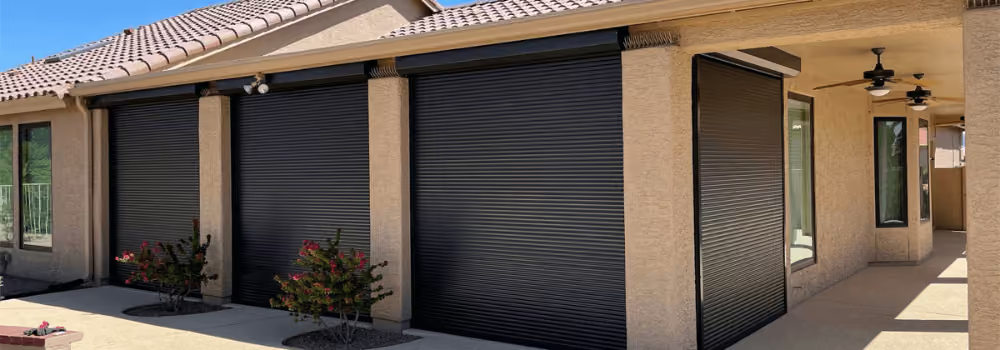














































%20-%20thumbnail.avif)




%20-%20thumbnail.avif)

%20-%20thumbnail.avif)

.avif)




%20-%20thumbnail.avif)