Host: There's a big industry in America with all the characteristics you want as a business buyer, but we've never even mentioned it on Acquiring Minds, let alone had a guest who bought a business in it. This industry has high fragmentation, retirement age owners, tech stagnation. So lots of opportunity to implement modern best practices and enduring demand. Well, Today's guest, Jack McCarthy is building a big business buying these little businesses. And these little businesses are farms. Turns out farming in America hasn't gone corporate as I had assumed. There are countless mom and pop operations growing crops like pistachios and almonds, and Jack and his team at Gold Leaf Farming are assembling an enormous portfolio of them. Since their first acquisition in 2017, Gold Leaf has acquired $350 million worth of mostly pistachio and almond farm across 1,000 miles from Northern California down to Arizona. Now this isn't some financial play or a roll up looking to exit. There is a very long term mission at the core here. It's actually hard to bucket what Jack and team are doing. It borrows from Search and Hold Cos in private equity, in real estate and zero to one Entrepreneurship. If I were being semantic, I might call Jack a zero to one entrepreneur more than an acquisition entrepreneur. But the parallels of his model and ours are so numerous. Jack's a listener of Acquiring Minds that it made sense to have him come on. Regardless, the venture is fascinating, the numbers are big and the vision generational. Please enjoy this conversation with Jack McCarthy, co founder of Gold Leaf Farming. Welcome to Acquiring Minds, a podcast about buying businesses. My name is Will Smith. Acquiring an existing business is an awesome opportunity for many entrepreneurs and on this podcast I talk to the people who do it. August Felker is a two time successful searcher, first with a traditional search fund. The second time around he did a self funded search. Today August runs Oberle Risk Strategies, an insurance firm with a dedicated practice group for searchers and acquisition entrepreneurs like you. If you've got a business under loi, Oberle will provide complimentary due diligence on that business's insurance and benefits program. A great no risk way to get to know August and team. They love helping searchers. They've worked with hundreds. Oberle is a specialty insurance brokerage for searchers by a former searcher. Check out oberle-risk.com O B E R L E- risk.com link in the show notes Jack McCarthy welcome to acquiring Minds.
[3:10] Guest: Thanks for having me Jack.
Host: What you are doing is different than my typical guest in that you are focused on farms rather Than businesses, Of course. Farms really are businesses. So as we'll tease out over the next hour or so, there are tons of parallels between you and a typical searcher. But let's start at the end for context, Jack, and then we'll go back, get your story and work forward. Please tell us, what is gold leaf farming?
Guest: So we own and operate almond, pistachio, and medjool date farms today on behalf of our partners, who are all individuals and families that want exposure to ag but don't have a good way to get it.
Host: Great. And give us a sense of age of the business and size by whatever metric you use.
Guest: Yeah. So we started six or seven years ago when I was in business school, and today we own about 12,000 acres of farms. Central park is a little less than 1,000 acres. So we're decent size acreage. It's about $350 million of asset value. And we've got a great team of 80 people that are mostly, unlike me, driving tractors every day and operating the farms.
Host: Excellent. Well, we're going to return to that $350 million to understand what it, what it means, because I suspect it means something a little different than if we were talking $350 million worth of H vac businesses. Maybe not. We'll return to it. But on the physical size to give people a visual, that was helpful. So Central Park's a thousand acres and you own 12,000. So 12 central parks, give or take.
Guest: Yeah.
Host: And for a, for a modern business person in farming, is that, is that a lot? Because Central park is in the middle of Manhattan, so. So the scales are a little different here.
Guest: Exactly. Yeah. It's a little different. You know, we were a decently large grower today. We got about 6,000 acres of almonds and 6,000 of pistachios. Our medjool Day business is tiny, so, you know, we're a decently large grower in those crops. Probably top 25 globally.
Host: Okay.
Guest: Most of our business is a mom and pop industry. I think the Aver almond grower has 100 or 200 acres. So, you know, it's a pretty, you know, small mom and pop business. There's about 7,000 almond growers, for example, and while there are some. Some large ones like us, mainly it's a small family family business.
Host: Well, you've just hit on parallel number one between your industry and the industry of many of my guests. All right, totally. Let's. Let's go back to business school or even earlier if you want. Wherever relevant. Please give us the Backstory.
[6:03] Guest: Yeah. So, you know, I'm from the Midwest originally, grew up in Indiana and you know, after going to Indiana University for undergrad, I worked at McKinsey, I did a stint in politics in Chicago, I worked for the mayor in Chicago. And then I worked at a private equity firm. Took me out to California called tpg. And through all that stuff, I think partially like my, my dad ran a construction company growing up. I was from Indiana, I was working at places like tpg and I think they just sort of assumed this guy must know about, you know, farming, manufacturing, heavy industry. So I got always staffed on those types of things and, and really grew to, grew to like those types of more overlooked businesses. So I was in business school at Stanford and was really sort of, hey, I'm either going to, I really like tpg, I'm either going to kind of work my way up that, that firm or I'm going to do something very, very different, much more entrepreneurial. And I, you know, had the good fortune to be able to spend business school mostly kind of finding that breakaway opportunity. So I, I spent a fair amount of my first year looking at different tech ideas. I was at Stanford after all, and a lot of my classmates were looking at tech. I was looking at agriculture tech with a buddy whose dad was a, was an almond farmer.
Host: Tell us a little bit about where you, how you guys arrived on that potential opportunity and started pulling the thread.
Guest: My friend and I both wanted to do something more entrepreneurial after business school and were spending our kind of free time. You know, we had Wednesdays off. Most of our classmates play golf. We would drive out to Chowchilla, California and see an almond processor. So his dad was a, was a almond grower. He was getting ready to go to school and was sort of like, dad, how do you sell your crop? Must be, you know, on an exchange or something, right? And his dad was like, no. Well, I give it to this processor, Steve. Steve calls this guy Bob, who sets up a contract. Then he calls somebody in Dubai who's going to buy it. They put it on a boat. So it was very kind of opaque, old school phone based industry. And we thought that was intriguing. We thought there were other problems related to that that technology could solve. And so we went down that path with the general concept of kind of specialty agriculture is traded in an old school way. And unfortunately we couldn't find anything that would really improve. Kind of just works. And I'm sure your audience knows that in their businesses, no matter how much tech and stuff you add to it stuff generally works pretty well how it's functioning today. So we didn't find anything that we were excited to build a business around. But we met dozens and dozens of people in California agriculture, which tends to be more specialty crops like what we grow today, and realized there was this massive amount of land in the U.S. there's like $3 trillion of land in the U.S. it's very limited institutional type of money that's in the space. It's really very mom and pop and there's a big problem in that the folks that own the land, the farmers that own the land, if they were successful, a lot of times their kids went to college and they're a doctor in LA now and they don't have a good succession plan. There's also a lot of young talent that studied plant sciences. They know how to operate the farms, but they don't have $10 million to buy a sort of scale farm. And so they. That was the genesis of what we do today is realizing there was this big asset class that was very attractive but a big mismatch between the owners today and who needed to operate it tomorrow.
[10:12] Host: Awesome. That was phenomenal. All right, Jack, a lot of follow up questions before we proceed. Personally, you said you grew while you were at tpg, you grew to like the overlooked businesses. What did you grow to? Like why did you grow to like them?
Guest: Yeah, like at McKinsey and TPG I worked on a variety of things from, you know, more like manufacturing businesses, construction, mining. I worked, I looked at businesses that did, you know, District tire distribution and all that. One of my businesses at TPG was Chobani yogurt. And I thought like, finally I have a consumer facing company. They have an office in Manhattan. It's going to be fun. I get to go to a big city and they're like no, no, you're going to the plant in upstate New York in Twin Falls, Idaho. And so I was helping them with procurement and operational issues and you know, just really liked that sort of like hands on aspect of the business and like how the real world operates is so sometimes distant I think from you know, the end consumer and what we see as sort of consumers. So yeah, I just grew to like that business a lot and saw from my dad's experience in construction that the same sort of principles that apply in the tech world where you really want a bunch of smart people in one room, in one company rowing in the same direction. That stuff works in heavy industries too, but it's not as common. Something I've been really proud of and appreciative of is we've tried to really bring a lot of smart people into agriculture. All focused on things like organic conversions and saving water. And that's just really paying dividends is sort of concentrating a very high talent team in a space that doesn't have as many companies that have done that.
[12:13] Host: And your friend that you were exploring possible venture ideas with, his name was what?
Guest: Larson?
Host: Larson. Larson. And Larson's dad was the almond grower? Was. He was Larson's dad what you described as kind of the typical 100 to 200 acre farmer?
Guest: Yeah, maybe a little bit bigger than that. But, you know, Larson was a Olympian and a Navy SEAL and went to Stanford Business School. So, you know, his dad was a successful farmer, but he, he wasn't necessarily back in, back in Wasco Shafter taking care of his dad's operation. So, you know, I think that was a great example and, you know, kind of showcases what, what we see every day in the acquisition side of the business.
Host: Yeah. And we're going to, we're going to really get to that. And yeah, you're, you're in Larson's exploration, looking for kind of tech ideas, applying tech to the supply chain. At least that was kind of your, the first thread you started pulling on why I assume the first idea you had was some sort of clearinghouse or marketplace for the supply chain. Why doesn't that exist? And why did you also conclude that it wasn't a good opportunity?
Guest: Yeah, I think we did a lot of the classes that I think are common in entrepreneurial places like lean startup type methodology, where we're interviewing people trying to find where the pain is, like who really feels the pain. I would say there's certainly problems to the way that the business works today, but it's not especially painful for any one participant. The grower, the processor, the trader or the end consumer. Nobody feels the pain. And so no one needs to do things differently, like badly. And therefore it's very hard to get people to do things differently because it kind of just works. It works at least. Okay. And so I think one of the lessons from that, that, you know, I'm not in, in technology at all today really, but I think seeing that you gotta be pretty different, you know, 10 times better or 10 times cheaper to get somebody to do things really differently. And I think that was a really great lesson.
Host: Yeah. And by the way, isn't that 10 times better right out of 0 to 1 from Peter Thiel? I think that that's where I first heard that.
Guest: Exactly.
Host: Yeah.
Guest: Yeah, exactly.
Host: And you keep referring to specialty crops. What do you mean by specialty crop?
Guest: So in, in ag, we talk about, you know, row crops which would be like corn and soybeans. We especially crops would be stuff that, you know, is smaller markets, you know, maybe grown in only a few places. So we grow almonds. They're grown 80% in California globally, 7% in Australia, 5% in Spain. So they need very specific weather to grow. And that doesn't exist very many places. Other types of specialty crops would be fruit. Like in California we grow berries on the coast and lettuce on the coast. We grow things like citrus in the Central Valley, like near where we farm. And those tend to be crops that can't grow everywhere. And the markets are a little smaller, a little more niche and that's, you know, create some good opportunities for growers.
[15:38] Host: And so when you say specialty, really what we mean is basically just a smaller market. Exam product is just a smaller market. Listeners of Acquiring Minds know that for almost any business you acquire, its success comes down to the people and how you develop and manage them as their new leader. Thing is, in addition to management, there is also a lot of process and bureaucratic work when it comes to your new employees. Payroll, compliance, hr, technology, hiring, to name but a few. These processes are crucial to get right, but at the same time distract from where you want to be putting your energy in leadership. So Aspen HR is an HR firm and PEO that takes this work off your plate and handles it with the care it demands. Aspen is owned and run by Mark Sinatra, himself a successful former searcher. So Aspen's own leadership understands the HR challenges that searchers have. Post acquisition. The firm is offering Acquiring Minds listeners a complimentary pre acquisition HR and PEO review for your target business. Check out aspenhr.com or contact Mark directly@markspenhr.com and what, and you also referred now to, I think corn and soy. What are the giants? I guess you call, and you call it a row. Agriculture. What are the giants of agriculture in the U.S.
Guest: you know, I think the big businesses tend not to be farmers themselves. They tend to be more, you know, seed businesses, chemical and fertilizer businesses that are selling to farmers. Some of the processing and more like midstream businesses tend to be very large. The farmers themselves still are fairly mom and pop. And I think there's been more consolidation as the technology gets better. You do want to be investing in kind of the latest and greatest ways of farming more sustainably. And some of that takes more capital, more concentration. And we're seeing the same types of consolidation happening in our market. It's happening in other parts of ag too.
[18:04] Host: A couple things here are kind of counterintuitive to me as a layperson. First, we all, I have the sense that there kind of, there's this big ag, big agriculture and that agriculture now is like run by the Monsantos of the world. Honestly, all I know is Monsanto is a boogeyman. I don't even know what Monsanto does, to be honest. So maybe you can educate me.
Guest: But they're like those like seed and chemicals businesses. Is that's what you'd hear about as a consumer is people that are selling the farmer the seed or selling them the roundup. That's what you'd hear about more as the consumer.
Host: And so those guys are actually not farmers.
Guest: Yeah.
Host: And not farmers.
Guest: Yeah, yeah.
Host: And so the farmers themselves remain pretty fragmented even in non specialty crops. Even in say corn.
Guest: Yeah. Although I think there's more consolidation in some of those bigger crops, especially in land ownership. You know, there's more of a liquid market to buy a piece of ground and then lease it to a farmer. In our business, you know, almond trees take six years to get mature. Pistachio trees take nine years to get mature. So you have a piece of ground, you're going to plant an orchard on it. It's going to take half a decade or a decade to mature. And so a lot of the values in the trees and the irrigation that you've installed to run the orchard. So it's almost more, it's more challenging for that market to have outside capital because you have to have that amount of patience. And a lot of the value is not just in the dirt, it's in the trees and other aspects of a built up orchard.
Host: But why is it that if, if farmers, even non specialty crop farmers still are pretty fragmented? You said not as much as on the specialty side, but still pretty fragmented. You know, it used to be that like 50% of people were farmers or something. There's some statistic and now it's like less than 2% or less. So. So square that circle for me. Very few people today are, are farmers. I think, you know, you're in the world so you probably meet a tons of ton of farmers. So this is all kind of perspective. But we all have this sense that there are very few farmers. But it sounds like in fact there are thousands and thousands of mom and pop farmers to this day.
Guest: Yep. And you know, I think there's certainly a lot less than a long time ago, but it's still very fragmented. And, you know, there doesn't need that much employment because the process of this is quite mechanized. Like in the Midwest, you've got big machines that can cover lots and lots of ground out here. Our crops, we have maybe one person, one employee per 200 acres. So to my Central park point, maybe four or five guys covering Central Park. And so they're pretty mechanized industries. It doesn't necessarily employ tons and tons of people. But that said, like, the ownership is still very fragmented and, and you know, you got a lot of small, small business owners basically running acreage in their little part of the world.
[21:22] Host: Okay, fascinating. Yeah. Okay. And so now let's return to where we were. So the, so the opportunity that you guys ended up kind of spotting wasn't in some SaaS tool or marketplace to. To throw it. To throw it at the supply chain, but was in the fact that if there's maybe a talent, there's an opportunity for very hungry IT talent, talented new sets of eyes to come into this industry and maybe be more aggressive, better operators perhaps. And. And a very fragmented market. Yeah, so that was kind of.
Guest: Yeah.
Host: So thesis.
Guest: Yeah. So, so basically we realized, you know, the Average farmer is 60 or 70, you know, everywhere in the U.S. but in California, they don't necessarily have a great succession plan. And on the other hand, you know, I ended up bringing in my co founder, Brandon, who's an agronomist. And you know, guys like him studied plant sciences. They grew up in the industry, maybe even worked in a family operation. But to do this at scale, you might need 10 or 20 million dollars to get. To get into the business. And so a lot of our team today, and Brandon, you know, before we started this, were really talented agronomists and farmers, but they don't have the capital to get into the business the way it's structured today.
Host: And so there aren't, there aren't kind of incubators or startup competitions at the schools where agronomy, Agronomy is taught to target the Brandons of the world to raise a few million bucks of capital and go farm, go buy a farm.
Guest: No, it's very difficult. Like, the main capital is kind of bank debt, like mortgage debt, and that can only get you 50 or 60% of what you need to buy a property. So it's very difficult to enter into farming even if you have the talent. And I think that's something that we're addressing pretty head on.
Host: Okay. Addressing this head on. What shape did that take?
Guest: So the way we operate is we have a group of partners that want exposure to farmland. Our original partners were tech entrepreneurs that had actually bought several farms themselves directly because they couldn't find a way to get exposure to agriculture. They wanted exposure to agriculture and farming, they couldn't find a way to do it. So they bought farms directly and realized, man, this is actually a lot of work. In every other asset class, we have someone who manages that asset for us. And you know, that would work well here. So they helped us get started. I can get into this more, but it was basically like a search fund concept where they gave us some money to go see if we could make a business of it for the first two years. We ended up doing five investments over that time. And you know, that became the starting point to then continuing to grow. But you know, our investors look like those guys. They might be individuals, tech entrepreneurs, business owners, you know, work in finance. In most cases, they don't work in agriculture, they don't have exposure to that. And they, they want it. And so that's what we provide is a way to get access to that. And you know, then on the other hand, we're hiring really talented young people or talented farm managers that know how to take care of the trees, drive really high yields, but they don't have the capital to do it. And trying to create an environment where they really feel like they're running their own farm, running their own business. And we're making that easier for them to do by giving them centralized procurement, hopefully access to other talented people, kind of giving them the keys to run their own farm. And, and we want it to feel more and more like they're running their own, running their own operation, and we're just helping them make that easier.
[25:51] Host: Reminds me, Jack, something you said to me on the pre call that it's hard, it's hard to categorize what Gold leaf is. A little bit holdco, a little bit search, a little bit real estate, a little bit farming. Elaborate on that.
Guest: Yeah. So I think we, we borrow from lots of different other concepts because it is a little bit of a new model. You know, in some ways it's a new model where we're borrowing from search to get started. Like, hey, we had capital to go look for a couple of years and find the first set of farms to build a business around. In some sense we're, we're doing what searchers do, which is bring high talent people into a maybe overlooked industry or business. We also Own farms. So there is a real estate component to what we do, but we need to operate them, too. We can't just sort of lease them out. So I think we're borrowing from those businesses. But sometimes I start down that path and then I sort of realize, like, well, the. The big successful family farmers that we look up to, like, we look up to Driscoll's, the berry company. They, you know, only do blueberries, blackberries, strawberries, raspberries. They do four berries, but they do them really well. They own the genetics, the farms, the processing, and then the marketing. Like you'd see them in the grocery store. And so, you know, we think about building towards that over the next, you know, many decades. And really, like, we don't look way different from them. We just have maybe outside capital, but otherwise we. We look pretty similar to those guys. And so I think we are borrowing from lots of different industries, but at the same time, we're really emulating these. These great ag businesses that were built over certainly decades, but kind of family ag businesses that have. Have built a dominant business over time.
[27:49] Host: Well, without knowing anything about Driscoll's, perhaps, I mean, were they as acquisitive as you? I mean, your. Your playbook here is starting by acquisition and then growing through acquisition. And maybe in farming, it has to be that way because there's no such thing as unowned land. So you got to start by buying somebody's land.
Guest: Yeah, I think that's right. Like, we're in an interesting moment in our business where almond price has been low for about three and a half years, interest rates are up. And so we think there's going to be quite a bit of sales activity the next couple years where people are selling or having to sell, and we're going to see some really quality assets for sale. When we look at some of these family businesses, there's a great grower we know in the Sacramento area, they bought all of their farms in two. Two downturns. So in the 1980s and in the early 2000s, we had similar moments to where we are in almonds today. And that's when they bought, you know, really all their acres. They didn't buy anything else in other periods. So it is a growth by acquisition business to. To buy and buy more land to grow. But I think the smart folks are doing it in, you know, the right moments and. And, you know, building a quality footprint sort of patiently but aggressively, when there's. When, you know, the iron's hot.
Host: Yeah, but in fact, to date, you have been buying when the economics weren't as good as you think they're going to get now.
Guest: Yeah, I mean, we've had to start, I guess. Yeah, we started, but I think like, most of our acquisitions have been in the last few years when, you know, prices have been low. So I think we're seeing better and better deals. Like the first couple years, we invested 2 million the first year of equity. We invested 8 million the second year. I think we invested around 20 the third year. And today we have about 250 million of equity and we're in year six. So we really started slow, figured out our sweet spot of what were the types of farms that we wanted to own really forever. And once we knew that, we started acting. And I think now we're ready to continue to grow because we have this great operating footprint. We know what we're looking for, and the market timing is feeling more and more right.
[30:24] Host: And yet you're already at 350 million. So what exactly does that mean? I mean, talk to me like I'm eight. What is that exactly? Does that mean that $350 million number?
Guest: Yeah. So basically, approximate value of the farms that we own today, and you know, we use a little bit of debt and some equity and equity to capitalize them. So we have about $350 million of farms, about 250 million of that as equity value, and the rest is debt. So, you know, fortunate to have a lot of partners that have, have made that possible, like, you know, people interested in getting this kind of farmland exposure. And, you know, that's the. What's enabled us to, to buy that size of portfolio.
Host: So, and let's, let's tease this out a little bit. So $250 million of it is equity. So that means I, you know, that in the rest debt. So 250 to 100 debt. Usually I'm used to hearing terms that are kind of the reverse or more where they're heavily levered. So you're, you're just the opposite. I mean, you've bought these things mostly in cash, right? Is that what you're saying?
Guest: Yeah, yeah, I think. Or, you know, we're either buying land and then developing it and drawing debt over time. You know, when we plant an orchard or we're buying usually with, you know, 40%, 30% LTV debt. And, you know, I think over time we probably are moving in the direction of less debt, A, because interest rates have gone up, so the debt is more expensive. And then B, what we're finding is when you have a longer hold period, the debt doesn't help the returns as much. And so it, you know, if you're doing private equity and you're going to buy something and sell it four years later, the debt can help your IRR quite a bit. But in our case we're buying farms, hopefully hold for, for a long, long time and the debt doesn't help as much. And we're in a commodity business, so it does add to the risk to have to have more debt. So I'd say generally over time, like I'm a reform private equity guy, from using more debt to using less and less is the further we get into building this business.
Host: But, but, but again, Jack, I mean, I understand that the dynamics are very different when you kind of have a permanent hold mentality, but at the same time. Yeah. Doesn't leverage always juice your IRRs no matter what your hold period is?
Guest: It does, but I think if you, if you, you know, look at what going from 25 to 50% LTV does to your IRR in a, a four year hold versus a, you know, 25 year hold, it matters less on the, on the IRR and you know, it adds the same amount of risk. So I think the further we get into this, particularly with our long hold deals, the less leverage we're trying to use. And I think as we grow, we think we'll use some debt but less and less over time.
[33:39] Host: Right. So I guess, yeah, the longer, the longer the hold is, the less the debt helps the irr. Sorry, you just said exactly that. But I'm just making sure it crystallizes.
Guest: Yeah, that's exactly right. That's exactly. And I think that's why you see like, you know, in these sort of older school businesses like in the SMB world, like people not using as much debt because they built the business over 30 years. Or look at how like Berkshire Hathaway is capitalized. Like they have the float but they also have, you know, a little bit of debt. But really like trying to use less and less debt over time. And sure, they could have used more and gotten more return for it, but you know, they were trying to build something over the long run, not get every last, you know, basis point of irr.
Host: Well, we are going to dive into this long term hold philosophy in just a minute, but before we do. So Jack, this $350 million in assets, 250 million of which you've said is equity.
Guest: Yeah.
Host: That you've raised from your LPs. So is that some mega fund that gave you a quarter billion dollars or is it a bunch of billion dollar checks? What does the makeup of that look like? What can you share?
Guest: All our investors are high net worth and family office. And you know, I think, you know, it's generally regular people that want exposure to ag and have, you know, enough capital to do alternatives. But you know, people writing 100k checks into getting a little bit of ag exposure up to, you know, we have family offices or multifamily offices have done one to $10 million with us. But I think the bulk of our investors are sub million dollars and really just looking for a little bit of diversifier in their, in their portfolio. So that's our capital today, that kind of long term tax paying smart money we've really enjoyed partnering with and I think that's kind of how we plan to keep growing the business. Although I'm sure as we get bigger we'll have opportunities to take in other types of capital too.
Host: So your average LP is a million dollars or less. So we're talking 200, 250 individual checks
Guest: that you've, that you've raised. Yeah, I don't know the exact average, but I'd say, you know, we have, Most of our LPs are less than a million dollars and you know, in the couple hundred grand and we have, you know, friends and family that are in it, it sort of expanded from there and you know, today we have people that have done, you know, over millions of dollars with us that are more like a family office or a ultra high net worth investor. But you know, a lot of our partners are business owners, entrepreneurs, folks that have the capital to do some alternatives but they're not, you know, multi billionaire, that's, that's doing this. It's just regular individuals.
[36:42] Host: So if people listening have a few hundred grand laying around and they want some exposure to ag, they should reach out.
Guest: Yeah, give us a call. Yeah, and, and you know, we, we have all accredited investors. There's various securities rules and stuff. But yeah, we you know, have basically a, a set of friends and family that expanded from there. And that means that you know, we personally know most of our investors and, or met them through someone that we know well and, and that's been a great group of partners to have over the last six years and I think we'll continue to target that kind of, that kind of group.
Host: But just so I understand, if you've raised $250 million, is it common that you'd have so many investors? Dozens and dozens and dozens Is that often how something like this can kind of.
Guest: I think it's true over time or
Host: are you guys unusual this way?
Guest: I think it's more common in real estate. But yeah, I mean like if private equity firm had $250 million fund, it would not be made up of this, this kind of investor. So I think it's something cool about our model is that it started kind of friends and family and expanded from there into, you know, their friends who did this kind of stuff. And I, I feel we've been really, really lucky with it. It is more common in real estate because there's like tax and stuff to what we do and what exists in real estate that makes it more suitable for a tax paying investor like an individual or a family. But I still think it was sort of organic that we just started that way and then it grew over time.
Host: Now you've said multiple times that your investors want exposure to this, they want access to the asset class. You've said it a number of different ways.
Guest: Yeah.
Host: Why has it been so hard for them to access before? I guess because it's so fragmented.
Guest: Yeah. And I think there's a variety of reasons. So you mentioned earlier in the 1800s like 50% of people were farmers. Today it's very small. And so the overlap between where there's capital and where there's talent in agriculture is pretty limited. In Silicon Valley, the capital's on Sand Hill Road. The talents at Stanford University down the block, it overlaps quite a bit. And so I think in this business that's one challenge. I also think when people have tried to come into agriculture to build businesses with capital, often they're, you know, in New York or San Francisco, they don't have the operating experience to know what they're doing. And one of the things we've tried really hard to build is that combination of my co founders, an agronomist, a private equity guy. Really down the org chart we have that mix of younger Stanford alums, but experienced farm manager in Fresno. And that's what we're trying to combine. So capital and the talent lining up. There's also institutional investors have tried to come in our space. The average farm that we buy might be 5, 10, $15 million. So if you're a Canadian pension trying to put out $500 million, that's not easy to do. It takes a long time and especially if you're going to have a very high bar for what you're buying. So I think the talent, capital overlap, the lack of familiarity, people have with agriculture as a business and then just the sort of size of acquisition that's available make it challenging for people to, whether it's individuals or institutions to get exposure.
[40:28] Host: And then, and why do they want exposure? What, what is the, what is kind of the understanding of this asset class by these folks that make it appealing and, and make them, I, I assume they think of it as a very long term thing. So it's a kind of a place to not get irr, but to park money for a very long time. So. So elaborate on that for us.
Guest: Yeah, so US farmland since, you know, World War II has done about the same returns as the s and P500, but maybe half the volatility. So it's done a low double digit return, some driven by cash flow, some driven by appreciation. And the only down period in farmland and aggregate was in the 1980s. So there's been a one down period. The S&Ps had probably 15 or 20 in that time period. And so I think people think of it as a safe asset class that can get decent returns. When you look at the types of specialty crops that we do, the returns have been a little higher, some more like 15 to 20% depending on when you entered and exited. And compounding over 10, 15, 20 years, that is very attractive. I think Berkshire hathaways compounded at 20% since the 60s. So, you know, pretty interesting long term compounding in this, in this asset class really achieved by mom and pop farmers who are great farmers but not necessarily that sophisticated in terms of using technology or having access to lots of money. They've just been in an attractive industry and done a good job with their farm. So I think it's a fundamentally attractive asset class that's performed well over a long time, but it's just unfortunately hard to access. And that's what we try to do.
[42:17] Host: Yeah, well, Jack, where do I sign up? You're really, this is a compelling, this is really a compelling opportunity you're presenting.
Guest: Here you go.
Host: And I actually, I meant that half jokingly because we are going to also talk about if, if, if there's opportunity here for, for the audience. But let's, let's put a pin in that. So let's, let's get back to the plot a little bit. So you said in year one you deployed 2 million, year two, 8 million, year three, 20 and now 350. Take us, take us back to the very beginning where you said you had kind of a quasi search fund model. Just, just give us a couple minutes on how this thing really got rolling and these first investors. And was it. You said it was kind of a search fund, kind of not so if you would.
Guest: Yeah, yeah. So, you know, I had spent the first year of business school doing this, various tech ideas. The first investors who I mentioned, we had met through that process of like trying different tech ideas, meeting potential, you know, users. And he called me at the end of the summer between my first and second year and said, hey, how's your, how's your ag tech thing going? I was like, terrible, we're going to shut it down. And he was like, you know, I really feel, as, you know, we own some farms, I feel that there's a business to be made around giving people that exposure. But you guys running the operation and kind of doing what we do now. So that was the original concept. The original guys helped us get started and basically said they'll give us money to pay salaries, pay for legal, things like that for the first couple years. And beyond that, we'd have to sink or swim. And that's kind of what ended up happening. So we got sort of seed capital from these two investors. They also became investors in the farms themselves and ended up, over the course of my second year of business school, setting that up, starting to look at farms to acquire. And I really met my co founder, Brandon during that period too. He was an agronomist who'd helped one of the institutional investors in our space build a big portfolio and sell it to a Canadian pension and was looking for more of a like, true farming company situation. He was thinking about doing farm management for outside investors. I was thinking about becoming an outside investor. And we said, why don't we do this all under one, one roof? And so Brandon and I got that, that seed capital from our first investors, Brian and Scott, and then got started
Host: and the first year, maybe, maybe give us like a picture of what these, these two, these, these first $2 million of capital deployed look like. Like what? Just, just some story time. Like what were, what were these family farms? Like, where were they? You know?
[45:15] Guest: Yeah, so it was just one farm. You know, we looked at many, many, many farms. We're pretty picky on for sure knew right out the gate that having good access to water was important. So in our business, the, the water rights are attached to the farm. So the old savvy growers like, have positioned themselves in good areas with good water rights. And that was something that was important. We also knew we wanted a quality orchard, quality growing conditions. So we looked a lot, ultimately found a First deal that was $2 million of equity. The second deal is maybe more interesting to talk about because we kind of knew it wasn't 10 out of 10 buy window like it's kind of emerging to be today. Now that price has been low for a little while and interest rates are up. We're starting to see some more, more frequently see very attractive situations. So far we've looked at 11 or 1200 farms and bought 20 something. So our hit rates 2 or 3%, we're seeing that attractiveness level go up. But back when we started, we knew we were in that kind of moment. So we were looking for more off the beaten path opportunity too. We found an opportunity in Arizona, which is not traditionally a growing region for these high value crops. It had good, the right weather, some advantages over California, like it had much colder winters and then it had good access to water. And we thought, hey, let's see if we can't turn that into a pistachio region. So that was our second deal, which was mostly just buying land and then kind of over the next five years proving it out by planting some trees, a small portion of it, proving out the water by drilling wells, and then as we got into it, doubling down again to sort of, once we knew it was working, then really add more capital. So I think like philosophically that's how we try to operate is start small, do more once we know it's working. And that's, you know, embodied in the first couple deals we did, particularly our, our second deal which was in, in Kingman, Arizona.
Host: But, but the second one, you're basically starting from scratch. I mean, you're, you're, you're, as you said, buying land and planting a crop there for the first time or an orchard there for the first time, and you have to wait five years. So how did you, why did, why did you not. Why did the proof come earlier than five years that you deployed capital much faster thereafter?
[48:00] Guest: Well, the proof is different things. It can be just showing that there's water. So we knew from the geology that there was water from the diligence. But being able to access it for the first time adds a lot of value. Seeing how the trees mature and age as they get older and seeing that it's on pace with California or better is helpful. So we're sort of seeing different things as we prove out this region. And you don't necessarily need to wait till year nine to have, you know, full proof. We're sort of measuring the, you know, trunk circumference and looking at how the, you know, when they're coming out of dormancy and things like that to understand how they're, how they're, how they're growing and maturing. But a lot of it's water, a lot of it's growing conditions and, and kind of showing that slowly and steadily over time. And then in the meantime, you know, to your question on like what it kind of looked and felt like I worked out of my closet, my co founder worked out of his truck. Eventually we had our first kid. So I got kicked out of the closet and worked in my friend's, you know, startup and you know, we basically spend a few days a week getting stuff done, a couple days a week out looking at farms and meeting, meeting farmers to, to look at opportunities. So it was kind of a mix between, you know, working out of your closet or sort of startup feel and then working out of the back, the bed of my friend's, my co founder's truck. You know, when we'd meet up at a farm that we were looking at,
Host: man, that sounds like a lot of fun. Seriously. Meeting in the field, not being in the closet.
Guest: Yeah, yeah. There's a Dollar General by our first property that we still talk about is like that was like our office for the first couple of years because we'd always meet up at that Dollar General. And I don't really feel any negativity around this, but like I drive a Subaru, I live in the Bay Area, I'm very like overt about, like I'm not a farmer but my co founder is. And so in the early days we would kind of jokingly, not jokingly like park my subaru at the Dollar General, hop in his F150 and drive over to. Drive over to meet people. So we look the part more than I would by myself.
Host: Totally Jack. They should have just left you in the closet, hide you in the back room.
Guest: I know, right?
Host: Hurting all the credibility.
Guest: Exactly.
Host: So how many of your farms are start from scratch farms versus operating farms?
Guest: It's about half and half or a third that we developed and two thirds that we, we bought. Even the ones that we bought where they were already planted, the trees might have been, you know, only three or four years old or we were going to take them from conventional and convert them to organic. So still today we have, you know, quite a bit of capital and development farms. And then of our mature portfolio, 43% is mature and at its steady state production, 57% of the acreage is either not yet mature or not yet certified. Organic.
[51:26] Host: Well, that leaves me feeling like this is more of a land play than anything, because from across your whole portfolio. I don't know, I missed the math there, but maybe 25% from the entire portfolio is actually operating mature farms that you're just continuing on in the way that they were. And the rest is kind of you're redeveloping or starting from scratch orchards.
Guest: Yeah. And to your point, on like where we are in the cycle, you know, it's going to change depending. Like, I think our belief is we want to be really expert at operating these crops, you know, really good almond farmer, really good pistachio farmer, and then be flexible on what makes the most sense. Like most of our pistachios are in a new region where we've developed because the valuations are really high in California. And so, you know, if we can sell our Arizona stuff someday for California valuation, great. But we're certainly building it at a much cheaper cost. I see where we are in Omans today. I think buying mature farms is becoming more attractive than building planting an orchard from scratch just because of the price being so low. So I think we're flexible on where we are. Most of our firm's existence has been coming out of a boom period into a lower period. And so we've done a lot more value add and development, if you will, in real estate lingo and less buying existing orchards.
Host: And when you're doing value add, are you. Is it still the case that you're like buying from a family and it's kind of a small mom and pop? I mean, what is on this land before that you then redevelop a farm, just sort of an inferior one.
Guest: Yeah, that's still, still mostly the story. So yeah, it could be they were growing cotton or alfalfa, like a lower value crop, and they didn't have the know how or the capital to plant an orchard. It does take fair amount of capital to get an orchard up and running. You know, in some cases we've had orchards that were, yeah, I think cotton, alfalfa, rice cattle, sort of like lower value crops that long term. More and more of the places with good water and good growing conditions in California go to that highest and best use, which is like higher value permanent crops in California. And there's still a fair amount out there that's. That's not yet made that transition.
Host: And so how are these farms valued? That was something I spoke with your, with your colleague Sawyer about and what a mess it is or how just kind of unpredictable it is so talk us through that.
[54:13] Guest: Yeah, I think that's one of the interesting things about. And I'm sure folks more in the search world or the, the SMB world, like, you know, are familiar with this, but things are not necessarily priced on a multiple or cap rate type of basis like a cash flow type valuation. I'd say many farmers have in their head that an almond farm is worth 30 or $35,000 an acre. And what we know is some farms produce $2,000 of cash flow or $1,000 of cash flow. Some might produce $4,000 or $5,000. And so we're really sort of sifting through for great water and then valuing the orchards more on what they're going to produce from a cash flow and returns perspective than caring about the comps. So yeah, that's something unique about our market, that it is less institutional. And so the valuation framework is just pretty old school. Whereas at TPG, every business was 50 different private equity firms were looking at it and they were all bidding to the decimal point of EBITDA multiple. And that's just not at all how our business is. There's no competition. And usually the competition is the guy keeping it for another year, he decides not to sell it. And you know, the valuation is done sort of based on what did my neighbor get or what did I hear almond farms are worth.
Host: Well, it also seems like another contrast between your valuation and how searchers will value an H Vac business is you're basically pro forma ing what you guys will do with this land and it's almost completely decoupled from what it has historically produced or the economics of the historical production. Whereas in search, you're encouraged strongly to look only at, you know, that H Vac business, whatever it produced for the last three or five years, don't think that you're going to come in there and transform it and grow it. Assume that you're just going to steady state it if you grow it. We all want to grow it. That's the goal. Great. But don't proforma that, I mean, I mean do have a, you know, have a, have a good case or whatever, have your cases. But like you're really, you're really leaning on it on the recent historical financial, historic financials and sounds like you guys are not it.
Guest: It depends. Like I'd say in California, where there's good production history, we're typically looking at, you know, what does this area produce in terms of almond yield? Like we know where the high yielding areas are that have the right weather and soils and the right water. And so we know what a high quality farm in a given area is going to produce. Or even often we know the actual production history of a farm. So we try to mainly focus on that sort of hard facts and not be focused on can we do better than that, can we save money on this or that. Really the only case where we think we're, you know, building in some upside is if we know we're going to take it organic. That is something that we, you know, bake in, if you will, that we know we're going to do. But you know, typically we're saying, okay, this Guy's been averaging £3,000 an acre of almond yield. This is what it would cost to farm in this area because we farm up the street and that that means we can pay X and we might not have financials from the buyer. We'd have like USDA production history, but these are small businesses, so they usually would have like a tax return but not necessarily a detailed financial package. And we're really focused on what do we spend to farm, what's his production history been or what's the USDA average production history in this area so that we can be pretty certain of how we're going to do.
[58:17] Host: So tell us more about this USDA production history centralized database thing. So this is kind of a benchmark that exists that you can reference.
Guest: We gather yield data from all different, different places. Like there's county averages that the USDA publishes. We look at, you know, other types of data that's out there. We get, you know, advice from, agronomists and farmers and say, you know, where have they seen high yields? And we have a, basically a tool we've built like a GIS tool that has water districts, you know, what kind of opportunity zone tax system it's in. What have the yields been historically? What do we think the cost of production is in this area based on the water and the yield? And we sort of aggregate all that into like, basically we know the areas where we'd want to buy and where we wouldn't. And we've gotten to the point now where I think when we see a new opportunity for sale in five minutes, we know if it's probably going to be a fit for us or not. And I think that the level of focus we have on the same types of assets has allowed us to really know what our strike zone is and what it isn't over the last five or six years.
Host: Well, this tool sounds mighty powerful. Is this, is this kind of emerging as some secret sauce for you guys? I mean, do other players in the space, to the extent you even have competition, have data tools like this?
Guest: I'm sure some of the, you know, there's a few more institutional investors in farmland. I'm sure some of them have it. But typically, you know, they're doing lots and lots of different crops. We only do two crops which are grown in the Central Valley in California. So we know the water really well, we know the growing conditions really well, and I think that's allowed us to be pretty focused on what we want. And, you know, I think it is probably secret sauce that's a mix of this tool and just what's in our head from having done this for quite a while now.
[1:00:16] Host: And sorry, how long has it been?
Guest: What year are we in 2017 we started. So it's been six years, six and a half years.
Host: You just mentioned upside. What about downside? So, of course, on the search, and again, bringing this home for the searchers listening, one of the names of the game for searchers is really focusing on downside more, if not as much, if not more than the upside. And because diligencing is so hard, there's so many unknowns, the businesses are so small and messy and fragile, et cetera, et cetera. So really thinking it through is, is the name of the game. How do you guys think about downside protection when you're buying land and farms?
Guest: Yeah, I mean, I think the further we've gotten into this, the more we're really looking for very high quality farms, like almost like a barbell approach, where most of our acquisitions are going to be high yields, senior water rights, good climate position. And that's going to be a farm we want to own for a long, long time. So we got to do our water diligence, make sure that the quality of the property is high. Like we do tissue samples, water samples, all sorts of sort of agronomic look at the farms, and then we look at how is the weather likely to change over the next 20 or 30 years in this area? You know, are we going to get so warm in the winter that the trees don't properly go dormant and then they don't set a good crop. That's something we think about. So a lot of it is just doing really good diligence and making sure we're sort of buying, you know, the 1 or 2% of farms that are kind of highest quality. Generally that means they're going to have very low cost of production. You know, because they have high yields and inexpensive operating costs. And that's really what we're solving for is that sort of one end of the barbell, very high quality, quality farms
Host: we've talked about now a number of times. Kind of the play here or the playbook or the thesis is bringing this talent who's this kind of who's studying at university, agronomy and so on and pairing them with kind of their own farms to run. We also just talked about your fancy data tool. What about going back again and trying to kind of intersect this with how searchers think? What about operational efficiencies being more tech forward, you know, out with the fax machine, in with Gmail. Does any of that stuff play a role here? Just being, you know. Yeah, operational efficiencies or, and, or tech forwardness for sure.
[1:03:07] Guest: Yeah. So we, you know, I think it all does start with the team. So we, we have to have a really great team because we're going to give them a lot of authority. Like we want it, you know, to borrow another concept from another business. Like we want it to feel like a franchise business where our asset managers and farm managers are really running their own, running their own property and we're just helping them. So we need really good people that can do that. We have kind of a mix of like farm managers that are that like young guy out of college that studied plant sciences and you know, knows how to do it but doesn't have the dough. And then also some really experienced farm managers who've been managing for a family or a larger operation but were never given kind of the, the full reigns to run it themselves. So I think we have a mix but it starts with that very high bar for talent and kind of concentrating great people in one place. When you get that kind of talent you can do hard things. So the average farm manager might not want to give self driving sprayers and tractors a try, but our guys do. And we use all sorts of different ag tech for a variety of efficiency reasons. We use field in which a tool that tracks our equipment as it moves around to look at like optimal pace as it goes through the orchard. We use aerial imaging to see the tree health because it looks at the leaves to see how stressed or not they are. And we can spot problems in the orchard. If you've got orchards the size of Central park, you need somebody to sort of look at that holistically and identify areas that are something's going wrong. We use sensors in the soil that look at how hard the Roots are pulling to, to get the water they need and that allows us to really dial in the irrigation. So we're super efficient with water, which is important to us from a value standpoint and a cost standpoint. So we use a lot of technology, but all that's really enabled by our team and there's no like silver bullet, but it all adds up and makes us more and more efficient. So yeah, the way we think about our business is, you know, we invest a lot in our team that allows us to invest a lot in the farms from a tech sustainability efficiency standpoint and then that's ultimately going to drive more returns and creates this like virtuous cycle where, you know, there's sort of mission embedded into the business model. And that's something that's super motivating to me and super important, I think, to the overall success of the company.
Host: Well, we haven't even talked about mission, which we will, but before that, tech. Back to the tech. So, you know, I, I again as a complete layman here, I think of, you know, one of the applications you'll hear of drones, for example, is aerial photography for agriculture. And so I just think, okay, well this is a best practice that's been adopted by across the agriculture industry. But really it's probably, it's probably just like you would see in an SMB that yes, it's a best practice, but in reality these small operations have not. Are. You have not adopted it and are indeed years from adopting it sort of thing.
[1:06:31] Guest: Yep, yep. Yeah. And like I think an example would be, you know, most farmers and in our crops use drip irrigation, like micro irrigation, more and more. That's becoming the norm to be just as efficient as possible. It's more rare to see people use the types of sensors that we use in the field because they're not cheap. It's complicated. You need to be able to look at your iPad or your computer in the morning and dial things in further. And I think fortunately or unfortunately, that's not that common in the industry. So I think we definitely use more technology than, than the average, the average farmer. And I think, you know, there's no silver bullet. Like none of it's going to add 50% to the bottom line. But it, it all adds up and it makes us more efficient, smarter kind of learning machines and we're just, you know, getting something out of each at bat, at bat. We have each season getting better and better operators.
Host: And so this hiring great talent being such a key part of your strategy. Do you guys have this like really well honed, aggressive recruiting function. Are you, I mean, are you at the, the schools where agronomy, the best agronomy schools and you know, recruiting from within them sort of thing.
Guest: We have some people straight out of school, but mostly, you know, we're hiring from other farming companies, other family businesses, kind of the agronomy and more like plant doctor type of businesses that are out there that give farmers advice. So we hire from different parts of ag. I think we do have a very strong reputation. We treat our people really well. We have a very strong culture and I think that's made it easier and easier to recruit good talent over time. Like recruiting now is much easier than it was four or five years ago because we've just invested or like over invested in making this a great place to be kind of a concentration of really awesome people. Yeah, it's hard to describe, but I think when I talk to other business owners, the more you put into the culture, the more you're going to get out of it. And I think we definitely feel the benefits of that. And in an industry where, you know, small businesses can't necessarily do that, large businesses tend to be more like stale and bureaucratic. Like our. We're very thoughtful about the culture and the value system that we, we operate within and that's just paying big dividends in terms of getting fantastic people.
[1:09:12] Host: Well elaborate on that. That's perfect segue to, to the mission. What is the culture, the mission, the values.
Guest: So our north stars leave the world better than we found it, which to us is like the test we apply to anything we do. So we want our team to be better off than if they worked elsewhere. We want our investors to be better off than if they invested in something else. We want the farms to be better off than if somebody else owned them. So it's sort of the bar we hold ourselves to. We hope that's going to lead to farms, families in a future we're proud of. So a lot of what we're doing is, you know, hopefully showing the ag industry there's a better way to. Better way to do things sometimes. And you know, the way we try to act is being really candid with each other, putting family first, acting like owners and then leading by example. So we want to be really honest with each other. We want to remember there's bigger things in life than work, which is the family first. I think what we're fantastic at is acting like owners. We have this very dynamic team that ultimately feels more responsibility for the farms than if they Owned them themselves and all of our team has equity, so they really do own them. But I think people act that way anyway and then lead by example to us is certainly doing the right thing, but it's also trying new things that the average grower might not do. So we have a desalination system on one of our farms where we can take water that couldn't be used, clean it up so that it's suitable for the trees, and we're basically using found water that really is much more efficient and sustainable. So we don't know how well that's going to work, but we're definitely going to try it. And then if it works, we're going to do more of it. Or going into a new region doing organic conversions. These things are not necessarily everyday activities, but we're going to take some, some calculated risk, try new things and try to, you know, double down on what's working and not be afraid to try new things because that's kind of what the industry needs. So that's how we describe it to our team. I think it sort of feels like really serious about what matters. So culture, results, financial, sustainable, otherwise we're really informal about what doesn't. We don't have a dress code. We didn't get an office till like a year ago. You know, we were working out of closets and shared spaces and whatnot.
Host: Dollar generals?
Guest: Yeah, dollar Generals. No fancy trucks. You know, we just don't believe in that kind of bullshit. And so we want to be really serious about the things that actually matter and like extremely informal about the stuff that doesn't and kind of, you know, keep the sort of bureaucracy out and the entrepreneurialism high.
[1:12:17] Host: You know, hearing anything about agriculture is going to, is going to invariably kind of make contact with the climate conversation both in terms of, both in terms of doing right by the climate, which I think you've kind of already addressed in trying to move or go organic and where you can, but also in terms of your own prospects and how climate change may or may not affect the law. Especially if you're a long term play here and you're not, you're not thinking in five year increments, but in 50 year increments. So I think you've already addressed the former. But if there's more to say about how you guys are doing your best to respect the climate, say more but then, but then also address how you think about climate change in terms of, in terms of mitigating risk.
Guest: Yeah, yeah, I think, you know, we do a lot on sustainability on the farm. So of course there's the things like organic conversions that are, you know, more known to the consumer. If you're in this sort of sustainable ag world. There's things that are a part of organic farming that matter. You know, we're not using pesticides in organic, we're using like pheromone based disruption. So we emit female pheromone that confuses the pests, they don't mate, the pest population is suppressed, we don't have to kill them. But that affects pollinators for example, because we're not, we're not killing the bad bugs. We're also not accidentally killing the good. We use compost to deliver the nutrients our trees need. And compost generally improves the soil quality, the soil health and is capturing carbon. So almonds and pistachios generally are carbon negative, whereas most types of protein is pretty carbon intensive like beef, pigs, chicken, all that stuff is carbon intensive. So we're fortunate that we're carbon negative. And then we really lean into that when we're doing the organic. There's a lot we do that I think the end consumer doesn't know about today, but I think is caring more about over time and new types of certifications around pollinators and regenerative farming that I think will be something we participate in over time, we're probably already doing. And we'll just sort of take credit as those markets and certifications become more clear and defined. And then, you know, the way we position ourselves is we, you know, back to the original like North Star. We want to leave the world better than we found it. We want to be doing this for a long time. And so, you know, I think we're trying to protect ourselves by buying high quality water rights areas that really can long term support these types of crops because there's some areas that can't. And that means good water rights that are going to have water every year. It's climate position, meaning it's going to have the right weather now, but the right weather in 30 years. And that's challenging to do. But it's something that we think is important given we're trying to build this business for the long haul.
[1:15:31] Host: We still got a few more questions here, Jack, I hope you're up for it and some meaty ones too. Okay, good. The let's talk about what the business looks like kind of, kind of in terms of ownership and all this equity that you've taken on. So yeah, super basic. You are a business, you are not a Fund, Right.
Guest: Yep.
Host: Okay.
Guest: We think about ourselves increasingly as, you know, a investment firm with one portfolio company. So it kind of. I sit in both seats a little bit, but really it's a. It's a business, not a. Not a fund.
Host: And actually I, despite the fact that I'm the one who asked the question, can you explain to folks like what the nuance there is between the difference. What the nuance there. The difference between those two, kind of. So things are.
Guest: So historically we had a, you know, manager entity that oversaw all the different farm entities. We pulled them all into one main business. So now most of the farms are in one partnership. Our company manages that partnership, kind of like you might see in a private equity context, where there's TPG and then it's portfolio company. They might have lots of portfolio companies. We have one, and we are deeply involved in the operation of it. So I think about it more and more like an operating business that, you know, we have partners that come into the operating business, the operating business, the Goldie Farming lp, they pays a management fee and a carry for us overseeing it and running the business. But ultimately it's one single partnership that has our investors in it, that owns the farms, that does the farming and all that.
Host: Okay. And as you. So $350 million in assets, is that number set to just grow indefinitely? Is there a ceiling or as long as you can find deals, you can keep growing that number?
Guest: I think our business is going to sometimes grow, sometimes not, depending on where we are in the markets that we're in. So, you know, this is a particularly attractive buy opportunity in almonds because price has been low for three and a half years. These crops tend to have cycles where, you know, price gets high, all the growers make money, they over plant five or six years later, those. Those orchards come online and create too much supply, price falls. In a time like this, where price is low, nobody's planting, people are ripping out or abandoning orchards. And so supply is falling and demand will keep growing and cause that to boom again as it outstrips supply. So there's going to be moments like today where we want to be acquisitive, and then there's going to be moments where prices are pretty high, valuations are pretty high, and we're going to be probably not growing quite as much in those periods.
[1:18:43] Host: So I guess, and you referred to examples earlier where a couple of firms who have kind of done this playbook over decades, there were two big buying opportunities where they were very acquisitive in their intervening Years just kind of sat on their capital or didn't deploy more capital.
Guest: Yeah, yeah. And I think, you know, we see that, you know, certainly if you read like, you know, Berkshire Hathaway letters, you're going to read all about that kind of stuff, like, you know, buying in the opportune moments that only come around once every 10 or 15 years. And then even like in ag, we see that with the family farmers we really respect built their businesses that way, like the one I mentioned. Yeah.
Host: And but if you had to guess, just to give us a sense of ceiling or potential here, what do you think that $350 million number is after this buying window? Like after you've gone through this acquisitive period?
Guest: Yeah, you know, I don't know. I think there's about 1.5 million acres of almonds in California. And, you know, maybe that's $50 billion of. Of assets. So it's a big market as, as I share, like, a lot of that is not of the quality that we'd want, and so it's a smaller portion that we'd want to buy. But I do think this is a big market with a lot of opportunity, and it's something that we're excited to keep building a business around. So I don't know. And it's definitely hard to say how the growth will play out because we do want to be very flexible and grow when it makes sense, not grow when it doesn't. But I do think it's a big market in almonds and pistachios and then probably some other crops that over time, you know, would make sense to use a similar model to get into as well.
Host: The structure of ownership. So how does, like, what does your equity look like? To whatever extent you can share and your co founder and then. And then the man and the managers who you kind of really want to see thinking like owners over their farms. And you said that they probably would anyway. But you've also given them equity to. To juice it further.
Guest: Yeah, yeah. So we, our investors are limited partners in a limited partnership. So we have a, you know, limited partnership that they come into that capital allows us to acquire the farms. And if we do well and the assets appreciate in cash flow, we earn 20% of the profits, a carry type of model or promote. And so that's where my equity comes from. We also grant 5% of the profits off the farms to our team. So like a private equity firm would have an option pool for its management teams. That's the same concept. So we have 5% of. If a farm makes $105 are going to go to the asset manager, the farm manager, some of the farm operators, the accountant who's involved with that farm. And usually I'd say the asset manager and farm manager are going to be some of the bigger investors in their, in their properties via that program and really feel a lot of ownership over how the, how the farm does over time. And what I see is a strong incentive to, you know, go the extra mile, make tough decisions on, you know, things that are working or not working. A good example I always share is our big property in Arizona. You know, I go down and visit occasionally. I was driving back to, to Indiana during COVID where I'm from, originally from California, all the way through the night. Ended up in Kingman, Arizona at like 6am on a Saturday. Pull in the gate, you know, let myself in. But of course this is a strange car pulling onto the property. And I've been there two minutes and I see a dust cloud coming at me, you know, 50 miles an hour. It's our foreman Jerry, who for whatever reason was like monitoring the gate at 6am on Saturday. Excuse me, can I help you guys? He's like, jerry, it's me. So you know, that stuff, you know, a sort of typical employee is not going to do that 6am on Saturday, come check on who's, who's pulling into my operation. But our team really thinks of it as their farms, not like my farms or our investors farms. And I think that mindset is just the whole ball game really.
[1:23:25] Host: I wonder if they feel that way. I mean, you've developed a culture to kind of facilitate, enable them to feel that way. But I wonder if there's also something in the nature of land, kind of presiding over land that lends itself to somebody feeling like they're a guardian, a custodian of a particular bounded space of land. You know what I mean?
Guest: I think that helps. Yeah, I think that's part of it. But I really think like we happen to be in a business that is very tangible and I think that helps. But we just have a very special group of people that, you know, whether they had equity or not, would really treat it like it was their own and think about it like it was their own and you know, do the hard things negotiate the extra little bit to kind of save money and drive the maximal performance that we want. And I don't know, we're just really lucky, I think.
[1:24:33] Host: So you had said maybe in the future you, you look at other crops to do kind of a similar playbook. And, and let's again kind of define. Yeah, Key elements of this playbook. But, but, but actually abstract it out because so basically an older, an industry that maybe where a lot of the kind of mom and pop, it's very fragmented, a lot of mom and pops, they're not necessarily using the best practices or the, the latest technologies. And yet there are operators out there who could basically run the businesses better, let's call it. But those operators don't have access to capital to go buy their own. So you're building a business around kind of marrying capital with these businesses that can be improved with the operators to run them. So the obvious question is, you know, I didn't, I don't think I said the word farming in that description once. Could, could this model. I wonder. I'm so this is just me.
Guest: Yeah.
Host: You know, spitballing. Could this model be applied to a bunch of different in industries and maybe this, this is what private equity does and I just don't realize it. But how do you re. How do you react?
Guest: Well, I certainly think it's the search ecosystem, you know, like I think whether it's formal searches or more informal that I know is a big part of who listens to this podcast. Like, I think that is what the search ecosystem is. And you know, it's sort of taking high talent people and giving them the keys to run a business that has good potential. So I think, you know, we happen to be pretty focused on agriculture and see a lot of opportunity for that mindset in agriculture. But a lot of the companies we look up to, like I mentioned franchise businesses, if you look at like Chick Fil A franchisees, they're extremely selective. Like how they, you know, hire the right people to go open up a new Chick Fil A. And it's a bonanza when a new Chick Fil A opens up. And you know, those are well run operations. We look at, you know, Alpine Investors, a private equity firm that's really done this model of buying smaller businesses but bringing in high talent people to the senior levels of those businesses and really focusing on the people side of the value creation. So I think you're right that it definitely applies to lots of different things. We happen to be focused on agriculture and I think there is a lot of opportunity in agriculture for this kind of model. But yeah, I think you're right. It is search and other places as well.
[1:27:19] Host: Well, and I guess, I guess I often just come at this not from the investor mindset or the Private equity firm fund mindset, but as just the searcher mindset, the person who's going to buy the business. In many of those, the vast majority are see themselves as the owner operator of a single business. And yes, they may then acquire more and more and build something larger. But I just, I wonder if rather than people in the audience thinking about buying a single H Vac business, they think about kind of your playbook where they set out to buy 10H vac businesses in Virginia and they focus their energy on finding great managers of those businesses instead of themselves being the owner operator of an individual business. And again, as I hear myself talk, I guess, yeah, this is a playbook that, that kind of maybe traditional search investors are effectively doing, although they're doing it across multiple industries and maybe other. And maybe private equity industry focused private equity funds are kind of that. That is the playbook. So maybe it's not quite as novel as I think.
Guest: Yeah, I don't know. I mean, I just definitely have found the people is the whole, the whole ball game. And when you get the right person in the right seat, which is like we use a system called eos, which I'm sure a lot of people in this community use, that's, you know, from Jim Collinger from eos. But we, it's so real and you really feel that like, click of somebody being like, wow, this is just working. And so we spend a lot of time on that because we just, we find that it works. I find it to be really motivating. I think our team does too. And yeah, we're just super focused on that because I think it's, you know,
Host: really matters, people in the audience, for searchers in the audience, the idea of buying a single farm so not doing what Jack and Gold Leaf are doing, where there's this, you know, hundreds of millions of dollars of capital deployed, but buying that, that one pistachio farm and improving it and bringing best practices to bear on it. Is that something that you think a searcher should consider or do they need like the level of expertise, the agronomy, you know, your agronomists and so on. People have really been educated in this. Is that really, is that really. Who should think about doing this? Because as you well know, many searchers do buy businesses that are highly technical. H Vac businesses that stand in that I keep using, those are very technical businesses. And so searchers who have no H Vac experience will buy them and make a success of them. Can the same thing be thought of here for like single farm Acquisitions, I think possibly.
Guest: I mean I think we definitely occasionally see like a younger, a younger guy that manages to raise capital around, you know, buying a farming operation. And I think that's, that's awesome. One thing I talk about in one of our letters a year or two ago is this isn't a winner take all business like in tech where you need to scale it to survive. Like you know, we can sit at our current size and do quite well over time if we operate well and have the right farms. So I think there is opportunity there. I think we get little bits of advantage over time as we get a little bit bigger, but it's not so substantial that you can't imagine, you know, owning a couple hundred acre farm and doing well with it. You do need some amount of scale but you know, it doesn't need to be our size to work.
[1:30:47] Host: And to be clear though, you would have to part you a searcher would have to partner with. You'd have to have your manager. I mean if you ain't doing the
Guest: farming is like somebody that, yeah, that is, looks like one of our farm managers that kind of bootstrapped a farming operation over time. That's what we tend to see is, but not necessarily like somebody from HBS or GSB going and going and buying a, buying a farm because you know, you do need the farming and agronomy expertise and that's, it takes a long time to learn because you only get one crop a year. So you only have like one feedback loop per year. So I think that's why the industry is so long duration because you don't get to learn quite as fast as you would maybe in other businesses.
Host: Sure, sure.
Guest: Yeah.
Host: That is an interesting challenge of agriculture. But, but Jack, just to be clear, why wouldn't, why couldn't an entrepreneur buy a business and have a farm manager that already has a farm manager? They hire a farm manager and so they're the, you know, they're the Jack of this, of that particular business.
Guest: I think they could and I think it's definitely possible. It just takes, you know, it takes time to get basically the, that relationship going. And it's some of, some of the things of like why has this space not been institutionalized like the overlap of talent and capital and stuff. So I think it's possible. What we've seen more of is a couple cases of like more of a younger farmer that, that gets into the business themselves, finds the capital to do it.
Host: Great Jack. Well, one last kind of big topic I want to hear more about. Is just the long term, like a few elements of being a long term business. First of all, kind of a technical question. Is there going to be a moment where you return the capital or to, to your investors or what does that look like? How do they think about the return on deploying a quarter billion dollars into something that's indefinite? Like just how do they think about that?
Guest: Yeah, I mean, I think when we were buying these as individual farms, eventually we would sell the farm, you know, And I think now pistachio farm lasts for like 50 plus years. Almond farm lasts 25 years. So that could be quite long term. But that's how we originally thought of it. Now that we have it as one business, we really think of it as building the business over time and creating off ramps for our partners if they want that. I think a lot of our partners want the long duration compounding, some of them want a shorter duration than that. And so I think the next phase of the business is really focused on raising to take advantage of the almond cycle where it is coming out of that. And I think there will be opportunities to recapitalize, let people cash out if they so choose. And I just really think about this as like one of my companies at TPG where maybe a different firm, a different owner owned it before we did. They took it through one phase of the business, we were taking it through the next. And I do think we're going to be with the business for a long time. But the partnership group might stay pretty consistent. It might turn over a little bit as we raise money and offer chances for liquidity. But we're definitely thinking about the business long term. And I think a lot of our investors think that way too. But not all are Planning to be 25 year hold.
[1:34:23] Host: Jack, when you were thinking about how you wanted to kind of model this as long term or not, one of the other businesses that you mentioned earlier in this interview, forgive me if I'm butchering it, but was, I guess it was Brandon, what Brandon worked on before where he, he did kind of acquire a portfolio of farms for the Canadian fund. Do I have that right?
Guest: Yeah, they planted, developed a bunch of orchards and then sold that to a Canadian pension.
Host: Yeah. Thank you. And so you must have considered that yourself is what you know, you would, you, Jack, would go do. How did you decide to do something that is going to require decades of your life? What did you like about kind of truly long term commitment as opposed to something like what Brandon did?
Guest: Yeah, I think there's some like personal aspects of it and then some more like industry aspects of it. Like when we look around our industry at who's been successful, this is just a very long term industry. So we look at companies like Cargill or Driscoll's that I mentioned and those businesses were built over many decades, if not centuries. I think Cargill was founded in the mid-1800s and is still around today. And that's the type of businesses we really look up to. And really what's worked in agriculture, this is not a business where you can sort of buy turnaround and flip like in real estate. And so it just doesn't work. And the businesses that have been successful in our space are very long term oriented and so that's something that is sort of just foundational about the industry we're in. I think I also just admire those businesses a lot and I think I personally enjoy building something for the sort of act of building it. Like trying to make a great company out of nothing is very inspiring to me and something that gives me a lot of energy. So like building our great team, building a great portfolio, learning every year and improving every year. And that stuff doesn't happen overnight. It, it's not like a quick mastery kind of industry where you can just come in, do something and, and have a great result, maybe like tech or something. So for us like I, I think it is a long term compounding type industry and, and that's something I found really motivating and I think matches with my personality and my, you know, just like what gets me excited about coming to work every day. So I think it's the industry, but it's also, also personal.
[1:37:35] Host: Yeah. Yeah. Well, I too, I just think businesses that are century businesses are so cool. It's so neat and so, and you really think about Gold Leaf in those terms like you aren't going to be around in 100 years, but you hope and expect that Gold Leaf might.
Guest: I hope that's what we're building is like that level of kind of strength and durability is, you know, I hope it lasts beyond me and I hope I do this for a long time, but I hope it lasts beyond me. And you know, I think we're going to have lots of different things we learn and lots of different iterations of how we operate. But I hope that what we're building is pretty lasting and that's definitely how we approach growing the company and building it.
Host: And just again kind of on working with investors when you're thinking about something so indefinite, you know, permanent equity is a phrase that you hear about a lot. But, but you know, I've, I've, I've heard some people also be kind of skeptical of it because permanent equity, they'll say is, well, that just means, you know, rather than seven years, it means 15 years or rather than seven years, it means 20 years. So it's, it's a longer time horizon, but it's not really permanent or indefinite. Do you have any thoughts about that, that you can educate the audience on how to think about that?
Guest: Yeah, I mean, I think we don't seek to have like no accountability from our, from our partners and that like they're, they're stuck and you know, nothing they can do about like. I think sometimes the, the permanent equity thing is like aspiring to have things that aren't good for the business. You know, like we want the. Well, I just mean, you know, I think we like that our investors ask questions and get involved and, and are helpful to us as we, as we grow. And I think we are hoping to build an investor base that is long term oriented, but still like us, has a high ambition level and high bar for what we're, for what we're building. So I don't know, I think we don't necessarily think of our equity as permanent. We think of it as partners that want to be along for the ride, but we have to keep earning their trust every day and demonstrating good performance every day. So that's like a, every day, month, year commitment. And we try really hard to do right by them and do a good job for them. Even if the vehicle is set up to be longer term than that and sort of the legal docs are set up to be longer term than that. So I guess that's what I mean.
[1:40:20] Host: Okay.
Guest: But you know, I think like, you know, not to my, my team's gonna laugh at this because I always use like so many Berkshire Hathway analogies. But they talk about their investor base as like carefully crafted over many, many years. And you know, they were really reluctant to do the B shares that they eventually did. You know, they basically felt they had an awesome group of people that were their partners and they, they didn't want to change that up because they'd spent a long, long time telling them what they were building, getting people who are on board for that. And there is that aspect of, hey, here's what we're doing. Are you signed up for that? And trying to get that more perfect kind of match between who are your partners and what are you trying to build? Is everybody on the same page. So anyway, I think it's a constant work in progress, but it's something that we think about a lot to have the right type of partners for what we're trying to do.
Host: Yeah. Well, as you guys grow and become more successful and, and better at what you do and your, your reputation precedes you, I imagined kind of a flywheel will kick in with respect to your investors the same way it does with your access now to the best farms and your access to the best talent. All that stuff kind of gets easier as your reputation grows. You can you rather than, you know, you can kind of become selective with, with who you hire, what you buy, and then also whose capital you take, so.
Guest: Exactly. Yep, exactly. Right.
Host: Jack, what didn't we talk about that you wanted to. Did we miss anything?
Guest: No, I don't think so. I think. No, it's been, it's been fun to kind of share the story, talk about the different aspects that are similar and different from, you know, the typical business that's. That's on your program. And now it's been awesome to be here. So. Thanks.
[1:42:11] Host: You mentioned, well, this is where I'll ask how people should reach out or connect with you. But you did mention an annual letter. Is that something the public can get?
Guest: Yeah, I think we have it on our website. I try to put together thoughts on what we learned each year and share that out with our investors and other people. We're pretty open book. So we have lots of information on our website, which is just Goldleaf AG, G, O, L D L E A, F.AG and, you know, whether you're interested in, you know, learning more, coming to, coming to work with us, investing with us. All that information is on our website and, you know, contact info there to reach out. So always love meeting people interested in ag and trying to get more involved in food production and sustainable food production.
Host: And so if people want to reach you directly is still the best way via the contact form of the website or can they hit you up on LinkedIn?
Guest: Yeah, my email is. Yeah, JackOldLeaf AG. And you know, our website has a, has a variety of contact details too. But yeah, feel free to reach out and I'll get you the right person. Great.
Host: Jack McCarthy, thank you very much, sir. What a fascinating venture you're working here. Working on here.
Guest: Thanks for having me.
Host: Thank you.
Guest: Sat.


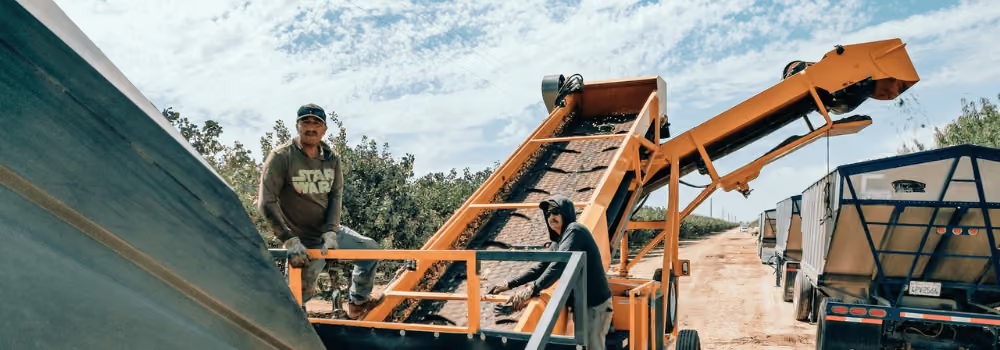


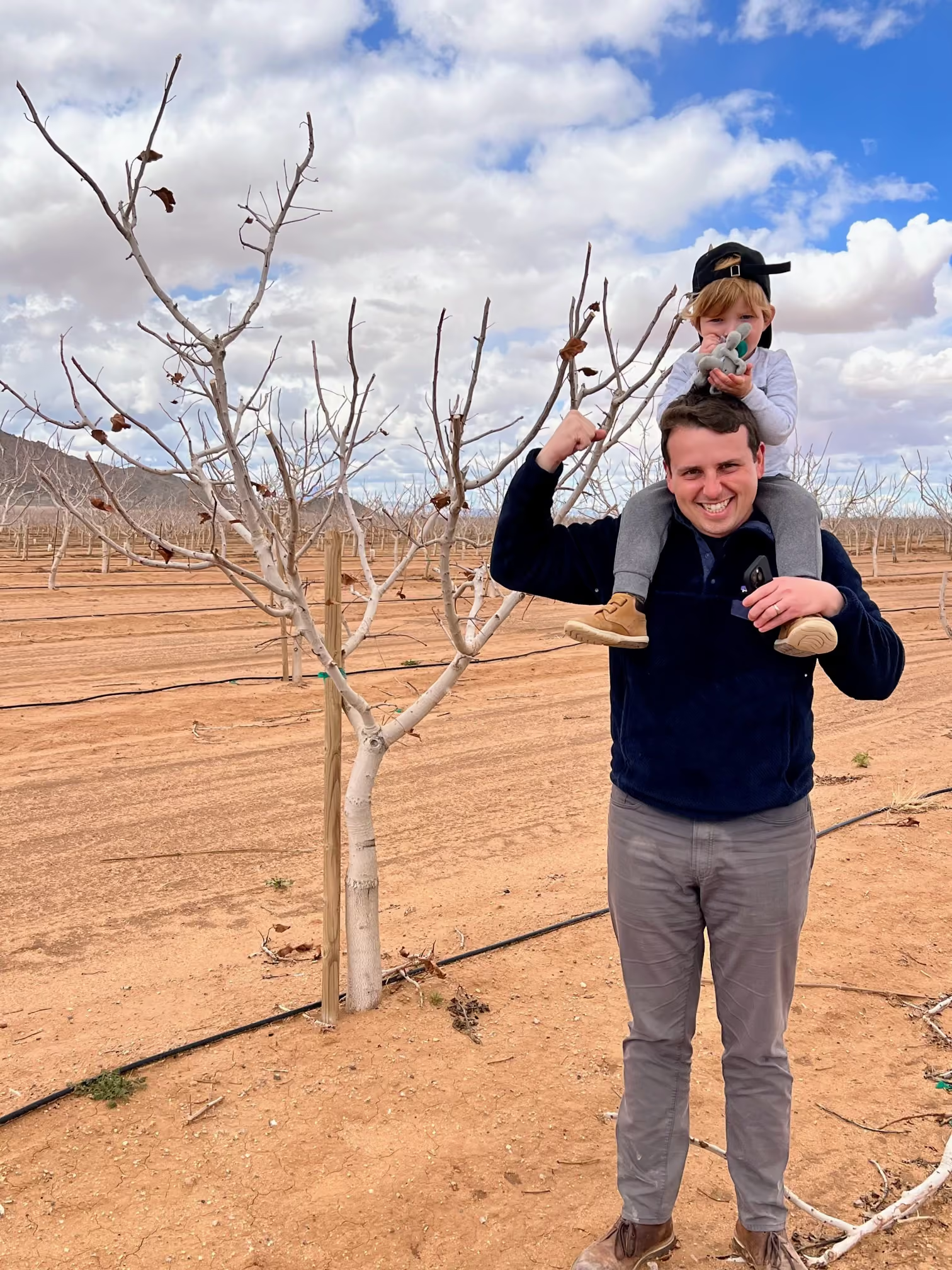

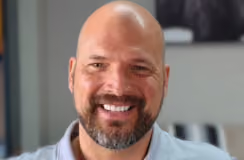



%20-%20thumbnail.avif)

%20-%20thumbnail.avif)
%20-%20thumbnail.avif)
.avif)
%20-%20thumbnail.avif)