Host: One thing that draws a lot of entrepreneurs to search is the low multiples, the compelling economics. But while enticing, those low prices are low for a reason. As searchers quickly learn, it's very hard to find a small business you'd actually want to own. Today's guest had this realization about a month into his search, but he didn't stop at search. He and his partner kept following their noses, kept networking, having conversations, kept their minds open. And where they arrived was doing a franchise seemed like a better use of their time and resources than doing self funded search. Jacob Lee and his partner ultimately signed up to build out 10 locations of the young dog grooming franchise Scenthound over four years. So far, so good. Their first location, opened in February, is exceeding all expectations. So today's interview is about the journey of an entrepreneur and his partner who were very drawn to doing a self funded search, but later decided that there was a more optimal path to get to $1 million in EBITDA over the next few years. And even if you disagree or don't like the idea of a franchise, this conversation will help you stress test your own approach to search. I so love learning about the many different ways that entrepreneurs build fulfilling and financially rewarding lives for themselves. Today's guest, Jacob Lee is the latest example. Hey Quick Housekeeping note. I'm going to start airing Acquiring Minds on Mondays instead of Tuesdays as I do now. I want to have a little more distance between the episodes now that there are two episodes per week. So expect new episodes on Mondays and Thursdays. Going forward. We'll see how that goes and adjust as necessary. Thanks for listening. Welcome to Acquiring Minds, a podcast about buying businesses. My name is Will Smith. Acquiring an existing business is an awesome opportunity for many entrepreneurs and on this podcast I talk to the people who do it. August Felker is a two time successful searcher, first with a traditional search fund. The second time around he did a self funded search. Today, August runs Oberly Risk Strategies, an insurance firm with a dedicated practice group for searchers and acquisition entrepreneurs like you. If you've got a business under Loi, Oberle will provide complimentary due diligence on that business's insurance and benefits program. A great no risk way to get to know August and team. They love helping searchers. They've worked with hundreds. Oberly is a specialty insurance brokerage for searchers by a former searcher. Check out oberle-risk.com O B E R L E risk.com link in the show notes Jacob Lee thank you for Joining me today on Acquiring Minds.
[3:01] Guest: Happy to be here. Thanks so much for having me. Will. I'm honored.
Host: Jacob, you were at one time a self funded searcher. So you were attracted to and well understand the opportunity in entrepreneurship through acquisition. But eventually you decided against it and chose a different path, that of becoming a franchisor of a growing franchise brand. So we're going to hear that journey today and really dive into this assessment you made about franchising on the one hand versus search on the other. Start us off, Jacob, with some personal background on you, wherever you really want to begin.
Guest: Sure. I'll just go briefly over my childhood. I grew up on a farm in middle Tennessee. My family has always been in business. My great grandfather started a business in home services industry that has been in my family ever since. And so kind of always been around small business and the farm is a small business as well. So always was appealing to me. Studied mechanical engineering in college. I worked as an engineer for a couple of years out of college and then went back and got my MBA after mba, did the traditional consulting path and worked for a firm called BCG for a few years after business school and was really a phenomenal opportunity for me. Changed my career trajectory, got to work with people way smarter than me and learned a ton and really built my confidence. You know, people ask how is that relevant for what you're doing today? You know, it's not directly relevant, but I after business school I didn't have that confidence to go and jump and do my own business. After spending a few years at bcg, I did. And I think part of that is you get thrown into projects in which you don't really have a lot of context or expertise and you learn really quickly and you just figure out how to get it done. And so I felt like I could do that in a small business. So about a year and a half ago, a friend of mine that I'd met at Darden in business school was working at an investment banking firm at Wall Street. He's from Birmingham, which is where I'm at now. And we started talking about what it would be like to go into business together. And you know, I may talk about later, but someone came and spoke at a class at Darden who had done something very similar, had gone into consulting, spent five years and then left, found a business to buy and that was just always in the back of my head is something that sounded really cool. So anyways, we took the plunge, left my job and yeah, we'll get into the whole search thing and everything. But we kind of started out as self funded searchers. But that's kind of my short professional background.
[6:03] Host: That's great. Thank you, Jacob. So, and Darden, just most folks will know but just in case not is UVA's. UVA's business school. It's near and dear to my heart. I'm in Arlington, Virginia right now. A lot of family that went to uva. So you. And let me just press on this, this consulting phase of your career. BCG also will probably be familiar to folks, but if it's not, BCG is really kind of one of the most prestigious consulting management consulting firms in the world. Often mentioned in the same breath as McKinsey or Bain. Those are kind of the big three. At least they were back when I was in college and people were applying to those places. Why not continue? Well, we are going to get into like how you chose what you did, but what you're doing now is probably not the traditional path for somebody who was at bcg. Why not either continue at BCG or go to what I assume is the next step for a lot of kind of BCG grads which would be, you know, Fortune 500 or I don't know, maybe leadership at a, at a, at a high potential, high growth startup or something like that. Take the first question first. Why not, why not continue on, you know, aspire to be that, that partner at bcg?
Guest: Yeah, for some people it's a great pass. You know, some people thrive in that environment and they love the continual change and the high stakes engagements and working with senior, senior clients and big dollar signs and everything. It's exciting to them. They like to be in the room where the decisions are made. For me, I think part of my personality, it was very stressful. I mean it was, it was like my personality. I always wanted to be at the top of the performance. But you're working with people that for me felt like a lot smarter than me. And so just the competition and there's this every 18 months you're up for promotion. It's kind of an up and out culture. So you're always thinking about the next review and you're always thinking about the next presentation. And so you know that part of it. And then also, you know, we had our first son when I was at Darden in business school. And so the travel aspect of it, you're traveling typically four days a week every week. So you know, it probably never was going to be a career for me. It was always going to be a place to go and learn and totally fulfilled that purpose. But I mean some people love it again, some people, they get in it and it's exhilarating for them and they love that environment. Just not for me. And then your second question on why not the traditional path? I just really enjoy building something. I really enjoy solving a problem. I really enjoy owning something. And the idea of going and owning a business, even if it's smaller, owning something and being able to have full control over it and build it myself versus going and being a part of a big corporation, spending 80, 90% of my day in zoom calls. And I know in the large corporate world, a very small portion of your time, at least when I was at btg, a very small portion of it was spent on what I felt like was extremely high value activities and a lot of the time was spent on like the presentation aspect of the job. And I think that continues on into the corporate world and Fortune 500 world. And so yeah, it's just not a great fit for me. And this small business, this building a business has been from day one clearly a good fit for my personality and my goals. And it just really fits in with my goals for my family. I really want to be a part of my community. I really want to build relationships in my community, my church. I really want to be a good father. I've got twins that are three and a five year old son. Those items in my life, they were hard to prioritize when I was working at BCG and working 60 hour weeks and traveling all the time. And now I'm able to really prioritize and put a lot more time into those things that are important to me.
[10:33] Host: Excellent. Great. That was phenomenal. Thank you. Okay, so let's get back to the story. So you reconnect or you're friends with one of your classmates at Darden. You had at there had been a visiting lecture of somebody, essentially an acquisition entrepreneur researcher who bought a business. That was kind of in the back of your mind. But did you know what kind of, you know, entrepreneurship through acquisition or search was? Were you well acquainted enough with the concept that you like had the vocabulary down or did you just kind of remember this, remember this cool story you'd learned about at Darden?
Guest: Well, after that guy came and spoke, I read a book by HBS professor and it's called like I can't remember the title but lbo the Small Business or something. It's one of the like original from that from the early 90s. And when I read that I was like, wow, the economics here are really strong. You know, you can buy a business. And in that book he makes it sound a lot easier than it is now. And it probably was a bit easier back in the day. I don't know, it's hard for me to speculate, but I would imagine back in the day before private equity was going into a lower, lower middle market and some of these founder owned small businesses were out there, it's probably a lot easier to find a high quality business for like four times ebitda. And so I read that book and I was like, wow, I could really build. I mean for one, the economic outcome of this, this is something I think that people at BCG also don't understand is I think a lot of people have this idea of like passive financial success means X, Y and Z become partner of BCG or become CEO or start a technology company and have like an exit. But I think reading this book sort of unlocked this idea of like I can have a really great economic outcome by buying a small business using debt. And so anyways, that that book was a big influence. And then yeah, I started following people on Twitter like Brent Be sure was someone I followed early on. And I read all this stuff, I'm trying to think what else. You know, I started networking a little bit. The guy that I mentioned who spoke at our class, his name is Adam Duggans. I think I mentioned him to you before, connected with him and had a few phone calls. Just that's part of the beauty of having a network like Darden. There are probably six or eight people that I was able to connect with that have kind of done that. So yeah, that's how I learned about it.
[13:24] Host: So you really were kind of starting to immerse yourself in search. So you understood the principles, you had, the vocabulary, you were talking to former searchers. Okay, yeah. And so you reconnect with your, this classmate, this friend. And so you guys basically you're kind of done at bcg. You're looking at what the next chapter is going to be and you decide, let's do search.
Guest: That's right. And fortunately BCG has a phenomenal program where they allow you to sort of pursue your next opportunity while still getting paid like half your salary and benefits. So I had think it was four month Runway to do that. So I quit my job a little earlier than my partner did. He was in New York City. He moved back to Birmingham to do this. And yeah, we just set up shop in my shed in my backyard and I can get a little bit if you're interested in a little bit of like kind of our process, as we got started, we, like I said, we were kind of focused on self funded search. So we had conversations with people in town, had some meetings with an investment bank, an investment banker that worked at a lower middle market firm in town, had a phone call with a guy who was also a Darden guy that had done a search in Birmingham a couple of years. He had started a couple of years before us and he was still searching for a business. I think for me that was probably the biggest. That was probably the moment where I was like, wow, this guy went to the same school I did. Extremely smart, well spoken, energetic guy, probably did exactly what I'm planning to do. He's been doing this for over 2 years, still hasn't found a business to buy. And Brett and I just started saying, hey, what if we went two years and couldn't find a business to buy? That's a terrible outcome. That, that outcome is something we really need to try and avoid. So that's really what got us kind of started looking at franchise businesses.
[15:36] Host: Okay, and how long did you actually search?
Guest: Well, we didn't like, we never set up meetings with companies. So I would say a month or so of conversations and this was all. Brett was still working, so I'd say a month or so conversations. You know, we like built a website, had a logo made, kind of started to form our thesis and meanwhile having conversations. And I guess as we're forming our thesis and like when I'm working at bcg, I don't really have the mental bandwidth to really think these things through. And so it wasn't until I left BTG and we're having these conversations that it sort of became clear like, man, this searching for a business to buy is going to be a lot harder than we thought it would be. We also had a call with a guy who, also a Darden guy who works at a private equity firm here in Birmingham and sort of told him our whole idea, our whole pitch. And then he, he told us he had been working at this firm for six or eight years and he's, and he said, kind of told us his process for generating deal flow and just how hard it was even for this guy who has the backing of this really, you know, well known firm in town to get business owners to even pick up the phone. And he kind of challenged us like, what is it about you two that will cause a business owner to take your call and to be like, I want to sell my business to these guys. And especially because in the world of million dollar EBITDA home service businesses or whatever, those guys see investment banker and consultant and have a really probably negative image. So even though, yeah, even though we may think we have what it takes to go and run this business, these guys are like, what experience do you have? You built PowerPoints and you built Excel models and some of that is probably valid. But all those things together sort of scared us. And then we concurrently started looking at franchise opportunities and what we found there really started to excite us. And so it quickly became something. And I think what happened was there was a moment where we said, hey, we'll go look at franchise concepts and we'll spend two or three months doing that. And if we spend two or three months and don't find something that really excites us, then we can go back to the search. It's kind of like we need to take the time to go look into this because what we found here is interesting and if what we find is not what we expected, then we can always go back to search.
[18:26] Host: You've probably heard me mention SM Bash, the conference in Orlando for acquisition entrepreneurs, SMB owners and investors. It was such a valuable event. I met no less than 12 acquiring minds guests there in person, hosts of other podcasts in this space. And if you're on SMB Twitter, it was a who's who of all the biggest accounts. Well, SM Bash is coming back around this time in Austin in April and I'll definitely be going back. I'm told by the SM Bash team that this year they're going even deeper on content relevant to search, including a focus on finding investors for your acquisition and inviting a lot of investors to attend as well. For serious searchers or those who've recently acquired, S.M. bash is really the leading event. There are others associated with universities, but as far as I'm aware, this is the biggest and best indie conference for entrepreneurship through acquisition. Check out smbash.com six letters S M B A S H.com or click the link in the show notes. See you in Austin. Well, it sounds like I was going to ask you the parameters for your search. So it sounds like you were looking for million dollar ebitda. That was going to be your key parameter, your size parameter, which of course those businesses are hard to find anywhere. And I, I'm getting the feeling that you basically were more are both settling back into Birmingham, Alabama. So you were geographically constrained in a not huge metropolitan market. What is the kind of the population of metropolitan Birmingham, under a million.
Guest: Yeah, so you're exactly right. You know, we constrained ourselves geographically and it needed to be a big enough business for two people, you know, so it couldn't be. And, you know, I think we're flexible on this, on the, the EBITDA amount. But as you know, anything sub million dollar ebitda, it starts to get blurry between an actual standalone business and just a sort of cobbled together job for the founder. And so like, when that founder leaves, is there really an entity with systems and processes and management in place to go and buy? Is it something worth paying a multiple of EBITDA for? And so, yeah, anything when it gets real small, that's a tough thing. And yeah, it had to be big enough for Brett and I to both have a good outcome. So it was constrained. And that was definitely another factor that played into our decision to look at franchise businesses.
[21:07] Host: Yeah. Yeah. Okay. And so as you turn your attention to looking at the many, many, many franchise concepts out there, what do you find? Well, and before I ask that, did you have any. There's kind of a bias against franchises for, for a lot of people, I think. I mean, I know that I hear it, I probably have a little bit of it myself. And the theme I return to over and over as I talk more about franchising on acquiring minds is like, there's a step where one needs to get over that bias and they just, they don't have, they don't have the same romance or maybe they feel less personal than an independent business. Did you have any of that hang up?
Guest: Oh, yeah, for sure. So I have that. I had this image of franchise is what a middle manager who wants to be their own boss does. You know, they go start, they go buy a single unit franchise and they run their own shop. And I actually had a meeting with the guy that I really respect and I was kind of telling him about this franchise idea and he was like, man, I think you could do something more than that. And so I think there's definitely a perception thing you have to get over. But I also same time had guys like my brother in law who I really respect, he's an investor, and another guy that we know who works at Roark Capital that invests in franchisors. And in those conversations we really learned like, hey, yeah, there's franchising as a broad category means a lot of things. And maybe 95% of the businesses out there are probably not investable businesses. But here are some examples of some franchises that have been phenomenal Investments for even on the franchisee side, because a lot of people think about the franchisor, you know, private equity investing in the franchisor. But there's a lot of examples of the franchisee side being successful. And I think the first thing that piqued our interest was we learned about Orange Theory Fitness and learned about the economics there, which were, from what we heard at the time, you could build a shop for three to four times stabilized Ebitda, which is similar economics to buying one of these small businesses. You can build a business for three to four times ebitda. And then orangetheory Fitness has been one of those brands that has taken off and attracted a lot of interest. And so those businesses can sell in the high single digits EBITDA if you have enough units. So there's the low cost of entry and then there's the opportunity to potentially exit down the road and kind of have that multiple arbitrage. And so that was the first thing that got us interested. The second thing was the idea of, I mean, when you go buy a million dollar EBITDA small business, we're going to take out a huge SBA loan. The downside situation there is a lot more severe than like what we're doing right now with scenthound. You buy 10 stores, you build your first store, you take out, it's a $300,000 investment. You take out a $200,000 SBA loan, if it totally blows up, then we could go get a W2 and pay off that loan if we had to. They're not going to come take our houses. So that was the other thing that really attracted us to this multi unit model was you can sort of stair step your investment and you can do it without raising a bunch of outside capital like you can, especially if you're able to stretch it out over time where the earnings from the early stores are able to fund development later on. It really is like a compounding. So there's a high opportunity for reinvestment. Whereas if you buy a landscaping company in Birmingham, all the reinvest, all of the growth is going to come organically, most likely, which, which could be great. You could have a lot of opportunity for growth, but with something like Scenthound, it's still organic growth, but you have this pathway to build a lot of units, you know, so you can, yeah, we signed up for 10, but in theory you could take the whole state of Alabama and every medium sized town could hold a scent hound. So that was the other big thing was like the opportunity for High rate of reinvestment, which you don't really find in the, in the search fund kind of realm.
[26:19] Host: That's excellent. And I just want to. Going back to the person who said to you, you should be doing something more, did you, any of your former BCG colleagues, did they, did they give you a similar reaction? I could imagine that.
Guest: Well, I mean, it's mostly like, hey, what are you going to do next? And I'm like, well, we're starting a dog grooming shop. And it's like, oh, okay. Like, they don't really have a framework. They don't really know how to respond to that. So, yeah, you definitely have to swallow your pride and you know, but there are some people. I mean, I think this whole search fun thing has become really popular. And so there's a lot of people now from business school from bcg that sort of get it. And especially when you explain what's going on. Yeah. You explain the economics and you explain the lifestyle. You know, like, my colleagues are burned out too, of work, of traveling all the time and working crazy hours. So I think once they kind of understand it all, they're like, wow, that's actually interesting. And then I've actually had a colleague from, or a classmate of mine from, from Darden that we referred and that signed on as a franchisee of St. Helm. So, yeah, I think it's, I think it's really interesting once you kind of learn the whole deal.
[27:40] Host: Yeah, yeah, totally. And that's kind of a big part of what acquiring minds. The entire podcast is about the. And I don't want to beat BCG to death, but one more question on bcg, just to give us a, to give us a point of contrast. If you were to devote your life to the partner track, becoming a partner at bcg, what could you expect to earn? What are the people at the top of the game in consulting earn?
Guest: Yeah, I don't know exactly. But like, I would guess the top, the top partners are earning like five plus million dollars a year. So it's a really.
Host: That is a lot of. Yeah, okay.
Guest: But I mean, these guys are, these, these guys are, they're really good at what they do. You know, they're, they're like some of the smartest people I know. You know, they ran circles around me. So these are really talented people and
Host: they've devoted their lives, I mean, they're, their lives are probably consumed by their role, for better or worse.
Guest: And these guys, these guys that I'm talking about are like the ones that have like personal relationships with the CEOs of these big companies and are advising them on big matters. So it's not every partner at bcg.
Host: Yeah, yeah. Okay. I want to get into how you chose Scenthound. And we haven't even introduced what franchise you chose. So give us a just a minute on Cent Hound. We're going to return back to it and the numbers of. And the opportunity with Centown. But just couple bullet points. What is it?
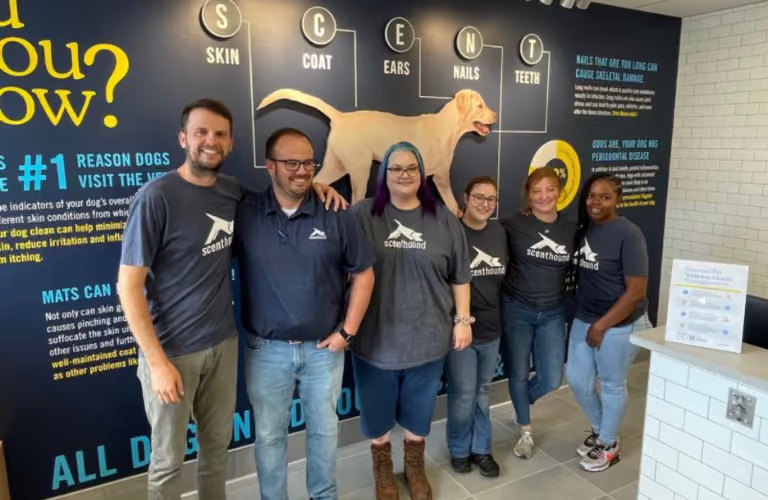
Guest: Sure. So Scent Hound is a dog wellness franchise. So we have brick and mortar stores, about 1200 square feet. Think about the size of a Great Clips or Supercuts. And we offer membership based grooming services. So our membership in our market starts at $35 a month. You get a bath, ear clean, nail trim and teeth brush once a month for that price and then you can add on services like a haircut or a brush out blowout. About half of our revenue comes from the membership. About half of it comes from the add ons. And so we are, we have, we have our franchise. We have the rights to 10 stores. Four in Birmingham, six in Nashville. The first store we built in February of this year, we just crossed over 800 members in that store. And then the second store we opened in November about a month ago and we just hit, we just crossed 300 in that store. So it's been, it's been a great, it's beat our expectations from, from a. Yeah. Market. From a market fit.
[30:25] Host: Yeah. Well, and we're going to get into that more. But let's hear your analysis on why Centown. So, so if anybody considers franchising, you know, the first thing they see is this universe of, of options. I was talking to Wolf of franchises the other week and I think he said 4,000. There's kind of like 4,000 franchise opportunities, many of which are really kind of dismissible out of hand. They're not high quality business opportunities. So there's 4,000 options and kind of pitfalls everywhere. Tell us about your analysis on choosing the brand that you did.
Guest: Sure. So we spent, like I said, we spent a couple of months on this. So a few of the things we looked at in no particular order. One was the great thing about franchises is they have the FDD that they're required to publish. And a lot of franchisors will publish pretty good financial performance information in the FDD. The item 19 just to FDD is
Host: the financial disclosure document.
Guest: Yeah. And so, you know, there's a range of information that franchisors will publish in those documents. But the good ones that are proud of the results will. In my opinion, the ones that are proud of the results will publish. P and L like the earnings you can expect from a store or from a territory. And so we use that heavily. So we downloaded 100 FDDs. We use things like to source ideas. We use things like Franchise Times list of like top franchises. We would go on, we would kind of like find all the private equity firms that buy franchisors and then we'd go look at their portfolio companies and we would use that as a list. We also spoke with guys from Roark and L5 Capital and some other firms that are in the franchise world to kind of get ideas. So we had this big group of ideas and then we started to gravitate. Like we kind of crossed off the non brick and mortar businesses. I guess one bias I had was like I said, my family's in the home services business, so we have H Vac and plumbing business in Middle Tennessee. And so I kind of like cross that one off, that whole category of like territory type franchises off. Because I just sort of thought like if we're going to do that, we could just kind of expand that home, the family business. At least that's how I thought about it in my head. And also. So back to like the gross story. Like when you have a territory, you're kind of expanding your geographic territory. When you have stores, it's a bit more of a clear path for growth, at least in my head. Like you build a new store, you get it up to maturity, it's a standalone business. Whereas the territory, let's say you have a landscaping franchise, it's a lot more like buy an incremental truck, hire a new crew, kind of expand into this region of the market, which made it fine. But anyways, we kind of crossed that off and then we started looking at, I'd say a range of sizes. Like we were really interested in one called Tommy's Express Car Washes.
[33:53] Host: Tommy's Express Car Washes.
Guest: Yeah. And we loved a lot of things about that business. For one, it had been family owned for a long time, had a really great management team, had a really serious support team. So like that's another big element of franchisors, like the quality of the support they offer. And we had like the super day or whatever they call it with them. And we met a lot of their support team. We were really impressed. That business is totally different than Scent Hound. It's like a four to five million dollars car wash and it's a little bit more of like a real estate kind of hybrid. And it takes. It takes a couple of years just to get one built. So it's hard to get all the permitting and construction ground up construction. But, you know, if you look at their FDD at the time, I think they averaged almost $2 million in revenue per car wash and almost a million dollars of ebitda. So incredible margins. So that's an example, one we looked at, we really liked. We also looked at another business that was a window tinting business, automotive window tinting. It was just one we kind of stumbled upon. This is kind of on the other end of the spectrum. It only costs like a couple hundred thousand dollars to build a window tinting shop. It's a super high margin product. It costs like five or six hundred dollars to get your windows tinted, but it's just basically some labor and some like, plastic film to apply. So really high contribution margin. And the competition in Birmingham seems pretty weak in that area. So similar to dog grooming, it's like all mom and pops and so. But at the end of the day, kind of leading up to what attracted us to Scent Hound was this idea of a growing market. So like a market with tailwinds, like an industry with tailwinds. And the window tinting business just doesn't have that. And it also probably has this, like, this risk that it may just go away completely. Like, we found, for example, this technology where you can flip a switch and your car windows automatically tint. And so we did a lot of research into that, and we actually found there's like a publicly traded company that owns the IP for that technology. And at one point we floated the idea of buying stock in this micro cap company to hedge against our investment in the franchise. If this became mainstream and it tanked our franchise business, at least we'd own the stock and like the ip. But anyways, probably a sign that you
[36:50] Host: should just choose a different franchise.
Guest: Yeah, exactly. Yeah, yeah, exactly. At the end of the day, like window tinting, it was. It was really high, you know, so you look at the investment costs versus the stabilized ebitda, and in that situation, you know, the return on investment could have been like 50 to 75%. You could have made your money back in like a year and a half. So that's kind of like what was really appealing. Scenthound was kind of the best of both worlds. Like, so economics is it takes about $300,000 to open a store, and that includes a $200,000 build out of your physical location, $50,000 of equipment, $50,000 of working capital, like wages and advertising, everything until you hit profitability. And at the time they only had five stores on their fdd, so they had five corporate stores. It's a South Florida West Palm beach based franchisor. So they had the average P and l of those five stores. And for those five stores they averaged around $100,000 of EBITDA. So we looked at that and we said, okay, anything over 25% return on investment, like really meets our investment criteria. And then so it checks that box. And then we'd really looked at like the management team and the industry. The industry as you, as you may know. So there's long term growth in dog ownership over the past 20 years and there was a huge bump during COVID Then there's a long term growth of spend per dog. So those two things just with a growing market, it's just hard to fail. We really liked those two trends and then we felt like Scenthound serves a unique niche within the pet services space, which is grooming focused. There's a lot of great players. Like we looked at another business, Dogtopia, which is a great franchise. It's got an awesome management team and they seem to have a really cool product, but that's a pretty competitive space. Especially in Birmingham. We've got, they do dog daycare. We've got six or eight really quality competitors in the daycare boarding world. And so there was a little bit of fear of us, like does that market become saturated? And the other interesting thing about this discussion is like you can look at national averages, but what really matters to your stores or is the competition in your local market? Yeah, and so, you know, in local market may mean like within a three mile radius of your shop. So anyways, the dog grooming in Birmingham typically happens at vet clinics or a handful of mom and pop shops. And so we really liked the niche they were focused on. And then finally the management team, they've put together a really quality management team and we went down and met with them and we're really impressed.
[40:00] Host: So yeah, can I poke at your sense of the trend a little bit just to talk it out? So the first thing is the very well publicized growth in spend on pets, people who have pets and then to spend on those pets. And, and you know, I feel like every couple of years there's like some headline about how ridiculous it's become. You know, like doggy braces are next sort of thing. But, but you know, and, and, and it's and it's got people wondering like, well, at some point we're probably going to reach, you know, peak pet or, or at least peak pet spending. And, and you know, I, and I feel like grooming is kind of, I don't know. I mean you do have to wash your dog. I mean, but you know, grooming does feel. And I guess I'll just tie this into like where we're at macroeconomically. It does feel pretty discretionary. Pretty.
Guest: Right.
Host: You know, you know, like pampering your dogs. And so.
Guest: Right.
Host: If there was ever a pullback in pet spending, it seems like that would be kind of, that would be in there, that would be threatened. And similarly, like if there's a recession and people are belt tightening just in general, again, maybe pet grooming. So I'm sure you consider these factors. How do you, how do you respond?
Guest: So I think about the franchises that we looked at for one to kind of talk about spending on grooming versus other pet services categories. Yeah, like dog food is like the least discretionary, I'd say. I would argue that like dog boarding is probably. Dog boarding and daycare are probably more discretionary than grooming. Like your, these dogs do need some level of grooming. Whether they need a bath every month is a question. But a lot of these people consider their dogs their children. I mean, I read some survey and one of the questions was, yeah, do you consider your dog a part of the family? And like it was thinking it was like 80 or 90% said yes. So to a lot of people it's really not discretionary. To a lot of people this is like a basic need for their child. So yeah, maybe they cut back and they don't do their unlimited membership. They do something less. But so, and then, and then also think about Scent Hound compared to like we spoke with Exponential Fitness. I think they're a big public traded company that owns a bunch of boutique fitness brands like Purebar. When I think about Scenthound compared to them or Sit down compared to even car wash or window tinting or some of these others, like, I think dog grooming is much more recession resistant than those others. So it's a good question. I don't know exactly what will happen if and when there's a recession, but I feel pretty good about it relative to other businesses that we looked at.
[43:00] Host: Well, I think when we chewed on this on our pre call, you also said that this is targeting people with more discretionary earnings. So you also pick your market and you target dog owners who have, who are Whatever, upper middle class or have a little bit more to spend. And so those folks are going to be less impacted by a recession as well. So there's that insulating you from larger market forces, right?
Guest: Mm, that's right. Yeah. And we're, we do feel like our product because we're not super expensive, we're right in line, if not cheaper than most of our competition. So we are sort of curious how our stores will perform in not the highest income areas. So like our first store is in a high income area. Second store is a high income area. Most of the system, there's about 30 cent hounds open across the country. Most of them are high population density, high income. But we do feel like we're approachable from a price point. I mean, $35 a month again for people that consider their dog as a member of their family is not crazy. So we are thinking about like moving into some of these lower, I mean still upper middle class, but lower income than what we're in now. And if those are good markets, then it really does open up the state of Alabama, you know, for a whole lot more of these stores. So we're kind of interested to learn about that.
Host: Yeah. Yeah. Another follow up question to your decision on your, your decision to go with Centown. So when you first started looking at them, they only had five stores and they were all owner operated or what's the phraseology? Owner?
Guest: Yeah. Corporate stores. Yeah, corporate stores, yeah. Right.
Host: So did that give you any pause that there that the actual model of third party franchisees making it work didn't appear to be proven yet?
Guest: Yeah. So they, they had other franchisees. They probably had 10 or 12 stores open at that point, but they weren't on the FDD because they hadn't had like a full year of earnings or whatever. So they, they had just started franchising a, a year or so before. It certainly does. It's way more. It would be great if we had five years of history of franchise stores to look at the issue with franchising. And this is something we haven't talked about yet, but there's a balance between finding a mature brand and then finding a brand that is still selling markets you're interested in a lot. Like we looked at.
[45:39] Host: Get into this for us. Yes.
Guest: Yeah. We looked at like the joint chiropractor clinics and we loved that business. It's actually a small publicly traded franchisor and we love that business and we felt like it's kind of a similar. Most chiropractor clinics are all mom and pop, this was more of a professional offering. And they had a lot higher volume than a traditional mom and pop because superior systems. But they didn't have any available territories where we wanted to be. They had like two in the state of Alabama, and they were in random towns. And I really think that probably as important as picking the right franchisor is picking the right markets to be in, and the franchisors are especially these mature ones, I'm guessing, are trying to sell units. So they'll sell you a unit. They're not going to sell a unit that they think is going to be a failure. But, you know, they start to push, probably they start to push the boundary a little bit of like, oh, yeah, you can open a store in like, Anniston, Alabama, or some kind of random town. So anyways, we felt like we wanted to be in a brand that we could go into markets we believed in. And obviously we live in Birmingham, so that was kind of priority number one. I'm from Nashville, and Nashville is a booming market right now. And so when we found that Sinthe had not available territories there, we secured that as well. So that's definitely the balance. We looked at a lot of mature brands, and you just don't have available markets to go and do. Maybe you can do one or two units. But again, we needed to do enough units to make it big enough for. To support the both of us. So that was a big aspect of our search.
Host: Well, going back to the mature franchise brand question, like, the play there might be blending franchising with ETA at that point. So you acquire established businesses that are under a franchise brand. And we're seeing more and more talk of this on. On Twitter and. And I'm going to be highlighting it myself a lot. That's why I had Wolfer franchises on for the interview. So. So did you consider that, you know, buying, you know, 10 Midas locations in middle Tennessee or northern Alabama?
Guest: You know, we did not really have any serious conversations about that. Maybe because we didn't really know anyone who had done it. Maybe because we didn't really know that there was a great market for it. I also think we're probably a little bit intimidated by, like, at least the way I see it is like, if you. If you're wanting to buy into a successful franchise system, a lot of those successful franchise systems, when they get to sell their stores, they're selling to other franchisees. And so it's kind of like what I've heard, at least. So to get into a great system I think might be difficult to do through the acquisition, but again, this is kind of out of my wheelhouse. So it's probably why we didn't really explore it because we didn't really know a lot about it.
[48:53] Host: Yeah, well, and just to answer that question, not my own, but what Wolf of Franchises had told me, true, it is, it is that much harder to break into a brand, but if you can swing it, then it's good because Precisely, it's like there's a barrier to entry and once you're on the inside, then you as the acquisition entrepreneur can become the acquisitive player. And if you, you know, prove yourself and other owners around the country know you, you know, you, the, the deal flow just becomes quite easy and then you can, you know, quickly roll up because the, the systems are all integrated and adding another location is, is trivial compared to buying a bunch of independent businesses. So yes, harder to break in, but once you're in like way less friction to expand through acquisition. Okay, this is, this is really great, Jacob, let's get into some, some numbers. You've, we've already got into it a little bit. So you had said that when you looked at these five locations early. So they had, they had two or three other franchised locations, third, third party franchisees, they weren't yet on the FTD because one full year hadn't gone by yet. So you were looking at these five locations corporate owned and they were each doing about a hundred thousand dollars in ebitda. So as you know that a hundred thousand dollars is way too small to buy a business according to the traditional like self funded search model. So this only makes sense if you really have a plan to own multiple like a minimum of five. And so what you did is agree to 10. So talk us through that like how you thought about why 10, why not 7, why not 15, how much that costs, what you have to commit. Just, you know, how did all of this come together into a concrete, you know, investment?
Guest: Sure. So I'll start by saying what we know now for these early franchisors, the numbers in the FDD are good guidelines, but they're not like you can't expect that's what you're gonna earn. So in this case, we think we could do a lot better than $100,000 of EBITDA, possibly. Like the stores that were earning $100,000, EBITDA in this FTD had like 500, 600 members. We've already got 800 at our first store. And there's no reason that we can't have a thousand. However, like the, also the late, the labor figures that they had in that FDD were a lot lower than we're experiencing now. So it's not like we're just printing money in our first store. And I think I mentioned to you that we invested in a really high quality manager and a really. And we also invested in a groomer trainer, which are not. You don't need those two people if you're just doing one store. So all that to say, if I were to go back and evaluate the FDD numbers, I would take it with a bigger grain of salt than I did because I think it's probably a good basis to get you interested in the business. But what it works out to is very different, at least in our experience from what we saw there. We saw those numbers and we thought, okay, we need to probably do 10 to make it equivalent to the search fund million dollar EBITDA business that we were kind of considering. And if you think about it, we signed on for 10 stores to develop over a four year time period. So two stores in the first year, three in the second, two and then three. So in theory, at the end of four years you built your 10 stores and then maybe by the fifth year you're able to hit that million dollar EBITDA number. So if you compare that and then it takes about $200,000, you know, for us, we invest about $200,000 of debt, we get a SBA loan for about $200,000 for each store and then about $100,000 equity. So yeah, you invest a million dollars of equity, $2 million of debt, you have a business that does about a million dollars of ebitda. You compare that to buying, let's say your landscape company for like 4 to 5 times EBITDA. In our mind, it probably takes you by the time you start your search to when you execute the deal, to when you're like kind of like comfortably managing the business. It probably does take three to four years anyway. So if you kind of look at the end of four years, it's a pretty similar outcome. We felt like one of them required a lot bigger risk up front. And you're also diving into an existing business where you are the outsider and you're having to adapt. Whereas like we're sort of building this business from scratch and building the culture and selecting the team and everything. So kind of that was kind of back to comparing this against search.
[54:08] Host: That's great.
Guest: The numbers. So I don't know what the Latest numbers are to buy 10 packs, they call it. So I'll just say like to buy a single unit, you pay $50,000 for the rights to a single unit. I think it goes down to 30,000 if you buy multiple. And again, I don't know what the latest is, so I won't share what we did, but say about 30, $50,000 per unit to secure the rights. And then you have a multi unit development agreement that states the timeline in which you'll develop those stores. And if you miss the timeline then like in theory, I think you could lose some of those units or have to sell them back. I think in practice most franchisors are pretty flexible. As long as you're actively trying to build units and as long as you're like, let's say you go and look for a site, you put an loi, like you work and then the lease blows up last minute and then you have to start from scratch and it puts you behind a couple of them months. The franchisor is probably not going to take away your territory if it takes five years. I don't think the franchisor and it's probably depending on who you're working with, which franchisor. So you secure the rights and then you pay a royalty, you pay a brand fee, you pay technology fee. It usually adds up to about 7% of revenue. But you got to think about, you know, one, the support you're getting and two, would I have ever gone into the dog grooming business had it not been for finding Scent Hound? No. You know, like they, they're the most valuable for the first couple of years of your operation when you don't know how to operate a dog grooming shop. And they're basically teaching you.
Host: Yeah.
Guest: And you know, once you like we're, we're about a year into our first store, like we've learned a lot. We know how to run these stores pretty well now. Probably less value. The franchisor is probably less valuable in teaching us that. But it certainly is worth all the money that you pay in fees I think to like get to this place.
Host: Well, and also that 7%, it's not like you're not getting anything from it. I mean if you were a completely independent business, some of those cost, you'd have some of those costs anyway, the marketing costs, the CRM, the whatever. And so I think part of the analysis of choosing which franchise you're going to go with is if, if you feel that your license, the licensing fee. Right. That's what we Call this the licensing fee or.
Guest: No, royalty.
Host: The royal. The royalty is whatever you're getting in exchange for it. Makes sense and is, is, it is fair. It is value for what you're getting. So it's not a tax. I mean you should be getting something in return and just going back to the, the 30 to $50,000 fee and sorry, what was that one called again? The outlook.
[57:18] Guest: I don't know what they call it.
Host: The right.
Guest: The right is just like the rights to a unit. Right.
Host: And what is that? Just a one time kind of reservation. Like you're.
Guest: That's right.
Host: Okay, okay. And that's fine.
Guest: Yeah. So like for us, we counted that toward our equity. Like the SBA loans want to have a certain percentage of your total investment as equity. And so we're able to count that fee as a part of our equity.
Host: Okay. And when you were talking about how every, every new build is 300 grand, 200 loan, 100 equities, how it broke down, the point here and tying into kind of the effects of compounding you touched on earlier is that the profits from every existing store will go into this equity cost for subsequent stores. Right. So you're not coming to build your $3 million empire of 10 stores. You're not coming out of pocket a million bucks. I mean you are, but gradually.
Guest: Yeah. And SBA loans, you can borrow up to I think 90, and the percentage goes up the more equity you have. So like our banker told us that in a couple of stores we probably could finance 100% of the store. So if you were to try and minimize the amount of equity, maximize the amount of debt you're going to use, then you probably could get away with our development schedule and only investing like maybe 400 or $500,000 of equity because you have cash from early stores to finance the later stores and. Or you can use more debt in the later store or a higher percentage of the total investment in debt in later stores because the bank will count the cash flow and equity of your early stores when looking at the later stores. So it's in that sense can be, I mean the return on equity can be obviously enormous if you're only investing $400,000 $500,000 of equity. And then in theory, let's say scenthound turns into an orange Theory Fitness and you have a market in which you can sell these stores into, I think, for franchises that don't blow up and don't become, you know, invested in by professional investors, from what I hear, the market to sell those stores are like, you know, three, four, five times ebitda. But if it becomes something where there's some private equity investor that has some strategy of rolling up 150, like L5 Capital in Atlanta bought a bunch of Orange Theory Fitnesses. They bought like 120 of them. You know, if that activity starts to happen, I think it drives up the multiples in the store. So like in theory we could potentially sell our 10 at a 10 times EBITDA multiple. So if you did the math on that, the return on equity would be enormous. Obviously a lot has to go right between now and then. And we also, like, we don't have any, we don't have any stated intention of building these and selling them. So like that's the other beauty of this is they do generate good cash. And so it may be that we just want to build this business and we still have a great relationship with our franchise partner and want to hold them and sign on for another 10 years.
[1:00:44] Host: And going back to the multiple that you said, if you don't have big private equity coming into buying up your, buying up Your, your brand, 3, 4, 5 multiples on EBITDA are basically the same as what you'd see on in independent businesses. So are you saying that in your experience there's no penalty for, in, in terms of resale value for being part of a franchise brand?
Guest: I think this is hearsay for me. I don't have any direct experience in this market. I, but I do, I have heard that they're actually, I think it depends on what market you're talking about. Like if you're talking about for one, the things that influence it are the number of stores you have. So if you have three stores, that's not really a standalone business. Like at least in our, in our, in our industry, $300,000 EBITDA, you can't afford an area manager. And that's another big part of our decision to do 10 was that we needed enough EBITDA to support an overhead structure. And for us that really meant an area manager so that we could not be running the stores day to day. So if you're looking at that like small store count range, again, I haven't been in this market, but I think it's like low, low single digit EBITDA multiple. I have heard that there can be a penalty for franchise brands versus independent brands, like let's take a burger chain. You know, if you have an independent brand that has some potential to grow into a new market, then that might have a higher multiple than Than like, let's say some Burger Kings, that the, the potential to like expand that, that business is, is lower. So I think it all depends on probably the individual market and kind of situation you're looking at.
Host: Yeah, okay. Okay. I want to get a little bit into just the operational stuff that you were talking about in the management layer. But, but first, just meant to ask this earlier when, when we were talking about how you chose Scenthound. Just coming at that question from the perspective of kind of new business idea, you know, pure, you know, spitballing on the whiteboard, like, wouldn't this be a cool idea? Wouldn't that be a cool idea? And probably you've engaged in that. I know I have. And one of the things that you always stress test your, your shiny new idea with is, well, if this is such a good idea, why hasn't it been done before? And I feel like you could ask yourself the same about a new franchise concept. So with Scenthound, it's like doggy grooming isn't brand new, as you said, to the extent that it exists. They're kind of very small, little independent mom and pops here and there. What about the question of, like, well, this would already be a sizable business or there would be more, bigger, more mature players or a more mature market at least, if doggy grooming, if there was an app, a bigger appetite for doggy grooming. How did you answer that for yourselves?
[1:03:54] Guest: It's a good question. I think that the players in the industry like Petco petsmart, they're kind of our big competition from a, you know, national chain perspective. I think that those, and so they have the services that we offer. They offer those in their stores. They offer bathing and grooming, and they offer, they offer everything we do in a different format. They don't do like the membership. And we also, we're pretty different from our kind of focus. We're more focused on health and wellness. So a part of our brand is really health and wellness focus. So your dog needs these basic hygiene services to stay healthy and to live longer. And we also give a report card of, we call it a scent check of skin, coat, ears, nails, teeth, with every visit on a score of 1 to 5 and some notes. So anyways, we do feel like we're positioned pretty differently from Petco petsmart. But I think, to answer your question, for one, I think that those guys are big box retailers primarily, and they are more just focused on where most of their money comes from, which is being a great big box retailer. So it kind of makes me think about like Walmart, you know, you know, Walmart may sell like hardware in their stores, but that's not their focus. I think Petco, Petsmart, they do dog grooming. It's not their focus. So we think we can do it better than they can. But it is a good question. I don't know exactly the answer to your question on why they're like great clips and a supercuts and five other human haircut chains, but there's no chain of dog grooming shops. I think it's a good question and I don't know why, but I'm glad that we're doing it because I think it could be, I think it could be in 10 years that there are that many different options.
[1:06:02] Host: Yeah. Yeah. Well, you, it seemed like you entertained a little bit of that doubt and feel that the results so far, I mean, as you said, like the, the, those five initial locations, what did you say they had 500 customers and you have eight and think you could get to a thousand. So that certainly suggest that there's, there's more demand than, you know, even your most optimistic projections. But I want to just. Jacob, indulge me because, because I love this. When I was preparing for our call, this Twitter thread you had from September 6th. So I just, I just. Because this is in your own words, you already put it out there for public consumption. I just want to read it back to you because it's just, it's cool and kind of exciting. So you say we're opening February 1st of this year and you opened in February 1st. 750 members. And you say, I'm convinced picking them, the market was the important part. You talk about the dog. Dog services have serious tailwinds with a lack of high quality competitors. We've talked about that. Most pet services are focused on bigger ticket products and services. So that's the boarding. And you found it an underserved niche. And you say, I now feel extremely confident in the model. The biggest risk and barrier to successful execution is people. And then you get into saying, basically apologies for the cliche, but this is a people. Finding people is the hardest part of this business. So anyway, a lot of that was stuff we've already touched on, but I liked just seeing that Twitter thread of yours and the energy behind it. So let's start wrapping up here, Jacob, with a little bit more about the people question and what your layer and operations operational layer looks like to the extent it exists at all. I, if I recall, your business partner is not full Time in the business. You are, but you guys are not yet paying, paying yourselves. So what does that look like today?
Guest: Sure. And it's funny you bring up that thread. I think my evolution of how I think about this business went from, like, when we started looking at franchise opportunities, it was way more like, looking at as an investment, and then it was looking at it as development, building out the store, Facebook ads, marketing, trying to build the membership. And now it's like culture and people and how do we build the best team? Which, again, is cliche, but.
Host: And do you like that progression or are you like, wait, this isn't what I signed up for?
Guest: No, I like it. I don't think of myself as. And I think this is where I need to develop into, like, the culture builder, the leader of people. I think of myself more of an engineer, problem solver, like evaluator problems. But yeah, I'm enjoying it and I really do believe that, okay, the market's there, the model is great. If we can build, if we can attract the best hourly worker team and build a family environment. And then culture. When I think of culture, it's like when you look at your co worker, what do you see them doing? What is the expectation for how you behave in the store? Is that I complain, I'm on my phone, I'm just like, kind of looking for ways not to work. Or is it. I'm, I'm competitive, like against myself, and I'm like, happy to be here. And like, my co workers are optimistic and like this, this, this competitive, positive environment, I don't think it matters that it's hourly worker or bcg. I think having that, like, sort of healthy, competitive and family feel within the store is what will allow us to attract great employees and retain them. And at the end of the day, like, when our customers come and the service they expected to get, they got and it happened on time, then they're going to keep coming and they're going to keep recommending it to their neighbors. So. So kind of back into the management and how we thought about setting this up. So it's different than a lot of our fellow franchisees, Like, a lot of fellow franchisees dove in as the manager of the store day to day. We, like, purposefully didn't do that because we didn't want to get stuck kind of in that role because I do think there's a risk of. It's easy to think about. I'll serve as a manager for six months and then I'll hire someone to replace me. But I think that's from what I've observed, like harder said than done. So we went and found a guy who had 15 years of experience managing movie theaters and hotels and vitamin shop, not dog industry, but like retail management experience. And he's been the best thing that happened to our business, like the best thing that happened to our business other than picking scent hound. He just has taken on this role and kind of like acts like an owner and has led to the success of both of our stores. And he's going to be the guy that steps into that area manager role. And so he does all the hiring and firing, he sets all the schedules, he manages the business day in and day out. I'm a lot more focused on. So my partner and I started together full time. We quickly realized that it wasn't full time for both him and I to do this with Bobby, our manager, running the day to day. So he went back, got a full time job, he's still involved. I mean we still talk all the time, but we have Bobby who started as store manager number one, stepping into an area manager role. And yeah, I mean it's been. And then the other big thing that we did was we hired a groomer trainer. So I think hiring groomers is the hardest part of getting started. And we found that if we wanted to be able to scale this business, open new stores, we had to find a way to create our own groomers. Because the haircut that we do for one is not a breed specific cut, it's not a fancy cut that most groomers are used to performing. We provide like a wellness cut, which is a single length cut. It takes less time and it's a lot more efficient. So we can take someone who's never groomed before and we can take them through as a bather and then take them through our training program and you know, within six months or so they can do the haircut. So we invested in that, in that groomer trainer. She has 20 years of experience as a groomer and that's been a game changer for us. We've been able to train six groomers since we hired her like six months ago.
[1:13:15] Host: That all sounds awesome, but you know, a fully mature store makes 100 grand. And even if yours are overperforming those, those five stores in Florida, let's say you're doing 120 or 50 grand. Optimistically, I feel like that just, that all just was spoken for with these two hires and then some.
Guest: Yep, yep, that's right.
Host: So, okay, so, so maybe store number one and store number two. So store number one probably wouldn't be profitable even at full capacity, full customer capacity with these two hires to store
Guest: number it's a little bit profitable. So we have all of that labor loaded on store number one, and it's a little bit profitable. I mean, if, if we were to pull out that extra labor, it would be, it'll be a great store. Store number two, like store number one, we're kind of considering as our loss leader. You know, it's like helping support. And then store number two is where we should start hitting those, those numbers that we expect.
Host: Yeah. Yeah. Well, that's, that's great. Okay. And so store number two, you'll, you'll, you'll. You're aiming for 100 or 100 more or more than 100,000 in EBITDA. And then, so what was it? One, the first year to the next year? Three, the next year, for the following
Guest: year, it's two, three. Two, three. Okay, so we, we have a, we have a lease signed for our third store. We're planning to open around March. And then honestly, we hope to open a store every three or four months from that point on. And, you know, if, if we, again, if we love the business and we were two or three years into this, we could definitely see ourselves signing up for a new territory and doing more. Because the beauty is once you get into a rhythm and once you have your area manager and once you kind of have like, sort of the structure for the business to, for the area manager to manage the existing stores, then each incremental store is not that hard. I think the key is, like, making sure you're building in really good markets because we picked, like, the very best markets for our first two stores. I think it's important not to, like, dip your, your threshold down just because you want to build more stores.
[1:15:29] Host: Yeah. Yeah. Well, I guess. And, well, and the other thing, maybe this is a different way of saying. What you're saying is that, like, you worry that your first store, your inclination is going to be to put your first store in the most desirable location. And so you just worry that maybe your first store isn't, you know, representative of what store 7 and store 10 will look like.
Guest: Right, right. But the other, on the flip side, store seven. Okay, you already have six stores. You already, you already have an area manager that could, in theory, cover an additional store. And so I do think that the threshold for, you know, the quality of the market might be a little bit lower. But, yeah, it's important. I Think something we haven't talked about, it's important to find like what geographic area is too big for your area manager to like support. So to be able to do day trips and to be able to actively manage those stores. So yeah, we're not, we're not there yet. And we know that doing four in Birmingham is going to be fine. There's plenty of great markets there. Doing six in Nashville is going to be fine. So I think if we were to go sign up for more, that would really be where do we want to go into a new city? Do we like, do we. Will we need to hire a new area manager for that new city or would we rather infill a couple in Nashville, Birmingham? So I think that's all TBD and
Host: then going to your salary or salary and or the money that the EBITDA that you're able to take out your dividend or distribution. What does that look like? What's the plan for that? Are you, you're not paying yourself now, I assume based on my understanding of where.
Guest: Yeah, that's right. So I think we like, we're really fortunate to be able to have income, to be able to pay the bills outside of Sit Hound, which I do, I mean I do think is a huge part of this equation, you know, and allowed us to pursue this option and we really just wouldn't be able to pay ourselves the income we need to do that otherwise. So I think that within a couple of years we hope to be able to pull, start pulling cash out. And again, it's kind of a, it'll be a decision at that point whether we want to keep reinvesting in these stores because honestly the return on equity and investing in sit down stores higher than anything that we could find elsewhere, especially given that kind of the knowledge and the risk of once you get three or four stores in, the risk on that investment I think is a lot lower than once you start out. So it'll be a kind of a question of like do we want to pull money out or do we want to use that money to keep building stores? So yeah, yeah, we don't have a definite plan on when we're going to start pulling money out. But I guess for me, as long as the stores are profitable, like that's kind of like whether we use that money to pay down debt or whether we use it to build new stores or whether we use it as a dividend, it'll be a question at the time of what makes the most sense. But the most important thing is that the business is generating cash, you know.
[1:18:53] Host: Sure, sure, sure. But I also do think it's under. It's important for the listener to consider, like if they need to be taking salary out of their acquisition.
Guest: Yeah.
Host: What that would look like or not look like in your case.
Guest: Well, I do think, you know, kind of like if I were to do this and I needed a salary, I do think that there are a lot of people interested in investing in opportunities like these. And so I think you could structure something similar to a traditional search fund where you get paid a salary or some kind of management fee and still have a really attractive return on investment or return on equity for your investor. So I do think this, this sort of business could lend itself well to having an outside investor.
Host: Interesting.
Guest: Especially like a single, like if you were to have like a wealthy individual because the check sizes are not huge, you know, so it doesn't need to be like some fund or something.
Host: Yeah. Because the actual costs here to get something going are not super high.
Guest: Yeah. I think you could certainly structure something, especially if you were not partnered up. I think you could certainly structure something with a investor. Let's say you had an investor provide all of the equity and co sign the loan with you. I think you could certainly set something up where you took like a low salary for a few years and then you shared, you earned in an equity portion over time and it still would be an attractive investment for an outside investor. So I definitely think you could set this up kind of like a traditional search fund to make the economics work.
Host: Mm. Interesting. Well, Jacob, let's close on brainstorming a little bit. So I, I just did a quick search for sent hound in my area. I'm in the D.C. metropolitan area. I'm in Arlington, Virginia specifically. And I see one Sent hound only In Fairfax, about 25 minutes from me. 47 reviews, 4.9 stars on Google. So people are happy, seems to be doing well. But I would imagine my area is a very strong area for something like this, just because It's a. The D.C. area is very healthy economically. A lot of counties here are always on the top 10 list for, for, for income per capita, so. And then there's Baltimore to the north. So we got a lot of population. What's the play here? Do I do I go to Scent Hound Corporate and say let me build out new territories? Should I do an ETA approach and approach the. The Fairfax owner and say let me buy your location and. And then go. And then be the only game in town and start building out units after learning from this successful operator, you know, what would you do if you were sitting up here in dc?
[1:21:55] Guest: Yeah, I think the ETA route is probably too early in this brand. There may be some opportunities of franchisees that want to exit for some reason or the other, but you're basically buying their territory. They may have like one or two stores that are up and running, but it's not like you're buying a Midas or something and being able to roll
Host: up a bunch of stores.
Guest: There's not really many mature stores out there, so there might be an opportunity here and there. I don't think in your area there is, but yeah, setting up, setting up a phone call with Scenthound, they'll be able to tell you more on available markets, available territories. They're also looking for certain candidates, you know, so they do have a process of evaluation. They're looking for, you know, people with the right financial background. Like they need to have a minimum liquid net worth, things like that. And then also they're looking for people with the right experience. Um, so in theory, they're not going to just let anybody sign up for one of these, but you set up a call, you'll have an intro call with sort of the salesperson there, and then it's sort of a process. A lot of people will reach out to existing franchisees like me. Sometimes I'll host a call with six or eight prospective franchisees and do a Q and A. That's the best way because the franchisor is not allowed to tell you a lot of things because there's like certain rules around what they can and can't say because they can't, like, you know, make any performance claims. And so the best thing to do is speak with the existing franchisees and get their experience. So you'll talk with franchisees and then you'll have a. I can't remember what they call it. Meet the Pack is what they call it. You go down to South Florida and you spend a day or two with the management team and you do like a short presentation. And that's kind of the final step of you get approved for your territories you're looking for. And yeah, and then it's, you know, maybe six or eight months between then and when you can open your first store. Or for the listeners out there, they're happy to reach out to me directly. Jaylee.com, i'm happy to answer any questions or help get that process started.
[1:24:19] Host: And so are you. I think you said there are 50 locations now around the country 50 cent hounds around the country.
Guest: I think it's more like 30. It changes every month, but it's more like 35ish.
Host: And so have you been reached out to by many of these folks? Because, yeah, you're an existing franchise.
Guest: You know, I did, I. We did. We use this process heavily when we're evaluating franchises. We spoke with a ton from a bunch of different systems. So I try to be as open and available as possible to help people out. And then we also do like a scenthound will designate a franchisee for doing these, you know, get to know you phone calls. So I, I'll do that for a few months where every, every two or three weeks I'll host like a 30 minute phone call to help people out. So I've done six or eight of these.
Host: Cool. Well, Jacob, you. In that Twitter thread that I, that I referenced earlier, you. You ended by saying, on a side note, professionally, this has been the most rewarding sl fun thing I have ever done. 100x better than management consulting. Even though washing, even though washing dogs is much less glamorous. So that's still pretty much how you feel. Less glamorous, but more fun.
Guest: Yeah, it really is. I mean, for a lot of reasons. You know, personally, you know, being able to prioritize the things that I care about, you know, being able to build relationships with guys like Bobby, who's our, our manager, and invest in him and like, see him grow and like, have an opportunity to have a real leadership role in this growing company and to be able to like, sort of be a part in creating that is really fulfilling to me. Being able to go into the store, see something that we could do better, go back to the office and like, think about it and build a process document or whatever and then go and implement it and see that thing improve is like my favorite thing to do. Like another example is, you know, we have a sales process of people click on a Facebook ad, they put in their information, we get a lead. And I'd spend a couple of weeks like building out a better CRM process where the lead will fall into the CRM and then we can automatically text and email them. And then going from having a Google sheet to manage that to having this CRM and seeing the efficiency we gain and like the, the improvement in conversion and results, that's the sort of stuff I love to do.
[1:27:07] Host: So totally.
Guest: Me too, for all those reasons. And then also just, yeah, the, the whole idea of building a business that you own, like, this is a cool thing. And to have, you know, hopefully a business that has some outside value is an exciting proposition to me. So 100%, you know, even if, yeah, this is probably the end of my career in the corporate world, if I had to guess, it's probably it. I don't think I can get back.
Host: And the question of franchising that we already, that we touched on at the top and the bias against franchising that so many people have, is that all a distant memory for you? It's like it doesn't matter that you're under the sent out umbrella. You don't even think about it.
Guest: No, I, like, I was at a Christmas party the other night and you know, hey, what do you do? Oh, I'm insurance broker. What do you do? Oh, I just opened a dog grooming shop. People are like, okay, like, it's still kind of funny, but I like sort of take pride in it a little bit. Like, I, yeah, I don't know, I, I, I try and I think we talked about this before, you know, one of my personal goals is to not let the world, not let other people sort of define what's valuable to me. And I think this is an exercise in that, like, I try to, you know, stay true to what is what I think is valuable. And this, this extends to my career, you know, like, I don't want to care about what people think when I tell them I work at or I have a dog grooming shop instead of like, I'm a consultant at bcg.
Host: So.
Guest: Yeah. It's kind of funny though, to get the looks from people when you say you own a dog grooming shop in that setting.
Host: Well, we could all stand to be a little less tied to our egos. I know I could. So it's awesome that you're proactive about that in yourself. Jacob, what a fun and interesting conversation and story. Thanks very much for coming on and just being so transparent. Sharing so much about your thinking here, the numbers, your plan, all of it. Great, great conversation. Thank you very much.
Guest: Absolutely. I'm honored, Will.
Host: And congratulations. I mean, I, it's a, it's a really neat path that you're on now, too. So.
Guest: Yeah, thank you so much. And again, if anybody wants to talk more or wants to hear more details, I'm happy to exchange emails or hop on a phone call. And my email is j.leehound.com so I'm always available.
Host: All right, Jacob, thanks very much, man. Until next time. Absolutely.
Guest: Holy. Yeah, have a good one.















































%20-%20thumbnail.avif)




%20-%20thumbnail.avif)

%20-%20thumbnail.avif)

.avif)




%20-%20thumbnail.avif)