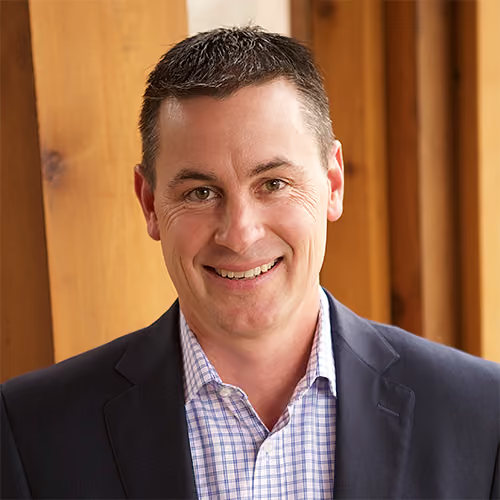
Host: Jason Andrews story has some elements to it that aren't so common among guests on Acquiring Minds. Namely, Jason used a buy side advisor to buy his business. It was expensive, but he feels worth every penny and looking at his situation, I do too. Jason got a sizable business, high seven figures, maxed out the SBA loan and then some and he was a total novice. I really wanted to understand working with a buy side advisor. So we do spend time on that. We also talk about doing this in your 40s taking such a big swing. Whether he was buying a job where he invested his time during due diligence, the consulting agreement he structured with the previous owners, buying big versus buying small, and what his life looks like now. Six years into his acquisition spoiler, he sees a near future where he's working only 15 hours a week on the business and then going out and buying. Another phenomenal packed episode here with Jason Andrews of GroupSource. Welcome to Acquiring Minds, a podcast about buying businesses. My name is Will Smith. Acquiring an existing business is an awesome opportunity for many entrepreneurs and on this podcast I talk to the people who do it. August Felker is a two time successful searcher, first with a traditional search fund. The second time around he did a self funded search. Today August runs Oberle Risk Strategies, an insurance firm with a dedicated practice group for searchers and acquisition entrepreneurs like you. If you've got a business under loi, Oberle will provide complimentary due diligence on that business's insurance and benefits program. A great no risk way to get to know August and team. They love helping searchers. They've worked with hundreds. Oberle is a specialty insurance brokerage for searchers by a former searcher. Check out oberle-risk.com O B E R L E- risk.com, link in the show notes. Jason Andrews, welcome to Acquiring Minds. Thank you for joining me today.
Guest: Thank you Will. Good to be on.
Host: Thanks for the invite. Jason, we met in Orlando at SM Bash. We were seated next to each other at one of the panels and got to talking and learned that you were an acquisition entrepreneur, then connected again. And your story is interesting on a lot of fronts. The size of the business that you acquired quite large, the fact that you used a buy side advisory. You're my first guest to have used one of those. So we'll want to get into that the age that you acquired at 42, which is how old I am right now. So lots of, lots of particular topics I'm going to want want to dive into. But every story of Acquisition entrepreneurship is inherently interesting to me. So you got that in spades here. So let us kick it off with your. A quick bio on you, Jason. So give us two or three minutes on your life as it led up to the decision to go out and buy a business.
[3:05] Guest: Sure. So I'm, I'm Midwest based, I'm here in Kansas City and always kind of have been. And so, so my career has almost always been in sales and sales leadership, management, that sort of thing. Pretty early on in my career went moved to the medical device side. So kind of had some long stints with the division of Johnson and Johnson called Ethicon Endosurgery, and then another long stint with the company called Intuitive Surgical Medical Robotics, the Da Vinci robot. And so kind of building and scaling sales organizations was really what my background is in degree in finance. But that's mostly my professional experience has been in building and scaling sales teams. And so when you do that and you live in the Midwest, you travel a lot and as you gain responsibility, you know, you have more territory and more travel and things like that. And so with a small family that was, that was a lot of time on the road. And so at the end of 2015, 14, the end of 2014, I was a VP at Intuitive. My position was eliminated. And so I was kind of at a midpoint in my career. I'd been working for about 20 years. I figured I'd be working for about 20 more. And so this idea of maybe buying a business was interesting to me. If I was going to continue on my same professional path, that was just going to be probably more travel and a lot of new stuff and things outside of my, what I felt like was my control. And so, so that's when I started my search and, and then all the things you mentioned. So that's kind of what, what I have done in my past and that sort of thing kind of what to the point of a search.
Host: And how did you discover search? This concept of buying a business is not obvious to a lot of people. So how did it get on your radar?
Guest: So I would tell you I had a file in a file cabinet for this group that I used and I had met someone there years before. So I'll say, you know, maybe as much as 10 years before I actually went on search, met with them and just had an introductory meeting, learned what they did, thought it was interesting, went on about my business, filed it away and then dusted it off and started making some calls. And so it was one of those things the way I Always look at it is like, I don't know anybody who doesn't think about it. Right. A lot of people think, well, it'd really be nice to do my own thing. Fewer people than that. But some talk about it with their friends or, hey, wouldn't it be great if we did it? And then you get into a much smaller group that actually do something about it. So I'd done the thinking about it part and the talking about it part, and I was ready to move on to the doing something about it part. And that's when I reached out. So how I came in contact, I wasn't sure, but I knew who they were and what they did and thought I'd explore it.
Host: Man, that firm must have just a really, really wide funnel because they have a conversation and then 10 years later that might turn into a client relationship. Okay, so you're at this midpoint in your career and you dec. Decide that now is the time to do something entrepreneurial in large part because your family life, you didn't, you didn't want to. You didn't want to do the. Continue doing the. The intense travel. It was maybe only going to get worse. And you had always had this kind of notion that as you said that many people do, that it'd be nice to work for yourself. So. And at this point you have some money in savings. Like you, you've done well in your career and so you have some capital to work with. So you call this buy side advisory firm. And what do you learn?
[6:43] Guest: Yeah, so back in those days, I mean, it seems like the stone age is 2015, they were still doing, I mean, they were doing mailings out. And so it was kind of like, here's my criteria. I want to find a business within 45 miles of Kansas City. And they walk through the process like they do what essentially is drip emailing now only with real mailings and with a very personalized message. So it isn't, hey, would you be interested in selling your business? It's really a bio on me. So here's Jason. He's married, he's got three kids. He lives in this part of the city. Here's his cell phone number, here's what he's done and all of those things. And so it's personalized message to really what we could find either in D and B or through the searches of industries that I might be interested in. So we kind of took some out, put a lot in, mostly business services types of things. It's limited on what you could find on Private companies, both in, you know, size of the company revenue, ebitda, those sorts of things. So you know, went out to a wide swath and really just trying to get conversations and then narrow it down from there. And so that was the process. And it was a monthly fee to do the process. Most of that was just to make sure you're serious. I mean when I was sitting with these guys I felt like I was pretty serious. And they said, well, 85% of the people that sit here won't go through with it. You know, it's really, we're still, even though you're sitting here, you're still in our view really in the tire kicking phase. Not their words, those were mine. But so it was sort of making sure you were serious and, and I don't know, over. That was probably a 10 month process. Maybe got 30 responses of people that I met with. I met with just about everybody that I could and found group source, maybe in early mid fall put in an offer and 100 day, 110 days later we closed.
Host: And just a little bit more on this buy side advisory. So is the name, the way this firm positions itself, is it called Buy side advisory or do they call themselves like a boutique bank or how do they position themselves in the market?
Guest: Yeah, they're a mergers and acquisitions firm. So they do buy side advisory, they do sell side. I mean they're basically business brokers. But they're, I'll say I describe them as business brokers that don't do bars and restaurants and coin laundries. You know, they're more higher end and they serve a niche for, you know, manufacturing that's looking to fill a spot in the country and things like that. So they'll do searches for businesses as well, where businesses are the buyers. So but they're that they're emerges and acquisitions firm just in the lower to middle market. I don't know how many of those there are really, but they don't just search in the Midwest, they do nationwide searches. They were actually begging me to not look in Kansas City. They're like, we've, we've plowed this ground a lot. So if we could look in or broaden our search or look at other cities, we can find a lot more success. But you know, the thing that I found out then that everybody sort of knows now intuitively is that small businesses aren't really for sale. No one puts a sign out if you want to sell your house. You want everybody in the world to know if you're trying to sell your business. That's not something that you want out there. Your people don't necessarily want to hear that. Your competitors would love to hear that and use it against you in a lot of industries and instances. And so there are a lot of people that are thinking about it, maybe selling their business that are unknown. And so for somebody like me who didn't have a network in the small medium business space, I needed to find some way to source opportunities and this was a great one for me.
[10:16] Host: Can you share at all what the costs were like that monthly cost, the retainer, for example, what size of business should you buy? What can you afford? How much STE or EBITDA does the business you acquire need to generate to pay off your loan, pay you the income you need and reinvest in the business? Of course, the answer varies from person to person. So you need to answer this question for yourself. Chelsea Wood runs the acquisition lab and did a great interview on Acquiring Minds last week. The lab is a Do it with youh Buy side advisory service founded by Walker Deibel, author of Buy Then Build. Chelsea's running a live session on this question, what size of business should you buy? She's worked with over 250 searchers who've gone through the lab and this question comes up constantly. So at the live session she'll explain how to arrive at the answer. Acquiring Minds is co hosting it. So I'll be there as well playing MC and taking notes. It's Wednesday, June 22nd at 10am Pacific, 1pm Eastern. Register in the show notes.
Guest: Yes, and so I would tell you, and this, I'll say this is part of the lesson that I learned. I'll tell you what I think it was. I think it was a couple thousand dollars a month. And, and I, and there was a sliding scale on what it cost to ultimately get the deal closed. And it's, you know, the larger the deal, the smaller the percentage and that sort of thing. What I will tell you is it was an absolutely significant fee and one that I can't remember because it was really immaterial in the grand scheme of things. So it was like, yeah, it was seemed pretty painful at the time, but it wouldn't have happened otherwise. But it was, I mean it was north of, I know it was north of 200,000. I think it was north of 250. What I ultimately paid for them, not just to source it, but to them. I mean they ran the due diligence room. You know, they helped me find an SBA lender. I mean they were truly held my hand through the process and without them doing that, I wouldn't have gotten it across the finish line. No doubt in my mind. Well, I wouldn't have found it number one. And then number two, even if I would have somehow stumbled onto it, I would have never been able to get it across the finish line with my limited ability capability.
[12:31] Host: You know, it's interesting because so few people in the search world use buy side advisories and maybe it's just because I'm talking to acquisition entrepreneurs and buy side advisories are typically, I don't know, maybe not target. Maybe that's not their sweet spot. Maybe like you said, they target firms looking to acquire other firms. I don't know. But it works out so well for you. I'm just interested that you're my first guest who's done it. I also think that maybe you had more capital available and we're going to get into that a little bit. You could, you could afford to spend the two or three grand a month on that and then whatever their final fee was going to be if, if the size of the business was justified at which, which it did, which we're also going to get to. But, but it's interesting. Yeah. So it's all an interesting process to me. And, and were you, what were you doing while they were searching because you were no longer employed?
Guest: So what were you job with a, with, I'll say. A friend of my colleague of mine, friend of mine that I'd worked with for a long time. He had left the same organization a while before, before I did, and he was building out a sales team and he called me up, said, hey, would you be interested in doing, in doing this? I need somebody to help me build out the western half of the US Sales team. And I said, well, yeah, I'd be interested, but I'm doing this other thing too. It's just not full time. But I've got this thing going on and if it works out and I find something, then that's the direction I'm going to go. So I just want to be upfront with what that is. And he said that's fine. You know, if it works out, great. I don't know if you didn't think it was going to work out or if it was whatever the timing was. And so it was almost a year, but so I was working full time during the search.
Host: Okay, okay. Which also helps offset the, the burden of the, this monthly outlay. And I assume there's no guarantee or anything. It's they're, they're not making some sort of guarantee they're. They're going to find a business because a lot of that is up to you whether or not you like what they bring you.
Guest: Yeah, I mean, but, but it was basically like you, you're going, you know, if you don't find something in 12 to 15 months either, you know, it's like you're, you're probably. This is probably isn't for you. So it's like you're gonna. We're gonna, we're gonna hunt this field, and then we don't need to hunt it again. It's like either whatever it is you're looking for isn't there or whatever. I mean, we'll just. You'll probably be tired of us, and we'll probably be tired of you. And they didn't say as much, but it's sort of like, you know, we'll run this process and, and there'll be something at the end of the tunnel. If it doesn't look like. Or at the end of this rainbow, if it doesn't look like gold to you, then, then that's probably your answer.
[15:01] Host: But, but it sounds like they did feel confident that they would be able to bring you a number of opportunities. They felt confident in their process.
Guest: 100. I mean, they do this. They don't do this. I mean, they do it, I don't know, 10 to 15 times a year. And so, you know, they have a lot of. Of successful, successful options. And that's the. So what I was looking for. It's like I'd done a lot of interviewing in my life, never looked for a business. But it's like the, the danger was if you, if you interview eight people in a day, okay, let's say there might be one person or two people that seem better in a relative sense. Right. They might all be terrible, though. And that's the thing. But it's like there's still one or two that's. That are better than the others. And so that's the concern is that, am I going to buy a terrible business? Because I looked at four and this one was better than the other three. And so I felt pretty comfortable that I would be able to identify a good business if I found a good business. But if I only looked at four, I wasn't. And I, you know, and I don't. Never did see a good one. I wasn't as confident. So I'm like, I need a lot of views.
Host: Yeah.
Guest: And if I see a lot of views, then I feel like I, I can find something that, that's good. If I don't see very many and have very limited, I'm not as I don't trust myself as much.
Host: Yeah, yeah, no, that's great. And that, that, that squares with what I've heard a lot of other guests say who are conducting their own searches. But it's like this concept of getting reps looking at deals and you know, the more deals you look at, eventually you sort of just develop a nose and you can really tell when something is strong has come across your desk. But only after you've had, you know, quite a bit of, quite done quite a bit of reps looking at other, looking at other opportunities. And so they brought you 30 and even though they had tried to dissuade you from doing just the Kansas City metro market, turns out they actually could bring you 30 deals in this, you know, medium sized market.
Guest: So of the 30, I would tell you there'd be, there were probably a number that even when I was going to the meeting, I'm like, I can't really see myself. I mean some people who make pallets, like in pallet manufacturer, I'm like, I don't know if I could see myself in a pallet manufacturer or, you know, I can't even remember some of them of what they were. So there were some of them. But I was committed to taking every meeting for a couple of reasons. I wanted to, I wanted to meet all these owners, I wanted to understand them. And then some people, because when they get a letter like that and you're dealing with an entrepreneur and somebody says they want to buy your business, they're like, they, they think their business is always for sale. Right. Well, how much? Well, I wasn't looking to pay any price for a business. I wanted a reasonable price for a reasonable business. And so there were some that were more intrigued by, you know, it was sort of like the knock on your door and I want to buy your house. It's like, well how much? You know, I guess anything's for sale type of thing. There were some that I would say weren't fully serious sellers in that 30 as well. Some that I wasn't necessarily interested in. And so it was a much smaller number than that, that was viable in the range that I was looking and those sort of things.
Host: And, and what was, but you went in and met with these 30 folks. Yeah. And so what was that like? I mean, were there any, I mean you just gave, gave one takeaway from that, that Some of these people were just, were just kind of like, you know, offer me, you know, $100 million and sure, you can buy my business sort of thing. So you can just dismiss them, dismiss that out of hand. Most of my guests, I mean, they start talking to an owner when a deal gets pretty serious and they. So therefore they don't have experience talking to 30 different owners. Any particular other things jump out at you from that experience of going around and talking to so many prospective sellers?
[18:31] Guest: Well, I'll say two things. One is, and you find this in the small bit. I was only coming from big companies, right? And the thing that I was worried about is big companies are really resourced, right? I mean, they have a marketing, they have a person for everything. And so you get really worried about how you're going to fill in those gaps because you're used to just calling a phone number or a department or sending an email and somebody else takes care of that problem. And what you find in the small business community very quickly, I will say this about any market because almost anybody I've talked to says the same thing. There are lots of resources to help you out. Now you have to ask, right? So you may not be know exactly what phone number to call, but if you say, hey, listen, I need some help with this with payroll, I've got this with hr, whatever the problem is, there are people in the small business community that will point you in the right direction, that will find you resources very quickly. They're very nice and really want to help. So that's the first thing. And then just kind of learning about what their experience was with small businesses. And so one thing a person told me in the business, like, you come from this background, you've done a lot of things. But he said, here's the issue. You work with a lot of really, I'll say, smart people that do what you do. And so you work with a lot of people that will tell you you're full of shit. And he's like, when you go buy a small business, you may not have anybody that will tell you that. They may think it, but they won't tell you necessarily. And so you better have some people around you because there are no other. Like, you make a decision, that decision goes. And so you want to make sure that you've pressure tested that with people, whether they're inside your organization or out. That always stuck with me as well. So you always got a lot of interesting nuggets from people who've done it for a number of a number of years, regardless of whether it was a business that was right for you.
Host: And so when you were, when you were rolling into these businesses and kind of looking around, it sounds like you were just getting comfortable with the cultural difference or the lifestyle difference that this was going to represent being in small business, but versus being in corporate America. But it didn't spook you. Obviously you were. It did. You signed up for that.
Guest: I mean, it's, it's different. I mean, that's the thing. I mean, I went from, you know, I mean, like Surgical Robotics. I mean, I was the person people want to sit next to at dinner parties to, you know, group purchasing organization. I mean, by the time I, and even in 30 seconds explain what it is I do, people are looking for somebody else to talk to. They're like, wow, I can't imagine anything less interesting. So, but the problem solving component of it and the building the business is super fascinating to me and always has been. And so that I really didn't have any trouble wrapping my head around that. Although it was, it was different.
[21:09] Host: Okay, well, now let's get into to Group Source. So they identify the business. So among these 30, were there others that you were, were close that you went, you know, you went further down the path with, like, how did, how did Group Source shake out compared to these other. The other 29.
Guest: So, so some that I was, you know, had second meetings with and different things where we really exchanged a lot more information. None that got to an alloy phase. So, you know, so they, some got past a first date, but then to, to a marriage proposal, so to speak. So, so a little bit of dating, but this was the only one that was, was an ally. And I don't say it's a little bit, I think I told you this before, but you know, if you was like when my wife and I bought our house, you know, we were, we would look at different houses and then you'd sort of Ben Franklin this thing, pluses and minuses and all this stuff. And oh, I really like this and not so much that. And then when I met the guys I bought Group Source from, it's like, oh, this is it. I mean, there was no, I mean, like, you throw that sheet of paper away. It's like, I already know this is the one. Now that's the easy part. Knowing that I wanted it was the easy part. Getting across the finish line is a, is a whole nother thing. But when you, I sort of say, I don't know if this is for everybody, but when I knew I knew and with this one I knew and.
Host: Okay, so elaborate please. What was it that grabbed you?
Guest: So one thing that, that DVS Group, which is a group I use, the mergers and acquisitions firm, they're like, listen,
Host: you got to find out DVS Group, Jason's for people to, so I can link to it. DVS Group, based out of Kansas City.
Guest: Sam. Yeah, DVS Group, they've got, they're in Kansas City and, and also St. Louis. I think they've got an office there.
Host: But great.
Guest: They said you need to understand like what, what, what do you do? Number one, that you do really well and number two, that you enjoy doing. And so you got to look for a business that needs those things.
Host: Yeah.
Guest: You know, because that's what you're going to want to do. That's where you're going to. And so I had kind of figured that part out and written that out and, and so that's what I was looking for. And so then when I met with groupsource, I mean it's a sales and service organization and so it really, I understood it because it's in medical. And that's where my experience had been, even though I didn't, I knew what GPOs were. I had never worked for one or anything like that, but I understood what they did, I understood the value propositions and I felt like it was something that I could continue to grow and scale. So it just made sense to me. It clicked.
Host: So it had, it had the sales aspect which, which was what you'd spent your career doing. And it was in healthcare, not, not in your, your corner of healthcare, but close enough, I mean, within the same umbrella industry to, to feel comfortable, to feel familiar. Great. What can you tell us about the size of the business and what you paid? And I know we don't want to be super specific here, but what can you tell us?
[24:00] Guest: So, I mean, it was started by a couple brothers. It had been going for 20 years and it's in, it's the, in the non acute side of healthcare. This is still, still growing. So there were, there were tailwinds in the business. So if you think about what non acute healthcare is, it's everything that's not done at a hospital. So everything's not acute care. And so when you think about that, so many things are getting pushed out of the acute care environment into a lower acuity environment. Maybe that's surgery centers or freestanding imaging centers or endoscopy suites or things that get done in a physician office. So there, there are a Few things in healthcare where everyone's aligned but the payer and the patient and the provider are all aligned with doing as few things in the hospital as possible. It's more efficient, it's cheaper and all those sorts of things.
Host: So this is like a big trend happening in healthcare over the last number of years that pushing everything out of the hospital. That's possible. Tenure.
Guest: Okay, that's right. And so, and so that, that part was, was, had been going on and so I saw that. So I was, when I was doing my search, I was very certain I was going to buy, quote, unquote, smaller business and I was going to have to supplement my income with savings for a long time and build it up. And group source ended up being the exact opposite. And so it was a full SBA note, a large seller note. It was pretty much every dollar I had that wasn't in a 401k all in to, to, to acquire it. And so the multiples weren't what they are today for, for these types of businesses, but it was still well over four. It was probably, I mean it's probably five, maybe five and a quarter of an EBITDA multiple, which was significant for a business where there's really no assets. I mean, it's a, it's a, you know, it's a recurring revenue cash flow type business.
Host: Yeah, well, I, I want to get into that in a second. So if five, five and a quarter multiple on EBITDA and your acquisition price wasn't at eight figures, but it was kind of in, in that direction, is that fair characterization? Fair to say so fully maxed out the SBA loan, which we all know is $5 million. So closer to 10 than $5 million. So a big acquisition for a first timer. I'm impressed. I want to applaud you. So this strikes me as a really risky acquisition, or it's just that you're putting a lot on the table. I don't mean to suggest that the business itself was risky. It seems like you're going to tell us more about GPO and the stability of it and so on. But just in terms of your cash position, it seems like you really went all in. Am I right about that? And what was your psychology on that? And, and you had, you know, you had kids, you were, you know, you had, you had something to lose here, for sure.
Guest: I mean, I would tell you. I mean, I don't really know. I mean, when I think back about it, it seems a little odd. I mean, so it's sort of like oh, yeah, 100% cash at close. Oh, yeah, there's that mean you have the seller note, right? But it was like, yeah, I mean, it was, it was an all in type of thing. I mean, I'd done all the resources buy, then build and the HBR stuff. And so I felt, I felt comfortable around the business that had been around for 20 years that I could keep it around. So I felt, I guess, good about that. The other part was, I mean, I'm probably a lot more risky. Let me tell you who's pretty risk averse. Lenders. Even with the sba, the safety net, they're pretty risk averse. And so they're doing a lot of pressure testing. Obviously, you know, my advisors were doing some pressure testing. And so I felt like I had some professionals that said, oh yes, this is, you know, this is a good thing, it's steady. We looked at this. So I felt good about all those things. But yeah, I mean, it was a, it's a very risky thing. I'll say, you know, when you, you know that the old saying, you know, if you got a very clear why, you'll do almost any how. And I think that was it. I was, it was sort of like I didn't ever have any trouble working hard or getting out of bed or doing all those things. But I certainly wasn't lacking in motivation from day one of the close because it was a. I went from having very little, I don't even know if I had any debt in this world to having a significant amount. And I was not interested in having my house sold on the courthouse steps. That was not, that was not a reality I wanted to live for sure. Yeah. Yeah.
[28:26] Host: And your family was, was on board. Did it take any convincing there? Were they. Were they. If as long as you were comfortable, they were comfortable sort of thing?
Guest: Well, they were. I mean, they were certainly in on the, on the why. Right. I mean, it was like we were all on board with me traveling a lot less. And my wife is a serial encourager, and so she is, which is important. I mean, you've got to have a spouse that is completely on board if you're going to do something like this. Because it's not a, it's never just you. Right. And it's never just you and your team. It's an all family thing. And that's true of entrepreneurship, even if, you know, we didn't start it. Right. I mean, I didn't, I didn't birth this baby. But, but when you acquire it, it becomes in the Weave in the fabric of your family very quickly. And so you definitely need every, everybody on board, which, which I had. And we were, we were all in the rowing in the same direction for sure. But that's, that's an important point.
Host: The, the amount of, the amount that this business that you acquired it for. So, you know, millions of dollars, single digit millions of dollars, but still for a loan individual, we're talking, we're talking a significant amount of money. And it had $20,000 of capital assets. Right. I think, I think that's the number I remember. So you might, you know, and this is the thing about buying, I mean, it's, it's magical that the SBA loan now allows us to buy cash flowing businesses. That's really the enabler of this whole acquisition entrepreneurship thing. At least, at least kind of the, the modern version of it that so many of my, my guests are participating in. But, but at the same time, it's like, man, you just spent a lot of money and, and the only physical thing you got to show for it is 20,000, you know, $20,000 of capital, of capital assets. It reminds me of another guest who hasn't aired yet. And when he did his first acquisition, you know, he wired the money and it was, it was a much smaller deal than yours. And he's just like, I just sent all this money into the, into the, you know, into, into the air and I don't have anything in my hands or, you know, I just really don't have much to show for it. So it's a, it's a funny, it's a funny psychological aspect of, of this that you're buying cash flow and you're buying, you're buying employees that you hope aren't going to quit when you roll in as the new boss. Talk to me about how you felt on that.
[30:46] Guest: Sure. There's a couple things. One is the SBA is a magical thing. I would tell you. You're on SMB, Twitter, and you'll kind of hear some things, see some things where people are. Anybody who has a bad experience with the sba, One is maybe that wasn't even required to acquire their business, or two, it was really the lender. The SBA program is what the SBA program is. And every bank in the country says they can do SBA lending and they can just like there's the best, you know, physician in the country and there's the worst and everything in between. Right. So you want people who get a lot of reps and do a lot of it, if you work with a good SBA lender, you will have a good SBA experience and it will allow you to buy a business that you could not buy otherwise. It's magic, it's fantastic, it's great. And I'm no SBA expert, but there are a lot of people who are, you can find them, they're great. So the SBA program is fantastic. And yeah, the, the, you know, I would tell you this pretty much about any small business. The entire value of your business goes home every night. You just hope they come back the next day. And so whether it's a cash flowing business or even if it has a lot of assets, that, that part is true. And if you don't believe that, then you're wrong. It is really the people that are the value in the business mine that was obvious because there was no other thing to place value on but the equipment that you might place value on. The only people that make that valuable are the people working on it. And so mine was pretty clear to me that was the case. And so that's really, I don't know how to say it other than that. The other thing I would say that you learn pretty quickly. So the difference between, I'll use an accounting term that maybe I don't fully understand, but the difference between the tangible assets and the purchase price that call that goodwill, Let me tell you what it really is in a small business. It's the reputation of the people you're buying it from. That's what it is. And so when I worked with an intermediary, what that allowed them to do is have difficult conversations. What that allowed me to do is get to know the two brothers that I bought it from. So I got to know them really well. And so part of how that, how the business gets de risked on the buy side is understanding the people that you're buying it from. Because if you're buying it from good people who have treated people the right way, their employees, their customers, their, their suppliers, their vendors, if they did things the right way, maybe it's not exactly the way you're going to do them or whatever, but if they're good people and they have a good reputation, that goes a long way. And if they don't, that is a, that's not a yellow flag, that is a red flag. If you're buying a high goodwill business that are from people that you're not really sure about, that's, that should be hugely concerning to you because that's what you're buying. In my Opinion, in my, my experience and in my opinion, yeah, that's great.
[33:36] Host: And just to, to drill down on that and actually step back a bit or step back in your story here a little bit. The due diligence. So you, your buy side advisory, DVS was doing the due diligence as well. They were diligencing the whole deal.
Guest: I had an accountant, I had an attorney, and then they ran the data room because, you know, these guys hadn't sold a business before, I hadn't bought a business. And so all the things that needed to happen and the timeline with which they needed to happen and all the things that I needed to do for the sba, they knew all that. I mean, they'd done that process before. And so they've got the long checklist and they're, you know, running the data requests and, and sort of quarterbacking that process through. And so both from a, making sure all of it gets done, helping to review it, and then, you know, the timeline. And so I do believe time kills all deals. And there were certainly parts in my 110 days from Loi to close where things got a little sideways. And so if that would have been 250 days, it wouldn't happen. And so, you know, and so help walk that through is big.
Host: Yeah. And it sounds really valuable. How, but how active are you involved in this? I mean, they're asking you to provide this documentation and that. But in terms of like the negotiation, for example, or you said that sometimes, you know, they were the bad cop to your good cop sort of thing, and you're, and you're getting in and you're getting to know the sellers. I'm just curious, so using this buy side advisory, who's running the deal room?
Guest: How.
Host: How involved are you, the searcher, as this deal comes together?
Guest: I'll say involved. They're sort of quarterbacking and communicating on the. So it's like you can want these things as a seller, but they have to be bankable. And so here's what the SBA looks like. So this means you're going to have to carry this much. And here's what it is. And so, you know, sort of like you can have your price or you can have your terms, but you can't have both. And so let's talk about what's most important to you. Let's find a structure that works for both parties. And so, you know, just having some expertise on deal structure and what could be creative ways that you can do these different things makes a big difference in coming to Something that, that works. And then really, I'll say the only other piece that at least the negotiations part was the networking capital discussion. And so, you know, what does that look like and what's included and all of that? I would say they, they mostly ran that. I mean, I knew that was going on and I knew that wasn't like everybody was in vehement agreement the whole time, but they worked that through to an amiable resolution.
[36:22] Host: And when you then took ownership of the business, did you feel like you. I guess one of the things that I would feel like if I didn't have my hands all over the negotiation and the due diligence is that maybe I wouldn't be as familiar with the business once I, you know, took ownership of it as I would as, as I would otherwise. Did you any, any thoughts on that or am I, am I, am I overstating really, how familiar you get with the business in the traditional search case?
Guest: Well, I mean, you, it's like you, there's, there's two things I, in my opinion, you, you sort of, there's two, there's two things you know about the business. One is what the numbers tell you and then the other is what the people tell you. And then the answer somewhere, probably in the middle somewhere. And so what you get in the due diligence side is you get a very much what the numbers tell you and then you don't necessarily get all of the people side until you get the keys. And so similar to what you've, you know, heard and were really best practices, you really just want to understand what's made this business successful for the period of time. And so it was a steady, growing business over a number of years, so it wasn't broken in any way. So it's like, I feel like I'm going to be able to add some things to this. But first I want to understand all the things they're doing, why they're doing them, and learn and just learn as much as I can about it for some period of time and then iterate from there. But just know, get to learn the people get to learn how it is that they make money and how it is that these things work. And the better you understand that, you build trust along the way. But then it also makes a big difference with, because a lot of things you think you might want to do, if you just shut your mouth for 90 days, those things go away and you're like, oh, I get why they're doing that now. That makes sense.
Host: Yeah. I heard other Guests say exactly that. It's interesting. And these owners, sellers, were they thinking about selling when you came along or when your buy side advisory pinged them or what? How did that work?
Guest: So funny story always. So it was really, truly started by these two brothers. But they got so come to find out, right, that they were thinking about. They had. They had a number of partners, all silent partners, but they were either going to borrow money themselves and buy out the remaining portion, the remaining partners, or they were maybe looking to sell. They just had some internal discussions between the two of them. My letter hit them at the right time. They said, let's meet this guy. And they like me, they like my background. They thought I was the person that could take the company forward. And so we move forward from there. But so it's an SBA deal, right. And so at the time of closing, so we work mostly in independent physician arena. And so some of their initial seed capital were accounting firms that specialized in physician group tax preparation. Okay. So imagine a group of 10 accountants, and they all throw in a little bit of money, create their own LLC and invest in this company. And then 10, 15, almost 20 years later, for some of them, right now it's looking, they're looking to sell. Well, so at the time my deal closed, 77 signatures were required. That's how many individual investors there were. Some on such a small piece, some had passed away and they're trying to track down widows. Some were off the grid. I mean, it was insane because 20 years had passed and it was a small little investment that a lot of these guys weren't thinking anything of. Yeah, they get a check once a year, whatever. And so, yeah, so that was, that was stressful to work through that. But. But we did it. And anyway, so, yeah, so that, so the long and short of it was that that was an internal discussion for them was do we take this, you know, 50% that we own and buy out these other 75 people that all own a small piece, or do we just sell and go do something else? We've been doing this for a long time. I'll say my letter probably pushed him one way versus the other. And, and so you were, you, you.
[40:18] Host: They were already, think they were already kind of approaching a fork in the road. They recognized either buy out the investors or to whatever. Right. So there, there was happy timing there. And, and of those 30 folks that, that you met with, were a lot of them kind of like already thinking about selling or were some of them not at all or it was a little of it was just totally mixed.
Guest: It's totally mixed. It's. It's all. I mean, it truly is all over the board. Some, you know, I've heard some folks on some of your previous episodes where it's like, some people never even think their business is sellable, right? So they can't believe they even got a letter like this. Like, what do you mean somebody might want to buy my business? You know, they. It's like versus they're. They. You know, I get some people, it's like, oh, this person, they'll answer every letter. Like, they meet with everybody that they can, and they have no intention of selling their business. So, you know, they just. It's sort of flattery to meet with people who might be interested, you know, so it runs the gamut, truly, you know, but it's. But it's. I found every one of them to be worth the time spent because you just learn something about how they view it, how they approach it, what they've done, their experience. So if you ask a lot of questions, you can, you can glean some insights, even if it's not a real opportunity.
Host: Jason, we're. We're getting toward the end here, but I want to make sure we have time to just talk about the business itself and gpo. So you've touched on what it is, but give me a strict definition for those who don't know what a group purchasing organization is, please.
Guest: Sure. So essentially what we do is we're a sourcing and contracting company. So we negotiate based on the spend of all of our members. We negotiate discounts with manufacturers, suppliers, distributors, that sort of thing. And so if you think about vaccines, that's one that's out there. So for vaccines, so for all, all of our primary care pediatricians, they buy millions of dollars of vaccines. So we negotiate discounts with Sanofi, gsk, Merck, the main suppliers of those vaccines, and then offer those discounted purchases, those discounted pricing to all of our members. And not if those, they buy them directly, but if they're buying medical supplies from table paper to, you know, blood draw, anything that they're doing there, any interaction that you have in a physician office, any of those supplies, and the people that supply them, we negotiate the discounts on behalf of our members for those.
[42:43] Host: And that's because you basically, your clients, these offices, you've pooled all of this demand effectively by getting 100 or 1000 or whatever it is, number of offices, you can then negotiate discounts with the actual manufacturers and sellers of whatever it Is vaccines correct? Correct. And then just to finish out here on the business model, how do you guys make money? Is it a percentage of purchase from across all of your offices?
Guest: It is. And so we negotiate the price, right. And we link that price at the manufacturer and at the customer and at the distributor. So all three sides. So we do that. So they don't buy it from us, they don't buy it through our, through any sort of a portal. They'll buy it directly from there, either directly from the manufacturer or from the distributor. And we make a small percentage, under 3% always, sometimes 1% or something along those lines. So it's a small, small fee that we get paid and that's, that's how we make our revenue. So most of our members, we don't make very much money on them individually. And so ours is really a, I'll say it takes a lot of crumbs to make our loaf, so to speak. And so we get a very little bit from a lot of different practices across the country and that's, that's where our revenue is derived.
Host: And in this. So as we talked about at the top you had had a career in healthcare but in really in health tech, totally different, different corner of the industry. How hard was it for you to learn GPO once you had acquired groupsource?
Guest: Not, not really. I mean I would tell you the. So we've continued to grow and it's really just through, through refining our value propositions. And so here our biggest challenge is we sell an unbelievably unsexy thing, saving money. So most people are interested in making more money, they are not interested in saving money. And so, you know, we don't. I would tell you we spent a lot of time trying to make that important to people and I would suggest we've really given up on that. So we just tell people what it is that we do and if they get it then, then they move forward pretty quickly. If they don't, then then they're probably not a good fit for us. So it's like the good news is we can save almost anybody money. The bad news is some, most of them don't care. And so a lot of times you got to get to the person who cares and maybe that's the physician or you know, if it's a long term care, it's the, it's the person that owns the facilities and those sort of things. And so you've got to get to somebody who cares and not, not just because it's not, they don't own it doesn't mean they don't care. There are a lot of practice managers where that's very important too. But you know, it's like ours is more informing them of what we do and if they get it, then we move forward pretty quickly. If they don't, we don't do a lot of overcoming objections because you know, ours is pretty easy to understand and if it's not of interest to you, we tend to just kind of move on to the next one. Where we found our time is better spent, I guess.
[45:42] Host: Well, interesting to hear that from a salesman who is going to bring in sales experts.
Guest: I know, I don't, I don't, I don't love saying that out loud. It pains me me at times. I mean I love the challenge, but it just was, it just, you know, that's the, you know that that's through iterating and trying to figure out where our time is best spent and how we grow and how we find more people that are aligned with us. That's just where we've seen the, the most impact.
Host: One of the things that struck me in our pre call was the cash flow per employee for in this, in this business, in this industry. If you, if you are comfortable sharing those numbers and, and how you know, what you compared that to with other small business owners that you know and what they were, what they see inter, you know, comparably and that's a real really attractive aspect of, of Group Source and GPO in general. So talk about that if you could and what other things that are good about this business and what things do you not like about the business? Pros and cons. Pro and con it for me.
Guest: So, so at. So what I bought was a sales and service company and so we, we have really refined what it is we're excellent at. So we've got a sales team and then we've got a group that, that does this implementation and a lot of these back office types of things to make sure that value is realized. And then we outsource almost everything else. We outsource our hr, which we didn't used to do. We outsource our payroll, all of our benefits, all those things which we used to do in house. We outsourced. We also have a team that's not employed by Group Source exclusively but with team that we work with in India which helps us with all of our, you know, when we tell people we're gonna save them money, they're like, well they don't just take our word for it, we gotta show it. And so we are doing, you know, several hundred, maybe nearly a thousand, what we call market baskets or cost comparisons each year. So we're running 20 of those a week. We can turn those around very quickly using our team in India doing a lot of the data entry. And so we have outsourced almost every function we're not excellent at, which has really helped and it's helped make us so much more efficient. And that's where, so we do have a small and lean team that is, I'll say, group source employed, but we have a big group of people that we access that aren't group source employed, that are, that are experts in their own niche, I guess.
[48:03] Host: And the, but the, the cash flow that you generate per employee was, was really eye popping compared to other small businesses. So, so it's a, it's a, a really strong business model. Do I have that right?
Guest: Yeah, absolutely. I mean it's, you know, I mean it's probably what, what, what most people get in revenue per employee, we probably do better than that in, in, in cash flow per employee.
Host: Yeah, it's phenomenal. One of the things that I think you said was not what you'd like it to be is that it's not a high growth industry or business. Correct, correct.
Guest: I mean, so we, you know, I'll say we don't, we don't hit a lot of home runs, we slap a lot of singles and we, you know, so our, our growth is not in, you know, is not each customer being really, really large individually. I mean, our growth is in really bringing a lot of value to everybody who's currently a customer. So that our retention rates 99% or above, which it has been since I took over, and then adding as many as we can. And so we can very steadily grow in the mid teens every year, but it's very difficult. So if somebody said, hey listen, we want to, we want you to buy, you know, to go hire 10 more salespeople and we want you to grow it right, you know, 60% a year. I'd say keep your money if that will work, you know, which is very odd to say, particularly coming from a sales standpoint. But our business is more slow and steady from that standpoint. And, but we're able to do it without, you know, adding a lot more people. We kind of outsource some things, do some things on the back end that allow us to, to keep that growth rate and stay as a pretty intimate group.
Host: And what about growth through acquisition? Is there an Acquisition possibility in the offing as a way of growth.
Guest: That's a good question, not one that I've necessarily explored. There obviously are some other folks, I mean arts, pretty niche industry. There are some folks that do what it is that we do it. I haven't really seriously considered that. I just, I'm pretty happy with how we're growing from an organic standpoint. But, but you know, maybe that, that's not a. It's a fair question. I don't know. There aren't, there aren't an infinite number. I mean, it's not like H Vac where you can kind of trip over them and tuck in and things like that. It's not really what. What it is that ours is, is our reality, but it's not an impossibility either.
Host: Jason, you said that your multiple was five, a little bit north of five. And on our pre call you said, and I think actually you said it also in this conversation that maybe you didn't get the best deal in the world. Like you maybe, you know, that multiple represented a little bit of a premium. But in our pre call you did say that you haven't thought about that since. I mean, it's been a phenomenal acquisition, even if you overpaid a little bit, as I recall. Repeat that for the audience. I found that really interesting.
[51:19] Guest: Yeah, I mean I, and I'll say the same thing about the group that I used. I mean, did I. I mean, I paid a lot to get it across the finish line. I paid, you know, I paid a lot. So I, I feel like I got a really good business for a really good price. But I, I don't feel like, you know, it's a situation where, oh, you make all your money on the, on when you buy it, you know, like a rental house or something like that. Some people say, well, you make it all the money up when you buy it. When you're looking at. It's like you've got to find a good opportunity for a good price. And I feel like I got a good opportunity for a good price. But there are people I am certain that would have walked away because they're like, listen, for a business like that, there's no way you should ever pay over 4. They might be right generally, but specifically for me, that certainly wasn't the case. And so I was not. I didn't think like to your point. I don't think anything about it now. The only thing I think about is I wish I would have done something like this 15 years sooner. Not man, Was I should, I waited another year to see what was around the next corner or the next corner. It's like you kind of find a good enough and something that you feel like you can wrap your head around and grow and the people are right and that and go. And that's what I did. And that was the best decision that I made really. And so did I overpay a little? Probably. Did I pay a lot to have an advisor? Absolutely. Would I do it again? Without question.
Host: Well, and part of it is it has gone really well. I mean, obviously when things go well, it's easy not to push against some of the decisions we made in the past. But can you add a little color to how well it's gone? I mean, I think you're going to pay down your SBA, your SBA loan in advance of the, of the 10 year term and put a little color on that for me, certainly.
Guest: Yeah. So I, I would put a pretty big premium on the, on paying down the debt. And so we very aggressively paid that down. We've refund refinance out of our SBA note and making really double payments and have been for, you know, 12 or 18 months and very aggressively continuing to pay that down and like I said, and we continue to grow. So I mean Covid hit us. It didn't hit us probably to the extent that it did everybody else, but we had, you know, so I bought it in 16. 16 was the best year the company ever had. 17 was better than that. 18 was a little better than that. Not much, but a little. You know, we didn't went into Covid and then took a little bit of a hit. But last year was as good as any year we'd ever had and we'll, we're trending well above that in, in 22. So yes, I mean it's been, it's been a great thing and there I, I get the survivor bias piece a little bit. But what I also know is if you know, you do de risk things when you buy good businesses and they've been around a while and you've got good reputational owners and you've got a good feeling around it, the chances of that continuing on is high. It's not without turbulence certainly, but all things that can be managed through. So I feel like some of these things get, are maybe not as risky as they think, but maybe that is just from my, where I sit, I guess.
[54:41] Host: Jason, one tactical thing I wanted to make sure I asked was the, the fee that went to the buy side firm which Was, you know, quarter million bucks or maybe a little, even a little bit more than that. Could that be rolled into the loan or part of your overall financing, or was that just cash out of pocket that you had to basically come to this whole process with? How did that work?
Guest: That's a great point. That is not. It cannot be included in the SBA note. And so that needs to come cash at closing for that. Actually, I got a separate, kind of, separate note from the bank to kind of COVID that, but it was outside of the SBA note. That was interest only for a period of time, and then I paid that off. But, but no, that is not something that can be rolled into the, to the financing, at least not the SBA side. And so, you know, the other thing I want to mention that I didn't mention before was when you do an SBA note, the sellers have to be out of the business. They cannot be employed in the business anymore. At least that was the way it was with mine. I think that's still a rule. And so the way I worked that part was I did consult agreements with each of the two brothers and that they were for a thousand hours apiece, and it was spread out over a year. And it, it was full time for 90 days. So it was five days a week for 90 days, three days a week for 90 days, and then sort of an as needed. So I got 80% of the work in the first six months. I spread the payment out over 12 months. But so how long were they involved in the business? They were intimately involved for 90. Still very involved for the first six months. And then it was pretty much, you know, call us if you need anything. And. And it was pretty light over the back half of that first year.
Host: And so for those after that first six months, you felt like you were, you know, what you were doing, and you could, you could be work pretty autonomously.
Guest: Even if you don't, you're ready. You're ready, right? I mean, so there isn't anybody where it's like, oh, it was, it was, it was too short unless somebody had like a week, you know. But most of the time people think they need more than they actually need. You aren't going to learn it all, but at some point, somebody has to let go of the bike, you know, the back of the bike, and you guys got a pedal, and if you fall down, you fall down. But, you know, that was the way it was. And so I certainly didn't know everything or anything like that. I don't want to imply that, but I'd learned as much as I was going to learn as with them still in the business.
[57:09] Host: And on this point about, about learning and training wheels and falling on your face or not. You know, a number of my guests have talked about just the intimidation of the size of business that they go looking at, go out looking for. So there's, there's a bit of a, like every searcher needs to decide how big a business they want to acquire. Obviously finances will, will dictate a lot of that, but some folks will, will kind of trend a little bit lower buying a million dollar business, let's say as their first acquisition because they've never done this before and, and it's daunting to buy something significantly larger. A three, a five, a $7 million business you, you bought again as we, as we know, a pretty significantly sized business compare comparatively. So do you have any thoughts about what you would say to them? Do you agree, for example with the, the advice buy as big as you can?
Guest: I don't know. I mean that's the thing. That was certainly my experience but I didn't go out, I mean that's the thing. I didn't go out looking for that. Right. I went out looking for business for me and if it would have been half this size or less, I wouldn't have been less excited about it now I wouldn't have known what I didn't know, but I wouldn't have, I wouldn't have turned it down because it wasn't, you know, at least X amount. Like oh, it has to be a max SBA plus or I'm not interested. You know, I mean I do think, you know, if you've got your options, if you've, if you're looking at two or three different options. Yeah, I think tending towards a larger one. I mean, so it's like there's, there's two things that help de risk the business. Maybe not you personally, but the business. How long has it been around and how big is it? Bigger businesses are more likely to last than smaller ones and ones that have been around more than the newer ones. But, but obviously your risk on those is sometimes larger because you're taking out a bigger note. But, but yeah, I think there is something to that. But I don't know if I would turn down a bird in hand to go look for a bigger version. If you find the right one, you know, taking it, running it, growing it and figuring it out and doing bolt ons, tuck ins, all that stuff is another way to get there I think you gotta. Gotta look for what feels right and then. And let that be the bigger guide. More. More important guide than size.
Host: Yeah, yeah, yeah. It really. It really seems like you took that to heart, Jason, what this firm told you that, like, look for a business that gives you energy, that plays to your strengths, that you can really add something to and have that be criteria number one versus some sort of financial criteria. And that's. Happily, that business ended up being a really big one for you. So the business that fit with what you were looking for ended up being big, too. So that's great. Last question, Jason. So you're on the other side of this now. You're 46 now, so you.
[1:00:10] Guest: You.
Host: Well, wait, do I have that right? You bought it in 2016. 48. You're 48 now. So this was six years ago. Yeah. There. That math works. I think goes. Goes without saying that you thought that this was a. That you made a good choice, that this has been what you hoped it would be. If. If not, if not better. What is your life look like today? And how do you envision spending, you know, the last couple of years of your 40s and into your 50s?
Guest: Sure. So I recoil at the idea of people like, oh, you bought yourself a job, because I did. I mean, I bought a company, and I run that company every day since. And so in theory, I guess I've bought a job, but I've also bought something that, you know, I feel like I've been able to invest in the people here and grow and scale it a little bit. And so a lot of the things that I used to do, some people on the team have taken over. And so I don't necessarily spend. I feel like I'd like to get to the point where I could spend 15 hours a week here and do the things that I'm really, really, really good at, and other people handle the rest of it. And I think I can get there this year. And so when I met you in Orlando, sort of like, okay, well, what else? You know, because I don't. I haven't really thought that this has, you know, really roll up in the industry. So it's like, maybe there's a new challenge for me not to do instead of. But in addition to. So it's sort of like, you know, hey, now instead of, you know, 90 days in, bring somebody in to run it. It's like, okay, now I feel like I scaled the org. It's taken six years. That's longer than most people I get. But how can this mostly run itself with some interaction on a part time basis for me and then what could I spend that other time doing? So I'm really fully gotten that figured out. But I would like to maybe find a, an additional challenge to, to take on. But I would tell you, I've been through all this and I sat next to you and I'm like, I don't know anything more than anybody that is in that room. I mean, like, I don't know anything about buying a business. I bought one and I can't even remember how it went. Right. So, so I'm, I'm as new as anybody in the, in the small, small business game.
Host: Well, let that be encouraging to you audience. Here we have Jason Andrews, who acquired, you know, a significant business for a solo searcher. It's gone so well that he can see a near future where he's spending 15 hours a week and is going to go out and buy another business and still feels like he doesn't even know what he's doing. But it's gone that well that he's comfortable with a path like that in the next few years. Pretty encouraging case study I'd say. You are, Jason, for acquisition entrepreneurship.
Guest: Well, I appreciate you saying that. And I would tell you I get a lot of energy from hearing people's stories on your podcast. Like I say it, there are times where it can be, you know, a lonely business because you're, you know, not a lot of people are thinking about things the way you're thinking about things as a small business owner. And so hearing other people's stories and you know, not everything, not everything is the same certainly. But they, they're, they do rhyme a lot. And, and so you get reinforced a lot. You, you know, you get encouraged a lot from hearing things from people in completely different industries and completely different phases of life. So I appreciate what you're doing. I spend a lot of my car time catching up with folks and their stories and it's fun.
[1:03:31] Host: Well, that's awesome, Jason, and I appreciate you saying that. And I do have one last question. I didn't get in. You have said that you have friends who are impressed with what you've done and they reach out to you and they ask about buying a business and then they, they just don't take it any. They don't take, they don't do anything. They don't take action. You talked about the buy side advisory firm that you use, DVs, and how part of the reason that they require that monthly retainer is because so many of the individuals that they work with don't actually end up getting across the finish line. So this is all to. Just to say that, you know how important taking action is. Care to elaborate on that?
Guest: Yeah, I think so. I mean, because it's like the idea sounds good to a lot of people, but a lot of times it sounds good when they're. When they're unhappy in their current job. Right. Or something like that. And owning a small business is not something that you do when you're running from something else. So if you're running from an unhappy work situation, you're running from something that you're not happy with. I don't like my boss and so maybe I'll go buy a business. Probably not going to work for you. Right. It needs to be something that you're running to. And so that, that, you know, it's like that either and it doesn't mind. Wasn't financial. I have to be honest with you. Mine was a lifestyle thing. My. My main. Why was. I wanted to get off the road and I felt like I could provide for my family, I could do what I was doing and I could do lots of things and sleep at home every night. I thought that was possible, and it was. It wasn't possible doing what I was doing. I needed to do something else. And so. But I ran towards that and that was very clear for me. So if you're running towards something, then it's probably. But you do have to, you know, to do something is like subscribe to the biz by sell, get sims, talk to people. And it's probably more than you think it is from an activity standpoint. But if you, you know, write down every Friday, what did I do this week and what am I going to do next week? And it's like, did I get what I was going to do? And you keep making steps. Good things are going to happen. But that's what it takes. I mean, the thinking about it and talking about it's great. The doing something about it's where you'll get it.
Host: Perfect point to end on. Jason, if people want to get in touch with you personally, how's the best way to do that?
Guest: So I'm on LinkedIn. Hit me there. Or I'm on probably Twitter. I'm a very active consumer of Twitter. Not an active poster. It's at J. Andrew707 is my Twitter handle, so I'm not much of a follow. But if anybody wants to connect, I'm happy to. I'm happy to jump on a call anytime and share what I've done or talk people through anything. I'm happy to help in any way.
[1:06:03] Host: Great. I encourage you to take advantage of that listeners. Jason, thanks so much for the time. Really enjoyed our conversation today.
Guest: Thank you. Will appreciate it.


































































%20-%20thumbnail.avif)





%20-%20thumbnail.avif)



%20-%20thumbnail.avif)

.avif)




%20-%20thumbnail.avif)