Host: The specter of personal bankruptcy looms over our world. When you buy your first business, the loan is typically personally guaranteed, which means the bank can come after you for everything if you default. This is a possible outcome and a chilling one. Well, today's guest experienced bankruptcy before he bought his NOW business. Jeff Velker was generous in his transparency with me, sharing what it was like to endure that back in 2011. But what's so optimistic about Jeff's story is that he clawed his way back, re established his finances and his career, and about 10 years later took another chance on himself and acquired a pen maker. Today he's the CEO and co owner of Retro 51, a pen business that will generate $4 million in revenue this year. And Jeff believes sales can grow into the eight figures in the years ahead. Here is Jeff Velker, co owner of Retro 51. Welcome to Acquiring Minds, a podcast about buying businesses. My name is Will Smith. Acquiring an existing business is an awesome opportunity for many entrepreneurs, and on this podcast I talk to the people who do it. An SBA loan broker, as opposed to a direct lender, doesn't work for a particular bank. Instead, the broker pairs you with the right SBA lender for your deal based on industry terms, risk thresholds, then helps you navigate the process better than many lenders themselves do. Matthias Smith of Pioneer Capital Advisory is just such a broker. Matthias worked at two of the country's top 10 SBA lenders. So he's been on the inside of the SBA process and knows well the pitfalls and hurdles and how to avoid them. He struck out on his own to laser focus on the ETA and search space. Our niche is his niche. You'll see Matthias at all the ETA conferences. He's closed over 30 search deals since starting Pioneer in May of 2022, including some acquiring Minds guests. To learn more and get in touch, go to PioneerCapitalAdvisory.com or click the link in the notes. Jeff Felker, welcome to Acquiring Minds.
Guest: Thank you, Jeff.
Host: Shane Ursum, a two time guest on Acquiring Minds, recommended your story to me. He thought it was a great story and a fun business and thought I would too. And he was right. You bought Retro 51 a pen business? Pens like the things that you write with. So let's get into it. Jeff, start us off with some background on you, please.
[3:04] Guest: Well, yes, it is and I appreciate Shane introducing me to you. We bought retro 51 in 20. Well, we started talking to the owner in 2020, the original owner and founder, and closed in January of 2021. So through Covid we made this acquisition which was, made it very interesting. But Retro 51 is a 30 year old pen manufacturer. We do a lot of very creative type pens. But my background was not in the pen industry. It was all in supply chain and logistics with major corporations.
Host: Well, give me, give me some of that personal background going even back. I, I, as I recall you were kind of an entrepreneurial kid. Whatever color here, whatever color here paints a picture of who you are, give it to us please.
Guest: I've always been entrepreneurial. Starting out as a kid I had a paper route detail, small detail business where I would detail several customers that were paper out detail their vehicles. On the weekend I would cut grass. Basically anything that would make me money. My parents had a kind of a, their process was they would say okay, we're going to spend, you know, granted this is the 80s, so we're going to spend $15 on tennis shoes for you. If you want the $30 Nikes then you have to pay the difference. So you know that just taught me the value of money and it taught me that okay, well okay, so $15, I have to work three hours to do cutting three lawns, is that worth. So it helped teach me the value of money and the value of hard work. I grew up in a very middle class. My mom was a nurse and my dad sold cars and insurance at that time, but cars later on and so not I wasn't wanting for anything but if there was things that I wanted above and beyond that, then it was up to me. And I had a very, for my age I had a BMX racing bike that was completely custom and all my friends were running around on Huffies or smaller store type stuff. So it was, it was fun.
Host: So so you were a successful entrepreneur as a kid?
Guest: Yes, basically. And then I went to school, I went to school for architecture for a year, decided that that wasn't for me, came back to home, came to Toledo, back to Toledo where I grew up, went to University of Toledo and ended up getting an undergrad in marketing and then just started out with different management careers. Right before I graduated, uh, we had our first child, my daughter Lindsay. And then we shortly about two years later we had my son Caleb. And during that time so I was graduated and had a very young family. So basically go get a corporate job. So I started management with Roadway Express and then ended up going to Vision which is a division of Ford and working doing supply chain type things with either managing the flow through the factory or managing their Paint production for bumpers is what they made there.
[6:52] Host: And then you had an entrepreneurial dalliance at some point in here.
Guest: And then that's where in about 2004, after being settled and getting my MBA, I decided that I wanted to be my own boss again and purchased a couple of franchises that did custom window treatments and custom. And then I purchased ones that did custom closets as well. Built that up to pretty decent amount with one person and then figured out that with a franchise I basically bought a job. So if I wasn't there doing the work, I wasn't making money. There's a big difference between buying a job and owning a business.
Host: Were you actually doing the service delivery, doing everything?
Guest: So I was doing all the sales, I was doing the installations, I was doing the follow up, any type of repair, marketing, accounting, everything. I was a one man show. So I had run it out of my house. One person with a van.
Host: And was there a path, did you think, to growing it into a, a, a business versus a one man job?
Guest: Yes, yes, there, there was one path was. So I partnered with somebody that was, did a car, owned a carpet store. I did his back end on the carpet store and then we would pass referrals back and forth. So that helped me with the sales side of things as well. And then I hired a salesperson, two salespeople and an installer. And then we negotiated a deal with a builder in Dundee, Michigan that was going to build three phases, total of about, I think it was 11 or 1200 houses. And we just negotiated the exclusive contract for all window treatments going into, from the spec level, all and up, all window treatments, flooring and closets. So it was a very lucrative contract. Yeah, we did three or four spec houses, which was on our dime. Part of the negotiation was we had to open a showroom to do the upsell. So we opened a showroom that was on our dime and two months later the market crashed with the housing market crashed in 2008. So that, you know, obviously negatively affected everything. And we were backpedaling at that point. That builder ended up going out of business, filing bankruptcy. Almost took me with them at that point. And I ended up lasting until about 2010. And during that time frame I was running it kind of back all the way down to me in the van by myself. But the one positive thing or the positive thing in there though, none of my customers got burned, none of my vendors got burned, and none of my employees got burned. I held on to them until they found jobs. I helped them find Jobs. So, you know, it probably cost me $100,000 more than what it should have if I just closed and walked away, but it allowed me to sleep. That was more important to me.
[10:22] Host: Yeah, that's. That's a. That's a big accomplishment.
Guest: So. But then ultimately ended up costing me everything. Cost me all my savings, my marriage, my house. Oh. So, you know, but it was a learning curve. I mean, things happen in life. You just, you know, you can't control what things happen to you in life, but you control how you react to them. And, you know, my reaction was basically to pull my boots up and figure it out.
Host: And, Jeff, you said you lost everything, so I assume that also means personal bankruptcy in there. Yes, it was among the basket of other horrible things. Okay.
Guest: Yeah. Wow. So in 2000, by 2011, My house was gone, bankruptcy was filed, personal bankruptcy was filed. The business assets that were left were sold for pennies on the dollar, basically, to the person that I was. I had subcontracted out my installations to he subs, then closed that completely not even a few months later. And so at that time, basically, I was looking for a job. And.
Host: Jeff, can I. Can I just ask a little bit more about.
Guest: Sure.
Host: The experience. And you. I suspect you don't want to dwell on it. It's also not the subject of today's interview, but the risk of BK bankruptcy is ever present for people in. In our world who buy businesses and. And if done with an SBA loan, need to personally guarantee those loans. So it's a very. It's a very serious risk, frankly. And there's often debate about how much you truly need to worry about it. You'll hear, even hear people say, well, on one end of the spectrum, some people won't just won't do it simply because of that risk. The personal guarantee is too much risk, so they won't go down this path, period. On the other side of the spectrum, you'll have people say, you know, even if the worst came to pass and your business goes to zero, or you can't make the loan, and even after trying to work with your bank to defer payments or whatever plan they get you on at all, you just can't make it go, and you have to file for personal bankruptcy. Even. Even that assuming basically you don't have a family and. And that there aren't a lot of people around you that are going to suffer, you could recover from. And. And, you know, obviously these two differing perspectives are just coming from. The reason for the difference perspective is because people have a different way, different tolerances for risk. So for somebody who's experienced it, what would you say on about this, about this debate or this spectrum?
[13:33] Guest: Anytime you're an entrepreneur and you go out, I mean, there's risk in that, and you're looking at that. It's something you have to decide ahead of time. I did have an SBA loan that I was ultimately responsible for and paid off in full to purchase Retro51. I qualified for for a second SBA loan, and it's because I handled the first one properly. So, you know, you still have those risks. Just like with, you know, one of the things that I ended up getting in trouble with the sales tax and dealing with the state of Michigan, and I had to pay all that back, too. It wasn't, you know, so that was a personal. So even though we. We ended up filing a personal bankruptcy, I was still left with probably close to $70,000 in debt that I had to pay back. And I, you know, but it was a way to remove us from the house, sort out what was left of our marital assets, and could we have gotten away without doing it? Possibly, but it would have taken a lot more, and it would have drawn out the whole scenario for probably two to three more years. And it was a way to draw a line in the sand and say, this is the point. We're done. So it was done not just for economical reasons, but it's more for personal reasons as well. But that was all weighed out, you know, with what I thought was going to happen. And, you know, you can recover from that. You just have to understand credit and know what to do and what not to do with your credit. And, you know, I was able to recover from that and rebuild my credit score up pretty significantly within three years. Now, you always have. You have that BK on your record for seven. And some loans ask for. You have to be careful how they word it, too. If you have ever. Because if it comes to light, then they can claim that you lied on that. So.
[15:55] Host: So even after seven years, if you're asked in a loan agreement, you have to divulge it.
Guest: Yes, which I do. I mean, it's part of my history. It's part of what happened to me. And sure, you know, it. It's a tough decision. I mean, it's. But, you know, some of the most successful entrepreneurs have had four or five of them. I mean, sure, sure. And it's just part of it. But, you know, you have to, you know, to be successful, you have to take risks. You know, if you're going to play it the safe route, which there's nothing wrong with, then you know you're not going to be able to stomach being an entrepreneur.
Host: What do the following Acquiring Minds guests all have in common? Doug Johns, Morley Desai, Tim Erickson, Chirag Shah, Shane Ursum. They all went through the Acquisition Lab, the accelerator in community for people serious about buying a business. But they represent just a sliver of the lab success stories. The number of deals across the lab's cohorts now stands at over 120, with over $300 million in aggregate transaction value. The Acquisition Lab was founded by Walker Deibel, author of Buy Then Build, the book that introduced so many of you to the very idea of buying a business. The lab offers a month long, intensive, almost daily Q and A sessions with advisors, live deal reviews with Walker, Deal team introductions, and an active community of serious searchers. Check out acquisitionlab.com, link in the notes or email the lab's co founder, Chelsea wood Chelseie. Then build.com, maybe just another minute on recovering. You said after three years you could recover your credit score. Seven years. Sorry, what was the seven year threshold?
Guest: What, what happened when it drops off your record? Seven or eight? I don't remember.
Host: But it's when it drops off your
[18:01] Guest: officially drops off your credit report. Then you don't have to disclose it unless you're specifically asked, especially if you're asked by an sba.
Host: Okay, okay. All right. And you, and after how long did you feel like you got your footing? After how long of the personal bankruptcy did you kind of feel like, okay, I can survive, I can have another go at bat, Maybe even
Guest: probably about three years. I mean, I knew I would survive from day one. I mean, just because you have to. But feeling like, okay, well I'm in a position where I can go get a new vehicle, I can go do this, I can go do that, I can do that? Probably about three years. And then closer to the five to seven year mark, I started getting the itch to be an entrepreneur again.
Host: So you go corporate again. And as I recall in the pre call you, you kind of, at some point you said to yourself, okay, this is what I'm gonna, this is gonna be my career. I'm gonna be a corporate guy. I had my, I had my fling with entrepreneurship, but now I'm just gonna be a corporate guy for the duration. Right, Expand on that. And then how to change.
Guest: Well, that was about 2010. It, you know, 2209 to 10 I was kind of like, okay, well this didn't work. You know, this is what I'm going to be looking at and kind of mapping out the next five years or so. And I was just the point where I just needed some stability. And I did accept a different job. Ended up only being there 90 days because I had an offer for the job that I wanted and that offer came from CSX, the railroad. My grandfather worked there for 45 years and retired in mine too.
Host: That's incredible.
Guest: And then my uncle worked there and retired. I knew it was hard. I knew, but I knew that it was solid. And the biggest thing that was I liked was I was. When it was going into, as a manager at that time they called them train masters. You basically went into training and you could be placed anywhere east of the Mississippi, wherever they were basically wherever they have lines. You had no control over where you got placed. You. So I'm sitting in Michigan, my house is gone, I'm moving out. And I got the call and essentially I. Well, not essentially literally. I had a dumpster and a pod in front of, in my driveway of the house that I was emptying. Things were going into one of them and I had Audi TT coupe, that was my toy J. Lee driver type thing. And I threw a tote in the back of it, packed up clothes and I left for Atlanta and never went back. So essentially while I was training, I effectively was homeless because I, I didn't have a house, I didn't have an apartment lease or anything. So I would just travel around and do the training. And then I ended up getting placed in, back in Ohio where I came from originally. So, you know, that was kind of nice because I was still close to family in that and then just started building my career there. I'm like, okay, well 20 years will get me a full retirement so I can retire 62, figure out something to do for a couple years until 65, so I can, until I get full benefits. And the nice thing is you have railroad retirement versus Social Security. So there was a lot of benefits to joining the railroad. So that's what I ended up doing and got a few promotions and ended up in Jacksonville, Florida at corporate after four years, five years, and I was there for six years until I made this decision to do this. And like once we got to Florida, at that time we were renting apartments, renting houses. And then we purchased a house in Florida that, you know, and then it was like, okay, now I'm really solid. And that was about eight years after the bankruptcy. Nine Years.
[22:47] Host: And okay, so eight or nine years after, I mean, that's a good amount of time. But you've recovered quite nicely. I mean, you're a homeowner, things are stable. You've got a good job that you've already been in for a number of years and have been promoted a number of times. You have a clear plan for retirement. So you're back on track, as it were. Forgive the railroad pun. And. But you. But with that stability comes the itch for adventure or. Or what. So how. How does entrepreneurship re. Re. Enter the picture?
Guest: Yes, during that time frame, my schedule there was a very good schedule. So I had a lot of free time. I'm not good with free time. I end up spending money on cars, doing things with cars and that kind of stuff. And I didn't want to pull money out with. To do things, play with the cars from my salary and from my life. So I was looking for an option to basically supplement my salary to be able to play with cars. And so I looked at Amazon website, I looked at a couple affiliate marketing type programs, did a couple started a couple didn't like it. I wasn't able to get the Amazon store going. I somehow screwed up the process. I think it was 2016 and 2016, going into 2017, hedge fund bought a billion dollars worth of CSX stock and put in. Basically fired everybody from the division manager up and put in their own people. So it became very clear to me, and especially having the entrepreneurial background, that I didn't control my own destiny any longer. And nobody's going to take care of you like yourself, you know. So I started looking for opportunities. I started looking for businesses to buy, doing some research on different ones. What industry do I want to go into? What do I like? And then somebody, I thought somebody stole a pen off my desk. It was a carbon fiber and black CSX pen that I got off the company store. And I thought somebody stole it. I later found it, so I simply misplaced it. But that's what the caveat started this whole thing. I googled all metal rollerball, bought a retro 51 Stealth, which is all black, had it monogrammed with my name on it so no one would steal it again. Got it in and started writing and was like, holy crap, this is a really nice pen for 30 bucks, you
[25:48] Host: thought somebody stole your pen. So you're penless, you go online to buy a replacement pen.
Guest: Yes.
Host: And you end up on Retro51 and you buy. And you buy the pen that you just described. Okay. And so you get it, you hold it in your hands and you're really impressed. This is an experience.
Guest: Yes. And the way our pens write is with the high flow rollerball ink. They just glide across the paper. They have good weight. They're all metal construction. I mean, there's just very positive things about experience. So then I started doing more research, like, oh, what brand is this? Okay. And then I found that they did a Dr. Gray pen, which is a skeleton pen that glows in the dark. My wife's in medical, so I bought her that. Then I go to a chiropractor. And my chiropractor in Jacksonville is amazing. AJ And I bought him one and was like, I just wanted to thank him. And then I bought a fountain pen. And then I discovered a letter that the previous owner had put out in the beginning of 2020, and that was March of 2020, that I bought the first pen that he put out in the beginning of 2020, that he was on the close and retire the brand with him at the end of the year. So I was like, that's interesting.
[27:13] Host: Where did you discover this letter?
Guest: Just doing research online. He had Penworld magazine is a. Basically an industry magazine that's very popular. And I was just googling Retro51 and reading different articles and found this letter that he had that he basically published in one of the articles. It was like, end of an error type article or something like that. And June 2nd, I made a phone call and asked to talk to the owner. And he accepted my phone call and started the conversation with, I know nothing about your business. I just bought a Retro Stealth. And I think it's amazing. Would you allow the right person or group of people to continue your brand? And we started a conversation, and to
Host: be clear, in his letter, his public letter, he said he was shutting it down. He was not soliciting buyers.
Guest: Correct.
Host: Although maybe he did put it in that magazine to fish for buyers. Probably.
Guest: I don't know. I know that he had gone down the path of a couple different buyers making him offers. One thing he was not going to do was sell to a conglomerate or overseas or somebody that was just, in his words, going to bastardize his brand. He didn't need the money, so it was not worth it to him. So we started a conversation, started moving along the path, and, you know, I did sign the NDA. He. He agreed to allow somebody.
Host: And Jeff, you're. You're in Jacksonville at this point?
Guest: Yes.
Host: And where is Retro51 based?
Guest: Richardson, Texas, just northeast of Dallas.
Host: Okay. And so what do you find? What do you learn about the business? Give us a. Give us kind of a picture. What does a pen business look like? Employees? Revenue. Do they make the pens? Is it. Is it sort of out an outsourced thing? Paint a picture, please.
Guest: All of our pens are made in the factory in Taiwan. The interesting fact about that is at one of the trade shows that George had gone to after being in business a few years, he had met the owners of this factory, and they were moving from mainland China to Taiwan and starting a business, starting a factory to make pens. They made the connection, and we were their first customer, and we have been their only customer for 33 years.
[30:01] Host: Their only customer or their only customer that's been there the whole time?
Guest: Only customer. We've been there. We've been the only customer they've ever had for 33 years.
Host: Wow. Well, so that's very interesting and quite a relationship. How did you get comfortable with that risk factor? They have customer concentration in you, so they have but a single customer making their business pretty flimsy, it would seem. So. Weren't you worried, don't you worry that something might happen to them since they're totally reliant on. On you?
Guest: Yes. And then also with being in Taiwan, you always have the threat from mainland China. Exactly. They were planning. They. They honestly were planning on retiring. They are in between my. My age and the previous owner's age. They're of retirement age, so they were comfortable with just retiring. So that was their plan. So it was just very open, honest communication on, will you continue manufacturing for us? Do you have a, you know, ability to continue the business? And they brought one of their sons in, and he's starting, you know, he was starting. He's been doing it for about two years now, learning the business inside and out and to continue running it, because they want to basically have another 30 years with Retro. And they love us. We love them. Their quality is impeccable. They have amazing relationships throughout Taiwan to do, because. To do all the little processes, the plating, the painting, the acid etching, and then bring it all in house and coordinate it and build our pen. You know, it is a little scary sometimes that they're our only source. But, you know, I have. I've tried to find a secondary source, and nobody can touch their quality. And, you know, so it's like, I'm just banking that they don't do it. They don't, you know, leave me. And I don't think that's a issue. I don't, you know, it would not be. I don't think it's anything that's going to happen unless something drastic happens. Yeah.
Host: And to be clear, they were Chinese nationals.
Guest: Yes.
Host: The family or the parents who. And now I guess the son is starting to run it, Starting to take things over.
Guest: Yes.
Host: And. And when you say that you've. You've just looked around for other potential suppliers should this relationship for some reason not continue, and you couldn't find one who delivered the quality that your supplier does. What about the big guys who, who sell really, really premium pens? Do they have all of their manufacturing in house or. They probably have exclusives with their suppliers, so they're locked down.
[33:19] Guest: Most of them have exclusives. Either that or they own their own factories and build their own product. One of them, one of the products companies that I tested is a manufacturer, but more of a niche, smaller manufacturer that has a large capacity production facility. But again, I. I've not gotten to the point where I'm happy with the. With the. Exactly. Happy with the quality. Now we may go down that road with them on a different design, but not duplicating this design. And my factory now is, you know, with open and honest communication, there's really no reason to continue looking outside because they're. They're content, they're happy, they love what we're doing. We've kept them busy. They really probably could use expanding a little bit. And, you know, we talk pretty regularly. I mean, every day by email, but we try to schedule a call and do a call every other week with COVID and different things. Unfortunately, I haven't made it out there yet, but we are planning a trip in the end of October, November time frame to go visit them in person, which I'm really excited and anxious to go do.
Host: Oh, great. Taiwan is a wonderful place. That'll be a lot of fun.
Guest: Yeah, sorry, go ahead.
Host: I got enthusiastic.
Guest: No problem. You know, and you know, one of the things that we were looking at and you know, the location of that secondary factory is not key or not, you know, not great for us.
Host: So we are the second factory. Sorry, what's the second factory?
Guest: No, the one that I was testing. The one that, that one that is in mainland China. And you know, there is a stigmatism with Chinese product. So I don't want to, you know, that's not. That's not an ideal situation for us. So we, you know, I would like to find one in North America, probably Mexico, Mexico City, somewhere in there. But that's not a path that we've been able to go down yet.
Host: Well, what I don't know. I. Not knowing enough about manufacturing. I don't. Maybe these types of situations are more common than I realize where the actual manufacturer that you're outsourcing your product manufacturing to and you have this very kind of codependent relationship where they are very concentrated in your business and you and theirs, maybe that's just, that's a not infrequent dynamic in manufacturing and it's just one of the risks in this industry, in this business. But you know, on the other hand,
[36:27] Guest: coming from supply chain that is. Yeah, that is rather unique and it is something that you, you know, it's kind of just like with an accounting you don't have the same person do accounts receivable as you have doing accounts payable. You know, it's kind of a, you know, you don't put all your eggs in one basket type scenario. It is a risk. It's a big risk.
Host: Yeah, yeah, yeah. Okay, well, eyes wide open. And it sounds like you're exploring your options but no obvious alternative has presented itself. On the other hand, you, it sure, you know, it sure sounds like a great working relationship. So the frictionlessness of this relationship that you guys have developed over years, the previous owner in them and now you and them probably just feeds the momentum of just carrying on with this group. You guys, you just know each other
Guest: so well at this point and I, and I think the in person visits on just strengthen that.
Host: Oh, exactly, exactly.
Guest: I ask them all the time, you know, because you see on the US Media. Okay, well.
Host: Yep.
Guest: How big is the risk? How real is the risk? And they're like it's nothing. US media blows out of proportion. They're like, it's been that way for 50 years. It's not going anywhere. And they don't think there's a risk. So.
Host: Well, not a geopolitical expert on, on you know, China, Taiwan relations. But I don't know and I don't claim to be smarter than people who are actually on the ground in Taiwan, but I would, I would get a multiple, a multitude of opinions on that one because it sure seems to be heating up and there's lots of hard evidence of it.
Guest: Yeah. And it weighs, you know, but, but that helps ease my mind a little bit more.
Host: Sure.
Guest: Because I, I know that they're, I know that they're not naive. I know that they're very aware of situations. So. But they, they say it's not an issue. So hopefully that's the case.
Host: What would you call Your business. Are you a manufacturer or are you something else?
Guest: Warp. Well, Retro51 basically is a design house.
Host: A design house. Okay.
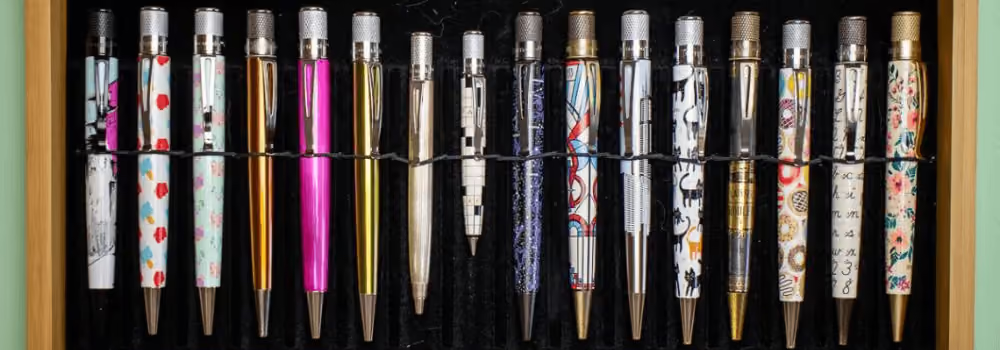
Guest: Yes. We. We design. We design the pen. We work with them to create different techniques on the pen, like the knurling at the top and so like the section here, the knurling at the top and. And the clip design. You know, we work with them and you know, say, okay, we want to do this, we want to do that. But mostly now we're a design shop and we come up with different designs and whether it's our new literary series, which we just. We did Winnie the Pooh. Now we launched Alice in Wonderland a while ago and now we just launched the 20,000 Leagues under the Sea Acid Edge Nautilus pen. So constantly refreshing the designs. So we essentially are a wholesale company. We do have a retail arm at our website, which is just Retro51.com but we're primarily a wholesale company and a design house.
[39:54] Host: Great. What's the employee makeup of a business like this when you bought it? What. What is revenue of a business like this? And margins and profits if you'd share?
Guest: Well, when we bought it, there was about eight. Eight employees. Like I said, his idea was that he was closing the business until. So until we actually closed on the business. His mindset was he was closing the business at the end of 2020. So he was paring down inventory. He would not replace people when people left. Everybody knew that was happening. So other people were leaving, you know, looking for different opportunities to support their families. He did say that anybody that stayed with him till the end would be benef. Would he would take care of because he needed people to run the business. But at the same time, he wasn't going to stop anybody. So the promotional side of the business was. Was let left to go down that, you know, organically. We had. The only salesperson was the sales manager left who retired about who was planning on retiring at that time, but then retired about three months after we purchased a business. So there was about eight people and it was one designer, two people in the warehouse, a ware office type manager, the sales manager and the president and the owner. And I came in and basically replaced the owner, replace the president and replace the sales manager with myself within four months. And we were. Then I think we were down to six employees and the revenue was right around two and a half million. And then we started growing. We added an intern in the design department, hired them full time and they're still with us. That was Mac right now. And he's been promoted to our digital brand manager. Then we hired another intern in the design department that. Her name's angel and we hired a social media manager. They have left but we've. Angel is kind of taken over that role as social media manager designer and is doing an amazing job with it. We hired another designer. So right now we have Richard, angel and Liz as our designers. Mac is our brand manager and we have three office people now. So.
[42:53] Host: So, so you took it from how many employees?
Guest: Right now we're up to 14, including myself.
Host: 14 and 2 and a half million dollars of revenue. What, what are margins like in a business? In a business, in a pen design house, pen business.
Guest: On the product itself, it's right around 50%. So we pretty much function off a keystone and within. So 2020.
Host: What is that? What does that mean?
Guest: Keystone is 50% margin. 50 points.
Host: Okay.
Guest: So when we took over, you know, everything was paring down. A lot of the big, big, big customers bought a lot of inventory because they thought the brand was going away. So we were very. The first quarter we were low on inventory. We didn't have a lot coming back coming in because orders had pretty much pared down to. Because you're not going to bring inventory into a closing business. So it took us a good 6 months or I mean 60 days to build back up inventory. So the first quarter of 2021 was pretty much a wash. There was. That's actually been the only quarter that we've not made money and a wash.
Host: Because you were just reinvesting all cash flow back into the business to build back up inventory. Yes.
Guest: And then we were looking at it.
Host: And Jeff, if the business was two and a half million when you bought it in revenue, but it was also being basically slowly closed, what had it been at its peak? Or I mean what, what did you think the potential and it's. Or I should say in its recent years of strength. What was that revenue number more like? So in other words, what you might be targeting.
Guest: At one point he was up to 25 employees and about 8 million in sales.
Host: But when, how recent was that?
Guest: That was early 2000s. So. So 20 by the time, you know, he had decided that a long time ago that he didn't, he didn't really want a business that big. He wanted a small. So he was managing the business down and comfortable. So 2021, we ended up about 2.7, but we pretty much did that in the first, in the last three quarters.
[45:24] Host: Okay.
Guest: And then 2021, 23, 2023 last year we were at 3.5 and we'll break 4 this year. So overall we've, we've raised the about 32%.
Host: Fantastic. And, and what did you kind of, what were you hoping to do? Are you on track? Are you, are you exceeding what you would wanted to do?
Guest: We're on track with the goal, but we're not on track with my stretch goal. My stretch goal. I wanted to be at five right now.
Host: Okay.
Guest: But with the economy, interest rates going up, just prices of everything going up, you know, that has slowed our growth not nearly as much as it does has with like some of the other larger pen manufacturers that are making, you know, four or $500 pens. Because while our pens are a luxury item, I get it that not everybody's going to spend $60 on average for a pen. But if you want a really nice pen, but, and you normally write with Mont Blanc's and you need a pen and the economy is, you know, you're probably not going to spend 400 on one, you know.
Host: Yeah.
Guest: So it hasn't affected our business as much as it has the higher end stuff. So. But there has been, obviously it exists right now and you know, I'm hopeful with what we, you know, the election coming up that things will start turning around in the economy. And you know, my goal, my goal going into this was 10 and 10. So that's our baseline goal. So 10 million in 10 years.
Host: And so this would be a good time to ask about the demand for pens overall in the pen industry. So other than your, your supplier concentration, you know, the sole supplier and them, you being their sole customer, the other risk here, it would seem is that, that it's in an industry that's in decline. People are using devices and now writing less. So the $8 million that the seller founder had gotten the business to in the early 2000s, you might wonder, could that, could you ever get back to that point? Because has the market just contracted in a, in a, in a secular, permanent way? So, so address, address the, address the bigger question of how you think or you thought about kind of overall demand for pens. And then, and then what you, you know, and then your 10 for 10 goal and, and how big you think you can get this business?
[48:34] Guest: Okay. We are such a small niche in the market that I do believe we can. The, the share is, market share is still there. We can gain market share. The majority of people still in, even in the pen industry don't know about Retro51. So we're doing a much better job at that we're reaching out to different industries like, and different people via social media, doing different types of shows rather than pen shows. So that's all gaining knowledge or gaining market share and gaining new customers. When he was roughly around the 8 million mark, he was doing a lot of more desk accessories, games type, knickknacky stuff too, which, you know, while we can go down that road, I want to stay more with desk accessories than I do with, you know, he had like a backgammon game, a chess set and things of that nature. Actually one of the biggest things that he had was a this tissue dispenser box called Rudy that the. You pull the tissues out through its nose. It was like a tiki statue type thing.
Host: Okay.
Guest: That was, that was picked up by Target and they did millions of those. And then the other big one was he sold reading glasses in Barnes and Noble or was, I think it was, it was one of the stores, I don't remember. So. So those were the two bigger things that really elevated those numbers up. So one of the things that did increase over Covid was medical professionals were recommending journaling and writing and that. So that has actually continued in the popularity of journaling is still very, very prevalent. And there's a cathartic type when you're writing down versus typing. It's much more personal. It's much more, you know, it's slower and intentionally slower. Especially if you're doing it with a fountain pen, which when I journal, I like to write with a fountain pen just because it, you know, I try to write slower and really thought get my thoughts out. You know, some of the bigger manufacturers, like if there's a, if there's a market out there for a 500 rollerball from Mont Blanc or some of the other bigger manufacturers, and that's just one of them. You know, I really don't see why there wouldn't be a market for our rollerballs that are under $100. Yeah, especially with our creative designs and the different things that we do, we do on them because we have designs for pretty much everybody from like I said, the Winnie the Pooh, our car cat dog rescue, our owl rescue, sea turtle rescue, all the way through to military planes. We're going to be introducing a new plane design here shortly. We have license agreements with the method we just launched license agreement with the Imperial War Museum and launched their Spitfire pen. So we have such a broad spectrum of product. And then also our just our classic lacquers and that I. The demand will, you know, I think we reach a lot, a lot of people and the biggest interesting or the. One of the most interesting to me things that has happened to me is at pen shows people will come up to me and I still get it and thank me for rescuing the brand and not letting it go away.
[52:33] Host: Oh, and then it's always a great sign.
Guest: Yes. And then they'll open up their portfolio which is basically a pen holder and they'll have, you know, David Oscarson's that are five, six thousand dollars a piece. So Mount Blanc's, Esther Brooks, no Nuvalar, you know, all these higher end pens and they'll have like the top row will be that. So I have like five, six, seven, eight, nine of those and then they'll have seven retros because we just are like the go to for rollerballs. And I know a lot of the, I know several of the people that work for other pen manufacturers like that have their own products that have their own lines that collect our pens and they're the owners of those businesses.
Host: Well, that's very promising. You know the other thing about this industry I would imagine is like surely it's everything going digital and everybody starting to collect information and notes on their devices had some impact but you're now on the backside of that. So it's like whatever disruption to the industry that digital devices was to. To. To traditional writing that digital devices was going to cause, it's probably caused it by now. So you don't have to worry about M. The previous owner probably did. He, he went through that roller coaster or that uncertainty. But now you. Where the business is today is probably where it settled out or where I should say where the industry is today is probably where it's going to settle out. It's probably not going to decline further or be further threatened by digital disruption because that's happened to the extent that it's going to happen. Is that how the pen industry sees it or am I being overly optimistic?
[54:34] Guest: I'm not real sure how the whole industry sees it. The, all the trade industry and stuff like that are very optimistic about and you know the way that I read some of the information is that the pendulum is actually swung back a little bit away from the digital. Yeah, even see that. You know, when you're writing with a, a digital pen like you know, with the Apple pen or remarkable or whatever, some of the other ones out there, it's the sensory is not there. And so when you write with a pen on a piece of paper, it's more than just you're make you know, you're not. You're not just making a note. You're. You know, it's more. It's the feel of it and stuff like that. And it's the same way how a lot of people feel about electric vehicles. When you drive an electric vehicle, you don't have the sound. You don't have, you know. Yeah, there's benefits to it. You can argue the environmental benefit or lack thereof however you want, but, you know, you don't have that engine noise. You don't have the visceral feeling of it. You have the G forces from the acceleration, but you don't have the sound to go with it.
Host: Yeah.
Guest: And it's, you know, so, I mean, I know. I know one person that they just bought an older car that they've always wanted for that. It's not nearly as fast as their Tesla. It's not nearly as comfortable. It's not nearly. But it's all about the visceral feeling. It's. And it's a. It's a manual, so it's about shifting the gears and that. And then I feel writing instruments are the same way. I mean, apple pencil is very. Yeah. You know, but a pen is something that you pick out, you take, and you show people, you know.
Host: Yep. Great. And so we still haven't heard what margins could be in a business like this. So, Jeff, if you hit your 10 million in revenue in 10 years, and assuming there's no loans left over at that point, what could the profit. What could the SD or EBITDA on a business like that be?
[57:01] Guest: I'd say probably between 25 and 30%.
Host: 20% and 30 net margins.
Guest: Yeah, at. Probably 20 at the low. At the lower. Lower end.
Host: Oh, wow. So it's so pretty good margins. Yes, those would be good margins if 20% is the. Is kind of the floor.
Guest: Yeah. In. In the railroad industry, we called it the operating ratio. So. Okay, so I think an operating ratio of, you know, a 7 to a 0.8 is doable.
Host: Okay, well, Jeff, we haven't gotten into the terms of the deal. Let's do that quickly because we're already kind of at the. At the end here. But I think it's important because it was a little bit unusual, including the fact that you have partners in this and how that took shape. So tell us what you can, please.
Guest: Okay. Well, yes, I do have two partners. Adam and Joe. The previous owner actually helped us put those together, that partnership together. Adam and Joe both reached out to them individually, or him to individually seeing the ad.
Host: These are two guys who saw his letter.
Guest: I should say Adam did. Joe knew. Joe is an SBA banker and he was representing a couple that were in the process of buying the company. And then that couple, I don't remember if it's a husband or wife, which one of them blew up the deal, basically didn't want to do it. So after that, Joe reached out to George, the previous owner, and basically said, you know, hey, I was representing them. If anybody needs SBA help, whether it's, I'm helping them in the loan itself or just guiding them, let me know. And so when it became evident of what we were going to pay for the business and the down payment needed that I didn't have enough down payment, he introduced me to Adam. Adam reached out to him and said, basically, you know, I know nothing about how to run a business, but my whole background is creative and he lives in LA and is in that whole world and creative side of things. Writing. Trademark or trademark professor or copyright professor. That's right. Of writing. And he said, but, you know, I don't want to see the pen, the go anywhere I can gather some money for an investment. And so he brought me to Adam and then we were looking at SBA funding and so he introduced us to Joe for guidance and then Joe ended up becoming a partner as well. Adam is involved in the business day to day. He's our chief marketing officer. And Joe, while he's involved, he doesn't collect a salary. He's basically an investor. But.
Host: And what was the equity split among the three of you?
Guest: I. I'm about 30, I'm roughly 35, 37. Somewhere in that ballpark. Adam is about 29 and then Joe's about 25, I think it is.
[1:00:15] Host: And the money that you brought to the deal was, did you put in any money or you put in what you could towards the down payment?
Guest: Okay, yeah, we. We all put in what we could towards the down payment. It was. The down payment had to be 400 grand. I actually put in the. Well, Adam and I put in the same amount, but we put in. And then Joe put in a little bit more, even though he has less of a ownership stake. That's primarily because we were both planning on working on the business, but it was mostly my sweat equity of putting this deal together and working sure. To gather everything that. And I was the one that was moving to Texas to do this and to run the business on a day to day.
Host: So I know I was going to ask that. So you have, you Moved to Richardson, Texas. Adam. CMO and your partner who's in LA is still in L. A.
Guest: Yes.
Host: Working remotely. And your family at this point, you, you had kids, you have kids?
Guest: I do have kids, but they're both adults. They have other adults involved, families of their own.
Host: Okay, great. So it was a matter of you and your now partner moving to, making a decision to go from Jacksonville to Richardson, Texas.
Guest: And I wouldn't be able to have done this without the support of my wife. I mean, she has been amazing. I don't know how many wives would be okay with me coming to them and saying, hey, I've been talking to this guy about a pen company and think I want to pull the trigger and buy it, quit my corporate job, have you quit your job, sell our house and move to Dallas.
Host: And so by the way, what did convince her or is just. It can't have just been faith in you?
Guest: Well, a lot of it was faith in me. Okay. But she does have associate in accounting, so I knew that I had to have the numbers in a row spelled out And I had 24 month projections, you know, all the things that are required, due diligence. And as for the SBA I had all put together before I even approached her with it, because it had to make sense. I mean, that's the biggest thing. It had to make sense for us. I knew that it was something that we weren't going to be able to move here. And you know, I didn't collect a salary for six, eight months. But it's not something that we're gonna be able to move here. And I would be able to take a year and a half to. Of not getting paid or money out of it to be able to live.
Host: Yeah. Yep. And well, speaking of spousal support, that was a requirement of yours and your partners as well.
Guest: Yes. One of the things that I think, because my, our partners I never met, I ended up meeting them in person until August of 2021, six months after we closed, seven months after we closed.
[1:03:07] Host: Wow.
Guest: So it was very, very important to me that they had their spousal support, that their spouses met me, talked to me, you know, on zoom, know that my spouse supported, you know, and if I. They had any questions, you know, and I'm all about open and honest communication. I mean, you may not like what I have to say, but, you know, and you may not agree with me, but I'm still going to tell you and you know, if it's a disagreement, we can talk about it, you know. Nope. Two people think alike and the actual
Host: terms of the deal. So you guys, you've shared what your split with your partners is. What, what you, that you went in, you've shared what your split with your partners is. That $400,000 was the down payment. What more can you say about the deal? What was the purchase price in. In other terms, if you would.
Guest: The purchase price was pretty much 11 times revenue. So we were right around 2.5. We were able to put the down payment down. We were lucky that he was willing to do some owner financing. And then we were able to get the secure the SBA loan for the balance. The one interesting part of the SBA loan is we were able to collateralize Goodwill. Over 30 years, he's built a brand and that allowed us to take a very good chunk and move that around as goodwill and be able to actually depreciate that or amortize that I guess is the better term for it during, you know, over the last few years to help with taxes and that kind of stuff.
Host: And that's unusual in SBA acquisition deals as you understand it.
Guest: Um, it's different. It's a lot, it's legal and it's, you know, obviously they allowed it, but it's something that we were looking at and I could, I found a precedent for it. So that was what allowed me to look into it and go farther. But to my knowledge, it's not real common just because, yeah, I don't know why, honestly. I mean, if you have a solid brand that has, you know, our pens have a cult like following and we, there's five or six Facebook groups dedicated and buying or selling our pens secondhand that, you know, we pull it out a post and it gets spread between those groups. And so, you know, we have a solid brand, you know, and you know, some of the largest companies in the world, you know, what you're buying is their name. You know, you pay a premium for Adidas, Nike, Puma, you know, right, Goodyear, you know, because of the name brand. So that's all goodwill.
[1:06:32] Host: Right. Well, I, and I, I should know, this is why I'm pressing on it. But I, I think that that's probably the case for a lot of my guests who buy businesses where there's not a lot of capex. So, you know, that's not where the purchase price is allocated. It's allocated to, to goodwill. I mean, what you're buying is, is the name of the brand, the ringing phone, the contracts. And so I just, what I'm, I'M kind of thinking out loud here. I'm wondering, is your case so dissimilar from my average guest? I should, I should ask more about how this purchase, how purchase prices are allocated to kind of better understand that,
Guest: you know, that's just a matter of. The way I looked at it is even if Retro went out of business, there would be demand for Retro. Retro products. Even, even if George, if he would have closed the business, there would still have been a demand. That's why the larger customers bought eight months worth of product. So, you know, and that's why, you know, outside of the second hand, you know, depends that we do in a limited release, you know, we sell for 60, $70. And some of them, like our Halloween pen, which we did a Sleepy Hollow, which, which was like the story and then a Frankenstein and then this year's will probably do the same thing. They were sold out within three, four hours and on eBay that night for four times what the purchase price. Really?
Host: Wow.
Guest: So, you know, and we did 10, 30, one of them for Halloween. So, you know, that's what gives a company goodwill.
Host: Yeah.
Guest: Because even if, you know, even if the world exploded and we're, we're out of business and that I could sell the inventory, I could sell, you know, I could get rid of the product online. There would still be a drive for it.
Host: Well, Jeff, I want to ask one last just question on the negotiation and then we'll close out. So a seller who has announced to the world that he's basically shutting down hasn't left himself a lot of negotiating leverage, frankly, because he's like, you can come to him and say, well, I'll buy your business for half a million bucks. It's half a million more than you'll otherwise get. Should be, you know, that's gotta be appealing. So did you lean on that strategy or, or, or was his position such that, like, look, I have as much money as I need. I'm really not going to be. I, you know, I'm, I'm really, I really don't need your money. So I would actually in fact close it rather than sell it for a few hundred thousand dollars?
[1:09:29] Guest: Yes, that's exactly where we were. We were at heat, man.
Host: He's really done well with this business to be willing to walk away from, you know, whatever lower price you might have otherwise offered.
Guest: It's not just this business.
Host: He's at other businesses.
Guest: Yes. So his position was basically when they were going down the road, that with the sale that Joe, Joe was representing for the, they did a business valuation, they came back with a number and he was happy with that number, which was right around the 2.5. And he said, this is the price, take it or leave it. So all the due diligence was justifying that price, not trying to come up with a new price. So, and I, it really, it didn't matter. He made it more than clear that, you know, he was in a position that this was non negotiable.
Host: So, so his position was, hey guys, I've already had this business valued, already done a lot of the diligence here. It's worth two and a half million. We can do this if you want to pay me two and a half million, otherwise I'm closing this thing down and I'm walking away. Even if you offered me 2 million. No, I'll take zero. Over 2 million.
Guest: Yep.
Host: Wow. Very interesting.
Guest: It wasn't just about the money. It was, you know, during this whole process we had to prove to him how we were going to treat Retro, how we were going to treat his brand, how we were going to continue honoring where it came from, but yet progressing further. So. And that's one of the things that we've managed to do very well. And you know, that has actually brought us a couple more opportunities that we're looking at. Probably within the potential acquisitions. Yes.
Host: Of other pen businesses.
Guest: Yep. And other, other businesses outside of the pen industry. But.
Host: Oh, and, and so sorry, final, final
Guest: question, but related to the pen, what
Host: are, in what are industries that are related to the pen industry? Like things that go on the desk,
Guest: you were saying earlier, accessories, collectibles. Our pens are very collectible. You know, we have, we have some customers that literally have thousands of our pens. Oh, and so collectible items. We were looking at a company that did a lot of sports memorabilia, but tied it into products. And we actually used to make a pen for them. And that was just one of the things. But they did cufflinks, watches, wallets, shot glass holders, just all kinds of different stuff, all based around memorabilia. And we were looking at that company, it ended up not working the way we wanted to, so we didn't do it. But you know, that was an opportunity that was brought to us because of how we treated retro, the brand Retro.
[1:12:54] Host: Great. Jeff. Well, if people have questions for you, want to learn more, want to connect, is there a way that you prefer they do that?
Guest: Yeah. My email is jeff retro51.com more than open. Just make sure you mention that you heard me on Inquiry minds and that way I have a context of where you're coming from, you know, because I get a lot of random emails about selling me stuff, so those don't get much attention.
Host: Fair enough. Jeff Felker, congratulations on this really interesting business. And, you know, Reflecting back on 13 years ago now, I guess 2011, somebody who went through bankruptcy and pushed through and caught himself back and now is bought another business and is a business owner of what seems like a, as I said, a really fun business with a lot of growth out of it. So congratulations on that whole trajectory and thanks for sharing all of the details with us.
Guest: Oh, thank you very much, Will. I appreciate it and it's been enjoyable. I like, I like sharing my journey because it's had its up and downs, but also, you know, if I can inspire one person to be an entrepreneur to do something, then that's great. I have a niece that is a entrepreneur.
Host: She
Guest: does, like little 3D printed things, does shows and stuff like that. But, you know, anytime I can support her and, you know, talk to her about it, you know, she's very grateful and it makes me feel good because she's learning from me, so.
Host: Well, you and me both, I, I share that, that spirit. Thank you, Jeff.
Guest: Thank you, Will. Appreciate it.








































%20-%20thumbnail.avif)




%20-%20thumbnail.avif)

%20-%20thumbnail.avif)
.avif)


%20-%20thumbnail.avif)