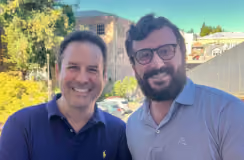
Host: Biz Buy Sell for the Win Today's guest, Jordan Novgorod tried to get upstream on Deal Flow. He scraped data, did broker outreach, iterated his methods. But wouldn't you know it, the $800,000 SDE business that he ultimately bought, he found right on bizbuysell, sitting out there publicly for all to see. Just goes to show that despite whatever sophisticated processes you develop for your search, always keep an eye on bizbuy, as some brokers call it. Something else I want to call out about Jordan's story that we don't hit directly until the very end. Acquisition entrepreneurship for Jordan is an escape from the middle class. It's hard. It's a risk. He sold his house to enable himself to do it, but he sees buying a small business as a uniquely powerful path to a level of wealth otherwise unattainable to most W2ED people. And he has gone all in to walk that path. Here he is, Jordan Novgorod, owner of LT Engineering. Welcome to Acquiring Minds, a podcast about buying businesses. My name is Will Smith. Acquiring an existing business is an awesome opportunity for many entrepreneurs and on this podcast I talk to the people who do it. Wouldn't it be great to have experts at your back when buying a business? People to help you polish up your pitch and processes as you go to market as a searcher, then help you evaluate opportunities once you get some deal flow? Such experts exist buy side advisors, but they'll cost you to the tune of tens of thousands, even hundreds of thousands of dollars. But another option exists, the Acquisition Lab. The Lab is a do it with you buy side advisory service, not do it for you. Founded by Walker Deibel, author of Buy Then Build, the Lab represents Walker's vision for what is most needed to make a searcher successful and available at an accessible price. It's cohort based and you will come out the other side of your cohort prepared to go to market as a savvy searcher with a tight message and process so brokers take you seriously. Pre approved for a loan and with an entire community at your disposal to help you along the journey to buying a business. To learn more, check out acquisitionlab.com link in the show notes Jordan Novgorod thank you for joining me today on Acquiring Minds.
Guest: Thanks for having me, Jordan.
Host: I love when my guests don't fit the mold of the typical acquisition entrepreneur. I would put you in that category for two reasons primarily. First, you were employed at the same place for 17 years, so an almost two decade stint as a single as an employer at a single place is not really typical on the resume of an entrepreneur. And second, you were never really interested in personal finance money, and you only became interested in the topic about three years ago, introduced to it by From Rich Dad, Poor dad, that famous book that has introduced so many to personal finance. And yet here you are having acquired a business. So not sure the Jordan of three years ago would recognize the Jordan of today, but we're gonna, we're gonna hear all about what that journey looks like. So maybe start us off, Jordan, with, you know, these, these 17 years. What were you doing and what happened that prompted you to, I mean, beyond just reading Rich Dad, Poor dad, you know what go. How does somebody working for 17 years go to buying a business?
[3:44] Guest: So I guess 17 years was what I fell into. And I got the, you know, salary and all that. I gained enough that it became like the golden handcuffs. You couldn't easily walk away. And while I wanted to start a business, my wife was never supportive of being poor while we did a startup. So every time I tried, she would say, hey, wait a minute, that's not going to work for us.
Host: How many times did you try?
Guest: A handful. Okay, Handful.
Host: So you did, you were entrepreneurial, so it wasn't totally out of left field that you would eventually do something entrepreneurial.
Guest: Right? Okay. I feel like always been entrepreneurial. I did start a business in college that I totally ignored for college, so it didn't last very long. But, you know, I do. My family, I guess, has always been entrepreneurial. Most, most everybody in my family start. Had started or run a business. So, ah, you know, that was kind of normal for me. So finding myself at a job where I stuck for 17 years was. Was out of the norm for my family. And, you know, it basically got into. I was, I was working for the Johns Hopkins Applied Physics Lab and doing DoD work. So I was, you know, finding a lot of that stuff very interesting, having gotten engineering degrees, um, and one thing led to another and I just kept, you know, finding it hard to. To break out of that. So then Covid happened and that changed everything. We decided to sell our house and, and move to a rental so that we could then have that money available to invest on. We decided that we wanted to get closer to my in laws since they were getting older. We did all that. And then the COVID mandate started happening and I was totally against the mandates and applied for an exemption and all that. And long story short is it didn't work out. They. They very much had a draconian style. You'll do what we want or you won't work here. So I knew I wasn't going to be working there for very long. At that point I was ready to dive off and start investing in self storage. But the economics of that aren't, aren't nearly that of buying a business that you know as a typical search. So along that journey.
[6:51] Host: Let me hop in here with a couple of questions I just want to understand. So you read Rich Dad, Poor dad, you guys sold your house to invest that money. What is that? What does that mean exactly to so business? So I get into self storage or what?
Guest: Okay, so you know, it's, we didn't have a lot of the way, a lot in the way of savings. Being a single income household in Maryland is kind of, kind of tough. And my, my wife homeschools our kids so we just had my income. So we didn't have a lot in the way of savings. Well, one of the things we did have was a house that we had bought and, and renovated. So we did a lot of work on the house and we decided to pull the equity out of that and, and, and then rent so that we could use that money to invest. And it wasn't clear when we, when we made that decision. We didn't know exactly what we were going to invest in, but we knew we wanted to have, you know, cash flowing assets instead of just a liability. So we really took that rich dad philosophy of your house is not an asset to heart and ran with that.
Host: Yeah. And so is you. Read Rich Dad, Poor Dad. Sounds like your wife is on board with all this. So is she kind of also going on a personal finance journey alongside you or you're doing it together?
Guest: Yeah. So it took me a while to convince her to read Rich Dad, Poor Dad, I think maybe, maybe six months before she finally did. And then she was totally on board with it, which is what enabled us to do it. Because if your wife isn't on board, you're not going to be doing much. Right? Right.
Host: Behind every good searcher there is a supportive partner and you. So I imagine, well, I know from our pre call you kind of go down the personal finance rabbit hole. So Rich Dad, Poor dad leads, I assume to all sorts of videos and personalities and stuff, but you arrive at sweaty startup Nick Huber, who will be familiar to many people listening. And Nick Huber's big thing is self storage.
Guest: So
[9:00] Host: for a minute there, you're interested in self storage. Correct. But you decided it's too expensive. Just expound on that just a little bit.
Guest: Sure. So I had been listening to a lot of self storage podcasts and all that, trying to get educated. So I understood the space and in that I found Nick and I listened to the one podcast he had on buying a business. And I'd never thought that was a concept. I thought that's what rich people did. Right. Never thought that you could go out and you know, leverage a loan and get, buy a cash flowing business. So when I discovered that I was up all night on biz, Buy, sell, going, oh my God. It's not, it's true. There are actually these businesses. Yeah. So I started, I told my wife about that and she said that's a lot, lot better idea than self storage. She was on board with that. So then at that point I lost my job or quit or both and started full time searching. So that was in January.
Host: That was in January of this year.
Guest: Okay, January of this year. Yeah.
Host: Okay. And. And you didn't like self storage. Not just because you feel like the category has become a little overheated with all of the attention that Nick Huber and others are bringing to it, but also because it's, it's just, I think you, you told me it just appeals to you less. And why was that?
Guest: Well, so it's, I mean you're not, you're, you're not really managing much in the way of people. You're mostly managing in boxes and that's not very exciting. Although I just don't think there's value in self storage investing. It's just long term. Yeah. And you know, my wife didn't like it because I said, well, we're going to pull in almost no salary for the first 10 years, but then we'll make money. And she didn't like, she didn't like. Can't blame her. I can't.
Host: Give me your educational background. You're an engineer you had mentioned, but specifically, could you be more specific?
Guest: So I went to NC State and I did a program called Accelerated. So I got a bachelor's and master's in five years and in electrical engineering. And so I got convinced to stay technical and I finished those degrees and then went off and got a job at the Johns Hopkins Applied Physics Lab and worked there for that 17 years.
Host: So you are an electrical engineer with a master's and worked for 17 years as an engineer and yet you find through the duration of your, as you kind of see success in, in promotions with, during those 17 years that the management piece is not something that you were drawn to. But in fact Enjoyed.
Guest: Yeah. So actually I didn't go into management because I wanted to climb the ladder or whatever. I kind of went there because I was looking for a job outside and realized my skills were so narrowly focused that I couldn't find a lot of opportunities. So I wanted to find a way to have more opportunities. And in that I discovered that, hey, management will give me those more opportunities. They expect you to be broader. So I applied for and got a job still at the lab doing management. And what I discovered, as you said, was that I actually enjoyed it. So that was kind of surprising. Helping people grow and you know, seeing them succeed really, really empowers me. So that wasn't what I was expecting. And so I kind of, you know, had a really good manager myself, which helped once I took on that management role and grew and that kind of made it hard to leave, you know, because I had somebody I trusted above me. But ultimately that, you know, led to the mandates and that wasn't too hard after that.
[13:13] Host: And so you actually. One of the themes often of business buyers, acquisition entrepreneurs is whether or not they're drawn to managing people. Many of the target businesses that acquisition entrepreneurs might look at are blue collar businesses, meaning there's a lot of people management. Some people run toward that, some people run away. And it sounds like earlier in your, earlier in your career you would have run away, but as you matured and got some experience managing, realized that in fact you liked it and so you actually were, you were totally embraced that the idea of, in fact even wanted it in the business that you acquired.
Guest: Yes.
Host: Right.
Guest: Yes.
Host: Great. Okay, so self storage categories too hot. Seems boring. Managing boxes. You, you like managing people. So are you at this point, have you narrowed your search criteria to like a blue collar business? What is, what does your search criteria look like?
Guest: Yeah, so my search criteria, you know, having read all the standard books and you know, spent time on search funder, a lot of time trying to educate myself on what, what, what is a good target and all that. I had narrowed it down to the typical service based business. Right. In high school and all I did construction. So I figured I'd fit really well with that kind of stuff. So we're just trying to find that service based business where I could scale it and grow it and manage people and not have too high of capital expenditures, that kind of stuff. So that was kind of my search criteria which ultimately, you know, that's what I was looking for. I ultimately bought a manufacturer. So, you know, there I was kind of like, well, let me look for what's commutable where I currently live, and broaden that out and just look at all the businesses that are available that would be commutable. And so then I discovered it, and I'm like, wow, this. This really. This is the business. And I told my wife, I said, I found it. And she's like, no. She read the teaser, said, yeah, this is it. So. And it ended up being it. So.
[15:29] Host: And when. So why was her reflex to say no? Because it was manufacturing rather than services.
Guest: Her reflex to say no was just because that was her attitude. Every time I brought her one, I'm like, this one looks really good.
Host: You know, she strikes me as one of those people who maybe where her. She just says no to force you to think that much harder and be that much more persuasive just to. Just to like, raise the bar a little bit so that you. You are more confident in your own thought process. I love it.
Guest: Yeah, she was definitely doing that.
Host: When you said commutable. So you were. Where were you at that point? You were. You'd already done the move to West Virginia. And what was. What was the radius of commutability?
Guest: So my radius, commutability wasn't really in miles. It was in time. And I figured an hour and a half one way was the most that I was willing to drive. So.
Host: So an hour and a half radius from where you are in West Virginia, does that get to any metro areas? Does that get to D.C. or Baltimore?
Guest: Yeah, it gets basically to Bowles. Right.
Host: Okay. Does it get up to Philly?
Guest: No.
Host: Does it get to Philly or Pittsburgh?
Guest: No.
Host: Okay. Okay. All right. Well, still the dmv, big area, including Baltimore and that even bigger. So that's pretty good. The. Okay. You know, one of the other things about your story, Jordan, is that you have been blogging all the while. You've got a substack. Of course there will be a link to it in the show notes. I encourage people to read it. Quick digression. Tell us why you blogged through this experience.
Guest: Well, so there was a couple reasons I wanted to blog first. I wanted to hold myself accountable for making progress. And I figured if I wrote that down, that would make sure I did more than had I not. The second reason is I wanted to make sure that others, even though there are great books and stuff, they still don't get into all the nitty gritty. And so I just wanted to blog those nitty gritties to show, you know, how. How an actual search went and maybe help somebody in the future with their search. And then third, I was looking for, you know, not having contacts and you know, finance and that kind of stuff. Not having an MBA and backing, I was thinking that I might need investors and what better way for investors to get to know me than to be able to read my journey along and follow. So I wanted to build that trust over time.
[18:06] Host: As we talk there were a few of your blog posts that jumped out at me that'll be, that are. Well, I mean they're all relevant to your story of course, but a few that I want to, I want to hook in as we talk. So the first one is your approach to deal flow. So obviously deal flow is really the name of the game in search and you were trying to be intelligent about it, as intelligent about it as possible. So you tried to get upstream on deal Flow. I think that your blog post was something along those lines. Getting upstream on deal flow. What did, what was your thinking, what was your approach and what did you learn? August Felker is a two time successful searcher. First with a traditional search fund. The second time around he did a self funded search. Today August runs Oberle Risk Strategies, an insurance firm with a dedicated practice group for searchers and acquisition entrepreneurs like you. If you've got a business under loi, Oberle will provide complimentary due diligence on that business's insurance and benefits program. A great no risk way to get to know August and team. They love helping searchers. They've worked with hundreds. Oberle is a specialty insurance brokerage for searchers by a former searcher. Check out oberle-risk.com O B E R L E- risk.com link in the show notes.
Guest: So I guess, you know, trying to figure out how to get upflow on the deal stream was not, not simple, right? The books just talk about doing that, you know, establish relationships with brokers and get on their short list. It doesn't really talk about the mechanics of how you go and do that. In discussions with Search Investment group because I was trying to be a part of their program, they kind of hinted that what they do is use a CRM and go out to all these brokers and send out, you know, emails to explain the search and get on their list basically. So I said well you know, when they weren't, when they didn't take me, I said well I can do this on my own. So I did just that. I collected, scrubbed all the websites for broker information, started compiling that and then started emailing those brokers with a one pager Right. Which I, you know, went on Search Funder and got lots of help on. What should I say? What shouldn't I say that kind of stuff to, to clarify that message. And you know, ultimately what I discovered was that all of those brokers that I, that I initiated that process with, and I gave up on that process about two or three weeks into it because all I was getting was the standard listings. And those standard listings were actually like from the worst brokers. They were ones they wanted 20 times cash flow for the business and that kind of stuff. And so I decided.
[21:11] Host: Hold on, hold on a second, let me jump in. You said you scrub the websites. So by that you mean going on Biz Buy Sell, seeing the, the brokers alongside listings that are in your target geography and that seem like within the industries or categories that you're interested in, and then sending this an email to them that says, you know, that has your one pager and it's basically introducing yourself. And what you correct so far?
Guest: Well, actually by scrubbing the websites, I mean I went on to like IBBA and Interexo and collected all of the broker's contact information. Ah. Using a web scraping.
Host: Okay.
Guest: Okay.
Host: So you were just getting lists of brokers. You weren't looking yet at Biz by Sell and seeing who the active brokers were.
Guest: Okay.
Host: And then you send out emails to all of these folks with your introducing yourself, saying what your target is, one pager about yourself. And then what you find is that this isn't that productive because really you're automatically put on their lists. And it seems to be lists of, you know, brokers not really selling quality, not really putting out quality stuff. Right.
Guest: Yeah. I mean, so I mean the, a lot of the brokers in Florida, right. Are. They can be anything from a real estate agent. Right. And so I was getting a ton of calls from them wanting to do, you know, buy side engagements. So they wanted to help me find that business. I was. And then if I was getting on a list, the list was always one where. And I still have them emailing me today. These businesses that you know, will never sell because they're wildly overpriced and you know, unrealistic. So that's, that's what I found using that process. And so ultimately what I decided on was to use to do as you said and look at the listed ones on Biz Buy Sell, find those that match. Like, okay, this is a business that I'm interested in. Let me find out more information. And then, you know, as with a lot of them, you're going to look at it, you're going to realize this isn't the business for me or I don't like the hair on this one. And so my goal then was to let the broker know why I didn't want to move forward on this business. And by doing that I develop much better relationships with brokers. And I could tell of those brokers which ones, like if they were, you know, telling me the cash flow is a million dollars and then you get the, the sim and it's really 200,000. Well, you know, this is a broker I don't really want to deal with because they're just inflating everything to unrealistic and it's not worth my time.
[24:06] Host: So, so when, so when you went to bizbuysell and you identified brokers that you wanted to reach out to more specifically rather than the IBBA scrape, how many, how big was that list? I assume it was a lot, much, much smaller.
Guest: So I mean I was, when I was constantly looking at the listings and then reaching out to every one of those listings that I found interesting. So it was a whole lot smaller. Right. Which is what ultimately led me to broaden it up in, in terms of the kinds of business I was looking for locally.
Host: The other thing that strikes me is like, you know, one of the things, I mean, Biz Buy Sell is amazing in many ways, but it has the reputation for, you know, the very best businesses are pocket listings and are sold before they ever go public on Biz By Sell. Not always. I've had plenty of guests on here who found their business on Biz By Sell. But that is certainly the kind of the conventional wisdom you hear in the search funder circles and elsewhere. And there is a lot of truth to it. So is it, is it the best. Are the, you know, the broker selling the listings on Biz Buy Sell, you know, are, are they the best brokers? Because, you know, because they haven't been able to sell their listings, you know, off market, which is, as we're told, the best. You know, those are the, where the best, best listings and presumably best brokers are active.
Guest: Sure, maybe, maybe so. I don't know. I don't really have a, you know, inside knowledge on those brokers. What I will say is I bought my business from Biz Buy Sell and the broker I thought was very good. So you know, he's, he, he's the type that their brokerage carries 1, 2, 3 businesses tops. And they, you know, price them right to sell, not to hold on to forever and try to scrape listing, you know, contacts or whatever. So, you know, that, you know, if you, if you can, you know, obviously if you're a buyer that's seasoned and has bought many businesses, you're going to get access to deals that other folks that aren't won't.
Host: So, you know, yeah, yeah, fair enough. And we didn't cover what your, your search criteria was. Other than the, the geographic constraints. What were, what financially were you looking for?
Guest: Well, geographically, I was actually looking all the way from Pennsylvania to Texas, kind of the whole Southeast and then some. Financially, I was looking for anywhere over half a million in EBITDA to 2 million. Figuring 2 million would be tough to finance, but right within my capabilities.
[27:08] Host: That's a broad range. And yes, a $2 million EBITDA business is a big bite for somebody who just read Rich Dad, Poor dad three years ago.
Guest: Well, well, you know, I mean that at the, at the start, I actually looked at a business that was like 330k or something in seller discretionary earnings or whatever. And it, and that seemed like, you know, hey, that's, that's pretty good money. Like, if you can grow that and like, great. And then once you figure out how much you're paying for financing and all that, and then all of a sudden that's not very much. And I would have made more, you know, staying at a job than doing that without all the risk and all that. So that kind of set the lower bounds. I didn't really want to go down to, you know, 500 or whatever, but I wanted to stay flexible enough so that there were, you know, there are more businesses on the lower end, obviously, than there are on the higher end. So
Host: you're. Something tells me that your conversations with Sig, with Robert Graham and Jordan Carter were influential in this thinking. I mean, a lot of people say it, but they are especially forceful in their argument that Searcher should only be looking for, you know, 700 EBITDA or 700 SDE and above.
Guest: Yeah, I mean, and they make a, I think, a very compelling argument because, you know, there is all that risk, and if you're going to do that, you might as well get to the point where you're going to get rewarded for it. So.
Host: Sure. You know, and also I, you know, I, I learned this rule of thumb late, but it's, it's a great, just at a glance, you can look at an SDE and have it mean, be more specific, have it be more meaningful to you. Good rule of thumb is when you see Ste, just have it. And that's what you'll be left over with after servicing your debt. If you're doing kind of SBA loan with kind of standard parameters. So if you're looking at that $330,000 SDE business, really you're only going to have. What's my math? 165 to pay yourself and reinvest in the business. And, and, and, and, and after debt service. So just. Good, good rule of thumb for people who don't already know this, probably most listeners do, but have that SDE to, to understand what you're left with after servicing your debt. Okay. And Jordan, I, I didn't, I either didn't understand or I missed something where you talk about your geographic constraints being an hour and a half from where you live to the entire Southeast. I missed.
Guest: Yeah. So I guess, I mean, to make that clear, I broadened my search. My first, my, my criteria was the whole Southeast for service based businesses. And when I decided that I wanted to open up, find more businesses that were closer in terms of being able to commute, that's when I just took away and looked at all the businesses that were for sale. So whether it was a gas station or a car wash or whatever, I just looked at everything that was commutable. Um, instead of staying more narrowly focused.
[30:28] Host: Yeah. Okay, gotcha.
Guest: So
Host: have we kind of exhausted your, your blog post about getting upstream on deals that was. Did we cover everything?
Guest: Yeah, I think so.
Host: Okay. Because eventually, as we, as we already know you, the deal that you found was not through any of that. As it turned out, it showed up on Biz by selling.
Guest: Yes.
Host: So is there any takeaway from that? I mean, would you still recommend people do the final method that you arrived at, which was looking at Biz, Buy, Sell and maybe a few of the other sites, seeing the brokers that are active and kind of cold outreaching to them, it still, still worth it, would you say?
Guest: Yeah, well, I think I wouldn't do cold outreach. I would still inquire about their deal even if they're only marginally interested. So you can get to know them a little better and they'll actually pay attention to you if you're cold outreach and they're good, they're not going to pay any and they're not going to give you any time. Right. Because they're busy, they got lots of stuff to do and you're one of the million people bugging them that, you know, probably will never close a deal. Right?
Host: Yeah. Yeah.
Guest: So.
Host: And curious, would you get on the phone with these brokers or was it all over, was it all over email that you were kind of developing relationships?
Guest: I mean, I ended up on the phone with them, but I started out over email. And would I do that? Yeah, I mean, I plan to after, you know, some period of time when I get this business running well and where I feel comfortable going and acquiring more businesses. So I plan to use that method.
Host: Well, you will have already done a deal then, so I imagine a lot more doors will open to you and a lot more. You'll get a lot more calls back. There's a huge difference between somebody who hasn't ever done a deal and then somebody who has the credibility of having done one, especially if you've then been successful with the business you acquired. So that'll be, that'll be fun. Okay, so tell us more about the business that you found that you immediately loved and that your wife immediately loved too, once she actually was willing to look at it.
Guest: So the business is metal fabrication. So we manufacture stuff in metal and plastics, but that includes machining and welding. So we build basically all kinds of different metal things. And it's sort of why it fits, is because in my job I was in management over a small machine shop as part of one of my duties. And so I kind of understood the very basics of the business. You know, in that job, it was not about making money, it was about, you know, just getting stuff done. The finance and all wasn't part of it, but nonetheless, I did have experience with that. So. And I like, I like building things. I like seeing things built. I'm, you know, hands on kind of person. So that's why it fit really well. And so once I, you know, decided this, you know, this was the business to go after, I, you know, did full court press and I met with the owner as quick as I could. We met in person, we hit it off really well. And I, at that point, my wife was like, it was supposed to be like a two hour owner meeting, ended up being like six. And my wife was like, are you ever coming home? She knew right away, as I did, that this was definitely the business for me. So.
[34:24] Host: Well, what a lesson in buyer seller chemistry, which is another theme that you hear over and over again. I mean, just last week I was talking to a seller who sold their business and she said I had stronger offers than the person I chose, but I liked the energy of the person I chose. So I was willing to receive less money because I felt chemistry with the buyer. And so you're so six hours. What did you guys went for lunch and then lunch became a tour of the shop. How does two hours become six? What did you do for those six hours? You weren't literally talking the whole time?
Guest: Well, we were actually here at the shop after hours so that the employees didn't know. And we did, we talked for a good bit of that and then we did a tour of the shop and lots of questions and it just kept going and going and going because I was, you know, interested in learning more and you know, by the time I left, I told both the owner and the broker that I was going to put in an offer in that I wanted to buy this business. And so, you know, I then worked within two days to put together the offer and get it in. So.
Host: So had you, did you have your LOI templates and stuff ready to go or were you kind of scrambling because you hadn't yet reached that stage in your buying process yet?
Guest: No, I hadn't reached that stage. In fact, the broker provided me an LLI template. I found, you know, the ones on the Stanford pack and you know, tried to meld those two together and not make it too complicated and you know, it, it, I didn't end up wanting to use a lawyer for that aspect of it. So I, I just took and used mostly what the broker had done. I had ended up, I ended up with two. One that was far more legally written, that was mostly from the Stanford stuff. And I ultimately chose the less legal one that the broker was familiar with.
[36:40] Host: So why did you choose that one?
Guest: Because I wanted a better chance of accepting it. Yeah.
Host: Did you get the impression that this was going to be competitive?
Guest: Yeah, it wasn't clear right whether there were other offers on the table when I put mine in. The, the broker kind of alluded to there were other interested parties. You know, vaguely there never aren't other interested parties. So. But ultimately it ended up I didn't have competing bidder, but the business was priced right. And the I, you know, felt that the seller was being honest and the ultimately to me that was the most important thing. Like all the shady people that I had interacted with in many other businesses I'd looked at, you know, where people would run literally every expense through the business. Like there were, there was one particular one where it was like there was like $30,000 of bed, bath and beyond that was added back. It's like
Host: a person was single handedly keeping Bed, Bath and Beyond business, by the way.
Guest: So when, when none of that was in this deal, it felt right to me. So it was very clean.
Host: Yeah. So you, you did feel that a lot with a lot of the sims that you looked at that there was, there was, there's a lot of shadiness out there. A lot of, A lot of minds to avoid.
Guest: Yeah, well, I mean, you know, you know, and maybe that's a fact. Of those businesses being listed on, on those websites, is there still the bad ones are hanging around? Right, so.
Host: Yep, Exactly. Great point. Yep. The two, two follow up questions about this business are more the. Can you tell us what some of the financials were?
Guest: Yeah. So I mean the SDE was on the order, it was over 800 and then the price was roughly a little over three times the ste. So that's, you know, right down the lane of what I was hoping to find.
[39:04] Host: What a find. That's phenomenal. And further evidence that not only did you buy something on Biz Buy Sell, but you've found a sizable kind of self funded searcher special right there on Biz Buy Sell. The. Now what was the hair on this particular deal? What. What was there to not like about it? Surely there must have been something.
Guest: Well, I mean, you know, there's always hair. Right. So figuring out what that is in this case, there really isn't a management layer. Like almost all I have, you know, nine employees and they almost work independent. Like there's very little in the way of that kind of a management layer, which I would have expected right. At that size of a business. So you know, what that ultimately means is that the seller was doing all of that. Right. Which means I will have to do all that. Right. And so I, you know that some people would run away from that and say I just don't want to be there in the day to day buying myself a job. Right. But I was perfectly all right with that. So I do want to eventually grow to where I'm not in the day to day, but I'm not in any hurry to get away from it at this point.
Host: Well, and it's not necessarily, yeah, buying the job, but it's also, I mean, this is why you buy a business that has sizable ste. Because you have the resources to reinvest in making hires. Now that means obviously that you don't take that money out of the business, but you're buying this business to grow it anyway. So let's actually just do some quick public math here. So if it's 800 STE, you know, following our rule of thumb, I'm not saying this is exactly how your numbers shook out. But following the rule of thumb, you actually, after your debt service have 400 left over. You want to pay yourself, let's call it between 100 and 200. So that leaves you 2 to 2, let's say 200 to 250 to grow the business. And that's, you know, that's certainly enough to hire at least, at least one, maybe two managers. Although then you're really not going to have anything left over. But is that kind of how you, is my math at least a passing resemblance to your plan?
Guest: Yeah, I mean that, that was how I looked at it and is how I'm, you know, looking at it going forward. So it's, it's, it's the, the other hair on this deal was the amount of working capital, right? That's how much, how much working capital do you need? And being a manufacturer, it's not, you know, my worry was that there's a whole lot of capital expenditures. The machines can be pretty expensive. How, you know, how often do you need to buy those and you know, what does that cost? Well, you know, digging in now, having owned it for three months, the Capex isn't really an issue. But the, the what, what most searchers want, right, is a very short working capital cycle. And this business is not short 90 days. Some of the customers are net 90. That's a long time to put out money right before you get it back. So yeah, you know, that part is, that part is, you know, some of the hair on it.
[42:42] Host: So going back to the management layer for a second, a follow up question on the numbers. What is revenue? Or roughly so 800 SDE from how much revenue?
Guest: 2.2.
Host: Okay, so a third. So, so yeah, so over a third. So that's like whatever, approaching whatever, somewhere between 35 and 40%. And you know, I'm reminded of my episode with Ryan Doyle, who's a searcher who had kind of seven takeaways from seven, seven things to red flags in businesses that you're looking at to be careful of as a searcher that he's learned from looking at so many deals and decide realizing like what the patterns, what patterns emerged from the deals that he ultimately said no to. One of them was if margins are too high, like you'd be like, well, you know, how can margins be too high? Like more margin. The more margin the better. It's exactly like what you found. It probably means that the owner is doing everything and that if you really want to understand how what you might do with this business you should reduce that ste. Because you're going to need a manager if you, if you want to, you know, build a growing asset and an asset that you or a business that you yourself can eventually sell. So yeah, so Here you have 35 to 40% margins in your business. It's, I mean this, you know, this is a perfect example of that. So I encourage people to listen to that. That episode, by the way, that was episode 81. Don't be tempted. Eight signs of a bad business. Eight signs, not seven. Returning to your story, Jordan.
Guest: So
Host: the, the other. Can we spend a minute on the nature of this business? I don't know anything about manufacturing. I've said that before when I've had on guests who have bought manufacturing or manufacturing like businesses. And in fact, in a number of those cases the folks are, they say, well, it's a manufacturing business technically, but it's not really, it's more kind of fabrication or a recent guest was like, I actually, he said, I realized after six years of owning my business that I don't, I'm not in the manufacturing business. I'm in the e commerce business. We do some design here, but basically the manufacturer's in China. I'm not really, you know, striking an arc at all. Sounds like yours is a real deal manufacturing business, the machine shop, am I right?
Guest: Well, yeah, I mean, yes and no. We, we do have some products that we make on a continuous basis, but most of what we do is project based. So we have a lot of recurring customers. They come back to us over and over and over. But we build different things for them. So it's not, there's, it's a little bit like a manufacturer and a little bit not. So the, a big portion of the work we do is for water treatment plants and every one of those is different. And the kind of metal fabrication we do, whether it's stairs or railings or you know, grading that kind of stuff, it's very unique to each project. So we have to go out and measure it and then manufacture it to match.
[45:49] Host: So, and so you're, you're distinguishing that from a manufacturing business. And then a manufacturing business is producing a product at scale and so they're just doing, they're stamping out the same widget over and over and over. Whereas yours is kind of custom manufacturing.
Guest: Yeah, yeah, that'd be a good way to distinguish the two.
Host: And on this point about recurring and reoccurring. So it sounds like yours would be kind of the classic. Well, I was going to say reoccurring because you have clients coming back. But I'm not sure that is reoccurring technically either. But did that give you pause that it's project based? I mean, that's often something that is certainly not within the sweet spot of what searchers look for project based businesses.
Guest: Correct. So no, because I knew some of the work was that reoccurring work. So we build some things like. And that portion of the revenue is on the order of 40, 50% of the repeat stuff. So that I thought was a good stable base from the, on the project side, you know, to help balance that the project margins are higher, which help. Right. You know, and being that the projects weren't tied to, you know, I looked at pool building businesses and, and that kind of stuff. And there was a Covid bump for sure in pools. Right. This business, you know, I was like, well, it's infrastructure, if anything, we're at the beginning of needing to replace an awful lot of infrastructure. So that project base to me seems like a good stable spot to be. Not necessarily like, you know, now that the pool bump is done, people are going back to work, they don't need their pools anymore, you know, a whole lot more stable in that regard on the economy. So. Sure.
Host: Well, the other thing that jumps out at me is the, a lot of what you were buying is these relationships that you have with the, with the folks at the local governments or whoever is building the water treatment facilities. And so those relationships presumably were with this owner, this gentleman that you spent six hours with on that first meeting. So something that is so incredibly valuable and needs to be transitioned just. So are those relationships. Did that strike you as, I mean, did you recognize that? And how did you, how have you managed that?
[48:23] Guest: Yeah, I mean, so that, that definitely was one of the risks. Right. Is can those relationship transfer. And so when working with the seller, I wanted to make sure that he understood that that's what I was worried about. And when I wanted to make sure, you know, we worked on together to try to transition. And so what has happened is that we've gone out and met each customer one by one together and we talk them through the transition and ownership. He's still working in the business, so we still have that in the business. And I think for the most part those relationships have transferred really well. We have, we haven't had a single customer be like, oh, we're done. You know, we haven't actually seen that like trail off or anything else. It's been pretty constant. So, you know, we didn't Tell them all on day one. We did that very deliberately after months of owning the business. That way you can. We could be like, yeah, this happened two months ago. You know, you still keep getting your stuff. Right. So.
Host: And did. Did you write that contractually into the purchase agreement that he would do that, that he would. That he would introduce you personally? And, and that, because that's. So that strikes me as so important and maybe something not to be left to, you know, a vague understanding or a handshake.
Guest: Yeah, I don't. I don't think we wrote that specifically into the contract. We, we did write in that he would be in. In helping transition, but not the specifics of those relationships. So it was kind of a trust thing. And again, I felt like I could trust the seller. So that was what. I felt pretty comfortable with that happening. So it has. So.
Host: And how many customers are we talking that he's. You've gone out and done site visits for the introduction. Just curious.
Guest: So at this point, it's been about five or six. The smaller customers. I mean, we don't. Don't. Don't really care. Right. If they're a smaller customer. So five or six largest customers is the ones we've done so far. Okay,
Host: Jordan, let's spend just a minute on the business of machine shops. I don't know. So kind of define that for us. For those who are ignorant of the whole world of manufacturing, what is a machine shop? It's something that you see on Biz by Sell. You see these types of businesses on Biz by sell from time to time. I see people in search fund are asking about them.
[51:19] Guest: Yeah. So a machine shop typically takes metal or plastic and then removes parts of it to build things. So it cuts away metal with. With different machines that are computer controlled. So instead of like a 3D printer that builds up, a machine shop takes away material to get to the finished product. So we, we are just a machine shop. We also do fabrication and welding. And that's different in that it's not. Not all machine shops have those capabilities. And if you're building handrails, you're not doing that in a machine shop because it would be way too expensive. Nobody'd be able to afford it. But when you're building handrails, there are parts that you do want machined. And so a typical fab shop would pay a machine shop to do part of their work. We do both, so we're able to cross that line. So we, we do that as well. And welding, fabrication is, you know, Much coarser, not nearly as tight tolerances. So where a machine shop, we can be in talking in thousands of an inch. In the weld shop, we're talking like quarter inch. Right.
Host: But in a welding shop, that's where you're actually, you're, you're, you're creating something you're building up rather than cutting away. Was that one of the.
Guest: You do also cut away in a, in a weld shop as well as build up. So it's, it's both.
Host: Okay.
Guest: Okay.
Host: And now that you have shopped for one of these and acquired one and sat in the seat as CEO for three months, anything that you might tell searchers who are looking at this category to, you know, what to like, not like, be careful of anything come to mind?
Guest: No, I mean, I'm loving it. There's not been a day where I haven't been happy to come to work, which is quite a change from when I was an employee. So, you know, if you like hands on stuff, you'll like it. You don't, you probably wouldn't. Okay.
Host: Okay. So this, this is a business where you really gotta, yeah. Invest in kind of learning and understanding and really what you're actually building and stuff. This is technical and you need to be drawn to that and enjoy it and learn it.
Guest: I think so, yeah. I mean, to be able to price correctly and understand the dynamics of. Well, you know, one of the things the former owner was doing and I'm doing now is figure out how to price stuff correctly. Right. If you price it wrong, you could end up losing money instead of making money. So but to do that, you kind of understand what the dynamics of that are. So if you're, you know, given a part that they want manufactured that's not machinable or extremely expensive, you got to understand, well, do they really want, does the customer really want that or do they want it to be, you know, functionally workable or, you know, and so understanding those, that aspect of the technical, you know, it's like you can't, you can't just machine out square inside corners, for example. Right. Yet a lot of designers will put square inside corners because it's just easy. Well, does the customer really need a square inside corner? And most of the time the answer is no. But you know, understanding those kind of aspects I think is pretty important.
[55:10] Host: And this is all stuff that you didn't know before. Yes. You're an engineer, so you're, you know, you're kind of, you have an aptitude for this sort of thinking. But you really didn't know any of this stuff before. And what you just described, for example, is something you've learned basically in the last three months.
Guest: Yes.
Host: Okay, Jordan, I want to close out with talking about a couple of these blog posts that I mentioned. You did a post on day one, so tell us what your first day looked like.
Guest: So, I mean, the first day we decided that I would come in after the former owner announced at a meeting that he had sold the business. So I came in after he'd already told everybody. And this our business, we really don't have, like, daily meetings or whatever. It's a rare event when we get together for anything like that. So I came in and everybody was, like, dead silent. They looked all shocked and surprised and awful. And so it was. It was. It was quite uncomfortable. But okay, you know, I. I gave a short speech that said what I wanted to do, why I bought the business, and essentially I got, okay, we'll give you a chance kind of. Kind of response. And then it was, you know, everybody went back to doing. Like I said, they're almost all autonomous, so they went back to doing their work. And that was. It was really, really strange because I wanted to be super excited, and they all seemed pretty upset. So we. We. You know, it took. It took a while. I, you know, had to get to know them before they wouldn't, you know, let me know what they thought. So it's been. It's been quite a process. But, you know, I think connecting with people is not. Not too hard for me. So after, you know, after that first day, I told them all I wanted to take them to lunch, which, because the office has zero, like, you know, I can't. There's no offices. It's like a cubicle set up, so it's all open.
[57:33] Host: Yeah.
Guest: I wanted to get the take from each of them on what they wanted, you know, with their. With their job and what they wanted to see with the company, what they thought was wrong with it and that kind of stuff. So I took them all out to lunch individually, which was, you know, it. It cost me my waistline, but sure that it was all good because they really. I got so many thanks from that. Like, they felt that was really good to get a free lunch and have time to actually just discuss where they wanted to go and what they wanted to do. So that was the beginning of building the rapport that I think now that I've fully gained all their trust, I haven't lost any employees. I think everybody's as happy, if not Happier than they were before.
Host: So that's great, Jordan, congratulations. When you said that they all seem pretty upset. Is it just simply because people don't like change or was there something else?
Guest: Yeah, I don't think people like change at all. And none of them had a clue that it was coming. So, yeah, they were all just completely shocked. They probably had in their heads all kinds of, you know, it's going to be this many years before former owner retires and that kind of stuff. And so they weren't expecting it, I guess.
Host: And the speech that you gave, what were the, what were the key points?
Guest: So, I mean, I put that in my blog post, but, you know, it, let's see. I, I, you know, wanted them to know I bought the business because of them. Right. It was very much a, you know, a good business because they, or the, you know, providing the value and doing the work. And you know, I let them know I looked at hundreds of businesses and decided on this one. I let them know my background and you know what, that, you know, I didn't come from money, that I, you know, worked my whole life. I started working when I was six. So, um, I let them know that. I let them know my leadership style. I, you know, I don't like to micromanage. I don't like to be looking over shoulders constantly. But I do like to reward people that go above and beyond and, you know, that kind of stuff. So I let him know all that and I told him what I plan to do by not, you know, not changing anything in the business for 90 days or very minimally. I let them know I, you know, wanted to grow the business over time. But I'm, you know, not, not trying to be a big company. I don't want to be huge. I just, you know, I think a lot of them really enjoy working for a small company and the bureaucracy that comes with larger companies, they don't want. So I let them know that. I let them know, you know, what my plan was for, you know, how I was gonna, how I planned on trying to grow the business. And then I let them know what, what, what I had at stake and that I just wanted them to give me a chance.
[1:00:58] Host: So what did you have at stake?
Guest: Pretty much everything. I mean, I've, I put in, like I said, I, I sold my house and I use the equity, um, part of that to help buy the business. I put it in my retirement money. We didn't talk about that, but I used the 401k robs to fund the other Bit, so I don't have any investors. And then the sba, so. And with, you know, as, you know, buying a business, personal guarantees on everything. Everything.
Host: Yep.
Guest: Even the lease. So, like, you know, if the business goes down, I'm never crawling out of that hole, so.
Host: And, and you told them at least some of that. I mean, you told them about the equity in your house, for example.
Guest: Yeah, I told them that they had my, you know, entire life savings tied up into it.
Host: So, you know, I, I haven't heard somebody say that as their, as their piece of their day one speech, but I, I love that. You know, I feel like it's like you don't want to mention money, maybe is people's kind of instinct, but I think it's really compelling to say what you said, because for so many searchers, this is huge. They are, you know, many, many people are scraping every last nickel to do this, and many can't do it. So they have to. They have investors as well, and this is just an enormous swing for almost all of my guests. And maybe if they communicated that just, you know, transparently on day one, that it would. That their employees would not. Their new employees would not only understand how serious this is for them, but it's also, you know, it's a little bit of vulnerability on day one, which is. Can also kind of disarm people. So. I, I love that you said that. Did you come up with that, or does the literature say to mention that?
Guest: I. I don't think I had heard that in any of the books or anything. I think I felt like, you know, just letting them know what was at stake would help them come to understand that I wasn't some, you know, rich, fat cat just, you know, lording over them kind of view was, you know, how I, How. How I viewed it so.
[1:03:13] Host: Well, it sounds to me like a great day one speech, Jordan, but it sounds like it didn't. Wasn't effective, at least immediately. Everyone went away grumpy, it sounds like.
Guest: Yeah, well, you know, I, I won't claim that it was a smashing success of a speech, but I think it was the seeds that helped them, you know, to gain respect for me. So.
Host: Well, and I don't mean to. To suggest that the speech was the problem. It's just maybe there's no way to give the perfect speech that will assuage people's concerns when they're kind of, you know, broadsided by this news. News like this.
Guest: Yeah. And.
Host: Yeah. And so then when you took everybody to lunch, did you I recall from your post, you know, a lot of that was just kind of like rapport building. Getting to know them personally rather than, you know, sitting them down at lunch and interrogating them about like what the, you know, what should be improved at the business is, does memory serve or I mean, how much in these conversations, these lunches with folks were you talking about the business versus just getting to know him personally?
Guest: Most of it was trying to get them to know, get to know them personally. I didn't want to, you know, press them. I didn't want them to feel like it was an interrogation or anything like that. You know, trying to understand what they thought of the business was more of like, you know, a very broad question that just wanted to get their take on, you know, why they liked or why they wanted to work there or not. Right. Like, you know, none of them told me they were out looking for another job, but I suspect that several probably did entertain that. Right. Just being that there was change.
Host: So yeah, sure, but they're still there. So so far at least you seem to be doing something right. Knock on wood. Don't want to jinx it. So Jordan, you are, you had said in your speech to everybody that you weren't going to change much for 90 days. No big changes for 90 days. And we are right around the three month point. So you're at the point where you might actually now implement some big changes. Do you have a list of things that you're gonna, of changes you're gonna make or what? Where's that?
Guest: Yeah, so, I mean, I came in with a list in my head. The more I learned about the business, the more I morphed that list. You know, it's almost entirely paper business at this point. You know, everything is printed and filed and you know, checks are handwritten and mailed out. So one of the things I'm, I am changing is bringing more of that online and less of it in paper. So I had planned on implementing CRM and that kind of stuff to help. Now having been in the business long enough, I'm not sure that is worth the squeeze, you know, so my, my plans have changed since when I originally came in, but I am implementing changes now. I'm not trying to make any giant abrupt changes, just incrementals. Incremental changes that improve things. For example, we have analog phone lines and fax machines and we don't really get any faxes, so we're switching over to the digital system. You know, it's not, it's already been signed but it hasn't been scheduled yet. But you know, so we're going to be doing that where everybody will get their own phone line instead of one general number that rings. You know, those kind of changes are super simple. You know, I'm making changes in like equipment. Like you know, we got guys in the weld shop that were sanding stuff with a, with a angle grinder which wasn't very safe. And I was like, why don't we have a sander? I don't know, it's like by sander, you know, a nice stand sander that'll let them work safer, that kind of stuff. So I'm making those kind of changes but I'm not trying to, you know, I, I don't. The systems that are in place, even though they are all in paper and all are very, very methodical and good. So it's just a matter of trying to transition those to digital. And then, you know, right now there is zero marketing. So I am planning to implement some marketing strategy to try to get more, more business.
[1:07:44] Host: Oh, I was, I took it to mean when you said that the implementing a CRM probably wasn't worth it, that you had identified that like a new sales effort or new business development actually wasn't a priority as it turned out. But now you're saying that, that it is.
Guest: I mean, no, it is, I just think it's, it is very much relationship based. So trying to gain those relationships versus, you know, cold emailing. Right. So you know, the CRM won't gain a lot in value if it's, you know, just being a part of a cold email effort versus, you know, meeting up with somebody. So one of the strategies that I'm implementing is I'm actually going to push the former owner out into the field to meet with the project supervisors of our current customers more to get in their face more so that we're more visible.
Host: The point you made about the methodical systems, even though it's, you know, fax machine, analog phone lines, paper based, you know, but, but in fact really tight, well organized systems, I, I, this is not the first time I've heard that and I would caution listeners like just because there's paper doesn't mean it's disorganized. I think people conflate those two things. Paper means hot mess, disorganized backwards. Not necessarily. It just might just mean they haven't gotten around to putting in digitizing stuff. But it still could be really good processes, which means that don't overestimate how much Optimization there is just because you see a lot of paper. There's probably some to be had by digitizing all that, but maybe not as much as you think. I assume you're. When, when a big change does come, it's going to be a first hire starting putting that management layer correct. Correct that assumption if it's wrong and if it's not wrong and it's right. What do you see your first hire being?
[1:09:40] Guest: Yeah, so I mean I even, I haven't really been focused on trying to figure out who to hire first. It's been more of trying to understand, you know, where, where new customers that are. My feel is that if I can get significant work backlog built up, then hiring will be a lot easier. Right now, you know, it's, it's some somewhat being project based. It's ebbs and flows. Right. So there's too much work. There's not enough work. There's too much work. There's not enough work. I'd like to get where there's always just too much work so that it's easy. Easy to hire. You know, I, I haven't really thought through management hiring on the former owner tried toyed with the idea of hiring a general manager to run everything and he was unsuccessful in doing that. And you know there's some of that alignment of incentives, right. To find the right person that's going to be interested enough that you know, you can pay well enough to do it. You know, it's, it's not, not simple.
Host: He did he actually hire somebody that didn't work out or he never even was able to hire someone.
Guest: He, he did. He had a trial. He had somebody on a trial basis for like three weeks and he was like this just ain't working. He also went down the whole like, you know, go to an employment agency and find somebody there. Right. And like tried, he tried that method unsuccessfully. So his solution was sell the business.
Host: Oh, that's what, that's what prompted him to sell the business. Yeah, because he, he wanted to, he, he wanted to not be involved doing everything.
Guest: Right.
Host: It wasn't that interesting because oftentimes when it's like that, it's like the, the owner operator usually founder is very territorial and they just want to keep everything on their plate. But he was actively trying to get it off his plate. Couldn't crack that nut. And it was like, okay, I threw his hands up and said he's selling.
Guest: Well.
Host: Yeah, we all know that general managers, small business, SMB, CEOs, whatever, operators, whatever word you want to use for it are the bottleneck to really being an acquisition entrepreneur, to kind of taking it to the next level of your career as an acquisition entrepreneur. And it's a hard one, I say, from hearing from a lot of people, not that I've done it myself. So you'll have to let us know. Jordan, now that you are in this seat three months and you blogged about being, going through the process of acquisition entrepreneurship, you listened to all the pods, including this one, you read all the books. What's different or surprising about, about the process from just, from versus just, you know, consuming the media and content around it?
[1:12:47] Guest: Well, I mean, I think, you know, the podcast really helped me a lot because you hear the stories of people that actually did it and that's, you know, a little bit different than the polished books where it's like, here's the success and all that. So that, that really helped. You know, I would say that, you know, it's, the small businesses are all unique, right? So each one's going to be a little different. And you know, just being able to, you know, roll with the punches I think is important. But I wouldn't, you know, because I did listen to all the podcasts, including every one of yours. I felt like I, you know, wasn't really surprised in the process. It was, you know, it was, it's tough. It's not, you know, everybody says, oh well, you know, in the 11th hour you're going to have a freak out and there's that kind of stuff. And you know, in, in essence there's, there was something that came up and it was like, oh my, you know, you know, is this really going to be a deal breaker? So, I mean, all those things did pretty much come to pass as they, you know, as many of your guests have said, in terms of, you know, trying to get a deal over the finish line, that was not, not simple.
Host: Yeah. Yeah. Well, congratulations on doing so. And Jordan, I want to, I do want to hear just one quick thought that you had said on our pre call about how you feel, feel about acquisition entrepreneurship being a path for middle class people to build wealth. Can you just.
Guest: Yeah. So I mean, part of the motivation I had for going down this route, besides independence, which was certainly one of it, was to be able to build enough wealth in my family that my youngest, who may or may not be able to support himself, can have life. So to do that in employment wasn't really feasible. So when I discovered entrepreneur acquisition, I just, you know, realized that there was a path there to build real wealth. And so by putting, you know, by, by putting capital on the line, by, you know, buying a cash flowing asset, you know, I think it's possible to step out of the middle class. Not, you know, not there now, but I hope to be and I think this is the right path to do it. So, you know, I think it's very doable by, you know, an average person so you don't have to be, you know, a Elon Musk and come up with, you know, some grand startup to step out and be able to build that wealth. So that's why I view it as such a great path.
[1:15:42] Host: That's beautiful. Maybe I'll put your answer there at the beginning of the interview. Splice it into the beginning of the interview. That was. Couldn't have said it better myself. Jordan, thank you so much for doing this. Congratulations on your acquisition. Congratulations for proving everybody wrong about Biz by Sell. You found your business on Biz by Sell in less than six. You did your search in six months and here you are, we're hearing the background noise of the business that you now own, the machine shop that you now own. So things seem to be going in the right direction and I will love to watch you pull yourself out of the middle class over the next few years.
Guest: Well, thank you. I really appreciate it. I love your podcast.
Host: Hey, thanks, Vern. I love hearing that. So good stuff. Thanks, sir.



































































%20-%20thumbnail.avif)





%20-%20thumbnail.avif)


%20-%20thumbnail.avif)

.avif)




%20-%20thumbnail.avif)