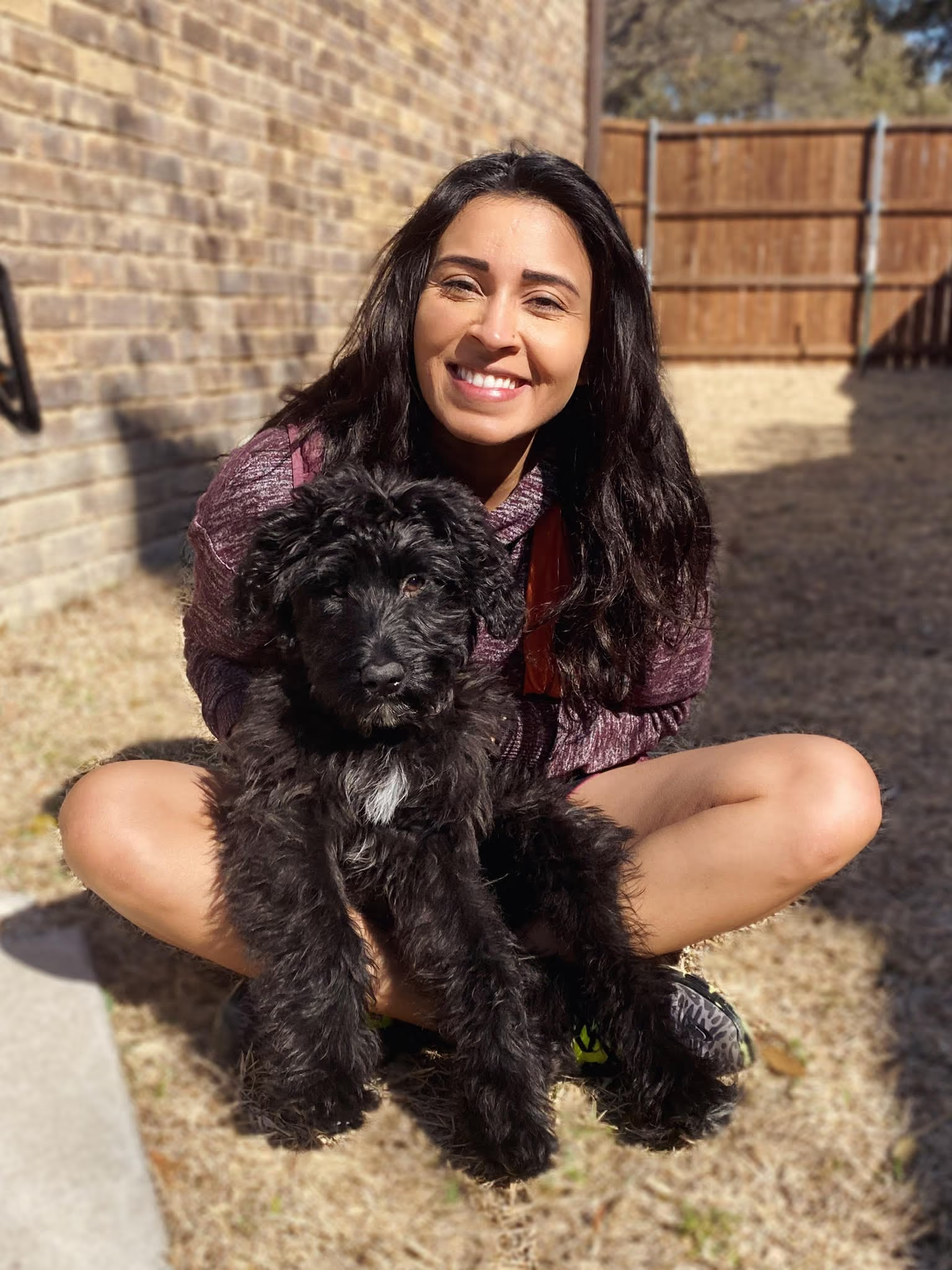
Host: I should have aired this episode a couple weeks ago. Around the 4th of July I get a little patriotically misty eyed with today's guest Kinza Asmat Kinza at one point marvels at her own trajectory from six year old Pakistani girl newly arrived in New York, overwhelmed and intimidated to today the new owner of a thriving 35 year old real estate brokerage with locations across Texas. A Of course, Kinza's success is more to her own credit than to America's. Hers is an immigrant success story that humbles me, a native born man who has encountered no such friction. And Kinza's story isn't just about that. It's also more significantly maybe about self actualization. Kinza was on a pretty traditional path. She jokes about it being the typical daughter of Asian immigrant parents path and was eventually employed at one of the world's most revered companies, Apple. But along the way she felt called to do something else. Something harder and weirder, but ultimately for her, much more rewarding, much more suited to who she really is. That's a theme that runs through most Acquiring Minds interviews really. So if you feel such a calling, hopefully my guests embolden you to heed it. For now, please enjoy this guest Kinza Asmat. Welcome to Acquiring Minds, a podcast about buying businesses. My name is Will Smith. Acquiring an existing business is an awesome opportunity for many entrepreneurs and on this podcast I talk to the people who do it. August Felker is a two time successful searcher, first with a traditional search fund. The second time around he did a self funded search. Today, August runs Oberle Risk Strategies, an insurance firm with a dedicated practice group for searchers and acquisition entrepreneurs like you. If you've got a business under loi, Oberle will provide complimentary due diligence on that business's insurance and benefits program. A great no risk way to get to know August and team. They love helping searchers. They've worked with hundreds. Oberly is a specialty insurance brokerage for searchers by a former searcher. Check out oberle-risk.com O B E R L E- risk.com link in the show notes Kinza Asmat, thank you for joining me today on Acquiring Minds.
Guest: Great to be here. Thank you for having me.
Host: Kinza, you're the new owner of WTA Realty, an apartment locator service in Austin. You and I connected on LinkedIn where you've been sharing aspects of your journey into acquisition, entrepreneurship, the good, bad and ugly. We'll get to that, but start us off please with a quick bio on you Kinza, what were you doing before deciding to buy a business and what led you to acquisition? Entrepreneurship.
[3:04] Guest: What was I doing? Man, I think I've done everything out there. Started out in engineering, went to operations after engineering, then transitioned to business school, consulting after that across several different industries. Then tech was a business broker for a little bit in between as I was trying to find my footing into entrepreneurship, and then eventually made the jump into entrepreneurship. Real estate specifically, and more specifically, apartment locating.
Host: Okay, and the. So how. How were you turned on to. I mean, give me a little bit more of kind of the emotional journey. So why. It sounds like while you did a lot of things, it was kind of a traditional corporate path. Why did you decide to veer off of that path pretty. With a pretty hard right turn?
Guest: Yeah, I guess you could phrase it most easily as like, imagine a newly minted Asian person growing up, you know, go be a doctor, lawyer, engineer. And my parents worked really hard to kind of set me up in life and get me the education I needed. And so very education driven, very traditional pathway driven. Engineering seemed to be a great fit for that. And then when I actually became an engineer, I realized, hey, you know, my personality is a lot more dynamic than this. I think I need to be on my feet more. I need to just be doing a lot of different things in the day as opposed to that very intense, cerebral work that engineering can be at times.
Host: What type of engineer were you?
Guest: Mechanical. So I worked in the airline industry working on structural repairs for aircraft. So think like, bird hits plane. How do we get that damage off the plane and get the aircraft restored to service? So, so transitioned, you know, through a different. A couple different careers. And then consulting was really, you know, that's where I got my juices flowing. I felt intellectually engaged, was solving, you know, really critical key problems. But it was just a career that had a lot of burnout and a lot of tedious excel work kind of at those lower levels as you work your way up. And then eventually when you work your way up, you end up doing a sales job, which, you know, I can sell myself all day, but I wasn't really interested in doing that. I wanted something that more cohesively tied together all the. All the things I knew, all the problems that I could solve. And I had two friends of mine in B school who were reading Walker Deibel's book Buy Them Build, and they told my husband to read it. And my husband, I went to business school with him. So we ended up getting married, which is great. He read it and then it was just kind of sitting on the coffee table and I was like, whatever, I guess I'll read this thing because it's sitting here and it's a very digestible book. I read it and we all kind of like were searching, the four of us, sort of in parallel, sort of not in parallel. And they ended up kind of following their own path. My husband didn't really find this that appealing. He's a little bit more cautious. Although he now thinks that, you know, one day he would be interested.
[6:12] Host: Inspired by his wife.
Guest: Yeah, I was the one who actually decided to execute and go do that. So I got more, more curious. I didn't really think tech was going to work and so I started searching for businesses and that's where it all began.
Host: Wait, but Kinza, you said business school friends. So were you in business school when you all started, when you all read the book, or these were friends from business school.
Guest: But it was later, I think we had probably graduated business school and despite all of the successful careers that we had launched upon, we weren't really feeling it as far as maybe flexibility or, you know, those juices, fulfillment that you want from roles. Like, it just seemed like we had gotten to the next level from a pay threshold. But, you know, where do you find that joy in life? How do you really feel connected to something larger than corporate?
Host: Yeah. And you were, you were at Apple, correct?
Guest: Yeah, yeah, I was at Apple for a brief period of time. And I really thought, you know, that was going to be my thing, like I was going to move to the Bay Area. It was going to be great. Covid hit I started doing work on a laptop for Apple out of my house in Dallas. And it just didn't really do it for me. And I realized that maybe what attracted me to Apple was, you know, that fancy headquarters, that lifestyle, all the perks of being in California. And I didn't really want that. After a while when I reflected on it.
Host: And the buy then build model attracted you because of. Let me ask, was it entrepreneurship broadly and kind of just being your own boss that appealed to you? Or was it specifically the model and. Or was it the. Specifically the model of acquiring an existing business? Because those are, you know, entrepreneurship broadly is kind of the umbrella appeal. And then below that it's do you start your own thing or do you buy an existing business? So break down that for me and how you emotionally responded to those, those various. Thanks.
Guest: Sure. I think if you look at it broadly, the folks who are interested in acquisition entrepreneurship have a Sense of stability and a sense of income that they're used to. And so approaching from the startup angle taps into a level of risk that I personally was not interested in. And also I had income coming in to maintain a certain quality of life. So what really appealed to me about acquisition entrepreneurship was one that I could continue having an income that continued giving me that quality of life. I reduce a level of risk that I was just not willing to take on. And then three, broadly above even those two, is that I would have the autonomy to make the decisions that I needed to make and I wouldn't need to run it up the chain. I wouldn't need to check with a boss. I had gained that level of experience in my career to where I could have confidence in making decisions, provided that I have input from a strong team, a good understanding of the landscape, all of that good stuff.
[9:17] Host: And being a business school grad and somebody who's just basically been in business for her whole career, the idea of entrepreneurship itself, had that ever before you were exposed to buy, then build, had that ever crossed your path as something that was appealing or possible or that you might do later in life?
Guest: I think so. I think there were like little like leaks or small events in my childhood. You know, I was always trying to come up with some weird business for something like repairing computers or taking women out on outdoor adventures because I love the outdoors. So I was always trying to create some sort of business in a way that I would achieve more fulfillment. But I always just got stuck in the beginning phase of, you know, branding, marketing, like getting system together, infrastructure, as opposed to actually doing and executing on what, what I would need for a business to scale.
Host: And to your point about your kind of the traditional Asian pattern that you fit of parents as immigrants coming here and really investing a lot in you and being very education focused to set you up well and then going off of that beaten path that, that beaten Asian path. How did your parents react to. Of yours?
Guest: I think, you know, when I. So I graduated business school and I got my first job offer in consulting and I remember just taking a screenshot of that, that print the letter that came in the mail with my base salary and the income. And I think after that my parents were like, oh, she's got this. Like, we have no idea how this happened or came to be. But clearly compensation is at a level where we don't need to worry about this duckling anymore. She's got it figured out. And so, um, at that point, you know, that I was off, I. I Was off to this, to sea and just doing whatever I wanted. And I had, I didn't have any more constraint after that. But it took, you know, like 10, 8 to 10 years of my life to, to get to that point, to even give myself the, the ability to make my own decisions without needing their validation.
Host: That's awesome. I mean, that's awesome. That it, that it, it took a while, but that it eventually did come and came in kind of this really clean moment where it was like, you know, they're kind of like, okay, she's, you know, she did it. We don't have much, much, much to offer at this point. She's captain of her own ship at this point. A lot of people, Asian or Asian or not, you know, they, they may never get there with their parents.
Guest: Yeah. And I'll share this just because it's funny now that I think about it and reflect, but I remember prior to applying for business school, I had changed jobs so many different times, trying to find the right fit. And I was talking to my mom. I'm like, mom, I think I'm going to, you know, turn in my application. Cool school. And she's like, kenza, like, why are you doing that? Like, you have a great, successful career. You're on this track as an engineer or in operations. Like, Southwest Airlines is a great company to work for. And I had to go against what they wanted to really even go to business school. And then after that, two years of business school and getting an offer, then they were convinced that this was the right path. So I'm glad I pushed back.
[12:36] Host: Yeah. Yeah. Okay, well, let's get into the search. So tell us about the search. You mentioned that you had a stint as a business broker. I assume those two things play into each other. So take us through it, please.
Guest: Yeah, it's actually the funniest story which I can share because I don't work at Apple anymore and I don't have to answer to anybody anymore. Like, business ownership is awesome because you can have complete autonomy and control and be authentic to who you really are. So I was working for Apple. I think it had to have been like, maybe five or six months in. I'd been dabbling on, you know, the various business sites and told my husband, I'm like, I think I'm just going to, like, start looking a little bit more seriously. And I reached out to a broker, and he ended up offering me a job at his firm. So I was working as a business broker while I was working at Apple. Thanks to Covid and all of the strange work restrictions and that was like a great six to seventh month snapshot of what it really is like to be a broker, how hard it is to come across, quote unquote, good deals and all of the work that has to be done to get a seller psychologically prepared to even sell a business. So it kind of just taught me that there's a lot of people like me searching out there. I'm not just going to come across something and it's going to work. It would have to be a real concerted effort. And so through that experience, that is what actually led me to search full time, leave Apple, leave the brokerage and really commit like a solid four to six month time period of launching like a true search and being ready to make a decision.
Host: Two follow ups on that. So there's two things that might that experience as a broker in learning how difficult it is to find sellers and then convince them psychologically to sell and you know, share all their financials, etc. Two things that might follow from that. First are, the first is that you thought, I guess, that you could probably find a business to buy part time. You were under the impression initially, naively, that you would continue working at Apple and kind of find a business to find a business to buy during nights and weekends. Was that, is that right?
Guest: Yeah, yeah. I mean, I thought it would just stumble across my desk. I thought, you know, the brokerage is going to have access to so many businesses, I'm going to get ahead of the curve in their pipeline before anything even hits the market market. And it was actually a bunch of stuff that didn't even fit my criteria was going to be difficult for anyone to buy. And that seemed to be a case that reverberated across that industry.
[15:15] Host: Yeah. Okay. And then secondly, there's often talk on acquiring minds about proprietary search versus brokerage search. And when you do proprietary search, when you're the one, you know, doing cold outreach to business owners to see if they're would be interested in selling you their business, you're doing all of that legwork. Basically you're doing a big part of the, of, of, of the work that brokers themselves do to bring a business to market you are doing. So did it make you feel like you, you should lean one way or the other in terms of brokers, broker just brokerage search versus proprietary search when you went full time, wouldn't it be great to have experts at your back when buying a business, people to help you polish up your pitch and processes as you Go to market as a searcher, then help you evaluate opportunities once you get some deal flow. Such experts exist, buy side advisors. But they'll cost you to the tune of tens of thousands, even hundreds of thousands of dollars. But another option exists, the Acquisition Lab. The lab is a do it with you buy side advisory service, not do it for you. Founded by Walker Deibel, author of Buy Then Build, the lab represents Walker's vision for what is most needed to make a searcher successful and available at an accessible price. It's cohort based and you will come out the other side of your cohort prepared to go to market as a savvy searcher with a tight message and process. So brokers take you seriously. Pre approved for a loan and with an entire community at your disposal to help you along the journey to buying a business. To learn more, check out acquisitionlab.com link in the show notes
Guest: I thought that everything is hard. All approaches should be considered. You should consider what the effectiveness of the approach is. So for example, you know, if I was doing a proprietary search, I wouldn't even want to take the angle of a broker because it was actually really difficult to build rapport with sellers and convince them that you didn't have malicious intent. So when I was doing my own proprietary search, I took the method, the tools from how they would, you know, induct new clients, but I added my own personal information into it. Like hey, I'm, I'm a University of Texas grad, like a woman, just finding those connection points and just, you know, straight up asking a business owner if they were interested in chatting with me, mentoring me, interested in selling their business. And the response rate for those was so much higher than mass outreach or trying to find a team of interns to just plug away at sellers using blase approaches. So I learned that. But as far as brokered search, I mean, why would you not tap into that? Like brokers have already done everything psychologically that they can do with a buyer. Hopefully at a good brokerage, they've set expectations on pricing that are realistic for the market. There's a lot of brokerages out there that are just bid only. And that's like my number one, you know, flag in my brain. Like I'm going to have to go through all the work of setting expectations with the seller on what price is actually reasonable. The brokers never do any of that type of stuff because they don't want to have those difficult conversations with the clients.
[18:37] Host: And the, the brokerage where you worked, did you was the way they got leads kind of their own proprietary searching because other. Some brokers are established enough in their markets that they business comes to them, sellers of them. And so they actually just, most of their business is inbound, which is great. Doesn't sound like that was the case for the brokerage where you worked.
Guest: The brokerage that I was with, there was two aspects to it. So they did their own proprietary work, but they were also an affiliate of a much larger national brand that had a different approach to deal flow. And so their deal flow was a lot like imagine having to call someone for 10 years every quarter. Like that's the level of work that they had been doing to generate clients on a macro scale and then inducting them into, you know, bringing them in when the seller's finally ready and willing to answer the phone and talk to you and they're like, yeah, I've heard from you like 50 times, like, fine, what do you have to say? Because I'm ready to sell my business. Then they invite them to, you know, a conference where they learn about the market and like how their business could be valued, who might be interested in their business. And then they would hand off those transactions to us, a more regional affiliate of that brand and then we would actually work the deals. And I don't know what the process was for, what gets handed off or why it got handed off to us. I was just hired as a broker to work those deals and then also separately the pipeline that the brokerage itself had.
Host: Yeah. And in fact, even with all of that nurturing and 10 year old funnel work that some of these leads were being generated from, a lot of them are just really low quality.
Guest: Yeah, I mean some of the toughest decisions like, or conversations, I would go and meet with owners who had agreed to finally list for sale. They had finally gotten their valuation, the expectations had been set, I would visit with them and then like they just wouldn't understand. Like they're like, what does this valuation mean? Like, I mean I thought I was going to get 5x this or I thought I was going to get revenue as my sales price. Like even though all of the data and the financial modeling indicated what a price range would be, sellers still had this major shock. And so I had to be on the front lines having these conversations with these business owners. And it's really heartbreaking when you realize that all of the work that you've been doing is not really going to materialize unless you do more work and consider selling at a later point.
[21:12] Host: Yeah, yeah. And, and then Your strategy that becoming a broker would allow you to kind of like move up, funnel in for deal flow, like get closer to deals as they were, as they were coming down the pike that also kind of didn't really pan out or. Well, that didn't pan out. I know, but like is that a strategy that you know, other people out there might consider or you just don't really think it's a good use of time? Better to just do a, you know, be a searcher and devote yourself full time to just being a searcher rather than kind of this hybrid searcher business broker thing.
Guest: I think it gave me a good opportunity to lift under the hood and see what sellers are really like, see what buyers are really like. Both are a little bit of a nuisance and childish sometimes. It gave me respect for brokers because despite a lot of brokers being incompetent, the ones who are competent are doing a lot of work to earn the commissions that they are paid. I would recommend it as a short term stint, but it is a full time career of its own. And so once you have learned what you need to learn, make your peace with it and figure out your own search process.
Host: Okay, great. Really interesting. Okay, so you leave the being a broker aside. You go full time on your search. So tell us what that looks like. When did you start? How did you know? Tell us kind of how did month one, month two go? Were you making early mistakes or did you kind of know what you were doing at the outset?
Guest: I think the best thing I did was start my search before the full time search which was the part time warm up search. So I got myself used to getting on phone with brokers, having like a quote unquote Rolodex of lenders to talk to, getting pre qualified. So I had already done all the legwork of building a network. So the network wasn't immediately like hey, now I'm just going to talk to Kinza and send her these deals because she reached out to me and she has criteria. It was more of like a, if I email or call this person, they'll respond to me within like two to three days because they know who I am. So I used all of the ramp up time being a broker to do a part time soft search, if you will. So I had like, you know, templates for Lois together. I understood what letter of intent meant, what the contents should, should have in there, all that good stuff. When I converted to a full time search, I gave myself a defined time period of it was September through April. I Sat down with my husband. I'm like, this is what we can financially plan for. I'm not going to be producing income. We aligned on that and he held me to it. So I defined my criteria and anytime I got sidetracked and bogged down because I couldn't really get traction in the search, he would redirect me to the criteria and he was like, don't waste your time on this. Like, this is not in your criteria. Do not give up. Focus on what you thought you should be doing. I would end up like, you know, I'd look at like E commerce because I wasn't really interested in E commerce, but just to like keep it flowing and feel like I was doing something productive. So that was the search originally. And then I kind of. Let's go back to your question and make sure I'm answering what you're asking.
[24:32] Host: And you. So, and what did you say that the dates were that you gave yourself? You said from fall to spring, was that right? So about six months?
Guest: Yep. Yeah. Okay. I gave myself a six month time period and said I got to go find a business. So I looked everywhere in Dallas, like that's where we were. And that was the number one criteria, geographic. Our number two criteria was that the finances, I had to be able to make an income that I was making in tech. So for me that number was around 2 to 300k. For others it might be something else. So the size of the business and the geography was constrained to an extent, but that's what directed it. I found a number of things in Dallas, went through a few negotiations with a few different businesses and those were. They taught me a lot. And I'll pause there because that might be a lot to unpack and you might have some questions.
Host: Yeah, great, thank you. I do. So you were not going to take a cut in pay. You wanted to basically meet a MBA tech salary for yourself right out of the gate. Good for you.
Guest: Yeah, yeah. And I wasn't going to be competing with private equity at that price point anyway, so it didn't matter. And I wasn't going to get lost in the weeds of, you know, if my focus is worth X dollars, why would I take that same amount of focus and have it be worth half X with a smaller business?
Host: Sure. Well, and the only answer to that might be because there are so many more opportunities at a, at a business of a lower valuation and less ebitda. Because what you're, what you're looking for is, you know, you know, you're looking for A sizable, you know, kind of the sweet spot, kind of larger size searcher business probably, you know, I'm estimating, but like 750 to 1.2 in EBITDA. That range and in one geography, which as we all know is, is a, is a giant constraint. So. And, and your time constraint, six months, which is, which is pretty tight. Kinza. So as I'm talking through this, I'm like, you set a pretty high bar, so keep going. So how was it going?
Guest: I performed really well under pressure. So I knew how to get that pressure cooker right for me to do some good work. So I came.
Host: And when is this? Sorry, this is the end of 2021. So fall 2021 to spring 2022. Okay, go ahead.
[27:05] Guest: Yeah, I was really sweating in my boots, like for sure. And there was a lot of self doubt because things were just not materializing. I found a cabinet company in Dallas that kind of fit the bill. I started negotiations with them and that approach. I made a mistake. I was too analytical and I didn't actually. I wanted it too bad. I'm traditionally a really good negotiator, but when it came to this business acquisition stuff, I would show my cards too early. And because of all the tight constraints, I really just wanted to perform. So.
Host: What do you mean by that, Kenza? What mistakes? How did you show your cards too early? How did you negotiate?
Guest: Poorly, I guess. Letting. So it all. A lot of times it comes down to working capital, letting the broker push you around, not coming out of the gate directly with what your offer is to the seller. They were really wishy washy and they kept trying to pull working capital out of the business and it just, there was too many things that were not really headed in the right direction. Um, so I, looking back, I should have just been more confident and been like, hey, this is what I'm willing to offer you and actually walk away rather than letting it like prolong over a multiple week negotiation.
Host: Gotcha, gotcha. So you let it eat up your time where you should have just been kind of firmer with an offer, you know, and if you weren't in the same ballpark, just walk. Be prepared to walk sooner.
Guest: Yeah, absolutely. And ultimately I got so frustrated with the Dallas market because I think a lot of deals happen, you know, off market. My husband, I went on a vacation, I was like, hey, you know, the broker just. Or the lender sent me this deal in Austin, like, do you want to move to Austin? I don't think you do. And he was like, yeah, I mean, I don't care. Like. And I'm like, well, if you want to move to Austin, where else are you okay with? Why are you not telling me this? So over the weekend, we went on some hikes, threw some cities on the list, prioritized the cities, and then I was off to the races and had found, like, a whole new deal pipeline. And I just. The next week, I had, like, three businesses. I was on a plane. I went to. I went to Seattle and I went to Portland, and I went to Austin, saw three businesses in completely different industries, realized the one in Austin was the one I really wanted to go for, and that was the company that I eventually acquired. And this all started late November, early December.
Host: Okay, Late November, Early December. So about two months. Two months into your search, and the businesses that you added to your search were the biggest. The biggest. Excuse me. The cities that you added to your search were the biggest cities in Texas. I'll assume Seattle and Portland, you've already made clear. Were there others?
Guest: We had Denver, we had Salt Lake City, we had Atlanta. So I basically just.
[30:00] Host: California is conspicuously absent from this list. Hey, you don't want to live in California.
Guest: I'm from New York. I like being able to afford things. So just off my list for now, Maybe after I retire.
Host: Okay. Okay. And Atlanta, you're okay. Looking east as well. All right, cool. And so that presented you really quickly. That kind of unlocked some deal flow. Three businesses, and then you saw the one in Austin that you liked the best. So tell us about. Actually, before you tell us about that particular business, first of all, I want to compliment you. I said at the top that we connected on LinkedIn. You're really good at content, Kenzo. The posts that you put on LinkedIn are interesting and engaging and not the usual stuff. So keep at it. Not always rosy. So one of the posts that you posted on LinkedIn was a screenshot of an email that you got from a broker who you were. You were planning to go meet a seller in person for. For a business that you were looking at. And this broker emailed you what.
Guest: I have to remember exactly what it was, but I think he told me to bring my husband because I was a honey and a sweetie and the seller was not going to get along with someone like that. It was the funniest visit. This was a visit in Dallas, and it was like a machine shop environment. And my background's in engineering, so I don't care. I can deal with those kind of people. I would ask the seller questions directly during the visit, he would physically turn from me, turn to my husband, talk to my husband to answer the question. And Nishant's not really doing anything. He's just standing there making eye contact with the seller. And he's an electrical engineer. He doesn't know what's going on in this machine shop. It's just the funniest thing. And I actually can't believe that I. I followed through with that. Like, I should have just, like, seen it for what it was. Like we would. We would have an unsuccessful transition. I would be in a culture where I would be working against that culture and would never be a fit. But I was so desperate to acquire something that, you know, I kind of, like, the blinders were just on, and I was willing to make anything work, which, when I look back, like, I'm so glad I didn't make that business work.
Host: Yeah, well, because I looked at this LinkedIn post more recently than you. It sounds like the broker actually said to you, hey, the seller's kind of racist and misogynist. Can you bring along your husband? So, wow. Quite telling of a lot of bad stuff. But anyway, props to you for having the courage to go anyway and kind of. Yeah. Dealing with that. Did you have any other experiences around during your search? We can get into it, um, for the actual acquisition and post acquisition, but for your search, being a woman or a woman of color that you felt were attributable to. Attributable to that fact.
[33:04] Guest: Yeah. Yeah, for sure. I mean, there's two sides to it, right? And this is kind of like what I've. The line I've walked my entire life. One side is you can play into whatever that is and think you're worth less. Um, a lot of times people are surprised by who I am, surprised by the directness. Um, it takes a long time to warm them up. But eventually, you know, I have them eating out of my hand, and they are very excited about having me there. So they have some initial biases that impact them. The second is you can play into those biases just as well. Right. So if you're a pretty sweetie honey or whatever they want to call you, then you can interact with them just that way and play. Play into that role. And there's a line from My Big Fat Greek Wedding. She's like, I'm the. The woman is the neck, and. And the man is the head. And even something along the lines of, like, the neck can turn the head in any which way she wants.
Host: That's a great line.
Guest: So I Like to think of, despite being at the wrong side of the wrong seat at the table, sometimes I can get people to do whatever I want. I just pick which journey to go on with the Hardy Boys and their mind biases.
Host: Because it's like when somebody exposes their bias to you, you have, have something to kind of manipulate them with, frankly. You can either confront the bias or, or use it and kind of go, somehow go with it and kind of judo it back on them. But they're, but they're basically kind of like exposing a flaw in their own worldview. That can be a weakness that you can exploit. We're getting very Machiavellian here. Okay, and then, and then one more thing, Kenza. Before we get into the business itself, what were you going to do if after six months you didn't find a business? Was it back to, back to Apple or back to the corporate path?
Guest: I hadn't figured out that step yet, but I was pretty nervous about it. You know, we had savings, so it's not like it was the end of the universe. And I knew I could always get a job if I went back to the market. I thought that maybe I would slightly adjust my criteria and maybe, maybe instead of brick and mortar, I might try something E Commerce. Maybe I would finally respond to the broker that sent me an email with 10 different lawn care companies and just do a lawn care roll up. That was my next idea. I thought I would come up with something. And I know I'm laughing now thinking about it, but I was really concerned and nervous when I was going through that process that I might end up with nothing.
Host: Yeah, yeah, yeah. Well, it's a, it's a valid concern. You've made a big decision to go down this path and search is very binary. And you know, there's plenty of stories of people who don't, don't buy that business and then have to figure out what they're going to do next. One more question before we get to the business. We haven't actually explored your criteria, so you've made it clear that you are kind of drawn to E Commerce as a temptation, but actually kind of thought better of it and disciplined yourself away from E Commerce landscaping. You've just made clear that you didn't want to do that. Although, by the way, plenty of successful searchers do landscaping. So in fact, landscape, I think I've had four or five guests on who have all done landscaping. But you didn't want that. What were your criteria other than other than actually did? We did. Was it just the geography and the, and the money piece that we've already talked about or what was the, was there industry stuff as well?
[36:33] Guest: I think geography and money is probably the high level. With a background in engineering, I thought I would have to pick a manufacturing business. I was lucky enough to find a business in the service industry, which is fantastic. I think as a broker we get so many emails from all of these searchers like me. On the flip side, I want blah, blah, blah, adjusted ebitda, I want margins like this, I want solid leadership, ownership transition, like all of these things. And I'm like, please take that list and just shove it in the garbage because you're not going to find any business like that. The business you're going to find is going to have maybe two of those things if it's a good one. And if you have investors on board, you might have trouble with the rest of the list. And so that's primarily why I did a self funded search because I knew that if there were things that didn't fit in the list, I would decide how okay with that I was. So criteria was geography that the financial performance pieces there. And when you say financial performance, it's important to be more specific. So across Covid, you know, we saw businesses that either were doing, you know, steady, steady, steady and shot up or they were doing steady, steady, steady, shot down. And so your ability to control that variability in financial performance would be, I think, that third criteria. So if you can't come to terms without controlling that, that huge change in financial performance, then it's not a deal worth looking at. But if you can come to terms and build it into the mechanisms for
Host: the deal, then yeah, okay, so you wanted something that was basically stable through Covid or if it either really benefit, benefited from COVID or got hammered by Covid, you wanted to be confident that you could kind of normalize it post covet and bring it back to it's
Guest: kind of the baseline, normalize it post Covid and only enter into a transaction in which that was a mechanism built into the transaction. So a lot of us think that you can't have an earn out per se in an SBA deal, but you can, you can have it with a forgivable note, it's possible. Or you can negotiate a different structure and make a compelling case to the seller, Mr. Ms. Seller, like your business shot up through Covid. There's no way anyone's going to give you the valuation off of the last year when it went up 40%. Like what are you willing to come to terms with on price and if they're not willing to do that, you're either going to have a tough time getting financing from the bank or you're going to be screwed when you try to make your debt payments moving forward.
[39:10] Host: Okay, now finally, tell us about WTA Realty, please.
Guest: WTA Realty. So it's a 35 year old real estate brand. We're based out of Austin, Texas. We have Austin offices in San Antonio and San Marcos as well. We primarily specialize in apartment locating service. So we have a team of about 150 to 200 licensed real estate agents in the state of Texas. We help clients, customers find apartments that they want to rent based off of their specifications and needs. And that's what we do. It's a fantastic company, a fantastic legacy. The owner, the two previous owners did a really great job of building a fantastic team that they could rely on. The skill sets, the knowledge, know how it's all there. And I think you know all of the skill sets that I have from my background in consulting across retail, bringing systems and structure to companies, those are really going to benefit the company. It's just kind of like two puzzle pieces fitting together and I have no idea how I got to this place. And it actually is such a great fit. It's a little bit kind of like pinch me again that this is happening.
Host: Awesome. That's so such a happy outcome. 150 to 200 agents. Are these salaried, are they commissioned or what's the general structure, if you can?
Guest: Yeah, typically in the real estate industry the majority of your compensation is commissions. We are commissions only as far as contractor compensation. So they're all contractors, the agents are. We, we have a small team that supports, motivates, leads those, those agents across the different offices. So we have assistant managers, office managers that guide the agents in their day to day.
Host: And so that overhead, those salaried folks. How many salaried people are there at the business?
Guest: I would say probably 5 to 15. Not too many. So we'll have billing functions, we'll have the strategic leaders of each side of our business. We have a residential sales brokerage and also apartment locating. So we have key leaders in both of those. Fantastic women by the way, real powerhouses. I wouldn't be able to do anything of what I do and add value without them. And then we have a fantastic marketing director and you know, she, she actually does so much more than just marketing. So we're working through, you know, roles, responsibilities and how we can structure it best to fit the company and the future vision moving forward, but just, you know, just a great team. And the seller was so transparent when he was going through the process. He just really loved, loved on the team, loved on their skill set, the contributions they've made over the years. And I can see that every day.
[42:23] Host: And so it's. You have these. You have leadership at the business, so there is a management layer in. In place. Does that mean that you are just, you know, 100% of Kinsa's time is working on the business rather than in the business? Or how does that break down? Was. Was if you were to step away or if the seller. Could the seller step away or was the seller full time in the business? Like, what's the. What's that look like?
Guest: I got really lucky in this process. I think a lot of searchers are looking for a business where they can be flexible with their involvement, where they can be more strategic. The previous owner, his decision for leaving was due to retirement, and so he had reached a point in his career where he was a little bit more hands off. He still did some key functions and was there for support and guidance when anything urgent came up. But that allowed me to step into a slightly more flexible role than someone would be stepping into at a company of this size in the industry that it's in. So, yeah, I am more strategic. At the same time, you know, a lot of things are changing and shifting and I have to be there to oversee a lot of that. For example, we had a team survey go out. The first week I was there, you know, day three, I had a survey already designed in SurveyMonkey, and we had fantastic engagement and participation from the team. It seemed like people really had a lot to say, a lot of great things and a lot of improvement opportunities, and they were really candid. And I'm told by my HR friends that we didn't have too much participation to make us question their motives. So it was a healthy amount of people taking the survey, and we're taking the feedback from the survey, converting it into our strategic plan for the next year. So I don't know, I stepped into something fantastic and amazing and I don't know how I ended up here. It was a lot of hard work, but I am grateful every day and absolutely think it's the right fit. Like, when I show up to my office and sit in my chair, I'm like, how the hell did I get here? This is awesome.
Host: Well, you just answered your own question. A lot of hard work. So this survey, this was Something that you had teed up yourself. So this was kind of like the first thing that you wanted to do as you got in there is collect feedback from the team and take a snapshot and of every. Of what people need, what, you know, opportunities for improvement and all that. This was a Kinsa initiative.
Guest: Yeah. I was on a, I was on a train ride in Spain a few months back when I was in the search and my HR friend was with me and we designed this team survey together based off what I thought that this company needed most. Whether that, you know, was it strategy, was it the offices, was it technology? Like, what are all the things? So we broke that all down. And then when I took over, it was a great way to build rapport because people felt heard, seen, understood. They weren't panicking as much, thinking I was, you know, someone in a suit trying to change everything. They really enjoyed it.
[45:30] Host: You, the, this, the business being such a good fit for you? What about, what about it being what makes it such a good fit? You know, it's not in line with your mechanical engineering education. You know, there's nothing, you're not building anything here. There's not engineering other than, of course, systems and processes. So what, what value did you envision or do you envision adding?
Guest: For right now, I think I am the chief solution architect. So historically, across my career, whether engineering consulting, I have always just been solving problems. So how do we one, collect all of the problems and improvement opportunities? How do we solve them in a strategic and structured fashion? How do we get tools, technology to fit along that vision and solving that problem? And then at a higher level, looking at strategy consulting is all about strategy and where are we headed, what's the market doing, how do we want to grow as a company? All of the, the stuff, the things that this business really needs are things that I've done before that I've been great at and I got my real estate license as part of the process to gain that experience. And hopefully I'll get to do some ride alongs with the agents coming up here now that there is some free time in my schedule after the dust is settled. But I think it's going to be really great. We're going to create something really freaking fantastic.
Host: Kit, can you give me just an example or two of kind of initiatives that you, that you see pursuing that could grow the business and take it to the next level?
Guest: Yeah. We'll be announcing this to the company shortly. So if anyone is listening to this podcast when it comes out and they haven't heard it yet. It's coming up. We're going to have a rebrand. So we have several different brands across all of our different offices, which served its purpose for a long time. And I know we take a lot of pride in the different brands. But looking forward into the future, we want clients, consumers, our property partners, to know who we are. So consolidating into one brand so we can simplify understanding of who we are and make sure we're getting paid for the services we perform. That'll help our billing team collect money a lot, a lot faster, a lot better. It's going to be exciting. We're going to rebrand. So that's a huge, huge initiative to just change a company's brand. And you know, when you have like 150 to 200 team members across almost 10 offices, like, rebranding is a big step.
[48:07] Host: Sure, sure. Kinza, how are you feeling about just the nature of the job versus your corporate career to date? You know, you talked about the liking, the autonomy and so on. Here you are. How does it feel different? What do you like about it? More or less
Guest: overarchingly, I love it. You get to choose which 12 hours of the day you want to work. So I get to decide, you know, where I want to be, who, who I want to meet with, what I want to do. There's a lot of autonomy and flexibility in planning your day, and that's at a tactical level. But more, more fulfilling even is being able to see where a company can go and knowing that you're going to be the primary visionary in, you know, in collaboration with the team, the key leaders, all the way down to the agents, the billing team, marketing, our admin team. Like, everyone has a vision. That's what they said on the survey. Like, I know what the vision is and know that we can actually affect and achieve something at a scale that I never had access to as a corporate employee. Like, wow. Like, how amazing is that, right? I never had this level of impact and I have rubbed shoulders with, you know, C suite of Fortune 50 companies and advised, presented, been paid hundreds of hundreds of dollars per hour. Like, I think my bill rate was 528 per hour as a consultant. Like, and the stuff I'm doing here is so much more fulfilling, so much more impactful.
Host: Great. One of your other great LinkedIn posts was you took a photo of your down payment check, which was for $345,000. So people can kind of back in ish to the enterprise value of what the full transaction was. But I want to ask about. For folks listening to this who. Who might not be so liquid and might not have $345,000. Maybe they have 100,000 of their own dollars or 150. Any thoughts on raising the. But they want to buy a business of the size, similar size to WTA. Excuse me. Any thoughts on raising money for that equity, for that capital equity or that piece of the down payment?
Guest: Yes. So I think it, you know, at the end of the day, you want to define how much money you really need to live your life and what you're really aspiring towards. So I was aspiring towards autonomy. I did not want investors to stand in the way. And also, this is funny. I. I'm five months pregnant, and I did not want a pregnancy covenant telling me what I could or could not do with my baby when I took over a business. So there were a lot of, like, external factors that drove me to, you know, retain 100% ownership. I didn't want to give that up. But I did explore options with other investment groups. I explored options with family and friends. You know, there were people who, you know, grandma, you know, my grandma's not here with us today, but grandma's willing to put down 25k on a business and make. Make you happy. There are ways to find money, or you can give up equity. Equity financing is expensive, and you will give returns to investors year over year. And potentially, if you choose to do anything with your company moving forward, they will want to approve those decisions, and they'll be receiving a portion of the proceeds at sale. But I think anything is possible. I also think it could have been possible for me to buy a smaller business and grow it substantially. I always viewed it as if I'm putting the same amount of work into something, then I would want to start with whatever was the largest that I could buy and retain 100% ownership. And that's what it happened to be. Yeah, we had a. Go ahead.
[52:28] Host: No, finish your thought, please.
Guest: Yeah, so it becomes extremely complex. I think no one really talks about this, but I'm married. You know, there's married searchers out there. Everyone makes it sound like this decision was just made in a vacuum of how much money we could put up for something. I had, like, 50 conversations with my husband trying to convince him of how much money he could put down. And sometimes he'd be like, well, why don't we just put all of our savings down? Like, everything, take it all. And, like, you know, it was a little bit contentious, but we finally got there through some therapy on what this amount should be. So bring your spouse in on the conversation, understand their hesitations. If you're going to be taking this huge risk with your life and signing a personal guarantee for an SBA loan, which is the case if likely the case if you get an SBA loan, like really have those conversations with your spouse. And I was surprised later when Nishant wanted to put down more money than I thought that I wanted to put down. And he actually enabled me to proceed in a direction that was more risky than I was okay with. And that's a cool outcome.
Host: Oh, wow. So you, you did such a good job at convincing him that you over convinced him he was over capitalizing the acquisition.
Guest: Basically.
Host: The just. We're wrapping up here, Kinza, but I still have a couple important questions for you.
Guest: The.
Host: You talked about your pregnancy just now. You kind of glossed over that, but I want to ask you directly about it in a minute, just again, to get kind of a sense of the size of the business. So 150 to 200 agents. And so in an apartment locator service, not all cities have rental brokerage. I years in D.C. that just doesn't exist. You find your own, you find your own rental. If you're looking to rent, you find your own apartment in San Francisco. It's mostly that way as well. But other cities, Austin, obviously, Chicago, where I've lived that you, you and I think in New York, actually you use an agent to find an apartment for you. So anyway, this model might not be familiar to everybody, so kind of break it down for me. I, I'm. I've arrived in Austin. I want to, I moved to Austin. I want to find an apartment. I go to, you know, one of your brands and I work with an agent and the agent helps you find an apartment and where is money transacted and how much?
[54:54] Guest: Yeah, sure, absolutely. So if I were an agent and you were a customer, client searching for an apartment, you know, I would clarify with you. That's a completely free service to you. I. Your, your interests and my interests are completely aligned in the sense that I want to find you the best apartment based off your, your preferences on location, bedrooms, pets, requirements, all that good stuff. And then we have property partners that we work with, which is a substantial number of properties in the local area that compensate us for our services based off of if you happen to sign the dotted line or not. So we'll actually take you to the properties, we'll show you the properties. We will go through that, that process Stepped together of touring. It's. It's a fairly, fairly abbreviated process. The Austin market's really hot. San Antonio is just as hot. If there's something that pops up, we will find it, make sure you get the best deal on it and get you into the apartment and then you're
Host: the community there or the apartment building pays you all. How much? Like one month's rent or what. What's the fee structure?
Guest: It varies. It varies. And in the state of Texas, in common to the real estate industry, they're paying the broker specifically to maintain any regulations there. But yes, it's usually one month's rent, a portion of the rent. It varies, the market changes and that also fluctuates depending on what the market looks like.
Host: Okay. And then that agent then has some sort of split with you, the business that they, where they hang their, their shingle. So a split of whatever, 60, 70, 80%, something. I'm sure it probably varies based on their performance.
Guest: Yeah, it varies at a high level in the industry too. And you know, a lot of brokerages, they'll charge your desk fee. They'll. They'll charge you like a marketing expense fee. So we tend to roll a lot of those into the. To the commission split for agents and offer all of the amenities as opposed to nickel and diming.
[57:00] Host: You know, Kenzo, obviously. So we talk a lot in this world about like, what are you really buying and what's the value? And it's the cash flow and the brand and the reputation and so on. But oftentimes it's. It's also your people, the team that's been assembled. And I feel like, you know, if I wanted to go open a competitor to an apartment locator service, the barriers to entry are low. I mean, become. Actually you do have to have agents who are licensed, and so there's some barrier to entry there. But do. Am I right in that intuition or like, how defensible. Talk to me about barriers to entry in this business.
Guest: Yeah, I mean, at minimum you would need a license. You would need to be sponsored by a broker. I think where the difference is, is being able to do that at scale. So what we provide for our agents is, hey, Mr. Ms. Agent, you go focus on what you actually like to do, which is find properties for your clients and all of your billing. You know, here, create your invoice. Our billing team will take care of collecting money on the invoice. We'll take care of all of that. As far as branding, who, who you represent, what brand you work under, we'll take care of all of. Of that aspect of it. Our tools, technology, systems are all, you know, items we invest in quite heavily. And so we have that as a resource to our agents. So from a. From a barrier to entry perspective, like, anyone can go get their real estate license and get sponsored and go work as an apartment locator, but are you really able to focus on what you love to do in your work? And are you really able to even get paid? Because this industry is also notorious for taking long time to get paid. So you have to have billing teams go to bat for you to get payment. And a lot of times, if you're independent, and I'm a property manager and I have a whole stack of bills I have to pay to apartment locators, who is going to get paid first? The one with the biggest scale that has, you know, a legal team and a billing team that's going to make sure their agents get paid. And that's. That's the harsh truth of some of the aspects of this business.
Host: Mm. Excellent. Yeah. Great. Okay. Your pregnancy, so how did that factor in, if at all, you know, And. And when are you due? Did you say you're five months? Talk to me about this.
Guest: Yeah, we're very excited. You know, I made it through the first trimester.
Host: Congratulations. Congratulations.
Guest: Yeah, no, no, we were. Well, I. I was really nauseous at first when the deal was happening. So when the delays were happening and the deal kept getting pushed out, I'm like, all right, this is okay, because I'm slightly less nauseous when I get to this dotted line. It was completely, completely unplanned, but we're really happy and we have a great leadership team in place, thankfully, and we have a few months to get situated before I really need to take any true, you know, time off. And I don't know, people say all sorts of things with pregnancy. You know, they give you all sorts of advice, but it's just my own journey. I'm gonna figure it out. And. And I absolutely don't think I need months and months of maternity leave. I think that in corporate, people want that because they don't really, like, enjoy their jobs that much. And it's kind of like grunt work, and they're being forced to be there for 40 hours a week. But I read this book, it's by the former CEO of Pepsi, Indra Nui. And she was so successful in her career. She had her kid and, like, the next day she had a board ready, a board meeting in her house. After giving birth, I don't think I'm going to be that. But there's a balance, right? And the balance is really driven by your sense of purpose and fulfillment with what you do every day. So I don't. We'll be fine. I'm due in November and the team's going to help me figure it out. And I have a husband who does so many different things, so he's offered to pitch in and help, which I'm basically completely replaceable by him.
[1:01:05] Host: Well, this is also just one of the benefits of working for yourself, right? Being an entrepreneur is that you get to decide what your maternity leave is going to look like. Short, long, whatever you want. Two more personal questions, but I'll close with those. One more gritty question. So we talked on the pre call about asset sale versus stock sale. So typically in our world it's an asset sale. So the acquisition entrepreneur is buying the assets of the business. They're not buying the actual legal entity of the business. And that's typically for liability reasons. So if there's any sort of liability issues against the original company that's being sold, they will stay with that company. And you're just acquiring the assets which are not tied up in any of that legal threat. But sellers actually want to sell, typically want to sell, do a stock sale if they can, for tax reason, for their own tax reasons. You figured out how to do what?
Guest: So what we figured out and the reason it came to be is because we had several leases and a huge team and to get contracts resigned for all of that and get the parties transferred with the lessors, it was just going to be a lot of really demanding work. So that was the driving factor there, what we ended up doing. And I won't claim to have a degree in this, you'll know that when I talk about it. But a class D or a class F reorg in which you essentially create new entities, transfer the seller, transfers the assets to these new entities and then you convert it from an inc to a limited liability corporation and then I acquire those corporations. And that's why some of the deal was delayed because we were restructuring and reorgang things to have it all be capiche. But I'm told the question started as 338H10 is an election and that's somewhat an in between between a stock and an asset sale where whichever party does that has advantages. And this is a further iteration. The class D and class F re orgs are further iteration of that that have even more advantages.
[1:03:28] Host: Okay. And Is this something that you feel like was. Was advantageous to you given the idiosyncrasies of this business or is this something that you recommend most listeners look into? Like it could be advantageous to almost any acquisition entrepreneur?
Guest: It was very advantageous to me due to the nature of the business. It took a long time and it takes an intense level of expertise from your legal CPA team members and it takes a high degree of coordination with the other party. So I would not recommend this in a scenario in which the seller and the seller's broker were not competent. If there are folks that who just can't seem to get the hang of things and their team also can't seem to get the hang of things, I absolutely would not recommend this. However, if you're in the case of there's mutual benefit and the seller wants some additional tax savings and you as a buyer also have some process oriented savings, then I would absolutely recommend exploring it. It doesn't come at a small price. You know, you hire a lot of advisors and they cost a lot more than the usual billable rates. But it could be a pathway potentially for some people.
Host: Okay, great. Kinza, we've already talked about the fact, you know, kind of your Asian upbringing, your Asian American upbringing and traditional Asian parents, but just indulge me and give the kind of starting from 6 year old story that you posted on LinkedIn which I found so inspirational and judging from the likes, a lot of other people did too.
Guest: Yeah, it was so, I mean it was so gratifying to see that people connected with that story because I always thought I was like the odd one out growing up but, but we, we immigrated from, from Pakistan when I was 6. We lived in New York and I mean like, I didn't really speak great English. I was the youngest or the oldest kid and it was just me and my brother and we, it was pretty tough growing up in New York and I was just this kid who was learning something new. Everything was coming at me at like 50,000 miles per hour and my parents worked really hard to get me in a gifted education program and my brother as well. Over the years, you know, we moved to Ohio and I went to Ohio State in school there and stuff. But it's just, it's been a wild ride to look back and be like, holy crap, like America truly is the land of opportunity. You can do anything here, just put your mind to it. I mean there's obviously restrictions in place depending on how great your dreams are, but the fact that a random kid from Pakistan can like get an SBA loan and own a business that's been around for 35 years. Literally the owner's like entire adult life pouring his heart and soul into this. And Now I'm the CEO of a 35 year old real estate company with 200 people like Mind blown, complete mind blown. And, And I'm just 31 right now. Like this is at 31 years old. So my entire life is still ahead of me. And that's, that's cool. And like, wow. I don't think there's any other country where you can do that. And so I absolutely wholeheartedly, like completely non politically believe America is the land of opportunity.
[1:06:41] Host: That's awesome. Wow. I'm holding back tears here. That experience of being an immigrant kid and feeling overwhelmed and so on, I assume is, I don't. Maybe this is just your personality anyway and you would have grown to be this woman in Pakistan as well. But I assume it's why you're such a preparer, an over preparer. I think using your own word that you just. Anything that you kind of set out to do, you, you, you hit the books and, and you come in ready because I assume as a, you know, little 7, 8, 9 year old still struggling with English, that was kind of your day to day and how, how school work was for you. Just kind of talk me through about, to talk to me about being such a prepared person. I'll just add a little bit more context. One of my interviews yesterday that will air in a few weeks. Thomas Smale, the founding, the founder of co founder of FE International, a brokerage of digital businesses, well known broker of digital businesses was talking said to me that one of the biggest mistakes that he sees buyers make, business buyers make buyers who actually cross the finish line and do buy that business is that they believe it or not, they underestimate the work that is involved. They think that they, I don't know that there's some arrogance to a lot of them. They think they're smarter than the seller. They're just not prepared to really work at this enterprise that they've acquired to the extent that really is necessary. It kind of blew my mind because it seems like people who have the initiative to buy a business are all going to be kind of hardworking people and recognize that this is a risky undertaking and that you're really going to strive to make it work. But I guess not. Anyway, then I talk to you right now and you're such a counterexample to that. I'll Leave it there. Any thoughts on everything that I've just said?
Guest: Yeah, I got some thoughts. I think growing up, the immigrant mentality was fit in, do what you need to do to fit in. So what does fitting in require? It requires studying the environment around you. It requires constantly comparing where you are compared to other people around you and what you need to do to get to that skill level. So I constantly was doing that my entire life just to get to what I thought was the starting line to be competent with other people. And it didn't really click in that I had gone overboard with that or in a sense was exactly where I was supposed to be, which is overly prepared for most things in life. But until I got into consulting and I realized, holy crap, like, I am actually just as smart as all of these private equity consulting people. A lot of times I was in the C suite with people and they were just as brand spanking new with their ideas as I was. Right. My ideas were just as good. They were asking the same questions I had on my mind. And so over time, I got that reinforcement that I was actually holding my own in these social circles, which was really gratifying to feel. But yeah, it's from starting the immigrant mentality of fit in.
[1:09:58] Host: Is your brother the same way?
Guest: Fit in hard, Fit in hard. I have two brothers. One brother is the complete opposite. He doesn't care about fitting and he went on his own path. He's an outdoor guide in Alaska, travel nurse, fantastic, amazing soul. And then the other one is Gen Z and more like, yeah, I'm woke. Like, I fit in everywhere. People fit in around me. So I was just the oldest kid and that fit in mentality kind of faded away over the decades.
Host: Yeah, yeah, well, they also, they were younger, so they didn't have to, you know, by the time they were learning their languages, they were probably just learning English alongside native English speakers.
Guest: Yeah. And growing up as a Pakistani woman and the. The oldest kid in a family is comparatively a lot different than growing up as a male in those same family structures. So I had a lot of other homework I needed to do to really break out of my shell. You know, we all have our shells. My shell was just different.
Host: Okay, Kenza, I've. I've enjoyed this conversation immensely. Congratulations. Huge congratulations on this acquisition and on your whole life path. Where can. Well, I'll just. LinkedIn is a great place to follow you, as I've already said a couple of times. So there will be a link to your LinkedIn profile in the show. Notes is you're not on Twitter as far as I know. Correct.
Guest: Yeah, I wouldn't call my presence on Twitter. It's just like, yeah, LinkedIn is the best place to reach me.
Host: Okay, all right, great. So no. So I'll just leave it there then. And the name of the business again is WTA Realty, if people want to Google that or there will be a link in the show notes. Anything else, Kinza, or does that do it for us?
Guest: I just wanted to say thank you to you for producing this podcast. In my darkest times of the search, I was listening to podcasts and you were that nice, comforting voice at sometimes, like, I'd wake up at two in the morning and I just wouldn't be able to sleep because I was so panicked about the search. And so I would just listen to a lot of podcasts. So thank you for being that awesome.
[1:12:14] Host: Thank you for saying that. That's. That's so awesome. That's really. It's really gratifying to hear. Well, cool. Well, let's leave it on that. That note, Kenza, thank you very much. Much. I imagine I'll have you back on down the road where we can hear more about what you've done with your. Your acquisition. Craig, congratulations again.
Guest: Thank you.




































































%20-%20thumbnail.avif)





%20-%20thumbnail.avif)


%20-%20thumbnail.avif)

.avif)




%20-%20thumbnail.avif)