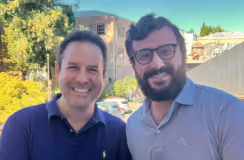
Host: Mark Oliveto bought a sub million dollar barely profitable project based construction business with serious key person risk. As he says, we check off every box of what not to buy. Why'd he do it? First, a bias toward action. He couldn't see himself sitting in front of a screen for two years, searching, searching, searching.
Guest: Second.
Host: Second, he saw the business as an uncut gem with a vast untapped market. Professionalizing the business, reinvesting earnings and building awareness seemed like a winning formula for a long term hold. Five years later, he's tripled the business with faster growth around the corner. In addition to his story, Mark and I spend time talking about the hard truths of small business ownership. He is vocal about the dirt under the fingernails nature of this beast and often finds the culture of ETA too academic. It's a theme you hear on Acquiring Minds again and again and will continue to as enthusiastic as I am about this path, it is imperative to be clear eyed about the weight of it. Finally, long term holding another theme I love. Like Chenmark in Maine or Chase Murdoch's Dakata Group in Salt Lake City, Mark celebrates not exits, but cash flows. Not irr, but endurance. He's five years into this business and only just getting started. This was such a fun interview with Mark. Make sure you check out his podcast Hustle or Bust. If you want more of him, here he is. Mark Oliveto, owner of Paver Art Quick note, you may have noticed the number 200 alongside this episode. Yes, this is episode 200 in the next episode, which I'm publishing on Wednesday, not Thursday, which is Thanksgiving here in the States. I reflect on what I've learned from 200 episodes and I pull back the curtain a bit on Acquiring Minds and why I started it and where it's going. Please join me for that again Wednesday this week as opposed to the usual Thursday. Here's today's episode. Welcome to Acquiring Minds, a podcast about buying businesses. My name is Will Smith. Acquiring an existing business is an awesome opportunity for many entrepreneurs and on this podcast I talk to the people who do it. I want to share an update on the Acquisition Lab. As you know, the Lab is a highly vetted cohort based accelerator and community for people serious about buying a business. After going through the Lab's month long intensive, you have ongoing access to almost daily Q and A sessions with advisors, regular live deal reviews with Walker Deibel, author of Buy, then Build Potential Deal, team introductions, and a very active Slack group with other searchers on the path. Well, the update is that the Lab recently passed 60 businesses acquired and for well over $100 million in aggregate transaction value. Also, all members now enjoy lifetime access to the Lab because when you buy a business, it's often just the first of many and the Lab wants to support you in every deal, not just your first. Lastly, check out my recent interview with Shane Ursum, episode 105. Shane acquired a business with over $1 million in EBITDA in just six months. And he attributes a lot of his deal success to what he learned in the lab. Check out acquisitionlab.com or email the lab's director, Chelsea Wood. Chelseieve.com Mark Oliveto welcome to Acquiring Minds.
[3:55] Guest: Will, it's great to be with you. Excited to be here.
Host: Mark, you bought a small, very niche services business doing just about $100,000 of SDE. You've tripled it and intend to keep reinvesting into it, holding and growing it for the long term. It's called Paver Art and we're going to hear that story today. But your acquisition of this business was after a successful run in the food in industry. So let's start there. Please give us some background on you Mark, leading up to why you eventually decided to strike out on your own and buy a business.
Guest: Sure. Well, you know, I'm a, I'm a New Jersey guy so I, I have a career in manufacturing, really consumer products, consumer packaged goods. So my career kind of took a, I started big and then went progressively smaller. So over the course of 20 years, Big Food manufacturing, sales marketing and then moving towards general management. So I started at Kraft Foods which at the time early 90s while I was in college was the largest food company in America. Spent about three and a half years there, then went to a smaller but still major food company, Sara Lee Foods. They were a publicly traded company as well at the time. Did a stint, worked there for about five years, did a stint in consumer packet marketing, services sales, a company called Catalina Marketing behavior based marketing, really hardcore direct sales in the marketing space. And then one of my old colleagues, a mentor of mine, used to be president of Sara Lee Foods, recruited me away from that world to move to a startup food company in Memphis, Tennessee. Gentlemen still friends with him to this day, a lifelong mentor, a gentleman by the name of Wes Jackson, recruited me to leave New Jersey and go to Memphis, Tennessee to join a startup food company called Monogram foods. Small little $5 million company. I had a nice run there, eight and a half years as the chief marketing officer. We grew it to about 330 million
Host: 5 million to 330 million.
Guest: Yeah, they were probably, if not the, definitely one of the top five fastest growing food companies in America. And, you know, today they're well over a billion dollars. So nice company. Great. Eight and a half years. And this was from 32 years old to call it 40 years old. And then I was approached by a private equity group to take a run at buying a little food company back in New Jersey, of all places, where literally about five, five miles from where I grew up in New Jersey. So was able to say yes to that. Yeah, I had to say yeah. It was a chance to kind of fulfill a lifelong dream, which is to own a company. And it was the classic nice little business. It was 14 and a half million, two and a half million of SDE. We maxed it out with the 504 loan, real estate, $5 million and then $5 million of the 7A loan and then seller financing and then pulling together a group of 27 investors. That was my first acquisition. I'll pause there. So that. That took me up to about 40 years old and then opportunity to buy my first business, which I did at that point.
[6:54] Host: And so let's just hear a little bit on this last. This last acquisition that you called your first acquisition, but you said it was a private equity group that reached out to you. So on the one hand, that sounds like kind of, you know, the hired gun pay pattern where you're brought in by private equity group with a target. They already have to run said target.
Guest: But.
Host: But you characterize this as your own acquisition, so. So kind of elaborate a little bit.
Guest: Yeah. It wasn't a. It was kind of a hybrid. I would say Will, it was okay. They needed somebody to be the CEO number one. And then the deal was there was an LOI under. So it wasn't. It wasn't a search that I conducted. It was a search that the PE found a company, a target company. They put it under loi. They were trying. They were chasing this little company for, call it a couple years, two to three years. Finance, though, through SBA acquisition debt. So the dynamics of the deal was to max out the 504 loan I guaranteed my wife and I, which is fun when you have those cold sweats guaranteeing 10 times your net worth. Right. So I had to go through that whole process, pull together all the investors. So I came in post LOI to pull a deal together, get the SBA deal on it, guarantee all the debt. So more than a hired gun, it felt like ownership. It certainly felt from a risk perspective that I Had all my skin in the game and then some. And then I invested in it. I was one of the lead investors as well.
Host: Well, well, we know that your equity must have been over 20% if you had a personal guarantee on it. So you had a material piece of the business.
Guest: Exactly.
Host: Yeah. Great.
Guest: And then we'll say it was right at that low 20% range. So, you know, the Acquiring Minds podcast didn't exist in 2014 or it would have looked a little different. All right, Mark.
Host: And so, and sorry, how did that story end?
Guest: It ended well. We, we did all the hard work that you need to do to buy a food manufacturing business. It was really my show. It was, you know, go in there. It was, let's see, it was 65 employees, 100 of them immigrants. So you had a Korean management team, you had a Hispanic workforce and you had a mix in the office, in the management team. But it was lean and mean. It was capacity constrained, customer concentration, key man risk. So even though it was a prototypical from a size standpoint, 14 and a half million, couple million dollars of SDE, there was a lot of the risk that I see in smaller businesses. So, you know, there, I think there's a little bit of a myth out there that the bigger you buy, the perceived safety increases. I'm not sure I agree with that. I didn't see that in the business. I saw all kinds of risk work to de risk it. But long story short, we did all the, we invested in CapEx, we expanded margins, built a culture, people started making more money. We did a nice job with it. It was, we took it from two and a half million dollars of SDE to over 4.6 million. And then we had a good exit. We had the opportunity to merge it with another company. So it was about a three and a half year run at it. Only regret is not compounding the investment for 10 years, 15 years, that type of thing. So when you have, it's one of those things when you think about buying a business, when you have other interests, I.e. multiple investors, at some point you got to figure out how to either recapitalize the business or get them a cash out through a sale. So no one's going to cry for a nice exit. But that is one of the things when you're an operator. Yeah, I bought the business at 40 years old. So from 40 to 43, I guess it's an enviable position to have a great exit. But the problem is when you're 43 and you have an exit, what are you going to do with the rest of your life if you're not independently wealthy to just call it a day? So even if it was, let's say it was a seven whatever multi hundred million dollar exit, which it wasn't, I'd still be doing something. So part of it is the thrill of the game. So. But it was a good exit, no doubt.
[10:31] Host: Great, great. Mark. Well, you've already hit on a couple of themes there that, that I know we'll return to in the course of this conversation. Namely how, you know, just because you're over $2 million in SDE or EBITDA does not mean this is a mature business with, you know, with all kinds of, without the key man risk, without the customer concentration, without all of those things that we try to D in in much smaller businesses and then also your interest in compounding in kind of your long term view and how so many people are eager to exit, talk about the exit, fantasize about the exit. And you've just made a point that I think drives your philosophy today in paver art that exiting maybe isn't all, it's all it's cracked up to be unless it's truly, truly such a monumental amount of money that you can not do anything.
Guest: Yeah, I think the, the private equity world, if I can riff on that for a little bit, you know, there's all sorts and you've had a lot of them podcast will the, you know, there's fundless sponsors, there's independent sponsors, and then there's private equity groups that actually manage a fund that they get paid 2% management fees on. And then there's all kinds of permutations in between them all. But when you're dealing with outside capital, they want a return and they're notoriously short in their horizon. If they can take a nice win in three years, they would rather do that than double their money and get twice as much money if it takes them 10 years. So IRR internal rate of return is notoriously tied to that time time horizon. And the longer that time horizon goes out, you might double the money. But if that, that depresses IRR down to the 15 to 20% they'd rather have. This was like a 70% IRR. So it was a fantastic deal. We did significant, you know, we 10 times the equity that went into the business. But the fact that it was 76%, you can't do that unless you're in a short term time horizon.
[12:15] Host: Yeah. And Mark, I've asked this question before. Why do you Think that the private equity industry is, is so focused on exiting what seem like really solid investments. Why doesn't the same calculus that you just articulated for yourself apply to them? Namely that well, if I have a great exit, great, but then I just got to turn around and redeploy that capital again. And, and it's, it's really hard to find a business that's solid and growing and has, has continued great growth, growth prospects ahead of it.
Guest: And it's a good question. I'd be speculating, but I certainly can speculate. I think it's all about private equity spends and again I hate to broad brush because there's so many different flavors of private equity. Notoriously their energy is on finding the next deal and then raising another round of investor capital to deploy in this next deal. There are some private equity groups that focus on actually building the business post deal, but I would say that's the exception. So they're finding. So if you go to investors and try and raise for a next, let's say it's a $10 million acquisition and we're dealing with the lower, lower middle market here. To have an exit in their portfolio allows them to tell a story. If they've got 10 companies under management and they haven't had one exit, you know, they get a little antsy with that. That's my experience. So they want to have an exit to put points on the board to show a win and then to keep raising that next round. Now if you're a funded private equity and you're managing a hundred million dollar fund, a $300 million fund there, that's a game of deploying as much capital as quick as possible because they're making money on 2% management fees. So they will notoriously overpay for an asset because they, until they deplete that fund and put that capital to work, they can't go raise the next fund. So there's different dynamics and the first question with private equity is are you dealing with people that are actually managing money or are they going deal by deal and trying to raise money for the deal that they found kind of like an independent fundless sponsor type of model. So understanding that those dynamics. And by the way, a lot of this isn't taught when you start figuring out search. A lot of people learn the hard way on this in terms of understanding the landscape. Obviously now it's a lot easier than it was back in 2014.
Host: That was great. Just a little taste of, of kind of the, the nuances of private equity which yeah. Are not covered very much, at least not on this podcast. And I, and I'm just, as I listen to you talk, recognize how, how naive I am, how much I need to learn about all those various flavors. But returning to your story, Mark, so, so you said it yourself at the top. It's kind of like you've kind of as you've gone in your career, you've gone smaller and smaller businesses, but essentially more and more entrepreneurial, kind of the spectrum from corporate to entrepreneur. And here you are now kind of at the very far end of doing something on that spectrum and doing something very entrepreneurial. So after that, that exit you it's. I think I know you buy the business in 2018. So you're kind of let's 201718 time frame, connect the dots from there to finding and buying Paver Art.
[15:14] Guest: Yeah. So maybe let's say about nine months later, I was, I'm always searching, right. So even when I'm working, I'm always looking for a deal to add on in terms of growing a business where I'm leading. Found I closed on Paver art August of 2018. So I exited the last business in November of 2017, discovered paver art. Maybe it was mid June of 2018. So it took a couple months to close that deal. I did not put debt on it. I wrote a check for it. Found it. Classic biz buy, sell. I was looking for a number of deals, found a meat distribution company that was doing a million. I saw evaluations that were just all over the board. There were seven times, eight times. So the classic, you know, buy as large as you can. That, that was my mindset. Let's see if I can find a million to $2 million of SDE, buy it at a 4 multiple and call it the 7 months of full time work that I was looking. Valuations were seven times, eight times. I just couldn't find anything. So what started to get to me was, all right, it's only been seven months. This thing could be every bit of two years. So the search and the time horizon, you know, I am not one to sit in my attic for two and a half years and looking at listings and then, you know, I would come out of my skin. The opportunity cost for me not being in the game just from a mental psychological thing. I give all the credit in the world to people that can endure a two and a half year search. I am not. That meant I've got to be operating. Right. So I would rather buy a small business and see what Kind of damage I can do in a good way, hopefully. Right then endure and trying to find this very specific criteria of SDE revenue and all the things that we read about and buy, then build. To me, that was not in the cards for me to try and endure that type of search. So I had a seven month taste, let's say of trying to find that classical model. Then I found Paver art, stumbled across it and the more and it defies everything that you should do in search. It's capital intensive, it's manufacturing, it's project based, it's small, it's key man, you name it. We check off every box on what not to buy. But I had to do that calculus of do I do this for two years search and find that criteria or do I go in and start to wreak havoc on a business in a good way? And obviously I chose the latter.
Host: Listeners of Acquiring Minds know that for almost any business you acquire, its success comes down to the people and how you develop and manage them as their new leader. Thing is, in addition to management, there is also a lot of process and bureaucratic work when it comes to your new employees. Payroll, compliance, HR technology, hiring, to name but a few. These processes are crucial to get right, but at the same time distract from where you want to be putting your energy in leadership. So Aspen HR is an HR firm and PEO that takes this work off your plate and handles it with the care it demands. Aspen is owned and run by Mark Sinatra, himself a successful former searcher. So Aspen's own leadership understands the HR challenges that searchers have. Post acquisition, the firm is offering Acquiring Minds listeners a complimentary pre acquisition HR and PEO review for your target business. Check out aspenhr.com or contact Mark directly at mark@aspenhr.com well Mark, so you referred to buy, then build the book. So I guess you'd read that at the time.
[18:44] Guest: Okay.
Host: Because that was, I think that was right in the time frame when it came out kind of.
Guest: Yeah, exactly.
Host: And, and of course then you have all this experience growing small businesses, exiting them, working with private equity. So you've, you've just got also a lot of hard won knowledge at this point. But were you, were you plugged into or aware of kind of the capital S search world or ETA entrepreneurship through acquisition as a thing people were doing in the business, schools, were teaching or were you kind of out there solo kind of doing your own thing, figuring this out?
Guest: You're affirmed back in 2018, correct? I was not plugged in like I am now. I was not. You know, you're in my weekly podcast routine, so I commute 82 miles down to Paver Art and I give all the. All the credit in the world. You. You know, I listen to your two episodes a week, and it's educational. In 2018, when did you start your podcast?
Host: 2021.
Guest: Yeah. So obviously I didn't know about yours. I wasn't in that scene. So the answer is I kind of knew it was a thing. But if you were to forget about Paver Art, if you were to compare my knowledge of this space now, just through listening to your podcast and others that are like it, to where I was in 2018, you know, you're talking about an A student versus a D minor student. So I knew it was out there. I knew people were buying businesses. I did that with a private Equity Group in 2014. But search funds and independent sponsors and all of the nuances of it. The answer is no. I found a listing, took a look at the listing. 60 days later, we own the business. So I knew that. I knew that it was out there. I knew you can get SBA finance, and I guaranteed with my wife $10 million. So I knew it was a thing. I'm not. I don't think I would have done anything differently. Would I have not bought Paver Art if. If I found Paver Art in 2023 and I was coming a year off of the ex, the previous exit, I still would have bought paperwork. So I don't think it changed anything. But, yeah, the. The knowledge that we have now, it's really hard to put a value on all the free knowledge that's out there now on this world of eta. It really is great.
Host: Well, I'm glad you find it so valuable, Mark. That's gratifying to me, of course. So you. You've already articulated why you were willing to overlook the, for lack of a better word, weaknesses of Paver Art. Project based, very small keyman risk. You know, every. Every box it checked.
[21:07] Guest: Every.
Host: Every box you want to avoid, it checked, but you really. You just. You had this itch to get in the game and see what damage you could do. Given that it had all of these weaknesses, what was your confidence level? I'm just curious about. Yes, I understand not wanting to be in your attic and search forever and ever and ever, but at the same time, it seems like you are taking on a whole lot of risk to buy this business, especially since you snuck in there, you struck to check for it. I mean, you bought the thing in cash. So give us a little bit more on your psychology and your kind of appetite for risk that allowed you to get over the line and do this.
Guest: Sure. Yeah. I gave you the laundry list of things that. Why you should not buy paperwork. Obviously, there was a laundry list that was 10 times bigger. Why I did buy paper art. Right. So, quick little story. One of the early reads that I had before even going to see Paver. You know, you do the. You do the website, you take a look at it. You get a first impression of the brand in the business by looking at a website. In 2014, when we moved back from Memphis to New Jersey, we did an outdoor living project. So we did a patio, we did a fire pit, Paver Art. The name kind of explains what we do. We turn pavers into art. And we're really the only company that does what we do in the country on a national scale. We did a patio, we did a fire pit, we did a retaining wall. And I see this listing called Paver Art. And my first impression was, boy, this is cool. Why didn't we look at this back in 2014? The company's been around for 15 years. I sent the link over to my wife to go look at the website. It wasn't within five minutes. She calls me up and she says, who is this company? They're in New Jersey. And she's like, why didn't we do this? Why didn't our contractor recommend that we buy a nice little compass rose we just spent? I forgot what it was. Let's just say it was $20,000. Doing an outdoor living project. If you're telling me this stuff is a couple thousand dollars, $3,000. We absolutely would have put one of these compass roses in our backyard. So the light bulb goes off. Right. All right. When I'm going through the purchasing decision that we made to do that project, there was no discussion of design. There was no discussion. It was kind of a. A, A sniff of opportunity, if you will, that we would have been in the market had we known about it. So that was step one and step two. I'm walking through the shop, you know, small little 8,000 square foot shop. Dirt everywhere. There's grime everywhere. The stuff is heavy. A paver, a concrete paver that's 2 and 3, 8 inches thick. It's 28 pounds per square foot, and we're using one square foot to make the design. So it's 28 pounds that you're lifting. Right. Big old, dirty, complicated machine called a CNC water jet. So very, very specialized. Technology. There's not many craftsmen out there in the country that know how to fix these things. So I saw that as a risk as well as an opportunity. Kind of like a built in mode. As I started to learn about the business, the general manager and co founder who's still there with me today, Mike Bull, great guy. He saw every project that went through and he was there before day one. He's just photogenic memory. He's rattling off project after project. The Philadelphia Eagles. Philadelphia Eagles at their entrance. We did that logo, we did the Carolina Panthers, we did all these residentials. He's rattling off what a portfolio. That's fantastic. Yeah, I mean the. That's exactly it. The body of work across the country, it was national and from pro sports teams to homeowners, to the LSU Mike the Tiger design. 20 foot that's sitting in there Plaza. Two little businesses with paver art and engraving. If you ever walk down a university and you see engraved bricks, you see your name, class of 1997. We do that stuff too. That's a smaller piece of our business, but a body of work across every market in the country. And we're not installing anything, so we're not geographically constrained. So we make the stuff in New Jersey, we package it up in a way that's proprietary to us, and we ship it to California or Washington or wherever it is. So a national business in scope, hitting every single market. It survived the Great Recession in 2008, launched in 2003. The first job we ever did was appealing to me. It was four intersections in Wildwood, New Jersey that were actually a replacement. Landscape architects and the town council. So you got the mayor, you got the whole town. They installed four decorative concrete intersections. One was like a sailboat. Long story short, they didn't last two years. They were basically kind of like a colored concrete, a decorative application. It didn't last two years. They tore them up and then they said, you got to find something permanent. Let's keep the decorative concept, come up with something permanent. And then that was the start of Paver Art. The founder who passed away, rest in peace, he came up with Paver Art as a concept. And the first job that we installed way back in 2003 still stands to this day. So that origin story of the company really appealed to me.
[25:46] Host: Mark, I actually think that we should give the audience. I don't think that we should assume people exactly can visualize what it is. So give us 30 seconds on exactly what you're making. Art out of pavement. But tell us more. Give Us, the Philadelphia Eagles example. That give us a couple examples that'll help.
Guest: The Philadelphia Eagles, their, their logo, which is an eagle. Right. Long eagle. Can you actually take concrete pavers, two different colors? Let's just say it's white and light gray. And cut all. Think of it like a concrete jigsaw puzzle. We're going to cut all the shapes, all the different colors and assemble it together almost like a mosaic to build that logo. So when you walk in and you're on the ground, typically what you see when you go to a university or a pro sports team is what I call a sea of pavers. It might be gray pavers as far as the eye can see. As you're walking 50 yards into the stadium, you get almost assaulted in the ground stopping power of a design that. Oh my God, there's the Eagle or there's the Carolina Panther. The logo made out of concrete pavers. And that's what we call paver art. Or it could be at a house. You might be Will, you might be a Grateful Dead man. So the steely logo, you want to put 15ft in the middle of your driveway because you want to be unique and you're proud of your affiliation with the Grateful Dead. And we're going to put a 15 foot Grateful Dead steal your face logo in the middle of your driveway. So it's. You can kind of picture the consumer. This is someone that wants to be unique. They want to bring the art that they, they find personal to them and meaningful and they want to put it into their patio or their driveway or in front of their pro sports team entranceway, so to speak. And does that give you.
[27:20] Host: It does. It's helpful and I think the key word there is mosaic. So you're basically. Because kind of like tile work, you know, was done by the ancients, you know, using tiles and you know, walk into a church and you see a beautiful floor where there's real artistry and kind of. Yeah, artistry on the. In the design, in the floor that you're walking across. This is that modern using pavement, custom, often a logo of some kind. Right. And that's exactly. If anybody's still having trouble, just go to paper Google paver art and you'll see countless examples on the website. But it's really neat and I think it, I think it's important to say that it was patented. Right. So because why you said you had the cnc, what was it? Water. Water what Water?
Guest: The water jet. Water jet. So high pressure water cutting.
Host: High pressure water cutting as a Bit of a moat, but all. But still, why couldn't somebody else. Why couldn't a local GC and wherever just copy what you guys are doing? What. What? There was a patent. Tell us more about the competitive moat you saw.
Guest: Yeah, they. They could and they try. A lot of guys will think they can wield a saw in the field and try and do something, and they can in a small degree. When you get to things like text, if you want to do the letter M or the letter S, you've not only got to cut the letter M, but. But you got to cut something to put in. So excuse the cruelty. The. But you got a male, female, Female part connection there. So you got to cut the M and you got to have it inserted into the neg. The reverse negative. That's really hard to do with conventional tools. The other thing with doing it on site is you got environmental risk. We have a lot of contractors, they're the exception, but they do call up and they say, you know what? I got your price. And I tried to do this myself. I went to the university. I tried to cut their 15 foot logo in by myself. It took me three times. They were frustrated. We got all the environmental risk. I regret the time I ever tried to do that and pull that off on my own. So they. They can do simple things and a lot of them will try, but we excel in. We take the risk off of a job site. So if the Philadelphia Eagles or whoever it is, wants to do something, we build it in our shop and we actually pretend like we're at the stadium or the home and we build it on our factory floor to make sure it's built perfectly. So for a landscape architect that specifies paver art, they love the fact that we're taking all that job site risk and we're pulling it under our roof and we're building it on the factory floor and we give them a proof of completion photo and they know when they get it. We've already proved this thing's built perfectly before anybody even tries to install it. So there's some certainty there. And people pay for that, obviously.
Host: And in terms of installation, kind of any kind of GC can do it. Like, the installation isn't so tricky for people who work with pavement.
Guest: Yeah, yeah. If they install concrete pavers, they can install our stuff very easily. It takes all the cutting away from them. They really don't have to do a lot. They got to follow a schematic that we send them and we kind of break it down in a really easy to follow kind of paint by numbers type of thing. So they install it and yeah, the bigger design, the longer it takes, but it takes all that work off them. So contractors all across the country call us because they don't want to try and pull something like that off the marketing of it. The key for us is to get to the end user decision maker and say, I want this. They call paver art. We engage in a conversation and then we loop in a contractor. And a lot of times we'll add value. They'll ask, can you recommend someone to install this? We need a contractor. So a lot of times the project starts at paver art because they're trying to figure out a design. And then we go to our network and we say, all right, who's in our zip code here that we know of, that we've done business? You want to call will in Washington D.C. he's installed our stuff before. Great guy. Here's another one. If you want another recommendation, then do your own search. But we know these two guys really good at what they do. So we can add value to contractors by bringing them business as well.
[31:02] Host: Great. And when you talk about, you know, you gave the examples of somebody in his driveway, you know, the Grateful Dead logo or what was it? The.
Guest: What did you call it?
Host: The face.
Guest: Steal your face.
Host: Steal your face. Yeah, that, that's the.
Guest: The bear. It's the skull. Kind of like a skull crossbones type of.
Host: Yeah, yeah, yeah. Thank you. And the or in the backyard for you guys would have been, if you'd known about it, a Compass rose. So B2B versus B2C. What, what percentage of your business is consumer and what percent is. Is our businesses?
Guest: It's probably good question. It's about 30% will be what we call the residential market. It goes to a home and then the balance goes to commercial. And that commercial could be broken up to university. Schools are a big piece of our business. Could be corporations, Google. We did Google's logo at one of their locations. So really that type of thing. So 70%, 65% commercial, 30% residential. And then of that we break it down by looking at how much is coming to us from a contractor that wants to sell or that's doing the install versus the direct end user. 98% of our inbound calls are from the end user, not contractors. So one of the challenges we have with our business contracting is the number two most failed business in America behind restaurants. So really challenging business. They're typically, they start out as landscapers cutting lawns they move into construction if they're trying to grow and their business acumen might not be well developed, their capital base. So you know, it's a big push in the industry to figure out how can you educate contractors, add value to their business and try and work with them to become more successful business people.
Host: Yeah. And exactly what type of contractor would you, would you say is your ideal kind of channel?
Guest: They're typically in the landscape and world that have moved into design, build construction. So they start out cutting lawns, then they move into building patios. So hardscape installers, that's really the people that are certified in hardscape install.
[33:02] Host: And you had said that one of your experiences I think prior to when you partnered with the private equity fund. So this was when you grew, helped grow the business from 5 million to 330 million, your role at that business was CMO, correct?
Guest: Right.
Host: So you're. So marketing is a big part of your expertise, right?
Guest: It is. But let me, let me define if I can a little bit what marketing looks like in a consumer products company. If you're in the food manufacturing world, most people think of marketing, the perception is I turn on a tv, I see that ad. That's marketing. That is, that's true. But in the world of cpg, marketing is either to the trade, the trade being the Walmarts of the world, the the actual customer or it's to the consumer, the people that are turning on the TV and looking at something, the end user versus the trade. Historically, trade accounts for. If marketing was 100% made up of consumer versus trade, trade is going to be 75 to 85% depending on the business. That's where the money spent. So my background in marketing was what we call customer marketing or trade marketing. So how do you set price in how do you set promotion? How do you build those budgets and then how do you interact with the customer? And it's also much more responsive. Very difficult. If you want to do a TV ad to measure what's the impact on sales. But with data, if you want to go run an ad at Walmart or any retailer that you shop at, Safeway, let's say, and your Everyday price is 299, reduce it to 1,99 and do a feature, you can see the volume right there directly as a function of that. So as good marketers, if you can measure it, that's always preference to be non measurable. It also erodes margin and there's this what if analysis that goes on. So my background in marketing to get, get to your question here. Will is on the trade side, but then I also incorporated the consumer later on in life, you know, and as you get to trade, marketing can be a drug for food manufacturers. Because think about it. If I can 10x my volume in one week, if I'm normal, easy math, I'm selling a thousand units through the cash register a week and if I can go to 10,000 by doing a feature and display, why wouldn't I do that? If I did three last year, if I can do five this year, I'm going to grow 20% and then maybe I'll do seven next year. And then at the end of the year you look at a 52 week volume chart and you got like a irregular heartbeat, you know, you got pricing going all over the board. What is, does the consumer really know? It becomes rug that people try and wean themselves off of. But it's very measurable, it's very quantifiable. You can measure not just the revenue, but you can measure your. Are you making enough volume to account for the decrease in margin? Because the manufacturers fund all that. Retailers don't lower the price because they're good guys or gals. They lower the price because the manufacturers aren't set in them to do it. So it's a very, I'd recommend if anyone's in the manufacturing world to do a stint in a quantifiable customer market and type discipline. The other thing that's important with that is you start to deal with operations pretty well. If you can 10x your revenue in a week, you better tell the people they're going to manufacture that in the plant that they're prepared for that kind of volume increase. So you got to start to have some liaison work with operations and get involved in production. So it's good experience from that regard. So a little bit of a side, side view.
[36:11] Host: No, that was great Mark. And you could guess where I'm going with that. I was trying to see if that ties into what is part of the opportunity you saw in paver art. Because as you said with the story with your wife, it was like both of you saw that one of the potential opportunities here was that neither the lack of awareness that something like this exists and lack of awareness equals, you know, ad marketing. So what am I, am I right there? Did you see your marketing chops? Granted it, as you just explained, it was less consumer marketing chops than trade marketing chops. But did you see that skill set being applicable to growing paver art?
Guest: I did, I saw not so much confidence in myself and my historical skill set, because it's different.
Host: Yeah.
Guest: What I did see, though, is if we did the Eagles, we did the Carolina Panthers, we've done thousands of compass roses in backyards, we've done church design. If I saw all these markets, we've proven that we can sell successfully in every single market. So I saw an opportunity there to figure out, let's pick the best one or two or three type of thing. If we've successfully manufactured and made people happy in different markets, then I thought that was an opportunity to figure out, is there a margin difference? Do the analysis on. All right. Are schools more profitable than churches? More profitable than households? And then go figure that piece out. If you just had the awareness increase. Now the question was, how do you do that? How do you increase awareness? So we, we spend our time on digital paver art. It's art. It's very visual. If you see a picture, we tell contractors to sell paper. It's not complicated. You're building them. Let's just say it's a thousand square foot patio in the backyard. Mr. Contractor, open up Instagram, open up the paper Instagram. And do three flips of the thing. And that consumer, that's like my wife, if she sees a compass for, she can say, oh, yeah, I want that. Find out how much this is and let's see if we can get that in the backyard. Literally that easy. So I thought it wasn't a hard sell if we can get somebody to actually see it.
Host: Yeah.
Guest: So the question then became, how do you actually reach the consumer in an efficient way, cost effective way? So we had to go learn digital marketing, website management, SEO, we had to go learn all that. And it's a work. You're never going to learn that in a short amount of time. It takes time to learn all this stuff.
Host: Sure. Well, I hear that, Mark, on the other hand, if it's such a compelling sell, and if you just get the image in front of your wife or somebody on Instagram, they're gonna, you know, a lot of people are gonna say, I want that. I guess you'd hope that. And also you have these really high visibility installations, you know, Philadelphia Eagles. I mean, what a, what a, what a showpiece. You would hope that it might have sold itself. And, and there it. Maybe it would have. I guess where I'm going with this is it was still a very small business, not very profitable, even after a good decade and a half of life. Did that give you concern that maybe it was, wasn't going to be as growable because it, maybe it would have grown more on its own in those first 15 years. Given how compelling you, you kind of thought the product was. Shouldn't it sell itself? Shouldn't it have sold itself more over the years?
[39:08] Guest: Yeah, you'd be, you'd have to question anyone's intelligence to see a 15 year old business that's never broken a million dollars in sales mark. And not to say, why am I going to be any different? Thank you. Yes. So absolutely fair. Paverart had, I think, one of the unfair advantages that Paver had, why it survived for 15 years. Unbelievable. Founding team. Mick Soroka, the founder who passed away. Mike Bull, our general manager today, he's also my podcast Hope co host. And then Ken Bull is a co founder. He's the CFO or chief operating officer at Five Below, one of the most successful retailers, publicly traded retailers in America. And he told a story. We had him on our podcast. I don't know, it was six months ago. He and I didn't know this when I bought it. I might have shied away, but he actually pitched Paver or to venture capitalists to get an investment, a growth infusion. He told the story on our pod and I almost fell off my chair. 15 presentations, 15 pitches and he went over 15. And I'm thinking, man, this, this guy's one of the most successful financial minds out there in the world. Pitched it and went over 15. That's pretty humbling, right? And they, they all said the same thing. It's not scalable. You just be able to grow this thing to a rate that we're going to get a return on our investment. So that validates kind of your line of question in there. Well, but lucky, what I looked at is 15 years, they did survive. The classic word that I heard in my first six months was survival mode. Everything was about making next week's payroll. Everything was about keeping a train on the tracks and servicing the customers. One machine in a manufacturing operation, if you have one machine and it breaks down and you don't have a lot of high tech people around you to fix that machine, you're at risk right there. If you have one guy that gets hit by a bus, the classic he man risk. Yeah, you're at risk. So in the first year and a half, my concern was not growing the business, it was building more resiliency in the business. How do you, how do you build redundancy around machinery, around people, build out the team? We couldn't even think about growth to be honest with you, until maybe 18 months or so.
Host: But I imagine a lot of this kind of risk that you were seeing everywhere was also opportunity. So, you know, really professionalizing the business and fixing a lot of this. That's right. You know, getting it out of survival mode once and for all and getting it to be an established business, that alone would unlock a lot of value from a purely kind of enterprise value perspective.
Guest: That's right.
Host: Well, and speaking of enterprise value and the money piece of all of this, Mark you. So you. It has a hundred thousand dollars of ste. So for a guy who that might
Guest: be, that's a little generous. It was probably closer to 65, 75 somewhere in that range.
Host: Okay. So. So really. And you know, that's, you know that, that 65, $75,000 of SDE can probably be eaten up by two, two projects gone wrong. So, I mean, really tight, you know, tolerance is here on any profit at all coming out of the business. So I think it's important that we just, you know, surface that your own balance sheet was what enabled you to do this. You had come off, no doubt, you had come off an exit. You stroke a check to buy this thing outright so you don't have to get a loan. And you're presumably with such a little bit of amount of money coming out of the business, you're not going to even worry about it paying you. So, so, so fill, fill in the blanks for us there.
[42:20] Guest: Yeah, yeah, yeah. And then the, you know, so that not only do you buy the business, you've got to appropriately capitalize the business once you buy it. Whether you have debt on it or not doesn't matter. But you know, I threw 100, $150,000 in the bank when I bought the business. I didn't want to sweat making three weeks worth of payroll and then having a lull. It's amazing how many. And you've had a lot of them on your show. They start with a very thin bank account.
Host: Yeah.
Guest: And think about it. It's tough enough now. I had supreme confidence in myself. I had 20 years of general management experience and we can go into that later about how much experience should you have if you're going to think about running and owning a small business, but the last thing you need to do, no matter what your experience is, is sweat the bank account. So, yeah, so I capitalized it where I wouldn't have to kind of sweat a bad week of sales. And small business, you can have six, six consecutive weeks of bad sales.
Host: So.
Guest: But you capitalize it appropriately going into it. But you're exactly right. You know, could somebody come into pay for if they needed that $65,000, that's not the right business for themselves. You had a guest on a few weeks ago. It was the kind of the horror story where she couldn't get her head around not taking a paycheck out of the business. If I would caution, if anyone can't envision themselves from a need or a philosophical standpoint, if you can't go without a paycheck for three or four weeks or five weeks, my opinion, but I think that's not right for you. You've got to be the leader. Really does have to eat last. Now I'm not advocating people don't take money out of the business. I'm not advocating that. But if you can't even picture foregoing four weeks worth of pay in a rough time, you gotta question if this thing's right for you. This is not a job. These are, this is ownership. It's. It's a cold, hard reality. But you know, you're, you're right. My personal balance sheet was certainly an advantage. There's no doubt. And then we started cash flowing at a nice clip and then we plowed all that money back into the business as well in terms of expansion projects.
Host: Yeah, well, we're going to get to the growth that you've enjoyed here in a minute. So. But can you give us then Mark, just lay out the entire terms of the deal, what you bought it for and so on. Is that something you can do?
Guest: I'm sure it was. Purchase price, 750 after escrow and kind of like a quasi earn back, let's call it 710. And then I capitalized it with about $150,000 in the bank. So. 900,000.
Host: 900,000, yeah. For a business that's thrown off, call it 70, but. And so, you know, if you look at that on a purely return basis, that's less than 10%. But you're not thinking about it in these kind of, these kind of irr ROI terms. You're thinking about this because as an entrepreneur, somebody who's going to take some raw ingredients and grow something, grow something substantial. So what it looks like today has very little bearing on, on your, on your overall goal and project.
[45:07] Guest: You're exactly right. So when, when people ask me about, you know, it's always a simple, you know, why did you buy a seafood manufacturing business? You know, if that's kind of odd, and why'd you buy Paver Art, a hardscaping construction type manufacturing business. Then they start doing what you do. Are you paid this? And look, I can tell you that's a high multiple. It's what, 15 times? Yeah, I get it. I could do math too. Right.
Host: So.
Guest: But look, you, you can, you know the origin story of a successful exit after three and a half years. That kind of scars you when you want to run the thing for 15 years. I'm not looking at it over three years, you know, so it's. The question's not did I overpay for the business? Look, I'll save you the trouble. Yeah, I overpaid for it over 20 years. What's this business going to be? Or 15 years. So that's really the calculus that you've got to do if you want to be an operator and a dirt under the nails operator. Now if you want to put an. Yeah, I'm fascinated by the whole discussion of can you put a GM or an operator in business. I think that is if that's the thought process I want to put an operator in. I want to go do a roll up. Look, people are successful with that. So I'm not denying it. That's. But it's hard for me to get my eyes around it. I will say the intent of what. So why did I overpay for the original ingoing intent? Paver Art was going to be one of many. I was going to kind of do a holding company and try and tack on businesses that might be complementary or might not. And I would work a couple of days a week at Paver Art and then while I go buy other businesses. I went into Paver Art with a partner. I was 2/3 and then she was one third. And then after four months, she realized that it wasn't the business for her two grit Manufacturing. So I ended up buying her out pretty much at the cost basis. So that did derail things a little bit from my strategy. And I said, all right, I've got to now dive in and commit myself to this thing and see what we can do over the next few years here to see if this thing's going to be able to grow if I work with the team and do all the things I think we can do with the brand.
Host: And was she going to be the operator in the business? Is that why her deciding it wasn't for her was kind of derailed the
Guest: other strategy now she was going to be the operator. She was going to be a active. I would call it an active investor While we go out and tack on other businesses to it. I was going to be more of the hands on, you know, call it three days a week. She would be there one day a week and we thought that could be enough juice to allow the thing to grow. So it was a blessing in disguise that when she said look this I made a mistake. This wasn't the right business for me. So I bought her out. And then I dove headfirst into it. I kind of. I punted on the idea of doing a holding company roll up because Paver did need a full time additional person there. So. And then I played that role.
Host: It did need a full time additional person there. And you play.
Guest: Yeah, it was naive. Yeah. So if you want to call that that, that premise or thesis, if you want to, you know, use a private equity term, that was a naive thesis that you could put a two new owners in, call it service the business for three days a week. Just a flawed premise right off the start when it was that lean, it needed more than that and learned that after about four months. So the exit of my original partner, it really was a blessing from a standpoint of it got me to say, all right, we're going to throw our. We're going to go head first in this thing and see what we can do with it.
[48:03] Host: And remind me, is your wife involved in the deal or the business at all?
Guest: She is.
Host: Okay.
Guest: She is. So we really. Yeah, she. She does the bookkeeping. She does, she does the catch all. Anything that I stink at, I throw to her. And she does a great. And she's got a food background experience too. We met at Craft Food so we've worked with each other in different degrees over the course of 21 years. So yeah, she does the bookkeeping, she does all the administrative shows. Yeah, she's. We've essentially added two full time people in the business.
Host: Oh. So she's actually full.
Guest: My wife and I. That's right. Okay.
Host: And well, Mark. And so now this is a good time. We've touched on it twice now. Let's. Let's lean into it. Just your thought about long term hold versus the private equity model of exiting. You've already kind of said it, but let's give this some air because it's something that I just really resonates with me. It might just be kind of a personality thing. Some people think in five year increments in their career and they don't want to commit to something forever and ever. And other people. It really resonates the idea of Building something for an indefinite period. And you know, there's examples on both sides. Warren Buffett's buying businesses to hold forever is kind of the canonical example. So just, just riff on that, on that a little bit.
Guest: Yeah, I think, look, there's no right or wrong answer on that question. It depends on the person. It, you know, the private equity world is going to be notoriously short term and they're all going to say five to seven years, but if they could do something in three, they will. If they're measured by anything that resembles irr, that's my, I don't, I wouldn't say that's generalizable, but that's generally short term in nature. If the operator or the person that's in the ETA world, I believe they should have a passion for operations and being real, hands on. They almost need to have a chip on their shoulder that says something bigger than, you know, financial freedom is one thing that's important, we all want that. But do you have something else that's driving you? That, that burning that flame in your belly to do something? And that could be, you know, for me it's, look, I want to take people in the blue collar world and I want to, I want to prove that we could have small business in America in a gritty world of manufacturing like we are specialized, that if they stay with me in a growth company, small business, and then we grow and do what we can do over the next five, 10, 15 years, they're going to do a hell of a lot better than going to work for Amazon. I believe that. And I'm, we're pretty darn close to proving that now. So that's kind of an example of do you have a fire in the belly to do something like that that extends beyond. And if that answer is yes, when I was at the food company, it was, I think we could be the greatest little food company in America. That doesn't mean biggest. I think when you walk through our plant, it's going to be like a Disney. You're going to feel a culture, I call it heart and hustle. You're going to feel a performance standard that is top tier in the industry. You can measure that by margins, you can measure that by return on investment, whatever measure you want. But we're going to have a culture that is sustainable and is really motivating to work at. I've taken that to paver art. So those are things that don't happen over three years or five years. You need a long term window, you need a Lot of reinvestment. You need a lot of risk appetite to do that type of thing. But you gotta have, if you've got that, if you want it more than just I want to cash out after three years and be financially free and do whatever it is, passive investments, then you're not going to be thinking 10, 15 years, you're going to be thinking shorter. So, so I think both are successful. The owner needs to decide, you know, what drives you to get into the entre. The ETA space. You know, for me it was the one thing I will say, well, when I bought the first business the, the food company in New Jersey, I was, I just turned 40 within. Ah geez, it might have been 30 days. The, the, the realization hit me really quick. I was ready for this at 35 years old. I was ready from a skill set standpoint at 35. So by, you know, the kind of like the only regret is not doing it sooner. But you've got to be. Would I be honest with myself and you if I said at 30 I was ready? No, I wasn't. I didn't have the chops, I didn't have. I'm a disciple of the, you know, Malcolm Gladwell 10,000 hour rule. You know, it takes 10,000 hours of really not just work of defined practice at getting better at your craft to really be able to master something and to step into the unknown and the risk of small business. And especially when you're dealing with leverage that is not for the faint of heart, you better know what you're doing. You better be able to deal with the general management, you know, people coming in and you know, the personal tragedy and especially in a blue collar world, you're going to see it all. And if any of that is intimidating or you don't have experience, I would not recommend it. It's a great. What I would do is go work for a small business in that type of industry that you're going to do, do it for six months. That's the best use of your time you can do just to get a feel for it if it's right for you or not. But to go back to your original question, that burning that flame in your belly, to do something beyond just an exit, I think is important. And if you do that and you find kind of the joy in the grind or the process that's going to propel you and by nature you're going to want to do that for a long time.
[53:01] Host: That was great, Mark. There was so much there. So you're. Aside from the Two follow up questions. First, I do want to talk money for a second and then I want to return to kind of your why, your fire, your fire in the belly. But just on the money thing, let's highlight too about what we kind of talked about earlier. If you have an exit, even if it's a great exit, you know, a really stunning irr over three or five or seven years, you then still got to redeploy that capital. How do you think about the financial implications of holding a business for decades?
Guest: For, for me to hold a business for 10 dec. For decades.
Host: Yeah. Yeah. So just speaking purely on the money piece, why do you like why it pains you to sell the other business and so why do you like the idea of holding onto a business for the very long term from a money perspective?
Guest: Well, let's, let's say the old food business.
Host: Yeah.
Guest: Business that we bought doing two and a half million and we grow to 4.6 million. We did it with a couple million dollars of equity, heavily leveraged. Within five years it would have been debt free and we'd be throwing out a $3 million a year dividend on two and a half million dollars of equity. There's a pretty good reason to hold it. Right. Imagine putting $100,000 into a stock and then getting back $150,000 a year as far as the eye could see. Not a bad investment. And then selling it for 50 million, you know, type of thing. So if you, and that's the beauty of leverage, you don't really, if you buy a deal. Now here's the case for leverage. And I, and I lived in that world. We bought the food company with 80% leverage. If you don't screw it up. And that's the key thing, do no harm. You know the Hippocratic oath, do no harm, figure it out. Don't, don't let those risks materialize. Build relationships. Walk the plant at 6am it's amazing how many people have a startup at 6am in the food manufacturing world. You won't find the owner or the CEO at the Planet at 6am and that no plant in America starts at 6am when they're supposed to. And they usually don't start there because the owner's not there and kind of creating that culture. So now why do people not show up at 6am in a cold, wet seafood or a meat plant? Because it's cold, WET and it's 6am that's why they don't show up. So this is hard work. Right? This is not sexy. Work. But yeah, there's a raw financial aspect to it, you know. Yeah. $2 million into it, you pay off the debt and then you're throwing out $3 million worth of dividends a year. That's a financial reason. But look, I think one of the rules in private equity that I kind of grew up with is don't, don't entertain buying a business unless that owner is 65 years old or has a catastrophic life event, divorce, terminal illness type of thing, they're just not going to be motivated to sell. And you're going to be just grind. If they're 55, they're going to be doing the math that I did at 43, which is, all right, I'm going to sell for this three, four times, five times after taxes, you're gonna be doing the math. And I've got 35 years to live. That. That's going to be a very difficult deal to do. You got to wait until that person's of age. So not really directly answering your question, but how I look at it financially, there's a case to be made. But again, you got to love operating. What are you going to do with your time? That's a big thing. So you sell. Then he's. Are you going to play golf every day? You know, what are your hobbies going to be now? Spending time with family and all, that's great. But if it's a sport and you love it, that there's a case to be made that you get more enjoyment from doing a thing than cashing out the thing and then doing some leisurely activity. To me, that would drive me nuts. It's kind of like sitting in my attic trying to find a business. It's just I can do it for so long and then I'll burn out.
[56:27] Host: Well, not all of us are, are as lucky as you and me, Mark, that we, we really like what we do and you know, we don't, we don't want to retire because I'm, you know, I'm sitting here playing all day, so why would I want to give that up?
Guest: That's right.
Host: Well, but, and then, Mark, so, so let's just take it home with the example here of paver art. So you, you're you're 900 grand in and you also with the opportunity cost of not taking. I don't know if you've said this yet, but I know from the pre call you haven't really taken anything out. Well, you can correct me.
Guest: Well, just tell me one distribution.
Host: You're taking one Distribution a couple hundred grand out. Yep, a couple hundred grand. Okay, but are you. And are you paying yourself salaries?
[57:02] Guest: No.
Host: Okay, so just a single distribution, no salaries for five years. So. So then there's the opportunity cost of not earning salary elsewhere. So, you know, more if you, if you, if you really want to be strict about how much you have in this financially, it's more than 900. What do you think that this could be? What's your. When you fantasize, strictly money, strictly mercenary here. When you fantasize about what this could be in another 10 years generating in an EBITDA, what does that look like?
Guest: Well, the, you know, and I think it was two distributions, by the way. But regardless, it was. Let's say we haven't gotten a third of our money back, right. Of what we put into it. We're about a third of the way there, let's say. But it doesn't mean the business is not making money. We did one major expansion project. We added. We went from one machine to another machine. That was a, call it, $135,000 project. And then we added a brand new machine and then it built out a new. A completely new location across the street. And that was about a $450,000 project.
Host: Right.
Guest: So we, we generated cash flow. And so there was no other money that came out of our pocket to fund all that. That was all internally generated cash. So if it was a fancy statement of cash flow, you know, the business is throwing off real cash. We just redeployed that. And look, and part of my thought process is I don't feel bad for not taking money out, because the question. There's a great in. I don't know if you're a fan of Moneyball, Brad Pitt, that there's a great scene in that movie when they trade away the All Star and they're like, the question we should be asking ourselves is, do we believe in this thing or not? So at the end of the year, for a business owner, when they've got a hundred thousand of SDE or seven hundred thousand of sde, are they gonna put it in their pocket or redeploy it in their business? That's the test of do they believe in this thing or not?
Host: Yeah.
Guest: So that caught $550,000 of capex that got internally generated that we plowed back in. Well, now we got three machines, two and a half locations. We gotta, we got some moats around us that if anyone tried to get aggressive and try and come after us, they're coming after A different business than they were five years ago with one machine, three people. Now we got nine people. I mean if you do it before and after we, I think we've proven over the course of five years, blood, sweat and tears, it's a different business. So, you know, back to your point, where could it be in 10 years, 15 years? I don't know. You know, could it be north of 7 million and a couple million dollars of EBITDA? I would hope so. I don't really obsess about it. You know, we got to do the right things now. We, we've reinvested a ton of money in the business, we've gotten wages up, we've built out the team, we've got over $15,000 of marketing investment every month. It's hard not to stumble across paver art if you're in this world and you're doing a search. So, and we haven't even gotten real expertise around us for things like SEO and things like that. So I don't know what the upside is. What I do know is, you know, you asked a question on a pre call, Will, what is the total addressable market?
Host: Yeah.
Guest: And I started doing some analog, you know, with 80 million homes in America, single family homes, just, just residential alone. If you just take the top 15% of them from real estate values, call it 800,000 and over, and you start backing out like 3% conversion against that really defined market, we've got a $14 million annual revenue if we just capture 2% of it. So the beauty of a national business you're shipping all over the country is it's a big market, it really is. Even if you just say million dollar homes and above.
[1:00:10] Host: Yeah.
Guest: You know, you look at a million dollar now, maybe a million is not what it used to be. Right. So go a million and a half. But when interest rates go up to, let's just say they go to 9% mortgage rates. Is the person that owns a million dollar and a half home going to be worried about putting a $3,000 design in their backyard project? I don't think so. Now everybody, you know, rising tide hits all boats or lifts all boats. I think we got a lot of Runway ahead of us. I think, I think it can go north of 7 million pretty easy if we start doing roll ups and acquisitions. One thing I will say, it's a lot easier to do eta when you own a business and you start picking up the phone and calling like minded businesses or complimentary businesses, they'll take that call a hell of a lot quicker than you were if you were a searcher. Yep, that's, that's my, that's my belief when I was doing the 7 month search versus where I am now. When I pick up the phone, they don't always answer, but my hit rate is a hell of a lot higher.
Host: Sure, sure. No, this, this came up in a very recent conversation. Can't remember if it was one of my interviews or not, but when you, when you buy a business, you graduate from, you know, from searcher to business owner. But that can't be understated. What a dramatic status change that is in how the world perceives you and how, you know and kind of the opportunities that that affords to you. Now, now you're in the game, you've done a deal, you're a business owner a lot. You know, you're completely positioned differently in the world and how people perceive you.
Guest: The other. Well, can I give you a little riff on position of yourself as a person?
Host: Yeah.
Guest: I was fascinated by the search fund world. You know, the MBAs that are coming out and they, you know, they raise a $600,000 search fund or even the independent, you know, self funded searchers. I did a quick search on axial and I typed in search fund. I just want to see what the websites look like. I think I looked at 18 of them and all 18 had the word investment and, or private equity or something investment equity oriented in there. And I don't get it. You know, the, the world of private equity. Another thing, another opinion. Private equity to a small business owner that does not connotate positive images. And now you got this world of search guys whether they're self funded or search and they're calling themselves whatever investments or whatever equity that is just what. So the question is why do I get a better response rate as an owner versus when I was just a guy out there searching. I think because I'm an owner, you're on their side of the table. Private equity has so many different connotations and a lot of them are not positive and they're positioning themselves to people with search funds as investments. Slash private equity. They got to be thinking operator and they're going to sell to somebody that's kind of looks like them as a, as a grinder. So just a kind of a soft opinion there. But I didn't that strike me that their positioning themselves in this private equity world. I don't think that's positive positioning per se.
Host: Yeah, it's a, it's a really interesting thought, Mark. But let me, let me make the counterpoint which is sure, sure, private equity has negative connotations, but it also has big positive connotations. Namely, you know, dollar signs in their eyes like it's going to be private equity who's going to pay up for your business. So doesn't that maybe overcome whatever negative connotations there are? Like wouldn't. If I'm a business owner who's thinking about selling now I got to be thinking about selling. If I'm really in my business and I'm committed to it and I'm not interested, then almost no, nobody's going to get my attention. But if I'm like you said, the retirement, you know, kind of approaching retirement, thinking about the next stage of life, aren't I going to, aren't I going to take a call from private equity? Aren't I going to want to talk to private equity? Because they're the ones with all the money.
[1:03:42] Guest: Is that search from private equity?
Host: Well, but I guess the point is they don't necessarily know, they just see private equity. So and I, I feel like they'll know.
Guest: Yeah, it go, it goes back to kind of what we started the conversation with I think is private Equity. If they're $100 million fund that they're managing at their disposal, that's a different call than this 32 year old search fund.
Host: Right.
Guest: That's doesn't have the money to pay his own salary. That's why they raised a search fund that those are two different worlds. Sure. If you've got the managed fund or a fundless sponsor, that's private equity too. So yes, do I want to take that call for private equity? Yes. But look, when someone, a self funded searcher pays four times for the business or three and a half times whatever their target is and 90% of that is debt, they can do that with their general manager that's working on site right now that they've known and they've worked with for 10 years. So what's the advantage? You follow me?
Host: Yeah.
Guest: So private equity matters and you want to take that call if you're an owner, if you're going to get a 6 multiple but of all you're going to do. So the first thing I would do if I was an owner is bring in your local bank and let's see if I can get this thing pre qualified for SBA financing and let's do my own quality of earnings report. I would have that sucker if I'm planning to exit. Small tip. Every business owner I Think should be writing themselves an annual report at the end of the year, whether they own 100% or 2% of the company and talk about things like their stakeholders, employees, suppliers, investors and write it and be accountable to yourself with a three page letter, almost like a Warren Buffett type thing. Side note, but back to your point, would I want to take that call as an owner? Absolutely. But I'd want to know am I dealing with a private equity group that can get me a six or they get. Or is it a self funded searcher that's calling themselves private equity that's going to get me a three and a half times because they're going to use 90% SBA. Two different worlds right there. Yeah, really is.
Host: Okay, so, so the, the point is because I think, you know, a lot of searchers will position themselves as fancy private equity because they, they want the perception to be that they're well capitalized, that they can close a deal, that they're serious business people, which is all well and good and that might get you a second look, but the business owner is savvy enough to quickly poke through that and figure out that in fact you are just a lone guy or gal, young, inexperienced, and are only going to pay 3 or 4x for, for the business. So, so the charade only doesn't last.
[1:06:05] Guest: Right? So the moment that LOI comes out and they start putting down three day and they start asking how you're going to finance it and there's loans and all that, they're going to know real quick that there's an independent buyer and yeah, they might have investors lined up for the equity piece that they might, they might be putting in 20 investors might be putting in a million, whatever it is. But yeah, I think it comes out pretty quick. But private equity, when they position themselves as private equity, I think it sets a little bit of a high. It creates a perception that all right, this is my payday as the owner, when really it's, it's the lone guy, like you said.
Host: Okay, okay, that's great, Mark. So the other question I wanted to circle way back to your. When you were talking about, you know, why get in this and what, what you kind of your why and what your fire in the belly was and how. And I think, correct me if I'm wrong, but what it was was really building an organization, a blue collar organization where employees can thrive and, and you can prove to the world that there is, there is a home for blue collar employees that isn't Amazon, where they can thrive, they can make good money, they can build a career. Was that it?
Guest: Yeah, I think you're right. I think, you know, one of the side notes, I've got a 16 year old son who's worked at Paver Art for I think four or five years. You know, he started pretty young. We developed a program. The hardest part about the blue collar world is finding good quality people. I think our society. I started a program, website, the whole thing, we haven't really gotten it off the ground, but it's called Brick by Brick Future which is basically a customized apprenticeship program that says, look, come work for a small business, learn every area about the business. And I believe at the end of four years, let's picture a 18 year old high school kid that doesn't want to load himself up with conventional college debt, maybe graduate with $70,000 of debt. At the end of four years, you're going to know everything there is to know about this small business. You're going to get an education customized for this business. Technical, you'll get some business classes, you'll get all that. You're going to be, well, far ahead. You're going to be on a path to possibly being a general manager and maybe buy your own business by the time you're 32 years old or something like that. So that is part of it. I think just as a, I think this obsession with college and the conventional path, it doesn't play well to the trades. There are people that have electrical degrees or electrical certifications plummet. The trades are really making good money. There's 10 million shortages in terms of job opening. So that is part of it is how do you take, how do you have a great lifestyle working for a specialized kind of a trade business.
Host: Yeah.
Guest: And then grow them over time and then proven that it can work.
Host: And where did that come from? Did you, did you go, did that kind of develop as you were in and operating Paver Art over time or did you have this vision before you actually bought Paver Art?
Guest: I made the mistake of Google in my university and what tuition is today? So I went to Northeastern University in Boston and yeah, great school, real proud of it. I'm a believer in education, but the tuition was like $80,000 a year. Right. And here I am, you know, a 16 year old at home, smart kid who's got $300,000 burning a hole in your pocket, ready to write a check to a professor. Now the irony is, look, I was a CMO for eight and a half years at a company that is now $1 billion. I couldn't go get a teaching job, teacher marketing, one on one because I don't have a PhD. I think that's freaking crazy, right? So I think the world has valued credentials too much than people that are then operators that have dirt under their nails that can really motivate a class. So what started it? I started doing college planning for my kid and looking at this world and look, if he wants to go to college, I'll support that. But I think there's, you know, like I said in 2014, the Acquiring Minds podcast didn't exist. In 1997 when I graduated Northeastern, YouTube was not non existent, Google was non existent or just coming out. So what's available at our fingertips now is unbelievable. The end of the day, you still got to, you know, the beauty of entrepreneurship. It really comes down to how good you are. Is the market going to accept what you're doing and how good are you to grow this thing over time? So that goes back to a chip on the shoulder. If you've got the ultimate faith in yourself as a business operator, as a leader, there's nothing better than entrepreneurship through acquisition. But the motivation's got to be pure and you got to be a grinder, I think, to make it successful. What started it all was, you know, it was googling my old university, doing the college planning. I didn't like what I saw.
[1:10:22] Host: All right, well, let's, let's, we're starting to get to our time here, Mark, but I want to spend a little bit more time on the nature of small business. It's been a theme already in the conversation, but you responded to me privately about a couple of the episodes and you've mentioned one now that I've aired where people are really struggling and, and there are a number of things to unpack there. There's. Did they buy too small? You know, that, that might be kind of a, that might be a kind of an armchair quarterback thing to say, well, this person bought too small and you know, and they weren't prepared for that and that's why it's so difficult or the, or something you've already said like they're just not prepared for what operating a small business, a blue collar business is going to be. And there might be other details, so I'd like to have you riff directly on this now. Maybe, maybe let's, let's go in order there. Small business. So you have said that that's probably not the answer. Buying a business with 400,000 of SDE versus 2 million of. Of SD or EBITDA, like that, that $2 million business, there's still a whole lot of risk there. So please take that and run with it, please.
Guest: Yeah, I believe it. I wouldn't say it's a myth. There is a lot of logic behind it. $2 million, you typ. There's a lot of risk there. But you can make a $400,000 business work. You really can. Equally as well as a 200,000. Now, if you can grow both of them, you'd rather have the bigger one. All things being equal, take the bigger one if you can buy it. Right? That's obvious. I think the. The episodes that you've had on. I think it comes down to the person, I really do. Are they ready for it? Not just from a mental standpoint, are they good enough? And when I say good enough, I hate to make this sound like. Because you could be good enough and have bad circumstances happen. You could have. If you're in the food business, you can have a recall. There's all sorts of existential things that can happen. No fault of the owner, and you can go into bankruptcy. You can. You can find yourself in that situation. But when I say good enough, do you have. I don't know what the minimum is. Do you have a decade worth of quantifiable achievement? Quantifiable being you took something from X to. Yeah, and here was your role in that. You work with operations, you work with finance, you work with sales, marketing. And you did this over time, and you repeated it for 15 years, a decade. One little side story. I started writing a blog in 2012, and I kind of started documenting my business experience. What I thought worked, what I thought didn't. When I went for the $10 million of SBA financing, the 504 and A7A, they actually, you got to go through. It was UCC, a local development corporation. They do the financing, kind of the underwriting for the sba. They actually said, this is the first time someone's given us a link to a blog that they wrote that was more important in your resume than any of the financials. They spent half a day going through 200 articles I've written, and I had no idea. I just thought, hey, here's some stuff. You know, ignore the Yankee rants because they were making bad trades at the time. Right. But when you start documenting your experience and putting yourself out there, kind of being a little vulnerable, how you view the world of small business, that I found that to be helpful. Now, I wouldn't recommend people just do that for the sake of getting a loan. But I do think you've got to be ready. You've got to have general management experience. If you've got functional expertise, that's good. I happen to be marketing, but I spent days at plants and I did the annual planning process with a cfo. So I could have been interchanged for a CFO in any of my old previous roles. Now that doesn't mean I'm a financial person, but I spent enough time with a different function where that mattered, right. I could have been ahead of sales, head of marketing, or kind of bluff my way through being a cfo. I wouldn't pretend to be a competent one, but I could have probably tried to figure out how to navigate it and operations. I had enough experience that when I became CEO of a food manufacturing, nothing, nothing really fazed me. I was kind of used to the interplay and how the whole thing worked. The business model I was able to understand throughput pretty quick to figure out how to expand margins 80% because I had experience with that and I had success and I had achievement and a lot of battle scores of screwing things up. If you've got a body of work with some achievements and some screw ups, you're going to be so much more prepared of going into now. If you're going into blue collar, you got to be prepared for a totally different set of experiences. It's almost like I've seen plenty of potential physical altercations between employees. You got to be comfortable.
[1:14:53] Host: You've seen almost fights happen a lot
Guest: in my office where we're trying to hash out a detail. So you got to be. Now my stomach is churning while I'm watching this and trying to broker a meeting to try and get two people to work together that are seemingly going to kill each other. If you can't picture yourself in that world, you probably don't want to be venturing into that because I wouldn't say it's common, but that's not uncommon. So the question is, can you get through that type of thing and become stronger on the other side? You've got to be able to picture that. So if you've got a body of achievement that you can fall back on, it makes you a little bit more comfortable in those fish out of water moments. I would tell you as cmo, I never saw that right saw a lot of other things, but I never saw that one thing, one quick little story going through as a CMO and being cross functional. Never forget the story. We had a meat plant in Minnesota. So if you've ever been to Chandler, Minnesota, in the middle of January, it's like minus 30 degrees, right? And a meat plant is kind of a miserable environment. And I spent eight years there, so in that type of environment. So going back and forth and visiting. So we do a hard day of work and then we go out to dinner at night, five o'. Clock. And Chess shout out to my friend Chess. He said, no beers, we're going to night shift. And I'm like, what is night? What is he talking about? We just spent a whole day. I'm tired, I want to go to bed. And I'm a pretty hard worker. This guy can. This guy makes me look like a child's play compared to his work ethic. We go back for night shift and we're wandering through the plan at 1am and the sanitation comes in and there's foam and power washers all over the place. 1:00am and I'm like exhausted the next day. We show up at 7am for the first shift and, you know, so we got like three hours of sleep. We do like a lunch type of presentation to show how the company's doing financially. And it was a Hispanic workforce, so they had interpreters at the end of this little pitch or a presentation on the company performance. I'll never forget it. Four little Hispanic ladies, they go to their locker, they pull out like a big cupcake, and then they sit in the corner, they got their hard hats on, and they light a candle and they sing Happy Birthday in Spanish to one of their co workers. And I'm looking at this and I'm thinking, here I am, I'm feeling sorry for myself. These guys have hard hats on. They're going out into the cold meat plant. We just worked the night shift. If these four people can practice a little gratitude, why in the hell am I feeling sorry for myself, Right? Small little example. But when you're in that world, you've got to have that experience to kind of think through it a little bit.
[1:17:16] Host: That. That's great, Mark. Well, well, I. I love that story. I want to ask. Just press on this a little bit because people will hear Acquiring minds. They'll.
Guest: They'll.
Host: They'll know that stepping into an environment like this is going to be challenging. But it still seems like a lot of my guests underestimate it. And maybe I do too. But it's why, it's why I ask about it at Ad Nauseam, because I just, I just really want people to know and I want to know myself. It's like, it's like, I know this is going to be hard. And. And then they get in and it's like, wow, this is hard in a way I've never experienced before. What do you think that they're overestimating in their own, frankly, in their own experiences. That gives them maybe a little too much confidence. I'm not trying to dissuade people from doing it, but I am, I guess, trying to say maybe just it's going to be harder than you think. Even if, you know, intellectually it's going to be hard. What do you say to all that?
[1:18:10] Guest: Yeah, I'll give you a quick story. I came in, I guess it was six, seven months ago, and I just start talking about. The topic is mental health, right? And are you prepared for the challenges? And I just start riffing and I start talking to Mike and I see Mike's got this. And I'm talking about how my mind works at 3am in the morning when I wake up. And it's like, if you ever sell those, those lottery, commercial or lottery, when they draw the lottery, there's that ping pong machine, the air and the balls are going all around. And that was kind of equating that as an analogy to what goes on in my brain when I wake up at 3:30 in the morning. I go on my walk and I call it a mental freight train. Right? And you're trying to sort out and you get a rapid onslaught of brain activity. All right, payrolls this week. But then I got this other thing and then I got this customer coming in and it's just like all at once and none of it makes sense and it's a garbled message. It was a mental free train. So Mike's got the white look on his face. He says, let's turn on the microphones, let's talk about this on the pod. Because someone needs to hear this. That's something that I've had for. Let's just say it's a decade, this mental freight train. And I think in a small business world there's going to be some version of a mental freight train that people have to deal with. It's not a question of if they're going to deal with, they're going to have. Who was it? Reg Zeller on your episode, the fetal position. The fetal position moment will come. So what is your strategy to deal with it? And I, and I would go. So I would build on Reg's theory, which is a good one, and a small version of the field position will come weekly and you gotta have a strategy. For me, it's this onslaught of brain activity. So I go on a 3:30am walk and I've noticed that at minute 60 it starts to kind of slow down a little bit. At minute 70, the brain kind of freezes and productive thoughts start to be able to come in. Now if I didn't have that routine of the 3:30am walk going till 58 5am I probably would have had a heart attack right now. That's not small business per se, but I think if people think about that level of mental stress and some way to deal with it, whether it's working out, everyone deals with it differently. Just assume that's going to happen. So why do they overestimate? Your question was why do they overestimate
Host: this challenge or under underestimate and overestimate their own, their own kind of preparation for it?
Guest: We're approaching it. My theory would be we're kind of approaching it too academically. Million dollars of sde enduringly profitable. Reoccurring revenue. No. Capital intensive. That, that. I mean, it's just such a crock of shit. I mean, it's, it's so academic. The real world of value creation is the two guys about to come to blows with each other being maybe dramatic for effect. But that world is so academic and so spreadsheet oriented. And look, private equity is coming down. If they find businesses that are a million SD and has all those characteristics, private equity is going to come in and buy those. And then we're already starting to see that in a lot of the world. I think it's the buy, then build book, the community, the financial freedom. We're glamorizing the asset known as small business. And is it a life of potential freedom and wealth creation? Absolutely it is. I'm in it for a reason. Look, and part of the. You heard some of my reasons. But I'd be lying to tell you that the wealth creation is not part of it. Of course it is. But I do think this academic approach, this, this glamorization of the private equity world or entrepreneurship through acquisition, it is a, it's a danger point in all this. I mean, you, you position your podcast as a. It's a greater career alternative. Is that correct or.
[1:21:32] Host: Yeah, yeah.
Guest: Shed light on it. I think it absolutely is. But there is that other side which is it's freaking hard work and it's mentally taxing. And look, when you're signed the front of the checks and not the back of the checks that's a lot of responsibility that people got to get their head around.
Host: That was great, Mark. Thank you for that. Do you have any other crazy stories, either fists or cupcakes or otherwise, just. Just to give one more image that we can leave people with of to, you know, envision themselves in this environment?
Guest: Yeah. I will tell a story that maybe not before I bought Paver Art, but maybe shortly thereafter, our plant manager, Brian, a shout out to him and his wife, the founder of Paver Art, a gentleman by the name of Mick Soroka. He passed away to cancer, and he was working almost until the last week of his chemo. And then Brian, who was an hourly employee, learning under Mick, he only had two guys in the plan, Brian and Mick. The plan was all right. Brian's got to learn this thing rapid speed, because, you know, Mick passed away. It's all going to fall on Brian's shoulders. So you want to talk about small business with risk, Keyman risk. This is playing out, right?
Host: Yeah.
Guest: Ryan told the story, and he was just communicating what it was the first night, and we had to build that eagles logo. It was right around that time. Right. So he's up in bed, he's staring at the ceiling, and he's like, my God, I've got nobody out there to help me. If I don't figure this out, Hayward as we know it is going to go away. And then his wife, in her infinite wisdom, as wives, can only do simple response. Well, you better figure it out, then. Well, that made it simple. All right. Go figure it out. So I think that that kind of captures now the guard. So what's a new owner going to think about coming into that world? He's talking about key man risk, although he doesn't know the term key man risk. It's my job as an owner to come in and build a business where you've got resiliency, you've got four people out there that can learn from each other and train a new generation. So I think he man risk becomes visceral when you see it happen before your eyes. That was one that stuck with me. A founder, my way into business. And an hourly guy's got to step up. People are extraordinarily capable, but sometimes you don't know what they're capable of until their back is put against the wall. And that was a good. Another reason why I admired Paver art and kind of what got us through the first 15 years.
Host: Fantastic. Mark, we're wrapping up here. I do want to ask, especially in the wake of everything that we've just talked about for the last 20 minutes. Sounds like you or you said you were interested in the concept of GM's hiring man, you know, hiring a manager to come and run your small business. You yourself entertained a fantasy of having a holding company where you'd only be in, in each of the businesses a day or two or three a week. And so, so you're still drawn to this, this concept, even though you have also just finished saying, like how hands on this needs to be, you know, dirt under your fingernails, breaking up fights, you know, in your office. This is not, this is not an academic exercise often. This is not moving pieces around on the chessboard. And yet you are, you are, you are drawn to that at the same time because the idea of just putting in an operator and you being able to go off and buy another, another business, I suspect still, still does really appeal to you. So what Given how much experience you have and given that you, you, you know, you, you got dirt on your fingernails from five years of paper art. How are you thinking about this question?
[1:25:03] Guest: Well, I've got the, you know, one of my. I've never met a deal I didn't like. So I continue to, I look at deals, I take a look at them. I'm like, yeah, you're a fantasizer. I might overpay for him. Right? We've prov. Pay for things. The. I'll give you what one other thought. Yes, I'm drawn to the holding company world. I haven't shut that off. I look at deals all the time. I try and see if something's interesting. I think it does a lot. I think where size does help you. If you acquire another business as you're operating one, the cash flow increase allows you to build out a better management team, a deeper management team versus growing organically. You can do that as well, but it'll take longer. So I've always looked at acquisitions as a way to build, have more cash flow, to build out more resources. That's why I'm drawn to it. So I keep looking, I will talk a little bit when people are fortunate enough to have an exit. I think people I, I've made some mistakes on post exit getting too fancy. This world of passive income is getting played out a little bit too much. I put a large portion of my proceeds into pass quote unquote, passive investments, real estate management, all this stuff. I, I'd be, well, I'd be, wouldn't be doing my service. You know, keep it simple. S and P index funds. I Invested into a small food company, manufacturing, run by a husband and wife team. And my first question was, who's the parent? Because I had young kids, 14, 15 years old and what do you mean who's the parent? We both are. And my, what I want to know was, are they both going to the baseball game? You got to have, someone's got to be the operator here and who's going to work 12 hours? Well, I invested in a company and I had those conversations after I invested. Turns out they were both going to the baseball game. Big mistake. You can't. These are small businesses and they need an operator hardcore. So I will never invest in another husband and wife team where both of them are full time parents. One's got to be the operator and one's. That doesn't mean they both can't be involved. Look, me and my wife are involved, but she's the full time parent. If there's a parent for the kids to our two kids, it's her. So anyway, I don't know if I answered your question at all, but they're just some thoughts. I, I'm drawn to deals because of their ability to build out management teams. I think if you can build out management teams, that is a definite unlock. But you gotta, you know, it's not easy. But I do know it's easier once you're operating a business to go tack on to other businesses. They'll take the call quicker, you'll have meetings, you can build it out quicker. So I am looking at them. I think that's a viable strategy over the next 10 years.
[1:27:34] Host: And Mark, so tell us now where, where Paver art is, if you can. On. In terms of numbers, we've said that you've tripled it, but can you give us any more kind of metrics?
Guest: Yeah, we should cross $2 million and you know, we'll, we'll do 25% margins. We're at a point now where we've done a lot of the, you know, the, call it the $550,000 we've plowed back in. We've got a team of nine, including my wife and myself. We've got three machines, we've got two locations across the street. So we, we separated out our engraving business from our part. We're looking at expanding again. But yeah, we've crossed that, that threshold. You know, the world of outdoor living. Backyard, patio. One thing Covid did do is people realize their backyard can be an extension of the square footage of their home.
Host: Yep.
Guest: So people are buying pizza ovens and you know, one of your episodes, what was it? Long Texas and Long Turf. I forgot the guy.
Host: So there you go.
Guest: Yeah, yeah. So I am Long outdoor living. I don't think that's going away. You know, people will. People might curtail some of that spending, but maybe not for the $2 million. Plus homes and universities are going to keep raising their tuition. They're going to keep plowing money into their hardscape and their landscaping. But anyway, that's where we are financially. I don't spend a lot of time thinking about are we going to do 2.2 1.1.9. We're heading in the right direction. When you don't have debt in the business and you don't have investors, it doesn't really matter. I look at the financials maybe once a month. I don't obsess about them. I look at the cash in the bank and working capital and you know, I do think people should get consumed with the balance sheet. Look at their current assets, compare it to the same time year ago. Look at their working capital. Businesses that are profitable will grow their working capital over time, their current assets, net of their current liabilities. And I mentioned that annual report thing. People that are forced to articulate their accountability to themselves and all their stakeholders. That's a good exercise to go through once a year. Lock yourself in the closet for four hours and try and do that. And that'll be a good tool when and if you go to sell the business, you can show them. Here's eight annual reports I wrote. Here's the metrics behind it and it's a good little tool. And then I would do the quality of earnings. I would do the, I would get a pre SBA finance approved. And it's amazing how many people are trying to hide money in a small business. They're trying to do tax avoidance and save 30 cents on the dollar and avoiding taxes. When they're going to give up that multiple on that same hundred bucks, they're going to. So at the very least do your tax avoidance and then for three years clean up your books and do it the right way. So that's a lot of problem with these deals. I got to recreate the books and do all that and just some little top of mind thoughts there.
[1:30:07] Host: Great, that's great.
Guest: Thank you, Mark.
Host: Well, was there anything that we, we didn't touch on? We covered a lot of fantastic territory but maybe there was something you wanted to say. I didn't give you the chance to.
Guest: No, look, I think we covered it all I think the mental, if you can take away one thing that this is hard and just expect the hard, have a strategy to deal with it and try and go into it knowing that it's not an academic exercise. It happens in the real world with the human beings. And you know, when people buy a business, you should fall in love with that business. If you're going to put your financial life on the line and guarantee a $5 million 7 loan by, you've got to have that bias towards you. Put your financial life on the line, think highly, be positively predisposed to those assets. And the number one asset that you're buying is the team. Treat them with the respect, try to do no harm in the first at least 90 days. Everyone's got a debate on how quick you should make changes. Yeah, I'd be biased towards, you know, take your time with it, capitalize it well. Don't leave too much, too little cash in the bank. Try and do that and that'll give you some Runway to be, you know, do more listening than talking.
Host: That's a key thing that I've learned and Wait, Mark. So to be absolutely clear, you get up at 3:30. This walk, 3:30am walk is a daily thing.
Guest: It's four days a week. When I'm. I try and do that before my commute. The one disadvantage of paverward, it's 82 miles south. So I try and do get that walk in for an hour and 20 minutes and then I jump in the car and I put on a choir of mines and then we go from there.
Host: You have mentioned a number of places you're available online. Let's plug them all directly. People already know paver art. Google paver art. But what about your podcast and your blog and anything else you'd like to plug?
Guest: Yeah, we, you can, you can reach me on. I'm on Twitter, but I'm not active on it. I would say LinkedIn's probably, you know, look up Mark Oliveto on LinkedIn. You can hit me up there. If you look at paver art, my cell phone will be on there somewhere on a website. You can reach out to me there. Malavitoaverart.com is my direct email and I'd be happy. Yeah. Our podcast, Mike and I do, is the Hustle or Bus podcast, powered by Paverart. We're nowhere near as consistent as you. We're on like 48 episodes, but we talk about operations, what it's like to be a small business operator and some of the things that we've Learned in a 20 year business.
Host: And it's the two of you having a conversation, right?
Guest: Yeah. We're back and forth and, you know, we'll riff on a lot of different things, but basically, it's what does the life of a small business operator look like? And we don't come at it from a peer point of view of being experts. We're trying to learn like everybody else and trying to give back a little bit.
Host: Mark, this was a really fun interview. So I'm really glad we connected and made this happen. Thank you very much for coming on and giving us an unvarnished view of, of the whole, of the whole picture of your life and what small business is all about.
Guest: Look, Will, it's been fun. Thanks. And appreciate all you're doing for the community.




























































%20-%20thumbnail.avif)





%20-%20thumbnail.avif)



%20-%20thumbnail.avif)

.avif)




%20-%20thumbnail.avif)