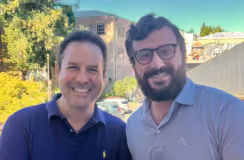
Host: Today I delve into two topics with a name you may recognize. Mark Sinatra Mark was an early guest on Acquiring Minds and more recently he's become one of the show's sponsors. The first topic with Mark is what your HR due diligence should look like when evaluating a business to buy. This area of diligence is often overlooked, but of course getting the people the HR aspect of your acquisition right is going to be crucial. And the second topic is how to evaluate when to buy an add on business to your first acquisition. Growing through acquisition AKA Inorganic growth is a favorite approach for people who buy businesses if for no other reason than they got into their industry by acquiring. So continuing to acquire is a natural path. Mark is a believer in that path and we discuss the timing as well as a couple types of add on acquisitions. Please enjoy this conversation with Mark Sinatra, Search Fund Investor and CEO of Aspen HR. Welcome to Acquiring Minds, a podcast about buying businesses. My name is Will Smith. Acquiring an existing business is an awesome opportunity for many entrepreneurs and on this podcast I talk to the people who do it. You already know that business owners are making amazing use of virtual assistants, often based in the Philippines. And while virtual assistants are helpful, virtual professionals are transformative. Moore Staffing is a boutique agency that hires a players in the Philippines not for simple tasks but for deep competency work. Think operators, supply chain managers, controllers, Moor staffing de risks your engagement with a 12 month guarantee to you and they provide coaching for six months to their talent. When an engagement begins that means your hire is coached in the background, no additional cost to you so that your working relationship flourishes and is as successful as it can be. Global staffing is increasingly the norm and building the muscle within your business to take advantage of it will be crucial in the years ahead. Speak with more staffing about the pool of capable affordable managers they can connect you with. Check out Morenow Co. That's Morenow Co. Mark Sinatra welcome back to Acquiring Minds.
Guest: Thank you Will Smith. Appreciate it.
Host: Mark, you're a business buyer and now a two time Acquiring Minds guest. You were an early guest back in late 2021 so you have acquired and grown and exited businesses. You are an investor in other search deals, so broad experience in acquisition, entrepreneurship and your day job is running Aspen hr. Aspen HR is an outsourced HR provider so you have a lot of frontlines experience with the people side of things. And as comes up time and again on this podcast, small business pivots around this topic people. So we're going to dive into some specifics and Your expertise around some of these, these HR and people questions in small business for acquisition entrepreneurs. But first, Mark, refresh our memory a little bit. Give us a little bit more of a bio than I just did on you, please.
[3:40] Guest: Yeah, yeah. Thank you, Wall. Like you said, I pursued a traditional funded search shortly after getting out of business school. For many of the folks listening to this today, the big appeal was to run a company without really taking the risk or without having the idea that I was uber passionate about to have started one at the time. And I felt like the search fund model was the most direct path for me to get into that CEO seat. So pursued that path. I searched for about a year and a half and this is during the, I would say 2007 to halfway through 2008 time period. And then was lucky enough to cobble together a transaction to acquire a company called Staff one hr, which was a provider of outsourced HR services, otherwise known as a peo, to small medium sized companies. The company was based about two hours north here in the Dallas area. Was really good representation of I would say a lifestyle business where you know, the owner had kind of built it up, was looking to retire. No succession plan, no liquidity plan. So on paper had a lot of the attributes that you know, any search fund operator would to see in a, in an acquisition. I will say, and we'll go into this a little bit later. There were certainly some attributes of the business that were significantly, I, I think underprofessionalized. That kind of led to, you know, me spending a lot of time. The first, I would say three years or so, you know, really kind of fixing and trying to professionalize and trying to kind of gear it up to be more of a, of a gross company. But that said, we actually got it to a point, I would say like three years into the deal where I felt, okay, now we can really start to grow organically. Pursued a path of mostly organic growth for really the six year period from really 2011 to 2017. And on top of that made three small add on acquisitions towards the end of the hold period, which we'll get to later as well. Kind of package everything up together and we sold it to our largest privately held competitor in 2017 that was backed by a couple large private equity firms that were doing a roll up of the industry. We were the second to last acquisition that they did prior to them, about 12 months after they bought us. They then in turn packaged everything up and sold everything to a public company in our space. And so I left about Six months after that acquisition and then like you said, started kind of dabbling in investing in search funds and currently do that now with my friend and business partner Matt Zucker who I've known for, you know, long time, since the early days at Wharton. So we invest in search fund deals out of the ETA equity fund that, that we run. So.
[6:46] Host: Great, thank you for that Mark. And so the, and then Aspen hr. How did you get involved in this business?
Guest: Got involved in Aspen HR due to some mutual industry connections and I did make a, an investment but it was, it was started about five years ago and I got introduced really in the, in the very early innings of the business. But it was, it was after they had, they had started and you know, they were looking to really, you know, kind of grow, scale, professionalize the business. So in some ways actually some very similar elements to you know, kind of the search fund thesis. And you know, we pursued a path really since then of significant or organic growth to the point where, you know, we were recognized on the Inc 5000 list. Last year's the third fastest growing PEO in the country. This year will probably be up on a top line basis 50%. And really I think what's leading to that is this, you know, our white glove service model and our keen focus on, on our sandbox which is really serving, you know, the investment management segment. So we serve a lot of like VC funds, private equity funds and their portfolio companies and I think part of you know, our partnership as well, like we're starting to really kind of dive in more into actually serving, you know, search fund operators as well.
Host: Great. There will be a link to your first interview so people can get your story in full there. So we're going to move on from that and let's dive into some of the themes that we decided we'd talk about today. First, diligencing the people aspect of an acquisition. So this is something that comes up a lot, you know, looking for key men and women risk retain, making sure that they stay, that employees in general stay pro forma ing people coming to you on day one for raises. I mean there's so, so much of is, is about the team that you're about to inherit in lead. What do you want to let searchers out there know about how to diligence from an HR perspective?
Guest: Yeah, I mean, absolutely. I mean I think it's one of those underrated aspects of, of diligence that you know, when you think about due diligence in a traditional framework you would think about, you know, Q Of E legal. If it's a tech deal you do your tech diligence. If it's a healthcare deal, you do your healthcare diligence. But I feel like the HR component really gets, gets overlooked. And if I had to kind of boil it down into, I would say, you know, three areas. You know, one would be HR compliance. You know, the reality is a lot of these search fund companies have never, never sold before. Right. You know, HR is very, very rarely will they have a dedicated, you know, HR professional or HR manager that's an in house employee managing that function. It's usually a function that's shared really among like you know, could be the, the owner, the controller, maybe an office manager. So you know, I'll typically see a lot of improvement just to professionalize, you know, what the company is doing from an HR compliance perspective. Ensuring that you know, there's you know, proper classifications of employees between, you know, full time, part time, 1099 W2 very common issues that pop up that sometimes aren't really caught in the traditional, I would say workflows of, of due diligence that we'll see. You know, the second area would be like you said, you know, key employee transition risk. So you know, really understanding, you know, to kind of taken away like you know, besides the seller and the owner. But you know, who are those other folks that at the end of the day like really like drive the business, right. And like not just looking at like an org chart and like inferring from that because that often is not reflective of a reality. In terms of, you know, who do those like key customers really rely on, you know, for questions and answers on a, on a regular basis and you know, how is that person, you know, compensated relative to the market? What's their tenure, you know, are they engaged, are they happy? What's their tie to the owner? If the owner's going to leave, you know, will that key employee leave as well? Are they going to stay? To the extent and this is the hardest part of due diligence, you know, to the extent that the, the searcher, you know, or the buyer can build, start to build and form, you know, that trusted relationship during the due diligence and deal process, the better it's going to serve them in the future in, in terms of first like understanding well, you know, if this key employee going to stay on or not and, and hopefully you know, they, they will stay on and, and you get a good sense of, you know, what motivates them, what drives them, you know, what do they like about, you know, the current company, what don't they like? What do they want to see improved? Really asking a lot of, a lot of questions to, you know, seek their input early on is I think, you know, extremely, extremely critical. So I would kind of classify that second bucket, again as transitional HR risk. That is really critical. And I think it's really, it doesn't matter if the company is a service company, software company, healthcare company, or even a manufacturing company. Right. All of these companies at the end of the day have key employees that the seller and owner rely on to drive the day to day operational part of the business. Now I would say the third part is really assessing kind of going forward, do you have the right team in the right seats, doing the right thing, the right way. So more like the strategic HR element. And I don't know if you've had folks on this podcast before talk about different business growth frameworks such as EOS Entrepreneurial Operating System or Gazelle's, you know, through the Vern Harness method. But the bottom line is, and this is true from my experience, it is imperative that you have the key roles in the company at all levels, but particularly the, I would say mid level managers and then your executive team filled with people who are obviously technically competent for the role, but also culturally competent as well. And it's a very strong culture fan. If you can firmly kind of check those two boxes, then it's going to make your job a heck of a lot easier as the CEO to run and grow that company and to have time to focus on the right things to drive value for the company. I found from my experience, and this will dovetail into a topic we'll talk about a little later that, you know, it took me honestly too long. I would say it took me a good like three years to really kind of figure out the right formula and to have those right seats filled with the right people. But I can tell you once I was able to do that, that enabled me then to then focus on, you know, those add on acquisitions, to focus on growth initiatives and all the fun stuff that really drive, you know, significant value in the company. So kind of take it a step back. I think again, those are the three areas of what I would call HR due diligence that are extremely critical to evaluate in a potential transaction. And oftentimes you're not as a buyer and as a searcher, you're not going to be able to do really any dive or deep dive into those areas until you've probably made some progress in the transaction. Because the owner is likely going to be pretty guarded initially, you know, certainly post loi, even in the early stages of providing you access to, you know, some of their, you know, key leaders and key employees. But what I found is, you know, you as long as you continue to do what you say you're going to do in the transaction, which builds trust, right? And as you continue to build that trust with that seller and you continue to make progress through different key milestones and gating items in the transaction, the greater your probability is that you're going to be able to, you know, get good quality FaceTime, group FaceTime, even better, one to one face time with those key employees. And that is going to be really, really key again to giving you the confidence that, okay, you know, these key new hires or I'm sorry, these key employers are going to stay on, you know, post acquisition or conversely, maybe they're not, but either way you're going to have clarity in whatever direction that's going to go in.
[16:01] Host: I want to share an update on the Acquisition Lab. As you know, the Lab is a highly vetted cohort based accelerator and community for people serious about buying a business. After going through the Lab's month long intensive, you have ongoing access to almost daily Q and A sessions with advisors, regular live deal reviews with Walker Deibel, author of Buy, then Build Potential Deal team introductions and a very active Slack group with other searchers on the path. Well, the update is that the Lab recently passed 60 businesses acquired and for well over $100 million in aggregate transaction value. Also, all members now enjoy lifetime access to the Lab because when you buy a business, it's often just the first of many and the Lab wants to support you in every deal, not just your first. Lastly, check out my recent interview with Shane Ursum, episode 105. Shane acquired a business with over $1 million in EBITDA in just six months and he attributes a lot of his deal success to what he learned in the lab. Check out acquisitionlab.com or email the lab's director, Chelsea Wood. Chelseieve.com I want to hit one of the next themes, which is another thing that comes up, of course in due diligence is customer concentration. Well, I shouldn't say customer concentration. I should say being aware of your biggest customer. That big customer might or might not represent too much concentration. But even if it's not, even if you've got a nice distribution of your customers, you're still going to be hyper aware of who your biggest ones are. You have lost Your biggest customer. This is something that you've, you've experienced. Tell us that story and how, how you dealt with it.
Guest: Yeah, yeah, I mean it's definitely something that, you know, I'll, I'll see quite often when we're, you know, evaluating, investing in search fund deals. And that's partly just due to like the, you know, kind of, you know, fairly, relatively speaking, small nature of the deals. Right. You know, companies with 5 to 20 million revenue. So you know, it can be certainly solved for sometimes in terms of how you structure the transaction. I think in my case, when, when you know, diligencing the deal, the largest customer was actually only about 10 to 11% of total revenue, which, you know, still is like higher than what you would want to see, but nothing that was, I would say alarming per per se. But a couple things happened subsequent to close. One thing that happened was really a macro headwind of just the kind of a deep recession. And so, you know, that really hindered our ability to have as much organic growth as we expected. So didn't sell as much as we, we thought. And then coupled with current clients, you know, we had some clients that were just, frankly just went out of business or we had some clients that were reducing headcount, which reduced their revenue. But at the same time our largest client actually during the recession grew very quickly. It was a company in the property management space and you know, they were just well capitalized and they really took advantage of a significant growth opportunity to acquire new properties to manage during the recession. And so if you just kind of look at it mathematically like the numerator grew a lot while the denominator kind of reduced. And so I kind of found myself, you know, a couple years post acquisition with now my largest client. Not they weren't 10%, but lo and behold they were actually 30% of the business. And it presented us with like a significant risk. You know, from, from that perspective, of course the fact that they grew was really nice, but it's a double edged sword, right? Because the more they grew, the more, the more risk there was. And kind of looking back at it, you know, despite the fact that they, that they grew so much in headcount, at the end of the day, like at their core, you know, they're very, I would say, you know, kind of relationship based folks, you know, the, the, the decision makers and, and the influencers, you know, at that organization. And unfortunately for us, you know, we had a kind of a long term, long tenured employee who was really kind of at that retirement age and you know, unfortunately, like after, like I would say the two year period, really wanted to, you know, retire permanently, you know, kind of forever. And it, it kind of gave us a, it left a void in terms of okay, well, we have to really do a good job of ensuring that the replacement for this individual would be equal to or just, or even better. Right. In all aspects. And the short answer is that I just did not get the replacement hire correct at all. It was just, it was really kind of a, I would say a misfire on my end where I think I had valued, overvalued perhaps, you know, this individual's, I would say, you know, kind of HR competency and skill set came more from a traditional, perhaps corporate background and not really a small, medium sized company background. And so the relationship building component wasn't as, as high as, you know, what the other person had that retired. And so as a result, you know, the largest client was really not comfortable at all, you know, with the, with the person who, you know, we had hired to, to replace. I will say, and I may have talked about this on the last podcast and so maybe slightly redundant, but real quick, I mean that really, that whole experience, you know, kind of opened up my eyes to leveraging, you know, the use of personality profiling tools to increase hiring effectiveness, improve hiring accuracy. And, and you know, I will say, like, I don't think after that experience, I really don't believe I had a misfire to that extent, but it really did, you know, I think have a negative impact on this client to the point where I remember walking into, you know, the building, our building one day and got in the elevator and you know, saw this FedEx guy with an envelope and going to my floor and I'm like, oh geez. Like, I just had a really sinking feeling in my stomach that it was going to be some sort of a cancellation letter. And it was, that's what it turned out, turned out to be. And, and that, that really, you know, kind of set the stage for us to really, you know, restructure the business and really kind of like showing kind of a magnifying glass of just making sure that we really understand the type of employee and executive that would be value add to us and to our clients going forward.
[23:44] Host: So to be clear, this customer of yours who hadn't represented too big a percentage initially had grown into 30% of your revenue. The person who is servicing on your team, the person on your team who is servicing that client retired and your replacement that you chose, it was Just a terrible fit.
[24:04] Guest: Yeah, I mean it was my, I mean definitely my mistakes. I mean I don't want to put it on that individual like solely. And there, there were, you know, a couple other challenges as well which you know, as what we have found is as companies tend to get extremely large. Right. I mean like you know, thousand plus employees, the kind of the, the way that you service them, you know, in the earlier days changes. Right. And needs to change. And I don't think we, you know, we really adapted quickly enough to that. But that's a good, that's a good summary on your end though.
Host: Yeah. And so what to do differently was what, what you took away from that experience, which is personality test. I mean you became much more data driven, analytical, scientific even in terms of key hires. Is that, was that kind of the, the big lesson?
Guest: Yeah, that's definitely one of the, the biggest takeaways. I would also add as well though that we went to more of, I would say a decentralized approach to managing the client, clients in general. Right. And, and, and so there's always like a double edged sword of having do you have a single point of contact to make it kind of easy, seamless for the client or do you have kind of a team of people? And we went to more the latter because we felt that sticking with the single point of contact model would have presented us with a similar risk where in the future of being you know, kind of too concentrated in, you know, of you know, risk in that the quality of that relationship between the single point of contact and the client. And so kind of decentralizing that among, you know, I would say like three individuals on a team or pod, if you will, was something that we went to afterwards that I think really helped, you know, mitigate that key person risk going forward.
Host: Great Mark, thank you for that story.
Guest: The,
Host: one of the things that you, I think you mentioned, but I know from your, your, your experience over those nine years was that you, there was a lot of organic growth but you did do a couple of add on acquisitions and you also see into, into search deals of other acquisition entrepreneurs wanting to buy and then acquire more. And that certainly is something that you hear about a lot here on acquiring minds, people doing that and it's one of the exciting, kind of one of the exciting prospects. It's like once you've done your first deal, you've learned how to do a deal. If you bought kind of a good platform, then maybe these second and third deals are even easier. You're now part of the industry. So you're not some outsider knocking on doors saying, hey, can I buy your business? I mean, so you know, it should only get easier. Now that's probably naive and a lot of people have said that their whole plan is to, you know, buy the first business, then the second and the third, then the fourth. And they got in there and realized how unrealistic that, that unrealistic that was. However, it's still a playbook, it's still certainly done. What are your thoughts on how, how searchers that you talk to should think about add on acquisitions and how you have in your own business?
[27:28] Guest: I mean, I think in general, inorganic growth, add on acquisitions can be a fantastic lever to grow and to increase enterprise value, particularly in industries that are fragmented industries where the barriers to entry may be, I would say like low to moderate, but the barriers to scale are high. And so as a result, you've had a lot of companies that kind of plateau, you know, at that, you know, anywhere from 1 to 20 million in revenue. And they just, they either can't get beyond that or they don't want to. Right. Because oftentimes, you know, an entrepreneur can actually be the most risk averse person when, you know, they get their company cash flowing to a really sustainable, you know, predictable level. Right. And so then it starts to kind of, kind of plateau. And those can be really interesting and very creative acquisition opportunities, you know, for a search fund, you know, operator, I think the way that I approach it. So I did three add on acquisitions. Two of them were extremely accretive at a weighted average. You know, actually they all were creative, but I would say two were very successful. One was, was, I would say like average but you know, across all three, the weighted average but multiple was actually like 2.7. Now that was synergized, that was post, post synergies, but you know, we sold for double digit EBITDA multiple. So you can see like, you know, there's significant arbitrage there. But it was a strategy I didn't really pursue until, I mean, I would say like at least five or six years, you know, of running the business. I wanted to make sure that we had a strong foundation first where we could operationally do a great job with integration and absorbing those add on acquisitions and that we were showing sustainable, consistent double digit organic growth. And so once we were able to check those boxes was when I felt comfortable actually pursuing inorganic growth as a strategy for us. And so one of the things I did was I got really involved in our industry trade group even to the point where I served on two different boards at different times. And that gave me really incredible, I would say, visibility and profile within the industry. So that, you know, when I did my reach outs to potential target companies, it was often a friendly reach out. Just as, hey, I'm just representing the industry trade group, wanted to give you a sense of, you know, what transpired at the last meeting and just, you know, kind of trade insights. And I felt like most, if not everybody was very receptive to that. And of course like invariably like, you know, the conversation at some point would turn to whether or not the company was going to be receptive to us, you know, engaging in some high level conversations about us acquiring them. But I would say like that use of my time was really kind of high return on in terms of, you know, being able to just build relationships, build my profile and just build credibility within, within the industry to give me kind of an early look at, you know, acquisitions that you know, were sourced by myself proprietarily or, or maybe even through, through a broker or, or to a banker. So it turns out, you know, we, we closed our first two. The first add on acquisition was two years prior to our sale. The second one was one year and the third one was actually two months prior to our sale. And they were all add on acquisitions where it was essentially buying a book of business one of them. The second one was a little larger. So we did inherit and retain most of the employees. I think there were nine employees, not eight or nine employees that we retained from that deal. But ultimately it was still like, I think all three were pretty much like buying books of business. And I really like the timing in terms of how, you know, we kind of planned it out in terms of, you know, the add on acquisitions being done and then, and then our exit because it allowed us to, when we kind of went to market, we could show that we did these deals and you know, post deal, post transaction, we had, you know, very high retention rate, you know, of those clients. And so it was a real, I would say compelling, credible story to potential buyers that we could say, okay, we've grown organically, continuing to do that, but now we're also credibly growing, you know, inorganically. And it was a good story. I feel like, you know, there's obviously different types of add on acquisitions, right? You've got your book of business acquisition, which is what I pursued. I feel like, you know, those are, can be great deals in like the second half of your hold period before you exit. Because if you the risk Is if you do those books of business deals a little too early and you don't have a good model to really retain those clients, you could end up attriting, you know, a good portion of those clients by the time you exit the, the entire deal years years down the road. On the flip side, you know, if you're looking at an add on acquisition that could give you access to, you know, a wider, you know, deeper pool of talent, so kind of more of a quasi aqua hire or an add on acquisition that'll give you access to a new market or to new product, new service. I feel like those acquisitions, you know, to really get the biggest bang for your, for your buck are best done in the idea if you can in like the first half of your hold period so that you know, you can, you know, do the level of integration you need and to extract the amount of, you know, value add synergy, revenue synergy if it's a new product or service or new geographic market or human capital synergy in terms of, you know, having access to, like I said, you know, wider, you know, deeper pool of talent because there's some latency involved right in all of these deals where, you know, the work that you do day in and day out may not flow through and show up in the P L until like, you know, several months later. And so you want to make sure that, you know, if it is an add on acquisition like that, that you're going to do that, you know, kind of well before you know your, your exit time horizon. So you realize the value of that acquisition. But if it's a book of business, like I said, I feel like, you know, that can be done, you know, certainly in like the second half of the whole period. So those are just my thoughts on, on and my experience, you know, with, with doing add ons.
[34:54] Host: Well, you, and you mentioned integration and I guess when it's a book of business, those are kind of integrated kind of pretty seamlessly because you're just plugging in those customers. But for, for businesses or acquisitions that are not just book of business, book of business acquisitions, you know, integration is, is the trick. And, and sometimes you don't necessarily need to integrate. You just kind of have two businesses that might be complementary or adjacent or even in the same space, but you decide to keep them segregated kind of or as different. Two different entities. Is there any way to generalize here some best practices or is it so case by case that, that, that, that is hard.
Guest: Yeah, I think there is. I mean I, I was accepting on both Sides, right. So like you know, when I, when I sold, you know, the, the search fund company, you know, we were essentially an add on, right to a much larger platform. So I've been on both sides here. Now the difference though is, you know, when I sold the search fund company as the add on, you know, that was I guess about a year, yeah, it was a year before that entire company sold. But I really thought that the buyer in that case did a really, really good job of the, of approaching the integration. So their approach to integration was to really identify what I would call like, you know, if you look at a two by two like the low hanging fruit, that would be fairly easy to synergize and, but would not have any impact on the clients. Right? So that, that kind of like box like was like tier one priority. An example would be, you know, certain back office functions, you know, trying to realize some, some efficiency synergy and you know, finance and accounting, you know, corporate hr, you know, things like that that were kind of like fairly easy to, to realize that synergy of, you know, maybe they had, you know, they were much larger scale so they had discounts on things such as, you know, their banking relationship or other vendors and so kind of absorbing us there as long as it didn't have an adverse impact on the client experience. So conversely they were very hands off in, in a lot of other areas. In terms of even, even our brand, you know, we were able to still sell, you know, underneath our, our, you know, existing local brand for a pretty long period. You know, I would say up to I think at least 24 months post close. And so that enabled us to then, you know, I would say have a good show, good organic growth post acquisition and to have high client retention as well. Because the client experience in terms of who do they talk to for day to day questions, who they talk to for payroll, what kind of technology platform are they using and were those workflows going to change? None of that changed whatsoever obviously. I mean it did at some point, but that was, it didn't change I think for at least two to three years, you know, post acquisition. And so I thought again, the acquirer of, of my search fund company did a really phenomenal job at like just identifying those easy, quick wins that were not going to have any impact to revenue and then just being, you know, I would say fairly hands off and supportive in terms of initiatives that would be positively impacting revenue.
[38:40] Host: Mark, I know I'm, I'm looking at the clock here and I know you have a hard Stop. And so I, I need to let you go. But there are going to be a lot of people listening to this who are working on deals. If they are interested in, in talking to you about investing in their deals, should they come to you?
Guest: Yeah, definitely. If you know for traditional funded searchers that want to learn more about us, definitely check out the website which is etaequity.com for the HR stuff, PEO stuff, HR diligence. That company is called Aspen HR. We've helped several searchers with their PEO and HR evaluations. My email address is Mark with a k@aspenhr.com and yeah, I appreciate you being cognizant of the time. I mean I do have a 1pm barber appointment which you can probably tell so definitely don't, don't want to miss that. Of course.
[39:39] Host: And Mark, just to be clear, should self funded searchers reach out or just traditional search fund folks?
Guest: Any, any and all, all searchers. I will say for terms of you know, in just purely investing as of this time, you know we're, we're really kind of focused on the traditionally funded asset class but I talk to self funded searchers all the time and just the context of just you know, answering questions, you know, providing you know, any advice particularly when it comes to like kind of the, the hr, you know, side of those, of those deals. So really just happy to talk to anybody, you know looking to, looking to buy and acquire and run a business.
Host: Great. Well Mark, thanks for coming back on Acquiring Minds. I will let you go and get those hairs cut and we'll put all of his contact information in the show notes. Thanks very much sir.
Guest: Thank you. Thanks Wal.










































































%20-%20thumbnail.avif)





%20-%20thumbnail.avif)



%20-%20thumbnail.avif)

.avif)




%20-%20thumbnail.avif)