Host: The allure of Passive income It plagues the Internet, generates clicks and course sales, but of course disappoints nearly all those who chase it. In our world of buying businesses, the passive income fantasy looks like this. Buy a small business, pay someone to operate it for you out of the profits of said business. Collect checks. Most experienced people would say that such a strategy will break quickly and painfully, and to just put that out of your mind. But as today's guest Matthew Saskind points out, in some ways the private equity model is built around doing exactly this buy, business, install operator. And Matthew himself is doing it. Now, as you'll hear, Matthew's acquisition is certainly not passive. He's putting 10 hours a week into the business, maybe more. But he did hire an operator to run and grow the business from the moment he became owner. The arrangement is working well enough that Matthew still works as W2 and plans to indefinitely. So this is a fascinating case study of looking for a small business to buy and an operator at the same time, with the intention to install that operator immediately and never really operate the business yourself to be working on the business, not in it from day one. Also, you're going to learn about the towing business and some of you will immediately jump on bizbuysell to look for one after you hear what Matthew has to say about that industry. Enjoy my interview with Matthew Saskid, owner of East Coast Towing in North Carolina. Welcome to Acquiring Minds, a podcast about buying businesses. My name is Will Smith. Acquiring an existing business is an awesome opportunity for many entrepreneurs and on this podcast I talk to the people who do it. I want to share an update on the Acquisition Lab. As you know, the Lab is a highly vetted cohort based accelerator and community for people serious about buying a business. After going through the Lab's month long intensive, you have ongoing access to almost daily Q and A sessions with advisors, regular live deal reviews with Walker Deibel, author of Buy, then Build Potential Deal Team Introductions and a very active Slack group with other searchers on the path. Well, the update is that the Lab recently passed 60 businesses acquired and for well over $100 million in aggregate transaction value. Also, all members now enjoy lifetime access to the Lab because when you buy a business, it's often just the first of many and the Lab wants to support you in every deal, not just your first. Lastly, check out my recent interview with Shane Ursum, episode 105. Shane acquired a business with over $1 million in EBITDA in just six months and he attributes a lot of his deal success to what he learned in the lab. Check out acquisitionlab.com or email the lab's director, Chelsea Wood. Chelseieveenbuild.com Matthew Saskind welcome to Acquiring Minds.
[3:10] Guest: Pleasure to be here.
Host: Matthew. You bought a towing business in North Carolina at the end of last year. We're going to get a little tutorial on the towing business today which I'm excited about. But also you acquire this towing business which is a, was a larger business, is a larger business for a self funded searcher and immediately put in an operator. You are not the owner operator. And this is a fantasy of many people and yet discouraged by many others. Don't think they say that you can buy a small business 10% down SBA loan and just put it in operator and not be the operator yourself. At least not initially.
Guest: Right.
Host: You are doing it though and are even maintaining your day job, your W2. So we're going to spend a good amount of time on this structure. How you pulled this off, how you would address the naysayers. But first, Matthew, let's have some background on you, please.
Guest: Yeah, yeah, by all means. So you know, as you mentioned with the businesses in North Carolina. So I live in North Carolina. I'm in the Durham, North Carolina area. I've been here about 10 years or so. Was in New York City for most of the time before that that by way of background I come out of the technology industry. So my, my, my degree is in computer science, although I've never used that practically a day in my life, but have spent my most of my career in the technology industry mostly in technical sales, sales leadership, general management and executive roles. Been at large global enterprise service providers, have run startups and done a little bit of everything in between and that's, that's what I do today as well. I look after go to market operations for a large technology company separate from that. About 15 years ago my wife and I started investing in real estate as a, let's call it a solo gp right. Our, our money, our investments. We did what I think many people do, which is bought a triplex using an FHA mortgage as our sort of first home plus investment. So you know, started out the gate with fairly minimal down on that. The FHA program is a fantastic way to get into real estate investing. Had a couple of, couple of tenants pay the entire mortgage and then some. And this is, this is when we were living in New York City and over time we just kept investing in real estate buying you know, larger and larger properties. So went From a triplex to you know, some larger stuff, a couple of, a couple of 10 unit properties, 20 some odd unit apartment building, all in the kind of value add class, class C housing space. And you know, we've been doing that kind of on the side for the past 15 years. Have always had professional property management so sort of used to the, used to the concept of having others involved in a lot of the day to day operations of the thing we were putting our money into. Took advantage over the past several years of the run up in asset prices during COVID to to sell almost all those. So we're now at a place where kind of the only real estate we own is the, the house we live in and a piece of land that we're building a new house on. And then we ended up being, you know, mid last year left with, left with a bunch of profits from some of these real estate sales going okay, what's next? Like where, where are we going to put the money? The real estate market for, for various reasons, just not, not a place we were looking to put a ton of money in at that point. And you know, given, given my experience kind of running companies and running startups and, and some things we had talked about, you know, we had considered, you know, is it worth buying an operating company? And that could have taken a number of different directions. Right. If it was something that was, that was truly large enough, I'd be happy to step into that day to day. If it was something that was, let's say a little bit smaller but still relatively big and we could talk about what that means, you know, which was the ideal target, one that's big enough that has the cash flow to support debt service, support reinvestment into the business and most importantly support bringing in an operator, a true executive level leader to run the business day to day. And we also sort of geographically boxed the search to be relatively local to us. And the goal there was as an absolute fallback plan if things went completely sideways, I'd have the ability to step into the business full time. My wife would have the ability to step in and help with things. So that's always the contingency plan. You know, we're three and a half months in, knock on wood. We, things are looking extraordinarily positive and we'll, we'll talk more about that. So if I say took the money, spent about six months in total looking at businesses, the end of the day I probably probably reviewed 40 or 50 Sims, ended up talking to maybe 10 or 12 sellers, ended up issuing a single LOI for the one for this one business that I thought kind of was the right one after, you know, several meetings with the sellers, probably spent six, eight hours in total with the sellers before we even got to issuing an loi. And then, you know, progress to close. And as you mentioned, we closed the beginning of December and kind of jumped right into it.
[8:04] Host: Great. That was a great background. Thank you. Going back to your real estate just, Just for some color. I'm interested. So all of your. How many doors did you have at the end there, by the way?
Guest: At peak, like 50 something. And it kind of ebbed and flowed over time where there were a few, few things we sort of opportunistically sold when the right offer came along and had. Had been rolling Those forward with 1031s with a few exceptions. And then the end. Decided to just get rid of that last handful of properties.
Host: And that first triplex that you bought, where was that? Where in New York.
Guest: That was in. In Bushwick. So in Brooklyn, Pre. Let's say pre Bushwick. Getting. Getting cleaned up. So, so for us, it was just my wife and I at the time. We, we did not have kids when we were in New York. Um, and for us, the, the toss up was essentially, well, for about the same amount of money, we can, we can either purchase kind of a. A condo in Park Slope or we can purchase this triplex in Bushwick and have a, Have a kind of different life, but start a path that's. That. That reinvests money. And we, you know, hindsight being 20 20, made the right decision.
[9:12] Host: Well, it's, It's. It sure set a precedent because, you know, you built this whole big portfolio and then have parlayed that into small business ownership. And so now it's, it's, you know, your thing. You guys are building serious wealth on the side. That's great. And so all 50 of those doors were in New York proper, in Brooklyn proper even.
Guest: We had no. We had properties in New York City down here, outside the Raleigh area. We had a building in Chicago.
Host: Oh.
Guest: So. So our goal was really about really investing in markets that we. That we knew, right, either that we had lived in, we had spent a bunch of time in. So we were able to sort of understand some of the, The. The inner workings of the very specific areas we were putting money into. So that. That's sort of what led us to a handful of different markets. At a certain point, it stopped making sense to invest in New York City. At a certain point, it stopped making sense to invest in the kind of surrounds of, of Raleigh. And that's where we landed.
Host: Okay, let's go back to your search now. So first of all, how were you searching? Were you just reaching out to cold outreach to brokers or Biz by Sell? Go ahead.
Guest: Yeah, so an entirely brokered deal. So we, we did not do any proprietary outreach and go and start calling sellers or potential sellers. So a mixture of some outreach to local brokers who I saw were doing volume and then deals that were sort of broadly published. Right. Things that were on Biz Buy Sell and others. And that's sort of what led to the 50 or so at the top of funnel, so to speak.
Host: And the brokers that you outreached to that you saw were doing volume. Did you infer that they were doing volume simply because of their activity on Biz Buy Sell?
Guest: So a combination of that things that got listed on their own sites that weren't on Biz Buy Sell. Some discussions I had with some other folks who were searching sort of led to, led to where we are. And I knew from the beginning kind of the things that didn't interest us. So there's certain industries we had, we had no interest in buying a business in. Right. Being in a pure retail business, food services industry, sort of the traditional home services businesses that everyone's buying, those weren't of huge interest for a variety of different reasons. And then as I mentioned, we had sort of the geographical box of wanting to be within the general Raleigh Durham area and then a size box. Right. There's sort of a minimum footprint and obviously that changes based on interest rate and those sorts of things. But based on the equity you're looking to put in the deal, there was kind of a minimum, minimum EBITDA or cash flow needed to support buying the business debt service, putting a leader in place and then still having money to reinvest.
Host: Yeah, Typically it's, there's kind of the three things that a searcher is looking for in terms of ebitda, the debt service themselves and reinvesting in the business. But you had that fourth, which was the operator, because it wasn't, it wasn't you.
Guest: Right. And I was also, you know, by virtue of, you know, I have a W2, I'm well paid, I really enjoy what I, what I do day to day. So, you know, was able to sort of minimize the amount of money I'm paying myself basically to whatever, you know, to what our accountants felt was a reasonable amount to maintain S Corp status and be able to get the benefits from there. So, you know, paying myself sort of the minimum amount the accountants are happy with. We're not taking any distributions now, nor do we foresee taking distributions out of the business for the, you know, let's call it the next three to five years. It's truly, truly in reinvestment mode.
[12:29] Host: Okay. So actually the ebitda, the profits from the business didn't need to pay for that much more than a typical searcher would because the typical search is going to pay themselves as an operator. And you were just going to pay an operator and pay yourself just kind of a token amount that, to keep within IRS requirements of an.
Guest: Exactly.
Host: Although you probably had to pay that operator or are paying that operator much more than, than many searchers pay themselves, they're often willing to pay themselves less early on because they're also in reinvestment mode.
Guest: Correct? Yeah. So we've got a fairly, I'll say a fairly healthy cash plan for, for the, the person I've got leading the business, he's got some upside on an annual basis and then we also put together sort of a phantom equity program. So you know, he's sort of in it for the long term. We've got a multi year vesting period and you know, he'll, he'll own a reasonable, or he'll own the equivalent of a reasonable portion of the business over the next several years. So that, you know, sort of, we're, we're, we're tied together in terms of the long term success. He knows the direction we're looking ahead with the business. We're sort of, we're in, we're in mutual agreement there and working towards the same goal.
Host: Well, we're going to get into that in some more detail here in a few minutes. And Matthew, you have referred now a couple of times to your geographic box just for people to understand what, what was your limit? I assume it was kind of a number of minutes drive time, no traffic radius. And what was that exactly?
Guest: Yeah, so we were generally looking in kind of, let's call it 30 to 45 minutes in the Raleigh Durham area. Like I said, I, I live in Durham, so a little bit I'm sort of northwest of Raleigh, but what you end up with in North Carolina is sort of Raleigh, Durham, Chapel Hill and some of the outlying towns form kind of the research triangle. Right. That form this nice geographic area. So we were really looking in those, those cities plus the surrounding towns and that's where we are.
Host: But you, you were going to allow yourself to buy a business that Was up to, let's say 45 minutes away, would you have gone an hour away?
Guest: It's, everything's malleable, right?
Host: Yeah, yeah, yeah,
Guest: exactly right. If it was the right thing in the, the, the home office, so to speak, was an hour away. Cool. If it was the right thing and in this case, kind of our, our current home office, home office, head office, whatever is 32 minutes from my house without traffic. So you know, it works for the, for, for when I need to run down there and you know, when I need to, you know, I, I've gone down on weekends. I still work out of that facility sometimes during, during the day, if only because the, you know, it was a family run, family held a business before. Most of the employees I don't think are yet at a place where kind of an absentee owner or a financial owner, call it what you will, is something they really understand. So I've been making sure from day one that I spend time, I get to know everybody, that I'm still a visible part of the business despite all the day to day decision making being handled incidentally by a guy named Matt who's the operational leader.
[15:29] Host: And so what does that mean exactly how many times a week are you in there or time every two weeks?
Guest: Yeah, no, so, so we sort of timed the close right to where you know, we, we sort of had vacation and the holiday and all that. So I was able to spend kind of the first three weeks fully dedicated to, to being there, to helping get things up to speed, getting, you know, while, while Matt's been handling a lot of the day to day ops, you know, I spent a whole lot of time getting back end systems up and running, making sure we were good to go from, you know, the bank and all the finance systems and got our accountants up to speed and all of that moving forward from that point forward, you know, I've been working out of that office doing my other stuff a couple of days a week generally and we've done, you know, it's a 247 business which we'll get into. So I've had the ability on nights and some weekends to go out to large accident scenes and sort of participate with the team and make sure they understand that kind of I'm a visible, sort of a visible force and part of the business. Similarly we've been sort of ramping up internal training for our drivers and we've been doing those on weekends and I'm, you know, making sure I participate in all of those again to be visible but also because quite frankly, it's, it's, it's cool. Like these are, this is cool equipment to get to play with and learn how to operate.
Host: Yeah, yeah, super cool. Okay, so for those first three weeks you were in there kind of daily and now you're in there a couple times a week. But you might, you might actually just be doing like your other work, but your face is at least there. And, and, and then you'll also kind of go to these trainings. You might go out into the field every now and then to actually see the work happen and kind of special occasions. So just looking for opportunities to, to, to, to learn yourself, but also to show folks that you're there.
Guest: Yeah, very much so.
Host: Yeah. Yeah. And then how do you envision that kind of declining? Because I assume this is, you're, this is kind of like an early burst for people to see you and for you to learn and that it'll decline a little bit over time. Do you, do you, do you have kind of a steady state that you envision at month 6 or month 12 of how often you'll be in the business?
Guest: Yeah, absolutely. So, so over sort of the longer term, the intent is once we hit probably in the month six to month nine range, I'll probably ratchet that down to maybe once a week there. And by the time we hit, you know, middle of year two, I wouldn't intend to be spending a ton of time there. Additionally, you know, for now we've been, you know, I've been making sure that when Matt, my GM is unavailable, that, that I've been there just again, so there's someone who's present. We've now, after, you know, three and a half months in, I think we've got, we've got the right managers in place and we'll talk more about that and sort of the right people understand that they are allowed and empowered to make certain decisions on their own. So I'm less worried that something's going to happen and someone physically has to be there to make a decision because we've, we've, like I said, we've got the right people. They know now that they are empowered to make decisions around certain things. So, you know, overall that's, that's how we're moving along.
[18:31] Host: You already know that business owners are making amazing use of virtual assistants, often based in the Philippines. And while virtual assistants are helpful, virtual professionals are transformative. More Staffing is a boutique agency that hires a players in the Philippines not for simple tasks, but for deep competency work. Think Operators, supply chain managers, controllers moor. Staffing de risks your engagement with a 12 month guarantee to you and they provide coaching for six months to their talent. When an engagement begins, that means your hire is coached in the background, no additional cost to you, so that your working relationship flourishes and is as successful as it can be. Global staffing is increasingly the norm and building the muscle within your business to take advantage of it will be crucial in the years ahead. Speak with more staffing about the pool of capable, affordable managers they can connect you with. Check out Morenow Co. That's Morenow Co. I want to go back to your search and get through that and then, and really, really get into post search. But you had said that you don't like home services, which is as you mentioned, a hot area of searcher activity today. Why did you decide that you don't want a home service business?
Guest: Yeah, I think part of it was dealing with. Part of it is just the valuations have gotten crazy. The other part is dealing with some of the, dealing with some of the licensure and things like that. And then the third, which may just be sort of local to this area, there are a handful, you know, you look at H Vac businesses, for example. We have a handful of extraordinarily large, well run, you know, fully digital H Vac services businesses in this area. I've called them before, I've used them, I've been a customer of theirs. So there's not a ton of sort of differentiated advantage I could bring to those because there are several here that have already followed the playbook that most searchers who are requiring, say H Vac or plumbing businesses would follow. So not, not, not much opportunity to grow them here.
Host: Okay. And you didn't want retail and you didn't want food service. Any others that would kind of be interesting to people that were our conventional choices that you chose against.
Guest: Nothing that comes to mind. I look just, just by nature of my background, I looked at a couple of small, small technology businesses. A couple, you know, some, some agencies and things like that. Yeah, those just, I don't know, maybe it's because I'm used to working in more scaled technology businesses or, or software startups as opposed to, you know, a $5 million software business is very, very different than a $5 million agency in that you don't really get a ton of operating leverage in an agency professional services model you do in software. So it's sort of all the worst parts of a services business and being subscale. So there are a Handful of those in the market. I talked to the sellers, looked through them and they just didn't, they didn't do it for me.
[21:28] Host: But they're less attractive to you than a traditional services business where there's also doesn't have the, the operational leverage of software. Yeah.
Guest: And I think the difference there is a sort of a traditional services business and we could consider towing a services business because it really is. Right. We don't, yeah, we don't gain any, we don't gain any leverage from anything really. Proprietary is sort of much like the H Vac playbook. These are, these are businesses that are so far behind on the, on the everything curve. Right. So we can, we can call it technology but it's the, the use of marketing how you go out and acquire customers regardless of what facet of the business you're doing that there's still the ability to really gain, gain something over time. Whereas there are so many technology services businesses that you know, if you're a $5 million one, there's not much you can do. You're not, you're not, you don't have the cash flow available or the person power to reinvest into some proprietary systems to actually gain any leverage. So it's really just like a, it's a labor arbitrage game at the end of the day.
Host: And actually I want to circle back to that point but first did you look at software businesses like, like, like on micro acquire? I mean somebody like you, did you go out and look for or E commerce where I mean there is more opportunities for leverage than just an agency.
Guest: I did not. Ecom as a whole just doesn't, isn't particularly attractive to me. I don't know why. It just isn't. And smaller software companies there's just at given what valuations people are looking for there, there's a lot of garbage businesses out there that are both not making money and sellers have unreasonable expectations of what they're worth. So nothing, you know, I, I perused my grow acquire a little bit. I see some deals there every so often but nothing, nothing's just jumped out at me as like oh my, oh my. This is, this is the thing. And also I think in a smaller scale software business like you really like I said, my degree is in computer science but I am not a developer or engineer by any stretch of the imagination. And I think with a lot of the smaller software businesses, unless you're the one who can go in and actually not just diligence code base but be able to Start making changes and driving improvements, you're truly at the mercy of whoever you can hire.
Host: Okay. And then Matthew, I also just want you to talk a little bit about your. This might be jumping the gun a little bit, but you have a lot of experience managing people as you said at the top in your, in your background you've, you know, managed very large teams within larger businesses. You've been involved in smaller startups and everything in between. How in these first three and a half months is that serving you? And also speak to people who might not have the same, the same amount of management experience that you do and what you would tell them?
[24:15] Guest: Yeah, absolutely. So it is definitely serving me well. And it's sort of funny you bring it up because I was before we started recording, I'd mentioned I met with another searcher who just recently acquired incidentally a towing business here in Raleigh. I met him over the weekend for dinner and one of the things that I think couldn't quite articulate when we first started talking, but now he's about two weeks post close and it's hit him is kind of for us the first month plus was, was truly an exercise in sort of in EQ and people management. Right. You got a lot of people and in our case it was a, it was a closely held sort of family run business. The, the founder of the business had unexpectedly passed away several years ago, but his, his wife and some of her family members stepped in to take over. So you know, there were a lot of really, really close personal relationships within the business and I think, you know, a handful of the employees maybe felt a bit of a betrayal that all of a sudden this link to the founder who many of them knew was gone. So yeah, the first month just having the ability to, to go in and sit down, talk to people, kind of understand what their concerns are, what their fears are, what they're looking to do was, was absolutely invaluable. Like month one, quite frankly, we really didn't look at much operationally like one of the, the former gm who was a minority owner stayed on with us for several months in a consultative basis and we, we let him continue to run the day to day show for the first 30 days. So you know, first 30 days for us were meeting the people, allaying concerns, kind of becoming, becoming members of the team, making sure they all understood what the goals were, which is quite frankly not to change a lot but to make it better in a couple of discrete ways and then getting the back office stuff moving right, like making sure the bookkeepers were lined up and that payroll is working the way it should and all those sorts of things. So to bring it back, I think having. Having experience managing kind of widely distributed and larger teams was, was absolutely helpful. The flip side of that would be, you know, if you're a searcher coming out of a, maybe coming out of a background where you don't have a ton of direct management experience, I don't necessarily think that's a problem. Like I said for us, the first 30 days was probably a little less about. I've had experience managing, you know, teams of hundreds of people and more just having that eq. Right. Having the ability to empathize and sit down and talk with people who realistically come from a very different background than you do that than I do, than most searchers come from and truly kind of understanding what are they looking to do, why are they here, what motivates them, what are their fears about everything that's going on. So take that for what it's worth.
Host: Yeah, that's great. And, and going back on this point about the eq, so do you think that your misstep might have just been kind of not showing empathy, not appreciating how disruptive this might be and how threatening this might be to, to. To the, to the staff's professional lives? Like what, how. What would have a less ideal transition look like?
[27:20] Guest: Yeah, and I think it's not like it, it. I want to be careful because I don't think it's a misstep. I think it is. I certainly, I didn't fully appreciate going in, just, just how kind of EQ heavy the first day and then the first week and then the first month would be. Right. I think a less than ideal transition would have resulted in, resulted in, you know, people, people rage quitting and walking out the door. So that would, that would be the less, the less than ideal scenario. Luckily for us, I sort of knew going in and was able to witness it firsthand. Like there were several employees who were. Who were really upset week one, just super emotional. Especially the ones who had been with us for say 10 plus years that were very close to the original owner and founder who had passed away because this was truly the end of his family running this company. But sort of I knew going in we had long tenure across a number of employees. We pay pretty well, not top of market, but pretty well. We offer substantially better benefits than our competitors in the surrounding area. And you know, we're generally. It's a good place to be our customers like Us, they're, they're happy with us. It's not a super stressful environment. So you know, some of the people, it was really about just kind of giving them space to breathe and process and then making sure we can engage them. Others were kind of gung ho from the beginning to just start, start getting to know each other and get moving
Host: and talk a little bit about how this theme of, you know, you coming from a techie, white, very white collar background and interfacing with people who have a very different, very blue collar background. Did you. Yeah. Anything you want to want to say about that? Other than the obvious? Just culturally it feels very different.
Guest: Yeah, no, I think there's sort of two things that were extraordinarily helpful. One is, and I guess this probably speaks a little bit to buyer business fit as as many will call it. While I know relatively little about the or I knew relatively little about the towing industry. I've at least, I've had cars towed of mine. I've sort of my fallback career, I always joke is being a mechanic. I've always worked on my own cars. I always have several project cars ongoing. So at least I know my way around a vehicle. I'm able to talk, sort of talk that talk and understand what's going on. So I think that kind of bought a bit of credibility in the beginning. Like while I don't know how to operate a tow truck of various sizes, I at least can speak fluently about vehicles and what's going on in the shop and understand that whole piece of the puzzle. So I think that helped a great deal. Additionally, you know, we didn't get to this yet, But Matt, my GM is a 20 year Navy vet, exited as a captain. So you know, he's run crews of you know, several hundred plus sailors. He's run you know, steam, steam plant crews of 80, 80 or 90 enlisted enlisted sailors. So he, he personally has much more experience dealing with that, let's call it a blue collar background because that's sort of fundamentally what most of the, most of the Navy enlisted ranks are. So I think those two things combined from us really helped to sort of get us, get us tied in with the team and kind of get everybody on our side.
[30:30] Host: Thank you Matthew. And then so where did you ultimately find this business? Was it biz by seller? Was it one of the brokers who came to you?
Guest: Yeah, so this was listed on, on biz by sell.
Host: And so give us some of the, the specs of the business, how big, how old and profitability what you paid for it, kind of all the numbers that you can share.
Guest: Yeah. So business was 25 year or is 25 years old. Past three, four years have been in the, you know, let's call it 5 million ish range in revenue. There was obviously a drop at the beginning of COVID There was a bit of recovery the year after. Business has been running kind of historically at about 15 to 20% EBITDA margins. End of the day, end of the day. This is a $4.1 million purchase price. As you could probably imagine. It's an extraordinarily asset heavy business. So of that 4.1 million purchase price, 3.2, 3.3 million of it was allocated to stuff, mostly to the trucks. Like there's probably $100,000 of stuff in our shop and then three point something million dollars in trucks and trailers. About 35 trucks and trailers of various sizes and shapes and values. So asset heavy business generally on a good track. So the business, I think this scared a lot of people who looked at it. In fact, I talked to one searcher several months before we went under Loi, who actually had looked at this business and was scared off by the fact that there was a prior bankruptcy in the corporate history. As you can imagine, following the death of a prior owner and some confusion that followed thereafter, things did not go particularly well. So the business filed bankruptcy in 2016, if I recall, purely through kind of the resultant chaos of, of, of, of a leader, of a leader passing away unexpectedly and just not being able to recover quickly. That said, you know, credit to, to this seller and her minority partner who's also in the family, they did a phenomenal job recovering from it, put together a really well structured payout plan. They exited from bankruptcy protection I think about 18 months ago somewhere in that vicinity. And they really did a good job taking this business from being clearly unprofitable to kind of a well run, if not growing fast, a well run, consistently profitable business. So, you know, I'll say we lucked out, for lack of a better term on, on having something that was, that was truly structurally sound to begin with. Like there's a ton of spot area for improvement and that's what we're focused on. But the, the, the bones were good, so to speak.
[33:12] Host: Why did it scare the other searcher then? And, and, and it didn't scare you, just kind of prejudice. Like if a business had had like a bankruptcy, that's really it.
Guest: I couldn't get a clear answer other than, oh, it's a bankruptcy and to my view, I'm, I'm thinking, well, number one, I'm, I'm, I'm not, it's not a stock sale, so I'm not worried about any kind of residual things from that, any residual claims rearing their head years from now. And you know what, like things happen, right. It's, it's not the end of the world that the business went through bankruptcy. I, you know, I spent several hours with the sellers discussing it and kind of understanding the nitty gritty details and everything you could get beyond just looking up, right. Bankruptcy court proceedings. And it was a, it was a perfectly, kind of a perfectly human story as to what happened, you know, so,
Host: so it didn't, it didn't kind of suggest any fragility in the business?
Guest: No, no, not in that, not at all. They, they grew, they grew to, they tried to grow too quickly and then someone passed away and it, and, and chaos ensued. It was, it's, it can really be be summed up that way.
Host: Great, Matthew. So let's talk about your, your intention to put in an operator. In fact, your, your, your requirement to put in an operator from day one. So talk us through the whole, how you thought about that. You've already to, you were comfortable kind of having with your, your real estate portfolio. You'd always outsource management. But give us the whole kind of your thinking there and then how you approached it and I'll jump in with questions.
Guest: Yeah, absolutely. So something that obviously we talked about offline. The thing that always struck me, and I say this, having been in a leadership role at a PE backed software company is right. The PE model fundamentally is one of buying a company and putting an operator in place. Maybe that's leaving the operator from the company that was acquired. Maybe that's taken someone that's a, you know, an executive in residence and sitting on the bench or an operating partner, maybe that's hiring someone cold. And, and again, I, I, I've sat in those roles so I'm, I'm sort of used to it or I've, I've experienced it firsthand. So I, I didn't think, maybe it's a bit of naivete, but I didn't think that was an unreasonable approach even at sort of the smaller scale. And to be clear, like $5 million in revenue is not, not, it's not a particularly small business and in this industry in general, we can get more into it. Like we're, we're a sizable business in the towing and recovery industry. So you know, I went into it just sort of knowing from the beginning the goal with this was to put an operator in place. The, the other side of that, of course was while we're working through the loi, while we're working through the deal, I'm busy looking to, you know, searching for an operator for the business and knowing that those two things have to coincide. Right. We, we weren't going to close until we had an operator in place who could be in with me day one. And realistically at the end of the day, he was on the books of the entity about a week beforehand so that we could kind of get, get the playbook in place and get ready to kind of get ready to hit the ground running day one. So maybe it's naivete, maybe it's just that's my view of the world. But that, that was the plan from the beginning. Like as I said, I, I, I have a WG job. I really enjoy it. I like the industry I work in, the people I work with, company I work for, all that stuff. So this was sort of primary investment first and first and foremost.
[36:25] Host: Yeah, you know, I'm interested. You, it seems like from, from your real estate days to now, your SMB days, you really are. You do think about things more of as an investor than an entrepreneur. Not to say that you're not entrepreneurial, but kind of a capital allocator. I mean you guys, you guys sell rather than kind of holding onto your real estate portfolio indefinitely forever and just kind of being owners and doing more and more real estate investment. You time the market so you see that the prices are out of control and you decide to sell. And then you look around and you say, how are we going to allocate this capital now? And you considered your options and you landed on SMB for a variety of, I assume, kind of logical reasons more than necessarily some big affinity to go in and operate a small business. So, so you, you really seem like more and more investor minded. That's, Would you first, would you agree? Am I, am I right about that?
Guest: Yeah, I think that's, I think that's a fair statement and I think to go a step further, what we've done with real estate and what we're doing with, with this business, our goal, doing it, as opposed to say just, just being an LP in others deals, because that's obviously something that could do as well. Right. Is a bit of, is a bit of selfishness and wanting to capture most of the upside for ourselves as well. So maybe that's just sort of my, my My risk level I'm willing to take. But you know, for us the thought has always been we're, we're willing to risk a little bit more to make sure that we capture the full upside as opposed to, you know, as opposed to just being an LP in someone's deals and making 10 or 12 or 18% or whatever, whatever it happens to be tied to the investment.
Host: Yeah. And on that point about risk, so you do seem like risk takers. On the other hand, you keep your W2, you've said that your W2 is you keep it more just because you really, you really enjoy your work, you're compensated well and so on. But you know, other people in our world would certainly be thinking about just making this their full time thing if, if not, not to be a towing company operator forever, but for long enough to then acquire a second SMB and build a Holdco and kind of take that path as far as it will go as a full, but giving their full efforts, their full time to it. How do you react to that?
Guest: I think it's perfectly reasonable. And I, and I, I, I'd be willing to bet that's a place we end up with at some point in the future. You know, I'm still relatively, I'm 38, so I got, I got, I got plenty of Runway. Yeah, I would, I think it's entirely reasonable and we can talk more about this. I'm happy to, to that, that we're in a place where, you know, over the next, let's call it 10 years, I think where I don't have a W2 anymore and the focus is purely on sort of our portfolio and either a much larger version of this company or to the point, potentially several companies with some adjacencies to one another. So yeah, I don't think that's an unreasonable place to be. It's not where I want to be right now, but love to get there.
[39:18] Host: Yeah, well, you know, to that eventuality in some sense you are jumping ahead, though it might not seem like that because you're not diving in and operating yourself. Like to make any holding company model work, you basically have to be able to buy a business and put on an operator.
Guest: Right.
Host: And so that's actually in some ways that's kind of like a more advanced level of play than going in being the operator operator yourself. So if you can figure out how to do this well once with your towing business and maybe a second time, you've actually unlocked a lot more scale more quickly than your conventional searcher does. Who kind of gets in there and operates for two or four years themselves and you know, doesn't trust themselves to put in an operator until they've done the operations themselves sort of.
Guest: Sure, yeah.
Host: Which is probably where I am to be honest. You know.
Guest: No, and in this one I think, you know, part of, part of the diligence process was truly vetting out like this business. To be very clear, nothing was documented. Right. So it's not like we walked in and there was an operations playbook or anything like that. But generally people had a good understanding of what they were supposed to be doing and how it happened. So. So it's been more, more about sort of unlocking what's stored inside a couple of people's heads and starting to get it on paper and systematize it as opposed to just walking into something that was complete and utter chaos. And step one was trying to piece together what the process even is like. We had people who clearly know what they are supposed to be doing and execute it well. So it's about capturing that and then making sure we can kind of push it forward.
Host: Another advantage of buying a business on a, on the larger side is, is that 100% right.
Guest: Right. I mean this is one. To be very clear, the, the prior owners, one was the day to day operations leader and there were some downfalls to that which we can get into. And one was purely doing back office administrative tasks. Right. Managing the books and so forth. And okay, like that's, you know, we knew day one that the books were going to get outsourced and okay, cool. We, we just eliminated 90% of the job of one of one of the prior owners. Right. So, so yeah, that we sort of knew going in that that there was some low hanging fruit like that that would not be, not be a scary or hard thing to, to, to make more sort of systematized and let it just run.
Host: Mm mm. And I want to actually circle back on something but related but before we do that, just to be clear. So $5 million in revenue with 15 to 20% EBITDA. So we're looking at 700, 800 to a million in ste.
Guest: Yeah.
Host: Yeah.
Guest: Okay.
Host: Okay. So. So this low hanging fruit, always the, the phrase of choice in our world. You talked about like with agencies, how you, how agencies are already very tech forward. They work in tech and so there probably isn't a lot of low hanging fruit and agency land. It's fiercely competitive. It's just pure labor arbitrage. Whereas you. I, I'd never heard this one Before I liked it a lot. You said about this business that it was behind. What was it on the everything curve? It was behind.
[42:18] Guest: Yeah.
Host: Okay. On the everything curve. It was behind. I. And that is a kind of traditional way to view small business land that there's just so many ways to optimize. But I've also heard sometimes counter points that it's like these businesses look unsophisticated and inefficient from the outside, but in fact they're, they're maybe not as inefficient as they seem. And maybe, you know, putting in cloud software isn't going to be the win that you think getting rid of the fax machine will be. And actually my interview from a week ago, Monday the 13th was with Michael Arieta, who, who has built, is building a holding company. He's acquired three businesses and kind of went through that progression where he thought initially it was going to be putting in tech that was, those were going to be the big levers. And he still does that, but only when there's a screaming need for new tech. It's not, it's not like his go to and in fact what his go to is, is better culture. And I thought this was a really interesting insight that, that maybe the, the opportunity in a lot of these businesses isn't getting rid of the fax machine. It's improve. It's, it's, it's attacking the culture with intention and with tenderness or whatever.
Guest: Right.
Host: And anyway, so, so answer all of that, please, Matthew. No, no.
Guest: So, and I think when I say sort of behind on the everything curve, it truly does mean everything. Right. So when you look at technology as an example, not a particularly technology heavy industry where we have, there are, There are basically two SaaS platforms out there in use by the towing industry for doing dispatch and fleet tracking and impound management and things like that, they were already on one of the two. It works well enough. I have my own qualms with kind of the reporting capabilities and the platform we have are pretty terrible. And that's fine. Like, we'll get over that hurdle. We'll talk with a vendor, we'll figure out what we need to do. But, but by and large it works well. Similarly, you know, they already, they were using email and using chat to be able to communicate with the drivers when they're parked and things like that. So, you know, it was simply about professionalizing that, taking it from being, you know, truck102ectmail.com and bringing everything over to, you know, nameastcoasttowing.com and kind of cleaning up the brand a little bit. Similarly, we had a web presence and a social presence that hadn't been touched in years later, five plus years. So we just got finished updating the website and starting to pay some attention to sort of organic reach. Because a fair bit of our business is what we call a cash call. Like people who truly break down on the side of the highway, search for towing company near me, me. And if we pop up, they call us. Beyond that, you know, there, there's just this litany of little things that just weren't addressed by the prior owners for any of a number of different reasons. They're all super small wins. So when I talked about there being kind of inefficiencies to one person being the operations person who was not interested in hearing feedback or suggestions from any of the other employees, so they all got kind of beaten down into a thing of not asking, right? Everybody just kind of did their thing and went about their way and carried on. So, you know, we took a bunch of very small actions month one to make sure everybody understood if there's a problem with something small as it may be, bring it up and we can address it, right? Things that are 100 bucks to fix, super easy. The dispatch office, like they had a vacuum that hadn't worked in a year and a half. Cool. I can literally drive to the Walmart that's a minute from the office, spend 150 bucks. Voila, you got a new vacuum. Everybody's happy, you know, making sure the office was just generally cleaner, right? Getting a cleaning crew in, getting exterminators in, like little stuff like that bought a ton of goodwill and also started to get people attuned to the culture of we can fix problems. I can't guarantee that we can fix everything, but when you bring things up, it will be listened to, addressed. We may ask you, as the person asking to do some homework and help us fix it, but then we'll spend the money and fix it or we'll change XYZ and get it done. So, you know, a lot of the effort, as I mentioned, has been into that sort of building the culture, getting
[46:31] Host: people
Guest: to a place where they want to spend their time and energy invested in the company because they know that they're going to be listened to and they all have great ideas. They've been doing this a boatload longer than I have or that than than Matt has. So getting feedback there and then, you know, working on sort of the marketing side of Things, right. We put a ton of effort over the past three months into, into adding to our Google review base. You know, we've, the business was at, I don't know, 380, 380 reviews and 4.6 stars. When we took it over. We're at 520 something reviews and just ticks up to 4.7 stars. You know, we, we get almost exclusively five star reviews. So our customers really like us. And we've seen that that velocity of adding reviews has resulted in more cash calls and more customers calling us. And it's also become a source of pride for the employees. Right. We put in place some, you know, $50 cash bonus for whoever guesses the date when we hit 450 reviews. 500 reviews. 550 reviews. So you know, it's got our dispatchers now who are the interface to customers. Right. When you call in, you talk to our dispatch office. You know, they're, they're talking about and checking the Google reviews on a daily basis and you know, it's really cool to see that and to see everyone starting to take some, some more pride in the business itself and in our reputation in the industry and in the, in the area.
Host: That's a really clever contest, Matthew, because it, it, you're just incentivizing a trivial thing. Like anybody can say, oh this date. But it just, it, it trains everybody's attention on the reviews but indirectly sort of in a selfish way like am I going to, am I going to win the prize?
[48:07] Guest: Yeah. And so far we're not, we're not doing Price is Right rules. So so far the, the prize keeps ticking up because no one's hit the exact date. We just had someone miss it, miss 500 reviews by about six hours or so. If a review came in, you know, six hours later, it would have been the next day and they would have got one, you know, a hundred bucks. So everyone's focused now on 150 bucks for the next target.
Host: That's awesome. Cool. All right. All right. We still haven't really talked about Matt. Finding Matt. So, so how did you. Yeah, let's talk about how you found Matt and then let's talk about the structure of the deal that you have with him.
Guest: Perfect. So generally I went out and looked in two places, put a job post out on, out on search funder to, to find what was what I posted out there as an operations leader so you know, think a COO or similar and then put some job posts on LinkedIn as well. The candidate quality from LinkedIn was not particularly good. And I think that's because kind of the listing something as a general manager ends up getting you a lot of kind of true general managers. So people who have, you know, retail or hospitality or food service, GM experience which, which is perfectly fine, I think any of them would make suitable purely operations managers, someone to go in and make sure the ship goes in a straight line. But I was truly looking for someone who could do that and also be a strategic partner in the growth of the business because the intent is we grow it and we can put additional managers in needed as things expand in various ways. So that was LinkedIn on Search Finder ended up having, let's call it six or so kind of really high quality candidates come across and they generally fit into two buckets. There was a bucket of folks who were younger, had predominantly PE experience, maybe a little bit of operations experience and were very clear that you know, their goal was kind of save money, build capital, gain experience and go out and launch their own search three, four or five years down the road, which to me is perfectly fine. Especially I'm happy to, happy to help someone gain some experience. If I see someone successfully operate for three, four, five years, I know where I potentially want to place some money in the future. The flip side of those candidates is I knew it would take a sort of heavier load of mentoring and guidance from me for someone who did not have a sort of a deep managerial bench to come from. The other pool of candidates were more later career folks who had a variety of different corporate experience. A lot of them had sort of executive experience at similar size companies, let's call it 5 to $10 million in revenue. Weren't, you know, we're on search funder, I don't know why but you know, weren't looking to go and run their own business or buy their own business, but sort of liked being in the SMB world and liked running SMBs. So went through an interview process at the end, kind of narrowed it down to two or three really serious candidates. We started talking numbers and things like that. Um, and at the end of the day the decision I made and I think it, it cost me a bit more, cost the business a bit more money, but I'm, I'm totally okay with that. Was that kind of based on the depth of expertise and experience that Mac brought to the table from his time in the Navy, his time in some SMB incubators over the past five, six years, post Navy career, was sort of going to be the, the right person and that's, that's where we landed.
[51:29] Host: SMB incubator.
Guest: Yeah. So he had post, post Navy. He has been doing some consulting work with a handful of, handful of university SMB incubator programs. I think, you know, there's, I can't remember which school. One of the university down in Florida has a, has a program to help, I guess to help graduates who either are launching or have launched small businesses. Some technology related, some not. But he sort of worked as a, let's call it an entrepreneur in residence or consultant in residence for them. He was in a COO role at kind of a tech startup, kind of a physical logistics business. So had a good bit of, I don't want to say real world because that sounds like a pejorative of non Navy experience coupled with 20 plus years of progressive, progressive officer experience in the Navy. So those two things worked really well together. And then obviously key, key thing also is just we had along really well. Right. Like, you know, this is someone who I've been trusting to do quite a lot and I'm spending a lot of time with and you know, want to make sure that we, we get along with one another and have the same goal in mind.
Host: Really interesting to hear about the two buckets of candidates that you got from search funder and in the second bucket that Matt felt, Matt fell into. So I guess there, so there are some sort of mid career executive experience, executive level type people who have a cultural affinity for SMB. So rather than getting a gig in corporate, they want working in small businesses or. And not in startups and not in Silicon Valley.
Guest: Exactly.
Host: This is a cohort of. Okay, and they're, and they're, but they're beyond general managers. They're not people who ran the local, whatever. X. Exactly.
Guest: Right.
Host: Food service business. Okay, interesting. Okay, can you tell us more? So while just punchline here, Matt doesn't live in North Carolina or Matt's family doesn't live in North Carolina. Right. So that's an interesting angle to this. Tell me more about that.
Guest: That is correct. And that was, I'll say it was a big sticking point for me at first because I wasn't quite sure how that was going to work, but we spent a whole lot of time talking about it. I'm assuming this is a byproduct of his Navy career and both being away from family and family moving around all over the place, but works really well for him. So sort of generally how we're structuring it is, you know, he's, he's here In North Carolina full time, has an apartment, is living here. You know, he does a handful of long weekends either back home or, or meeting his family elsewhere. They're, you know, traveling for, you know, some of his daughter's sporting events, things like that. Once we hit kind of six months or so, the place we've landed at is he'll probably end up taking sort of an extended, you know, long weekend. Maybe it's going to be a Thursday through Sunday or something once a month and, or twice a month and heading, heading back home. And that works for them. That works for them. I mean, I'm not, I'm not one to judge or comment. I spent, I spent almost a decade in corporate traveling 50% of the time, so it's not, it's not that dissimilar, I suppose.
[54:39] Host: And, and his family is based. Where did you say?
Guest: In Colorado.
Host: Colorado. So yeah, Colorado to North Carolina. Okay. Okay. And just going back to the timing. So did you have, I guess, I mean, were you just kind of marching forward in finding a mat and marching forward with the LOI process, the offer process, the due diligence of the business and just kind of hoping that they would, that, that they would align, that they would intersect on the timing?
Guest: I mean, yeah, I suppose hope is a word.
Host: You know, I was like, what would you have done? I mean, hiring an operator, that's great. Is. It sounds like you got really lucky with Matt, but it could have been very likely that you just never had found a Matt.
Guest: I was confident enough that I could find the right person. And again, maybe there's some naivete there. Like I said, I've, I've hired a whole lot of people in my career. I've hired a whole lot of fairly senior leaders in my career. I know they're out there. Maybe I had a bit of a feeling just, just based on the search fund and SMB ecosystem that there is this pool of people out there who, who want to work and run small businesses but, but don't want to work in tech and don't want to work for a startup and sort of my own, my own, my own search for an operator out there proves that there are these pools of people out there unquestionably. And, you know, it was not hard to find a reasonable enough pool of candidates that I could then get to pretty quickly, a handful of really, really solid ones and get pretty far down the process. So for those who are maybe hesitant or don't think it's possible, I think it's entirely possible there's A ton of these people out there. I'd say even more so in that first bucket of I eventually want to start a search fund or buy my own business, but I don't have the experience, capital whatever to begin with. And I need, you know, I need five years of Runway to kind of build that up. So if that's in particular right, especially fast forward five or ten years, right. If, if, if I'm able to spend more time on something and maybe we're just running investments, that's absolutely the type of operator that I'd be happy to sort of invest more time in again for the selfish reasons of gives me the ability to see what someone's doing firsthand. Gives me the, gives me some time mentoring people, which I love doing. I love being able to help others and tells me where I could potentially invest money in the future as well.
[57:00] Host: Fascinating. And, and give us a little bit more. Matthew, on what you'd said about Matt where like what differentiated him from, you know, the, the, the many, many GMs that are out there that have run, you know, a local restaurant or hotel or something. What was that, that, that, that extra that you were looking for in that Matt had.
Guest: Yeah, absolutely. So I would say it comes down to a couple of things. One, the, for this in particular and I think that applies to most blue collar businesses. I think the, the Navy experience and in particular being a, you know, being an officer and at the end of the end of his career running a boat was tremendously experienced, tremendously helpful. He's, he's run large crews of people. He's operated in a, in a 247 environment which this business is. He's run sort of, as I said, the equivalent of blue collar workforces before. And then equally as important, he's done something outside of the Navy. So you know, is able to see that there's both the ability to create structure and rigor and create and follow a process while also being able to think strategically. And I've not personally had enough experience with kind of senior military officers to know whether this is the case across all of them, but he definitely has an ability to sort of think strategically and view the three to five year plan, be able to provide super meaningful feedback and input into what that plan is and how it, how it's going to change over time. So it was really a great balance of, of deep operations experience and the ability, sort of a proven ability to think strategically.
Host: If Matt hadn't worked out, you did find from. You said there were six candidates that, that were all kind of strongish from search funder. You, you do feel like if Matt hadn't worked out there were some second and third choices that were.
Guest: Yeah.
Host: That were decent. So, so more, more than decent.
Guest: Yeah.
Host: So going back to your confidence that there is a pool of people out there. It's not just you got super lucky with Matt. There's actually a pool of people out there who are, who, who are good candidates. You don't have to strike it rich. You don't have to get super lucky.
Guest: 100%. Yeah there was of the, I don't know of the second place so to speak. I think that I had, there was one that I would have had no qualms whatsoever about hiring and there were two that I would have happily hired knowing that it would have taken a greater investment of my time especially in the first probably 6 to 12 months in kind of keeping on top of them. Helping them out would have involved you know, much more spending time together after hours and coaching and guiding. Whereas you know, I mean I just, I was just on vacation for a week and didn't not the slightest bit concerned about anything like Matt as he's got more than everything handled and rolling along.
Host: Fantastic. Matthew. Okay let can you before we move on from Matt of course the, the aligning of incentives, the, the package, the compensation package that you offered him. The, the phantom equity. You, you use that phrase earlier. I assume some of this you, you won't be able to, to go into, you know exactly what how many dollars you're paying him but if you can great. Tell us what you can because this, how you structure something like this will be very interesting to people.
[1:00:17] Guest: Yeah, absolutely. So I, I, there are some, I won't do it here. I have shared privately with others who have reached out to me more specific details about compensation structure. So I guess consider that an open invitation. I'm happy to talk through it in more depth with others but sort of broadly he's got an, let's call it an above market base comp for the job he does day to day. There is a variable cash structure on top of that where we've, we did 30% on top of it that's tied to a matrix of revenue and EBITDA growth and actually full credit for that structure goes to Michael Girdley so borrowed from some of his writings on how he structured that and then sort of off to the side we created like I said, a sort of phantom equity agreement. Whole host of reasons why it's not true equity or truly making him a Member of the operating company company but you sort of got a functional equivalent to that. So we're doing a four year, sort of a, a ramped four year vest. So off the top of my head it's 10%, 20%, 30%, then the remainder after year four. And what that basically entitles him to is, is two things both tied to a percent ownership or a behind the scenes percent ownership of the company. One is, you know, obviously if we, if there's some sort of liquidity event, right. We get to a place where we eventually sell the business, he gets a portion of that of growth in EV from purchase to disposition. And at a point in time where sort of where I decide that we're going to start taking distributions from the business which would really be if we're not at a place where we've sort of sold or substantially grown the business by you know, year five, year six, that's probably about the time we start taking distribution instead of reinvesting everything, then he's entitled to sort of proportionate distributions of cash proportionate to ownership or quasi ownership. And we went back and forth on the specific details there. But overall I think everyone agreed it's a really good mutually beneficial way of working towards how do we keep someone well paid, well compensated for what is a very difficult job now and also incent towards the long term growth with both of us knowing the end goal is to grow the business substantially over the next five plus years and either, you know, either sell it if the right thing comes along or keep it going in perpetuity as a much larger cash flow generating thing.
Host: And so just on the dividends thing, let's just say for sake of argument, easy numbers, you it cash flows out a hundred thousand dollars per quarter. So when you take out a hundred thousand dollars in dividends, you, he will get, let's say his Phantom Equity is 20. He'll get $20,000 in dividends and you'll get the 80. Great. Once he's, once he's fully vested. So after the four or five years and then going back to the, the enterprise value. So should you exit the business? Let's, assuming he's fully vested.
[1:03:15] Guest: Yep.
Host: He so say, say you know, you bought the business for $4 million and you sell it for let's say $10 million. So that's a $6 million profit or you know, capital gain. And so he's fully vested. Let's say, let's call his, his phantom equity 20%. So that would entitle him to 20% of 6 million.
Guest: That's correct.
Host: Okay. And then. And lastly phantom equity. So what is the point of phantom equity versus true equity?
Guest: Yeah, so. And I am, I'm not a securities lawyer, so don't quote me on any of this, but what I, what I've been told by, by my attorney is the act of actually granting equity over true equity in the business over time would require registering it as a security and dealing with a whole bunch of additional, both paperwork and legal complexity. Whereas sort of a phantom equity agreement is essentially a, a piece of paper on the side that is a, a contract between the company, the entity and the employee stating the terms of everything we just went through. So what the vesting period is what that entitles them to. Obviously there are some taxable differences. Right. It's no longer, it would not be for him treated as capital gains. It's pure cash payments. So there's some tax disadvantages to, to the employee for phantom equity versus true equity, but makes things overall simpler.
Host: And what about control? Does it have any, any impact or control or. Not really, because that, that's all, that's all written up in a contract anyway.
Guest: Yeah, so, so he, he, so he has no control.
Host: Right.
Guest: I, I suppose one could structure it such that you eventually phase in to some control or some real ownership over time. But again not, not a lawyer, so don't, don't quote me on that.
Host: But either way, like it's not because it's phantom equity that he does or does not have control because even if it were pure true equity, he also might not have control. So really?
Guest: That's correct.
Host: The. Okay, all right, really interesting. Matthew, I got to say you, you seem like you've really learned a lot about this world. I mean you only started this. So here we are in March. You only started basically mid year last year, so nine months ago. I mean had you done. Are you just a quick study or had you, had you. Were you already kind of conversant in this stuff? Like I'm just curious how somebody like seems like such a natural at all this was in such a little amount of short amount of time.
Guest: Define this stuff. This stuff being the business side or the towing industry? We haven't gotten even.
Host: No, no, no. We haven't even gotten to the towing industry. No, no. The, the. Just the mechanics of buying small businesses and all the considerations.
Guest: Yeah, I mean I think part of it is. Part of it is. I'm a quick study. Part of it is I've got a fair bit of experience dealing with VC and PE backed businesses. And dealing with sort of the investment side over there. I've done some M and A work on, on the corporate side of things. So I think notionally I understand and have, have direct experience with buying businesses and selling businesses, albeit at sort of the lower mid market and larger. So kind of 5 million EBIT plus. So a lot of those mechanics are similar. They're kind of more complex on the larger side. And on the smaller end, quite a bit of it is not. There's more detail to it, but it's actually not dissimilar to, to real estate investing once you get to a slightly larger scale. So right, buying a single family home or a two unit property as an investment is pretty easy. But once you get to say 10, 20, 30 unit apartment buildings, all of a sudden you do need to worry about like what is the transition process? How do we get 20 or 30 leases from tenants moved over? How do you introduce a property management company? How do you take over from you know, potentially years of deferred maintenance? How do you deal with the operational ins and outs of it? So I think there's a lot of similarities there, but I'm also a quick learner.
[1:06:54] Host: Well, one thing that actually I wanted to ask you how you find this investing in small businesses different or similar to investing in real estate? You just answered some of that. But it doesn't require the same EQ to, to invest in property as it does. These are all, as we all know, these are, these businesses are comprised of people. So can you elaborate on any of the similarities or differences between your past life as a property investor and your now life as an SMB investor? How it feels different?
Guest: Yeah, I mean contrast. Excuse me? Yeah, I mean so, so as right as you mentioned, right. Businesses are people. Businesses and, and real estate is not like there are people involved. You have tenants, they are fundamentally your customers. And in our case like class C, Class C housing is kind of, let's call it housing of last resort. Right. It tends to be affordable housing or, or something close to it. You kind of tend to have consistency of tenants who are there maybe not consistency of tenants throughout the life cycle. Right. They might not stay long, but there's always people ready to move, move in. So you know, similar in, in similar in some regards. Right. In the due diligence, lots of, lots of procedures and, and process and check boxes to get through to make sure you got everything you need so that day one, you or your property manager can kind of hit the ground running coming into this, which is a fairly capital intensive Business that's, that's not dissimilar to real estate like there are. You know, you'll always hear the trope. Depreciation is a real expense. Depreciation is a real expense. And you get it with buildings. You get it here with, you know, 30 trucks running or running around North Carolina and parts of the Eastern Seaboard. So, you know, at the end of the day, it's still, real estate is still running a, running a business. If you choose to take it and do it, perfect, do it professionally. I don't mean that in the sense of, you know, being a GP, having LPs and so forth, but if you, if you want to treat it in a professional manner, not just, hey, I own a house down the road and I rent it out. It's a real business.
Host: Let's close out. We're, we only got a few minutes left, but I definitely want to spend some time on the towing business and towing industry itself. So let's tell, let's start with where you something you already said, which is yours? East Coast Towing. That's the name of the business. Yeah, east coast towing is a large business for the industry. So expand upon that.
[1:09:16] Guest: Yeah, absolutely. So the towing industry as a whole is still very much mom and pop operated. And there's not a ton of great data out there, but sort of, from what I've seen anecdotally and some research that I've read, what little, little is out there, you're at a place where kind of 80ish percent of the towing companies out there are true mom and pop operations. Like one person, one tow truck, maybe they have one or two employees and, and that's kind of it. From there you start ratcheting up and you have kind of, let's call it the next 15 to 18% being in the five to 10 trucks, maybe five to 10 employee vicinity. At that scale, you're probably doing $1 million a year in revenue somewhere in that vicinity. Economics as an owner still are not really good. And then you get kind of the few and far between that are, that are bigger. Bigger defined as, you know, 20 or 30 or more trucks doing 3 to 5 to 10 plus million dollars in revenue. Again, speaking sort of anecdotally, in the Ratley area, There are probably 70 or 80 towing companies in the immediate vicinity. Here there are only three, including us, that are sort of of the size we're at. And we're the biggest, at least in terms of vehicles and people. I can't obviously hard to get a handle on Revenue. Some of these businesses do other things. One of our large competitors in town also operates as a heavy truck mechanics. They do a large diesel repair shop. So they clearly have revenue from that. That's different from our streams of revenue. But the companies at this size in this industry are relatively few and far between. And one of the last sanity checks before closing on this was just as it happened in mid November, kind of the largest industry conference was held just up in Baltimore. So I took a trip up there. Matt flew out to, to meet me there. Anyway, we spent a couple of days in classes, a few days wandering the trade show floor and just talking to people. And that, that kind of cemented everything we had thought leading into it, which is again highly fragmented industry, a lot of mom and pop operators, a lot of lack of professionalism and how companies are approaching how they run their business, how they manage their fleet, how they market and sell and all that, all that great stuff.
Host: And what about the high capex? I mean when you, what you just described is like okay, great ideal, like what? And so question is when you see a highly fragmented industry like why hasn't PE or searchers, why haven't they gone in there and why isn't there more activity yet? And I suspect in, in this business's case it's just because there's high cap X which is always a, a flag to business buyers. We don't, we don't like that. Any other things to not like about? I mean tell us a little bit more about the character of the industry, the growth. I mean, is it growing? Talk to me about it more. So these qualitative features.
[1:12:06] Guest: Yeah, absolutely. So I think at from an objective standpoint, kind of the only thing to not like is it's capex intensive. Going beyond that, the industry overall is growing at I think it's 3 to 4% CAGR or something like that. Like if you got to think through fundamentally what drives people to need vehicles towed and there's a few macro things that do that, right. One is the number of cars on the road which is going up. Number two is the age of cars on the road, right. Older cars tend to break down more, be less reliable, so that drives more usage of towing services. And by and large, especially as we potentially hit some economic headwinds here, the age of cars on the road is going to go up as people keep vehicles longer. Another piece of the business which is really on the heavy duty towing side is how much truck freight is moving along because the same thing as a car, right? Those Box trucks and tractor trailers and all that stuff, they break down, they need to be serviced, they need to be towed. And when they need to be towed, oftentimes it's a fairly big ticket because you're taking the tractor and trailer to the destination it was going to, letting them unload the trailer, unhook the trailer, then bringing the tractor back to wherever it belongs to be repaired. Same thing with bus fleets and things like that. So sort of the macro conditions, it's growing along with the general economy, right. More people, more cars, more cars on the road lead to more accidents that need to be cleaned up, stuff like that. And then what you also sort of face in the industry is whether. And we can, we can spend some time on this, but kind of who pays the bills? And in a lot of cases, a lot of our bills get. Especially things like accident cleanup get paid for by insurance companies. Right. They're not paid for by the, by the actual customer because they get an accident, we tow the vehicle or we tow several vehicles, the insurance company eventually comes to claim it and pay the bill and either scrap the vehicle, send it off to get repaired, that sort of thing. So, you know, if I had to quantify, probably, probably a third of our revenue is paid for by an insurance company at the end of the day, about a third is a customer who pays cash cod. Right. Pays cash for us to do a service. And about a third are corporate customers who, you know, pay us via ACH on payment terms. You know, think the subcontractors that work for Amazon or, you know, grocery stores, things like that. Delivering food truck rental services. Right. Ryder and Penske and things like that.
Host: So that reminds me, the other thing that maybe people wouldn't like about this business is that there's not recurring revenue, but I assume some of these corporate accounts, I mean, I know from your business plan that some of these corporate accounts are contract. So they are. There is a recurring nature to them. Talk to me about and. Yeah, talk to me about that a little bit. Dive into those. Those three.
Guest: Yes.
[1:15:00] Host: The insurance company, the cod, the corporate. Sorry, the talk kind of about the recurring or not nature of those. Where the money comes from in the nature of the money and which of these is the, the opportunity for growth. Which of these buckets, if not all.
Guest: Yeah, absolutely.
Host: So.
Guest: So there is a. There is a reoccurring nature to a lot of our revenue if not recurring. So. So generally when you think about maybe take it up a level, because I think it's helpful for people to know the towing Industry at the top level, you can sort of break off into two categories. Categories. There are businesses that do what we do, which is essentially towing broken things and getting things from point A to point B. And there are towing companies that do what is euphemistically referred to as parking management, but that is non consensual towing, private property impound, that is the trolling around parking lots, finding cars that are parked in the wrong place, towing them, and then the customer's got a common, or the, the unintentional customer has to come and pay the bill to get their car back. And generally those businesses also do repossession work, right? So going out and finding, finding cars where the lien holder is trying to reclaim the vehicle. And usually what you find is that those two sides of the industry never cross with one another. Different skill set for drivers, different way of operating the business, different financials, vastly different insurance concerns both on workers comp and liability. So generally those are very two different sides in the industry. So we focus on the side where it's moving broken stuff or moving things from point A to point B. And the way we make our money again falls into a couple of different buckets. We have cash calls, so that is customers who break down, go and Google for towing company near me, call us and we go out and we do the thing. Mostly light duty towing. So passenger vehicles, although we do occasionally do some heavy duty cash business, could be a, a hotshot operator, right? A person just owns one tractor and trailer that broke down and needs to go from A to B. Another piece of the business is what are called rotation contracts. So you know, we have several of those with local cities, counties, state highway patrol, things like that, where essentially if, if you are a towing company in a geographic area and you meet a set of requirements around physical location, insurability, ability to respond in a particular, in a specific amount of time, you get on that rotation. And that's essentially car accidents, right? So when a car, when a vehicle gets in an accident or has to be impounded, the police or the highway patrol call, whoever is next on the rotation. You show up, you respond, technically the police aren't your customer, they're the end customer. Or really their insurance company is your customer. So we take the vehicles, we bring it back to our lot, we, we sit on them and wait and they disposition in one of two ways. Either it sits with us for long enough that we can put a lien on the vehicle, in which case we sell it, or it sits for us long enough an Insurance company or a customer finally comes to pay and get it released. So you know, there's a fair bit of money in that storage because storage has no, no, no incremental cost to us. Like we pay for our lots and our facilities. So it doesn't cost us anything to have a vehicle sitting there. And then third are those commercial accounts and that is mostly on the medium and heavy duty towing side of things. So again that's truck fleets, bus fleets, things like that, where we have contracts which generally are not a committed revenue but rather here's the parameters by which we're going to operate, how we're going to invoice you, we'll offer you credit terms, here's some preferred pricing that you get and when one of your things breaks down, you call us. So to the beginning, cash calls purely one off in nature. I'm actually surprised at the number of repeat customers we have, maybe just with very unreliable cars. But it's fundamentally that is not recurring in nature. That is purely a marketing driven exercise. Rotation work is, I would call it reoccurring in that vehicles are not getting into fewer accidents in the areas that we are in. And generally the bar is fairly high to get onto a police rotation. So there's not risk of additional companies starting up and getting on a rotation and therefore diluting our share of that pie. So that is reoccurring in nature. Right. Cars get in accidents, we go and get them. And then the commercial contracts are ones where we can absolutely again are reoccurring in nature. Most of these are medium sized fleets. Right. Our customers have anywhere between 10, 10 to hundreds or in the case of some of the national customers, thousands of vehicles on the road. And if they're in our area and need service, they call us. And again, those trucks break down on a highly regular basis. Truck drivers quit and abandon their trucks wherever they happen to be. I learned that I had no idea that actually happened. So it is reoccurring in nature. And that is one where it's not marketing. That's a sales or biz dev driven growth where we can, can go out and spend some time with, with the fleet managers and operators of these companies to go and you know, drive additional commercial business.
[1:20:01] Host: And across those three, the cash on delivery, the, the corporate contracts and the, the rotational with the police where how do they rank in terms of profitability and how do they rank in terms of growth opportunity?
Guest: Yeah, absolutely. So rotation stuff tends to be the most profitable. And the reason for that is twofold. One, heavy truck accidents so think tractor trailers overturning take a lot of work to clean up and require a lot of specialized equipment. And we bill fairly heavily for those. You know, we, we, we deal with maybe one overturn tractor trailer a month and you can, you can think the typical recovery bill for something like that is going to be 15 to 20 thousand dollars. Additionally, the rotation stuff tends to be the most profitable because, but we accrue storage fees while the owner or the insurance company are figuring out how to disposition a vehicle. Right. Are they going to repair it, are they going to total it, what have you. And also we tend to, in our size business we have, we have 30 to 40 vehicles a month that we put that we've had long enough, 120something days to put a lien on and that we are then able to sell for scrap or salvage. And that's all basically straight to the bottom line, right? We, we pay our employees right at the beginning when the work gets done and then every day of storage that gets accrued it just sort of drops straight down, straight down to the bottom line. So that's our most profitable following behind that would be the commercial stuff because it is mostly medium heavy duty towing. Again, highly specialized equipment. That's where we have CDL drivers driving big trucks and we bill proportionately for that. Right. We charge substantially more. It costs much more to tow a tractor trailer than it does to tow a Honda Civic. And then cash calls are kind of the least profitable but the, the easiest to control volume in, in the near term only because they're, they're marketing driven. Right. So we've seen tremendous growth even in the past few months in our cash call business simply by putting a party focus on revamping a website, putting a real, real heavy focus on driving positive Google reviews and sort of leading ourselves to top of search.
[1:22:15] Host: And how sophisticated are the other cash call towing companies in terms of their Google positioning? I mean is it pretty easy out there, out there to jump to the top?
Guest: It is, yeah. I mean that essentially you, you can go and take a look at, at websites for towing companies in any given area and you can see that the majority of them have not been updated in several years to many years, the majority.
Host: But I imagine the searcher isn't even clicking onto the website. They're probably just no correct, right.
Guest: And I'm far from an expert when it comes to SEO, but from everything I've understood, keeping websites refreshed, having relevant meaningful content, actually having positive reviews and a velocity of reviews that is adding more reviews over time all starts to contribute to search position and ranking. And what we're seeing as we, as we start to see where people are clicking and we don't quite have the ability to correlate website to call, but we are seeing that, right. A lot of people are now at least to find us. We get more views, if you will, on our profile in Google Maps, on our business profile than we do people actually searching for us and clicking on the website. So I don't know if that's Google direct there, people searching in maps versus searching on google.com, but it's, it's so far, right, Knock on wood. So far it's relatively easy to move the needle on that front while we then spend time on the more sort of intensive efforts of going and selling more commercial customers. Because rotations, we can't grow like they just, they are what they are. The only way we grow rotation business would be we have to open up additional facilities and be eligible for additional rotations in other geographies, be they different cities, different counties, etc.
Host: Fantastic. And just to close us out on the towing business, what about labor and finding drivers and the challenges there and what it's been like and what you predict it's going to be like for the next year or two?
[1:24:05] Guest: Yeah, absolutely. So one of the things we heard leading into it and at the, at the tow show in Baltimore was sort of nothing but doom and gloom about finding employees. Everyone's having a nightmare of a time finding drivers and we didn't think it could be that hard. And again, maybe there's some naivete on display there. But you know, after looking at how most of these companies are hiring, which is maybe a post on their Facebook page once a month saying hey, we're hiring for drivers and dispatchers, maybe it's just relying on walk in traffic like people who walk in the door and want to complete a job application. And we get a couple of those a week generally. But you know, there's a lot to be done about bringing sort of modern hiring practices to this. And you know, in our case we're going out and trying to identify, you know, how do we go and find drivers who are happily, or maybe not so happily employed elsewhere but are already in the industry and how do we convince them to come over and work, work for us? You know, generally it's a, it's a good job. It requires a fair bit of skill. We, we have a training program to bring new people in the door. You know, we, without getting into too Much detail in sort of how the industry pays drivers. You know, our drivers for the light duty side of things, that is guys that don't have a CDL guys and gals, we have a few women we've hired. Our non CDL drivers make anywhere between, you know, 45,000 and about $80,000 a year. Our CDL drivers make anywhere from kind of 70,000 a year up to, you know, our Highest earners make 110, $120,000 a year. So it's a, it's a really good job that especially at the higher end and at the, on the CDL side requires a ton of experience and a deep level of technical skill and expertise. People are out there, you know, I, I, we have again, knock on wood, we've had no problem bringing on four or five drivers in the past few months as well as sending, you know, we just had one that we sent to go get his CDL and just passed and he's now driving a heavy truck for us. So the people are out there. I don't think it's as, as, as doom and gloom as others would indicate. Going back to the kind of the everything curve. Hiring and learning development is just one of kind of a million areas that it seems like a lot of companies are just exceedingly far behind here.
Host: That's encouraging for searchers out there. I wonder if that extends to other industries. I'm sure it does. I would, yeah. Matthew, this has been great. Is there anything that we didn't talk about that we should have. I didn't ask you your business plan so you, you had sent me the business plan that you put together for the bank as searchers often need to. I think yours was a little bit more comprehensive than, than the norm. It's probably a 20 page document. Yeah, 20, 25 page per document. And it's great. I mean it was really, I think it's a good template for how to think about doing a business plan as a searcher. But it also is just really interesting if you want to do a deep dive into the towing business. So, so you said people could reach out to you for that or actually that I could, that you might have to redact some of the sensitive stuff with it that I could then link to a redacted version of it.
[1:27:12] Guest: So yeah, happy to share that.
Host: Great. So we'll get that in the show notes. Anything else?
Guest: I mean, I think the one question which I think every employee asked at the beginning and you haven't yet is kind of is why the towing industry like this is kind of an oddball thing.
Host: Yeah, yeah.
Guest: So the real quick answer and, and I, I it is the truth is it's not going anywhere. Like at the end of the day the thesis is at its base extraordinarily simple, right? There are more cars on the road, there is more cargo being transported on the road. Things are not getting more reliable. I had a Tesla for a couple of years. I'm probably going to get flack for this. But full self driving is not it. That's not the future. That's going to keep people from not having accidents and vehicles not breaking down, at least not for the next couple of decades. So the business is not going anywhere. The cost structure is a really interesting one. We pay drivers on commission. So we've got a real, a real nice lock between revenue we generate and how much we pay in person power for most of our employees. The downside of course is capex heavy. But I think the combination of the business isn't going anywhere and how nascent the industry is on that curve of professionalizing makes it feel a lot like and I've, I've sanity checked this with a handful of folks who I know who have, you know, bought H Vac and plumbing businesses say five to 10 years ago. It sure seems like the way this industry feels now is much like the H Vac business did say 10 years ago. So I think there's a lot of room to run over the next bunch of years, years in, in, in bringing a level of professionalism to how you operate and how you, how you market and sell and grow these businesses. And you know, they're, they're, they're hyper local in nature. Like our heavy stuff goes out to multiple states but fundamentally we're, we're dealing with North Carolina and really the eastern half of North Carolina and there's a ton of room to grow.
Host: And you didn't set out to find a towing business. You had those businesses that you were not interested in. And then with, with that in mind, you went to brokers and biz by sell and then looked at whatever struck your fancy and up came this towing company. And then you did a deep, yeah,
Guest: I saw this and kind of read through the same and went wow, this is not an industry I'd given any consideration to, but it's actually really interesting. And let's sit down and have a talk with the sellers. Spent a couple hours together the first time and started to go deeper and deeper and deeper down the rabbit hole and, and here we are, here you are.
Host: Well you talk about a rabbit hole, but still it's been. You went down that rabbit hole quickly and executed on it because again, nine months ago you were wondering what you were going to do with your money and here you said. And here you sit owning one of. And I don't think you said this explicitly, but it's the size of your of East Coast Towing puts it in the top 2% of towing businesses in the country.
[1:30:00] Guest: From what I can tell, there's no, there's no true source of data there. But sort of anecdotally from what I can tell, we are, we are one of the larger businesses in general. I know I've spoken to operators and know there are companies out there doing say 10 to 20 million dollars in revenue in a handful of other parts of the country. But you know, there is not to my knowledge and again I'm happy to be corrected here. I know there was one in the past that was a prior PE roll up that went bankrupt and fell apart of you know, 50 to 100 million dollar roll up vehicle. But there's none out there that I'm aware of. And like I said again a bit more than anecdotally, but most are two or three trucks which kind of equates to 3, $400,000 in revenue somewhere in that vicinity.
Host: And at this Baltimore show, nobody's talking about people trying to buy their businesses because you'll hear anecdotally from people who, at plumbing business, plumbing industry conferences and H VAC industry conferences that you know, they are very, these owners, these retiring owners are very aware of the searcher and phenomenon and certainly private equity. Yeah. Because their doors being knocked on constantly and so they talk about it. Was there any of that?
Guest: It doesn't. No, there, there was not. There were, there were a handful of PE analysts that we picked out and were able to talk to that are their firms. You know, from discussions we had, their firms are kind of just starting to put a thesis together. I've personally spoken to again a handful of PE firms that I know are like looking at the industry from an early days standpoint point. But it's definitely not something that any current owner, especially those in the industry, a long time sort of view out there as a thing that's happening.
Host: Cool. Well, further evidence that. Yeah, it's, it's nascent for, for interest from outsiders.
Guest: Exactly.
Host: So listen, listen to that audience. Very cool. Matthew. What. How do you prefer people reach out to you? Because I assume you, you will get some outreach from this. Do you prefer LinkedIn Twitter or email?
Guest: Yeah, I mean, easiest is going to be, easiest is going to be email or, or Twitter. I, I will apologize, I'm not super on top of my DMs, but I'll, I'll, I'll pay more attention following this. So, you know, I, you already give information here. How do you want to post it? I'm not sure how you want to.
Host: Yeah, I'll post it on, in the show notes here.
Guest: Okay. Email. Email and Twitter both work well and like I said, always happy. Happy to, happy to chat and see where I can help people. You know, if you're, if you're looking at the towing industry in particular, happy to share what I've been able to learn over the past nine months and if you just want to talk about, you know, placing an operator. Again, happy to share what I've learned. I, I don't think I'm an expert, but have managed, have managed well so far.
Host: Yeah. Yeah. Well, it's, it's a fascinating topic and a really hopeful one because there's so much leverage to be gained if, if you can crack that nut. Matthew, thanks so much for the time and your transparency. What a fascinating story.
Guest: Well, I appreciate it. It's a lot of fun.


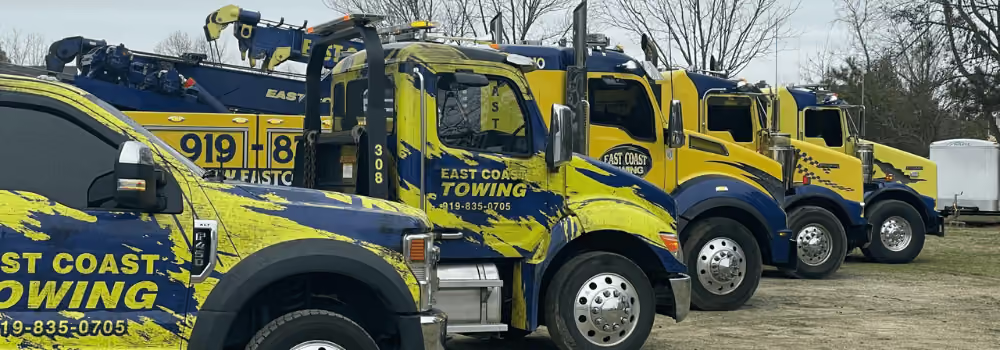






















































%20-%20thumbnail.avif)





%20-%20thumbnail.avif)


%20-%20thumbnail.avif)

.avif)




%20-%20thumbnail.avif)