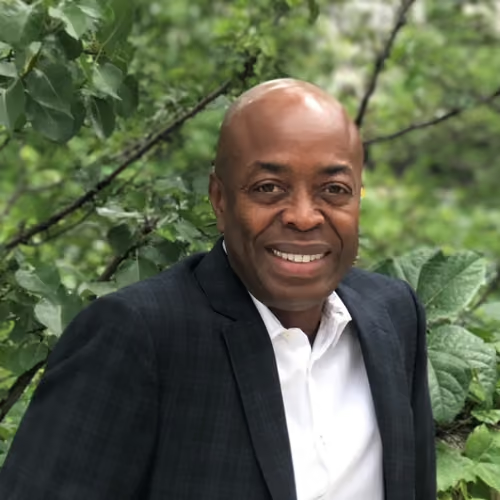
Host: We often call buying a business a shortcut. A shortcut into an established brand, into revenue. Customers, employees. And shortcuts are great, especially when time is of the essence. Today's guest, Maurice Thomas found himself in his early 60s, semi retired but involuntarily so. So rather than ride off into the sunset, Maurice decides to jump back into his career, this time by buying a business. Maurice and his partner acquired a 30 year old, 30 employee electrical contracting business with nearly $5 million in revenue and $1 million in SDE. To me, Maurice's story is a great example of one of my favorite features of buying a business that when you might otherwise feel stuck, the revelation that you can go out and buy a business unlocks a whole universe of possibility. Please enjoy this interview with Maurice Thomas, owner of Mainline Electrical Quick announcement everyone. An event you should know about In May, the M and A Launchpad Conference is bringing together searchers, experienced business buyers, owners and private equity investors for one day to go deep on buying businesses. Walker Deibel, author of Buy Then Build is one of the keynotes and 30 other experts will be on hand sharing their expertise. It's happening May 11th in Houston. The organizers are running a promotion just for us. $200. Off with the code acquiring minds go to malaunchpad.com and use the code acquiringminds all one word or use the link in the show. Not. Welcome to Acquiring Minds, a podcast about buying businesses. My name is Will Smith. Acquiring an existing business is an awesome opportunity for many entrepreneurs and on this podcast I talk to the people who do it. Most business buyers acquire their target company using an asset purchase, which means that you've got a brand new legal entity that needs to be ready on day one to properly employ your new team. Payroll, HR documents, tax accounts, workers comp benefit plans like medical and 401k. You need to make sure all of that is transferred or set up on day one. Aspen HR understands this challenge and the delicate timing that searchers have to juggle. Led by a successful former searcher, Mark Sinatra, Aspen HR can assist searchers to ensure a seamless transition for the employees. If you are structuring an asset purchase, contact Aspen HR for a free consultation. They'll walk you through their proprietary checklist for asset purchases that assesses your readiness for HR payroll and benefits. Check out aspenhr.com or contact Mark directly at markspenhr.com Maurice Thomas welcome to Acquiring Minds.
[3:21] Guest: Thanks for having me. I'm glad to be here.
Host: Maurice, you bought an electrical business, an electrical contractor and electrical is of course A huge trade, but we don't hear about it as much in the search world as its cousins like plumbing or H vac. So we're going to get into that today. We're going to learn something about the electrical business and industry. But after we get a chance to hear your story. So let's start there. Please start us off, Maurice, with some background on you.
Guest: Sure. So once upon a time, long, long ago, I started my career in accounting out of undergraduate school. I worked as a CPA for about four years, went back to business school, got my MBA and as most of us did back in late 80s, I went off to work in the financial services arena. So I spent a long time in the financial services arena, probably about 20 years. And towards the end of my financial services career, I teamed up with a gentleman, an older gentleman who actually turned out to be a serial entrepreneur himself. And while I was working with him, I came across through a client of ours, my first entrepreneurial opportunity. And because of him, I had already sort of seen what it was like to be an entrepreneur and manage multiple businesses. I sort of got the itch and when my opportunity came along, I went for it. And so my first business was in the technology services business. Gaming technology. It was basically a fuel services company.
Host: Services company in gaming. Give us a couple more sentences on that.
Guest: So for example, state lotteries.
Host: That kind of gaming.
Guest: Yes, that kind of gaming. So I had a company that worked with all of the large gaming technology manufacturers and I put together field service teams in states to install all of the technology. And we were sort of like the. Remember the old Maytag commercials?
Host: Yeah, sure.
Guest: We were sort of like the Maytag repairman. We'd come out and fix, install, replace, repair. And so that was the business. So I moved out and did this full time on my own starting in around 2010 to 2011. Grew to about a 60 man shop and did pretty well. And then right before COVID in about 2019, we, my client lost the contract and we were the sort of proverbial baby that got thrown out with the bath water and we lost hours. And this was about, I guess six months before COVID And then when Covid hit it just sort of slowed everything down even more and it even delayed more so my re entry into that business. And so I found myself in 2020 kind of semi retired, but not really wanting to be semi retired and found out about acquisition entrepreneurship. Started to learn a bit more about that thanks to a book I read and some contacts I made through my organization Entrepreneurs Organization and that led to the discovery of acquisition, entrepreneurship and this business that I ended up buying, which I'm happy to tell you more about.
[6:24] Host: Great. Well, a couple follow ups there, Maurice. That was great. I guess in your startup experience, the business that you had in the gaming industry, you painfully learned the value of or, or the, the vulnerability of customer concentration. Because it sounds like one lost customer devastated the business.
Guest: Yes, that's correct.
Host: Yeah. Okay, so 2020, you're, you're semi retired involuntarily and tell us how old you are at that point to give people a picture because you're a little bit older than my typ. So I want to address that.
Guest: Sure. So this was 2020, I was 62, I'm now 65. Yes. Great, great.
Host: And for somebody who's 62, buying a business, your other options would be starting something from scratch. And one of the arguments, of course, for buying a business, one of the biggest, if not the biggest, is the head start, the shortcut that it is. And when you're later in your career, that shortcut becomes more and more valuable. So from that perspective, it makes maybe even more sense for you than for somebody who's 22 or 32.
Guest: Sure.
Host: But what about becoming a consultant or going into industry? There are other options. It's still, you know, an unusual choice to do so. Maybe say a little bit more about what resonated with you so much about this possibility of buying a business.
Guest: So I think some of it was largely psychological. I mean, I found that I have a bit of a passion for running a business. I've been in service, some aspect of service my entire career. And when we ended up really shutting down our operations, for the most part, I think psychologically I felt sort of like I, I got taken out of the game before. I really wanted to be out of the game and being fortunate to be in, in an organization like entrepreneurs organization and being surrounded by a lot of other entrepreneurs. Of course I find out about other opportunities, not really knowing what it involved to buy an existing business. I took this acquisition lab through a gentleman that we both know, Walker Dibel, who wrote the book Buy then Build. I discovered that book, read that book, then discovered the acquisition lab, which is a lab where people like myself, entrepreneurs, aspiring business owners, come together to learn all of the aspects of what it takes to find, research and buy a business. I went through that process and I just, I was sort of like a fish to water. After I finished the lab, which was In December of 21, my business partner and I started looking for businesses in January of 2022. And by April 1, 2022, literally 90 days later, we had found our first business, which is this one. Put an LOI on it. And by June 30, we were brand new business owners of a new electrical contracting firm. A little bit quick by standards, as I've been told, but there you have it.
[9:49] Host: Well, I, I want it. That is quick. You're making it sound easy here, Maurice. So, so we're, we're going to spend some time, a little bit of time on your search and why, why you think it went rather quickly. So do now tell us some about your search when you get out of the lab, what does your search look like? How do you approach it?
Guest: Thanks to the lab and what we learned in the lab, I came out with a very clear target statement of what we were looking for. And we knew, we being myself and my business partner, we knew that we wanted a service business. And it just seemed sensible. I didn't want sort of an online sort of Internet based business. I wanted an old school sort of service business. And then the obvious place to start looking for me were the trades. H vac, plumbing, roofing, electrical. So we began looking primarily in that space. And we looked at a number of different companies. We were specifically looking for a company that was, had been profitable. Of course, we didn't want any turnarounds. We wanted a company that had EBITDA or SDE in the 750 to $1 million range. We were what I called geographically agnostic. I didn't really care so much about where the business was. And that's because I'm single, my kids are adults now, I'm unattached. So I have the flexibility to sort of move around as I did before in my previous business. And sort of with those parameters, we began our search. We talked to a number of different brokers. We looked at probably 20, 25 different businesses literally to the point of screening them, modeling them. We probably talked to five or six different owners. And we began to learn as we were doing this. And what I learned in the process was we probably weren't moving too, we weren't moving fast enough. We were probably getting too granular in the data search and data compiling parts of the search. And so literally within that 90 days, we just got smarter and smarter, faster and faster. And when I came across this business, we had gotten smart enough and fast enough that we were able to pull the trigger. What that looked like was we modeled.
[12:18] Host: Before you get into that, let me, can I stop You.
Guest: Absolutely.
Host: I want to. I want to hear more about how you guys got smarter so that searchers listening, who might have. Who might be making the mistake that you were making early on can. Can develop the. So you said something about maybe taking too much time, maybe overanalyzing the opportunities before. Say more, please. What were you doing wrong that you improved upon?
Guest: Yeah, good question. And it wasn't so much that we were doing things wrong as perhaps we weren't moving as quick as we could. So I think there's sort of a fine line between having enough information to know that the company is a viable candidate that you might want to buy and sort of overanalyzing it. And also we got smarter in the sense that through the lab, we. Well, what happened also was there was one company in particular that I remember that we were really excited about. And we went back and we had probably two different conference calls with the owner and his consultant. And when we came back for the third call wanting some more information, the business was already under LOI by another potential purchaser. And so in the next lab session or two, we learned the importance of distinguishing between critical questions and critical data to make the determination as to whether or not you wanted to submit a letter of intent versus information that could be gathered and evaluated post LOI during the due diligence phase. So we got smart about distinguishing from case the case what was something we really needed to know in order to decide if we wanted to put in an LOI and offer to buy the company versus information. That was information once we decided we wanted the business, but information we needed to learn in order to really structure and negotiate, to close. To know really sort of what we were getting into.
Host: And, and is there a. There might not be a cleaner answer. I'm putting you on the spot a little bit here, but is there now a bright red line where you, you. You can define what, what you need to know before you submit an LOI and the. Everything else that you can figure out in diligence. Does it. Does it sort nicely in a way that you can describe?
Guest: So I think there is a dividing. There was a dividing line for me in terms of what do you need to know prior to making an offer versus what you can discover post loi? Yeah, and for me is the obvious financial analysis and other financial measures that you can look at and determine that the company meets your parameters from that perspective. And then from my perspective, it's also about speaking with the owner to figure out sort of what the owner's personality, what their Core values, how do they run the business, those sorts of things, especially in the service business. And so for me, it was once we knew that the company met certain financial parameters that we were looking for, and then after having met with the owner, whether it be face to face or via a zoom call once, I had a sense that that person's philosophy, core values, the way they ran the business, was something that either was consistent with mine or wasn't going to be in conflict with how I run a business. At that point, I knew it was time to then put an offer on the business, with the rest coming in due diligence.
[15:59] Host: An SBA loan broker, as opposed to a direct lender, doesn't work for a particular bank. Instead, the broker pairs you with the right SBA lender for your deal based on industry terms, risk thresholds, then helps you navigate the process better than many lenders themselves do. Matthias Smith of Pioneer Capital Advisory is just such a broker. Matthias worked at two of the country's top 10 SBA lenders. So he's been on the inside of the SBA process and knows well the pitfalls and hurdles and how to avoid them. He struck out on his own to laser focus on the ETA and search space. Our niche is his niche. You'll see Mathias at all the ETA conferences. He's closed over 30 search deals since starting Pioneer in May of 2022, including some acquiring minds guests. To learn more and get in touch, go to PioneerCapitalAdvisory.com or click the link in the notes. Tell us a little bit more about your core values. What are those? Say more, because I know people generally, my guests generally want to make sure that they feel simpatico with, with the seller, that the seller is not dishonest, but. But they. But rare. Is it one of my guests that kind of leads with core values? So it sounds like it's something more important to you than maybe to many of my other guests. So if you would.
Guest: Sure. So knowing that I was going to be in a service business and understanding the importance of two very different sets of people for me, and in fact, this has been one of the core values of each company I've run or started or now owned in the service business, in my opinion, it's all about people. It is the people for whom you work that being your client and the people with whom you work being your colleagues. And so from a core value perspective, in buying a company for the first time, I wanted to make sure and for me I thought it was important that the owner of the company that I was looking to buy had a certain feeling about how people should be treated, whether those people were his clients or his employees. And in this particular case, sort of a personal anecdotal story. When I met with the seller of this particular company, I was. We were talking about something. I don't recall what it was exactly. We were talking and he hit me between the eyes with the question that sold me. And he said, maurice, I know you want to grow this business, but what about the people that are here? How do you feel about the people that are here? What do you plan on doing with the people that are here? And when he said that, it was very consistent with a number of other things he had said that we were talking about that told me that this person felt about serving his customers and taking care of his employees very much the same way that I do. And having consistency in those two things meant that there was not going to be some additional hurdle that had to overcome either with his clients or with his employees. And as it turned out, there wasn't. It was great.
[19:16] Host: Thank you for that. Now, Maurice, one other thing. On kind of your. Your search, and before you actually close the deal or get serious about the deal, you've mentioned a partner. What. What is your relation? Who is this partner? What's your relationship to him or her?
Guest: My business partner is someone I've worked with. Now, I've known him for about 20 years. He worked for me in the prior company that I owned, came on in a senior management role in that company. And as it turned out, when we were planning on shutting the company down, and then Covid hit. He and I both were sort of in the same situation. He lives in Dallas, he's married, and two beautiful daughters. And we were both in the same situation, but somewhat different. He was sort of helping at home. His wife is in the medical profession. She's a physician. And we were both sort of licking our wounds and upset that we sort of got taken out of the game. We were both wanting to get back into the game. And after having worked together for probably nine or 10 years, we were certainly philosophically aligned. He's about eight or nine years younger than me, which gave me a perfect sort of succession plan, if you will. I trust him. He's very bright, very good core values. And so during COVID we decided that we wanted to partner. And I said, why don't we go look for a business and why don't we be co owners? And so that's what we decided to do. I'm the majority owner, but we're both owners. I'm the president and CEO and he is the chief operating officer. But it's very much a simpatico sort of relationship. We are certainly aligned in terms of values. We have a very similar background. He's a finance major, mba, and in fact, we worked together in a prior company that was owned by a good friend of mine, which is how we met. So we had a chance to work together under a different setting before. And so by the time we decided to partner up, we had worked together in a different company, worked together in my company. And then when we decided that we wanted to work together, to pursue a company and run it together, we were very much aligned and had the experience to know what we were getting into, if that makes sense.
[21:46] Host: Yeah, yeah, for sure. No, you guys had a lot of history together already.
Guest: Yes.
Host: And so you mentioned that you're the. Just to get into the weeds a little bit. You mentioned that you're the majority owner. I assume that means you also probably brought more equity, more of the equity to the deal.
Guest: That is correct. The vast majority.
Host: So it's kind of the classic operator role versus strategy, kind of CEO leader.
Guest: Yes. Is your role correct?
Host: Great. And in terms of the split on time, are you both full time in the business?
Guest: We are both full time in the business. We actually run this business very much like we did when we worked together in my other business. And that is. He lives in Dallas. The business we bought is here in Florida, in Orlando. I live in West Palm beach, but I keep an apartment here in Orlando. And we both work full time in the business and on the business. He works remotely from Dallas. He comes to Orlando probably once every six weeks or as needed. But we huddle every day and we collaborate, I think, quite effectively, despite not being together every day.
Host: Yeah, well, it's. I have to say, it's interesting, Maurice, that the coo, the operator is. Is the one who's remote. So. So you said you. You live in West Palm beach, but you have an app. You keep an apartment in Orlando, where the business is for people not familiar with Florida geography. What's the distance between West Palm and Orlando? Two, three hours.
Guest: It's probably about 100. 175 miles is about two and a half, three hours drive.
Host: Okay, two and a half, three hours. So you'd think, you know, the op. You think that the operator would be the one who needed to be closer to the business and at the business more often, rather than the strategy guy or the CEO. You sure So a little bit, little bit of a reverse there from what you'd guess. But I guess the answer is he, he's in town as often as he needs to be to, to properly operate this business.
Guest: Yeah. And for the most part, I mean, one might even say that I'm kind of operating in the CEO role, but not really. He, he's, you know, we have a lot of experience having done this together for nine years when we were, when we were a 60 man shop in the prior business that was in Illinois and same thing, I lived in Florida, we kept an apartment in Illinois. I was there almost full time and he would come in as needed. So we had a lot of experience. We had a lot of time refining this model and figuring out how we work together and how to make it work. So this was just sort of the second iteration and it's going well. Great.
[24:41] Host: Well. And is there anything more to say about geography that neither of you actually live at the business? I mean, the fact that you maintain an apartment there is, is almost maybe that, maybe that's the answer. It's like you really are at the business quite a lot. I guess I'm just trying to tease out if there's anything to learn, if there's anything for that audience member listening right now who's like, I'd like to buy a business remotely and operate it remotely. You know, are they gonna, is, is yours a playbook they could follow or. Not really? Because what you, what you've done is effectively set up a second home in the, in the town where the business is.
Guest: Yeah. And given the nature of our ownership structure at the senior management level, meaning that. Meaning being both I and my partner live somewhere else, I wouldn't call this a remote model. I would tell your listening audience that for the most part, I live here where the business is and I go home on the weekends from time to time when I can. So it's sort of like having set up a second home in order to run the business. So it's, it's not a, it's not quite a remote model.
Host: Yeah, yeah, exactly. Exactly. Okay. And then before we get too far away from it, you mentioned that you'd set up that you'd written a target statement for yourself as instructed to do by the acquisition lab. I remember that as being a key part of my own experience at the lab way back in early 2022, I think. Tell people just a little bit about what this target statement, what its function is and why it gets so much attention and kind of anything more you want to share about how you finally distilled and dialed in your target statement.
Guest: Yeah, great question. The purpose of the target statement is to ensure that the prospective purchaser can communicate with a great deal of clarity who he is, what he's looking for, specifically what he's looking for. So that when he's speaking to, most importantly, brokers representing sellers, lenders representing the SBA or other private equity sources, the target statement allows one to be very, very clear about what it is they're looking to do. So in the target statement, one articulates either what kind of business they're looking for, what are the revenue, what are the other qualities that they want in the business they're looking for, if there's any geographical restrictions or somewhere specifically, they want the business to be any and all those things. And the importance of having clarity around that is when you talk to an SBA lender or an investment group, or you talk to a buyer or a buyer's broker, the more clarity you have around what you're looking for, I think the more seriously they take your candidacy as, as prospective purchaser.
[27:51] Host: And I would just add to that that it also going through the process and the discipline of this, of really clarifying on paper what you're looking for and the value you bring is also just a good exercise for yourself to kind of die to dial in these things in your own mind.
Guest: Absolutely. And to that point, just another shameless plug for the lab and Walker. The way he does it is Walker brings in people who help you figure out how to answer the question of, or how to, to complete the task of sort of know thyself. You go through this exercise where you have to ask yourself, you know, who are you? What are you looking to do? What are you good at? What are you not good at? What is it you want to do in this next business? What is it that you don't want to do, whether you're good at it or not, and what industries are you interested in? Are you geographically flexible? And you go through this series of questions that really forces you to sort of engage in this self examination. And the clearer you can be about who you are, what you're looking for, the clearer you can then articulate to the people that can help you get there and help you get there. So I found that exercise to be the single most most clarifying, the most effective exercise I engaged in in the lab because when I came out without my target statement, it was, it was when we came out with our target statement, excuse me, it was it was quite clear.
Host: And for people from zero to one venture capital land, you know, the, the analogy might loose analogy would be like an elevator pitch where you, you know, when you've got your business and you've caught the venture, the VC in the elevator and you've got nine floors as you both descend to the ground floor to, to, to say in 40 seconds what it's all about. This is kind of the, you're the distillation of you as a buyer, the value prop. What you're looking for. So kind of same kind of exercise, you know, something that you could recite at a cocktail party or you know, when you're talking to the person cutting your hair and saying you're buying a business like what you would say just, you know, it's like it's what your, your kind of personal elevator pitch is as a buyer.
[30:08] Guest: That is exactly right. And in fact Will, what we did, well, we all did in the lab. The target statement was. It was literally that a target statement that articulated what you were looking for and all of the different characteristics that you could articulate. And then it was like and oh by the way, here's my skill set, here's what we went to the table and here's a little bit about my bio. So on one page, and in the case of myself and my business partner, because there were two of us on two pages, we had a target statement that was very specifically, that very specifically stated what we were looking for. It then very specifically listed the skills and the value proposition of us as owners and then our educational and operational and business credentials. And so in a very concise manner, a business owner or a business broker representing an owner or a lending a lender for the SBA or a private equity group who might be looking to loan you money can see very much to use to your point in a very concise manner what it is that you're all about and what you're looking to do.
Host: And Maurice, I, I feel like now tying back in your personal story, your personal statement would have been so effective because the type of business that you were looking to buy, you had direct experience. So your, you had basically run built and run a service business where you have. It's kind of a guys and it was kind of a guys and trucks business. The one in the one in gaming, right where you would dispatch people to go into the field to fix whatever the machines, whatever they needed to fix and then come back again. That looks and feels like a lot of kind of blue collar trades businesses that people in search go out looking for in here you had directly applicable experience. Am I overstating it or does that sound right?
Guest: That is exactly what it is. And in fact one of the things that I was a little nervous about was we didn't have until we got into this business experience, specifically in the electrical contracting arena. But what I was able to articulate was I've been working for 40 years in some aspect of service. I know how to build a service model. I know what. I know what a good customer service experience looks like. I know how to motivate a set of employees charged with the responsibility of providing customers with a service model. I know how to go out and get more customers to provide that service to. And you would think that not knowing what electrical the whole electrical contracting business was about might have been a stumbling block. But I sort of kind of did it tongue in cheek and even made sort of a joke I would even tell and when I talk to custom home builders now, our clients, new ones that we are successfully picking up, I'll tell them, I'll say listen, I'm new to the electrical contracting business but I'm not new to service. And I'll say something jokingly like I can spell electricity. And that's the about the extent of my experience or it was the extent of my experience when it comes to electrical contracting. But my job is I run businesses, I can create service models and I know how to make both sides of that service model work, whether it be the people providing that service, my colleagues, or the people for whom we're providing the service, my clients. Because remember, the core value statement that we try and uphold is the two sets of people that matter the most to us are the people for whom we work our clients and the people with whom we work our colleagues. And what we do is we build all of our reward systems around that so that our so called core values, our reward systems mimic that or are consistent with that. Because sometimes people, they build reward systems that don't really cause the behavior that they want and people are going to do what get them paid. And so we try and structure our compensation and other rewards, promotions, etc, recognition in a manner that's consistent with what we want them to do, which is good customer service.
[34:24] Host: This is the. I think it's a Charlie Mungerism. Show me the incentives and I'll show you the outcome or whatever. Like you, there's just a direct line. Sounds obvious, but until you've really spent time unpacking how outcomes and incentives interrelate, it's a. It's actually a pretty subtle and profound truth, but it sounds. It sounds like you. You've internalized that long since working on it still. Okay. Okay. Well, I'm sure there's a lot for you to share and teach us about the service model. Building a service model, as you said. Maybe. Maybe we'll have a minute or two on that toward the end, but let's return to your search. So you guys were asking too many questions before sending out your Lois lost a business that you really liked, learned what to kind of the minimum viable comfort. I'm coining that phrase now. Minimum viable comfort to send out an loi and then post loi. That's when you really start asking, getting the nitty gritty. You learn that lesson and then you. And then does that explain. Was it learning that lesson that explains how you were able to find a business so quickly or did finding the business that you like so much so quickly, was that just happy coincidence? One just came along?
Guest: I think it was probably a little bit of both. I think it was probably 70% finding the business that I really like and 30% the smarts we had developed as a result of me missing a couple of opportunities along the way. Yeah, yeah, I'd say it was a 70, 30 finding the opportunity and 30% moving with deliberate speed, having learned from prior mistakes.
[36:13] Host: Okay, well then let's hear about Mainline. Tell us about the business, why you liked it.
Guest: Okay, so Mainline is the company historically has worked with high end custom home builders here in the central Florida, Orange, Volusia, Seminole county area. The company does all of the in a new home construction. If you would imagine a residential construction site, what we do is we go on that site and we install all of the electrical infrastructure, everything that would require power or everything that would provide power. Wiring all of the cans for lighting outlets. So we provide all of the electrical. We install all of the electrical infrastructure. But we also do light fixture, specialty fixture packages. We are a dealer of Lutron. So we install program Lutron lighting controls and shades. We sell generators. And then the. So that was what appealed to me for this company is the company has a strong reputation in that market here of dealing with high end custom home builders. The company's known for quality and its execution and its service. And I thought that that was a very appealing business model to start with. And the company doesn't do a lot of service work. And therein lies one of the opportunities. Service work is, as you probably know, it's a very nice recurring revenue stream. And being in those communities already. Building these homes sort of gives you a customer base to start with. And so the priority owner focused on new construction and service was kind of as needed when we can, when we had someone to do it. And what we're proceeding to do now is build into the business a very intentional service model component to the business as well as a new construction. So I like that about it. Some great people that work for the company, some experienced individuals that have been there 15, 16, 17 years. So it had a lot of different qualities about it that I could really improve upon that was already there, that was really appealing.
[39:01] Host: So I always find it so interesting in identifying a business to buy because there's always the weakness or the flaw or the thing that the business isn't taking advantage of. That depending on how you look at it, that can either be a reason to walk away from the business, like that's why you don't want to buy the business, or that's precisely why you do want to buy a business. Because therein lies the opportunity. Precisely in your case, being heavy on construction, very light on service, this audience will, will know that every that service is, is classically what you want. There's exceptions everywhere, of course, but classically service recurring revenue is seen as higher quality revenue than construction revenue, which is cyclical, which is project based and so on. And so, so a lot of people might see a, almost purely construction business and say, and walk the other way. Whereas you saw it and walk toward it because you were like this, this is, this spells opportunity. If I can build out a service component to this business, then I will really increase the enterprise value.
Guest: Correct.
Host: Right. So, and well, I'm gonna, I'm gonna return to it, but I want to ask how you're going to build out this service component? Big question. So we'll, we'll circle back to it because if there's a playbook there, that could be a really valuable thing for anybody contemplating a trades business that's heavy on construction. To, to, to follow. Maurice, how big was the business and how old was the business? So size, employees, revenue, age, all if you would.
Guest: The business was about 30, 35 employees, mostly electricians, probably an office staff of four or five. I, I think when we bought the business it was somewhere around 4 and a half, 5 million and top line revenue.
Host: How old was it?
Guest: So the business was formed in 1988. So it's been around for 34, 35 years. One owner that started it, great guy and in fact he also does, he's a builder himself and yeah, and so we still work together. In fact when he does projects that are that fit our profile and where we fit his profile, we are his electricians on some of his projects. Very bright guy. Yeah, we just hit it off. We had about a 30, 45 day transition period post acquisition where we spent time together and everything I thought about him I was able to confirm was what's true. Just a really good guy who ran a really good business offered me a lot of good advice as we were transitioning and to this day I can call, I can call him right now and we can strategize about things and he is pro main line to this day.
[42:01] Host: And can you share what SDE was on the four and a half to 5 million in revenue? How profitable was that? What are margins on it?
Guest: So yeah, I'll try to put this in some perspective. So you'll have to understand that we bought this business in 2022, early 2022. And so the prior three years were 2019, 2020, 2021. So right in the heart of that three year period was Covid. So it's hard to. The average SDE over the three year period was kind of less measure as much as it was. It was kind of the three year average but for us it was also about the 2021 numbers. And so I'll give you some perspective on the 2021 numbers. The 2021 numbers, the SE was almost right at about a million and our purchase price multiple was just under four. Great. So. So it really the three year average wasn't a really good average to look at because again it was right in the heart of COVID Right smack dab. Well, the COVID year was right in the middle of the three year period. So we had to be a little creative at the way we looked at the numbers.
Host: Going back to the question of that it's mostly a new construction business project based construction revenue and how your your plan here is to build out a service component to the business in terms of risk in this business. Did you does the like if you're unable to build out a service component like does your entire does the entire success of this project hinge on your ability to build out a service business? Service component to this business or just purely on the merits on the business as it existed when you bought it as a construction electrical business, would you have been comfortable buying it? So the service is gravy if you can build it, but if not you still like the business a lot.
Guest: Yeah, so. So there's been A little bit of a change in terms of what we thought now versus what we know. We bought the business with the idea of. Morphing it into a little bit more than what it is. I don't know that I would have bought the business strictly on the basis of just kind of continuing to do residential new construction in the high end market. I think you take a model like that and we knew that there were a number of different possibilities and we were. And we decided that we were going to wait till we got into the business to figure out which one of those possibilities made the most sense. So for example, I'll give you some examples. So we work with high end custom home builders. So you could sort of, you could sort of downstream that and start working with smaller high end custom home builders or not quite so custom home builders. Or you could do track homes and, and, but, but you're not doing anything to diversify away from new construction. Risk service was something we looked at, we thought made a lot of sense. And then even within service you have residential service coming to somebody's house and selling a light bulb for lack of a better example, then you have commercial electrical service work. And then there was also the possibility, and still is a possibility, although I don't see us pursuing it. There are, you know, there's government contracting. I and my business partner are both African American. And as you know, there are states and counties and other municipalities often encourage the inclusion on a subcontracting basis companies that are owned by minorities or women. So that's another track we could take that it would be to get the company certified and start doing government contracting and doing some commercial work. We're not pursuing that, but that's another avenue. So we knew when we bought the business that we had no desire to let it just continue to run and strictly depend on its current customer base. But we saw so much possibility in terms of how we could expand the customer base and so many possibilities in terms of how we could expand the service base.
[46:19] Host: I see. Okay, so I may have overstated it before. It wasn't necessarily that your plan was to go in and build service like that was the plan. You saw optionality. You saw a lot of different places. So you were going to buy the business, familiarize yourself with it and really figure out what the best strategy was. Might be building out service might be one of the other things you just listed.
Guest: That is correct. Okay, that's a good way to put it.
Host: All right, great. And can you share anything about the deal terms? Was this kind of a typical. I assume it was an SBA acquisition?
Guest: Yeah, it was a typical deal. Terms. We had a, an SBA 7A loan combined with our personal equity and we were able also to negotiate a seller note from the seller. So typical, typical structure.
Host: Okay, back to your age, Maurice. You were, you were 60. You said you're 65 now. So you would have been 64. 63. 64 when you bought the business. SBA 10 year term, as we, as we know. So that puts you at 72. 73 when that comes, or 73, 74, whatever. When that comes. The term is up on that. Do you envision possibly being involved in this project for that long or, or not or. You'll see. But you're comfortable with the possibility that you'll be into your 70s when you're still, when you're still paying down that SBA loan and working in this business?
Guest: Yeah, I don't, I don't, I don't, I don't necessarily think in those terms. In other words, let's go back to the whole optionality concept. So my business partner is eight or nine years younger than I. We are aligned. We're actually friends now. A lot of trust built up over the years between us and when it comes to optionality. So if we're able to build this model the way I want to build a model and we're able to grow the business the way I'd like to believe we are going to grow the business, there are a number of options. I can move from working every day in the business the way I'm doing now. Once from a visionary perspective, I have it set up the way I want to set it up. I can fire myself, if you will, from kind of CEO, president, go kind of to the board level and do other things, do public relations, business development, other things that don't require me to be involved in the business on a daily basis. My business partner could then theoretically become president and coo, continue to run the business. He's nine years behind me. And, you know, best case, someone comes along in three years and makes me an offer I can't refuse and we sell the business, which I don't really see that necessarily. Another good case scenario could be if we're able to grow this model the way I want to grow it, I still have that optionality of stepping out because the company will be sufficiently profitable that I can go on to do whatever I want to do from wherever I want to do it, whenever I want to do it. And that's sort of My. That's sort of my B hack, if you will. I like that B hack.
[49:43] Host: Well, I have to say, Maurice, I mean, we haven't gotten into the transition or how things have gone, but from the pre call, I know that things are going pretty well. We're about to hear that. You know, you're making it. You're making it seem easy. Whenever I have a guest where things are just kind of going as they should now I'm like, you're making it seem easy. Because I have many other guests where it's. When they get in there, it's surprise after surprise, you know, and some of them will find themselves on the fetal. In the fetal position in the bathroom floor at 2am because they're in such dire straits. Doesn't feel like that's the case here. And it feels like you. You're drawing a pretty straight line between where you are now and having a lot of optionality at age 67, 68, 69, maybe you continue to grow this business. Maybe you've sold it. Maybe you're doing whatever you want, wherever you want, whenever you want. So disabuse me of that. Is it. Is it as good as it sounds? Or am I making it. Am I making it seem cheerier than it has been?
Guest: It's pretty good. But you actually, you are making it a little bit cheerier than it really is. We are not without challenges, and probably one of of our greatest challenges has been the tight labor market. This is a service business and it requires human expertise to do what we do. And the labor market, I don't know how much of this is the result of COVID I don't know how much of this is. We're simply learning. That's typical in the trades. But to find experienced journeyman electrical electricians, that's been our biggest challenge. The work is there, I believe. And one of the most salient pieces of advice I got from the prior owner was to be careful what you ask for and not to get out over your skis. We're fortunate to have bought a company that's got a very strong reputation in the marketplace. But I have not been yet, 18 months later, really aggressively marketing to go and get new business because we're still building service capacity. And service capacity looks like experienced lead electricians who might can give a set of plans and send them to a construction site and have them build a new home, or experienced service techs who know how to walk up to someone's door and conduct that customer service experience from the minute they ring the doorbell to the moment they walk back to their truck. So labor has been, I think, the greatest challenge. And so it's, it's especially frustrating when the business you feel is just sitting there waiting for you to ask for it and you can't ask for it. So we've managed to keep busy and keep what we call work in progress going because the home builder community here, they're constantly submitting requests for proposals or requests for bids, and we've been almost exclusively just responding to requests as opposed to going out and asking for more business. And again, so the challenge has been from day one and continues to be finding talent. And especially when you're talking about a business that the reputation for which is based on quality in the marketplace. And so we've had more turnover, I think, than I'd like to have. We have, we're fine tuning that. But I think I would say that our greatest challenge has been and continues to be labor, good labor.
[53:21] Host: And so are you, are you still around 30 to 35 employees like you were when you bought it?
Guest: No, we were, we had 50. So we've grown.
Host: Oh. Oh, well, that sounds like you. You don't have a labor problem.
Guest: Well, it's, it's. So we've gone from, yeah, we've gone from, I want to say 31, 29, 30 electricians to 39, 40. But the challenge is finding lead electricians who can take a team and go out to a site with a set of plans and drive that project. We've been able to find and good help, good helpers, even experienced helpers. But finding someone who's been in the trade long enough and understands the unique skill set that's required. You know, when you're building a 15, 20,000 square foot house with a lot of smart technology, it's a far cry from a track home, a 3,000 square foot track home, and to find the skill set that has to be resident and someone to do that. It's, it's a, it's a bit of a challenge. So a lot of that growth that I mentioned has been in finding help and the challenge has been in finding leads. So we are doing some things internally to address that, one of which is sort of growing lead and leadership from within that's sort of driving our training process. We are now working with some recruiters and going in that direction as well. So we're aggressively addressing the issue because while it does appear that we've grown, the growth that we've experienced has been mostly with helpers and not nearly as much as with leads, which is what really dictates and determines your rate of new business retention.
[55:25] Host: Thank you for that, Maurice.
Guest: Sure.
Host: On the. Just circling back really quickly to the fact that you and Barry are not electric electricians. You have the, the joke to customers that you know how to spell electricity and your knowledge ends there. How did the crew, how did the, the team re. Respond to the two of you not having. Being from outside the industry? Did they, were they, were they pacified by that joke or did they, did they lean on you a little bit harder to prove yourself?
Guest: No. I walked in admitting my flaws while also stating what my core competencies are. And so the first day we owned the business, we walked into the warehouse and we let them know, and I told them, I mean, probably within two minutes that I am not an electrician, I'm a businessman. I explained to them that I'd been in the service, some kind of service, for 40 years. I said, the owner, Chris, tells me you guys are the best at what you do. And for every. Everything that I've seen tells me that you guys are the best you can do. I tell you what, if you guys are the best at what you do, I, I believe that I and my partner are some of the best at what we do and we're going to be okay. I don't need to be an electrician, and, and so I'll get smarter. I'll learn enough about. Elect the business to go and know if you're doing a good job, and I'll learn enough about this business to go and get us more jobs. But I am not an electrician. I don't think I'll ever become an electrician, but that's okay. I'm going to have my lane and I'm going to lean on everybody else who's responsible for their lane to do what they need to do. And if we all manage our lanes, we're going to be okay. And over the past 18 months, that's what we've been doing. I've been getting a little bit smarter about the electrical trade, but I've been letting people do what they need to do for the business. The management team that I acquired, if you will, was young and hungry, not very experienced when it came to management. So I'm doing a lot of coaching, they're doing a lot of learning, and I think they appreciate that. They can see, and I can see them really growing and thriving at what they're doing. And so everybody understands that at this level. You know, I don't have to be an electrician. And it resonated, I think.
[58:06] Host: Well, it resonated with me. That was, that sounded, that sounded really, really compelling. It's great. Yeah. And convincing. Fantastic. Well, actually give us a little bit elaborate, a little bit more on the coaching and training because I know from our pre call that that's actually happens to also align with something that you really value. You like that aspect of the business. You know, some of my guests might, might not like that so much. The, the, the really kind of hands on management is maybe seen as an interruption to working on the fun stuff, the strategy stuff, but it's something that you really run toward actually. So tell us more and why you like it and whatever you want to share.
Guest: So I try and acknowledge the value that individuals bring to the table. And one of my other philosophies is I don't have all of the answers. We're going to find the answers and whoever has the best answer, that's what we're going to do. And along the way I've cited examples of that. For example, there was no, the perfect example of that would be when we first got there, there was no way for everyone on the team to communicate and I wanted to fix that. And one of the young men, the first guy I hired said, hey, why don't we just start Slack? And I said, great idea. And so now we communicate throughout the organization using the Slack channel. And I always say, whatever is the best idea, it's what we're going to go with. And the best ideas aren't always going to come from me. So if you got an idea, you got a question, raise your hand and if it makes a lot of sense, we're going to go for it. That's one of the ways that that notion of inclusion, that notion of acknowledging that someone else is bringing value and they're being heard, makes people really lean in and want to work even more. And so these young guys that had been helping the prior owner run the business, they weren't required to do a lot of customer communications and they weren't, they were writing proposals. But they, there's certain subtleties to certain things that, that I like to see things done a certain way. And so it's a perfect opportunity to coach. And I'm always telling them, hey, play chess. And so I'll, I'll, I'll sit and I'll talk to him about something that I want to do and I'll say, okay, I'm going to call this guy and I'm going to Talk about this. And he's either going to say A, B or C. If he says A, we're going to do this. If he says B, we're going to do this. If he says C, we're going to do this. And over time they start to see how this works and after a while they start mimicking it. And so I have a vested interest in these guys growth because if they grow, if they get better at what they do, that means I can do less and trust that what needs to be done is getting done and it's being done the way we like for it to be done. And I really like coaching. I like nothing. One of the most gratifying things that this whole entrepreneurial experience has given me is you hire someone, they come in, they're bright eyed, bushy tail, they're clueless. And two. Right. And two years, three years later you go, okay, hey Mike, all right, I want you to go and do that. And Mike goes, me? And I go, yeah, you're ready, let's go do this. And you know the growth that you see when you point to someone who says you can do it, I got you. It's, it's, it's amazing. So. And knowing that there are things that I'm doing that I don't want to continue to do, or knowing that there are things that I can't do that I need people around me that know how to do and I want them to do it well. There's just this built in incentive to coach.
[1:02:09] Host: Well, on top of the coaching that you're doing, on top of, you know, things like taking ideas like the Slack idea by one of the employees. Anything else? Any other changes you've made that, that the audience might benefit from hearing about?
Guest: Yeah, I mean, well, what Slack opened up really effective communication that hadn't been going on before, implemented a number of different things. I'm trying to think of some of the other things that we've done. We have little slogans to get people to buy into the whole customer service model. We've had a couple of little incidents. For example, like, like politics and religion can. Sometimes there are other things. You can have a favorite football team and get into a big fight about that. But politics and religion are oftentimes topics that can create division. And I can remember one day in the warehouse, we were talking and I told the guys, I said, look, I don't care what God you pray to, you have the right to believe whatever you want to believe religiously. I don't care who you vote for you can vote for whoever you want to believe. You know your politics or what your politics are. To the extent that your political beliefs or your religious beliefs interfere with your ability to work with your co workers, respect your co workers, service our clients, leave it outside. To the extent that those beliefs help you lean into them and do them. I said, for example, because religion around here, our, our master electrician whose license we work under his name, we call him Gilly. I said under around here, our religion, we. Our religion is the book of Gilly. And in the book of Gilly, in the, in the book of Gilly, we only have two commandments. Commandment number one, take care of our customers. Commandment number two, take care of ourselves. And it's become like this sort of rhythmic slogan that we all sort of lean into. So we got buy in, we get consistency. And the buy in and the consistency is around the core values that we want to make sure that people are embracing that lead to, I think, success. Because when you're in the service business, you gotta care about the people you're working for and you gotta care about the people you're working with. And the more you do that, I think the more effective and the more successful you are more likely to be fantastic.
[1:04:38] Host: Now just a couple more questions here, Maurice. They're both larger ones. Circling back now to the possibility of implementing service to build out a recurring revenue line or some of the other options that you saw as possible before you actually got into the business 18 months later. What is the strategy to diversify away from what was just new construction?
Guest: Well, it starts with recruiting. We are fortunate to have a client base in communities that lend itself to capturing customers. So the customer capture piece is kind of there. We, the labor challenge is still there as well. So we're leaning into recruiting firms now more. Our goal is to have a 6 to 7 up to perhaps as much as a. Probably won't, we probably won't get to 10 men, a 10 man service crew before year end. But I'm setting that as a goal and I won't be disappointed if we get to seven or eight. We are consulting. We have a, we have a consulting relationship. I rather not disclose what that is, but we're working with a coach and a consultant with experience specifically in the trades and specifically in building residential service models. And so we're leaning into that coaching. Access to technology, access to a number of other resources. I can't tell you. That would be like asking Coke what's the formula. I'd rather not share what the formula is. But I can assure you we're working on, and we have subject matter expertise behind us in building the service model.
[1:06:31] Host: So building service did ultimately end up being the opportunity that you thought from the outside looking in that you thought it might be.
Guest: I would say service is at this point the next most logical and the first most logical source of revenue diversification and growth. Yeah, I'm not yet dismissing commercial service and I'm not yet dismissing working with builders that build something other than 15 20,000 square foot, three story mansions. There's a lot. There's a lot. If we were to go sort of down the food chain, there's plenty out there, but right now there is plenty within the food chain within which we are eating to go and get more. And so it's about focus, it's about efficiencies. We're also big on just identifying and removing inefficiencies as you're executing on any particular service model. But yeah, to answer your question, service is just the most logical first step in terms of diversifying and expanding our revenue base. Great.
Host: And the other, because the other one you had mentioned is like government contracts where there's the set asides that's in
Guest: the future yet or, or never.
Host: Oh, okay.
Guest: Yeah, I was just talking about optionality things that are out there that could be if we chose to go down those roads. But yeah, I, I think with a solid residential construction business, as we have already, that we bought into building a solid service business, starting with the residential and then Moving from those two pieces is I think, the making of mainline version 2.0.
Host: Maurice, let's start closing out here. But as I, as I warned you, this is a larger question. Just give us a sense. I want to learn something about the electrical business. So I've had multiple guests who have bought plumbing businesses, multiple guests who have bought H Vac. I don't think I, I've had somebody who bought an electrical. Some of the, some of the, some of my guests have gotten big enough that they have electrical. They've ultimately started offering electrical, but it wasn't there for the first business that they buy. Pure electrician electrical contracting. So let, first of all, I guess one question to warm you up would be why do you think that is? Why is electrical less a less common acquisition target in our world versus H Vac and plumbing?
[1:09:21] Guest: That's a good question. I honestly, with this being my first entree, this being my entree into the trades, I honestly don't know. Perhaps it's, I don't know a lot about H Vac or roofing or plumbing. But in electrical, there is an electrical license. And it could be that you have to have a license. So, for example, we don't have an electrical license. I, neither I nor my business partner. So when we were, when we were doing the deal, one of the due diligence items, and it was contingent upon this in our loi, was that we needed to be able to get the license holder that worked for the company under contract. So that was one of our visits to meet with the owner. After we submitted an loi, the next meeting we had with him was to meet with his licensed electrician so that he could meet us and know what our plans were with the business. And we did that and we, we like. We hit it off. We liked each other and we signed and we signed him to an employment agreement. Now, it's possible, I don't know about H Vac, plumbing or roofing, it may be that you don't need a license in some of those disciplines. I don't know. And so maybe the licensing requirement with electrical contracting businesses can be prohibitive. If you are a business owner or looking to buy the business and you don't have a license, because you would then need to. If you're buying a company, you need to make sure that it's not the owner that you're buying out that has a license, or if it's the owner that has a license, he's going to stick around. Or if it's an employee that has a license, you want to lock them in. Especially with the sba. The SBA will not lend money unless you have that license locked in. Right. So that could be part of it.
Host: Actually, I don't think it is, Maurice, because what you described is in fact a feature, as I understand it, of buying plumbing businesses in H Vac as well.
Guest: Okay.
Host: It's got to be a license holder.
Guest: So.
Host: So I don't think it's that, but I did, I did wonder if maybe the licensing is somehow more onerous in electric and electrical because it's, it's more. It's a more dangerous. It's a more dangerous trade. I don't know. Maybe the licensing stipulations are just. Are harder to meet.
Guest: Now, that could be because I know, I know that with an electrical license, because you have an electrical license, it doesn't mean that you can provide your services just anywhere. You can have licenses, licensing, at least here in Florida, as I understand it, you get, you get permission to work and get licensed in Particular counties. And then over time you can get reciprocity and over time you can get the state license, which is one of the things we're working on with our license. Our master electrician, once he meets the time requirement, you can simply apply. And at that point, if we want to expand anywhere within the state, we could. But for example, we couldn't go to Broward county in the southern part of the state right now and provide our services because our electrician is not licensed to do so.
[1:12:48] Host: Oh, so it, maybe that's it. I've never heard of. I didn't. I always assume licensing is at the state level. I'd never heard it being. Could be my ignorance, but I'd never heard of it or realize that it could be kind of county by county.
Guest: Yeah, again, I don't know, I don't know what is the case with plumbing H vac roofing. And it may be the same with them, but I do know with licensing in electrical space here in Florida, it's, it's county, you have, you have to be licensed in each county that you do work with. Now again, there is reciprocity.
Host: Yeah.
Guest: So there is that. But I don't, you know, that's a good question. I don't know why electrical contracting companies are art. As sought out as plumbing, H Vac and roofing. It's a good question.
Host: Yeah, I was going to admit maybe there's just fewer of them, but I doubt that because any, any structure that needs plumbing in H Vac is going to need electrical too. So.
Guest: True.
Host: Probably not that. Okay. And you've mentioned too that labor is a challenge. Labor, kind of more experienced labor, leadership level labor is a challenge. Anything else to not like or any other particularly acute challenges in, in electrical that you've seen that, that you might educate the audience on.
Guest: I really can't think of any. And, and it's mostly will because we are such, we operate in such a little niche. Right. We're not, we're not operating in a way that we are trying to be all things, all people. I mean, we really literally are working almost exclusively right now with truly high end custom home builders and creating and building an extension of service off that many electric. Many electrical contracting companies, they do service or they do renovations or they do construction, but I don't know how many do almost exclusively just new construction like we do. So we're really operating in kind of a niche of the market. And so, and that was actually kind of an interesting challenge for us when we were trying to do, when we were assessing the company to determine whether or not we wanted to buy it. Obviously, one of the due diligence checks that you make is one of the exercises you engage in is a sort of a competitor analysis. And we couldn't find anyone that really was a direct competitor. Everyone that we saw, they had a service component, or they did track homes, or they did something that was different than how we do what we do. And even that takes a little getting comfortable with when. Because, you know, when you say there's no way you got to have a competitor out here, and we have competitors, but no one competes directly and exclusively in just our market. So it's a unique market in that regard for us.
[1:15:53] Host: Well, Maurice, anything that you want to share with the audience that I failed
Guest: to ask, I would say that the single most important exercise that one should engage in, and engage in it seriously, is the exercise of sort of know thyself. The more you know about what you want to do, the more you know about what it is you don't want to do. The clearer you are on what your core competencies are. Look, the clearer you are on which of your core competencies you want to really work on and utilize for purposes of the business. The more you know these things, the clearer you can be in your pursuits. I. I think that is the single most important thing I did that came out of that lab that set the. I think. And that might be what that. And I'm, you know, I'm an older guy, so I. A little bit more experience, but. But going through that exercise was the single. That. That set the. That set the path for me in a way that nothing else did. And they do a great job within the acquisition lab of giving you the tools to come out of that exercise. With the target statement in bio, that was the most effective exercise in this whole process for me.
Host: Yeah, I really got a lot out of that exercise myself. When I was still contemplating doing my own search, I had that. That target statement dialed in, and I had it. You know, I had it bookmarked so I could just drop it into a sim. I mean, I. I used it and reused it a lot, and it was. And as we were touching on before, it was really just helpful. Helpful to myself, to me, kind of to helping me know myself.
Guest: That led. That was the. That was the lead in for us for every conversation with every broker and any potential SBA lender, and made the difference in that first conversation. Yeah.
Host: Yeah. Well, it also. It also really does help surmount a challenge that newbie searchers experience, which is that brokers won't even get back to them. Brokers will just their communication is just screams tire kicker or amateur. And when you have a dialed in target statement and you come to a broker sounding like you know what you're talking about, like, but you know what you want, like you know what you're doing, you are much more likely to get their response from them because you know they're first. They're just trying to filter out tire kickers. They don't want to waste their time. They get a lot of inbound and so they only want to be dealing with serious people. And the target statement definitely helps you present as such.
[1:18:39] Guest: 100.
Host: What are the pros of buying a business being so much more established in your career on the other side of 60? And what are the cons versus say what if you'd done this when you were 40?
Guest: The cons are you have less time to screw it up. The pros are seasoning clarity. Yeah. If you know yourself. Yeah. It, it should be a little easier for the older person to come to the point where they know very clearly what it is they want, don't want. I think the younger you are, the more you think, I could do that, I could do this. That's, that looks. That sounds good. You know, you can kind of be all over the place a little bit more. I think as you get older, it by necessity forces you to be much more focused, much more intentional. I'd say that's the, the dividing line for me.
Host: That's great.
Guest: In terms of young versus older.
Host: Well, this has been great. Maurice, if people want to reach out to you, how do you, how do you prefer they do that? Do you like LinkedIn? Do you like email?
Guest: They can reach me on LinkedIn. Maurice Thomas, you know, Mainline Electrical happy to accept emails of anybody that wants to email me. Maurice, @mainlineelectric.net I'm on Instagram, but I'm mostly on LinkedIn and email would be happy to help. And I'm also in the acquisition lab still in the Slack channel there. So if, if your audience happens to be someone who's in Walker D's acquisition lab, they can DM me in our Slack channel there as well. And I'm happy to help anybody however I can.
Host: Fantastic. Thank you for that offer, Maurice.
Guest: My pleasure.
Host: I really appreciate the time.
Guest: Thank you so much, Sam.



















































%20-%20thumbnail.avif)




%20-%20thumbnail.avif)

%20-%20thumbnail.avif)

.avif)




%20-%20thumbnail.avif)