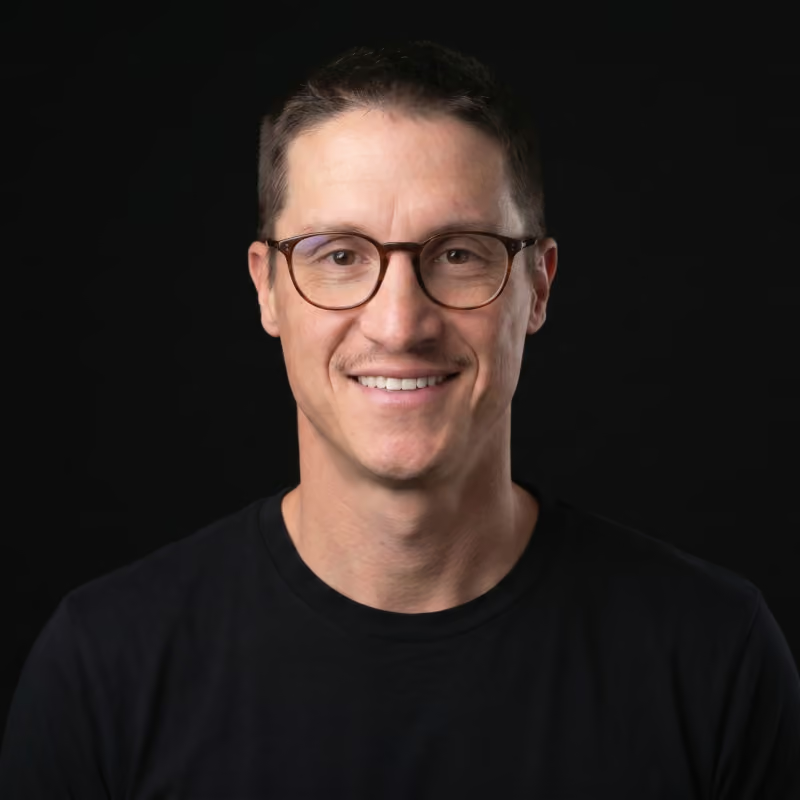
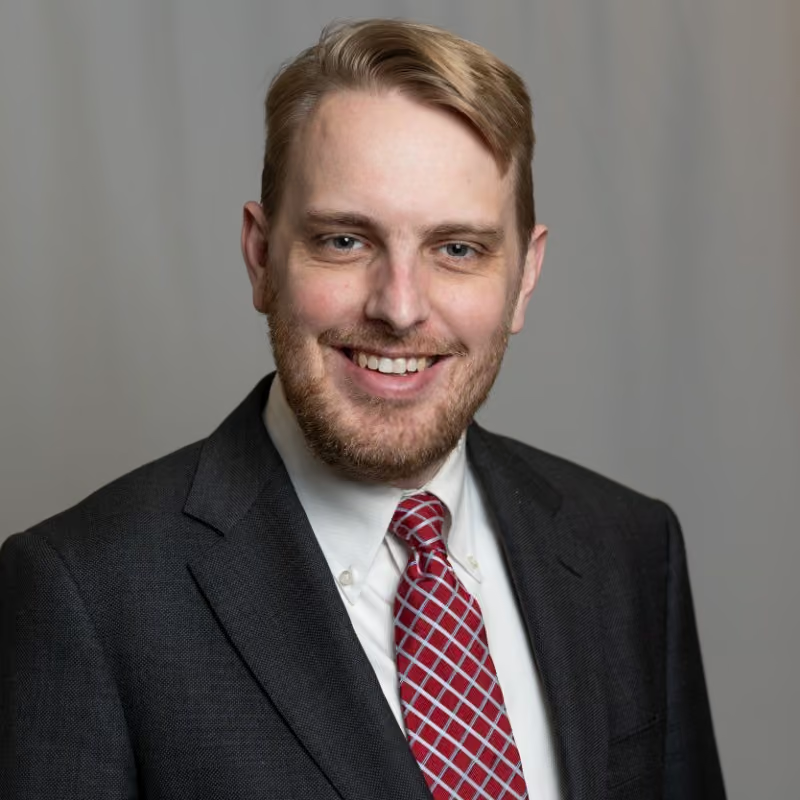
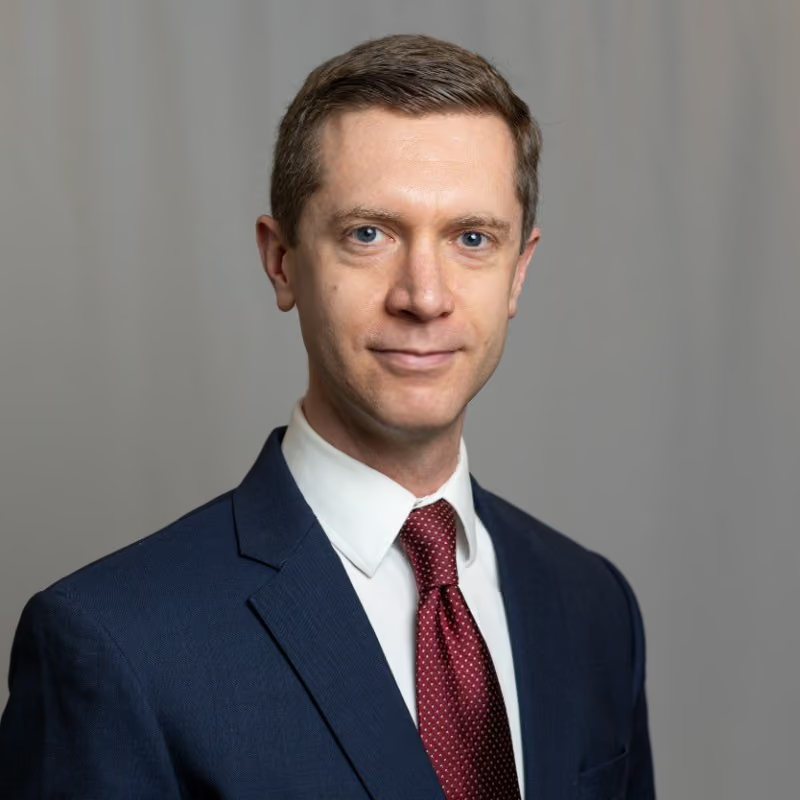
Host: Today's episode is an exciting one for me personally. I brought on Nicholas James and Max Lummis, my two partners in Mind's Capital, a fund we've recently launched to invest in the deals of searchers and sponsors. This is the formal announcement of a project one year in the making. Now, I didn't want this to just be a self promotional episode, so we make a point to discuss Mind's Capital in a way that is valuable to you. We talk about how a fund comes together, why we would want to raise a fund, what it was like to ourselves raise money from investors, the LPs, how the perspective as an investor differs from that of a business buyer. Listen closely there why small acquisitions are hard for a fund to invest in and much more. As you'll hear me say at the end, I'm thrilled to be partnered with Max and Nicholas, who have years of experience and relationships in our space. But just as important, if not more so, two individuals I consider of the highest caliber. To learn more about what we're doing or if you have a deal under LOI that you're raising money for, see mindscapital Co. Okay, please enjoy this conversation with Max Lemmmis, Nicholas James and me, the three general partners of Minz Capital. Announcements don't forget the webinar this coming Thursday hosted by the guest with the most listened to episode in the entire Acquiring Minds catalog. Matthew Saskin, episode 142 bought a 5 million dollar towing business and while going through his deal found and hired an operator to run the day to day of his new business. Matthew's owned the towing business for over a year and a half. Now his operator is there running things and Matthew has kept his day job the entire time. The webinar is this Thursday, June 27th at noon Eastern. Link to register at the top of the show notes where it says Register for the webinar and if you can't make it on Thursday, register anyway so that you receive a link to the recording after the fact. Also, System 6 is sponsoring this webinar. System 6 provides bookkeeping, payroll, bill pay, invoicing, controllership and other day to day finance services to over 200 companies including more than 40 searcher acquired businesses. System 6 is led by Chris Williams, himself a former searcher and two time guest on Acquiring Minds. How to Buy a business and hire an Operator at once is this Thursday, June 27th noon Eastern. Register at the top of the show Notes okay, on to today's episode. Welcome to Acquiring Minds, a podcast about buying businesses. My name is Will Smith. Acquiring an existing business is an awesome opportunity for many entrepreneurs. And on this podcast I talk to the people who do it. An SBA loan broker, as opposed to a direct lender, doesn't work for a particular bank. Instead, the broker pairs you with the right SBA lender for your deal based on industry terms risk thresholds, then helps you navigate the process better than many lenders themselves do. Matthias Smith of Pioneer Capital Advisory is just such a broker. Matthias worked at two of the country's top 10 SBA lenders. So he's been on the inside of the SBA process and knows well the pitfalls and hurdles and how to avoid them. He struck out on his own to laser focus on the ETA in search space. Our niche is his niche. You'll see Matthias at all the ETA conferences. He's closed over 30 search deals since starting Pioneer in May of 2022, including some acquiring Minds guests. To learn more and get in touch, go to PioneerCapitalAdvisory.com or click the link in the notes. Max Lummis, Nicholas James, welcome to Acquiring Minds.
[4:30] Guest 2: Thank you.
Guest 3: Thanks for having us, guys.
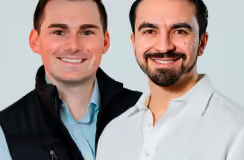
Host: We're here to discuss Mind's Capital. Mind's Capital is a fund that the three of us have partnered in to invest equity in the deals of searchers and sponsors. So this is a conversation I've been excited to have and record for the Acquiring Minds listeners because I've mentioned some investing activity here and there and we put out a post or two on social media, but we've been waiting to formally announce Mines Capital, which is what this conversation is. So we've officially completed the fundraising and started deploying the capital. To date, we've completed four deals, both self funded searchers and independent sponsors. And so we're going to get into what it is we're doing here at Mines Capital. Let's introduce you guys to everyone. Max, do you want to go first? Tell Acquiring Minds listeners a little bit about yourself, please.
Guest 3: Absolutely, yeah. I'm Max Lummis. I'm one of the three general partners at Mind's Capital. I'm also the founder and managing member of LCS Forensic Accounting and Advisory. And we're one of the leading accounting and transaction advisory firms in the United States. We specialize in financial due diligence. You could think quality of earnings and tax diligence for independent sponsors, self funded searchers, funded private equity. We work on about 80 to 100 deals per year in the lower middle market. So that is my, my day job also, you know, in about the past 10 years I've been a private investor in the lower middle market in SMB deals and I have stood up a small fund about a year ago which is the precursor to Mines Capital and it's also a co investor now with Mines Capital. But yeah, I've just been in the SMB space for probably about the last 10 years looking at deals very closely from a financial diligence standpoint and investing in, you know, some of my favorite deals along the way.
[6:40] Host: Fantastic. Thank you Max. Nicholas James, people might recognize you. You have been a guest on Acquiring Minds. Actually about this time last year you were my first independent sponsor guest so we did a deep dive on self funded search versus independent sponsorship. You've been both a very successful independent sponsor for the last seven years and now partner in Mind's Capital. Can you give us more of your story please?
Guest 2: Yeah. Fantastic to be back on Acquiring Minds. Thank you Will and obviously excited to talk about Mindz Capital that we have all created together here. About my background, most people will wonder about my accent, so let me just clear that out of the gate. I grew up in Norway. I'm Norwegian. I've lived in the states since 2011 and currently live in Florida. But as far as my background, after college I started at Bain and company. At Bain I was mostly under private equity due diligence group working for middle market shops in Europe. I also spent quite a bit of time in their industrials and oil and gas practices. After Bain I had a quick stint working in venture capital and then I moved to the States to do my MBA at hbs. I graduated from Harvard and took a corporate job. A couple of years later I got my green card and promptly went on to become self employed and have been in the search and sponsor space ever since. This was late 2015 and as a searcher in the early years I completed a software transaction that we discussed on the podcast episode from last year and then after that in 2020 I syndicated the deal in the Home Services based in Texas where I'm still the Executive Chairman today. We've had a good run, done a lot of M and A for add on acquisitions and also grown organically. We're having a lot of fun with that platform and I am the sponsor of that and that's been my background as an operator. Obviously having been in this space for so many years now, I've gotten to know so many other searchers and sponsors and I've been lucky to be able to invest in many of my friends deals. I've had a really good track record with that and a good experience. And so when the opportunity arose to institutionalize this, this was very exciting. And that's what we're doing here with Mines Capital.
[9:06] Guest 3: Great.
Host: Thank you for that, guys. Well, let. Let's hear more about the genesis of Mind's Capital, which starts more with. With the two of you. Maybe. Max, you want to share how you and Nicholas met?
Guest 3: Yeah, yeah, it's. It's great. It's been a. It's been a while now, but about eight years ago, I was introduced to Nicholas by a. We were just talking about a gentleman named Christopher Russell who. Who was a serial networker in Houston when both Nicholas and I were living in Houston at the same time. So we were introduced, and Nicholas engaged me and lcs to work on the financial diligence for one of his deals. And we hit it off. You know, we became. Obviously, Nicholas became a client, but we became friends as well and kept in touch very closely over the years, often, you know, meeting for coffee and things that discuss the SMB space and just broader economic things that were happening in the world. Along the way, we also got involved in Nicholas's home services roll up. And so we were working together more closely, you know, more frequently. And basically about. I'd say, a year ago or so, I had just finished setting up the. The fund. I mentioned that it is about 50% fund of funds investing, and the rest of the capital will be deployed as equity into search and sponsor deals. So I had stood that up and was making some investments and realizing, you know, it's a lot of work and a lot of fun, but I wanted to professionalize that more. And of course, I have always thought very highly of Nicholas. And, you know, we had some discussions over dinner one night about, you know, partnering together in some fashion with either that fund or more likely a new fund that would be a bit larger. And so we got very excited about this concept. Nicholas, of course, being as strategic as he is, started thinking about this from a lot of different angles and in a lot of different ways than, you know, a bean counter like myself. So this thing started to evolve pretty quickly. And then I'll let Nicholas talk about how he met you, but serendipitously, he was on your podcast not too long thereafter. Nicholas, you want to take it from there?
Guest 2: Yeah, absolutely. And as you said, we had worked together on many, many projects, probably a dozen or so QFEs by then, so we know each other well also personally, and it's always great to get together, and you're underselling Yourself a little bit, because you came to me at dinner and said, I've, I've raised some capital and I think I'm well positioned to invest. And I had thought about the idea of investing because I already was doing so on my own, but I didn't necessarily see that on my own. I had a differentiated pitch to invest in this space. But you came to me and you said, nicholas, I think I have something we can build on here. Because first of all, I get great deal flow. I run a company that works with searchers, so we do. I mean, you tell me the number later, but hundreds of. Of deals every year, so I get good deal flow. And then secondly, you said, I am better positioned than anyone to look at these deals because I am the one doing the due diligence. So I know when a deal checks out or not. And not only do I look at the deal, I also get to know the sponsor or the searcher because I work with them for two months on the Q of E. And then lastly, you said, and this really resonated to me, when I ask to invest in their deals, they always say yes because I'm the Q of E provider, and if I'm in their cap table, it just lends so much credibility towards the rest of their fundraise. So these were three really great reasons to partner up with you and a really differentiated pitch that I thought we could build on. So having capacity as a sponsor to take on more projects, this piqued my interest right away. And then, yeah, as you say, serendipitously, which is a hard word for me, but there you go. I was on Acquiring Minds two or three weeks later. I had never met Will before this, but we had really good chemistry in the calls that we had both before and after the interview itself. Will is a very smart person and great at what he does, but also has an ability to see the bigger picture and connect with people and brings a lot to the table there beyond just being a megaphone. And so in one of our conversation, the concept of investing in this audience came up. And a long story short, that's how the three of us ended up forming a partnership, where I think all of us bring something very unique to the table.
[14:05] Host: And I'll just add to that Nicholas's episode. Nicholas, your episode, as, as you well know, because you got so much inbound afterwards, was a very, very popular episode. And are my experience of you not unlike what Max described? I mean, I just had a really high opinion of you, not only for your just intelligence but your, your manner of doing business and the way you approach the process of, of the interview and the seriousness with which you took it and the communication, these are all, these are all attributes that I see in you now on a daily basis that were, that were really attractive. Um, so, so I was, I had considered doing some kind of investing in my audience or fund, but not very seriously. I hadn't had any conversation with anybody about it really. So when you guys were already starting to work on something and I had such a favorable impression of you, Nicholas, it seemed like this was the perfect opportunity. So I, I really just, I just seized it. I jumped at it. It was, it was kind of a no brainer for me. And then Max, you and I, of course we met later also hit it off. We did, Yeah.
[15:20] Guest 3: I enjoyed that very much.
Host: Yeah, that was a, that was a really fun night. A really first good meeting and of course have, have worked together really well ever since. So. And then just to, to restate, we've all kind of been saying is that when you do a fund, you or any business really, you want some kind of differentiation. And what each of us three bring to this is quite unique. And together as a group, it's that much more unique and differentiated. And so it just seemed, that value proposition seemed like a no brainer and seemed really exciting, just immediately, immediately compelling. And we knew we'd be able to, to sell others on the vision, which I'm happy to say I think we have.
Guest 2: Great. Thank you for, thank you for all the kind words in there to both of you. I will say thank you. There was a six month period in there where I couldn't sleep very well because I was nervous that either or both of you would just run away with this concept without me. But I'm happy to say that, Happy to say there's a ring on your finger now. So we're in this together and I'm excited about what's ahead.
Host: Well, no wonder you work so hard on this, Nicholas.
Guest 3: Yeah, no, we're all super excited. It's a great combination of unique skill sets and unique positioning in the marketplace. You know, we, we have, we all have great deal flow. When you think about deal flow, it's, it's like a funnel, you know, with, with lcs, we're more towards the bottom of that funnel. We've been for the last, you know, 10 years chasing deals under LOI to, to sign them up as clients. And that is no different than what we're doing at Mines Capital. So we've got you know such a head start and, and having put ourselves out in the market to attract sponsors that, that have good deals under LOI and so obviously with you know will with your podcast as well we've just got such a great funnel to, to find deals and we've got unique skill sets to evaluate these deals and, and, and to hopefully make you know, great investment.
Host: August Felker is a two time successful searcher. First with a traditional search fund. The second time around he did a self funded search. Today August runs Oberle Risk Strategies, an insurance firm with a dedicated practice group for searchers and acquisition entrepreneurs like you. If you've got a business under loi, Oberle will provide complimentary due diligence on that business's insurance and benefits program. A great many no risk way to get to know August and team. They love helping searchers. They've worked with hundreds. Oberly is a specialty insurance brokerage for searchers by a former searcher. Check out oberle-risk.com O B E R L E- risk.com link in the show notes. Let's talk a little bit, I think guys about our own motivations for doing this. So obviously there's the financial motivation and the kind of professional motivation of starting a business, starting a fund, but I think each of us also have, there's a little bit more about why we're attracted to this project. Nicholas, why don't you go first?
[18:43] Guest 2: Yeah, absolutely. I think there are many motivations behind this and I think surprisingly what I'm really enjoying the most of everything so far is just it's been incredibly stimulating on an intellectual level, but also on a social level. We have signed up more than 50 LPs, all really smart, talented, accomplished people and being able to connect with these, work with these people. And then of course on the search and sponsor side, we're talking on a daily basis now with people who have great deals under LOI and are out there taking risks and doing great stuff with their careers. So just being involved in that fashion has been incredibly gratifying and makes every day so much fun. But beyond that, yes, doing this was synergistic. So I've been on the other side of the table for many years now as a sponsor and I understand how to approach a business owner. I understand how to think about what a deal should look like in order for that to be financeable and I understand, you know, I know a lot about operating a company as well. I'm an operator. But there is a nuance to sitting on the investor side of the table and being a capital allocator and I think having that knowledge, if I was to be a sponsor again in the future on any deal, in any capacity, I think this is broadening my skill set there. Not to speak of how it has expanded my investor network. And there are so many people that I can tap on now for future fundraisers for whatever that will be either for Mines or independently. So all of that has been really valuable as well. And then lastly, I would say it was just a unique opportunity to take advantage of our skills and the position that each of us has in the market. That was so obvious right in front of us when you think about it. And yeah, happy to go after it.
Host: Yeah. Max, you want to add anything?
Guest 3: Yeah, I mean, you know, I have always enjoyed, you know, at the accounting firm, as soon as I was introduced to the sort of search and independent sponsor entrepreneur space, I've always just really enjoyed working with folks who are so intelligent and so motivated. It's very refreshing. As Nicholas said. It's very stimulating. You get to work with, you know, some of the smartest people you could ever imagine. And I've always felt so lucky to have that opportunity to work with, with these folks. And now in Mines Capital, you know, I'm, I'm basically working with those same folks within the company and, and we're getting to work even closer with these sponsors. So, you know, it's, I've always been, like I said, really, really pleased to have this opportunity to work with such intelligent entrepreneurs. And now with Mind's Capital, you know, I can work with them not only as, you know, a diligence provider, but I can more actively participate in investing and in evaluating these deals and, and it's, it's really a thrill for me. It's something that I've thought about for a long time. As I mentioned, I have done some investing. I've always wanted to professionalize that a lot more and, and this has given me the opportunity to do that. But, but again, still within this space with, with these, you know, just highly motivated, high energy type A type, you know, individuals, which is just, it's just exciting and stimulating as Nicholas described it.
[22:16] Host: Well, I, I, I, I'll third that about the ecosystem. I think that I, I hope that anybody who's listened to an Acquiring Minds episode can feel my, my enthusiasm and real, you know, passion. I, I don't like to throw that word around, but passion for, for the space and the ecosystem for, for the same, for the same, the same re. For, for the guests and Their, you know, their entrepreneurial energy, they're taking a risk on themselves. The, the education about, about the, the economy in all of these fascinating corners of the economy where, where money is made and these interesting businesses live. I mean, it's, it's endlessly stimulating to, to use the word and fascinating.
Guest 2: But.
Host: Yeah, but, but fundamentally, I think the E and the ETA is, is really what most turns me on that my kind of, my, my core identity as an entrepreneur and just being able to Talk to now 250 other fellow entrepreneurs, it's just, it's a wonderful place for me to be spending my years of my career. And so, so Mind's capital for me, like you guys, it, it's a way to deepen my, my connections in the ecosystem. And I love that about it. I'll also say that, you know that the Acquiring Minds podcast was started with me having an eye toward buying my own business. And I, I said last year in an episode that I was putting that to the side. Acquiring Minds had taken over my life. And I mean that in a positive way. I pushed it to take over my life, but it meant I wasn't buying my own business anytime soon. So I do feel like if I can't buy my own business, investing in the acquisitions of, of others, on other entrepreneurs doing it is kind of the next best thing. So it does kind of get me a little bit closer to, to one day when I may be able to do that, have the time to do that. And then of course, the obvious selfish reason for me is that this should make me a better, a smarter interviewer. Nicholas talked about two sides of the table. And so to date, I've been seeing the world through the, through the entrepreneurs, the buyer business, buyer side of the table. And now understanding things from the investor side of the table should feed into my, my interviews and the questions that I ask. I'm hopeful that it'll do that as well.
[24:38] Guest 2: I've also found it to be a conduit for paying it forward. When I was in the early years of being a searcher, everyone I asked would pick up the phone and talk to me. This community is so collaborative. People help each other. And being a capital provider, obviously when you supply capital, that's a way to add value, but also it puts you in a position where people naturally reach out to you so that you can help them with whatever bottleneck they're facing on their journey. And so it's really a way for all of us to add value to the ecosystem in an amplified way to what we're already doing.
Host: Great point, Max, what were you going to say?
Guest 3: Absolutely, yeah, I, you know, one point that I failed to mention and, you know, of course we're doing this, you know, to try to make money and to try to generate a return, you know, in terms of motivation for, for doing a fund in general. You know, the, one of the obvious motivations is to try to spread the capital out more as opposed to picking, you know, with, with my own limited, you know, capital reserves, a handful of deals, you know, having the opportunity and, and the, the excess capital to be able to pick 20 or 25 of these deals to spread the investment among. So there's a, you know, there's a financial reason for doing this, of course, and a risk mitigation reason for doing this. You know, we're trying to generate the strongest returns that we can and, and by being able to spread that across, know, multiple investments, we're, we're in a much, much better position than if we were, you know, to try to just solely pick winners and only be able to pick a handful of them.
Host: Exactly. Yes. It's, it's definitely a diversified approach that we're, we're taking. And, and I think we're going to get there here and shed a little bit more light on that. But before we do, guys, let, let's talk or tell people a little bit about the fundraising process. We were all three obviously involved in that. Nicholas, you really spearheaded it, so I'll put the question to you. What was it like? Would you learn what would be interesting for the audience to hear about that process?
Guest 2: Yeah, the fundraising was a roughly six month effort where all of us contributed contacts and we were out there. I would say there were three months in the middle there in particular, where we were really hustling and going to conferences and mentioning it to people more actively. And then a lot of admin work, of course, involved in it as well. It's been just a lot of fun to meet so many great people and our pitch really resonated. I think people understand the asset class and it's been proven over history to have good returns to date, and they understood why we are differentiated within this asset class to have both deal flow and to be strong and due diligence. So, you know, the financial aspects of our pitch pretty much told itself by the time we got on the phone with investors after they had reviewed the materials, they understood what we're doing. And so what they were more interested in hearing about was, okay, how's the communication going to be? What Is my the opportunity to get involved, to be engaged, maybe to co invest in some of your deals? What are the networking opportunities here? And people were really, really excited about those aspects as well. So with MindzCapital, we have tried to create not just a passive financial vehicle, but a community of people who have a strong interest in this space and are eager to work with us as we deploy this capital and build out a brand in the space Overall, as far as lessons learned, you know, I think I've raised money for standalone deals in the past where you have a company under LOI and you raise money with a specific growth plan in place. And I found raising money for a blank pool was harder. It was our first fund and we don't have a track record as a blank pool investor. And so you don't have anything tangible to talk to, no cash flow that is already existing, so to speak. And so that was a nuance that was new to me. And you're talking about a concept and not about an asset. On the flip side, you know, our concept is not as highly up on the risk curve. We are not doing one deal that can do really, really well. We're doing, you know, maybe 20 deals within a portfolio. And so our chances of capital preservation should be higher. And I said to many that when I do standalone deals, I've learned a hard way not to include friends and family in my standalone deals because I don't want to lose their money. And with any given standalone deal, even within our portfolio, there is a lot of risk in this space. A certain amount of them will fail. However, when you spread your money across 20 deals, as we are doing here, our downside protection is greatly mitigated. And because of that, we all have friends and family in the cap table here as well, because we're excited about the upside, but also comfortable with the risk reward profile here of this fund. We did communicate a minimum amount to our investors and it was interesting to see that 70, 80% of our investors came in at that minimum amount. So I don't know if it was that the minimum amount attracted those exact prospective investors or that prospective investors just gear towards the amount that you tell them to. I suspect more of the latter, but that was definitely a takeaway that I'll remember. And then lastly, our pitch was clean. As I said, it was really easy for people to understand. And I think when, when you do any kind of sales job, when you get into the mode of having to explain something, people's enthusiasm goes down. It's just the same with An E Commerce. There's a science behind getting you to press the purchase button and there's a drop off every time there's a new page that you have to click through to. The same goes for a fundraising process that the more you have to explain and the more steps they have to go through, the more drop off you're going to get. So we had a crisp pitch and an easy process and that enabled us to have a very high closing rate.
[31:08] Host: Nicholas, let me jump in with something there. I mean I think that's a good takeaway for any searcher or sponsor out there as well. Just in your own raising, clean pitch, easy to understand business. Don't make your audience have to work too hard. By the way, we want some of this, these learnings of Nicholas's to be helpful to you Searcher you sponsor, listening who is in the process or anticipating going out and raising money. Were you done Nicholas, or did you have more learnings?
Guest 2: I had a lot more learnings, but I think those were the high level ones. Yes.
Host: Well, I actually want to follow up and just add that one of the things that we witnessed was the asset class, if you will. You know, the, the investor term for investing in search or eta. Most everybody who we were talking to knew about this opportunity and knew about the trend here and the activity in the younger generation buying the businesses of the older generation and all of the opportunities to improve and grow these businesses. So they understood that. But it's not clear if you are hearing about that or you have a friend or somebody that bought a business, how you can participate in that without being somebody who goes out and buys a business themselves. I mean there's not a lot of ways to get access to this asset class. And so that was kind of one of the, the I think solutions we were offering to the market is if you've heard about this, this thing that's happening, this search, this ETA thing and you've wanted to participate but you're not going to go out and buy a business yourself. Well, mind's capital is definitely a vehicle to do that and in a diversified way. So we're, you're not in, you're not investing in a sole searcher who's going to go buy a business and all of your chips are on that bet. You're investing in a basket of, of search deals, you know, 20ish that we anticipate doing or investing in over the, over the, over the duration. So it's, it's nicely diversified. It's just a classic kind of Asset class play, but to an asset class that's been kind of hard to otherwise get access to. And I also want to double click on the, the word community I heard. So first time doing a fund myself, I, I'm, I'm not, I'm not knowledgeable about what it's like to what how other funds are, are run and the, the extent of involvement as an lp as an investor in that fund or not. And as I understand it, we're doing something quite different there. So, so toot our horn on that a little bit. How are we different than, than other funds? Not necessarily in this space, but really in any space where it's a much more arm's length involvement. Maybe. Max, you, you had said something to me about that recently.
[33:59] Guest 3: Sure, yeah. And I've invested in some other funds over the years and you know, many of them have been, you know, very good and, and have done well, but the level of just sort of LP involvement in this fund so far has been, has been great. It's been exciting. There's been a lot of communication between the, you know, the GPs and the LPs. We, we talk about the deals we're investing in. Nicholas, as he likes to say it, he prefers to over communicate, which, you know, I think that really goes a long way in making the investors feel comfortable in the investment that they've made and making them feel part of this, this community or the fund that's Mind's capital. They're, they're engaged and, and our limited partners are, are, you know, very successful, smart people in their own right. And, and of course we value their thoughts and opinions. You know, we, we even get deal flow from them as well. So it's just a very symbiotic relationship. It's a, it's a nice community. And once again I go back to, you know, it's just fun to work with smart, motivated entrepreneurs. And that's what our group is here. And so we've built this, this group that, you know, we're all, we're all looking at these deals together. Granted, I mean the three of us make the investment decisions ultimately, but it's great to hear, you know, the insights of the other, of the other partners as well. And it's just fun that, that everybody takes such an interest and, and participates in this process together.
Host: Yeah.
Guest 3: Which is quite different from, from what I've seen in other funds, by the way.
Host: Yeah. And, and one thing I'll, I'll add to that is with Acquiring Minds, people tell me that there are connections that are made kind of associated with Acquiring Minds. So. So guests, for example, often get a lot of inbound. Nicholas can attest to this. Not always, but often a lot. And sometimes, often those are searchers who are seeking get a call or advice. But other times, often there's deals or business that's transacting and value that's being passed back and forth between that's based somehow on some Acquiring Minds interview led to that. So what I'm saying is that there seems to be kind of a community around Acquiring Minds but that I haven't really done anything to centralize. And it's kind of happening behind the scenes. I'm just kind of being told that these connections occur. You know, it's likely that I should do a better job or I should do something there of making that kind of more official or centralized in some way, time permitting, who knows. But with Mind's Capital, I feel like it's really, we've leaned into that and really positioned ourselves and explicitly tried to build a centralized place or community or network where we all are really cultivating these connections in making a point of them. It's kind of a lesson for me about maybe something I should be doing in my own with Acquiring Minds in my day job.
[37:13] Guest 2: Can I just ponder a little bit philosophically here and do it? Be patient with me because these are not thought through before this chat right now. But I think, you know, if you look at private equity funds in general, these are finance guys who come from a sharp elbowed world. And when they step out and raise their own fund, they do so by landing big commitments from pension funds and pension funds that have rather bureaucratic processes and regulated reporting mechanisms. So when you've landed there them, you just have to check the boxes and if you provide a decent return, they'll be around for your next fund as well. Because they don't really like to change it up if they found a sponsor that they can back repeatedly. And then very typically finance guys will be almost a little arrogant in that, hey, I am the capital allocator and at the end of the day money talks. And since I decide the money allocation and you might be privileged to get some of my money, if you are in our case, a searcher or sponsor who receives funding from us. And I think one of the philosophies that we've discussed since the beginning is that we really want to flip this on its head and we want to be more servant in our attitude. And I think this also syncs up with my background as an Operator and that we think about not only our LPs, but also our searchers and sponsors as effectively our customers. Yes, we are the ones providing you with capital, and yes, we are the ones providing you guys with a great return, hopefully. But at the end of the day, what more can we do to make that customer experience the best it can be? And if we're able to do this, I think it'll greatly enhance our reputation, which will consequently give us even more deal flow and even more capital access. So this is how we are looking to scale Mine's capital over time. Our next steps beyond Fund one are of course, tbd. And right now we're busy deploying it and making sure we do a good job with that. But I think we have a servant mentality around how we approach this and all the stakeholders that we have involved. And I do think that differentiates us maybe not so much within this very collaborative space, but certainly against other institutionalized forms of finance.
[39:43] Host: Well, Nicholas, you have a green light to. To get philosophical whenever you want. That was, that was great. All right, guys, well, let's move on a little bit here to our process. As I said at the top, we've. We've started deploying capital. We've committed to four deals. We foresee doing another, call it 16, over the. Over the life of the fund, into next year, into probably mid late 2025. We're looking at kind of a 1:1 deal per month cadence. So flesh that out a little bit for us. What is our deal flow, where it's coming from? We've also touched on that and then how we're processing deals.
Guest 2: Yeah, let me, let me jump on that a little bit there. So our top of the funnel includes many channels acquiring minds. Your podcast is a very differentiated channel. You have an incredible global audience and a fantastic reputation. We also have LCs, as we discussed earlier in this conversation with Max. So right there, from the get go, we have two very unique deal flow sourcing channels. On top of that, we will do the proven methods of attending conferences, be strong at networking. And then I think beyond that, we have a strong network of LPs, many of whom see deal flow also within this community and they're sharing deals with us. And then lastly, we are planning to be active on social media and with email marketing because it works. You have high. If you can be top of mind, it means people come your way. I like to say that I've prostituted my own LinkedIn account as part of the Mines Capital launch. I would say as an operator selling H Vac equipment to homeowners. My LinkedIn profile was not that relevant. But for finding investors, for finding investors and sourcing deal flow, it's super relevant. And so I try my best to put out content that is relevant and educational for, for the people who follow me. And I'm having a lot of fun with that. And we will do that, all three of us, but also on the Mind's capital level going forward. So the goal is to be top of mind so that when people have an loi, they will loop us in as part of that conversation.
[42:08] Host: Great. And of course audience, you'll, you'll hear me mentioning Minds Capital. I, you know, from time to time you'll hear me mention it explicitly. But as I said earlier, part of my motivation for doing this is, is hopefully becoming a better interviewer. So I expect that it'll just come up organically in my conversations with future guests.
Guest 2: And then I think you asked about the process overall there earlier and this is a question. Of course, we got a lot from the prospective LPs as we were signing them up as well. It's important to say first of all that all three of us have to approve a deal before we commit. That's part of our investment tenant right there. And so once we all are ready to commit, that's when we will socialize the deal, typically on a no name basis in a sanitized fashion with our LPs. And they like that because it's educational. And so far on the four commitments we've made to date, we've seen them raise their hands with great questions and in some cases direct relevant experience. In one case we even had an LP who lived on the same street as the sponsor, coincidentally. So he was able to be a fantastic reference check. Right. And while, you know, the LPs don't have veto rights, at that point, we have committed. They don't have veto rights if they have strong objections. And in this case he had said it was a horrendously low integrity neighbor. He had, you know, we would of course have listened very carefully to their feedback and their questions. So it's a very helpful resource and for us to be able to solicit their input. And so as far as our process, that's how it goes. And we think about investing in essentially three stages when we get stuff in at the top of the funnel. Stage number one for us is to look at the downside. And in order to evaluate the downside, we have a set of 60 or 70 bullet points that we look at. And all are pretty standard within private equity investing. You know, is it project based, is it cyclical, is it profitable, is it growing? Are there key people risk? You know, I can go on. But they are bucketed in four categories. Market target, company, sponsor, and the deal terms themselves. And so we want to see that all of these items check out. And this is a way for us to screen, are there any red flags or yellow flags about this deal that makes us uncomfortable and doesn't provide us with the downside protection that we need. And we typically say that one red flag is enough to be out on the yellow flag side. Every deal has yellow flags, but hopefully you don't have that many. And for those that you have, you have a great plan in place. And so, so that's how we approach it. And so once we've screened for downside protection, that's when we really have a candidate. And then stage number two is to take our candidates and ask, do these have real upside potential? With our fund, we're looking to do at least three or four times. That's what we are aiming for over the whole period is to triple or maybe even quadruple your money. In order for us to hit that range for an overall return for our fund, we're going to need some winners in there who do 5x plus, because we all know that some deals are going to go to zero. We have no idea which deals are going to go to zero. Maybe by miracle none of them will. But for any portfolio investor, this is a realistic expectation. And so those have to then be offset by deals that are well above that 3-4x range. And so that means each of our candidates must have the potential to become a winner and have a really, really high upside. And searchers come to us with deals that check out all our investment criteria. They're great cash cows, but it's a small market. The addressable market is not there or the growth isn't there, or maybe it's even a declining market. So, yes, it's a good business to own because it's a cash cow. It's not a great business for us to buy since we are looking for growth. If there is growth potential, then we call this candidate a contender. And then the final stage of our investment approach is that we take all our contenders and every contender we have. We ask ourselves, does this deal have the hallmarks of being the best deal that we will see this month? And this is a way for us to rank everything we look at, because we look at a lot of deals. A lot of them are good enough. A lot of them even have exciting growth. But our premise to our investors is that we can be more selective than anyone else because we have great deal flow. And in order for us to be very selective and truly pick the winners, we have decided we're going to do roughly one deal per month. This may change down the line, but with fund one, that's going to be arcaden. So we ask ourselves, is this going to be the best deal this month? Is it that strong? Of course there will be months when we do three commitments and other months when we do zero. But as a question, it's already been quite helpful in order to weed out those that are really exciting and good, but not quite at the level where we have full conviction. And one thing I wanted to add here also is I've been investing my own money for many years in this space and had good experiences with that. But very often I've invested based and I'm a little embarrassed to say it but you know, based on my gut feeling and because I know the sponsor and I basically just trust them, that works for me and I've been lucky with that approach. But when you invest money on behalf of others and especially when you are so transparent about what you invest in and you present each and every deal with them before you even close, you better be prepared to answer their questions and have full conviction behind each decision that you make. And so our three stage process really ensures this as well. We have covered for the downside, we have covered for the upside and we truly believe this is the best of the best of what we are looking at in our pipeline.
[48:30] Host: That was great, Nicholas. And let me just add a couple things there. The, that's been one of my learnings, similar to what you just described where you've invested individually in deals of, of, of friends and it's been kind of more of a gut, a gut investment. And similarly, as, as the as interviewer Acquiring Minds host, when I have had these many conversations, I, I, I press my, my guest on how they chose the business they did and did they think about X or Y and how they think about A and B and, and it's, but it hasn't been systematic, you know, and when you're doing this professionally and particularly when you're doing it with other people's capital, it needs to, you just need to bring more rigor to every decision. I mean it's just your, it's your fiduciary responsibility. But also as you said, Nicholas, like you Just you now have LPs who are going to say, well why, why, why that one. So you need to have this rigor for your own. Just to make good decisions, but then also to have something to point to if an LP says, I need you to explain to me why you chose this. There was a good interaction or for me an educational interaction we had a couple of months ago about a deal. Nicholas, I liked it a little bit more than you. I think you said, I need to be excited about every deal because you know, we're going back to our LPs and it can't just be, it can't just be good enough. We're selling every deal to our LPs. It's a high bar and it's just a, it's a, it's caused me to expand how I think about every deal. And, and I, and I really hope to import a lot of that rigor into my, into my interviews. Hopefully I don't become a pain in the butt to the guests, taking them through 25 criteria as we do. More than 25 criteria actually. But anyway, it's been a great education for me.
Guest 2: I like to say, I like to say that I love people who think outside the box and as operators you want to do that because you're looking to create value in every way you can. So thinking outside the box is a valuable skill. But as an investor and with Mines Capitals mandate, we are actually doing the opposite. We're thinking inside the box and we're trying to stay disciplined to that. And we have so good deal flow that we can afford to wait for the high quality opportunities that come our way. And coincidentally, even our logo reflects the fact that we are inside the box. So that's what we will be doing.
[51:06] Guest 3: One of the nice things about Mines Capital is we have so much deal flow. I mean, that was the genesis of why we all got together because we knew and recognized that we all had this great deal flow and opportunity to invest in businesses that were very, very interesting. But to capitalize upon that, we have to be rigorous, we have to be disciplined. And so putting those procedures in place is just as important as having the deal flow. So, you know, there's, there's plenty of stuff to invest in. We just need to do the very best job that we can to pick the very best companies that we can and the very best sponsors that we can.
Guest 2: Yeah, you know, I'm a little nervous for us saying we have so much deal flow all the time. While it's true, I don't Want any of the listeners to think that, oh, they've probably seen this deal already. I don't need to share it with them. I would just encourage everyone to share deals with us. We love it. And also we reply to everyone who does that and as quickly as we can. But we always reply to everyone that sends us deal, either if it's a direct deal from a searcher or if it's someone referring a deal that they've looked at. So everyone please send deals and don't assume we've already looked at it.
Guest 3: Yeah, and I would just also add that, you know, even though we have this rigorous process, it is a quick, you know, we can get you from step one to step two pretty quickly. So we're, we're taking the time and looking at these deals the right way and evaluating them based on, you know, these different criteria. But it is a relatively quick process and it has to be in this space.
Guest 2: Right.
Guest 3: Because you're coming to us, you've already, you're already under loi, you're, you're possibly already through quality of earnings and you know, you have legal documents. So we do, we do move quickly despite, despite all of our rigorous.
Host: I, I just want to highlight something, Nicholas, that you said about the candidates that we look at deals we invest in. You know, because one of the things that we think about an ETA is kind of buying all the older the better, you know, kind of eternally profitable businesses, often, not always, but it does kind of have the longevity of the business is, is a characteristic that generally my guests like to see and I think the search community likes to see. And there is an. The point you made about a great business to own versus a great business for, for mind's capital to invest in is subtle but really important. So, so there may be a searcher may have a great business under loi that if they can close, could be a phenomenal outcome for them, their family, their careers. That doesn't necessarily mean that it's investable for us because we need to, once we've satisfied ourselves that the downside is protected, we also need to see the ability for the business to grow a lot because of our diversification strategy in the way our need to see growth potential might be different than an individual searcher's need to see that same growth potential. So it can be maybe confusing to people that it's like, well, this is, this seems like, you know, this business has been throwing off $500,000 for, for 50 years. Why wouldn't you want to invest in that well, it, we, it's not, that's not our only criteria. We also need to see growth. Whereas you searcher or you future owner might not need to see that same growth. So there are subtleties and I would encourage listeners who are going to go out and raise capital for their deals to think about the perspective of your, of your investors, of your prospective investors. Investors like us who are planning to return capital in 5, 7, 8 years to RLPs fit a certain mold. Long term investors fit a different mold. An investor who's just an individual putting their own capital in has a different profile. Yet again, your friends and family have a different profile. So all of these, you should, you should think strategically about the motivations in the, in the return needs of each of these categories of investor. And so not, not all of those groups are going to be good for your deal.
[55:28] Guest 2: Yeah. And I also on that point, if we say no to a searcher who comes to us with a deal, it does not mean that your deal is not going to be successful. First of all, it might be, we might be wrong both in terms of those we select among 20 deals, we surely will have some that are not performing as well. But even more frequently, I believe we will not select deals that actually turn out to be really good. That's the case for anyone in the investor game. And what we can control on our side is not so much the outcome, but we can control what, what we do before making our decision. And for us that has been setting up a certain framework and a certain structure that guides us in our decision making. We have criteria that we abide by and then we try our very best to be both swift and comprehensive in our communication. And so to all of you searchers, as I said earlier, we will treat you as a customer. And our goal with doing that is not only to be a good steward of your attention, but but also to maybe give you some feedback points that you can then sharpen as you pitch your deal to other investors. And also to set ourselves up in a position where you had a favorable impression of us. So you will come back to us if you have a deal in the future or you will refer us to your friends in the search network because you had a positive interaction with us.
Host: Well, Nicholas, you just touched on customers, the customer service, if you will, of Mines, of Mines Capital. Let's, let's, let's sell ourselves a little bit more. Why should sponsors, why else should sponsors want to work with us? Searchers and sponsors. And to be clear, everybody, we use those terms kind of interchangeably. But we are, we work with it, we work with self funded searchers. We also work with independent sponsors. In fact, a couple of the deals that we've committed to were independent sponsor deals. So sometimes we strictly mean independent sponsor or strictly mean self funded searcher. Other times we're just using searcher sponsor searcher or sponsor interchangeably. Point of clarification, but why, why else should people send us their deals?
[57:45] Guest 3: Well, I think, you know, as we grow our reputation, Mind's Capital is going to be a catalyst for other equity investments in, in these deals. So we're just a minority investor at this point in the deals. But just as you know, being the, you know, CPA performing the diligence on a deal, often I'm actually sought after to be on a cap table because it's a good look for the deal. You know, having the, the managing partner of the, of the accounting firm who looked under the hood and you know, shook every tree possible on the deal to find anything wrong with it. You know, having that person as an investor on your cap table, it just looks good and it gives confidence to lenders and it gives confidence to other equity investors that, that somebody who took that close of a look at the deal wants to be a part of it. So you know, Mines Capital is going to bring that same, hopefully that same catalyst type ability to, to the equity raise for the sponsor. And you know, that, that could be quite powerful. You know, even if we're, like I said, a minority investment for now, it could be the piece that's needed to help attract more capital. It's certainly, as I said, it's certainly a good look for the deal and a good look for the sponsor. And we're of course happy as well to take that deal to our LPs. Like we said, we have, you know, 57 wonderful LPs that are part of this fund, many of whom are also very sophisticated investors personally in their own right. So you know, we'll take these deals to them as well, you know, with the ability for them to, to invest more. And so, you know, for those reasons alone, I think we're in, in addition to the, the resources that we bring and the knowledge and experience that we bring in the space, I think we're an excellent partner for sponsors to be on their cap table.
Host: Just to point about that co investing. So for a lot of our LPs, one of the things that they really liked about being involved in Mines Capital was being able to access some of these deals if they wanted to deploy even more capital into a particular deal. So those. So as you said, we being in mines capital is a conduit to more capital. I mean, we've got family offices and professional investors and as LPs, dozens of LPs, so it's a lot of other doors that might be opened by a mine's capital investment, no doubt.
[1:00:33] Guest 3: And if it's an, in an industry, you know, where One of the LPs has a particular interest, you know, it might be a situation where they want to, you know, take a, just take a bigger position in that specific deal. And that's a, that's an excellent position, you know, for us to be in, for our LPs to be in and for the sponsors. It's a great opportunity for them as well.
Guest 2: And we're actually even passing on deals that we are passing on to our LPs if we generally like to look or it's in a niche that somebody knows. Even if it's not a perfect fit for us or the best deal of the month, so to speak, it might be a great candidate for one of our LPs or other people on our network. So yes, we can provide some introduction. So that's a reason to come to us. Max is again underselling himself a little bit. He's incredibly resourceful in the sense that he has been a service provider in this space for a long time and knows how to help you steward a deal towards closing. I think the one thing neither of you said that I think is the most important thing is that I think we're a lot of fun to work with and for that reason you should come to us.
Guest 3: This is true.
Guest 2: On that note, we haven't yet set the date, but we are planning to do an exclusive annual off site for all our LPs and our portfolio CEOs that we will do at some point in the future. And then we're also looking to set up a peer group or kind of a cohort for all the CEOs or sponsors that we invest in so that they can learn from each other and become, you know, a little bit of a brotherhood there that we can facilitate.
Host: Guys, I don't want to get too far away from one of the points about size of deal we're wrapping up here. But I think this is an important point because there are criteria that we look at to, that we want a deal to have before we look at it. So while we invite searchers and sponsors to send us their deals, they should pass a certain, a certain threshold. First of all, it needs to be under loi. So that's going to be the criterion for, for, for most investors. They're not really going to want to look at something, spend much time looking at something that you don't yet have under LOI. But another one is just size of EBITDA or SDE and we put our threshold at about $800,000. And the reasons, Nicholas, I'm going to invite you to explain why smaller deals are something that we, we really just can't look at.
[1:03:04] Guest 2: Sure. I think there are two reasons to that. The first one is smaller deals are more vulnerable. They once you take out paying yourself, paying your debt, there just isn't a lot of cash flow to deal with if you're sub 1 million of EBITDA. And unless you hit growth right away, you're going to be using all of your free cash flow which leaves you with nothing to reinvest in the business and also in a fragile spot if something was to go wrong, which happens. So vulnerability is the biggest factor and why you see a lot of investors have a bottom line around 1 million. We set it officially at 800k of EBITDA. In our case, the other reason is just the check size. I think our fund came in at a size where our check size is such that the very smallest deals there just won't be space for us. So let's say you have a half a million dollar EBITDA company, you're buying it for four times, it might be a good business and you might have it under LOI for 2 million. But okay, so on that 2 million you're going to get an SBA loan of 1 and a half and then you have a seller note of 250,000 and then your brother and your cousin and your college roommate wants to put in 30k each. There just isn't a whole lot of equity space there for others. So there is also that aspect of it. And then within that the SBA has regulations that if you own more than max is a 20% then you have to PG it. So going if the equity pool is not big enough then we would kind of be up and around that with our check size. So. So that those would be the two main reasons like just the check size and the vulnerability.
Host: Great, thank you for that. Okay guys, this has been fantastic. I'm really excited to finally be sharing the mind's capital news formally with the world. Is there anything else that, that we didn't get to any, any closing thoughts before I close this out?
Guest 3: Yeah, I mean I Think, you know, now we just have to get to the fun part, which is, you know, finding good deals and, and deploying the capital. So, you know, we'll continue to do what we've been doing. Obviously, being on this podcast is, is super helpful and so we'll continue to hunt for good deals and good sponsors so that we can, you know, hopefully generate the, the returns that we're seeking.
Guest 2: I couldn't be more excited about the four deals that we have committed to so far. If the rest of our fund looks like the first four, this is going to be incredible. And now that the fundraising is closed, our job is really staked out for us. We have a fund here to deploy. Our goal is to do so over the next year or couple of years. And that's going to be our focus going forward. And then we know that if we do a fantastic job with the fundamentals, providing good returns and providing a good customer service experience to both LPs and sponsors, then this will unlock opportunities and open doors for us and Minds Capital in the future.
[1:06:18] Host: Great, guys. Well, I invite the audience to connect with us all on LinkedIn so we're easy enough to find, but also to submit a deal to us. If you're a searcher or sponsor looking to raise equity or mindscapital Co is where to go. As we, we've already said, we reply to everyone, we reply promptly and we'll reply with feedback even if it doesn't end up being a fit. You know, you'll, you'll hear from us and hopefully we'll, we'll be able to add value even if we don't end up working together on this particular deal. And if you're an investor or a would be investor or an LP in other funds and interested in this one, we also have a page on mindscapital Co for, for you and where you can sign up to a newsletter and follow along and get in touch with us and open a conversation there as well. I'll close this out, guys. That was, that was a great, great conversation. Thanks for coming on. I'm really honored to be partnered with you, Max, and with you, Nicholas. I think we've really built something special here and the early signs are very positive. The excitement, both among the three of us, but also with our LPs, is palpable. So this, I consider this kind of a second chapter for me in Acquiring Mind. So it's very, very exciting. Thank you, gentlemen.
Guest 3: Thank you so much.
Guest 2: Awesome. Thank you.

















%20-%20thumbnail.avif)


%20-%20thumbnail.avif)

%20-%20thumbnail.avif)
.avif)


%20-%20thumbnail.avif)