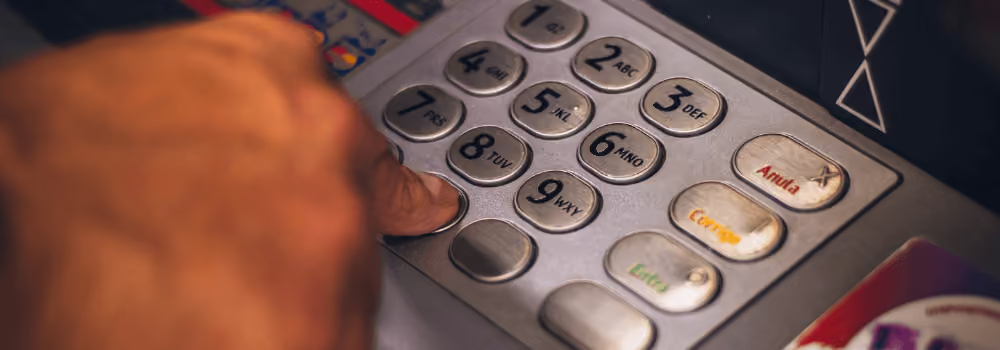
Host: Automated teller machines. ATMs seem like an unlikely place to build a business. Well, Mitchell Sorkin, who bought his first three ATMs in 2021, has 140 machines in his business today and is approaching high seven figures in revenues with great margins. And three years from now, Mitchell sees getting to 5 million EBITDA and maybe even 10 million. That would be a remarkable business, especially in an industry that many of you probably see as declining. It is declining, which means it's overlooked, but declining more slowly than you think, which means it's opportunity. You're going to learn all about the ATM business in this interview. Mitchell and I go pretty deep here. He is Mitchell the ATM Guy Sorkin. Welcome to Acquiring Minds, a podcast about buying businesses. My name is Will Smith. Acquiring an existing business is an awesome opportunity for many entrepreneurs and on this podcast I talk to the people who do it. Listeners of Acquiring Minds know that for almost any business you acquire, its success comes down to the people and how you develop and manage them as their new leader. Thing is, in addition to management, there is also a lot of process and bureaucratic work when it comes to your new employees. Payroll, compliance, HR technology, hiring to name but a few. These processes are crucial to get right, but at the same time distract from where you want to be putting your energy in leadership. So Aspen HR is an HR firm and PEO that takes this work off your plate and handles it with the care it demands. Aspen is owned and run by Mark Sinatra, himself a successful former searcher. So Aspen's own leadership understands the HR challenges that searchers have. Post acquisition. The firm is offering Acquiring Minds listeners a complimentary pre acquisition HR and PEO review for your target business. Check out aspenhr.com or contact Mark directly@markspenhr.com Mitchell Sorkin welcome to Acquiring Minds.
Guest: Hey Will, thanks for having me on. Appreciate it.
Host: Yes sir. Mitchell, you are a former digital entrepreneur. So E Comm SaaS now buying ATM machines, ATM routes and building an ATM route business rapidly. So it's a fascinating pivot and I'm really looking forward to sharing this with the audience. Let's start with some background on you please Mitchell. Before the ATMs before the digital businesses.
Guest: Sure. I think it might be useful to give a little bit of context on my upbringing. Might be helpful for the conversation. I grew up in a family of Russian immigrants. My parents had a very kind of typical immigrant story. Came to this country with nothing. Spent the first few years kind of learning English and working very low wage jobs. My mother ended up going out and getting a PhD, got a job as a statistician at Harvard, and my father went out and became an engineer. And so education was really stressed as kind of like a very, very important thing in our family growing up. And for whatever reason, no one in my family has ever had even like an ounce of entrepreneurial DNA. And I was kind of the outlier, kind of the black sheep in that sense. And so at a very early age I kind of became kind of enchanted with entrepreneurship. Did like very typical, like lemonade stand stuff and selling water bottles and just kind of like, you know, kid type businesses. And then once I, once I got a little bit older in college, I kind of like, I had a bunch of different failed startups, tried to go into the tech space. I wasn't a technical founder, so that didn't end up working out for me very well. And at some point in college, I believe it was in my second or third year, I started to, I discovered Alibaba, started sourcing products there and selling them online. My, my roommate at the time, who's my best friend and long term business partner now, basically came to me with a trending product. We ended up sourcing it on Alibaba, selling it online, and kind of just had like our little taste of success there. And so after that I started to like really dive deep into Google trends, just kind of like searching for anything that, that seemed like a good product to, to kind of like go for a quick flip. And it really was more of an arbitrage play than it was like a business building play. And so that was kind of like my first, my first real win in business. And I, I ended up going pretty deep into E commerce, selling a lot on Amazon. I went out to China and did some manufacturing work and I ended up in an IP lawsuit and kind of lost that entire business over the span of a few months.
[5:29] Host: How big had that business become at that point?
Guest: So, so one product, the, the product that we ended up in an IP lawsuit for, we basically went, we went from doing like 100, $200 in sales a day to a thousand to 3,000 to like 10,000 a day at one point. So it was, it was growing very quickly and I made a very big mistake. And this kind of like circles back to the fact that it was an arbitrage play and not a business building play. I didn't really understand that at the time. And I think I should have been taking money off the table as opposed to just reinvesting as much as possible. And so I didn't really walk away with much, but at the peak we were probably doing 3 to 400k a month and it didn't last very long. But you know, obviously at the time I was in my early 20s. It was, it was huge. Like I, it felt like it was the Goldman ticket.
[6:21] Host: Yeah, well, Mitchell, when an E commerce business is growing that rapidly, you need to be reinvesting a lot of the profits just in, in additional inventory anyway. So it's. Even if you wanted to, it's kind of hard to take money out of it. That's. This is my understanding and one of the big frustrations of E commerce entrepreneurs that I always hear. True.
Guest: Yeah, absolutely true. And looking back, I think it was just like my inexperience and yeah, I was just naive and didn't, didn't fully understand. Yeah, I mean, I think you're absolutely right on that.
Host: Okay. Yeah. Well, and just before you continue with your story, just a couple of things. This concept of arbitrage versus a real business, I think that's sort of self explanatory. But, but elaborate on it for us because I do think it's a great, it's a great thing for business buyers to think about because sometimes you'll see, quote, unquote, businesses that really aren't kind of like what you're saying. They don't feel like a real business. They feel like some series of events that are repeatedly generating money. But it's not a real business. And I know what you mean, but articulate what you mean for the audience.
Guest: Well, what I mean is that business, especially D2C business and E commerce, largely revolves around building brand and there's longevity there. Like you're able to basically sell something over and over again for an extended period of time. Arbitrage usually does not last very long because markets can be pretty efficient and people find out and kind of just rush in. And so what I mean is that this, like all of the products that we sold at the time were, were trending and they were trending for, you know, some arbitrary period of time. And so that's just what I mean. Like it was, it was an opportunity in the moment, but it was pretty obvious that it wouldn't last forever. And so I think the smart play would have been to just kind of like max out the opportunity in the moment, take the money off the table and just kind of like, you know, look for the next thing. That's, that's kind of. In hindsight, what I think would have been the correct play, you know, to your point about E commerce business necessitating, you know, reinvesting your capital and, and that like, cash flow can be a big issue for E commerce businesses. That's absolutely true, but I think that's more so true with companies that have this kind of like longer term vision in mind.
Host: Okay.
Guest: Yeah.
Host: Okay. And then before you get too far away from your family and your, and your background, when you say you're the black sheep. So did, did your family ultimately support your entrepreneurial personality or do they still want you to be a, whatever, an engineer or an academic or something?
[9:03] Guest: I mean, I'm, I'm 30 now. You know, I'm an adult, so they, you know, more or less, yes. My parents are amazing. I, I love them so much. They, they've, like, I, I can't stress how much they've done for me and, and what a great life they built for me and my brother. But, but no, I mean, if, if you, if you have friends with immigrant parents or you have immigrant parents yourself, you probably know that it's, it's, it's very rare for them to be supportive of things that seem foreign to them. Right. Like and, and usually immigrant success stories kind of fall into two camps. One camp is like people who go out and get educated and get high skilled jobs, become lawyers, doctors, et cetera. And then there's the other side of like, you know, the Panda Express founder who like came and started. Yeah, like started his first store and then built it to four and now he has 2,000. So that guy, I'm sure, is very supportive of his kids being entrepreneurs. But people tend to kind of like stick to the camp that they're from. And so it's funny, like, Alex Hermosi has a story that he tells about how in his second year he did like 40 million in top line and 17 million in EBITDA. And then his father came and apologized for all those years of like tormenting him. It's like, oh, now that you made 17 million, now he's finally okay with it. So I'm not there yet. Maybe, maybe when I get there my parents will be more supportive. But no, I mean, they're great.
Host: So. Yeah, no, it's an interesting point because we do in entrepreneur land, kind of think of immigrants as this really entrepreneurial hustle bunch because we hear it's, there's a little bit of selection bias there because we hear these success stories of people who were precisely that. But yeah, I have just as many friends whose parents were immigrants, they're first generation who wanted their kids to do very conventional, very conservative paths. I mean as immigrants their parents had had tasted enough risk. You know, they were trying to get here to provide comfort and to provide guardrails, not see their kids go, you know, go risk it all again. So interesting other the two camps make sense. Okay, onward with your story please.
Guest: Yeah. So yep, after, after the E commerce business kind of collapsed, I, because of our experience selling on Amazon, we had a really good grasp on keyword research and SEO and kind of all the organic growth stuff on there. So our logical conclusion was let's just build kind of a B2B product for Amazon merchants. So my co founder was somewhat technical. We ended up putting together what was an agency at the time and slowly kind of morphed into a SaaS company's called Stack Influence. And it's still growing, doing very well today. But we bootstrapped it for four and a half years and kind of like painfully clawed our way to a million in revenue. And like most startups, the first few years were, you know, very painful. Like I didn't really make any money. You know, our month over month revenue is like fifteen hundred dollars, eight hundred dollars, just you know, basically like barely holding on. Once we started to get some traction and kind of got, you know, even a hint of product market fit, we decided to go out and start raising money from VCs. And this was kind of pre collapse. Like this was back in the boom. You could just like go on Clubhouse and raise a million dollars in 30 seconds with, with an idea. And so Clubhouse.
[12:29] Host: Haven't heard that one for a couple years.
Guest: Yeah, and so, so yeah, we, we did that. And, and so at some point along this journey I kind of realized that I did not enjoy the venture route. I didn't want to kind of like endlessly cycle through raising money and lighting it on fire in hopes of being profitable down the line. And so I kind of desperately wanted to go back to basics and just kind of like build a profitable business. And so in, in early 2021 my brother and I decided to start looking into the SMB space. I started lurking on Twitter and, and yeah, when we started going on biz by sell and just kind of like scouring through deals and kind of purely out of serendipity, stumbled into ATMs. I wish I could say it was some sort of master plan, but we, we were looking at everything from gas stations to liquor stores to vending routes. We were actually very close to buying a vending route and, and then had some issues last minute with the seller kind of just like. So that, that deal is interesting. It was like 200 and I think it was 225K. We got to the closing table and requested a $15,000 seller note and the guy refused. And so that was just a huge red flag to us.
Host: The quote, boring businesses or, or physical businesses that you're now looking at at this by sell, I'm hearing Laundromat, cash, car wash, vending, these are all kind of these quasi passive type businesses. Were you looking at any of the other ones that are more like services where, where you, you or people are going to be delivering labor? You know, like the, the plumbing businesses and landscaping businesses of the world? Did you look at that stuff?
Guest: Yeah, absolutely. Like in the early days we were pretty agnostic as to what we were looking for. We, we didn't really know exactly what we wanted. We just were looking at anything and everything on, on this by sell. I just knew that we wanted to buy something that actually was profitable and there was cash flow there. And so.
Host: Yeah, well, just another observation, like it, it, the fact that you were not seduced by the VC route for a business that was, you know, that you'd gotten to $1 million in RR tells me that you, you know, you appreciated just good old fashioned profitable businesses. Before it was cool because there you had a tech, you know, you kind of had a tech ticket. Like you said you probably could have raised money very easily for that and kind of swung for the fences, but the whole model kind of disturbed you and so you kind of always have the, it seemed like you always had this kind of boring business appreciation.
[15:16] Guest: Definitely. Yeah. I mean, I think, I think that over the last 15 years entrepreneurs have been kind of seduced into this idea that you have to go out and build something sexy. And this, you know, in 2023, this is no longer a novel idea. Like, you know, plenty of people talk about this on Twitt and yeah, I think, I think that was always attractive to me. It was just like a business that actually made money. So yeah, it's kind of as simple as that.
Host: Great. Cool. Okay, so, so you, you talk to this, this seller about a vending business. He scares you off because he won't do, he won't do a tiny seller note. Then what?
Guest: Then a month or two went by and we, we actually, we saw another ATM route, didn't really like that seller and then stumbled into the one that we actually ended up buying. And the thing I really liked about this deal and the seller was that I, I Met with him and basically, basically shot. My shot was like, hey, what if I piece off very small part of this deal? Kind of give us like a low risk entry into the business. And he was open to that. And so the original route that he was selling was I think between 3 and 400k. It was like 80 machines. And so I convinced them to just sell us three and that was basically the best possible outcome for us. We got to dip our toes into the SMB world. We got to learn about ATMs and it was extremely low risk. The whole deal was 36 grand. And then we needed, I think we needed four or five thousand dollars for cash loading. So yeah, we ended up buying those three machines. We ran them for I want to say five or six weeks. Kind of fell in love with the business. Super straightforward. The math was amazing. The ops were simple. We had a machine kind of break down and I figured out how to fix it in, you know, a few minutes. The amazing thing about ATMs is vast majority of the parts on the machine are just like a few screws and a plug. So anyone who's decent with their hands and has any sort of, any, even like an ounce of technical savvy can kind of pull up a YouTube video and figure out how to fix them. So.
Host: Oh, that, that, that I don't find that reassuring that they're, you know, good guardians of actual cash. Given that they're, I would have thought that they'd be more sophisticated in there.
Guest: Yeah.
Host: August Felker is a two time successful searcher. First with a traditional search fund. The second time around he did a self funded search. Today August runs Oberly Risk Strategies, an insurance firm with a dedicated practice group for searchers and acquisition entrepreneurs like you. If you've got a business under loi, Oberle will provide complimentary due diligence on that business's insurance and benefits program. A great no risk way to get to know August and team. They love helping searchers. They've worked with hundreds. Oberle is a specialty insurance brokerage for searchers. By a former searcher, check out oberly-risk.com O B E R L E D Hyphen risk.com link in the show notes and Mitch, when you say because we're going to be using these numbers for the duration of the interview, three to four. The original package from this seller was 80 machines, 300 to $400,000. That 300 to $400,000 is represents what exactly?
[18:45] Guest: The total price of the acquisition. It was listed for 3 to $400,000.
Host: And but since we're on this point, how do you judge an ATM route? Is it like the volume of cash, cash dispensations, or is it just based on like ste. Just like any other small business, it's usually.
Guest: So there's a site called atm brokerage.com. they most of the stuff you see on there they listed as net revenue, which is literally just the total surcharge minus the commission paid out to the merchants. You'll see on Biz by sell cash flow sde. You know, there are a ton of different terms that, that people use to kind of list these routes, but yeah, we, we evaluate them on a few different things. The first question that we ask ourselves is are we going to cash load these machines ourselves or are we going to outsource the vaulting? If we're going to outsource the vaulting, the things that we look at are very different. And so I'll start with like the, I'll start with the stuff that we cash load because that's the majority of our portfolio and that's kind of the first business that we acquired. So if we're cash floating ourselves, one thing that we care about a lot is the efficiency of the money that's dispensed. What that means is for every dollar that comes out of the machine, how much are you actually netting in profit? And that's decided by obviously the surcharge, how much is being paid out to the merchant, and then the average, the average withdrawal on the machine. So obviously if you charge $3 and the average withdrawal is just $1 20 bill, that's a lot better than if the average withdrawal is $200 and you're charging $3. Right. And so that's one of the first things we look at is, you know, basically what is the net efficiency of each machine? That's part A, part B. Is the contract coverage super important? So we look at how many machines on the route actually have contracts. When were those contracts signed? Do they auto renew? What is the actual language in the contract? Can it be reassigned to another person when they sell it? Does it say on there that the merchant has no say in the surcharge on the machine? That's very important to us. So we look at all those things and then another thing we look at is route density. So ideally you want to kind of show up in one area and then load a bunch of machines. You don't really want to be driving in between each machine 10, 15, 20 minutes because then most of your time is spent in the car as opposed to actually loading the machines. So I'd say those are kind of like three high level things we look at. Obviously in diligence we, you know, meet with the seller and kind of do all of the standard search stuff. But those are kind of industry specific things that we look at. Hopefully that answers your question.
[21:42] Host: That's great. No, that, that, those. That's awesome. I feel like I can look at a biz by sell listing now and piece together the business. When you say net efficiency. So let's, what is the surcharge? Sharing with the, what do we call it? The host, the operator, the business owner. What do we, what do we call that person?
Guest: Just the merchant.
Host: Yeah, the merchant. Thank you. Yeah, the merchant. So let's say I withdraw 100 bucks. The ATM machine charges me, the consumer, $4. How is that $4 split?
Guest: It's completely negotiable. When you're buying routes. All of that is kind of baked into the deal already. So these machines most of the time have been there for two, four or five years. And so there's an existing deal with that merchant. It's negotiable on a case by case basis. So when you go and place a machine yourself, you know, you just kind of open up the conversation. At 50 cents per transaction or 75 cents per transaction. I'd say vast majority of accounts land anywhere between 75 cents and a dollar fifty per transaction. And it depends on the market. Like I don't have any machines in New York City, but I know people that do. And there the merchants are much more aggressive and lots of them are requesting 50, 60, even 70% of the surcharge to go to them. Here in LA we have tons of locations where they just get 50 cents and, and the surcharges 350 or 3% even on the total amount withdrawn. So you know, someone will withdraw $200, pay us six bucks, and we just get 50 cents to the location. So, so yeah, that's the, it's, it's a range and it varies. But I'd say like a dollar is kind of just like the average across the board.
Host: Okay, all right. And the value proposition to the merchant is this, this income that they get from, from, from the surcharges, their share of the surcharges. And then also is there, is there some argument that it brings people into the store? People, you know, I'm looking for an ATM sign so I can go withdrawal money and I wouldn't have otherwise gone in that convenience store?
Guest: Yeah, that's an intangible benefit. I guess there's no way to prove whether that works or not. We do put up signs and I think, I think that is more so true in like a mini mart than it would be at like a dispensary. Right. You know, at a dispensary people are coming there to buy cannabis and there's an ATM there. The cannabis is, the cannabis store is cash only and so they withdraw the cash and buy the cannabis at a mini mart. Somebody might be walking down the street and see the ATM sign and walk in and then end up buying something from the store. But again, I don't think that's really a material part of it.
[24:27] Host: So it really, it really just comes down to the split that you have. That's really what they're interested in is how much additional revenue is this, is this ATM machine going to generate for me every month? Yeah, that's what the merchant cares about. Yep. Yeah, simple enough. Before we continue with just kind of talking about the industry and what to look for here as business buyers, let's go back to your story really quick. So, so you bought these three machines as a carve out. Your seller was amenable to that. Happily, you loved what you saw. You, you, you did that for about five or six weeks. You had these three machines. Then what was your next move?
Guest: Next move is we actually bought an additional, I can't remember the exact amount of locations. I, I think it was 14 or 15 locations from him. And, and we ended up holding onto those for, I want to say, probably four or five months before we made our next acquisition. And yeah, I mean, not much changed. The, the great thing, you know, the thing I love about this business is that the, the cash flow at each location is very predictable. Right. If you look at transaction history over the last year at a location and it's been doing $150 a month, you know, it's very likely that it will continue to do that for the foreseeable future. So we've never run into any surprises where we looked at transaction history on a location and then we bought it and it completely fell off. Obviously there's variance and maybe the maximum amount of variance you'll see in either direction is let's say 15 to 20% on a month to month basis. But yeah, we, we just kind of, yeah, we took the next step and, and scaled up a little bit and just kind of continued operating for, you know, probably four months.
Host: When you decided you liked the ATM business after buying those three, why did you not go ahead and buy the other fully other 77 machines from your original seller?
Guest: Well, few reasons. One is that it's very, very difficult to get financing, get SBA loans or any sort of like traditional bank financing on, on these deals. And so we would have had to buy a cash. And I mean, once I understood that the seller was willing to piece off parts of the business, it made a lot more sense for us to just kind of like slowly take steps up the ladder instead of firing off half a million dollars in cash. And so that was very convenient.
Host: And why are these hard to finance these businesses, these routes?
[27:02] Guest: That's a question that I don't know if I have a good answer to, to be honest. I think, I think there are, there are a few reasons. I think that banks really don't like the idea of the working capital like sitting in the form of cash spread out in the real world. Maybe they see that as a big liability. I think there's like AML stuff like anti money laundering issues that, that they see. And so I think there are all these kind of like additional layers of risks that, that, that banks are not willing to take on. I've, I've, now that I've been in the business for almost two years, I've, I've heard of people getting it done and I think it's like largely a relationship building thing. So yeah, I think we'll eventually be able to tap into that. But my point really was that you can kind of, you know, I'm sure you've heard millions of stories of people just like stepping into landscaping and getting an SBA loan for $2 million. Right. And so that's just. I've never really heard of that happening in the ATM business.
Host: Okay, well, so after you. So, okay, so you're accumulating your machines, your routes more piecemeal because you're paying, you're. So you're paying all in cash. Are you getting more generous seller note or any seller note for these? Given that they reckon they probably recognize that you can't get bank financing or are you just. These are all cash deals, all cash, all upfront.
Guest: Those two are all cash upfront. That guy was not willing to sell or finance.
Host: Okay. Yeah, okay. Okay, well then, so you're. Now you're up to 15, about 18 machines keep. Oh, tell us where the story ends. How many machines do you have today?
Guest: 140.
Host: Okay, so maybe we won't go through every single acquisition. Yeah, but take us through the next couple. Take us through the Next couple?
Guest: Yeah, sure. The, the next. So I've, I've written about all of these on Twitter. The, the next two I kind of coupled into one because they happened back to back and it just seemed redundant to kind of like tell the story twice. But the next two were probably the best acquisitions we'll ever make. Very small, but just like unbelievable that these fell into our lap. The first one was doing somewhere in the range of 3,000amonth in net income. The guy sold it to us for 30 grand, so 10 month break even and we ended up raising prices on that one and today it does closer to 4,000amonth. So we broke even on that in like seven and a half months or something like that.
Host: Like that.
Guest: The, the second one was almost as good. It was 45k doing also somewhere in the range of. I think it was like 3200amonth at the time. Ended up raising prices to. But it, it does about 3,500, 3,600amonth today. Those we found just basically calling brokers at that point. I had spent a bunch of time just kind of like networking with all the small business brokers in LA and just really, really fortunate to have found those.
[30:11] Host: Are there, are there brokers that are focused in the ATM world? You'd mentioned that there's a website. It sounds like there's at least there's a website where you can see ATM specific deals.
Guest: Yeah. So these two, these two brothers, John and Jeff Sausville, this is a big plug for them. So John, I hope you, hope you hooked me up for this. But yeah, they kind of have, they kind of have a bit of a monopoly on the space. They've been in the business for a really long time and so they, they have a ton of routes that they list on their site. Atmbrokerage.com really nice guys and I've gotten to know them over the phone pretty well over the last few months.
Host: But is this one of those things where if it makes it to, if some ATM route makes it to that site, you know, everybody else passed on it and something about it sinks? I know you can't say that because these is your buddies, but.
Guest: No, no, no. You know, it's funny, like I think you bring up, you bring up something that I wanted to talk about. Regardless, there's, there's actually a big difference in the atm, so I, I didn't really understand this early on, but in, in real estate, right, when you see a deal that's been on the market for six months, it's exactly what you just said. Right. 100 people passed on it. There's something wrong with the deal. It's overpriced. There's no value in it whatever. In ATMs, there are deals that sit on the market still worth buying, in my opinion. And largely I. I think the reason is because people have all these kind of like, preconceived notions of risks associated with the business, like carrying cash around and loading the machines with your own cash and what's going to happen to the industry over the next five to ten years. And. And also because you can't get financing for it easily, you have to put a lot of cash up front, and that just makes it less attractive. And I think that there's another piece which is that the, the TAM is very, very much like kind of small potatoes for private equity. Right? Private equity comes into real estate. They have these like, $600 billion funds, and they have no issue, you know, kind of deploying the money. The entire market, the entire market here is. I don't know. I'm just throwing out a number. I don't actually know what it is, but let's just say it's 3 billion or 4 billion. And it's just kind of. I think it's a little bit too small for the big guys to come in and scoop it all up. And so for all those reasons, I think that you can't really make the assumption that you can make in real estate where, you know, this, there's something wrong with this. If it's been on the market for more than two months.
Host: The fact that that's. That was gold. Thank you for that, Mitchell. But the. But one negative to the fact that this is a little bit small potatoes is that maybe exiting out of these. These businesses is more difficult because you don't have a buyer, a PE buyer, above you. Is that a fair conclusion?
[33:10] Guest: It is, absolutely. I think. I think PE is tough. I think that what you can do is exit to a strategic buyer. So our. Our processor, Payment Alliance International, they sold to Brinks, the armored truck company, about two or three years ago for $250 million. So that's one of the big exits in the space that I know of. I have no idea what the multiple was that they paid. I don't know how many machines they had at the time, but I know it is possible. But, you know, a very good outcome, aside from an exit, is to just kind of like harvest the cash flow indefinitely. And you. You could just ride this out to zero and it would. It would still be great. So.
Host: Yeah, well, we're going to get to that very point when we talk more about the prospects of the industry, which is kind of the elephant in the room on these things. But before we do, one of your. One of your Twitter threads was about. I think it might have been the deals that you just referred to was about a seller who was. Who was a Korean immigrant and he only wanted to sell to another Korean, which. And you weren't that tell that story. I just found that so fun.
Guest: Yeah, that's the story that I just told you. That's the. That's the guy who sold us the route for 30K. Yeah. So I had. I had just done. I had just done the other deal for 45, and that was a Korean American kid who actually ended up investing in our business, wrote us a 25k promissory note. We became good friends, and that was just like, you know, just super fortunate to have stumbled into that. But it was. It was back to back. Directly after getting that acquisition done, this other one came up. I reached out to the broker, and his first question was, are you Korean? And I was kind of thrown off guard. You know, no, I'm not Korean. What does that have to do with anything? And he's like, I'm sorry, the seller's not going to be interested. And, you know, I kind of. I, like I said in the Twitter thread, I kind of just like hung up the phone and just stared at the wall for 30 seconds. Just kind of like, confused. But then I realized that I had just done this deal with. With my Korean American friend, and I decided, why don't I just kind of reach back out and say, hey, I have. I have kind of like a quasi business partner that is Korean, and maybe we can get this deal done. And so I reached back out and the guy seemed open to it. And we set up a meeting the following week. I had the. The Korean American kid come out and. And we went and met with the broker, and we basically were able to get the deal done. You know, I got. I got completely bashed on Twitter for this. Like, if you look through the comments on that thread, everyone's just like, you're a horrible person. You lied to the seller, this and that. I think, I think it's like, really interesting that people have that point of view when it's the seller that was being racist. So I found that pretty entertaining. But yeah, it was a really kind of really interesting deal. I don't know if I'll ever go through something like that again.
[36:17] Host: Yeah, yeah, thought that was such a fascinating. I did not see those, those later comments, but I saw your original thread and thought it was really fun. Okay, so let's. Okay, well, no, let's kind of cap off your story or at least get us up to where you are today. Then I want to talk about what you see as the potential here. So now you're. We're. I don't know how many machines in probably 80 or 90 where we are in your story. So how, how are you basically just to get from here to 140, just basically accumulating routes either through networking with brokers, Biz Buy Sell, et cetera.
Guest: We were at, I want to say we were at 50 or 60 machines at the time. And yeah, all of the routes we acquired since then have just been. Actually, no, we did buy another listed one. Another one was brought to me by people that I met at conferences. This, this most recent acquisition is kind of in the middle of nowhere. And the guy's 80 years old. He's been loading the machines himself for the last 20 years. He tried to sell it to basically one of the processors and, and somebody, basically, the processors. Because these companies are big and bureaucratic, it takes them a very long time to kind of move, and we're nimble and able to just kind of like, get deals done a lot faster. And so this guy was kind of fed up with how long it was taking, and he, he asked this guy if, if, if he knew anyone that would be interested, and he reached out to me and connected us. And so we ended up getting that deal done. And yeah, I'd say, I'd say most of the stuff we've done since the first day has been just through networking. The, The Biz Buy deals that we did in the beginning were somewhat overpriced, I'd say. I, I mean, look, at the end of the day, those, those routes are still performing really well today. And so, I don't know, maybe it was a fair price that we paid. I just know that there, there are better deals out there.
Host: And as you're accumulating these routes not with SBA financing, how are you financing larger and larger and larger purchases?
Guest: So we did the first, the first four entirely with our own money, just cash that we had saved up. And then at some point last fall, we went out and started raising money through private debt, just selling promissory notes. And the first little bit of it was just basically people in our network, people that we had worked with in the past. And then I started kind of, I started writing more consistently on Twitter around last October, November, and had a thread go semi viral late December and just kind of like started to kind of build a network on there. And early this year kind of put together a core set of capital partners and started raising money on Twitter. And so, yeah, everything has been through either private debt or cash. We've yet to secure any sort of traditional financing.
[39:29] Host: Okay, the capital partners that you have now, is there kind of like a lump sum infusion that will tide you over for the rest of this project, or are you going to kind of go back to them on a deal by deal or, you know, annual basis sort of thing, depending on what the next year looks like?
Guest: No, I really, I really wish that was the case, but no, we put together a holding company and the idea was just basically open up SPVs for each acquisition and syndicate them separately. And the capital partners would basically, you know, commit X number of dollars to each deal, depending on their liquidity, what they thought of the deal, et cetera, et cetera. So there was no, there's no promise of a concrete number. And that's proven to be pretty challenging kind of juggling between finding the deals and then syndicating just like literally scrambling to get the cash and then getting the seller to like us and also be patient with us while we go and raise that capital. And so to answer your question, no, there was no promise of a number that will kind of like ride us out for the next three, four years. We're going to have to put in a lot of work to go out and raise this money. And I'd say that's kind of like the bulk of my work at the moment.
Host: Yeah. So an SPV is what, special purpose vehicle? Special.
Guest: Just another vehicle, just another LLC that's owned by the holding company. And you know, the great thing about that structure is we can assign new economic terms to each spv. And so, you know, there's an operating agreement at the Holdco level, and then there's a new operating agreement between the Holdco and the SPV every time. And so depending on how much capital comes from the capital partners, how much of the equity we put in, how much capital I raise on the side, we can say, you know, 80% of the economic return of this SPV is going to go, you know, here, and then the rest will flow upstream to the Holdco. And so, you know, we're able to kind of like have a lot of flexibility in that respect.
Host: And so every SPV represents a new acquisition A new deal and you're raising, you know, on a deal by deal basis. But I imagine with these relationships, these capital relationships that you're developing, like every time you introduce a new acquisition opportunity to them, like it's becoming less and less friction. Like it's, you know, you guys are developing a rapport. You give them some bullet points and they're like thumbs up, thumbs down, like it's getting quicker and quicker and more. More and more efficient.
[42:00] Guest: Yeah, absolutely. But, you know, there's a finite number of dollars out there. People have plenty of other investments. They have kind of a certain level of tolerance to the maximum amount of exposure they're willing to have to, to one industry. So, yeah, there are a lot of kind of factors at play there.
Host: Okay, well, if somebody listening wants exposure to the ATM world, should they reach out?
Guest: Absolutely. Yeah, absolutely. I'll touch on what our outlook is over the next, like four to six months. You know, I touched on the fact that it's very challenging to syndicate these deals separately. And so the realization I've come to over the last couple months is that probably best for us to go out and raise a fund. I think that having committed capital and just kind of like the dry powder to be able to act on these deals quickly makes the most sense for us. And so, yeah, if people are interested in being LPs for sure, please reach out. Send me an email@infoorkinatm.com and I'm sure we'll plug all the other ways you can reach out to me at the end.
Host: Yeah, you said some of those early deals were biz by sell, but now that you're a player in this industry, a lot of the deal, I mean, you're just networking a lot. You know, the brokers, you know, the guys who run the ATM brokerage website, like, you're just, at this point, you're, you're probably a known buyer in the industry. And so deals are just kind of coming to you, right?
Guest: Yes and no. I mean, I'm still a very small fish in the pond. Right? I mean, okay, I'd say, I'd say, yeah, people know me in the business, but it's, it's an industry that's been around for 20 years, highly fragmented. There's a ton of like, small, medium and big players in the space. And so I'd say I got a long road ahead of me, for sure.
Host: Okay, okay, good clarification. But for people listening and they, if they want to get into the ATM business, and we're still going to Do a deeper dive into the industry itself. What, where do they, you know, they go on biz, by sell. Maybe there's a, a route for sale locally? Let's assume not. Then of course they'll check out atm brokerage.com then is there, if they're not already connected to the world as you are networked into the world. Does proprietary outreach work, do you think? Just pinging a, pinging an owner and saying hey, I'm somebody, you know, I'm a young go getter who wants to, you know, the usual kind of searcher pitch. Young go getter who wants to inherit your ATM business. Let's have coffee.
Guest: Yes, absolutely. I think so. The challenge is that it's not, you know, ATM owners can be quite elusive. It's not very easy to, to get access to their contact information. So what I've done in the past, I go into a store and I kind of look on the machine. Is there a customer service number, call, say who owns this machine? If that's not available, then I go to the cashier and kind of pry for information. And you know that that's worked in the past, but I haven't really been able to find a good like registry of leads where I can do consistent proprietary outreach like that. But, but yeah, it's definitely possible and I think, I think with enough effort that can definitely be like a valid way to, to try to get deal flow.
[45:17] Host: Okay. Okay, well, let's now pivot back into what the industry looks like. The before we pivot back into to, to the industry itself, Mitchell. So, so you've got 140 machines today. Give us a sense of your, your revenue and sde if you'll, if you'll share any, any numbers about what your operation looks like today.
Guest: Yeah, sure. So I'll clarify real quick that 30, 33 of those machines are, are vaulting only, meaning we are cash loading machines for other people. And so anytime you hear somebody in the ATM business say I have 800 machines or 1700 machines, some proportion of those machines are going to be machines that they vault for other people. They'll be machines that they just process for them. And we didn't really talk about processing only locations. We don't, we don't have any of those. But, but yeah, just to clarify, 30 of them are vaulting only that the basically we are cash floating for other people. And yeah, in terms of numbers, currently we're doing high 30s in top line per month where we're very close to breaking our first 40k month. Which I thought was going to happen months ago, but everything takes time, I guess. So, yeah, we're doing, we're doing, I'd say roughly in the range of 37 to 38k a month in top line. And gross profit on that is like last month it was like 22K.
Host: Okay. And when you say high 30, so let's just call it 38, 000. That is, that's, that's not volume through your machines. That's your, that's actual revenue that comes to you.
Guest: That's revenue. No, volume through our machines is. We're dispensing like one, basically like $1.1 million a month.
Host: So 22, 000 on 38. That those are better than 50% margins.
Guest: Yeah, the margins are incredible in this business. We've, we've averaged from day one 47% EBITDA margins. Our lowest quarter was I think 36. And you know, that's, that's with zero leverage. Like the deal that we just did that I, that I talked to you about, that was in the middle of the country. We ended up getting seller financing on that. We put 40% down. He financed 60% of it for six years at 9%. We're doing over 100 cash on cash on that one. So.
Host: Wow.
Guest: We put 50k down and it probably does 53k a year. 54k a year.
Host: Fantastic. Well, speaking of the, the DA in EBITDA or EBITDA is, is my new pronunciation. Somebody called me out for my putting emphasis on the wrong syllable there. The DUH and ebitda, the capex. So how big a problem is that? How much do these machines cost? You said that you can repair them pretty much yourself. Although if they're in the middle of the country, you can't do it. You got to hire somebody to do that. But talk us through that a little bit here. There's a lot of, I mean, sure, there's a lot of moving pieces.
[48:30] Guest: Yeah. So our sample probably isn't big enough to give you a super accurate estimate, but we've been somewhere in the range of 3% of gross is kind of like a decent estimate for Capex. The machines are 2,400 2500 at retail, brand new. If you need to refurbish a dispenser, which is kind of the unit that actually spits out the cash. And that's the main part of the machine that usually has issues that costs somewhere in the range of 200 or 300 bucks. And so, yeah, I think, I think if you are doing 100k a year in top line. You can probably budget maximum 4k a year. That, that'll go to repairs.
Host: Okay. And so, but also just give us like the lifespan of a 2400 machine. It's long because some of the, I, I would imagine because some of the ATMs I'll see at a gas station, I mean that thing looks like it hasn't been changed since, you know, the last century.
Guest: Yeah. So again, like the dispenser is the main thing that blows out. The machine itself is a tank. Like I, we have, I don't know if you've ever seen these yellow ATM machines. They kind of have like this arch on top and they say mini bank across them. They're like some of the oldest machines. They've been around for, I don't know, 30 plus years. But we have machines on our route that are, I don't know, 26 years old. And we had the dispenser blow out. We replaced the dispenser and the machine works great. So the life cycle is long, which is interesting because you were talking about the, the, the D and the A and the, and ebitda and like the depreciation from the point of view of the IRS is a five or a seven year life. And so I mean, I think that's a huge advantage in this business is like there's no way that a machine has a five year life. I mean again, we have machines that are 20 years old that, that are fine. So yeah, I think that's another huge advantage is like Capex is really low, machines are easy to fix. And so yeah, I'm a big fan of that part of the business.
Host: Yeah, yeah, that sounds great. You had mentioned that owners of these routes can be, feel a little bit elusive. And earlier also we talked about how getting SBA financing for this can be difficult. Maybe it's money laundering, maybe it's discomfort with having just cold hard cash out there in the world. Why do you think that these business owners are a little elusive? Does it have to do with the nature of the business somehow? Or like, why would that be?
[51:09] Guest: Yeah, I think so. I think it has to do with the nature of the business. People are paranoid. They hold large amounts of cash in their warehouse or wherever it is. Yeah, I think, I think it's partly that. Another part is that a ton of the operators that I've met in this space are kind of like these blue collar guys that used to work blue collar jobs and found their way into the business and so any of these ideas around networking and like M and A and using debt and kind of like going out there and using those types of networks I think are very foreign to them and probably not attractive. And so yeah, I mean, it's hard for me to generalize and guess why. You know, a giant group of individuals is, is elusive.
Host: You know, money just has this mystique. Is, is there a shadiness or a perceived shadiness to this? And like, and maybe that's why banks don't want to touch it because there's maybe something, a hint of vice around it. I mean it's not, it's an ATM. I use ATMs. I'm not, I'm not doing anything wrong there, but it's for some reason there's something about it that feels a little vicey. Am I, am I wrong there?
Guest: No, you're not wrong. I think that's absolutely the case. ATMs are often used for illegal activities. People go to the ATM and withdraw money and buy drugs with them. ATMs are, you know, some of the best performing ones are in strip clubs and casinos. People probably do money launder with them. You know, ATMs are massive in the cannabis space. So. Yeah, I think, yeah, I think, I think you kind of hit the nail on that there. Yeah.
Host: Okay. Okay. Now you've said this word a couple words a few times, so I want to understand what I think are three buckets. So there's, you mentioned the floating. You can have ATMs that, where it's your own cash in there. Then you can do the so called vaulting. Vaulting and then you can do processing. Right. These were the kind of, the three. Okay, so walk us through each of those, please.
Guest: Sure.
Host: The definitions.
Guest: Yeah, yeah, sure. So kind of like three pillars in this space. One is ownership, which is like you actually own the equipment, you own the contract with the location and you own the surcharge coming out of the machine. The second part is vaulting, which is actually the act of putting the cash into the machine. And so, and I guess I'll explain the third part as well. Third part is processing, which is every time somebody withdraws money, an entity needs to process that transaction on the back end. And so I mentioned pai to you that that's our processor. And so what happens is every single time a transaction occurs, there's this thing called interchange income. And interchange income is kind of an additional form of revenue for ATM operators. And the amount of interchange that you get to keep is decided by what is called a buy rate. And your buy rate is decided by your processor. And so your processor will say, you know, they come to me and say, mitchell, you have six machines. You're tiny. We're going to keep all of the interchange. And you kind of have no leverage there. And as you start to grow, you get to negotiate more and more of that interchange back to you. So you get a lower and lower buy rate. And so what happens is people will put other ATM operators under them, and they'll. They'll come to me and they'll say, hey, Mitchell, you have 140 machines, but I have 1800. Why don't you put all of your machines under me? And Pai is offering you a 10 cent buy rate, but I'll give you 7 cents. And after they give you 7 cents, you know, they'll. Hopefully they're transparent about the buy rate that they get, and you can understand how much vig they're basically taking off of your business. And so that's what's called processing only income. And so a ton of guys, a ton of the bigger guys have, like, really big parts of their portfolio dedicated to this. And it's, it's amazing because you have none of the asset risk. You don't care what happens to the machine. You don't care if it gets stolen. The cash in it isn't yours, and you're just basically collecting revenue every month doing nothing.
[55:25] Host: Yeah.
Guest: So, yeah, so those are kind of the three pillars. And you can, you can own all three of them, or you can have the first, which is you own the machine, but someone else vaults it. You can have the first and the second. So you own it and you vault it yourself. You can forfeit the first one. You don't own the machine, but you vaulted for someone else. So basically any combination of these, you can, you can take advantage of.
Host: Okay. And, and vaulting means you show up with a. I don't know if it's a. An armored truck, but some sort of secure vehicle and bags of money. And you go in there and you load the thing with hard cash.
Guest: Yeah, just a duffel bag and a shotgun. You know, you walk in.
Host: No, I love this industry. No.
Guest: Yeah, I mean, you know, people do it all sorts of different ways. People have guys with, with just a backpack that come in. Other people have armored trucks. You can actually outsource your vaulting to an armored truck. So Brinks provides the service. You can have Brinks come and load all of your machines, and they obviously have an armored truck with two guys and they're both carrying guns. And, you know, that's, you know, kind of viewed as the safest way of, of doing it.
Host: Yeah. And. But then of course that eats into your margin, but might be worth it based on. Now would be a good time to talk about theft. So the shotguns, the duffel bags. Talk to us about theft in this industry. Because on our pre call you said, yes, it is a factor.
Guest: Yeah. Anybody who spends time in this business will eventually experience theft. Usually it's the machine being stolen. Obviously it does happen where cash loaders get held up. We have cash in transit insurance. I'll plug another company here and hook them up. Marshall and Sterling is kind of like the. One of the only providers that we've found for this kind of like niche insurance product. But cash in transit insurance basically covers you if your employee steals the money. It covers you if your employee is robbed. And so, you know, just like any other insurance, you pay a premium and you have a deductible and, you know, that's kind of covered. You can also cover the machines themselves and the cash inside of them. But the insurance companies have like, kind of like a long list of requirements for types of machines they'll insure. So the store has to have a certain type of gate, has to have an alarm system, the machine has to be bolted to the ground. And, and the cost of the insurance is maybe not prohibitively expensive, which I, I've said that in the past, but I've kind of rethought that I think it's more so that it just makes more sense to insure. Sorry, to self insure, because it doesn't really happen that often. And you can kind of just like bake it into the P and L and make it kind of a cost of doing business.
[58:24] Host: Great. Well, that was going to be my kind of concluding question on this topic. Can you just throw a little bit, a couple points of margin at it and not worry about it? Or do you. Is this one of the keep you up at night questions? Who's stealing my cash?
Guest: No. Yeah, I think as soon as you're at any sort of reasonable scale and you can afford those losses in terms of a couple points of margin, then yeah, that makes more sense to me. No, it doesn't keep me up at night.
Host: And we talked a little bit about breaking in the elusive owner sellers of this business. The high fragmentation that there's. That there's players at all different sizes are the sellers. Is it, is it a lot of kind of boomer age retirement Age folks who are the owners in this, in this world. Yeah, okay. Yeah, definitely fits that, fits that profile sort of thing. Yeah, yeah. And so the industry has its own conference. You had mentioned that earlier.
Guest: Yeah, there are a few different ones. NAC is one of the big ones. NAC is, there's also atmia, which happened in New Orleans earlier this year. Every pro or not every processor, but our processor has like a, has their own conference every year. So PAI has their own private conference that you can only go to if you're one of the market partners, as they call us. And yeah, there are some other industry adjacent conferences that also feature ATMs. I went to one called Amoa, I believe it was. It's an amusements conference in Vegas. And so that was like jukeboxes and pool tables and, you know, the basketball, arcade games and all that stuff and
[1:00:06] Host: just about remote management. So as I gave you the hypothetical searcher who's looking in his or her local market for a, an ATM route, does it need to be local? You're talking about buying one in the Midwest, but you're also experienced. So what's that look like?
Guest: Yeah, it doesn't need to be local, but I would highly suggest against doing that as your first run. Like, I think the only reason we were able to get this deal done in the Midwest is because we have a network. I was able to find people to vault it when things go wrong. I have technicians in that area. So yeah, I would, I would not want to buy an ATM route five states away when it's my first time dealing in this business. So it is possible. But I think that to your point, because we have some experience, it makes
Host: a lot more sense and is the average route. I know it's very fragmented and so it's across the board. But do you feel like the average route is a standalone business or are some of these routes, or maybe most of these routes, side hustles for their owners or side deals, side things?
Guest: It's a bit of both. I've definitely. Okay, I've definitely. For example, the, the Korean American guy who sold us his route was definitely a side hustle for him. Yeah, no, that, there's, there's a ton of that out there. I, I don't know, I don't know what percentage. You know, that's, you know, that's not easy to, to evaluate, but yeah, it exists.
Host: Mitchell reflects back on your e Comm and SaaS days and now you're doing a, you know, physical, a physical business in the real World is it? What, what are, what are the differences there? What would you tell people still slogging it out for, you know, SEO rankings and Amazon rankings about your new life? Would you tell them to come on over or. All businesses are hard.
Guest: All businesses are hard for sure. There's, you know, if people are looking for some dream of passive income that's, you know, absurd and obviously I, I wouldn't recommend, wouldn't recommend coming over to this side of town just for that. I think it's a really hard question to answer. Like I, you know, it made sense for me. I don't know if it makes sense for others. Some people have like really strong passions around software and, and building in the tech space. And I think that's perfectly legitimate. And also some people might be much better than me at making the software business profitable. Right. Like I was just, you know, I was building a business that was very much like a long term growth story. And so I knew I was going to have to slug it out for five to 10 years and hopefully like, you know, get some really massive exit in the end. And I preferred to just kind of build brick by brick and know that like from day one I was going to be profitable and it would compound into something very big, almost guaranteed as opposed to taking this like one really big bet. So what would I tell them? I would tell them that, you know, software is, well, I was about to say software is a very labor intensive business because you need, you know, coders and you need marketers, you need salespeople. And you know, that's somewhat true. Although software is some of the, you know, kind of like the less labor intensive of the businesses out there. But I will say that ATMs are basically not, you know, you basically have zero labor attached. And so it's very capital intensive and not labor intensive. And I like that a lot. You know, there's basically like, you look at it, it's like as long as you manage the cash well, cash doesn't have feelings, you're not going to have anybody quitting on you. And I think that's a really attractive part of, of kind of this space. But yeah, I don't know if I, I don't know if I have any sort of like hard advice for people in software. Like, I mean, you know, business is business. I think you should, think you should build whatever you have fun building and you know, there are great outcomes on both sides.
[1:04:24] Host: Well, speaking of outcomes, and you're saying that you like the idea of building brick by brick with some Sort of compounding amazing outcome, being almost certain, how big can this get? Mitchell, do you have, do you have particular milestones that you're envisioning?
Guest: Yeah, I think we can, I think we can grow this to something really big. And the reason is because I think there's a lot of capital out there kind of like over exposed to tech. And there are a lot of people out there that are LPs and a ton of different venture funds and they are looking to put their capital to work on this side of town just in like a normal cash flowing business. And so, you know, that's been proven by a ton of these guys on Twitter that have gone out and raised 40, 50, 60, $70 million. And you know, as long as we can get our hands on the capital, I think we can roll this up into something large. If you want concrete numbers, I think we could probably get to 10 million and EBITDA over the next, let's say three years. That would be, that would be my A plus outcome. And you know, even if we get to five, I would be ecstatic.
Host: Now Mitchell, that's, that's a bold, I mean, 10 million in three years. Okay, so that's your A plus. But 5 million in EBITDA in three years. You know, many of my guests buy a business aiming to get to 1 million in free cash in EBITDA or in free cash flow in five years. So that is, that, that is what, five times in, you know, five times that in, in 60 of the time. Okay, well, we'll hold you to it. We'll see.
[1:06:07] Guest: Yeah, I mean, look, it might be bold, but I think it's doable. And you know, you can never predict what's actually going to happen. And you know, maybe, maybe I fail to, to make it happen, but I, I believe in our team, our team being me and my brother. I think, I think we have kind of really like a good set of skills to make it happen. And so, yeah, I'm optimistic.
Host: Cool. Well, I want to close out with. I still haven't touched on the thing that anybody looking at this at first glance would say, well, isn't this a shrinking industry? But before we get to that question which I keep dangling out there, your, you and your brother are the owners and then these folks who, all the people who work in the field refill the machines and so on, are they all contracted? Are they all 10, 99 or otherwise outsourced altogether or do you have, do you have any W.2 employees?
Guest: Yeah. So here in California, it's almost impossible to 1099 anyone. So we did. We did have a 1099 originally turned into a W2.
Host: Now, one guy, but just one person. One guy. Okay. And he. Is he just basically doing all of your field management of all of the machines, reloading, whatever service? Everything.
Guest: Yeah, service. We occasionally dispatch technicians and those guys are, you know, we just invoice them because they're one off, but. Yeah.
Host: Yeah. Okay. Okay. Mitchell, how. How do you answer the concern that, well, aren't ATMs dying?
Guest: Yeah, sure. I think there are a few different things to say on this topic. The first is that people kind of like grossly overestimate how quickly technology can actually disrupt these really established industries. So I have a few prime examples. One is fax machines. Right. You look at fax machines today, email has been out for 20 plus years. It's hard to even consider a reason why anyone would ever use one. Right. Fax machines last year did a billion in revenue. Right. How does that make any sense? Like, I mean, in sales.
Host: A million. A billion dollars worth of new fax machines?
Guest: Yeah. Yeah. So that's the number that pops up on Google when you, when you search it. I mean, let's say it was even half of that. I mean, that's still absurd, right? Yeah. You look at payphones. You know, cell phones came out in the early 2000s. They went mainstream. The iPhone came out in 2006. How much did payphones do in 2015? $300 million. So I think, I think that people have like, this really warped idea of how quickly things change. Humans are very good at being stuck in their ways. And so that's kind of my first point. I think, like, you know, if this industry is dead in 10 years, that's still an incredible outcome for us. You know, if it's, if it's any longer than that, it's just a home run. So that's, that's my first point. The second point is I think people don't fully understand the market that ATMs serve. So they kind of picture themselves walking into a store to buy lunch. It's cash only. They turn to the ATM, they withdraw 20 bucks and buy themselves, you know, a sandwich or whatever. That's obviously become less and less common over time. Credit card terminals are everywhere. There's Venmo Cash app. That's all true. The reality is that that problem, like ATM serving that market, that kind of went away many, many years ago. And so if you ask guys that have been in this business for 15 years, like, was it much better in 2007 to be in ATMs. Yes, it was because there were tons of cash only establishments and you had that like additional kind of like customer segment. Right. The reality is that that always was a very small part of the market. The large part of the market in this business has been kind of like the unbanked or the underbanked population, which is upwards of 25% of this country. People who literally do not have a bank account and so they receive ssi, unemployment, ebt, all these government programs kind of get deposited onto these debit cards. And ebt, for example, has tons of restrictions on what you can and can't spend the money on. So you can go into a grocery store and swipe it, but you can't walk into a liquor store and buy yourself a bottle of wine or whatever. But you can turn to the ATM and withdraw cash and spend the money however you'd like. So that's a giant portion of the business. There are tons of service providers like plumbers and electricians and landlords that only accept money, only accept payment in cash for obvious reasons. Right. These are people who are like, you know, somewhat tax evading or attempting to. At the very least, you know, we live in a liberal society where taxes are high and are likely to become even higher. And so I think the idea that people are going to stop trying to accept cash as payment is kind of silly. I don't, I don't see that happening anytime soon. And so I think like, for all those reasons, there's kind of a big disconnect between the perceived risk of the industry dying and like the, the true risk.
[1:11:36] Host: Well, I think you also just, I feel like a lot of this can be distilled to a single number, which is if, you know, this business continues on for 10 years or five or seven years, you're still, you know, it's still been an, you know, a very, very strong path to go down. So it's kind of like you ask yourself, like what year, what threshold year do I need? Does this all need to last, this industry need to last for me to have this whole business operation make sense. And I think the answer is high single digits. As long as, you know, the industry still around, in five, seven, eight years, you're golden. And that seems extremely likely that it will, that I get that right?
[1:12:15] Guest: Yeah, you did. And I mean the math is really simple, right? You do like 35% a year. So you, you know, every three years you break even. So in six years you've doubled your money. So if the entire industry dies in six years, goes to zero completely. Nobody uses an ATM ever again in six years. That's already. You doubled your money in six years, which is better than the market. And so anything each, each year in the market. And so anything each, each year after that is, you know, just a bonus, basically. And yeah, to your point, I think that any of these estimates when we're talking about six, seven, eight years is just. It's way too soon. Yeah, I think it's very likely that we'll, you know, we could hop back on the phone in 10 years and there will still be money to be made in the business.
Host: Well, another opportunity here to plug the Lindy effect. If people don't know which. I love this framework. Do you know the Lindy effect?
Guest: You know, I do, yeah.
Host: Yeah. I mean, you're, you're in, you're in the business of the Lindy effect, sort of.
Guest: Yeah.
Host: Which is for people who don't know, it's. I might butcher this, but at least the application here would be for a business or an industry that has lasted an X number of years, call it 25 years, it is very likely to last for another 25 years. And so however long an industry has existed, it is likely to last that time again. So if a business has lasted 30 years, if it lasts another five years, then it's likely to last after that another 30 years. So it's kind of like double whatever it's existed to date is how long it will continue to. So, and then another thing I was thinking, as you were. I was reminded of, as you were speaking and explaining this Mitchell is. Might butcher this one, too. But I see, I'm no student of Warren Buffett. I haven't read all the books, but I seem to remember that his. One of his, like, early investment philosophies or approaches was to find assets that were kind of on the downswing but still had value left, but everybody had kind of left them for dead because, oh, that industry is declining. But, but they had, but they, but so they were, but they were still undervalued relative to the life that they still had in them. And he called this, like, what, the cigar? But like one more puff on the cigar or finding there was something like, you know, a cigar butt that still had some, you know, some, some tobacco to smoke in it. And that was his approach. He, he ultimately, I think it was Charlie Munger who told him to no longer do that. And then he started investing only in premium assets, good companies that were already good already. You Know, healthily valued but still. But had still upside and, and were safer investments over the long term and hence Coke and Geico and the others. But anyway, he started this way, so kind of reminds me of the ATM business.
[1:15:06] Guest: Yeah, absolutely. I don't know, I don't know what he referred to it as. The cigar but thing. That's, that's funny. But yeah, I know he, he bought a railroad in like the early or mid-2000s, and everyone's like, what are you doing buying a railroad? Are you out of your mind? And he was like, no, this thing is going to compound at like 25% for the next, you know, 18 years or whatever, ended up being like one of his best investments.
Host: So.
Guest: Yeah.
Host: Wow. Wow. Yeah, because the, because the cigar butt thing was from, you know, middle of last century, so maybe he's, maybe he's still. Still at it. Okay. I think that was it. Mitchell, is there anything that we didn't hit on that you want, that you want people to, to know about the ATM business or what you're up to?
Guest: No, I think if people are interested in getting into the business, I'm, I'm happy to like, I do tons of zoom calls with people just, you know, basically giving out free information. I. You can find me on, on Twitter, Mitchell Sorkin. Mitchell under Dash Sorkin is my handle. People can email me at info. We'll be gearing up to raise the fund probably in the next four or five months. And you know, I'm going to stay active on Twitter and continue telling our story. But no, there's, there's no, there's no specific ask or anything like that. Just, just happy to come on here. And again, I really appreciate you kind of giving me the platform.
Host: Well, this was fascinating, Mitchell. I know people will love this. So I'm definitely. ATMs or ATM routes are now on my radar. I'm sure they will be on others as well. So thank you very much for the time, the transparency, really a fun conversation.
Guest: Of course. Thank you. Will.






























%20-%20thumbnail.avif)



%20-%20thumbnail.avif)

%20-%20thumbnail.avif)
.avif)



%20-%20thumbnail.avif)