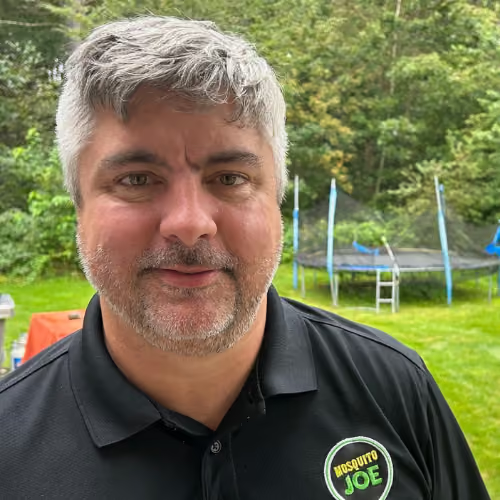
Host: Six months ago, Neil Finneran bought a Mosquito Joe franchise resale. He bought small less than $700,000 in revenue, which means some days he is out in the truck and spraying customer lawns. It's a big change from his days at a hedge fund or as a cfo. He's embraced it and he actually thinks his years of finance experience give him an edge in running an SMB. But of course there is still a steep learning curve going from the relative comfort and routine of corporate to being the operator of a blue collar business. Neil is still figuring that out, but with a smile. Fortunately, he mostly likes his new role and he and I try to tease out what it is that makes some formally corporate people like SMB life while others can't stand it. This is a salient question for so many of you. We also talk about the pest control business, which is one you hear a lot about in the world of buying small businesses. Entrepreneurs are attracted to it for the same reason Neil was It's easy to understand and it has recurring revenue. I actually have an interview that will air around the same time as this one with another acquisition entrepreneur who bought a pest control business and in actually the very same franchise system as Neil. Jesse Sundquist also bought a Mosquito Joe resale. So listen for that episode soon. Okay, please enjoy this conversation with Neil Finneran, owner of a Mosquito Joe territory in Massachusetts. Welcome to Acquiring Minds, a podcast about buying businesses. My name is Will Smith. Acquiring an existing business is an awesome opportunity for many entrepreneurs and on this podcast I talk to the people who do it. I want to share an update on the Acquisition Lab. As you know, the Lab is a highly vetted cohort based accelerator and community for people serious about buying a business. After going through the lab's month long intensive, you have ongoing access to almost daily Q and A sessions with advisors, regular live deal reviews with Walker Deibel, author of Buy, Then Build Potential Deal Team Introductions and a very active Slack group with other searchers on the path. Well, the update is that the Lab recently passed 60 businesses acquired and for well over $100 million in aggregate transaction value. Also, all members now enjoy lifetime access to the Lab because when you buy a business, it's often just the first of many and the Lab wants to support you in every deal, not just your first. Lastly, check out my recent interview with Shane Ursum, episode 105. Shane acquired a business with over $1 million in EBITDA in just six months and he attributes a lot of his deal success to what he learned in the lab. Check out acquisitionlab.com or email the lab's director, Chelsea Wood Chelseie then build.com Neil Finneran, welcome to Acquiring Minds.
[3:07] Guest: Thanks for having me. Longtime listener.
Host: Great, great to have you here, Neil. You were a hedge fund guy then you were a cfo. But you're sitting here before me now because most recently you acquired a mosquito spraying business. And I love stories like yours, Neil, because buying a business represents such a big career pivot. There's just a lot to learn from that. So we're going to spend the next hour ish hearing about the why and the how behind your pivot. Please start us off as always, Neal, with some background on you.
Guest: Yeah. So background on me. You know, I'm from the Northeast. Both you and I went to Brown. That's right.
Host: Same time.
Guest: Yeah. Class of 01.
Host: Didn't know each other.
Guest: Nope. Coming out of college, I did not know what I wanted to do. I think I followed a lot of the other athletes into finance just because that's what you're supposed to do. And I went into what they call the sell side for a few years, which, you know, was basically trying to get investors to buy or sell stock through you. So it's more of a sales role. I did not love that role, but it got me in the door and it got me interested in finance. And after a few years I was able to move into the hedge fund space as an analyst and a trader in 06. And you know, that was a great experience. I was, you know, at a value based distress hedge fund for those, you know, who know what that is. It was a spin off of some larger funds. So it worked with very smart people analyzing very little ton of businesses all up and down the capital structure and looking for ways to make money. So as a younger guy, clearly very fun, profitable business and it did very well for years, certainly through the financial crisis. Ironically, those are the best years for a business like that which is much more in the distressed event driven dislocation side. So that, you know, that was really fun, interesting work. Over time, I think the days of a few guys, a few Bloombergs and a few hundred million dollars kind of faded away. It got a little more institutionalized. I think money rightfully so went to lower fee places. Just too many smart guys chasing too few ideas and a lot of those value funds kind of fade away along with ours. Our performance wasn't horrible, but wasn't enough to justify those high fees, especially in the world of zero interest rates. So I made a move around 2018 to leave. I felt like it was time. I felt like, you know, I wasn't adding a whole lot of value to the world being there. It did do a stop at an appraisal firm where I, where I analyzed. I valued assets for lenders for a year or so. I didn't love that. I wasn't really in the game there. It's more of kind of a side player. Um, so around Covid time, 20, late 2019, early 2020, I actually had a friend who launched. He had a distillery for about 10 years, but he launched one of those canned cocktail drinks, think high noon type. What's the other one? White Claw, that type of stuff.
[6:44] Host: Yeah, yeah.
Guest: And it turns out it was a small, sleepy distillery in Rhode island, but that, that business did pretty well, you know, got up close to 10 million sales for that product. So he was one guy making the product with, you know, like 35, 40 hourly employees. And he just needed another. He just needed help. I thought, oh, that's cool, let's go do. Was that weird? Covid time. We didn't know if the world was going to end, but it turned out people just drank a lot more. So business did well. And I think in hindsight, I think the timing was right. We thought that brand, it was big in New England, but to grow it, it would be hard to go to additional states. We thought it'd be great if we could sell it to a big player and move on, good and bad. In that space, the big players really dominate and they have. The relationships with the distributors they have is really nice. So they can pay. They're not paying SMB small business multiples, they're paying high multiples because they can buy high multiple and shoot it out to all the distributors and make it a low multiple. So we sold that business, that brand in mid-2021. So after that I hung around for a year helping them out. But the sales, that was the majority of the sales. So I didn't really need me. Um, I kind of helped him downsize, get out of leases, kind of reduce liabilities for a little while. Um, and then I was looking for the next thing. Um, I wasn't necessarily looking to buy a business. It just kind of, it came to me. Um, I was actually looking for a little bit, looking at businesses on the side. People call, franchises would call. I would check biz by sell. Because just as a curious guy, I mean, I have read all the books, you know, specifically like the HBS or HBR book. I had that in the back of My mind. So I was more doing that for fun. Just look like looking at businesses as a former investor, but at the same time I was looking for, you know, CFO jobs or family office type jobs. And I have. Wasn't having a ton of luck. The CFO jobs, I think because I worked at a CFO, a small business, 10 million in revenue. So usually those are more controller types, that small company. And then the bigger ones, I didn't have the bigger experience. I definitely talked to a ton of private equity guys and they love the investing and operation experience. Just didn't know where to place me, which makes sense. So, yeah. So out of the blue, someone called me. I don't know if I didn't think about it enough, but they said, hey, this pest control franchise, it's like five years old, is for sale in your neighborhood. You want to take a look? I was like, yeah, sure. So, you know, I took a look. It's, it's, you know, we could talk about the numbers, but I took a look and I thought it had enough upside down with not a ton of downside. You know, we can talk about, you know, buying big versus buying small. What's riskier? And I see both sides, but I thought I could make it work, have some upside. Maybe it's buying a job, but I think it was buying a job with some upside. And it's a pretty good business once you get it to scale as far as cash flow. Hard business, but good business. Competitive but still good. And so, yeah, we did some due diligence, went through with it. Here I am six months later.
[10:35] Host: Neil, you skipped to the end. Yeah, exactly. We're going to spend a little bit more time on your analysis there. But I do want to, I want to call out something in your career. It seems like you time these international crises pretty well and you're in the right businesses that benefit from them. From distressed in 2008 to a booze business during company.
Guest: Yes.
Host: Well played. Neil, when you say you got this call from I guess like a franchise consultant, why did you get that call?
Guest: Oh, he. One of these franchise consultants was calling me for like a year with just showing me franchises, franchises and franchises. And I. He's very persistent. I kept on looking at some of them, but most, most part it wasn't interested in any of them. And then this one popped up as just somehow he got in the flow of this resale, which I like. The, the, I like the fact that it was a little. You got to pay for it. Right. A little more, I guess. Not sure if it costs more of a, you know, given it hasn't built in cash flow. But I just like the thought of it, you know, already had a pretty good territory, pretty good brand name and
Host: is that it was at that specific point that, that caused you to pay attention to this one where before when he'd call you, you'd kind of dismissed it. Was it like, oh, this one actually has cash flow. So I'll get another look at this.
[12:04] Guest: Yeah. You know, a lot of the other ones were more like a long build out, a long payback period, unproven business, a bad territory. Just everything else seemed like I could, you know, or just this wasn't interested. So there's always something, you know, I could knock off and, you know, I wasn't really interested in franchises. Like it wasn't like a goal. But he just happened to call on this, this one that was for sale.
Host: Yeah.
Guest: Checks and boxes.
Host: That was a resale. Yeah. Yeah. Okay. And so you, you said it was a, a good business, but hard. What did you, what, what was a, what was good about it?
Guest: I think, you know, what's good about it is it's very high margin. You know, like a lot of those, these, these type of home services businesses, they're, they're hard and the management labor is hard, but the, the pure cost of the service relative to the cost of the material and the labor is, it builds in a lot of margin. So I like that. Just, it's pretty high cash flow if you get the customer.
Host: Yeah. And did you, can you give us a sense what high margin means to you?
Guest: Well, yeah, I mean, I think let's say we treat somebody's yard for, for 100 bucks. I'm just throwing out numbers. You know, you gotta pay somebody an hourly salary. Maybe it takes them 15, 20 minutes to treat that property. You gotta rent a van and, and buy some equipment. But. And the, the actual materials, you know, probably, I don't know, five to ten bucks. So, so you do all that, you know, I mean, you do that 15 times a day. It's pretty good. Once you get ramped up, get some pretty tight routes and a lot of customers, it's hard to get customers and there's a lot of marketing expense, but if you can get them and keep them, it's, it can be a pretty good return.
Host: Well, I want to spend some time a little bit later on. What is hard about this business, because I think what's hard about it is, are elements that many people listening will need to be prepared to experience or may are already be experiencing in their businesses. But I, I, before we kind of get off here, I want to also just understand a little bit about your kind of like, emotional decision to do this because sure, this, this franchise consultant had been calling you a lot, but you'd almost basically always said no or not really been interested. And then this time you're kind of interested and then you do it. And as I said at the top, this is a pretty big pivot from being a cfo, your most recent thing, and before that, you know, kind of high finance hedge fund world. So, so how did you think about that? And did you have to sell it to anybody in your family? I know you got a family, I mean, luckily.
[15:18] Guest: And I think this, that's probably a common theme in your podcast. It's good to have a supportive wife. So she's like, almost too supportive. So, yeah, go for it, Go for it. I believe in you, but that's super important. And I recommend to all the guys and girls out there, if you don't have that, I'm sure it becomes very hard. So she was always super supportive. So, you know, so that, so. And my kids are, you know, they
Host: don't get a say.
Guest: They don't get a Sally. They don't, they don't get to say. Totally.
Host: How many kids do you have?
Guest: I have two. Yeah. So 15 and 12.
Host: Okay. And, you know, there's, you know, buying a small business when you're 30 and, and single is different than buying one when you're our age with a family and mouse to feed.
Guest: Yeah.
Host: So there's a, there's kind of a. Your, I assume your risk tolerance is probably lower, even though you did it, is lower than other people listening who are 30.
Guest: Yes.
Host: So how did you think about that? There's a bit of a leading question because I'm also kind of trying to get at the fact that I think you have a bit of a cushion, like you have some savings. So, so talk us through that if you can share what you can there.
Guest: Yeah, so, I mean, that's totally true. I mean, I think there's something to be said for the, like, I think you had someone on recently who, who actually had a similar background to me, but he was younger and sleeping on couches. And for him a personal guarantee is different than, you know, personal guarantee and me funding, you know, any losses or expenses given the, you know, obviously the responsibility you have when you're, when you're older. So, yeah, I mean, that's, that's, that's definitely something to think about and you know sometimes it keeps you up at night. You know I think the good thing about having a little bit of cushion as you're older, if you saved up, you know some, you know I could go for a while and not you know go for years and not even you know, pay myself and still like make it out to the other side and that know that adds, it adds some comfort. It also allows you to make better long term decisions. So if you don't have that cushion you might be more apt to cut muscle and you can see how a few decisions, decisions could be a spiral not not having a cushion. So you know there's both. I mean I think if you're 30, yeah you should go for it. If you have a cushion and responsibility it does, it does allow you some advantage as well. So I don't know if those are right or wrong. I think buying a little small for me it both kind of if it increased the risk or decreased the risk I think the super downside is decreased. Like you know if you bought a business 10 times as much everything was 10 times you'd have a lot more cash flow ability. But if it went wrong, you're really screwed. Whereas this goes wrong I feel still feels like a bump, an annoying bump but manageable.
[18:43] Host: You're not going to be ruined by it.
Guest: I'm not going to be ruined. So it's you know, you know, probably ideally you'd buy that enduringly profitable business that has a niche and you pay three times and you know, and maybe that's the way to do it but who knows. You know what, it's hard to find those.
Host: August Felker is a two time successful searcher first with a traditional search fund. The second time around he did a self funded search. Today August runs Oberle Risk Strategies, an insurance firm with a dedicated practice group for searchers and acquisition entrepreneurs like you. If you've got a business under Loi Oberle will provide complimentary due diligence on that business's insurance and benefits program. A great no risk way to get to know August and team. They love helping searchers. They've worked with hundreds. Oberly is a specialty insurance brokerage for searchers by a former searcher. Check out oberly-risk.com O B E R L E risk.com link in the show notes and Neil, I don't think you said can you give us put some numbers around this business that, that you've said now is buying small.
Guest: Yeah so it was approximately a little less you know, less than a million in revenue in 2022, like a little less than 700. I'll probably grow it like less than I hoped, but I'll probably grow like 10% even now it should probably get to 20% margins before debt service. So it's not a lot of cash flow but good margins and that's something.
Host: And so tying this now to the previous question about your cushion and where you are in life, you're not paying yourself, right? You're reinvesting.
Guest: I haven't paid myself in reinvesting. Yeah, I mean I could probably.
Host: You're reinvesting all the dollars back into the business.
Guest: Yeah, yeah. So I just want to build up some cash to get through the off season because it is seasonal. Put a lot in, you know, marketing. And then I did borrow some SBA debt. So I'm actually not only taking some out, but even just like a few hours ago I just paid down some SBA debt with some savings because the loan rates are so high. And I think that's something people definitely have to. If they're, they're thinking they buy lever up and buy with SBA loans at floating rates prime plus a couple hundred basis points. It's, it's a lot of cash flow. So. Yeah, so I haven't.
[21:27] Host: So you, you bought some of that debt down? Just bought some of.
Guest: Just an hour ago I was like this is crazy. I can't be paying double digit interest rates. Well, I have this money over here and the stock market, like I feel like I'd rather, you know, I own anyways.
Host: And you did that with money from the business or from your own?
Guest: Oh, my own things. Yeah, yeah, yeah.
Host: Okay.
Guest: So yeah, that I think that's going to change a lot of like the. I be interesting how that plays out over the next year or so. The impact of the interest rates on businesses and, and acquisitions and because it.
Host: Are you bearish? I mean do you think that we're going to see more kind of carnage than, than we have?
Guest: I think you probably will still see some carnage in very interest rate sensitive assets like real estate. Probably still have time to play out. I'm trying not to get too macroy on bearish. Bullish. But I do think it's definitely something to think about for your listeners and really think about the real cost. Don't just assume it's free money but really run the numbers is important as far as the impact in the economy. Yeah, I don't know. I don't know. It's interesting for every you know, borrower, there's awesome savers. So if you have extra money, you can earn 5% doing nothing, which is also not bad. So. Yeah, yeah.
Host: Okay, well, let's, let's dive into the business a little more. So it's basically doing about a little bit under 700. So let's just call it 700,000 a year in 2022. Right. Did I get that right?
Guest: Yep. Last year. Yep.
Host: And so that translates to how many people, how many employees?
Guest: I have one office manager who answers the phone and does some, you know, administrative work and then I have the, the technicians of Spray. And that's, that's right now I'm, I have, I've had between five and seven all year. Come in and come out a few of them, but I have a kind of five right now as we get towards the end of the year.
Host: Now one of the aspects of buying small, particularly in a blue collar business like this, although perhaps in really any business is there's less cushion to use that word again. But in this case we mean manpower. So you're probably working very much in the business or what was your expectation and what has the reality been?
Guest: I mean, my expectation was to be working in the business for a while until I would guess I'd have to get sales up at least twice as much to probably get some more out of the business. I think. So, yeah, I'm in it and you know, you gotta, yeah. When it's this small, you gotta be willing to roll up your sleeves. A guy calls out like, obviously there's days where I'm outside, you know, from a hedge fund outside for spraying for mosquitoes in a few years. So I mean, you gotta be humble enough to do that and roll with the punches. And that's, that's not unexpected.
[24:33] Host: Yeah. Okay, so you were, you were, that was something you signed up for. Because I've had guests on who bought a little smaller. A business like this, not necessarily pest control or mosquito spraying. And when they find themselves being in a, in a pinch, having to do the work itself, you know, it's, it's a rude awakening. But you were, you were totally on board and it's part of your plan, really even.
Guest: Yeah, I mean, I thought, yeah, I gotta fill in, probably build some goodwill with the employees that they see me going out there sometimes too. So it's not ideal. But you kind of, you know, try to keep your word when you tell customers you're going to show up. I, I don't, you know, I would rather, if I can Maneuver it and me show up than kind of canceling and say, you know, making up some excuse so it's the right thing to do. Yeah.
Host: And aside from, from that, being able to, like, know that you're going to service customers and, and not leave anybody hanging, have, has it been beneficial in your learning about the business and the other thing that you mentioned, where it's kind of earned you some cred with your, with your team.
Guest: Yeah.
Host: Those two take those separately.
Guest: Yeah. I think both, it helps for the credibility of, for knowing the business, for being able to kind of, you know, I get a lot of the complaints too. When you have, you know, 1100 customers, you know, you're going to get, I don't know, four or five calls a week at least of this and that. I got bit by a mosquito. So just kind of knowing, you know, kind of knowing what, what the process is and how to do a good job, it helps for management, it helps for respect from the employees, and it helps for. When I train new employees. I know what I'm talking about.
Host: Yeah. When you said that you get a call if somebody gets bit by a mosquito, I thought you were being metaphorical. But you probably literally do get a call if one of your customers gets bitten by a mosquito.
Guest: Yes.
Host: They're like, this isn't supposed to happen anymore. What's the deal?
Guest: Okay.
Host: You mentioned you got to be humble from, from hedge funds to mosquito spraying. Talk about that a little bit. Yeah, I mean,
[27:05] Guest: yeah, I think it's just. I am fine with it, but I think there probably is a perception of going from Bloomberg's and serving creditors committees and going through restructurings and working for a billion dollar hedge fund to spraying for mosquitoes. I don't really think about it, but I can see how that, you know, could be, you know, hard. And if you take a step back, you're like, what the hell? How'd this, how did I end up here? But, you know, it is what it is. You kind of. I didn't have a plan to go hedge fund to CFO to mosquito Joe. But it's kind of how it rolled out. And yeah, it's just, it's just the way things are and just doing the best I can with. With it.
Host: Well, I think one of the questions that feeds into this, the, the, the ego question is also what your, what your plans are. So if, if you're only going to kind of keep the business at a small level, then maybe that's, you know, there's more for your ego to accommodate there than if you're intending to, you know, build a, a pest control empire and when your ego gets the better of you, you can say to yourself, well, no, this is just step one.
Guest: Yeah.
Host: Of a, of a master plan of world domination. So which is it for you?
Guest: I think I have a loose plan. You know, sometimes you get into these, the, the franchises have a lot of, you know, positives and negatives, but I think I do have a, now that I'm in, there is a, in my, in my head, I feel like there might be some opportunity, especially, you know, maybe some of the other surrounding franchisees are older or I could probably hopefully roll up a little more at more reasonable multiples than the first one without adding a lot of big fixed costs and just kind of buying incremental revenue at a reasonable price, I think there may be some opportunity for that over time. Whether it's an empire, I don't know. But could it be several million in revenue? Yeah. And that, that'd probably be enough, you know, for me. So that is, that is in my head as being a finance guy. I think that might be even lower risk than just trying to, you know, do as much as I can with the hand I'm given.
Host: One of the, I think really compelling things about this world, speaking purely from, you know, money perspective, is that there is a pretty clear path to earn a million bucks a year. If you, you know, if we'll just assume as very kind of napkin math generalization that, that many of these kind of home services businesses are operating at 20% margins, you can get to, if you can get to $5 million in revenue, which is a big, bigger one of these businesses. It's not a huge, it's kind of of a medium size. Yeah, you're at $1 million a year, which is really a pretty elite place to, to be, not to mention comfortable, not to mention fat and happy. So it's pretty, you know, it's pretty interesting. And I, and I've, and I've had more than one guest say, you know, they bought. One in particular comes to mind. He bought small and his kind of five year plan was to, to build and, or acquire his way up to $5 million in revenue to hit $1 million and take home every year. And yeah, at that point he just cruise or who knows what. But if you're making a million dollars in cash a year, you've got a lot of options.
[31:05] Guest: Yeah, definitely, it definitely will de risk. I mean, I, I, I think having a plan like that and even getting 50, 75% there. That's something you pretty sure you can execute on. I think it's. In some ways it's less risky than not doing it if you can manage it. Well. And, you know, yeah, that, that definitely. I put. I'm definitely putting feelers out and we'll see what happens. It might, you know, take some time.
Host: So let's be patient feelers to. To what? To acquire.
Guest: Well, I just met. Yeah, just mention it to the franchisor and say, hey, just a heads up if something makes sense that I can fold in reasonably with that, you know, ideally, you know, almost like that. I think Walmart was very. Let's, you know, when the local market grow from there, if it's close enough where it can. It's an incremental ad. Not like buying in a different state where you're kind of starting from scratch, but you get some synergies. Is. Is a reasonable playbook if it works. You know, if the situation comes up and you have a reasonable seller,
Host: quick plug somebody that you know. Jesse Sundquist, who has been on the podcast before, about a year ago, he'd been searching for a year and he came on kind of having written this essay on search Funder about what it's like being a year into the search without having bought a business. Well, yeah, shortly thereafter, he did buy a business, and I'll be interviewing him shortly. And what did he buy? But he also bought a Mosquito Joe territory or two. One, and then I think maybe he's bought another. Okay, two. Okay.
Guest: I talked to Jesse quite a bit.
Host: Yeah. So that's.
Guest: That's great.
Host: So, so speaking of multiple territories and franchisees, why did this territory come up for sale? And the very franchisees that you're now interested in potentially buying out, why didn't they buy it before it hit the open market?
[33:05] Guest: That's a good question.
Host: And was that a red flag?
Guest: Yeah, red flag.
Host: It was. Okay.
Guest: Yeah. I mean, I think it's definitely a red flag, especially in the franchise world, but I knew the area pretty well. I grew up in Andover, Mass. Which is, you know, one of the towns in my territory. So I thought the territory was pretty good. I t. I talked well that the seller was mid-60s. I think he was very in the business. I mean, he. I'm out in the. I'm out there spraying for bugs once in a while. He's probably out there at least twice as much as me. And so I think it took a lot, a lot out of them. But, you know, why didn't the other franchisees buy it. I think they kicked the tires, but, you know, they, they just didn't. They just didn't want. They were very comfortable where they were. The two closest ones actually run by the wife of. Well, you know, even the wives run it and the husbands work other jobs. And they're doing. Already doing at least twice as much as revenue as me, maybe two to three times. So it seemed like they were pretty comfortable with where they're at in the cash flow. And they thought, God, it'll be such a headache to grow this. I'm doing fine.
Host: Well, that's also nice because, you know, I don't know, it may not be apples to apples. Maybe their territory is larger, but if you see that a neighboring territory is doing a lot more than the one that you're contemplating buying. Yeah, maybe that tells you that the ceiling is a lot higher than. Than the. Than the one you're considering buying is at.
Guest: That's right. That was a big part of my thought process. I thought, hey, I'm buying it, you know, at this. But it has a potential to do more just if I can get even, you know, close to where they are. And so is the multiple, you know, really X or is it half of X? Right. So you have to get there, I think tricking the house. And I knew this buying it. I mean, it's been so many weird years that I don't know, you can get the same growth you had definitely at home. Services like these Covid years were probably such a pull forward. So I think it's gonna be harder to get there. So I don't think it'd be like snap of the fingers, but I think over time, with good service, improved marketing, there's definitely room to get more market share.
Host: You had mentioned just a minute ago when we were talking about accumulating more and you know, getting to a higher, larger business, higher aggregate revenue. And you said as a finance guy, you're kind of thinking along those lines. So that, that's kind of a tease up this question, which is, do you, do you think that your history in kind of deeply in finance hedge funds than being a CFO and really kind of understanding finance at a probably much deeper level than many small, small business owners. Does that give you any advantage here?
[36:31] Guest: I was, yeah, I was thinking about the other day. I think knowing the numbers helps you make good decisions, you know, what a customer is worth. So do you place this marketing bid over here, what the chances are? Because, you know, the payback. I think knowing those really feeling the numbers I think if, if you want to, like, you know, and I'm, as a value game, always looking at downside. I'm sure a lot of your listeners and, you know, former guests stressed out. They're probably up, you know, and I do the same thing. Like, I'm six months in, so I'm at that, like three in the morning looking at the, the ceiling. I think having that finance background, looking at the numbers helps to calm some of those fears because you can say, okay, if revenue does this, I cut this, I cut that, I can do this. And so I think knowing the numbers gives you some comfort as far as investing and also as far as contingency analysis as well. Yeah, that's helpful, you know, knowing those.
Host: Yeah, it's kind of like it would allow, it allows you to do surgery on, on the business if you need to. I mean, you know, what, pulling this string or cutting this out. Yeah. You know, you kind of, you can maybe do that analysis. You're quite comfortable in that, that analysis. Yeah. It's also, you know, the thing about being a small business owner is that you're, you're an operator first, but you are, you know, we think about investors as kind of a different mindset. You know, they're capital allocators. They think about the best, you know, best place to place X number of dollars.
Guest: Yeah.
Host: But really a small business owner is making all those same choices or should be thinking about things that way because a dollar put into X is, Is removing that dollar from being put into Y. So you're always, you should always be evaluating your choices of X, Y and Z. And doing that analysis financially is a big part of it. Maybe there are other considerations, strategic considerations, people considerations. But certainly financial should, should be part of it. And if you're already at home with that mindset because you've spent a career in it, that comes to you naturally.
Guest: Yeah. Yeah. I mean, I just got to make sure.
Host: Yeah.
Guest: I don't get too caught up in the spreadsheets and, and you know, make sure, you know, you manage the guys and, you know, make sure they do a good job. But yeah, there's positive and negatives to it, but, you know, absolutely. You're, you're definitely 100. Right.
[39:12] Host: I remember from our pre call, you, you telling a little story about your previous seller and how he wouldn't give a freebie. Or if somebody said, you know, got bitten by a mosquito, it would ask that you come back to the yard, to the person's yard and respray.
Guest: Yeah.
Host: Previous owner would Say hell no. You say what and what, what's the what? You know, kind of I say yeah,
Guest: hell yes, you keep them happy. If they smell a mosquito, I'm going out there and it doesn't make the guys as happy. And you know, I try to explain it to them that the value and
Host: explain it to us. What, what's the explanation there?
Guest: Oh, I think, you know, when you think about, like we said earlier, the cost of doing a service versus the lifetime value of a customer, if you keep them happy and you can keep them coming back, I think we had, you know, 80 to 90%, 85% retention. The lifetime value of that customer is really high. If you go out there a bunch of times a year. And so to risk that over 15, 20 bucks is. It doesn't make sense. And then when you think about, you know, the cost to acquire a customer, God, I mean marketing relative to new customers is hundreds. It's over $200 I think this year. So we spread the marketing over new customers. So to spend that 10, 15 bucks is a no brainer. I keep them as happy as possible.
Host: And so just give us a sense. What is the lifetime value of a customer.
Guest: I guess if he's doing, I'm doing gross margin. With all the incremental margin, credit card fees and royalties, I would say if they go out there seven or eight times, I bet it's like 50% margin. So I don't know. So they're probably worth a few hundred bucks, 400 bucks a year. And if they're at 80% retention, 80, 85. It's probably at least. I mean, I guess it's. If you do the math, the software guys would be able to do the math in their head. I bet it's probably at least a few years.
Host: Yeah.
Guest: Of value. So it's probably 1500 to 2000.
Host: Call it, call it 1500 is.
Guest: I don't know.
Host: Yeah, 50. And, and by the way, 1500 net 1500 cash flow, right? Yeah, yeah, yeah.
Guest: Before the like op, like rent. But yeah, pure like gross margin. S. Yeah. Paying the tech, paying royalties, paying credit card fees. Yeah, I think it's probably 50.
Host: So when that, when a customer calls and says I got bitten by mosquito, can you come back out? And your calculation is.
Guest: Yeah.
Host: 15. Keep the retain 1500. Yeah. Spend $20 to retain 1500 seems pretty. Yeah.
Guest: And then knowing that the cost of a new customer is. Yeah, exactly. It's a couple few hundred. With cost per click being so high right now and so competitive to get a customer, it's much better to retain. You definitely want to retain and grow, but you don't want to lose them over 20 bucks.
[42:18] Host: Yeah.
Guest: a pride.
Host: Great deal.
Guest: Which is probably a lot of it.
Host: Yeah, exactly. Exactly. Yeah. As I recall the story, it was kind of like an angry. Kind of like, no, I'm not, you know, go back out there. And it was so. It wasn't even. Yeah, it wasn't even rational or, or rational if wrong. It was just pure emotion.
Guest: I mean, I, I think, yeah, he's a great guy. I think he takes a lot of pride in the work training and the quality of the work. So I get, I get where that comes from.
Host: Yeah. I don't mean to disparage him because I, I haven't worked directly with consumers, but being one and seeing the behavior of the general public, I, you know, I know that dealing with people and.
Guest: Right. Oh, my gosh.
Host: Yeah. Yeah. Actually, I caught up with Jesse Sundquist a few weeks ago ahead of our, ahead of our interview. And I. One thing on this point, I'm reminded that he said, and I'll just get your reaction, is one of the distinct things about a home services business like yours versus a business. So taking just B2C businesses, consumer businesses, you can either have like a retail restaurant or something where consumers come to you into your environment and it's your controlled environment.
Guest: Yep.
Host: Option A. Option B is a home services business like yours, where you're going into the environments of the public, you're going into their homes. And we are all very protective of our homes, in particular about our homes.
Guest: Yeah.
Host: And Jesse was like, you know, neither is perfect. You know, pick your poison. But there is definitely a lot of things that can go wrong when you are sending people, you know, your crews into, you know, there's basically 100 or 150 or 200 points of contact, you know, put you, your people in other people's homes.
Guest: Yeah.
Host: You know, every week or so. So it's around like.
Guest: Yeah. Imagine just pulling people's driveway and just, you know, miscommunication. Or you step on a flower or let the dog out. Jesse coming back for. Is, is he coming back for another podcast soon or.
Host: He, he is.
Guest: Okay.
Host: He, he's coming back very soon. In fact, I, I might bunch your episodes in the same week and have Mosquito Joe week on Acquire.
Guest: Love it.
Host: Yeah, we'll see.
Guest: We go back, we go back and forth with some more stories with the labor and customers. So it's fun.
Host: I do want to ask. Going back to this, this LTV lifetime value versus loss of a customer or acquiring a new customer thing. Again because it's so fundamental to just recurring revenue businesses and customer acquisition. And the math there. Yeah, the. If you're telling me yes, $200 to acquire a customer sounds expensive or maybe even a few hundred dollars. But, but, but if they're worth 1500.
[45:11] Guest: True.
Host: Why is the argument not just pour money into Google Ads? You know you're, you're profitable all the way up to fifteen hundred dollars as long as you're not paying over fifteen hundred dollars to acquire. Now I know we were doing napkin math, so maybe it's not exactly that, but the delta that currently exists between your lifetime value of a customer and and what you're paying to acquire them is still, there's still a lot of room there for you to just pour money into it.
Guest: And it's true. I mean yeah. I think you to balance that with cash flow. I think if you are like SaaS company and a bunch of investors, you probably would. I don't know. I don't know how much you can push to like I think there, I think there is a probably diminishing returns.
Host: Yeah.
Guest: I mean we put, we spend a lot of time like that. I told you what that money discussing maybe it might have cost 300 customer this year if I'm doing the math. But of the few hundred customers I got, I would bet at least a hundred of them were just referrals. So I don't know if the marketing even got them.
Host: Yeah.
Guest: So I'm not sure if doing more would have done anything. I don't know. That's a good question. If I knew I could get, if I knew I could spend more and get customers at 150 to 200, I'd probably do it. I just don't know. I don't know. I don't know if how far you could push that and where the, where it sits. I mean I think I, I think I'd like to be 10% of sales and it's probably a little over that this year. Like that's manageable. But if you really could play that game. If I, if I thought you pay more and you could keep it even at 150 to 200 bucks. I totally agree with you. You do it. I just don't know. I don't know if that is linear like that. Yeah, I'm still learning the whole marketing thing. That's my weak spot. I just kind of trust the people.
Host: Well, thank you for another segue which is I want to ask about buying a franchise. So one of the things. So I want to spend some time here. But one of the things that franchises franchisors often offer is, is kind of to do the marketing for you and. Or, you know, to send you leads. It sounds like in. In this case, Mosquito Joe does not send you guys leads. The marketing is in your hands.
Guest: They. They have some required spend. So they do send out a lot of post, you know, direct. I think they're changing it maybe, but they do have some required spend per territory that has to go through them and it comes out via. You have some options within it. So you can kind of whatever however you want to that menu, direct mail or more like emails or display ads or all that stuff or YouTube, I think. But they have some requirement spend which is mostly both, you know, it's probably both a good thing and a bad thing because you could see people not spending and then probably not good for anybody. So maybe some of that force spend is good as long as it's done well. Yeah, and then I spend above that with some, you know, outside of that, I spend a little more. Okay, I have got you like, you know, whether it's pay per click or putting up a Little League sign or something or some social media spend, but yeah, okay. Or yard signs or stuff like that. Some of the old school stuff works pretty good too.
[48:31] Host: And what else about buying into a franchise system, Neil, any. What would you share with the audience?
Guest: I mean, you're giving up, you know, you're giving up a lot on the, you know, they're taking, you know, in our case, 8 to 10% of sales, depending on your size. It scales down as you get, you know, over a million, I think. So that's, you know, it's a lot of money as you get big. But they do provide. I think that I really like the branding. I feel it'd be hard for me to get Neil's mosquito control brand. I mean, I think people know the brand almost nationally, I think. So that's helpful. I really like the ownership. You know, it is part of a bigger company called Neighborly, which is part of KKR Owns. So I mean.
Host: Oh, it's a Neighborly brand.
Guest: Yeah, it's a Neighborly brand.
Host: Okay.
Guest: So there's some good. Bad. I like the people. I think the. It's nice having the community. Probably the best thing is the community of other owners as far as best practices and tips and tricks. Like, you know, how do you guys incentivize your technicians or how do you do this and all that, you do have a community of, I don't know, at least a hundred, a hundred plus other business owners doing the same thing. And so that's good. And as far as all the, the technical stuff, like, you know, you have the bug people at Mosquito Joe. So like, I'm not, like, it's not like I was passionate about bugs before I started this. So it's nice to have like a entomologist to say, hey, what do you do with this bug? What is this? How do you treat this? So there's some support there. So I didn't have to be an expert in it. I have some support. So all that, you know, pluses and minuses.
Host: Well, one of the other big pluses of buying into a franchise system is that it unlocks the potential for what A.J. wasserstein, the professor at Yale School of Management, calls programmatic acquisition, which is basically just buying, buying up more territories, but doing it kind of very systematically with the plan of doing it. Just what we were talking about before. Inorganic acquisition of your contiguous territories and growing that way. And franchise systems make that so easy for two big reasons. First, the, the integration is trivial compared to integrating to independent businesses. That's huge because integration is a big part of where acquisition fails.
[51:06] Guest: Yep.
Host: And two, all of the other owners are known to you. I mean, you got the, the contacts of all of them, so you could email them all tonight and say, hey, I'm looking to buy more territories.
Guest: Yeah.
Host: Contact me if you're interested. Absolutely. Which is pretty powerful.
Guest: Yeah.
Host: So have we said everything that you wanted to about buying big or versus buying small? Was there anything more there to say?
Guest: Oh, yeah, I just like I go back and for in hindsight, you know, should I have this one? Really? I wasn't like looking hard like maybe Jesse was. Some of your other guests would look for a year and that they look at thousands and thousands of businesses. It was more just kind of. I was mostly looking for a job and this kind of came to me. So, you know, in hindsight, should I have gone bigger and looked a lot harder and found a more niche, you know, high barrier to entry business? I think that's, you know, that's also another way. I mean, it's hard, you know, in hindsight, but I think I can make this work. So I think it's all going to work out. But yeah, I think I've read the arguments big and small, and I think both can work. I don't think that's the right answer.
Host: Well, you remind me of one other point about buying big versus buying small. This isn't, you know, it's not like you can only buy one business in your life.
Guest: Right.
Host: Your mid career. So if you got this to a point of revenue where you could put in an operator and it's throwing off a, you know, significant six digits every year, then you can go do another search.
Guest: That's right.
Host: And, and be that much richer and wiser when you approach it. That's true.
Guest: Absolutely.
Host: And operationally, you know, savvy like you have operated a business.
Guest: Yep.
Host: Speaking of which, so Mr. Former hedge fund, Mr. Former CFO. What, what has it been like to become an operator of a blue collar business? You've already talked about a little bit about the ego of. Yeah, but what about actually the, the day to day and dealing with angry customers and spraying bugs sometimes. And most importantly managing, managing your staff.
Guest: Managing staff's probably the hardest part of all. Those three customers. Usually, you know, you get them on the phone for the most part. You can even turn a negative into a positive. Just, just being nice and, and adding some extra customer service more so than they used to, especially in some of these blue collar industries. So that hasn't been a huge problem. But the labor, managing the, this blue collar labor is, is just, it's hard. It's. I, I mean I like the guys, I think actually get along pretty well with them. But you gotta somehow be tough but also roll, learn to roll with the punches a little bit with them, which can be frustrating. I think there's like a high chance that if I have five guys tomorrow, there's like, I feel like there's a 50 chance one of them will something. I, I don't know, something. For some reason they won't show up. And that's, that is frustrating. But I think it's part of the game. You kind of got to roll with it. I think, I think you can get really worked up about it, but I think it might be just the nature of it.
[54:25] Host: Yeah, yeah. And so how do you, how do you deal with it if every other day somebody isn't, somebody isn't showing up? Does that mean every other day Neil does the work with that for that work.
Guest: I know.
Host: Are you, are you over hiring so to, to kind of. You have excess capacity or what?
Guest: Yeah, I think right now I'm a little tight but early in the year I had a little excess. I was almost like fine, it wasn't a big deal. I think, you know, I think you try to hire better and you try to get rid of, you know, firing a few people this year, maybe one or two. You try to make maybe that fire decision a little quicker. I think maybe next year I'm thinking about, I don't know, I'm going back and forth on whether they do a little bit of incentive bonus just like at weekly if they hit certain production numbers. But I might go a little more aggressive on the incentive. You get a percent of the revenue produce plus a little more if you show up every day unless it's like at least a week in advance. So I'm trying to think if I, as opposed to managing the discipline into them, is there a way to incentivize the discipline into them and the reliability? So I'm thinking about that for next year. But part of it just this stuff happens, I think at this level and you gotta be able like roll with it because I think, you know, some of these guys, I think we pay pretty well, well relative to other pest mosquito control companies, but they're not making a lot of money. So like one emergency in their house and they're in their family, it really affects them. Right. So, you know, they're a few hundred dollars away from a crisis. So you know, it's, it's hard. But I think you just kind of know when to, you know, roll with it. I'm sure Jesse will have some additional comments too.
Host: Well, well, Neil, I, I, let me, let's press on this a little bit because it's such a. I, I, I, I hear you. That you just got to roll with it. But it does seem like some people can roll with it and some people can't.
Guest: Yes.
Host: And you know, there's this, there's kind of this sense among SMB owners like of the very white collar person coming from a white, from a, from a finance background, like liking the napkin math of buying a small business and getting in way over, way over their head. Because the culture of small business is so foreign and so rough around the edges compared to what they're used to.
[57:16] Guest: Absolutely.
Host: And sure enough, some of those people do get in over their heads. Really don't like what it's all about.
Guest: Right.
Host: And they hate it and they run away screaming, made it, make a huge mistake. It's not for them, whatever, whatever the unhappy outcome looks like.
Guest: Yeah.
Host: Meanwhile you are saying, yeah, it's hard kind of with a twinkle in your eye and kind of a half smile, but there's something about your personality, I guess, that allows you to tolerate it or maybe even like it a little bit. What do you think the right person. So for somebody who's listening to this, who's W2, and they're used to a nice, controlled corporate environment, how do they know if there's somebody like you who can handle it or there's somebody like other folks who really can't. Won't be able to handle it?
Guest: Yeah, I don't. I mean, you're going to have to learn to handle it to some respect. I mean, I don't, I don't know. I think it's definitely, like you said, it's hard. It's definitely hard. It's definitely a big factor. I probably didn't appreciate it enough. I was more like you, like, oh, the napkin works. You know, you know, back of the napkin, they do pay this per hour. They charge this much. It's awesome. But actually doing it day to day and, and managing around that, it's like the full, you know, it's a lot of my time just managing the logistics of the labor and the changes. And so I think the answer is you probably want to pay a bucket to higher per hour than the other guy. And you all. But, you know, and you. Hopefully you get a good core group, which I think I do have a good core group, and maybe one or two that are a little. Get less reliable. And then you got to learn to, to roll with it a little bit. Even like good core group stuff happens. And if you're thinking about getting in this, it's a big deal if you're coming from a white collar company where people show up, do the job and leave. And it's not a lot of, you know, drama. I mean, you, you know, here's, here's like, you know, I can't get a drive. I can't get a ride in. Like this happened. Maybe they lie to you and you kind of know, but you let it slide. So, yeah, I mean, I had a. One of the guys I got rid of just. I didn't even think about this.
Host: He.
Guest: He couldn't come in. He sent me a picture of his car totals. But in the background it was a junkyard of all total cars. And I'm like, kind of like sarcastic. This is a guy who didn't work out. I didn't rid of him, but I was like sarcastically like, wow. It was like a tornado roll through there. And then the next day he shows up with the car in perfect condition. And I'm like, seriously? He's like, yeah, my cousin's really fast at fixing cars. I'm like, okay. And that's Kind of. I mean, that. I mean, obviously that one was so blatant. But yeah, you just kind of. You gotta roll with it. I guess there's ways to make it easier. Probably 20%, probably one more guy than you need. You gotta give it. Give where you can. If they're do a good job for the customer when they show up, like, they're not like, lying. If they're fairly communicative, even if they miss a day every couple, two, three weeks, if they tell you, they'll just disappear. I think you're gonna have to roll with some of those guys. It's probably like a line. I think there's a line where like, hey, if a guy, like, lied about doing a treatment, or he like, sprayed water or he like, you know, just a jerk to a customer, there's probably lines. You're like, okay, that's it. But if it's like, hey, you know, I might have Covid, but he's probably really hungover, you might have to roll with that. You know, it's kind of in that world. But I. It's hard.
[1:01:14] Host: You know, I like this, how you put it, this line, because basically you come from a white collar environment and there are lines that you don't cross. And if you cross, you'll expect to get fired. Or if you see that behavior, you know that person's going to get fired. You. You can't burst into your boss's office and start screaming at them.
Guest: Yep.
Host: But as I understand it, that might be within the line in blue collar. Blue collar environment. So you have to. You have to define new lines or recalibrate your lines. And if you got. If you have no experience in. And be. You might really just not know what they are, what those lines are. And. And so I guess talking to people like you, people who've been in it now have some experiences. Maybe a good way to kind of gauge like, it's because it's just got to be hard to know where that line is. If you're new to this, what should I let slide and what shouldn't I. Yeah, exactly.
Guest: And I probably get it wrong a lot.
Host: Yeah.
Guest: You know, sometimes I ask the office manager, they go, what would the prior seller would have. What would he have done in this situation, though? But yeah, it's hard. Hard to know.
Host: Do you like it? I. Not the bad stuff that we just talked about. Just overall.
Guest: Overall. Oh, my gosh. So I'm six months in. I feel like this is like, it. Like, I'm sure, like a lot of guys you talk to depends on the hour of the day. I like, I like the fact that I have control. It feels like I like almost like I know it was, you know, there's obviously a lot of responsibility. You have a wife, kids, mortgage and all that. But I like the fact that I'm in the game, I guess, if that makes sense.
Host: Yeah.
Guest: And I can play the game against other people and I think over time I'll succeed. So that's fun, you know, because sometimes you get into, you know, I was usually in small corporations, but you kind of don't have that control and you don't know, you know, you're probably, you know, a cog. But here I'm in control and I think if I show up every day and make good decisions, I think it's going to work out, but I'm going to do my best trying. Maybe, maybe it doesn't. But that's fun. It's almost like a, a sport to me. Like I guess like a, a game. And so that's fun having that control and being in the game and trying to win and strategize and think and always thinking. It, it does tend to consume you. So I mean you might say the hours or whatever, 8 to 7 to 6, but it's really non stop. So that's the. It's hard to shut your mind off when you're running it. Even in the size of this small, fairly straightforward business. Always kind of thinking.
[1:04:11] Host: But to be clear about feeling like you're in the game, you feel like you're in the game now and you did not feel that in your corporate past because. Because you weren't the protagonist.
Guest: Yes, yes, that's right.
Host: Great. I want to just hear a minute, Neil, on the pest control business. I like to ask my guests just about, you know, the industries that they're in. We've already mentioned many elements of it. Is there anything else to say? Because pest control is one that, you know, it's a classic home service and it's got, it's recurring. So that's something to, to, to like about it over some of the other home services which are, which are, you know, you only, you only go to the person's house when they call you.
Guest: Yep.
Host: And. But you know, I assume it's pretty competitive, low barriers to entry, like you know, classic kind of guy in a truck and is, you know, a spray. Yep, sprayer. And he's in business with you. So. So what. What would you tell people who might be looking at pest control businesses to buy.
Guest: Yeah. I think it's, it's competitive. A lot of big players, you know, it's a, it's a, it's a low barrier to entry like you said. I mean you have to do some licensing and some training, but it's not, you know, insurmountable to be a guy in a truck. So it's, yeah, you gotta, you gotta compete. I, I think you have a lot of guys, you know, some of the big players like the True Grains and Terminix, who maybe they don't do as a thorough job, but they're price competitive. Like you heard those margins. It's expected. So it's not easy, but it's a good business and I think it's winnable. But yeah, I really don't. Except it's very competitive and that's hard work. But it also can be very profitable with not a huge, you know, not a huge hurdle to get there. I mean like you said, 1, 2, 3, 4, 5 million is not outrageous within a region. And it's, you could probably get, geez, a few percent market. A few percent of the households that make a lot of money and get there in a region.
[1:06:38] Host: Yeah.
Guest: So
Host: also just this, I mean we all know how appealing recurring revenue is, but if you, if you really look at it like so let's, let's call your margins 20%.
Guest: Hopefully they're higher. I mean I think they should be higher. Should be 25, 30s across a million. That's what my understanding. Great.
Host: Yeah. So, so, so even better, let's say 2025% just to be conservative.
Guest: Yeah.
Host: So, so what I rather have and say I'm interested in home services. Would I rather have a plumbing business that does 20, 25% but I have to make the phone ring for every single job. Pretty much I have to make the phone ring like there's, there's little to no recurring nature to that revenue and, and for many home services versus 20 to 25% margins and it's recurring. So I know what my revenue is going to be next month and I, you know, even if the phone doesn't ring, I basically know what my revenue is going to be. When you kind of compare it that way, all else being equal, kind of similar businesses, but one's recurring, one's not.
Guest: Yeah.
Host: Control. A slam dunk.
Guest: I, I don't know. I. Only thing I wonder is, let's say, I mean we haven't had a. Any. I think consumers are struggling more than they have. But is the plumbing and emergency and the mosquito control nice to Have. I guess that would be totally, that would be the counter point. Yep.
Host: That's a good counterpoint.
Guest: Yeah.
Host: One is, one is a nice to have and one is a need to have. That's.
Guest: But I, I assume plumbing is, I don't know, maybe it's because I look at every home service van on the highway now. The amount of plumbing H VAC vans on the highway. Yeah. Is unbelievable. I don't know if it's new, if it's always been that way, but I just, I notice now. So it's probably also very competitive.
Host: Yeah, yeah, I, I, I noticed the same. And I find myself looking at every truck on the road as well. One of the other things, actually, Neil, that you had said to me offline was that you what, One of the things you liked about this business was that you really could understand the business. And I think by that you meant you could actually do the service delivery yourself.
Guest: Yeah.
Host: Versus buying a plumbing business. You're never going to be.
Guest: Yeah.
Host: A plumber and you're never going to really understand. I mean, you can understand, you know, 30,000ft kind of understanding, but you're really not going to understand how to do what you're doing. Crews do.
Guest: Yeah.
Host: And, and you, and you, you thought it was a strong feature of this, that you could understand it. In fact, do it yourself with, you know.
[1:09:00] Guest: Yeah.
Host: A few hours of training.
Guest: Yeah. Yeah, absolutely. Yeah. I can understand what exactly. What, what it, what it is and what a good job is and exactly where. Yeah. If we go to those other businesses not being able to get to that level, that leave you at a leadership, operational leadership disadvantage relative to your employees.
Host: Right. Anything I didn't ask, Neil, that you wanted to make sure we talked about.
Guest: I can't tell maybe because I'm listening to these podcasts and these Twitter. The small business acquisition world, is it, is it like a bubble or is it booming? Or is it the same 25 people I see all the time, like, what's your thoughts on how the space is? And then how do you see it changing over the next few years? What's your thoughts on that entire space?
Host: Well, all of my, all of what I'll say here is anecdotal. So it's just from my, my own sense. And then interacting with people on my podcast and then reading what I read and then what I'm hearing from other people and I just talk to them and kind of networking events or meet them for lunch. And for example, I just had lunch now with somebody who invests in SMB. Deals and he, his deal flow is actually up despite the fact that interest rates are up, despite that there are more searchers. So that's just one data point from, just top of mind from a couple of hours ago. But I would guess that basically there's more searchers all the time, that the space is growing year over year. There's evidence of that all over the place. I mean there's, there's more and more people talking about it in content areas like, like this podcast, but also on Twitter and elsewhere there are really big kind of content accounts that are pulling more people into the space. There's a proliferation of events around this. So there was, there was you know, two or maybe kind of zero events when I first started two years ago that weren't hosted by a business school and now there are three or four.
Guest: Yeah.
Host: So, so, you know, all of this tells me that the space is just, is growing a lot or at least, you know, it's hard to say what the year over year percentage growth is, but that it's definitely growing now. The question is, is it, is is it a bubble and, or is the silver tsunami that we hear so much about real? And so on the, on the bubble front, I, I mean I think with anything that gets really, really exciting. First of all, let me preface this by saying it's hard for me to be objective about it because I'm in it. So I'm living and breathing SMB acquisition all the time and talking to multiple people about it a week. So it's hard for me to kind of have a sense of what the normies, the people who are not in this space, how much they're actually seeing it. But it feels like there's just a lot of attention on it. Things, you know, they peak and then they recede a little bit. So I have to believe we're kind of on an up upward trajectory of this and that there will be some recession at some point of it, some it'll recede a little bit.
[1:12:11] Guest: Am I going to be competing against 25 HBs 32 year olds and like that? Yeah, right.
Host: Yeah, exactly. The happy news to that point, I mean who knows where what the upper limit is of how many searchers can there can be.
Guest: Yeah.
Host: But I do think that the, this is a hard path that's definitely not for most people.
Guest: Yeah.
Host: So there's a, there's like a natural ceiling to people who'd even want to do this. Yeah. And I think it takes a certain personality type. I think it takes a certain, you know, you got to be entrepreneurial. You got to want to. As you. What was your, the way you put it, kind of be in the game, feel like you're in the game. And that's not everybody at all. So there's just kind of a natural ceiling to it.
Guest: I don't know if I want to be in it exactly.
Host: Yeah.
Guest: But I'm in.
Host: So. So there you go. So I think there's that. But I. So there's just a lot of. There's a lot of kind of barriers somebody's got to surmount to actually truly go out there and buy a small business.
Guest: Yeah, I agree.
Host: And then just the thing on the Silver Tsunami, I, I've, I've come to be a little bit skeptical about that. I mean, there are retiring business owners and, and probably a swelling of them now, but the idea that there's just going to be. I mean, you got. All you have to do is be in search for five minutes before you realize that this idea that you can go out and pluck a great business off a tree and own it is total nonsense.
Guest: Yeah.
Host: So. So I don't know where we are in the Silver Tsunami or what, but it's not going to be like you throw a rock and hit a great business that you can just buy for 3x. No, it's not. That's just not going to happen. Yeah, I don't think so. Asking me the questions I like. We'll see. If I keep this in. I realize, you know, when, when I get asked a question, you know, it helps me empathize with my guests because you gotta, you know, you gotta think on your feet and organize your thoughts. And for somebody who sits behind a mic all day, that actually it's easier to ask the questions than to answer them. So, you know, I felt a little rambly there, like I need to tighten that up. And now I know why my guests get nervous.
Guest: Yeah, exactly.
Host: Cool. Yeah.
Guest: This is great, Neil.
Host: If anyone wants to reach out, how do you prefer they do that?
Guest: LinkedIn's probably easiest. Just look me up on LinkedIn. It'll be easy to find.
Host: Yeah. And we'll link to it in the notes, so. Good deal.
Guest: Yeah, Looking forward to.
Host: I'll talk to everybody too.
Guest: I like networking, so it'd be great.
Host: Okay, great. There's open invitation, everyone. Well, be eager to. Eager to see where you're at in a year.
Guest: I know.
Host: And if you're still waking up at 3am or if you've, you know, if you figured out where the line is in terms of managing your. Your team. All of these things that are very in process now, if you're eager to see where you. Where you sit in a year. Me too.
[1:15:01] Guest: Yeah. Six months in is interesting time.
Host: Good deal. Thanks a lot. New.
Guest: All right. Thanks a lot. It was really fun.









































































%20-%20thumbnail.avif)






%20-%20thumbnail.avif)



%20-%20thumbnail.avif)

.avif)




%20-%20thumbnail.avif)