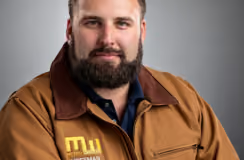
Host: Nick Akers had had a very full career before learning about search, about the concept of searching for and buying a business. Like so many of my guests, he was immediately drawn to it. He promptly applied to an accelerator to start this new chapter. But what actually drew Nick to search wasn't just the chance at entrepreneurship. He'd been an entrepreneur before. After all. Nick had experienced toxic work environments and he had developed a vision of the polar opposite. A supportive employee first environment, one where people could flourish and self actualize and where employee flourishing would lead to the whole organization flourishing. Buying a business to lead was the perfect vehicle to realize this vision. Early indications are positive. He's only two months in, but already his vision is coming to life. In this episode we also talk about what working with a search accelerator is like. Self funded search versus a traditional search fund. Nix accelerator is similar to a traditional search fund and the industry of MSPs or managed service providers which has many searcher friendly attributes and consequently a lot of attention from searchers. Please enjoy this conversation with Nick Akers, owner of STL Communications. Welcome to Acquiring Minds, a podcast about buying businesses. My name is Will Smith. Acquiring an existing business is an awesome opportunity for many entrepreneurs and on this podcast I talk to the people who do it. Listeners of Acquiring Minds know that for almost any business you acquire, its success comes down to the people and how you develop and manage them as their new leader. Thing is, in addition to management there is also a lot of process and bureaucratic work when it comes to your new employees. Payroll, compliance, HR technology, hiring to name but a few. These processes are crucial to get right, but at the same time distract from where you want to be putting your energy in leadership. So Aspen HR is an HR firm and PEO that takes this work off your plate and handles it with the care it demands. Aspen is owned and run by Mark Sinatra, himself a successful former searcher, so Aspen's own leadership understands the HR challenges that searchers have Post acquisition. The firm is offering Acquiring Minds listeners a complimentary pre acquisition HR and PEO review for your target business. Check out aspenhr.com or contact Mark directly@markspenhr.com Nick Akers welcome to Acquiring Minds.
Guest: Nice to be here. Appreciate it.
Host: Nick, you acquired an msp, a managed service provider. This is a category that we hear about a lot in search, but I've actually not yet had on a guest who bought an MSP, so we'll hear about the industry of MSPs. You also worked with a search accelerator to buy this business, so we're Going to hear all about that as well and so much more. Nick, please start us off with some background on you.
[3:20] Guest: Yeah, happy to. Thanks again, Will, for letting me join your great show here. So my background by way of education is master's in chemistry. And while I was doing that work, happened to invent something kind of in the advanced materials category that happened to garner a lot of popular interest was in popular science, for example, was mentioned in a Ray Kurzweil novel. And so, you know, got this crazy idea to try to start a company with this invention. So figured out how to license the technology from the university I was at, participated in a few kind of startup contests and ultimately raise some venture capital funding and you know, all told, raised, you know, roughly $25 million. This was, you know. Yeah, this was close to 20 years ago. So that was a lot of money back then to raise from, from VCs. It was, it was a great experience. You know, I had never had any business classes or finance classes while in university. You know, it was just a pure science track. So had to learn all of those aspects of running a business, hiring employees, all the legal, just everything. Really, really good experience. And then we ended up bringing in Emerson Electric as their strategic at about that eight year mark and, you know, still very young, had no interest in working for a big, large multinational and it was just a very natural way to separate from that activity.
Host: Was that like a good exit for a young founder? I mean, give us, you know, net it out for us. Did you do well?
Guest: I did. Okay. So again, the, I think the VC environment at that time, you know, nearly 20 years ago is very different than it is today. You know, today there's a lot of emphasis on protecting the founder's position. Back then that was not the case, at least in my situation and a lot of the other founders that I know during those times. So, you know, I experienced quite heavy dilution throughout the. Yeah, the multiple rounds of fundraising. So it was perfectly fine. You know, it certainly wasn't life changing. But you know, I think the experience far outweighs whatever monetary gains there were.
[6:01] Host: Thank you. Okay, so after your, your exit to the strategic Emerson Electric, carry on in your, in your story, please.
Guest: Yes. So I joined an engineering design and build firm and was running sales and business development for them. This was a really fascinating job to me and it was tremendous fun. You know, probably the smartest folks I ever worked with were at this company. And what we did was primarily in defense and commercial aerospace, designing, you know, one time unique pieces of equipment that would be used to test like the 787 for example, or test certain components in military jets, the F35, F15, F18, all these types of things. So it was again just a really great opportunity and fun job. But I did that for a few years and was then recruited to join a company in the chemical manufacturing space. So you know, there were a few very interesting things there. You know, one, it was my father in law's business, so and I knew that there was no succession plan in place at that time. So you know, I was definitely thinking long term of that potential opportunity. But then getting back to my, my chemistry roots, so to speak. And that business when I joined had not yet gone through the professionalization stage. It gotten to a very nice size, you know, probably 200 employees when I joined, but they didn't have the systems and processes in place. So you know, one of the number of things I did was, was really begin that professionalization. So establishing KPIs doing very simple things that, like the first budgeting process, the first time implementing employee reviews, modernizing the whole IT infrastructure, recruiting and running their board and it really, really transformed the business. And it was there for, I don't know, six or seven years and doubled the company in size and revenue, employees and square footage, all these types of things.
Host: Nick, when you say double the, double the business, do you mean are you the de facto leader of the business then at this point even though your father in law is the owner?
Guest: So my title was managing director was really more of a president type role. My father in law was certainly was there every day, literally Saturdays and Sundays too. But you know, I was driving all of this change. This, this was, I can't understate how dramatic of a change this was for the organization. I think it had been around for 30 years by the time I joined or so and had been doing things the same way that whole time. So you know, again, a 30 year old business and now you're going to do an annual budget for the first time ever. You know, these are, these are big changes within those walls.
[9:14] Host: Okay, so you are leading the charge in the professionalization of this business. And it's, it's seeing to great effect. You know, all the key metrics are, have doubled essentially over how many years?
Guest: It was about six or seven years.
Host: Okay, and so then what happens at the end of six or seven years? You, you are not now the owner of that business. So I take it that the succession plan did not play out that way.
Guest: Yeah, I think probably the best Way I could summarize it is if you've seen the HBO show Succession, that's what it's really like.
Host: Which character are you?
Guest: Oh, well,
Host: none of the kids are very flattering portrayals, so hopefully none, no.
Guest: But I did see someone write a comment about that show that basically said they've never seen a demonstration of the ramifications of complex narcissistic abuse in families the way that show laid it out. And, you know, I think that's really what was going on. You know, I'm careful, I'm not looking to air any issues here. I think this is very common. I think I know a lot of second and third generation family business folks and everybody has the same stories. So I don't think it's really an uncommon thing. And we had just, you know, the family dynamics. I think we just reached a natural point of. I think it pushed the organization and pushed my father in law about as far as they could take. And it's just time to do something else.
Host: And of course, you know, the, the difference between you and Succession is that it's success in succession. It's their own father. In your case, it was your father in law, meaning there, it was probably more delicate because, you know, that catches your wife in the middle. Is there anything to say about that? Or does that fall into the let's not talk about it bucket?
Guest: No, you know, I'm happy to, to comment on it. Um, you know, look, truthfully, it was, it was a traumatic experience. Um, and I mean that very seriously for myself, but also my wife. Um, so it was, it was rough. Got pretty dark there for a while.
Host: So you, you leave that business and then, then what? You've got a lot of. You're not yet, what, you're not yet 35 or not yet 40. Got a lot of experience. So what do you choose to do with this experience?
Guest: Well, I mean, the, the first, I think natural reaction is you got to go find a job and tried to, to do that, you know, certainly had some very good relationships. There's a, an owner of a fantastic business here in town that, you know, he put me through the full interview process, essentially as a president of a division, it would have been, it matched my skill set, you know, almost perfectly, perhaps. But I remember after the, the full interview process with his full leadership team and everything, we went to lunch and, you know, I could tell that he was, he was very nervous. He was visibly nervous. So I knew what the answer was before he could even say, say the words, which was, you know, it wasn't, it just wasn't the right time. And his specific feedback was, look, you are too, you are too raw right now. I mean, you got too much going on. And he said, I don't think this would be good for you right now. And it's funny how things, things work out, you know, at the end of the day because he said no, you know, in many other things in, in the sequence of events, you know, here I am today running this company and having a blast and you know, that guy is on my board for this company. So it's great. You know, I actually owe him a thank you for, for that decision. He knew something that I didn't. So, you know, after that experience, you know, I just knew that I had to find something for myself. There had always been this threat of ownership. You know, working for somebody else really wasn't gonna fit the bill. And you know, thinking back on the time, at different points along all of these companies, that engineering company at Jost Chemical, you know, I had looked at buying businesses not serious, not seriously in the way you do during search. You know, I would see something or hear something or meet a broker and kind of take the first step. You know, certainly at the chemical company we explored acquisition opportunities, looked at, you know, very specific companies that we could acquire. And I had the beginnings of an acquisition thesis in that chemical space. So you know, after leaving there, I started to flesh that out in more detail and started to shop that acquisition thesis to private equity firms and actually started working. And I guess it was a pseudo independent sponsor type activity that I was doing, although I wasn't being intentional about that, and really began pursuing deals with two private equity firms and you know, they were giving me deal flow. I was generating deal flow myself via my network, but also cold calling brokers in the industry and you know, we looked at a number of things and large 100 million plus acquisition situations submitted Lois, but obviously never got anything to close. I was doing that for probably 18 months and then happened upon the, the search fund world, had never heard that term before, started to investigate that and also at the same time came across NovaStone Capital Advisors, which is like the accelerator type model, sponsored search model. And uh, it, it was very intriguing to me because one, I could get some compensation, you know, not that it was entirely necessary but you know, this, this whole world of acquisition was very foreign to my wife. And so you know, I talked to her about this and you know, not bringing in income and I'm gone, you know, all the time. What are you Doing like I don't, I don't understand what's going on here. Plus you're not making any money so, so you know this sponsored search model had some appeal. I applied to NovaStone, was accepted and became their first searcher in the U.S. so NovaStone originated in Europe, it's Swiss based and they were bringing the program to the US at that time. So first searcher in the US and ultimately closed the their first US deal.
[16:38] Host: August Felker is a two time successful searcher, first with a traditional search fund. The second time around he did a self funded search. Today August runs Oberle Risk Strategies, an insurance firm with a dedicated practice group for searchers and acquisition entrepreneurs like you. If you've got a business under loi, Oberle will provide complimentary due diligence on that business's insurance and benefits program. A great no risk way to get to know August and team. They love helping searchers. They've worked with hundreds. Oberly is a specialty insurance brokerage for searchers by a former searcher. Check out oberle-risk.com O B E R L E- risk.com, link in the show notes. How did you come across novastone?
Guest: Yeah, I think truthfully I saw it come across my LinkedIn feed and you know, whatever ad they were running was intriguing enough for me to click on and it was started with a, a simple, you know, self recorded video interview, you know, maybe a two minute little pitch and then followed by what ended up being the most rigorous interview process I've been through. It took about six months, many rounds, know some financial modeling, testing, all types of different things and was ultimately accepted.
[18:03] Host: Wow, that's so six months just to be accepted into NovaStone that leaving aside your actual search, that's just where the actual search begins.
Guest: That's right, yeah.
Host: And you had said that your wife as, as, as many, as many of my guests have said about their own partners or people in their, their networks. It's like they don't understand what a search is or what you're doing, but they do understand you're not making any money. And so, so you liked the idea of this, of Nova Stone, which is a search accelerator because they have kind of traditional search fund terms which include subsidizing or funding the search process for you. So you are making an income probably less than you would make an industry, but you're making something so you can take that, that and show that to your wife. And of course you know it does help. It's, it's not, it's not purely symbolic. What, what else did you like about the they're offering and yeah, tell me more about what intrigued you because let me reframe. So most of my guests have, have been self funded and kind of just gone out there and, and figured things out. Maybe they've been through some sort of educational program, but a lot of it has kind of been self taught. Listening to the pods, reading the books and so an accelerator. I'm always interested to hear about one's experience with an accelerator. So tell us what you can about that experience, why you chose it, what you liked.
Guest: Sure. I also was looking at, you know, I had this history of looking at larger deals with the private equity firms so I wanted to continue to have the opportunity to play in that space and the NovaStone program looked like it would allow me to do so. So you know their target range Is in the 2 to 5 million of EBITDA can go higher in some cases, you know, perhaps up to even 8 or 9. And so so that also fit with the very specific industry thesis that I had and what I personally wanted to achieve. They also have a fairly significant team of folks that support you in their search. So you know, they have an M and a team that helps you with all the financial modeling they have in house legal to supplement different stages. They have, you know, an outreach team that can help you generate list. So I viewed kind of the, the whole program as a way that would accelerate my search and improve the odds of success and I think that proved itself true during the various stages.
Host: That's, that's great and that does sound like a lot of added value. Now the terms, traditional search fund terms, the, the economics are also a giant question here. They're perceived as slightly less favorable than self funded, at least from a very kind of crude sense of how much of the business you'll ultimately, you searcher entrepreneur will ultimately own. Now traditional search fund folks will say yeah, but you're, you know, it's a bigger, typically you're going to be buying a bigger business. So yeah, smaller piece but of a bigger pie. Did you think about that at all? Did you, did you, did you have other models of buying a business where you could compare and contrast those terms?
[21:43] Guest: You know, honestly, no, I mean I did at least understand that the Nova Stone terms were very much in line with the traditional sponsored search terms. But I was not doing this for any financial motivations. You know, I was doing this for something different which was really to prove certain aspects of leadership that I believe strongly in. You Know, my experience at the chemical company achieved a lot of great resume building things, you know, doubling the size of a business, building a factory in Poland, running a board, all of these types of things. But what I couldn't solve for was culture. And that bothered me. So my motivation to do a search and ultimately, you know, be the person in charge was to prove that a certain type of culture that is really, you know, an employee first type mentality will work. So that's why I did this.
Host: Well, let, let's double click on this a little bit, Nick. So, because culture can be, you know, it's one of those things, it's very amorphous and it can all. And sometimes it can even be kind of be poo pooed. I mean, probably by, by, by leaders of companies that have bad cultures. That's why they have bad cultures, because they don't, they don't take it seriously. But what for maybe people listening who underestimate the value of culture or haven't gone through the experience you did of a bad culture. What would you tell them? Just to elaborate on, on, on this, this hot button thing for you. This thing that was so hot button that it actually it was your entire why for, for this next phase of your career.
Guest: Yeah. So, you know, I guess having seen perhaps the, the very negative side of this, you know, living through that affects you. You know, if you, if anybody is familiar or looks into kind of the. Simon Sinek or Barry Wehmiller is a company that has a lot of material about this employee first style. And they have statistics, you know, don't hold me to the numbers, but they have very high statistics that, you know, a bad boss can contribute, you know, something like 80% of the negative health effects on a person than anything else in their life. You know, so these, I mean, it really does affect people. So, you know, what's, what's the opposite of that? And I can, we can talk about some of the things I've done here in short order, but when you create a really excellent culture that allows people to do their best and people come to work excited, they come to work empowered, you know, I could give you very specific examples of just little changes for folks here that I've seen, you know, a salesperson just start hitting it out of the park just by supporting them and listening to them, listening to what they want and letting them go do what they're they're best at. You just wouldn't believe how this person has changed for me in just two months. It's amazing.
[25:25] Host: That's so cool, Nick. Well, not to trivialize this question of culture, but you know, I thought it was, I thought it was interesting how Succession and TED Lasso, these two shows were both very popular and both airing contemporaneously. And I was watching both and really they're both, they're both kind of shows about the same thing. Which Succession One about just toxicity and dysfunction and I mean, yeah, just, just the, I mean it's just exhausting and bleak to watch that show. Meanwhile, you have Ted Lasso, which is a show about, you know, this unlikely leader and the incredible ripple effects of a guy who's an exceptional leader and, and how, and how powerful that is and how it just changes everyone around him and just elevates everyone, both individually and collectively. And it. So these two shows are just two sides of, of one coin, which is culture. So anyway, encourage the audience to watch both, but together, don't watch just one or the other because we want to see a full picture of this. All right, Nick, did you were going to say something?
Guest: Well, I was just going to say, you know, perhaps to, to put a finishing point on it is, you know, when, you know, I was told that the type of culture I'm describing doesn't work and you know, the surest way to get me to go prove something is to tell me that what you're, what you're saying is it isn't possible.
[27:04] Host: What had you said that this person responded, well, that can't work. What had you said? I'm going to create a company with a good culture. What were they, were they so discouraging about?
Guest: Well, I think it's, you know, perhaps the, the criticism that you alluded to at the beginning there that, you know, no, culture is not having a great culture doesn't result in growth. You know, you gotta just tell people what to do, constantly micromanage them, you know, beat them up, yell at them, all this type of stuff. Otherwise, you know, the employees are just going to sit around trying to get one over on you all the time. You know, that type of attitude.
Host: Okay, Nick. Well, that was a bit of a digression, but not really because it really is so central to your story. But we got to catch up here a little bit on the plot. So you're working with Novastone. Tell us some about the search itself.
Guest: Yes, so my search started in December of 21 officially and I had raised my search capital on a perhaps hyper specific search thesis at a very particular part of the specialty chemical sector for obvious reasons, and began looking there you know, I thought I would leverage my network and do the whole proprietary thing just like everybody kind of says at one point, you know, began working with brokers in that space, got some deal flow, you know, found one really great opportunity in the specialty chemical space. You know, just a perfect fit, perfect fit kind of for this. The reason for succession in search. There were three owners, all of retirement age that wanted to get out. It aligned excellent with my background. It was not near to me. So I went and visited the. They were very forthcoming with information, transparent, even let me meet all of their employees. This was all pre loi. So it, it felt like it was going in the right direction entirely. But you know, I wasted a lot of time frankly through all of these steps to ultimately get to an offer that, that was high on the multiple side of what I think you see in search. It was, it was close to a 7x and the reason for that is they were on their way to 7 million EBITDA. Yeah, it was just, just a great business. So I thought it was a fair price, was solving their succession but ultimately they said no clearly. You know, I'm not really clear on the reasons why they're. They still own the business but wasted probably six months and was doing all the other, you know, pipeline building as well in that timeframe and pursuing other deals. But it was that experience, as I know a lot of your, your folks and guests now talk about, that really shifted me to focusing on broker deals almost exclusively. You know, at least, you know, there's a somewhat serious seller on the other side of things. So this was. Brought me to about the middle of summer of 22 and was going in, in. In addition to looking at the brokered opportunities, I expanded beyond especially Chemical Thesis because other deals that I was looking at in that space, the prices were just too, too high for the search fund model. You know, everything was over a 5, you know, some cases 10 plus. So it just didn't fit. And I was starting to feel the pressure of time, which was the reason for broadening the lens on industries and you know, so continue to look at a number of things. Submitted a few Lois. I really didn't submit that many Lois throughout the whole journey, maybe five or six. And then came across I was just actually having a networking lunch with a local business broker, didn't know of any deals that he had going into that lunch. Sat down, explained search funds which this individual was not familiar with, explained the focus on solving this accession issue. And after that dialogue, then he brought up what became this opportunity in St. Louis communications. And the trick there was really solving the succession challenge. The owner did not want to sign up for private equity. He wanted to retire. So it was really kind of a perfect, I think that lunch was beginning of September of 22. We went under LOI Christmas Eve and then closed on May 6th.
[32:12] Host: So that's eight or nine months from that first meeting.
Guest: Yeah.
Host: And closed on May 5th means you just passed your two month mark. So this is a very recent acquisition.
Guest: It is. We are still in the honeymoon phase for sure. You know, I'm having a tremendous amount of fun. It seems like the folks here are really enjoying the transition. We have plenty of problems, but you know, we solve those problems and just keep moving forward.
Host: And so St. Louis communication. So you're in St. Louis, just to be totally clear, right?
Guest: That's right.
Host: Great. And then just back into the search for a minute. So you're working with novastone for this and so for out for the duration of all of this, you're getting the support. You're getting modeling, you're getting search support. One of the things that accelerators can also provide that can be so helpful is comrades other folks in your cohort who are searching alongside you. Given that you were the only, their first and I assume only American at the time. Were there other people in your cohort, maybe in Europe that you were having zoom calls with?
[33:26] Guest: No. I mean that's a very good point you bring up. And so although I was there first in the U.S. they very quickly, you know, within a matter of months additional US based searchers were into the program and we, so yes, of course we would talk amongst ourselves, both the US based and the, the EU based searchers, which was really great for obvious reasons. And the program has grown perhaps unbelievably I think today, you know, don't quote me on the numbers, but it's, it's, I think very close to 50 total searchers. So, you know, and that's roughly broken up 50% in North America and the rest in Europe. So it's quite a large program.
Host: And then going back to the economics for a second, the we maybe we should just remind people what traditional search fund economics look like. For those who aren't super familiar, it's essentially traditional search fund economics, which you said Nova Stone is close to or exactly a replica of. But I'm, I'm not speaking for Nova Stone. I'm just speaking for traditional search funds which are basically eight and they as, as you'll say eight and a third. Eight and a Third, eight and a third. So you get, so you get, you as the searcher get 8.33% of the business upon closing and then 8 point, the, the second tranche of 8.33% vests over your tenure. I believe over a certain number of years you just earn it with time. So that gets you to 16 1/2% ownership of the business. I think I'm getting this right. I hope I'm, I hope I'm not. I'm sure somebody will correct me if I am. And then the Last tranche of 8.33% is based on performance hitting certain, hitting certain growth or IRR numbers for, for, for the investors in the growth of the business. So you kind of have to, that's, that's performance based. And so if you, if you hit that, then you own 25% of the business and that's kind of the ceiling. You know, you're only as a, as a self funded searcher only ever going to own 25% of the business. And I don't want to digress too much, but you know, self funded searchers might own 100% of their business or if they take on investors they might own 80 or 60%. So 25% sounds like not a lot. But again, traditional searchers look for bigger businesses. So it's 25% of a larger pie. Typically. Not always typically. And another counter argument is that like, you know, if you, if you come at it from a different perspective, like a private equity perspective where private equity shops will buy a business and then install a CEO or an operator, those CEO operators will often have a bit of, a bit of equity in the business, but only a bit. I don't even want to say how much because I don't really know, but I get the impression like single digits. So from that perspective, 25 is actually a lot. So yeah, endlessly debated this point, but the point to leave the audience with is just those numbers and that 25 ownership max is what you're looking at based on time and based on performance. Anything to correct me on there, Nick, or does that feel right?
[37:01] Guest: No, that's all correct. From my experience and in the Nova Zone experience with, and you're absolutely right to compare it to the private equity CEO model. In, in the instances I've been involved in, you know, the CEO is, you know, 3 to 5% in that range. So yes, this, this allows you to, to earn more, more equity than that and pursuing decent sized deals.
Host: Yeah, yeah. And, and now Nick, because you didn't know much about search. You are not somebody consuming the pods and reading the books. Before you, you joined with novastone. You know, that actually happened rather quickly with you that you started working with them and got involved in your search. But now you do listen to acquiring minds and consume other media, as I know. And so you know about, you know, all these different structures, you know about self funded, you know about buying smaller deals and owning 100% of them are much more than 25%. Do you reflect any differently on it now? Now that you know what the range of options include is there? Do you envy at times self funded folks? Are you or not at all?
Guest: Oh, that's a good question. You know, truthfully, I think for me I'm in, I'm in the right spot. For me, you know, being able to start with a business of this size, you know, have a board of the quality of folks that I want to have, you know, having the free cash flow to reinvest in the business in meaningful ways. You know, I think this is the right thing for me.
Host: Well, and as you said at the outset, the economics was not your, your primary criteria at all. You told us STL Communications. Did you, did you give us a bullet points on the business, how many employees it is? It was founded in 1989, 1990. Can you go through those for us?
[39:07] Guest: Yeah, sure. So. Yes, correct. Founded 1990 and there are 41 employees today. Operates in IT managed service space, particularly what's called unified communication as a service. UCAAS is the acronym and this basically means any type of communication technology that companies are using from their phone to zoom to teams. All of this type of stuff falls under the UCAS umbrella. It seems to have a lot of the, the criteria that people look for and desire in search barns. You know, recurring revenue, low capital, sticky, very sticky product. Of course, those were all of the things that, that attracted me to it as well.
Host: Great. Okay. And so, and, and the size of the business. Can you give us a picture there? You, I, I, I know you need, you, you can't give us too much information, but Nova Stone requires that its searchers look for businesses of $2 million EBITDA and above. So we know it probably crossed that threshold. Is there any more color you can paint there?
Guest: Yeah, sure. Happy to provide as much as I can without being too specific. So you know, the search range for Nova Stone and myself was really in that 2 to 5 million of EBITDA. And you know, I think we fell in the sweet spot of that. Certainly the, the purchase multiple is important. For all of us, I think we did very well there. So it's, it's great deal, decent size, plenty of real nice cash flow and you know, 41 smart folks that work here.
Host: Okay, so you, you say that it, it operates in the ucas. You, what was that? Unified communication as a service, was that right? Yes, that niche within msps. So anything kind of, anything communication related. But can you, can you give us more about the MSP industry? Maybe you've already touched on why searchers like it so much. Recurring revenue sticky. Maybe some of the niches, maybe some of the opportunities like for people who are really novice to the value of the MSP industry. Tell us what you know. A little bit.
Guest: Yeah, so the MSP space, very broadly encompassing all of the different little niche areas in it, I believe is growing somewhere in the 5, 6, 7% compound annual growth. But I know specifically the UCAS sector is growing at 15% in North America and 20% globally. Of course the drivers that we would expect are all of the remote and hybrid work environment, but also just different technologies for communicating internally or externally with employees and customers. So you know that that high growth area was attractive as well as we look to create our value creation thesis. And the other really interesting statistic is, you know, only about 25 or 30% of businesses have migrated to some type of cloud solution which is really what you know, UCAAS operates on, although there, there are nuances to that. So you know, tremendous opportunity for customer acquisition. And the market is very fragmented. Lots and lots of companies in this space doing 1 million or maybe 2, 2 million in revenue. And then you have of course very large ones. At least in, in my research and experience, finding somebody in, in this size range is, is less common. So you know, certainly there's consolidation opportunities which is, which is part of my plan. With so many smaller companies out there.
[43:24] Host: So you say it's part of your plan. You stl the business that you bought is larger than a lot of the other players out there. So it smells like a platform acquisition to me. A good, a good platform to go, go out and buy smaller, smaller bolt ons. Right. Is that kind of the idea?
Guest: It certainly is one of the pillars of my growth thesis. Thesis. You know, I'm looking at one company right now that's just a little bit above a million in revenue, you know, close to 300,000 in SDE. You know, looking very seriously at it. You know, an an LOI is, is probably pending here very quickly and I'm looking very seriously at another one That I don't remember if it was on your podcast where a guest said that the fastest way to double the size of your business is with a signature
Host: and no straight line though.
Guest: And so this second one kind of falls in that category that, you know, just, you know, we all know there's a million miles between here and there, but you know, we're already off to the races and looking for other bolt on opportunities.
Host: Well, let me, let me press you on that a little bit as I'm sure your, your Nova Stone folks have. Doesn't feel a little, a little early, a little over eager. You're only two, two months in the seat. You have that much confidence that you could do another deal set like so soon?
Guest: Certainly. I, you know, I don't want to trivialize the, the complexities here. The, the million dollar size one, you know, I think would be fine. It's in a relatively close geography to us. You know, they're, they would roll right into my existing team, I think fairly well. The larger one certainly is, is a, is a different story. And, and we would be, you know, appropriately thoughtful about that. You know, that one poses other potential issues at this stage. But yeah, you're absolutely right, it is early, you need to be cautious. But also when an opportunity presents itself, you know, don't let it pass.
[45:33] Host: Yeah. And are these opportunities presenting themselves because you are now somebody that had people in your competitors or local folks owners have heard through the grapevine, you know, STL sold and so they, and so they call you up basically deal, deal inbound, deal flow because they heard about your deal with stl. Is that what's happening here?
Guest: No, it's, I'm, I'm continuing to be intentional about the search process so you know, continuing the same playbook as I was doing in the search phase now as, as the, you know, CEO of this company. But you know, related to your point being able to point to this acquisition both to the owners of these businesses but also the brokers has added, has accelerated the ability to get in on these opportunities.
Host: So I do think that's a benefit on MSPs. The, the industry of MSPs, which is a large, I mean large. I mean any, basically any outsourced it. I don't even know if people use the word it the phrase information technology anymore, but any outsourced it is I guess an MSP of some kind. So you can just imagine the flavors of MSPS out there. Uplay and ucaas. But for the edification of the audience, rattle off some of the other Niches that, you know, exist in MSP land. Just to give, give us some more vocabulary and points of reference within msps.
Guest: Sure. And there are many more than I'm going to know. But particularly when you see these smaller companies that are in that million or 2 million size range, they probably focus on just one or two areas. So you have companies that just focus on cyber security, you have companies that are very heavy on backups and server, that just do server management and you see companies that just focus on voice, you know, so there's just so many of those little kind of singular focus companies out there. Whereas when you get to this size, we roll all of that in into one shot. So as I was looking at this and thinking about the opportunity and having come from a manufacturing background, I look at it, you know, our number of offerings as kind of our manufacturing capacity. Right. So we can go into a customer and say, look, we can take over everything. You know, if you want us to just do your voice or you want us to just do your security, fine, but we have the capacity to do all of this and you can consolidate your vendor relationships to just one. Just us. Yeah, in that, that resonates with, with our customers. You know, we also, because of our size, you know, I liken it to lead time in manufacturing, you know, I have the, the headcount where we can do bigger jobs, bigger customers and get those jobs done faster than if that same customer was going to go piecemeal this out to two or three suppliers.
[48:49] Host: Well, this, this raises the question that so often happens in all like just in so many different areas of business, like niche versus kind of generalist in terms of your strategic, like as a vendor, what, what do you, how do you provide? Do you, do you double down on a particular niche and become, you know, those guys for this niche? Or, or do you, do you go more, more broad, which has its own value, the value that you just, that you just described and then, but also from the customer perspective, it's like, you know, do we do a point solution? Do we go with these guys who really know X, or do we go with the guys who can just, you know, they're one throat, throat to choke for everything. It's, it's that tension. I've seen that tension, that kind of dichotomy play out in so many different ways in business, even when you're deciding on like a SAS tool. We used to talk about this in Martech land, marketing technology land in the SaaS businesses I worked at. Do we want to be a Point solution or do we want to, you know, give the customer the entire marketing stack? So anyway, but it sounds like Nick, you do have a position on this, at least for where STL is in terms of its own size and maturation. That you are trending toward being more of a generalist msp is that, am I right?
Guest: I think that's, that's basically correct. And you know, also part of my value creation, growth creation thesis is to expand our product offerings. So you know, I always approached customers no matter which company I was at, you know, asking them, you know, what, what do you need? What can we provide you that we are not currently. And using that voice of the customer to really help direct us in our product offerings.
Host: Couple more questions on MSP and then I want to just ask some kind of broader questions about small business life and a little bit more about the deal on msps. So obviously, so by definition you're dealing with technology by, as the owner of an msp. And so, so how much do you, you know, you're probably learning a lot about the tech. How much do you need to actually learn? How much do you, Nick, need to understand all of these tools and the way they, they function? You know, this is the classic, you know, if I buy a plumbing business, do I need to, do I need to, you know, learn plumbing sort of thing? How do you think, how should somebody contemplating buying an MSP approach this question?
[51:27] Guest: That is a very good question. And I think about it in terms of size of the business. So if I was buying the self funded style or size MSP that might be 1 or 2 million in revenue and the owner has to be in there in the thick of it and designing servers and you know, really, you know, you have to know the tech at that size, I think. Yeah, at this size, you know, there's a leadership team here, obviously a lot of techs and engineers, at least thus far, you know, I haven't had to dive too deep into it because I have a team that does that. So, you know that the very first thing I did in the business was focus on cash flow. I mean, we all know how important that is. So I spent a lot of time in the very early days and weeks making sure the cash flow was good, just kind of making sure that the daily operations of the business were functioning so that all of these smart and experienced people can do their jobs to the best of their ability. I certainly will get in more in to the technology, but you know, thus far it's just been making sure the business functions Making sure that people can do their job and taking care of customers.
Host: You talk about cash flow and how you've really, really prioritized that that is often a learning for new small business owners that they underestimate cash flow and how it works and how it can be tricky and actually complex. It seems like you knew that going in that you really wanted to get your arms around how cash flowed in and out of the business. Why, why were you so savvy as to really, really focus on that?
Guest: Oh, I, I don't know if it's anything more special than just having the number of years under my belt in, in other businesses and, and knowing and understanding how important cash flow is to the business. And certainly as coming into this, you know, day one, really not knowing anything. You know, that just seems the obvious thing that you have to focus on because I've tried to explain to my folks here, who actually, they asked me a very similar question to you is, you know, do you want to get involved in learning the tech? Maybe even why aren't you spending more time on that? And he said, look, the most important thing I need to do for the company right now is to protect it. And at least the way I think about that is making sure the cash flow is working so that we can operate the business, pay our folks, pay our vendors and, and just keep functioning. So it just seems the obvious thing to do to me.
[54:22] Host: Well, and on this topic, Nick, you. There was a working capital infusion, was there not, at, at closing. Tell us about the thought there and how you, how you approach that.
Guest: Correct. So we did fund the balance sheet with some cash at close and we also had a very nice working line of credit with our bank, which I have not had to use yet, but it's, it's nice to, to have it there. I would say if we did not fund with cash at close, things would have been tight in the beginning. So it was the right thing to do. You know, I don't know exactly, but there could have been a couple weeks that were very hairy had we not done that. But it also, it gives me, you know, having that cash cushion at the beginning. You know, I'm in a real good cash position right now. I have this line of credit. So, you know, that's why I feel comfortable thinking about these follow on acquisitions, particularly in the smaller size. And we've been able to immediately invest in the business, you know, doing some things in marketing. This company was spending, you know, close to a hundred thousand dollars a year in rental cars and you Know, reimbursing people for purchasing personal mileage and I mean, that number just struck me as crazy. And so, you know, I've bought several company cars now that, you know, because I have the cash to do that. And you know, it's, it's ultimately going to save us a lot of money to, to continue to reinvest in the business. So I don't know whose idea it was on our team, but it was a good one to put some cash in the business.
Host: And how did you calculate how much cash to put in? Was it like a percentage of. Must have been a percentage of something pegged to something.
Guest: Well, we were looking at the historical working capital in the business and you know, put about half of that amount as cash.
Host: Gotcha. Again, a little bit more on this subject of learning the tech or not and you know, buying this business kind of as an outsider, not, not being a, you know, you know, a UCAS expert. Why was there business buyer fit here? I really, I should ask this question more. I really like this subject of business buyer fit. Why. Why did this what you liked? There were things about the business that you liked that you've already told us. But why was Nick positioned to add value and as, and as a, as a quick follow on, like could you have, could you have bought a plumbing business of a similar size or a blue collar business of a similar size or was there something about the actual service delivery that this was technical, highly technical, you know that I mean, plumbing is technical, but you know what I mean, like actually working with technology that was a particular fit for Nick.
[57:30] Guest: So I have a few thoughts there and I certainly got this question from, from, you know, my investor base when I brought this deal to the table. And you know, I would describe things, you know, if you look at the, my career history, those three experiences, each one was in a different industry, you know, fairly significantly differently. And so I was able to transition to three different industries successfully. Learn, learn what was going on in those businesses. But also, you know, my attitude in each of those three experiences is what we're really doing is it's about the customer service and whatever we're selling is just the widget behind that. So, you know, really focus on delivering excellent customer service, excellent customer experience and whatever is you're selling will find its fit. I mean we would even tell our salespeople very specifically at the chemical company, what you are doing is you are selling the customer service and our chemicals just come along with that. And I look at this, I mean this business is to me It's a service business, right? I mean you're selling this essentially software as a service to your customers. And if you're not delivering that excellent customer experience, you know, I just don't think you're going to be successful in the long run. So some of the things this company was doing to demonstrate that is when we sign up a new customer, they have an escalation list of contacts all the way up to having the owner's cell phone number. And you know, so customer or the owner, if you need to, you know, we have a service line so if a customer needs help, they can just call us. Whereas you know, on the larger side, our competitors, you, you cannot get somebody on the phone. You know, you're going to send an email, going to a ticketing system and at some point be able to interface with them, but it's not going to be over the phone. I mean these things sound simple, they are simple, but they make a difference.
Host: I love that, I love that thinking about that, that the, that the widget, the ostensible thing you're selling is less important than the service. The service is what you're selling. And then whatever the widget is comes along for the ride. That's, that's such an interesting. Flipping it on, flipping it on its head. And what about buying a blue collar business? Would you have done that, Nick?
[1:00:16] Guest: I think so. You know, in, in any of the companies I looked at, I would try to be very thoughtful about the fit for myself. At the chemical company it was, you know, it was 500,000 square feet, largely manufacturing facilities where you're dealing with non degreed hourly folks. So yeah, I think it would have been, would have been fine.
Host: So yeah Nick, I also just going back again to this theme of the size of the business, the working capital infusion, the your, your attention to the cash flow and in your early weeks there, in your first couple of months there also in how traditional, in the traditional model, you buy a bigger business, which you did, versus self funded, which is smaller but you own more of it. But just the question of buying small is also one of, you know, how much cushion there is and how much you as the buyer of the business are going to need to be really involved in the business. You've already articulated that. You really haven't had to do that because there's a management layer there because you bought a business of course appropriate size for that. But do you, how do you think about like folks that you might hear on this podcast who buy a business that has 400 600, $700,000 of SDE, which is, you know, 20, 30, 40% of your size or less, and far fewer employees. How when you look and hear, look at them and hear those stories, how do you juxtapose that with your own?
Guest: No, I, I certainly have heard those guests. And look, I think anybody that goes down any one of the variations of this process of buying a business, you know, forging your own path in life, creating your own legacy, hey, all the best. I mean, you know, how could you say anything but congratulations to any folks doing that? I mean, it's just awesome. So, you know, whatever fits your particular situation is great, right? You know, I mean, this has been a fantastic journey for me. I mean, it's changed my life. My only regret is I didn't know about this when I was younger, you know, but, you know, perhaps, you know, I needed all the experiences to get to this point for it to, to be what it is. But it's one of the things I really enjoy is with I have a nine year old son and a six year old daughter. And so when we're ever driving around, I'm always listening to podcasts, usually your show or one of the others that are talking about search funds. And I just, I love my kids being exposed to this world, you know, because I certainly wasn't, you know, all of this type of stuff wasn't available when we were young. And you know, maybe they'll get that little seed planted and maybe they'll start out with a little, you know, 100,000, 200,000 SD business on their own journey. Awesome.
[1:03:35] Host: And in what world, Nick? SMB? Sm. The world of SMB. What specifically do you like that they are getting a window into?
Guest: Yeah, exactly. The whole. That there are other paths out there in life than the traditional go to university, go work somewhere as a W2, that there are other things you can do. And I think, you know, we all in this community know the benefits and power of buying a business that has been around for a while and the value creation opportunities there.
Host: Well, I, I reading between the lines, you. Well, I guess you've said directly that things for the first two months have gone pretty well. You, you're having a blast. So have you had any fetal position moments? Have you? I mean, you were well capitalized, so you also haven't had a cash crunch. It sounds like any fetal positions and position moments or, and, and also tie that into like, yeah, just how, how you feel being an owner now versus a career of being not an SMB owner. Like how does it feel? Different?
Guest: Sure. Gosh. I don't know how to describe that. It does feel, it just feels amazing, frankly. You know, when I come in here on the weekends when there's nobody here and you're walking around, it's like, this is your own place. It's, I don't know how to describe it, but in terms of fetal positions, look, with, with my sticking to professional experiences, you know, I've had unbelievably challenging things already that I've dealt with. Right. You know, employee issues, you know, customer issues, you know, all the, all the things that business folks have to deal with. So it's going to take a lot for before I'm going to get into a fetal position here. So having those experiences is, I think, good. You know, but look, we, we've had challenges. Let's just tell a story. You know, I had a key person here, I think it was maybe week two or week three, walk into my office and give notice, and this is, this is a key person. And they said, look, this doesn't have anything to do with you, Nick, meaning me. They were like, you know, I started this, I didn't know the owner was selling this business. I started this process, you know, and now I've accepted this offer. I'm sorry, but, you know, I like you, but, you know, I got to go do this. Well, why, you know, tell me, tell me what, what started you down the path of looking for another job? And, and they told me all of their things and, you know, the long and the short of it is I said, you know, if I fix those things, would you consider staying? And I think the person was shocked at this conversation. And, you know, some of those things I could fix immediately. Some of them, they were going to have to trust me. And, you know, we talked it through and, you know, I think there were some tears person and they stayed and now they are, you know, shot out of a cannon, doing an unbelievable job. So earlier when I was talking about culture, that's an example.
[1:07:02] Host: Yeah.
Guest: Yeah.
Host: Phenomenal. Well, it must be so gratifying that your, your vision for creating strong culture is early indications are that it's, it's just being received so well. That's got to be very exciting. I, I, we're wrapping up here, Nick, but I want to take a couple steps back into just the closing or the deal itself. The one of the, again, going back to working with an accelerator, which I think will interest people. One of the values stated values of that is, of course, support all the way through including doing the deal itself. So what is, what is it? How much of the deal are you doing? Because I guess they provide. You already said they provide an M and A team. So they've kind of got. I don't know if they provide due diligence or they hook you up with a diligence provider, but there's probably a lot of diligence that's being done on your behalf versus if you were not working with the accelerator. What. How much of the deal fell on you and how is that partnership with them looking like as you marched through to closing?
Guest: So in. In my experience, it. So I was still the. The focal point of the whole process. You know, it's my responsibility to organize everything involved in the closing. I'm the point person, regardless of what support we had. So we certainly did have outside legal, outside QOV provider, but I'm coordinating all of those activities and reviewing it and summarizing and all of this type of stuff. NovaStone for me, was very helpful in the modeling, just because that's not my background. I'm not an Excel wizard. So they could help and assist there and run all the different scenarios. And obviously they're reviewing all the due diligence reports as well. We're working together as a team. You know, I also needed to create the kind of the internal investment memo, you know, this huge document that describes the value creation theses, you know, the whole background of the company, the, you know, potential returns, all of this type of stuff. So, you know, it was very helpful to me to have them involved. It was a very good partnership. And at the end of the day, you know, I probably shouldn't talk about specifics, but to get to close, just like any close, you know, there's stuff happening even at the last minute, basically. And novastone needed to really step up to do some things to make the close happen. And they did. I mean, they made it happen at the last hour to get it to the finish line. One of the, you know, search. There's many aspects of the search for the searcher that can be very lonely. Right. Yeah. I think all of your guests probably talk about this. The, the close was. Was certainly interesting. You know, as. As I mentioned, you know, the searcher is the point person, at least in my case, probably in most cases. So, you know, you're the recipient of all the stress from the broker, from the seller, from your deal team, your legal, you know, the Nova Stone folks in this particular example, and I've heard other searchers talk about, you know, it's important to have your support mechanism. And I've heard very specific examples. You know, I would call my lawyer and you know, just unleash and cry and you know, fall apart and they would bring me back. I would just suggest to think about that's not perhaps the best way to do it. You know, certainly have your support, but your deal team maybe isn't the best support people. You know, I would suggest you need to start acting as the CEO during that phase and demonstrating that you can handle the stress of a close and you can handle people treating you poorly for whatever reason because of their own processes in the closing and act as the CEO and demonstrate that you can handle this stress. So you can certainly handle the stress of owning the business. Just don't rely on your deal team as your own personal support mechanism.
[1:11:41] Host: That's great, Nick. What a lesson in leadership. You gotta choose your sounding boards and the shoulders that you cry on carefully. You gotta be aware of who your audience is. Yeah. And one, I think this will be my last question Nick, kind of about Nova Stone, but more generally in tying it into traditional versus self funded. One of the things too that people like about self funded as I mean you can have investors and self funded of course so maybe this just applies to self funded who have no investors is not having investors. So people who buy businesses or entrepreneurial, independent probably don't love, you know, someone else telling them what to do. Generally investors don't tell you what to do but in some moments they might or they might strategically kind of compel you in a certain direction anyway. Investors can certainly feel like bosses. You have had VCs back in in the early 2000s and you've already said that was before founder friendliness was a thing. You have novastone, who are your investors and then you had complicated experiences, you know, working under your at the your business with your father in law. So you've had other authority experiences. How do you feel about in now today? Kind of the weight of investors you are expected and will only be rewarded if you hit certain growth hurdles. You know, frankly they own the vast majority of this business. But it still feels like you, I'm hearing you and the way you're talking about it still feels like your business. So just yeah, just riff a little bit on that. How how the role and the presence of investors plays into the psychological piece of this.
[1:13:45] Guest: Sure. So you know, I certainly have heard other guests of yours that describe a more active role from their investor base at least thus far with novastone and their other you Know, quote, my colleagues that have acquired businesses in the program, novastone, you know, although they're very collaborative, they're, they're expecting you to run the business. They're not interested in getting in here and being very specific about opinions on what should be done. You know, a whole part of their program is they're really only partnering with what they call mid career professionals. So people with a track record. I think that's part of the reason why their interview process is so rigorous. Because at the end of the day, in the size of their program, you know, 50 plus searchers, you know, they need to have folks that they can rely on to run a business. So that is a good fit for me personally in that style. Now, however, I do like the fact that there are investors here that keeps me honest. Not that I need that, but I do like that we are playing a serious game here of business. Although I talk about this culture aspect, you know, I am very motivated professionally in growth in growing businesses. And I'm very clear with our folks here, you know, we are going to double this business in a certain time frame. Like that is going to happen and, and we can have fun along the way, but that's where we're going and we're going to hold that line. So in additionally, you know, I, I wanted to have a board. I've always worked with a board at every point in my career basically. And you know, I've been able to recruit a series of individuals that I've worked with before that I know will hold me accountable. And as I've described that here in the company because of course, these folks here have no experience with any board arrangement or anything. Look, folks, this is a good thing. You know, these folks here, we can learn from them. But also they hold me accountable to all the things that I'm saying that we're going to do. This is just all, this is all positive. This is all good.
[1:16:04] Host: Thank you for that, Nick. Anything else that I have failed to ask that you wanted to make sure you got in?
Guest: No, we covered quite a bit. You know, again, I appreciate the opportunity. You know, perhaps it sounded. I came into this whole search with being a bit naive, which was true. But having fine resources such as your podcast, I really have enjoyed listening to it and all the guests. That's been very helpful along the journey. So, you know, it was very exciting to me to finally be one of the folks telling their story. So thanks for that.
Host: That's awesome, Nick, I appreciate your saying that. That's, that's of course very gratifying for me to hear if people want to reach out to you Nick, how do you prefer that they do that?
Guest: Oh perhaps the easiest way you should be able to find me on LinkedIn nickacres with STL Communications and I would further off or just because so many people were were helpful to me along the way that if I can be helpful to anybody feel free to contact me. You know maybe a searcher is acquiring a business we would we could do an IT assessment for them either pre or post free of charge let them know what their situation is and opportunities for them. You know I'd be happy to be helpful in any way I can.
Host: Well I don't I don't want to reopen the conversation that we're bringing to a close but a searcher that I will be interviewing not for a couple months said to me in our pre call it diligence is at least in his story was the most overlooked thing it should be top of the list it's never talked about it's been very challenging for him so more to come on it due diligence. Very nice thank you Nick Akers really appreciate your time. Thanks Sam.

























































%20-%20thumbnail.avif)





%20-%20thumbnail.avif)


%20-%20thumbnail.avif)

.avif)




%20-%20thumbnail.avif)