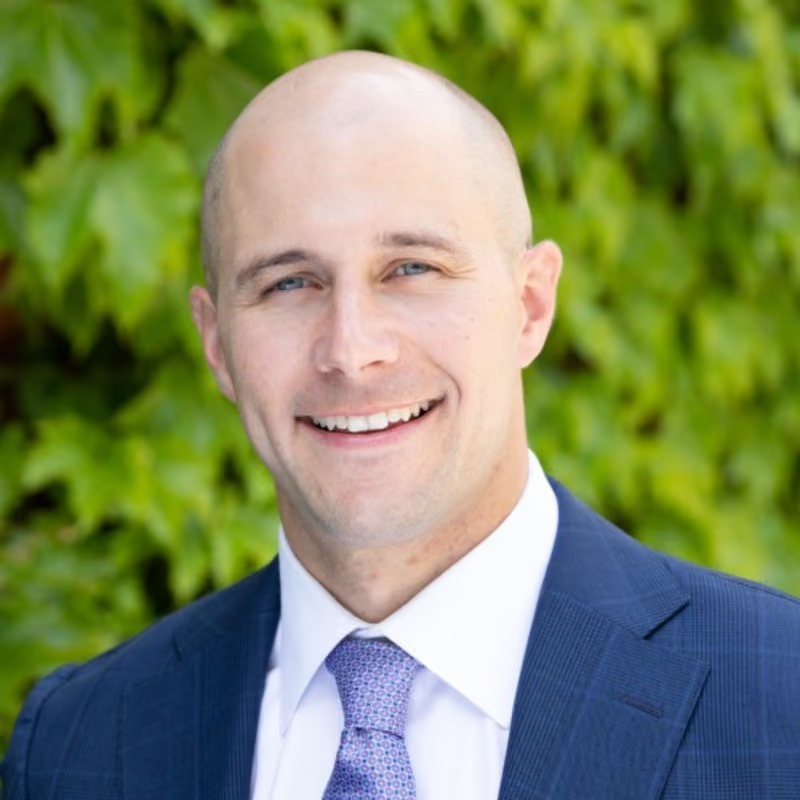
Host: There's a cliche in our world of buying businesses, you have to submit three lois before you close your deal. And another cliche, a deal dies three times before it closes. Now these are obviously approximations. Every searcher's mileage will vary, but they point to a core, unhappy truth about buying a business. Broken deals are part of the game. On your journey to buy a business, you are exceedingly likely to invest and lose time, money, and perhaps most costly of all, hope. Part of being successful at this game is managing all three so that you don't exhaust any of them before you get your deal over the finish line. But if you're a regular listener of Acquiring Minds, you probably already know all this. Countless guests have referred to their broken deals. Well, today I wanted to have on a searcher who just went through this. I know Nick Wheeler personally and had been getting updates on his search, including his landscaping deal, which looked like a great business and a great business for him in particular. Well, I also got his update when that deal died and I asked Nick, would you come on the pod to share what a broken deal looks and feels like as it's happening. He generously obliged. So today you get to see this infamous broken deal phenomenon up close. I think we all agree that showing the good and the bad in this messy, unpredictable world of buying small businesses is valuable. And the experience Nick shares here is definitely that. He does a great job calling out lessons and takeaways as he goes. My own takeaway from this conversation is the power of attitude. All of us, both in our searches and in our broader lives, can learn from Nick's perseverance and good humor in response to a maddening episode. Here he is in the trenches. Searcher Nick Wheeler. Welcome to Acquiring Minds, a podcast about buying businesses. My name is Will Smith. Acquiring an existing business is an awesome opportunity for many entrepreneurs, and on this podcast I talk to the people who do it. Listeners of Acquiring Minds know that for almost any business you acquire, its success comes down to the people and how you develop and manage them as their new leader. Thing is, in addition to management, there is also a lot of process and bureaucratic work when it comes to your new employees. Payroll, compliance, HR technology, hiring to name but a few. These processes are crucial to get right, but at the same time distract from where you want to be putting your energy in leadership. So Aspen HR is an HR firm and PEO that takes this work off your plate and handles it with the care it demands. Aspen is owned and run by Mark Sinatra himself, a successful former searcher so Aspen's own leadership understands the HR challenges that searchers have post acquisition. The firm is offering Acquiring Minds listeners a complimentary pre acquisition HR and PEO review for your target business. Check out aspenhr.com or contact Mark directly@markspenhr.com Nick Wheeler, welcome to Acquiring Minds.
[3:40] Guest: Well, great to be here. Thanks for having me.
Host: Nick, you recently suffered the frustration and setback of a broken deal. You were, you thought very close to acquiring a business, to finally crossing the finish line, but the seller had a change of heart late in the game. So we hear a lot about broken deals, the disappointment they bring, the loss in time and treasure. But I haven't had someone on who's dealing with that particular pain in the moment. And you are essentially in it right now. This was just a few weeks ago. Closing week would have been this week, I think you said, and you agreed to come on and share what it's like. So first things first, Nick, thank you for saying yes, because we are going to spend some time on something that maybe isn't the most pleasant part of search. And you've agreed to do this so that other people on the path to buy a business can benefit. So appreciate it. Thank you.
Guest: I'm happy to do it. And I think it's important to hear these types of stories. I know you've had a few episodes recently with people who have had challenges with search and of course everyone has challenges, but you don't hear those stories as often. And I think those are often the most impactful and where you can learn the most. So hopefully folks listening can learn a few lessons from, from my ordeal. And when I think back about the, the cases in business school that we studied, the ones that I remember the most are the, the challenged cases. So, you know, learning from other people's failures is, is definitely a valuable lesson.
Host: Exactly. And I, and I hear that from the audience a lot. They really seem to, I don't know if enjoy is the right word, but get a lot of value from the stories that don't go perfect. Before we get into it, Nick, let's get some quick background on you, please.
Guest: Sure. So I grew up in the Philadelphia area and around small business owners. My dad had a small printing business, really as a print broker, very, very small business, but always worked for himself. My grandfather had a horticulture distribution business. So it was always in the DNA, I suppose, though I never thought I would do it one day myself. I went a very different path. Don't really come from a military family, But I think 911 had a pretty big influence on my life when I was in high school, so ended up going to West Point for college. Spent 10 years as an army officer. Ultimately I always wanted to become a Green Beret, which you can't do in the army until you're a captain, so about five years in. So I spent my first five years as an infantry officer. I got to lead a infantry platoon for a couple years. Then I went to the Ranger regiment and led a Ranger platoon and then eventually when I was eligible, went through the two years of special Forces training and spent my last few years leading a Green Beret team. So had a phenomenal time in the military. Did it for nearly a decade and, and when I was getting out I knew I wanted to do something entrepreneurial. In fact, funny enough I wrote in my business school application about taking over my dad's very small business and kind of scaling that. So I was an acquisition entrepreneur I suppose before I realized it. And I later learned it probably wouldn't have been a good search fund type of acquisition. But funny enough I was interviewing at HBS and part of that was talking about, you know, my plans after school. And then about an hour after the interview, my friend AW Simmons, who I served with and was already a student there, told me about the whole search fund model which I frankly thought was it had to have been a hoax or two. Sounded too good to be true. So he told me to read this book, the HBR Guide to Buying a Small Business. And I quickly realized that that was the path that I wanted to pursue after business school. So spent two years at HBS and learned about search and then decided to do a self funded search. Immediately following school. I'm doing a search in the greater D.C. area where my wife and I live. So you know, I have a pretty tight geographic filter and decided to self fund for a variety of reasons if we want to get into that. But you know, I was fortunate. We have a fellowship through, through HBS that I won to help kind of fund my self funded search. It's just a grant that, that I'm get, I get for a two year period but really I'm a wife funded searcher so my wife has a job here at a government technology company so you know that helps float us through the the search period while I don't have a real salary coming in. So yeah, I'm about a year into my search, not an anniversary I wanted to celebrate and would have been closing this week on, on this deal but moving on to others. So such Is the. Such is the life of a searcher sometimes.
[8:54] Host: Well, you're saying all of this with a smile, so I think you're processing it well. And I have every confidence that you will find a business and buy a business, Nick, so. And we'll have you back on when that happens. So we'll get into maybe a little bit more of your decision to go self funded and kind of search prep. Search philosophy. In that conversation. I really want to kind of fast forward to just, you know, hearing about this particular deal. So people, because this episode is going to all be kind of all about the experience of, of losing a deal and how. What that, what that's like. So how long into. You said you're a year into it now. How long into your search did you find the business? That's the subject of today's conversation. And, and how did you find it?
[9:45] Guest: Sure, I was about. I think I first heard about it in January, so about six months into my search. And it was through Steve Ressler, who I'm sure you've probably had on the podcast.
Host: Yeah.
Guest: Who is also here in the D.C. area. Well, that's actually how we met and he mentioned it to me. It was a broker deal, which I typically don't really do too much brokered outreach. Most of my search has been proprietary, but I had a couple others I was working on. So it was kind of, you know, maybe number four target on my prospect list. But the other ones filtered out and I said, Steve, let me get that intro. So I think I met the owner for the first time in late February with the broker. Had a great initial conversation at coffee shop in Arlington that I'm sure you know of. And he certainly struck me as a real seller. They had been through a broken deal about a year prior with, with a private equity buyer, which, which of course I kind of saw as a potential red flag. But sometimes broken deals can create fatigue and a really motivated seller. We talked about working capital in the first conversation and he was in his early 60s. It's a business that's been around for over 30 years. And it seemed like the right type of search fund acquisition. You know, frankly I thought it was a little too small for a private equity buyer, a little bit too much key man risk. It probably needed a search fund type operator to come in and buy it. And yeah, I was really excited after leaving that first meeting with him. You know, I thought this is a real seller and I think this is a good search fund type, especially self funded search acquisition, you know, in terms of Size it was around you know, 1.3 million of adjusted EBITDA. You know, the last six or seven years it was between a million and a million and a half. You know, there was some of course, seasonality given that it was a commercial landscaping business. Mainly the snow was the biggest fluctuation year to year, which caused a little bit of issues with this deal because we, we had the first year without snow here in the D.C. area in the last 10 years. So they're trailing. 12 months was a bit down, but I thought it was a down the fairway type of self funded search deal. So we went.
[12:14] Host: So it was commercial, commercial landscaping. And so what kind of clients? Just kind of local office park sort of thing?
Guest: Yeah, so their biggest client was government, which is one of the things I really liked about this business. So they have some very large government customers here in the D.C. area. I would be giving away who the company is if I said specifically who they were serving. But the, the thing I really like about any government service business is you have long term contracts with really predictable sticky revenue.
Host: Yeah.
Guest: And so, you know, they had a mix of government and commercial. They had about 200 commercial customers, everything from office parks to condominiums to HOAs. But their, their majority of revenue came through these large government contracts that they served. And it was unlike a lot of landscaping companies that had the right mix of maintenance to construction. So only about 15 to 20% of revenue per year was tied up in construction. So I really liked the recurring revenue nature of the maintenance work that they were doing.
Host: Yeah, sounds like a, I mean it's, it really is checking a lot of the boxes, circling back to where you thought that the broken deal with a private equity outfit was a, could be interpreted both, you know, as good or bad good in that maybe they have deal fatigue and they kind of are that much more motivated to sell. But why could that be a red flag? Why did you perceive that as a potential red flag? Just because they might be sellers who are not serious because they just didn't get across the finish line before. So maybe they won't get across the finish line again sort of thing.
Guest: Well, that's one red flag from a broken deal. The other is why did, why did the buyer walk away? And of course you're only going to hear the story of, from the seller's perspective. What I was told, which is a common story, is the, the PE buyer came in and they cut cash at close. Well, in, well into diligence. You know, they had already drafted legal docs by this point and the sellers walked away because of that. At least that's the story I heard. I'm sure there was more to it than that, but you know, that to me seems like a logical explanation. That happens. And, and maybe they didn't feel right. There was also, which is typical with private equity buyers, they wanted the seller to stay on for a couple years. And I'm assuming there was some rolled equity or earn out contingencies that they weren't comfortable with. So again, I felt, well, a search acquirer is a different approach. I'm probably not going to offer as much as the private equity buyer, but I have a succession plan where you're going to be out of the business within the next 12 months to the extent that's appealing, which it certainly sounded appealing at the time to the husband seller we haven't talked about. He had a co owner, his wife, who really wasn't involved in the business, but owned 50% and had a very meaningful involvement in this whole process.
[15:25] Host: You're smiling. Something tells me that the wife plays a big role here, so maybe now is the time to introduce her.
Guest: Sure. So, you know, when I met who I refer to as the seller because he's really the CEO, she was not there. You know, it was just him and the broker. And so I put in an loi and the LOI actually got rejected. The broker said, hey, you know, they didn't like the offer. And I was just curious. I said, hey. To the broker, I'll say John. It wasn't really his name, but John. Why? Why? I thought, I thought this was a real seller. And he said, you know, his wife is just not comfortable with it and he thinks it's going to be like the private equity process again. I said, well, did you tell her about my approach? Let's just have dinner. My wife and I meet with the two of them. We're here, we live 20 minutes from the business. Let's grab dinner. And maybe she'll be more comfortable when she realizes I'm not a private equity firm and I'm an entrepreneur in the area that wants to run their business. So he set that up. We had a fantastic dinner. You know, rapport and trust seemed high coming out of it. We might as well have been high fiving. On the way out. She said, hey, I really like you guys. You remind us of ourselves from 30 years ago. So the next day, you know, the broker says, hey, they want to move forward. We went back and forth a little bit on some of the loi, specifically with regard to the seller note. But we got, you know, within the next week, I had assigned Loi and I thought, okay, I've got a. I've got a real deal. Let's. Let's move forward with this.
Host: Patting yourself on the back for a dinner well executed because you went into that dinner nervous and you came out seemingly victorious. By the way, what. What does a dinner like that feel like? Because I've never asked this of any of my guests, but where you go essentially as strangers, you bring the partners, and the four of you sit down to break bread, but not really knowing each other. Do you just kind of listen and kind of have them tell the story of the business sort of thing? And I'm sure they ask you for your story.
Guest: I think the, probably the only analogy that would resonate with people is it's probably like going on a first date. You're a little nervous, and maybe there's certain information you want to get, but you don't want to be too direct in asking for it. So it's a first date.
Host: That's exactly what it is.
Guest: At that point, I'd already seen enough from the sim and some of the financials that I knew it was a legitimate, you know, search fund acquisition from an investment perspective. So I just viewed that dinner as an opportunity to build rapport and trust. So I try not to go into those types of. Those dinners or lunches or whatever with too many probing, direct questions. It's really about building the relationship. So of course we. We got to talking about the business, but I. I just tried to pull out the story from them and let them kind of really kind of not gloat, but reflect on this thing that they've built over the last 30 years that they, frankly, should be proud of, proud of building. And I don't think many small business owners get the opportunity to do that. So when you listen to them and compliment them, I think that does build a lot of goodwill and trust. And you can get to the, you know, the nitty gritty detail questions after. But by that point, I'd already seen a lot of financials. So that was just really an opportunity to build trust and hopefully walk out. The goal was to walk out of that with a deal, and I did. So I would say the dinner was a success, though looking back, it would have saved me a lot of time and grief had it just gone poorly and I would accept it.
[19:09] Host: That's right. Yeah, said every divorcee. Man, I wish that first date had just gone badly. Saved me the whole marriage thankfully, this
Guest: was a lot less time and a lot less expensive than that.
Host: You already know that business owners are making amazing use of virtual assistants, often based in the Philippines. And while virtual assistants are helpful, virtual professionals are transformative. Moore Staffing is a boutique agency that hires a players in the Philippines not for simple tasks, but for deep competency work. Think operators, supply chain managers, controllers. Moore Staffing de risks your engagement with a 12 month guarantee to you and they provide coaching for six months to their talent. When an engagement begins, that means your hire is coached in the background, no additional cost to you, so that your working relationship flourishes and is as successful as it can be. Global staffing is increasingly the norm and building the muscle within your business to take advantage of it will be crucial in the years ahead. Speak with more staffing about the pool of capable affordable managers they can connect you with. Check out MoreNow co. That's MoreNow Co.
Guest: But to give some, some timeline, like I said, first meet the seller, just the husband into February, I don't have the dinner probably for another three weeks. So let's just say third week of March I had my, my signed loi. We went back and forth on a little bit, but April 7th, just to give a timeline of events. So okay, April 7th, you know, is the first, is when the LOI is signed. So five weeks after meeting the, the husband for the first time and then we go to diligence from there.
[21:00] Host: So into March you have this successful dinner, early April, signed loi, then what?
Guest: So you know, I've already done quite a bit of my own diligence. But you know, getting the data room together, getting access to QuickBooks, you know, that's one of the big lessons learned. The quicker you can do that the better. You know, we'd already discussed working capital, but it's difficult unless you have access to QuickBooks and you can really look at the last 12 months of the balance sheet to have that really critical conversation. And getting data probably in a lot of small businesses is very difficult, especially this one. I mean, you know, these are sellers that don't have a website, that don't understand how to drag and drop files into a data room. So I had to physically drive to the business and he knew how to use a thumb drive. When I asked for tax returns, I got in bank statements, I got a box of thousands of printed pieces of paper and I had to say, hey, can you ask your banker for this thing called a PDF? So the data process took some time. So you know, the first three to four Weeks was really just my own, my own diligence, my own mini quality of earnings and proof of cash to ensure that I felt comfortable moving forward. And, and that's another lesson, you know, looking back, I think as a searcher you have to be very deliberate about staggering your diligence because once you start bringing in third party providers, you know, quality of earnings and legal, that's when it becomes very expensive. Now of course that's with the trade off of time kills all deals. But frankly, time would not have been what killed this deal. But I'm glad I did some of my own diligence before turning on quality of earning. So I engaged with a well known Q of E provider. I'll give them a plug hood and strong. You probably advertise. They probably advertise on here. So worked with Jerry. We got through phase one of the quality of earnings and was beginning to do some insurance. HR diligence hadn't gotten to legal yet. We had done a, you know, I'd done multiple site visits. I'd met his team under the guise of being a consultant, which I don't think they believed. But you know, we did the ride around, you know, toured all of his sites and even got to the point where he was saying, you know, when you're running the business, when you're doing this. So certainly felt like this was going to move forward. And then at some point in that first month or so was the first blow up of the deal and it was over working capital. So I'd finally gotten enough data from both their balance sheet and some of the construction work that they were doing to get to a working capital target. So another lesson here is the sooner you can have the working capital conversation, have it. And that became a huge sticking point, which surprised me because we talked about it in concept on our first conversation and what the target was with their private equity buyer. But we were pretty significantly off. And what was surprising was the broker actually agreed with me and was on my side. So it was really the seller and his wife who weren't comfortable with, with what it should be. So usually you would think, you know, their, their advisor would be helpful if they're aligned with what you think that value should be for working capital. So that nearly blew up the deal. And I actually capitulated, you know, for what it amounted to, maybe 150, $200,000. After back and forth negotiations, I capitulated to what, what, you know, they said was what they thought was fair. And that included me going to their house and sitting at their dining room table and kind of having a come to Jesus moment as I call it, to convince them that this is a fair number and it shouldn't affect how much cash is coming off the balance sheet at close and so on. So that nearly killed the deal. And we were on the rocks for a couple days and then the owner called me and said, hey, you know what, we're, we, we can do this. Like this makes sense. Let's move forward. Not only that, like, you know, I, I think you're gonna do great running the business and you know, I'd actually like to stay involved with, with you somehow, maybe help you sell and be a, a, a BD guy for you. So I thought, okay, I saved this from the abyss again. Let's move forward and, and continue QOV and get closer to drafting the legal docs.
[25:48] Host: Nick, did you tell us what the LOI said, what the offer was? I don't think you did.
Guest: No, we didn't. So the offer was because it's seasonal. I really kind of looked at what did this look like over the last three years. So it was about four times EBITDA multiple on a three year average for 2022, it looked more like 3.3.4 times. So. And on TTM it looked higher than that because we had no snow. So I think if you look at a three year rolling average, it was about four times, which is, I think pretty fair for a commercial landscaping company. And then a big part of that, we did have a seller note in place that was going to be about 25% of the deal was in the form of a seller note.
Host: And the, this working capital sticking point. So do you think that they understood your point? Like, I guess, did this just become kind of a tug of war is like who wants more money? Or do you think that they fundamentally kind of like didn't understand your point as to why the business needed to have this gasoline within it when they turned over the keys? Like the argument for working capital is from, from we buyers is, is really kind of one of practicality more than just wanting cash, like wanting to line our pockets. But from the seller's perspective, it probably isn't it pro because for them it just feels like, okay, well I'm getting paid that much less for my business. If you're demanding another $100,000 be left in the business, how, what is, what is the nature of that disagreement look like?
[27:36] Guest: Well, I think most owners understand conceptually what working capital is, but just not in the, you know, fancy finance terms. That private equity or MBA types might use. So I think that's the biggest challenge is to convey what working capital is in, in layman's terms in a way that's you know, very understandable. I, I think ultimately he, he, he understood the cash flow in his business and what goes in and goes out. But there's always that argument from sellers that well, that those account, the accounts receivable should be mine going forward. And, and it's, it's complicated when there's not very good accounting mechanisms that aren't capturing a lot of what would be working capital. So in this case their construction work, although only 15 to 20% of the business or so sucked up a lot of the working capital which I think has been discussed on your podcast before in other episodes. And they were actually running that through a different accounting tool, not through QuickBooks. So there was another few hundred thousand dollars of working capital that I would be responsible for on the construction side that wasn't well accounted for and he wasn't really tracking well through, through his QuickBooks. So that certainly complicated matters as well. But I think just the general lesson with any business with regard to working capital is to be able to describe it and discuss it in a very straightforward and simple way and try to avoid the more know, financial jargony type terms. And it's just, it's just fundamentally more difficult in a seasonal business where working capital fluctuates. So landscaping makes it even more difficult because depending on the time of year, in the, the time of year that you're buying, the, the working capital target will vary significantly.
Host: Okay. And so this discrepancy came down or this, this distance between you and them came down to about 150 to $200,000 on a 5ish million dollar acquisition.
Guest: It was, it was about a 4, it was a $4 million deal. So you know, when I gave the EBITDA earlier, that was their 2022 EBITDA. So it was about, you know, on average the last few years is like a one million dollar EBITDA business. So it seems fairly insignificant. And I don't think working capital is what killed the deal. It was really just the straw that broke the camel's back over time. I realized one, the broker didn't really walk them through some of the finer points of my offer. And I don't think they really understood the seller note until I sat down with them at that die at their dining room table. Discuss working capital to also discuss how the seller note was going to work and so you know, I probably should have had that conversation more explicitly and not assume that the broker really walked them through the payout earlier on. But I think more importantly she just was not, I don't think she ever will be ready to sell and go through that process. She really enjoyed the lifestyle of working what was about three hours a week in this business and making, you know, SDE of a million to a million five some years and sounds nice. And as I got to know them better and some of the personal lifestyle, I think they had probably spent much of the money that they had been making over the years. So looking at a retirement where they were going to walk away with it was about 2.8, 2.9 cash at close. And then let's just say they were going to take another million dollars off the balance sheet or so. So high 3 millions was not going to be enough for her at least to retire off of without a significant lifestyle adjustment. That didn't become evident to me until later on in the process. So I think working capital was just one of many reasons why they couldn't get comfortable with, with moving forward.
[32:04] Host: Well, you explain working capital to them, you kind of get, you get owe them over the hump on that question, you think. And so, so now you're, you're so get us back to the plot. So now you're back to thinking the deal is going to happen and then it. And then what?
Guest: Yeah, so this is, let's just say probably late May was when we had the second time where it nearly blew up and we hadn't quite finished at least phase one of the Q of E. We still were working on a little bit of the data. So I let Jerry from Hood and Strong know, say let's keep going with the Q of E. I gave my lawyers a heads up. We're about two weeks out from drafting the purchase agreement and I was feeling pretty confident that things were going to move forward. I thought we had gotten through, I think a moment that a lot of search acquirers go through, which is a deal nearly felt falling apart. So it wasn't too much time between that second incident. Maybe another week or two transpires. You know, we finish, we finish at least phase one and a few other things. And, and, and then it just, you know, I get a call out of the blue from the broker. Hey Nick, this, this isn't going to move forward. He's like, I'm so sorry. I actually had a very good relationship with the broker to the point where he told me if this doesn't work with you. I'm firing these clients. But it just, it kind of all came out that, that third, you know, third time where it was working capital, it was the seller note, it was concerns about what was going to be asked in reps and warranties. And I think that was a, a sticking point in their last broken deal with the private equity buyer. So it kind of all just came out. It was a emotional and I could tell he, he was the one that I spoke with. He was defeated because I think he wanted to really move forward, but I just knew he wasn't able to, to get his wife on board with it. And at that point I knew, you know, I'm a resilient guy and I'll, I'll, I'll, you know, run through a brick wall to, to make something happen. But this one, I knew that, you know, it was, it was dead at that point. So, so yeah, I had a, you know, very tough, tough conversation and was certainly disappointed. But thankfully I've talked to enough searchers and have studied this process enough to know that this happens more often than it doesn't. And hopefully it happens earlier rather than later. But thankfully I hadn't started the legal documents where I would have really had significant costs in terms of broken deal fees.
[34:59] Host: And so at this point, Nick, how much had you come out of pocket in terms of like overall deal fees?
Guest: So probably around 7k I would say, which of course hurts more. But more significantly would be the time that I spent would certainly be the most expensive aspect of this broken deal. But legal fees can run certainly on a deal like this, upwards of over 50k. So, you know, thankfully it didn't fall apart, you know, post purchase agreement and further along. And you know, I, I, I also had learned from others that you need to keep your funnel open even when you have a deal in hand. So sure, you know, I still had some opportunities even as this was falling apart. Admittedly, I was certainly doing much less outreach and I was almost to the point where I was just going to stop. But if nothing else, it keeps you sane when you know, you have other opportunities as you, as you pursue one acquisition and then of course if it falls apart, you have others you can, you can move to. So certainly glad that I, that I kept my deal funnel open and had other opportunities when this one fell through.
[36:21] Host: Yeah. And just to close the loop on, on the psychology of the sellers itself. So a lot came out this cell, the seller actually spoke with you, this phone conversation and a lot came out through that conversation. But he, he was never explicit about it kind of being his wife, being the stopper. That's kind of Nick's interpretation with all of the, the, the whole picture that you eventually got that it was the sale price wouldn't have supported the lifestyle that they'd come to enjoy. And mostly with the wife.
Guest: Yes. I mean, and he mentioned, you know, her, she's just not going to get comfortable with this. And, you know, there was some personal things going on with them with, you know, a death in the family and moving to another house, actually far out into the country in Virginia, in the midst of what would have been closing. So, you know, maybe it'll come back around when things are less stressful for them. But, yeah, you know, he said he wanted to do it with me, but he just knew he wasn't going to get her across the finish line. Ultimately, I think whether or not a partner is a co owner, it's important to understand that dynamic in any deal because they're certainly going to have a significant say in, you know, in a business sale.
Host: Yeah. Yeah, for sure. Well, Nick, let's talk just for a minute. You've already touched on it about kind of your psychology, your emotions. You've already said that you, you were pretty disciplined about keeping your pipeline going, which is. Is a theme that comes up a lot for a lot of people. That's very hard to do. The self discipline of doing that is very hard. So at the end of a broken deal, they're left with a dead pipeline, which really hurts. You've said that you're resilient, a resilient guy, which also helps. Anything more to say about just kind of like what this felt like? I mean, were you, did you throw your phone? Did you laugh maniacally? Did you go for a jog? What did you do?
Guest: So, no, I did not throw my phone at that point. I'd already been through it a couple times, so it was kind of just, you know, a deflated feeling. Yeah. And, you know, I've, I've been through much worse trials and tribulations in my life, so I'm sure, you know, in the grand scheme of things, you know, I, I certainly gave myself 24 hours to feel sorry for myself and, and, and discouraged. But, but you got to move on quickly when these things happen. So was that. I mean, I was definitely frustrated. I had spent a lot of time, you know, I had, I'd been in underwriting with an SBA lender, put together a business plan for them. I was actually, the night before it fell through, I put together the sim I was going to distribute to investors. So I was up till two in the morning putting together a sim for that. So spent a significant amount of time and emotional energy on the deal and probably reached out to 12 different searchers who acquired landscaping businesses to help learn the industry, for which I'm very grateful. So, you know, certainly frustrating to spend all that time on something for it to not move forward. But, you know, it's a privilege to be able to live in a country and to be able to do an entrepreneurial path like this. And so, you know, I couldn't spend too much time dwelling on this failure and not moving on. It also helps to. This fell through the week before my best friend's wedding, which was in Italy. And there would have been some stress going to Italy while, you know, getting this deal moving along. So I said, well, at least this fell through before my vacation to Italy. So it kind of came at an opportune time, if there ever was one.
[40:23] Host: But I bet you made. Made a fool of yourself on the dance floor at that particular wedding.
Guest: Well, I make a fool of myself.
Host: Burn off, burn off some energy.
Guest: I make a fool of myself on any dance floor, Will. But particularly, particularly, particularly in light of that. But, but yeah, it's tough. You know, I think another thing that prepared me emotionally was, you know, before I launched my search, was talking to a lot of searchers who were both successful and didn't acquire. And you realize that this is part of the process. You're going to have to talk to a lot of business owners, put in a lot of offers, and on average, it takes a third executed loi to get across the finish line. So I think that anchored me in reality that, you know, this, this might not move forward. And I got to the point where I thought, all right, I've got like a 75% chance of this closing. So I was pretty confident. But there was still that, that quarter chance. Of course, those are arbitrary numbers, but that's, that's where I was feeling as we were moving along, that, you know, at a high, pretty high certainty of closing.
Host: And what about the emotions of, like, you know, one of the things you hear from searchers is that you start really imagining yourself in the business, going to work there every day, kind of fantasizing, looking for the ways you'll improve it, kind of, kind of salivating at, you know, this new life that you're about to embark on. Any of that stuff, or were you kind of more still abstract at this Point and just trying to focus on the deal itself.
Guest: No, I had definitely been excited about it and this is kind of a factor of my background and I think just my, my personality. But I, I like the operationally intensive blue collar service businesses. When I showed up and I can say that they, they, you know, their main yard was on a military installation. So showing up at 5:45 in the morning and having 60 guys descend upon the yard, you know, 30 minutes later with, they come get their trucks and go out for the day and do their service in a very different context. But I felt at home in that business and it also seemed to me that kind of quintessential search fund acquisition where it was very antiquated, yet despite that had historic profitability. There was no website, there was no, there was certainly no pricing strategy. So I, you know, I, I, you couldn't glean this from their financials, but they probably had a quarter of customers that weren't even profitable just doing some route distance analysis. You know, they were using none of the ERPs that are, that are out there now to help with doing bids and pricing and, and route planning and scheduling and all that. I mean this was a pen and paper business which of course is hard to transfer and hard to, hard to run. But I think that's where a searcher can create a lot of value. So I, I thought there was, there was a lot of potential. I loved the, this, the, the stability and visibility of their revenue backlog with their government customers. They had very high retention. I mean there's, there was a lot to like about this business. Despite that it was quite antiquated. So I had, I'd gotten very granular in some of the details of things that I thought I could do with the business. And yes, I was definitely excited, crazy as that may seem, to roll up my sleeves and be running another 60 something person organization coming at 5:45 in the morning and running a service business. So I definitely gotten to that point where I envisioned myself running this business and thought by the end of the summer that I would be doing it.
[44:15] Host: And did you ever circle back around with a broker? Do you know if he fought, if he fired these, these particular clients?
Guest: Well, I circled back with the seller actually came to my house to pick up some of those documents that he had given me and we had a good conversation and he even said hey, like I, you know, I'll, if you have other landscaping deals, I'd love to help you, you know, think about them. And so we actually still have our relationships Fine. I really liked the guy. I think that was one of the things I also liked about the deal was I thought he was a good man and an honest man and cared about his employees. And there was a lot to like about that. The broker, we had an after action review, as we would call it in the military, and we left on good terms and I haven't reached out to him since. I mean, it's been a little over a month now, but I said, hey, if you've got other opportunities, let me know. This was more of a boutique bank. And so, you know, this was another potential challenge here. This was his smallest client. So he, between that and the fact that he had already been through this and was frustrated with, with some previous processes, he probably didn't put as much attention and time into it. But. But no, you know, I actually really liked the broker on this one. And you know, a lot of the horror stories you hear about these broken deals are because there is no broker. And you know, there's a lot more risk of these things happening with, with a proprietary deal that you find through direct outreach. But just because they're being represented by an advisor doesn't necessarily mean that they are truly motivated to sell.
[46:01] Host: Well, I think that's another lesson here, if you haven't already articulated it, is that as much as you like this broker, you can't assume what the broker's doing. You got, if there's, if there's something about your, your loi, for example, your offer that you really want communicated, you just can't assume that the broker will, will do that. You got to make sure that it has been clearly communicated because as you know, your interactions with the broker are only half of that broker's interactions. They're also interacting with the seller. And you don't know what's happening over there or how much they're interacting. And it might, and as you later learned, this was actually the smallest and a frustrating deal for the broker. So he was probably not giving it as much attention as it might have seemed initially or as he was his other deal. So yeah, just don't, just don't assume your broker is, is running the deal for you. You are running the deal.
Guest: Yeah. And it became clear later that they started to butt heads and the sellers were actually kind of losing trust with the broker, which of course becomes challenging. So if you have a good intermediary, they should be very helpful in the difficult conversations with regard to a seller note or working capital if you can leverage them to, to be, you know, an Advocate for you to getting the deal done, let them talk through those. I think that's, that's generally good advice. But in this case I think maybe that was partially my mistake having a lot of those conversations. But I was in, you know, one, the, the broker wasn't here in D.C. and I had such a good relationship with the seller that we ended up just going direct quite, quite often and, and that's generally a good thing. Um, and I mean it was to the point where he was giving me his passwords to log on to his accounts to find, to, to, to find stuff. So, so we had definitely built that trust and, but it led to having some of those difficult conversations instead of having their advisor do it in depth. So you can't always expect that a broker is going to do that. There's, you know, most, many brokers out there are not, you know, the best intermediaries. But you know, this one certainly I think was good. I just, he just didn't give it the time, I think and attention that maybe, you know, one who, who didn't have as many other big clients would have, would have given.
[48:37] Host: Yeah, well, Nick, deals die three times before they cross the finish line. This one seems, seems like it has had a lot going for it. You still have good rapport with the seller. Who knows, who knows? Maybe, maybe this is the third time this deal died and it, it circles back around.
Guest: Yeah, we'll see. I, I think given some of the personal dynamics going on, there's, there's always a possibility of that and I don't know how much data there is to support this. I, one of my mentors is Jim Sharp, who I'm assuming you've heard of. He's to me is kind of the most prolific self funded search advisor out there and is a mentor of mine. And in his data that he tracks, about a third of closed deals come from Phoenix sellers as he refers to so sellers that rise from the ashes. So, so there's a chance this one comes back. But I think that's a good data point to take away is follow up with any seller who you make an offer on because no just means no now. So I have another loi. I'm negotiating right now that, that I put an offer in at the very beginning of my search a year ago. So you never know. You know, people might be ready six months from now, not today. So it could be the case for this business as well that they come back. I would have to really emotionally do some introspection to go into a process Again with them, given, given what I'd already been through. But we'll see. We'll see if they. They come back around.
Host: Yeah. Well, Nick, I want to close on just repeating something that you said a few minutes ago and that you'd actually put in your email. I'm on your list of your, your kind of investors and those who are following along, following along with your search. So I'll get the occasional email from you updating folks. And you said at the end, you closed that email by saying, you know, I just feel fortunate to live in a country where this path is even a possibility. And that's a wonderful perspective. I liked it so much and I think you, yeah, certainly about, you know, being living in a rich country, living in the States, but also just, you know, being just fortunate people. Anybody listening to this podcast or contemplating this path is probably just. It probably has a lot of gifts in many ways. So good to always keep gratitude anchoring one's perspective when things don't go the way you want them to.
[51:16] Guest: For sure, it's a privilege to be able to do this. And I mean, many countries don't even have the mechanisms in the form of an SBA loan or other forms of debt or investors that are willing to back unproven CEOs to go do this.
Host: Yep.
Guest: And, you know, to, to be able to go execute a search and, and hopefully live what I think is the American dream. You know, running a, running and owning a small business is something I never thought I would have the opportunity to do until I went to business school and, and really was shown the path. And one of the reasons I didn't end up doing what I talked about, my, my, my application to business school, which was going and working with my dad's business, is I was opened up to a world where you can really think big and you have access to capital and you can, you can buy a much larger business than what certainly he has. So I think when I put. Put those things in perspective and where I've been, I'm certainly grateful to. To be able to do this. That being said, I do not want to be doing this for a full second year. So God willing, one of the prospects on my pipeline right now will close and we can do a 2.0 episode on that because for sure, it certainly becomes. Doing the especially proprietary search outreach becomes certainly tiring after a while.
Host: Yeah. Yeah. Well, as I said, Nick, I have no doubt you'll get there. How can people reach out to you, Nick, if they want to pat you on the back or ask you questions or otherwise connect.
Guest: So I'm not on Twitter, which I'm told I need to get on, but best way to reach me is my email nick sage-succession.com or you can look at me, look for me on LinkedIn. Nick Wheeler, Sage Succession. You should be able to find it.
Host: Very good, Nick. Thank you again for coming on to share this heartache because it is such a feature of, of buying a business and it but it's one that often just gets glossed over. So I was, I was really, I'm really appreciative of the, of the deep dive.
Guest: Well, Will, I'm appreciative of Acquiring Minds. You know, I've listened to a ton of a ton of your guests and I've learned to learn so much from them. And when I was taking Rick and Royce's class in business school to and from school, I would be listening to Acquiring Minds. And I, I actually view this as probably the most valuable class that I've had in my entire ETA curriculum. So thanks for what you're doing and to all the other guests that have been on here to talk about their stories.
Host: That's awesome, man. Very high praise. Thank you so much for saying that.
[54:00] Guest: Sure thing, Will. Well, look forward to seeing you in Arlington soon.
Host: See you in Arlington and see you for 2.0 interview 2.0.
Guest: All right, sounds good. Sa.

































































%20-%20thumbnail.avif)





%20-%20thumbnail.avif)



%20-%20thumbnail.avif)

.avif)




%20-%20thumbnail.avif)